
1 Methods of Experimental Particle Physics Alexei
DJ
Published · 30 slides · 0 views

1 / 1

Description
1 Methods of Experimental Particle Physics Alexei Safonov Lecture 13 Presentations Two presentations today: Chris Davis about the design of the CMS Drift Tubes (DT) muon detector cells Jeff Roe on RICH detectors 2 Drift Tube Electrodes
Related Topics
Share
Embed code
Download this presentation From Below
"1 Methods of Experimental Particle Physics Alexei" is the property of its rightful owner. Permission is granted to download and print the materials on this website for personal, non-commercial use only, and to display it on your personal computer provided you do not modify the materials and that you retain all copyright notices contained in the materials. By downloading content from our website, you accept the terms of this agreement.
Presentation Transcript
01
1 Methods of Experimental Particle Physics Alexei Safonov
Lecture #13<br>
Lecture #13<br>
02
Presentations Two presentations today:
Chris Davis – about the design of the CMS Drift Tubes (DT) muon detector cells
Jeff Roe – on RICH detectors 2<br>
Chris Davis – about the design of the CMS Drift Tubes (DT) muon detector cells
Jeff Roe – on RICH detectors 2<br>
03
Drift Tube Electrodes Chris Davis<br>
04
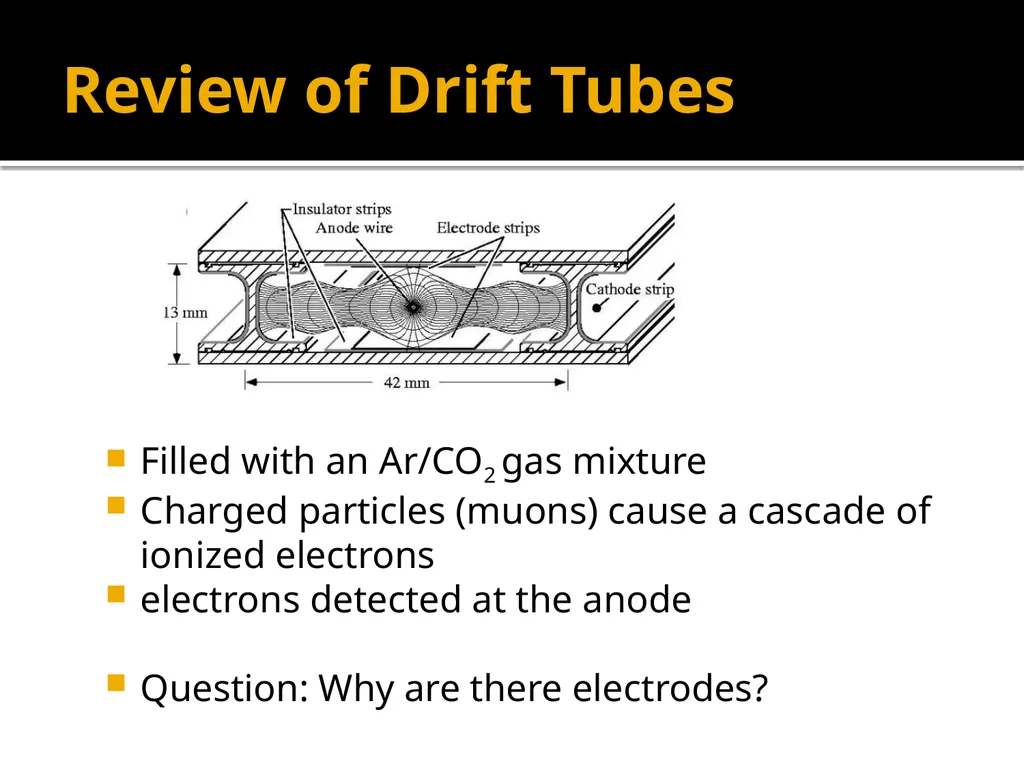
Review of Drift Tubes Filled with an Ar/CO2 gas mixture
Charged particles (muons) cause a cascade of ionized electrons
electrons detected at the anode
Question: Why are there electrodes?<br>
Charged particles (muons) cause a cascade of ionized electrons
electrons detected at the anode
Question: Why are there electrodes?<br>
05
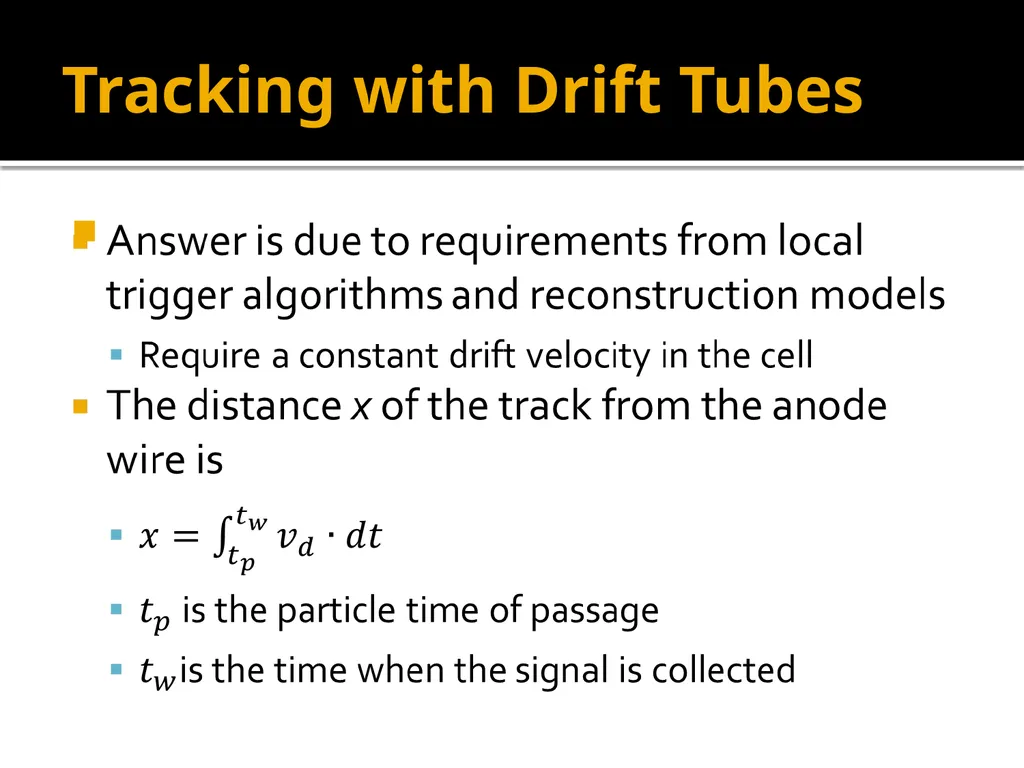
Tracking with Drift Tubes<br>
06
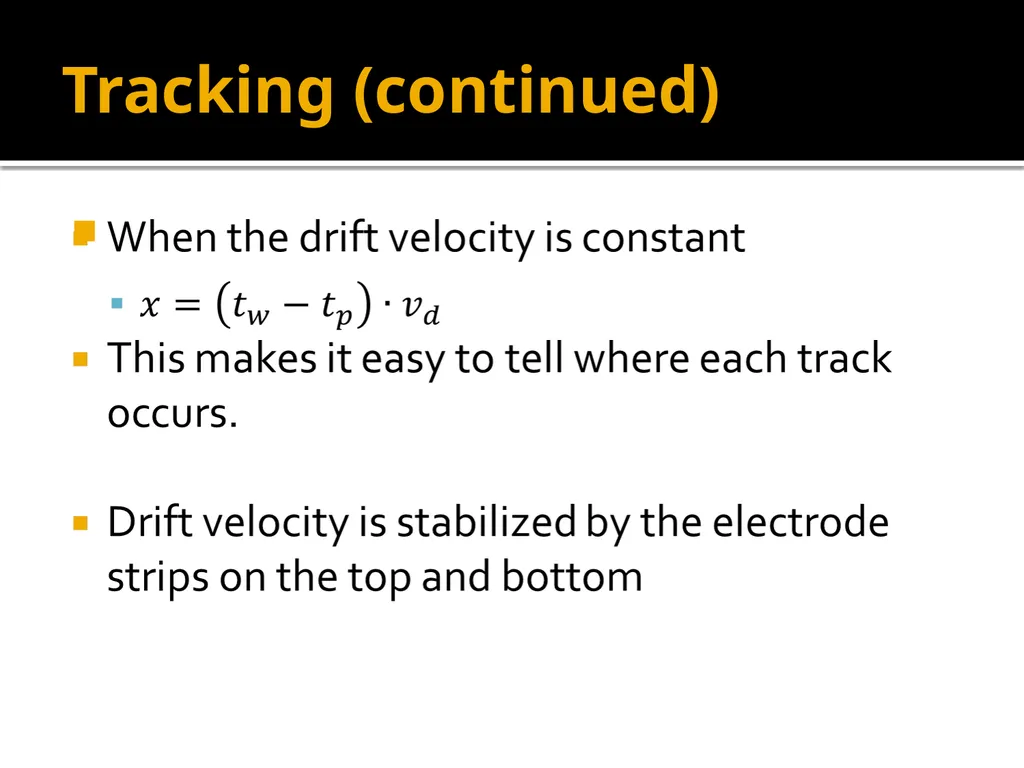
Tracking (continued)<br>
07
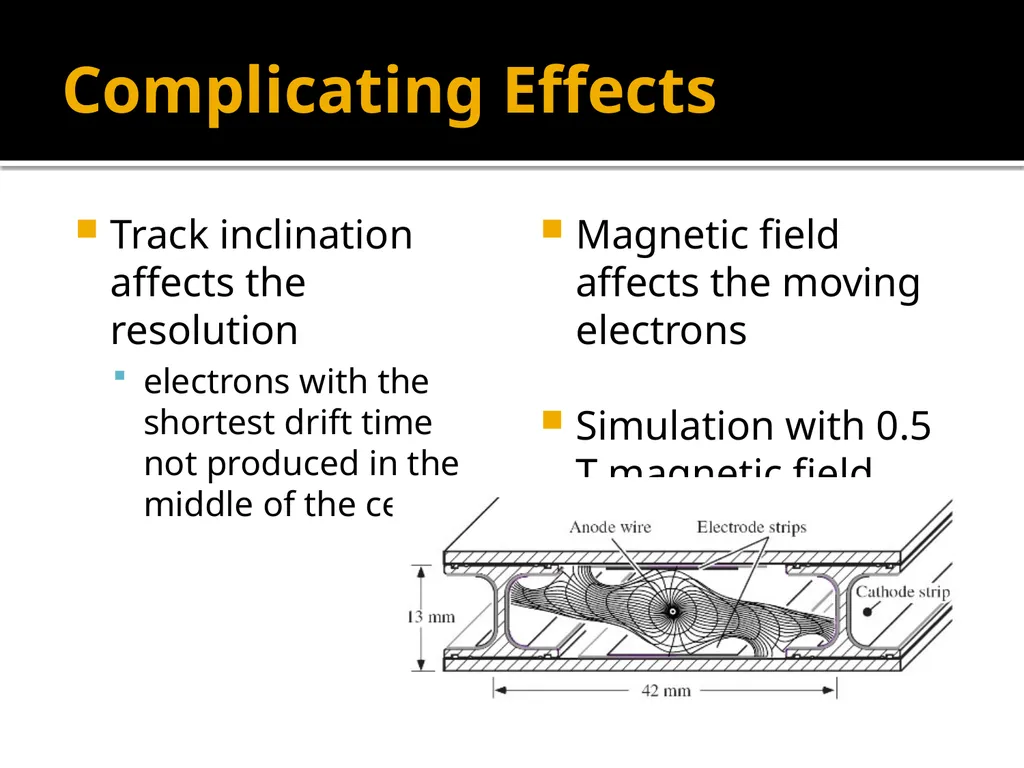
Complicating Effects Track inclination affects the resolution
electrons with the shortest drift time not produced in the middle of the cell Magnetic field affects the moving electrons
Simulation with 0.5 T magnetic field<br>
electrons with the shortest drift time not produced in the middle of the cell Magnetic field affects the moving electrons
Simulation with 0.5 T magnetic field<br>
08
Source Drift Tubes Trigger System of the CMS Experiment at LHC: Commissioning and Performances. Carlo Battilana, PhD Thesis University of Bologna.<br>
09
Jeffrey Roe
3/18/2013 Cherenkov Radiation and RICH Detectors<br>
3/18/2013 Cherenkov Radiation and RICH Detectors<br>
10
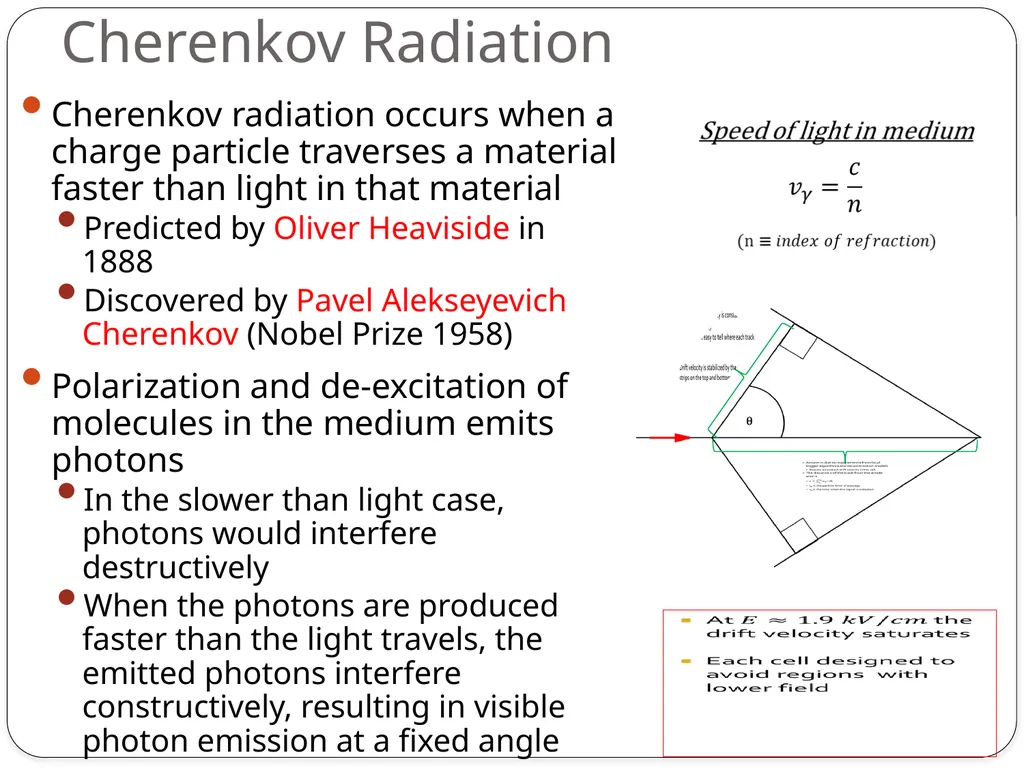
Cherenkov Radiation Cherenkov radiation occurs when a charge particle traverses a material faster than light in that material
Predicted by Oliver Heaviside in 1888
Discovered by Pavel Alekseyevich Cherenkov (Nobel Prize 1958)
Polarization and de-excitation of molecules in the medium emits photons
In the slower than light case, photons would interfere destructively
When the photons are produced faster than the light travels, the emitted photons interfere constructively, resulting in visible photon emission at a fixed angle<br>
Predicted by Oliver Heaviside in 1888
Discovered by Pavel Alekseyevich Cherenkov (Nobel Prize 1958)
Polarization and de-excitation of molecules in the medium emits photons
In the slower than light case, photons would interfere destructively
When the photons are produced faster than the light travels, the emitted photons interfere constructively, resulting in visible photon emission at a fixed angle<br>
11
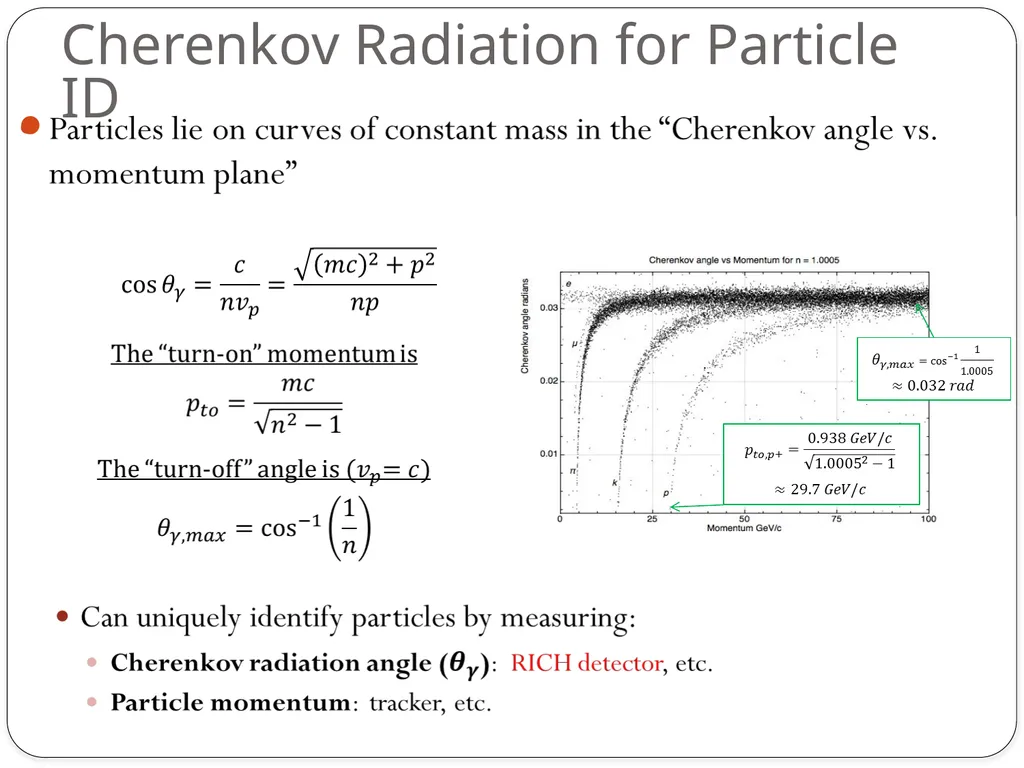
Cherenkov Radiation for Particle ID<br>
12
Ring Imaging Cherenkov (RICH) Detectors Design considerations
Angular Resolution
Angular dispersion for different frequencies
Flaws in optical systems (mirrors, lenses, etc.)
Position resolution for detector Number of collected photons
Depth of radiating material
Photon transmission trough the material and optical system
Efficiency (quantum) of photon detectors Design components
Radiating material
Optical system (optional)
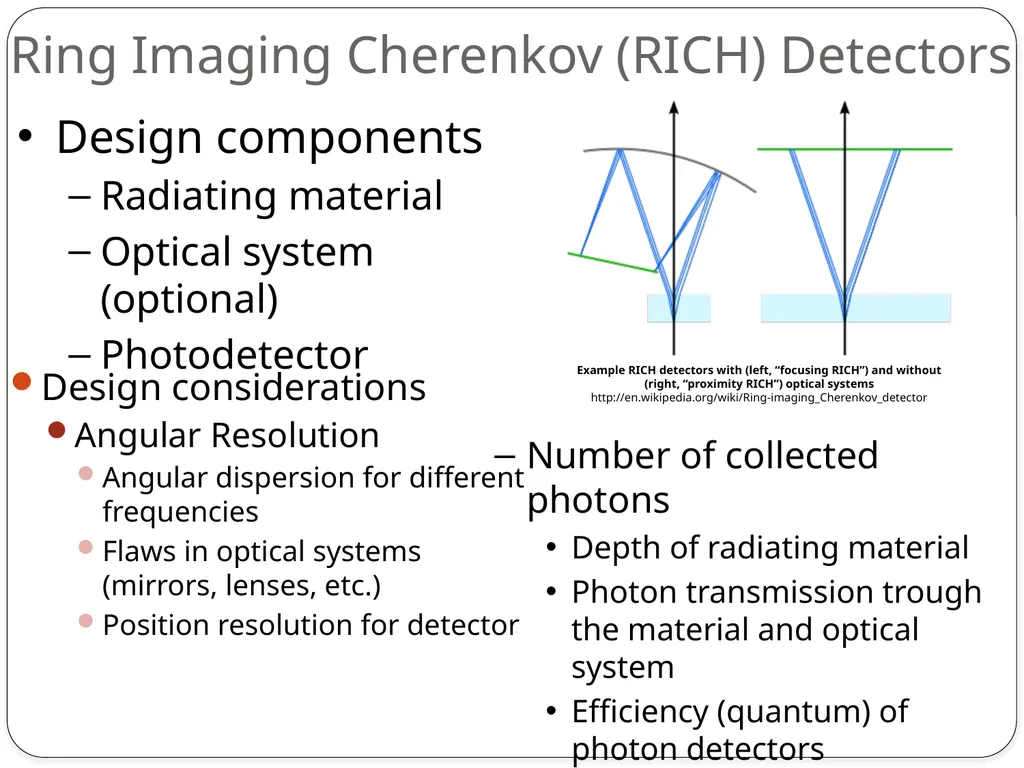
Photodetector Example RICH detectors with (left, “focusing RICH”) and without (right, “proximity RICH”) optical systems http://en.wikipedia.org/wiki/Ring-imaging_Cherenkov_detector<br>
Angular Resolution
Angular dispersion for different frequencies
Flaws in optical systems (mirrors, lenses, etc.)
Position resolution for detector Number of collected photons
Depth of radiating material
Photon transmission trough the material and optical system
Efficiency (quantum) of photon detectors Design components
Radiating material
Optical system (optional)
Photodetector Example RICH detectors with (left, “focusing RICH”) and without (right, “proximity RICH”) optical systems http://en.wikipedia.org/wiki/Ring-imaging_Cherenkov_detector<br>
13
RICH Detectors
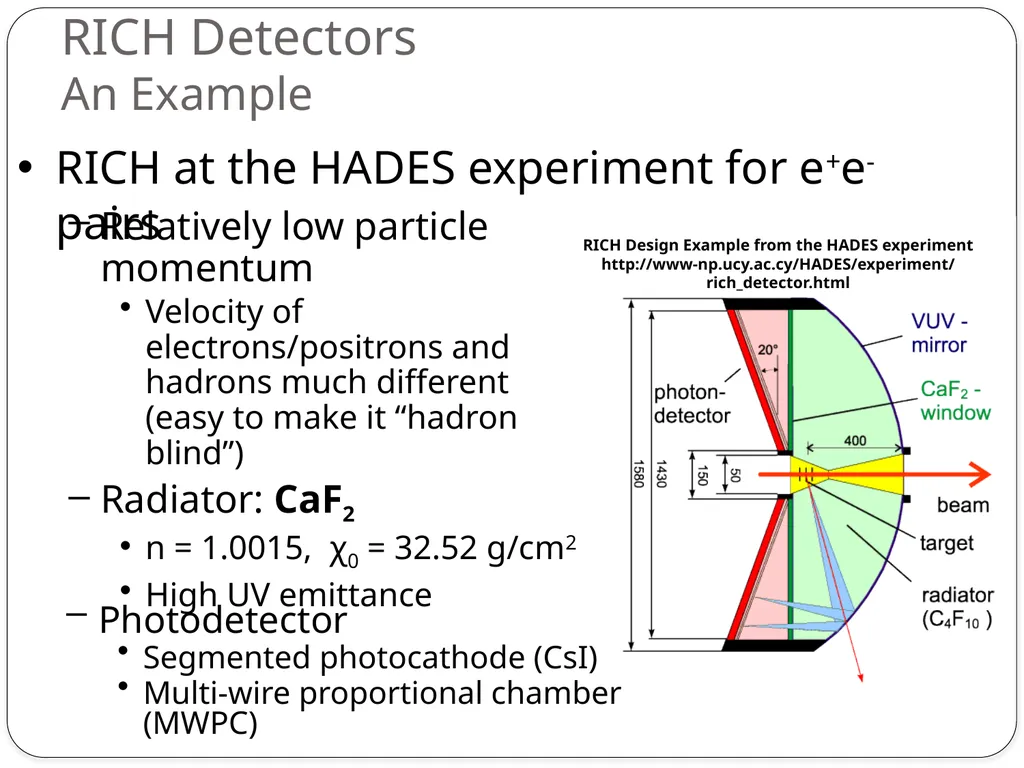
An Example RICH Design Example from the HADES experiment
http://www-np.ucy.ac.cy/HADES/experiment/rich_detector.html<br>
http://www-np.ucy.ac.cy/HADES/experiment/rich_detector.html<br>
14
RICH Detectors
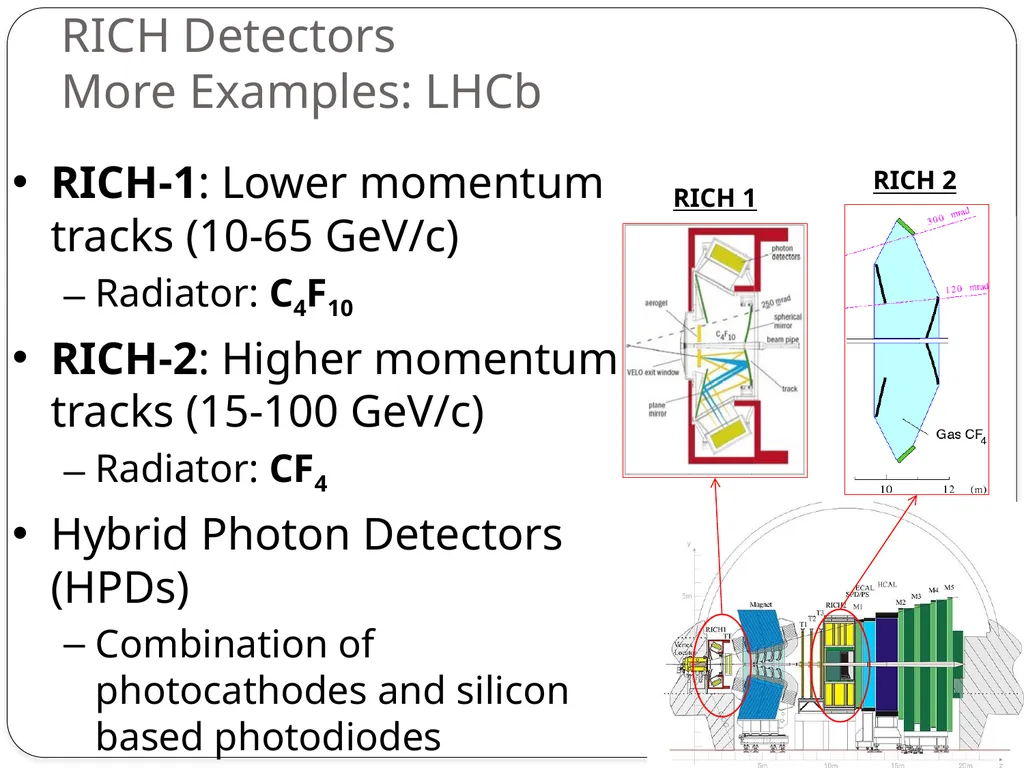
More Examples: LHCb RICH-1: Lower momentum tracks (10-65 GeV/c)
Radiator: C4F10
RICH-2: Higher momentum tracks (15-100 GeV/c)
Radiator: CF4
Hybrid Photon Detectors (HPDs)
Combination of photocathodes and silicon based photodiodes RICH 1 RICH 2<br>
Radiator: C4F10
RICH-2: Higher momentum tracks (15-100 GeV/c)
Radiator: CF4
Hybrid Photon Detectors (HPDs)
Combination of photocathodes and silicon based photodiodes RICH 1 RICH 2<br>
15
Main lecture: QCD 16<br>
16
Quantum ChromoDynamics (QCD) Another quantum field theory
Much like QED or the electroweak part of the Standard Model
QCD describes interactions of quark and gluons, which are constituents of all hadrons
Hadrons are bound states of quarks (“matter fields”) kept together by gluons (“force carriers”)
Not too different from the hydrogen atom where charged fermions (protons and electrons, the “matter fields”) are kept together by the electromagentic field (photons, the “force carriers”)
Also based on a gauge symmetry
SU(3) in this case, which is like SU(2) but a higher dimension group 17<br>
Much like QED or the electroweak part of the Standard Model
QCD describes interactions of quark and gluons, which are constituents of all hadrons
Hadrons are bound states of quarks (“matter fields”) kept together by gluons (“force carriers”)
Not too different from the hydrogen atom where charged fermions (protons and electrons, the “matter fields”) are kept together by the electromagentic field (photons, the “force carriers”)
Also based on a gauge symmetry
SU(3) in this case, which is like SU(2) but a higher dimension group 17<br>
17
QCD Charge The QCD Charge is “color”
In QED, the charge is electric charge
All QED interactions preserve conservation of the electric charge (can’t convert an electron into a positron by interacting with the force carriers)
In EWK theory, the electroweak hypercharge preserves the leptons and quarks from converting into each other (a muon can convert into a neutrino via interaction with W, which is the generator of the group, but it doesn’t allow it to convert into a quark as those interactions are explicitly not allowed)
QCD preserves quark flavor (a top quark cannot convert into a charm or up quark)
Quarks interact with each other by exchanging gluons but gluons do not change the flavor of the quark, it remains what it was
In some sense QCD is like QED, electrons can emit photons to interact with other electrons or positrons but you can’t kill an electron or convert it into a positron
Each quark can have three colors (that’s why it is SU(3))
Quarks can change colors by exchanging gluons, 32-1=8 gluons as they are the generators of SU(3) 18<br>
In QED, the charge is electric charge
All QED interactions preserve conservation of the electric charge (can’t convert an electron into a positron by interacting with the force carriers)
In EWK theory, the electroweak hypercharge preserves the leptons and quarks from converting into each other (a muon can convert into a neutrino via interaction with W, which is the generator of the group, but it doesn’t allow it to convert into a quark as those interactions are explicitly not allowed)
QCD preserves quark flavor (a top quark cannot convert into a charm or up quark)
Quarks interact with each other by exchanging gluons but gluons do not change the flavor of the quark, it remains what it was
In some sense QCD is like QED, electrons can emit photons to interact with other electrons or positrons but you can’t kill an electron or convert it into a positron
Each quark can have three colors (that’s why it is SU(3))
Quarks can change colors by exchanging gluons, 32-1=8 gluons as they are the generators of SU(3) 18<br>
18
Asymptotic Freedom and Confinement QCD is an attractive force that grows with distance
That’s why you can’t have a free quark, they always appear in “colorless” combinations
Any free hanging color will cause a huge force
This is “confinement” in QCD, it takes infinite amount of energy to separate two quarks
At very small distances (high energies), QCD force all but disappears – “asymptotic freedom”:
Quarks inside a proton are much like three pool balls inside a shell 19<br>
That’s why you can’t have a free quark, they always appear in “colorless” combinations
Any free hanging color will cause a huge force
This is “confinement” in QCD, it takes infinite amount of energy to separate two quarks
At very small distances (high energies), QCD force all but disappears – “asymptotic freedom”:
Quarks inside a proton are much like three pool balls inside a shell 19<br>
19
Energy Behavior QCD does not have the usual QFT troubles at high energy
As the force drops at small distances (large energies), there are no ultraviolet divergences and so no worries about renormalizability
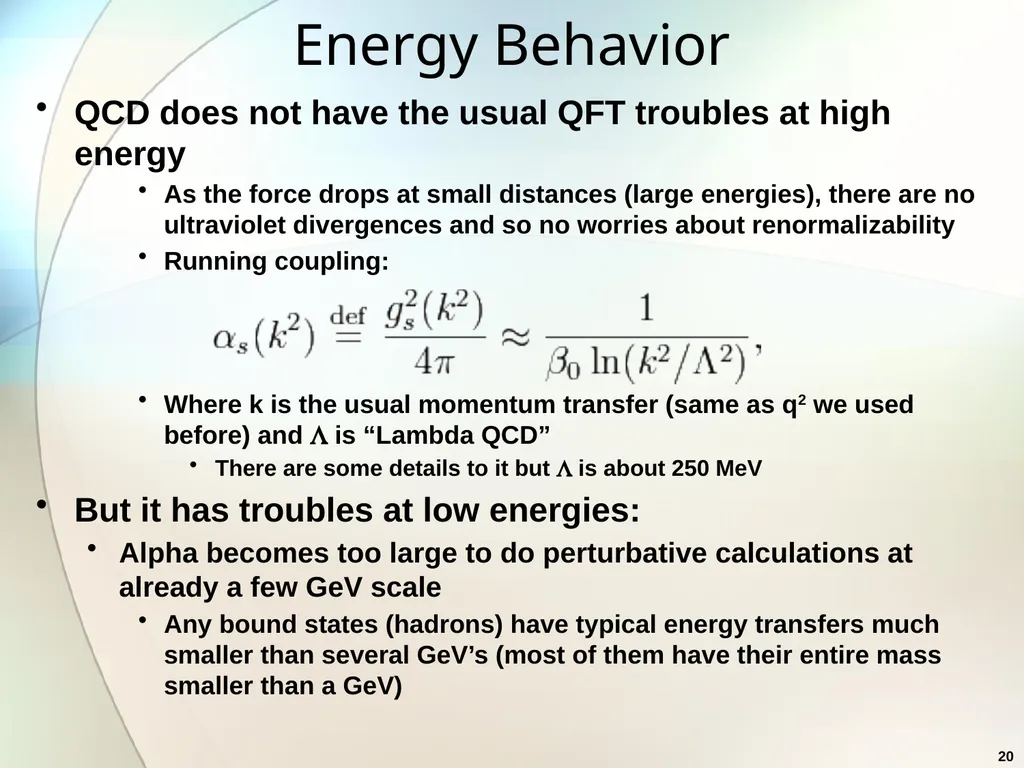
Running coupling:
Where k is the usual momentum transfer (same as q2 we used before) and L is “Lambda QCD”
There are some details to it but L is about 250 MeV
But it has troubles at low energies:
Alpha becomes too large to do perturbative calculations at already a few GeV scale
Any bound states (hadrons) have typical energy transfers much smaller than several GeV’s (most of them have their entire mass smaller than a GeV) 20<br>
As the force drops at small distances (large energies), there are no ultraviolet divergences and so no worries about renormalizability
Running coupling:
Where k is the usual momentum transfer (same as q2 we used before) and L is “Lambda QCD”
There are some details to it but L is about 250 MeV
But it has troubles at low energies:
Alpha becomes too large to do perturbative calculations at already a few GeV scale
Any bound states (hadrons) have typical energy transfers much smaller than several GeV’s (most of them have their entire mass smaller than a GeV) 20<br>
20
Bound States Despite being a nice theory, for a long time QCD has been only partially usable
What’s good in a theory that can’t predict the masses of mesons and baryons?
The issue is that we aren’t good at dealing with regimes where perturbative methods don’t work
QCD is one of them
“Lattice QCD” is an area of calculational particle physics where they calculate these using non-perturbative methods 21<br>
What’s good in a theory that can’t predict the masses of mesons and baryons?
The issue is that we aren’t good at dealing with regimes where perturbative methods don’t work
QCD is one of them
“Lattice QCD” is an area of calculational particle physics where they calculate these using non-perturbative methods 21<br>
21
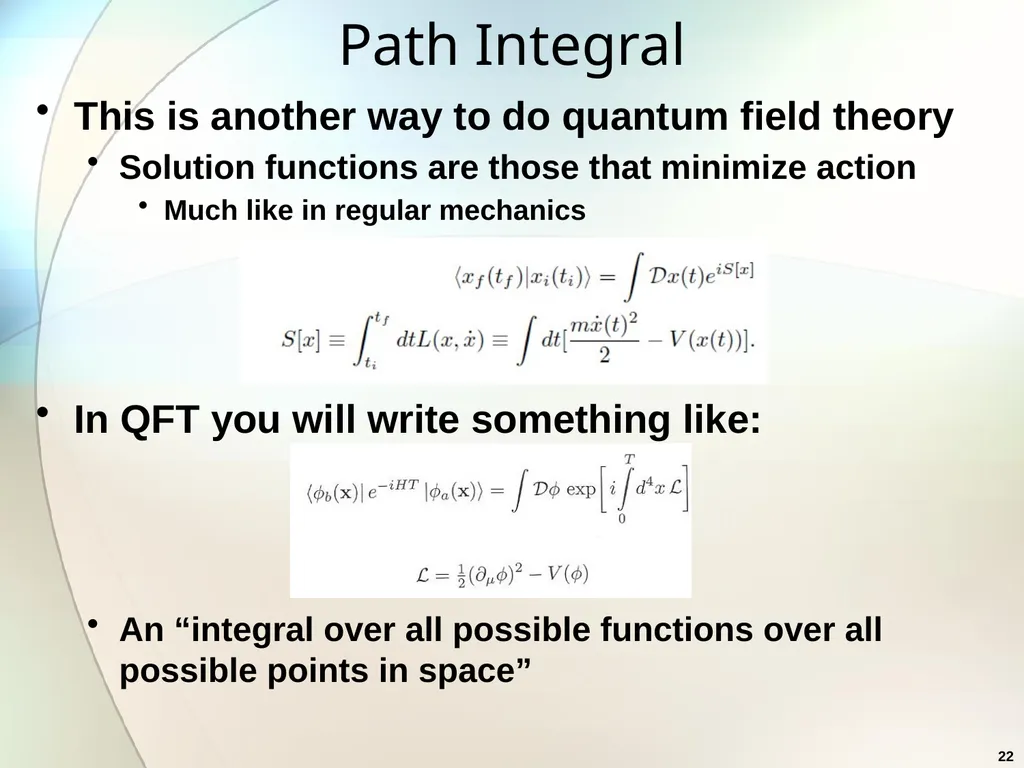
Path Integral This is another way to do quantum field theory
Solution functions are those that minimize action
Much like in regular mechanics
In QFT you will write something like:
An “integral over all possible functions over all possible points in space” 22<br>
Solution functions are those that minimize action
Much like in regular mechanics
In QFT you will write something like:
An “integral over all possible functions over all possible points in space” 22<br>
22
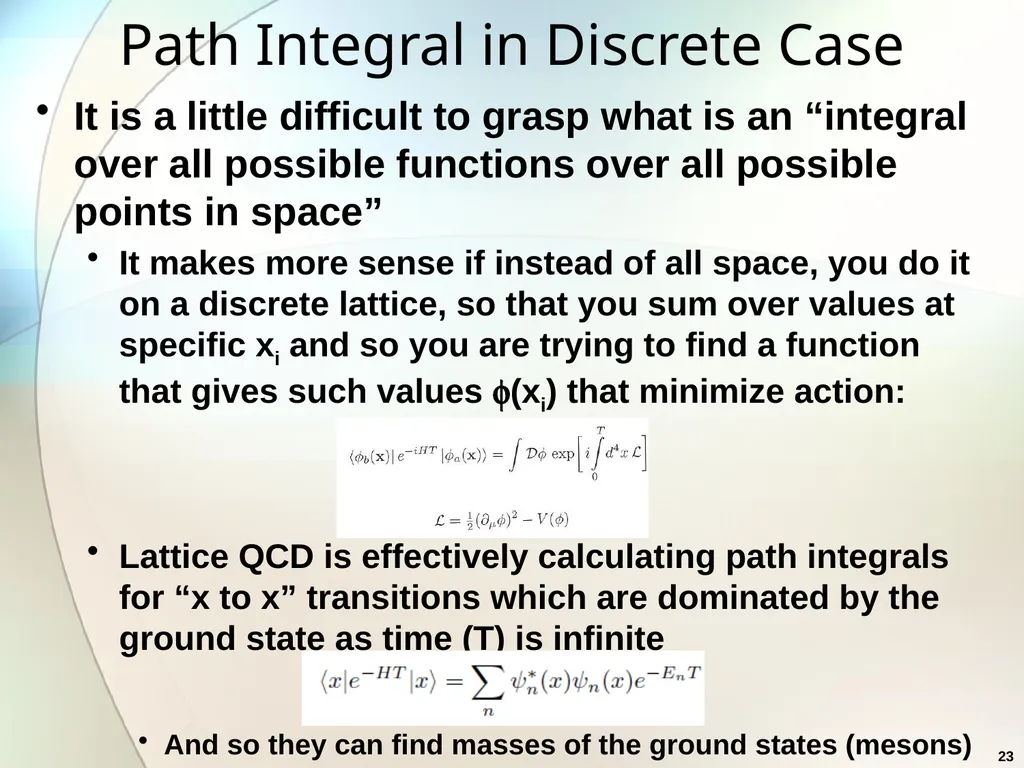
Path Integral in Discrete Case It is a little difficult to grasp what is an “integral over all possible functions over all possible points in space”
It makes more sense if instead of all space, you do it on a discrete lattice, so that you sum over values at specific xi and so you are trying to find a function that gives such values f(xi) that minimize action:
Lattice QCD is effectively calculating path integrals for “x to x” transitions which are dominated by the ground state as time (T) is infinite
And so they can find masses of the ground states (mesons) 23<br>
It makes more sense if instead of all space, you do it on a discrete lattice, so that you sum over values at specific xi and so you are trying to find a function that gives such values f(xi) that minimize action:
Lattice QCD is effectively calculating path integrals for “x to x” transitions which are dominated by the ground state as time (T) is infinite
And so they can find masses of the ground states (mesons) 23<br>
23
QCD Interactions For high energy collisions, there are two main implications:
You can produce quarks in colliding beams and something needs to happen with them as they can’t live by themselves
If your collider is a hadron machine, you need to know how to calculate cross-sections as what interacts in QCD is quarks and gluons and not protons 24<br>
You can produce quarks in colliding beams and something needs to happen with them as they can’t live by themselves
If your collider is a hadron machine, you need to know how to calculate cross-sections as what interacts in QCD is quarks and gluons and not protons 24<br>
24
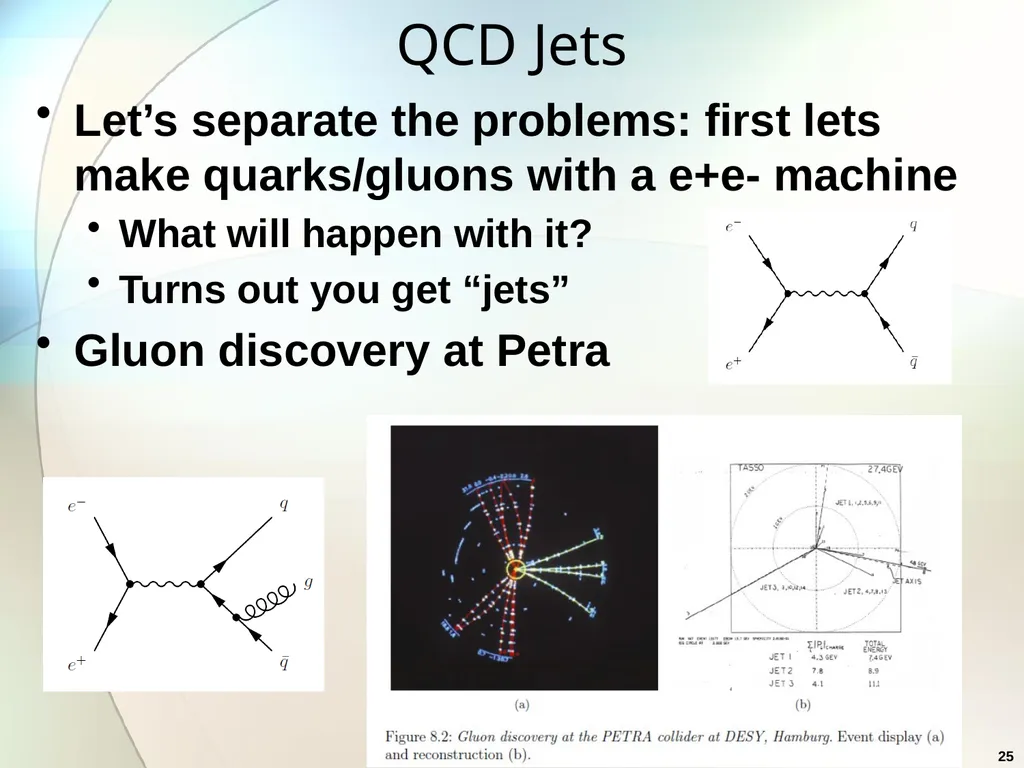
QCD Jets Let’s separate the problems: first lets make quarks/gluons with a e+e- machine
What will happen with it?
Turns out you get “jets”
Gluon discovery at Petra 25<br>
What will happen with it?
Turns out you get “jets”
Gluon discovery at Petra 25<br>
25
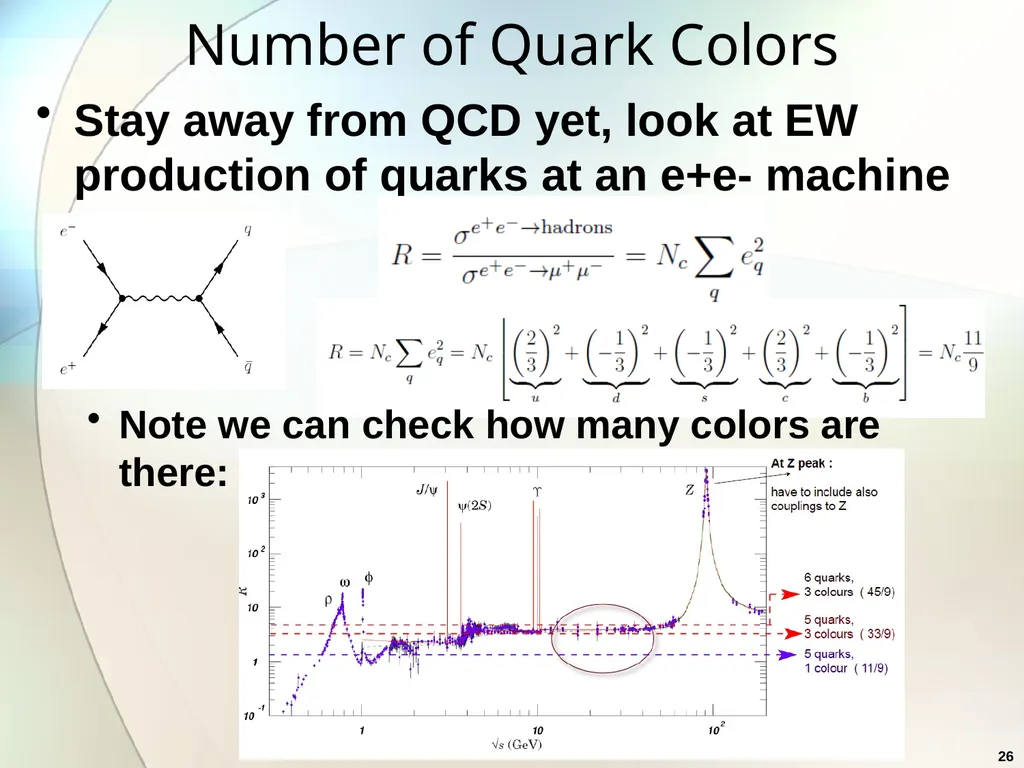
Number of Quark Colors Stay away from QCD yet, look at EW production of quarks at an e+e- machine
Note we can check how many colors are there: 26<br>
Note we can check how many colors are there: 26<br>
26
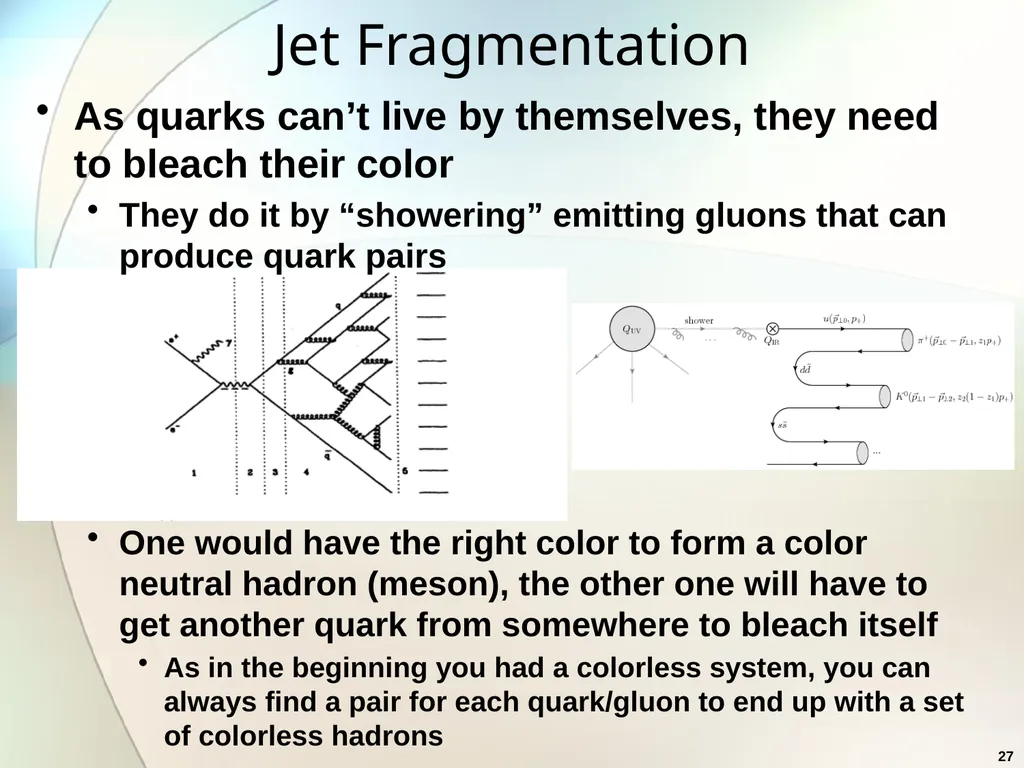
Jet Fragmentation As quarks can’t live by themselves, they need to bleach their color
They do it by “showering” emitting gluons that can produce quark pairs
One would have the right color to form a color neutral hadron (meson), the other one will have to get another quark from somewhere to bleach itself
As in the beginning you had a colorless system, you can always find a pair for each quark/gluon to end up with a set of colorless hadrons 27<br>
They do it by “showering” emitting gluons that can produce quark pairs
One would have the right color to form a color neutral hadron (meson), the other one will have to get another quark from somewhere to bleach itself
As in the beginning you had a colorless system, you can always find a pair for each quark/gluon to end up with a set of colorless hadrons 27<br>
27
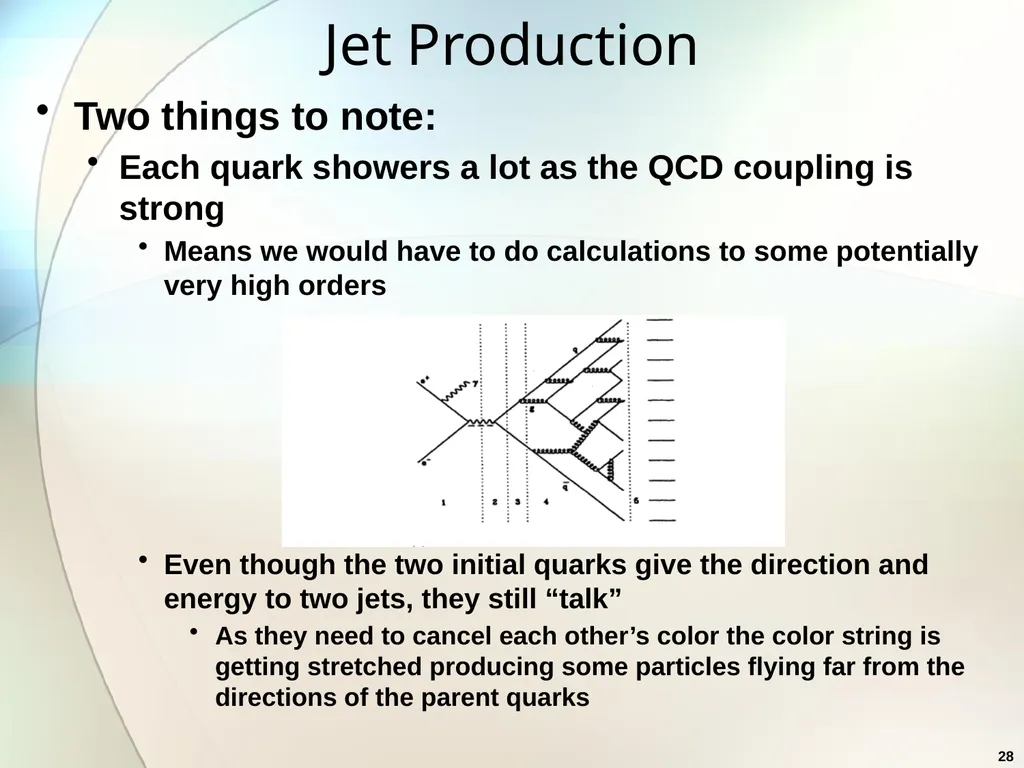
Jet Production Two things to note:
Each quark showers a lot as the QCD coupling is strong
Means we would have to do calculations to some potentially very high orders
Even though the two initial quarks give the direction and energy to two jets, they still “talk”
As they need to cancel each other’s color the color string is getting stretched producing some particles flying far from the directions of the parent quarks 28<br>
Each quark showers a lot as the QCD coupling is strong
Means we would have to do calculations to some potentially very high orders
Even though the two initial quarks give the direction and energy to two jets, they still “talk”
As they need to cancel each other’s color the color string is getting stretched producing some particles flying far from the directions of the parent quarks 28<br>
28
Factorization Doing any calculable predictions would be impossible without simplifications:
Break into two stages with very different energy scales:
Produce two energetic quarks
Hard process as energies are high
Very perturbative regime, calculations should work fine
Let each quark independently shower (called fragmentation) – difficult:
This is much softer process, one would wonder if QCD would even work there
At the end of it the groups of quarks/gluons form hadrons (very soft process, perturbative methods can’t work – need some modeling)
Then apply correction to account for broken strings (add particles between main quarks that are there to cancel the color flow) 29<br>
Break into two stages with very different energy scales:
Produce two energetic quarks
Hard process as energies are high
Very perturbative regime, calculations should work fine
Let each quark independently shower (called fragmentation) – difficult:
This is much softer process, one would wonder if QCD would even work there
At the end of it the groups of quarks/gluons form hadrons (very soft process, perturbative methods can’t work – need some modeling)
Then apply correction to account for broken strings (add particles between main quarks that are there to cancel the color flow) 29<br>
29
Next time QCD fragmentation
QCD in higher orders: LO, NLO, LL, NLL
Parton model and parton distribution functions 30<br>
QCD in higher orders: LO, NLO, LL, NLL
Parton model and parton distribution functions 30<br>