1. Northern Utah GIS Workforce Needs Survey
Description: 1. Northern Utah GIS Workforce Needs Survey Results 2014 Presented by: Mary Siegrist, Ph.D. IMSA Demographics Position Titles: GIS Manager: 3 GIS Analyst: 2 GIS Database Administrator: 1 GISGPS Specialist: 1 GIS Web Designer: 1 Application
Related Topics
Download Presentation
"1. Northern Utah GIS Workforce Needs Survey" is the property of its rightful owner. Permission is granted to download and print the materials on this website for personal, non-commercial use only, and to display it on your personal computer provided you do not modify the materials and that you retain all copyright notices contained in the materials. By downloading content from our website, you accept the terms of this agreement.
Presentation Transcript
slide1. 1. Northern Utah GIS Workforce NeedsSurvey Results2014 Presented by:
Mary Siegrist, Ph.D.
IMSA<br>
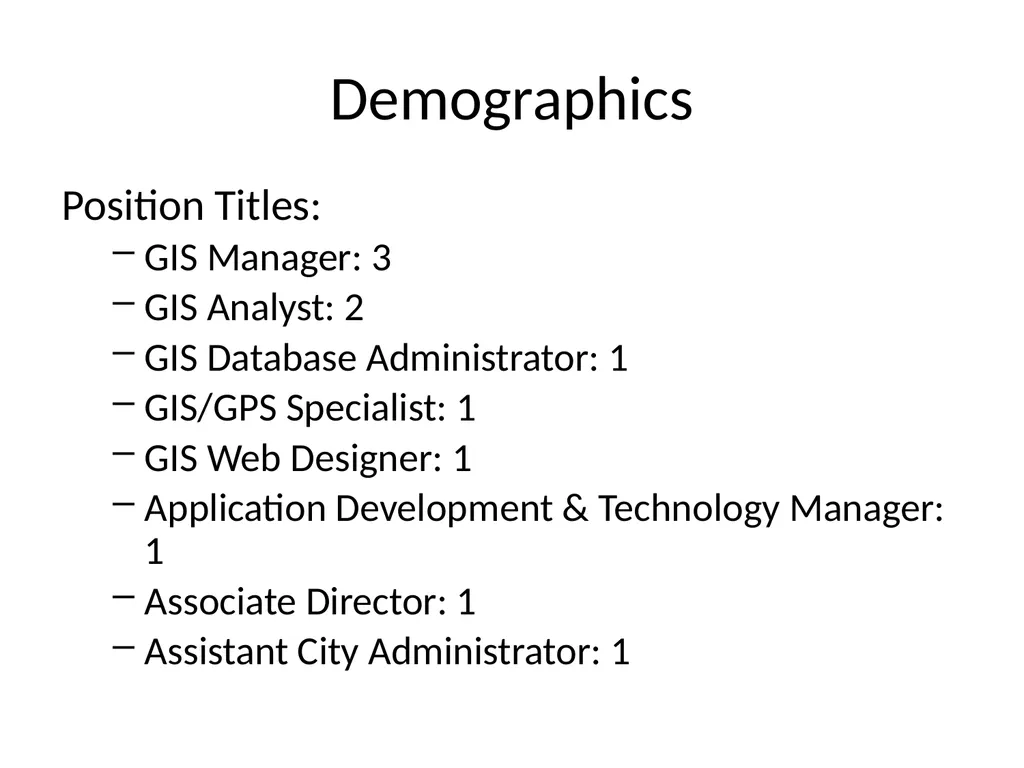
slide2. Demographics Position Titles:
GIS Manager: 3
GIS Analyst: 2
GIS Database Administrator: 1
GIS/GPS Specialist: 1
GIS Web Designer: 1
Application Development & Technology Manager: 1
Associate Director: 1
Assistant City Administrator: 1<br>
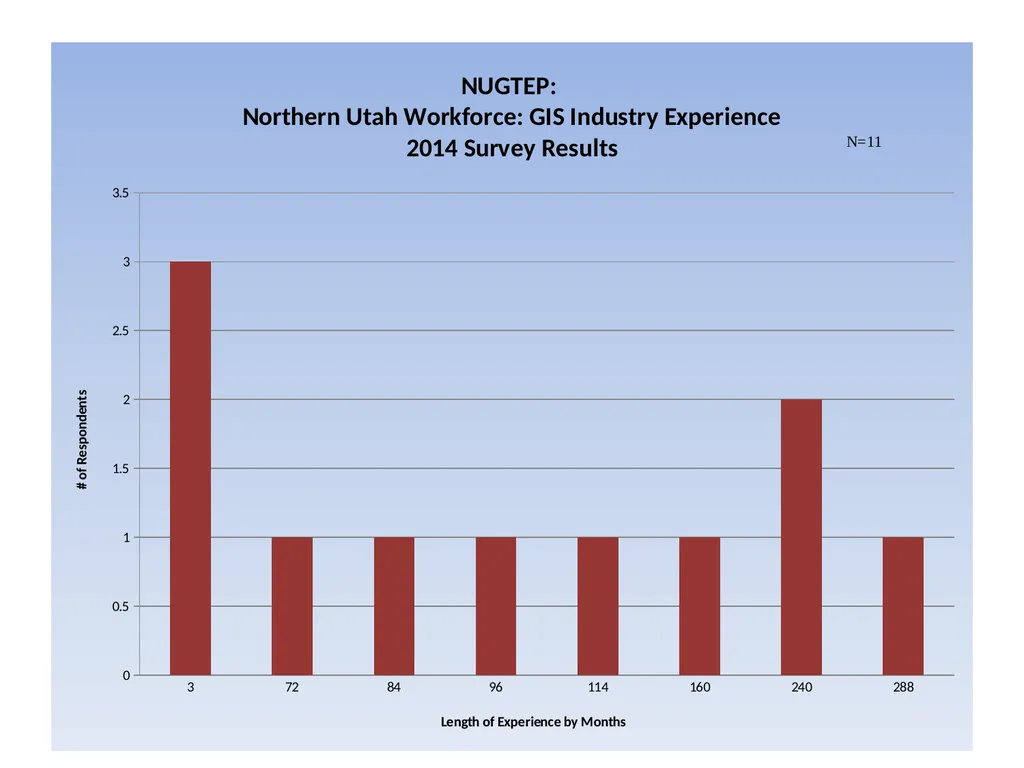
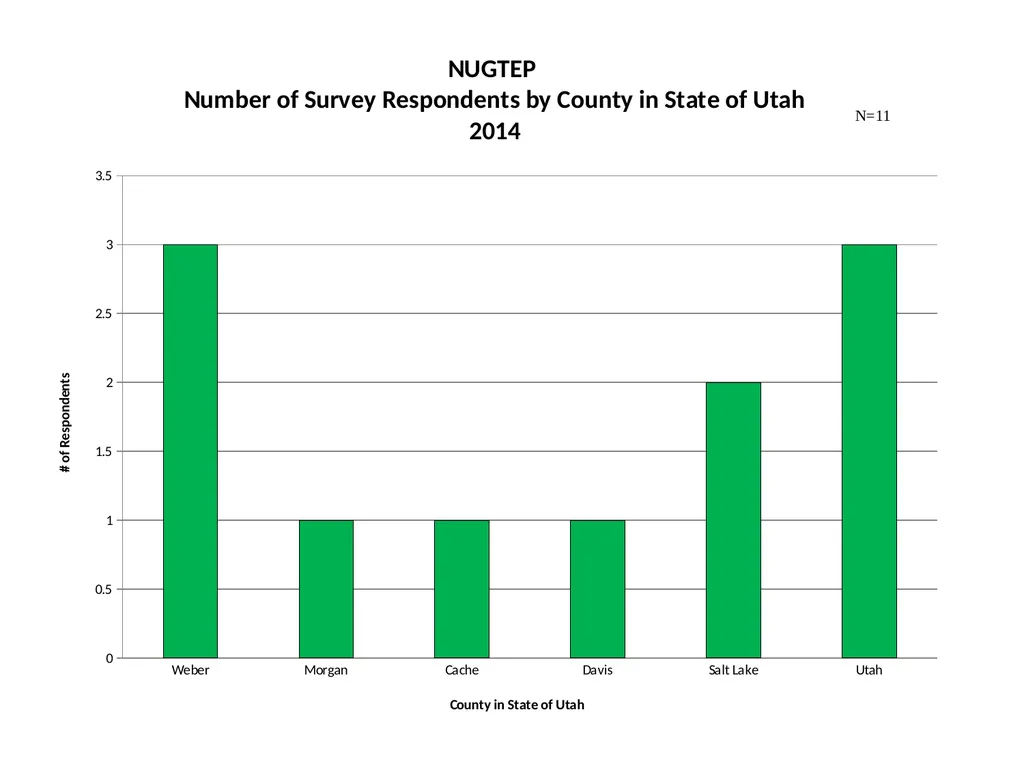
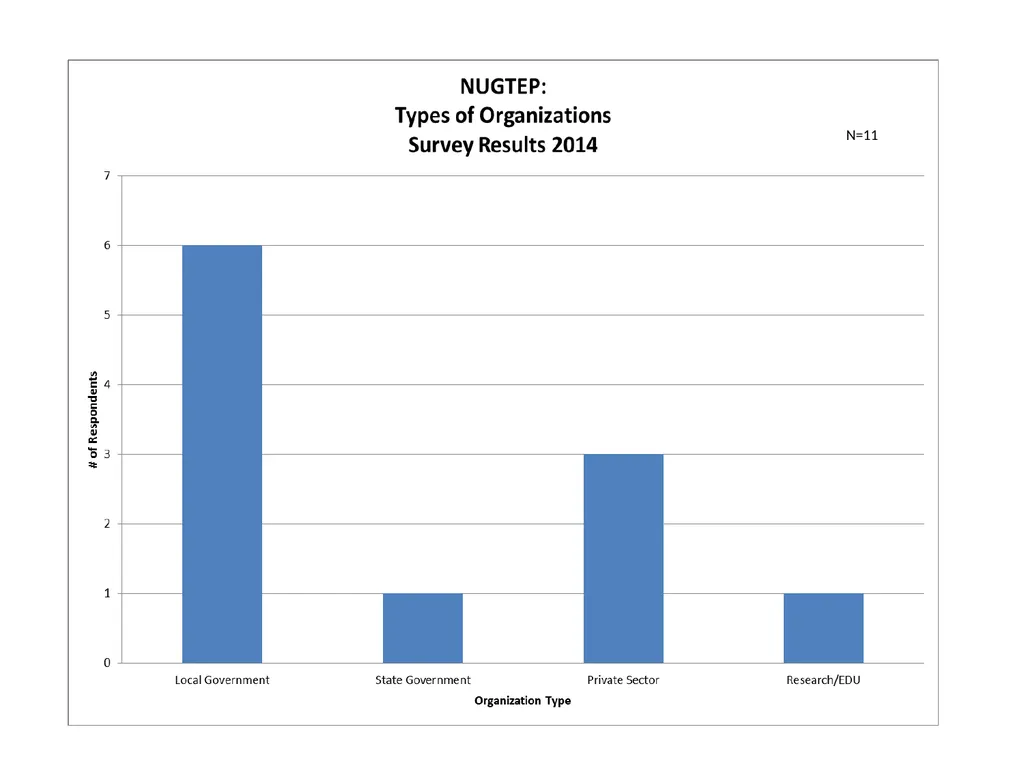
slide5. N=11<br>
slide7. GIS/Geospatial technician<br>
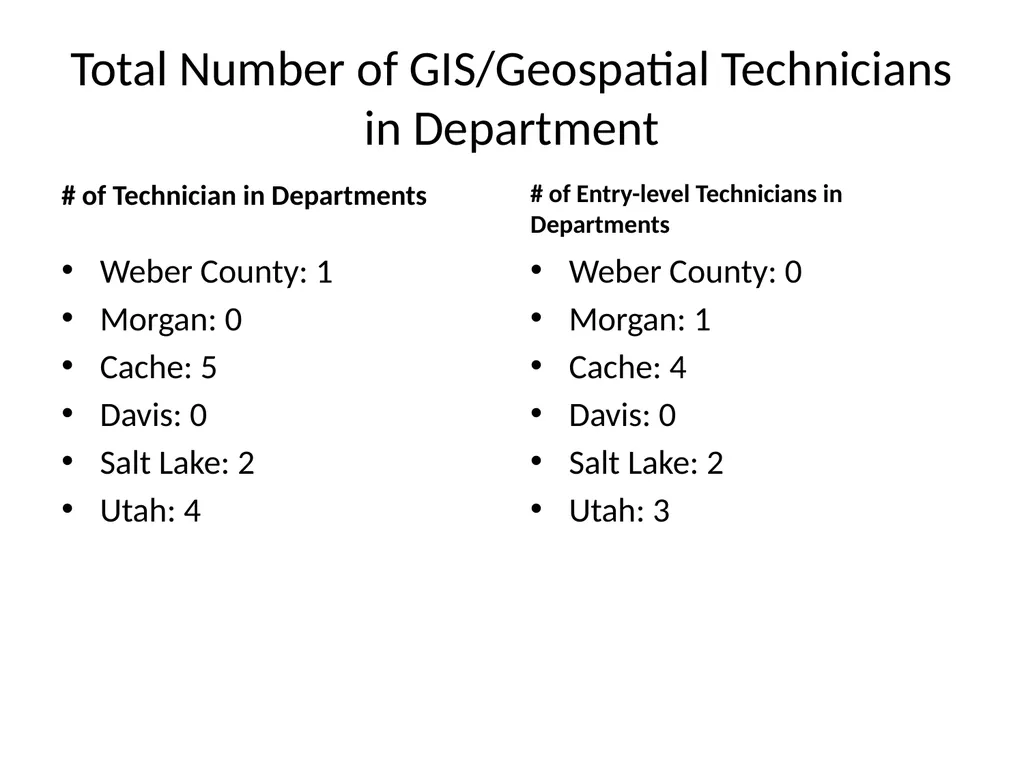
slide8. Total Number of GIS/Geospatial Technicians in Department # of Technician in Departments Weber County: 1
Morgan: 0
Cache: 5
Davis: 0
Salt Lake: 2
Utah: 4 # of Entry-level Technicians in Departments Weber County: 0
Morgan: 1
Cache: 4
Davis: 0
Salt Lake: 2
Utah: 3<br>
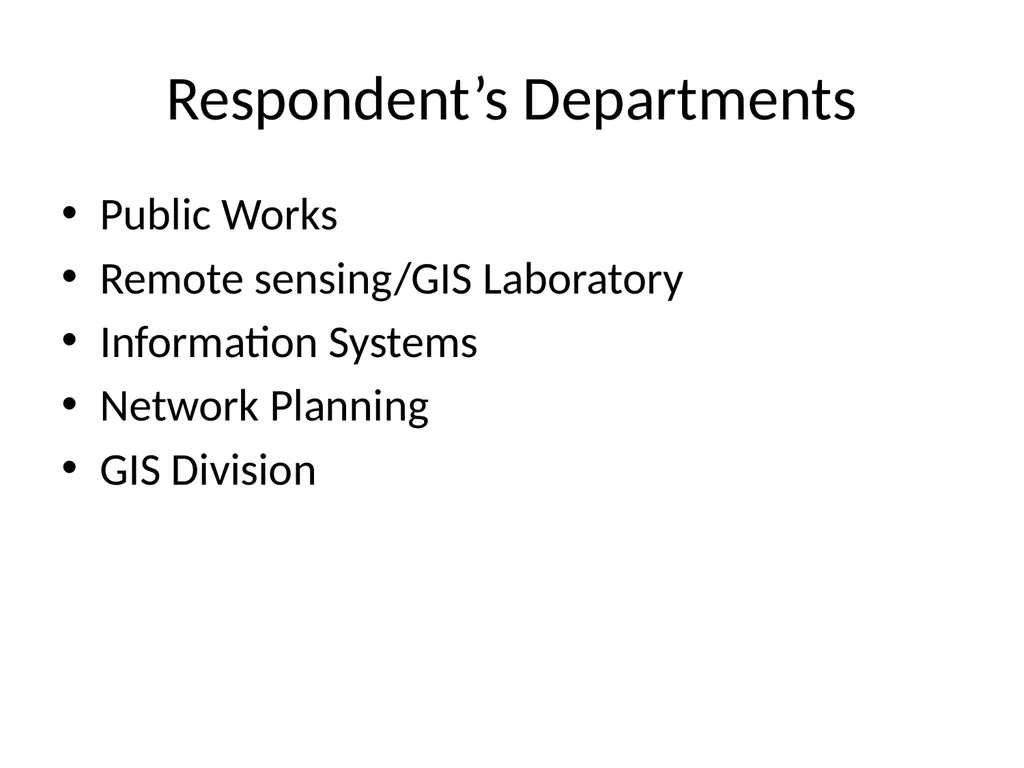
slide9. Respondent’s Departments Public Works
Remote sensing/GIS Laboratory
Information Systems
Network Planning
GIS Division<br>
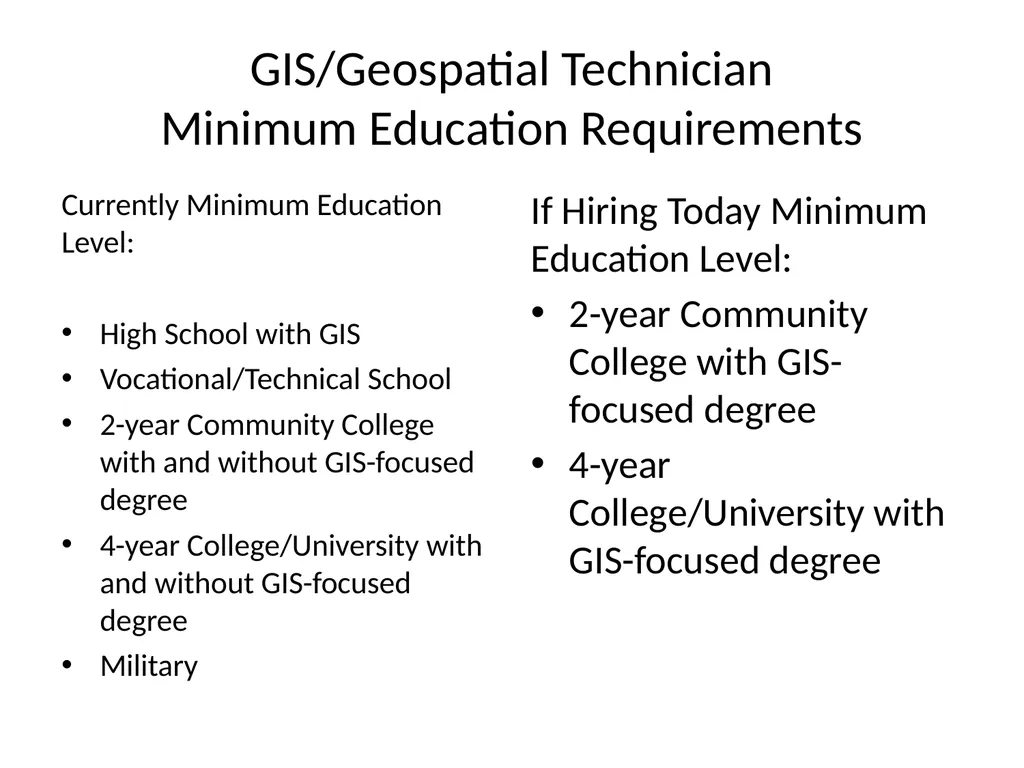
slide10. GIS/Geospatial TechnicianMinimum Education Requirements Currently Minimum Education Level:
High School with GIS
Vocational/Technical School
2-year Community College with and without GIS-focused degree
4-year College/University with and without GIS-focused degree
Military If Hiring Today Minimum Education Level:
2-year Community College with GIS-focused degree
4-year College/University with GIS-focused degree<br>
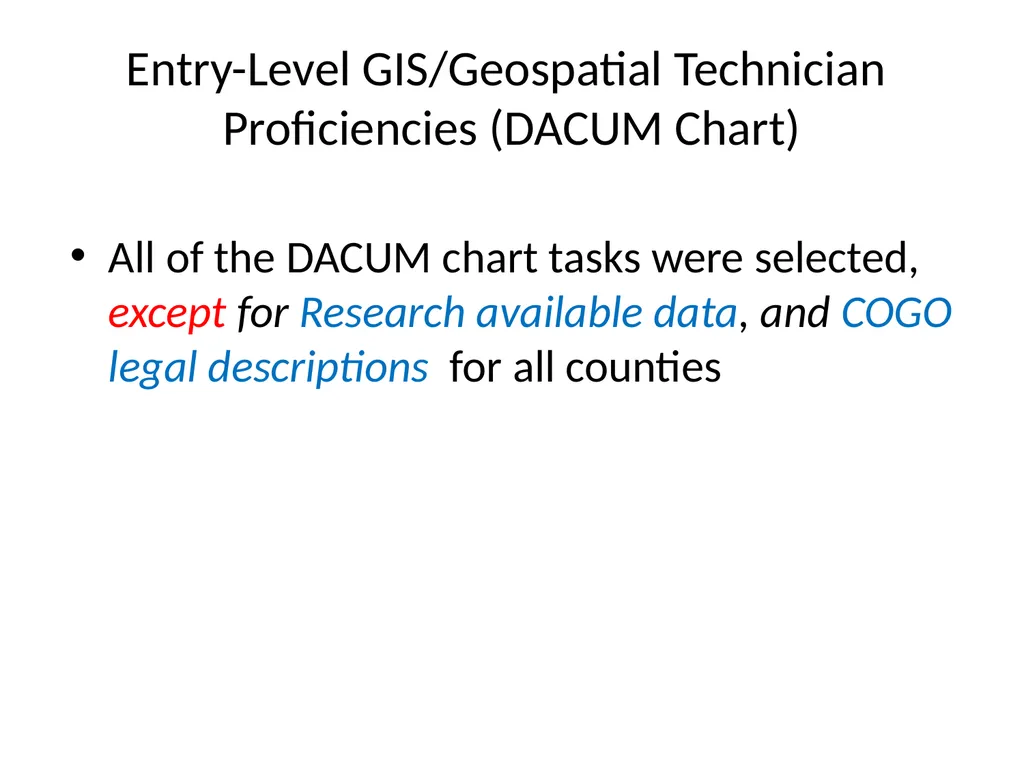
slide11. Entry-Level GIS/Geospatial Technician Proficiencies (DACUM Chart) All of the DACUM chart tasks were selected, except for Research available data, and COGO legal descriptions for all counties<br>
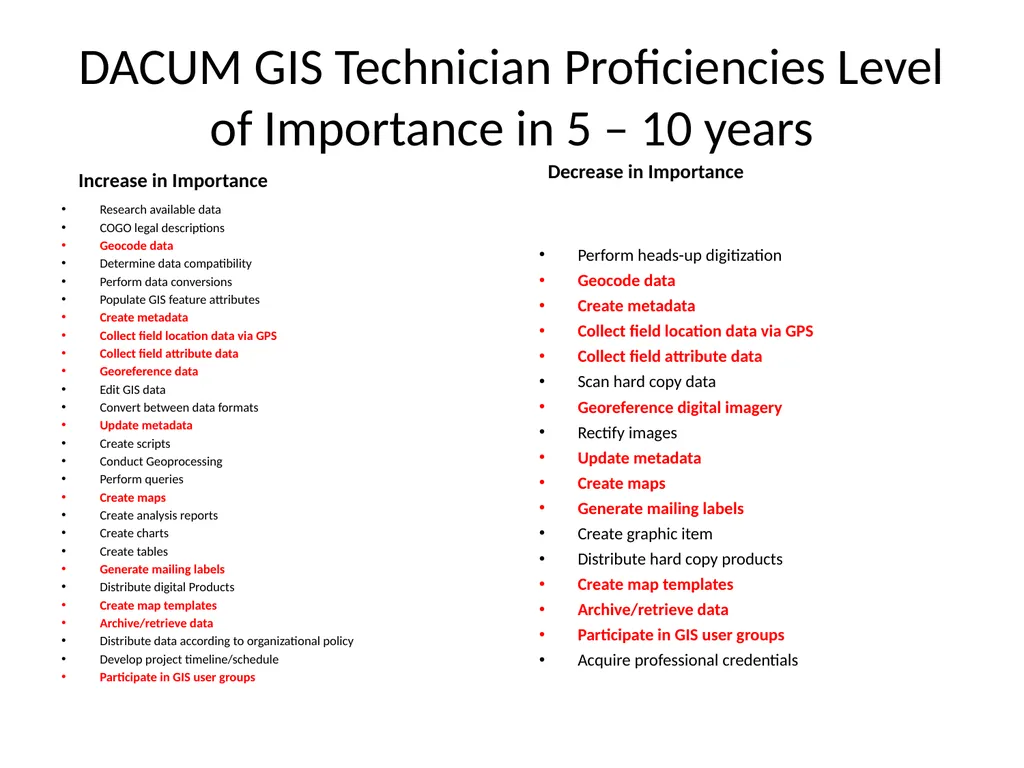
slide12. DACUM GIS Technician Proficiencies Level of Importance in 5 – 10 years Increase in Importance Research available data
COGO legal descriptions
Geocode data
Determine data compatibility
Perform data conversions
Populate GIS feature attributes
Create metadata
Collect field location data via GPS
Collect field attribute data
Georeference data
Edit GIS data
Convert between data formats
Update metadata
Create scripts
Conduct Geoprocessing
Perform queries
Create maps
Create analysis reports
Create charts
Create tables
Generate mailing labels
Distribute digital Products
Create map templates
Archive/retrieve data
Distribute data according to organizational policy
Develop project timeline/schedule
Participate in GIS user groups Decrease in Importance Perform heads-up digitization
Geocode data
Create metadata
Collect field location data via GPS
Collect field attribute data
Scan hard copy data
Georeference digital imagery
Rectify images
Update metadata
Create maps
Generate mailing labels
Create graphic item
Distribute hard copy products
Create map templates
Archive/retrieve data
Participate in GIS user groups
Acquire professional credentials<br>
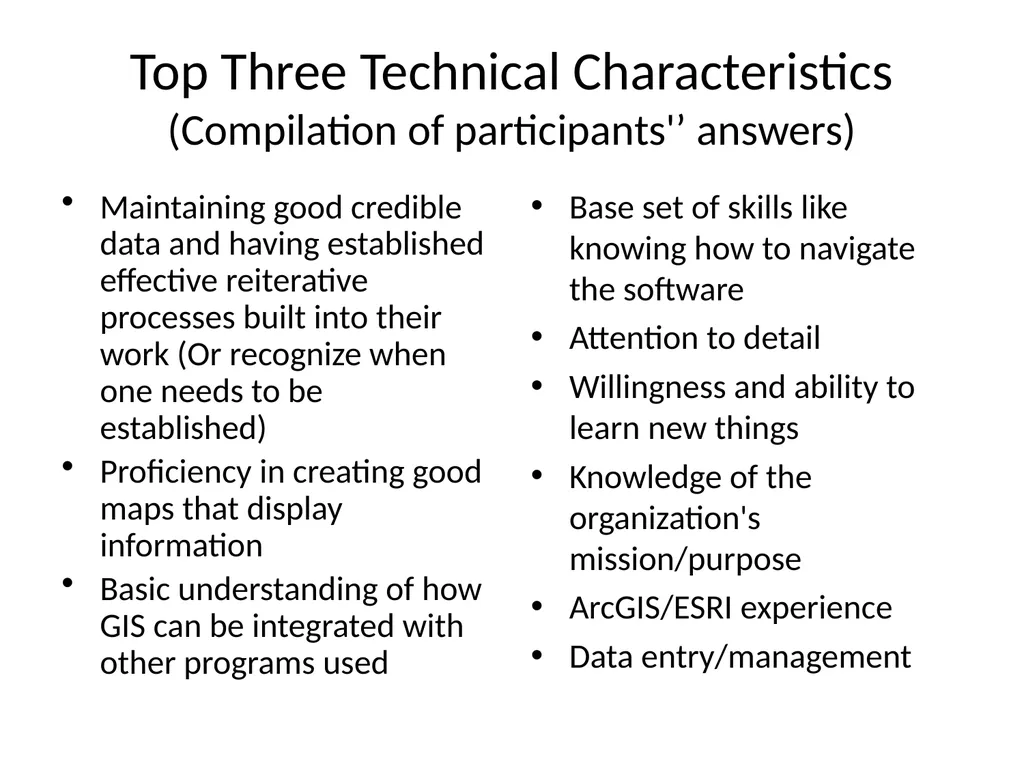
slide13. Top Three Technical Characteristics(Compilation of participants'’ answers) Maintaining good credible data and having established effective reiterative processes built into their work (Or recognize when one needs to be established)
Proficiency in creating good maps that display information
Basic understanding of how GIS can be integrated with other programs used Base set of skills like knowing how to navigate the software
Attention to detail
Willingness and ability to learn new things
Knowledge of the organization's mission/purpose
ArcGIS/ESRI experience
Data entry/management<br>
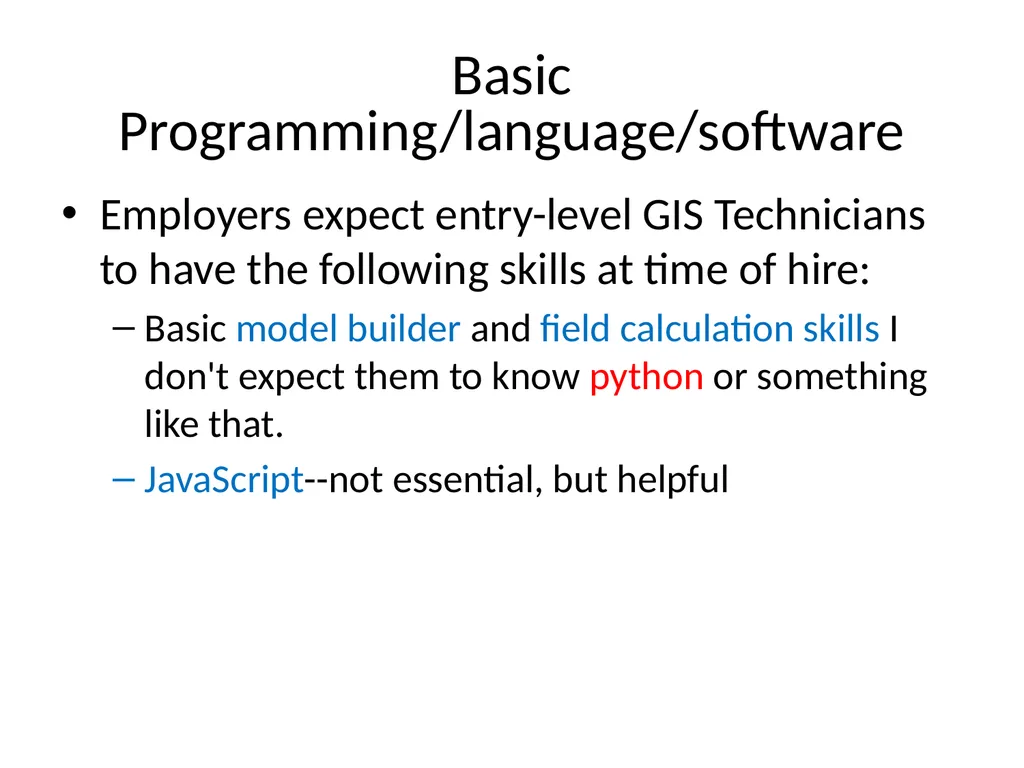
slide14. Basic Programming/language/software Employers expect entry-level GIS Technicians to have the following skills at time of hire:
Basic model builder and field calculation skills I don't expect them to know python or something like that.
JavaScript--not essential, but helpful<br>
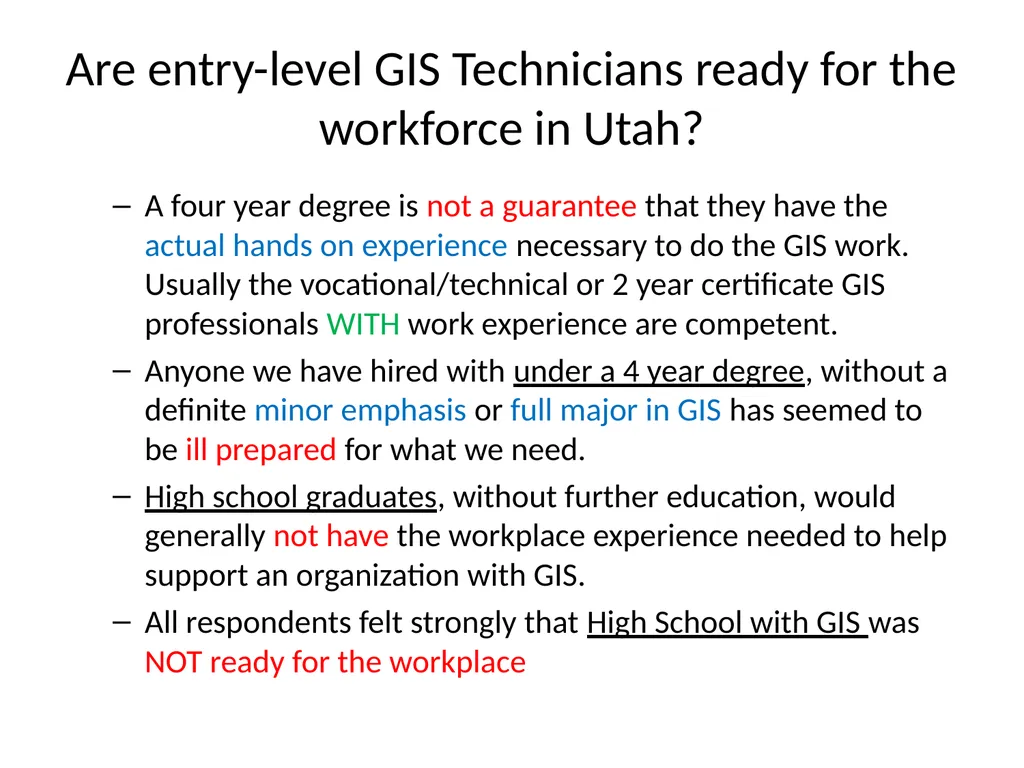
slide15. Are entry-level GIS Technicians ready for the workforce in Utah? A four year degree is not a guarantee that they have the actual hands on experience necessary to do the GIS work. Usually the vocational/technical or 2 year certificate GIS professionals WITH work experience are competent.
Anyone we have hired with under a 4 year degree, without a definite minor emphasis or full major in GIS has seemed to be ill prepared for what we need.
High school graduates, without further education, would generally not have the workplace experience needed to help support an organization with GIS.
All respondents felt strongly that High School with GIS was NOT ready for the workplace<br>
slide16. New Skills 5-10 years from now A physical relationship and understanding of what they are truly doing. For instance an AutoCAD technician will be far better off having had experience with technical drawing by hand. Do not lose the "old-way" and reasons of doing things on the computer.
Mobile GIS
Some application development/programming, internet mapping skills.<br>
slide17. GIS/GEOSPATIAL ANALYST<br>
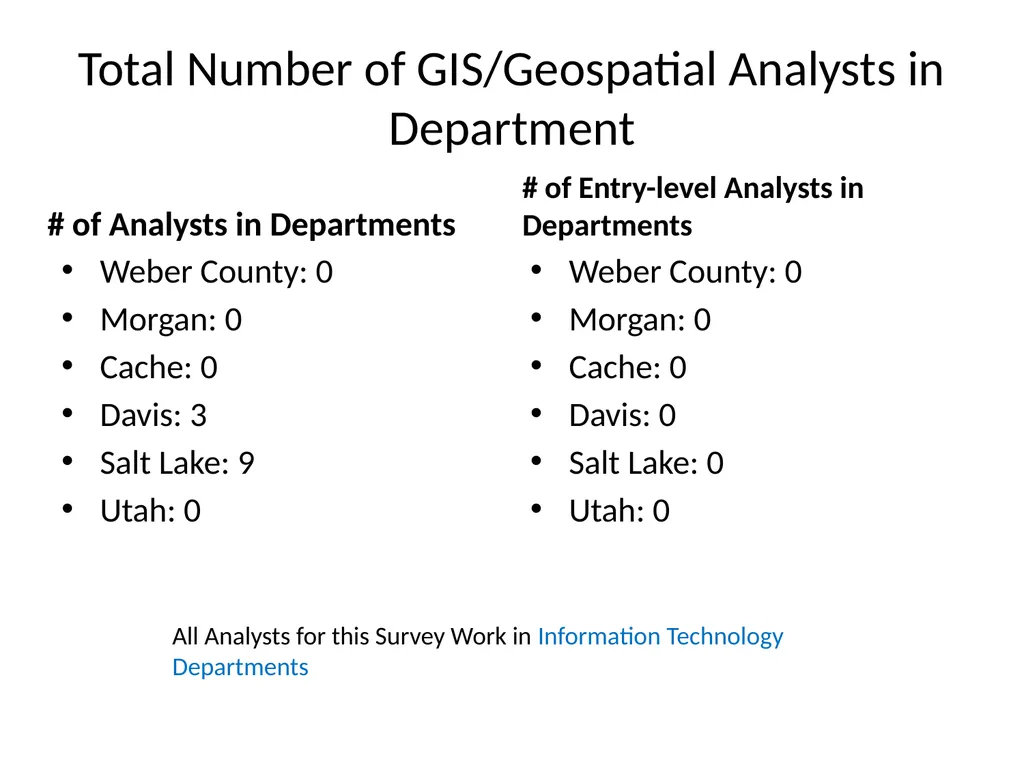
slide18. Total Number of GIS/Geospatial Analysts in Department # of Analysts in Departments Weber County: 0
Morgan: 0
Cache: 0
Davis: 3
Salt Lake: 9
Utah: 0 # of Entry-level Analysts in Departments Weber County: 0
Morgan: 0
Cache: 0
Davis: 0
Salt Lake: 0
Utah: 0 All Analysts for this Survey Work in Information Technology Departments<br>
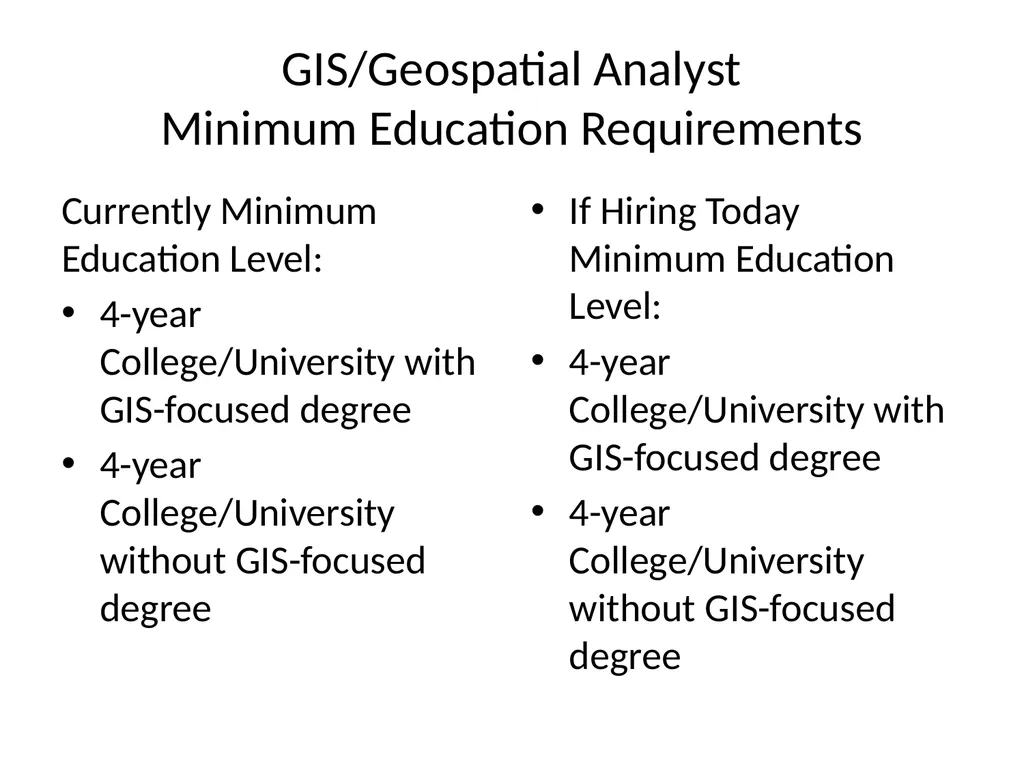
slide19. GIS/Geospatial AnalystMinimum Education Requirements Currently Minimum Education Level:
4-year College/University with GIS-focused degree
4-year College/University without GIS-focused degree If Hiring Today Minimum Education Level:
4-year College/University with GIS-focused degree
4-year College/University without GIS-focused degree<br>
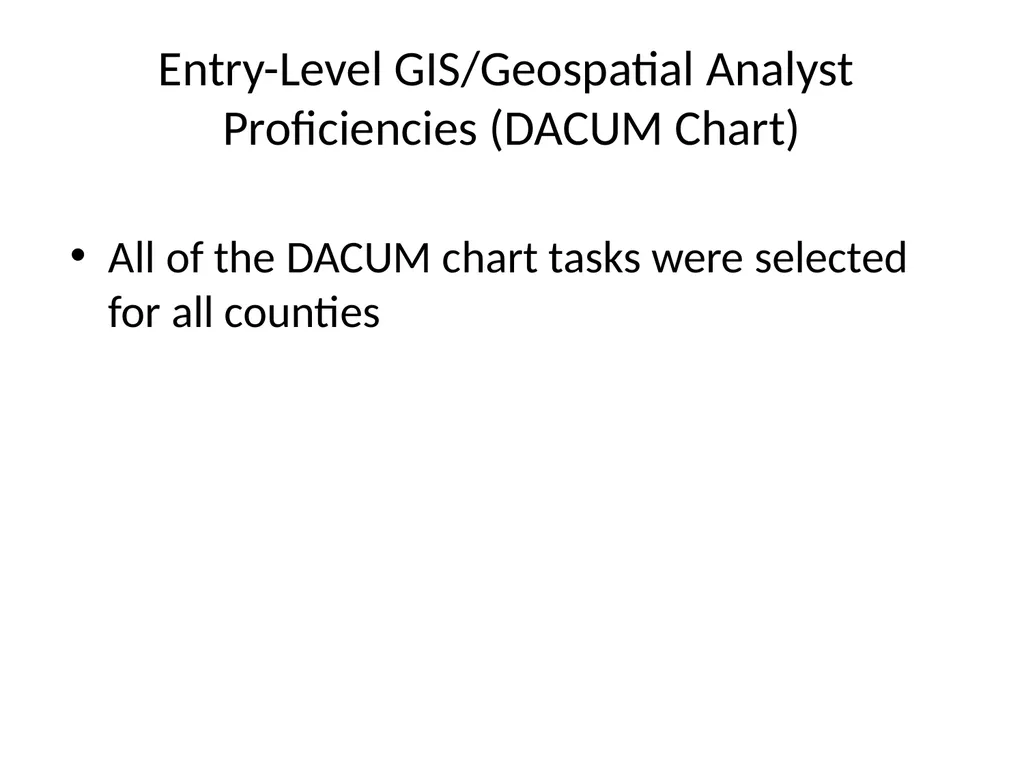
slide20. Entry-Level GIS/Geospatial Analyst Proficiencies (DACUM Chart) All of the DACUM chart tasks were selected for all counties<br>
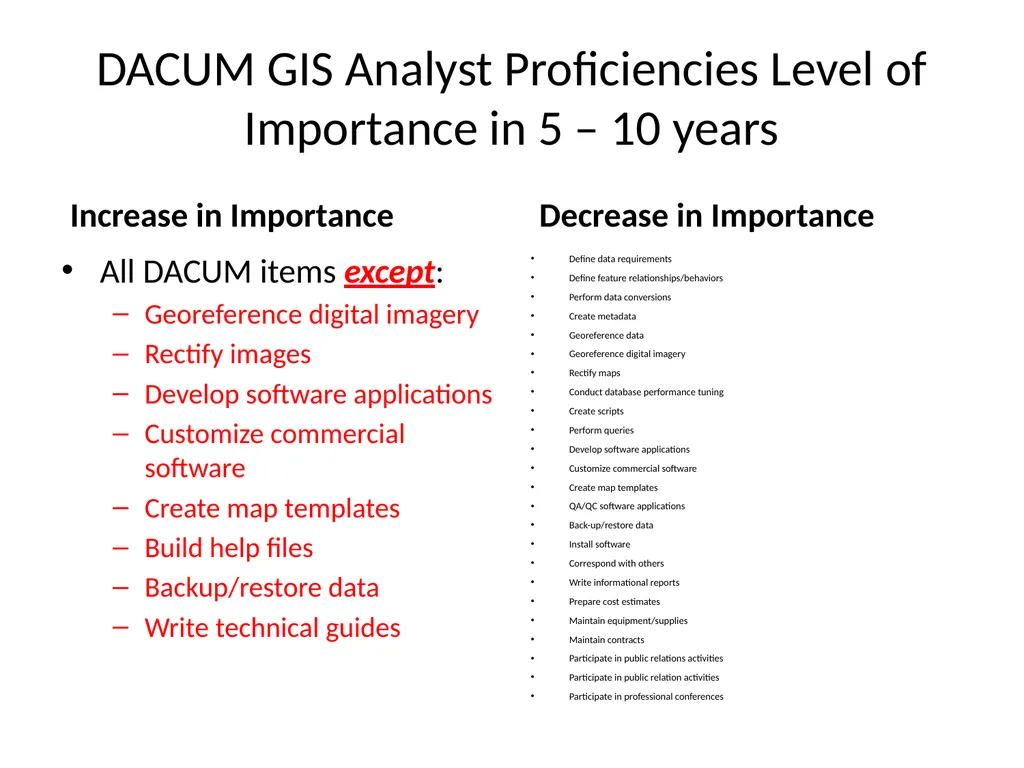
slide21. DACUM GIS Analyst Proficiencies Level of Importance in 5 – 10 years Increase in Importance All DACUM items except:
Georeference digital imagery
Rectify images
Develop software applications
Customize commercial software
Create map templates
Build help files
Backup/restore data
Write technical guides Decrease in Importance Define data requirements
Define feature relationships/behaviors
Perform data conversions
Create metadata
Georeference data
Georeference digital imagery
Rectify maps
Conduct database performance tuning
Create scripts
Perform queries
Develop software applications
Customize commercial software
Create map templates
QA/QC software applications
Back-up/restore data
Install software
Correspond with others
Write informational reports
Prepare cost estimates
Maintain equipment/supplies
Maintain contracts
Participate in public relations activities
Participate in public relation activities
Participate in professional conferences<br>
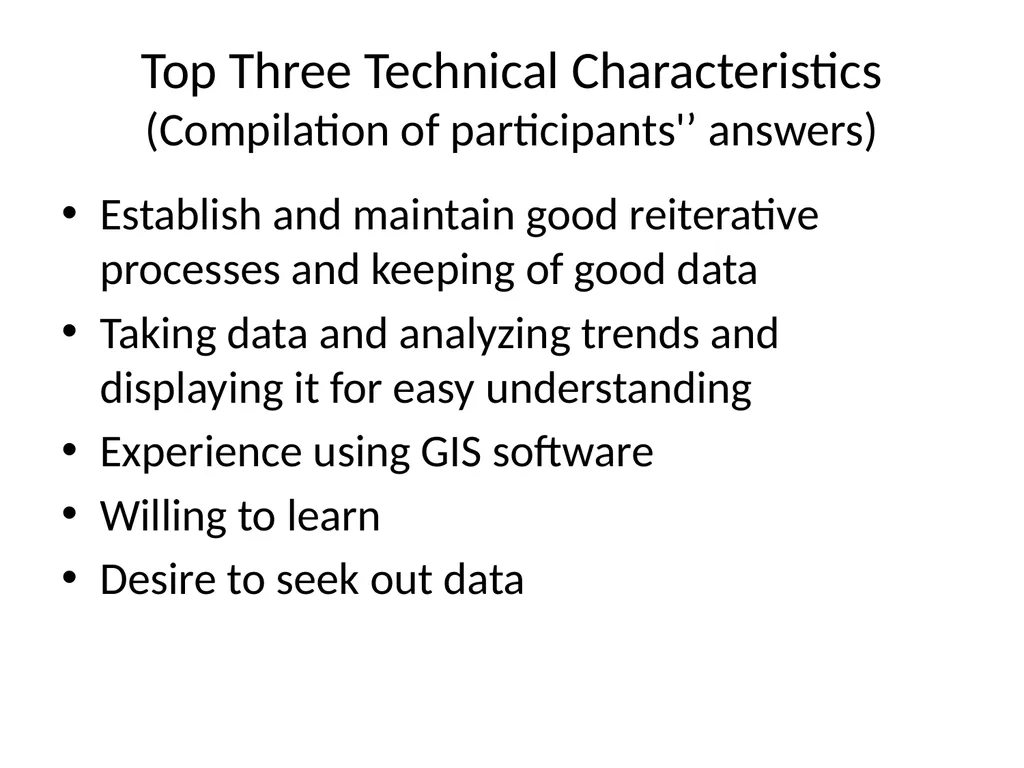
slide22. Top Three Technical Characteristics(Compilation of participants'’ answers) Establish and maintain good reiterative processes and keeping of good data
Taking data and analyzing trends and displaying it for easy understanding
Experience using GIS software
Willing to learn
Desire to seek out data<br>
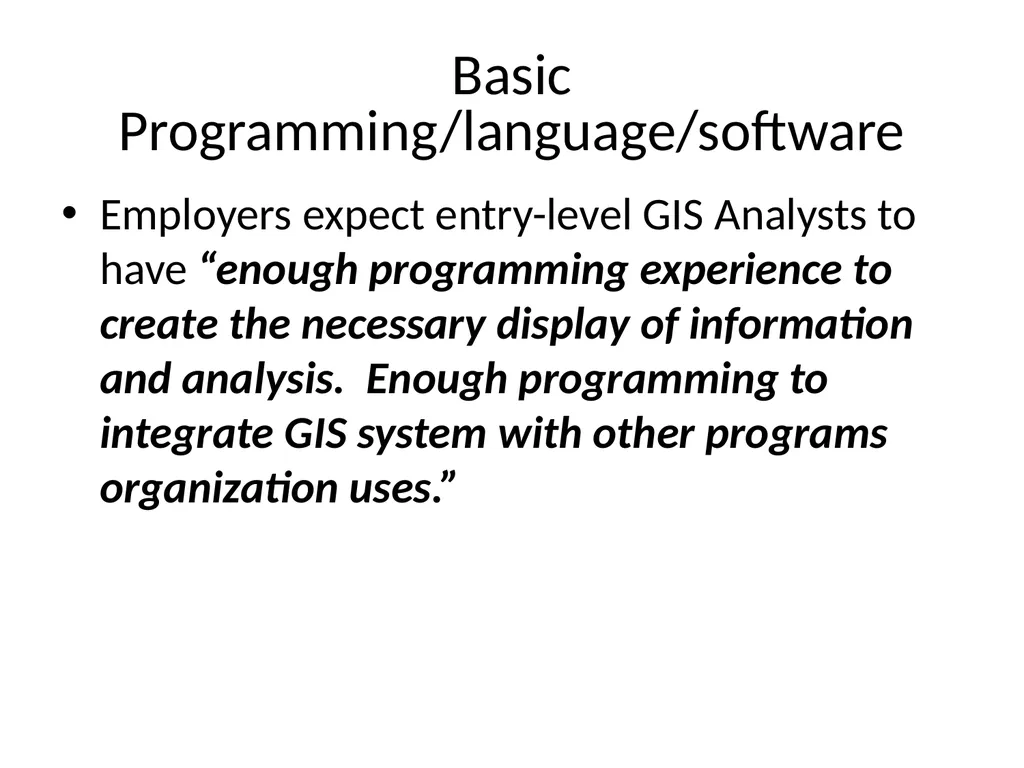
slide23. Basic Programming/language/software Employers expect entry-level GIS Analysts to have “enough programming experience to create the necessary display of information and analysis. Enough programming to integrate GIS system with other programs organization uses.”<br>
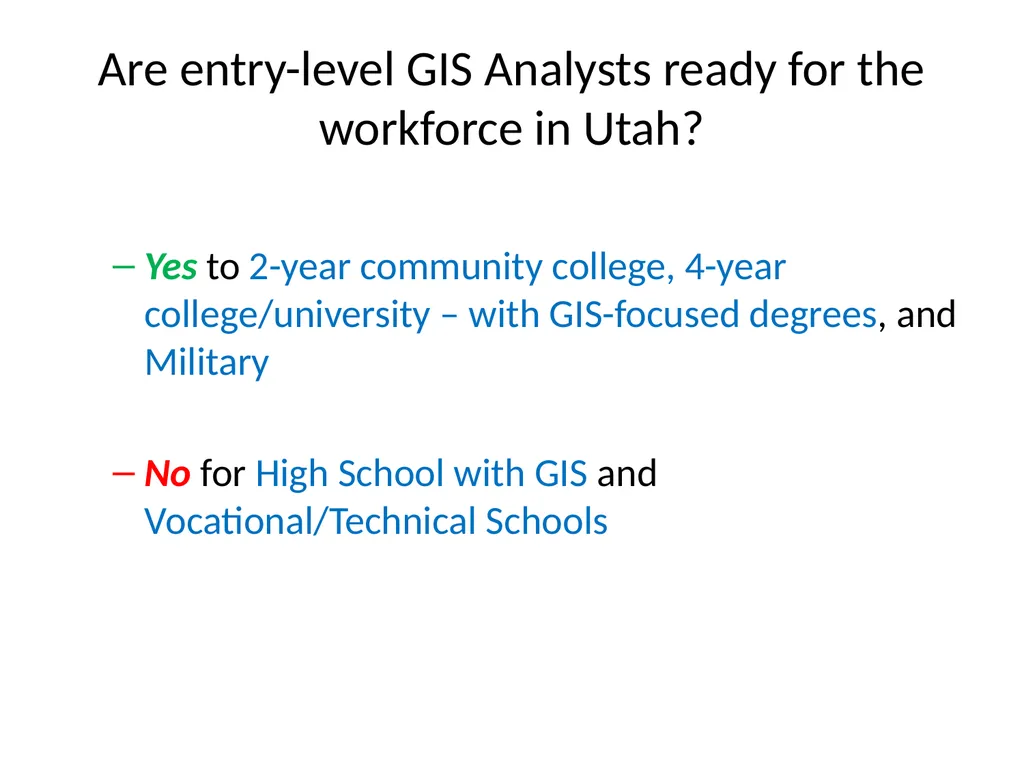
slide24. Are entry-level GIS Analysts ready for the workforce in Utah? Yes to 2-year community college, 4-year college/university – with GIS-focused degrees, and Military
No for High School with GIS and Vocational/Technical Schools<br>
slide25. New Skills 5-10 years from now Some database administration,
Some programming<br>
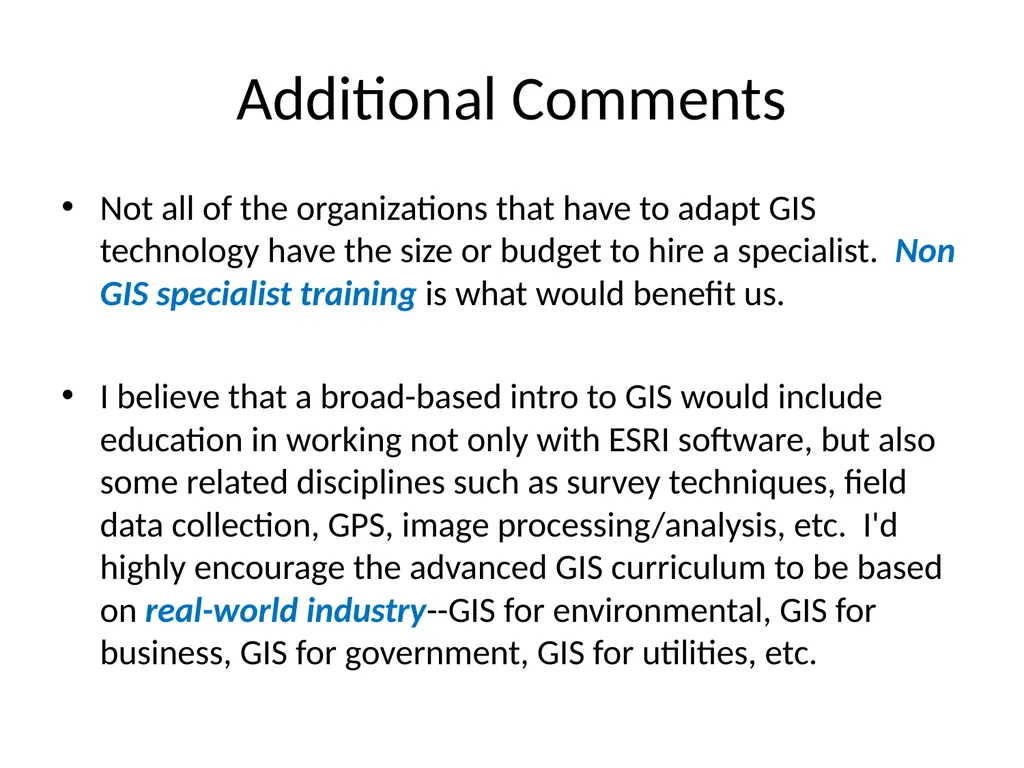
slide26. Additional Comments Not all of the organizations that have to adapt GIS technology have the size or budget to hire a specialist. Non GIS specialist training is what would benefit us.
I believe that a broad-based intro to GIS would include education in working not only with ESRI software, but also some related disciplines such as survey techniques, field data collection, GPS, image processing/analysis, etc. I'd highly encourage the advanced GIS curriculum to be based on real-world industry--GIS for environmental, GIS for business, GIS for government, GIS for utilities, etc.<br>

Mary Siegrist, Ph.D.
IMSA<br>
slide2. Demographics Position Titles:
GIS Manager: 3
GIS Analyst: 2
GIS Database Administrator: 1
GIS/GPS Specialist: 1
GIS Web Designer: 1
Application Development & Technology Manager: 1
Associate Director: 1
Assistant City Administrator: 1<br>
slide5. N=11<br>
slide7. GIS/Geospatial technician<br>
slide8. Total Number of GIS/Geospatial Technicians in Department # of Technician in Departments Weber County: 1
Morgan: 0
Cache: 5
Davis: 0
Salt Lake: 2
Utah: 4 # of Entry-level Technicians in Departments Weber County: 0
Morgan: 1
Cache: 4
Davis: 0
Salt Lake: 2
Utah: 3<br>
slide9. Respondent’s Departments Public Works
Remote sensing/GIS Laboratory
Information Systems
Network Planning
GIS Division<br>
slide10. GIS/Geospatial TechnicianMinimum Education Requirements Currently Minimum Education Level:
High School with GIS
Vocational/Technical School
2-year Community College with and without GIS-focused degree
4-year College/University with and without GIS-focused degree
Military If Hiring Today Minimum Education Level:
2-year Community College with GIS-focused degree
4-year College/University with GIS-focused degree<br>
slide11. Entry-Level GIS/Geospatial Technician Proficiencies (DACUM Chart) All of the DACUM chart tasks were selected, except for Research available data, and COGO legal descriptions for all counties<br>
slide12. DACUM GIS Technician Proficiencies Level of Importance in 5 – 10 years Increase in Importance Research available data
COGO legal descriptions
Geocode data
Determine data compatibility
Perform data conversions
Populate GIS feature attributes
Create metadata
Collect field location data via GPS
Collect field attribute data
Georeference data
Edit GIS data
Convert between data formats
Update metadata
Create scripts
Conduct Geoprocessing
Perform queries
Create maps
Create analysis reports
Create charts
Create tables
Generate mailing labels
Distribute digital Products
Create map templates
Archive/retrieve data
Distribute data according to organizational policy
Develop project timeline/schedule
Participate in GIS user groups Decrease in Importance Perform heads-up digitization
Geocode data
Create metadata
Collect field location data via GPS
Collect field attribute data
Scan hard copy data
Georeference digital imagery
Rectify images
Update metadata
Create maps
Generate mailing labels
Create graphic item
Distribute hard copy products
Create map templates
Archive/retrieve data
Participate in GIS user groups
Acquire professional credentials<br>
slide13. Top Three Technical Characteristics(Compilation of participants'’ answers) Maintaining good credible data and having established effective reiterative processes built into their work (Or recognize when one needs to be established)
Proficiency in creating good maps that display information
Basic understanding of how GIS can be integrated with other programs used Base set of skills like knowing how to navigate the software
Attention to detail
Willingness and ability to learn new things
Knowledge of the organization's mission/purpose
ArcGIS/ESRI experience
Data entry/management<br>
slide14. Basic Programming/language/software Employers expect entry-level GIS Technicians to have the following skills at time of hire:
Basic model builder and field calculation skills I don't expect them to know python or something like that.
JavaScript--not essential, but helpful<br>
slide15. Are entry-level GIS Technicians ready for the workforce in Utah? A four year degree is not a guarantee that they have the actual hands on experience necessary to do the GIS work. Usually the vocational/technical or 2 year certificate GIS professionals WITH work experience are competent.
Anyone we have hired with under a 4 year degree, without a definite minor emphasis or full major in GIS has seemed to be ill prepared for what we need.
High school graduates, without further education, would generally not have the workplace experience needed to help support an organization with GIS.
All respondents felt strongly that High School with GIS was NOT ready for the workplace<br>
slide16. New Skills 5-10 years from now A physical relationship and understanding of what they are truly doing. For instance an AutoCAD technician will be far better off having had experience with technical drawing by hand. Do not lose the "old-way" and reasons of doing things on the computer.
Mobile GIS
Some application development/programming, internet mapping skills.<br>
slide17. GIS/GEOSPATIAL ANALYST<br>
slide18. Total Number of GIS/Geospatial Analysts in Department # of Analysts in Departments Weber County: 0
Morgan: 0
Cache: 0
Davis: 3
Salt Lake: 9
Utah: 0 # of Entry-level Analysts in Departments Weber County: 0
Morgan: 0
Cache: 0
Davis: 0
Salt Lake: 0
Utah: 0 All Analysts for this Survey Work in Information Technology Departments<br>
slide19. GIS/Geospatial AnalystMinimum Education Requirements Currently Minimum Education Level:
4-year College/University with GIS-focused degree
4-year College/University without GIS-focused degree If Hiring Today Minimum Education Level:
4-year College/University with GIS-focused degree
4-year College/University without GIS-focused degree<br>
slide20. Entry-Level GIS/Geospatial Analyst Proficiencies (DACUM Chart) All of the DACUM chart tasks were selected for all counties<br>
slide21. DACUM GIS Analyst Proficiencies Level of Importance in 5 – 10 years Increase in Importance All DACUM items except:
Georeference digital imagery
Rectify images
Develop software applications
Customize commercial software
Create map templates
Build help files
Backup/restore data
Write technical guides Decrease in Importance Define data requirements
Define feature relationships/behaviors
Perform data conversions
Create metadata
Georeference data
Georeference digital imagery
Rectify maps
Conduct database performance tuning
Create scripts
Perform queries
Develop software applications
Customize commercial software
Create map templates
QA/QC software applications
Back-up/restore data
Install software
Correspond with others
Write informational reports
Prepare cost estimates
Maintain equipment/supplies
Maintain contracts
Participate in public relations activities
Participate in public relation activities
Participate in professional conferences<br>
slide22. Top Three Technical Characteristics(Compilation of participants'’ answers) Establish and maintain good reiterative processes and keeping of good data
Taking data and analyzing trends and displaying it for easy understanding
Experience using GIS software
Willing to learn
Desire to seek out data<br>
slide23. Basic Programming/language/software Employers expect entry-level GIS Analysts to have “enough programming experience to create the necessary display of information and analysis. Enough programming to integrate GIS system with other programs organization uses.”<br>
slide24. Are entry-level GIS Analysts ready for the workforce in Utah? Yes to 2-year community college, 4-year college/university – with GIS-focused degrees, and Military
No for High School with GIS and Vocational/Technical Schools<br>
slide25. New Skills 5-10 years from now Some database administration,
Some programming<br>
slide26. Additional Comments Not all of the organizations that have to adapt GIS technology have the size or budget to hire a specialist. Non GIS specialist training is what would benefit us.
I believe that a broad-based intro to GIS would include education in working not only with ESRI software, but also some related disciplines such as survey techniques, field data collection, GPS, image processing/analysis, etc. I'd highly encourage the advanced GIS curriculum to be based on real-world industry--GIS for environmental, GIS for business, GIS for government, GIS for utilities, etc.<br>