
1 Orientation PowerPoint (REV 4-14) PPT intended
LD
Published · 40 slides · 0 views

1 / 1




Description
1 Orientation PowerPoint (REV 4-14) PPT intended to customize and use annually for a discussion amongst the Board of Directors. Orientation generally requires 1.5 to 4 hours. Supplemental documents include Leadership Manual (Board Book),
Related Topics
Share
Embed code
Download this presentation From Below
"1 Orientation PowerPoint (REV 4-14) PPT intended" is the property of its rightful owner. Permission is granted to download and print the materials on this website for personal, non-commercial use only, and to display it on your personal computer provided you do not modify the materials and that you retain all copyright notices contained in the materials. By downloading content from our website, you accept the terms of this agreement.
Presentation Transcript
01
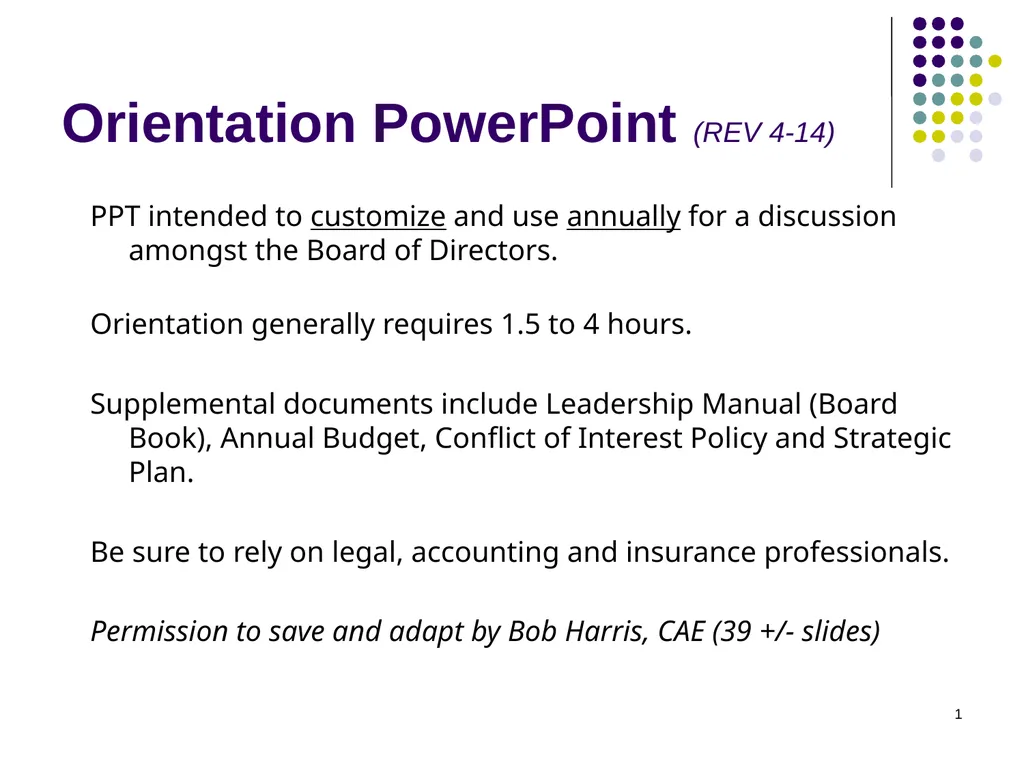
1 Orientation PowerPoint (REV 4-14) PPT intended to customize and use annually for a discussion amongst the Board of Directors.
Orientation generally requires 1.5 to 4 hours.
Supplemental documents include Leadership Manual (Board Book), Annual Budget, Conflict of Interest Policy and Strategic Plan.
Be sure to rely on legal, accounting and insurance professionals.
Permission to save and adapt by Bob Harris, CAE (39 +/- slides)<br>
Orientation generally requires 1.5 to 4 hours.
Supplemental documents include Leadership Manual (Board Book), Annual Budget, Conflict of Interest Policy and Strategic Plan.
Be sure to rely on legal, accounting and insurance professionals.
Permission to save and adapt by Bob Harris, CAE (39 +/- slides)<br>
02
2 Board Orientation<br>
03
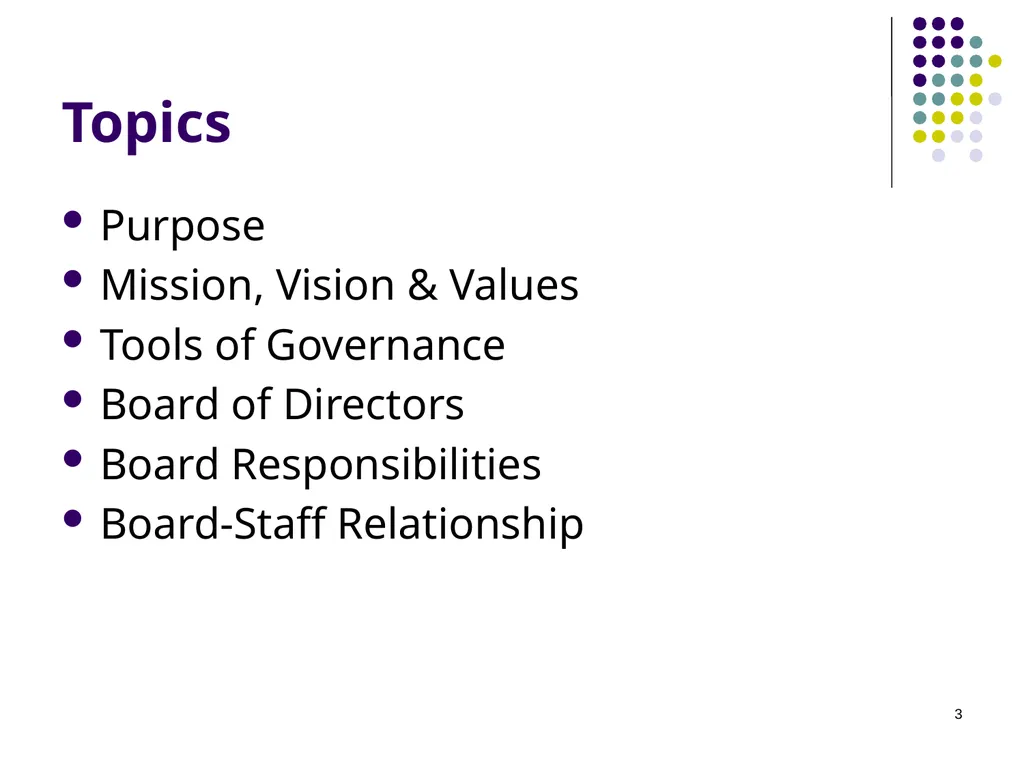
3 Topics Purpose
Mission, Vision & Values
Tools of Governance
Board of Directors
Board Responsibilities
Board-Staff Relationship<br>
Mission, Vision & Values
Tools of Governance
Board of Directors
Board Responsibilities
Board-Staff Relationship<br>
04
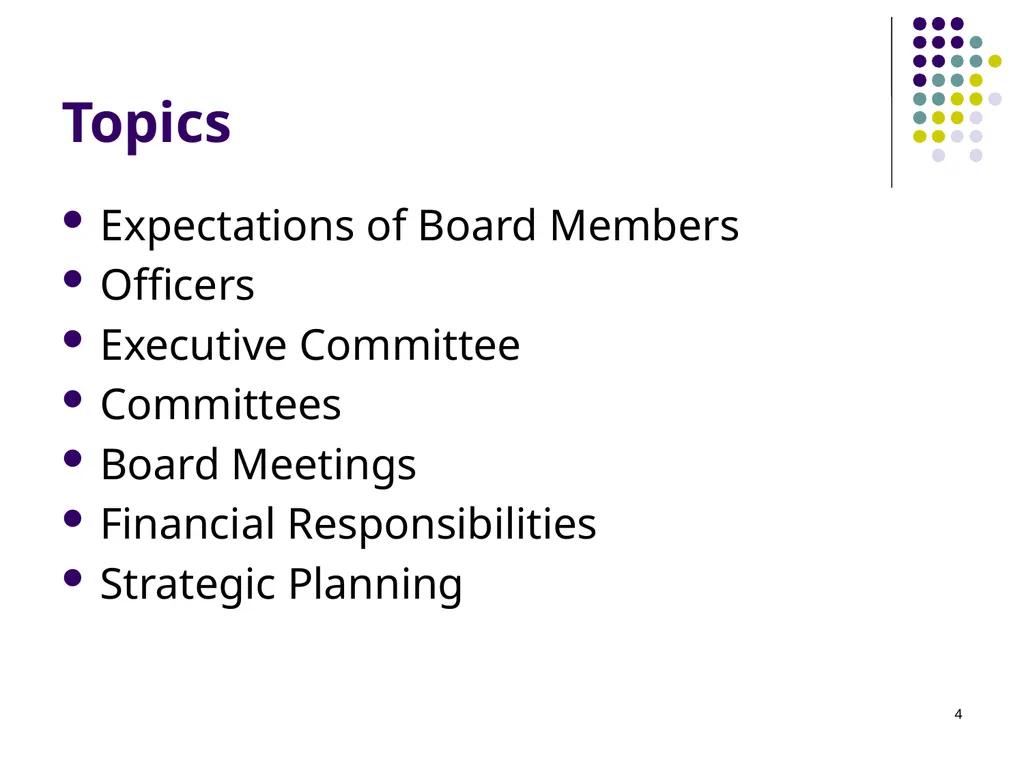
4 Topics Expectations of Board Members
Officers
Executive Committee
Committees
Board Meetings
Financial Responsibilities
Strategic Planning<br>
Officers
Executive Committee
Committees
Board Meetings
Financial Responsibilities
Strategic Planning<br>
05
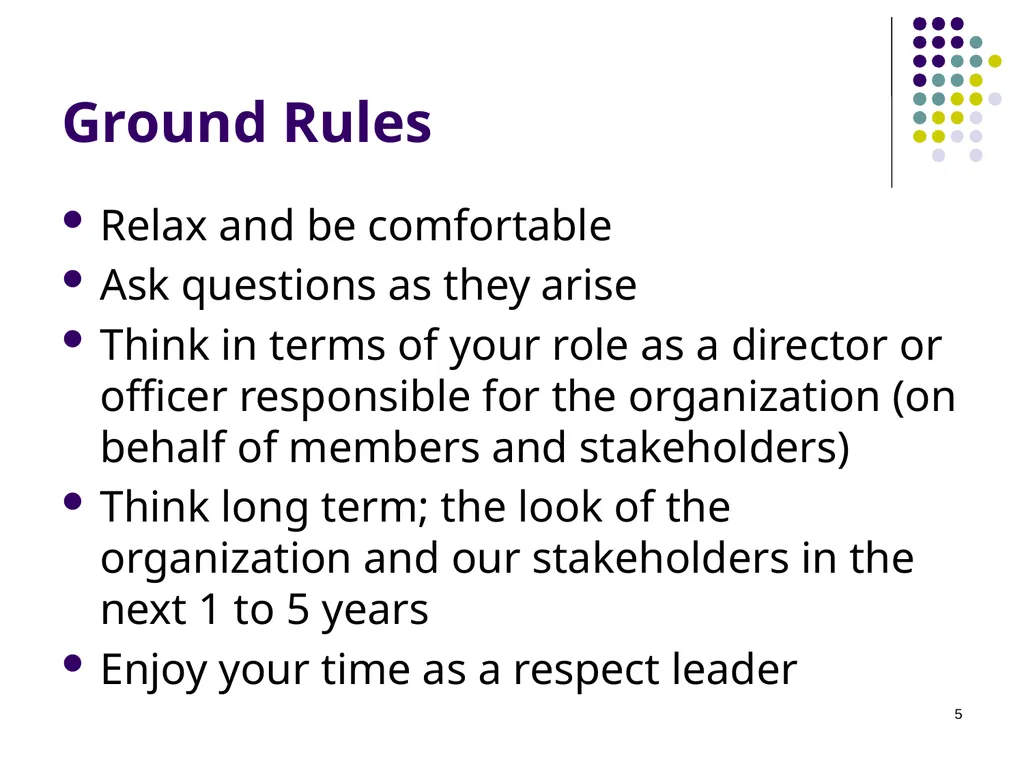
5 Ground Rules Relax and be comfortable
Ask questions as they arise
Think in terms of your role as a director or officer responsible for the organization (on behalf of members and stakeholders)
Think long term; the look of the organization and our stakeholders in the next 1 to 5 years
Enjoy your time as a respect leader<br>
Ask questions as they arise
Think in terms of your role as a director or officer responsible for the organization (on behalf of members and stakeholders)
Think long term; the look of the organization and our stakeholders in the next 1 to 5 years
Enjoy your time as a respect leader<br>
06
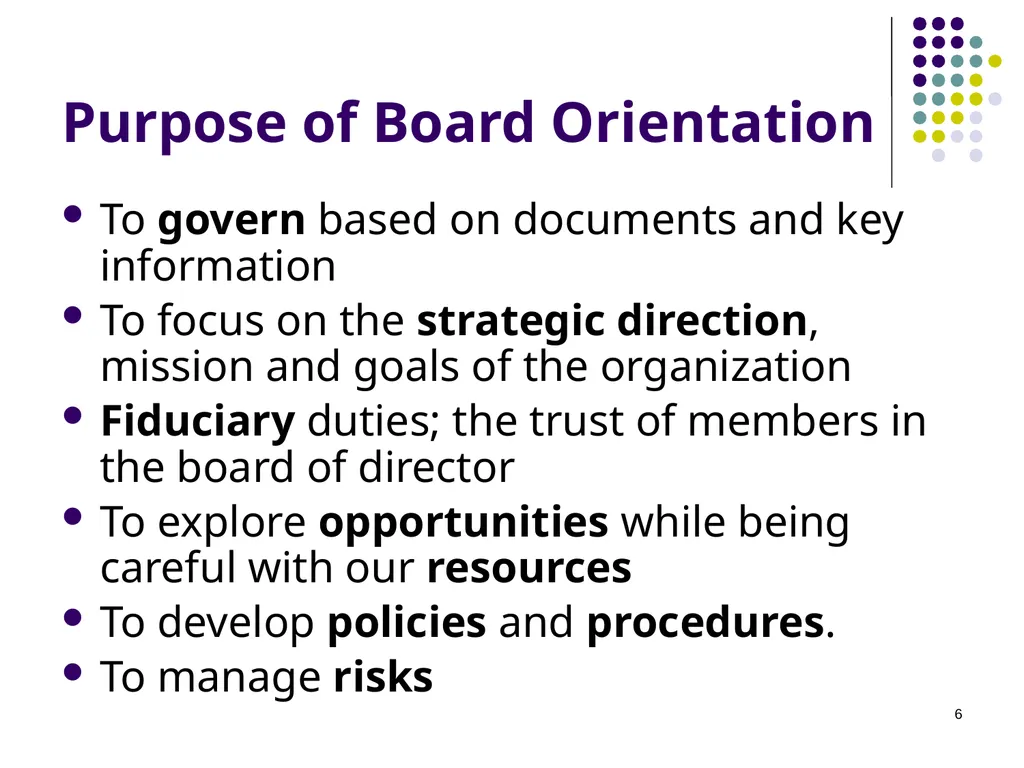
6 Purpose of Board Orientation To govern based on documents and key information
To focus on the strategic direction, mission and goals of the organization
Fiduciary duties; the trust of members in the board of director
To explore opportunities while being careful with our resources
To develop policies and procedures.
To manage risks<br>
To focus on the strategic direction, mission and goals of the organization
Fiduciary duties; the trust of members in the board of director
To explore opportunities while being careful with our resources
To develop policies and procedures.
To manage risks<br>
07
7 Our Mission Statement<br>
08
8 Our Vision Statement<br>
09
9 Our Guiding Values<br>
10
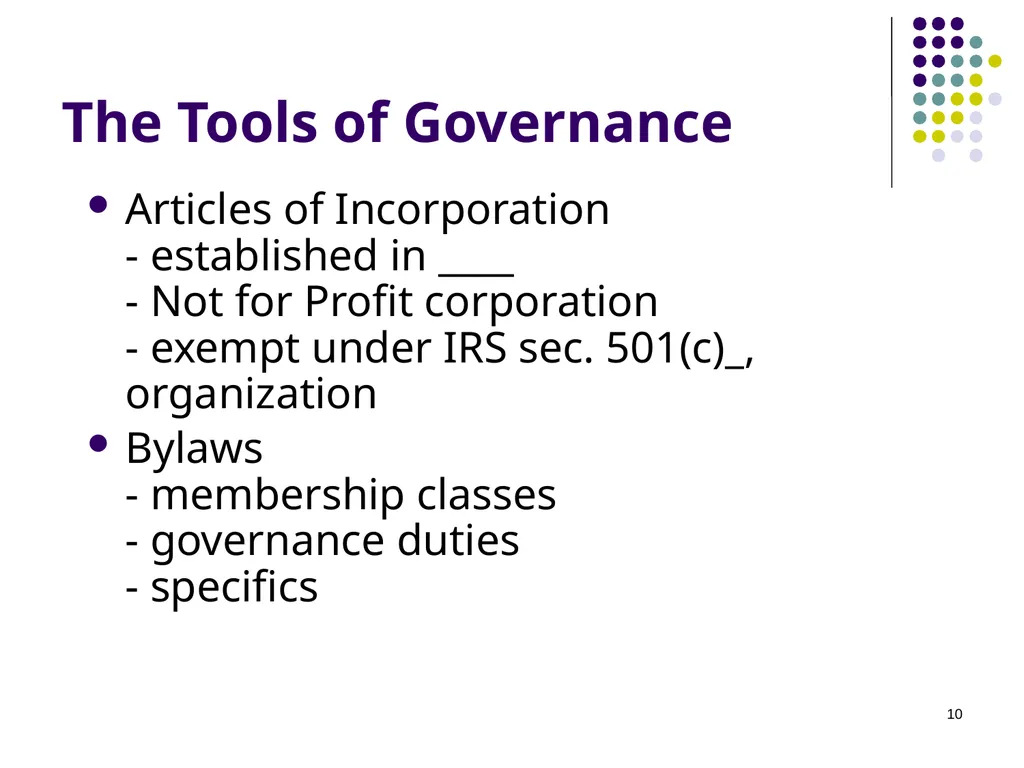
10 The Tools of Governance Articles of Incorporation
- established in ____
- Not for Profit corporation
- exempt under IRS sec. 501(c)_, organization
Bylaws - membership classes - governance duties - specifics<br>
Bylaws - membership classes - governance duties - specifics<br>
11
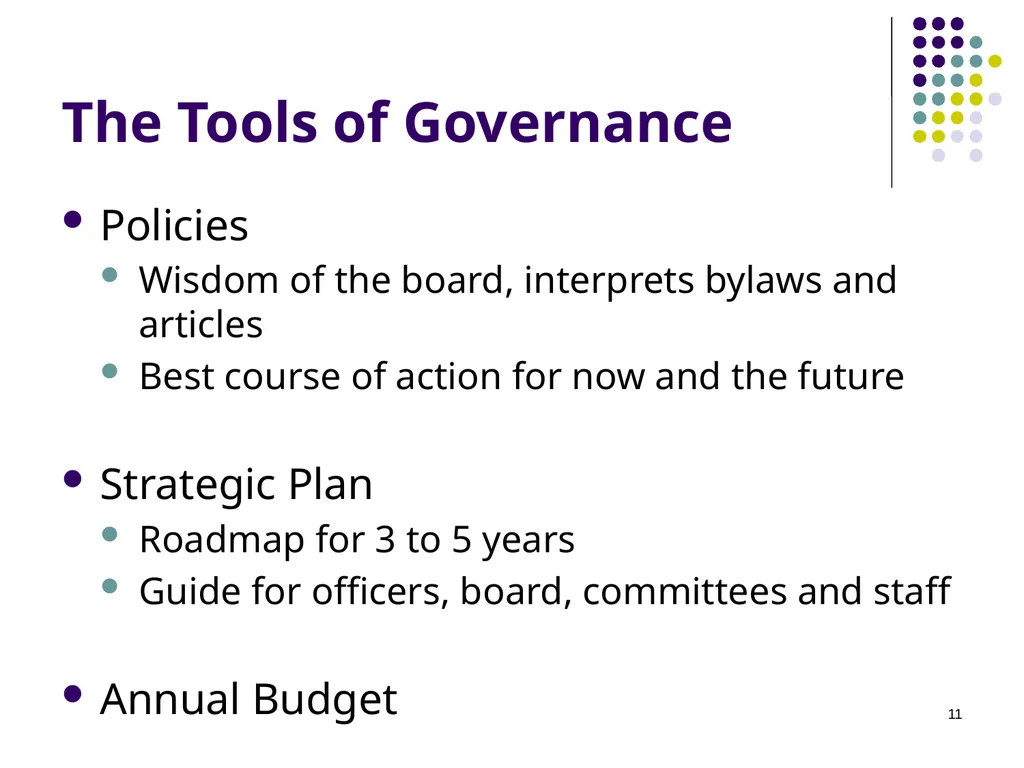
11 The Tools of Governance Policies
Wisdom of the board, interprets bylaws and articles
Best course of action for now and the future
Strategic Plan
Roadmap for 3 to 5 years
Guide for officers, board, committees and staff
Annual Budget<br>
Wisdom of the board, interprets bylaws and articles
Best course of action for now and the future
Strategic Plan
Roadmap for 3 to 5 years
Guide for officers, board, committees and staff
Annual Budget<br>
12
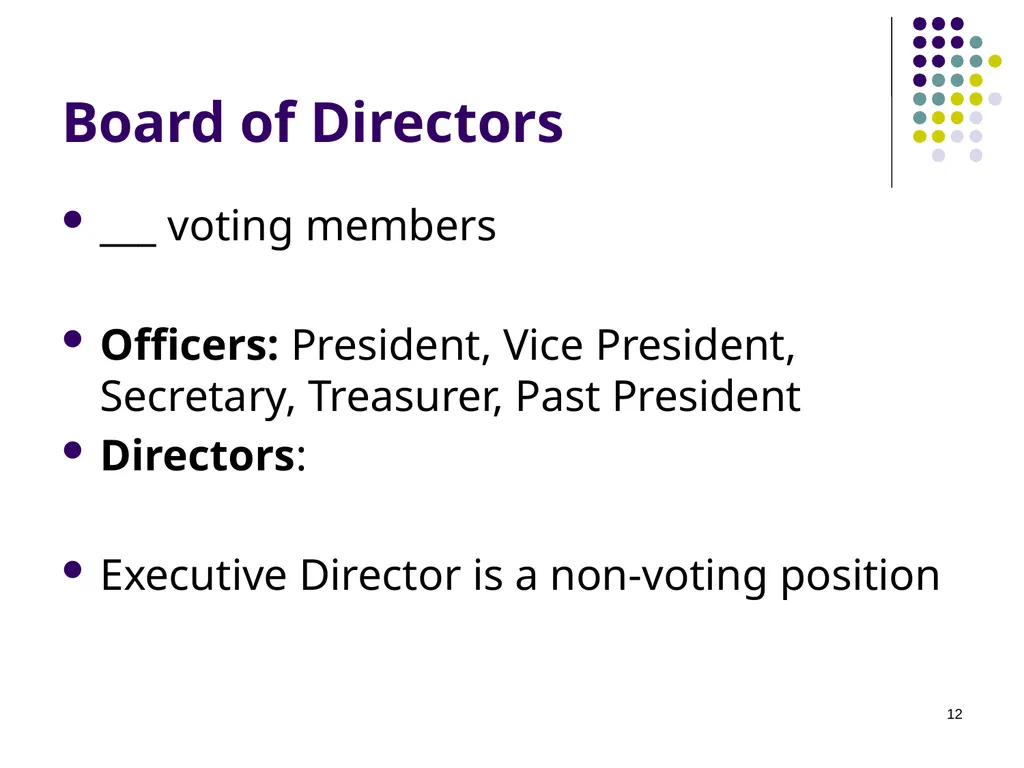
12 Board of Directors ___ voting members
Officers: President, Vice President, Secretary, Treasurer, Past President
Directors:
Executive Director is a non-voting position<br>
Officers: President, Vice President, Secretary, Treasurer, Past President
Directors:
Executive Director is a non-voting position<br>
13
13 Board Responsibilities Establish strategic plan and annual goals and objectives
Determine association policy
Allocate resources through the budget
Monitor progress
Promote the organization
Oversee the executive director, attorney and CPA<br>
Determine association policy
Allocate resources through the budget
Monitor progress
Promote the organization
Oversee the executive director, attorney and CPA<br>
14
14 The Board - Staff Relationship Two Partners, One Team
Board focuses on governance, direction and vision
Staff manages day-to-day operations within the context of the board’s direction
This partnership between board and staff allows the organization to achieve its goals, avoids micro-management of the staff and over-taxing of the volunteer leaders. Leaders govern; staff manages.<br>
Board focuses on governance, direction and vision
Staff manages day-to-day operations within the context of the board’s direction
This partnership between board and staff allows the organization to achieve its goals, avoids micro-management of the staff and over-taxing of the volunteer leaders. Leaders govern; staff manages.<br>
15
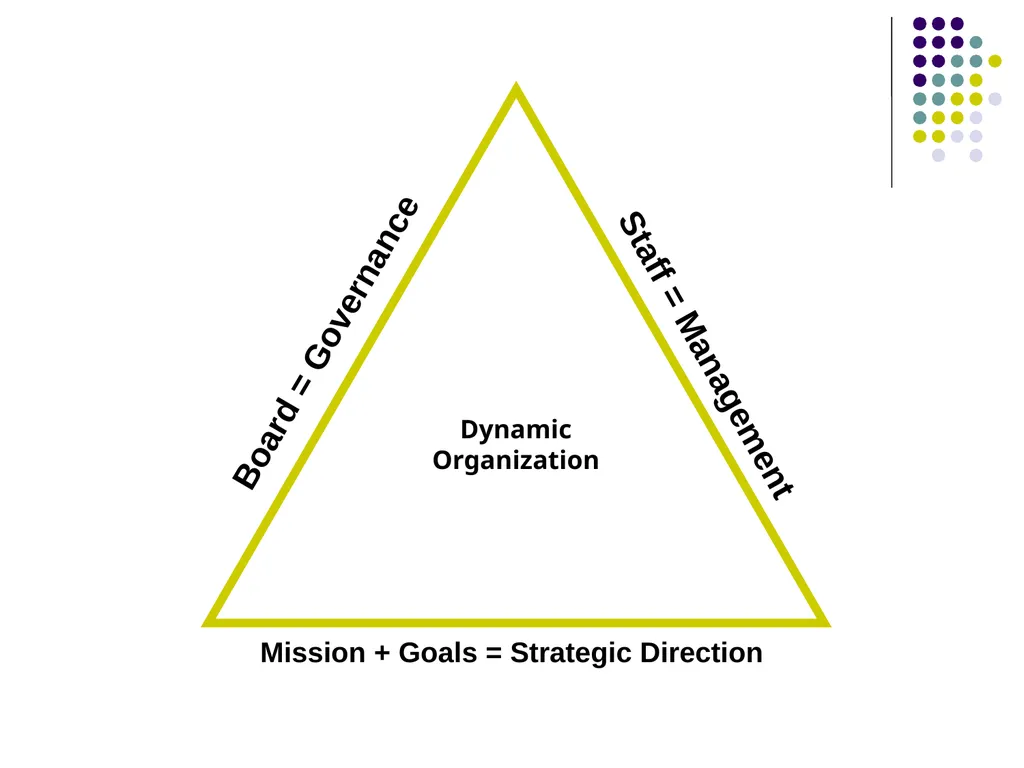
Board = Governance Dynamic Organization<br>
16
16 Expectations of Board Members Attend all board meetings
Start and end meetings on time
Study and understand the mission statement, bylaws, and strategic plan
Prepare for meetings by reviewing the agenda and supporting documents
Stick to established agendas during board meetings
Treat information and discussions as confidential
Be respectful of people and ideas<br>
Start and end meetings on time
Study and understand the mission statement, bylaws, and strategic plan
Prepare for meetings by reviewing the agenda and supporting documents
Stick to established agendas during board meetings
Treat information and discussions as confidential
Be respectful of people and ideas<br>
17
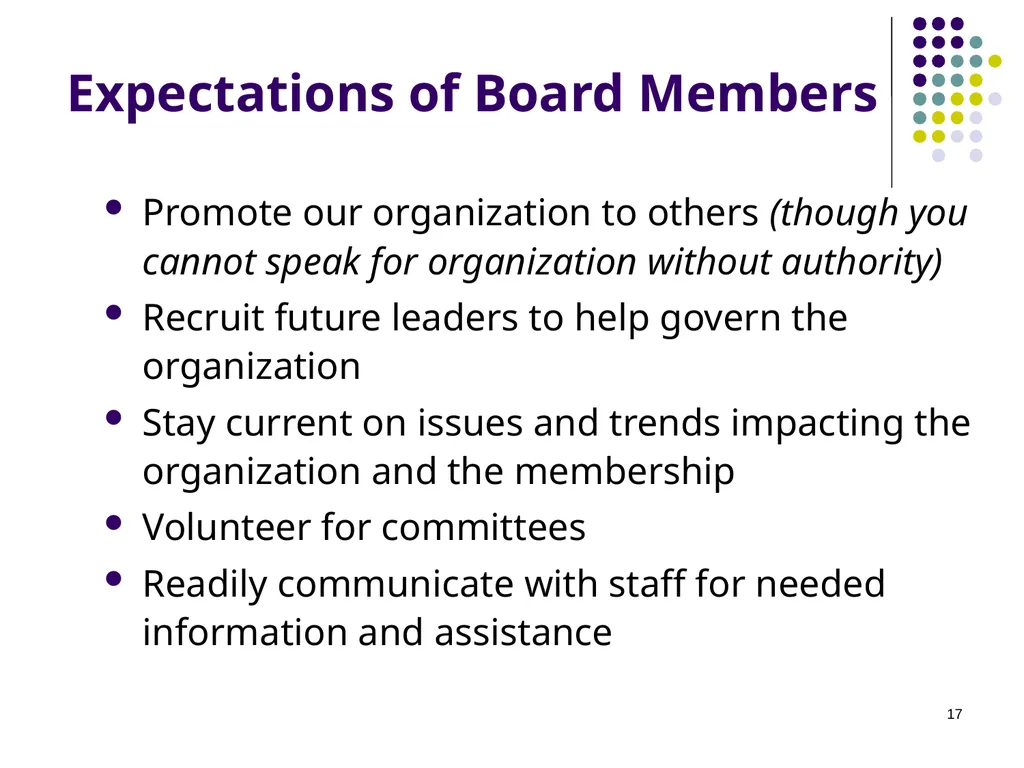
17 Expectations of Board Members Promote our organization to others (though you cannot speak for organization without authority)
Recruit future leaders to help govern the organization
Stay current on issues and trends impacting the organization and the membership
Volunteer for committees
Readily communicate with staff for needed information and assistance<br>
Recruit future leaders to help govern the organization
Stay current on issues and trends impacting the organization and the membership
Volunteer for committees
Readily communicate with staff for needed information and assistance<br>
18
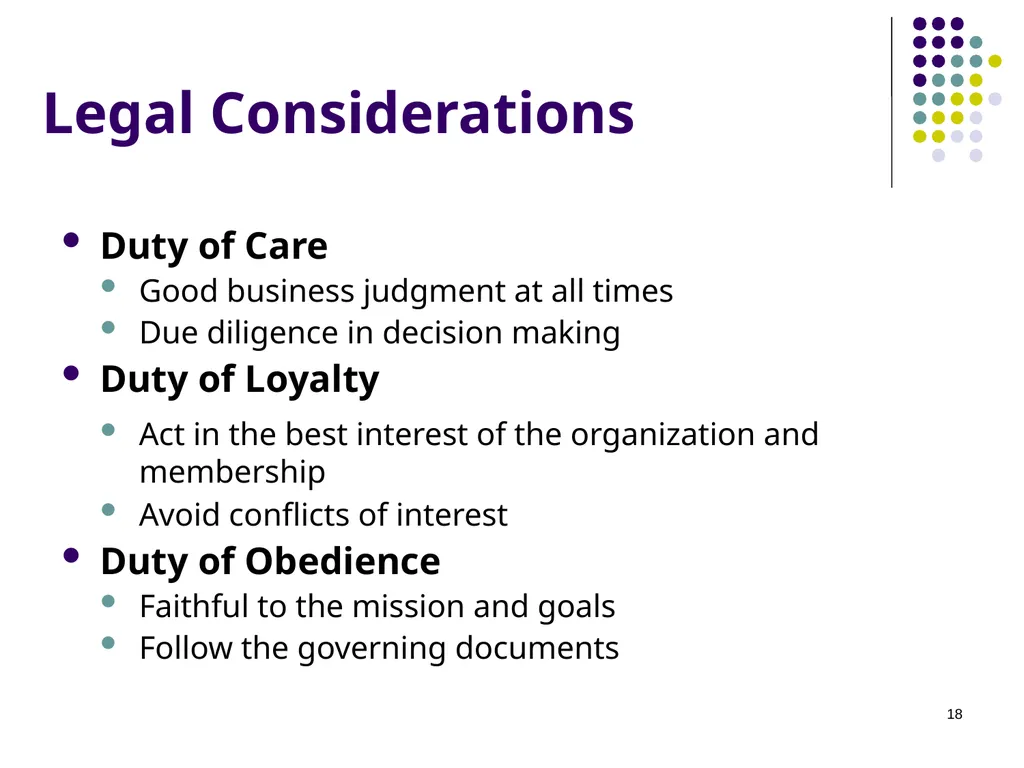
18 Legal Considerations Duty of Care
Good business judgment at all times
Due diligence in decision making
Duty of Loyalty
Act in the best interest of the organization and membership
Avoid conflicts of interest
Duty of Obedience
Faithful to the mission and goals
Follow the governing documents<br>
Good business judgment at all times
Due diligence in decision making
Duty of Loyalty
Act in the best interest of the organization and membership
Avoid conflicts of interest
Duty of Obedience
Faithful to the mission and goals
Follow the governing documents<br>
19
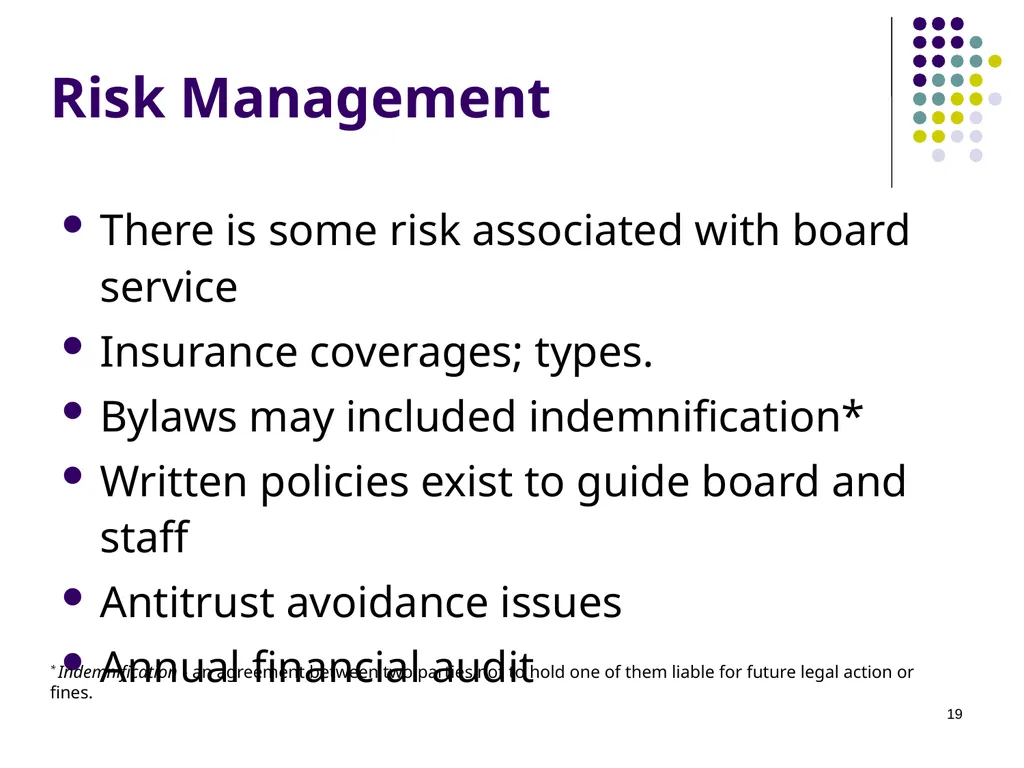
19 Risk Management There is some risk associated with board service
Insurance coverages; types.
Bylaws may included indemnification*
Written policies exist to guide board and staff
Antitrust avoidance issues
Annual financial audit * Indemnification - an agreement between two parties not to hold one of them liable for future legal action or fines.<br>
Insurance coverages; types.
Bylaws may included indemnification*
Written policies exist to guide board and staff
Antitrust avoidance issues
Annual financial audit * Indemnification - an agreement between two parties not to hold one of them liable for future legal action or fines.<br>
20
20 Risk Management - Insurance Organization maintains the following insurance policies:<br>
21
21 Risk Management – Antitrust Antitrust Avoidance
Antitrust statement on file and annual acknowledgements from each board member
Every staff, board and committee member should be aware of the policy and take immediate action in any setting where a violation is occurring. Most common threat is discussions of price-setting among competitors that could be interpreted as an effort to restrict trade
Staff monitors on-line discussions and meetings for potential violations
Up to $10 million fine + damages<br>
Antitrust statement on file and annual acknowledgements from each board member
Every staff, board and committee member should be aware of the policy and take immediate action in any setting where a violation is occurring. Most common threat is discussions of price-setting among competitors that could be interpreted as an effort to restrict trade
Staff monitors on-line discussions and meetings for potential violations
Up to $10 million fine + damages<br>
22
22 Risk Management – Who Speaks? Apparent Authority – Care should be taken that committee chairs or other volunteers not usurp the authority of the chief elected officer or take on authority not specifically delegated
“I can’t speak for the board but I can offer my personal opinion.”<br>
“I can’t speak for the board but I can offer my personal opinion.”<br>
23
23 Risk Management – IRS Issues IRS Issues
Increasing scrutiny of boards and staff
Unrelated Business Income Tax (UBIT)
990s is public information
Policy considerations
Whistle Blower
Audit
Conflicts
Record Retention
Compensation<br>
Increasing scrutiny of boards and staff
Unrelated Business Income Tax (UBIT)
990s is public information
Policy considerations
Whistle Blower
Audit
Conflicts
Record Retention
Compensation<br>
24
24 Recruiting Leaders A responsibility of board members is to identify future leaders
Don’t forget to ask prospective leaders to join our efforts.
The leadership development committee (nominating) plays a key role, but so does every board member
Committees may be a source of future leaders<br>
Don’t forget to ask prospective leaders to join our efforts.
The leadership development committee (nominating) plays a key role, but so does every board member
Committees may be a source of future leaders<br>
25
25 Executive Officers The officers have special duties described in the bylaws
The officers make up the Executive Committee
The Executive Committee does not usurp the authority of the board but may meet in between meetings of the board as needed.<br>
The officers make up the Executive Committee
The Executive Committee does not usurp the authority of the board but may meet in between meetings of the board as needed.<br>
26
26 Role of the President* Presides over all meetings of the board or membership
Interfaces with the Executive Director and senior staff
Appoints committees in accordance with bylaws and policy
Orchestrates and leads board meetings
* Sometimes called Chair of the Board<br>
Interfaces with the Executive Director and senior staff
Appoints committees in accordance with bylaws and policy
Orchestrates and leads board meetings
* Sometimes called Chair of the Board<br>
27
27 Role of the Vice President Serves in the absence of the President
Performs such duties as identified in the bylaws or assigned by the President
Automatically succeeds to the Presidency
May monitor progress of the Strategic Plan<br>
Performs such duties as identified in the bylaws or assigned by the President
Automatically succeeds to the Presidency
May monitor progress of the Strategic Plan<br>
28
28 Role of the Secretary Oversees the custody of all corporate records, except financial records
Monitors the accuracy and timely distribution of meeting minutes
Performs such duties as identified in the bylaws or assigned by the President
Chairs Bylaws Committee<br>
Monitors the accuracy and timely distribution of meeting minutes
Performs such duties as identified in the bylaws or assigned by the President
Chairs Bylaws Committee<br>
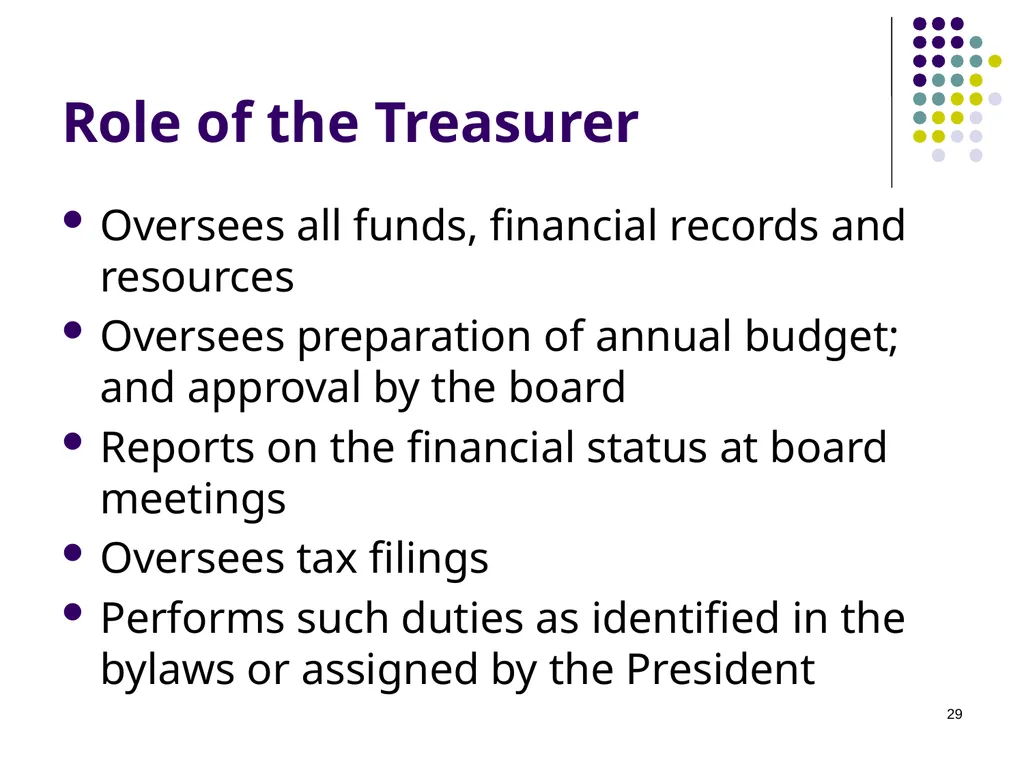
29
29 Role of the Treasurer Oversees all funds, financial records and resources
Oversees preparation of annual budget; and approval by the board
Reports on the financial status at board meetings
Oversees tax filings
Performs such duties as identified in the bylaws or assigned by the President<br>
Oversees preparation of annual budget; and approval by the board
Reports on the financial status at board meetings
Oversees tax filings
Performs such duties as identified in the bylaws or assigned by the President<br>
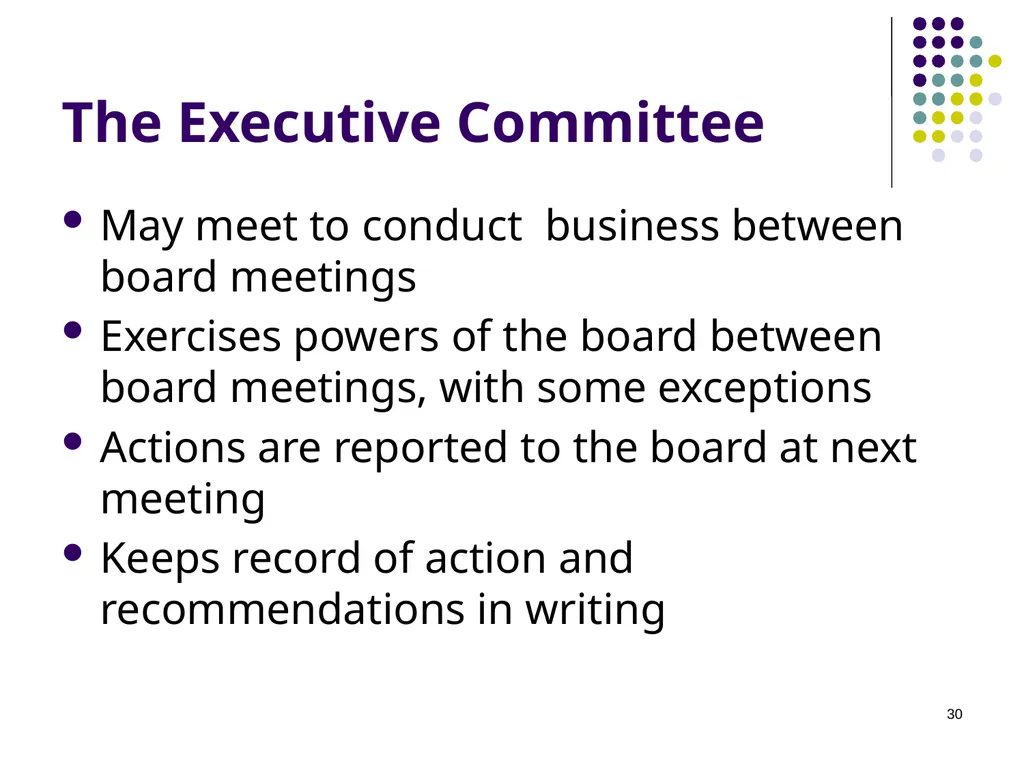
30
30 The Executive Committee May meet to conduct business between board meetings
Exercises powers of the board between board meetings, with some exceptions
Actions are reported to the board at next meeting
Keeps record of action and recommendations in writing<br>
Exercises powers of the board between board meetings, with some exceptions
Actions are reported to the board at next meeting
Keeps record of action and recommendations in writing<br>
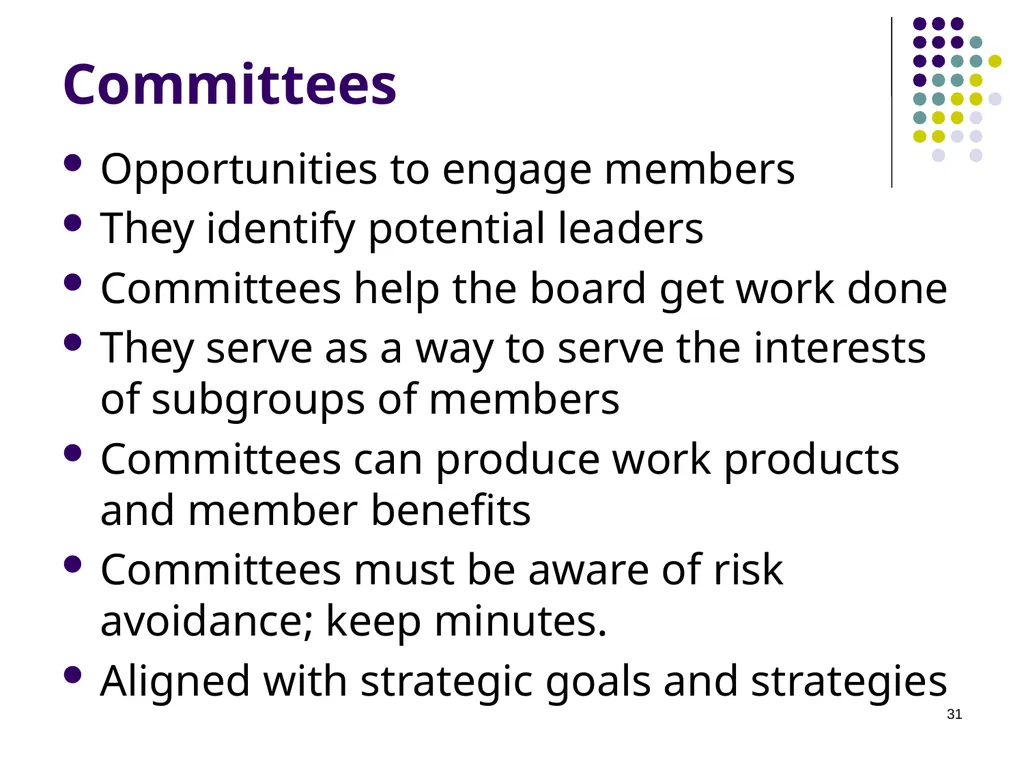
31
31 Committees Opportunities to engage members
They identify potential leaders
Committees help the board get work done
They serve as a way to serve the interests of subgroups of members
Committees can produce work products and member benefits
Committees must be aware of risk avoidance; keep minutes.
Aligned with strategic goals and strategies<br>
They identify potential leaders
Committees help the board get work done
They serve as a way to serve the interests of subgroups of members
Committees can produce work products and member benefits
Committees must be aware of risk avoidance; keep minutes.
Aligned with strategic goals and strategies<br>
32
32 Committees Standing – Identified in the bylaws
Task Forces – Appointed for short term assignments<br>
Task Forces – Appointed for short term assignments<br>
33
33 Board Meetings Usually _____ meetings per year
All directors are requested/expected to attend
Read to lead; directors prepare for meetings in advance
Purpose is to conduct board business, not to perform committee or staff level work
Input to the meeting agenda is welcomes in advance<br>
All directors are requested/expected to attend
Read to lead; directors prepare for meetings in advance
Purpose is to conduct board business, not to perform committee or staff level work
Input to the meeting agenda is welcomes in advance<br>
34
34 Board Meetings The Agenda
Prepared with the input of President and staff, with consideration of current issues, member needs and pending business
If you have items you would like to see added to the agenda, provide to President or Executive Director at least one month in advance
Agendas mailed two weeks before meeting<br>
Prepared with the input of President and staff, with consideration of current issues, member needs and pending business
If you have items you would like to see added to the agenda, provide to President or Executive Director at least one month in advance
Agendas mailed two weeks before meeting<br>
35
35 Board Meetings Minutes
Minutes are a legal record of the meetings and must be approved at the subsequent meeting
They are not a record of conversations, but rather of formal actions taken
Audio recordings should not be retained<br>
Minutes are a legal record of the meetings and must be approved at the subsequent meeting
They are not a record of conversations, but rather of formal actions taken
Audio recordings should not be retained<br>
36
36 Board Meetings Rules of Order
Procedural rules are used to maintain order
All persons must be recognized by the chair before speaking
Time limits may be set on certain topics
Know the basic rules of order to be sure motions and procedures are understood<br>
Procedural rules are used to maintain order
All persons must be recognized by the chair before speaking
Time limits may be set on certain topics
Know the basic rules of order to be sure motions and procedures are understood<br>
37
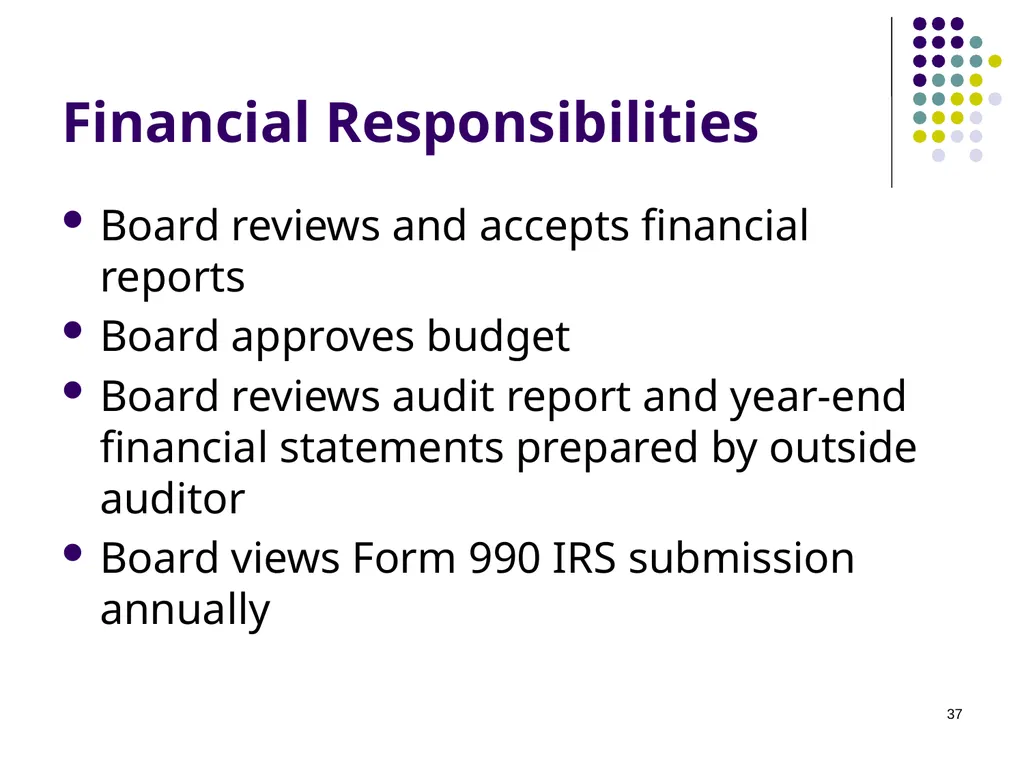
37 Financial Responsibilities Board reviews and accepts financial reports
Board approves budget
Board reviews audit report and year-end financial statements prepared by outside auditor
Board views Form 990 IRS submission annually<br>
Board approves budget
Board reviews audit report and year-end financial statements prepared by outside auditor
Board views Form 990 IRS submission annually<br>
38
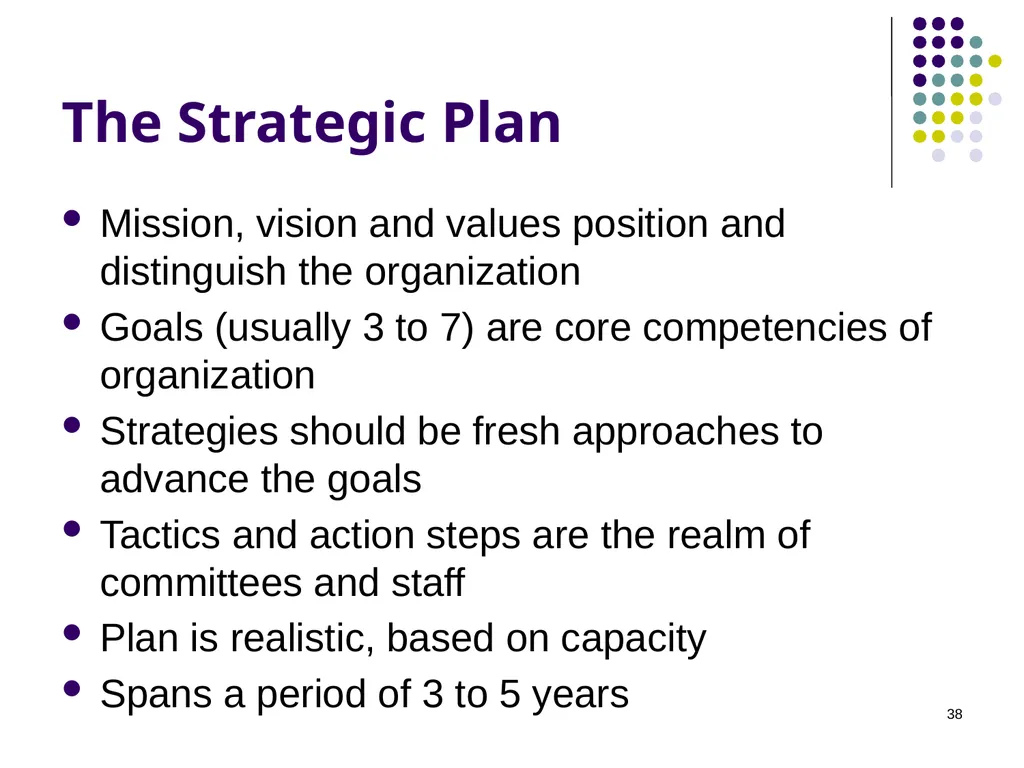
38 The Strategic Plan Mission, vision and values position and distinguish the organization
Goals (usually 3 to 7) are core competencies of organization
Strategies should be fresh approaches to advance the goals
Tactics and action steps are the realm of committees and staff
Plan is realistic, based on capacity
Spans a period of 3 to 5 years<br>
Goals (usually 3 to 7) are core competencies of organization
Strategies should be fresh approaches to advance the goals
Tactics and action steps are the realm of committees and staff
Plan is realistic, based on capacity
Spans a period of 3 to 5 years<br>
39
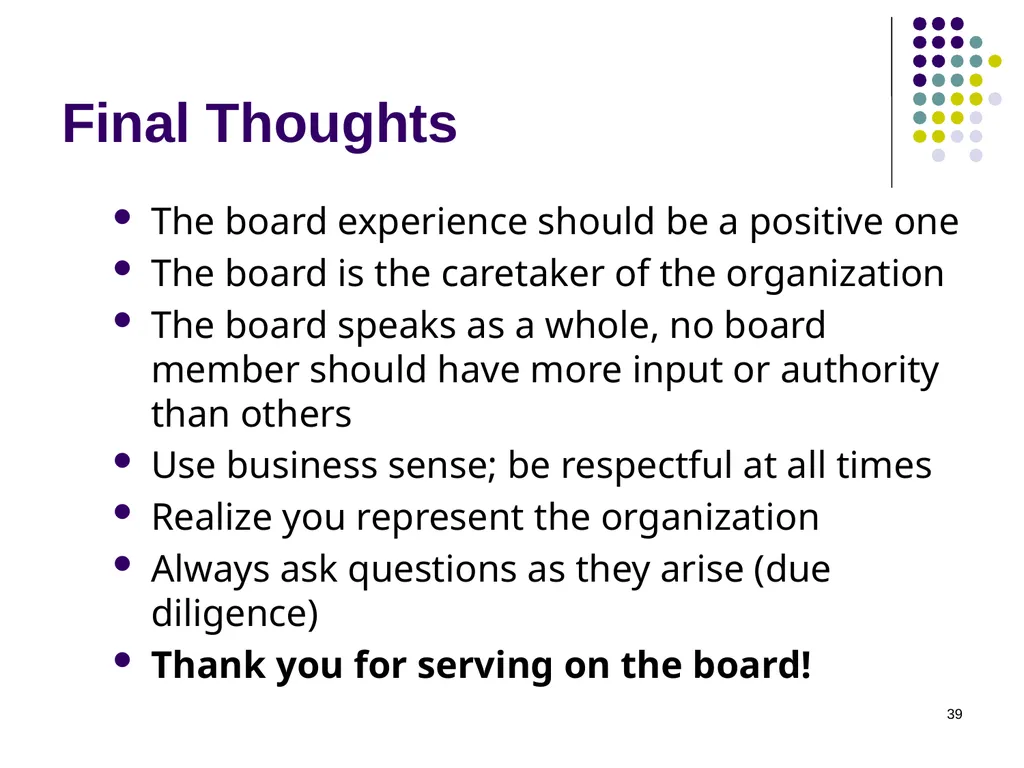
39 Final Thoughts The board experience should be a positive one
The board is the caretaker of the organization
The board speaks as a whole, no board member should have more input or authority than others
Use business sense; be respectful at all times
Realize you represent the organization
Always ask questions as they arise (due diligence)
Thank you for serving on the board!<br>
The board is the caretaker of the organization
The board speaks as a whole, no board member should have more input or authority than others
Use business sense; be respectful at all times
Realize you represent the organization
Always ask questions as they arise (due diligence)
Thank you for serving on the board!<br>
40
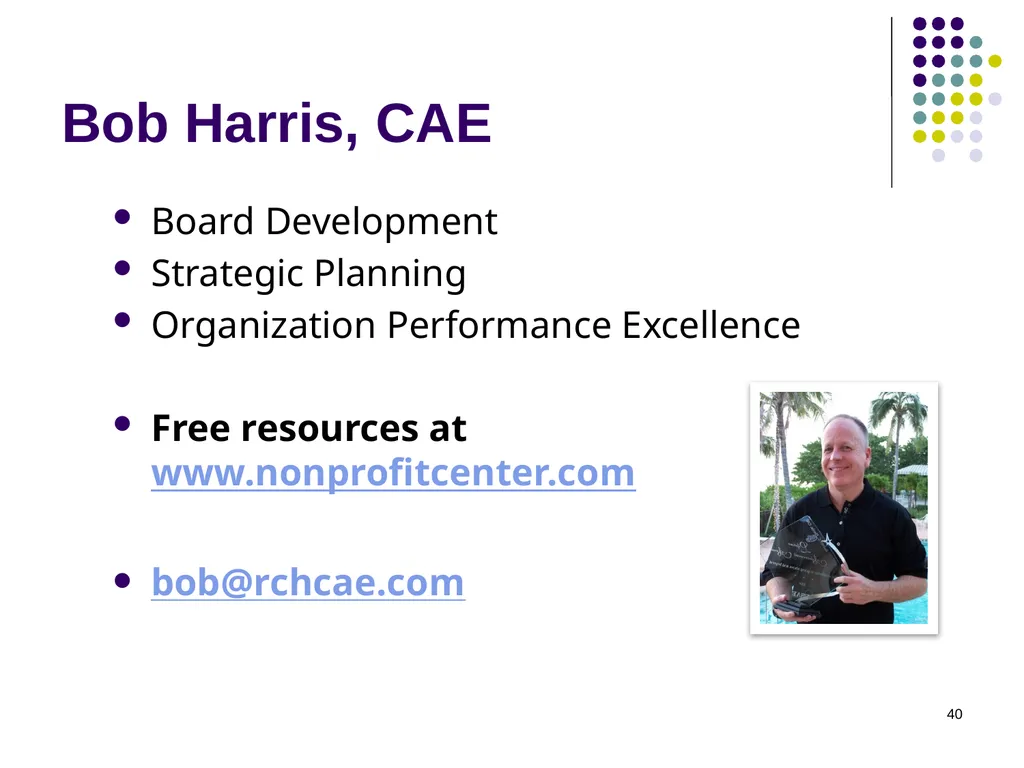
40 Bob Harris, CAE Board Development
Strategic Planning
Organization Performance Excellence
Free resources at www.nonprofitcenter.com
bob@rchcae.com<br>
Strategic Planning
Organization Performance Excellence
Free resources at www.nonprofitcenter.com
bob@rchcae.com<br>