1. Remove this slide and add the remaining slides into the TCCC Curriculum in the TCCC for Medical Personnel curriculum dated 150603. 2. Also remove MAST Trouser (PASG) slides from the TACEVAC Care Presentations TCCC Change 16-02 Pelvic
"1. Remove this slide and add the remaining slides" is the property of its rightful owner. Permission is granted to
download and print the materials on this website for personal, non-commercial use only, and to display it
on your personal computer provided you do not modify the materials and that you retain all copyright
notices contained in the materials. By downloading content from our website, you accept the terms of this
agreement.
Presentation Transcript
01
1. Remove this slide and add the remaining slides into the TCCC Curriculum in the TCCC for Medical Personnel curriculum dated 150603.
2. Also remove MAST Trouser (PASG) slides from the TACEVAC Care Presentations TCCC Change 16-02 Pelvic Binders<br>
02
Treatment of Suspected Pelvic Fractures in TCCC<br>
03
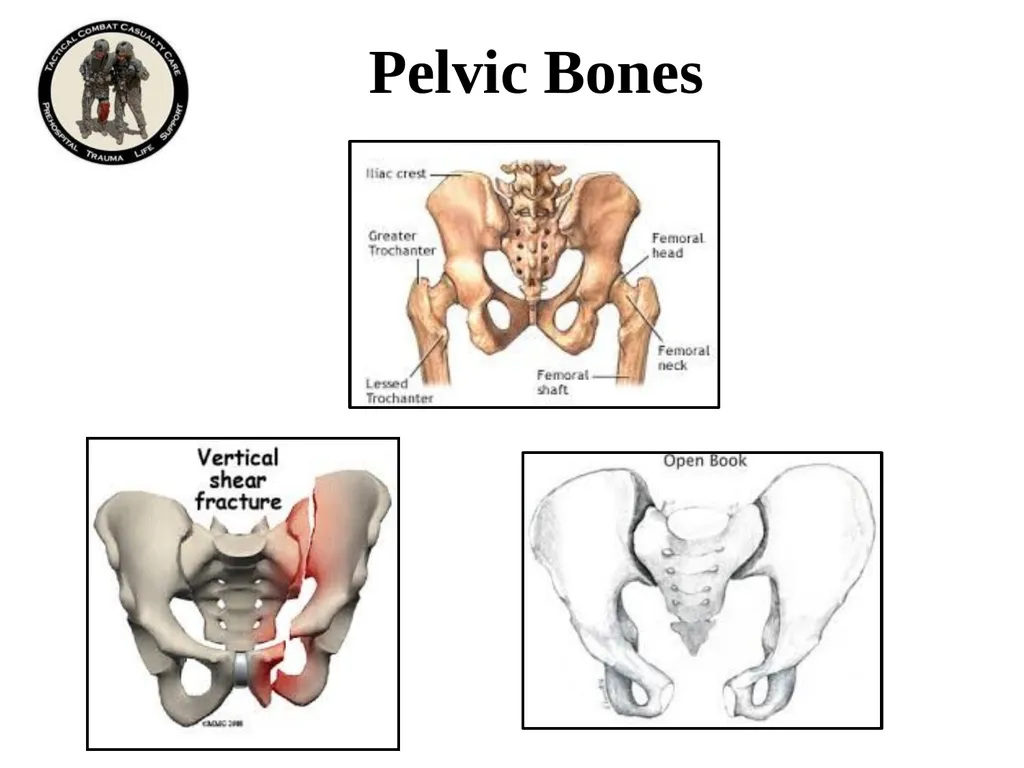
Pelvic Bones<br>
04
Tactical Field Care and TACEVAC Care 4. Bleeding
A pelvic binder should be applied for cases of suspected
pelvic fracture - Severe blunt force or blast injury with
one or more of the following indications:
- Pelvic pain
- Any major lower limb amputation or near amputation
- Physical exam findings suggestive of a pelvic fracture
- Unconsciousness
- Shock<br>
05
Most commonly associated with dismounted IED attacks accompanied by amputations
May also occur in severe blunt trauma (such as
motor vehicle crashes, aircraft mishaps, hard parachute landings, and falls from a height)
26% of service members who died in OEF/OIF had a pelvic fracture.
Bleeding pelvic fractures with hemodynamic instability have up to 40% mortality. Pelvic Fractures in Combat Casualties<br>
06
Pelvic fractures and Lower Limb Amputations due to Dismounted IEDs 77 consecutive patients with traumatic lower limb amputation after stepping on an IED.
Overall - 22% had associated pelvic fractures
Unilateral amputation: 10%
Bilateral amputation: 30%
Bilateral Above knee amputation: 39%
“This study demonstrates a high incidence of pelvic fractures in patients with traumatic lower limb amputations, supporting routine pre-hospital application of pelvic binders in this patient group” Cross 2014<br>
07
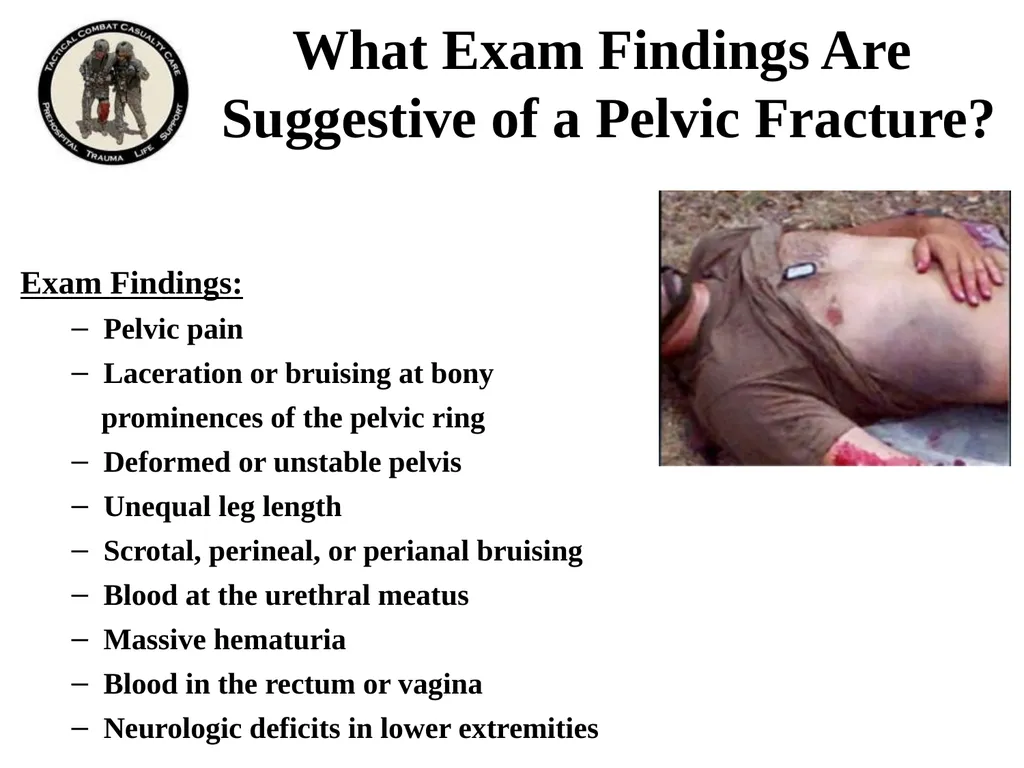
What Exam Findings Are Suggestive of a Pelvic Fracture? Exam Findings:
Pelvic pain
Laceration or bruising at bony
prominences of the pelvic ring
Deformed or unstable pelvis
Unequal leg length
Scrotal, perineal, or perianal bruising
Blood at the urethral meatus
Massive hematuria
Blood in the rectum or vagina
Neurologic deficits in lower extremities<br>
08
What Type of Pelvic Binder Should Be Used There are 3 commercially available pelvic binders:
- The Pelvic Binder
- The T-POD
- The SAM Sling
Additionally, two types of junctional tourniquets
May also serve as pelvic binders:
- The SAM Junctional Splint
- The Junctional Emergency Treatment Tool
* All 5 devices are recommended as options by TCCC.<br>
09
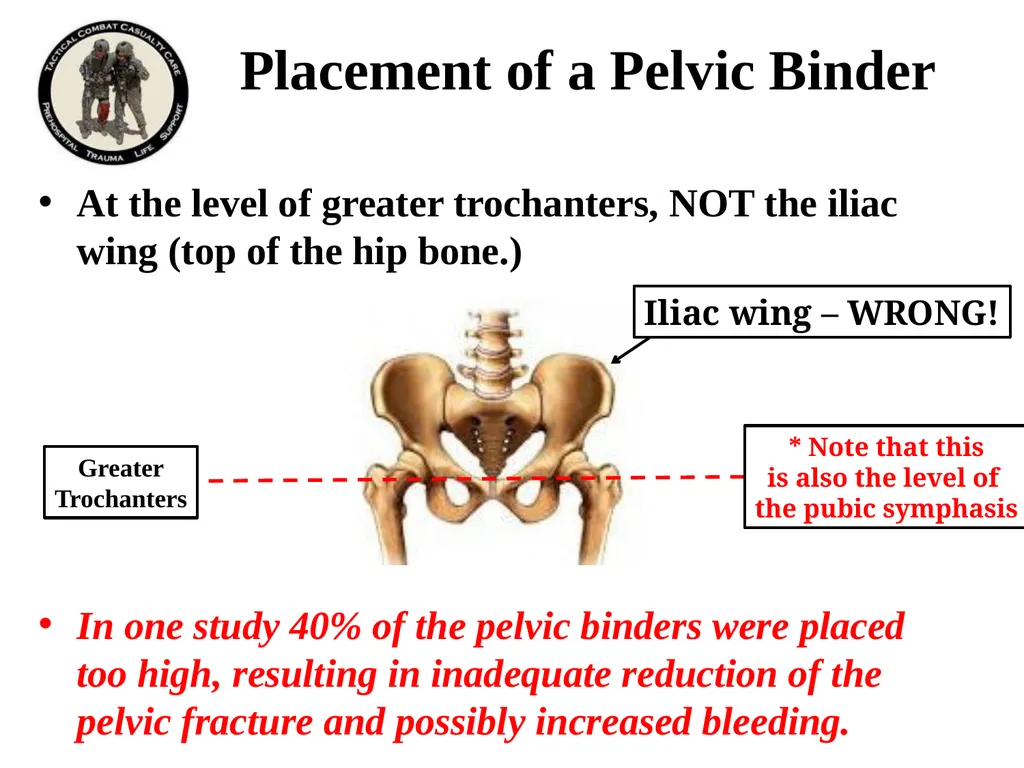
Placement of a Pelvic Binder At the level of greater trochanters, NOT the iliac wing (top of the hip bone.)
In one study 40% of the pelvic binders were placed too high, resulting in inadequate reduction of the pelvic fracture and possibly increased bleeding. Greater
Trochanters * Note that this
is also the level of
the pubic symphasis Iliac wing – WRONG!<br>
10
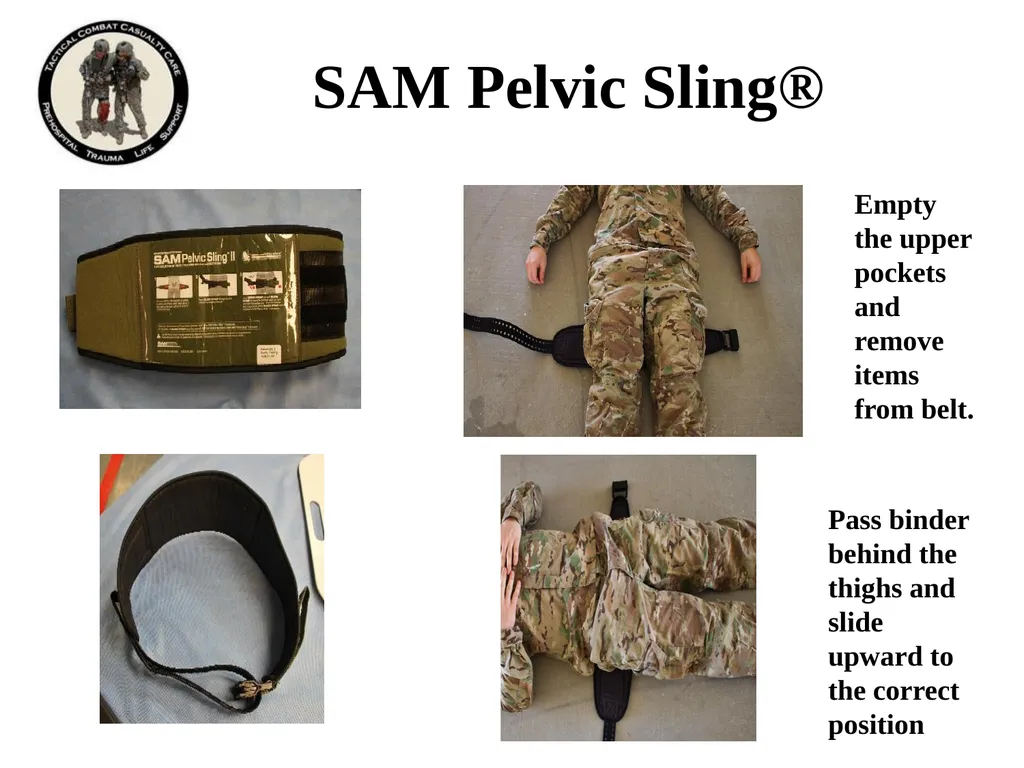
SAM Pelvic Sling® Pass binder behind the thighs and slide upward to the correct position Empty the upper pockets and remove items from belt.<br>
11
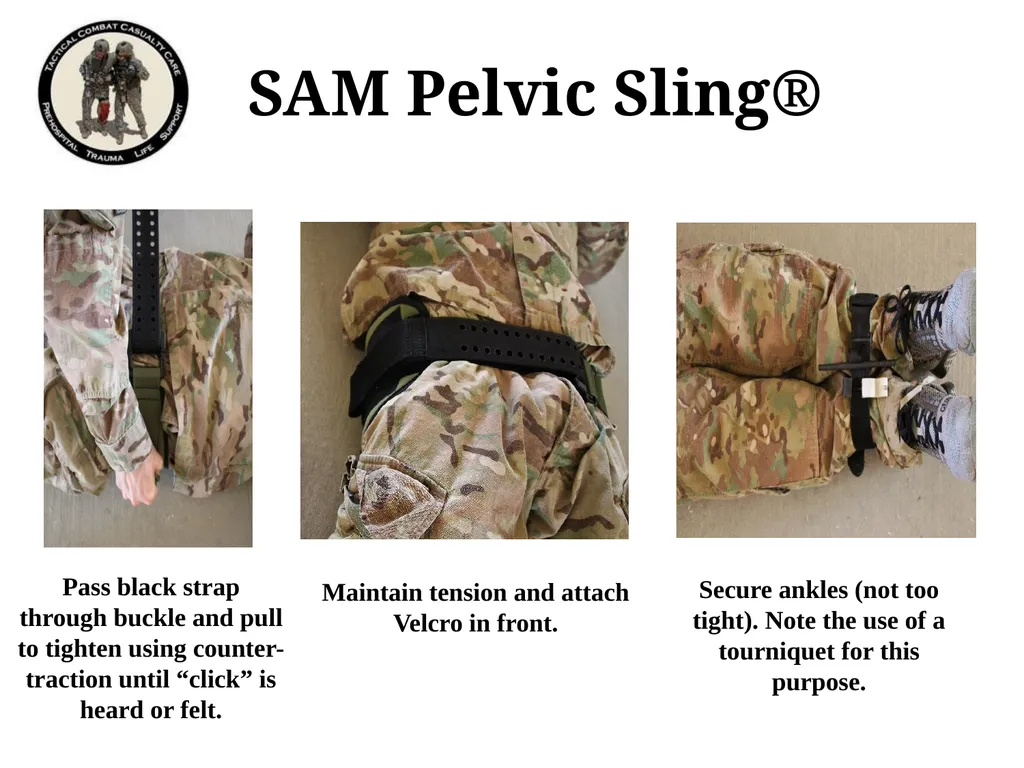
Pass black strap through buckle and pull to tighten using counter-traction until “click” is heard or felt. Maintain tension and attach Velcro in front. Secure ankles (not too tight). Note the use of a tourniquet for this purpose. SAM Pelvic Sling®<br>
12
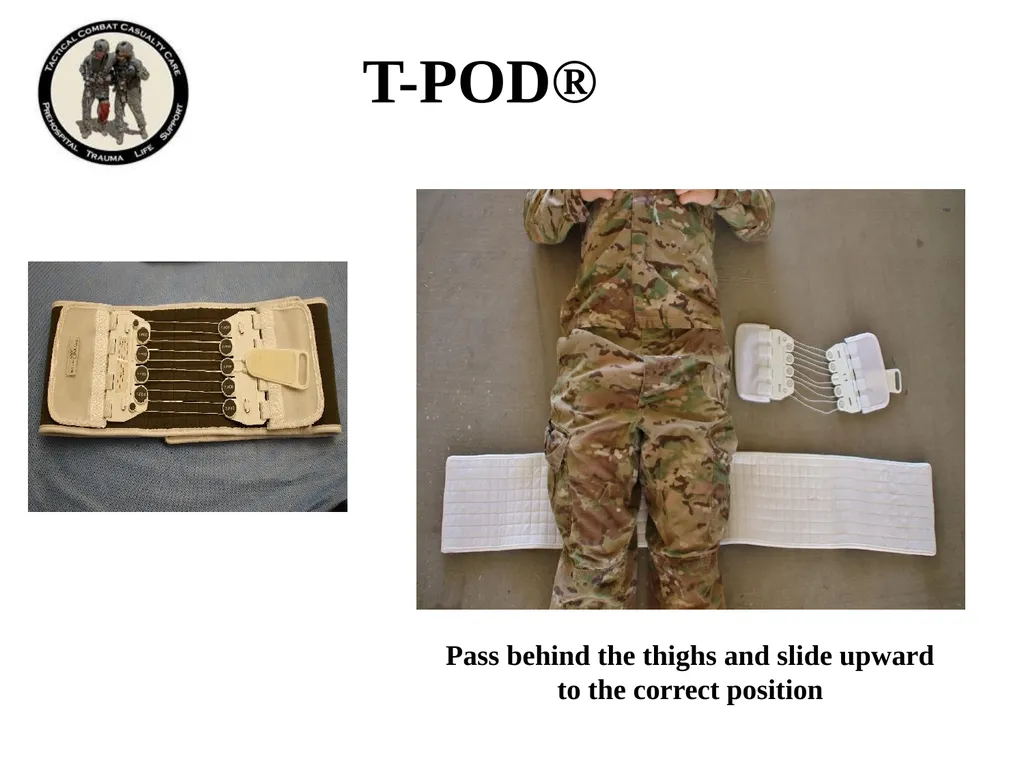
T-POD® Pass behind the thighs and slide upward to the correct position<br>
13
Cut or fold the belt to leave a 6-8” gap in front and secure Velcro to belt. Slowly tighten by pulling the tab. Secure cord to the hooks and Velcro-backed pull tab to the belt. Secure ankles (not too tight) Secure toes to prevent external rotation. T-POD®<br>
14
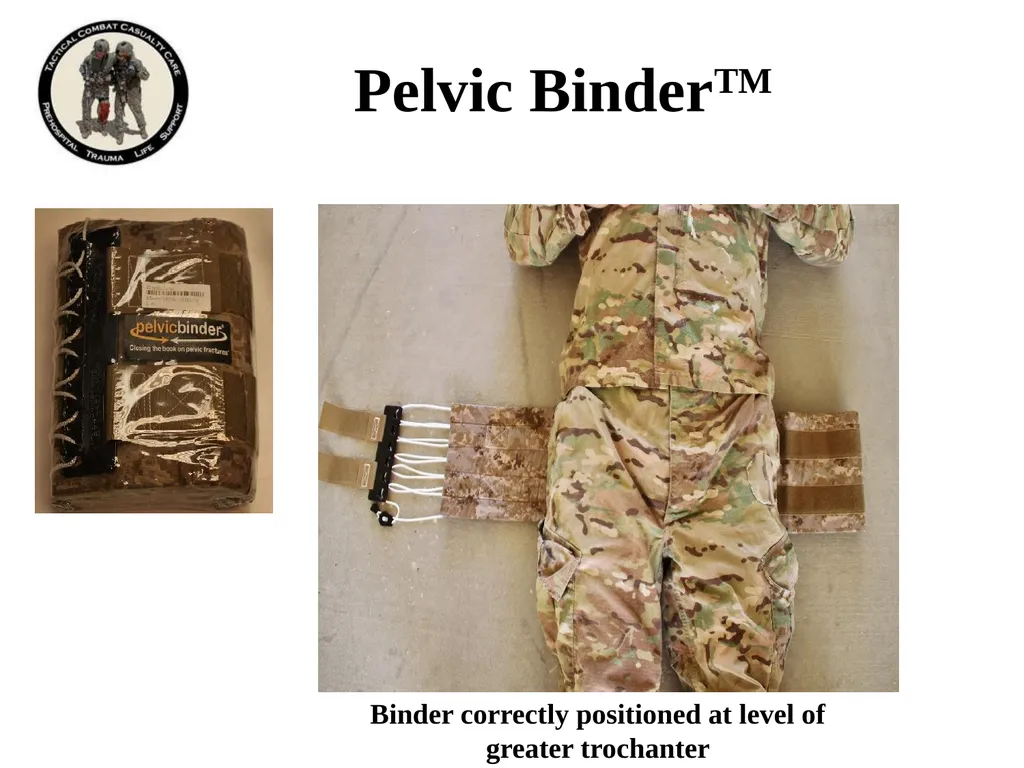
Pelvic BinderTM Binder correctly positioned at level of greater trochanter<br>
15
Cut or fold the belt to the edge of the plates in front and secure Velcro to belt. Pull cord to slowly tighten and slide lock. Secure ankles (not too tight). Pelvic BinderTM<br>
16
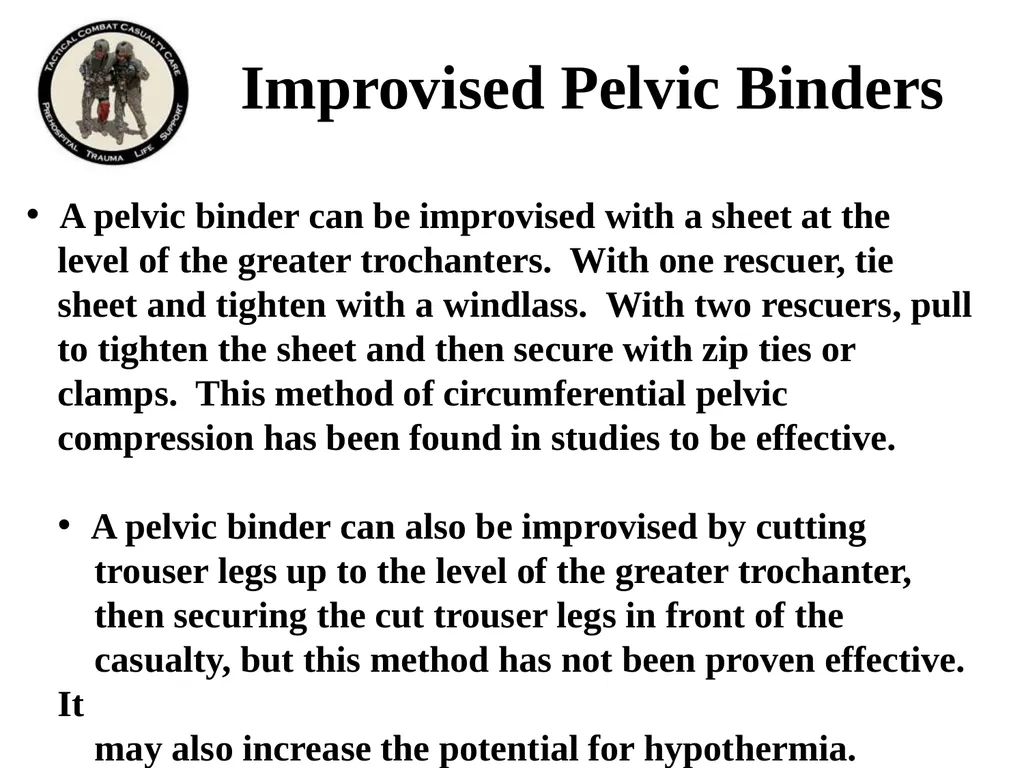
Improvised Pelvic Binders A pelvic binder can be improvised with a sheet at the
level of the greater trochanters. With one rescuer, tie sheet and tighten with a windlass. With two rescuers, pull to tighten the sheet and then secure with zip ties or clamps. This method of circumferential pelvic compression has been found in studies to be effective.
A pelvic binder can also be improvised by cutting
trouser legs up to the level of the greater trochanter,
then securing the cut trouser legs in front of the
casualty, but this method has not been proven effective. It
may also increase the potential for hypothermia.<br>
17
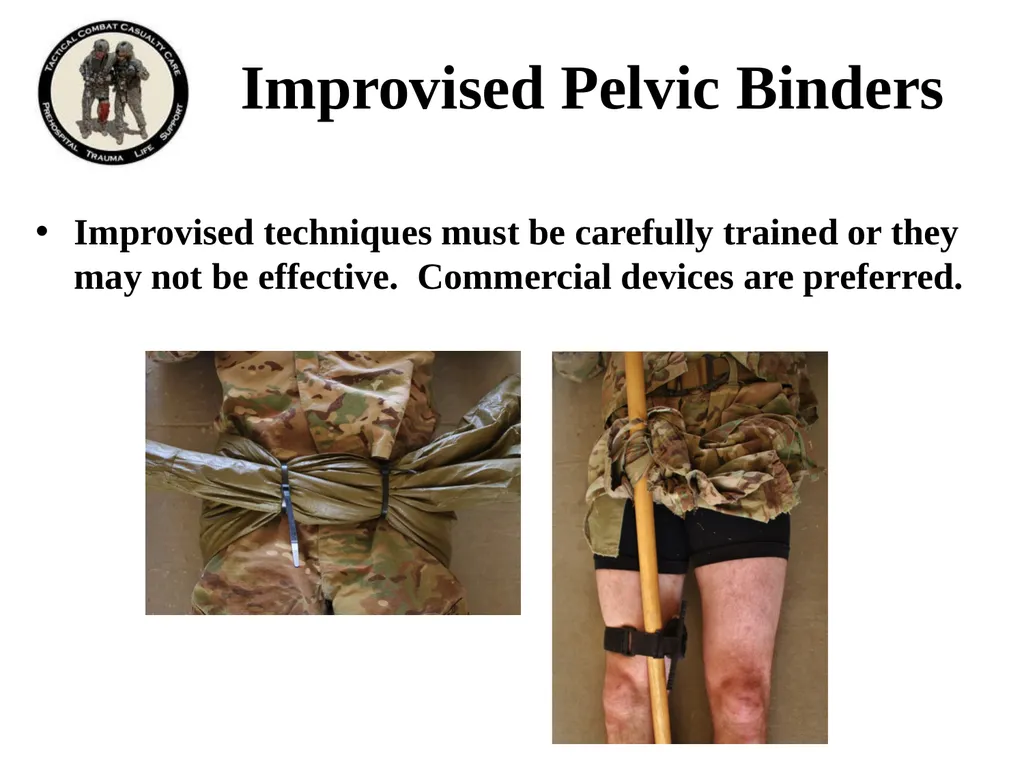
Improvised Pelvic Binders Improvised techniques must be carefully trained or they may not be effective. Commercial devices are preferred.<br>
18
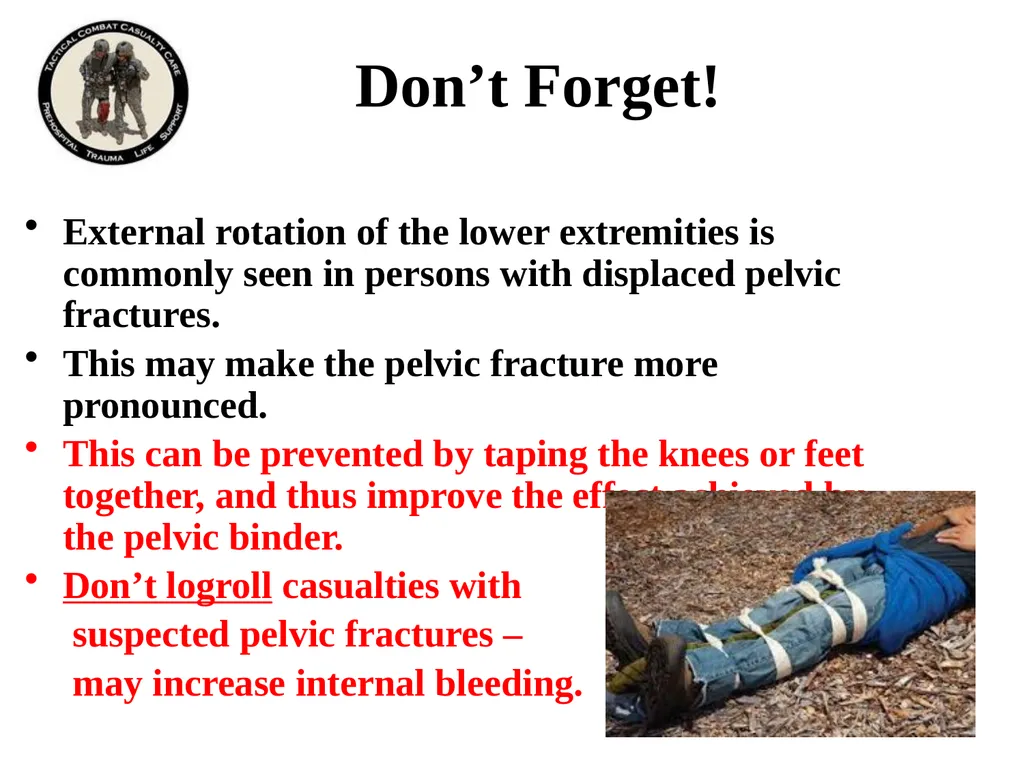
Don’t Forget! External rotation of the lower extremities is commonly seen in persons with displaced pelvic fractures.
This may make the pelvic fracture more pronounced.
This can be prevented by taping the knees or feet together, and thus improve the effect achieved by the pelvic binder.
Don’t logroll casualties with
suspected pelvic fractures –
may increase internal bleeding.<br>
19
Don’t Forget! Once a binder in on, if additional procedures require access to the abdomen or groin (i,e, REBOA), the binder may be moved down to the upper thigh. This will limit external rotation and minimize the reopening of the pelvis.
Use of one of the two circumferential junctional tourniquets (the SAM or the JETT) will also allow for control of external junctional hemorrhage without moving the device.
If definitive care is delayed beyond approximately 8-12 hours, the need for a binder should be reassessed and the binder loosened if the patient remains hemodynamically stable.<br>
20
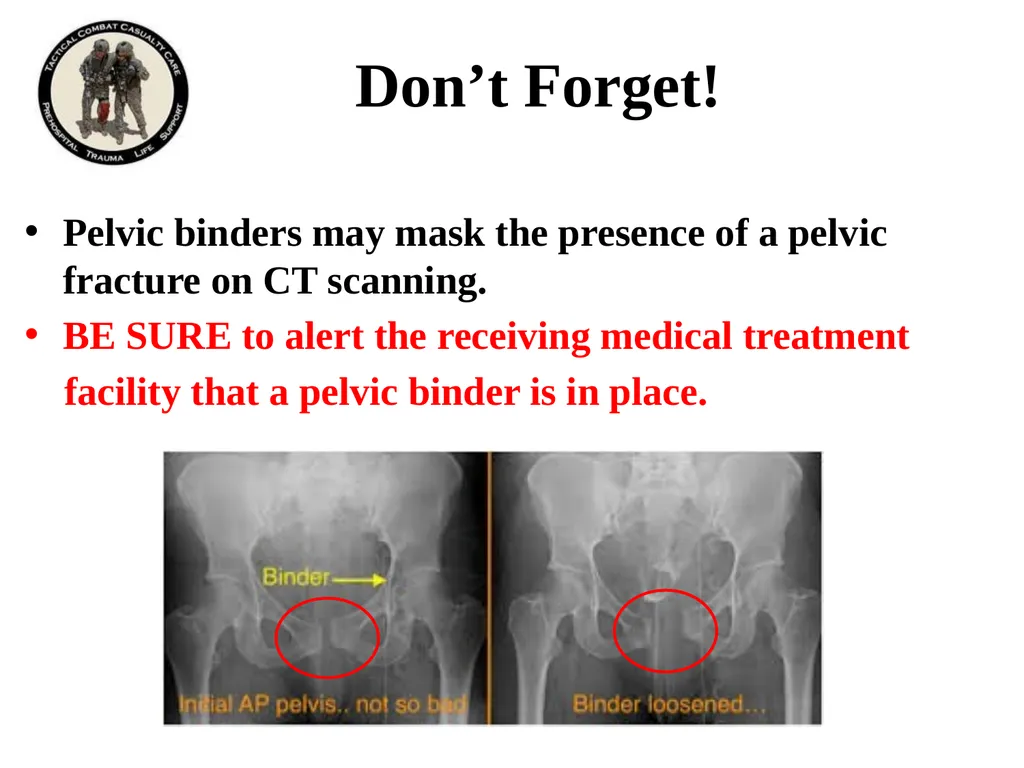
Don’t Forget! Pelvic binders may mask the presence of a pelvic fracture on CT scanning.
BE SURE to alert the receiving medical treatment
facility that a pelvic binder is in place.<br>
21
Pneumatic Antishock Garment No longer recommended in TCCC
REMOVE the following from the Tactical
Evacuation Care Guidelines:
“17. The Pneumatic Antishock Garment (PASG)
may be useful for stabilizing pelvic fractures and controlling
pelvic and abdominal bleeding. Application and extended
use must be carefully monitored. The PASG is
contraindicated for casualties with thoracic or brain
injuries.”<br>