
1 Research Administration Hot Topics Mark Sweet,

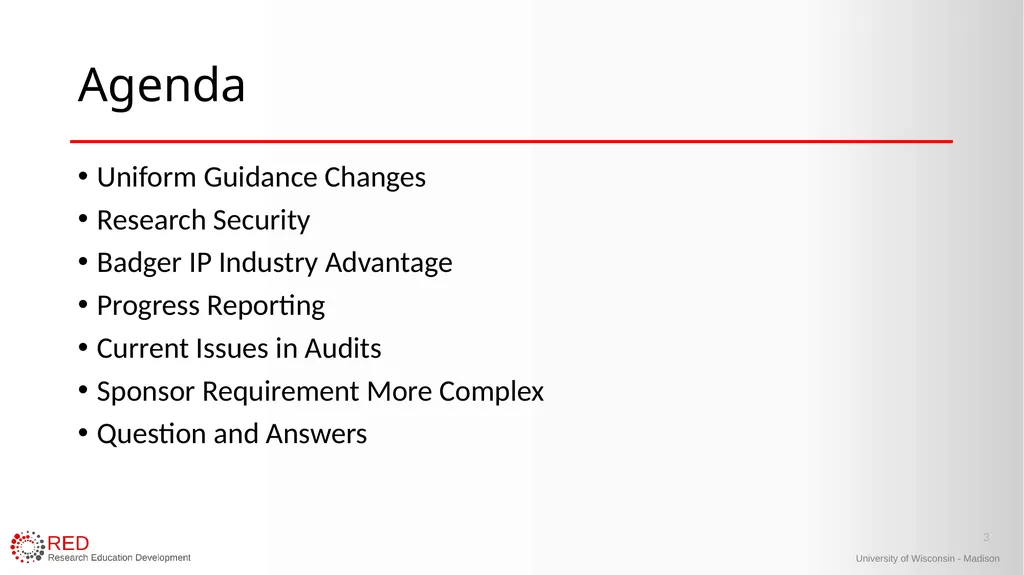
Description: 1 Research Administration Hot Topics Mark Sweet, Interim Assoc. Vice Chancellor for Research Administration Angie Johnson, Assistant Director Research Financial Services Bob Gratzl, Interim Assoc. Director Grants and Contracts 2 Agenda
Related Topics
Download Presentation
"1 Research Administration Hot Topics Mark Sweet," is the property of its rightful owner. Permission is granted to download and print the materials on this website for personal, non-commercial use only, and to display it on your personal computer provided you do not modify the materials and that you retain all copyright notices contained in the materials. By downloading content from our website, you accept the terms of this agreement.
Presentation Transcript
slide1. 1<br>
slide2. Research Administration Hot Topics Mark Sweet, Interim Assoc. Vice Chancellor for Research Administration
Angie Johnson, Assistant Director Research Financial Services
Bob Gratzl, Interim Assoc. Director Grants and Contracts 2<br>
slide3. Agenda Uniform Guidance Changes
Research Security
Badger IP Industry Advantage
Progress Reporting
Current Issues in Audits
Sponsor Requirement More Complex
Question and Answers 3<br>
slide4. Uniform Guidance (2 CFR 200)<br>
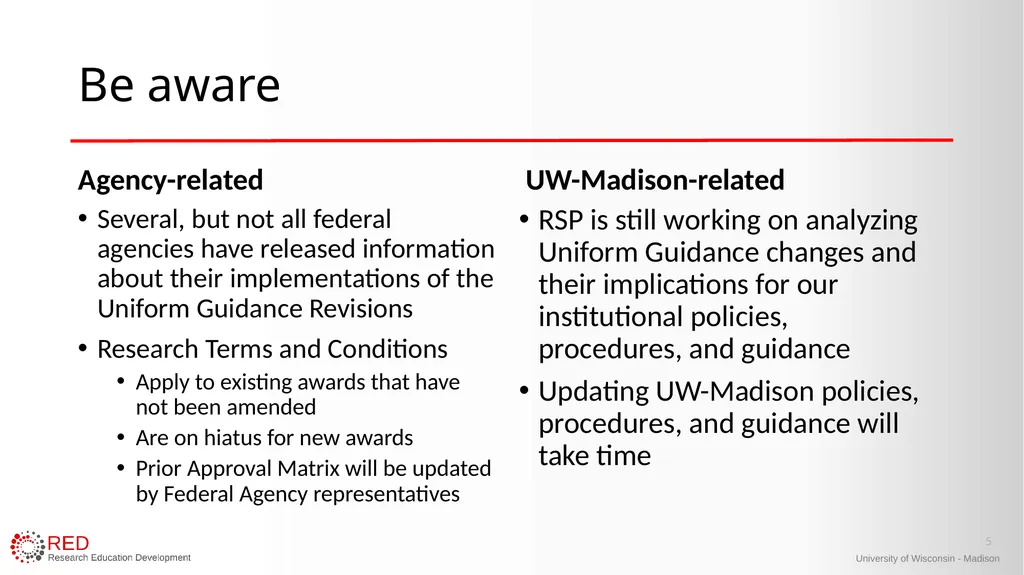
slide5. Be aware Agency-related Several, but not all federal agencies have released information about their implementations of the Uniform Guidance Revisions
Research Terms and Conditions
Apply to existing awards that have not been amended
Are on hiatus for new awards
Prior Approval Matrix will be updated by Federal Agency representatives UW-Madison-related RSP is still working on analyzing Uniform Guidance changes and their implications for our institutional policies, procedures, and guidance
Updating UW-Madison policies, procedures, and guidance will take time 5<br>
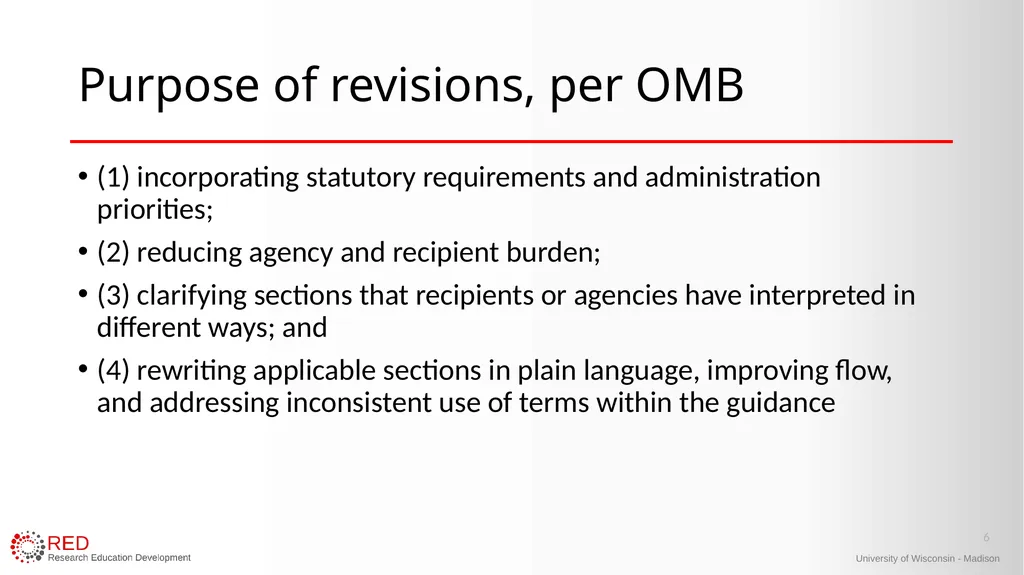
slide6. Purpose of revisions, per OMB (1) incorporating statutory requirements and administration priorities;
(2) reducing agency and recipient burden;
(3) clarifying sections that recipients or agencies have interpreted in different ways; and
(4) rewriting applicable sections in plain language, improving flow, and addressing inconsistent use of terms within the guidance 6<br>
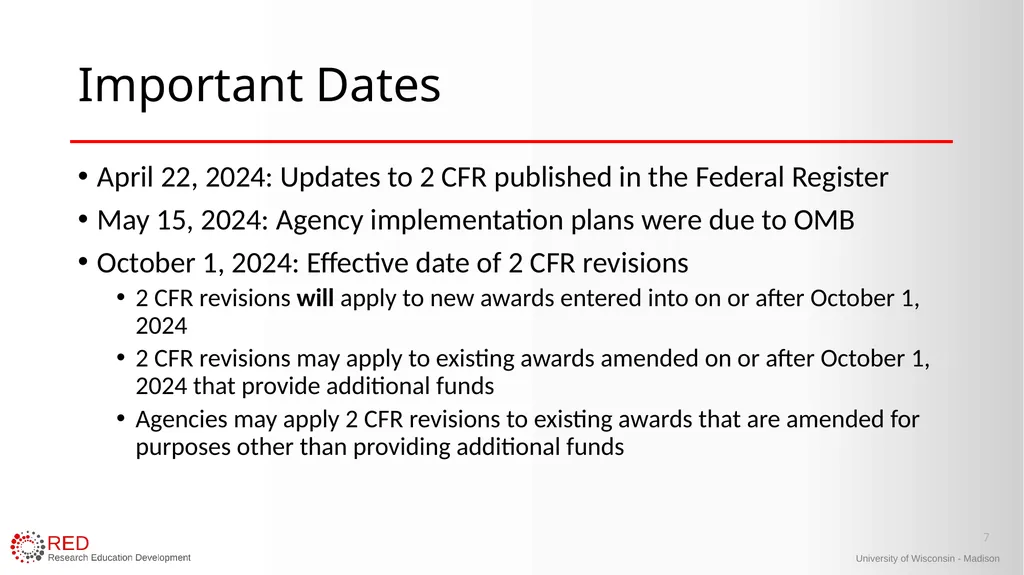
slide7. Important Dates April 22, 2024: Updates to 2 CFR published in the Federal Register
May 15, 2024: Agency implementation plans were due to OMB
October 1, 2024: Effective date of 2 CFR revisions
2 CFR revisions will apply to new awards entered into on or after October 1, 2024
2 CFR revisions may apply to existing awards amended on or after October 1, 2024 that provide additional funds
Agencies may apply 2 CFR revisions to existing awards that are amended for purposes other than providing additional funds 7<br>
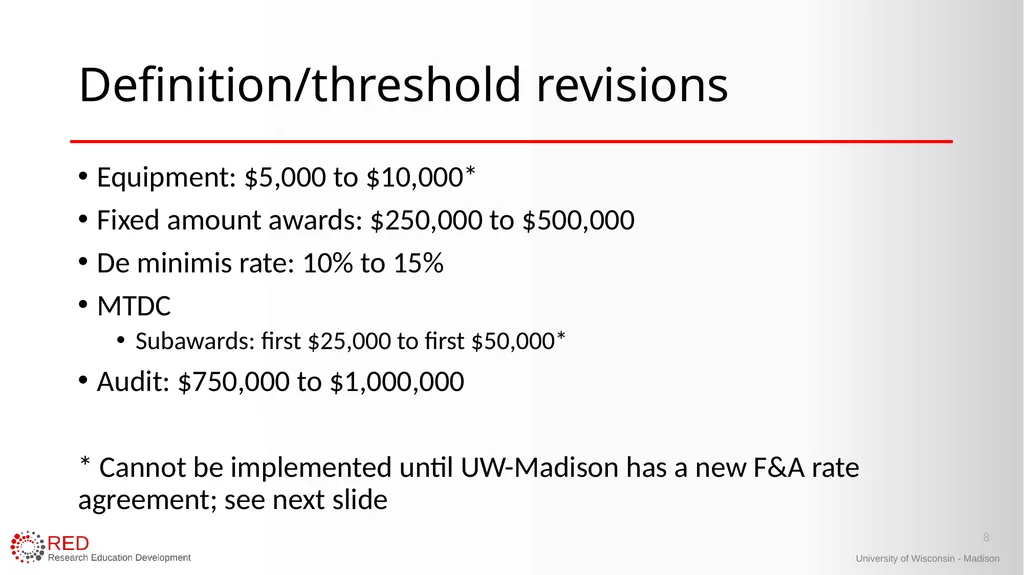
slide8. Definition/threshold revisions Equipment: $5,000 to $10,000*
Fixed amount awards: $250,000 to $500,000
De minimis rate: 10% to 15%
MTDC
Subawards: first $25,000 to first $50,000*
Audit: $750,000 to $1,000,000
* Cannot be implemented until UW-Madison has a new F&A rate agreement; see next slide 8<br>
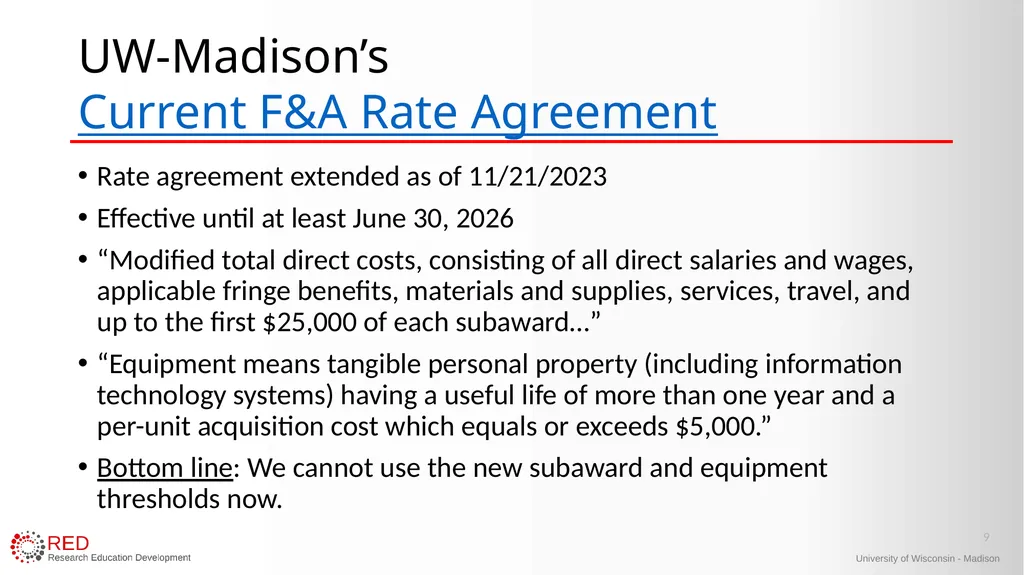
slide9. UW-Madison’s Current F&A Rate Agreement Rate agreement extended as of 11/21/2023
Effective until at least June 30, 2026
“Modified total direct costs, consisting of all direct salaries and wages, applicable fringe benefits, materials and supplies, services, travel, and up to the first $25,000 of each subaward…”
“Equipment means tangible personal property (including information technology systems) having a useful life of more than one year and a per-unit acquisition cost which equals or exceeds $5,000.”
Bottom line: We cannot use the new subaward and equipment thresholds now. 9<br>
slide10. Research Security<br>
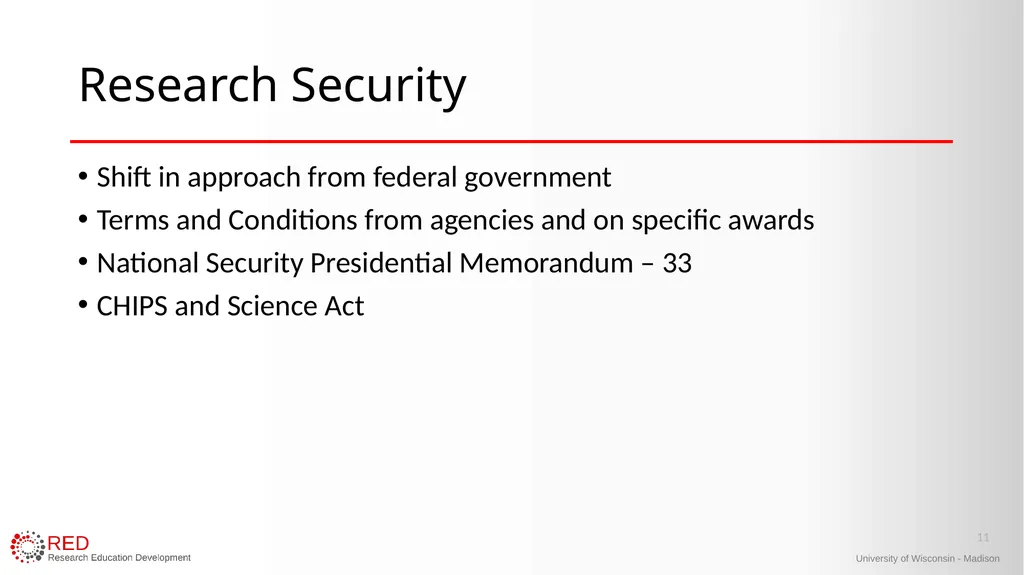
slide11. Research Security Shift in approach from federal government
Terms and Conditions from agencies and on specific awards
National Security Presidential Memorandum – 33
CHIPS and Science Act 11<br>
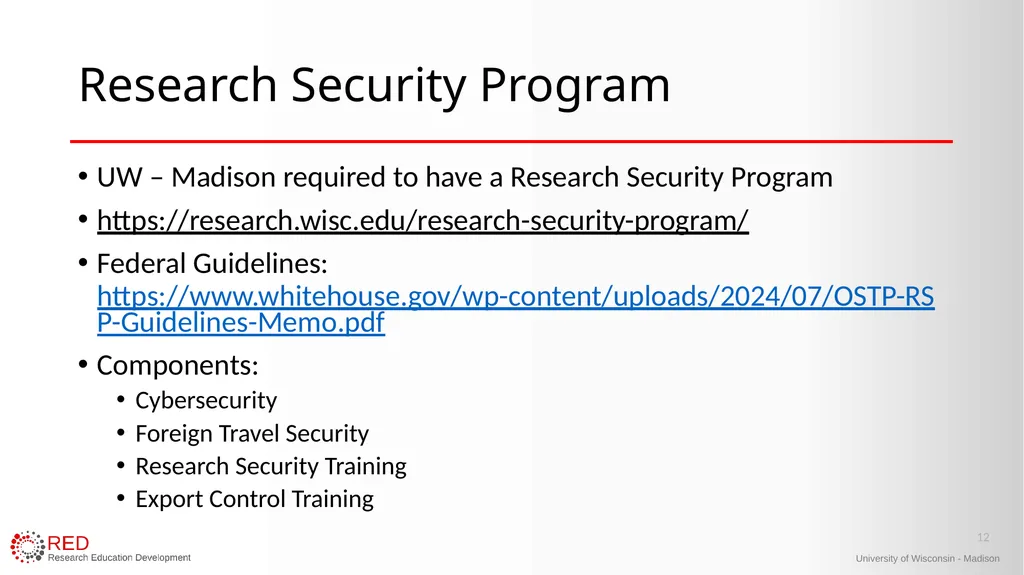
slide12. Research Security Program UW – Madison required to have a Research Security Program
https://research.wisc.edu/research-security-program/
Federal Guidelines: https://www.whitehouse.gov/wp-content/uploads/2024/07/OSTP-RSP-Guidelines-Memo.pdf
Components:
Cybersecurity
Foreign Travel Security
Research Security Training
Export Control Training 12<br>
slide13. Research Security Training Required training
Covered Individuals
PIs and UW-Madison will need to certify completion of training
Department of Energy requiring May 2025 13<br>
slide14. Research Security: Digital Persistent Identifiers Uniquely identify digital output - publications, webpages, documents, etc.
Uniquely identify people
NPSM-33 directed federal agencies to use DPIs 14<br>
slide15. Research Security: ORCID ID 15 Persistent Digital Identifier
REQUIRED by NIH and Dept. of Energy MAY 2025!
All PIs/PD, Key Personnel – Covered Individuals
Our advice: research administrators obtain their own ORCID ID to assist investigators<br>
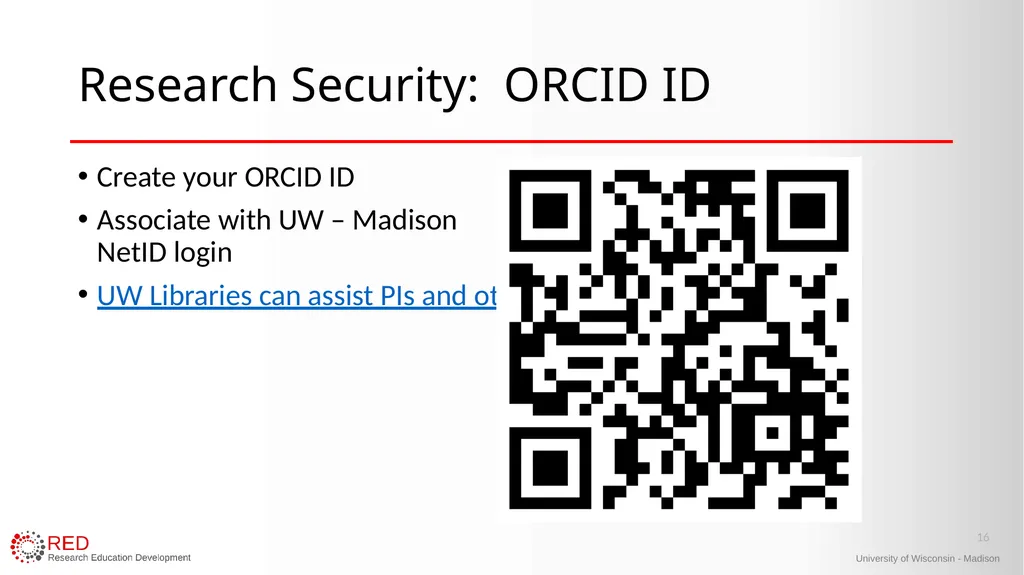
slide16. Research Security: ORCID ID Create your ORCID ID
Associate with UW – Madison NetID login
UW Libraries can assist PIs and others with ORCID 16<br>
slide17. The Badger IP Industry Advantage<br>
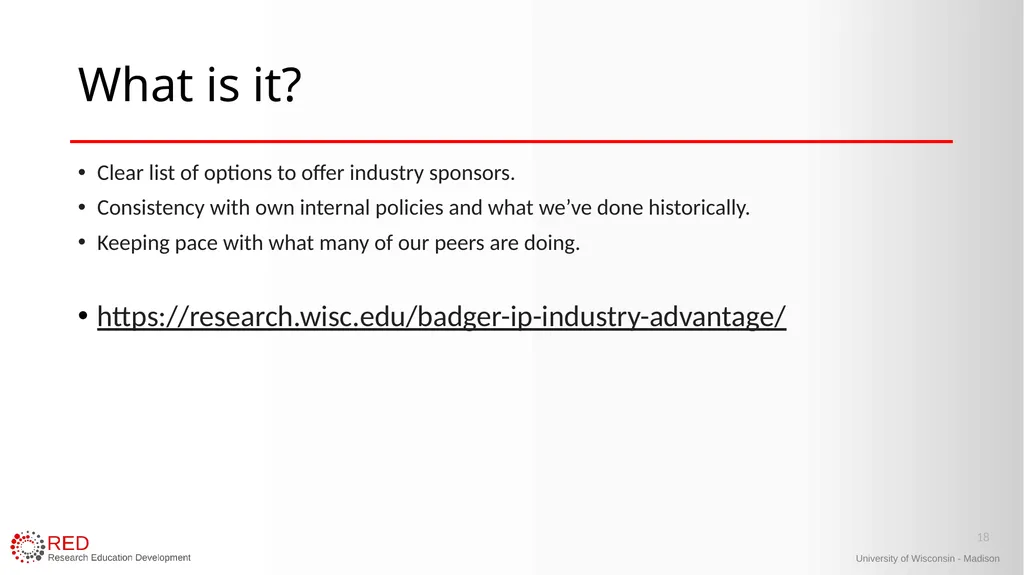
slide18. What is it? Clear list of options to offer industry sponsors.
Consistency with own internal policies and what we’ve done historically.
Keeping pace with what many of our peers are doing.
https://research.wisc.edu/badger-ip-industry-advantage/ 18<br>
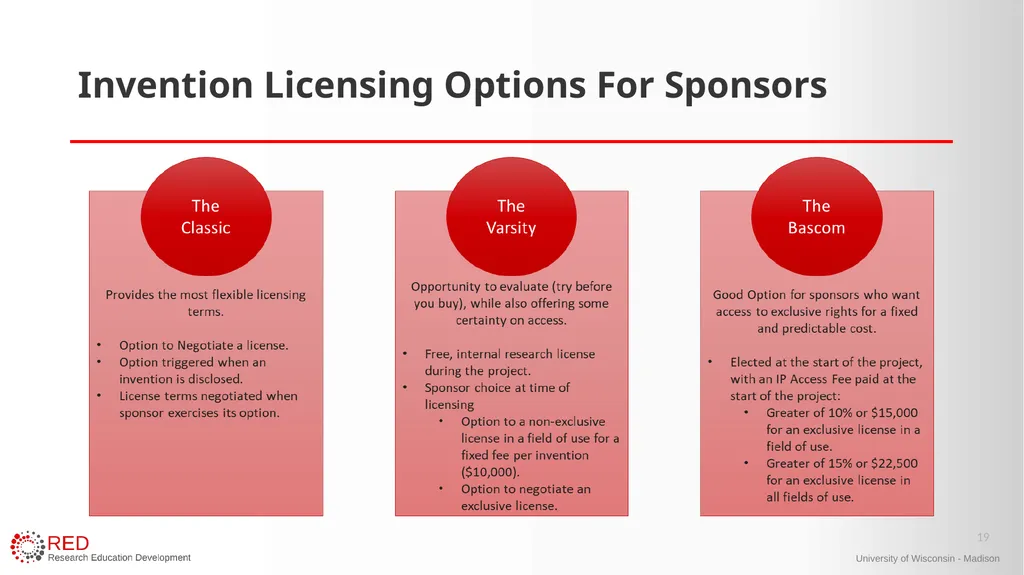
slide19. Invention Licensing Options For Sponsors 19<br>
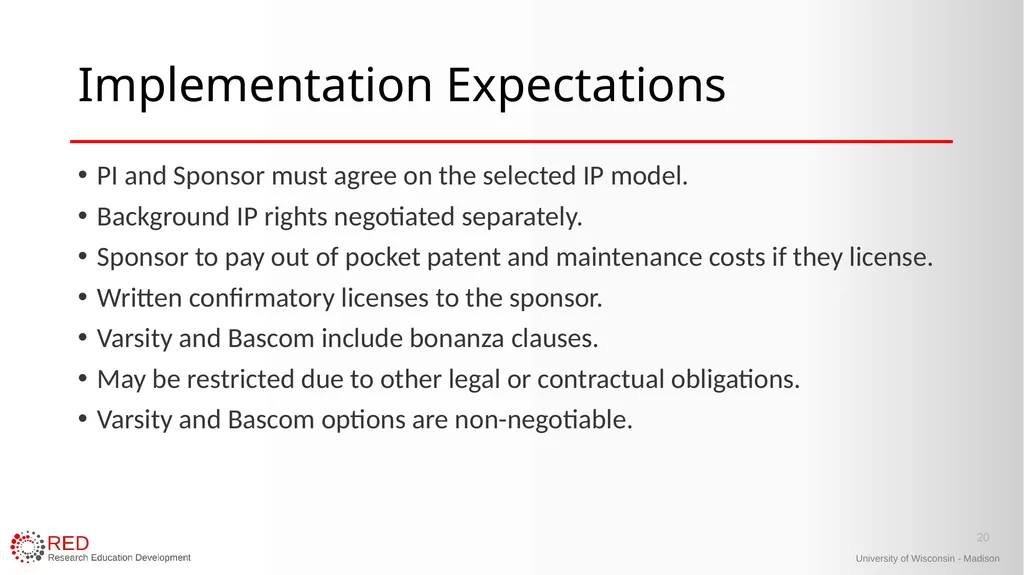
slide20. Implementation Expectations PI and Sponsor must agree on the selected IP model.
Background IP rights negotiated separately.
Sponsor to pay out of pocket patent and maintenance costs if they license.
Written confirmatory licenses to the sponsor.
Varsity and Bascom include bonanza clauses.
May be restricted due to other legal or contractual obligations.
Varsity and Bascom options are non-negotiable. 20<br>
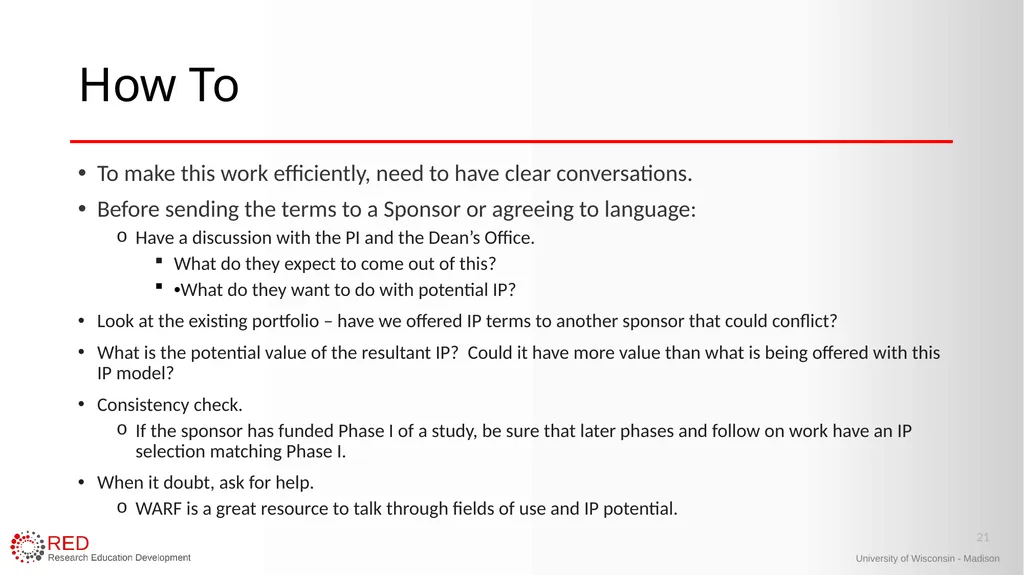
slide21. How To To make this work efficiently, need to have clear conversations.
Before sending the terms to a Sponsor or agreeing to language:
Have a discussion with the PI and the Dean’s Office.
What do they expect to come out of this?
•What do they want to do with potential IP?
Look at the existing portfolio – have we offered IP terms to another sponsor that could conflict?
What is the potential value of the resultant IP? Could it have more value than what is being offered with this IP model?
Consistency check.
If the sponsor has funded Phase I of a study, be sure that later phases and follow on work have an IP selection matching Phase I.
When it doubt, ask for help.
WARF is a great resource to talk through fields of use and IP potential. 21<br>
slide22. Progress Reports (RPPRs)<br>
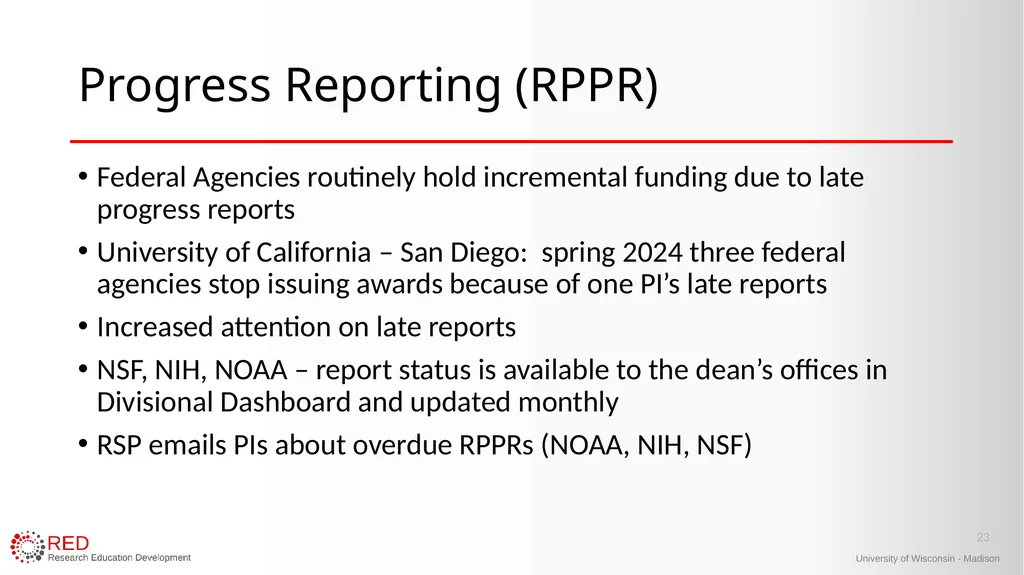
slide23. Progress Reporting (RPPR) Federal Agencies routinely hold incremental funding due to late progress reports
University of California – San Diego: spring 2024 three federal agencies stop issuing awards because of one PI’s late reports
Increased attention on late reports
NSF, NIH, NOAA – report status is available to the dean’s offices in Divisional Dashboard and updated monthly
RSP emails PIs about overdue RPPRs (NOAA, NIH, NSF) 23<br>
slide24. Audits<br>
slide25. Audits Increased focus on subaward monitoring
Documentation
Be aware of Record Retention Policies and who's responsible for retaining documentation
Understand Contractual Requirements 25<br>
slide26. Sponsor Requirements More Complex<br>
slide27. Sponsor Requirements More Complex Increase in required documentation for invoicing and reporting
More portals
Required kick off meetings and monthly/bi-monthly or quarterly meetings (NIH, CDC, Dept of ED, Dept of Commerce, DOE) 27<br>
slide28. Question and Answer<br>
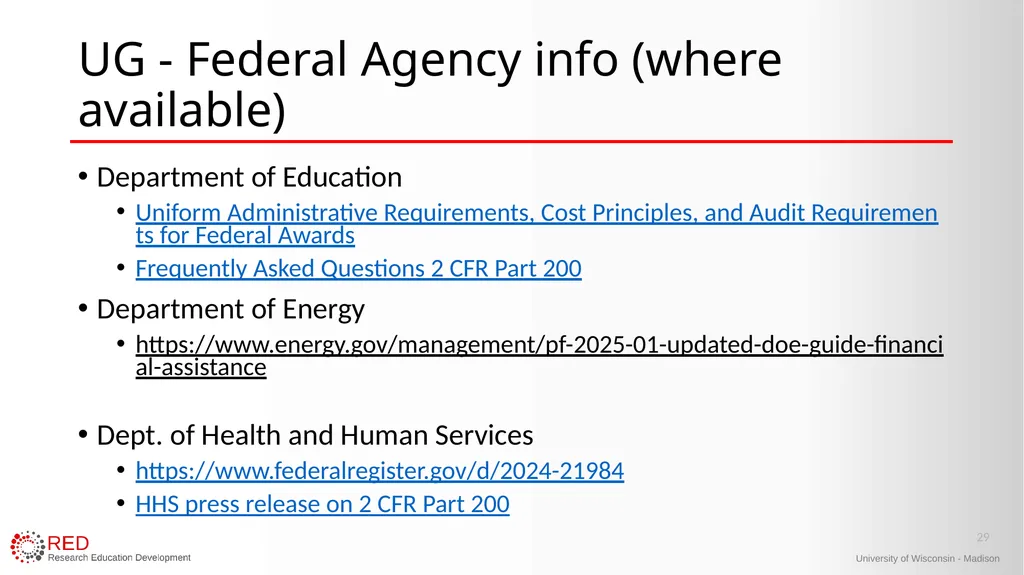
slide29. UG - Federal Agency info (where available) Department of Education
Uniform Administrative Requirements, Cost Principles, and Audit Requirements for Federal Awards
Frequently Asked Questions 2 CFR Part 200
Department of Energy
https://www.energy.gov/management/pf-2025-01-updated-doe-guide-financial-assistance
Dept. of Health and Human Services
https://www.federalregister.gov/d/2024-21984
HHS press release on 2 CFR Part 200 29<br>
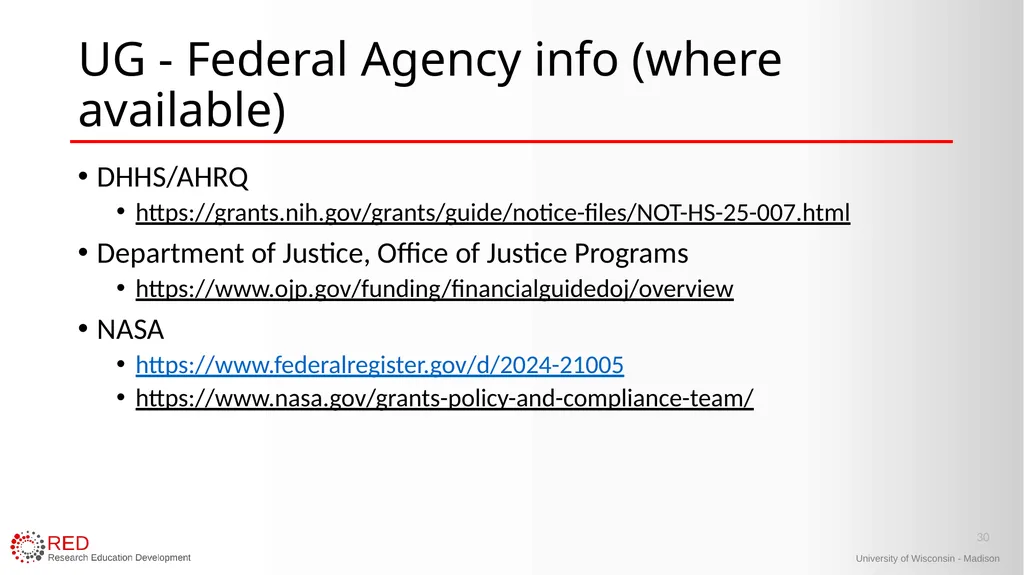
slide30. UG - Federal Agency info (where available) DHHS/AHRQ
https://grants.nih.gov/grants/guide/notice-files/NOT-HS-25-007.html
Department of Justice, Office of Justice Programs
https://www.ojp.gov/funding/financialguidedoj/overview
NASA
https://www.federalregister.gov/d/2024-21005
https://www.nasa.gov/grants-policy-and-compliance-team/ 30<br>
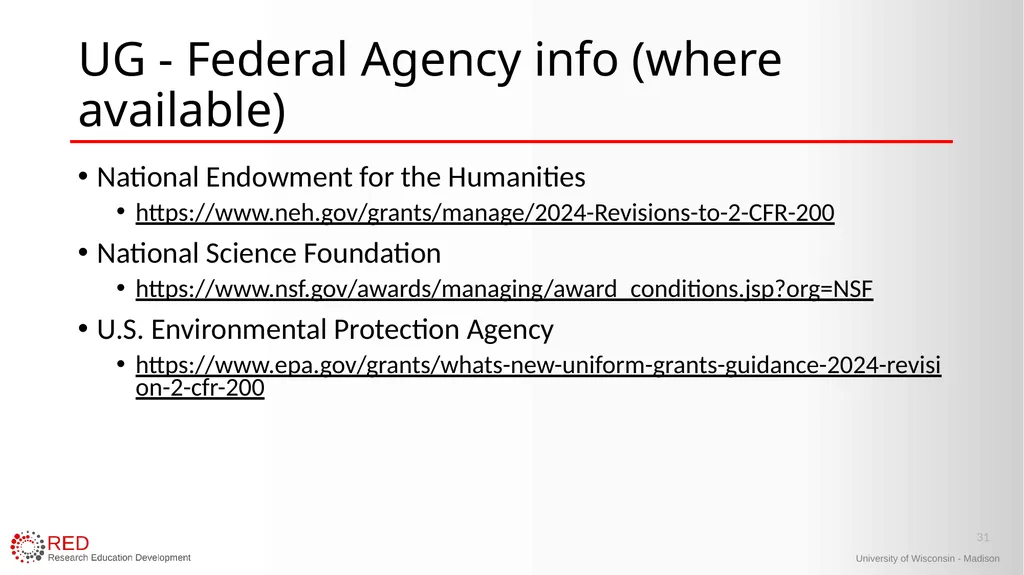
slide31. UG - Federal Agency info (where available) National Endowment for the Humanities
https://www.neh.gov/grants/manage/2024-Revisions-to-2-CFR-200
National Science Foundation
https://www.nsf.gov/awards/managing/award_conditions.jsp?org=NSF
U.S. Environmental Protection Agency
https://www.epa.gov/grants/whats-new-uniform-grants-guidance-2024-revision-2-cfr-200 31<br>
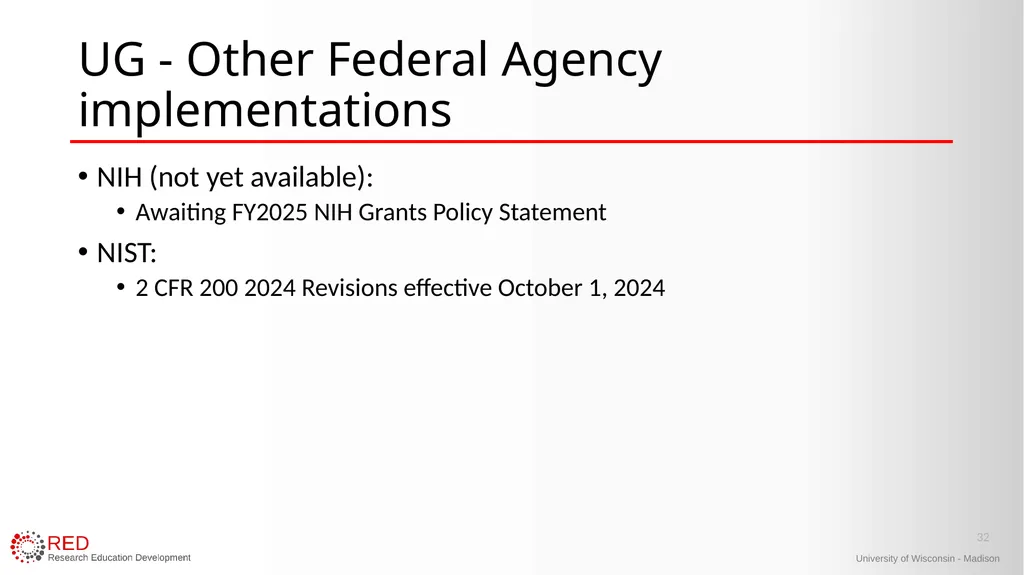
slide32. UG - Other Federal Agency implementations NIH (not yet available):
Awaiting FY2025 NIH Grants Policy Statement
NIST:
2 CFR 200 2024 Revisions effective October 1, 2024 32<br>
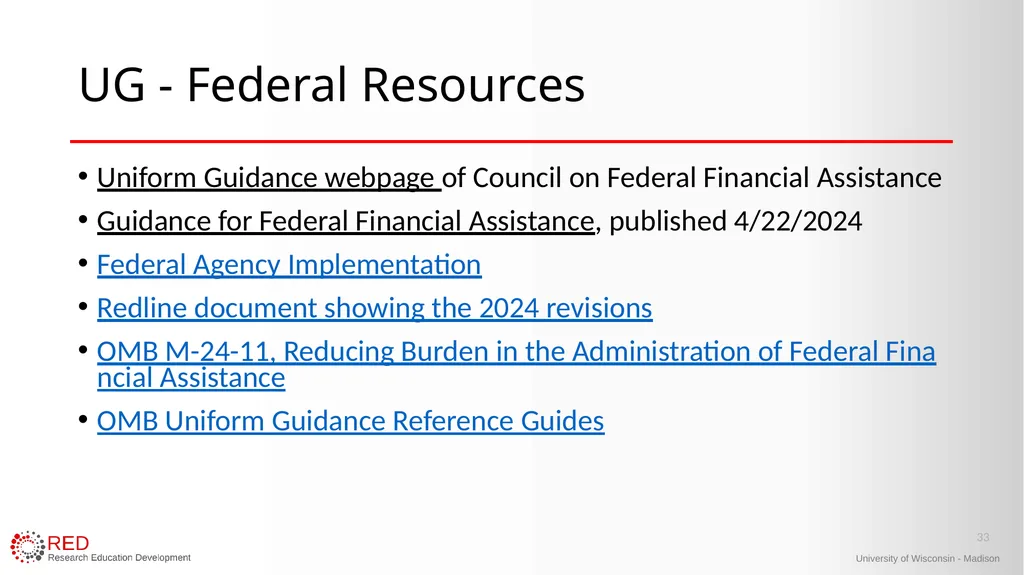
slide33. UG - Federal Resources Uniform Guidance webpage of Council on Federal Financial Assistance
Guidance for Federal Financial Assistance, published 4/22/2024
Federal Agency Implementation
Redline document showing the 2024 revisions
OMB M-24-11, Reducing Burden in the Administration of Federal Financial Assistance
OMB Uniform Guidance Reference Guides 33<br>
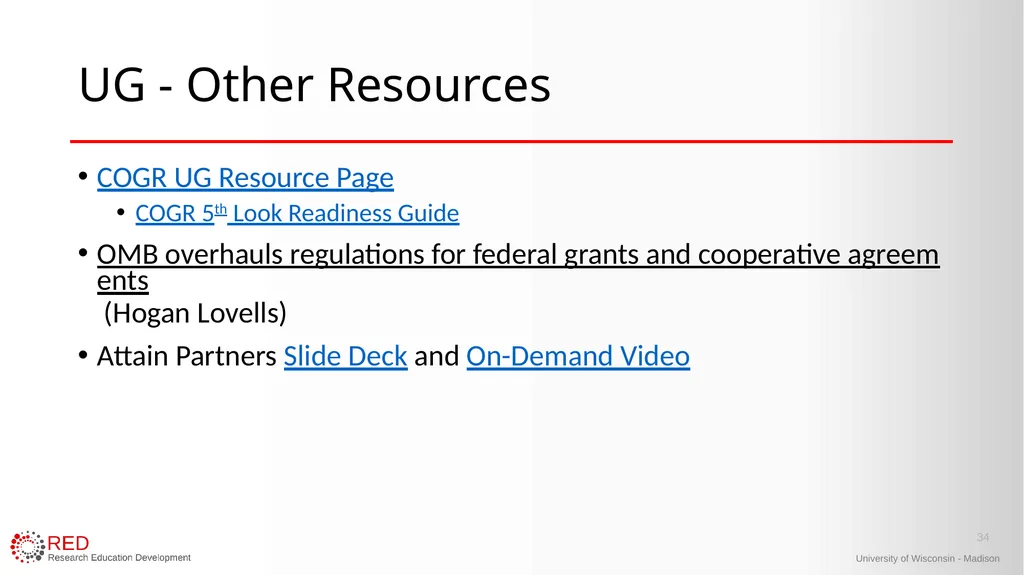
slide34. UG - Other Resources COGR UG Resource Page
COGR 5th Look Readiness Guide
OMB overhauls regulations for federal grants and cooperative agreements (Hogan Lovells)
Attain Partners Slide Deck and On-Demand Video 34<br>
slide2. Research Administration Hot Topics Mark Sweet, Interim Assoc. Vice Chancellor for Research Administration
Angie Johnson, Assistant Director Research Financial Services
Bob Gratzl, Interim Assoc. Director Grants and Contracts 2<br>
slide3. Agenda Uniform Guidance Changes
Research Security
Badger IP Industry Advantage
Progress Reporting
Current Issues in Audits
Sponsor Requirement More Complex
Question and Answers 3<br>
slide4. Uniform Guidance (2 CFR 200)<br>
slide5. Be aware Agency-related Several, but not all federal agencies have released information about their implementations of the Uniform Guidance Revisions
Research Terms and Conditions
Apply to existing awards that have not been amended
Are on hiatus for new awards
Prior Approval Matrix will be updated by Federal Agency representatives UW-Madison-related RSP is still working on analyzing Uniform Guidance changes and their implications for our institutional policies, procedures, and guidance
Updating UW-Madison policies, procedures, and guidance will take time 5<br>
slide6. Purpose of revisions, per OMB (1) incorporating statutory requirements and administration priorities;
(2) reducing agency and recipient burden;
(3) clarifying sections that recipients or agencies have interpreted in different ways; and
(4) rewriting applicable sections in plain language, improving flow, and addressing inconsistent use of terms within the guidance 6<br>
slide7. Important Dates April 22, 2024: Updates to 2 CFR published in the Federal Register
May 15, 2024: Agency implementation plans were due to OMB
October 1, 2024: Effective date of 2 CFR revisions
2 CFR revisions will apply to new awards entered into on or after October 1, 2024
2 CFR revisions may apply to existing awards amended on or after October 1, 2024 that provide additional funds
Agencies may apply 2 CFR revisions to existing awards that are amended for purposes other than providing additional funds 7<br>
slide8. Definition/threshold revisions Equipment: $5,000 to $10,000*
Fixed amount awards: $250,000 to $500,000
De minimis rate: 10% to 15%
MTDC
Subawards: first $25,000 to first $50,000*
Audit: $750,000 to $1,000,000
* Cannot be implemented until UW-Madison has a new F&A rate agreement; see next slide 8<br>
slide9. UW-Madison’s Current F&A Rate Agreement Rate agreement extended as of 11/21/2023
Effective until at least June 30, 2026
“Modified total direct costs, consisting of all direct salaries and wages, applicable fringe benefits, materials and supplies, services, travel, and up to the first $25,000 of each subaward…”
“Equipment means tangible personal property (including information technology systems) having a useful life of more than one year and a per-unit acquisition cost which equals or exceeds $5,000.”
Bottom line: We cannot use the new subaward and equipment thresholds now. 9<br>
slide10. Research Security<br>
slide11. Research Security Shift in approach from federal government
Terms and Conditions from agencies and on specific awards
National Security Presidential Memorandum – 33
CHIPS and Science Act 11<br>
slide12. Research Security Program UW – Madison required to have a Research Security Program
https://research.wisc.edu/research-security-program/
Federal Guidelines: https://www.whitehouse.gov/wp-content/uploads/2024/07/OSTP-RSP-Guidelines-Memo.pdf
Components:
Cybersecurity
Foreign Travel Security
Research Security Training
Export Control Training 12<br>
slide13. Research Security Training Required training
Covered Individuals
PIs and UW-Madison will need to certify completion of training
Department of Energy requiring May 2025 13<br>
slide14. Research Security: Digital Persistent Identifiers Uniquely identify digital output - publications, webpages, documents, etc.
Uniquely identify people
NPSM-33 directed federal agencies to use DPIs 14<br>
slide15. Research Security: ORCID ID 15 Persistent Digital Identifier
REQUIRED by NIH and Dept. of Energy MAY 2025!
All PIs/PD, Key Personnel – Covered Individuals
Our advice: research administrators obtain their own ORCID ID to assist investigators<br>
slide16. Research Security: ORCID ID Create your ORCID ID
Associate with UW – Madison NetID login
UW Libraries can assist PIs and others with ORCID 16<br>
slide17. The Badger IP Industry Advantage<br>
slide18. What is it? Clear list of options to offer industry sponsors.
Consistency with own internal policies and what we’ve done historically.
Keeping pace with what many of our peers are doing.
https://research.wisc.edu/badger-ip-industry-advantage/ 18<br>
slide19. Invention Licensing Options For Sponsors 19<br>
slide20. Implementation Expectations PI and Sponsor must agree on the selected IP model.
Background IP rights negotiated separately.
Sponsor to pay out of pocket patent and maintenance costs if they license.
Written confirmatory licenses to the sponsor.
Varsity and Bascom include bonanza clauses.
May be restricted due to other legal or contractual obligations.
Varsity and Bascom options are non-negotiable. 20<br>
slide21. How To To make this work efficiently, need to have clear conversations.
Before sending the terms to a Sponsor or agreeing to language:
Have a discussion with the PI and the Dean’s Office.
What do they expect to come out of this?
•What do they want to do with potential IP?
Look at the existing portfolio – have we offered IP terms to another sponsor that could conflict?
What is the potential value of the resultant IP? Could it have more value than what is being offered with this IP model?
Consistency check.
If the sponsor has funded Phase I of a study, be sure that later phases and follow on work have an IP selection matching Phase I.
When it doubt, ask for help.
WARF is a great resource to talk through fields of use and IP potential. 21<br>
slide22. Progress Reports (RPPRs)<br>
slide23. Progress Reporting (RPPR) Federal Agencies routinely hold incremental funding due to late progress reports
University of California – San Diego: spring 2024 three federal agencies stop issuing awards because of one PI’s late reports
Increased attention on late reports
NSF, NIH, NOAA – report status is available to the dean’s offices in Divisional Dashboard and updated monthly
RSP emails PIs about overdue RPPRs (NOAA, NIH, NSF) 23<br>
slide24. Audits<br>
slide25. Audits Increased focus on subaward monitoring
Documentation
Be aware of Record Retention Policies and who's responsible for retaining documentation
Understand Contractual Requirements 25<br>
slide26. Sponsor Requirements More Complex<br>
slide27. Sponsor Requirements More Complex Increase in required documentation for invoicing and reporting
More portals
Required kick off meetings and monthly/bi-monthly or quarterly meetings (NIH, CDC, Dept of ED, Dept of Commerce, DOE) 27<br>
slide28. Question and Answer<br>
slide29. UG - Federal Agency info (where available) Department of Education
Uniform Administrative Requirements, Cost Principles, and Audit Requirements for Federal Awards
Frequently Asked Questions 2 CFR Part 200
Department of Energy
https://www.energy.gov/management/pf-2025-01-updated-doe-guide-financial-assistance
Dept. of Health and Human Services
https://www.federalregister.gov/d/2024-21984
HHS press release on 2 CFR Part 200 29<br>
slide30. UG - Federal Agency info (where available) DHHS/AHRQ
https://grants.nih.gov/grants/guide/notice-files/NOT-HS-25-007.html
Department of Justice, Office of Justice Programs
https://www.ojp.gov/funding/financialguidedoj/overview
NASA
https://www.federalregister.gov/d/2024-21005
https://www.nasa.gov/grants-policy-and-compliance-team/ 30<br>
slide31. UG - Federal Agency info (where available) National Endowment for the Humanities
https://www.neh.gov/grants/manage/2024-Revisions-to-2-CFR-200
National Science Foundation
https://www.nsf.gov/awards/managing/award_conditions.jsp?org=NSF
U.S. Environmental Protection Agency
https://www.epa.gov/grants/whats-new-uniform-grants-guidance-2024-revision-2-cfr-200 31<br>
slide32. UG - Other Federal Agency implementations NIH (not yet available):
Awaiting FY2025 NIH Grants Policy Statement
NIST:
2 CFR 200 2024 Revisions effective October 1, 2024 32<br>
slide33. UG - Federal Resources Uniform Guidance webpage of Council on Federal Financial Assistance
Guidance for Federal Financial Assistance, published 4/22/2024
Federal Agency Implementation
Redline document showing the 2024 revisions
OMB M-24-11, Reducing Burden in the Administration of Federal Financial Assistance
OMB Uniform Guidance Reference Guides 33<br>
slide34. UG - Other Resources COGR UG Resource Page
COGR 5th Look Readiness Guide
OMB overhauls regulations for federal grants and cooperative agreements (Hogan Lovells)
Attain Partners Slide Deck and On-Demand Video 34<br>