1 SCUBA AND ITS MAINTENANCE OBJECTIVE After
Description: 1 SCUBA AND ITS MAINTENANCE OBJECTIVE After completion of this lesson you will be able to know : Scuba diving history Introduction to scuba items. Use and maintenance of scuba. Procedure of safe diving ,communication and signals. Diving in
Related Topics
Download Presentation
"1 SCUBA AND ITS MAINTENANCE OBJECTIVE After" is the property of its rightful owner. Permission is granted to download and print the materials on this website for personal, non-commercial use only, and to display it on your personal computer provided you do not modify the materials and that you retain all copyright notices contained in the materials. By downloading content from our website, you accept the terms of this agreement.
Presentation Transcript
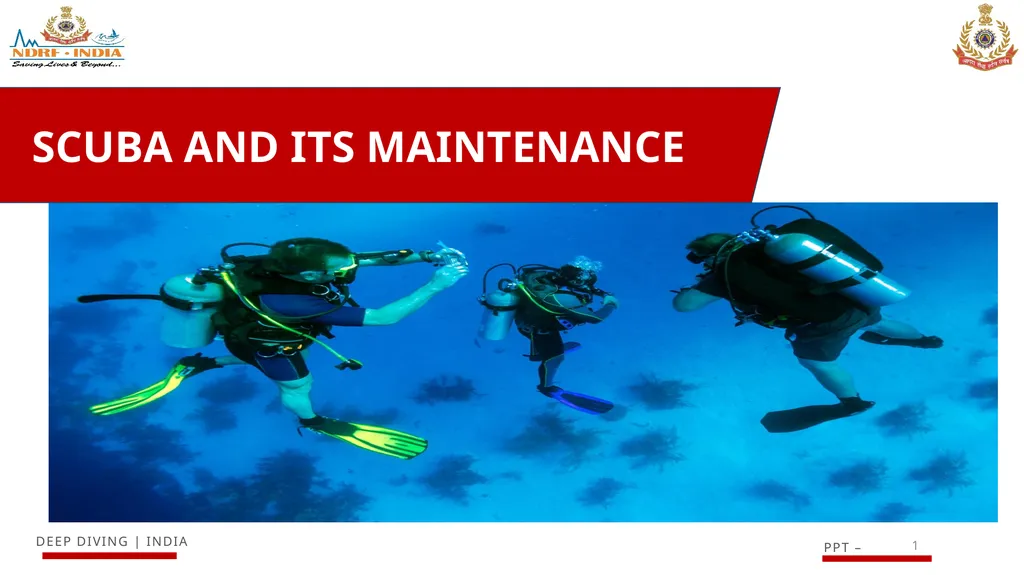
slide1. 1 SCUBA AND ITS MAINTENANCE<br>
slide2. OBJECTIVE After completion of this lesson you will be able to know :
Scuba diving history
Introduction to scuba items.
Use and maintenance of scuba.
Procedure of safe diving ,communication and signals.
Diving in pool tank .
Clearing the mask, hose, regulator. 2<br>
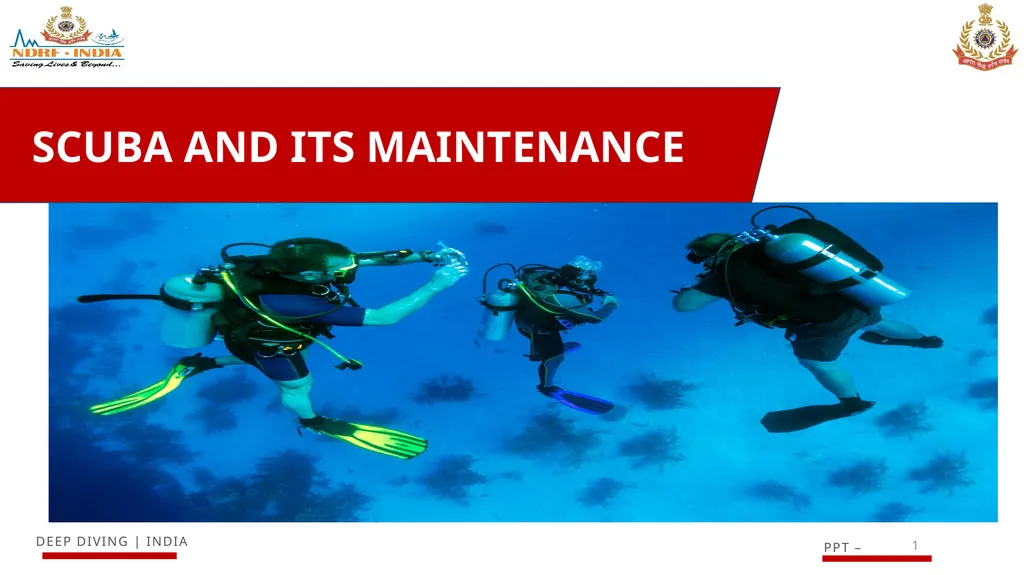
slide3. INTRODUCTION SCUBA Self-contained Underwater Breathing Apparatus.
Scuba Provides Respiratory Protection To Rescuer Working Under Water.
Working Duration Depends Upon Capacity Of Cylinder And Breathing Rate Of Diver.
Scuba Diving Done Recreationally Or Professionally
Scuba Diving May Be Done Scientific, Military And Public Safety Roles. 3<br>
slide4. HISTORY SCUBA - Self Contained Underwater Breathing Apparatus
Long history dating back from 332 BC
Modern fins, mask and snorkel tubes were developed by fishermen from America, Russia, France and England in the 1920s and 1930s 4<br>
slide5. HISTORY CONTINUED… Recreational SCUBA Diving began between 1942 - 1943, after Emile Gagnan and Captain Hacques- Yves Cousteau developed the self-contained "Aqua-Lung" and new regulator that was automatic.
Cousteau took many successful, experimental dives with his friends, wife and two sons, making this an experimental family trip and experience. 5<br>
slide6. SCUBA DIVING POPULARITY • It is popular, as its easy and fun.
• As 70 percent of the earth is covered in water
The underwater world interests many people. 6<br>
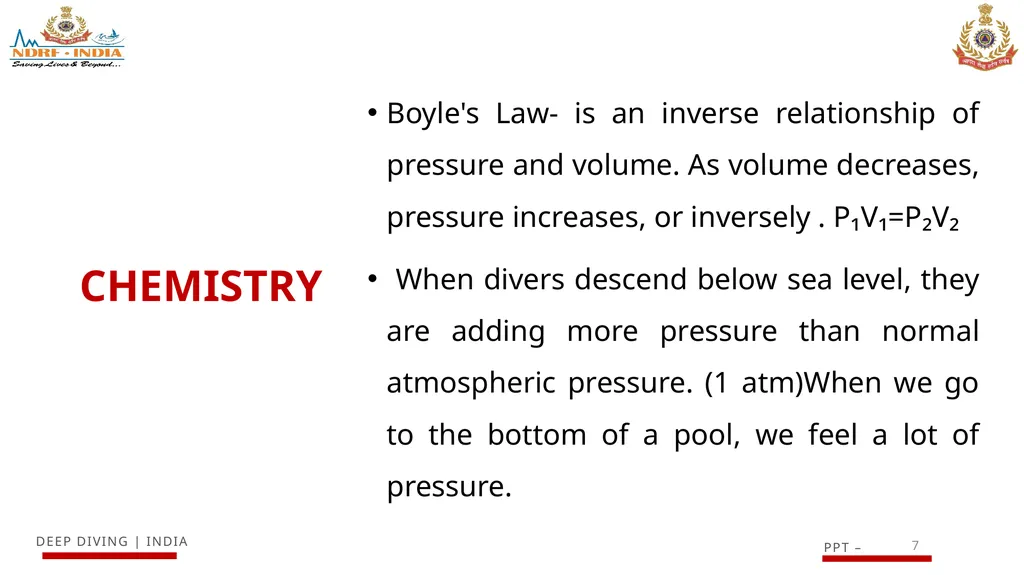
slide7. CHEMISTRY Boyle's Law- is an inverse relationship of pressure and volume. As volume decreases, pressure increases, or inversely . P₁V₁=P₂V₂
When divers descend below sea level, they are adding more pressure than normal atmospheric pressure. (1 atm)When we go to the bottom of a pool, we feel a lot of pressure. 7<br>
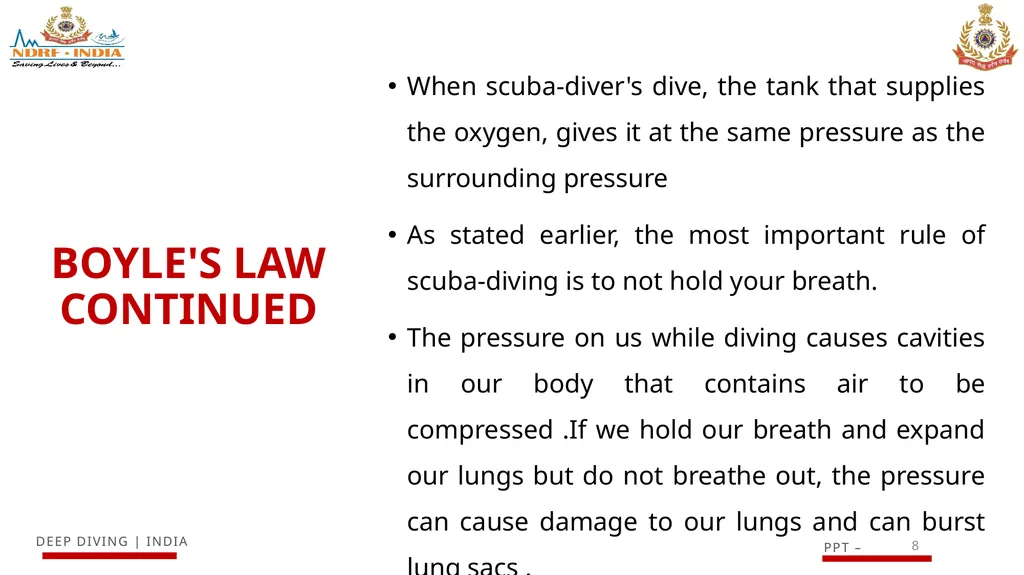
slide8. BOYLE'S LAW CONTINUED When scuba-diver's dive, the tank that supplies the oxygen, gives it at the same pressure as the surrounding pressure
As stated earlier, the most important rule of scuba-diving is to not hold your breath.
The pressure on us while diving causes cavities in our body that contains air to be compressed .If we hold our breath and expand our lungs but do not breathe out, the pressure can cause damage to our lungs and can burst lung sacs . 8<br>
slide9. ASCENDING WITH BOYLE'S LAW When a diver ascends to the surface, the pressure is decreased which causes the volume of gas in our cavities to expand.
That is why divers ascend in increments to lessen the risk of over expanding the lungs . 9<br>
slide10. SNORKELING Snorkeling is an underwater activity that involves a breathing tube.
A very popular recreational activity because it can be done by people of all ages‘
less dangerous than scuba diving. 10<br>
slide11. SCUBA DIVING DESTINATIONS Cozumel Mexico Fiji islands South pacific
Grand Cayman Islands
Dubai
Andaman
These are some of the popular places in the world. And there are many more.
KOCHI
SEI 11<br>
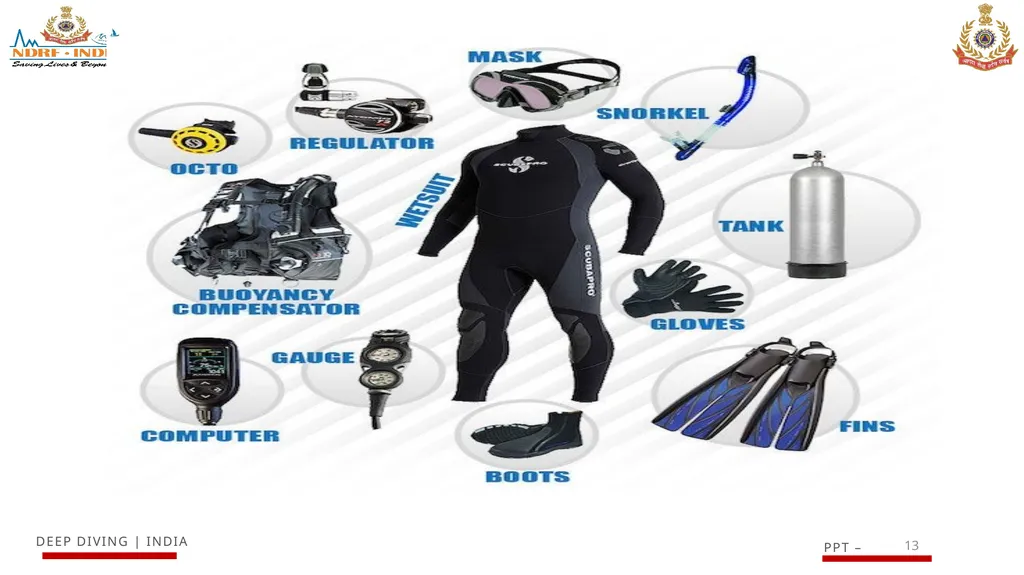
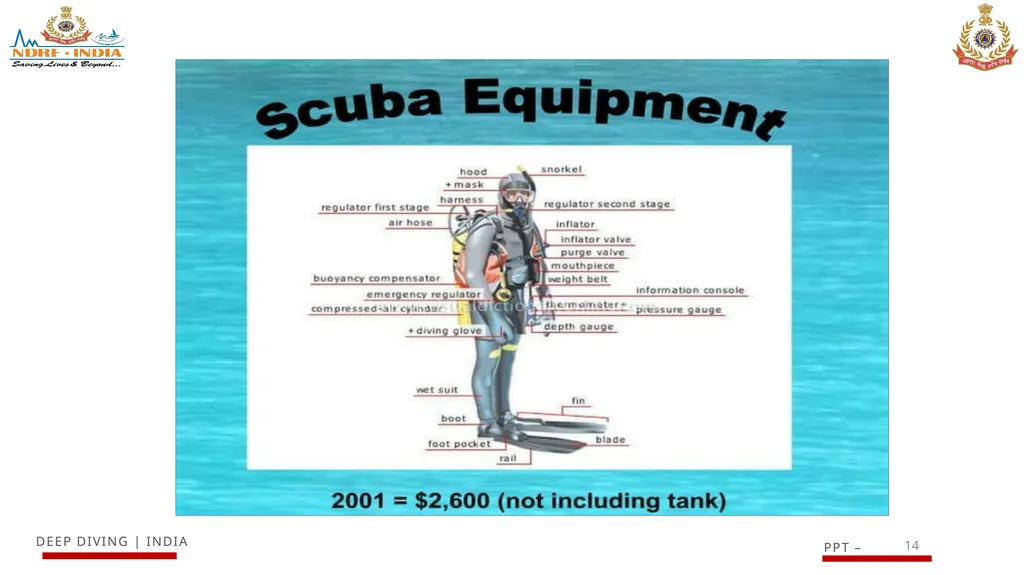
slide12. SCUBA ITEMS Wetsuit
Cylinder/tank
Mask.
Buoyancy compensator.
Octo.
Fins.
Boots.
Snorkel.
Gloves.
Weight belt.
Pressure gauge.
Special items (torch, computer, watch etc) 12<br>
slide13. 13<br>
slide14. 14<br>
slide15. TYPES OF DIVING Professional Diving
• Recreational Diving
Cave diving masters /instructor diving
Deep diving offshore construction
Ice diving
Naval diving , fishing 15<br>
slide16. HOW TO DIVE/TYPES OF DIVES Types of dives - Boat, shore, pier
How to enter the water - if on shore, walk into the water without fins, then put them on in the water- If entering rough water, put fins on and walk in backwards 16<br>
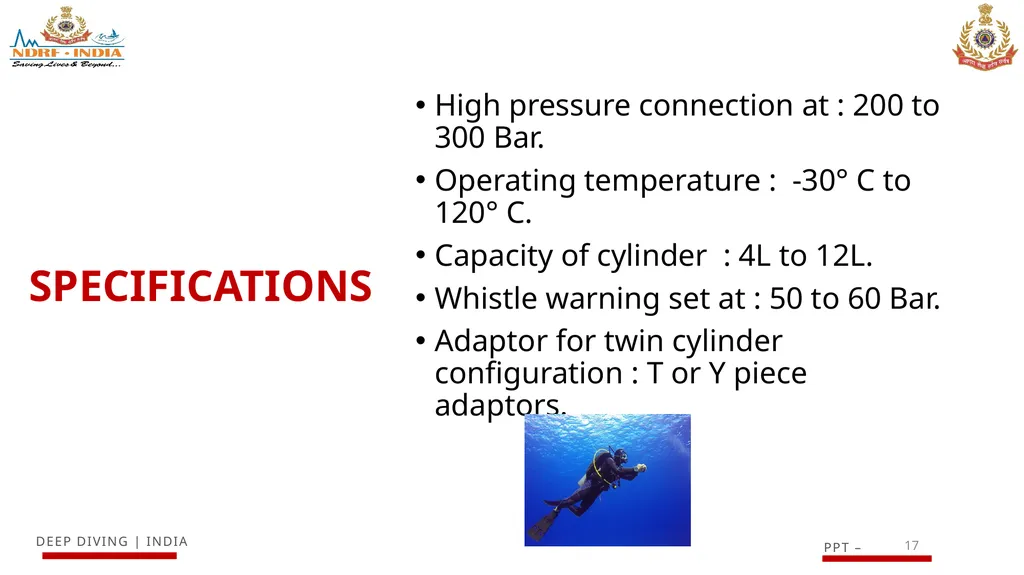
slide17. SPECIFICATIONS High pressure connection at : 200 to 300 Bar.
Operating temperature : -30° C to 120° C.
Capacity of cylinder : 4L to 12L.
Whistle warning set at : 50 to 60 Bar.
Adaptor for twin cylinder configuration : T or Y piece adaptors. 17<br>
slide18. Check face shield tightness , check face mask ports and sealing ring are clean and undamaged.
Before opening cylinder valve ensure the demand valve is activated to switch off positive pressure. Open the cylinder valve wheel by at least 2 turns.
Connect the demand valve to the mask ,press release button to set the positive pressure.
Go for whistle warning unit test before operation. 18 BEFORE USE:<br>
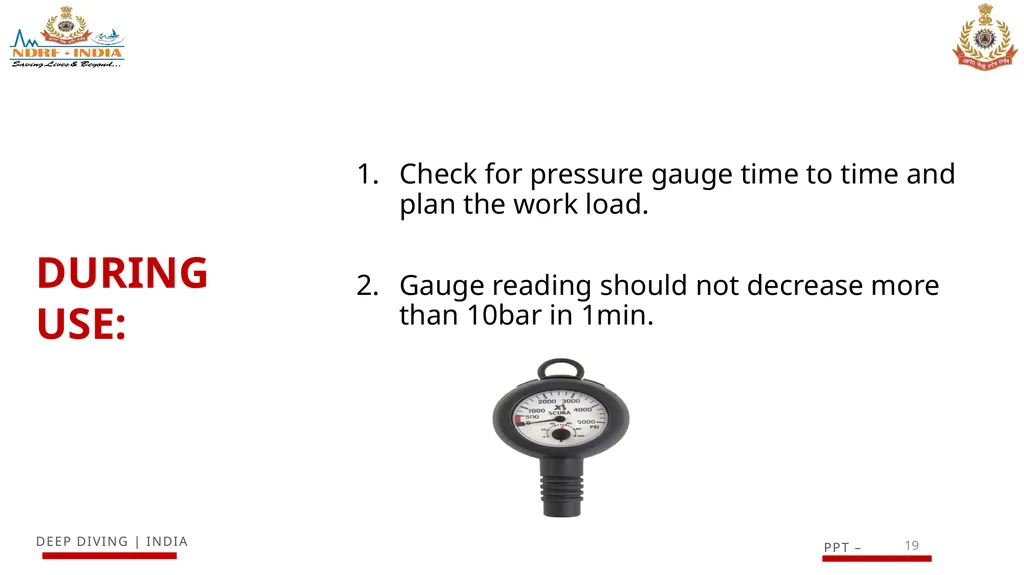
slide19. Check for pressure gauge time to time and plan the work load.
Gauge reading should not decrease more than 10bar in 1min. 19 DURING USE:<br>
slide20. Don’t remove eqpt until in safe area, clear of hazards.
Close the cylinder valve and disconnect demand valve from the mask excess air will went off.
Remove the demand valve from the mask.
Put off the mask and set the cylinder up on a clean surface. 20 AFTER USE:<br>
slide21. ENTRIES IN WATER Skin divers and scuba divers use the same methods to enter the water. No matter which method is used, the goal of the entry is to get into the water with ease and safety.
The most common methods of entry are the giant stride, back roll, seated entry, and shore entry 21<br>
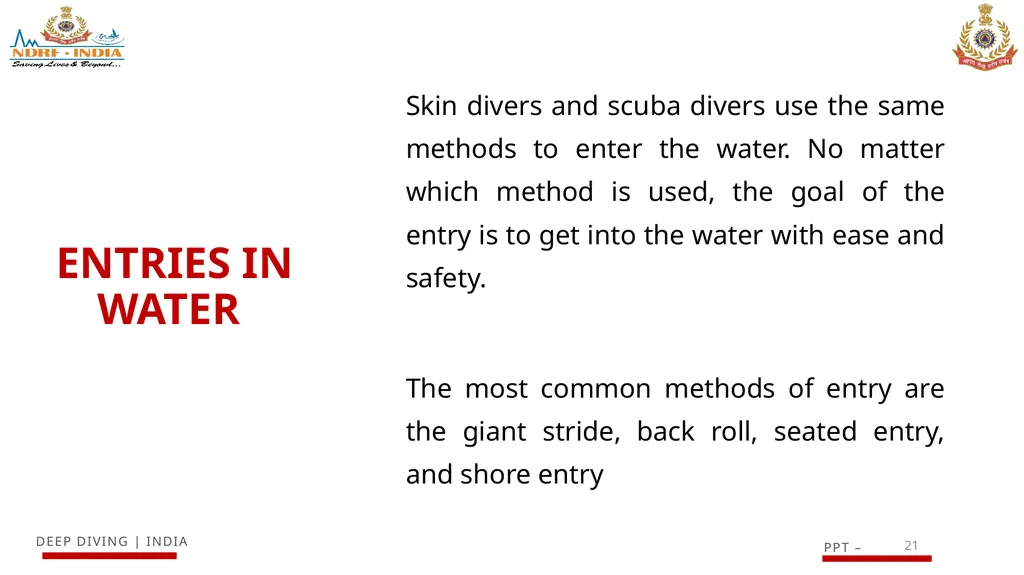
slide22. WATCH AND LOOK GO IN THIS DIRECTION 22<br>
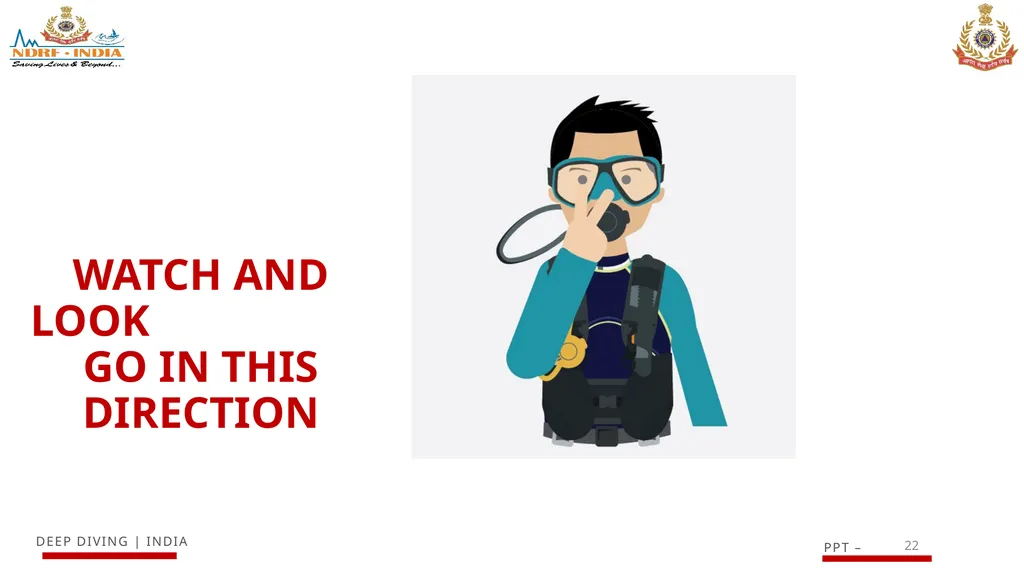
slide23. STAY TOGETHER LEVEL OFF 23<br>
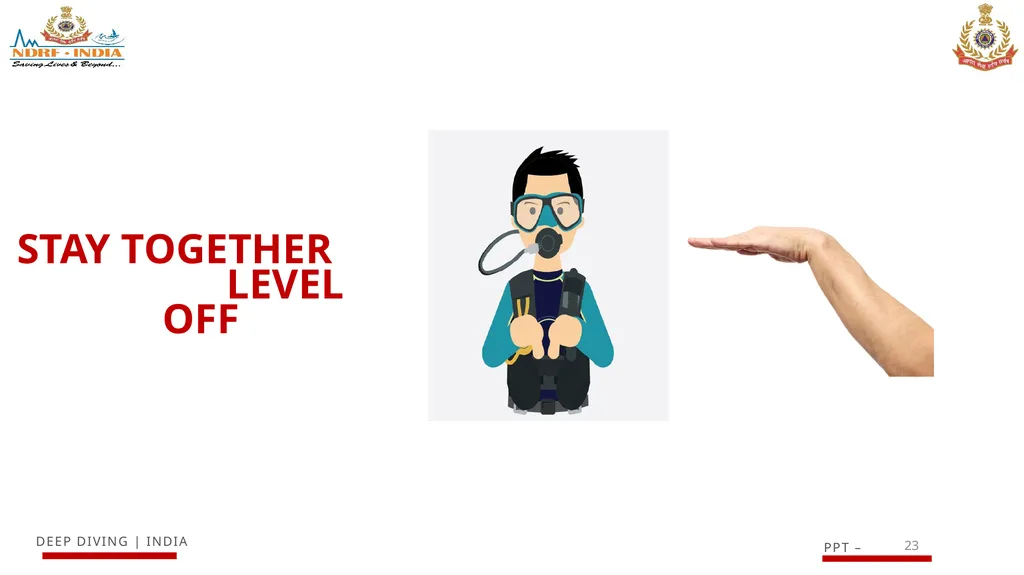
slide24. SAFETY STOP I AM COLD 24<br>
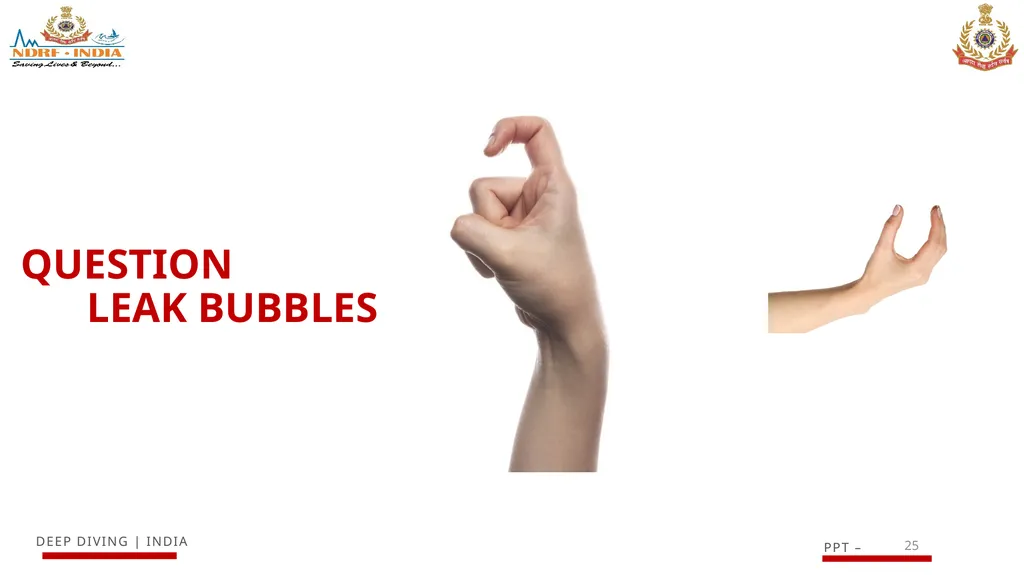
slide25. QUESTION LEAK BUBBLES 25<br>
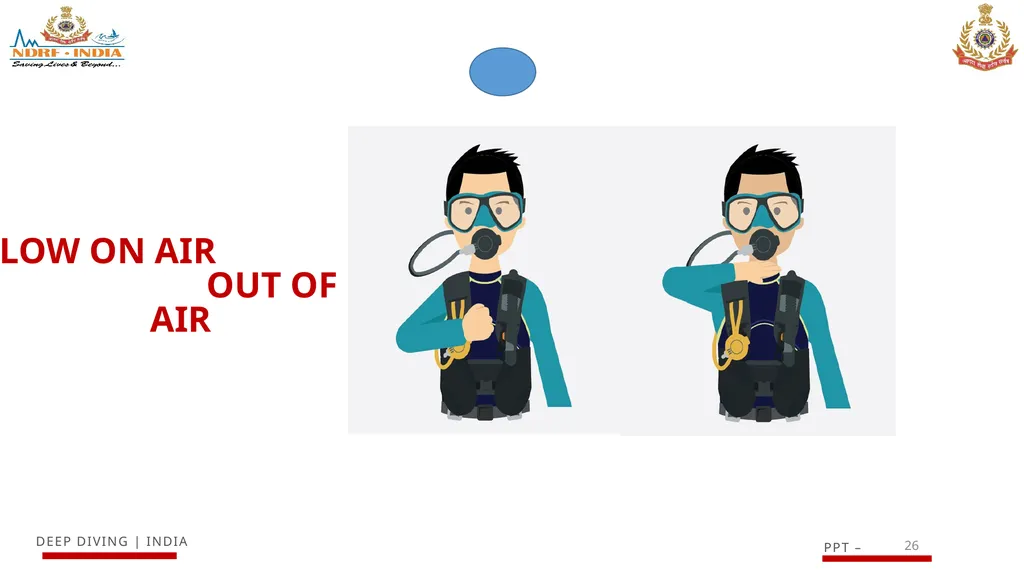
slide26. LOW ON AIR OUT OF AIR 26<br>
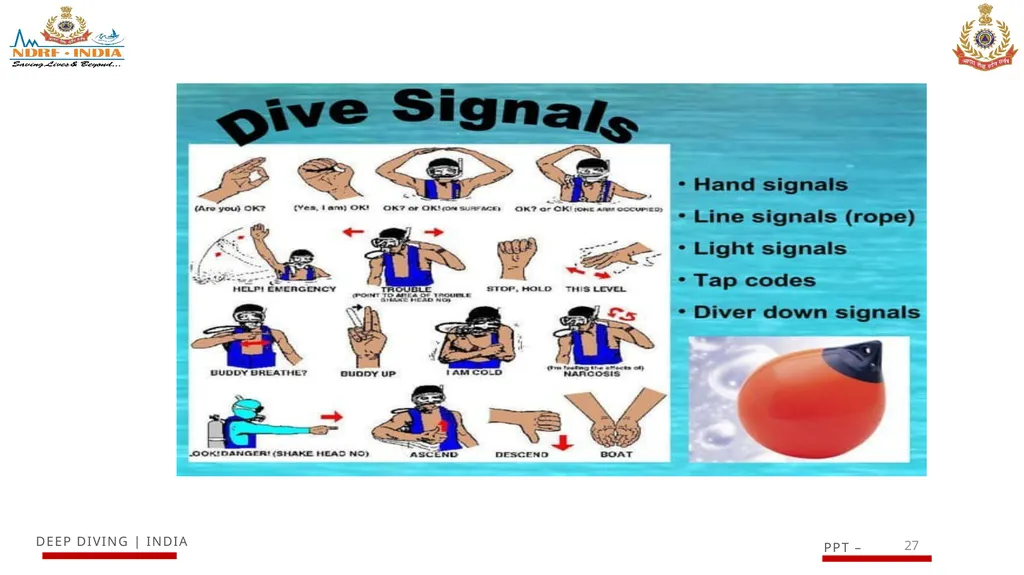
slide27. 27<br>
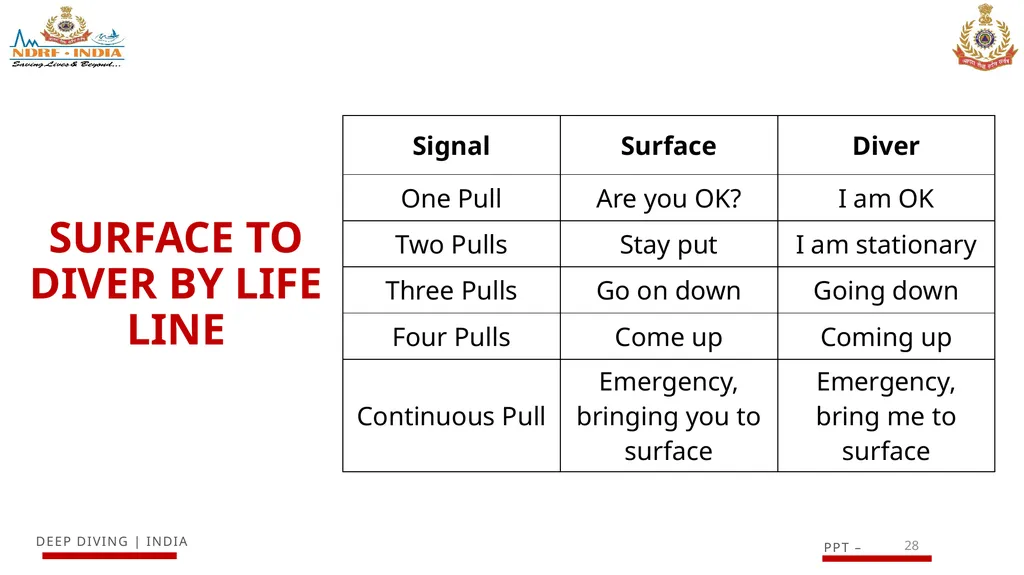
slide28. SURFACE TO DIVER BY LIFE LINE 28<br>
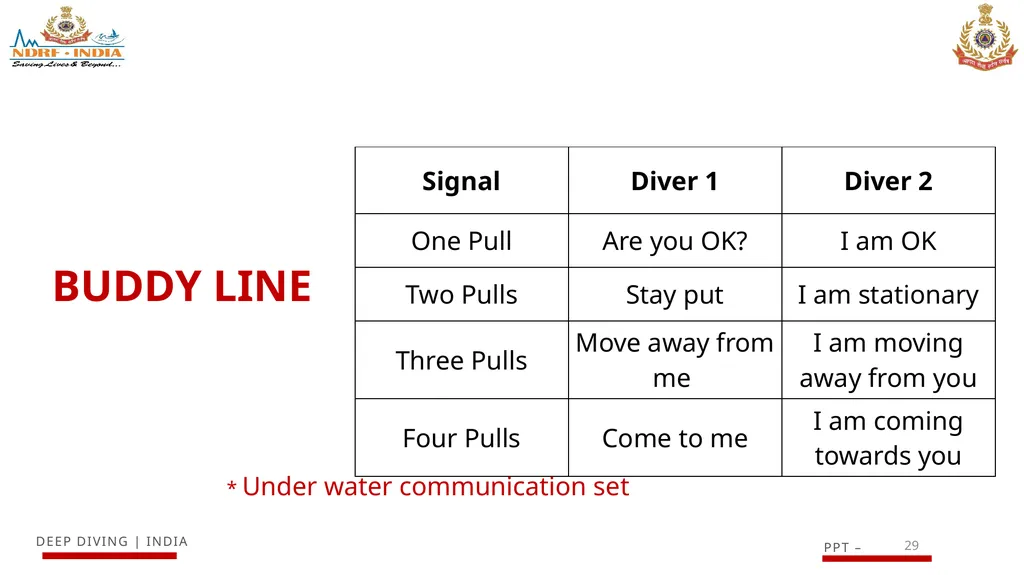
slide29. BUDDY LINE * Under water communication set 29<br>
slide30. DIVING IN POOL TANK Training purpose.
Improve your skill .
Get the diving certification.
Physical fitness. 30<br>
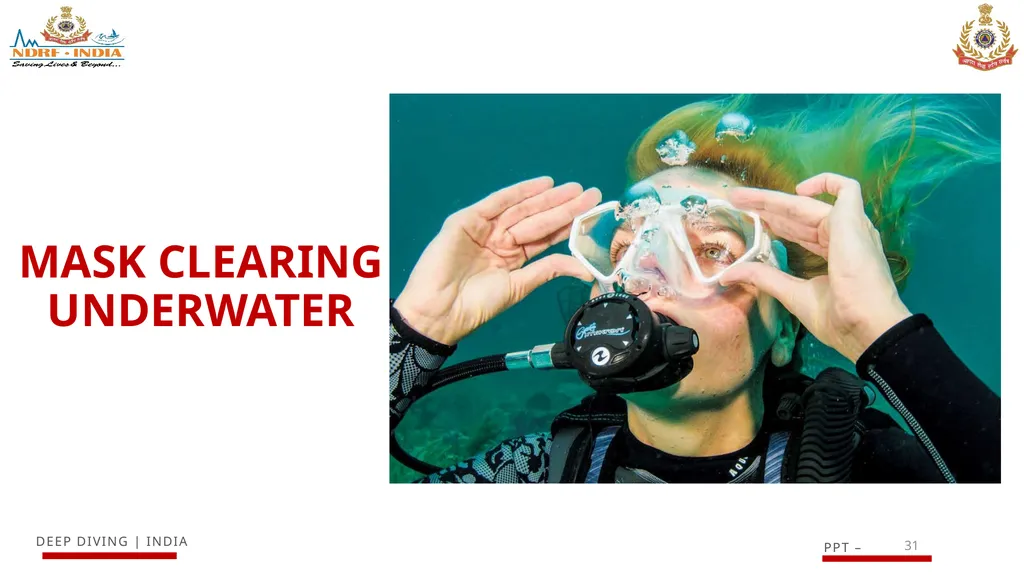
slide31. MASK CLEARING UNDERWATER 31<br>
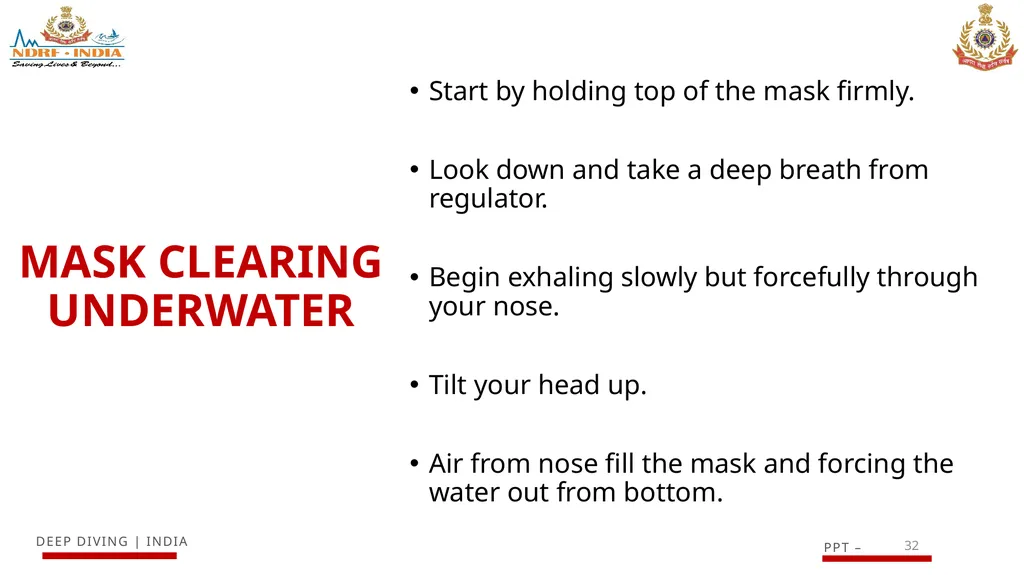
slide32. MASK CLEARING UNDERWATER Start by holding top of the mask firmly.
Look down and take a deep breath from regulator.
Begin exhaling slowly but forcefully through your nose.
Tilt your head up.
Air from nose fill the mask and forcing the water out from bottom. 32<br>
slide33. CLEARING HOSE AND REGULATOR Blast clear and purge valve method.
Blow out a puff of air into the mouthpiece, which will expel all water from the regulator through the exhaust valve.
The purge clear button is present on the front of second stage regulator.
It forces a blast of air into the regulator.
Pushing out all debris and water through the exhaust valve. 33<br>
slide34. HEALTH AND SAFETY – THE HAZARDS OF DIVING DCS-Epidermal or coetaneous, muscular, joint and limb pain and neurological
Hypothermia
Hyperthermia
Cramps
Nitrogen Narcosis
Carbon monoxide poisoning
Gastrointestinal
barotraumas.
Heart problems
Ear infections and Nosebleeds
Breathing problems
Dehydration
Diving while pregnant 34<br>
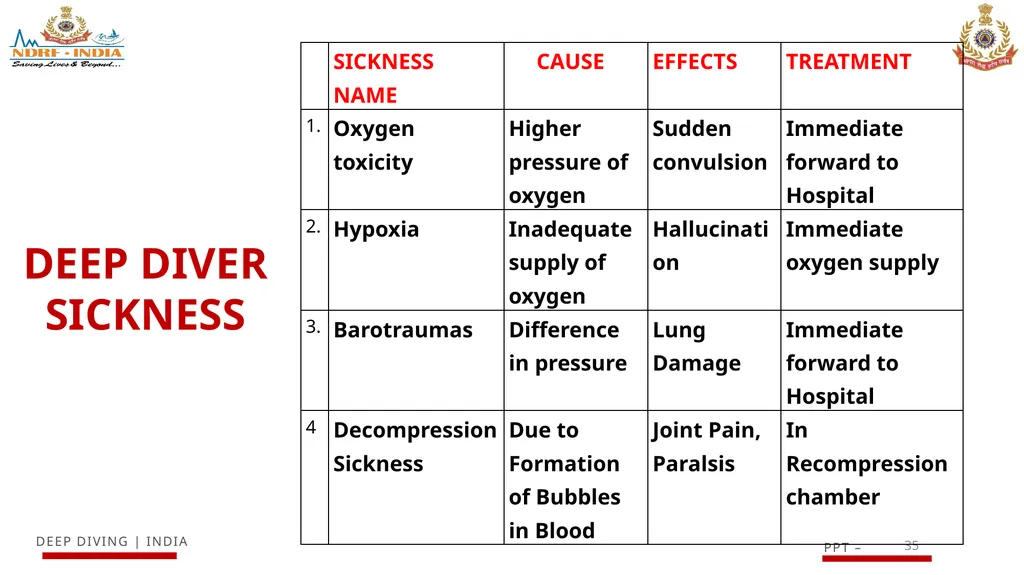
slide35. DEEP DIVER SICKNESS 35<br>
slide36. USE Do’s Ensure leak test before use.
Check for exhalation valve.
Replace the demand valve after every 16 month.
Replace the exhalation valve after every 6 month.
Check o ring
Physically and mentally fit
Natural and man made hazards
Contingency plan
Time 36<br>
slide37. Don’t use mask that leak.
Don’t operate in high temp if visor is damaged.
Don’t use in presence of chemical substance like hydrogen sulphide, phosgene which are absorbed by FFM or any diffuse through it.
Don’t use solvent like acetone alcohol etc. to clean face mask.
Don’t use the air filled cylinder after the expiry of one month.(refill it) 37 USE DONT’S<br>
slide38. RULES OF SCUBA DIVING Get proper training
Don't hold your breath
Be in good physical shape
Never dive alone Ascend slowly and with control
Check your equipment
Plan your dive and dive your plan 38<br>
slide39. REVIEW After completion of this lesson now you are able to define:
SCUBA.
Use and maintenance of SCUBA.
High pressure air compressor.
Procedure of safe diving ,communication and
Signals.
Diving in pool tank , breathing technique in tidal river.
Clearing the mask. 39<br>
slide40. 40 ANY QUESTION???<br>
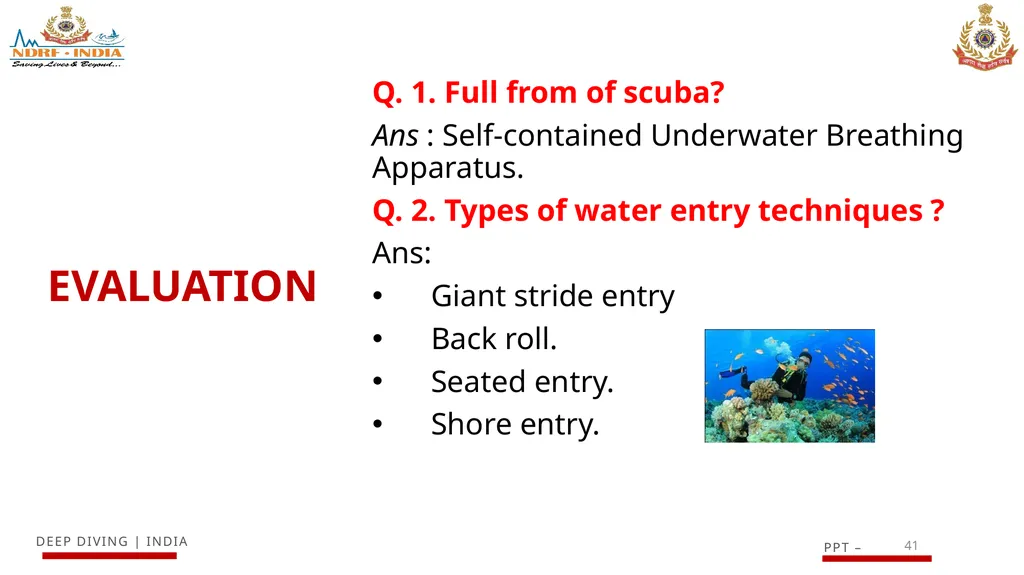
slide41. EVALUATION Q. 1. Full from of scuba?
Ans : Self-contained Underwater Breathing Apparatus.
Q. 2. Types of water entry techniques ?
Ans:
Giant stride entry
Back roll.
Seated entry.
Shore entry. 41<br>

slide42. 42 THANK YOU<br>
slide2. OBJECTIVE After completion of this lesson you will be able to know :
Scuba diving history
Introduction to scuba items.
Use and maintenance of scuba.
Procedure of safe diving ,communication and signals.
Diving in pool tank .
Clearing the mask, hose, regulator. 2<br>
slide3. INTRODUCTION SCUBA Self-contained Underwater Breathing Apparatus.
Scuba Provides Respiratory Protection To Rescuer Working Under Water.
Working Duration Depends Upon Capacity Of Cylinder And Breathing Rate Of Diver.
Scuba Diving Done Recreationally Or Professionally
Scuba Diving May Be Done Scientific, Military And Public Safety Roles. 3<br>
slide4. HISTORY SCUBA - Self Contained Underwater Breathing Apparatus
Long history dating back from 332 BC
Modern fins, mask and snorkel tubes were developed by fishermen from America, Russia, France and England in the 1920s and 1930s 4<br>
slide5. HISTORY CONTINUED… Recreational SCUBA Diving began between 1942 - 1943, after Emile Gagnan and Captain Hacques- Yves Cousteau developed the self-contained "Aqua-Lung" and new regulator that was automatic.
Cousteau took many successful, experimental dives with his friends, wife and two sons, making this an experimental family trip and experience. 5<br>
slide6. SCUBA DIVING POPULARITY • It is popular, as its easy and fun.
• As 70 percent of the earth is covered in water
The underwater world interests many people. 6<br>
slide7. CHEMISTRY Boyle's Law- is an inverse relationship of pressure and volume. As volume decreases, pressure increases, or inversely . P₁V₁=P₂V₂
When divers descend below sea level, they are adding more pressure than normal atmospheric pressure. (1 atm)When we go to the bottom of a pool, we feel a lot of pressure. 7<br>
slide8. BOYLE'S LAW CONTINUED When scuba-diver's dive, the tank that supplies the oxygen, gives it at the same pressure as the surrounding pressure
As stated earlier, the most important rule of scuba-diving is to not hold your breath.
The pressure on us while diving causes cavities in our body that contains air to be compressed .If we hold our breath and expand our lungs but do not breathe out, the pressure can cause damage to our lungs and can burst lung sacs . 8<br>
slide9. ASCENDING WITH BOYLE'S LAW When a diver ascends to the surface, the pressure is decreased which causes the volume of gas in our cavities to expand.
That is why divers ascend in increments to lessen the risk of over expanding the lungs . 9<br>
slide10. SNORKELING Snorkeling is an underwater activity that involves a breathing tube.
A very popular recreational activity because it can be done by people of all ages‘
less dangerous than scuba diving. 10<br>
slide11. SCUBA DIVING DESTINATIONS Cozumel Mexico Fiji islands South pacific
Grand Cayman Islands
Dubai
Andaman
These are some of the popular places in the world. And there are many more.
KOCHI
SEI 11<br>
slide12. SCUBA ITEMS Wetsuit
Cylinder/tank
Mask.
Buoyancy compensator.
Octo.
Fins.
Boots.
Snorkel.
Gloves.
Weight belt.
Pressure gauge.
Special items (torch, computer, watch etc) 12<br>
slide13. 13<br>
slide14. 14<br>
slide15. TYPES OF DIVING Professional Diving
• Recreational Diving
Cave diving masters /instructor diving
Deep diving offshore construction
Ice diving
Naval diving , fishing 15<br>
slide16. HOW TO DIVE/TYPES OF DIVES Types of dives - Boat, shore, pier
How to enter the water - if on shore, walk into the water without fins, then put them on in the water- If entering rough water, put fins on and walk in backwards 16<br>
slide17. SPECIFICATIONS High pressure connection at : 200 to 300 Bar.
Operating temperature : -30° C to 120° C.
Capacity of cylinder : 4L to 12L.
Whistle warning set at : 50 to 60 Bar.
Adaptor for twin cylinder configuration : T or Y piece adaptors. 17<br>
slide18. Check face shield tightness , check face mask ports and sealing ring are clean and undamaged.
Before opening cylinder valve ensure the demand valve is activated to switch off positive pressure. Open the cylinder valve wheel by at least 2 turns.
Connect the demand valve to the mask ,press release button to set the positive pressure.
Go for whistle warning unit test before operation. 18 BEFORE USE:<br>
slide19. Check for pressure gauge time to time and plan the work load.
Gauge reading should not decrease more than 10bar in 1min. 19 DURING USE:<br>
slide20. Don’t remove eqpt until in safe area, clear of hazards.
Close the cylinder valve and disconnect demand valve from the mask excess air will went off.
Remove the demand valve from the mask.
Put off the mask and set the cylinder up on a clean surface. 20 AFTER USE:<br>
slide21. ENTRIES IN WATER Skin divers and scuba divers use the same methods to enter the water. No matter which method is used, the goal of the entry is to get into the water with ease and safety.
The most common methods of entry are the giant stride, back roll, seated entry, and shore entry 21<br>
slide22. WATCH AND LOOK GO IN THIS DIRECTION 22<br>
slide23. STAY TOGETHER LEVEL OFF 23<br>
slide24. SAFETY STOP I AM COLD 24<br>
slide25. QUESTION LEAK BUBBLES 25<br>
slide26. LOW ON AIR OUT OF AIR 26<br>
slide27. 27<br>
slide28. SURFACE TO DIVER BY LIFE LINE 28<br>
slide29. BUDDY LINE * Under water communication set 29<br>
slide30. DIVING IN POOL TANK Training purpose.
Improve your skill .
Get the diving certification.
Physical fitness. 30<br>
slide31. MASK CLEARING UNDERWATER 31<br>
slide32. MASK CLEARING UNDERWATER Start by holding top of the mask firmly.
Look down and take a deep breath from regulator.
Begin exhaling slowly but forcefully through your nose.
Tilt your head up.
Air from nose fill the mask and forcing the water out from bottom. 32<br>
slide33. CLEARING HOSE AND REGULATOR Blast clear and purge valve method.
Blow out a puff of air into the mouthpiece, which will expel all water from the regulator through the exhaust valve.
The purge clear button is present on the front of second stage regulator.
It forces a blast of air into the regulator.
Pushing out all debris and water through the exhaust valve. 33<br>
slide34. HEALTH AND SAFETY – THE HAZARDS OF DIVING DCS-Epidermal or coetaneous, muscular, joint and limb pain and neurological
Hypothermia
Hyperthermia
Cramps
Nitrogen Narcosis
Carbon monoxide poisoning
Gastrointestinal
barotraumas.
Heart problems
Ear infections and Nosebleeds
Breathing problems
Dehydration
Diving while pregnant 34<br>
slide35. DEEP DIVER SICKNESS 35<br>
slide36. USE Do’s Ensure leak test before use.
Check for exhalation valve.
Replace the demand valve after every 16 month.
Replace the exhalation valve after every 6 month.
Check o ring
Physically and mentally fit
Natural and man made hazards
Contingency plan
Time 36<br>
slide37. Don’t use mask that leak.
Don’t operate in high temp if visor is damaged.
Don’t use in presence of chemical substance like hydrogen sulphide, phosgene which are absorbed by FFM or any diffuse through it.
Don’t use solvent like acetone alcohol etc. to clean face mask.
Don’t use the air filled cylinder after the expiry of one month.(refill it) 37 USE DONT’S<br>
slide38. RULES OF SCUBA DIVING Get proper training
Don't hold your breath
Be in good physical shape
Never dive alone Ascend slowly and with control
Check your equipment
Plan your dive and dive your plan 38<br>
slide39. REVIEW After completion of this lesson now you are able to define:
SCUBA.
Use and maintenance of SCUBA.
High pressure air compressor.
Procedure of safe diving ,communication and
Signals.
Diving in pool tank , breathing technique in tidal river.
Clearing the mask. 39<br>
slide40. 40 ANY QUESTION???<br>
slide41. EVALUATION Q. 1. Full from of scuba?
Ans : Self-contained Underwater Breathing Apparatus.
Q. 2. Types of water entry techniques ?
Ans:
Giant stride entry
Back roll.
Seated entry.
Shore entry. 41<br>
slide42. 42 THANK YOU<br>