1 Selection Rules Some transitions are not allowed does not mean that such a transition will never occur, but that it is less likely and that the intensity (molar absorption coefficient) of such an absorption band is very low. Whether
"1 Selection Rules Some transitions are not allowed" is the property of its rightful owner. Permission is granted to
download and print the materials on this website for personal, non-commercial use only, and to display it
on your personal computer provided you do not modify the materials and that you retain all copyright
notices contained in the materials. By downloading content from our website, you accept the terms of this
agreement.
Presentation Transcript
01
1 Selection Rules Some transitions are not allowed does not mean that such a transition will never
occur, but that it is less likely and that the intensity (molar absorption coefficient) of
such an absorption band is very low. Whether transitions are allowed or forbidden,
and to what degree they may be forbidden depends on selection rules:
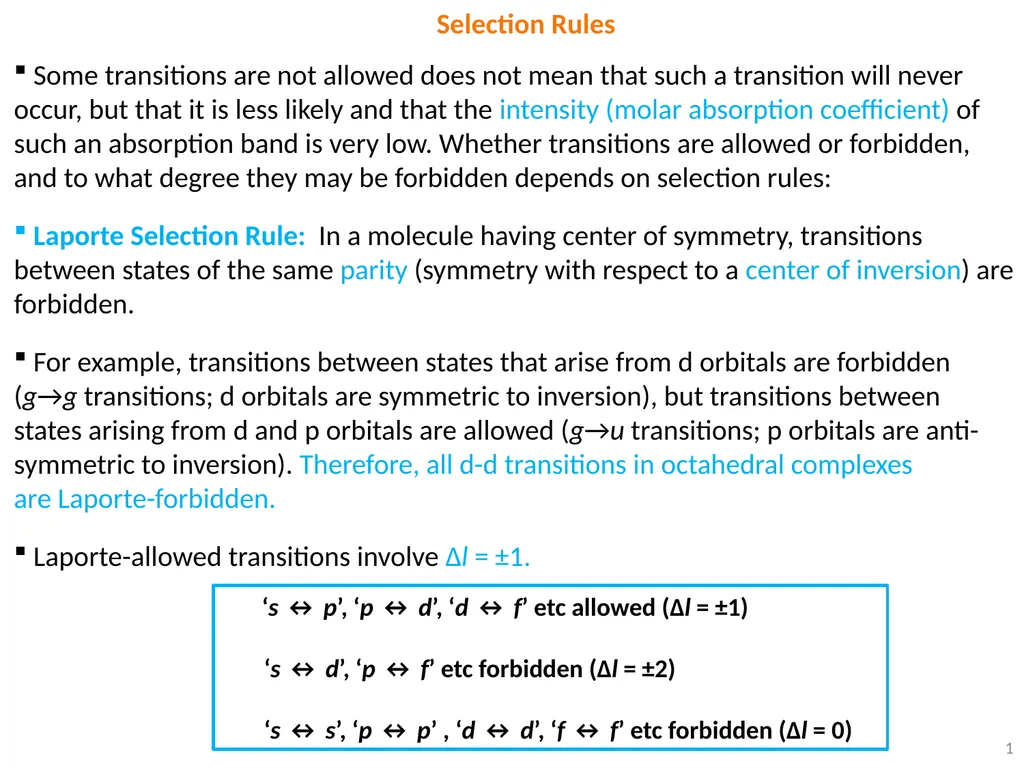
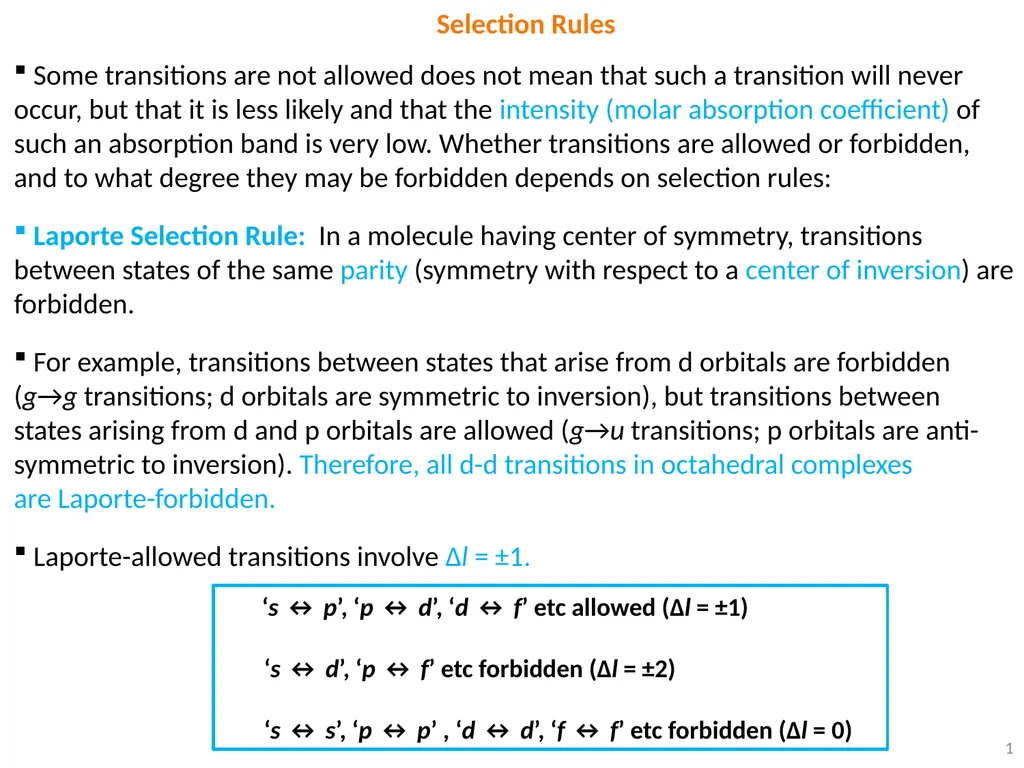
Laporte Selection Rule: In a molecule having center of symmetry, transitions between states of the same parity (symmetry with respect to a center of inversion) are forbidden.
For example, transitions between states that arise from d orbitals are forbidden (g→g transitions; d orbitals are symmetric to inversion), but transitions between states arising from d and p orbitals are allowed (g→u transitions; p orbitals are anti-symmetric to inversion). Therefore, all d-d transitions in octahedral complexes
are Laporte-forbidden.
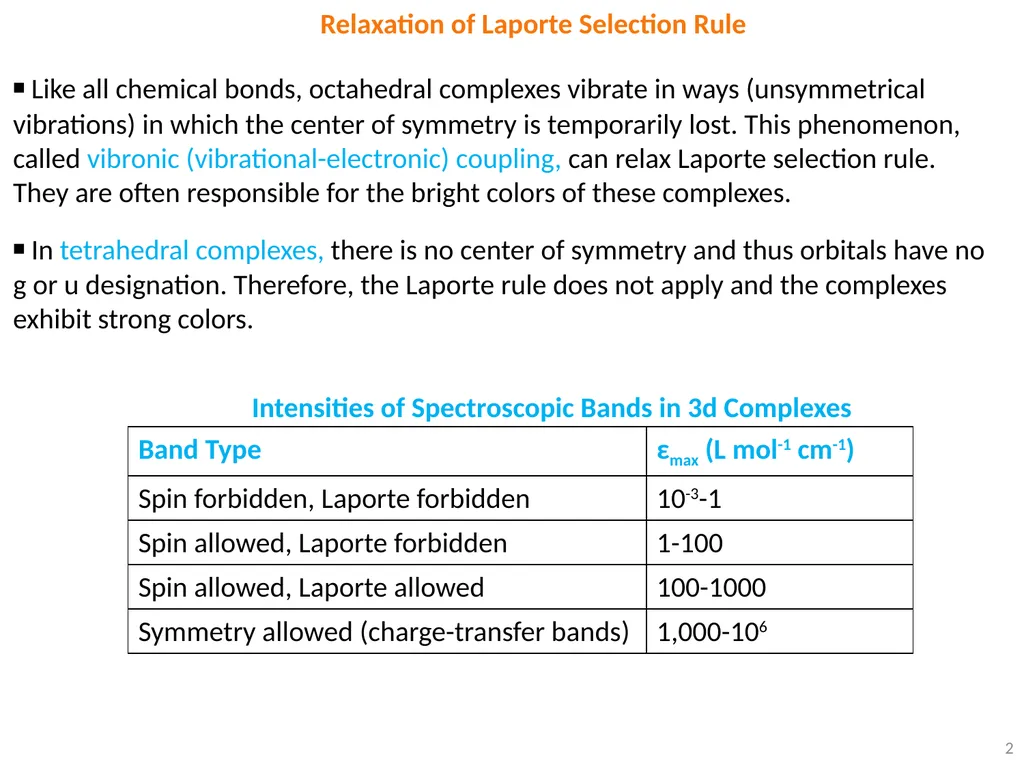
2 ▪ Like all chemical bonds, octahedral complexes vibrate in ways (unsymmetrical vibrations) in which the center of symmetry is temporarily lost. This phenomenon, called vibronic (vibrational-electronic) coupling, can relax Laporte selection rule.
They are often responsible for the bright colors of these complexes.
▪ In tetrahedral complexes, there is no center of symmetry and thus orbitals have no
g or u designation. Therefore, the Laporte rule does not apply and the complexes exhibit strong colors. Relaxation of Laporte Selection Rule Intensities of Spectroscopic Bands in 3d Complexes<br>
03
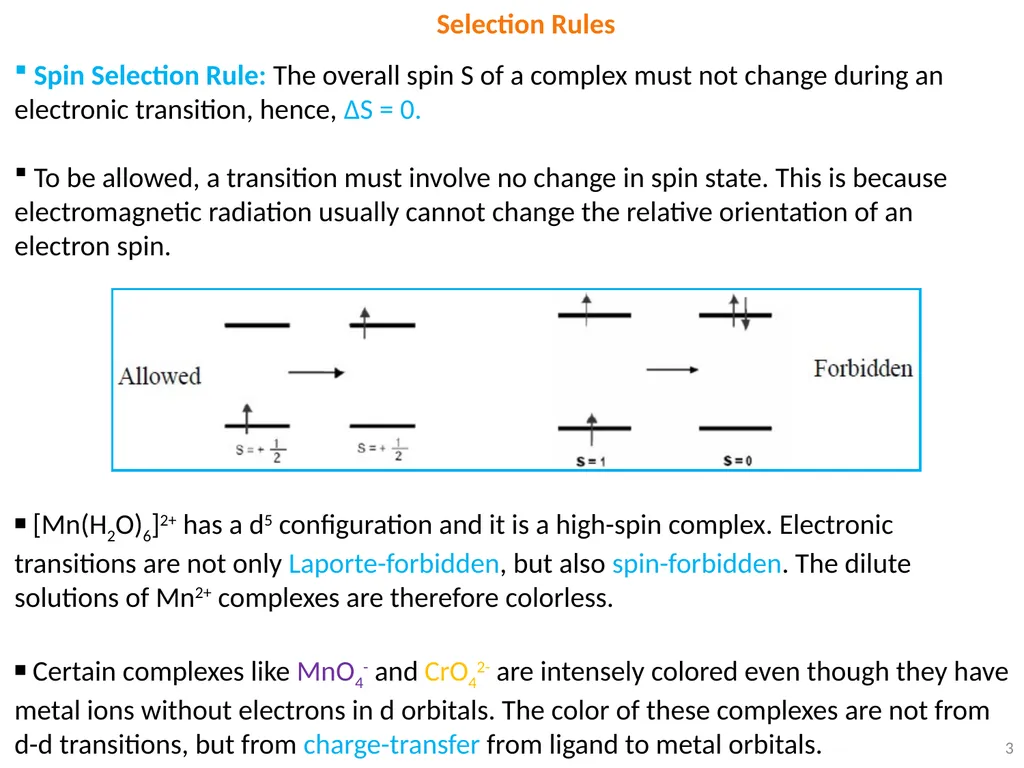
3 Selection Rules Spin Selection Rule: The overall spin S of a complex must not change during an electronic transition, hence, ΔS = 0.
To be allowed, a transition must involve no change in spin state. This is because electromagnetic radiation usually cannot change the relative orientation of an electron spin.
▪ [Mn(H2O)6]2+ has a d5 configuration and it is a high-spin complex. Electronic transitions are not only Laporte-forbidden, but also spin-forbidden. The dilute solutions of Mn2+ complexes are therefore colorless.
▪ Certain complexes like MnO4- and CrO42- are intensely colored even though they have metal ions without electrons in d orbitals. The color of these complexes are not from d-d transitions, but from charge-transfer from ligand to metal orbitals.<br>
04
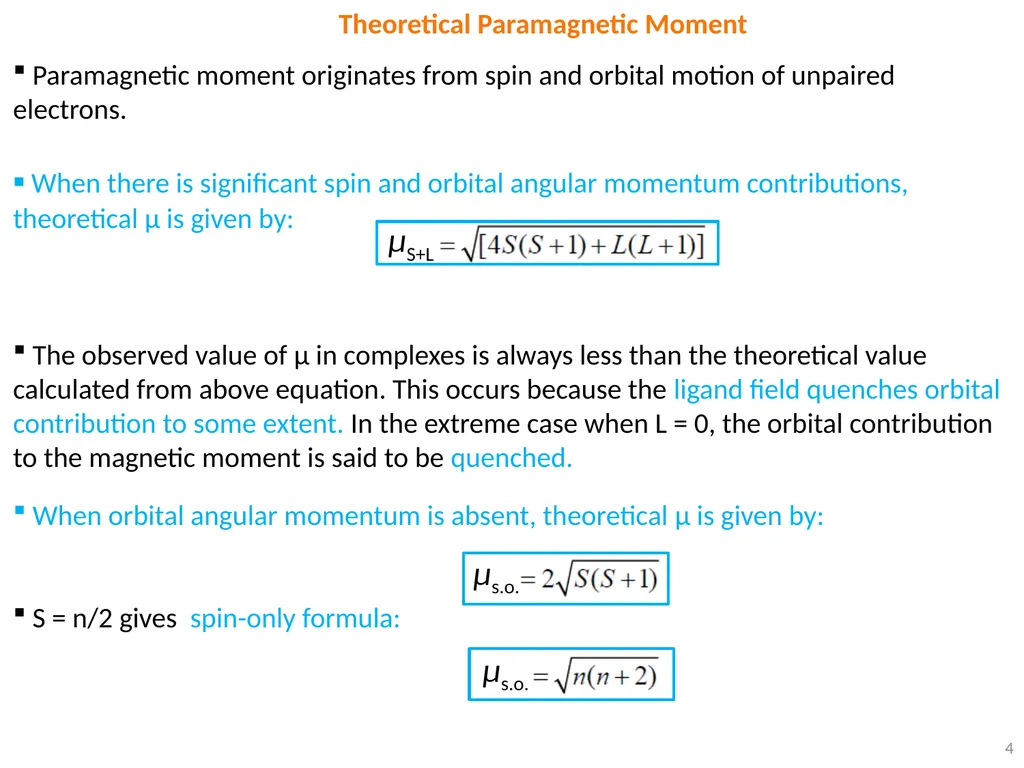
4 Theoretical Paramagnetic Moment Paramagnetic moment originates from spin and orbital motion of unpaired
electrons.
▪ When there is significant spin and orbital angular momentum contributions, theoretical μ is given by:
The observed value of μ in complexes is always less than the theoretical value calculated from above equation. This occurs because the ligand field quenches orbital contribution to some extent. In the extreme case when L = 0, the orbital contribution to the magnetic moment is said to be quenched.
When orbital angular momentum is absent, theoretical μ is given by:
S = n/2 gives spin-only formula: μS+L μs.o. μs.o.<br>
05
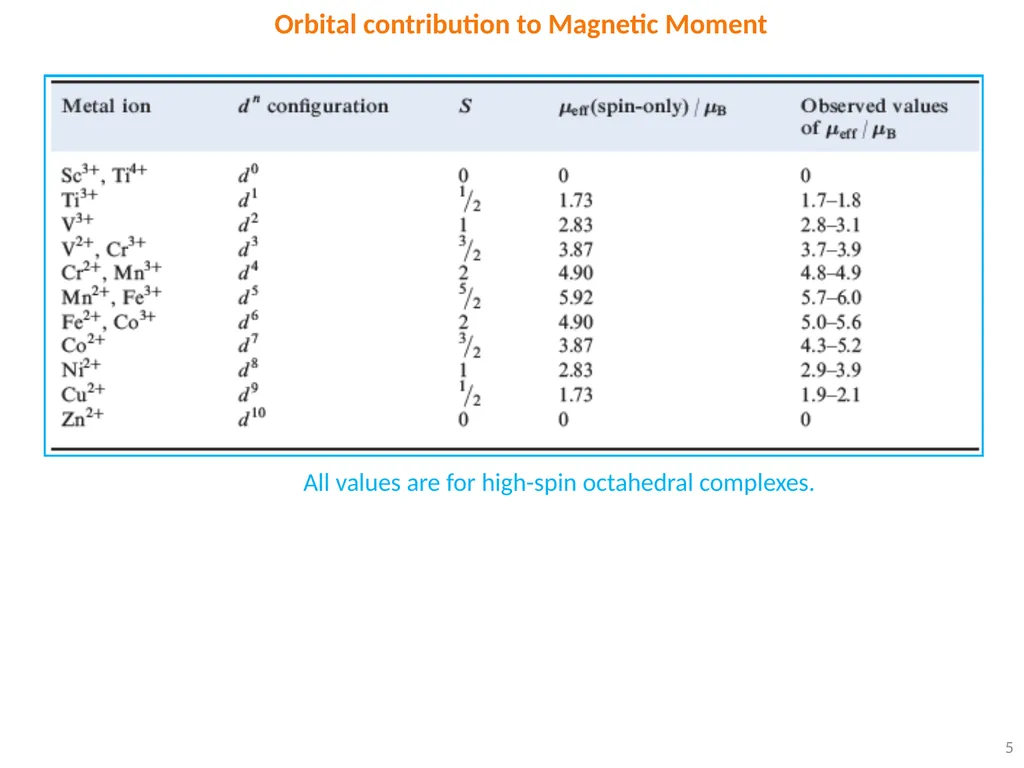
5 Orbital contribution to Magnetic Moment All values are for high-spin octahedral complexes.<br>
06
6 When does orbital angular momentum contribute to paramagnetic moment? For orbital angular momentum to contribute, there must be an equivalent and degenerate orbital (similar in energy to that of the orbital occupied by the unpaired electrons). If this is so, the electrons can make use of the available orbitals to
circulate or move around the center of the complexes and hence generate L and μL
(it is the rotation of the electrons which induces the orbital contribution).
Essential Conditions:
1) The orbitals should be degenerate (t2g or eg).
2) The orbitals should be similar in shape and size, so that they are transferable into one another by rotation about the same axis.
3) Orbitals must not contain electrons of identical spin.<br>
07
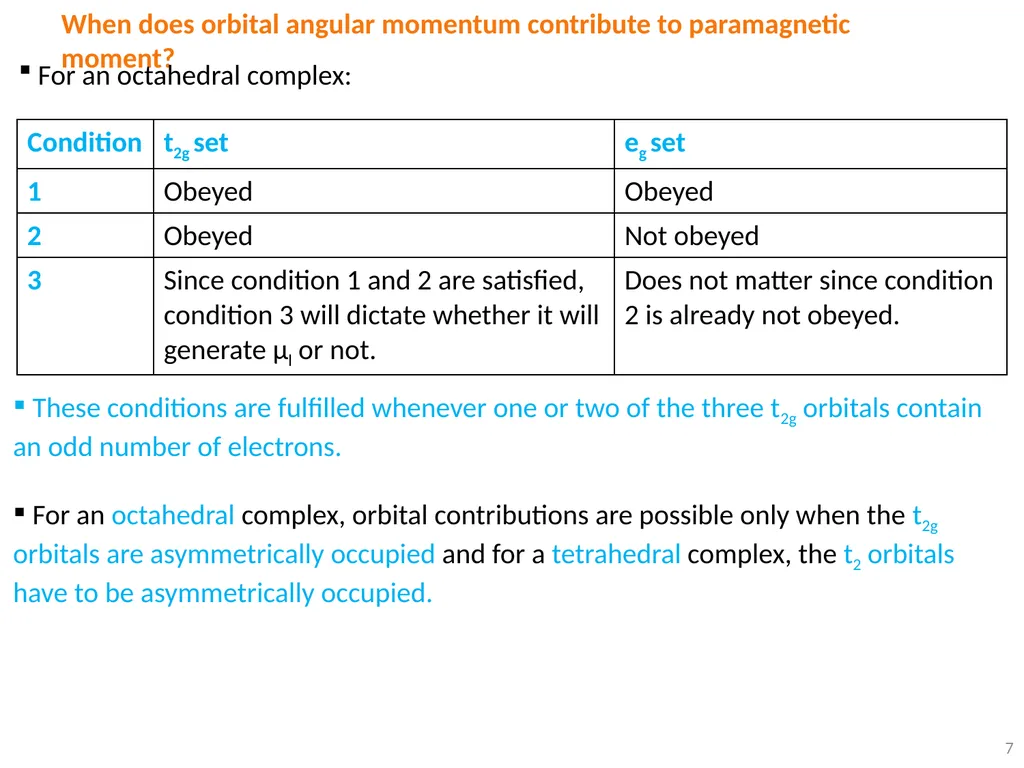
7 When does orbital angular momentum contribute to paramagnetic moment? These conditions are fulfilled whenever one or two of the three t2g orbitals contain an odd number of electrons.
For an octahedral complex, orbital contributions are possible only when the t2g
orbitals are asymmetrically occupied and for a tetrahedral complex, the t2 orbitals
have to be asymmetrically occupied. For an octahedral complex:<br>
08
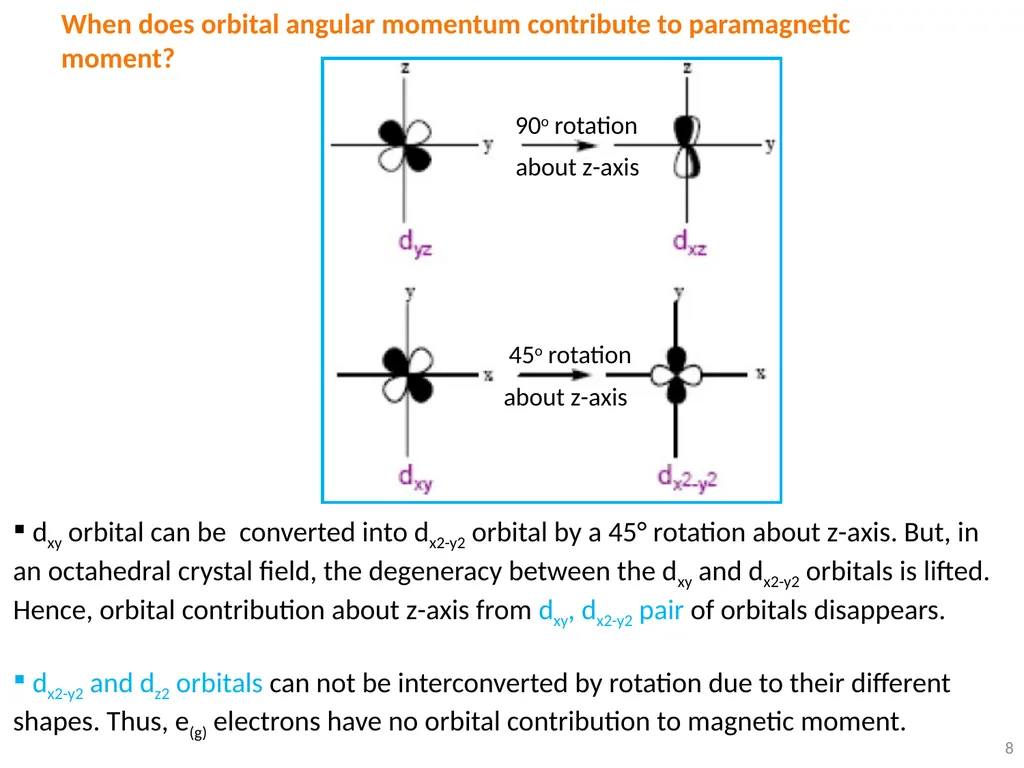
8 When does orbital angular momentum contribute to paramagnetic moment? dxy orbital can be converted into dx2-y2 orbital by a 45° rotation about z-axis. But, in an octahedral crystal field, the degeneracy between the dxy and dx2-y2 orbitals is lifted.
Hence, orbital contribution about z-axis from dxy, dx2-y2 pair of orbitals disappears.
dx2-y2 and dz2 orbitals can not be interconverted by rotation due to their different shapes. Thus, e(g) electrons have no orbital contribution to magnetic moment. 45o rotation 90o rotation about z-axis about z-axis<br>
09
9 When does orbital angular momentum contribute to paramagnetic moment? dxz orbital can be converted into dyz orbital by a 90° rotation about z-axis. Thus, all t2(g) orbitals may be interconverted by rotation about suitable axes and we may expect orbital contributions from t2(g) electrons.
If all the t2g orbitals are singly occupied (t2g3), an electron in, say, dxz orbital cannot
be transferred into dyz orbital because it already contains an electron having the same spin quantum number as the incoming electron; if all the t2g orbitals are doubly occupied (t2g6), the transfer is not possible.
Thus, only configurations other than t2g3 and t2g6 make orbital contributions to magnetic moments. For high-spin octahedral complexes, orbital contribution is expected for: t2g1, t2g2, t2g4eg2 and t2g5eg2.
For tetrahedral complexes, orbital contribution is expected for: e2t21, e2t22, e4t24
and e4t25.<br>