1 Sustainability Workshop Friday, February 15, 2013 Jeff Sellers, State Support Team Missy Cochenour, State Support Team Stephanie Porowski, SLDS Grant Program Photos are stock photos. Release for web use of all photos on file. Agenda
"1 Sustainability Workshop Friday, February 15," is the property of its rightful owner. Permission is granted to
download and print the materials on this website for personal, non-commercial use only, and to display it
on your personal computer provided you do not modify the materials and that you retain all copyright
notices contained in the materials. By downloading content from our website, you accept the terms of this
agreement.
Presentation Transcript
01
1 Sustainability Workshop Friday, February 15, 2013
Jeff Sellers, State Support Team
Missy Cochenour, State Support Team
Stephanie Porowski, SLDS Grant Program Photos are stock photos. Release for web use of all photos on file.<br>
02
Agenda
Stakeholder Support: How broad and deep is the stakeholder support for your system?
SLDS Use: How widespread is the use of your SLDS?
Financial Support: How strong is the financial support for your SLDS?
Return on Investment: Are you defining, measuring, recording, and demonstrating success?
Next Steps: Planning for Sustainability Overview 2<br>
03
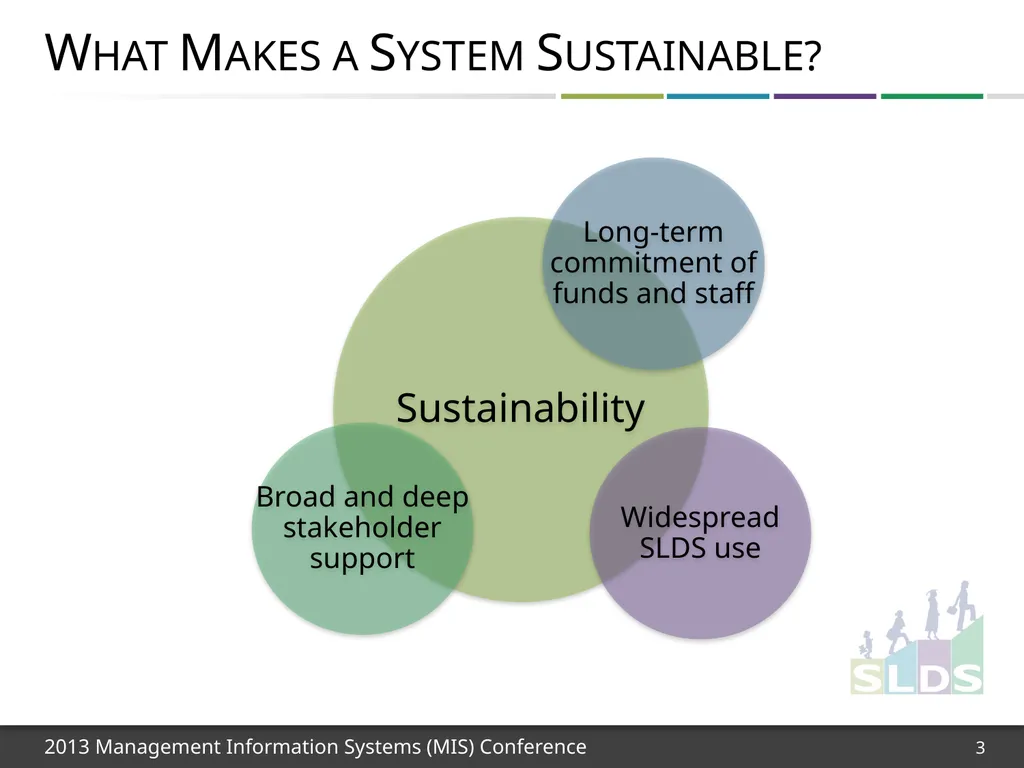
What Makes a System Sustainable? 3<br>
04
Stakeholder Support:
How Broad and Deep is
the Stakeholder Support
for Your System? 4<br>
05
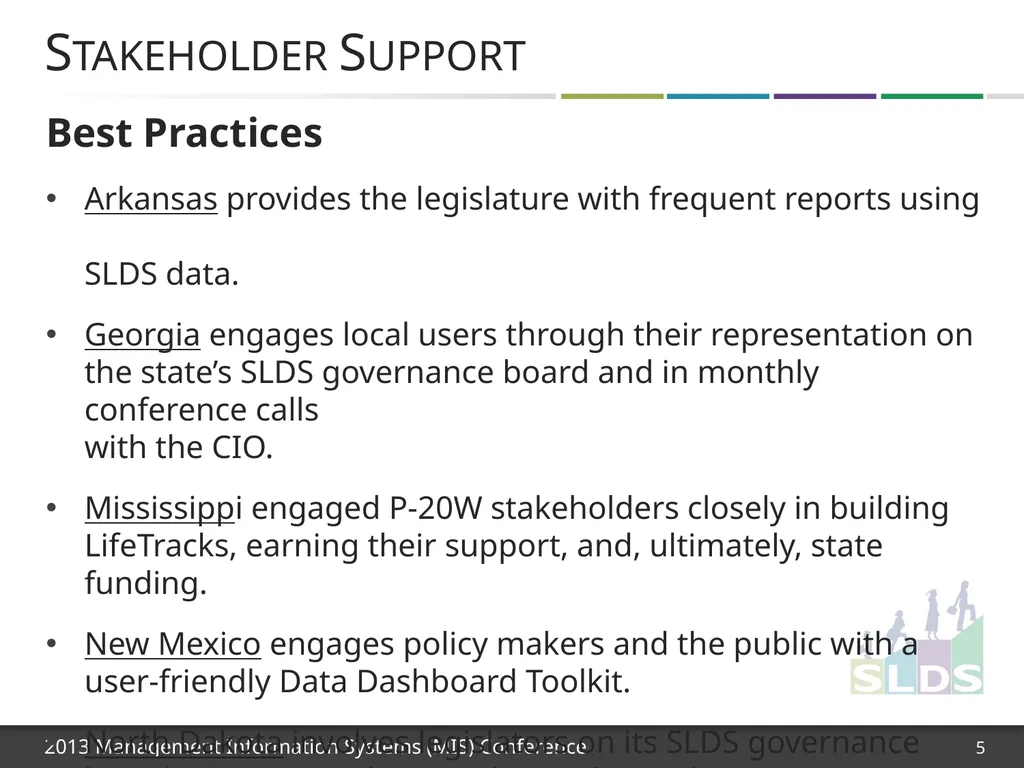
Best Practices
Arkansas provides the legislature with frequent reports using SLDS data.
Georgia engages local users through their representation on the state’s SLDS governance board and in monthly conference calls with the CIO.
Mississippi engaged P-20W stakeholders closely in building LifeTracks, earning their support, and, ultimately, state funding.
New Mexico engages policy makers and the public with a user-friendly Data Dashboard Toolkit.
North Dakota involves legislators on its SLDS governance board, ensuring a close working relationship. Stakeholder Support 5<br>
06
Small Group Task – 15 minutes
Working with your group, respond to the questions presented in Section A of your self-assessment.
In the “Quick Check,” reflect on your state responses and identify where the state has been successful and where there are potential needs in order to move the effort forward.
Full Group Report Out – 10 minutes Stakeholder Support 6<br>
07
Where has your state been successful with
stakeholder support?
What is still needed to move your state forward to
effectively ensure broad and deep stakeholder support? Stakeholder Support 7<br>
08
SLDS Use:
How Widespread is
the Use of Your SLDS? 8<br>
09
Best Practices
Georgia offers in-person and web-based trainings, integrated with the state’s technology trainings, to local users and Regional Education Service Agencies.
Hawaii provides data use training to local users in close collaboration with the state’s Curriculum and Instruction teams.
Oregon holds a Summer Assessment Institute where educators discuss their use of data. The Oregon DATA Project also sponsors trainings across the state for individuals to become certified to provide data use training.
Washington’s ERDC involves stakeholders closely in the process of determining which data are collected in the SLDS. SLDS Use 9<br>
10
Small Group Task – 15 minutes
Working with your group, respond to the questions presented in Section B of your self-assessment.
In the “Quick Check,” reflect on your state responses and identify where the state has been successful and where there are potential needs in order to move the effort forward.
Full Group Report Out – 10 minutes SLDS Use 10<br>
11
Where has your state been successful with SLDS use?
What is needed to institutionalize usage of your system? SLDS USE 11<br>
12
Financial Support:
How Strong is
the Financial Support
for Your SLDS? 12<br>
13
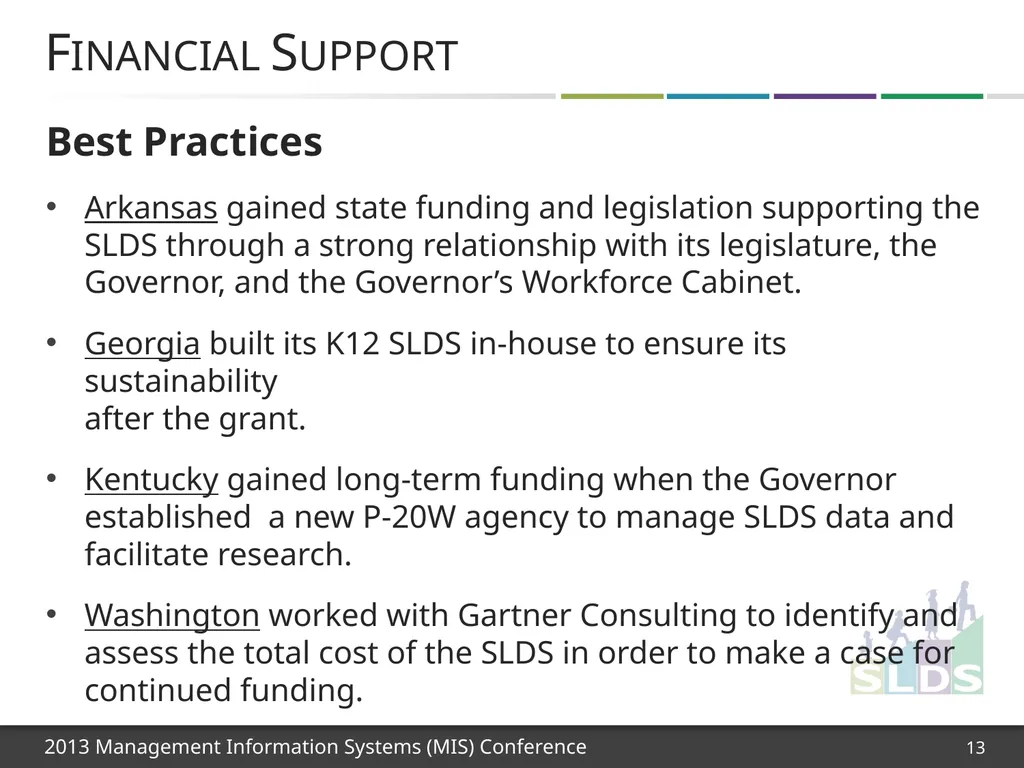
Best Practices
Arkansas gained state funding and legislation supporting the SLDS through a strong relationship with its legislature, the Governor, and the Governor’s Workforce Cabinet.
Georgia built its K12 SLDS in-house to ensure its sustainability after the grant.
Kentucky gained long-term funding when the Governor established a new P-20W agency to manage SLDS data and facilitate research.
Washington worked with Gartner Consulting to identify and assess the total cost of the SLDS in order to make a case for continued funding. Financial Support 13<br>
14
Small Group Task – 15 minutes
Working with your group, respond to the questions presented in Section C of your self-assessment.
In the “Quick Check,” reflect on your state responses and identify where the state has been successful and where there are potential needs in order to move the effort forward.
Full Group Report Out – 10 minutes Financial Support 14<br>
15
Where has your state been successful in financial support?
How might you expand your sources of financial support? Financial Support 15<br>
16
Return on Investment:
Are You Defining,
Measuring, Recording,
and Demonstrating Success? 16<br>
17
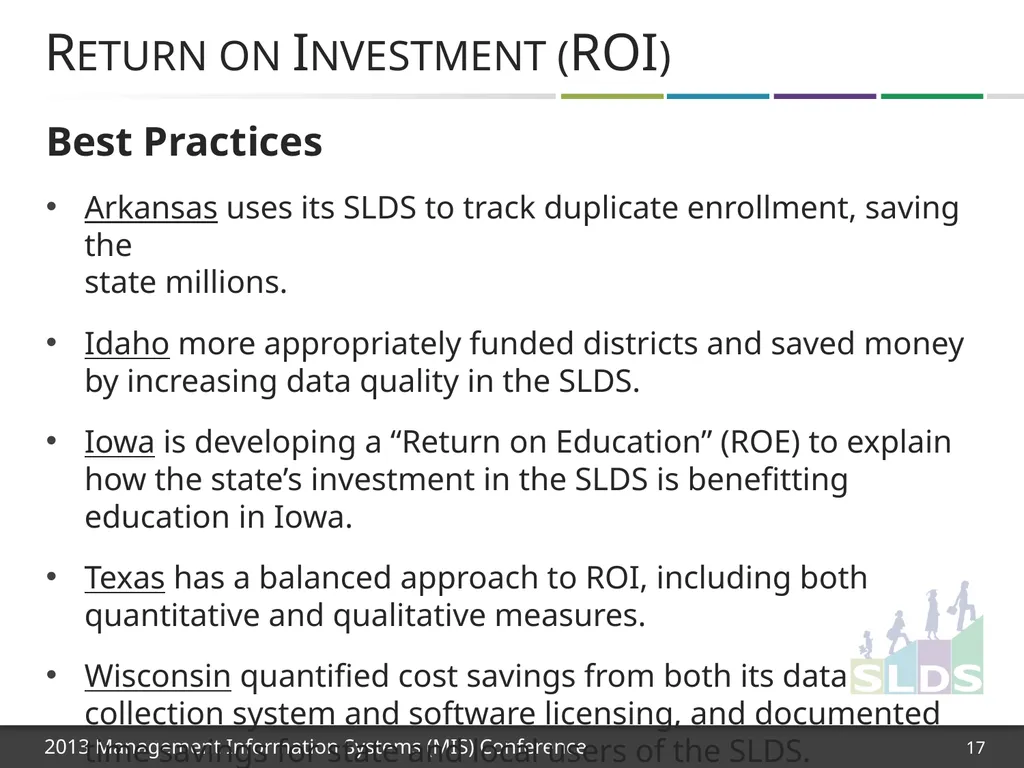
Best Practices
Arkansas uses its SLDS to track duplicate enrollment, saving the state millions.
Idaho more appropriately funded districts and saved money by increasing data quality in the SLDS.
Iowa is developing a “Return on Education” (ROE) to explain how the state’s investment in the SLDS is benefitting education in Iowa.
Texas has a balanced approach to ROI, including both quantitative and qualitative measures.
Wisconsin quantified cost savings from both its data collection system and software licensing, and documented time savings for state and local users of the SLDS. Return on Investment (ROI) 17<br>
18
Small Group Task – 15 minutes
Working with your group, respond to the questions presented in Section D of your self-assessment.
In the “Quick Check,” reflect on your state responses and identify where the state has been successful and where there are potential needs in order to move the effort forward.
Full Group Report Out – 10 minutes Return on Investment (ROI) 18<br>
19
Where has your state been successful capturing ROI?
How can your state begin to demonstrate its SLDS successes? Return on Investment (ROI) 19<br>
20
Next Steps:
Planning for Sustainability 20<br>
21
Small Group Task – 15 minutes
Working with your group, respond to the questions presented in Section E of your self-assessment.
In the “Quick Check,” reflect on your state responses and identify where the state has been successful and where there are potential needs in order to move the effort forward.
Full Group Report Out – 10 minutes Next Steps 21<br>
22
Where has your state been successful planning for sustainability?
What is needed to move your state forward to sustain its system? Next Steps 22<br>
23
For more information on planning for sustainability:
Alternative Sources of Support for SLDS Work: Tips from the States: http://nces.ed.gov/programs/slds/pdf/best_practices2b.pdf
Stakeholder Communication: SLDS Best Practices Brief: http://nces.ed.gov/programs/slds/pdf/best_practices.pdf Additional Resources 23<br>