1 The passive Summary phonological formshape of the passive in English (the data): be V-ed The guest was murdered by the chef problem: subject is patient 2 Voice analysis a. The chef murdered the guest. b. The guest was murdered by the
"1 The passive Summary phonological form/shape of" is the property of its rightful owner. Permission is granted to
download and print the materials on this website for personal, non-commercial use only, and to display it
on your personal computer provided you do not modify the materials and that you retain all copyright
notices contained in the materials. By downloading content from our website, you accept the terms of this
agreement.
Presentation Transcript
01
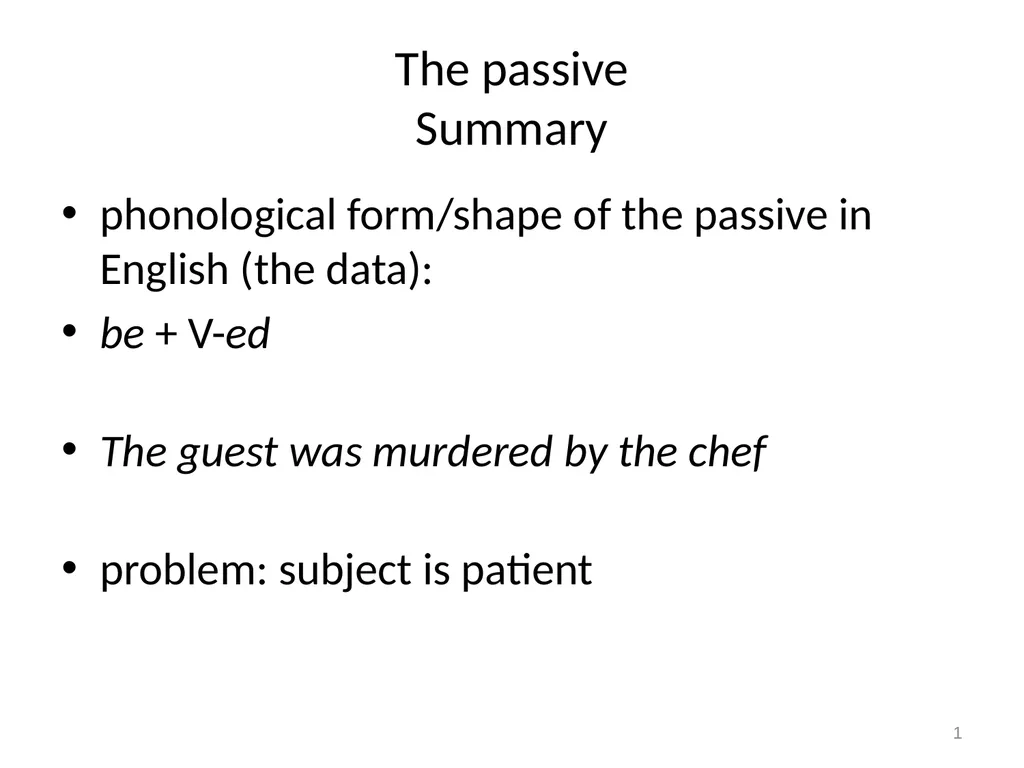
1 The passive Summary phonological form/shape of the passive in English (the data):
be + V-ed
The guest was murdered by the chef
problem: subject is patient<br>
02
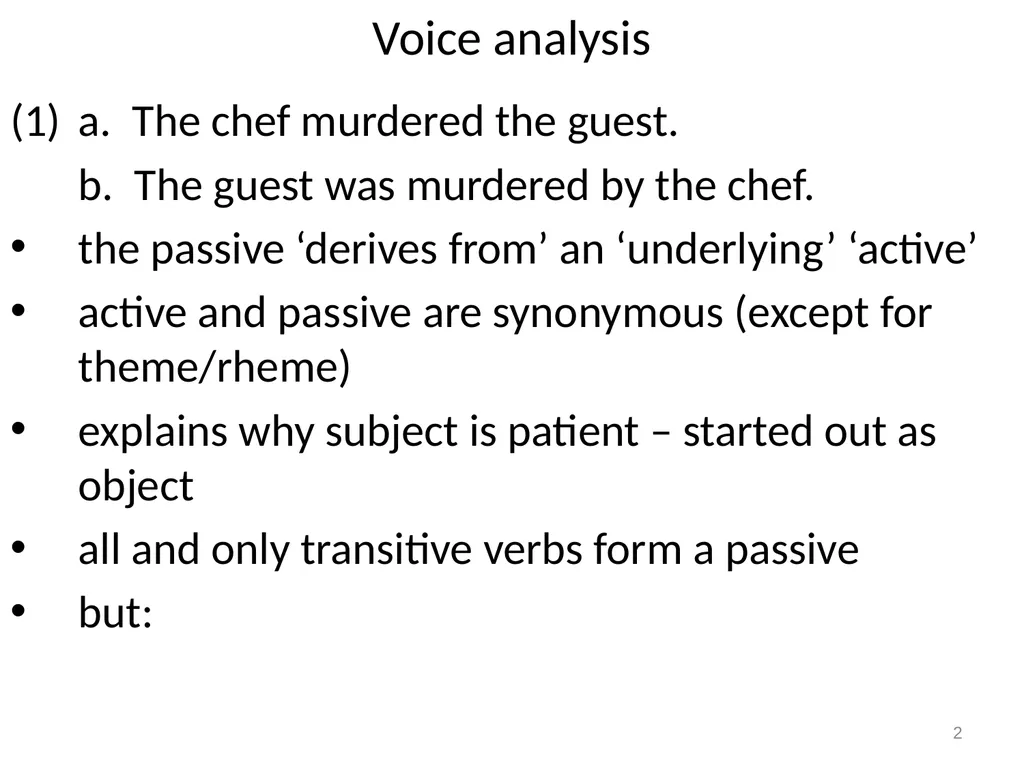
2 Voice analysis a. The chef murdered the guest.
b. The guest was murdered by the chef.
the passive ‘derives from’ an ‘underlying’ ‘active’
active and passive are synonymous (except for theme/rheme)
explains why subject is patient – started out as object
all and only transitive verbs form a passive
but:<br>
03
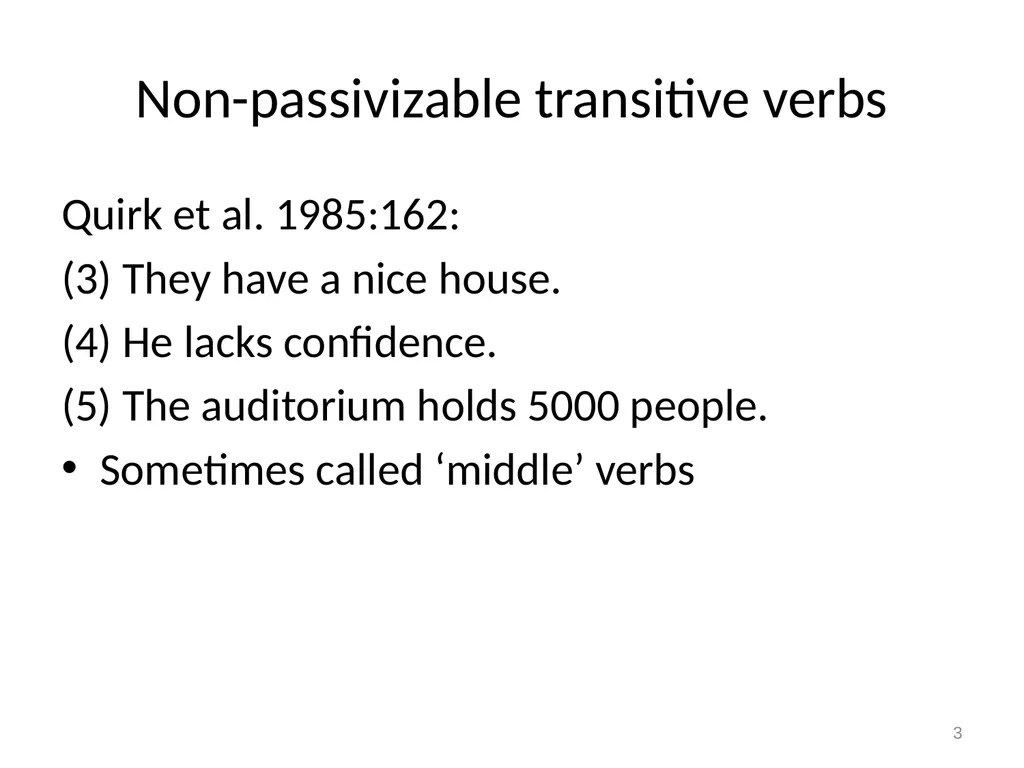
3 Non-passivizable transitive verbs Quirk et al. 1985:162:
(3) They have a nice house.
(4) He lacks confidence.
(5) The auditorium holds 5000 people.
Sometimes called ‘middle’ verbs<br>
04
4 Aims of analysis meaning of be + V-ed
syntax: combinable with which verbs or sentences?
form: what grammatical construction does it represent? (How is it to be parsed?)<br>
05
5 Voice analysis Form: passive derived from active active and passive are ‘voices’ of the verb
Meaning: passive is cognitively synonymous with active Halliday: motivation for passive is to make the patient unmarked theme
Syntax: all and only transitive verbs are passivizable (exceptions are listed individually)<br>
06
6 Criticism of voice analysis: contradictions, anomalies,flaws meaning of be + V-ed?
five formal differences – synonymous?!?
agentive by-phrase
4/5 without agent – contradicts derivation from active, where agent/subject is obligatory
statal passive:
The door was closed actional passive (action, no state)
The door was closed statal passive (state, no action)
how can this be?<br>
07
7 adjectival properties – why?
odd passives, and passivizability a property of sentences, not verbs
passive participle also in perfect
non-passivizable transitive verbs<br>
08
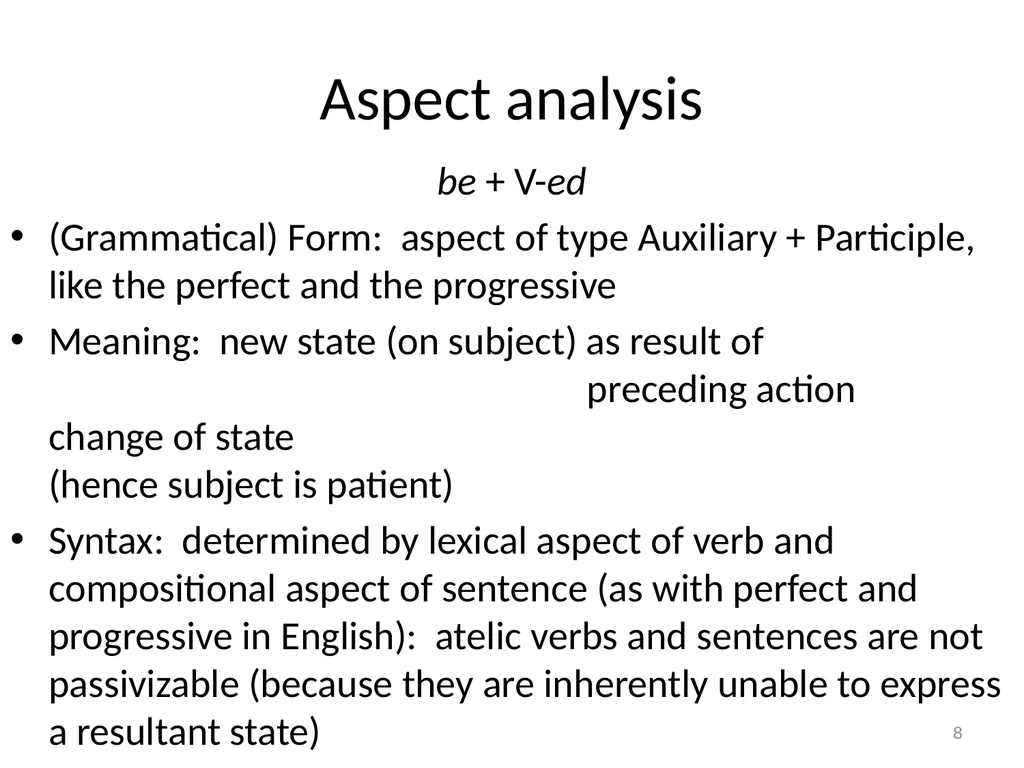
8 Aspect analysis be + V-ed
(Grammatical) Form: aspect of type Auxiliary + Participle, like the perfect and the progressive
Meaning: new state (on subject) as result of preceding action change of state (hence subject is patient)
Syntax: determined by lexical aspect of verb and compositional aspect of sentence (as with perfect and progressive in English): atelic verbs and sentences are not passivizable (because they are inherently unable to express a resultant state)<br>
09
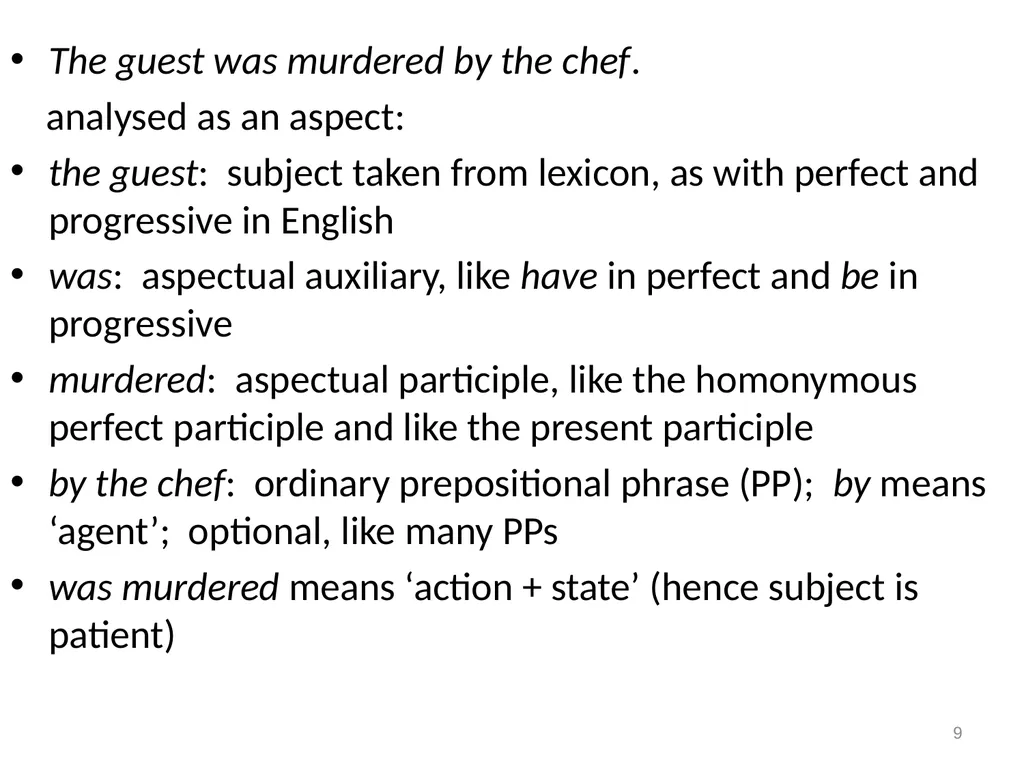
9 The guest was murdered by the chef.
analysed as an aspect:
the guest: subject taken from lexicon, as with perfect and progressive in English
was: aspectual auxiliary, like have in perfect and be in progressive
murdered: aspectual participle, like the homonymous perfect participle and like the present participle
by the chef: ordinary prepositional phrase (PP); by means ‘agent’; optional, like many PPs
was murdered means ‘action + state’ (hence subject is patient)<br>
10
10 Arguments in support of aspect analysis<br>
11
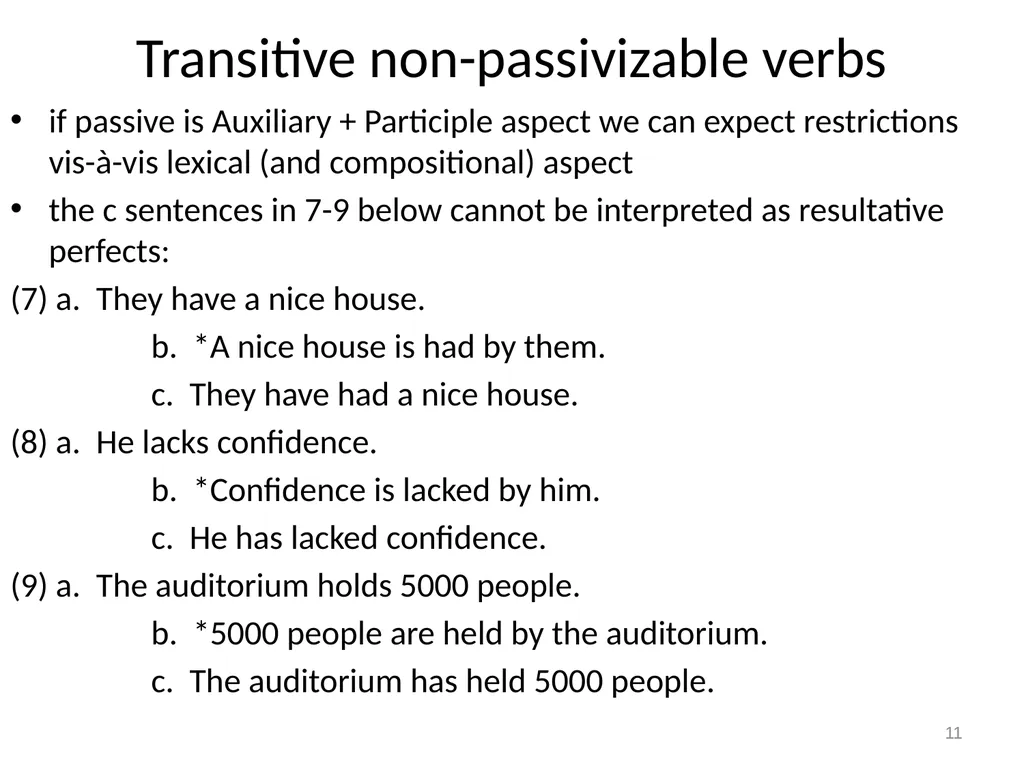
11 Transitive non-passivizable verbs if passive is Auxiliary + Participle aspect we can expect restrictions vis-à-vis lexical (and compositional) aspect
the c sentences in 7-9 below cannot be interpreted as resultative perfects:
(7) a. They have a nice house.
b. *A nice house is had by them.
c. They have had a nice house.
(8) a. He lacks confidence.
b. *Confidence is lacked by him.
c. He has lacked confidence.
(9) a. The auditorium holds 5000 people.
b. *5000 people are held by the auditorium.
c. The auditorium has held 5000 people.<br>
12
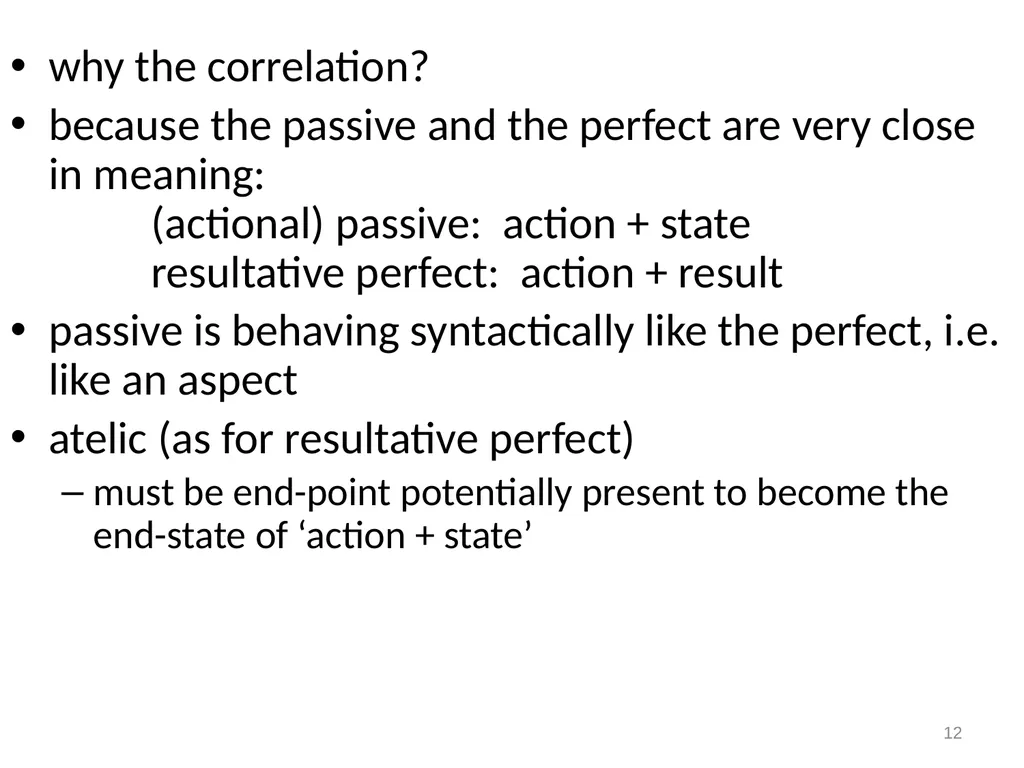
12 why the correlation?
because the passive and the perfect are very close in meaning: (actional) passive: action + state resultative perfect: action + result
passive is behaving syntactically like the perfect, i.e. like an aspect
atelic (as for resultative perfect)
must be end-point potentially present to become the end-state of ‘action + state’<br>
13
13 2/3 correlation
counterexamples explained by individual lexical semantics (see Beedham 1981, 1982)
the perfect-passive correlation is formal-syntactic proof that the passive is an aspect
any questions?<br>