1 The Risk Preparedness Methodologies Overview Stakeholder Webinar on Risk Preparedness Methodologies 5th September 2019 2 Electricity Risk Preparedness Regulation ENTSO-E to propose methodology for identifying crisis scenarios in a
"1 The Risk Preparedness Methodologies – Overview" is the property of its rightful owner. Permission is granted to
download and print the materials on this website for personal, non-commercial use only, and to display it
on your personal computer provided you do not modify the materials and that you retain all copyright
notices contained in the materials. By downloading content from our website, you accept the terms of this
agreement.
Presentation Transcript
01
1 The Risk Preparedness Methodologies – Overview Stakeholder Webinar on Risk Preparedness Methodologies 5th September 2019<br>
02
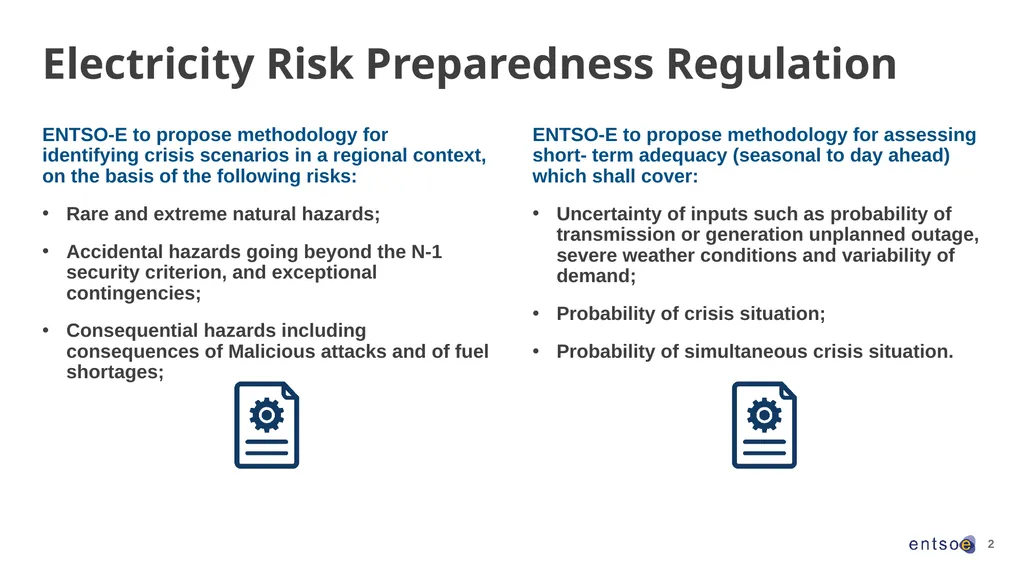
2 Electricity Risk Preparedness Regulation ENTSO-E to propose methodology for identifying crisis scenarios in a regional context, on the basis of the following risks:
Rare and extreme natural hazards;
Accidental hazards going beyond the N-1 security criterion, and exceptional contingencies;
Consequential hazards including consequences of Malicious attacks and of fuel shortages; ENTSO-E to propose methodology for assessing short- term adequacy (seasonal to day ahead) which shall cover:
Uncertainty of inputs such as probability of transmission or generation unplanned outage, severe weather conditions and variability of demand;
Probability of crisis situation;
Probability of simultaneous crisis situation.<br>
03
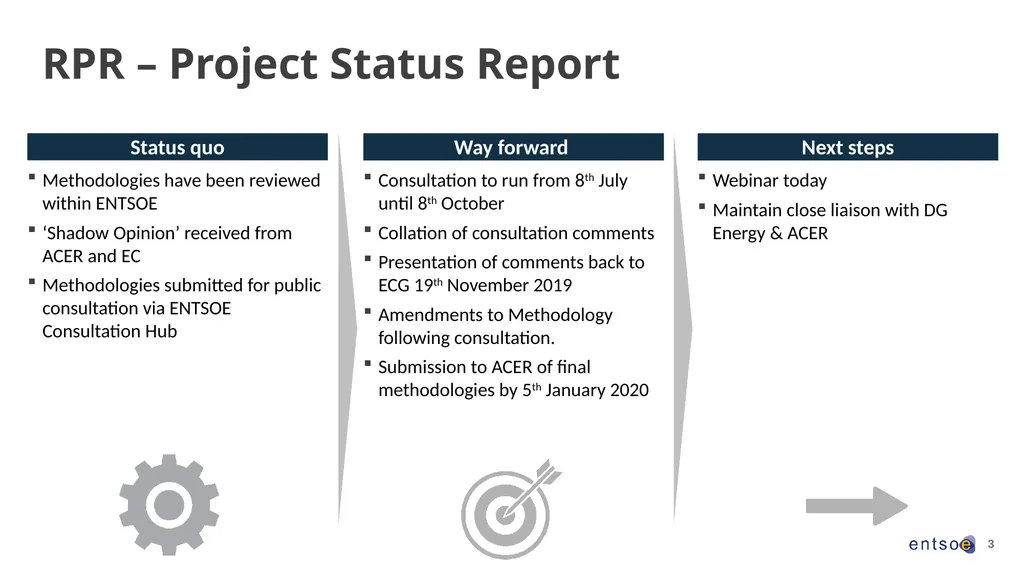
Status quo Way forward Methodologies have been reviewed within ENTSOE
‘Shadow Opinion’ received from ACER and EC
Methodologies submitted for public consultation via ENTSOE Consultation Hub RPR – Project Status Report Consultation to run from 8th July until 8th October
Collation of consultation comments
Presentation of comments back to ECG 19th November 2019
Amendments to Methodology following consultation.
Submission to ACER of final methodologies by 5th January 2020 3 Next steps Webinar today
Maintain close liaison with DG Energy & ACER<br>
04
4 Methodology to Identify Regional Electricity Crisis Scenarios<br>
05
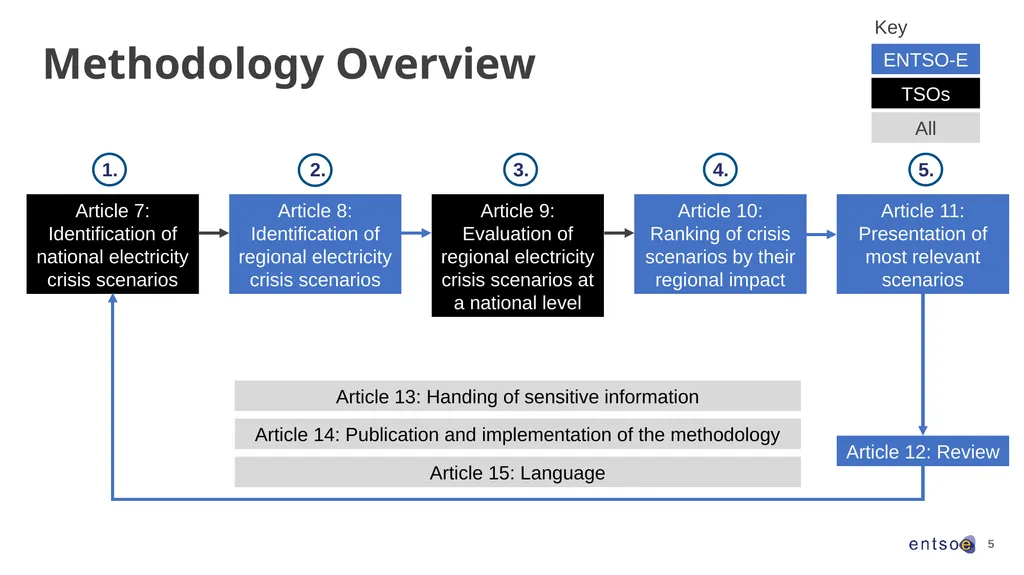
Methodology Overview 5 Article 13: Handing of sensitive information Article 7: Identification of national electricity crisis scenarios Article 8: Identification of regional electricity crisis scenarios Article 9: Evaluation of regional electricity crisis scenarios at a national level Article 10: Ranking of crisis scenarios by their regional impact Article 11: Presentation of most relevant scenarios Article 12: Review Article 14: Publication and implementation of the methodology Article 15: Language ENTSO-E TSOs All Key<br>
06
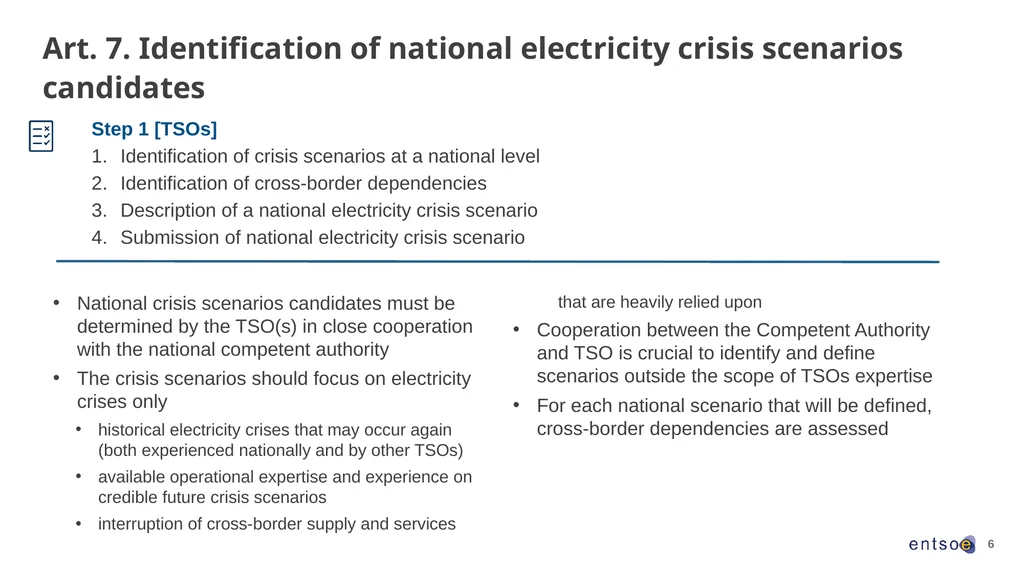
Art. 7. Identification of national electricity crisis scenarios candidates 6 National crisis scenarios candidates must be determined by the TSO(s) in close cooperation with the national competent authority
The crisis scenarios should focus on electricity crises only
historical electricity crises that may occur again (both experienced nationally and by other TSOs)
available operational expertise and experience on credible future crisis scenarios
interruption of cross-border supply and services that are heavily relied upon
Cooperation between the Competent Authority and TSO is crucial to identify and define scenarios outside the scope of TSOs expertise
For each national scenario that will be defined, cross-border dependencies are assessed Step 1 [TSOs]
Identification of crisis scenarios at a national level
Identification of cross-border dependencies
Description of a national electricity crisis scenario
Submission of national electricity crisis scenario<br>
07
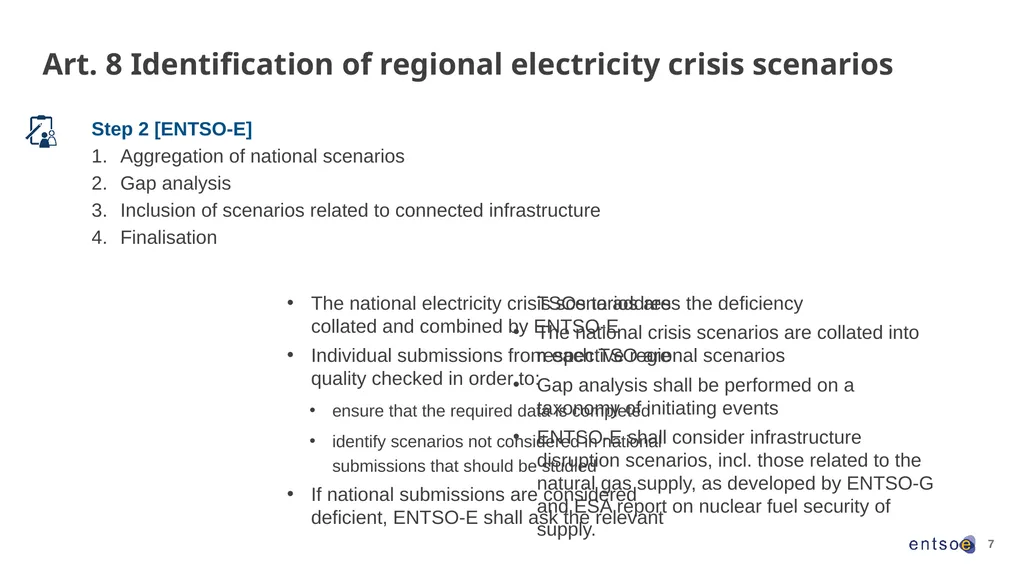
Art. 8 Identification of regional electricity crisis scenarios 7 The national electricity crisis scenarios are collated and combined by ENTSO-E
Individual submissions from each TSO are quality checked in order to:
ensure that the required data is completed
identify scenarios not considered in national submissions that should be studied
If national submissions are considered deficient, ENTSO-E shall ask the relevant TSOs to address the deficiency
The national crisis scenarios are collated into respective regional scenarios
Gap analysis shall be performed on a taxonomy of initiating events
ENTSO-E shall consider infrastructure disruption scenarios, incl. those related to the natural gas supply, as developed by ENTSO-G and ESA report on nuclear fuel security of supply. Step 2 [ENTSO-E]
Aggregation of national scenarios
Gap analysis
Inclusion of scenarios related to connected infrastructure
Finalisation<br>
08
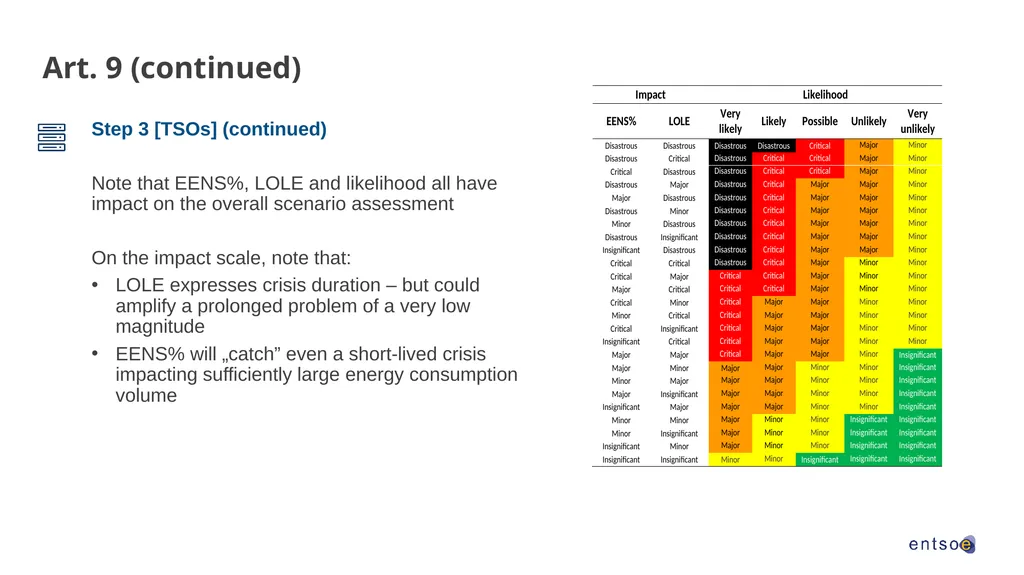
Art. 9 Evaluation of regional electr. crisis scen. at a national level 8 Each TSO should indicate, for their control areas, the likelihood and the impacts on the electricity system of each scenario identified …….consistent with the rating scales provided (Appendix I), in terms of Expected Energy Not Supplied and Loss of load expectation. Step 3 [TSOs]
Assessment of scenario impact per MS
Identification of cross-border impacts per MS
Submission of national crisis scenario assessments * ’EENS%’ is calculated by dividing expected energy not served for the duration of load curtailment by the total annual energy consumption of a Member State; ’LOLE’ (Loss of Load Expectation) is expressed in hours and represents the number of hours in which supply would not meet demand due to the crisis scenario<br>
09
Art. 9 (continued) Step 3 [TSOs] (continued)
Note that EENS%, LOLE and likelihood all have impact on the overall scenario assessment
On the impact scale, note that:
LOLE expresses crisis duration – but could amplify a prolonged problem of a very low magnitude
EENS% will „catch” even a short-lived crisis impacting sufficiently large energy consumption volume<br>
10
4. Ranking of regional crisis scenarios by their regional impact. (Art 10) 10 The regional impact of each scenario is assessed using the following method: for each scenario, the national “overall impact rating” and “overall rating of the strength of the cross-border dependencies” is collected,
a rating of a scenario is calculated as a sum over all Member States of “overall impact ratings” weighted by the “overall ratings of the strength of the cross-border dependencies”. x = national scenario impact rating strength of the cross-border dependencies regional impact Step 4 [ENTSO-E]
Gathering the national impact assessments per MS
Consistency Check of cross-border impacts
Evaluation of regional impacts
Ranking regional crisis scenarios according to their relevance<br>
11
11 Methodology for short term and seasonal adequacy assessments<br>
12
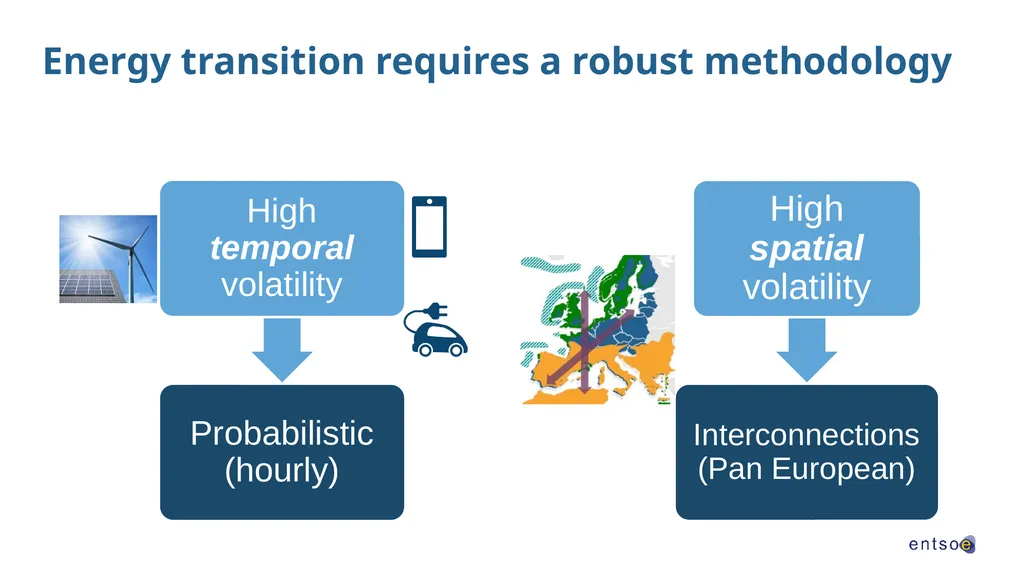
Energy transition requires a robust methodology<br>
13
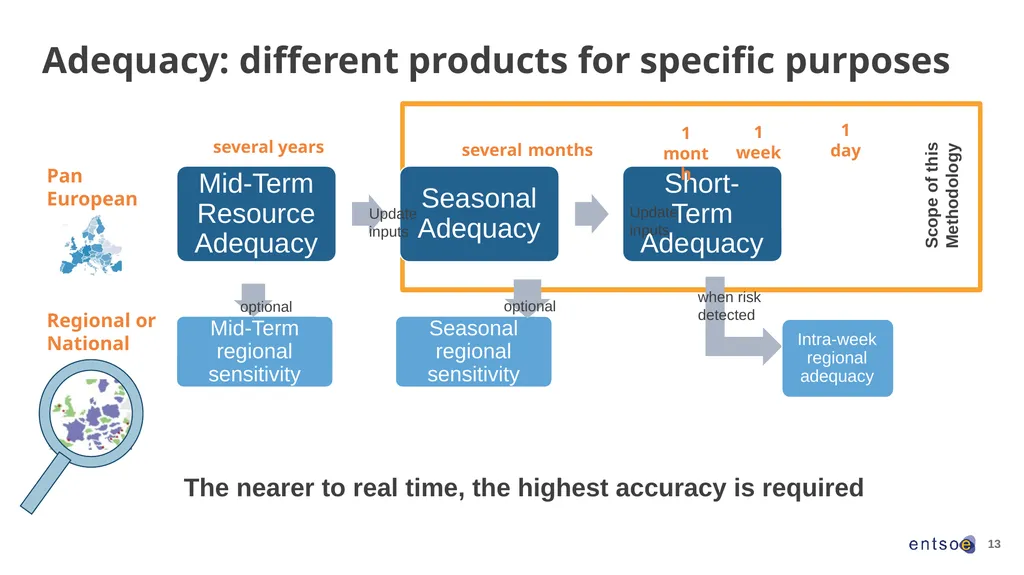
13 Adequacy: different products for specific purposes Scope of this Methodology The nearer to real time, the highest accuracy is required<br>
14
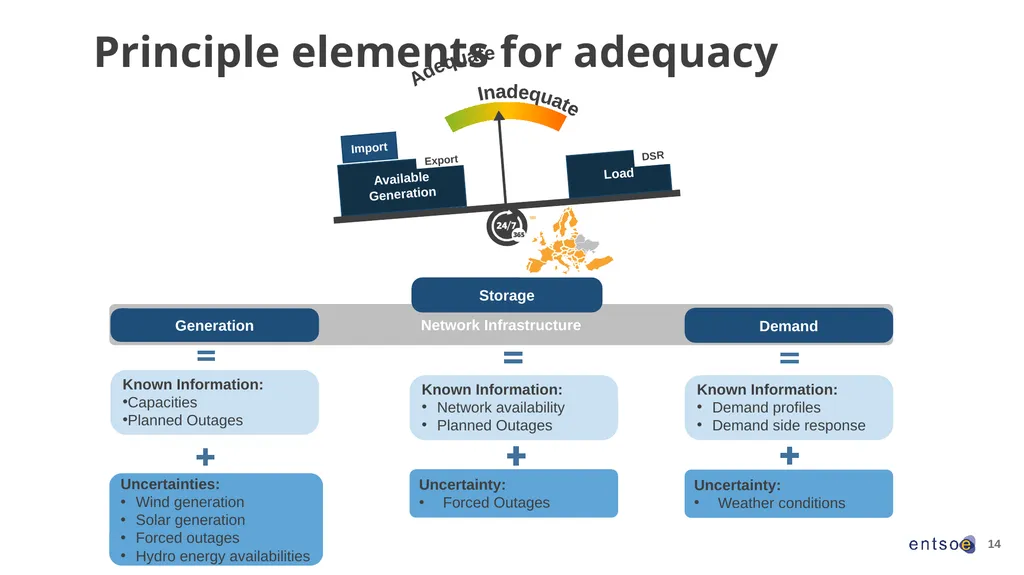
14 Principle elements for adequacy<br>
15
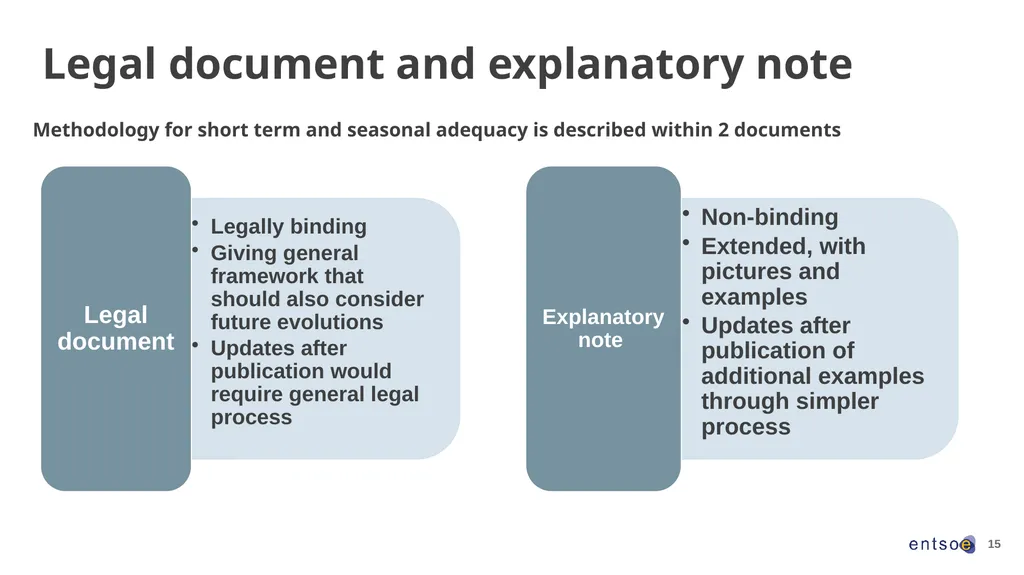
15 Legal document and explanatory note Methodology for short term and seasonal adequacy is described within 2 documents<br>
16
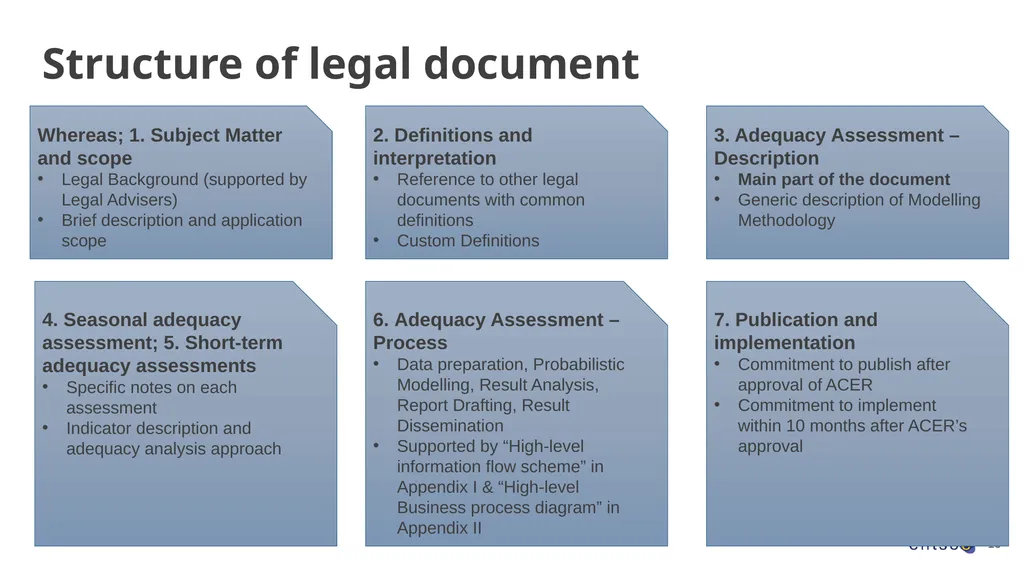
16 Structure of legal document Whereas; 1. Subject Matter and scope
Legal Background (supported by Legal Advisers)
Brief description and application scope 2. Definitions and interpretation
Reference to other legal documents with common definitions
Custom Definitions 3. Adequacy Assessment – Description
Main part of the document
Generic description of Modelling Methodology 4. Seasonal adequacy assessment; 5. Short-term adequacy assessments
Specific notes on each assessment
Indicator description and adequacy analysis approach 7. Publication and implementation
Commitment to publish after approval of ACER
Commitment to implement within 10 months after ACER’s approval 6. Adequacy Assessment – Process
Data preparation, Probabilistic Modelling, Result Analysis, Report Drafting, Result Dissemination
Supported by “High-level information flow scheme” in Appendix I & “High-level Business process diagram” in Appendix II<br>
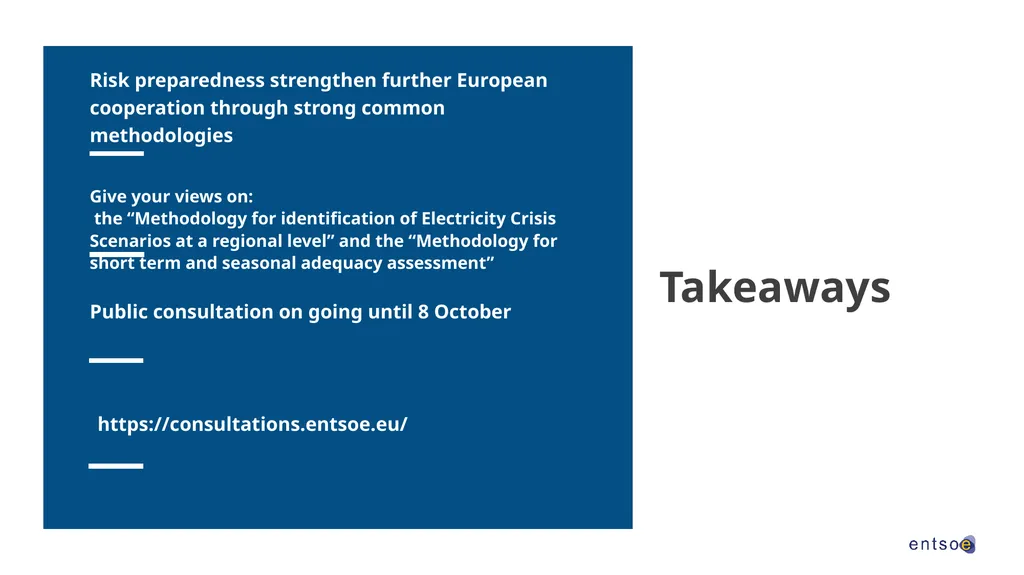
Risk preparedness strengthen further European cooperation through strong common methodologies Give your views on:
the “Methodology for identification of Electricity Crisis Scenarios at a regional level” and the “Methodology for short term and seasonal adequacy assessment” https://consultations.entsoe.eu/ Public consultation on going until 8 October Takeaways<br>
21
21 Thank you for your attention Please send any questions to:
Bruce.Riddington@sec.entsoe.eu or Alban.Joyeau@entsoe.eu<br>