1 The Sterile Insect Technique as a tool for controlling Aedes Aegypti Johann Antoine and Charles Grant What is the SIT? The Sterile Insect Technique, best known by its acronym SIT and also identified as the Sterile Insect Release Method
"1 The Sterile Insect Technique as a tool for" is the property of its rightful owner. Permission is granted to
download and print the materials on this website for personal, non-commercial use only, and to display it
on your personal computer provided you do not modify the materials and that you retain all copyright
notices contained in the materials. By downloading content from our website, you accept the terms of this
agreement.
Share
Embed code
Presentation Transcript
01
1 The Sterile Insect Technique as a tool for controlling
Aedes Aegypti Johann Antoine and Charles Grant<br>
02
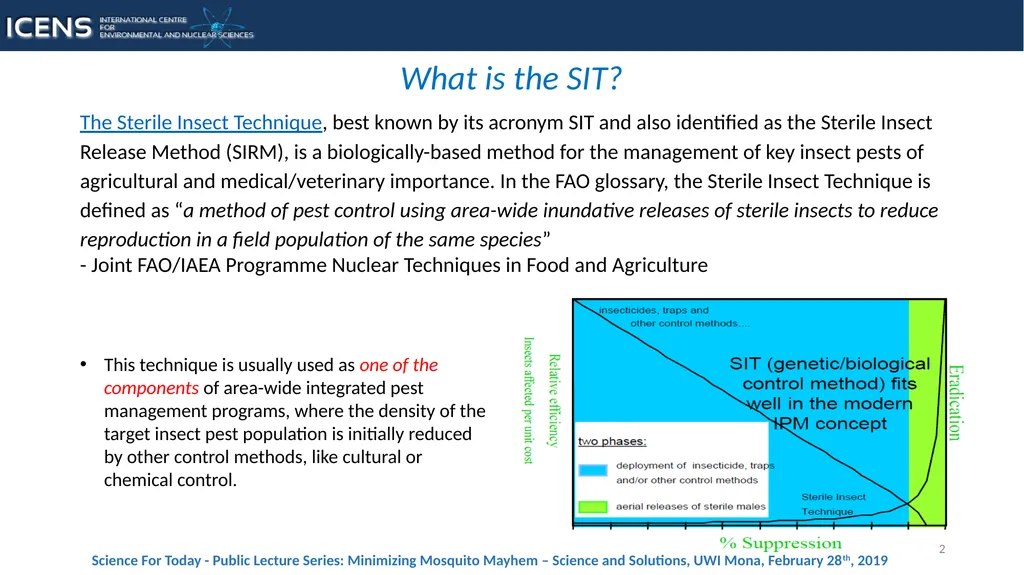
What is the SIT? The Sterile Insect Technique, best known by its acronym SIT and also identified as the Sterile Insect Release Method (SIRM), is a biologically-based method for the management of key insect pests of agricultural and medical/veterinary importance. In the FAO glossary, the Sterile Insect Technique is defined as “a method of pest control using area-wide inundative releases of sterile insects to reduce reproduction in a field population of the same species”
- Joint FAO/IAEA Programme Nuclear Techniques in Food and Agriculture This technique is usually used as one of the components of area-wide integrated pest management programs, where the density of the target insect pest population is initially reduced by other control methods, like cultural or chemical control. 2<br>
03
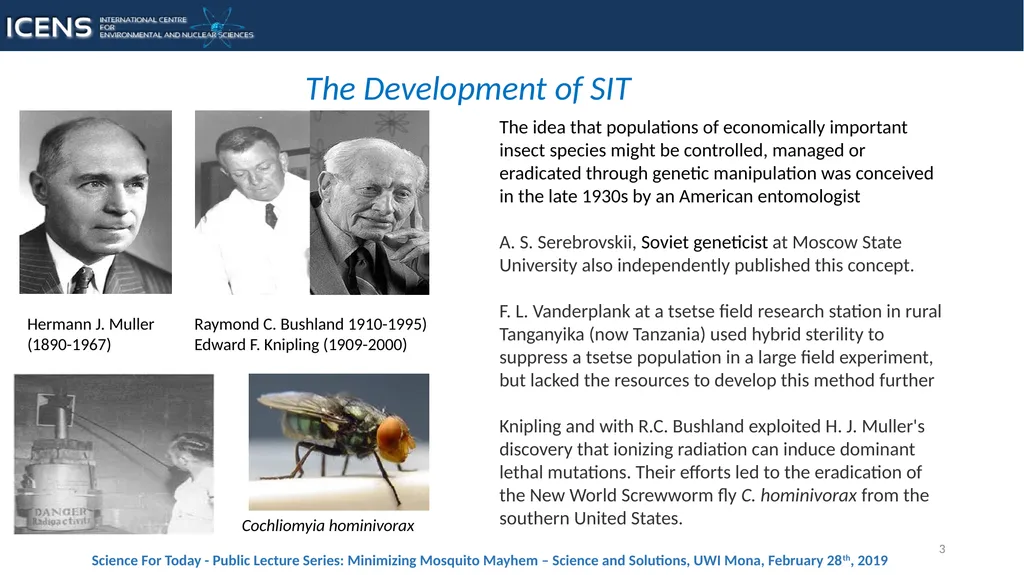
3 Hermann J. Muller
(1890-1967) The Development of SIT Raymond C. Bushland 1910-1995)
Edward F. Knipling (1909-2000) The idea that populations of economically important insect species might be controlled, managed or eradicated through genetic manipulation was conceived in the late 1930s by an American entomologist
A. S. Serebrovskii, Soviet geneticist at Moscow State University also independently published this concept.
F. L. Vanderplank at a tsetse field research station in rural Tanganyika (now Tanzania) used hybrid sterility to suppress a tsetse population in a large field experiment, but lacked the resources to develop this method further
Knipling and with R.C. Bushland exploited H. J. Muller's discovery that ionizing radiation can induce dominant lethal mutations. Their efforts led to the eradication of the New World Screwworm fly C. hominivorax from the southern United States. Cochliomyia hominivorax<br>
04
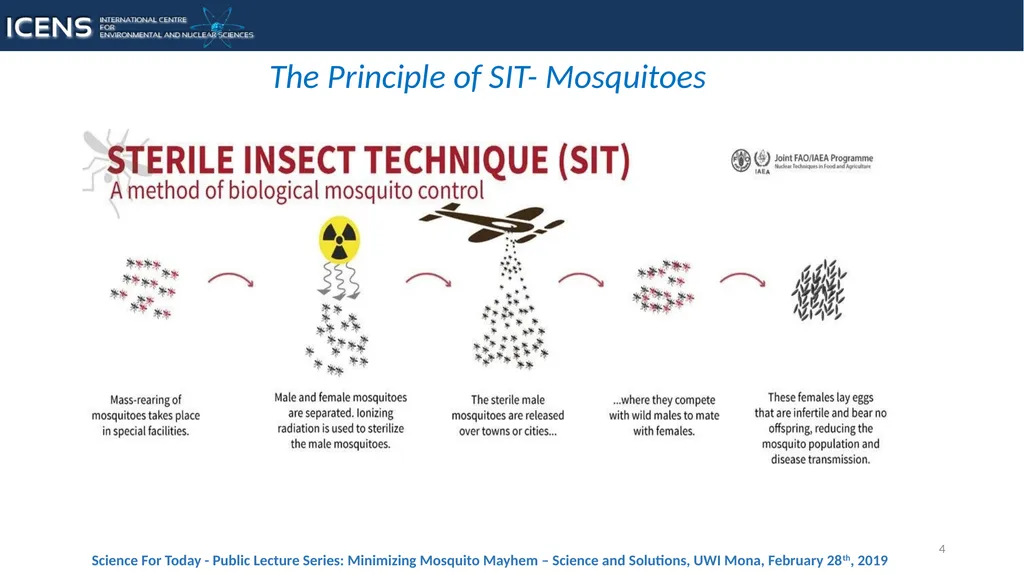
4 The Principle of SIT- Mosquitoes<br>
05
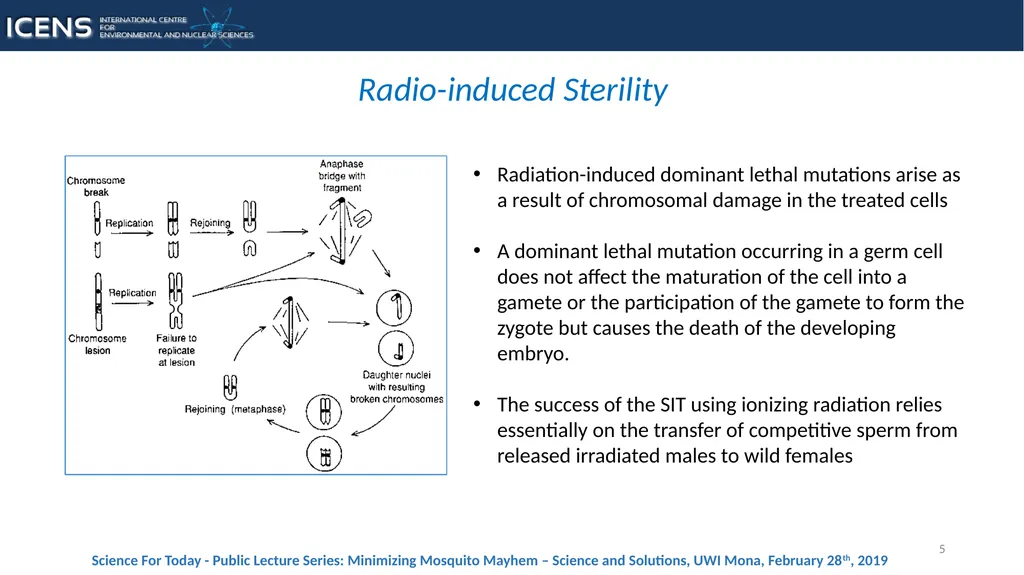
5 Radio-induced Sterility Radiation-induced dominant lethal mutations arise as a result of chromosomal damage in the treated cells
A dominant lethal mutation occurring in a germ cell does not affect the maturation of the cell into a gamete or the participation of the gamete to form the zygote but causes the death of the developing embryo.
The success of the SIT using ionizing radiation relies essentially on the transfer of competitive sperm from released irradiated males to wild females<br>
06
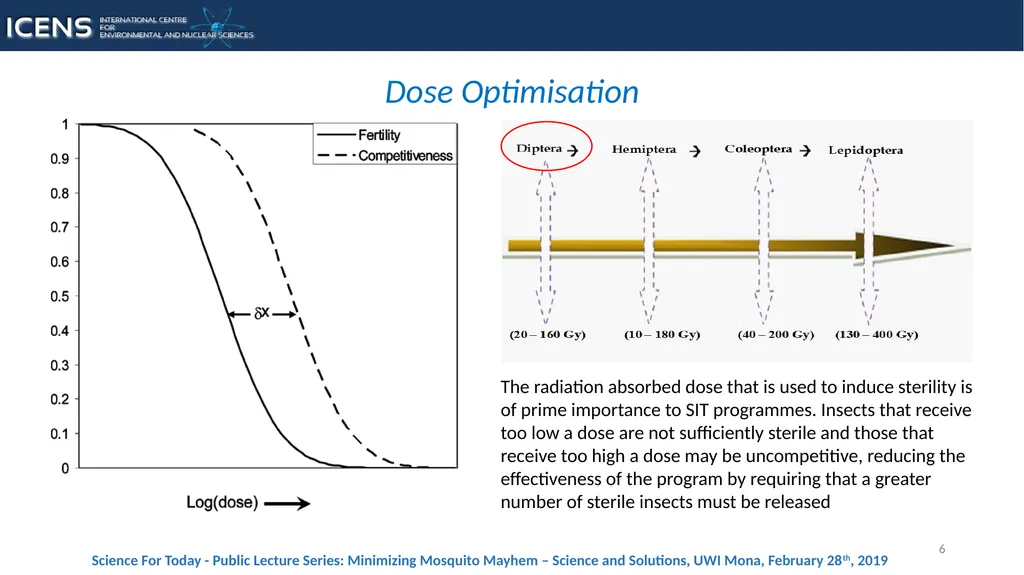
6 Dose Optimisation The radiation absorbed dose that is used to induce sterility is of prime importance to SIT programmes. Insects that receive too low a dose are not sufficiently sterile and those that receive too high a dose may be uncompetitive, reducing the effectiveness of the program by requiring that a greater number of sterile insects must be released<br>
07
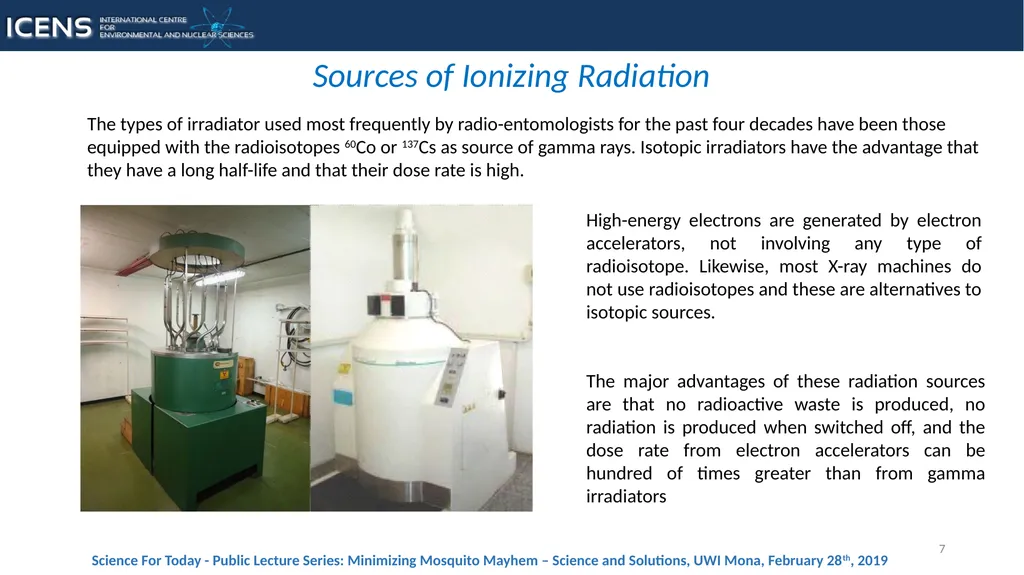
7 Sources of Ionizing Radiation The types of irradiator used most frequently by radio-entomologists for the past four decades have been those equipped with the radioisotopes 60Co or 137Cs as source of gamma rays. Isotopic irradiators have the advantage that they have a long half-life and that their dose rate is high. The major advantages of these radiation sources are that no radioactive waste is produced, no radiation is produced when switched off, and the dose rate from electron accelerators can be hundred of times greater than from gamma irradiators High-energy electrons are generated by electron accelerators, not involving any type of radioisotope. Likewise, most X-ray machines do not use radioisotopes and these are alternatives to isotopic sources.<br>
08
8 Considerations for the successful implementation The species must produce exclusively sexually Mass rearing procedures must be available Released sterile insects must present adequate dispersion Sterilization must not compromise the competitiveness of the males Females must preferably mate only once or irradiated sperm must be very competitive Population density of the target species must be low, making the release of a dominant population of sterile males over an extended period of time economically viable<br>
09
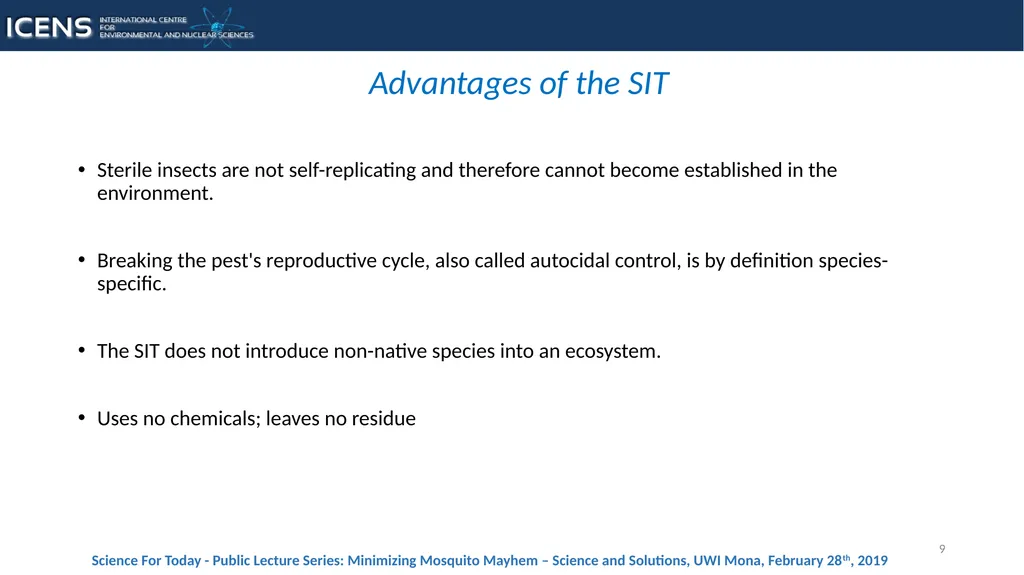
Sterile insects are not self-replicating and therefore cannot become established in the environment.
Breaking the pest's reproductive cycle, also called autocidal control, is by definition species-specific.
The SIT does not introduce non-native species into an ecosystem.
Uses no chemicals; leaves no residue 9 Advantages of the SIT<br>
10
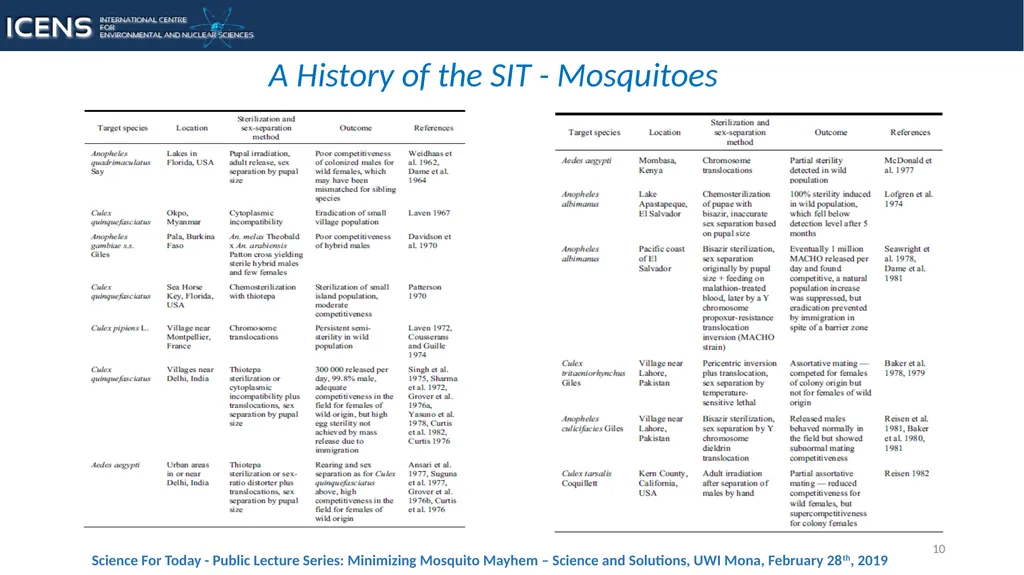
10 A History of the SIT - Mosquitoes<br>
11
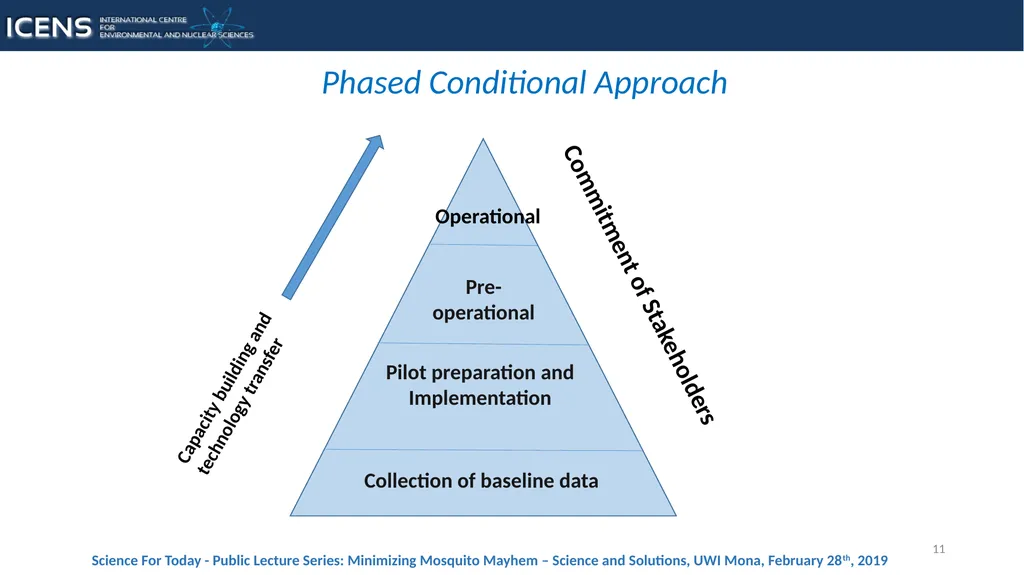
11 Phased Conditional Approach Capacity building and technology transfer Commitment of Stakeholders Collection of baseline data Pilot preparation and
Implementation Pre- operational Operational<br>
12
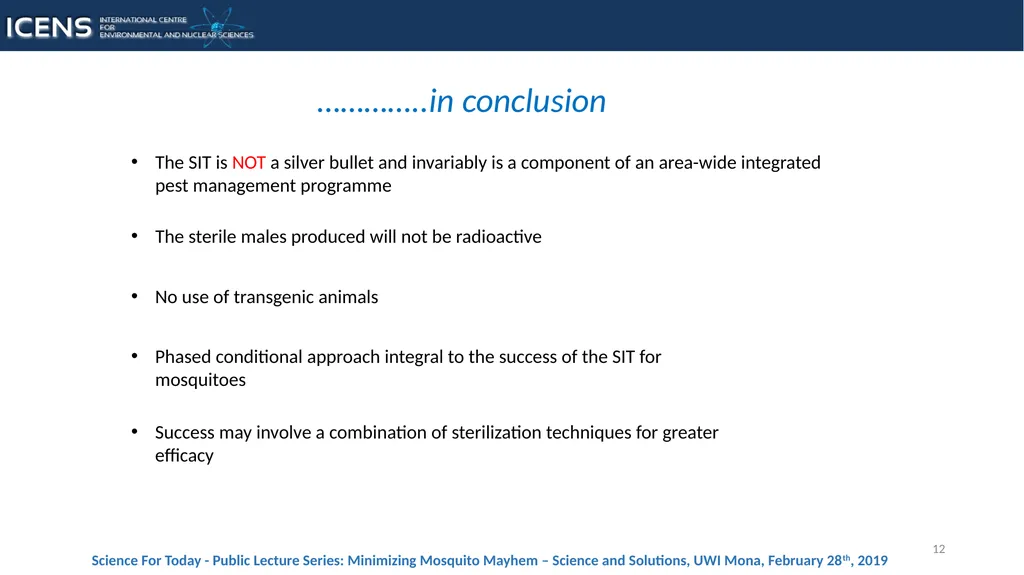
12 …………..in conclusion The SIT is NOT a silver bullet and invariably is a component of an area-wide integrated pest management programme The sterile males produced will not be radioactive No use of transgenic animals Phased conditional approach integral to the success of the SIT for mosquitoes Success may involve a combination of sterilization techniques for greater efficacy<br>