1. Two-Dimensional Isotropic Elasticity The coupling of stress and strain, leading to what are usually called constitutive relations, has been found to be dependent upon particular properties of the solid in question. When these properties
"1. Two-Dimensional Isotropic Elasticity The" is the property of its rightful owner. Permission is granted to
download and print the materials on this website for personal, non-commercial use only, and to display it
on your personal computer provided you do not modify the materials and that you retain all copyright
notices contained in the materials. By downloading content from our website, you accept the terms of this
agreement.
Presentation Transcript
01
1. Two-Dimensional Isotropic Elasticity
The coupling of stress and strain, leading to what are usually called constitutive relations, has been found to be dependent upon particular properties of the solid in question. When these properties are found to be the same regardless of the direction of measurement, the solid is said to be isotropic. If, however, the value of property differs as a function of direction, the solid is classed as anisotropic with regard to the property of concern. A solid is said to be homogeneous if its properties do not vary with location within the body. 2. Model of a Perfectly Elastic Solid
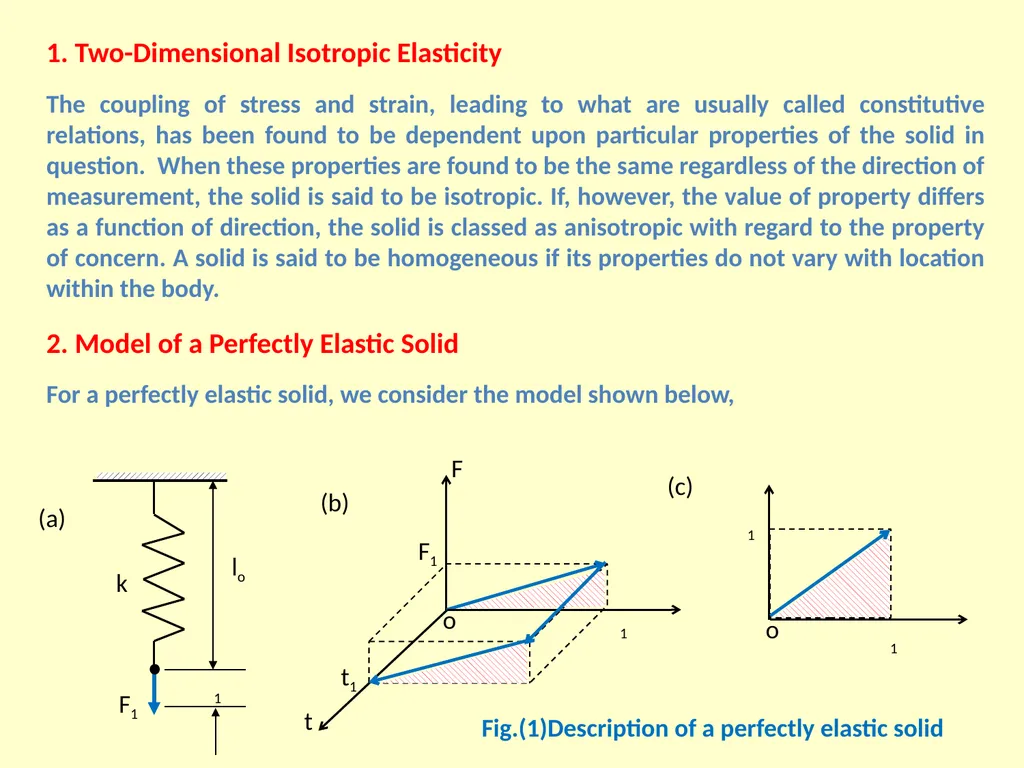
For a perfectly elastic solid, we consider the model shown below, (a) (b) (c) Fig.(1)Description of a perfectly elastic solid<br>
02
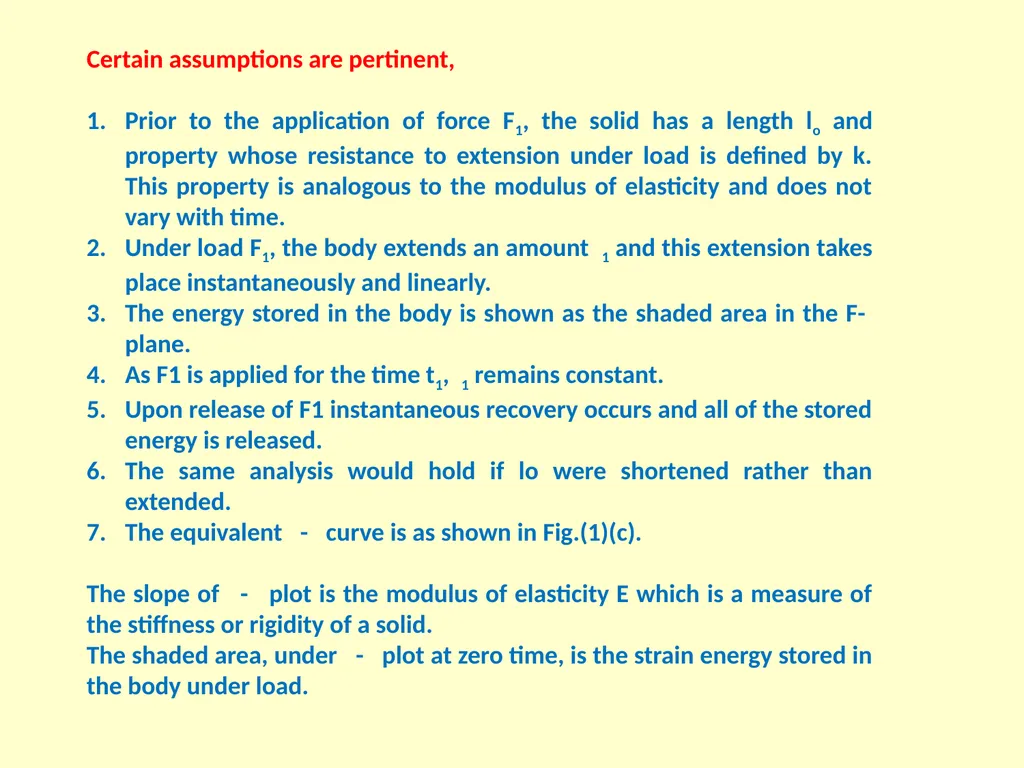
Certain assumptions are pertinent,
Prior to the application of force F1, the solid has a length lo and property whose resistance to extension under load is defined by k. This property is analogous to the modulus of elasticity and does not vary with time.
Under load F1, the body extends an amount 1 and this extension takes place instantaneously and linearly.
The energy stored in the body is shown as the shaded area in the F- plane.
As F1 is applied for the time t1, 1 remains constant.
Upon release of F1 instantaneous recovery occurs and all of the stored energy is released.
The same analysis would hold if lo were shortened rather than extended.
The equivalent - curve is as shown in Fig.(1)(c).
The slope of - plot is the modulus of elasticity E which is a measure of the stiffness or rigidity of a solid.
The shaded area, under - plot at zero time, is the strain energy stored in the body under load.<br>
03
3. Constitutive Relations
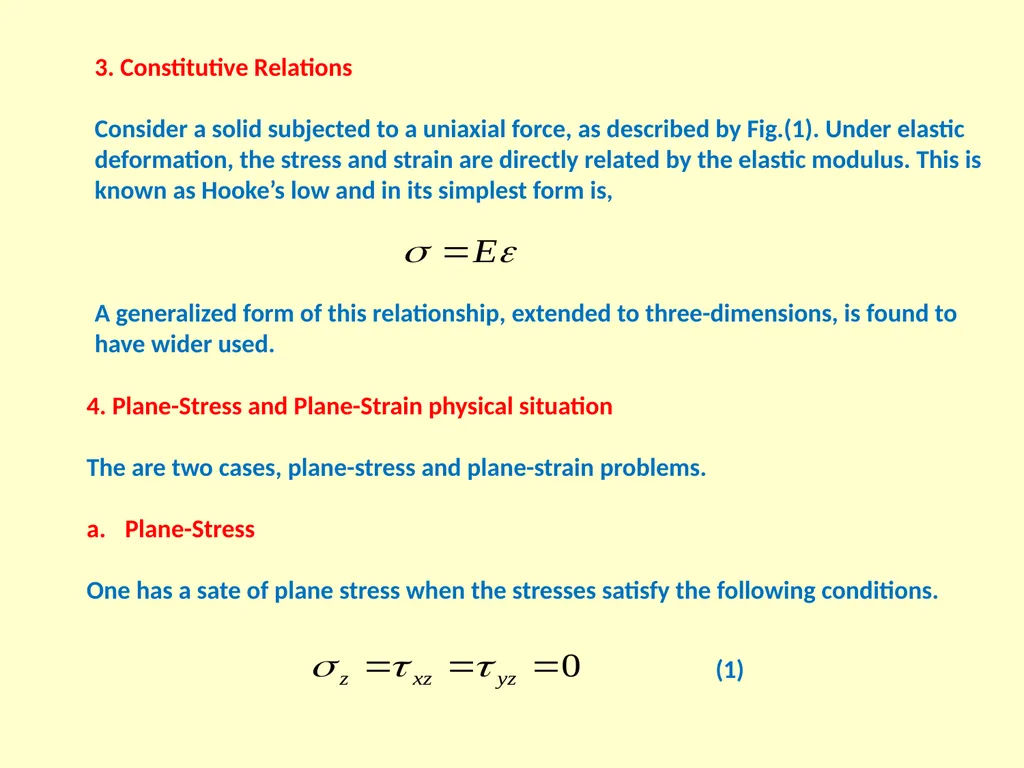
Consider a solid subjected to a uniaxial force, as described by Fig.(1). Under elastic deformation, the stress and strain are directly related by the elastic modulus. This is known as Hooke’s low and in its simplest form is,
A generalized form of this relationship, extended to three-dimensions, is found to have wider used. 4. Plane-Stress and Plane-Strain physical situation
The are two cases, plane-stress and plane-strain problems.
Plane-Stress
One has a sate of plane stress when the stresses satisfy the following conditions.<br>
04
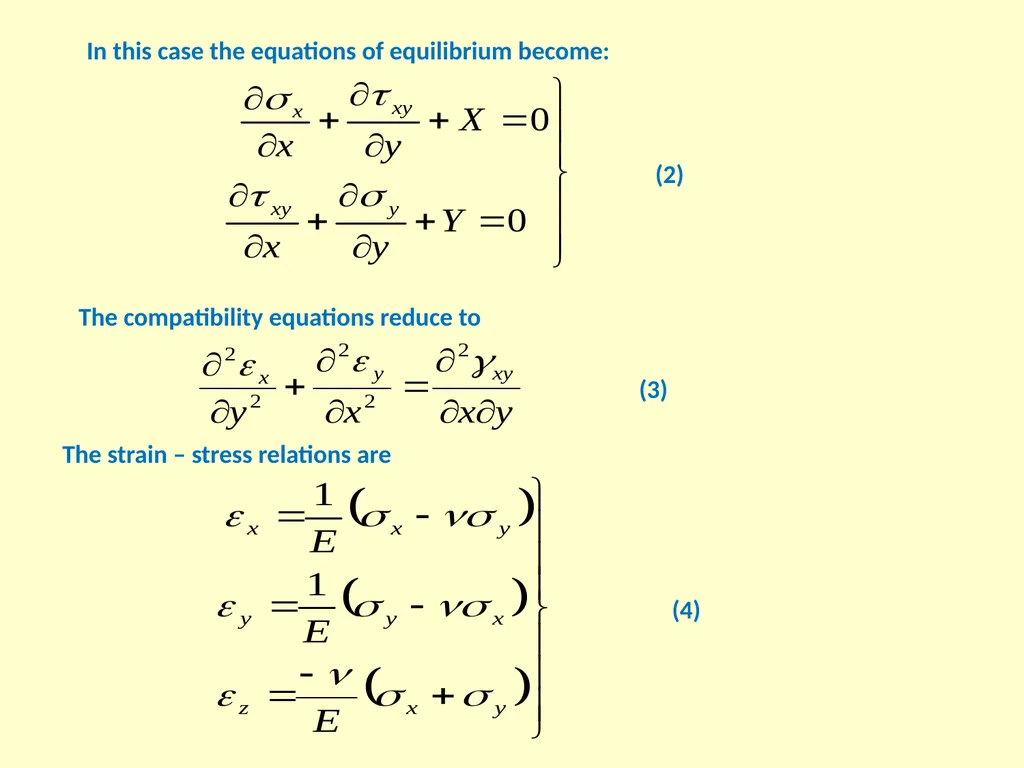
In this case the equations of equilibrium become: The compatibility equations reduce to The strain – stress relations are<br>
05
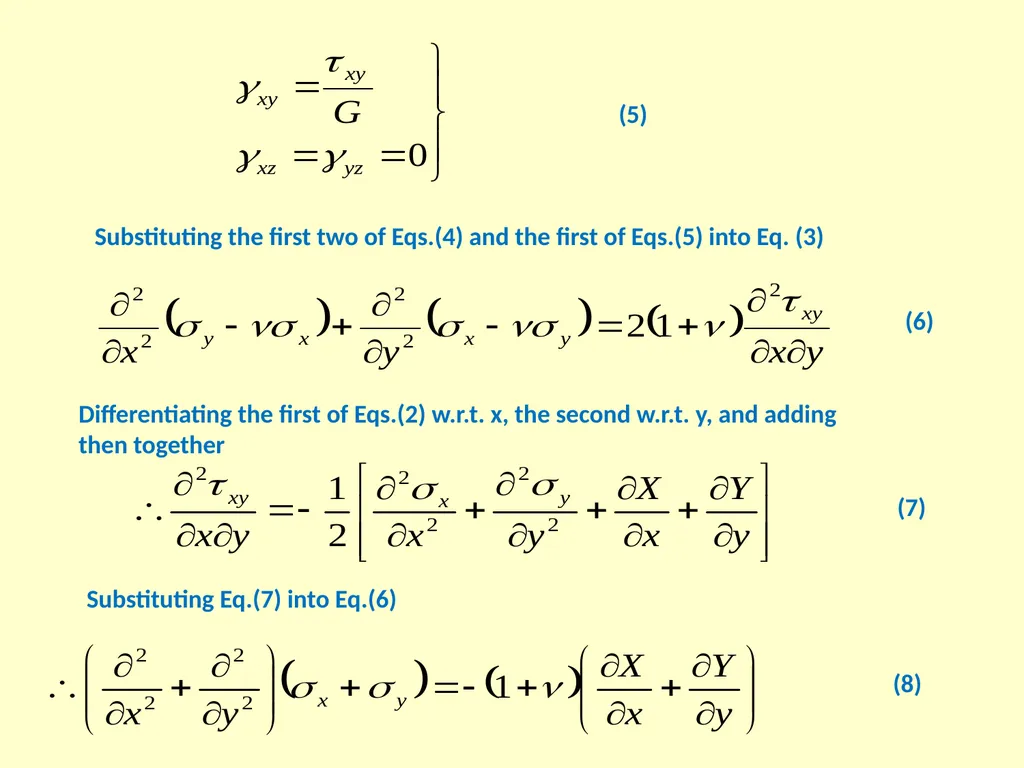
Substituting the first two of Eqs.(4) and the first of Eqs.(5) into Eq. (3) Differentiating the first of Eqs.(2) w.r.t. x, the second w.r.t. y, and adding then together Substituting Eq.(7) into Eq.(6)<br>
06
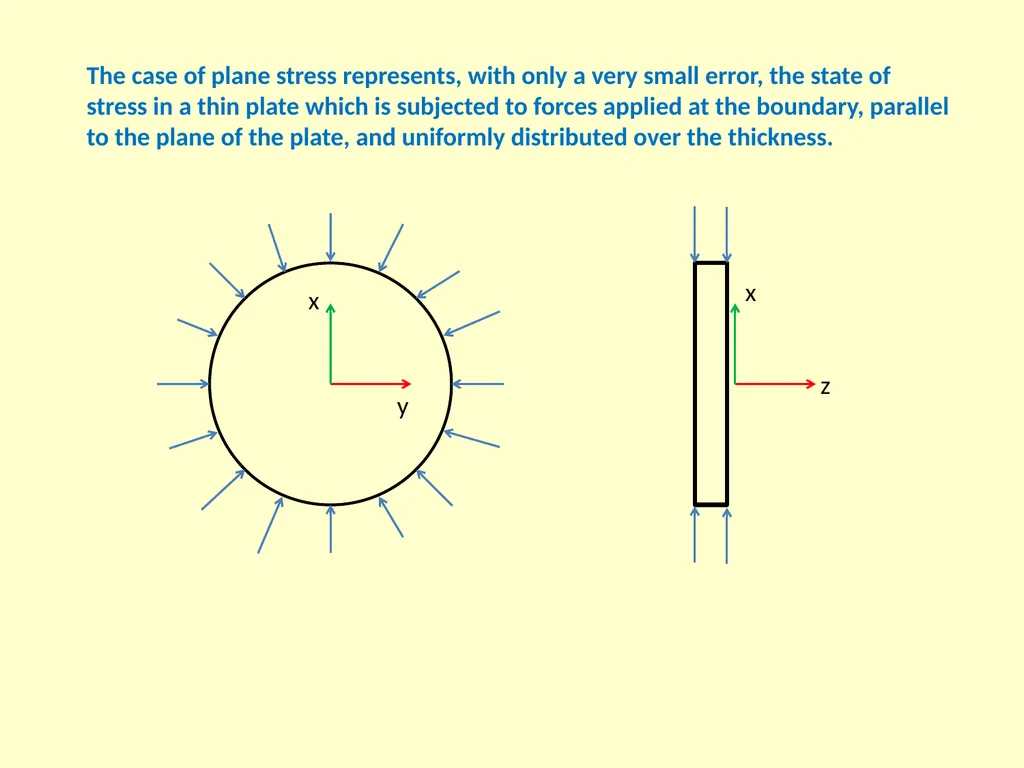
The case of plane stress represents, with only a very small error, the state of stress in a thin plate which is subjected to forces applied at the boundary, parallel to the plane of the plate, and uniformly distributed over the thickness.<br>
07
b. Plane-Strain
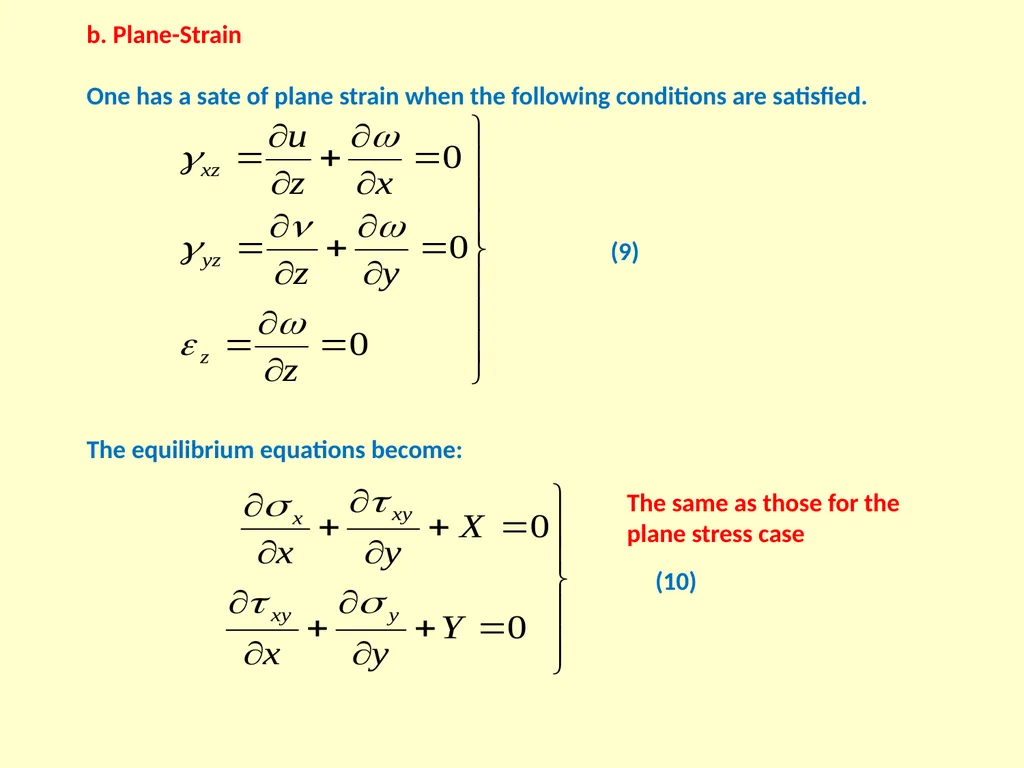
One has a sate of plane strain when the following conditions are satisfied. The equilibrium equations become: The same as those for the plane stress case<br>
08
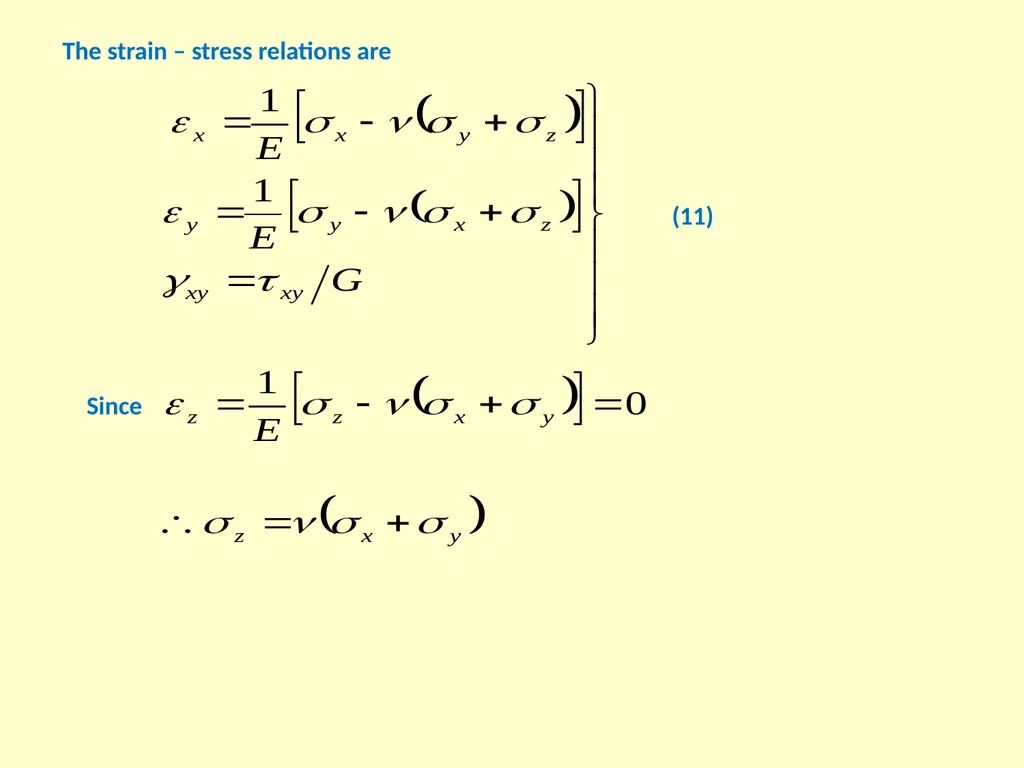
The strain – stress relations are<br>
09
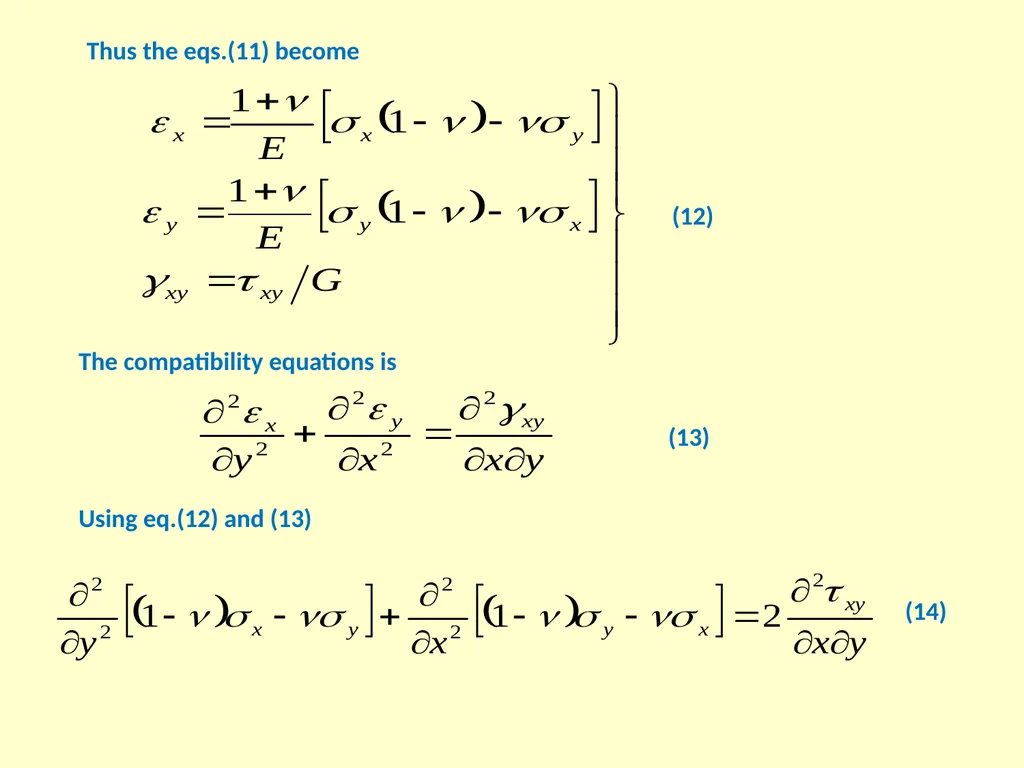
Thus the eqs.(11) become The compatibility equations is Using eq.(12) and (13)<br>
10
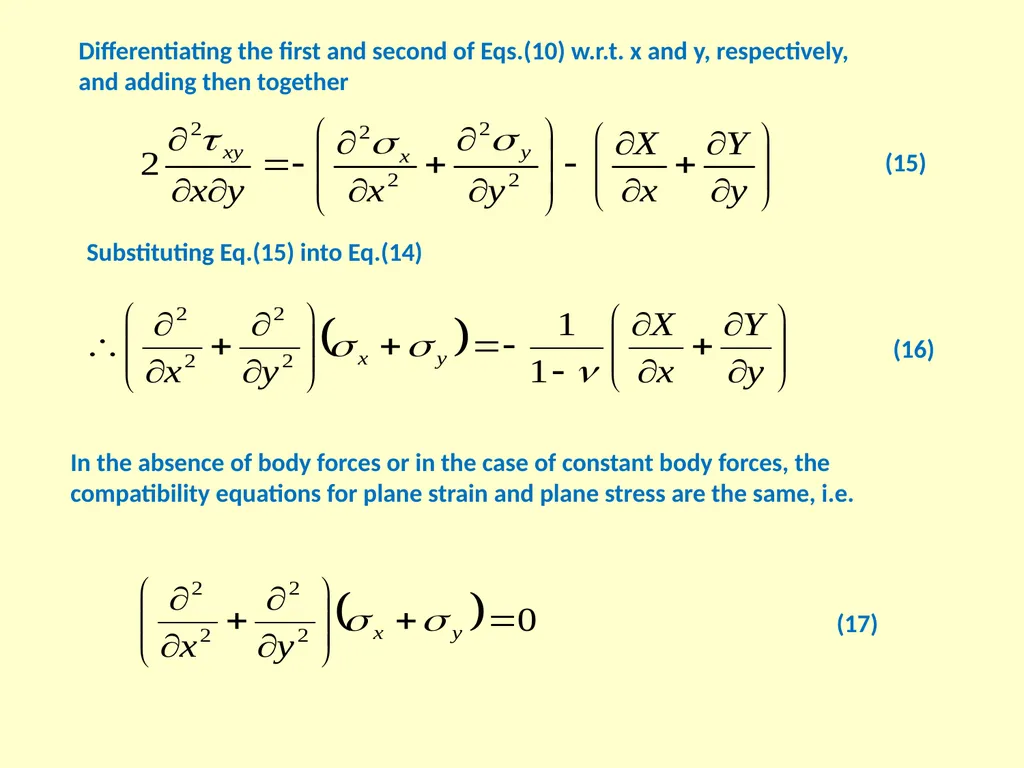
Differentiating the first and second of Eqs.(10) w.r.t. x and y, respectively, and adding then together Substituting Eq.(15) into Eq.(14) In the absence of body forces or in the case of constant body forces, the compatibility equations for plane strain and plane stress are the same, i.e.<br>
11
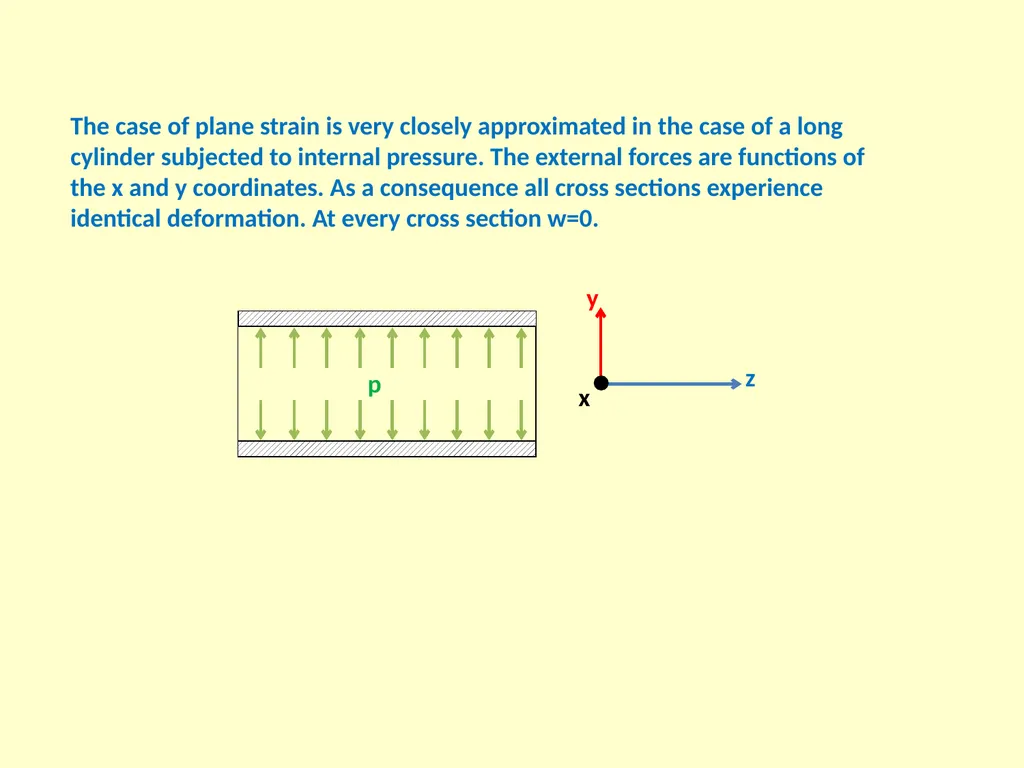
The case of plane strain is very closely approximated in the case of a long cylinder subjected to internal pressure. The external forces are functions of the x and y coordinates. As a consequence all cross sections experience identical deformation. At every cross section w=0.<br>
12
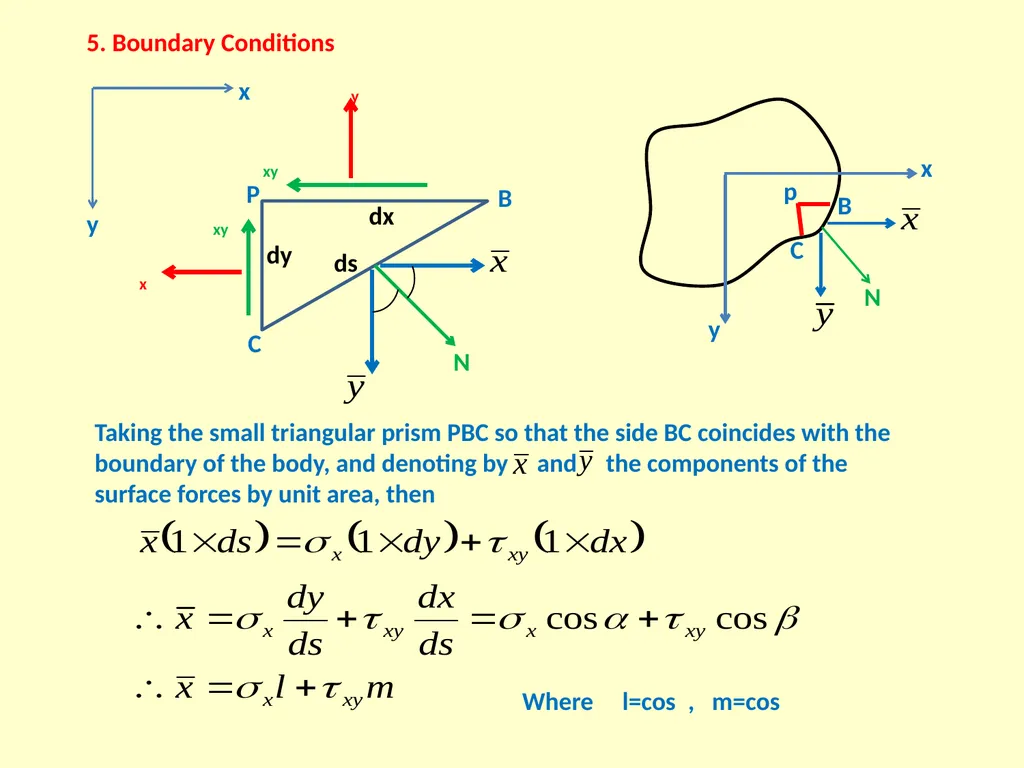
5. Boundary Conditions Where l=cos , m=cos<br>
13
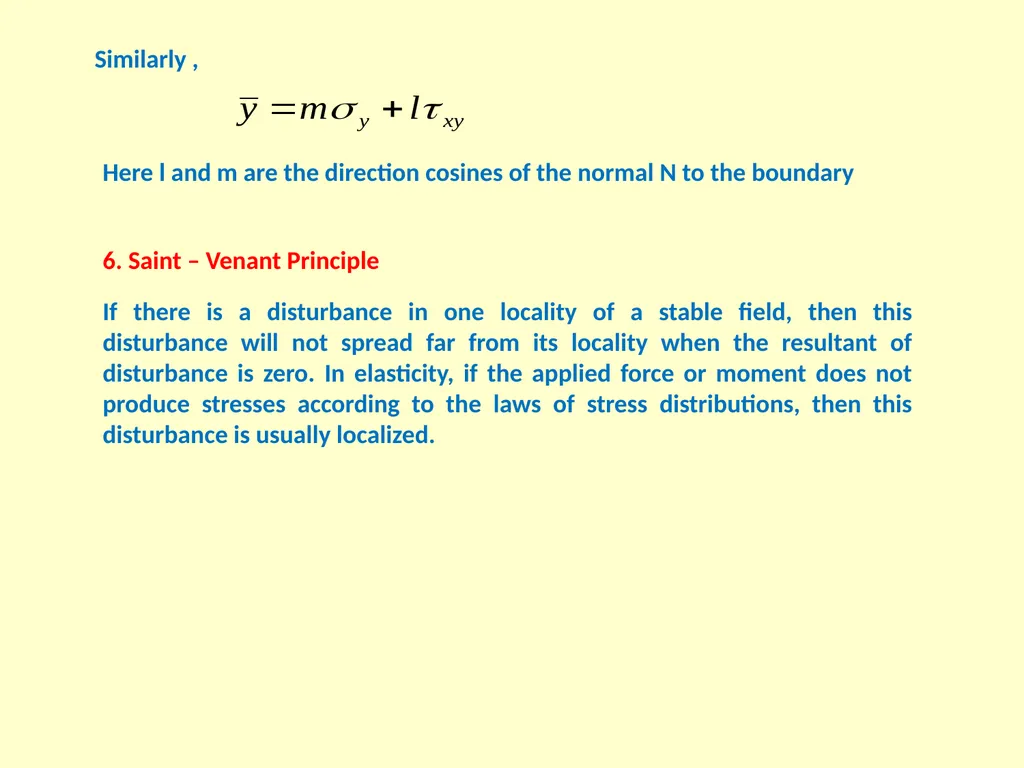
Similarly , Here l and m are the direction cosines of the normal N to the boundary 6. Saint – Venant Principle
If there is a disturbance in one locality of a stable field, then this disturbance will not spread far from its locality when the resultant of disturbance is zero. In elasticity, if the applied force or moment does not produce stresses according to the laws of stress distributions, then this disturbance is usually localized.<br>