
1 Week 1 – Lecture Notes What has happened -
AM
Published · 43 slides · 0 views
1 / 1

Description
1 Week 1 Lecture Notes What has happened - Descriptive Analytics Introduction 2 Introduction Three developments spurred recent explosive growth in the use of analytical methods in business applications: First development: Technological
Related Topics
Share
Embed code
Download this presentation From Below
"1 Week 1 – Lecture Notes What has happened -" is the property of its rightful owner. Permission is granted to download and print the materials on this website for personal, non-commercial use only, and to display it on your personal computer provided you do not modify the materials and that you retain all copyright notices contained in the materials. By downloading content from our website, you accept the terms of this agreement.
Presentation Transcript
01
1 Week 1 – Lecture Notes
What has happened - Descriptive Analytics<br>
What has happened - Descriptive Analytics<br>
02
Introduction 2<br>
03
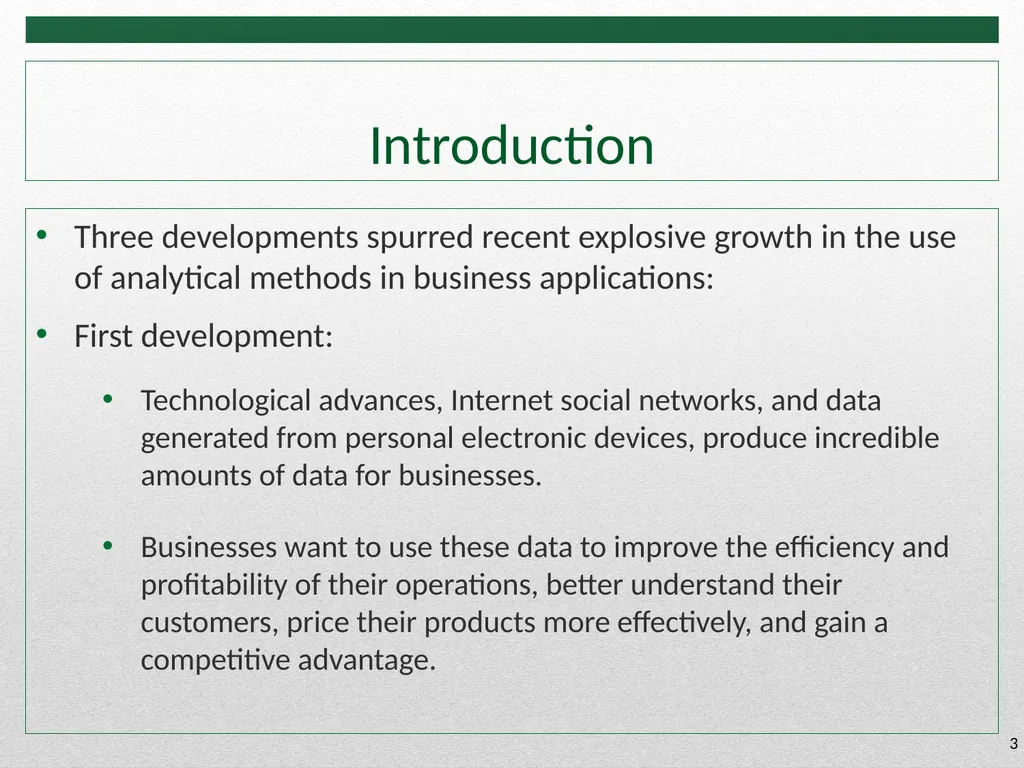
Introduction Three developments spurred recent explosive growth in the use of analytical methods in business applications:
First development:
Technological advances, Internet social networks, and data generated from personal electronic devices, produce incredible amounts of data for businesses.
Businesses want to use these data to improve the efficiency and profitability of their operations, better understand their customers, price their products more effectively, and gain a competitive advantage. 3<br>
First development:
Technological advances, Internet social networks, and data generated from personal electronic devices, produce incredible amounts of data for businesses.
Businesses want to use these data to improve the efficiency and profitability of their operations, better understand their customers, price their products more effectively, and gain a competitive advantage. 3<br>
04
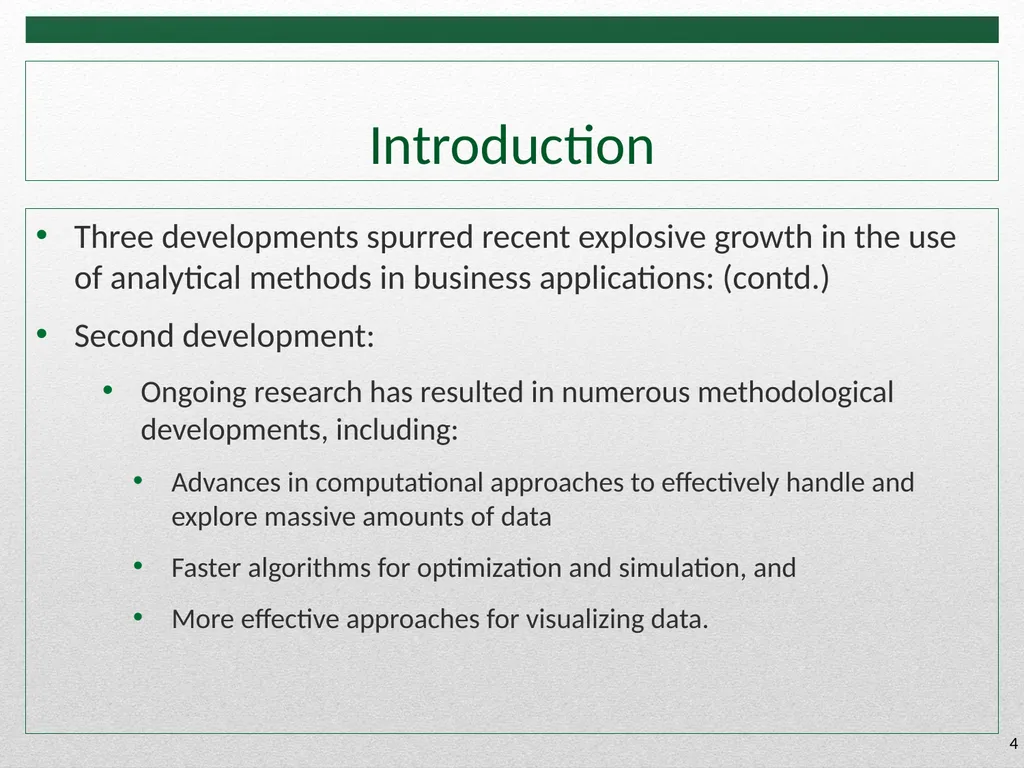
Introduction Three developments spurred recent explosive growth in the use of analytical methods in business applications: (contd.)
Second development:
Ongoing research has resulted in numerous methodological developments, including:
Advances in computational approaches to effectively handle and explore massive amounts of data
Faster algorithms for optimization and simulation, and
More effective approaches for visualizing data. 4<br>
Second development:
Ongoing research has resulted in numerous methodological developments, including:
Advances in computational approaches to effectively handle and explore massive amounts of data
Faster algorithms for optimization and simulation, and
More effective approaches for visualizing data. 4<br>
05
Introduction Three developments spurred recent explosive growth in the use of analytical methods in business applications:(contd.)
Third development:
The methodological developments were paired with an explosion in computing power and storage capability.
Better computing hardware, parallel computing, and cloud computing have enabled businesses to solve big problems faster and more accurately than ever before. 5<br>
Third development:
The methodological developments were paired with an explosion in computing power and storage capability.
Better computing hardware, parallel computing, and cloud computing have enabled businesses to solve big problems faster and more accurately than ever before. 5<br>
06
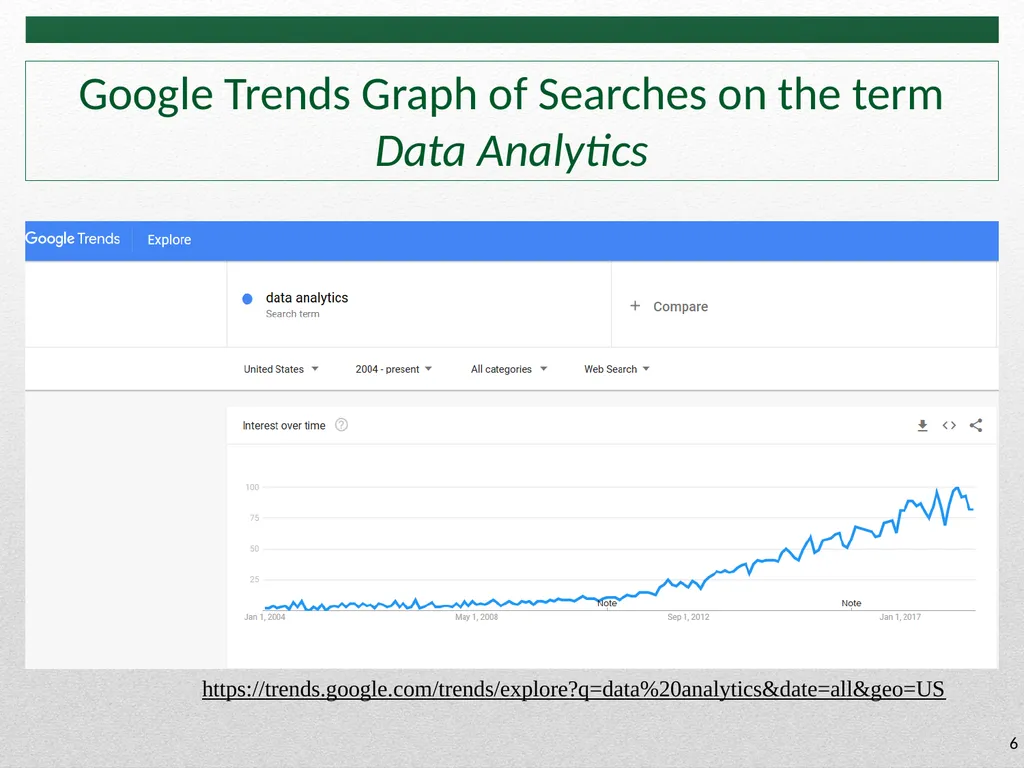
Google Trends Graph of Searches on the term Data Analytics 6 https://trends.google.com/trends/explore?q=data%20analytics&date=all&geo=US<br>
07
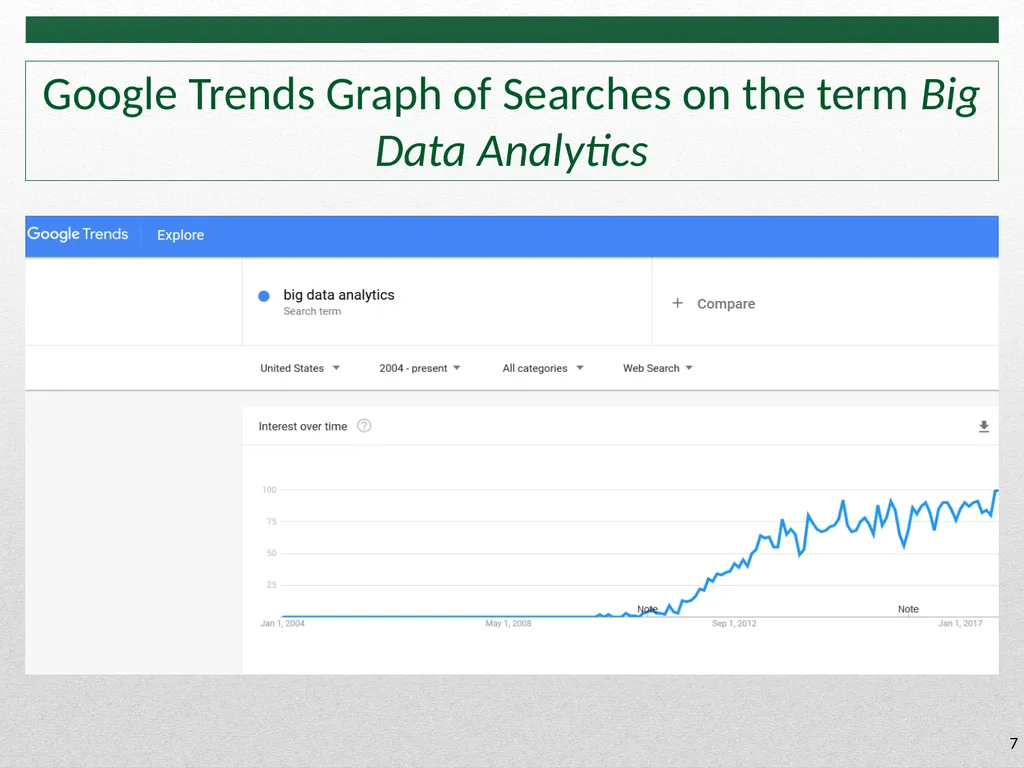
Google Trends Graph of Searches on the term Big Data Analytics 7<br>
08
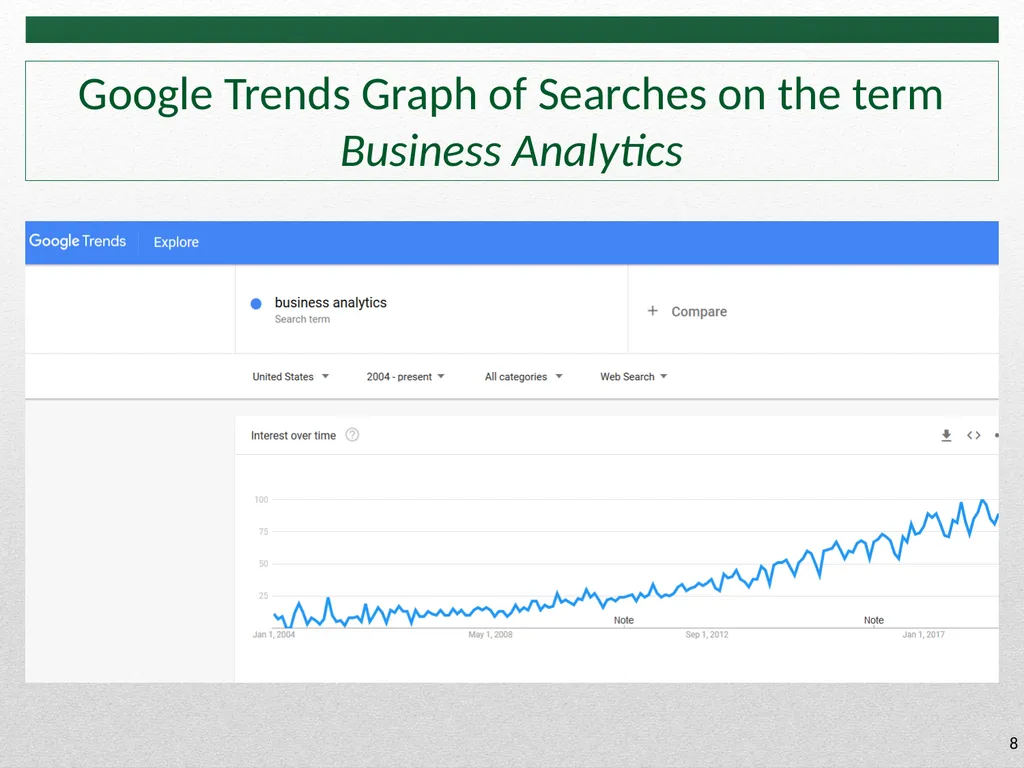
Google Trends Graph of Searches on the term Business Analytics 8<br>
09
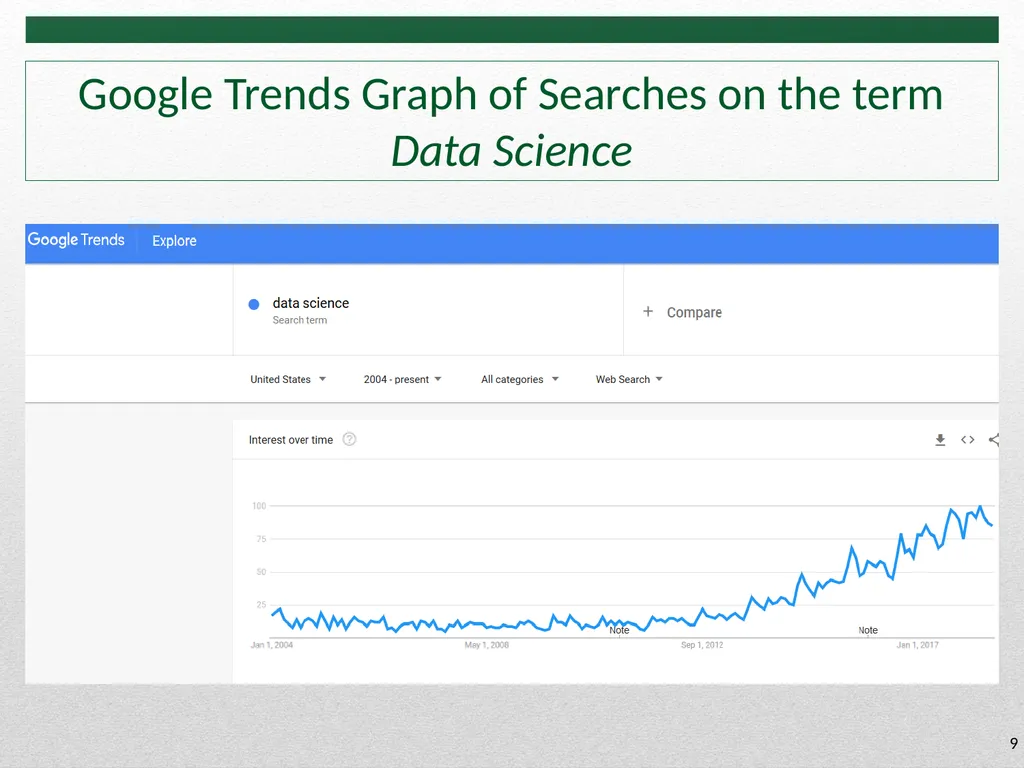
Google Trends Graph of Searches on the term Data Science 9<br>
10
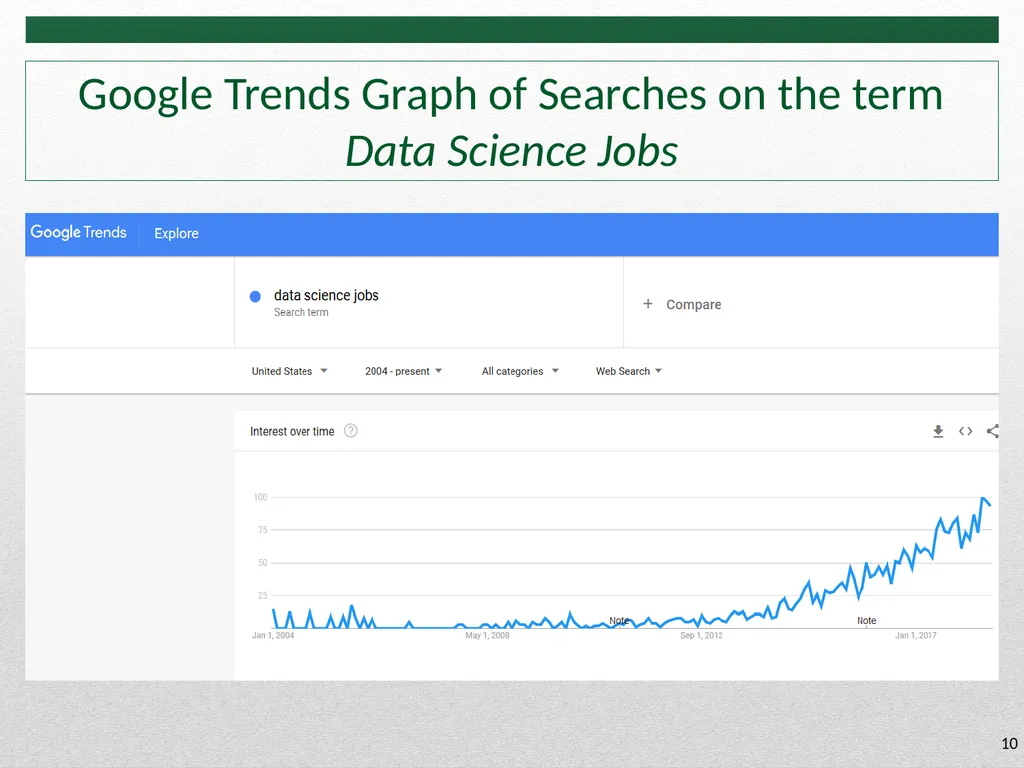
Google Trends Graph of Searches on the term Data Science Jobs 10<br>
11
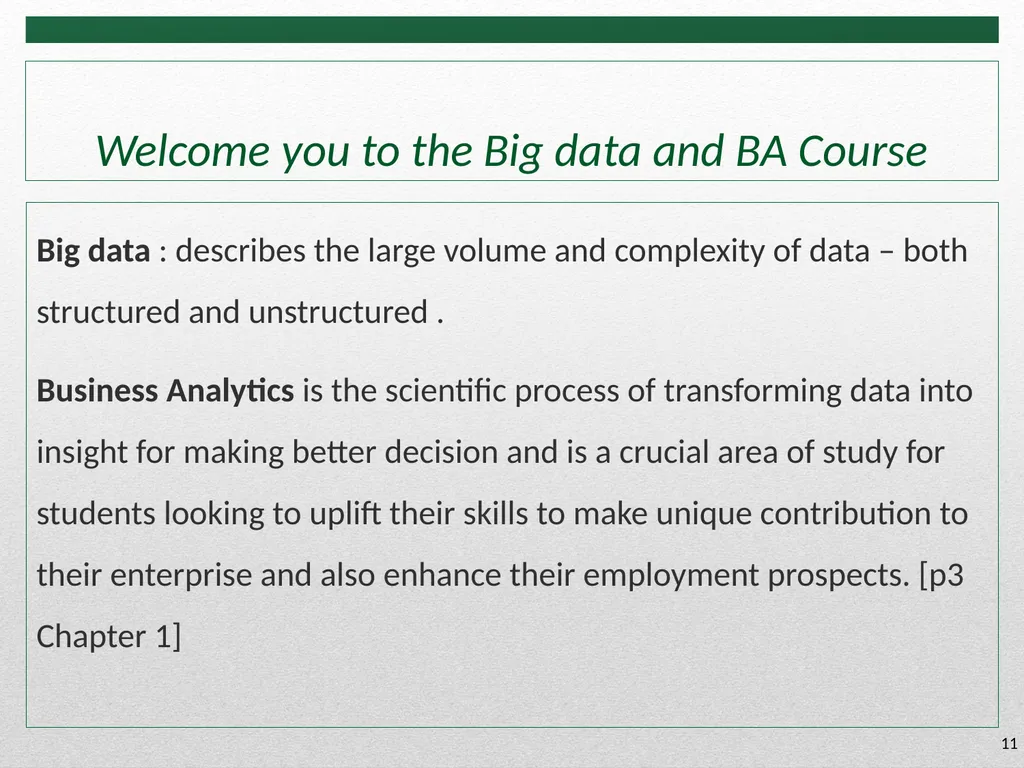
Welcome you to the Big data and BA Course 11 Big data : describes the large volume and complexity of data – both structured and unstructured .
Business Analytics is the scientific process of transforming data into insight for making better decision and is a crucial area of study for students looking to uplift their skills to make unique contribution to their enterprise and also enhance their employment prospects. [p3 Chapter 1]<br>
Business Analytics is the scientific process of transforming data into insight for making better decision and is a crucial area of study for students looking to uplift their skills to make unique contribution to their enterprise and also enhance their employment prospects. [p3 Chapter 1]<br>
12
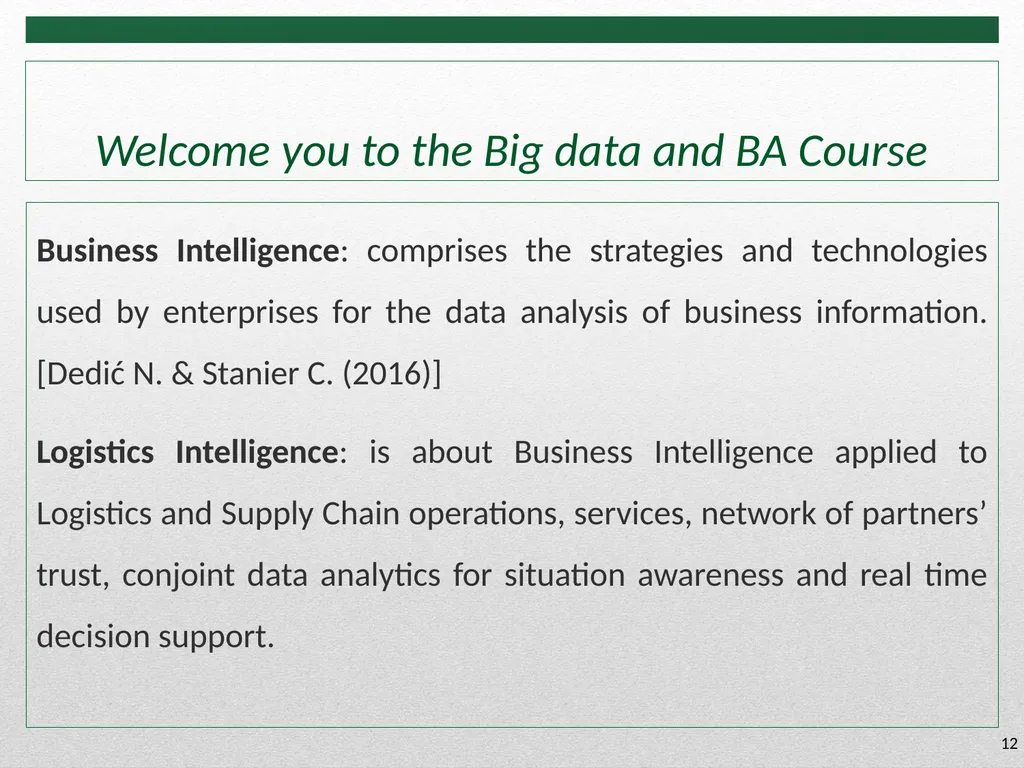
Welcome you to the Big data and BA Course 12 Business Intelligence: comprises the strategies and technologies used by enterprises for the data analysis of business information. [Dedić N. & Stanier C. (2016)]
Logistics Intelligence: is about Business Intelligence applied to Logistics and Supply Chain operations, services, network of partners’ trust, conjoint data analytics for situation awareness and real time decision support.<br>
Logistics Intelligence: is about Business Intelligence applied to Logistics and Supply Chain operations, services, network of partners’ trust, conjoint data analytics for situation awareness and real time decision support.<br>
13
Decision Making 13<br>
14
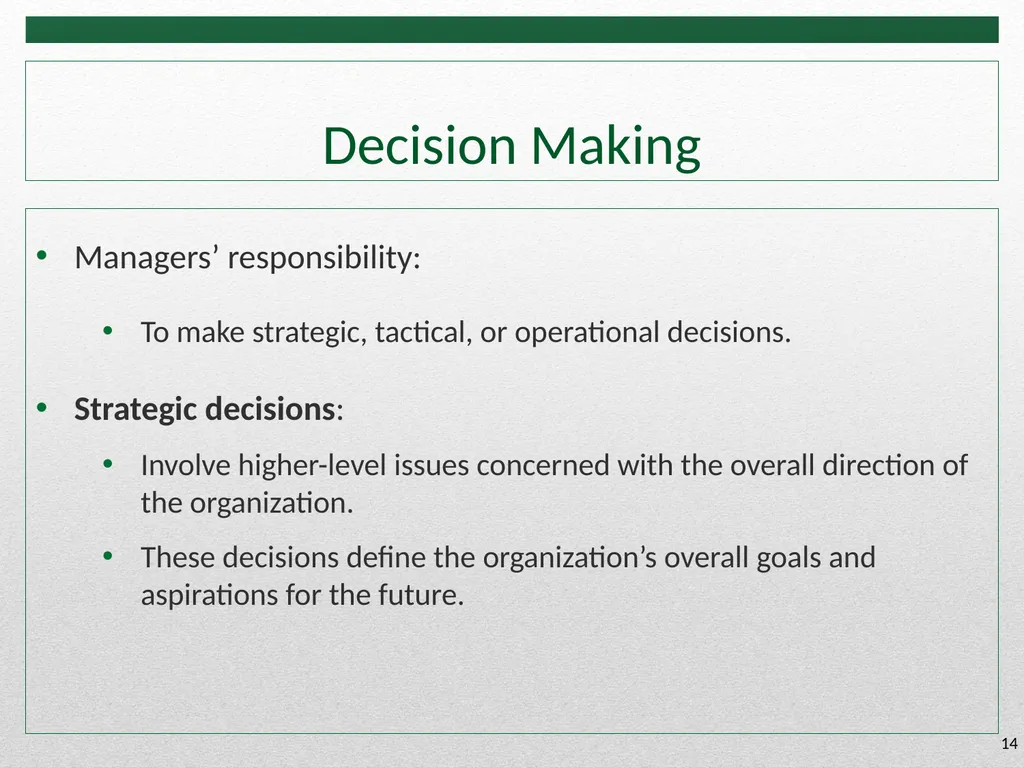
Decision Making Managers’ responsibility:
To make strategic, tactical, or operational decisions.
Strategic decisions:
Involve higher-level issues concerned with the overall direction of the organization.
These decisions define the organization’s overall goals and aspirations for the future. 14<br>
To make strategic, tactical, or operational decisions.
Strategic decisions:
Involve higher-level issues concerned with the overall direction of the organization.
These decisions define the organization’s overall goals and aspirations for the future. 14<br>
15
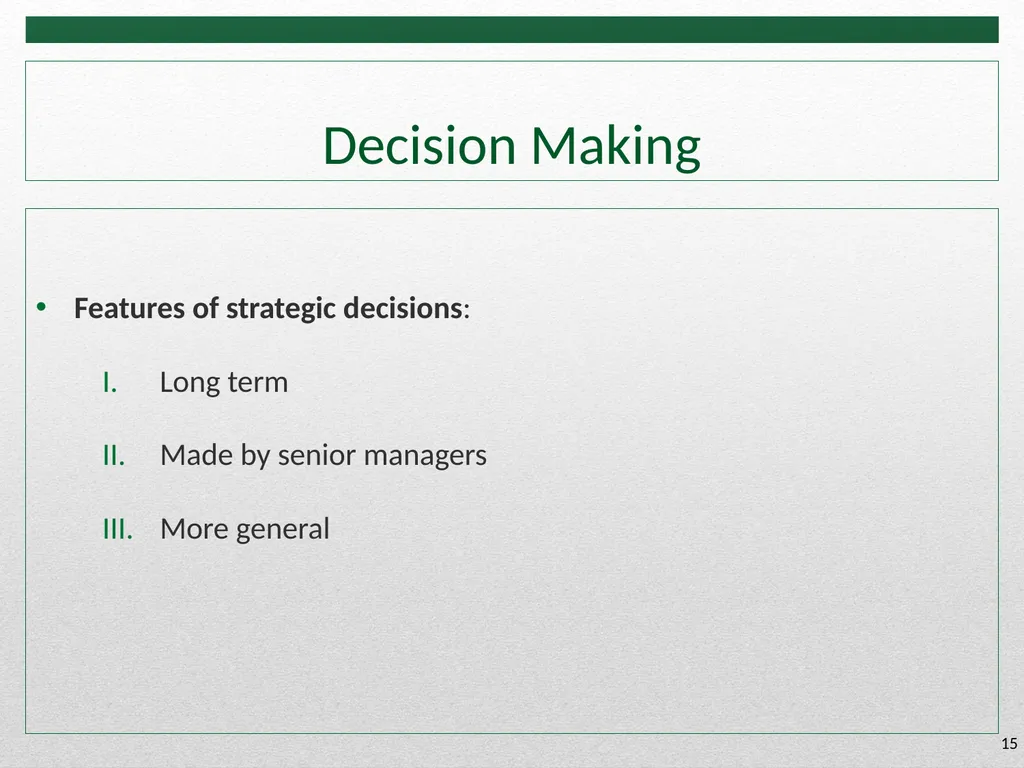
Decision Making Features of strategic decisions:
Long term
Made by senior managers
More general 15<br>
Long term
Made by senior managers
More general 15<br>
16
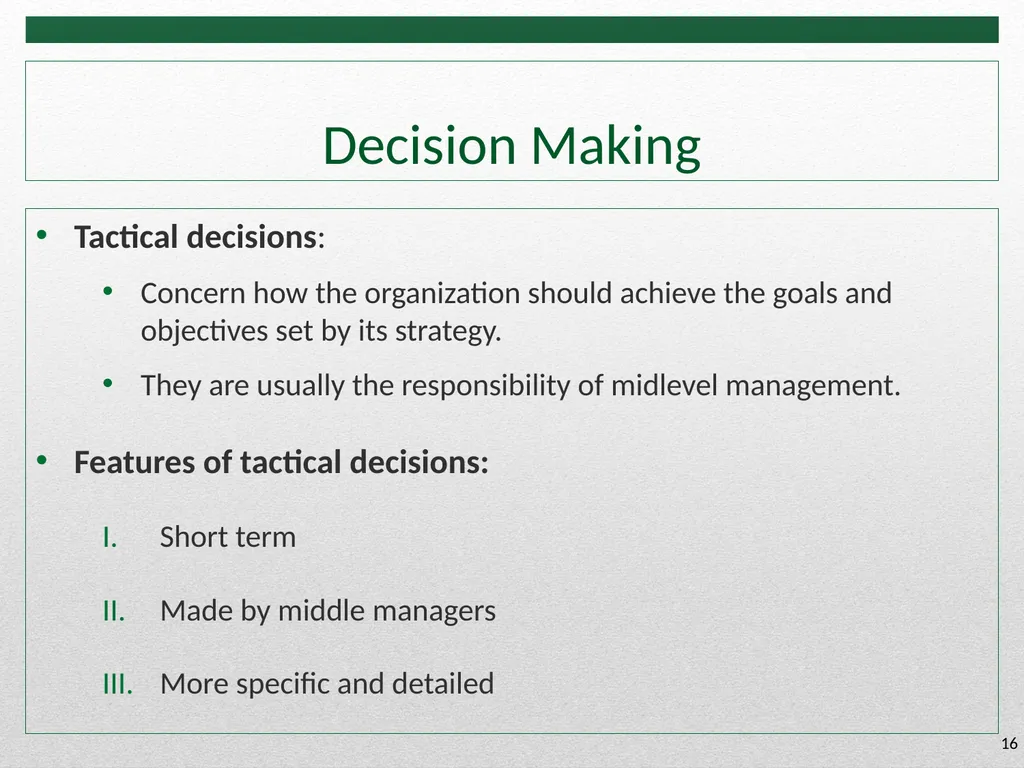
Decision Making Tactical decisions:
Concern how the organization should achieve the goals and objectives set by its strategy.
They are usually the responsibility of midlevel management.
Features of tactical decisions:
Short term
Made by middle managers
More specific and detailed 16<br>
Concern how the organization should achieve the goals and objectives set by its strategy.
They are usually the responsibility of midlevel management.
Features of tactical decisions:
Short term
Made by middle managers
More specific and detailed 16<br>
17
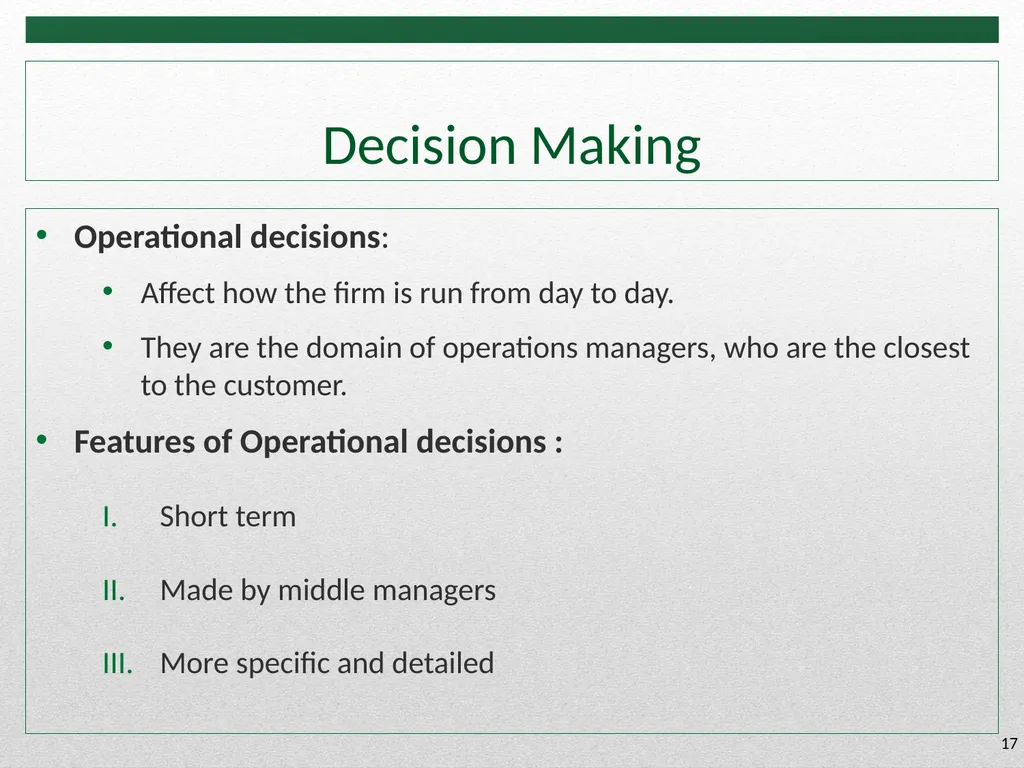
Decision Making Operational decisions:
Affect how the firm is run from day to day.
They are the domain of operations managers, who are the closest to the customer.
Features of Operational decisions :
Short term
Made by middle managers
More specific and detailed 17<br>
Affect how the firm is run from day to day.
They are the domain of operations managers, who are the closest to the customer.
Features of Operational decisions :
Short term
Made by middle managers
More specific and detailed 17<br>
18
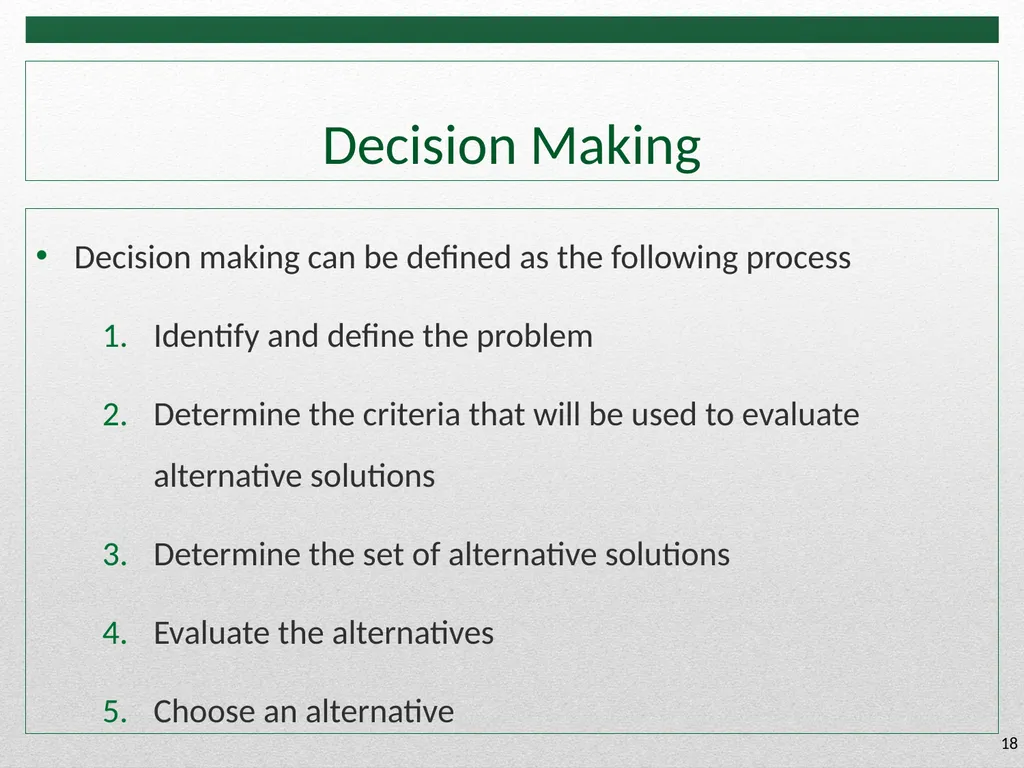
Decision Making Decision making can be defined as the following process
Identify and define the problem
Determine the criteria that will be used to evaluate alternative solutions
Determine the set of alternative solutions
Evaluate the alternatives
Choose an alternative 18<br>
Identify and define the problem
Determine the criteria that will be used to evaluate alternative solutions
Determine the set of alternative solutions
Evaluate the alternatives
Choose an alternative 18<br>
19
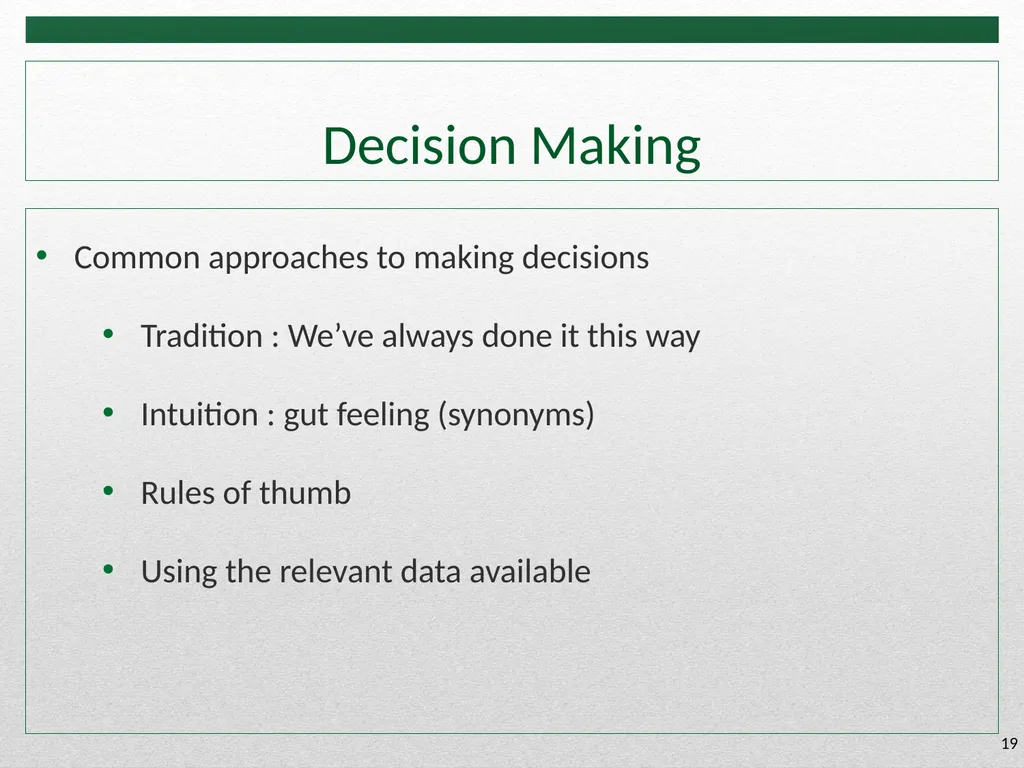
Decision Making Common approaches to making decisions
Tradition : We’ve always done it this way
Intuition : gut feeling (synonyms)
Rules of thumb
Using the relevant data available 19<br>
Tradition : We’ve always done it this way
Intuition : gut feeling (synonyms)
Rules of thumb
Using the relevant data available 19<br>
20
Business Analytics Defined 20<br>
21
Business Analytics Defined Business analytics:
Scientific process of transforming data into insight for making better decisions.
Used for data-driven or fact-based decision making, which is often seen as more objective than other alternatives for decision making. 21<br>
Scientific process of transforming data into insight for making better decisions.
Used for data-driven or fact-based decision making, which is often seen as more objective than other alternatives for decision making. 21<br>
22
Business Analytics Defined Tools of business analytics can aid decision making by:
Creating insights from data
Improving our ability to more accurately forecast for planning
Helping us quantify risk
Yielding better alternatives through analysis and optimization 22<br>
Creating insights from data
Improving our ability to more accurately forecast for planning
Helping us quantify risk
Yielding better alternatives through analysis and optimization 22<br>
23
A Categorization of Analytical Methods
and Models 23<br>
and Models 23<br>
24
A Categorization of Analytical Methods and Models Descriptive analytics: It encompasses the set of techniques that describes what has happened in the past.
Examples - data queries, reports, descriptive statistics, data visualization (data dashboards), data-mining techniques, and basic what-if spreadsheet models.
Data query - It is a request for information with certain characteristics from a database. 24<br>
Examples - data queries, reports, descriptive statistics, data visualization (data dashboards), data-mining techniques, and basic what-if spreadsheet models.
Data query - It is a request for information with certain characteristics from a database. 24<br>
25
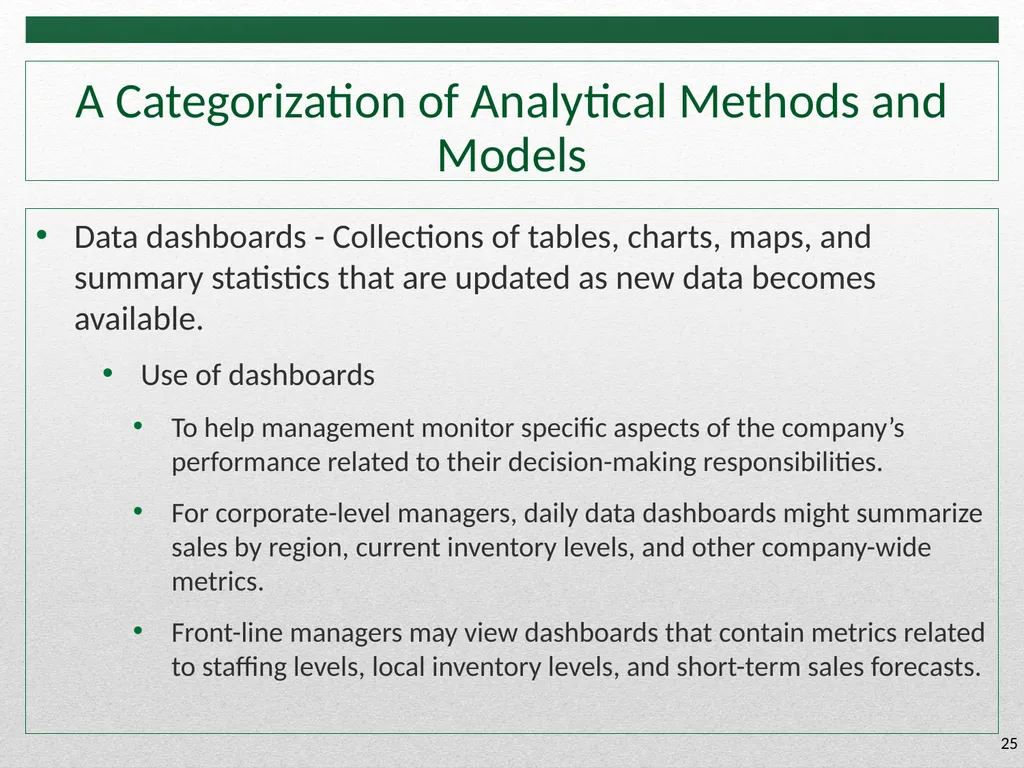
A Categorization of Analytical Methods and Models Data dashboards - Collections of tables, charts, maps, and summary statistics that are updated as new data becomes available.
Use of dashboards
To help management monitor specific aspects of the company’s performance related to their decision-making responsibilities.
For corporate-level managers, daily data dashboards might summarize sales by region, current inventory levels, and other company-wide metrics.
Front-line managers may view dashboards that contain metrics related to staffing levels, local inventory levels, and short-term sales forecasts. 25<br>
Use of dashboards
To help management monitor specific aspects of the company’s performance related to their decision-making responsibilities.
For corporate-level managers, daily data dashboards might summarize sales by region, current inventory levels, and other company-wide metrics.
Front-line managers may view dashboards that contain metrics related to staffing levels, local inventory levels, and short-term sales forecasts. 25<br>
26
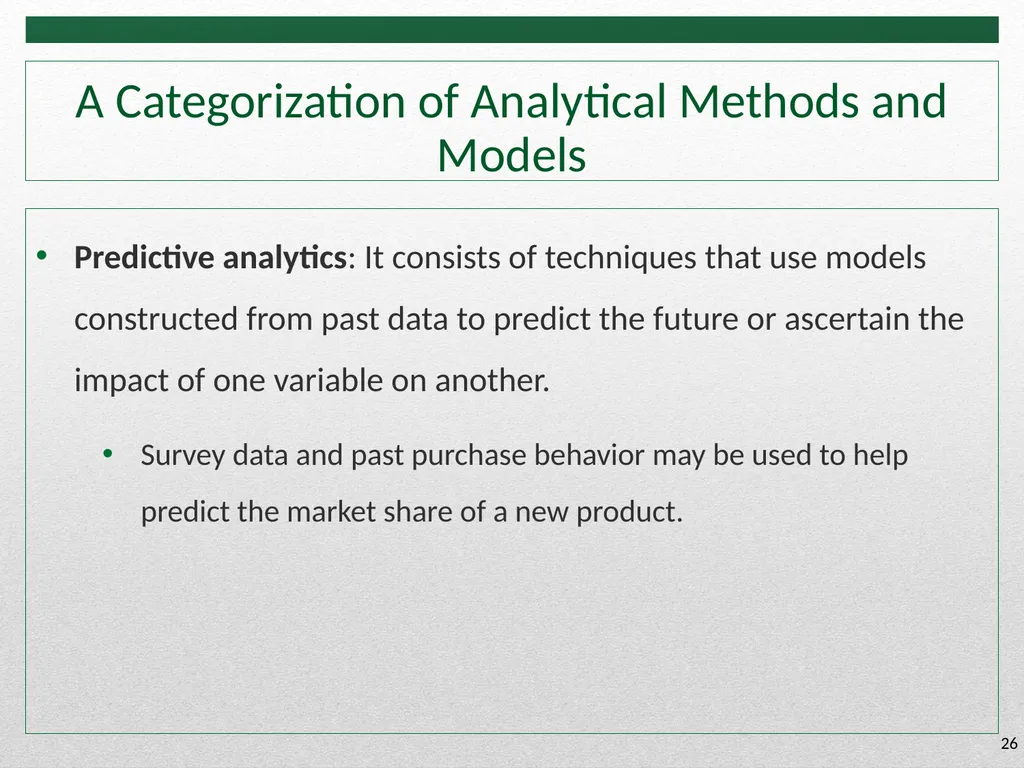
A Categorization of Analytical Methods and Models Predictive analytics: It consists of techniques that use models constructed from past data to predict the future or ascertain the impact of one variable on another.
Survey data and past purchase behavior may be used to help predict the market share of a new product. 26<br>
Survey data and past purchase behavior may be used to help predict the market share of a new product. 26<br>
27
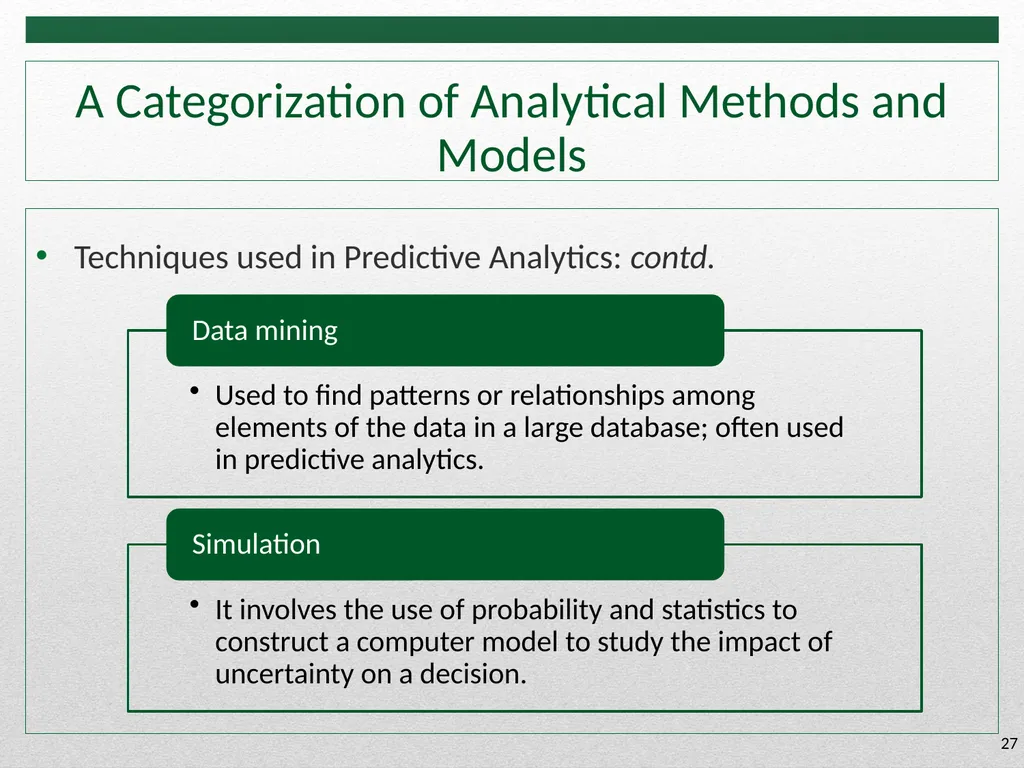
A Categorization of Analytical Methods and Models Techniques used in Predictive Analytics: contd. 27<br>
28
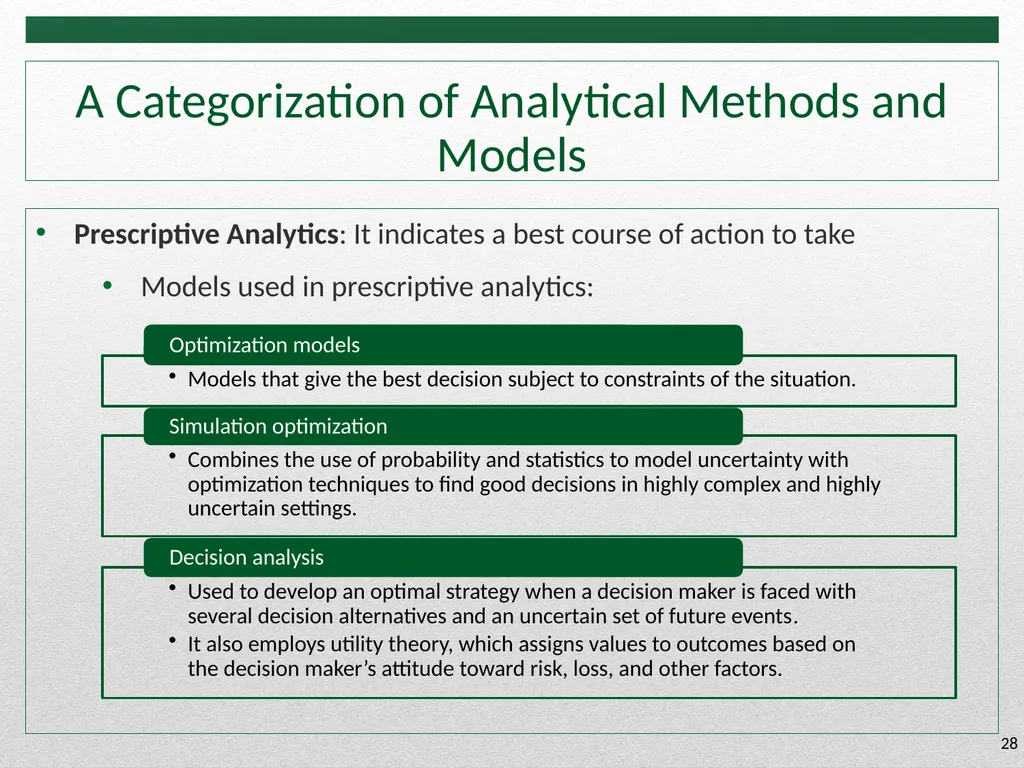
A Categorization of Analytical Methods and Models Prescriptive Analytics: It indicates a best course of action to take
Models used in prescriptive analytics: 28<br>
Models used in prescriptive analytics: 28<br>
29
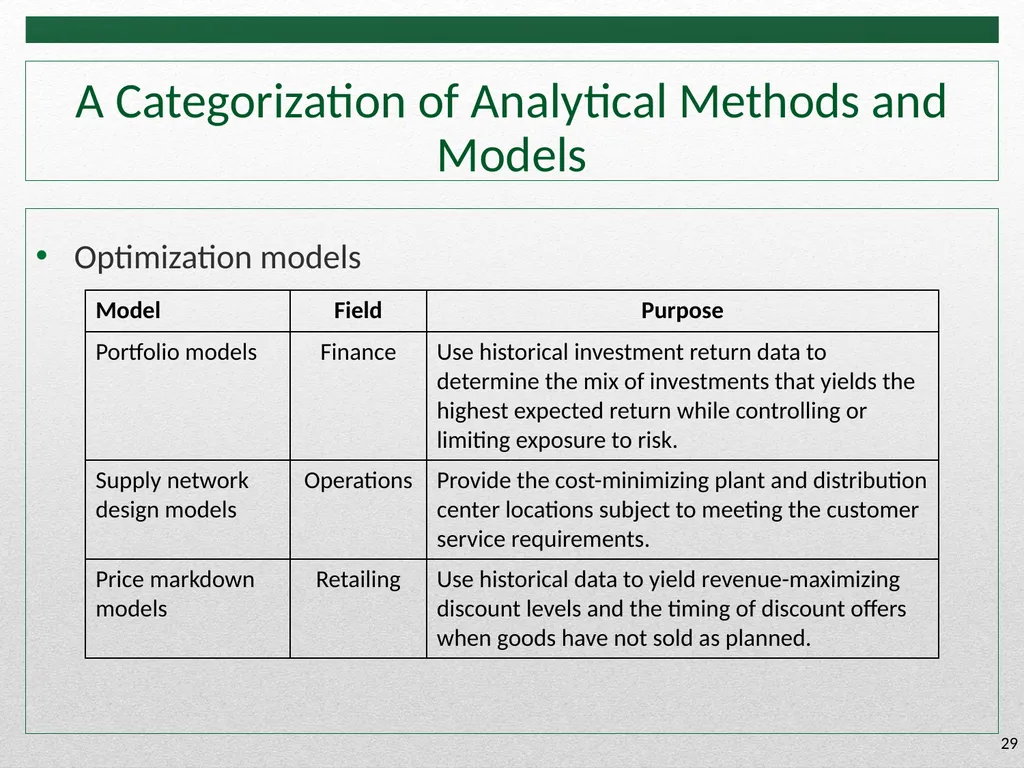
A Categorization of Analytical Methods and Models Optimization models 29<br>
30
Business Analytics in Practice 30<br>
31
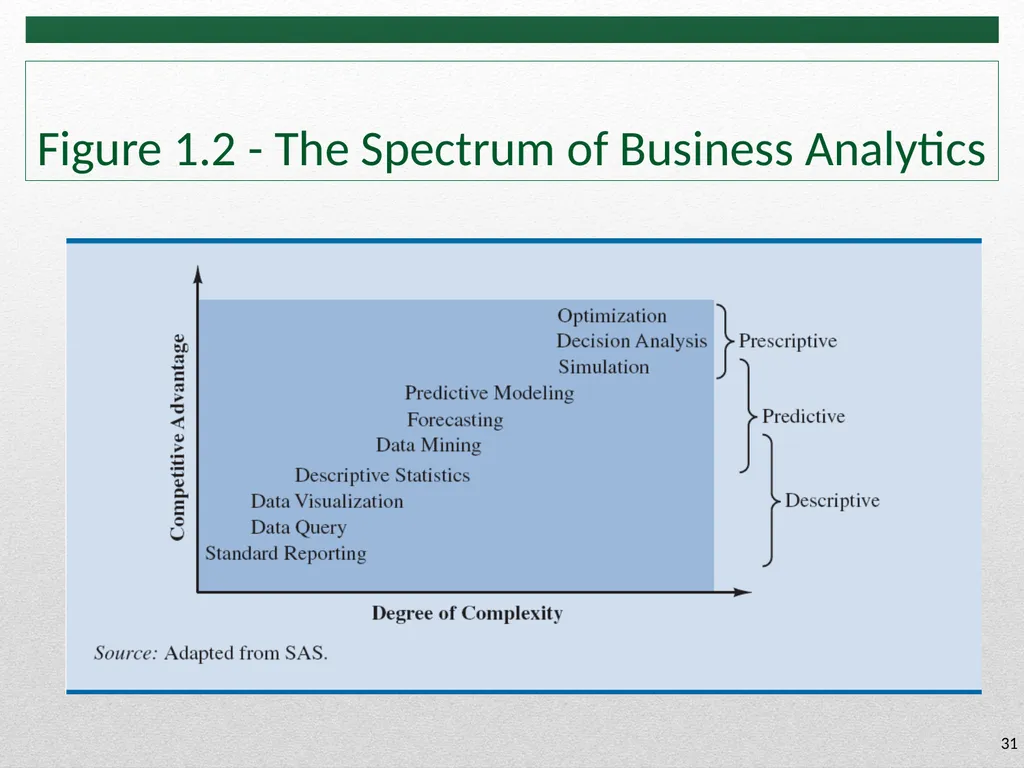
Figure 1.2 - The Spectrum of Business Analytics 31<br>
32
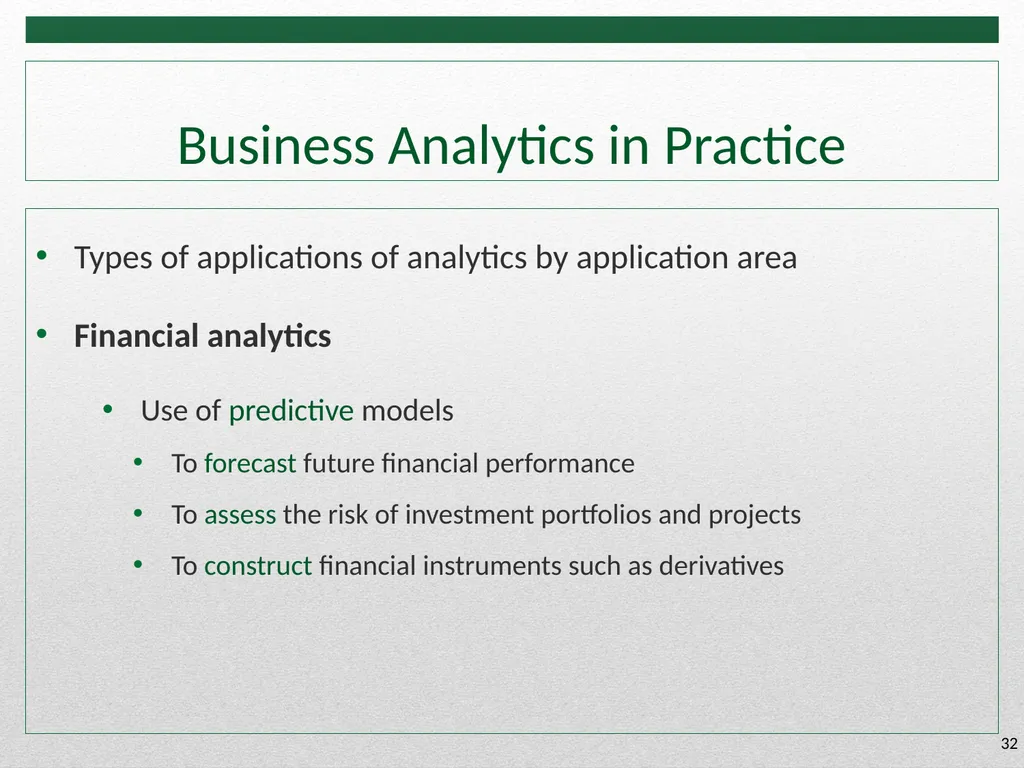
Business Analytics in Practice Types of applications of analytics by application area
Financial analytics
Use of predictive models
To forecast future financial performance
To assess the risk of investment portfolios and projects
To construct financial instruments such as derivatives 32<br>
Financial analytics
Use of predictive models
To forecast future financial performance
To assess the risk of investment portfolios and projects
To construct financial instruments such as derivatives 32<br>
33
Business Analytics in Practice Financial analytics (contd.)
Use of prescriptive models
To construct optimal portfolios of investments
To allocate assets, and
To create optimal capital budgeting plans.
Simulation is also often used to assess risk in the financial sector 33<br>
Use of prescriptive models
To construct optimal portfolios of investments
To allocate assets, and
To create optimal capital budgeting plans.
Simulation is also often used to assess risk in the financial sector 33<br>
34
Business Analytics in Practice Human Resource (HR) analytics
New area of application for analytics
The HR function is charged with ensuring that the organization
Has the mix of skill sets necessary to meet its needs
Is hiring the highest-quality talent and providing an environment that retains it, and
Achieves its organizational diversity goals. 34<br>
New area of application for analytics
The HR function is charged with ensuring that the organization
Has the mix of skill sets necessary to meet its needs
Is hiring the highest-quality talent and providing an environment that retains it, and
Achieves its organizational diversity goals. 34<br>
35
Business Analytics in Practice Marketing analytics
Marketing is one of the fastest growing areas for the application of analytics.
A better understanding of consumer behavior through the use of scanner data and data generated from social media has led to an increased interest in marketing analytics. 35<br>
Marketing is one of the fastest growing areas for the application of analytics.
A better understanding of consumer behavior through the use of scanner data and data generated from social media has led to an increased interest in marketing analytics. 35<br>
36
Business Analytics in Practice Marketing analytics (contd.)
A better understanding of consumer behavior through marketing analytics leads to:
The better use of advertising budgets
More effective pricing strategies
Improved forecasting of demand
Improved product line management, and
Increased customer satisfaction and loyalty 36<br>
A better understanding of consumer behavior through marketing analytics leads to:
The better use of advertising budgets
More effective pricing strategies
Improved forecasting of demand
Improved product line management, and
Increased customer satisfaction and loyalty 36<br>
37
Business Analytics in Practice Health care analytics
Descriptive, predictive, and prescriptive analytics are used:
To improve patient, staff, and facility scheduling
Patient flow
Purchasing
Inventory control
Use of prescriptive analytics for diagnosis and treatment 37<br>
Descriptive, predictive, and prescriptive analytics are used:
To improve patient, staff, and facility scheduling
Patient flow
Purchasing
Inventory control
Use of prescriptive analytics for diagnosis and treatment 37<br>
38
Business Analytics in Practice Supply chain analytics
The core service of companies such as UPS and FedEx is the efficient delivery of goods, and analytics has long been used to achieve efficiency.
The optimal sorting of goods, vehicle and staff scheduling, and vehicle routing are all key to profitability for logistics companies such as UPS, FedEx, and the like.
Companies can benefit from better inventory and processing control and more efficient supply chains. 38<br>
The core service of companies such as UPS and FedEx is the efficient delivery of goods, and analytics has long been used to achieve efficiency.
The optimal sorting of goods, vehicle and staff scheduling, and vehicle routing are all key to profitability for logistics companies such as UPS, FedEx, and the like.
Companies can benefit from better inventory and processing control and more efficient supply chains. 38<br>
39
Business Analytics in Practice Analytics for government and nonprofits
To drive out inefficiencies
To increase the effectiveness and accountability of programs
Analytics for nonprofit agencies
To ensure their effectiveness and accountability to their donors and clients. 39<br>
To drive out inefficiencies
To increase the effectiveness and accountability of programs
Analytics for nonprofit agencies
To ensure their effectiveness and accountability to their donors and clients. 39<br>
40
Business Analytics in Practice Sports analytics
Used for player evaluation and on-field strategy in professional sports.
To assess players for the amateur drafts and to decide how much to offer players in contract negotiations.
Professional motorcycle racing teams that use sophisticated optimization for gearbox design to gain competitive advantage. 40<br>
Used for player evaluation and on-field strategy in professional sports.
To assess players for the amateur drafts and to decide how much to offer players in contract negotiations.
Professional motorcycle racing teams that use sophisticated optimization for gearbox design to gain competitive advantage. 40<br>
41
Business Analytics in Practice Sports analytics (contd.)
The use of analytics for off-the-field business decisions is also increasing rapidly.
Using prescriptive analytics, franchises across several major sports dynamically adjust ticket prices throughout the season to reflect the relative attractiveness and potential demand for each game. 41<br>
The use of analytics for off-the-field business decisions is also increasing rapidly.
Using prescriptive analytics, franchises across several major sports dynamically adjust ticket prices throughout the season to reflect the relative attractiveness and potential demand for each game. 41<br>
42
Business Analytics in Practice Web analytics - It is the analysis of online activity, which includes, but is not limited to, visits to Web sites and social media sites such as Facebook and LinkedIn.
Leading companies apply descriptive and advanced analytics to data collected in online experiments to:
Determine the best way to configure Web sites,
Position ads, and
Utilize social networks for the promotion of products and services 42<br>
Leading companies apply descriptive and advanced analytics to data collected in online experiments to:
Determine the best way to configure Web sites,
Position ads, and
Utilize social networks for the promotion of products and services 42<br>
43
43 Conclusion and Notes This chapter helps you get a high-level understanding of business analytics.
It helps you to prepare your first assignment which is an online forum.
Shorts videos are available in your Moodle page on Business Analytics and Big Data.<br>
It helps you to prepare your first assignment which is an online forum.
Shorts videos are available in your Moodle page on Business Analytics and Big Data.<br>