1 Why Arent Students Motivated to Study Algebra? Christian Hirsch Western Michigan University 2010 DR K-12 PI Meeting National Mathematics Advisory Panel National Survey of Algebra Teachers 2 Conducted by the National Opinion Center,
"1 Why Aren’t Students Motivated to Study Algebra?" is the property of its rightful owner. Permission is granted to
download and print the materials on this website for personal, non-commercial use only, and to display it
on your personal computer provided you do not modify the materials and that you retain all copyright
notices contained in the materials. By downloading content from our website, you accept the terms of this
agreement.
Presentation Transcript
01
1 Why Aren’t Students Motivated
to Study Algebra?
Christian Hirsch
Western Michigan University
2010 DR K-12 PI Meeting<br>
02
National Mathematics Advisory Panel National Survey of Algebra Teachers 2 Conducted by the National Opinion Center, University of Chicago in spring and summer 2007
Of 310 public schools identified, 258 agreed to participate
743 randomly selected Algebra I teachers completed the questionnaire<br>
03
Key Survey Findings 3 In response to 10 options describing the challenges they face, a majority of the teachers (62%) rated “working with unmotivated students” as the “single most challenging aspect of teaching Algebra I successfully.” Their second highest-rated challenge—11%—was making mathematics accessible and comprehensible.<br>
04
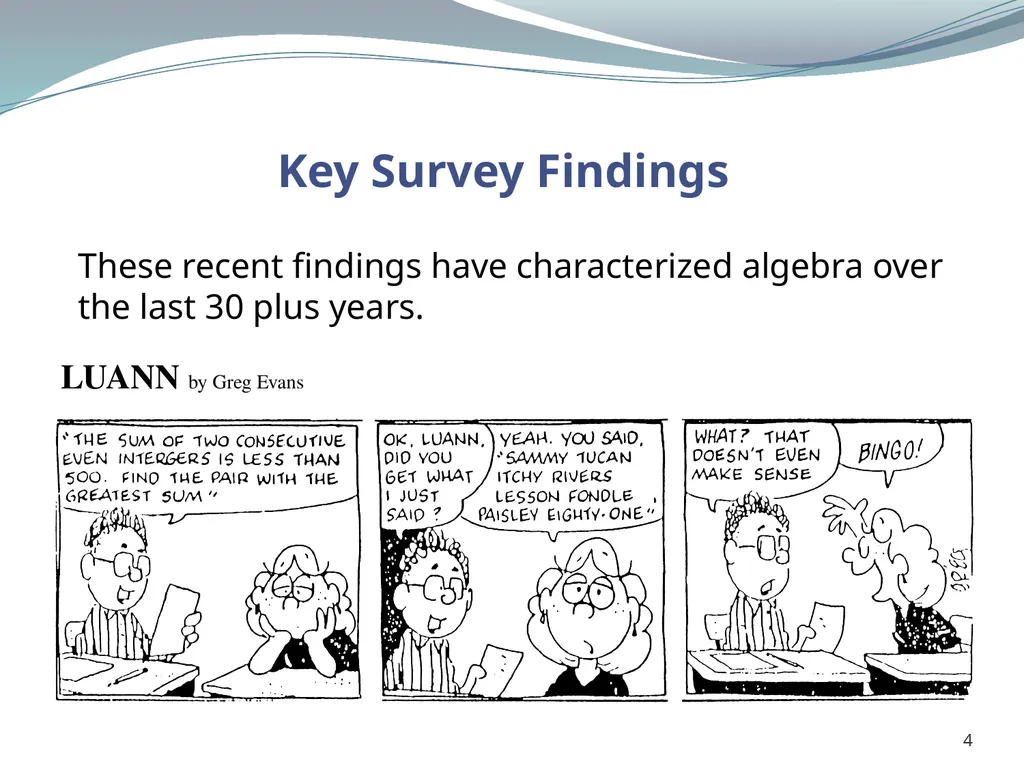
Key Survey Findings 4 These recent findings have characterized algebra over the last 30 plus years.<br>
05
Additional Survey Findings 5 Teachers reported that their students had the poorest background preparation in rational numbers, word problems, and study habits. U.S. Dept. of Education, 2008<br>
06
Panel Recommendations for the Major Topics of School Algebra 6 Symbols and Expressions
Linear Equations
Quadratic Equations
Functions
Algebra of Polynomials
Combinatorics and Finite Probability<br>
07
Turning Algebra on Its Head 7 One of the most important transitions from middle- to high-school mathematics is the emergence of algebraic concepts and methods for studying general numerical patterns, quantitative variables and relationships among those variables, and important patterns of change in those relationships.
The mathematical ideas that are central to that kind of quantitative reasoning are variables and functions.<br>
08
Algebra in High School 8 Organizing school algebra around the study of the major families of elementary functions (linear, exponential, power, quadratic and polynomial, rational, and periodic) and their use in mathematical modeling offers the opportunity to bring greater coherence to the study of algebra. Fey & Good, 1985; Fey, Heid, et al., 1995<br>
09
Algebra in High School 9 Situating the study of school algebra in explorations of contextual settings can provide more meaning to algebra, more motivation to its study, and can provide a broader population greater access to algebraic thinking. Hirsch, Fey, et al., 2008, 2009, 2010<br>
10
Goals and Approaches 10 From a functions perspective, the continued study of algebra at the high school level should enable all students to develop the ability to examine data or quantitative conditions; to choose appropriate algebraic models that fit patterns in the data or conditions; to write equations, inequalities, and other calculations to match important questions in the given situations; and to use a variety of strategies to answer the questions.<br>
11
Goals and Approaches 11 Achievement of these goals would suggest that the study of algebra be rooted in the modeling of interesting data and phenomena in the physical, biological, and social sciences, in economics, and in students’ daily lives. Achievement results support this “functions as models” approach to school algebra. Teachers report seldom hearing students ask, “Where are we ever going to use this (algebra)?” Huntley, M. A., Rasmussen, C. L., Villarubi, R. S., Sangtong, J., & Fey, J. T., 2000<br>
12
12 Answering questions about the situations being modeled leads to questions such as the following, some of which are at the heart of a traditional algebra program. For a given function modeling rule f(x), find f(x) for x = a;
x so that f(x) = a;
x so that maximum or minimum values of f(x) occur;
the rate of change in f near x = a;
the average value of f over the interval (a,b). Goals and Approaches<br>
13
The Motivation Problem Revisited 13 For further work in this area, see:
“Beliefs about Mathematics and Mathematics Learning in the Secondary School: Measurement and Implications for Motivation” by Peter Kloosterman, in Beliefs: A Hidden Variable in Mathematics Education? (2002). G. C. Leder, E. Pehkonen, & G. Törner (Eds.). Kluwer Academic Publishers.<br>