12.010 Computational Methods of Scientific Programming 2023 Tom Herring, tahmit.edu Chris Hill, cnhmit.edu Lec 01: Getting started and setup About 12.010 - I Introduces programming from perspective of physical science use. Programming
"12.010 Computational Methods of Scientific" is the property of its rightful owner. Permission is granted to
download and print the materials on this website for personal, non-commercial use only, and to display it
on your personal computer provided you do not modify the materials and that you retain all copyright
notices contained in the materials. By downloading content from our website, you accept the terms of this
agreement.
Presentation Transcript
01
12.010 Computational Methods of Scientific Programming 2023 Tom Herring, tah@mit.edu
Chris Hill, cnh@mit.edu
Lec 01: Getting started and setup<br>
02
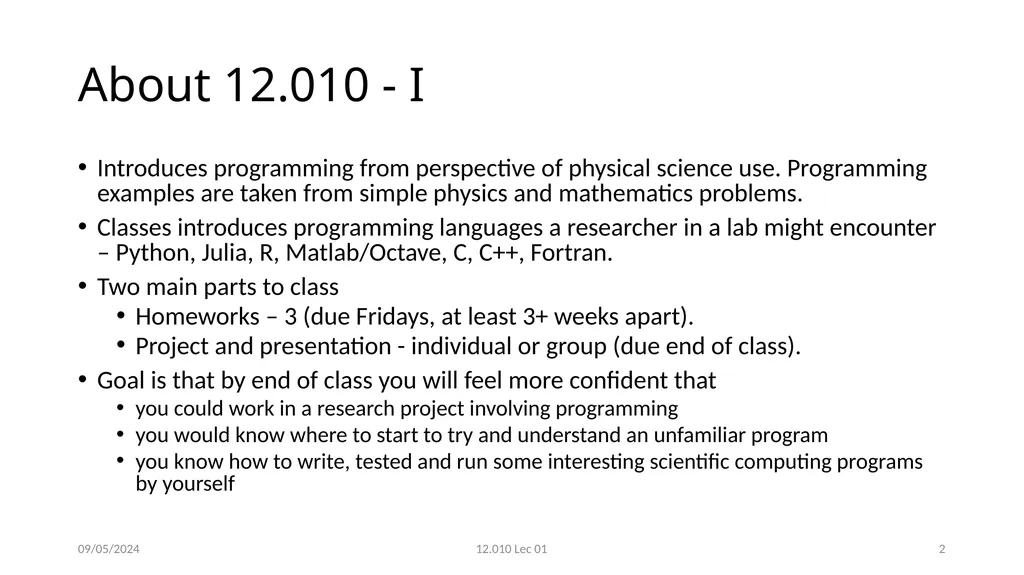
About 12.010 - I Introduces programming from perspective of physical science use. Programming examples are taken from simple physics and mathematics problems.
Classes introduces programming languages a researcher in a lab might encounter – Python, Julia, R, Matlab/Octave, C, C++, Fortran.
Two main parts to class
Homeworks – 3 (due Fridays, at least 3+ weeks apart).
Project and presentation - individual or group (due end of class).
Goal is that by end of class you will feel more confident that
you could work in a research project involving programming
you would know where to start to try and understand an unfamiliar program
you know how to write, tested and run some interesting scientific computing programs by yourself 09/05/2024 12.010 Lec 01 2<br>
03
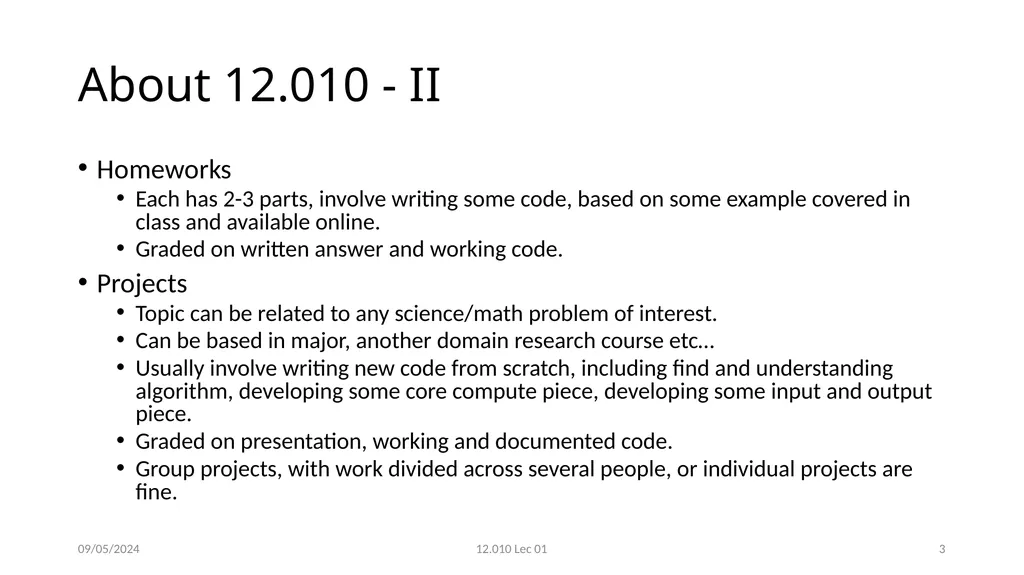
About 12.010 - II Homeworks
Each has 2-3 parts, involve writing some code, based on some example covered in class and available online.
Graded on written answer and working code.
Projects
Topic can be related to any science/math problem of interest.
Can be based in major, another domain research course etc…
Usually involve writing new code from scratch, including find and understanding algorithm, developing some core compute piece, developing some input and output piece.
Graded on presentation, working and documented code.
Group projects, with work divided across several people, or individual projects are fine. 09/05/2024 12.010 Lec 01 3<br>
04
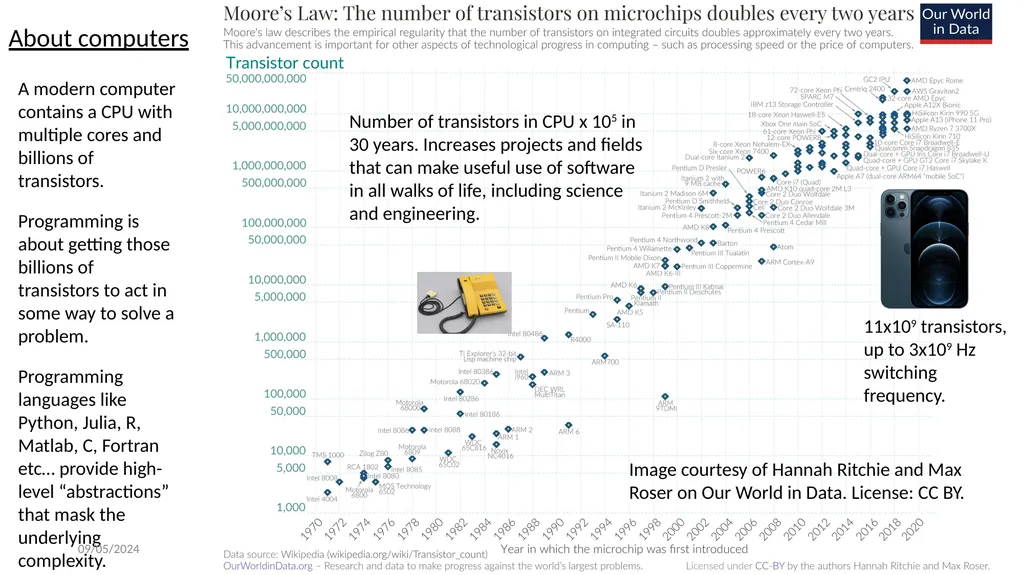
Programming is about getting those billions of transistors to act in some way to solve a problem. A modern computer contains a CPU with multiple cores and billions of transistors. About computers Programming languages like Python, Julia, R, Matlab, C, Fortran etc… provide high-level “abstractions” that mask the underlying complexity. Number of transistors in CPU x 105 in 30 years. Increases projects and fields that can make useful use of software in all walks of life, including science and engineering. 11x109 transistors,
up to 3x10⁹ Hz switching frequency. 09/05/2024 12.010 Lec 01 4 Image courtesy of Hannah Ritchie and Max
Roser on Our World in Data. License: CC BY.<br>
05
Programming languages In scientific computing/computational science there are multiple programming languages
Some of the most common ones include
Python, R, Julia, Matlab/Octave, C, C++, Fortran
The languages have different strengths, but also have a lot of ideas and concepts in common.
Practices around how to develop programs, how to test and check, how to formulate problems are similar too.
In 12.010 we introduce programming in Python, but then
explore how basic programs look in all the languages listed
illustrate different features that are found in different languages 09/05/2024 12.010 Lec 01 5<br>
06
Getting started Programming can only be learned hands-on experience
Computers are not that smart
Programming involves puzzling
over how to express a problem in a way a computer can solve it,
following rules about how to instruct the computer,
methodically trying to understand whether program is behaving as expected,
building up more complete and complex programs step-by-step.
The first “puzzle” is configuring a ”programming environment” to work in.
In this class we will begin by using Jupyter Notebooks as our common programming environment
Jupyter Notebooks are widely used in teaching programming and data science
They are not the only programming environment, and have some limitations, but they are very useful and common starting point. 09/05/2024 12.010 Lec 01 6<br>
07
First notebooks Start by trying cloud resource – see ”Launch Jupyterhub Class Exercise” in Assignments
Then install locally – see “Install Jupyter Notebook Locally Class Exercise” in Assignments.
There are example Notebooks in the Week 1 section we will try. Not all of these cases will be covered today. 09/05/2024 12.010 Lec 01 7<br>
08
09/05/2024 12.010 Lec 01 8 MIT OpenCourseWare
https://ocw.mit.edu
12.010 Computational Methods of Scientific Programming, Fall 2024
For more information about citing these materials or our Terms of Use, visit https://ocw.mit.edu/terms.<br>