
140MIC: Microbiology Lecture-2 Principles of


Description: 140MIC: Microbiology Lecture-2 Principles of Microbiology (Part-1) 1.1 Microbiology and Microorganisms The importance of microorganisms 1.2 Microbial Cells Cell chemistry and key structure Characteristics of living systems Cell functions:
Related Topics
Download Presentation
"140MIC: Microbiology Lecture-2 Principles of" is the property of its rightful owner. Permission is granted to download and print the materials on this website for personal, non-commercial use only, and to display it on your personal computer provided you do not modify the materials and that you retain all copyright notices contained in the materials. By downloading content from our website, you accept the terms of this agreement.
Presentation Transcript
slide1. 140MIC: Microbiology Lecture-2
Principles of Microbiology (Part-1)<br>
slide2. 1.1 Microbiology and Microorganisms
The importance of microorganisms
1.2 Microbial Cells
Cell chemistry and key structure
Characteristics of living systems
Cell functions: coding and metabolism.
1.3 Microorganisms and Their Environments
Microbial interaction
1.4 The Impact of Microorganisms on Humans
Microorganisms as disease agents
Microorganisms and agriculture
Microorganisms and food
Microorganisms, energy and there environment
Microorganisms and their genetic resources
Microbiology as a career Principles of Microbiology
Content 140MIC: Microbiology<br>
slide3. Introduction Microbiology is the study of microscopic organisms, such as bacteria, viruses, archaea, fungi and protozoa. This discipline includes fundamental research on the biochemistry, physiology, cell biology, ecology, evolution and clinical aspects of microorganisms, including the host response to these agents. (https://www.nature.com/subjects/microbiology)
What is Microbiology about?
Microbiology is about microbial cells and how they work .
Microbiology is about diversity and evolution of microbial cells.
It is about what microorganisms do in the world , soil , water , human body , animal , plant ..etc.
Microorganisms can affect and support all other forms of life, and considered the most fundamental of the biological sciences.<br>
slide4. The science of microbiology revolves around two themes:
Understanding basic life processes of microscopic organisms (basic biological science).
Microbes are excellent experimental systems for understanding cellular processes in unicellular and multicellular organisms.
Applying that knowledge to the benefit of humans, animals and plant (applied biological science)
Microbes play important roles in medicine, agriculture, and industry. Microbiology and Microorganisms 140MIC: Microbiology<br>
slide5. The importance of microorganisms
Oldest and smallest form of life
Largest mass of living material on Earth
Carry out major processes for biogeochemical cycles
Can live in places unsuitable for other organisms
Other life forms require microbes to survive Microbiology and Microorganisms 140MIC: Microbiology<br>
slide6. A cell
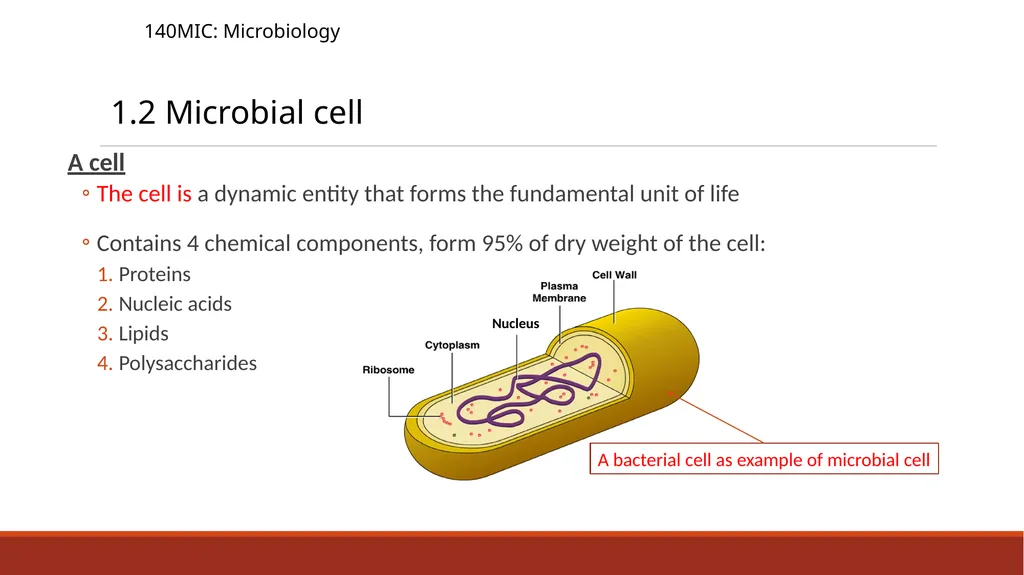
The cell is a dynamic entity that forms the fundamental unit of life
Contains 4 chemical components, form 95% of dry weight of the cell:
Proteins
Nucleic acids
Lipids
Polysaccharides 1.2 Microbial cell 140MIC: Microbiology A bacterial cell as example of microbial cell<br>
slide7. Cell wall
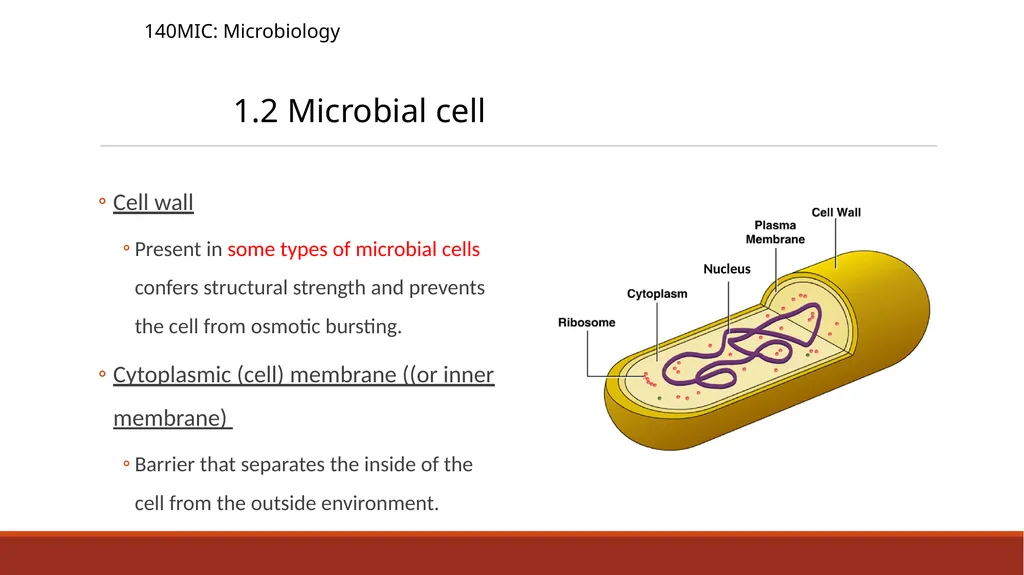
Present in some types of microbial cells confers structural strength and prevents the cell from osmotic bursting.
Cytoplasmic (cell) membrane ((or inner membrane)
Barrier that separates the inside of the cell from the outside environment. 1.2 Microbial cell 140MIC: Microbiology<br>
slide8. Cytoplasm:
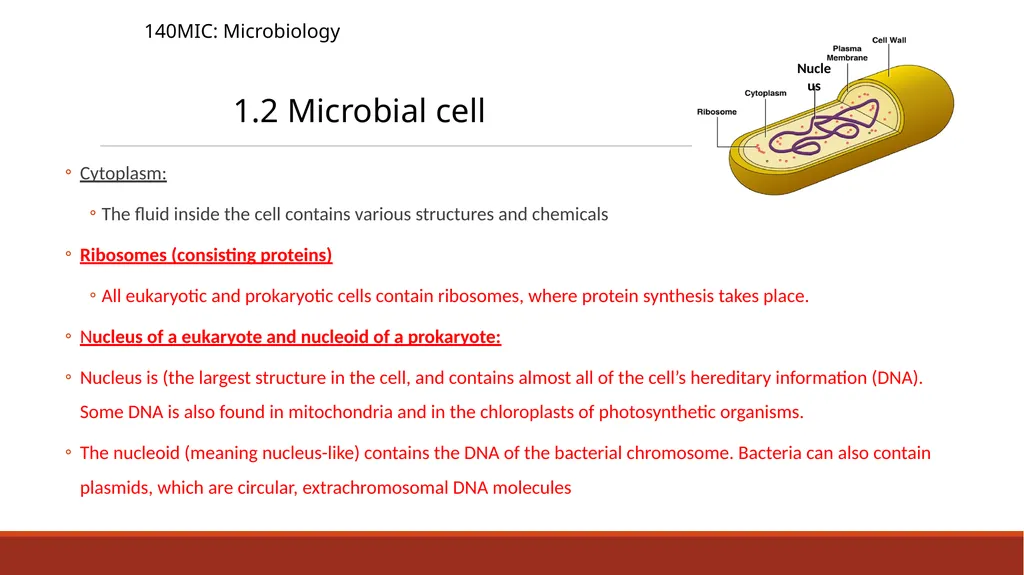
The fluid inside the cell contains various structures and chemicals
Ribosomes (consisting proteins)
All eukaryotic and prokaryotic cells contain ribosomes, where protein synthesis takes place.
Nucleus of a eukaryote and nucleoid of a prokaryote:
Nucleus is (the largest structure in the cell, and contains almost all of the cell’s hereditary information (DNA). Some DNA is also found in mitochondria and in the chloroplasts of photosynthetic organisms.
The nucleoid (meaning nucleus-like) contains the DNA of the bacterial chromosome. Bacteria can also contain plasmids, which are circular, extrachromosomal DNA molecules 1.2 Microbial cell 140MIC: Microbiology<br>
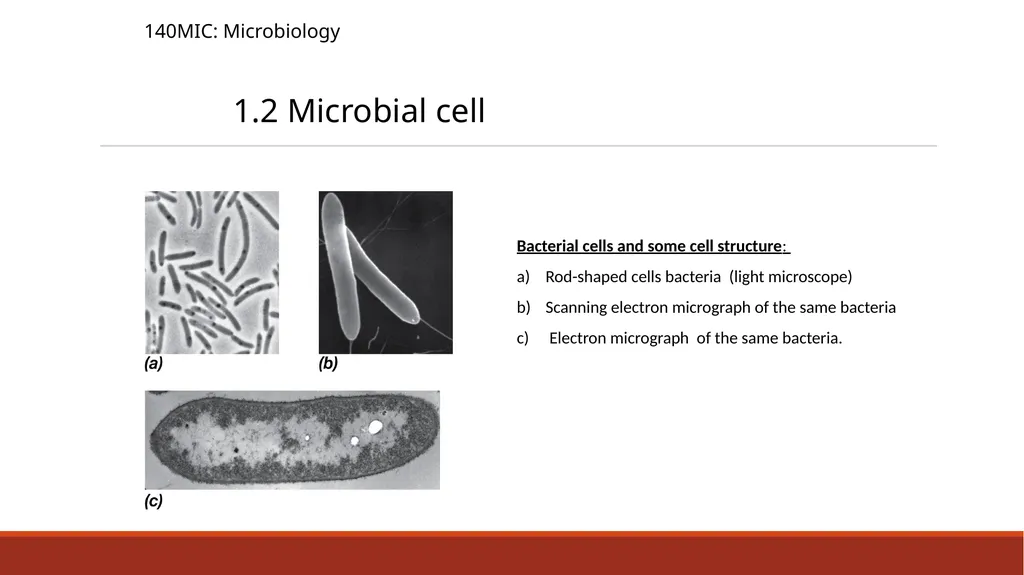
slide9. 1.2 Microbial cell 140MIC: Microbiology Bacterial cells and some cell structure:
Rod-shaped cells bacteria (light microscope)
Scanning electron micrograph of the same bacteria
Electron micrograph of the same bacteria.<br>
slide10. 1.2 Microbial cell
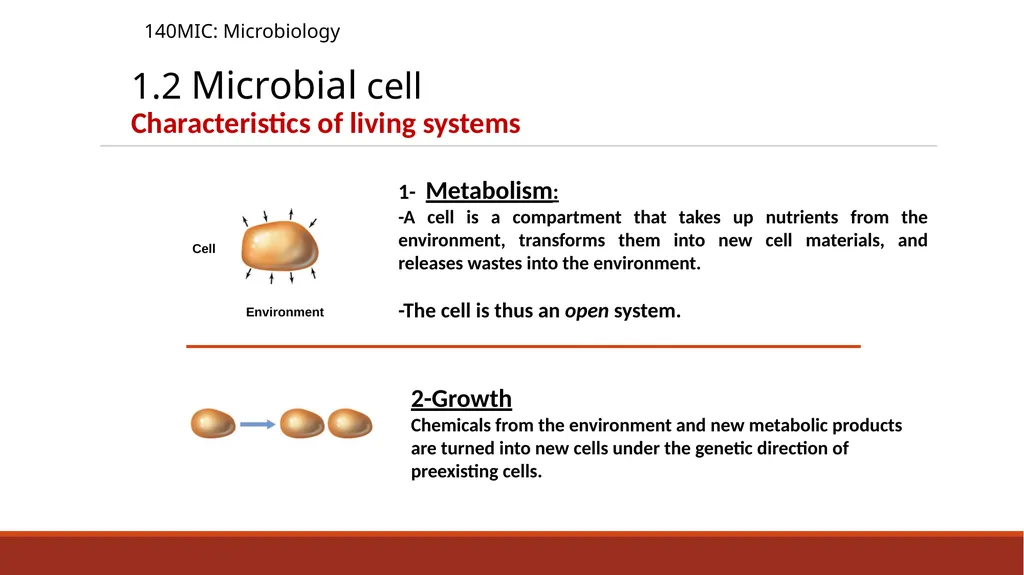
Characteristics of living systems 140MIC: Microbiology Cell Environment 1- Metabolism:
-A cell is a compartment that takes up nutrients from the environment, transforms them into new cell materials, and releases wastes into the environment.
-The cell is thus an open system. 2-Growth Chemicals from the environment and new metabolic products are turned into new cells under the genetic direction of preexisting cells.<br>
slide11. 1.2 Microbial cell
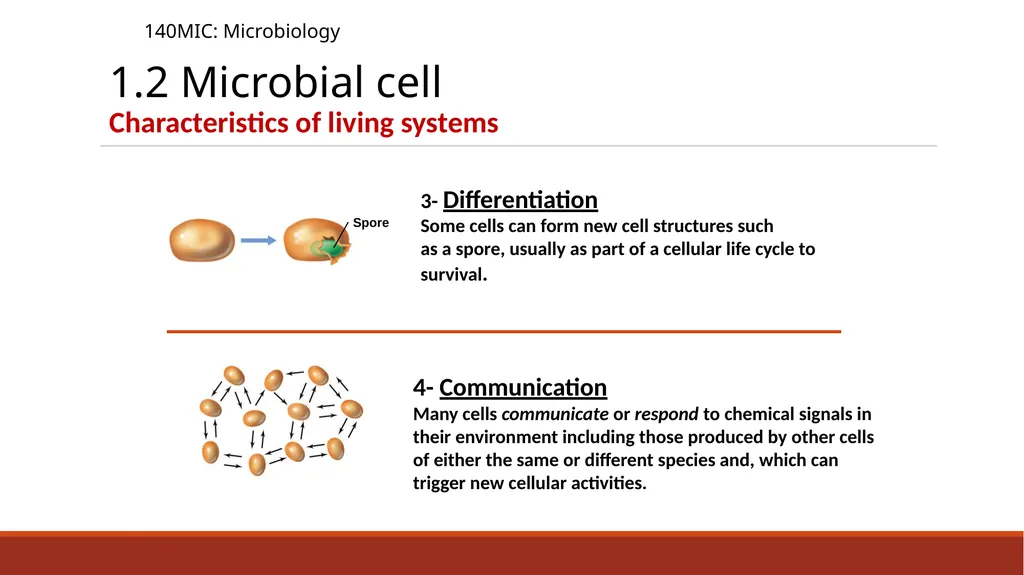
Characteristics of living systems 140MIC: Microbiology 3- Differentiation Some cells can form new cell structures such as a spore, usually as part of a cellular life cycle to survival. 4- Communication Many cells communicate or respond to chemical signals in their environment including those produced by other cells of either the same or different species and, which can trigger new cellular activities. Spore<br>
slide12. 1.2 Microbial cell
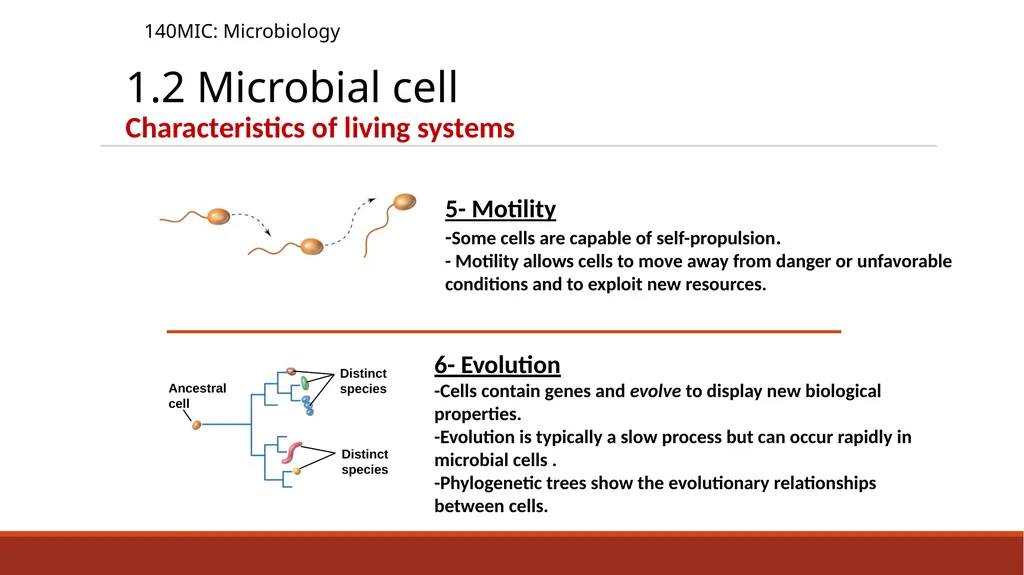
Characteristics of living systems 140MIC: Microbiology 5- Motility -Some cells are capable of self-propulsion.
- Motility allows cells to move away from danger or unfavorable conditions and to exploit new resources. 6- Evolution -Cells contain genes and evolve to display new biological properties.
-Evolution is typically a slow process but can occur rapidly in microbial cells . -Phylogenetic trees show the evolutionary relationships between cells. Ancestral cell Distinct species Distinct species<br>
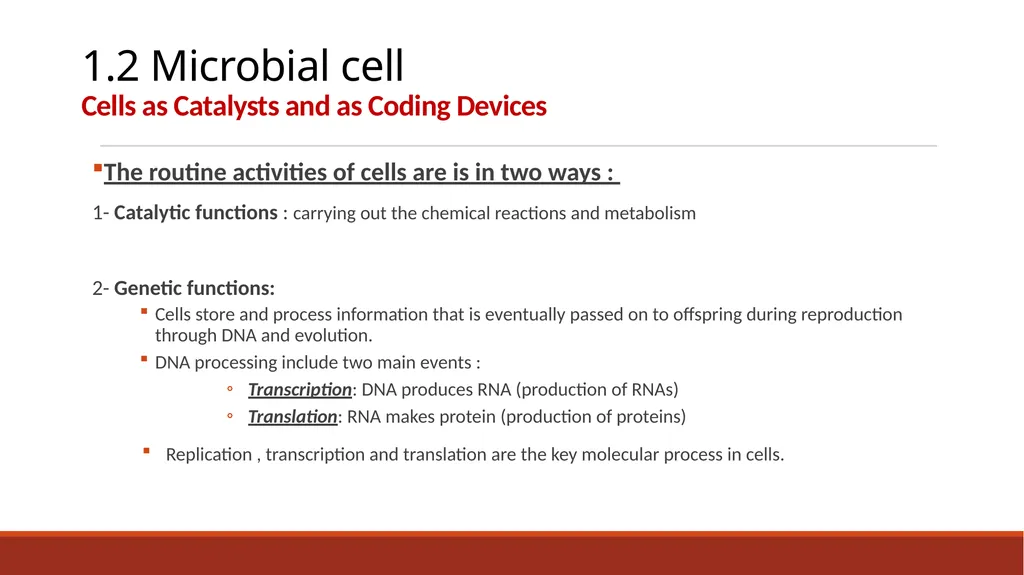
slide13. The routine activities of cells are is in two ways :
1- Catalytic functions : carrying out the chemical reactions and metabolism
2- Genetic functions:
Cells store and process information that is eventually passed on to offspring during reproduction through DNA and evolution.
DNA processing include two main events :
Transcription: DNA produces RNA (production of RNAs)
Translation: RNA makes protein (production of proteins)
Replication , transcription and translation are the key molecular process in cells. 1.2 Microbial cell
Cells as Catalysts and as Coding Devices<br>
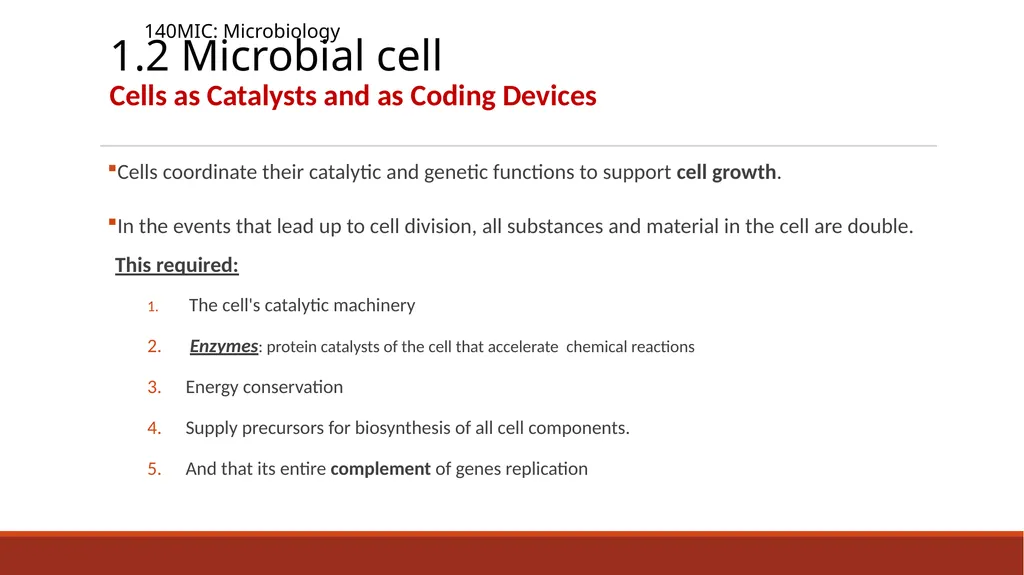
slide14. Cells coordinate their catalytic and genetic functions to support cell growth.
In the events that lead up to cell division, all substances and material in the cell are double. This required:
The cell's catalytic machinery
Enzymes: protein catalysts of the cell that accelerate chemical reactions
Energy conservation
Supply precursors for biosynthesis of all cell components.
And that its entire complement of genes replication 1.2 Microbial cell
Cells as Catalysts and as Coding Devices 140MIC: Microbiology<br>
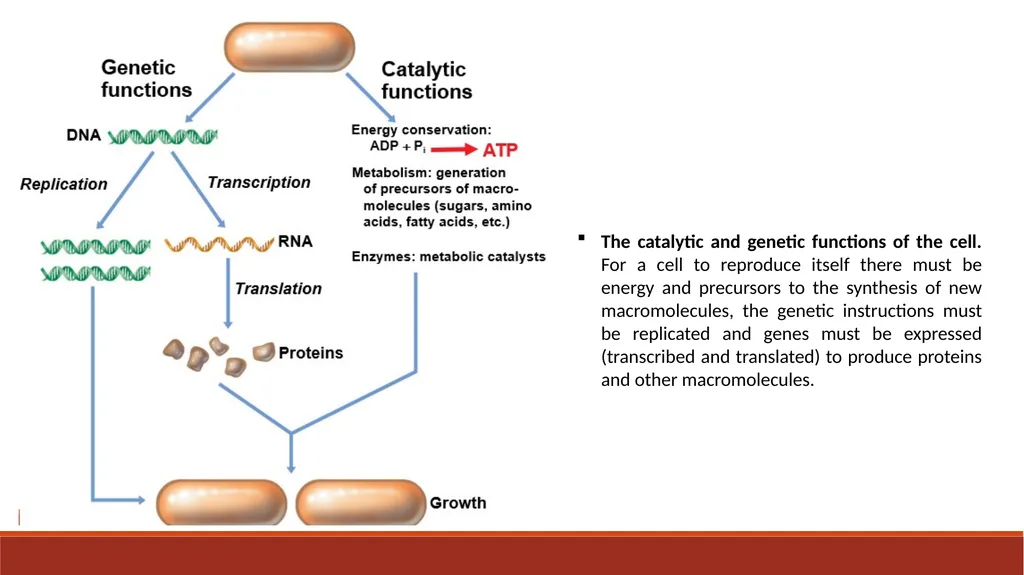
slide15. The catalytic and genetic functions of the cell. For a cell to reproduce itself there must be energy and precursors to the synthesis of new macromolecules, the genetic instructions must be replicated and genes must be expressed (transcribed and translated) to produce proteins and other macromolecules.<br>
slide16. REMEMBER You can always ask questions through our discussion board on www.lms.ksu.edu.sa<br>
Principles of Microbiology (Part-1)<br>
slide2. 1.1 Microbiology and Microorganisms
The importance of microorganisms
1.2 Microbial Cells
Cell chemistry and key structure
Characteristics of living systems
Cell functions: coding and metabolism.
1.3 Microorganisms and Their Environments
Microbial interaction
1.4 The Impact of Microorganisms on Humans
Microorganisms as disease agents
Microorganisms and agriculture
Microorganisms and food
Microorganisms, energy and there environment
Microorganisms and their genetic resources
Microbiology as a career Principles of Microbiology
Content 140MIC: Microbiology<br>
slide3. Introduction Microbiology is the study of microscopic organisms, such as bacteria, viruses, archaea, fungi and protozoa. This discipline includes fundamental research on the biochemistry, physiology, cell biology, ecology, evolution and clinical aspects of microorganisms, including the host response to these agents. (https://www.nature.com/subjects/microbiology)
What is Microbiology about?
Microbiology is about microbial cells and how they work .
Microbiology is about diversity and evolution of microbial cells.
It is about what microorganisms do in the world , soil , water , human body , animal , plant ..etc.
Microorganisms can affect and support all other forms of life, and considered the most fundamental of the biological sciences.<br>
slide4. The science of microbiology revolves around two themes:
Understanding basic life processes of microscopic organisms (basic biological science).
Microbes are excellent experimental systems for understanding cellular processes in unicellular and multicellular organisms.
Applying that knowledge to the benefit of humans, animals and plant (applied biological science)
Microbes play important roles in medicine, agriculture, and industry. Microbiology and Microorganisms 140MIC: Microbiology<br>
slide5. The importance of microorganisms
Oldest and smallest form of life
Largest mass of living material on Earth
Carry out major processes for biogeochemical cycles
Can live in places unsuitable for other organisms
Other life forms require microbes to survive Microbiology and Microorganisms 140MIC: Microbiology<br>
slide6. A cell
The cell is a dynamic entity that forms the fundamental unit of life
Contains 4 chemical components, form 95% of dry weight of the cell:
Proteins
Nucleic acids
Lipids
Polysaccharides 1.2 Microbial cell 140MIC: Microbiology A bacterial cell as example of microbial cell<br>
slide7. Cell wall
Present in some types of microbial cells confers structural strength and prevents the cell from osmotic bursting.
Cytoplasmic (cell) membrane ((or inner membrane)
Barrier that separates the inside of the cell from the outside environment. 1.2 Microbial cell 140MIC: Microbiology<br>
slide8. Cytoplasm:
The fluid inside the cell contains various structures and chemicals
Ribosomes (consisting proteins)
All eukaryotic and prokaryotic cells contain ribosomes, where protein synthesis takes place.
Nucleus of a eukaryote and nucleoid of a prokaryote:
Nucleus is (the largest structure in the cell, and contains almost all of the cell’s hereditary information (DNA). Some DNA is also found in mitochondria and in the chloroplasts of photosynthetic organisms.
The nucleoid (meaning nucleus-like) contains the DNA of the bacterial chromosome. Bacteria can also contain plasmids, which are circular, extrachromosomal DNA molecules 1.2 Microbial cell 140MIC: Microbiology<br>
slide9. 1.2 Microbial cell 140MIC: Microbiology Bacterial cells and some cell structure:
Rod-shaped cells bacteria (light microscope)
Scanning electron micrograph of the same bacteria
Electron micrograph of the same bacteria.<br>
slide10. 1.2 Microbial cell
Characteristics of living systems 140MIC: Microbiology Cell Environment 1- Metabolism:
-A cell is a compartment that takes up nutrients from the environment, transforms them into new cell materials, and releases wastes into the environment.
-The cell is thus an open system. 2-Growth Chemicals from the environment and new metabolic products are turned into new cells under the genetic direction of preexisting cells.<br>
slide11. 1.2 Microbial cell
Characteristics of living systems 140MIC: Microbiology 3- Differentiation Some cells can form new cell structures such as a spore, usually as part of a cellular life cycle to survival. 4- Communication Many cells communicate or respond to chemical signals in their environment including those produced by other cells of either the same or different species and, which can trigger new cellular activities. Spore<br>
slide12. 1.2 Microbial cell
Characteristics of living systems 140MIC: Microbiology 5- Motility -Some cells are capable of self-propulsion.
- Motility allows cells to move away from danger or unfavorable conditions and to exploit new resources. 6- Evolution -Cells contain genes and evolve to display new biological properties.
-Evolution is typically a slow process but can occur rapidly in microbial cells . -Phylogenetic trees show the evolutionary relationships between cells. Ancestral cell Distinct species Distinct species<br>
slide13. The routine activities of cells are is in two ways :
1- Catalytic functions : carrying out the chemical reactions and metabolism
2- Genetic functions:
Cells store and process information that is eventually passed on to offspring during reproduction through DNA and evolution.
DNA processing include two main events :
Transcription: DNA produces RNA (production of RNAs)
Translation: RNA makes protein (production of proteins)
Replication , transcription and translation are the key molecular process in cells. 1.2 Microbial cell
Cells as Catalysts and as Coding Devices<br>
slide14. Cells coordinate their catalytic and genetic functions to support cell growth.
In the events that lead up to cell division, all substances and material in the cell are double. This required:
The cell's catalytic machinery
Enzymes: protein catalysts of the cell that accelerate chemical reactions
Energy conservation
Supply precursors for biosynthesis of all cell components.
And that its entire complement of genes replication 1.2 Microbial cell
Cells as Catalysts and as Coding Devices 140MIC: Microbiology<br>
slide15. The catalytic and genetic functions of the cell. For a cell to reproduce itself there must be energy and precursors to the synthesis of new macromolecules, the genetic instructions must be replicated and genes must be expressed (transcribed and translated) to produce proteins and other macromolecules.<br>
slide16. REMEMBER You can always ask questions through our discussion board on www.lms.ksu.edu.sa<br>