
18/04/2024 Practical Implications of MCC for
LS
Published · 26 slides · 0 views

1 / 1

Description
18042024 Practical Implications of MCC for Credit Unions Presented By Íde McCormack Contents Introduction MCC Requirements MCC In-Scope Activities for CU New FP Controlled Functions Impact on Governance Arrangements Impact on Operational
Related Topics
Share
Embed code
Download this presentation From Below
"18/04/2024 Practical Implications of MCC for" is the property of its rightful owner. Permission is granted to download and print the materials on this website for personal, non-commercial use only, and to display it on your personal computer provided you do not modify the materials and that you retain all copyright notices contained in the materials. By downloading content from our website, you accept the terms of this agreement.
Presentation Transcript
01
18/04/2024 Practical Implications of MCC for Credit Unions
Presented By
Íde McCormack<br>
02
Contents Introduction
MCC Requirements
MCC In-Scope Activities for CU
New F&P Controlled Functions
Impact on Governance Arrangements
Impact on Operational Processes
MCC Gap Analysis
Developing MCC Plan MCC F&P Register
Fitness & Probity Controlled Functions
F&P Due Supporting Diligence Documentation
F&P Process for CU CF Roles
F&P Due Diligence Requirements
Data Protection Obligations
Review of Governance & Operational Documents<br>
MCC Requirements
MCC In-Scope Activities for CU
New F&P Controlled Functions
Impact on Governance Arrangements
Impact on Operational Processes
MCC Gap Analysis
Developing MCC Plan MCC F&P Register
Fitness & Probity Controlled Functions
F&P Due Supporting Diligence Documentation
F&P Process for CU CF Roles
F&P Due Diligence Requirements
Data Protection Obligations
Review of Governance & Operational Documents<br>
03
A key objective of the CBI over the last number of years is to ensure an appropriate and standardised level of professional competency within the financial services sector
Achieved by the roll out of the MCR and Fitness & Probity Regimes
The MCR will now include Credit Unions from 1st Oct 2024 for in scope activities
The recent changes to the MCC/F&P requirements, the new Individual Accountability regime and the recently enacted Credit Union Amendment Bill represents some of the most significant changes to the Credit Union legal and regulatory landscape in recent years Introduction<br>
Achieved by the roll out of the MCR and Fitness & Probity Regimes
The MCR will now include Credit Unions from 1st Oct 2024 for in scope activities
The recent changes to the MCC/F&P requirements, the new Individual Accountability regime and the recently enacted Credit Union Amendment Bill represents some of the most significant changes to the Credit Union legal and regulatory landscape in recent years Introduction<br>
04
MCC Requirements Already applies to Credit Unions providing Mortgages and who act as insurance intermediaries
The MCR requires credit unions to ensure relevant persons are compliant with MCC requirements after 1st October 2024
Individuals performing specified activities regardless of whether they are a member of staff, or a volunteer must meet the MCC requirements by 1st October 2028 but have commenced the process by 1st October 2024<br>
The MCR requires credit unions to ensure relevant persons are compliant with MCC requirements after 1st October 2024
Individuals performing specified activities regardless of whether they are a member of staff, or a volunteer must meet the MCC requirements by 1st October 2028 but have commenced the process by 1st October 2024<br>
05
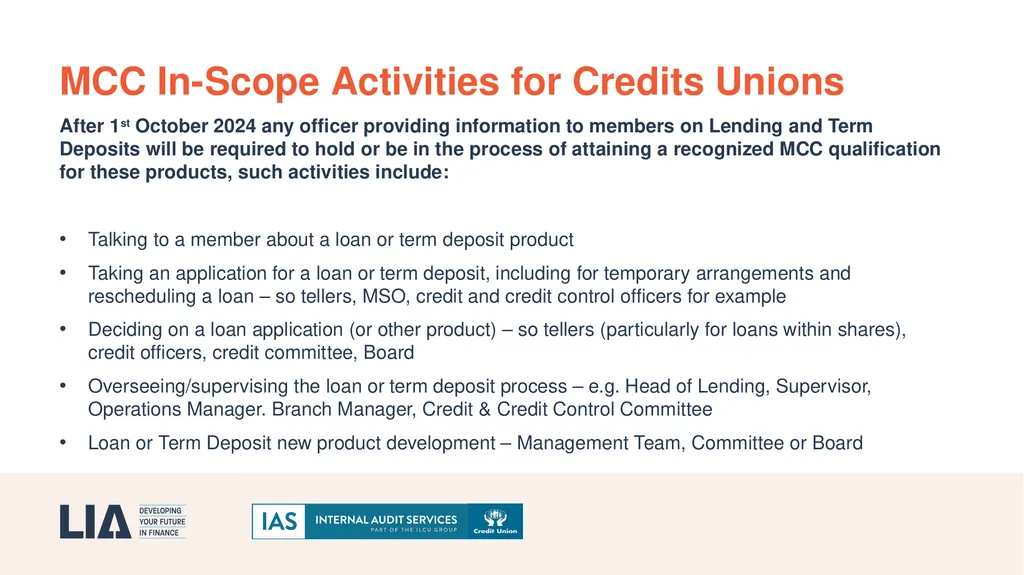
MCC In-Scope Activities for Credits Unions After 1st October 2024 any officer providing information to members on Lending and Term Deposits will be required to hold or be in the process of attaining a recognized MCC qualification for these products, such activities include:
Talking to a member about a loan or term deposit product
Taking an application for a loan or term deposit, including for temporary arrangements and rescheduling a loan – so tellers, MSO, credit and credit control officers for example
Deciding on a loan application (or other product) – so tellers (particularly for loans within shares), credit officers, credit committee, Board
Overseeing/supervising the loan or term deposit process – e.g. Head of Lending, Supervisor, Operations Manager. Branch Manager, Credit & Credit Control Committee
Loan or Term Deposit new product development – Management Team, Committee or Board<br>
Talking to a member about a loan or term deposit product
Taking an application for a loan or term deposit, including for temporary arrangements and rescheduling a loan – so tellers, MSO, credit and credit control officers for example
Deciding on a loan application (or other product) – so tellers (particularly for loans within shares), credit officers, credit committee, Board
Overseeing/supervising the loan or term deposit process – e.g. Head of Lending, Supervisor, Operations Manager. Branch Manager, Credit & Credit Control Committee
Loan or Term Deposit new product development – Management Team, Committee or Board<br>
06
New F&P Controlled Functions<br>
07
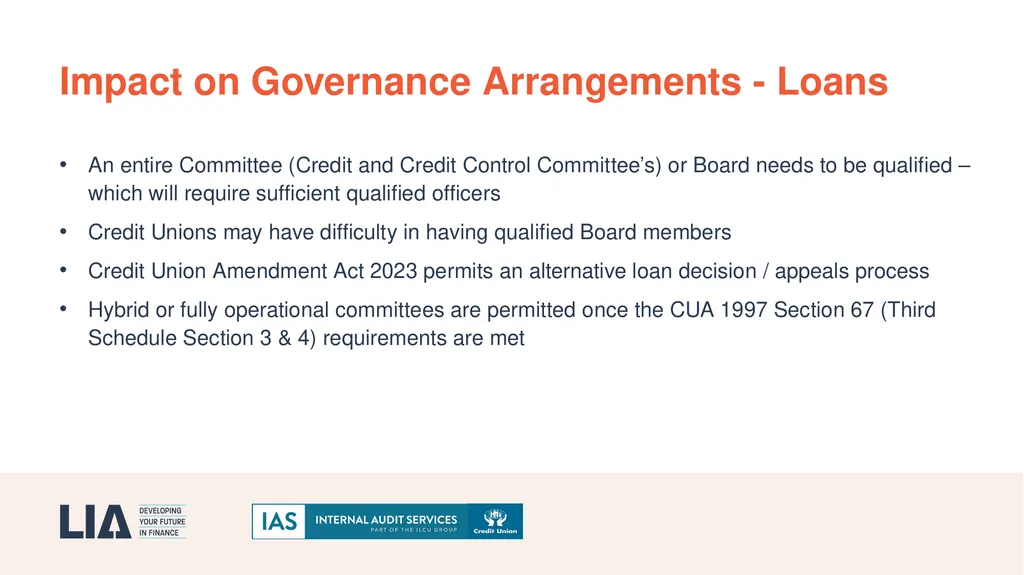
Impact on Governance Arrangements - Loans An entire Committee (Credit and Credit Control Committee’s) or Board needs to be qualified – which will require sufficient qualified officers
Credit Unions may have difficulty in having qualified Board members
Credit Union Amendment Act 2023 permits an alternative loan decision / appeals process
Hybrid or fully operational committees are permitted once the CUA 1997 Section 67 (Third Schedule Section 3 & 4) requirements are met<br>
Credit Unions may have difficulty in having qualified Board members
Credit Union Amendment Act 2023 permits an alternative loan decision / appeals process
Hybrid or fully operational committees are permitted once the CUA 1997 Section 67 (Third Schedule Section 3 & 4) requirements are met<br>
08
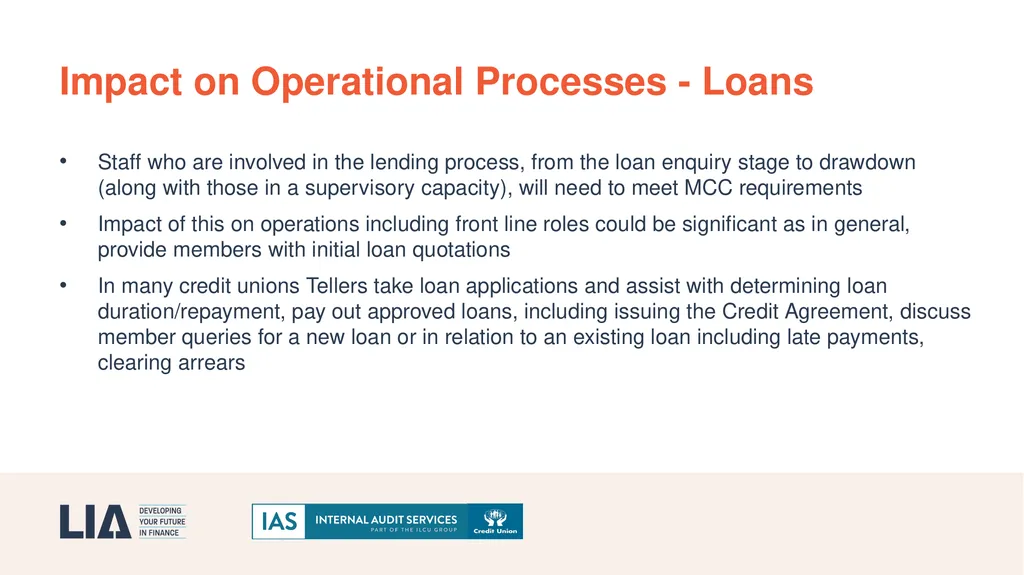
Impact on Operational Processes - Loans Staff who are involved in the lending process, from the loan enquiry stage to drawdown (along with those in a supervisory capacity), will need to meet MCC requirements
Impact of this on operations including front line roles could be significant as in general, provide members with initial loan quotations
In many credit unions Tellers take loan applications and assist with determining loan duration/repayment, pay out approved loans, including issuing the Credit Agreement, discuss member queries for a new loan or in relation to an existing loan including late payments, clearing arrears<br>
Impact of this on operations including front line roles could be significant as in general, provide members with initial loan quotations
In many credit unions Tellers take loan applications and assist with determining loan duration/repayment, pay out approved loans, including issuing the Credit Agreement, discuss member queries for a new loan or in relation to an existing loan including late payments, clearing arrears<br>
09
Impact on Operational Processes - Loans If Credit & Credit Committees becomes operational and it is expected they will for most credit unions, this could put a serious strain on staff resources as 6 qualified staff are required to fill these committees and as Credit nor Credit Control Officers can sit on these committees these roles will need to be resourced separately with 2-3 credit officers on average and 1-2 credit control staff. So that is a minimum of 8-10 staff excluding any tellers involved in in-scope activities as noted above
May result in MCC qualified 2nd line staff sitting on Credit /Credit Control Committee’s
Which raises segregation of duty concerns and impacts on the independence and objectivity of 2nd line
In this instance will require a risk assessment to be completed with mitigating controls identified<br>
May result in MCC qualified 2nd line staff sitting on Credit /Credit Control Committee’s
Which raises segregation of duty concerns and impacts on the independence and objectivity of 2nd line
In this instance will require a risk assessment to be completed with mitigating controls identified<br>
10
Impact on Operational Process Aside from the loan process from enquiry to drawdown, the following processes require suitably qualified individuals:
Term deposit enquiries, account opening, etc.
Claims involving loans e.g. LP/LS – as loan protection covers permanent incapacity
Complaints officer/team/committee
Loan appeals
Persons/body in direct management or in a supervisory role who may not have a direct involvement in the lending or term deposit process e.g. Operations Manager, Office Manager, etc.<br>
Term deposit enquiries, account opening, etc.
Claims involving loans e.g. LP/LS – as loan protection covers permanent incapacity
Complaints officer/team/committee
Loan appeals
Persons/body in direct management or in a supervisory role who may not have a direct involvement in the lending or term deposit process e.g. Operations Manager, Office Manager, etc.<br>
11
Impact on Operational Processes – Credit Control Credit Control staff need to meet MCC requirements as they assist members with temporary arrangements, rescheduling and arrears management
Discussion or queries with members regarding out of order overdrafts, missed payments, extra payments, arrears or pre arrears can only be with a qualified teller or Credit Control Officer
If Credit Control work is outsourced MCC requirements need to be addressed as part of the tender process and the annual review process to ensure continued compliance
Need to be cognizant of the ongoing F&P requirements for in scope outsourced functions
An outsourcing review template should be used to ensure a standardised and compliant approach<br>
Discussion or queries with members regarding out of order overdrafts, missed payments, extra payments, arrears or pre arrears can only be with a qualified teller or Credit Control Officer
If Credit Control work is outsourced MCC requirements need to be addressed as part of the tender process and the annual review process to ensure continued compliance
Need to be cognizant of the ongoing F&P requirements for in scope outsourced functions
An outsourcing review template should be used to ensure a standardised and compliant approach<br>
12
Where credit unions provide term deposit accounts for 1 year or more to members the following activities are within scope of MCC requirements from 1st October 2024:
Giving of advice to a member in relation to the provision of a term deposit account
Arranging or offering to arrange a term deposit account for a member
Supervising or direct managing those persons providing the above services
Adjudicating on any member complaint relating to term deposit accounts Impact on Member Terms Deposit Account Processes<br>
Giving of advice to a member in relation to the provision of a term deposit account
Arranging or offering to arrange a term deposit account for a member
Supervising or direct managing those persons providing the above services
Adjudicating on any member complaint relating to term deposit accounts Impact on Member Terms Deposit Account Processes<br>
13
In line with the MCC changes, the body or person with responsibility for member complaints regarding loans and term deposits needs to meet the MCC requirements
It is expected that member complaints becomes an operational role/committee Impact on Member Complaints Process<br>
It is expected that member complaints becomes an operational role/committee Impact on Member Complaints Process<br>
14
Impact on Product Design/Development Process MCC requires that the design /development of in-scope products requires at least ‘one key person’ on the appointed committee shall meet the required professional standard
Directors who are not qualified could sit on this committee once at least one key member of the committee meets the requirements and is present at each meeting – it is therefore advisable to have more than one qualified person on the committee
It is recommended that a Product Development Policy is documented which outlines the process for developing and testing new products or services right though to approving the new product<br>
Directors who are not qualified could sit on this committee once at least one key member of the committee meets the requirements and is present at each meeting – it is therefore advisable to have more than one qualified person on the committee
It is recommended that a Product Development Policy is documented which outlines the process for developing and testing new products or services right though to approving the new product<br>
15
MCC Gap Analysis A gap analysis should be competed to determine gaps in suitably qualified persons to fill the various in-scope committees and activities, such as: Loan and term deposit product development
The loan process from enquiry to drawdown (where it includes the signing of the Credit Agreement by the person paying out the loan)
Term deposit enquiries, form filling, account opening, etc. Insurance claims involving loans e.g. LP/LS
Complaints officer/team/committee Loan appeals
Persons/body in direct management or in a supervisory role who may not have a direct involvement in the lending or term deposit process e.g. Operations Manager, Office Manager, etc.<br>
The loan process from enquiry to drawdown (where it includes the signing of the Credit Agreement by the person paying out the loan)
Term deposit enquiries, form filling, account opening, etc. Insurance claims involving loans e.g. LP/LS
Complaints officer/team/committee Loan appeals
Persons/body in direct management or in a supervisory role who may not have a direct involvement in the lending or term deposit process e.g. Operations Manager, Office Manager, etc.<br>
16
Developing an MCC Plan An MCC Plan should be completed to ensure the necessary changes to governance and operational processes are in place prior to 1st October 2024 to allow for full compliance with MCC requirements, including:
Process for consideration of Officer loans and loan appeals once Section 37 of CUA 1997 is amended by the commencement of the relevant section of the Credit Union Amendment Act 2023
Have identified sufficient persons who will meet MCC requirements to fill the various MCC committees and roles
A process to ensure unqualified persons are either qualified or in the process of attaining a qualification by 1st October 2024<br>
Process for consideration of Officer loans and loan appeals once Section 37 of CUA 1997 is amended by the commencement of the relevant section of the Credit Union Amendment Act 2023
Have identified sufficient persons who will meet MCC requirements to fill the various MCC committees and roles
A process to ensure unqualified persons are either qualified or in the process of attaining a qualification by 1st October 2024<br>
17
Developing an MCC Plan - continued Ensure individuals identified to fill MCC roles have appropriate F&P due diligence completed and meet the F&P requirements prior to confirming their Controlled Function status
Ensure Board and operational succession planning is reviewed to take account of MCC requirements – ensure sufficient (qualified) staff to meet succession requirements or fill MCC roles on a temporary basis for taking account of planned and unplanned leave, segregation of duties, conflicts of interest, etc.
Succession plan should be used to inform Board and operations recruitment campaigns
Relevant policies and procedures are updated re MCC requirements
Data Protection obligations<br>
Ensure Board and operational succession planning is reviewed to take account of MCC requirements – ensure sufficient (qualified) staff to meet succession requirements or fill MCC roles on a temporary basis for taking account of planned and unplanned leave, segregation of duties, conflicts of interest, etc.
Succession plan should be used to inform Board and operations recruitment campaigns
Relevant policies and procedures are updated re MCC requirements
Data Protection obligations<br>
18
MCC – F&P Register Credit Unions are required to maintain and up to date MCC Register
Needs to record all officers (voluntary / staff) who are involved in an in-scope activity – this will include loans and term deposits from 1st October 2024
A listing of each officers MCC qualifications and CPD membership status to be documented in the register
Including a section for officers in the process of attaining a suitable qualification, e.g. date of initial registration for exam(s), how many completed, expected completion date, etc.
Ongoing CPD membership status e.g. progress on completing mandatory topics and sufficient CPD hours, etc.
Recommend it is sufficiently detailed to serve as the required F&P Register – needs to include individuals various CF roles and the certification process.<br>
Needs to record all officers (voluntary / staff) who are involved in an in-scope activity – this will include loans and term deposits from 1st October 2024
A listing of each officers MCC qualifications and CPD membership status to be documented in the register
Including a section for officers in the process of attaining a suitable qualification, e.g. date of initial registration for exam(s), how many completed, expected completion date, etc.
Ongoing CPD membership status e.g. progress on completing mandatory topics and sufficient CPD hours, etc.
Recommend it is sufficiently detailed to serve as the required F&P Register – needs to include individuals various CF roles and the certification process.<br>
19
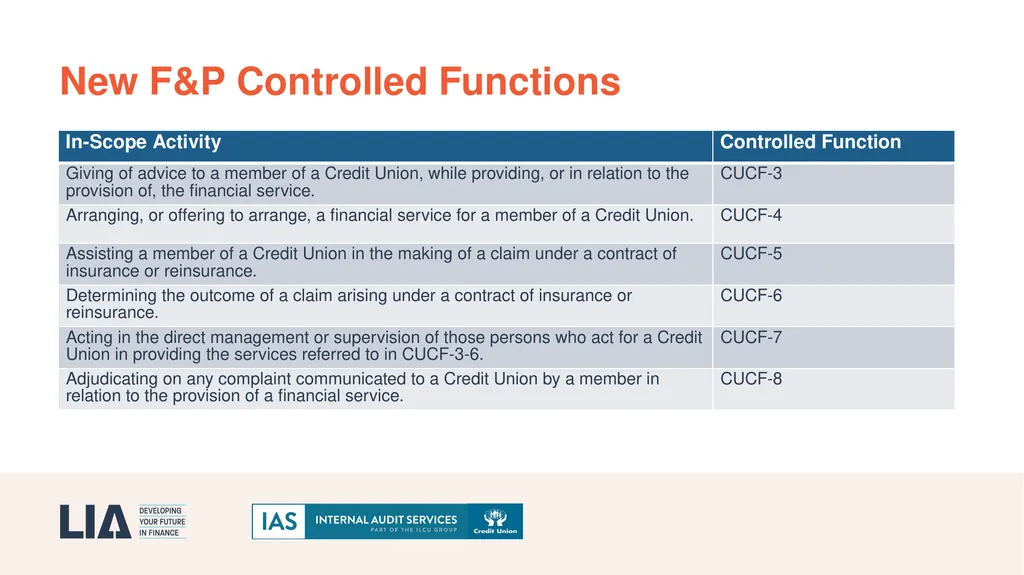
Fitness & Probity Controlled Functions Further controlled functions have been introduced to ensure full alignment between the new in-scope MCC activities and F&P Regulations – CUCF 3 -8
CUCF 1 & 2 are already in place including the various PCF roles, as such all credit unions should have a documented process for identifying and managing the various F&P obligations for voluntary and paid officers
Credit Unions will need to be satisfied on an ongoing basis that relevant officers & outscored function:
Meet the F&P standard – a process of due diligence
Continue to maintain those standards – self-certification<br>
CUCF 1 & 2 are already in place including the various PCF roles, as such all credit unions should have a documented process for identifying and managing the various F&P obligations for voluntary and paid officers
Credit Unions will need to be satisfied on an ongoing basis that relevant officers & outscored function:
Meet the F&P standard – a process of due diligence
Continue to maintain those standards – self-certification<br>
20
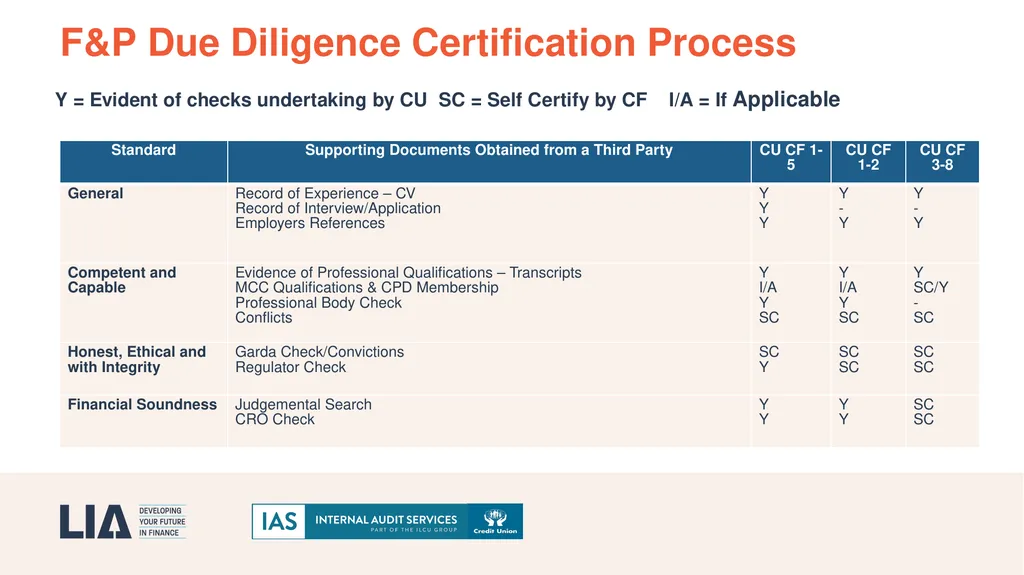
F&P Due Diligence Certification Process Y = Evident of checks undertaking by CU SC = Self Certify by CF I/A = If Applicable<br>
21
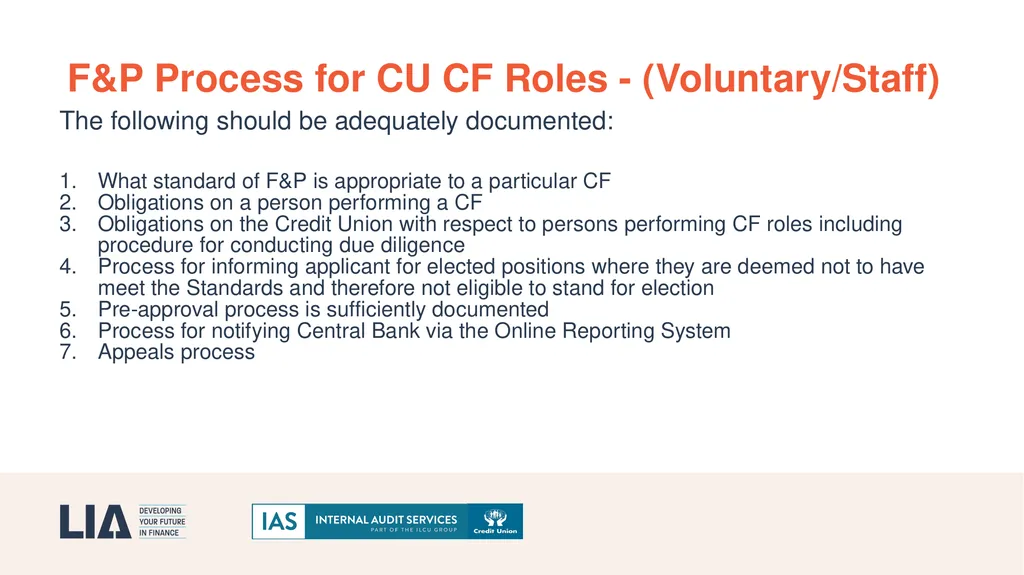
F&P Process for CU CF Roles - (Voluntary/Staff) The following should be adequately documented:
What standard of F&P is appropriate to a particular CF
Obligations on a person performing a CF
Obligations on the Credit Union with respect to persons performing CF roles including procedure for conducting due diligence
Process for informing applicant for elected positions where they are deemed not to have meet the Standards and therefore not eligible to stand for election
Pre-approval process is sufficiently documented
Process for notifying Central Bank via the Online Reporting System
Appeals process<br>
What standard of F&P is appropriate to a particular CF
Obligations on a person performing a CF
Obligations on the Credit Union with respect to persons performing CF roles including procedure for conducting due diligence
Process for informing applicant for elected positions where they are deemed not to have meet the Standards and therefore not eligible to stand for election
Pre-approval process is sufficiently documented
Process for notifying Central Bank via the Online Reporting System
Appeals process<br>
22
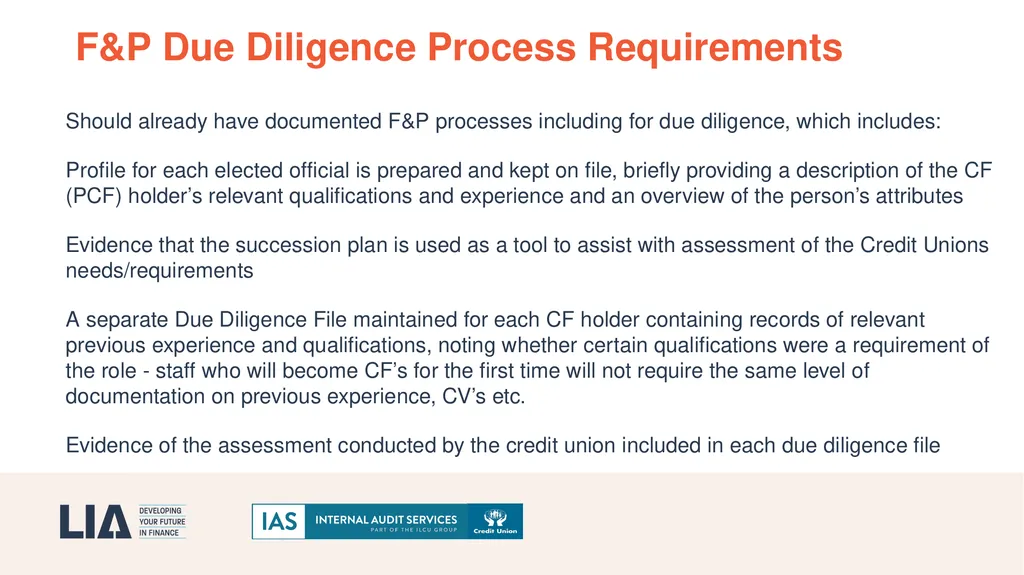
F&P Due Diligence Process Requirements Should already have documented F&P processes including for due diligence, which includes:
Profile for each elected official is prepared and kept on file, briefly providing a description of the CF (PCF) holder’s relevant qualifications and experience and an overview of the person’s attributes
Evidence that the succession plan is used as a tool to assist with assessment of the Credit Unions needs/requirements
A separate Due Diligence File maintained for each CF holder containing records of relevant previous experience and qualifications, noting whether certain qualifications were a requirement of the role - staff who will become CF’s for the first time will not require the same level of documentation on previous experience, CV’s etc.
Evidence of the assessment conducted by the credit union included in each due diligence file<br>
Profile for each elected official is prepared and kept on file, briefly providing a description of the CF (PCF) holder’s relevant qualifications and experience and an overview of the person’s attributes
Evidence that the succession plan is used as a tool to assist with assessment of the Credit Unions needs/requirements
A separate Due Diligence File maintained for each CF holder containing records of relevant previous experience and qualifications, noting whether certain qualifications were a requirement of the role - staff who will become CF’s for the first time will not require the same level of documentation on previous experience, CV’s etc.
Evidence of the assessment conducted by the credit union included in each due diligence file<br>
23
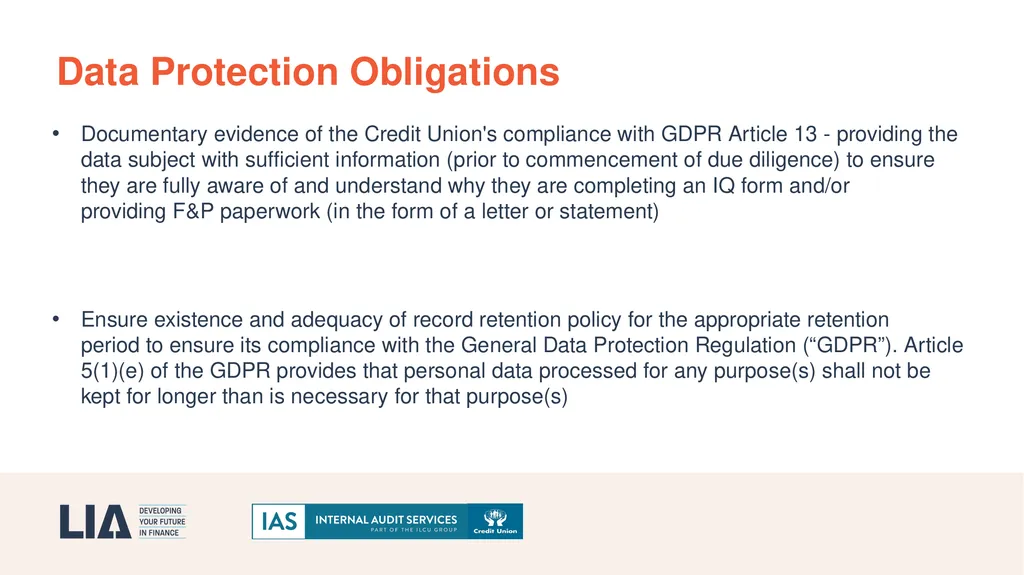
Data Protection Obligations Documentary evidence of the Credit Union's compliance with GDPR Article 13 - providing the data subject with sufficient information (prior to commencement of due diligence) to ensure they are fully aware of and understand why they are completing an IQ form and/or providing F&P paperwork (in the form of a letter or statement)
Ensure existence and adequacy of record retention policy for the appropriate retention period to ensure its compliance with the General Data Protection Regulation (“GDPR”). Article 5(1)(e) of the GDPR provides that personal data processed for any purpose(s) shall not be kept for longer than is necessary for that purpose(s)<br>
Ensure existence and adequacy of record retention policy for the appropriate retention period to ensure its compliance with the General Data Protection Regulation (“GDPR”). Article 5(1)(e) of the GDPR provides that personal data processed for any purpose(s) shall not be kept for longer than is necessary for that purpose(s)<br>
24
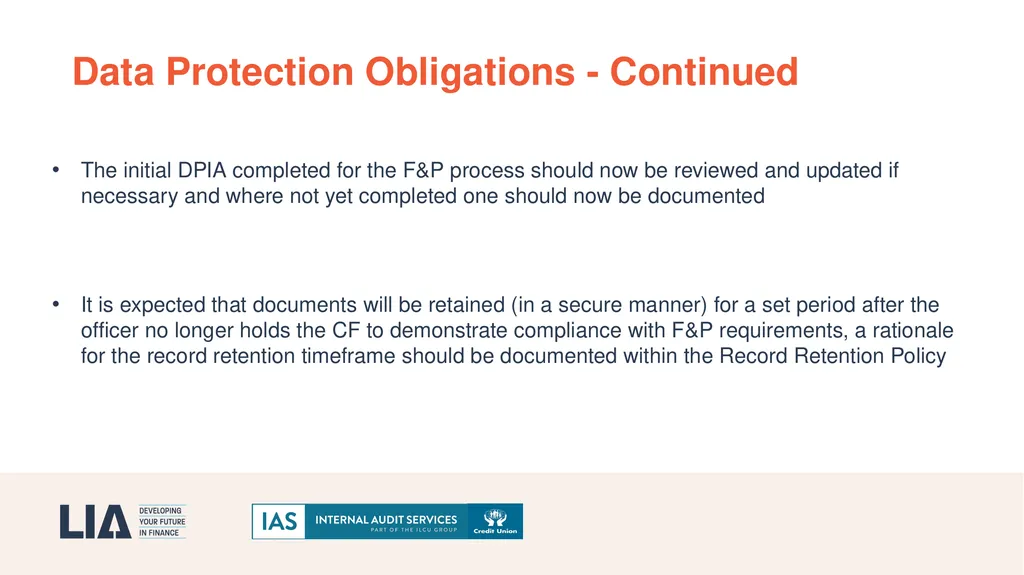
Data Protection Obligations - Continued The initial DPIA completed for the F&P process should now be reviewed and updated if necessary and where not yet completed one should now be documented
It is expected that documents will be retained (in a secure manner) for a set period after the officer no longer holds the CF to demonstrate compliance with F&P requirements, a rationale for the record retention timeframe should be documented within the Record Retention Policy<br>
It is expected that documents will be retained (in a secure manner) for a set period after the officer no longer holds the CF to demonstrate compliance with F&P requirements, a rationale for the record retention timeframe should be documented within the Record Retention Policy<br>
25
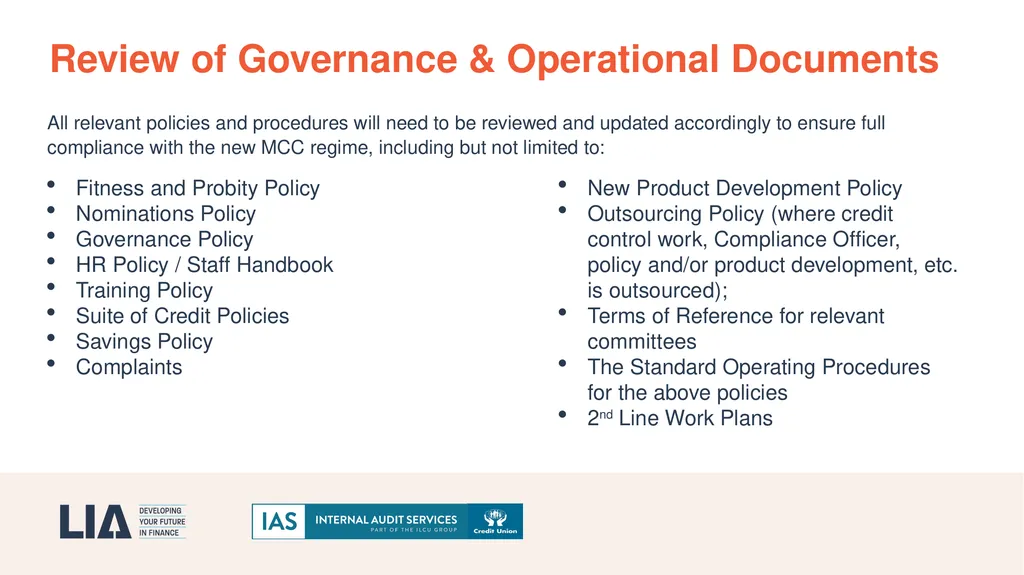
Review of Governance & Operational Documents All relevant policies and procedures will need to be reviewed and updated accordingly to ensure full compliance with the new MCC regime, including but not limited to: Fitness and Probity Policy
Nominations Policy
Governance Policy
HR Policy / Staff Handbook
Training Policy
Suite of Credit Policies
Savings Policy
Complaints New Product Development Policy
Outsourcing Policy (where credit control work, Compliance Officer, policy and/or product development, etc. is outsourced);
Terms of Reference for relevant committees
The Standard Operating Procedures for the above policies
2nd Line Work Plans<br>
Nominations Policy
Governance Policy
HR Policy / Staff Handbook
Training Policy
Suite of Credit Policies
Savings Policy
Complaints New Product Development Policy
Outsourcing Policy (where credit control work, Compliance Officer, policy and/or product development, etc. is outsourced);
Terms of Reference for relevant committees
The Standard Operating Procedures for the above policies
2nd Line Work Plans<br>
26
Any questions? For more information:
Íde McCormack – imccormack@creditunion.ie LIA – education@lia.ie<br>
Íde McCormack – imccormack@creditunion.ie LIA – education@lia.ie<br>