
18th Current Issues in Retirement Benefits Online
A
Published · 27 slides · 0 views

1 / 1








Description
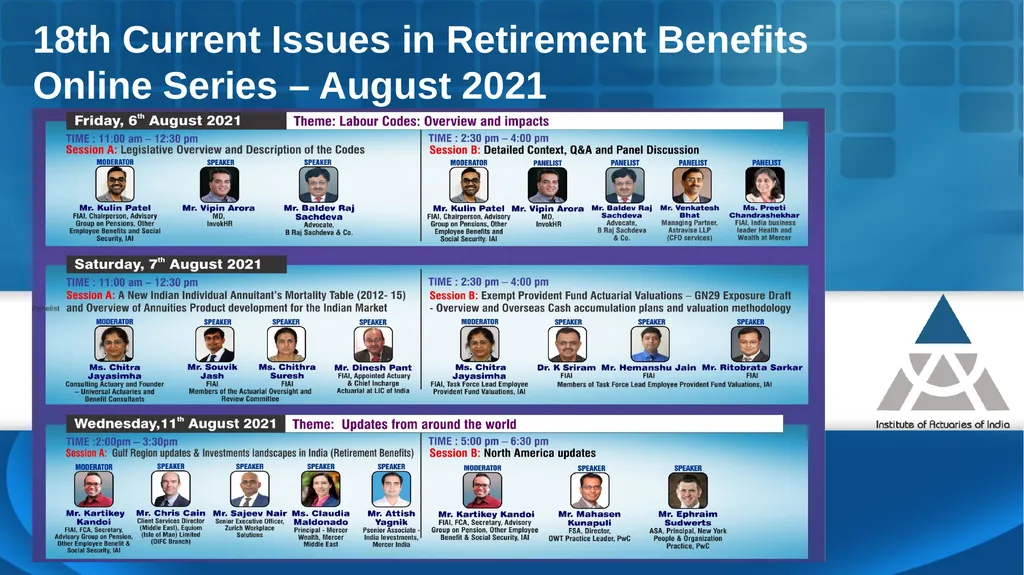
18th Current Issues in Retirement Benefits Online Series August 2021 www.actuariesindia.org Introduction Ephraim Sudwerts Mahasen Kunapuli Retirement Market in the United States A Brief 18th Current Issues in Retirement Benefits(CIRB)
Related Topics
Share
Embed code
Download this presentation From Below
"18th Current Issues in Retirement Benefits Online" is the property of its rightful owner. Permission is granted to download and print the materials on this website for personal, non-commercial use only, and to display it on your personal computer provided you do not modify the materials and that you retain all copyright notices contained in the materials. By downloading content from our website, you accept the terms of this agreement.
Presentation Transcript
01
18th Current Issues in Retirement Benefits
Online Series – August 2021<br>
Online Series – August 2021<br>
02
www.actuariesindia.org Introduction<br>
03
Ephraim Sudwerts
Mahasen Kunapuli Retirement Market in the United States – A Brief 18th Current Issues in Retirement Benefits(CIRB)
Online Series August 2021
11 August 2021<br>
Mahasen Kunapuli Retirement Market in the United States – A Brief 18th Current Issues in Retirement Benefits(CIRB)
Online Series August 2021
11 August 2021<br>
04
www.actuariesindia.org Speaker Introductions Ephraim Sudwerts
ASA, Principal, New York People & Organization Practice, PwC
Ephraim Sudwerts is a Principal in PwC’s New York People & Organization practice.
Ephraim began his career with PwC in 1999 and has since dealt with a wide array of clients, including law firms, private equity firms, health systems, and retailers.
In addition to expertise in the areas of pension funding and expense, Ephraim has significant experience with plan design, as well as coverage and nondiscrimination testing.
Ephraim serves as a key advisor to PwC management on matters relating to PwC's pension system.
Ephraim is an Associate of the Society of Actuaries, an Enrolled Actuary, and a Member of the American Academy of Actuaries.<br>
ASA, Principal, New York People & Organization Practice, PwC
Ephraim Sudwerts is a Principal in PwC’s New York People & Organization practice.
Ephraim began his career with PwC in 1999 and has since dealt with a wide array of clients, including law firms, private equity firms, health systems, and retailers.
In addition to expertise in the areas of pension funding and expense, Ephraim has significant experience with plan design, as well as coverage and nondiscrimination testing.
Ephraim serves as a key advisor to PwC management on matters relating to PwC's pension system.
Ephraim is an Associate of the Society of Actuaries, an Enrolled Actuary, and a Member of the American Academy of Actuaries.<br>
05
www.actuariesindia.org Speaker Introductions Mahasen Kunapuli
FSA, Director Advisory,
Leader People & Organization India Acceleration Cente, PwC
He is having +20 years experience of benefits consulting experience including traditional retirement benefits consulting, total rewards strategies to attract and retain talent, pension risk management strategies through asset liability management studies, etc.
Leads a team of 70 colleagues who have pension actuarial experience, Compensation strategies, change management and culture assessment, and Healthcare actuarial experience
HR transaction related services including HR due diligence, post-merger benefits harmonization, etc.
Fellow, Society of Actuaries (USA)<br>
FSA, Director Advisory,
Leader People & Organization India Acceleration Cente, PwC
He is having +20 years experience of benefits consulting experience including traditional retirement benefits consulting, total rewards strategies to attract and retain talent, pension risk management strategies through asset liability management studies, etc.
Leads a team of 70 colleagues who have pension actuarial experience, Compensation strategies, change management and culture assessment, and Healthcare actuarial experience
HR transaction related services including HR due diligence, post-merger benefits harmonization, etc.
Fellow, Society of Actuaries (USA)<br>
06
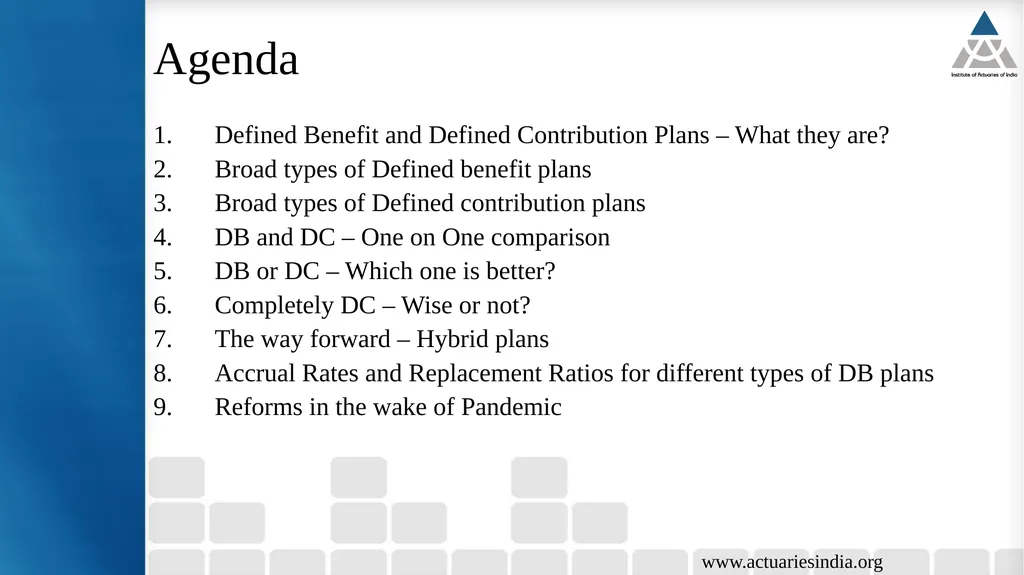
www.actuariesindia.org Agenda Defined Benefit and Defined Contribution Plans – What they are?
Broad types of Defined benefit plans
Broad types of Defined contribution plans
DB and DC – One on One comparison
DB or DC – Which one is better?
Completely DC – Wise or not?
The way forward – Hybrid plans
Accrual Rates and Replacement Ratios for different types of DB plans
Reforms in the wake of Pandemic<br>
Broad types of Defined benefit plans
Broad types of Defined contribution plans
DB and DC – One on One comparison
DB or DC – Which one is better?
Completely DC – Wise or not?
The way forward – Hybrid plans
Accrual Rates and Replacement Ratios for different types of DB plans
Reforms in the wake of Pandemic<br>
07
www.actuariesindia.org Defined Benefit and Defined contribution plans The pension plans available in the states can be broadly classified into two categories – Defined Benefit and Defined Contribution plans.
The description of these plans is all in the nomenclature.
For Defined Benefit plans (referred to as DB thereon), the final benefit at retirement is defined as a function of mainly tenure with a company and Salary drawn by an employee. An Indian equivalent of this type could be Employee Pension Scheme (EPS).
Similarly for defined contribution plans (referred to as DC thereon), the contribution to the plan is defined and the final benefit at retirement generally depends on the account value and is subject to the investment market performance. The equivalent of a DC plan in Indian market can be the Employee Provident Fund or National Pension Scheme.
With the ever changing demographics and market requirements, Hybrid versions such as cash balance plans and variable annuity plans have become more common in order to be in line with the market demands.<br>
The description of these plans is all in the nomenclature.
For Defined Benefit plans (referred to as DB thereon), the final benefit at retirement is defined as a function of mainly tenure with a company and Salary drawn by an employee. An Indian equivalent of this type could be Employee Pension Scheme (EPS).
Similarly for defined contribution plans (referred to as DC thereon), the contribution to the plan is defined and the final benefit at retirement generally depends on the account value and is subject to the investment market performance. The equivalent of a DC plan in Indian market can be the Employee Provident Fund or National Pension Scheme.
With the ever changing demographics and market requirements, Hybrid versions such as cash balance plans and variable annuity plans have become more common in order to be in line with the market demands.<br>
08
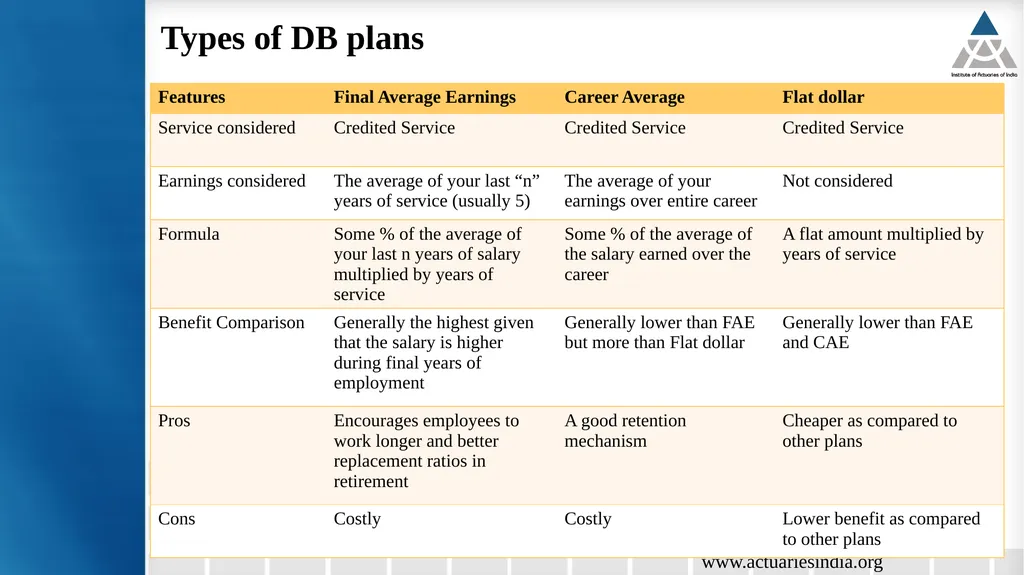
www.actuariesindia.org Types of DB plans<br>
09
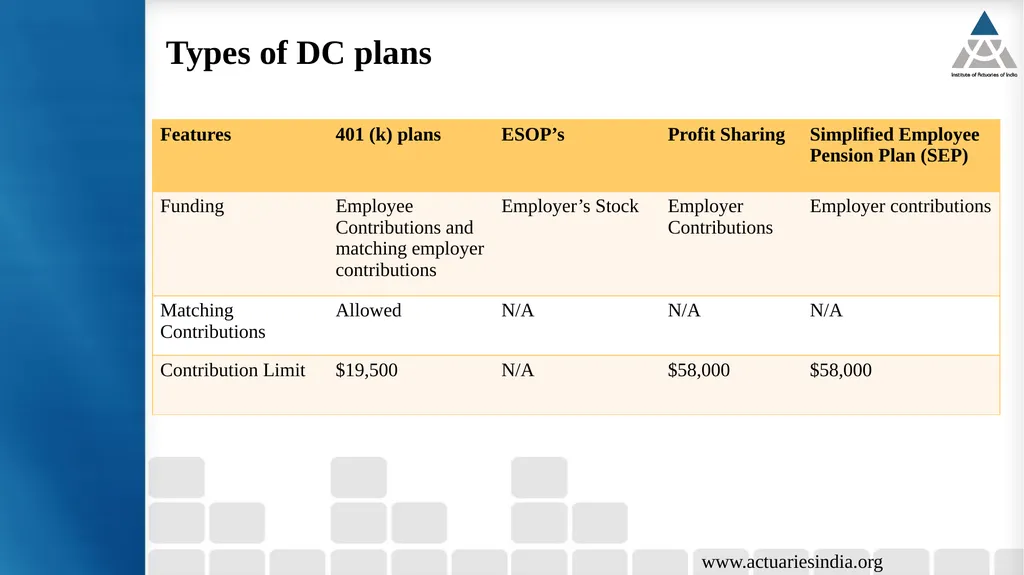
www.actuariesindia.org Types of DC plans<br>
10
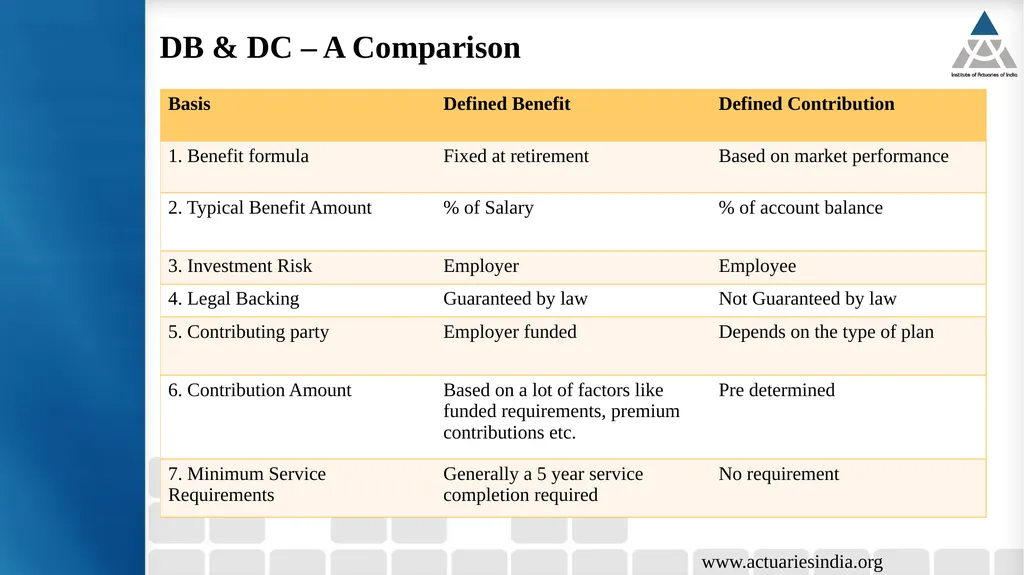
www.actuariesindia.org DB & DC – A Comparison<br>
11
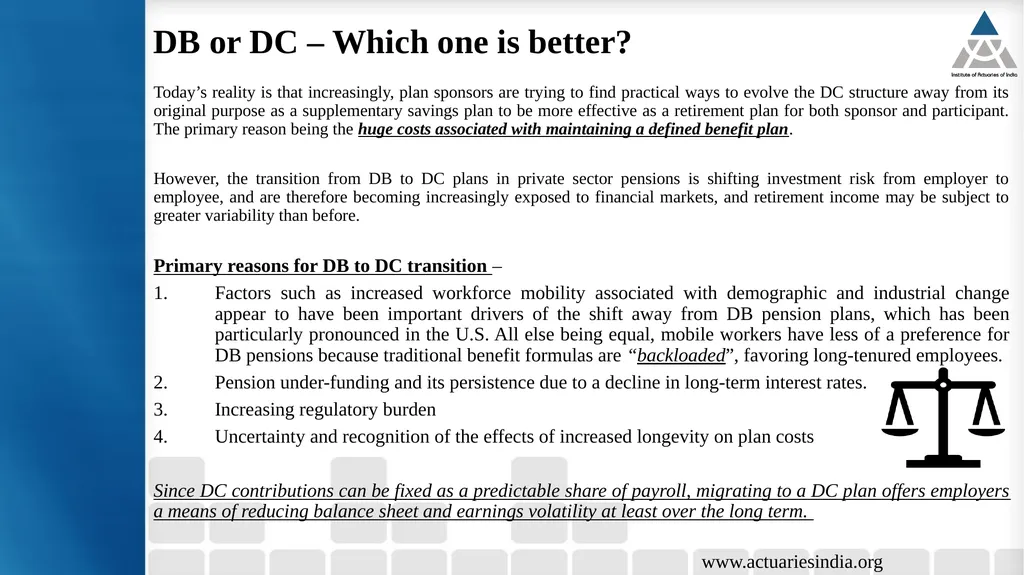
www.actuariesindia.org DB or DC – Which one is better? Today’s reality is that increasingly, plan sponsors are trying to find practical ways to evolve the DC structure away from its original purpose as a supplementary savings plan to be more effective as a retirement plan for both sponsor and participant. The primary reason being the huge costs associated with maintaining a defined benefit plan.
However, the transition from DB to DC plans in private sector pensions is shifting investment risk from employer to employee, and are therefore becoming increasingly exposed to financial markets, and retirement income may be subject to greater variability than before.
Primary reasons for DB to DC transition –
Factors such as increased workforce mobility associated with demographic and industrial change appear to have been important drivers of the shift away from DB pension plans, which has been particularly pronounced in the U.S. All else being equal, mobile workers have less of a preference for DB pensions because traditional benefit formulas are “backloaded”, favoring long-tenured employees.
Pension under-funding and its persistence due to a decline in long-term interest rates.
Increasing regulatory burden
Uncertainty and recognition of the effects of increased longevity on plan costs
Since DC contributions can be fixed as a predictable share of payroll, migrating to a DC plan offers employers a means of reducing balance sheet and earnings volatility at least over the long term.<br>
However, the transition from DB to DC plans in private sector pensions is shifting investment risk from employer to employee, and are therefore becoming increasingly exposed to financial markets, and retirement income may be subject to greater variability than before.
Primary reasons for DB to DC transition –
Factors such as increased workforce mobility associated with demographic and industrial change appear to have been important drivers of the shift away from DB pension plans, which has been particularly pronounced in the U.S. All else being equal, mobile workers have less of a preference for DB pensions because traditional benefit formulas are “backloaded”, favoring long-tenured employees.
Pension under-funding and its persistence due to a decline in long-term interest rates.
Increasing regulatory burden
Uncertainty and recognition of the effects of increased longevity on plan costs
Since DC contributions can be fixed as a predictable share of payroll, migrating to a DC plan offers employers a means of reducing balance sheet and earnings volatility at least over the long term.<br>
12
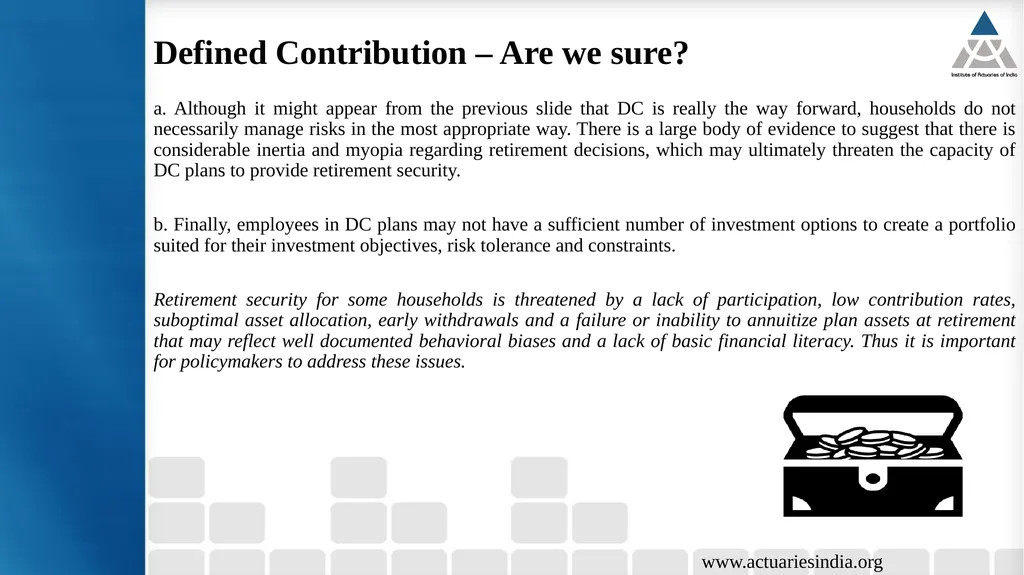
www.actuariesindia.org Defined Contribution – Are we sure? a. Although it might appear from the previous slide that DC is really the way forward, households do not necessarily manage risks in the most appropriate way. There is a large body of evidence to suggest that there is considerable inertia and myopia regarding retirement decisions, which may ultimately threaten the capacity of DC plans to provide retirement security.
b. Finally, employees in DC plans may not have a sufficient number of investment options to create a portfolio suited for their investment objectives, risk tolerance and constraints.
Retirement security for some households is threatened by a lack of participation, low contribution rates, suboptimal asset allocation, early withdrawals and a failure or inability to annuitize plan assets at retirement that may reflect well documented behavioral biases and a lack of basic financial literacy. Thus it is important for policymakers to address these issues.<br>
b. Finally, employees in DC plans may not have a sufficient number of investment options to create a portfolio suited for their investment objectives, risk tolerance and constraints.
Retirement security for some households is threatened by a lack of participation, low contribution rates, suboptimal asset allocation, early withdrawals and a failure or inability to annuitize plan assets at retirement that may reflect well documented behavioral biases and a lack of basic financial literacy. Thus it is important for policymakers to address these issues.<br>
13
www.actuariesindia.org The way forward – Best of both worlds Looking at the features of both DB and DC plans, it seems fair to say that both of these structures come with their own pros and cons. It seems only natural to design a hybrid version in order to tap the respective advantages of both. There are 2 most common hybrid designs that are being used as retirement savings instrument in USA nowadays –
1. CASH BALANCE PLANS –
A cash balance plan is a Defined benefit retirement plan that maintains hypothetical employee contributions like a defined contribution plan. In a typical cash balance plan, a participant's account is credited each year with a "pay credit" (such as 5 percent of compensation from his or her employer) and an "interest credit“.
Unlike the defined contribution plan, the funds are not invested in pooled funds/market, thereby minimizing the associated investment risk for the employee.
Unlike Defined benefit plan, the employer does not make contributions and hence is not at risk of bearing onerous costs associated with a DB plan.
Like a DB plan, the benefit at retirement is fixed in terms of an account balance. Like a DC plan, the contributions are defined based on a percentage of salary and an interest addition to the cash balance account each year.
Also, like a DB plan, the benefits are insured by government agencies<br>
1. CASH BALANCE PLANS –
A cash balance plan is a Defined benefit retirement plan that maintains hypothetical employee contributions like a defined contribution plan. In a typical cash balance plan, a participant's account is credited each year with a "pay credit" (such as 5 percent of compensation from his or her employer) and an "interest credit“.
Unlike the defined contribution plan, the funds are not invested in pooled funds/market, thereby minimizing the associated investment risk for the employee.
Unlike Defined benefit plan, the employer does not make contributions and hence is not at risk of bearing onerous costs associated with a DB plan.
Like a DB plan, the benefit at retirement is fixed in terms of an account balance. Like a DC plan, the contributions are defined based on a percentage of salary and an interest addition to the cash balance account each year.
Also, like a DB plan, the benefits are insured by government agencies<br>
14
www.actuariesindia.org 2. VARIABLE ANNUITY PLANS–
A defined benefit pension plan where benefits change based on the return of the plan's assets. Essentially, it is a retirement plan with less Contribution Volatility.
In a variable annuity plan design, the plan establishes a conservative assumed investment return (AIR), or hurdle rate. If the plan's investment returns equal the hurdle rate, the plan functions exactly like a traditional DB plan. However, if the plan's investments earn more or less than the hurdle rate in a plan year, all benefits earned in prior years are adjusted up or down by the difference between the actual investment return and the hurdle rate.
Variable annuity retirement benefits are generally larger than the DC retirement benefits provided by the same contribution due to professional investment management and the pooling of longevity experience.
In a nutshell, variable annuity plans shift the focus from the guaranteed benefits provided by the DB plans to the lifelong benefits provided by variable annuity plans where although the final benefit is not guaranteed, but participants are assured that they will not outlive their retirement income.<br>
A defined benefit pension plan where benefits change based on the return of the plan's assets. Essentially, it is a retirement plan with less Contribution Volatility.
In a variable annuity plan design, the plan establishes a conservative assumed investment return (AIR), or hurdle rate. If the plan's investment returns equal the hurdle rate, the plan functions exactly like a traditional DB plan. However, if the plan's investments earn more or less than the hurdle rate in a plan year, all benefits earned in prior years are adjusted up or down by the difference between the actual investment return and the hurdle rate.
Variable annuity retirement benefits are generally larger than the DC retirement benefits provided by the same contribution due to professional investment management and the pooling of longevity experience.
In a nutshell, variable annuity plans shift the focus from the guaranteed benefits provided by the DB plans to the lifelong benefits provided by variable annuity plans where although the final benefit is not guaranteed, but participants are assured that they will not outlive their retirement income.<br>
15
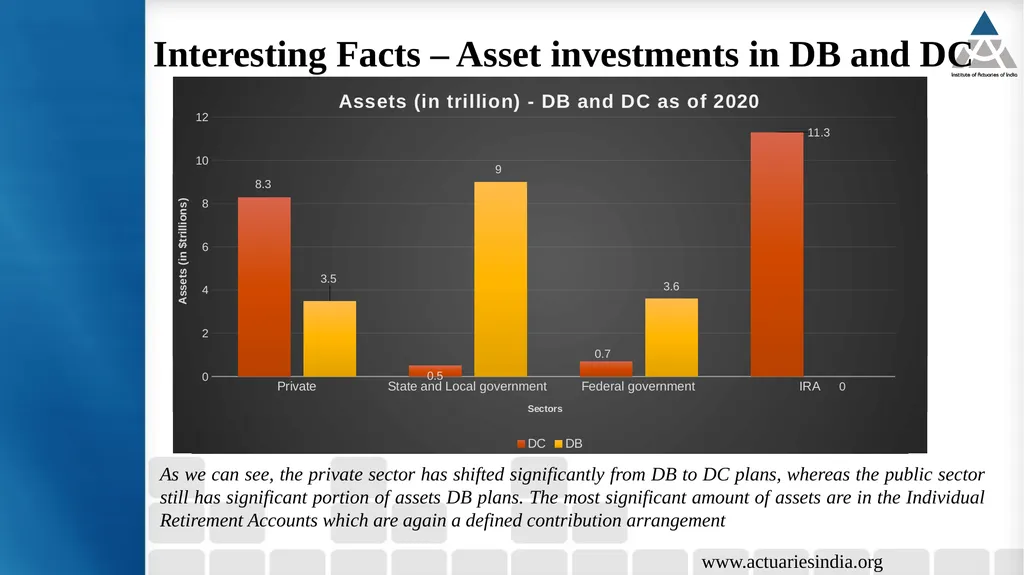
www.actuariesindia.org Interesting Facts – Asset investments in DB and DC As we can see, the private sector has shifted significantly from DB to DC plans, whereas the public sector still has significant portion of assets DB plans. The most significant amount of assets are in the Individual Retirement Accounts which are again a defined contribution arrangement<br>
16
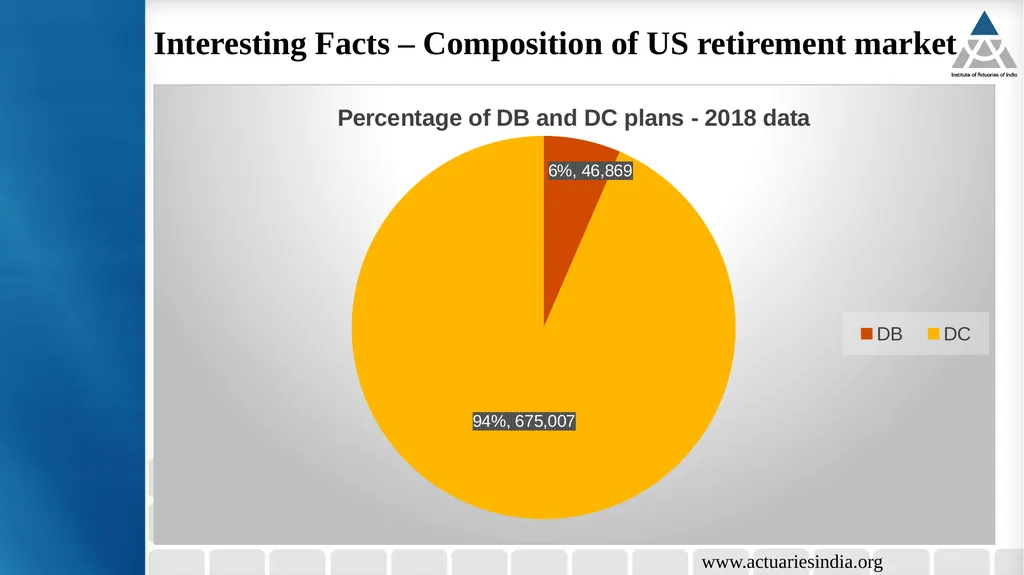
www.actuariesindia.org Interesting Facts – Composition of US retirement market<br>
17
www.actuariesindia.org Accrual Rates and Replacement Ratios An Accrual Rate is the rate at which pension benefit is built up as pensionable service in a defined benefit scheme. Often expressed as a fraction or percentage of pensionable salary, e.g., 1/60th (or 1.67 percent) for each year of service.
A Retirement Replacement Rate is the percentage of a person's pre-retirement income that will be needed for the person to maintain the desired standard of living after retiring. Social Security in the United States along with private pensions and withdrawals from qualified retirement accounts all may contribute to an individual's replacement rate.
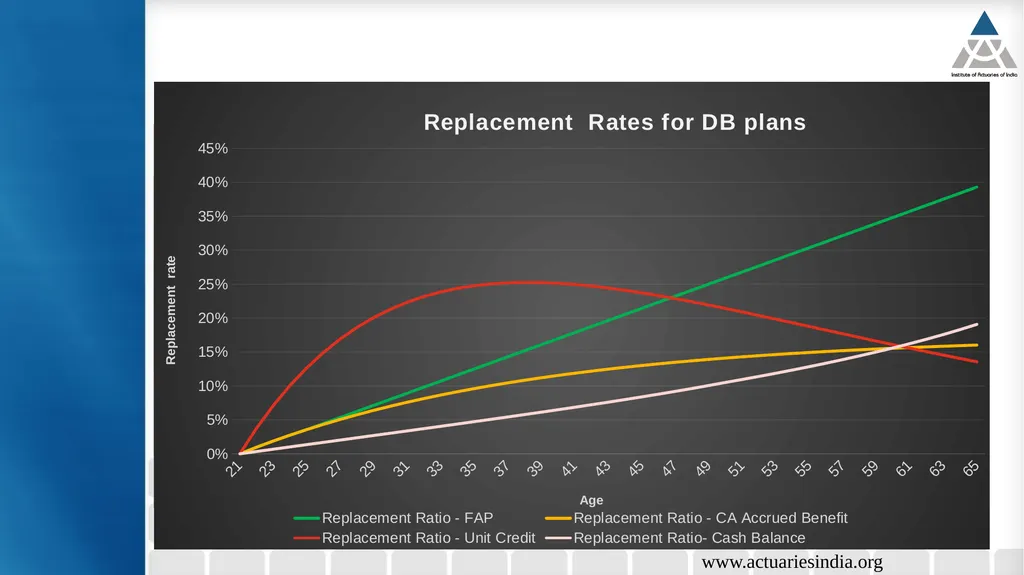
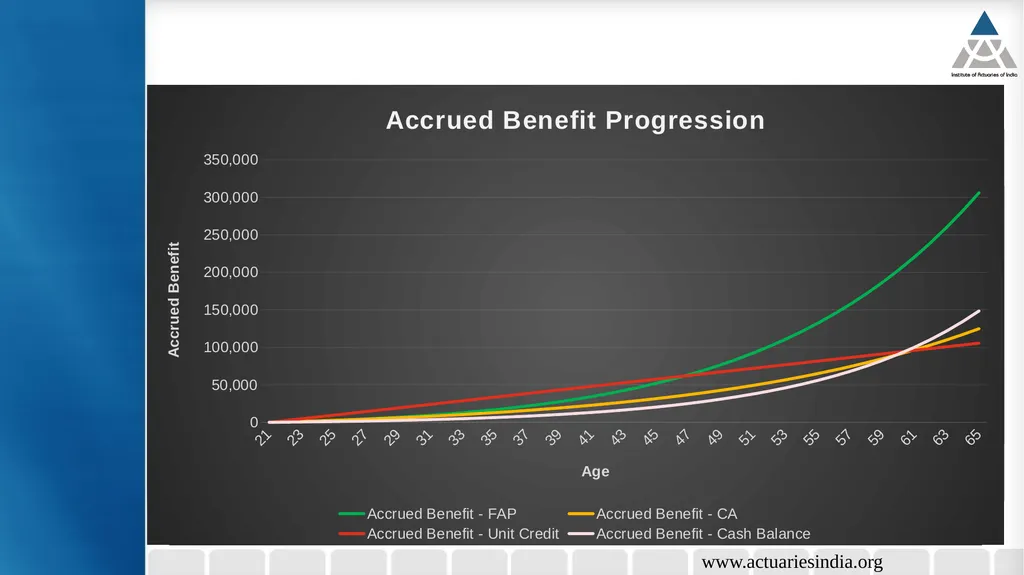
The graph on the next slide shows how the benefit builds up as a percentage of salary for various types of Defined benefit plan for various ages.
We can make the below inferences –
The FAP benefit seems the highest and converges with the cash balance rate at higher ages
The unit credit is higher at young ages but falls at older ages since the increment in benefit due to service is less than the salary increment as age and service progresses.
The career average benefit is lower at most ages. However, it is greater than unit credit at higher ages.
The cash balance benefit progresses steadily and seems to be having the highest replacement ratio and accrued benefit at older ages mainly because of increasing pay credits and interest credits.<br>
A Retirement Replacement Rate is the percentage of a person's pre-retirement income that will be needed for the person to maintain the desired standard of living after retiring. Social Security in the United States along with private pensions and withdrawals from qualified retirement accounts all may contribute to an individual's replacement rate.
The graph on the next slide shows how the benefit builds up as a percentage of salary for various types of Defined benefit plan for various ages.
We can make the below inferences –
The FAP benefit seems the highest and converges with the cash balance rate at higher ages
The unit credit is higher at young ages but falls at older ages since the increment in benefit due to service is less than the salary increment as age and service progresses.
The career average benefit is lower at most ages. However, it is greater than unit credit at higher ages.
The cash balance benefit progresses steadily and seems to be having the highest replacement ratio and accrued benefit at older ages mainly because of increasing pay credits and interest credits.<br>
18
www.actuariesindia.org<br>
19
www.actuariesindia.org<br>
20
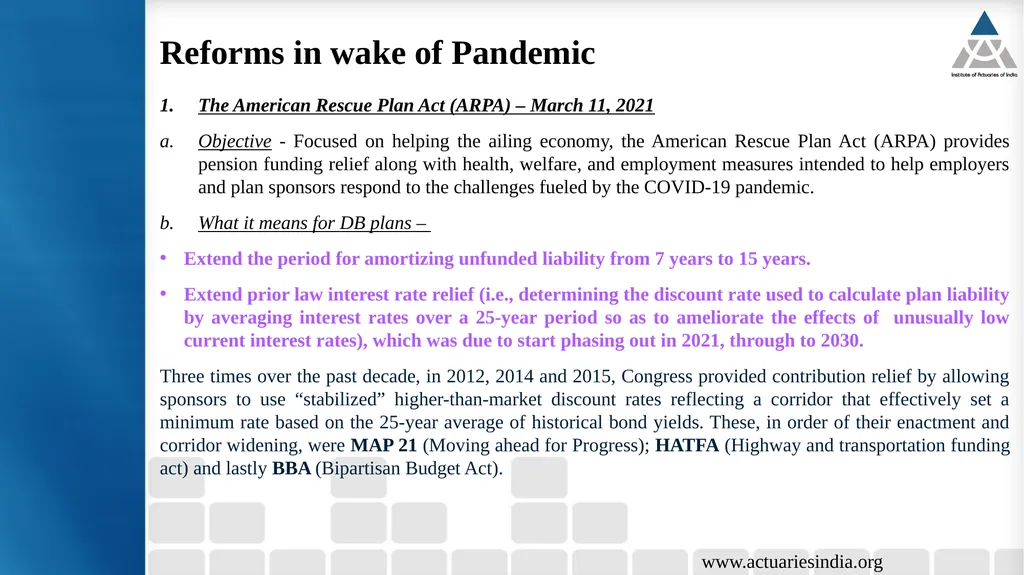
www.actuariesindia.org Reforms in wake of Pandemic The American Rescue Plan Act (ARPA) – March 11, 2021
Objective - Focused on helping the ailing economy, the American Rescue Plan Act (ARPA) provides pension funding relief along with health, welfare, and employment measures intended to help employers and plan sponsors respond to the challenges fueled by the COVID-19 pandemic.
What it means for DB plans –
Extend the period for amortizing unfunded liability from 7 years to 15 years.
Extend prior law interest rate relief (i.e., determining the discount rate used to calculate plan liability by averaging interest rates over a 25-year period so as to ameliorate the effects of unusually low current interest rates), which was due to start phasing out in 2021, through to 2030.
Three times over the past decade, in 2012, 2014 and 2015, Congress provided contribution relief by allowing sponsors to use “stabilized” higher-than-market discount rates reflecting a corridor that effectively set a minimum rate based on the 25-year average of historical bond yields. These, in order of their enactment and corridor widening, were MAP 21 (Moving ahead for Progress); HATFA (Highway and transportation funding act) and lastly BBA (Bipartisan Budget Act).<br>
Objective - Focused on helping the ailing economy, the American Rescue Plan Act (ARPA) provides pension funding relief along with health, welfare, and employment measures intended to help employers and plan sponsors respond to the challenges fueled by the COVID-19 pandemic.
What it means for DB plans –
Extend the period for amortizing unfunded liability from 7 years to 15 years.
Extend prior law interest rate relief (i.e., determining the discount rate used to calculate plan liability by averaging interest rates over a 25-year period so as to ameliorate the effects of unusually low current interest rates), which was due to start phasing out in 2021, through to 2030.
Three times over the past decade, in 2012, 2014 and 2015, Congress provided contribution relief by allowing sponsors to use “stabilized” higher-than-market discount rates reflecting a corridor that effectively set a minimum rate based on the 25-year average of historical bond yields. These, in order of their enactment and corridor widening, were MAP 21 (Moving ahead for Progress); HATFA (Highway and transportation funding act) and lastly BBA (Bipartisan Budget Act).<br>
21
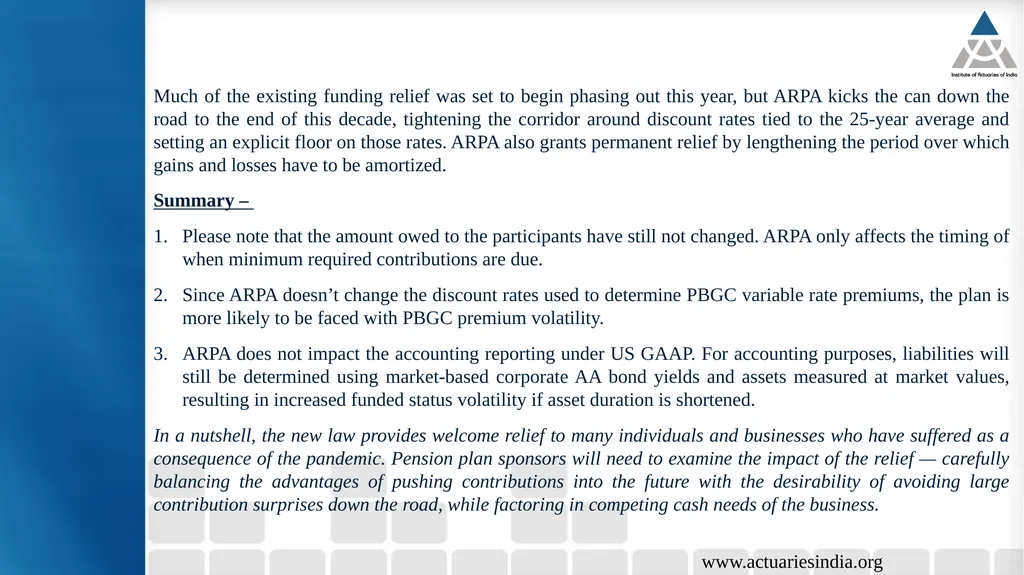
www.actuariesindia.org Much of the existing funding relief was set to begin phasing out this year, but ARPA kicks the can down the road to the end of this decade, tightening the corridor around discount rates tied to the 25-year average and setting an explicit floor on those rates. ARPA also grants permanent relief by lengthening the period over which gains and losses have to be amortized.
Summary –
Please note that the amount owed to the participants have still not changed. ARPA only affects the timing of when minimum required contributions are due.
Since ARPA doesn’t change the discount rates used to determine PBGC variable rate premiums, the plan is more likely to be faced with PBGC premium volatility.
ARPA does not impact the accounting reporting under US GAAP. For accounting purposes, liabilities will still be determined using market-based corporate AA bond yields and assets measured at market values, resulting in increased funded status volatility if asset duration is shortened.
In a nutshell, the new law provides welcome relief to many individuals and businesses who have suffered as a consequence of the pandemic. Pension plan sponsors will need to examine the impact of the relief — carefully balancing the advantages of pushing contributions into the future with the desirability of avoiding large contribution surprises down the road, while factoring in competing cash needs of the business.<br>
Summary –
Please note that the amount owed to the participants have still not changed. ARPA only affects the timing of when minimum required contributions are due.
Since ARPA doesn’t change the discount rates used to determine PBGC variable rate premiums, the plan is more likely to be faced with PBGC premium volatility.
ARPA does not impact the accounting reporting under US GAAP. For accounting purposes, liabilities will still be determined using market-based corporate AA bond yields and assets measured at market values, resulting in increased funded status volatility if asset duration is shortened.
In a nutshell, the new law provides welcome relief to many individuals and businesses who have suffered as a consequence of the pandemic. Pension plan sponsors will need to examine the impact of the relief — carefully balancing the advantages of pushing contributions into the future with the desirability of avoiding large contribution surprises down the road, while factoring in competing cash needs of the business.<br>
22
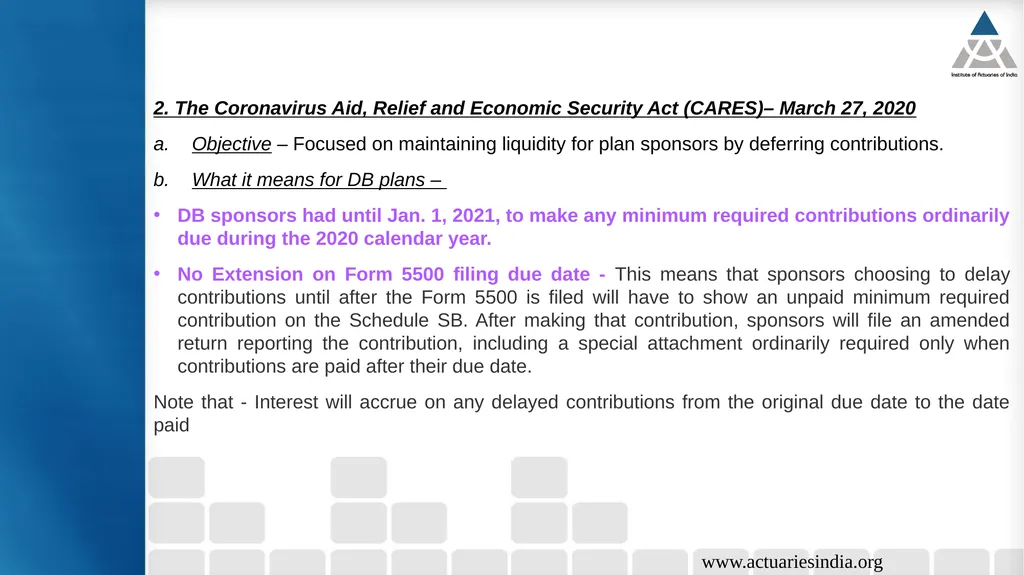
www.actuariesindia.org 2. The Coronavirus Aid, Relief and Economic Security Act (CARES)– March 27, 2020
Objective – Focused on maintaining liquidity for plan sponsors by deferring contributions.
What it means for DB plans –
DB sponsors had until Jan. 1, 2021, to make any minimum required contributions ordinarily due during the 2020 calendar year.
No Extension on Form 5500 filing due date - This means that sponsors choosing to delay contributions until after the Form 5500 is filed will have to show an unpaid minimum required contribution on the Schedule SB. After making that contribution, sponsors will file an amended return reporting the contribution, including a special attachment ordinarily required only when contributions are paid after their due date.
Note that - Interest will accrue on any delayed contributions from the original due date to the date paid<br>
Objective – Focused on maintaining liquidity for plan sponsors by deferring contributions.
What it means for DB plans –
DB sponsors had until Jan. 1, 2021, to make any minimum required contributions ordinarily due during the 2020 calendar year.
No Extension on Form 5500 filing due date - This means that sponsors choosing to delay contributions until after the Form 5500 is filed will have to show an unpaid minimum required contribution on the Schedule SB. After making that contribution, sponsors will file an amended return reporting the contribution, including a special attachment ordinarily required only when contributions are paid after their due date.
Note that - Interest will accrue on any delayed contributions from the original due date to the date paid<br>
23
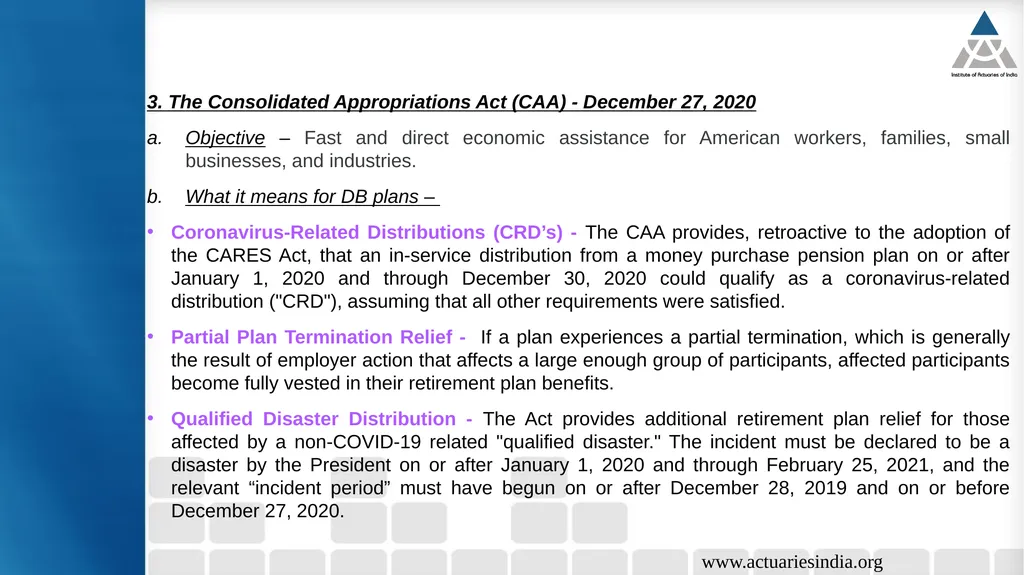
www.actuariesindia.org 3. The Consolidated Appropriations Act (CAA) - December 27, 2020
Objective – Fast and direct economic assistance for American workers, families, small businesses, and industries.
What it means for DB plans –
Coronavirus-Related Distributions (CRD’s) - The CAA provides, retroactive to the adoption of the CARES Act, that an in-service distribution from a money purchase pension plan on or after January 1, 2020 and through December 30, 2020 could qualify as a coronavirus-related distribution ("CRD"), assuming that all other requirements were satisfied.
Partial Plan Termination Relief - If a plan experiences a partial termination, which is generally the result of employer action that affects a large enough group of participants, affected participants become fully vested in their retirement plan benefits.
Qualified Disaster Distribution - The Act provides additional retirement plan relief for those affected by a non-COVID-19 related "qualified disaster." The incident must be declared to be a disaster by the President on or after January 1, 2020 and through February 25, 2021, and the relevant “incident period” must have begun on or after December 28, 2019 and on or before December 27, 2020.<br>
Objective – Fast and direct economic assistance for American workers, families, small businesses, and industries.
What it means for DB plans –
Coronavirus-Related Distributions (CRD’s) - The CAA provides, retroactive to the adoption of the CARES Act, that an in-service distribution from a money purchase pension plan on or after January 1, 2020 and through December 30, 2020 could qualify as a coronavirus-related distribution ("CRD"), assuming that all other requirements were satisfied.
Partial Plan Termination Relief - If a plan experiences a partial termination, which is generally the result of employer action that affects a large enough group of participants, affected participants become fully vested in their retirement plan benefits.
Qualified Disaster Distribution - The Act provides additional retirement plan relief for those affected by a non-COVID-19 related "qualified disaster." The incident must be declared to be a disaster by the President on or after January 1, 2020 and through February 25, 2021, and the relevant “incident period” must have begun on or after December 28, 2019 and on or before December 27, 2020.<br>
24
Thank you © 2021 PwC. All rights reserved. Not for further distribution without the permission of PwC. “PwC” refers to the network of member firms of PricewaterhouseCoopers International Limited (PwCIL), or, as the context requires, individual member firms of the PwC network. Each member firm is a separate legal entity and does not act as agent of PwCIL or any other member firm. PwCIL does not provide any services to clients. PwCIL is not responsible or liable for the acts or omissions of any of its member firms nor can it control the exercise of their professional judgment or bind them in any way. No member firm is responsible or liable for the acts or omissions of any other member firm nor can it control the exercise of another member firm’s professional judgment or bind another member firm or PwCIL in any way.<br>
25
www.actuariesindia.org Q&A<br>
26
www.actuariesindia.org Thank you! CPD Question<br>
27
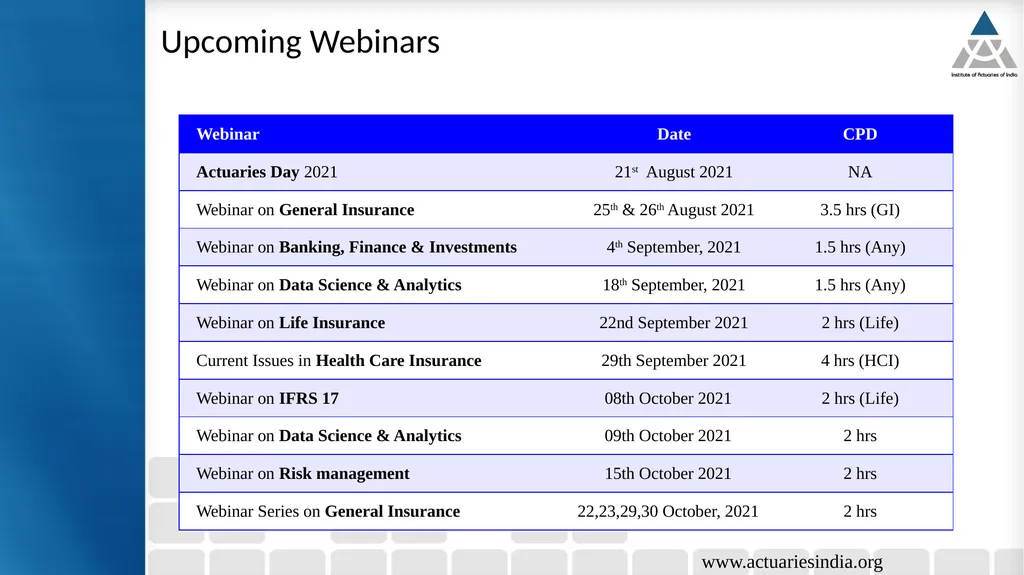
www.actuariesindia.org Upcoming Webinars<br>