
2/04/2025 Global Task Team on Targets
PC
Published · 17 slides · 0 views
1 / 1



Description
2042025 Global Task Team on Targets Recommendations UNAIDS Global Accountability System for HIV Why do we need global targets? Generate commitment and action in all countries of the world and among all stakeholders Ensure continuity with
Related Topics
Share
Embed code
Download this presentation From Below
"2/04/2025 Global Task Team on Targets" is the property of its rightful owner. Permission is granted to download and print the materials on this website for personal, non-commercial use only, and to display it on your personal computer provided you do not modify the materials and that you retain all copyright notices contained in the materials. By downloading content from our website, you accept the terms of this agreement.
Presentation Transcript
01
2/04/2025 Global Task Team on Targets
Recommendations<br>
Recommendations<br>
02
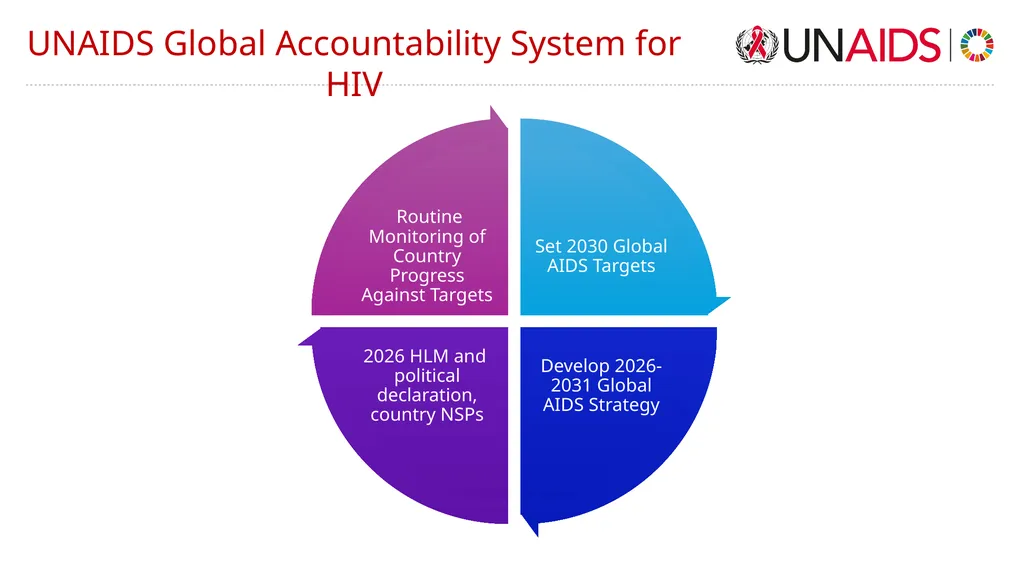
UNAIDS Global Accountability System for HIV<br>
03
Why do we need global targets? Generate commitment and action in all countries of the world and among all stakeholders
Ensure continuity with the existing Global AIDS Strategy 2021–2026 where evidence remains relevant and existing 2025 targets have not been achieved
Define the highest priorities for the HIV response and simplify accountability by reducing the number of targets as compared with the set of targets for 2025.
Define a path towards a more integrated effort to achieve the goal of ending AIDS alongside other relevant SDGs and global health targets
such as maternal and child health (MCH), sexual and reproductive health (SRH), tuberculosis and other communicable diseases, non-communicable diseases (NCDs), cervical cancer and education
And to ensure sustainability of the HIV response until 2030 and beyond<br>
Ensure continuity with the existing Global AIDS Strategy 2021–2026 where evidence remains relevant and existing 2025 targets have not been achieved
Define the highest priorities for the HIV response and simplify accountability by reducing the number of targets as compared with the set of targets for 2025.
Define a path towards a more integrated effort to achieve the goal of ending AIDS alongside other relevant SDGs and global health targets
such as maternal and child health (MCH), sexual and reproductive health (SRH), tuberculosis and other communicable diseases, non-communicable diseases (NCDs), cervical cancer and education
And to ensure sustainability of the HIV response until 2030 and beyond<br>
04
What’s new in the 2030 Global Task Team recommended
targets? Focus on integration and sustainability, while reducing inequalities.
16 topline targets supported by 50 second tier targets
The targets are grouped into 6 priority areas that aim to:<br>
16 topline targets supported by 50 second tier targets
The targets are grouped into 6 priority areas that aim to:<br>
05
16 topline targets to reach by 2030
A further 50 second tier targets indicate what is needed to achieve the topline targets.
See summary report of the Global Task Team on UNAIDS website. Source: Recommendations of the Global Task Team for Setting 2030 HIV Targets, 2025, UNAIDS<br>
A further 50 second tier targets indicate what is needed to achieve the topline targets.
See summary report of the Global Task Team on UNAIDS website. Source: Recommendations of the Global Task Team for Setting 2030 HIV Targets, 2025, UNAIDS<br>
06
90% of all people living with HIV have suppressed viral loads HIV targets to achieve the 2030 goals Lifting barriers of stigma and gender inequalities and ensuring human rights… By 2030,
reduce new HIV infections by
90% from 2010
and incremental 5% decline per year after 2030
Reduce AIDS-related deaths by 90% from 2010
Sustainability of HIV response after 2030 Integrating services and systems Resourcing the HIV response Providing treatment and care for people living with HIV 95% People living with HIV know their status 95% People living with HIV who know their status receive treatment 95% People living with HIV who are on treatment have suppressed viral loads 95% Preventive therapy for TB for people living with HIV, incl. children 95% of mothers and infants receive HIV services that are integrated with prevention of vertical transmission of syphilis and hepatitis B 95% of HIV-exposed children tested at 2 months and after cessation of breastfeeding 95% People living with HIV screened for advanced HIV disease 90% of services for HIV and TB care are integrated 95% of people receiving HIV prevention or treatment services also receive SRH services 90% of key populations are screened for syphilis 90% of women living with HIV screened and treated (if diagnosed) for cervical cancer <10% Punitive laws and policy environments that restrict access to services for key populations and people living with HIV <10% Stigma and discrimination against people living with HIV and key populations by health providers and general population <10% Gender inequality and violence against women, girls, PLHIV and key populations 30% Testing and supportive treatment services provided by community-led organizations 60% Societal enabler programmes delivered by community-led organizations 80% HIV prevention options delivered by community-led organizations US$ xxx billion mobilized for HIV investments for low-and middle-income countries Increase percentage of HIV funding that is domestic Resources allocated to communities from national and international sources Mobilize resources for societal enabler interventions Mobilize resources for HIV prevention 80% of people living with HIV are screened for NCDs (hypertension, diabetes) 90% of people living with HIV screened for depression 90% Reduction in TB-related deaths among people living with HIV <10% Arrests due to key population identity or behaviours and provide mechanisms for redress 90% of countries use community-led monitoring for national programme reviews Price equity for drugs and diagnostics across all countries … together with communities Reduce out-of-pocket expenses 90% of people living with HIV tested for hepatitis B and C 90% of countries have removed regulatory barriers for community-led organizations <10% Coercion and abuse in sexual and reproductive health services among women LWHIV vmmc 95% of pregnant women attend antenatal care and are screened or tested for HIV<br>
reduce new HIV infections by
90% from 2010
and incremental 5% decline per year after 2030
Reduce AIDS-related deaths by 90% from 2010
Sustainability of HIV response after 2030 Integrating services and systems Resourcing the HIV response Providing treatment and care for people living with HIV 95% People living with HIV know their status 95% People living with HIV who know their status receive treatment 95% People living with HIV who are on treatment have suppressed viral loads 95% Preventive therapy for TB for people living with HIV, incl. children 95% of mothers and infants receive HIV services that are integrated with prevention of vertical transmission of syphilis and hepatitis B 95% of HIV-exposed children tested at 2 months and after cessation of breastfeeding 95% People living with HIV screened for advanced HIV disease 90% of services for HIV and TB care are integrated 95% of people receiving HIV prevention or treatment services also receive SRH services 90% of key populations are screened for syphilis 90% of women living with HIV screened and treated (if diagnosed) for cervical cancer <10% Punitive laws and policy environments that restrict access to services for key populations and people living with HIV <10% Stigma and discrimination against people living with HIV and key populations by health providers and general population <10% Gender inequality and violence against women, girls, PLHIV and key populations 30% Testing and supportive treatment services provided by community-led organizations 60% Societal enabler programmes delivered by community-led organizations 80% HIV prevention options delivered by community-led organizations US$ xxx billion mobilized for HIV investments for low-and middle-income countries Increase percentage of HIV funding that is domestic Resources allocated to communities from national and international sources Mobilize resources for societal enabler interventions Mobilize resources for HIV prevention 80% of people living with HIV are screened for NCDs (hypertension, diabetes) 90% of people living with HIV screened for depression 90% Reduction in TB-related deaths among people living with HIV <10% Arrests due to key population identity or behaviours and provide mechanisms for redress 90% of countries use community-led monitoring for national programme reviews Price equity for drugs and diagnostics across all countries … together with communities Reduce out-of-pocket expenses 90% of people living with HIV tested for hepatitis B and C 90% of countries have removed regulatory barriers for community-led organizations <10% Coercion and abuse in sexual and reproductive health services among women LWHIV vmmc 95% of pregnant women attend antenatal care and are screened or tested for HIV<br>
07
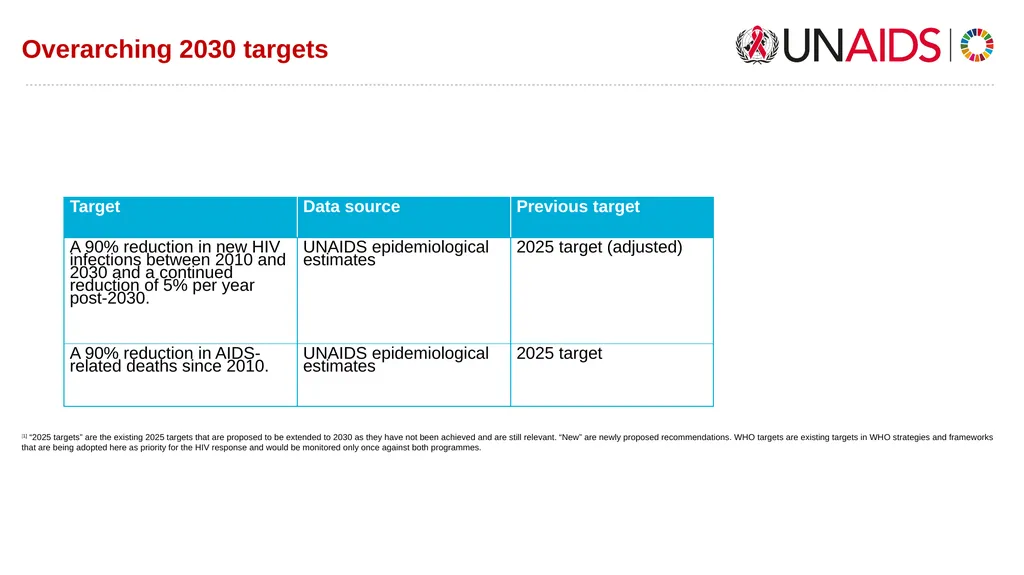
Overarching 2030 targets [1] “2025 targets” are the existing 2025 targets that are proposed to be extended to 2030 as they have not been achieved and are still relevant. “New” are newly proposed recommendations. WHO targets are existing targets in WHO strategies and frameworks
that are being adopted here as priority for the HIV response and would be monitored only once against both programmes.<br>
that are being adopted here as priority for the HIV response and would be monitored only once against both programmes.<br>
08
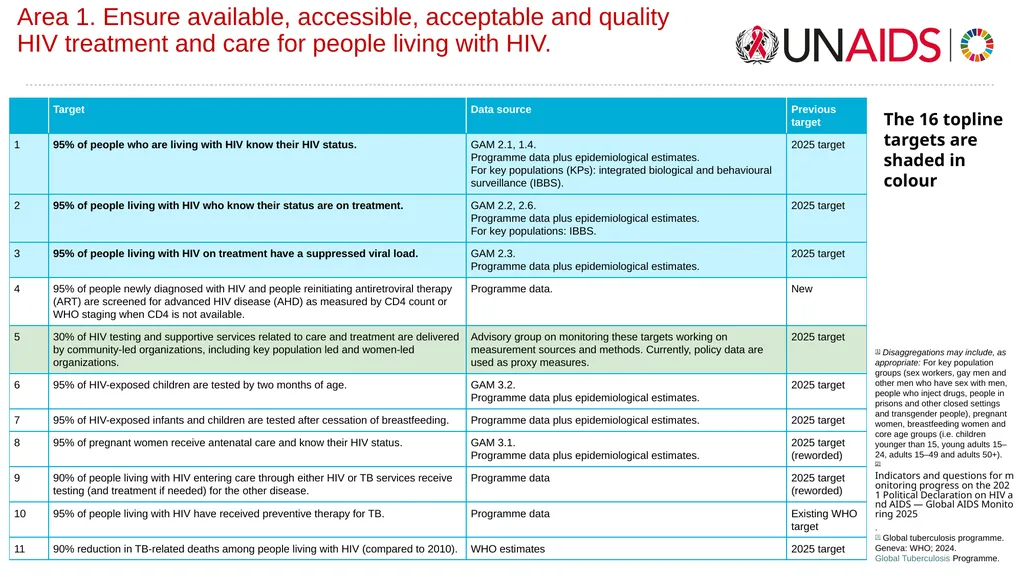
Area 1. Ensure available, accessible, acceptable and quality
HIV treatment and care for people living with HIV. [1] Disaggregations may include, as appropriate: For key population groups (sex workers, gay men and other men who have sex with men, people who inject drugs, people in prisons and other closed settings and transgender people), pregnant women, breastfeeding women and core age groups (i.e. children younger than 15, young adults 15–24, adults 15–49 and adults 50+).
[2] Indicators and questions for monitoring progress on the 2021 Political Declaration on HIV and AIDS — Global AIDS Monitoring 2025.
[3] Global tuberculosis programme. Geneva: WHO; 2024. Global Tuberculosis Programme. The 16 topline targets are shaded in colour<br>
[2] Indicators and questions for monitoring progress on the 2021 Political Declaration on HIV and AIDS — Global AIDS Monitoring 2025.
[3] Global tuberculosis programme. Geneva: WHO; 2024. Global Tuberculosis Programme. The 16 topline targets are shaded in colour<br>
09
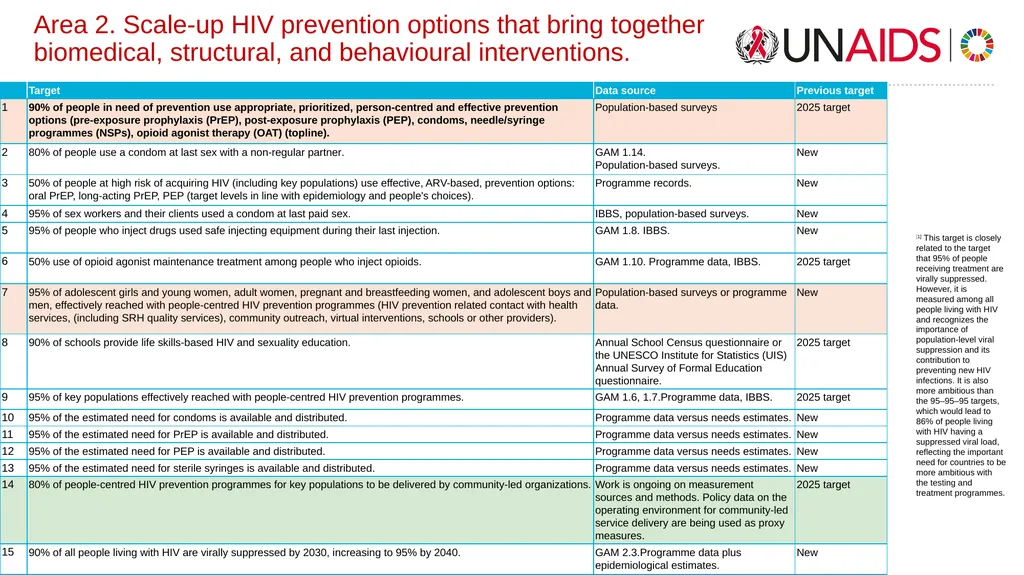
Area 2. Scale-up HIV prevention options that bring together
biomedical, structural, and behavioural interventions. [1] This target is closely related to the target that 95% of people receiving treatment are virally suppressed. However, it is measured among all people living with HIV and recognizes the importance of population-level viral suppression and its contribution to preventing new HIV infections. It is also more ambitious than the 95–95–95 targets, which would lead to 86% of people living with HIV having a suppressed viral load, reflecting the important need for countries to be more ambitious with the testing and treatment programmes.<br>
10
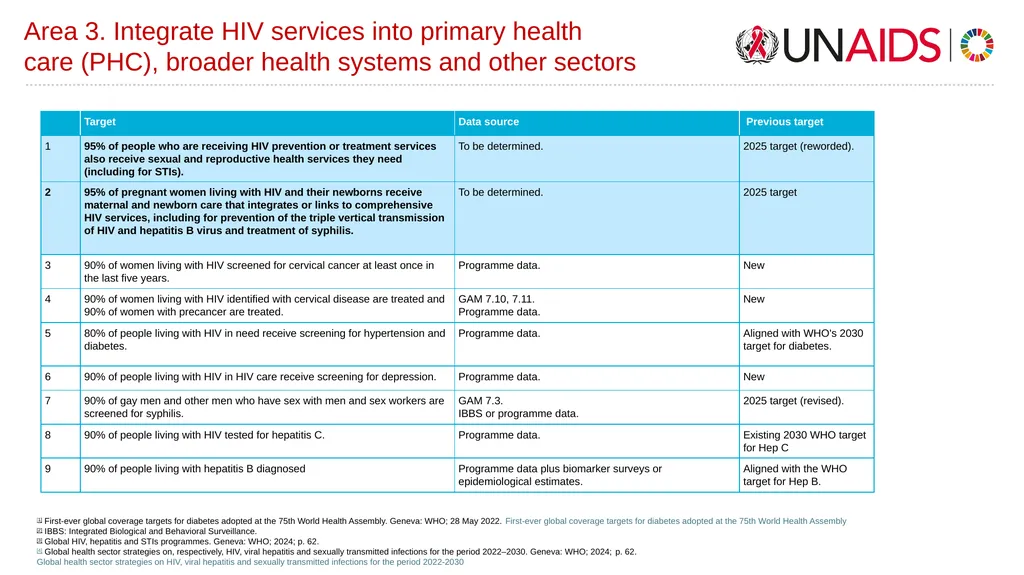
Area 3. Integrate HIV services into primary health
care (PHC), broader health systems and other sectors [1] First-ever global coverage targets for diabetes adopted at the 75th World Health Assembly. Geneva: WHO; 28 May 2022. First-ever global coverage targets for diabetes adopted at the 75th World Health Assembly
[2] IBBS: Integrated Biological and Behavioral Surveillance.
[3] Global HIV, hepatitis and STIs programmes. Geneva: WHO; 2024; p. 62.
[4] Global health sector strategies on, respectively, HIV, viral hepatitis and sexually transmitted infections for the period 2022–2030. Geneva: WHO; 2024; p. 62. Global health sector strategies on HIV, viral hepatitis and sexually transmitted infections for the period 2022-2030<br>
[2] IBBS: Integrated Biological and Behavioral Surveillance.
[3] Global HIV, hepatitis and STIs programmes. Geneva: WHO; 2024; p. 62.
[4] Global health sector strategies on, respectively, HIV, viral hepatitis and sexually transmitted infections for the period 2022–2030. Geneva: WHO; 2024; p. 62. Global health sector strategies on HIV, viral hepatitis and sexually transmitted infections for the period 2022-2030<br>
11
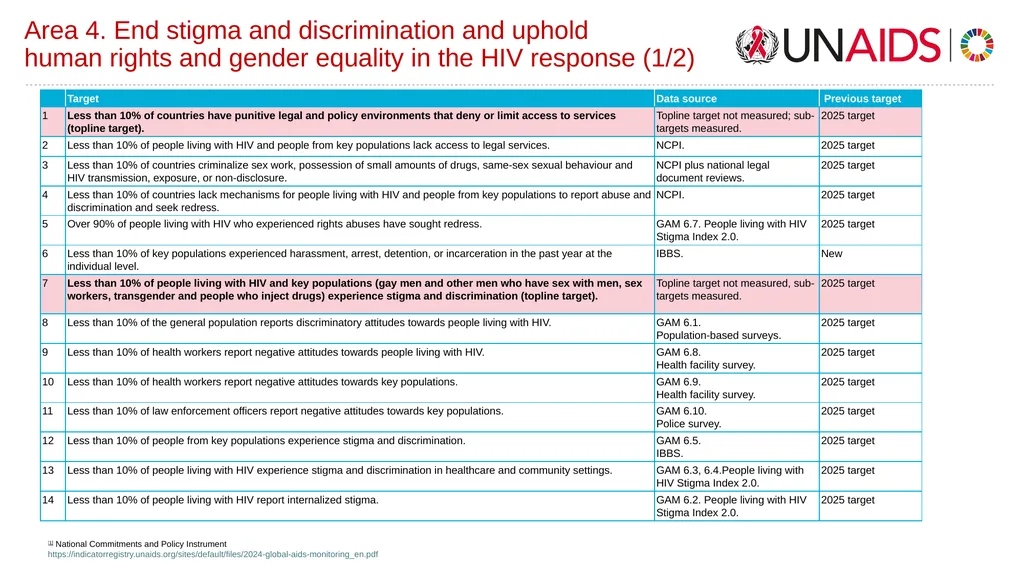
Area 4. End stigma and discrimination and uphold
human rights and gender equality in the HIV response (1/2) [1] National Commitments and Policy Instrument https://indicatorregistry.unaids.org/sites/default/files/2024-global-aids-monitoring_en.pdf<br>
12
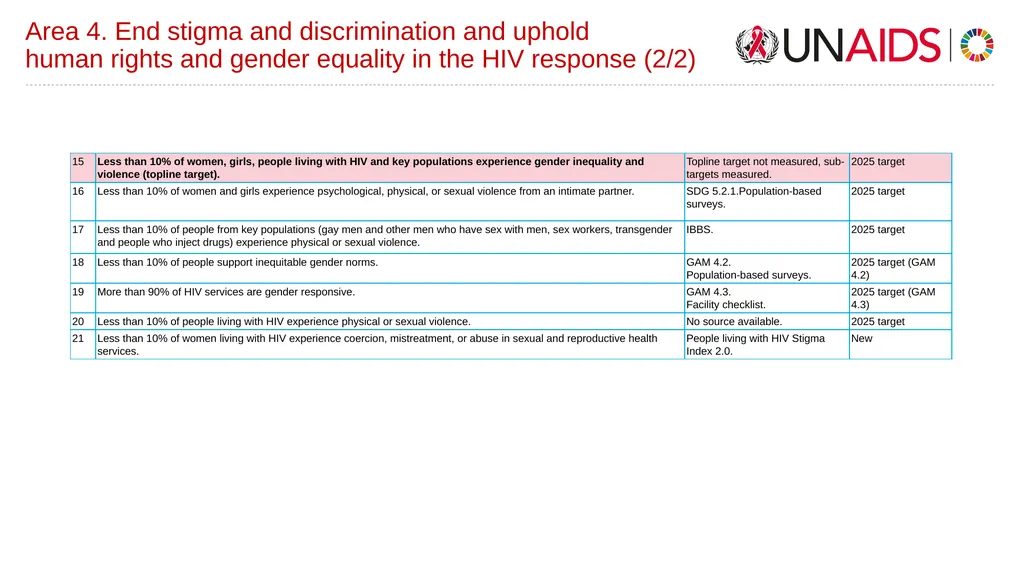
Area 4. End stigma and discrimination and uphold
human rights and gender equality in the HIV response (2/2)<br>
13
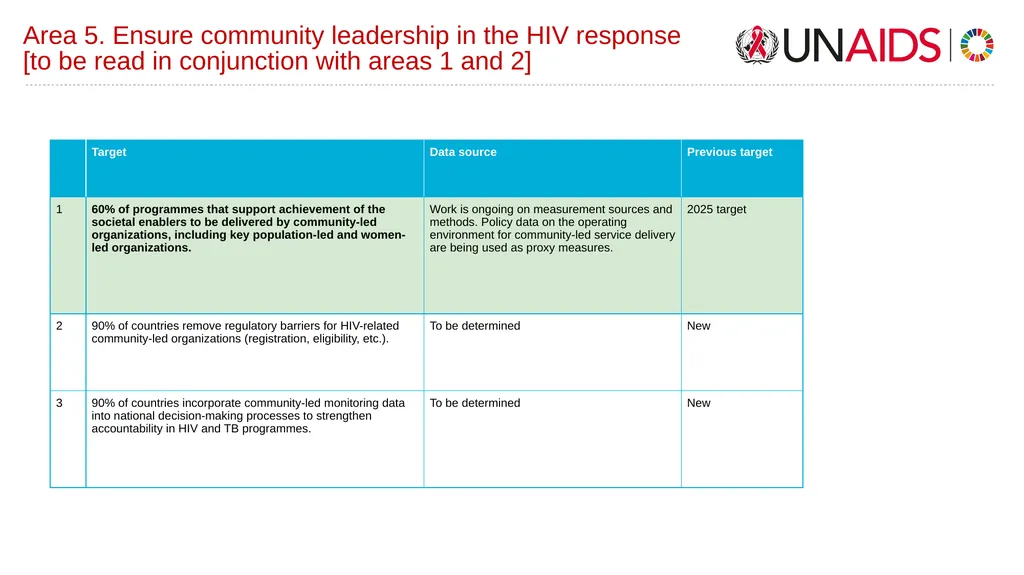
Area 5. Ensure community leadership in the HIV response
[to be read in conjunction with areas 1 and 2]<br>
14
Area 6. Ensure sustainable financing for a people-centered
national and global HIV response [1] SDG Target 3.8.2. New York: United Nations; SDG 3.8.2 Catastrophic health spending (and related indicators)
[2] WHO UHC technical brief. Geneva: WHO; 2017. Equitable access to medicines.indd (accessed: 17 January 2025): https://iris.who.int/bitstream/handle/10665/258914/Equitable_access_medicines.pdf?sequence=1<br>
[2] WHO UHC technical brief. Geneva: WHO; 2017. Equitable access to medicines.indd (accessed: 17 January 2025): https://iris.who.int/bitstream/handle/10665/258914/Equitable_access_medicines.pdf?sequence=1<br>
15
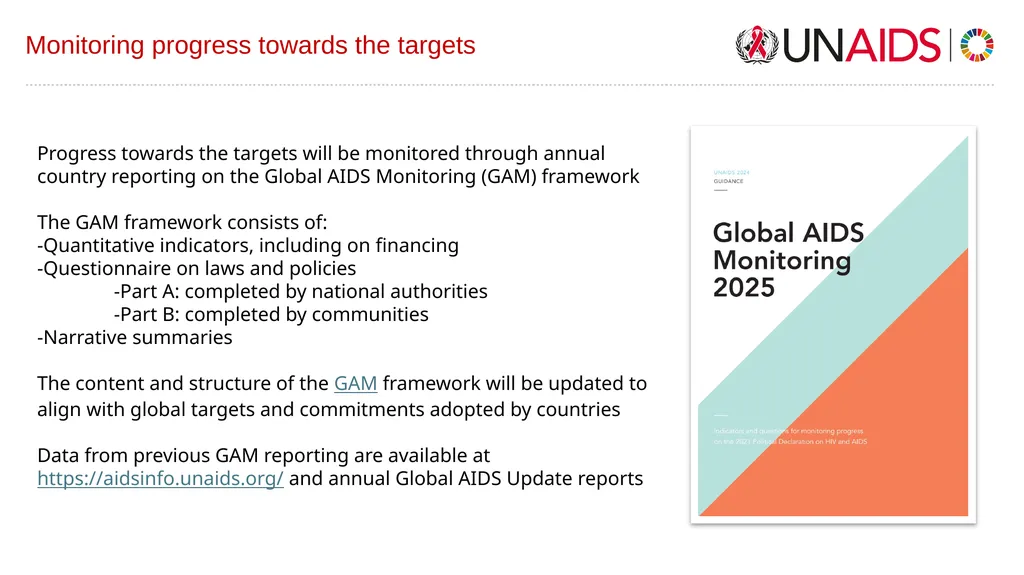
Monitoring progress towards the targets Progress towards the targets will be monitored through annual country reporting on the Global AIDS Monitoring (GAM) framework
The GAM framework consists of:
-Quantitative indicators, including on financing
-Questionnaire on laws and policies
-Part A: completed by national authorities
-Part B: completed by communities
-Narrative summaries
The content and structure of the GAM framework will be updated to align with global targets and commitments adopted by countries
Data from previous GAM reporting are available at https://aidsinfo.unaids.org/ and annual Global AIDS Update reports<br>
The GAM framework consists of:
-Quantitative indicators, including on financing
-Questionnaire on laws and policies
-Part A: completed by national authorities
-Part B: completed by communities
-Narrative summaries
The content and structure of the GAM framework will be updated to align with global targets and commitments adopted by countries
Data from previous GAM reporting are available at https://aidsinfo.unaids.org/ and annual Global AIDS Update reports<br>
16
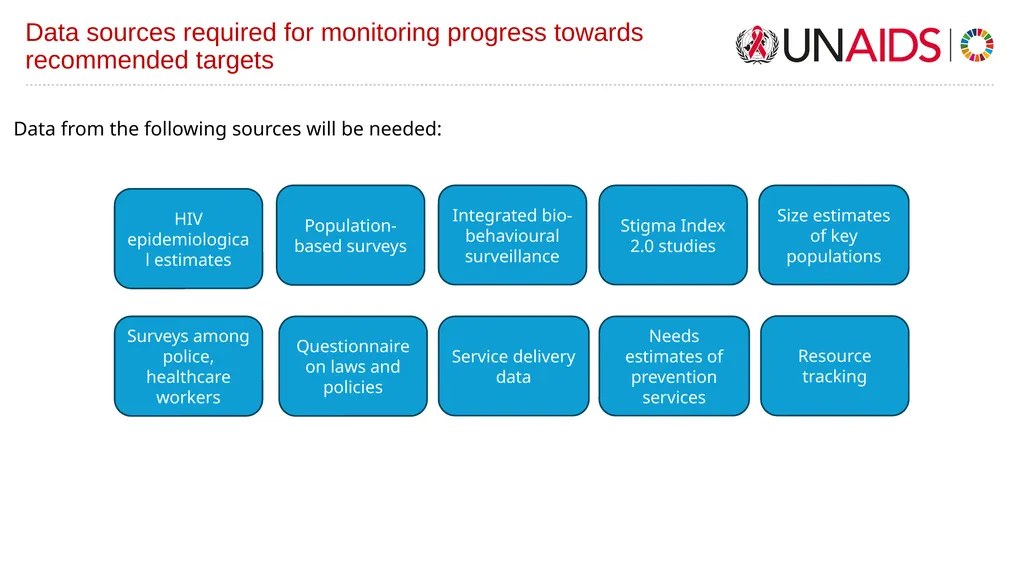
Data sources required for monitoring progress towards recommended targets HIV epidemiological estimates Population-based surveys Integrated bio-behavioural surveillance Stigma Index 2.0 studies Size estimates of key populations Needs estimates of prevention services Service delivery data Surveys among police, healthcare workers Questionnaire on laws and policies Resource tracking Data from the following sources will be needed:<br>
17
Linking the 2030 Targets and the Strategy The Targets provide the direction of travel: the what
The Strategy will determine the strategic actions needed to reach the targets: the how
The strategy should focus on how we achieve the topline targets and should consider the 50 second-tier targets to inform what programmes will help us achieve these targets
See the summary document on UNAIDS website for the list of targets
See the Glion meeting report for some of the reasoning behind the selection of targets
Estimates of the impact of reaching the 2030 targets and the potential price tag will be available in the coming weeks
Working with countries to model the impact of different funding scenarios at country level<br>
The Strategy will determine the strategic actions needed to reach the targets: the how
The strategy should focus on how we achieve the topline targets and should consider the 50 second-tier targets to inform what programmes will help us achieve these targets
See the summary document on UNAIDS website for the list of targets
See the Glion meeting report for some of the reasoning behind the selection of targets
Estimates of the impact of reaching the 2030 targets and the potential price tag will be available in the coming weeks
Working with countries to model the impact of different funding scenarios at country level<br>