
2.1 One possible model for improving coordination:
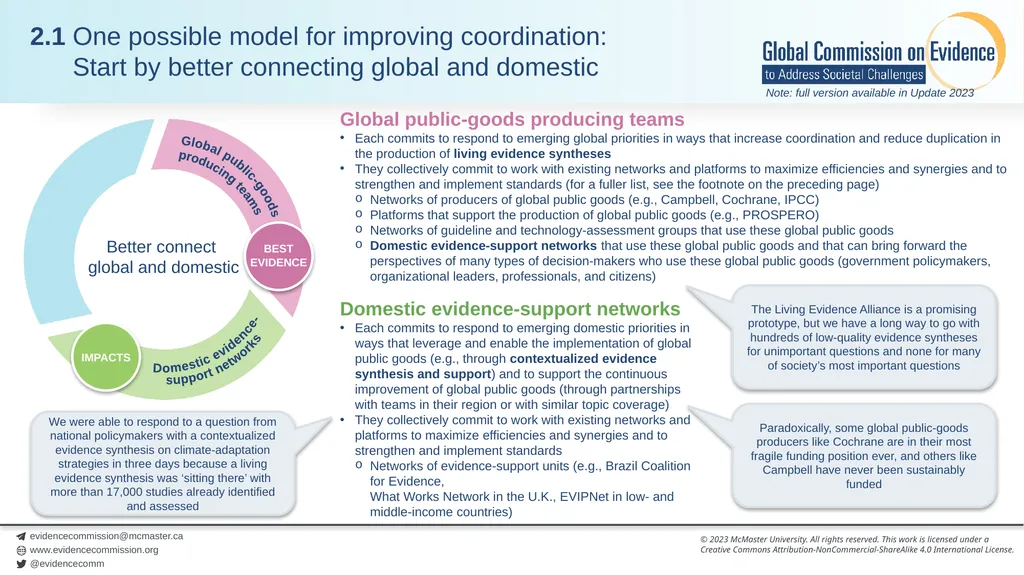
Description: 2.1 One possible model for improving coordination: Start by better connecting global and domestic Global public-goods producing teams Each commits to respond to emerging global priorities in ways that increase coordination and reduce
Related Topics
Download Presentation
"2.1 One possible model for improving coordination:" is the property of its rightful owner. Permission is granted to download and print the materials on this website for personal, non-commercial use only, and to display it on your personal computer provided you do not modify the materials and that you retain all copyright notices contained in the materials. By downloading content from our website, you accept the terms of this agreement.
Presentation Transcript
slide1. 2.1 One possible model for improving coordination:
Start by better connecting global and domestic Global public-goods producing teams
Each commits to respond to emerging global priorities in ways that increase coordination and reduce duplication in the production of living evidence syntheses
They collectively commit to work with existing networks and platforms to maximize efficiencies and synergies and to strengthen and implement standards (for a fuller list, see the footnote on the preceding page)
Networks of producers of global public goods (e.g., Campbell, Cochrane, IPCC)
Platforms that support the production of global public goods (e.g., PROSPERO)
Networks of guideline and technology-assessment groups that use these global public goods
Domestic evidence-support networks that use these global public goods and that can bring forward the perspectives of many types of decision-makers who use these global public goods (government policymakers, organizational leaders, professionals, and citizens) Domestic evidence-support networks
Each commits to respond to emerging domestic priorities in ways that leverage and enable the implementation of global public goods (e.g., through contextualized evidence synthesis and support) and to support the continuous improvement of global public goods (through partnerships with teams in their region or with similar topic coverage)
They collectively commit to work with existing networks and platforms to maximize efficiencies and synergies and to strengthen and implement standards
Networks of evidence-support units (e.g., Brazil Coalition for Evidence, What Works Network in the U.K., EVIPNet in low- and middle-income countries) The Living Evidence Alliance is a promising prototype, but we have a long way to go with hundreds of low-quality evidence syntheses for unimportant questions and none for many of society’s most important questions Paradoxically, some global public-goods producers like Cochrane are in their most fragile funding position ever, and others like Campbell have never been sustainably funded We were able to respond to a question from national policymakers with a contextualized evidence synthesis on climate-adaptation strategies in three days because a living evidence synthesis was ‘sitting there’ with more than 17,000 studies already identified and assessed Better connect global and domestic Note: full version available in Update 2023 © 2023 McMaster University. All rights reserved. This work is licensed under a Creative Commons Attribution-NonCommercial-ShareAlike 4.0 International License.<br>
Each commits to respond to emerging global priorities in ways that increase coordination and reduce duplication in the production of living evidence syntheses
They collectively commit to work with existing networks and platforms to maximize efficiencies and synergies and to strengthen and implement standards (for a fuller list, see the footnote on the preceding page)
Networks of producers of global public goods (e.g., Campbell, Cochrane, IPCC)
Platforms that support the production of global public goods (e.g., PROSPERO)
Networks of guideline and technology-assessment groups that use these global public goods
Domestic evidence-support networks that use these global public goods and that can bring forward the perspectives of many types of decision-makers who use these global public goods (government policymakers, organizational leaders, professionals, and citizens) Domestic evidence-support networks
Each commits to respond to emerging domestic priorities in ways that leverage and enable the implementation of global public goods (e.g., through contextualized evidence synthesis and support) and to support the continuous improvement of global public goods (through partnerships with teams in their region or with similar topic coverage)
They collectively commit to work with existing networks and platforms to maximize efficiencies and synergies and to strengthen and implement standards
Networks of evidence-support units (e.g., Brazil Coalition for Evidence, What Works Network in the U.K., EVIPNet in low- and middle-income countries) The Living Evidence Alliance is a promising prototype, but we have a long way to go with hundreds of low-quality evidence syntheses for unimportant questions and none for many of society’s most important questions Paradoxically, some global public-goods producers like Cochrane are in their most fragile funding position ever, and others like Campbell have never been sustainably funded We were able to respond to a question from national policymakers with a contextualized evidence synthesis on climate-adaptation strategies in three days because a living evidence synthesis was ‘sitting there’ with more than 17,000 studies already identified and assessed Better connect global and domestic Note: full version available in Update 2023 © 2023 McMaster University. All rights reserved. This work is licensed under a Creative Commons Attribution-NonCommercial-ShareAlike 4.0 International License.<br>