
2-3-4 Trees (BST) CSE 3318 – Algorithms and Data
LS
Published · 55 slides · 0 views
1 / 1
Description
2-3-4 Trees (BST) CSE 3318 Algorithms and Data Structures Alexandra Stefan Includes materials from Vassilis Athitsos University of Texas at Arlington 1 1142025 Search Trees search tree as a term does NOT refer to a specific
Related Topics
Share
Embed code
Download this presentation From Below
"2-3-4 Trees (BST) CSE 3318 – Algorithms and Data" is the property of its rightful owner. Permission is granted to download and print the materials on this website for personal, non-commercial use only, and to display it on your personal computer provided you do not modify the materials and that you retain all copyright notices contained in the materials. By downloading content from our website, you accept the terms of this agreement.
Presentation Transcript
01
2-3-4 Trees
(BST) CSE 3318 – Algorithms and Data Structures
Alexandra Stefan
Includes materials from Vassilis Athitsos
University of Texas at Arlington 1 11/4/2025<br>
Alexandra Stefan
Includes materials from Vassilis Athitsos
University of Texas at Arlington 1 11/4/2025<br>
02
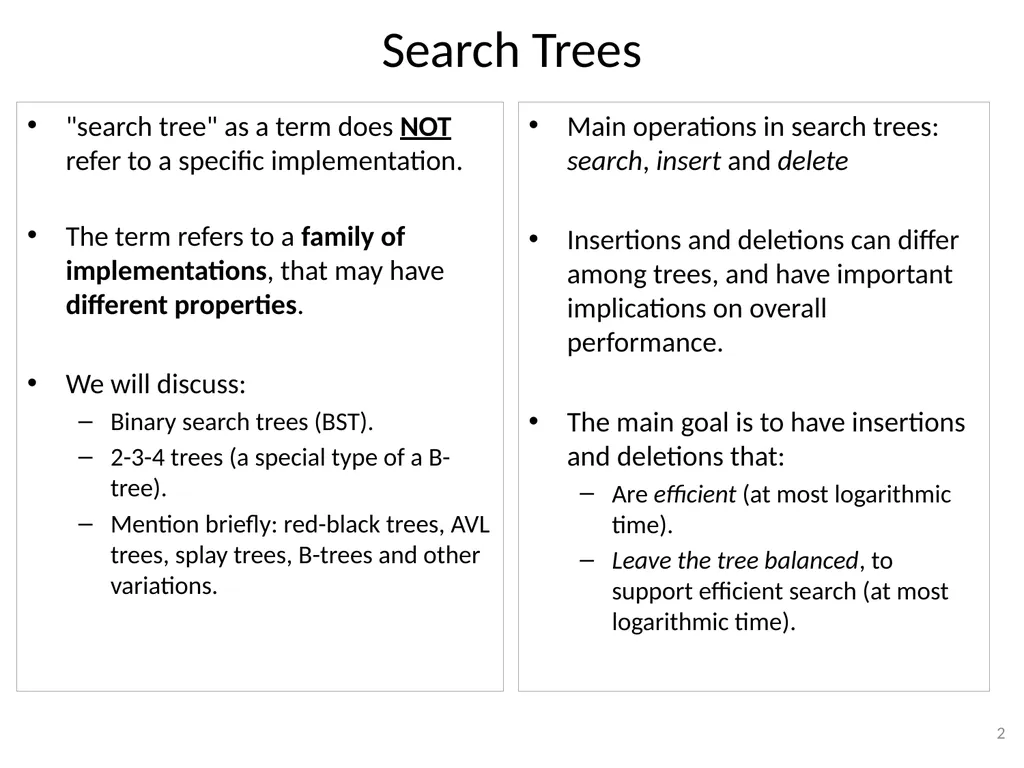
Search Trees "search tree" as a term does NOT refer to a specific implementation.
The term refers to a family of implementations, that may have different properties.
We will discuss:
Binary search trees (BST).
2-3-4 trees (a special type of a B-tree).
Mention briefly: red-black trees, AVL trees, splay trees, B-trees and other variations. 2 Main operations in search trees: search, insert and delete
Insertions and deletions can differ among trees, and have important implications on overall performance.
The main goal is to have insertions and deletions that:
Are efficient (at most logarithmic time).
Leave the tree balanced, to support efficient search (at most logarithmic time).<br>
The term refers to a family of implementations, that may have different properties.
We will discuss:
Binary search trees (BST).
2-3-4 trees (a special type of a B-tree).
Mention briefly: red-black trees, AVL trees, splay trees, B-trees and other variations. 2 Main operations in search trees: search, insert and delete
Insertions and deletions can differ among trees, and have important implications on overall performance.
The main goal is to have insertions and deletions that:
Are efficient (at most logarithmic time).
Leave the tree balanced, to support efficient search (at most logarithmic time).<br>
03
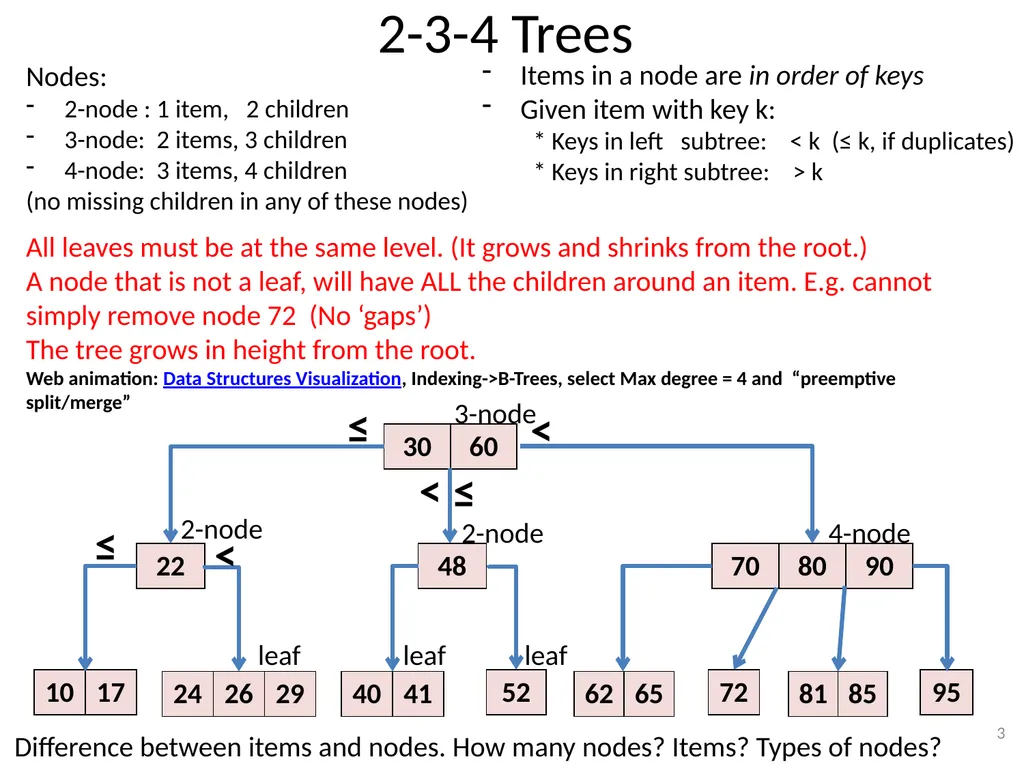
2-3-4 Trees 3 Nodes:
2-node : 1 item, 2 children
3-node: 2 items, 3 children
4-node: 3 items, 4 children
(no missing children in any of these nodes)
All leaves must be at the same level. (It grows and shrinks from the root.)
A node that is not a leaf, will have ALL the children around an item. E.g. cannot simply remove node 72 (No ‘gaps’)
The tree grows in height from the root.
Web animation: Data Structures Visualization, Indexing->B-Trees, select Max degree = 4 and “preemptive split/merge” Items in a node are in order of keys
Given item with key k:
* Keys in left subtree: < k (≤ k, if duplicates)
* Keys in right subtree: > k ≤ < ≤ < ≤ 2-node 3-node 4-node 2-node leaf leaf leaf Difference between items and nodes. How many nodes? Items? Types of nodes? <<br>
2-node : 1 item, 2 children
3-node: 2 items, 3 children
4-node: 3 items, 4 children
(no missing children in any of these nodes)
All leaves must be at the same level. (It grows and shrinks from the root.)
A node that is not a leaf, will have ALL the children around an item. E.g. cannot simply remove node 72 (No ‘gaps’)
The tree grows in height from the root.
Web animation: Data Structures Visualization, Indexing->B-Trees, select Max degree = 4 and “preemptive split/merge” Items in a node are in order of keys
Given item with key k:
* Keys in left subtree: < k (≤ k, if duplicates)
* Keys in right subtree: > k ≤ < ≤ < ≤ 2-node 3-node 4-node 2-node leaf leaf leaf Difference between items and nodes. How many nodes? Items? Types of nodes? <<br>
04
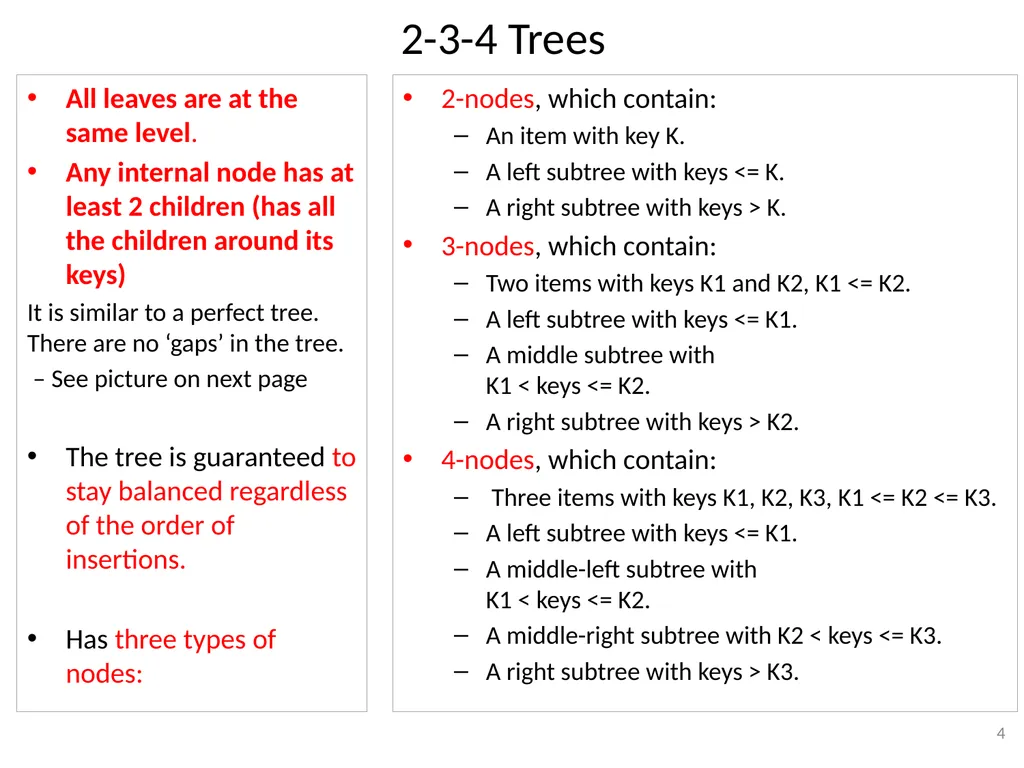
2-3-4 Trees All leaves are at the same level.
Any internal node has at least 2 children (has all the children around its keys)
It is similar to a perfect tree. There are no ‘gaps’ in the tree.
– See picture on next page
The tree is guaranteed to stay balanced regardless of the order of insertions.
Has three types of nodes: 4 2-nodes, which contain:
An item with key K.
A left subtree with keys <= K.
A right subtree with keys > K.
3-nodes, which contain:
Two items with keys K1 and K2, K1 <= K2.
A left subtree with keys <= K1.
A middle subtree with K1 < keys <= K2.
A right subtree with keys > K2.
4-nodes, which contain:
Three items with keys K1, K2, K3, K1 <= K2 <= K3.
A left subtree with keys <= K1.
A middle-left subtree with K1 < keys <= K2.
A middle-right subtree with K2 < keys <= K3.
A right subtree with keys > K3.<br>
Any internal node has at least 2 children (has all the children around its keys)
It is similar to a perfect tree. There are no ‘gaps’ in the tree.
– See picture on next page
The tree is guaranteed to stay balanced regardless of the order of insertions.
Has three types of nodes: 4 2-nodes, which contain:
An item with key K.
A left subtree with keys <= K.
A right subtree with keys > K.
3-nodes, which contain:
Two items with keys K1 and K2, K1 <= K2.
A left subtree with keys <= K1.
A middle subtree with K1 < keys <= K2.
A right subtree with keys > K2.
4-nodes, which contain:
Three items with keys K1, K2, K3, K1 <= K2 <= K3.
A left subtree with keys <= K1.
A middle-left subtree with K1 < keys <= K2.
A middle-right subtree with K2 < keys <= K3.
A right subtree with keys > K3.<br>
05
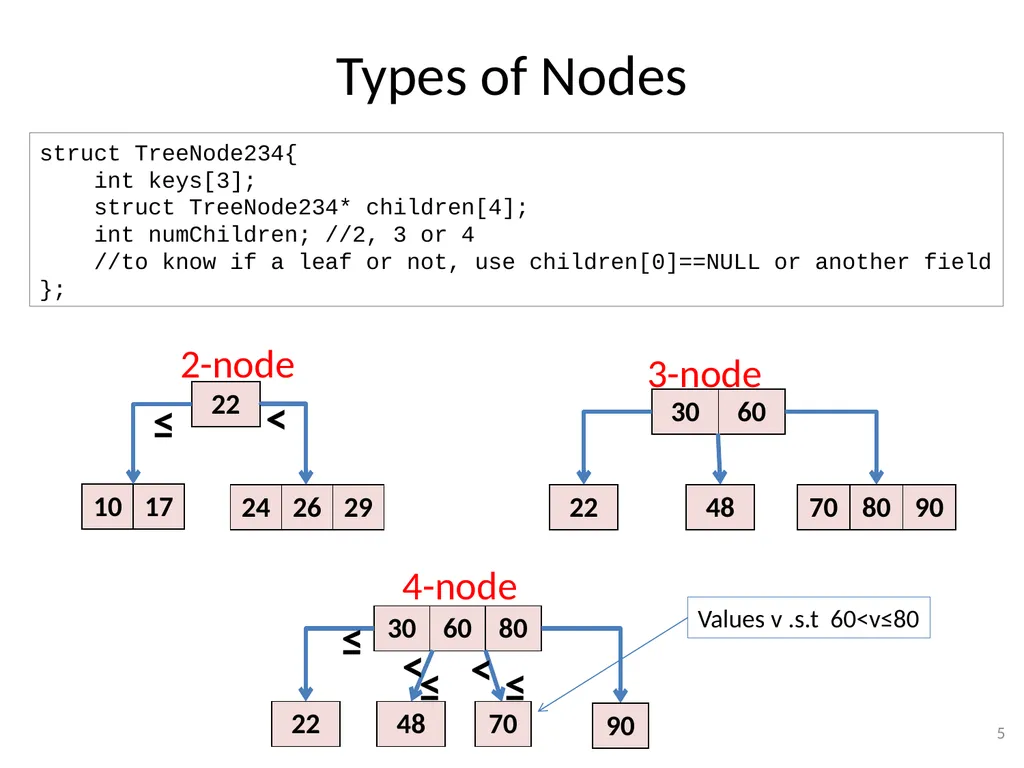
Types of Nodes 2-node 5 4-node 3-node ≤ ≤ ≤ ≤ < < < Values v .s.t 60<v≤80 struct TreeNode234{
int keys[3];
struct TreeNode234* children[4];
int numChildren; //2, 3 or 4
//to know if a leaf or not, use children[0]==NULL or another field
};<br>
int keys[3];
struct TreeNode234* children[4];
int numChildren; //2, 3 or 4
//to know if a leaf or not, use children[0]==NULL or another field
};<br>
06
Search in 2-3-4 Trees For simplicity, we assume that all keys are unique.
Search in 2-3-4 trees is a generalization of search in binary search trees.
select one of the subtrees by comparing the search key with the 1, 2, or 3 keys that are present at the node.
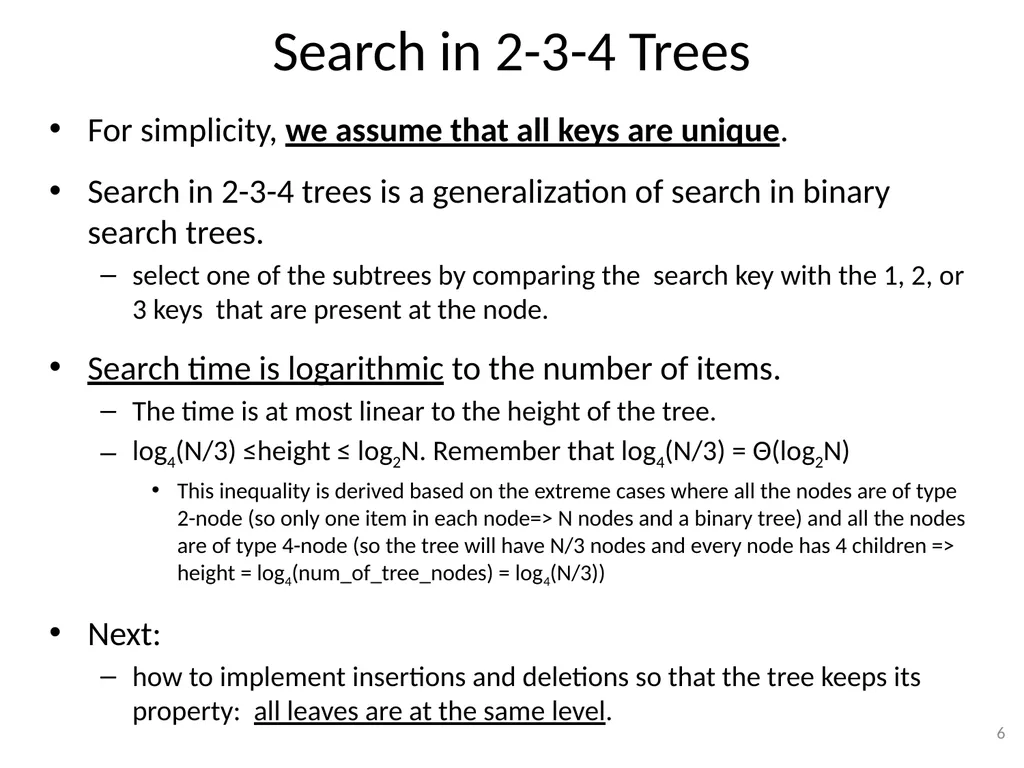
Search time is logarithmic to the number of items.
The time is at most linear to the height of the tree.
log4(N/3) ≤height ≤ log2N. Remember that log4(N/3) = Θ(log2N)
This inequality is derived based on the extreme cases where all the nodes are of type 2-node (so only one item in each node=> N nodes and a binary tree) and all the nodes are of type 4-node (so the tree will have N/3 nodes and every node has 4 children => height = log4(num_of_tree_nodes) = log4(N/3))
Next:
how to implement insertions and deletions so that the tree keeps its property: all leaves are at the same level. 6<br>
Search in 2-3-4 trees is a generalization of search in binary search trees.
select one of the subtrees by comparing the search key with the 1, 2, or 3 keys that are present at the node.
Search time is logarithmic to the number of items.
The time is at most linear to the height of the tree.
log4(N/3) ≤height ≤ log2N. Remember that log4(N/3) = Θ(log2N)
This inequality is derived based on the extreme cases where all the nodes are of type 2-node (so only one item in each node=> N nodes and a binary tree) and all the nodes are of type 4-node (so the tree will have N/3 nodes and every node has 4 children => height = log4(num_of_tree_nodes) = log4(N/3))
Next:
how to implement insertions and deletions so that the tree keeps its property: all leaves are at the same level. 6<br>
07
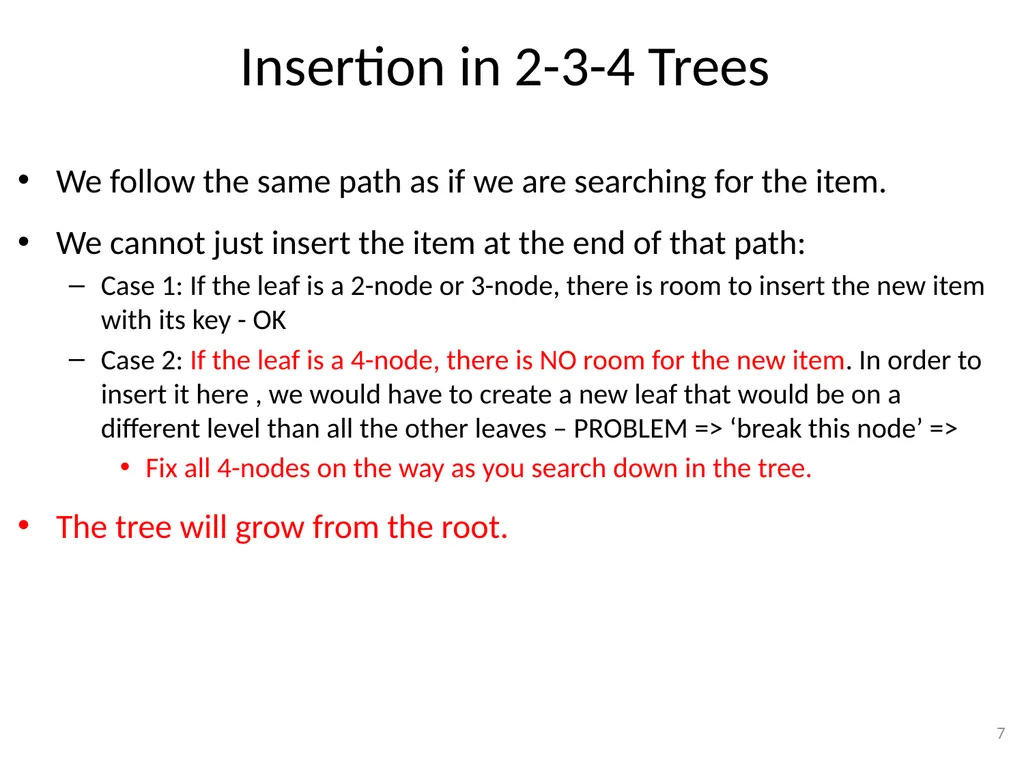
Insertion in 2-3-4 Trees We follow the same path as if we are searching for the item.
We cannot just insert the item at the end of that path:
Case 1: If the leaf is a 2-node or 3-node, there is room to insert the new item with its key - OK
Case 2: If the leaf is a 4-node, there is NO room for the new item. In order to insert it here , we would have to create a new leaf that would be on a different level than all the other leaves – PROBLEM => ‘break this node’ =>
Fix all 4-nodes on the way as you search down in the tree.
The tree will grow from the root. 7<br>
We cannot just insert the item at the end of that path:
Case 1: If the leaf is a 2-node or 3-node, there is room to insert the new item with its key - OK
Case 2: If the leaf is a 4-node, there is NO room for the new item. In order to insert it here , we would have to create a new leaf that would be on a different level than all the other leaves – PROBLEM => ‘break this node’ =>
Fix all 4-nodes on the way as you search down in the tree.
The tree will grow from the root. 7<br>
08
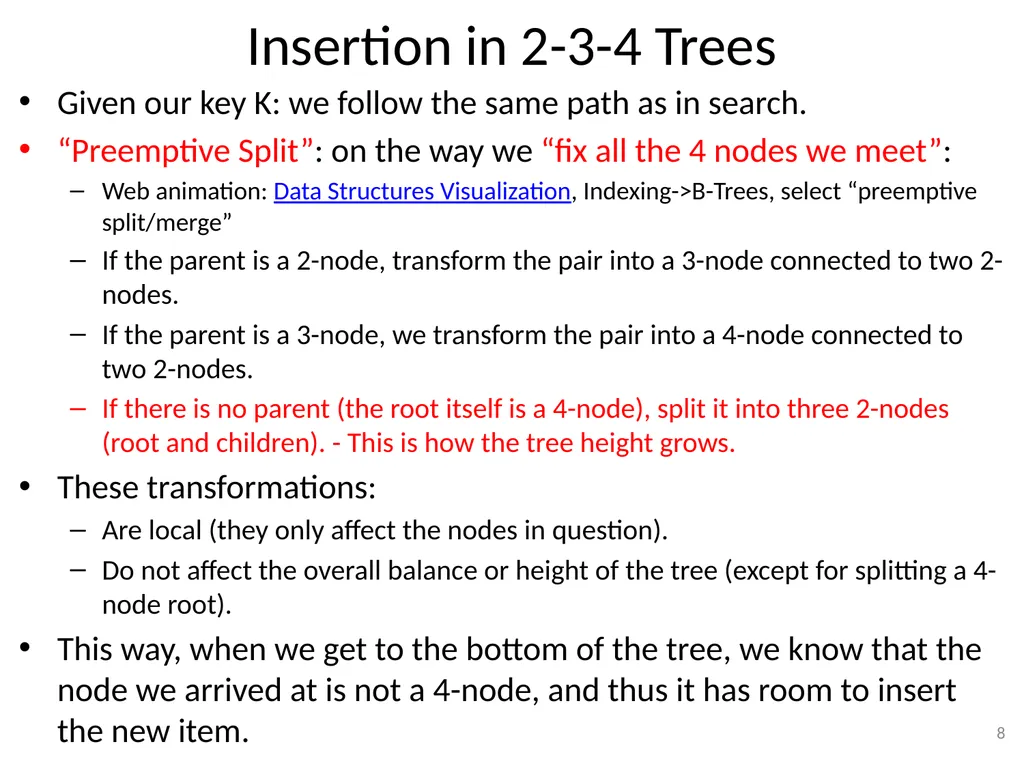
Insertion in 2-3-4 Trees Given our key K: we follow the same path as in search.
“Preemptive Split”: on the way we “fix all the 4 nodes we meet”:
Web animation: Data Structures Visualization, Indexing->B-Trees, select “preemptive split/merge”
If the parent is a 2-node, transform the pair into a 3-node connected to two 2-nodes.
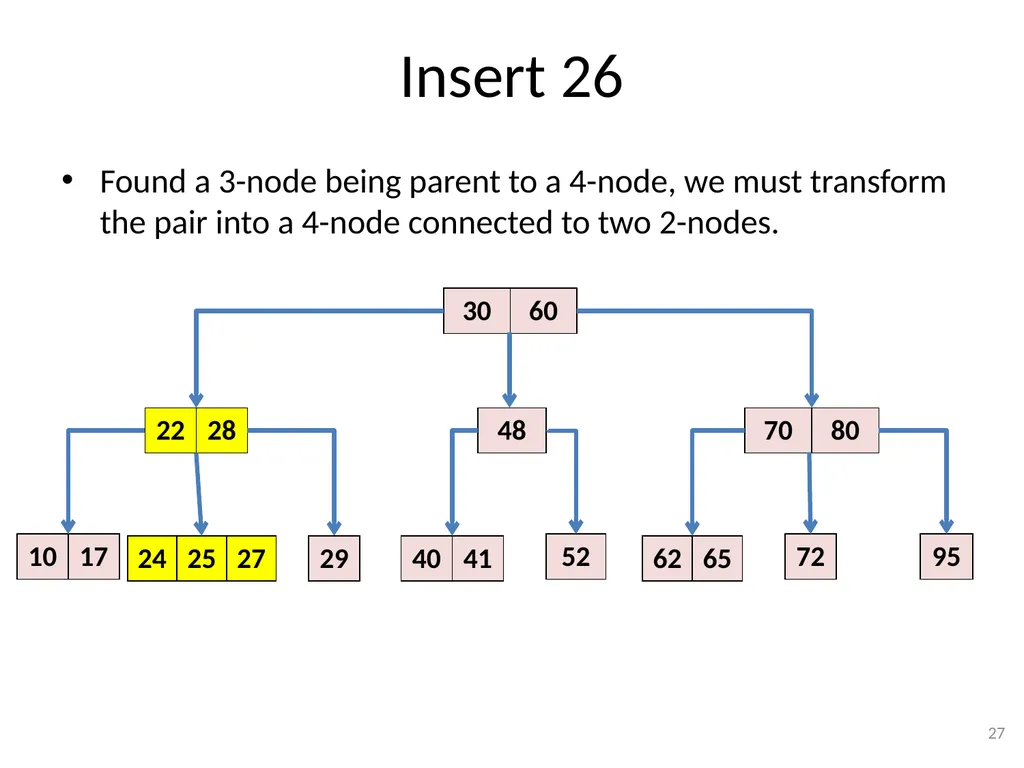
If the parent is a 3-node, we transform the pair into a 4-node connected to two 2-nodes.
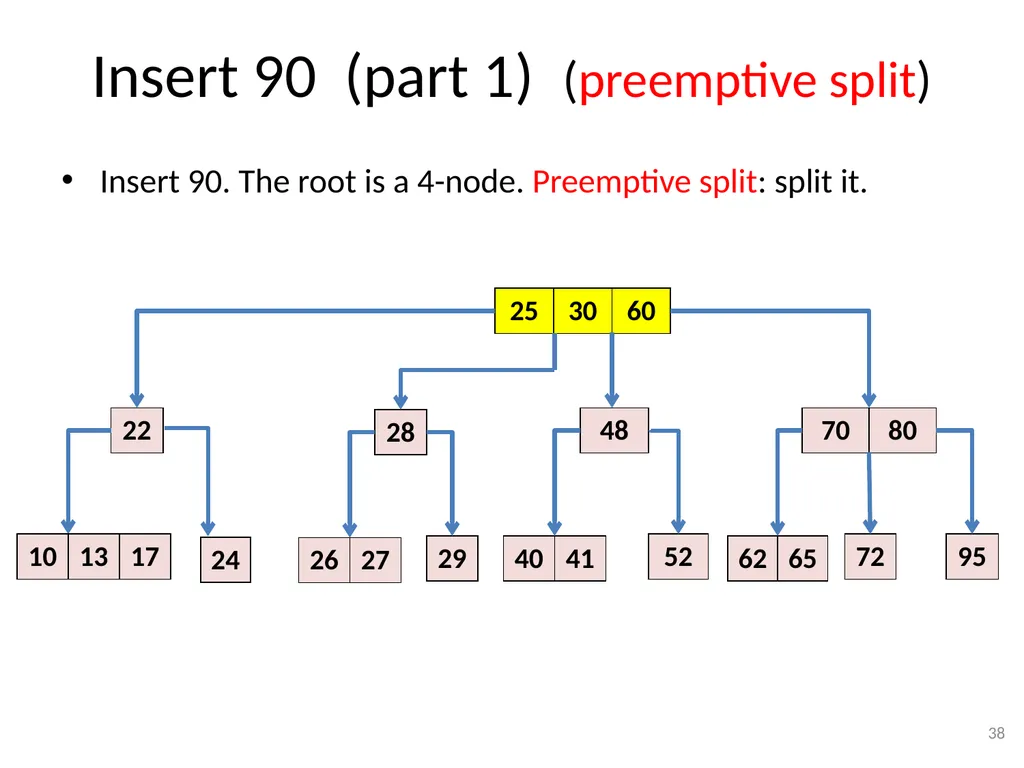
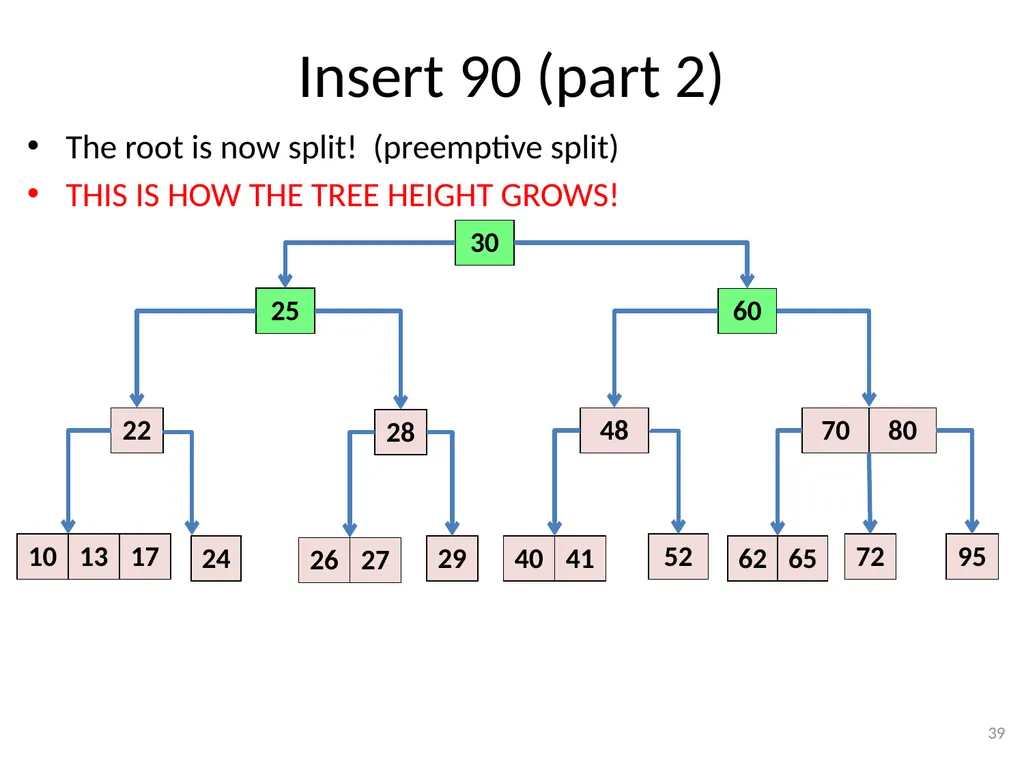
If there is no parent (the root itself is a 4-node), split it into three 2-nodes (root and children). - This is how the tree height grows.
These transformations:
Are local (they only affect the nodes in question).
Do not affect the overall balance or height of the tree (except for splitting a 4-node root).
This way, when we get to the bottom of the tree, we know that the node we arrived at is not a 4-node, and thus it has room to insert the new item. 8<br>
“Preemptive Split”: on the way we “fix all the 4 nodes we meet”:
Web animation: Data Structures Visualization, Indexing->B-Trees, select “preemptive split/merge”
If the parent is a 2-node, transform the pair into a 3-node connected to two 2-nodes.
If the parent is a 3-node, we transform the pair into a 4-node connected to two 2-nodes.
If there is no parent (the root itself is a 4-node), split it into three 2-nodes (root and children). - This is how the tree height grows.
These transformations:
Are local (they only affect the nodes in question).
Do not affect the overall balance or height of the tree (except for splitting a 4-node root).
This way, when we get to the bottom of the tree, we know that the node we arrived at is not a 4-node, and thus it has room to insert the new item. 8<br>
09
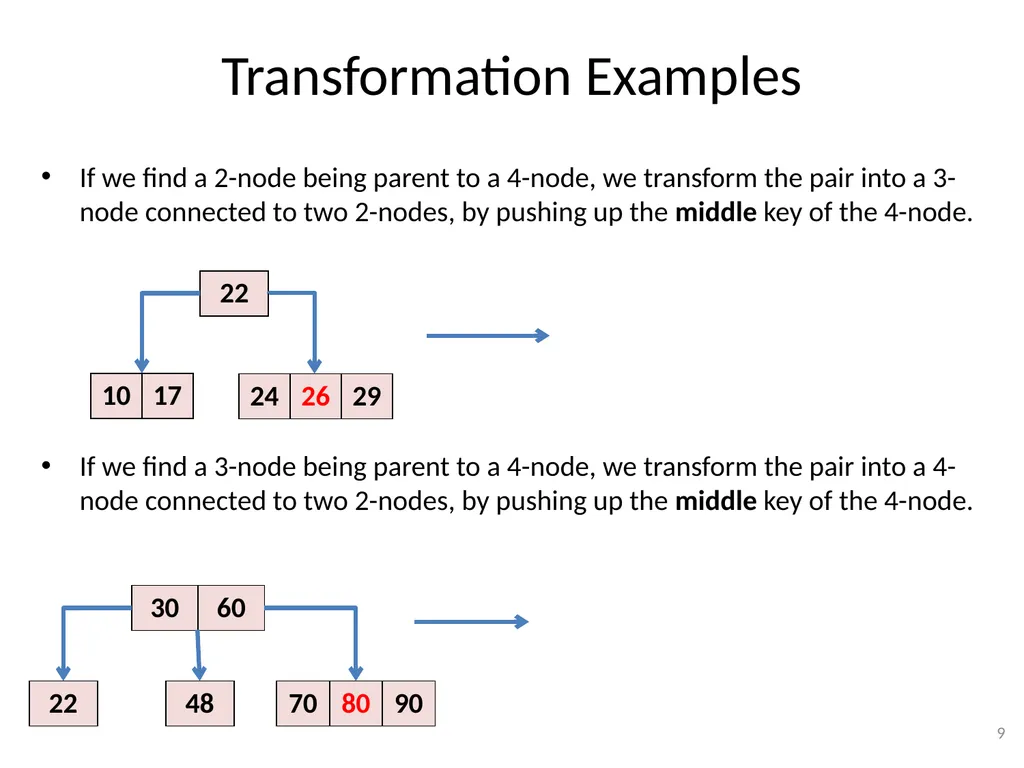
Transformation Examples If we find a 2-node being parent to a 4-node, we transform the pair into a 3-node connected to two 2-nodes, by pushing up the middle key of the 4-node.
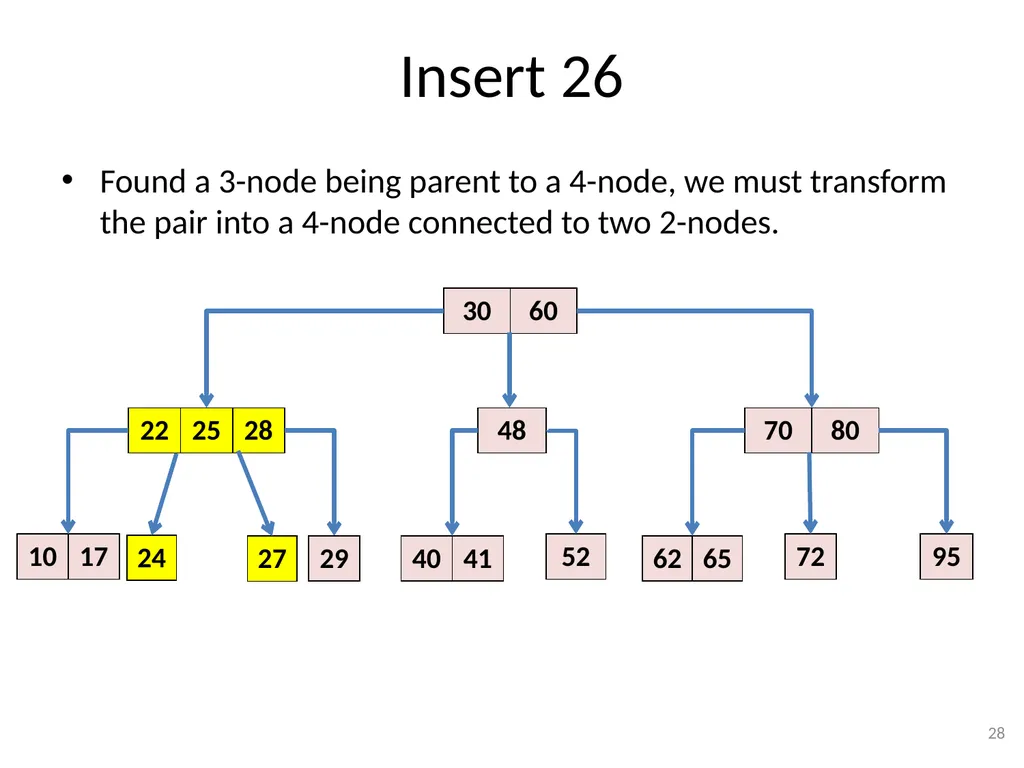
If we find a 3-node being parent to a 4-node, we transform the pair into a 4-node connected to two 2-nodes, by pushing up the middle key of the 4-node. 9<br>
If we find a 3-node being parent to a 4-node, we transform the pair into a 4-node connected to two 2-nodes, by pushing up the middle key of the 4-node. 9<br>
10
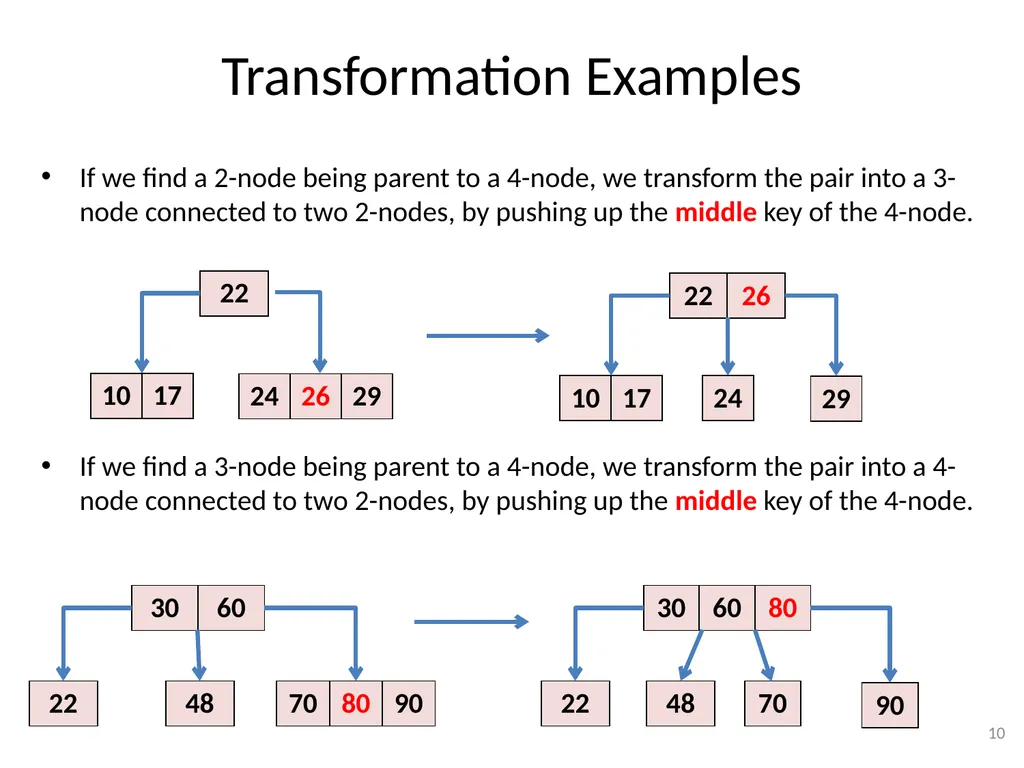
Transformation Examples If we find a 2-node being parent to a 4-node, we transform the pair into a 3-node connected to two 2-nodes, by pushing up the middle key of the 4-node.
If we find a 3-node being parent to a 4-node, we transform the pair into a 4-node connected to two 2-nodes, by pushing up the middle key of the 4-node. 10<br>
If we find a 3-node being parent to a 4-node, we transform the pair into a 4-node connected to two 2-nodes, by pushing up the middle key of the 4-node. 10<br>
11
Insertion Examples 11<br>
12
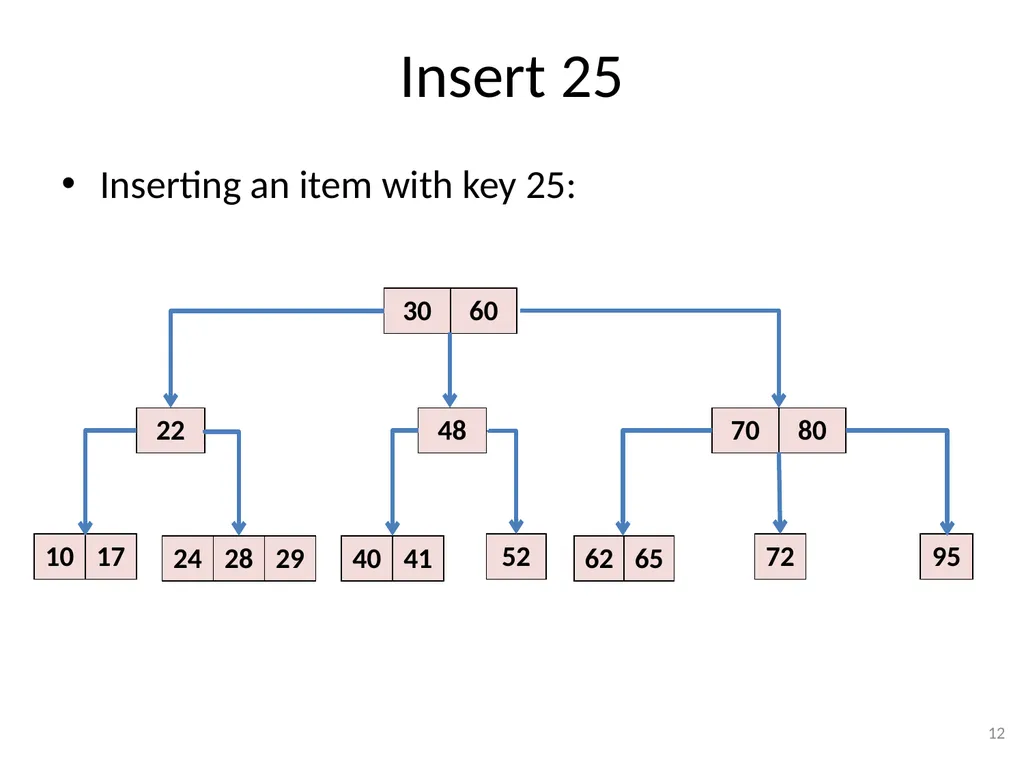
Insert 25 Inserting an item with key 25: 12<br>
13
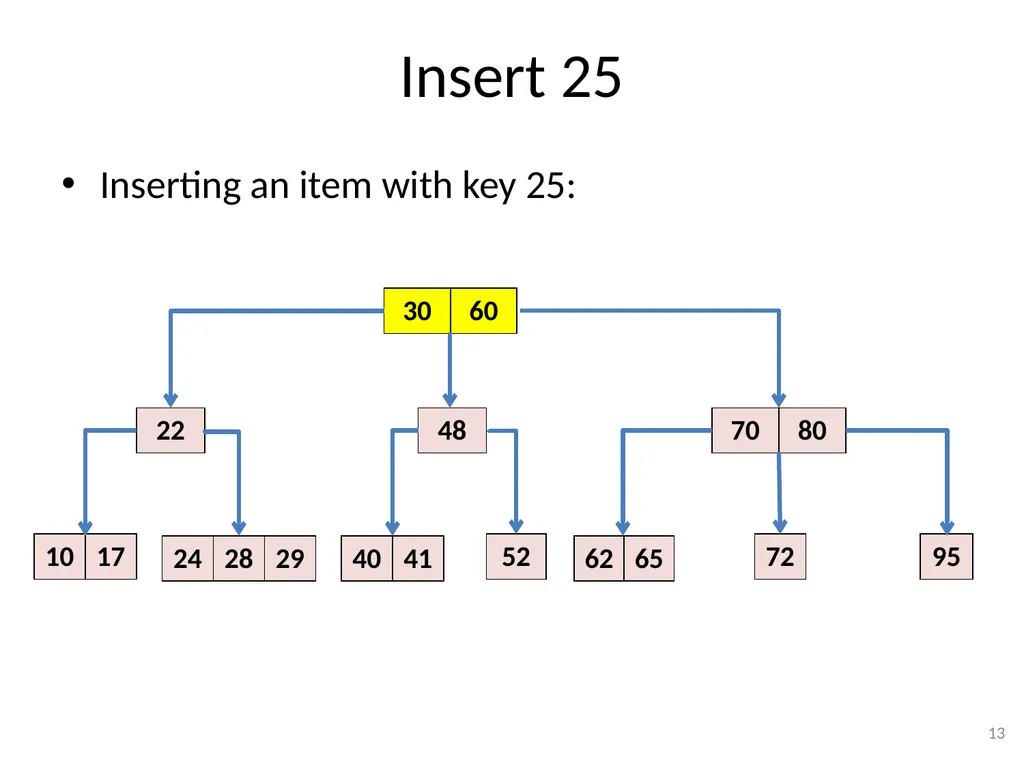
Insert 25 Inserting an item with key 25: 13<br>
14
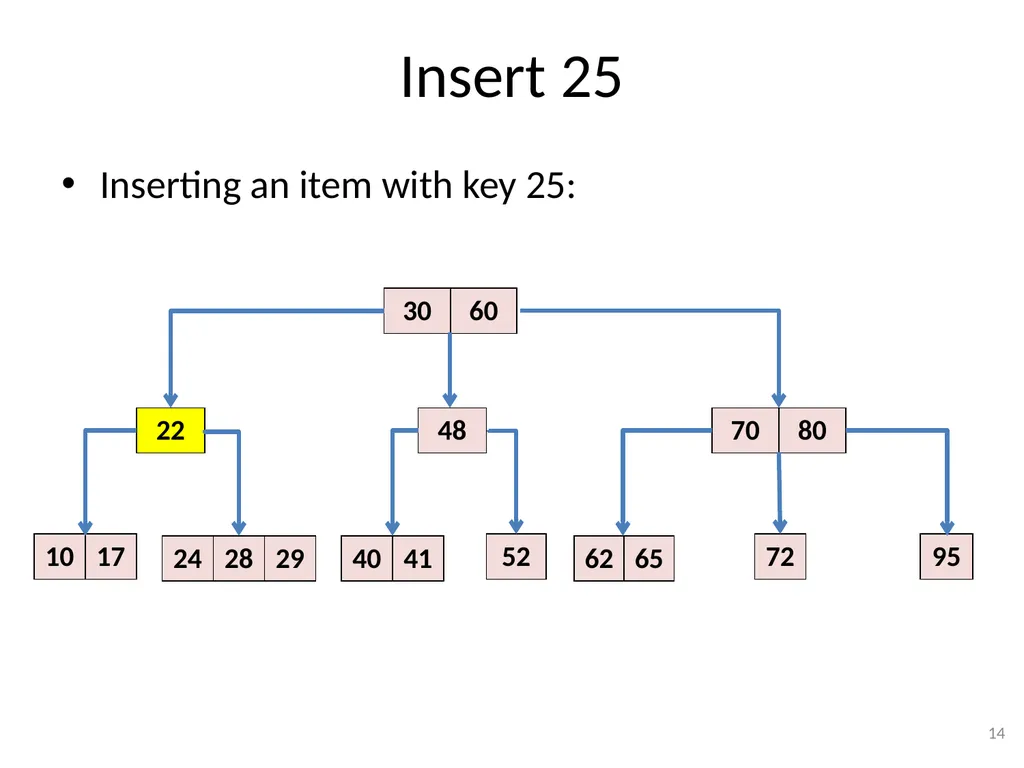
Insert 25 Inserting an item with key 25: 14<br>
15
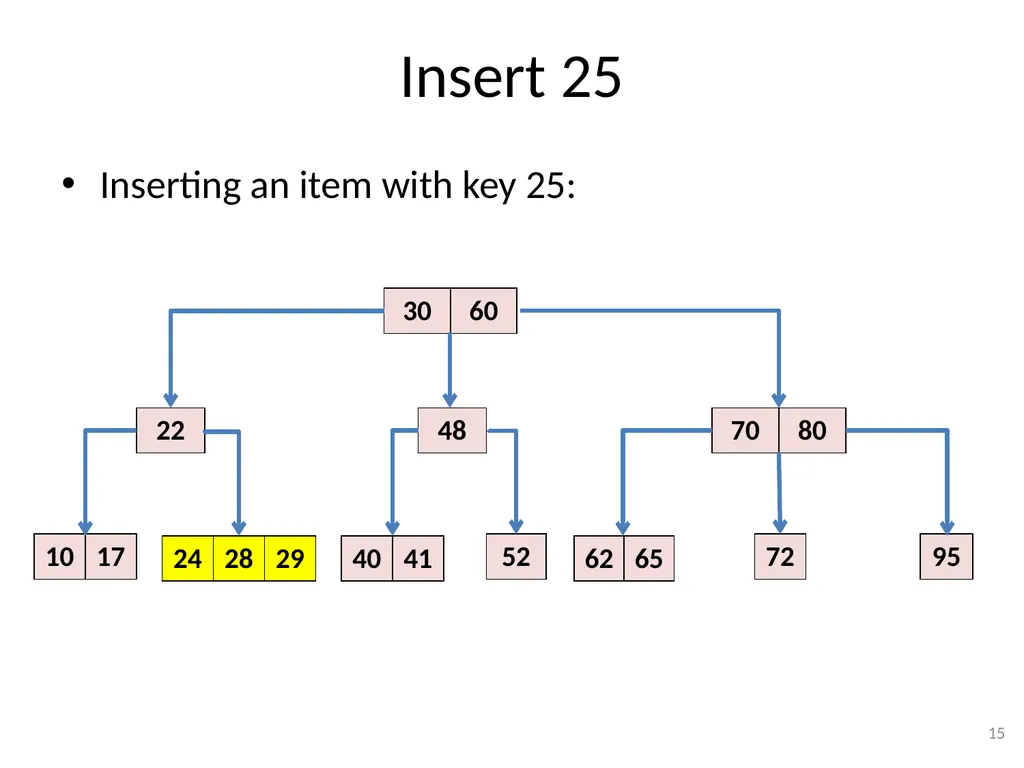
Insert 25 Inserting an item with key 25: 15<br>
16
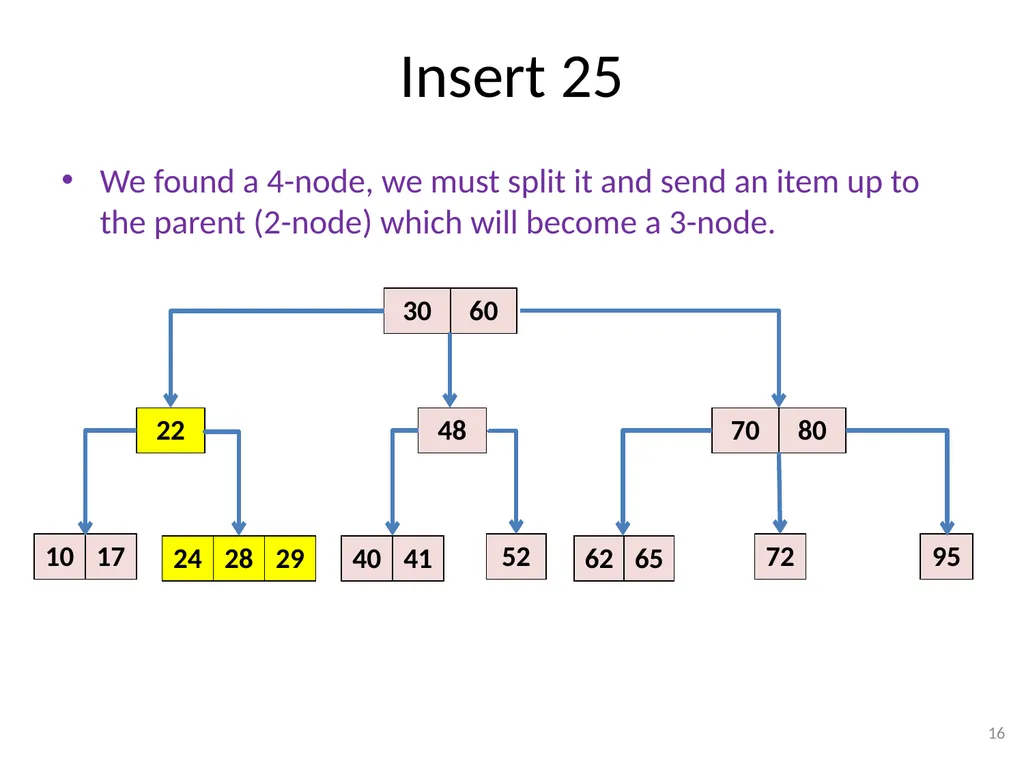
Insert 25 We found a 4-node, we must split it and send an item up to the parent (2-node) which will become a 3-node. 16<br>
17
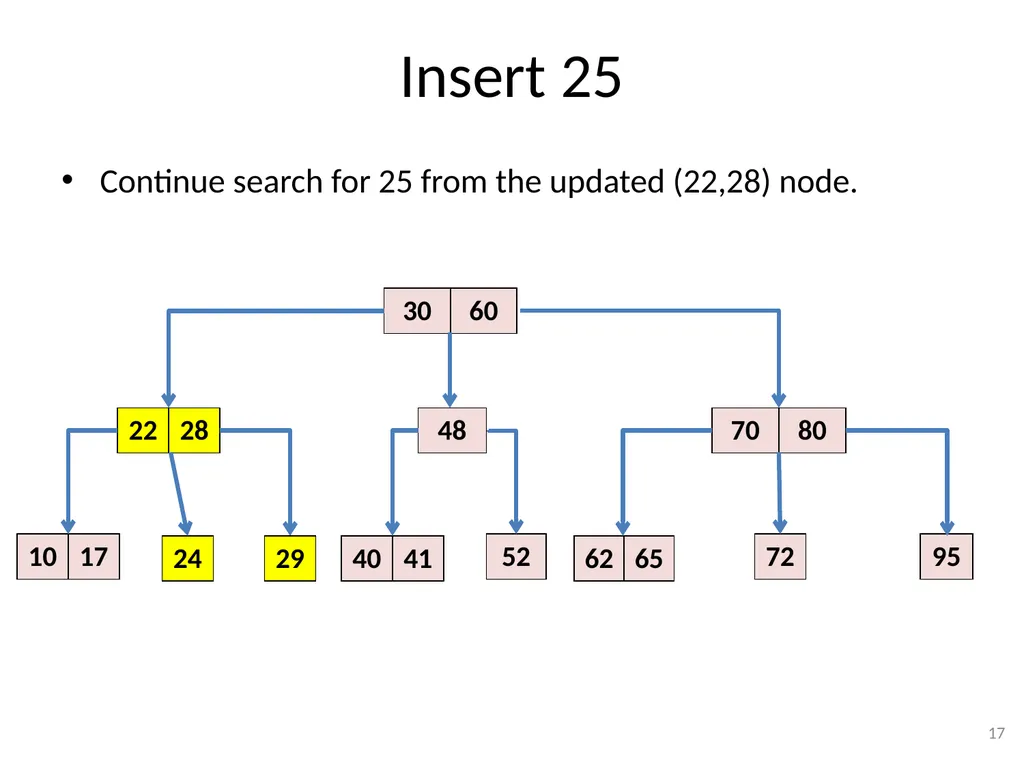
Insert 25 Continue search for 25 from the updated (22,28) node. 17<br>
18
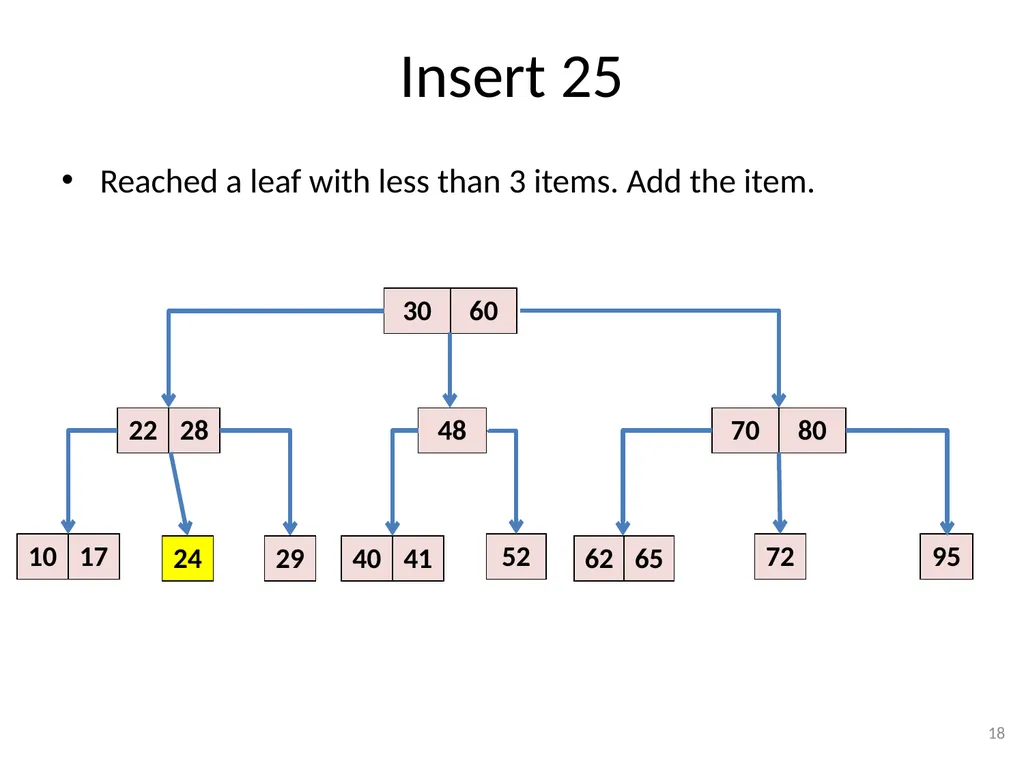
Insert 25 Reached a leaf with less than 3 items. Add the item. 18<br>
19
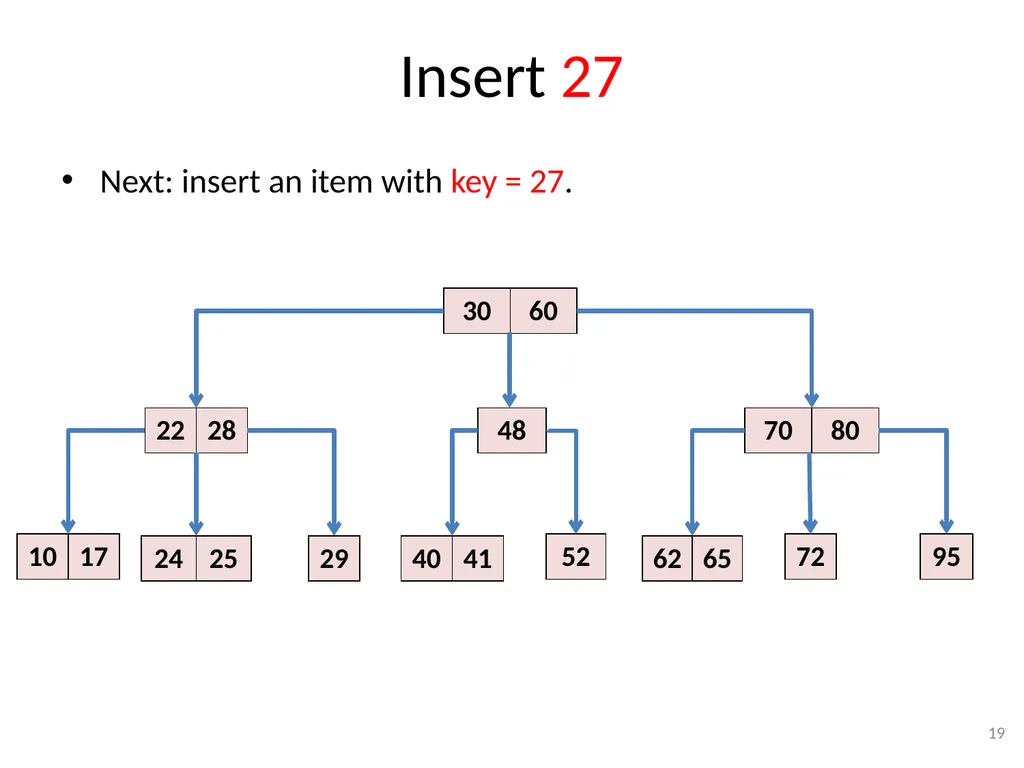
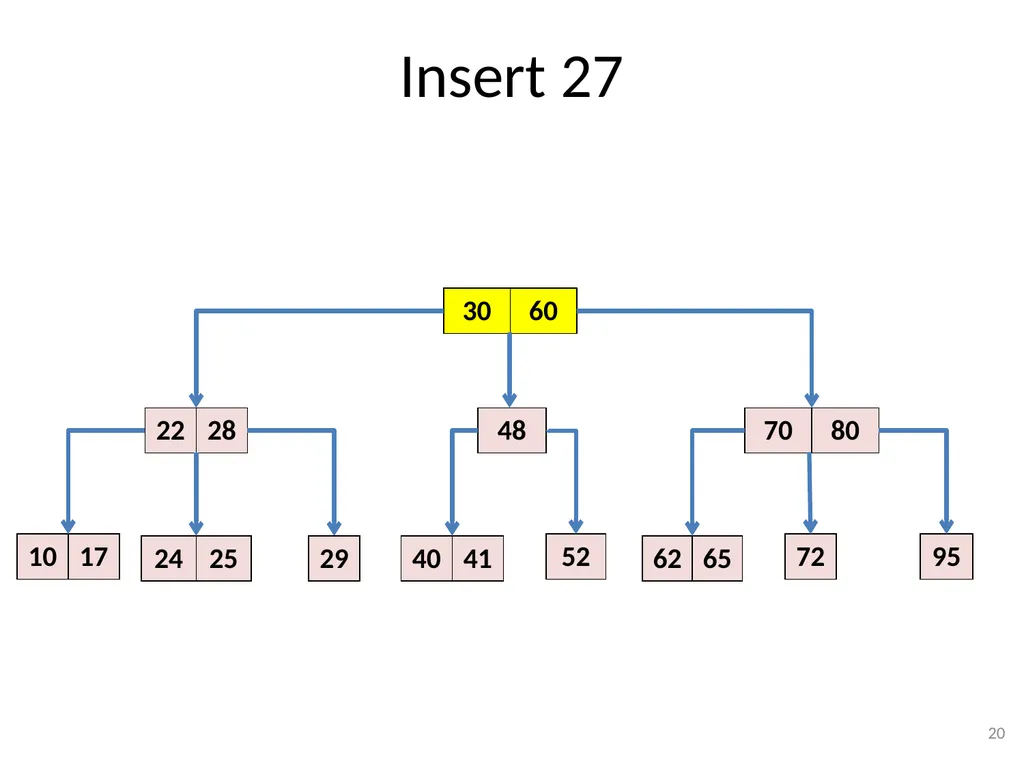
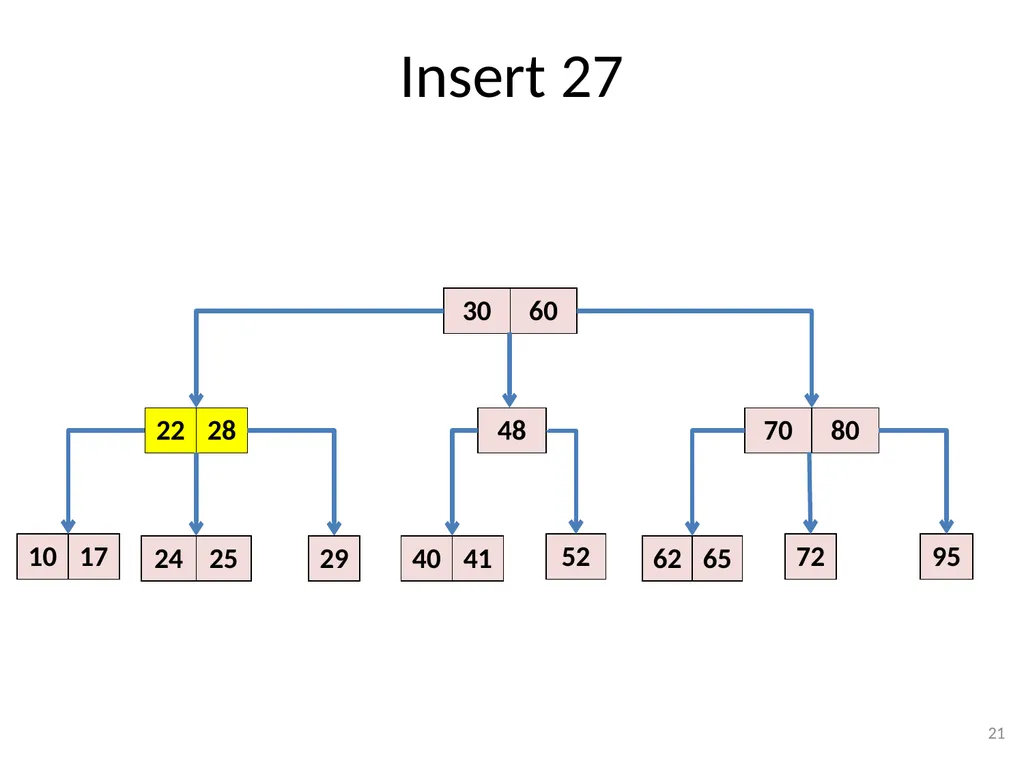
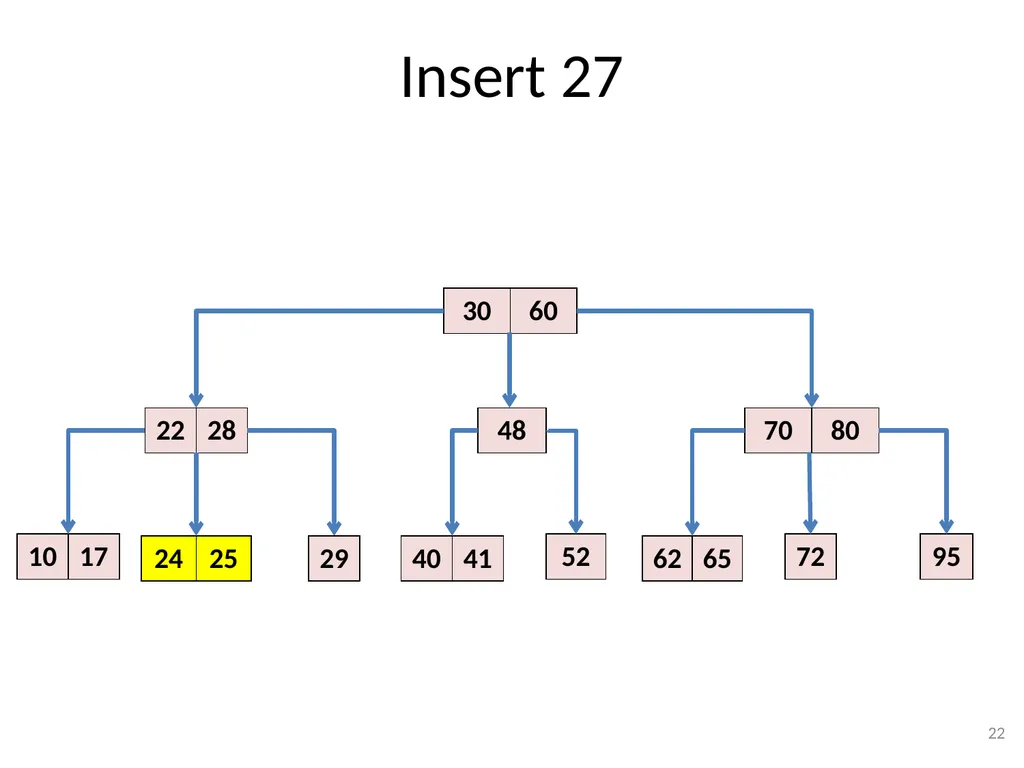
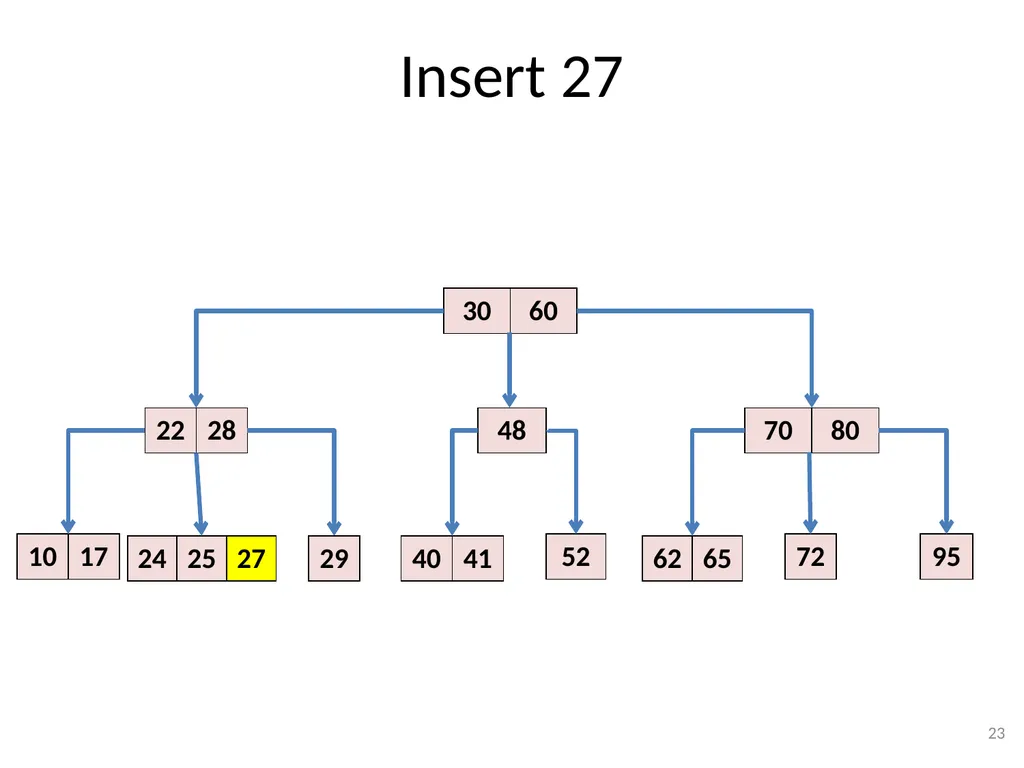
Insert 27 Next: insert an item with key = 27. 19<br>
20
Insert 27 20<br>
21
Insert 27 21<br>
22
Insert 27 22<br>
23
Insert 27 23<br>
24
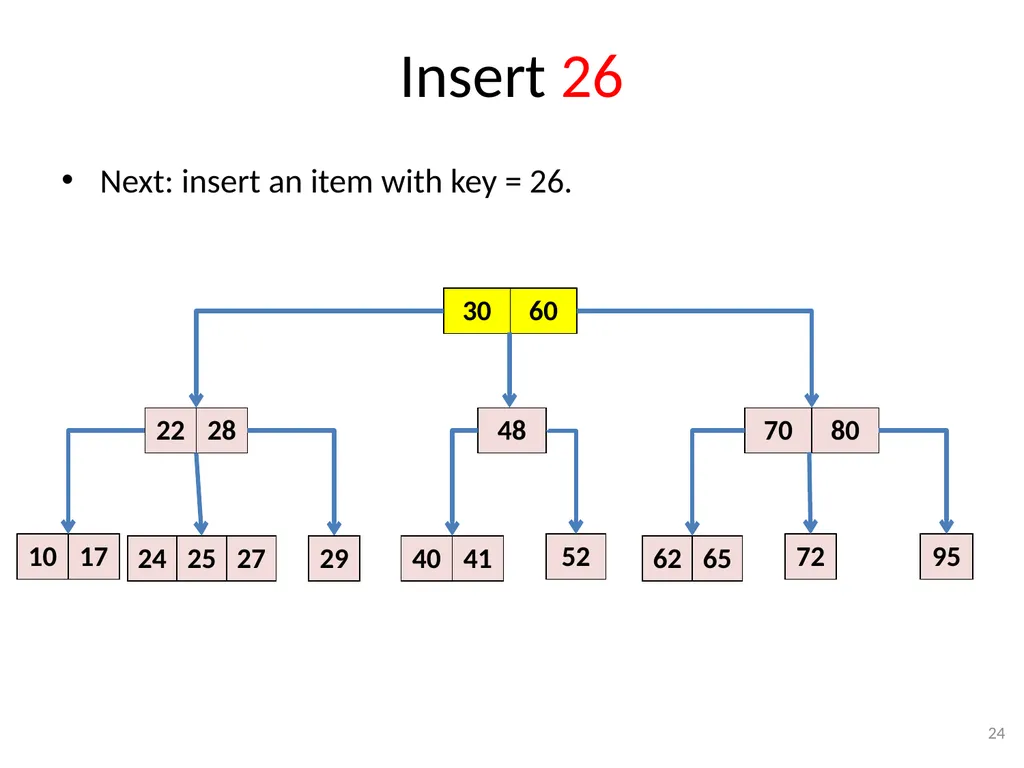
Insert 26 Next: insert an item with key = 26. 24<br>
25
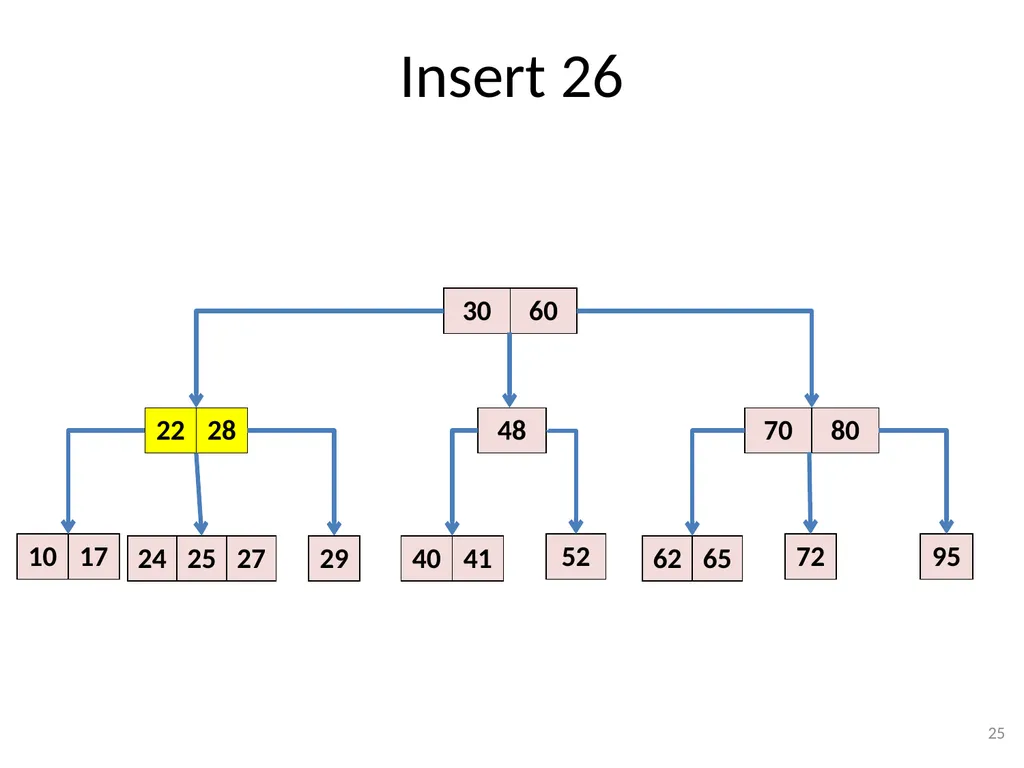
Insert 26 25<br>
26
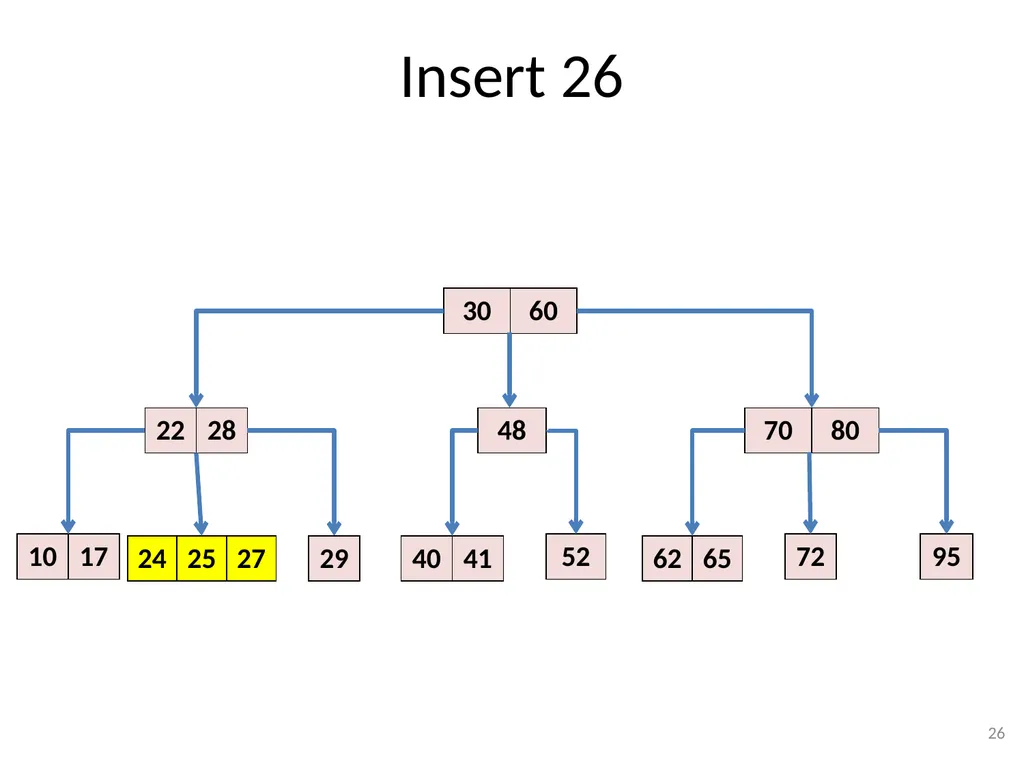
Insert 26 26<br>
27
Insert 26 Found a 3-node being parent to a 4-node, we must transform the pair into a 4-node connected to two 2-nodes. 27<br>
28
Insert 26 Found a 3-node being parent to a 4-node, we must transform the pair into a 4-node connected to two 2-nodes. 28<br>
29
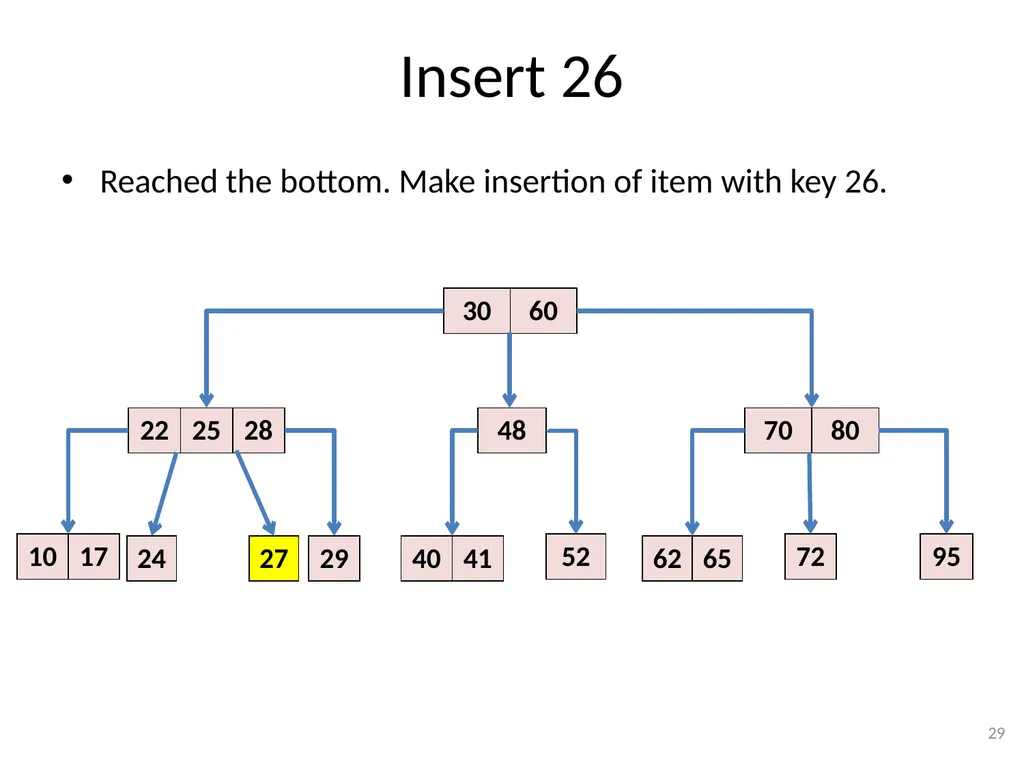
Insert 26 Reached the bottom. Make insertion of item with key 26. 29<br>
30
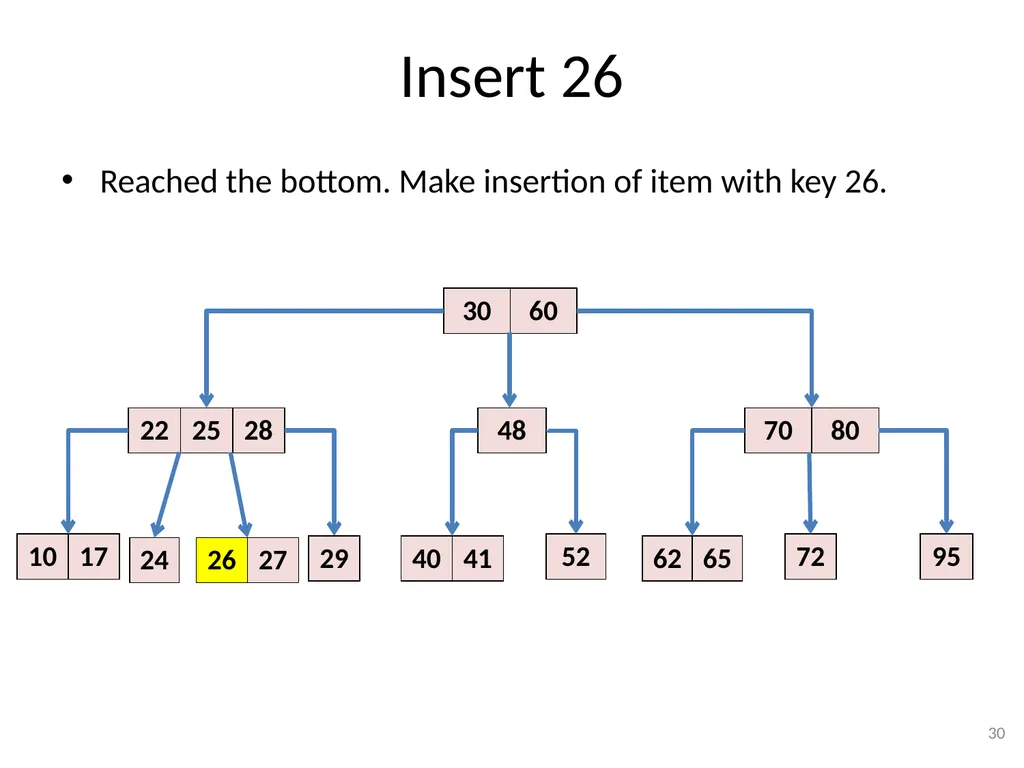
Insert 26 Reached the bottom. Make insertion of item with key 26. 30<br>
31
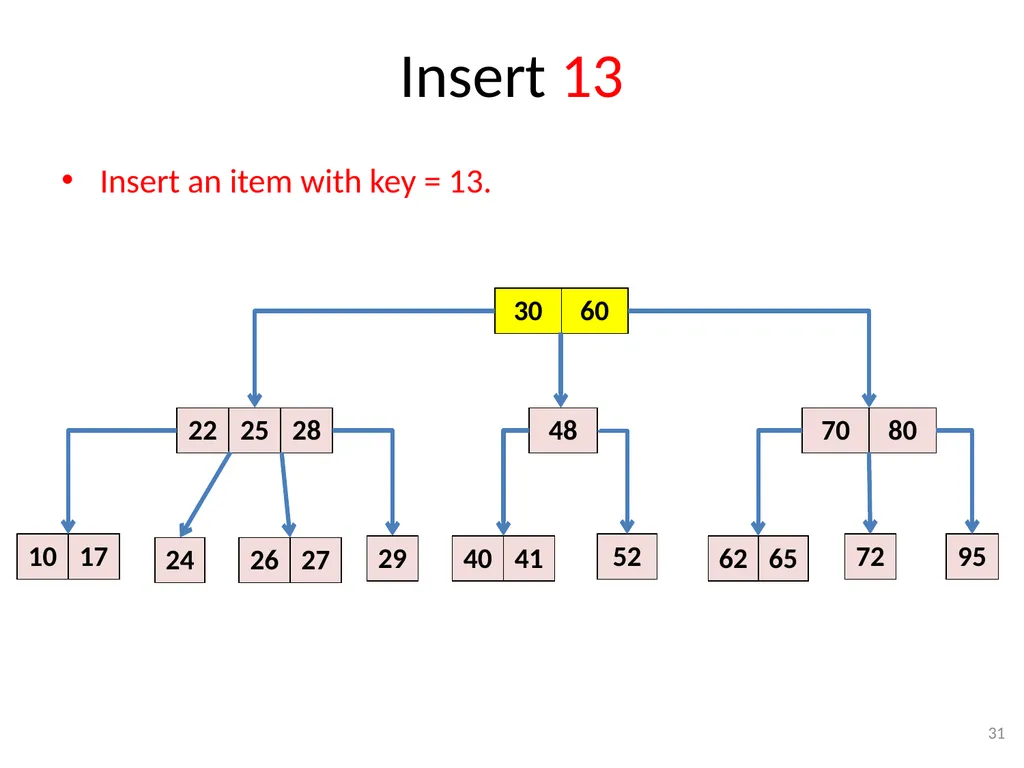
Insert 13 Insert an item with key = 13. 31<br>
32
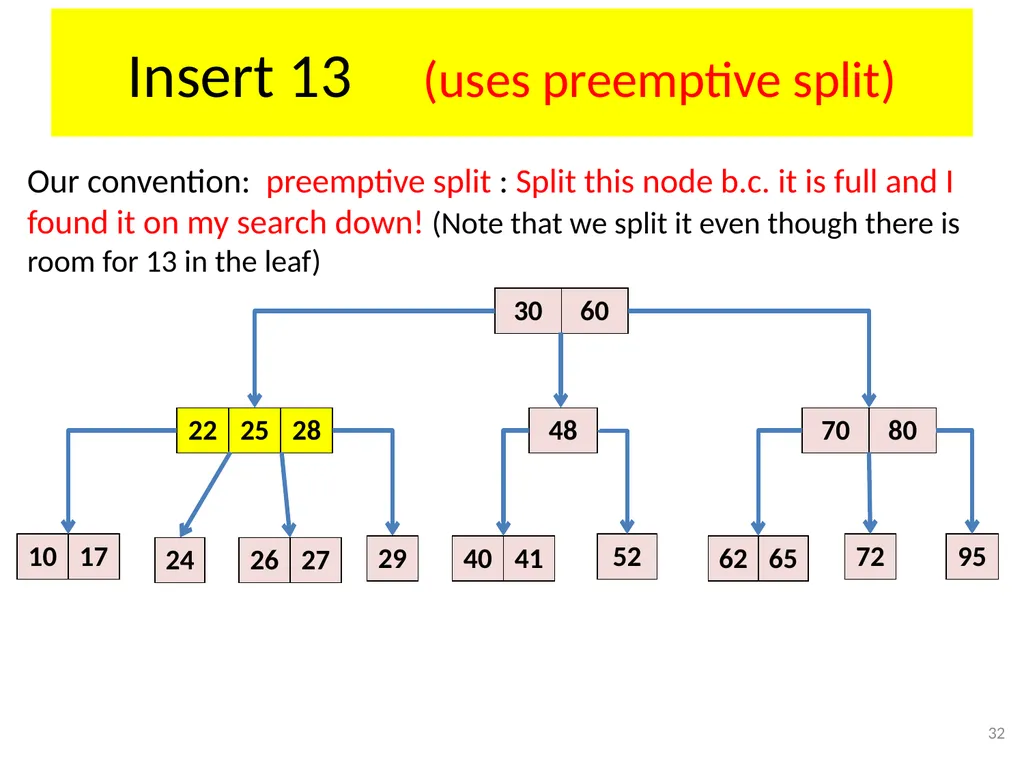
Insert 13 (uses preemptive split) Our convention: preemptive split : Split this node b.c. it is full and I found it on my search down! (Note that we split it even though there is room for 13 in the leaf) 32<br>
33
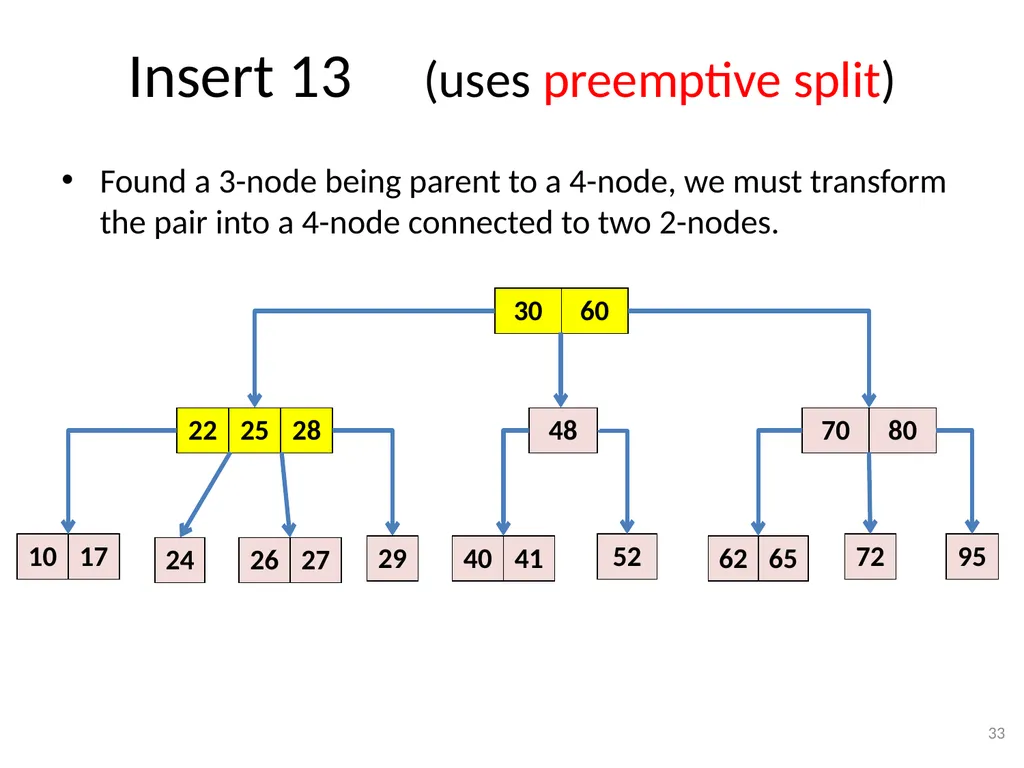
Insert 13 (uses preemptive split) Found a 3-node being parent to a 4-node, we must transform the pair into a 4-node connected to two 2-nodes. 33<br>
34
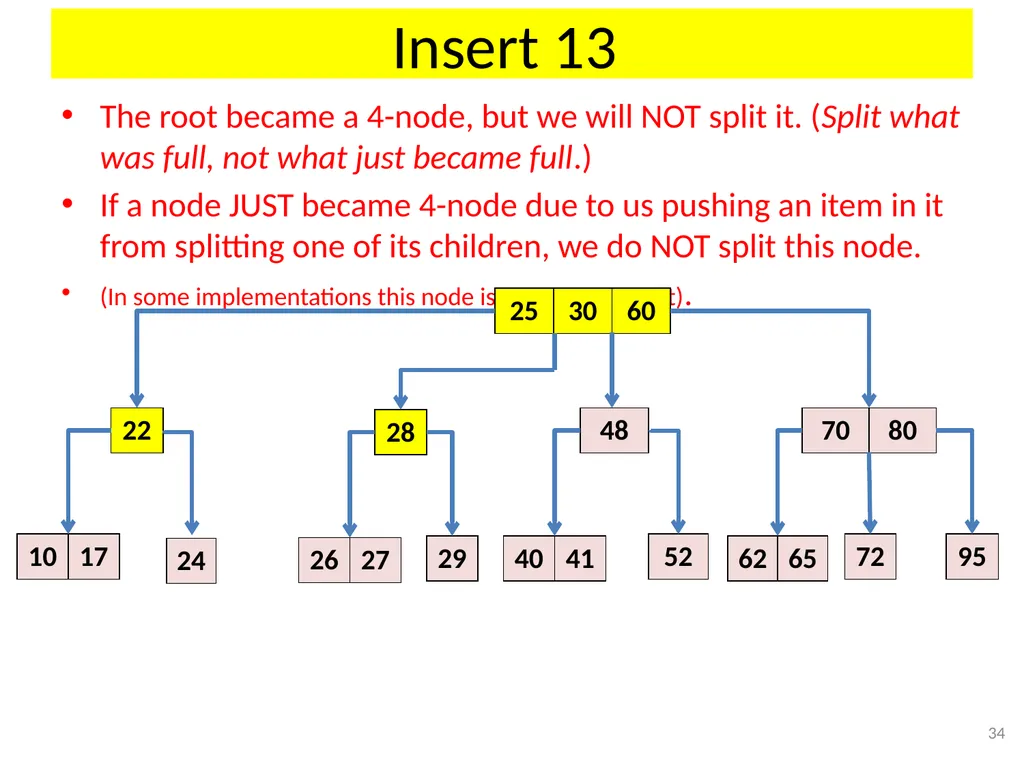
Insert 13 The root became a 4-node, but we will NOT split it. (Split what was full, not what just became full.)
If a node JUST became 4-node due to us pushing an item in it from splitting one of its children, we do NOT split this node.
(In some implementations this node is split at this point). 34<br>
If a node JUST became 4-node due to us pushing an item in it from splitting one of its children, we do NOT split this node.
(In some implementations this node is split at this point). 34<br>
35
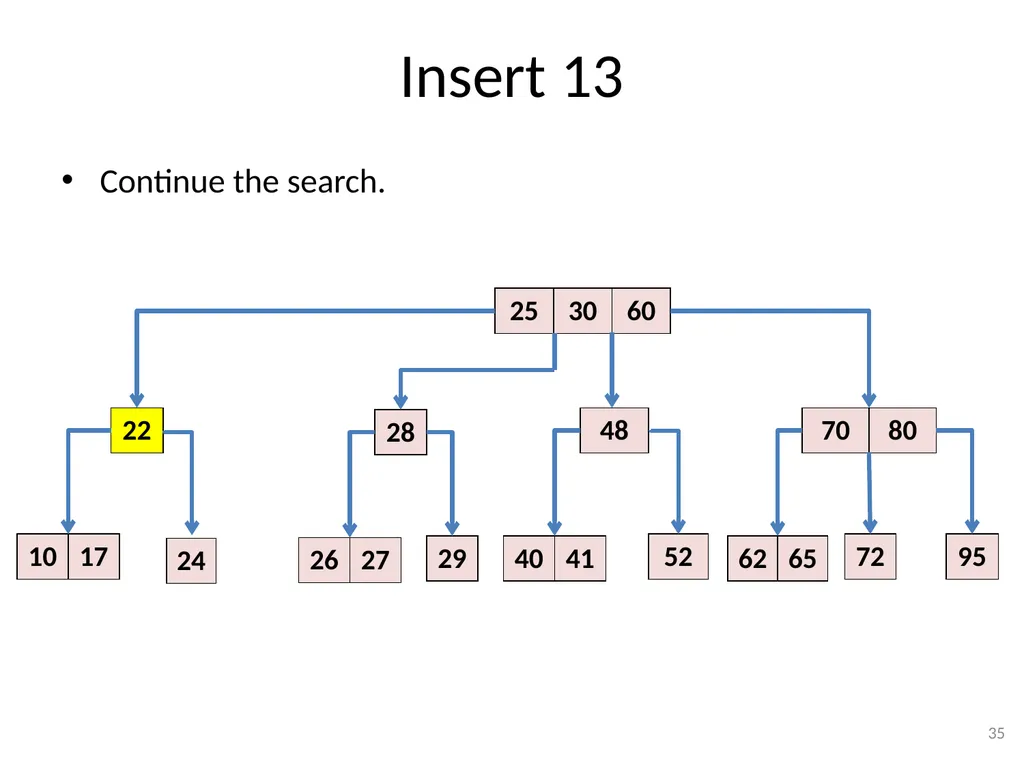
Insert 13 Continue the search. 35<br>
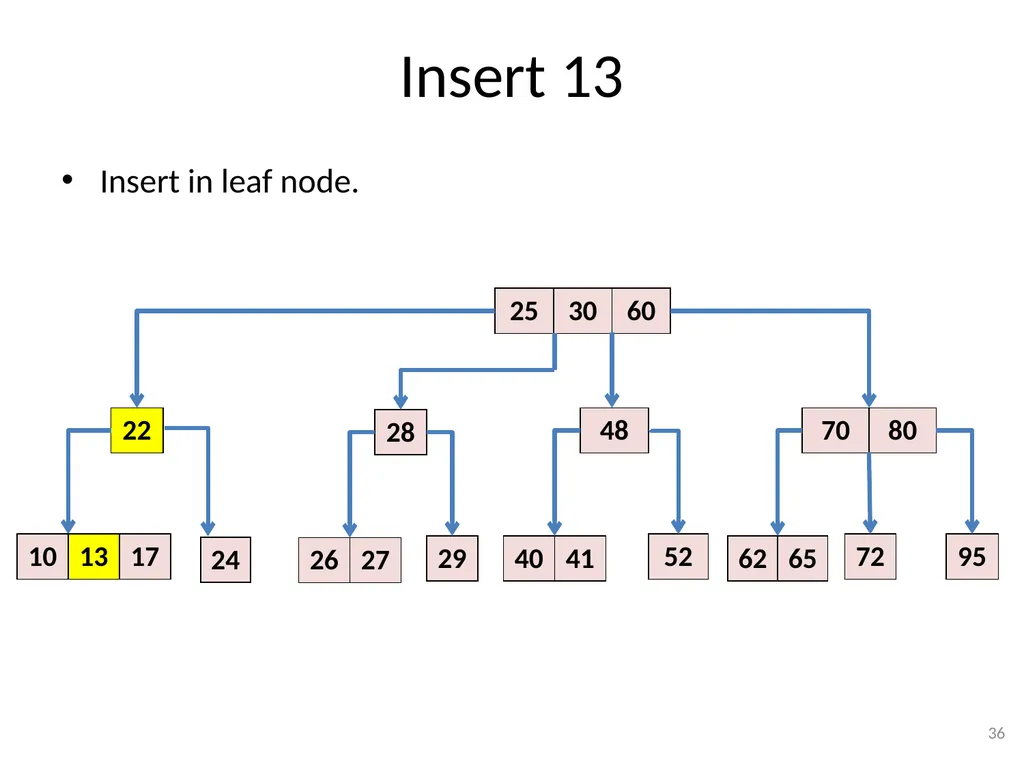
36
Insert 13 Insert in leaf node. 36<br>
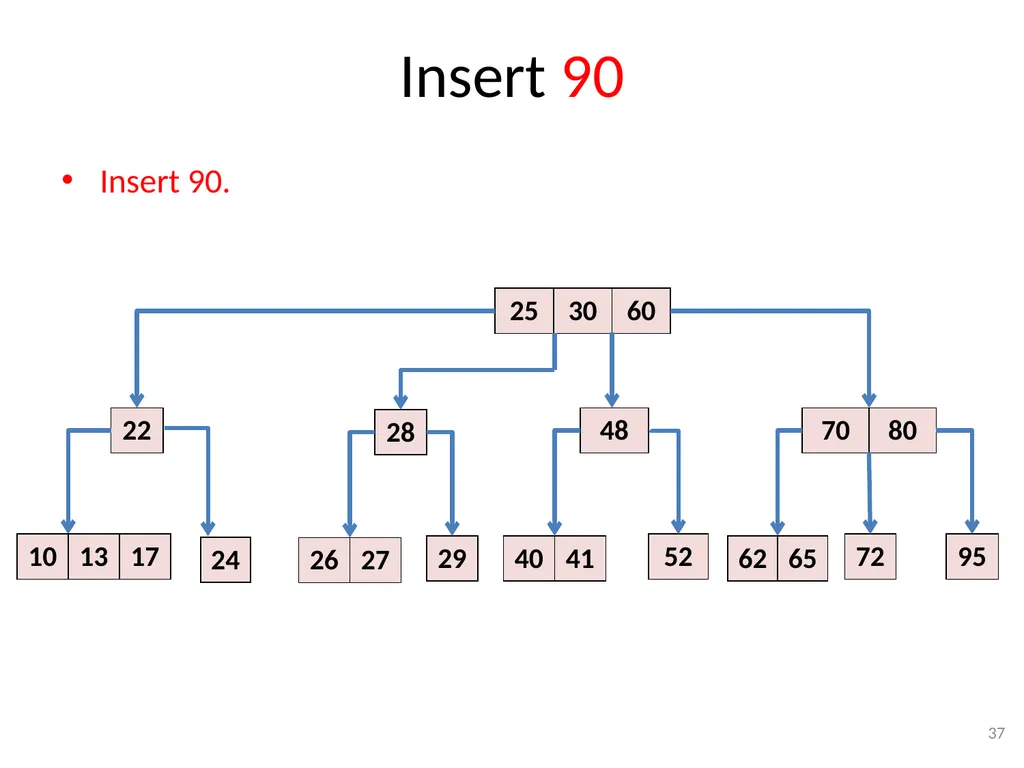
37
Insert 90 Insert 90. 37<br>
38
Insert 90 (part 1) (preemptive split) Insert 90. The root is a 4-node. Preemptive split: split it. 38<br>
39
Insert 90 (part 2) The root is now split! (preemptive split)
THIS IS HOW THE TREE HEIGHT GROWS! 39<br>
THIS IS HOW THE TREE HEIGHT GROWS! 39<br>
40
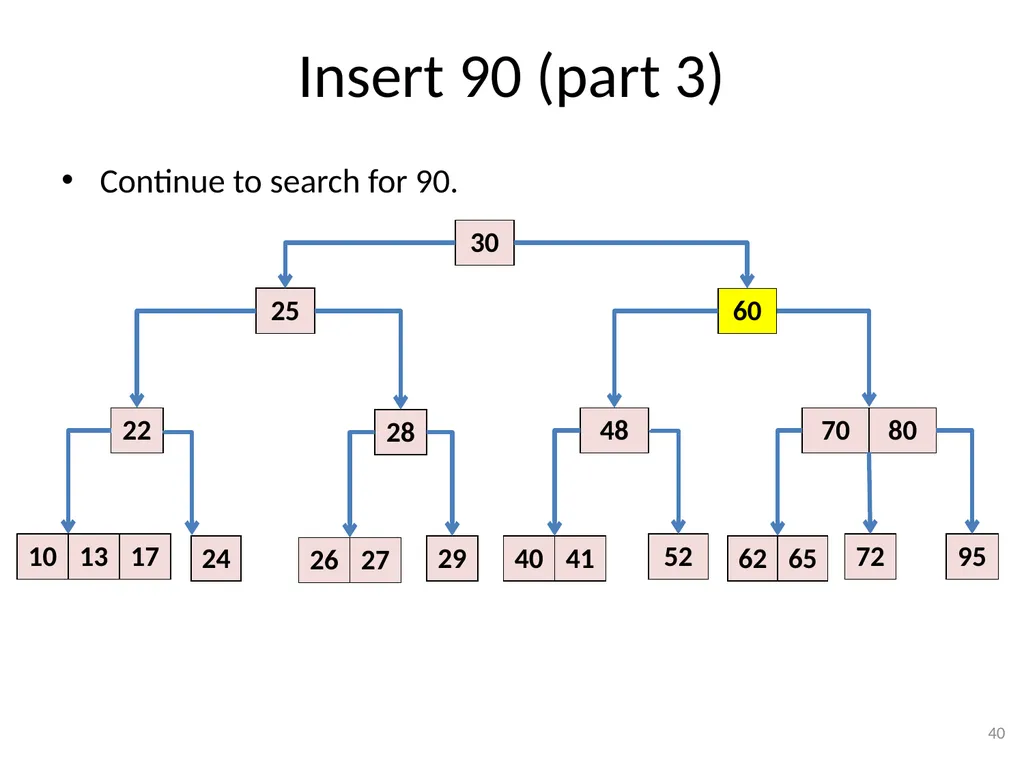
Insert 90 (part 3) Continue to search for 90. 40<br>
41
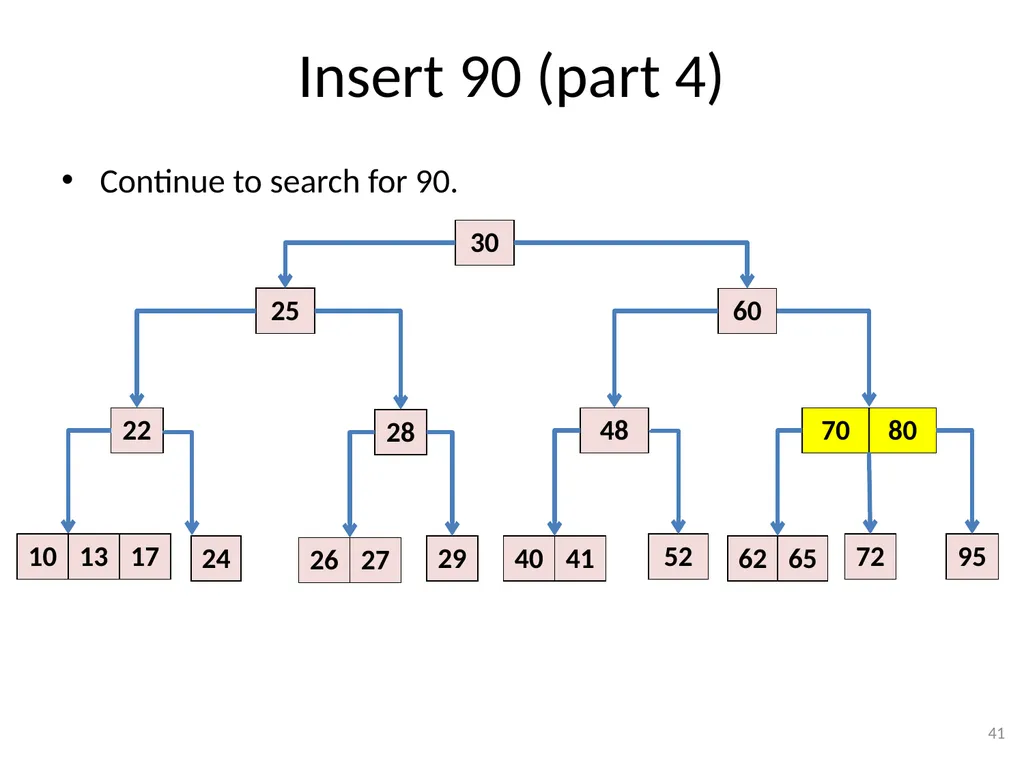
Insert 90 (part 4) Continue to search for 90. 41<br>
42
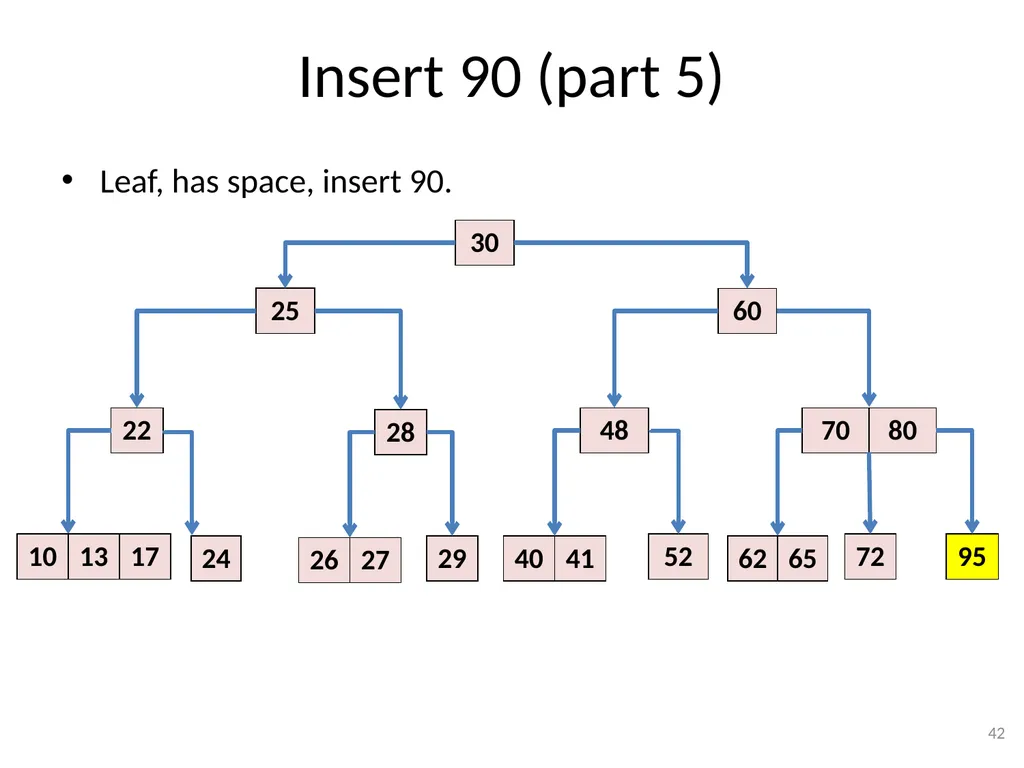
Insert 90 (part 5) Leaf, has space, insert 90. 42<br>
43
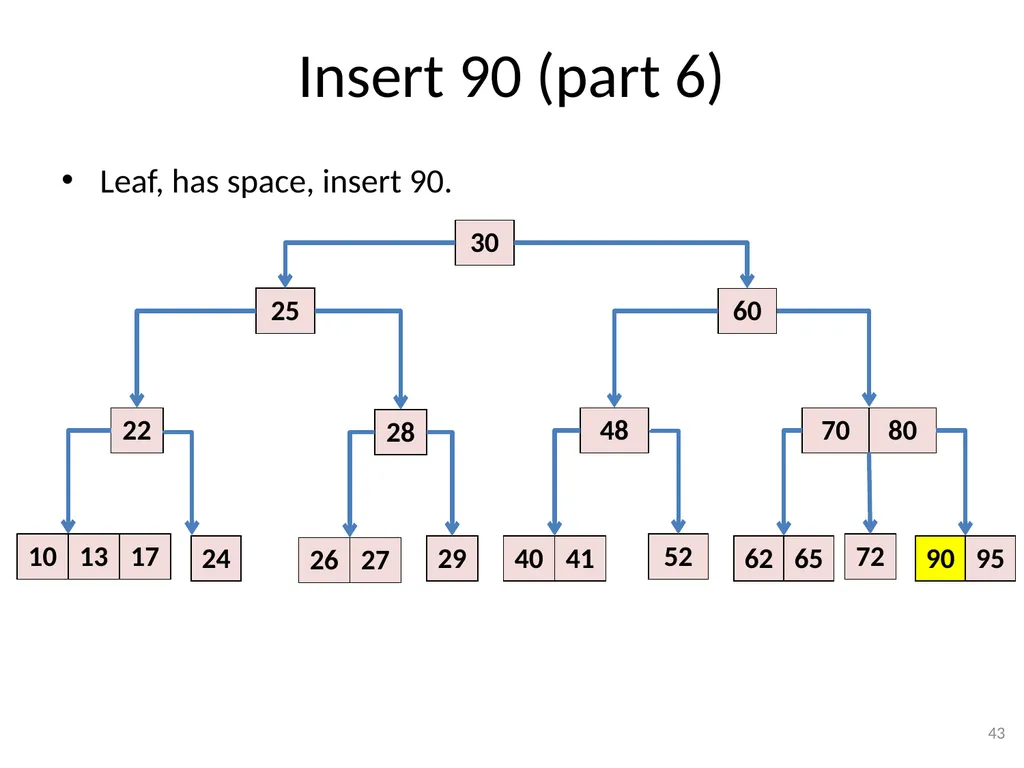
Insert 90 (part 6) Leaf, has space, insert 90. 43<br>
44
REMEMBER
our convention: premptive split If on your path to insert, you see a 4 node, you split it!
I will refer to this convention/choice as “preemptive split”
You do that even if there is room in the leaf and you can insert without splitting this node. 44<br>
I will refer to this convention/choice as “preemptive split”
You do that even if there is room in the leaf and you can insert without splitting this node. 44<br>
45
Example: Build a Tree In an empty tree, insert items given in order:
30, 99, 70, 60, 40, 66, 50, 53, 45, 42
On the Data Structures Visualization website, if you select Max degree = 4 and “preemptive split”, it will follow the same process. 45<br>
30, 99, 70, 60, 40, 66, 50, 53, 45, 42
On the Data Structures Visualization website, if you select Max degree = 4 and “preemptive split”, it will follow the same process. 45<br>
46
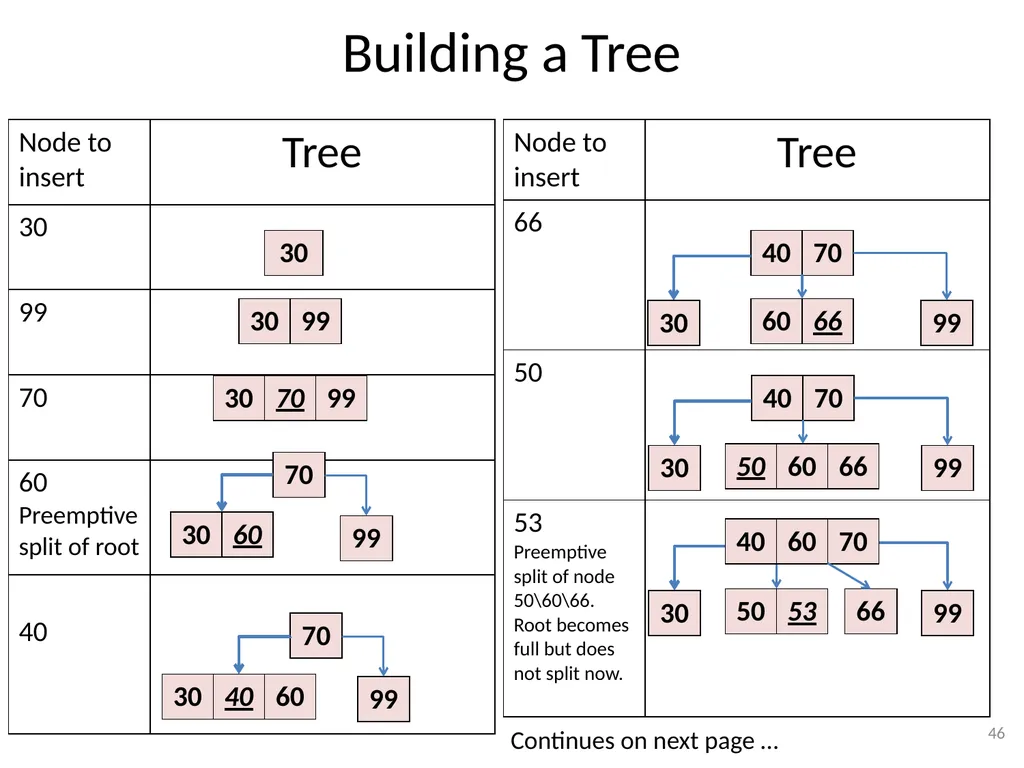
Building a Tree 46 Continues on next page …<br>
47
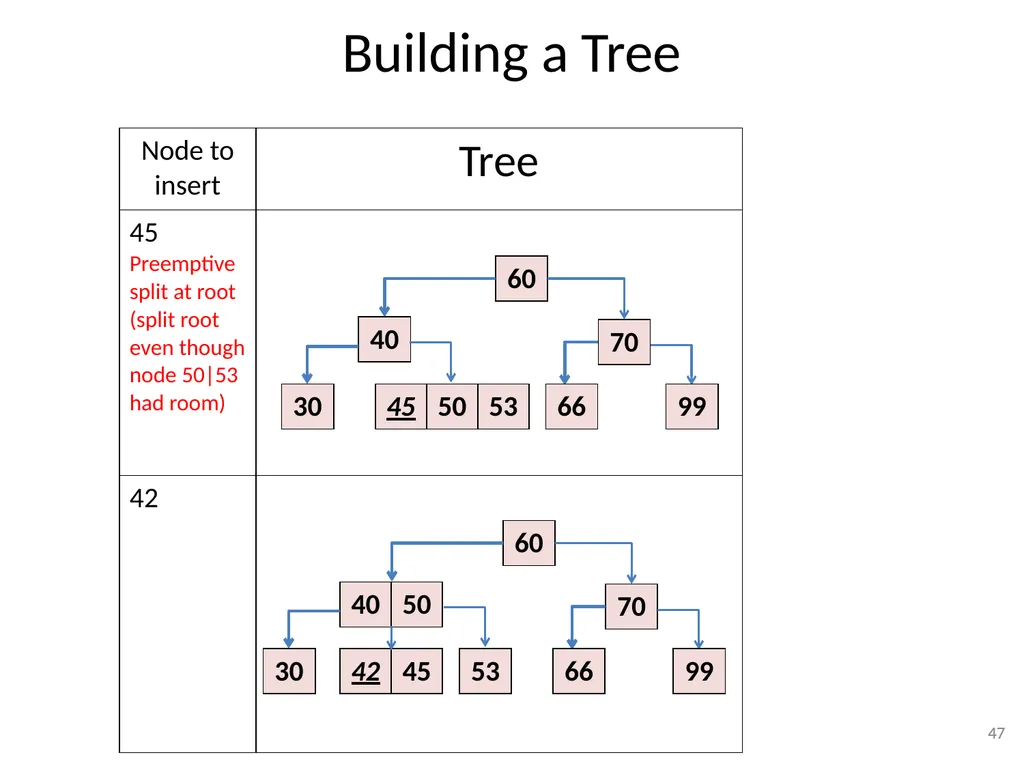
47 47 Building a Tree<br>
48
Deletion in 2-3-4 Trees More complicated.
Sedwick book does not cover it.
Idea: in order to delete item x (with key k) search for k. When find it:
If in a leaf remove it,
Else replace it with the successor of x, y. (y is the item with the first key larger than k.) Note: y will be in a leaf.
remove y and put it in place of x.
When removing y we have problems as with insert, but now the nodes may not have enough keys (need 2 or 3 keys) => fix nodes that have only one key on the path from root to y. 48<br>
Sedwick book does not cover it.
Idea: in order to delete item x (with key k) search for k. When find it:
If in a leaf remove it,
Else replace it with the successor of x, y. (y is the item with the first key larger than k.) Note: y will be in a leaf.
remove y and put it in place of x.
When removing y we have problems as with insert, but now the nodes may not have enough keys (need 2 or 3 keys) => fix nodes that have only one key on the path from root to y. 48<br>
49
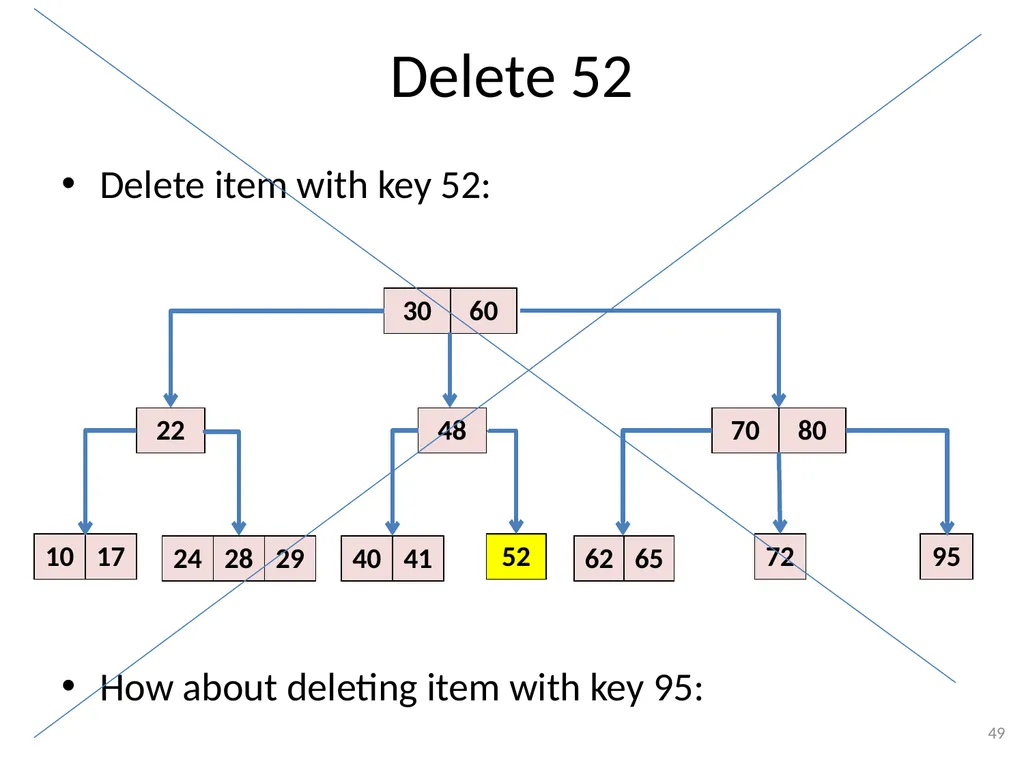
Delete 52 Delete item with key 52:
How about deleting item with key 95: 49<br>
How about deleting item with key 95: 49<br>
50
Deletion in 2-3-4 Trees Case 1: leaf has 2 or more items: remove y
Case 2: node on the path has 2 or more items: fine
Case 3: node on the path has only 1 item
A) Try to get a key from the sibling – must rotate with the parent key to preserve the order property
B) If no sibling has 2 or more keys, get a key from the parent and merge with your sibling neighboring that key.
C) The parent is the root and has only one key (and therefore exactly 2 children): merge the root and the 2 siblings together. 50<br>
Case 2: node on the path has 2 or more items: fine
Case 3: node on the path has only 1 item
A) Try to get a key from the sibling – must rotate with the parent key to preserve the order property
B) If no sibling has 2 or more keys, get a key from the parent and merge with your sibling neighboring that key.
C) The parent is the root and has only one key (and therefore exactly 2 children): merge the root and the 2 siblings together. 50<br>
51
Self Balancing Binary Trees Red-Black trees
AVL trees
Splay trees
…. 51<br>
AVL trees
Splay trees
…. 51<br>
52
Red-Black Red-Black trees (https://en.wikipedia.org/wiki/Red%E2%80%93black_tree)
Red & black nodes
Every node is either red or black
Root is black – CLRS requirement, but not in other works
a red node will have both his children black,
all NIL nodes are black (NIL = unexisting child node)
For every node, any path from it to a leaf will have the same number of black nodes (i.e. same ‘black height’) => actual path lengths differ by at most a factor of two (cannot have 2 consecutive red nodes)
2-3-4 trees can be mapped to red-black trees: 2-node = 1 black node, 3-node = 1 black & 1 red (left or right) 4 node = 1 black & 2 red children (see wikipedia) 52<br>
Red & black nodes
Every node is either red or black
Root is black – CLRS requirement, but not in other works
a red node will have both his children black,
all NIL nodes are black (NIL = unexisting child node)
For every node, any path from it to a leaf will have the same number of black nodes (i.e. same ‘black height’) => actual path lengths differ by at most a factor of two (cannot have 2 consecutive red nodes)
2-3-4 trees can be mapped to red-black trees: 2-node = 1 black node, 3-node = 1 black & 1 red (left or right) 4 node = 1 black & 2 red children (see wikipedia) 52<br>
53
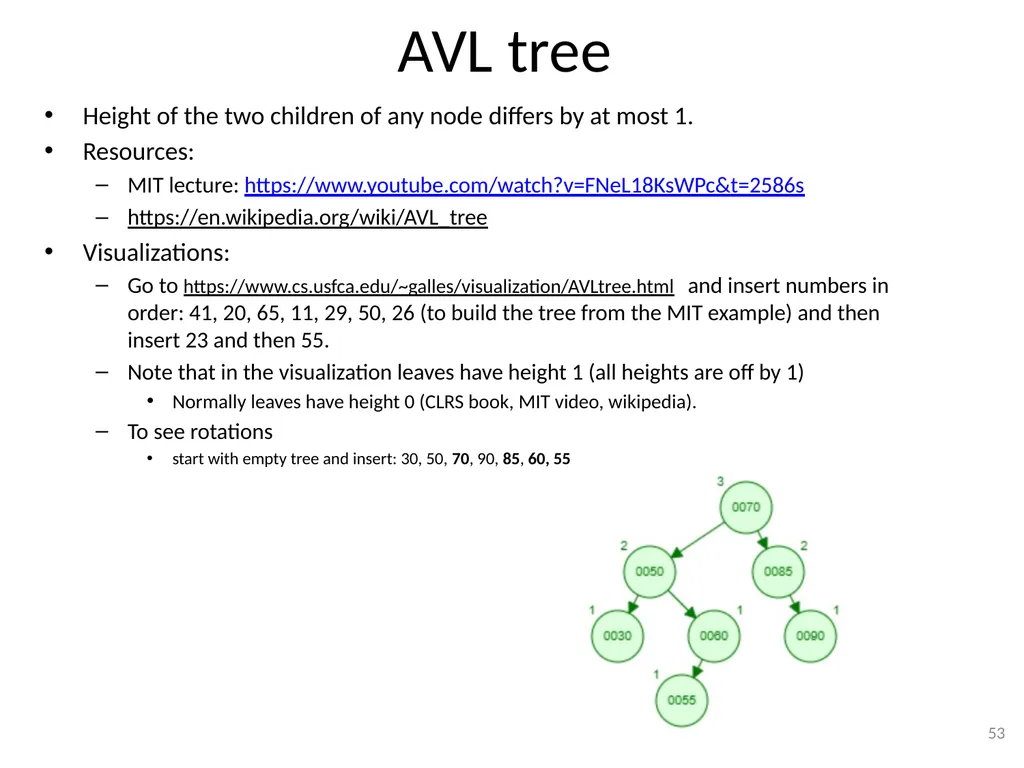
AVL tree Height of the two children of any node differs by at most 1.
Resources:
MIT lecture: https://www.youtube.com/watch?v=FNeL18KsWPc&t=2586s
https://en.wikipedia.org/wiki/AVL_tree
Visualizations:
Go to https://www.cs.usfca.edu/~galles/visualization/AVLtree.html and insert numbers in order: 41, 20, 65, 11, 29, 50, 26 (to build the tree from the MIT example) and then insert 23 and then 55.
Note that in the visualization leaves have height 1 (all heights are off by 1)
Normally leaves have height 0 (CLRS book, MIT video, wikipedia).
To see rotations
start with empty tree and insert: 30, 50, 70, 90, 85, 60, 55 53<br>
Resources:
MIT lecture: https://www.youtube.com/watch?v=FNeL18KsWPc&t=2586s
https://en.wikipedia.org/wiki/AVL_tree
Visualizations:
Go to https://www.cs.usfca.edu/~galles/visualization/AVLtree.html and insert numbers in order: 41, 20, 65, 11, 29, 50, 26 (to build the tree from the MIT example) and then insert 23 and then 55.
Note that in the visualization leaves have height 1 (all heights are off by 1)
Normally leaves have height 0 (CLRS book, MIT video, wikipedia).
To see rotations
start with empty tree and insert: 30, 50, 70, 90, 85, 60, 55 53<br>
54
Splay trees Self adjusting: the items used more recently (inserted or read) move towards the top.
Good for data with non-uniform distribution
The tree is not balanced, but performs well because it brings the frequently used items to the top.
Splay insertion: the new item is inserted at the root by a rotation that replaces a node with his grandchild.
Search in the tree for the new node. It takes you to a leaf location. Insert new node there and continue with repeated rotations to bring it to the root. This process will reduce the length of that original path to half (because with each rotation, the grandchild node moves two levels up => the path on which these rotations are done, is cut in half).
See visualization: https://www.cs.usfca.edu/~galles/visualization/SplayTree.html
For more on splay trees see Sedgewick, pages 540-546. 54<br>
Good for data with non-uniform distribution
The tree is not balanced, but performs well because it brings the frequently used items to the top.
Splay insertion: the new item is inserted at the root by a rotation that replaces a node with his grandchild.
Search in the tree for the new node. It takes you to a leaf location. Insert new node there and continue with repeated rotations to bring it to the root. This process will reduce the length of that original path to half (because with each rotation, the grandchild node moves two levels up => the path on which these rotations are done, is cut in half).
See visualization: https://www.cs.usfca.edu/~galles/visualization/SplayTree.html
For more on splay trees see Sedgewick, pages 540-546. 54<br>
55
Java TreeMap – Red-Black tree
TreeSet – implementation based on TreeMap 55<br>
TreeSet – implementation based on TreeMap 55<br>