2013 MAPP Project (2yrs): Exploration of advanced ocean data assimilation schemes at NCEP PIs: Jim Carton Eugenia Kalnay (UMD), David Behringer Hendrik Tolman (NOAANCEP) These results are produced by Steve Penny (UMDNOAA) Grant
"2013 MAPP Project (2yrs): Exploration of advanced" is the property of its rightful owner. Permission is granted to
download and print the materials on this website for personal, non-commercial use only, and to display it
on your personal computer provided you do not modify the materials and that you retain all copyright
notices contained in the materials. By downloading content from our website, you accept the terms of this
agreement.
Presentation Transcript
01
2013 MAPP Project (2yrs): Exploration of advanced ocean data assimilation schemes at NCEP PIs: Jim Carton & Eugenia Kalnay (UMD), David Behringer & Hendrik Tolman (NOAA/NCEP)
These results are produced by Steve Penny (UMD/NOAA) Grant Objective: explore the relative merits of different assimilation schemes: 3DVar, LETKF, and a hybrid filter in the context of NCEP’s GODAS ocean analysis
This Presentation: a 5mo long comparison of 3DVar GODAS and a HYBRID GODAS (DEC, 2010 – APR, 2011) Progress Report & Plans AOSC/NOAA Ocean Data Assimilation 1<br>
02
Grid: Global tripolar grid, 1/4-1/2 deg x 40Lev res
Physics: MOM4P1, KPP boundary layer mixing scheme, GM isopycnal tracer mixing, Smagorinsky velocity mixing, free surface, sea ice.
Forcing: Wind stress, heat flux, E-P from GEFS, SSS relaxed to Levitus monthly climatology with a 10day relaxation.
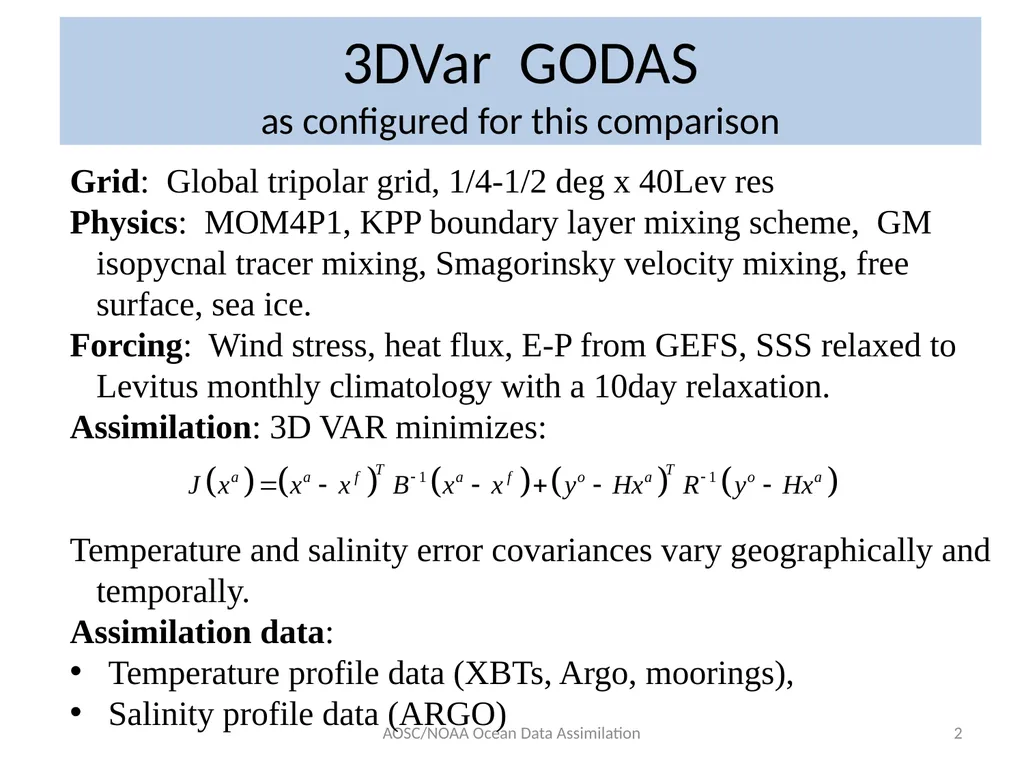
Assimilation: 3D VAR minimizes:
Temperature and salinity error covariances vary geographically and temporally.
Assimilation data:
Temperature profile data (XBTs, Argo, moorings),
Salinity profile data (ARGO) 3DVar GODAS as configured for this comparison AOSC/NOAA Ocean Data Assimilation 2<br>
03
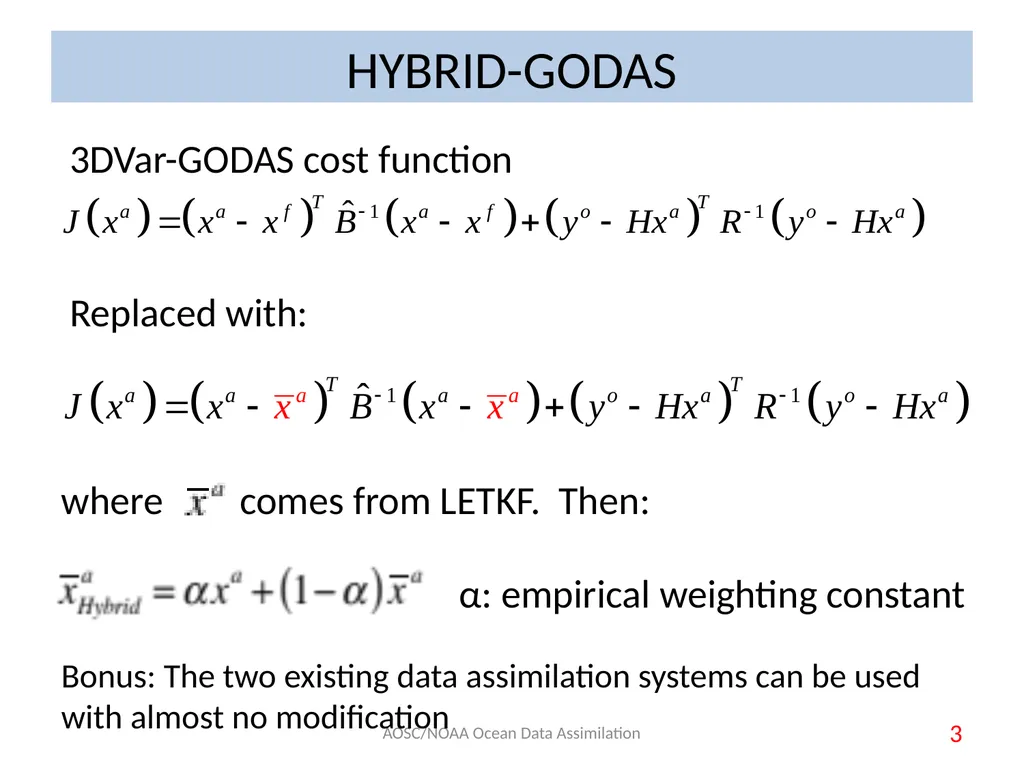
HYBRID-GODAS Replaced with: where comes from LETKF. Then: 3DVar-GODAS cost function Bonus: The two existing data assimilation systems can be used with almost no modification α: empirical weighting constant AOSC/NOAA Ocean Data Assimilation 3<br>
04
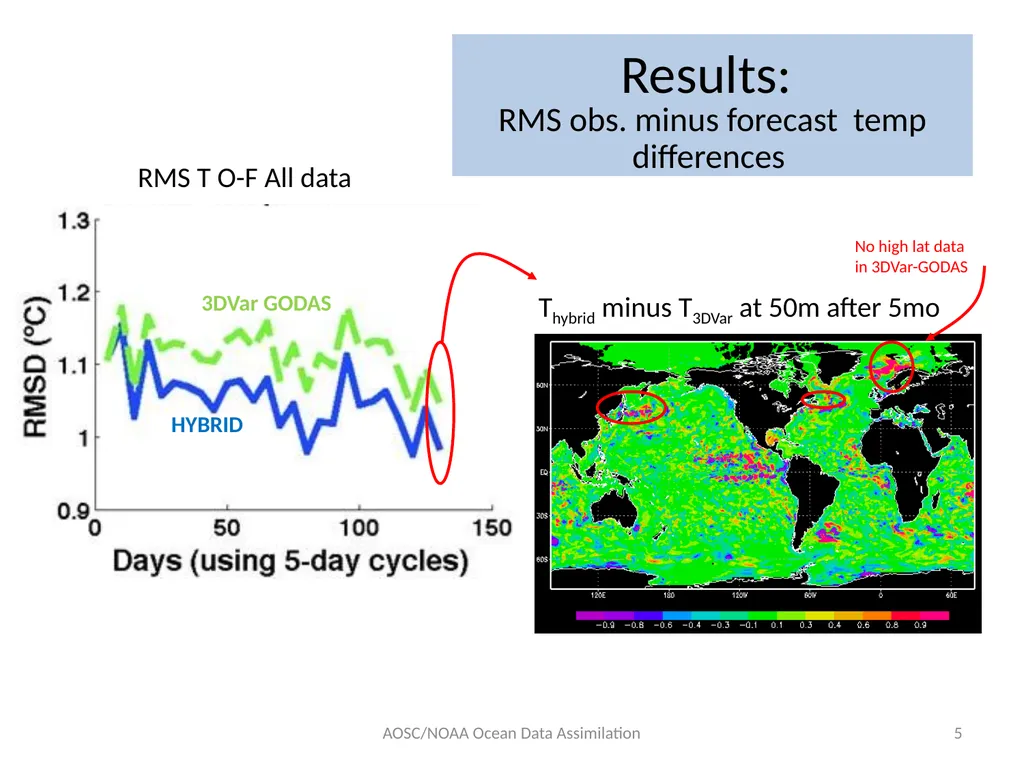
Comparison Experiment: 3DVar-GODAS vs Hybrid-GODAS Time Period: 12/2/2010 – 4/5/2011 (~ 5 months) La Nina conditions peak in January (very high SOI), fade by May.
Ocean model: same as 3DVar GODAS
Initial conditions: from a 10-year operational GODAS analysis using NCEP R2 surface forcing. Perturbations introduced to create initial ensemble.
Analysis Cycle: 5dy cycle, 5dy observation window
Time filtering: none
Observations: profile T, S (typically 1500/5dy)
Forcing: GEFS winds, heating, freshwater
Hybrid ensemble: 20-member ensemble with α = 1.0. No inflation in the ocean interior.
We’ll focus on statistics of temperature observation minus forecast differences AOSC/NOAA Ocean Data Assimilation 4<br>
05
Results: RMS obs. minus forecast temp differences RMS T O-F All data 3DVar GODAS HYBRID Thybrid minus T3DVar at 50m after 5mo AOSC/NOAA Ocean Data Assimilation 5 No high lat data in 3DVar-GODAS<br>
06
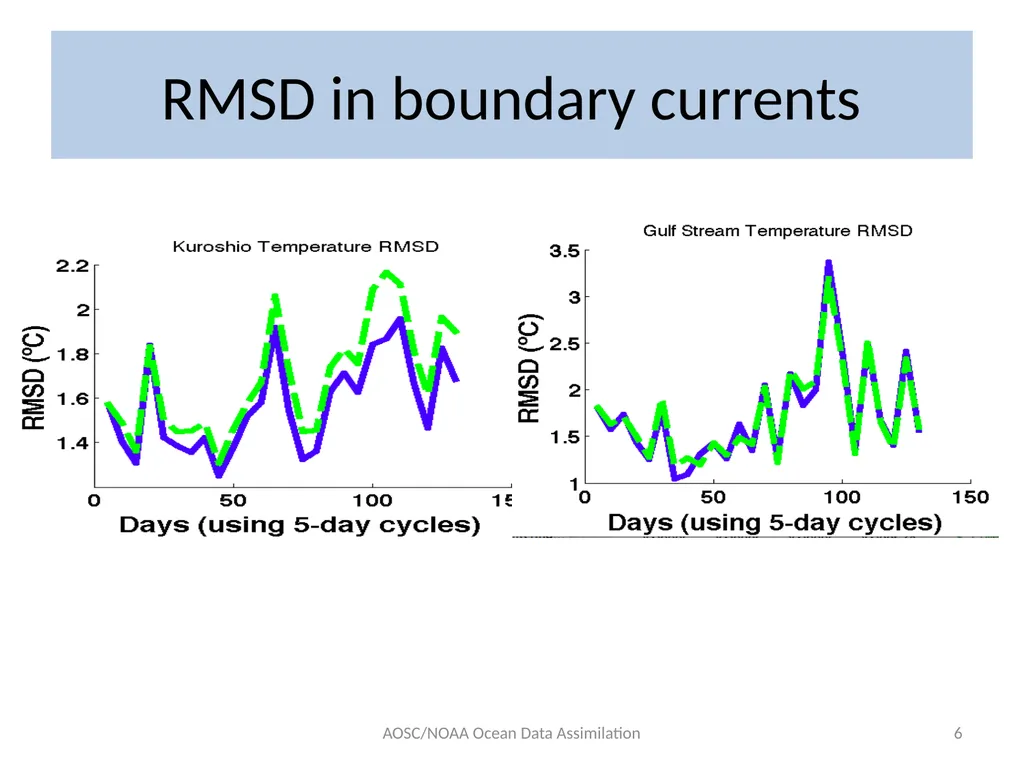
RMSD in boundary currents AOSC/NOAA Ocean Data Assimilation 6<br>
07
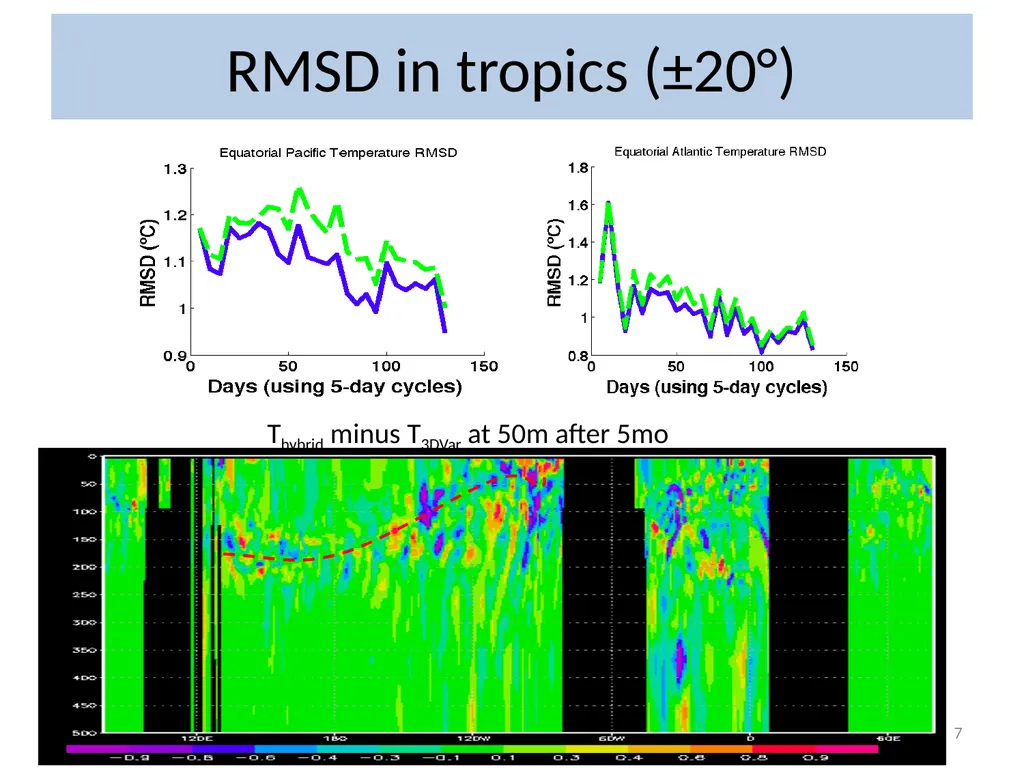
RMSD in tropics (±20°) Thybrid minus T3DVar at 50m after 5mo AOSC/NOAA Ocean Data Assimilation 7<br>
08
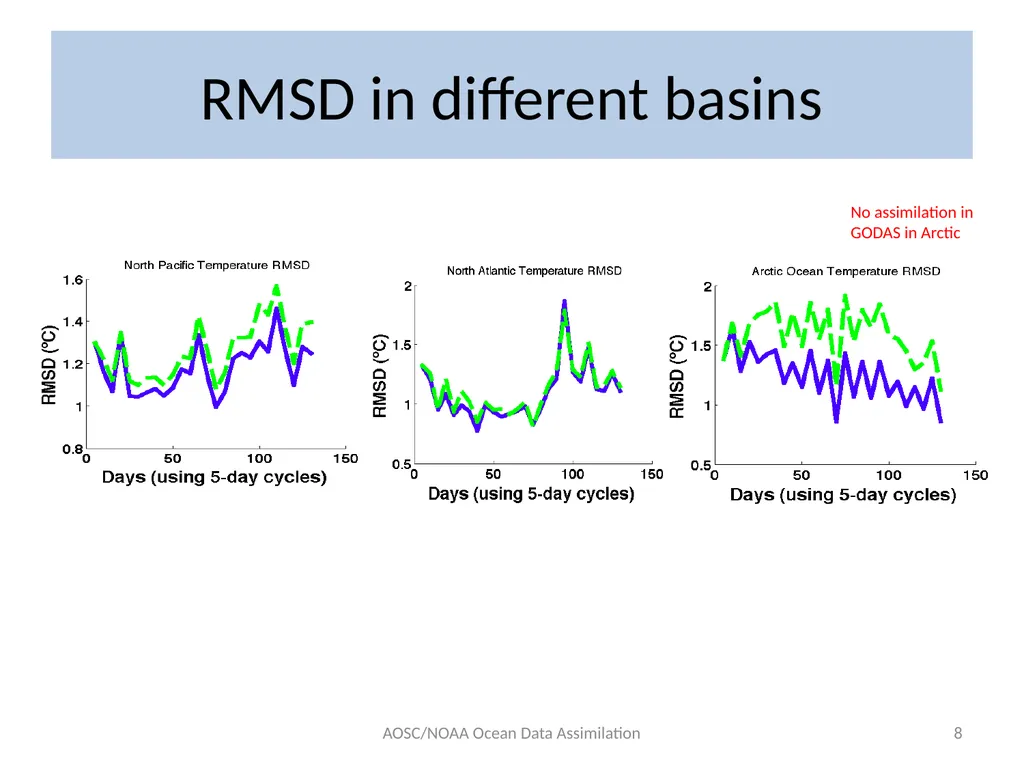
RMSD in different basins No assimilation in GODAS in Arctic AOSC/NOAA Ocean Data Assimilation 8<br>
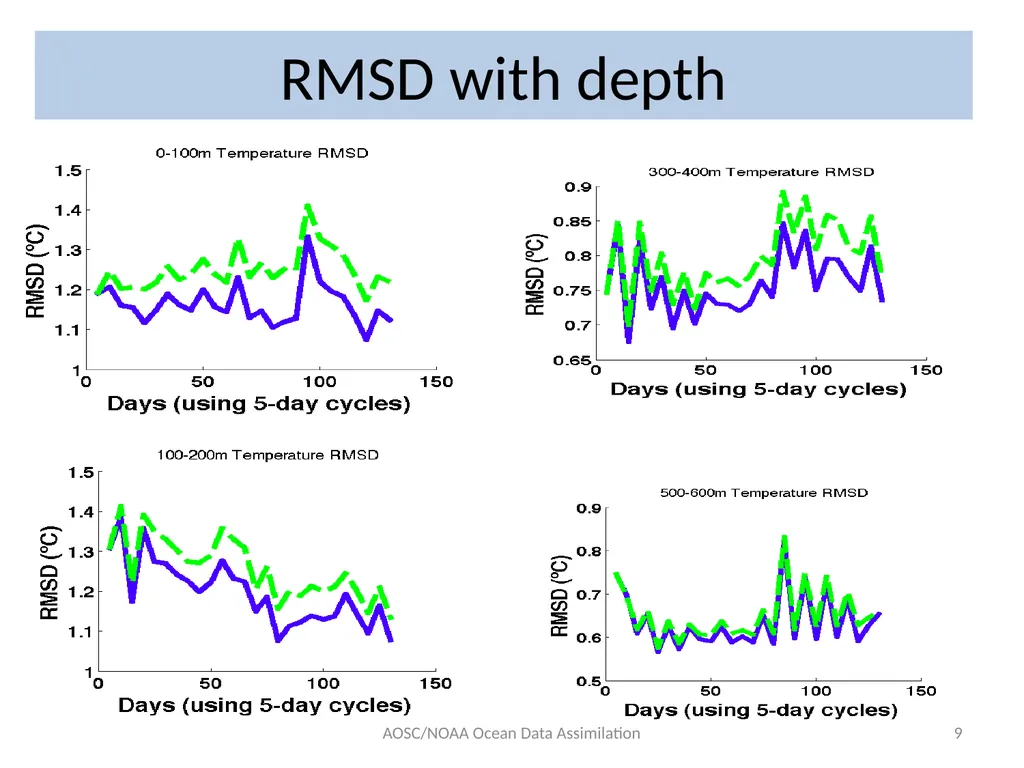
09
RMSD with depth AOSC/NOAA Ocean Data Assimilation 9<br>
10
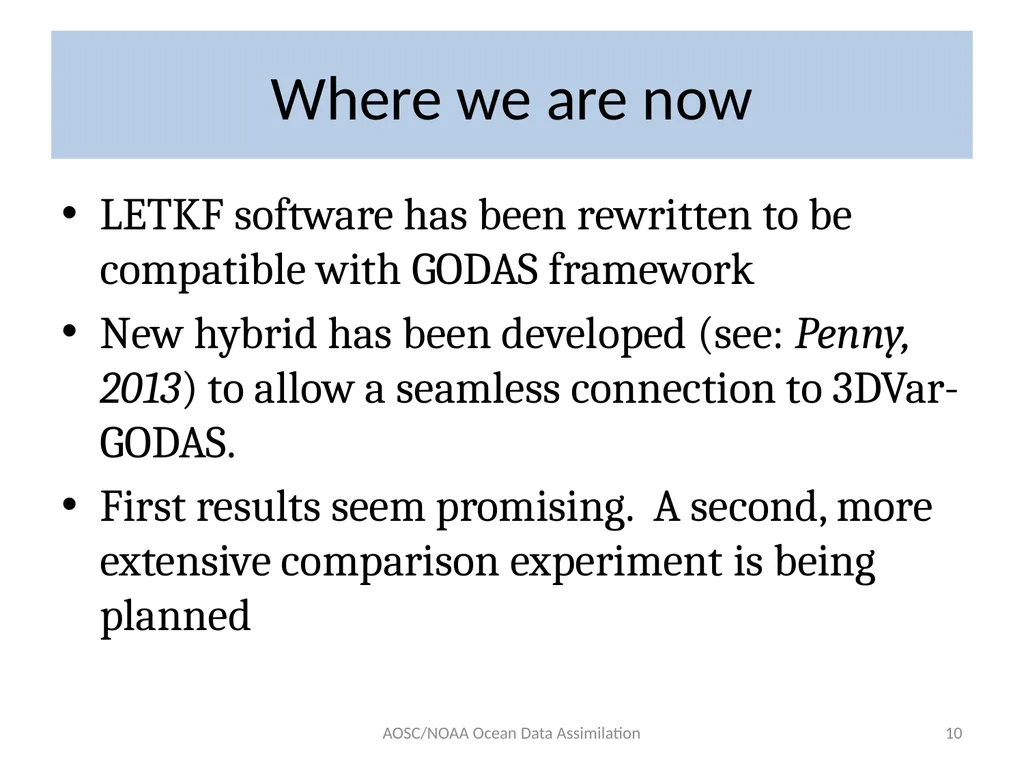
Where we are now LETKF software has been rewritten to be compatible with GODAS framework
New hybrid has been developed (see: Penny, 2013) to allow a seamless connection to 3DVar-GODAS.
First results seem promising. A second, more extensive comparison experiment is being planned AOSC/NOAA Ocean Data Assimilation 10<br>
11
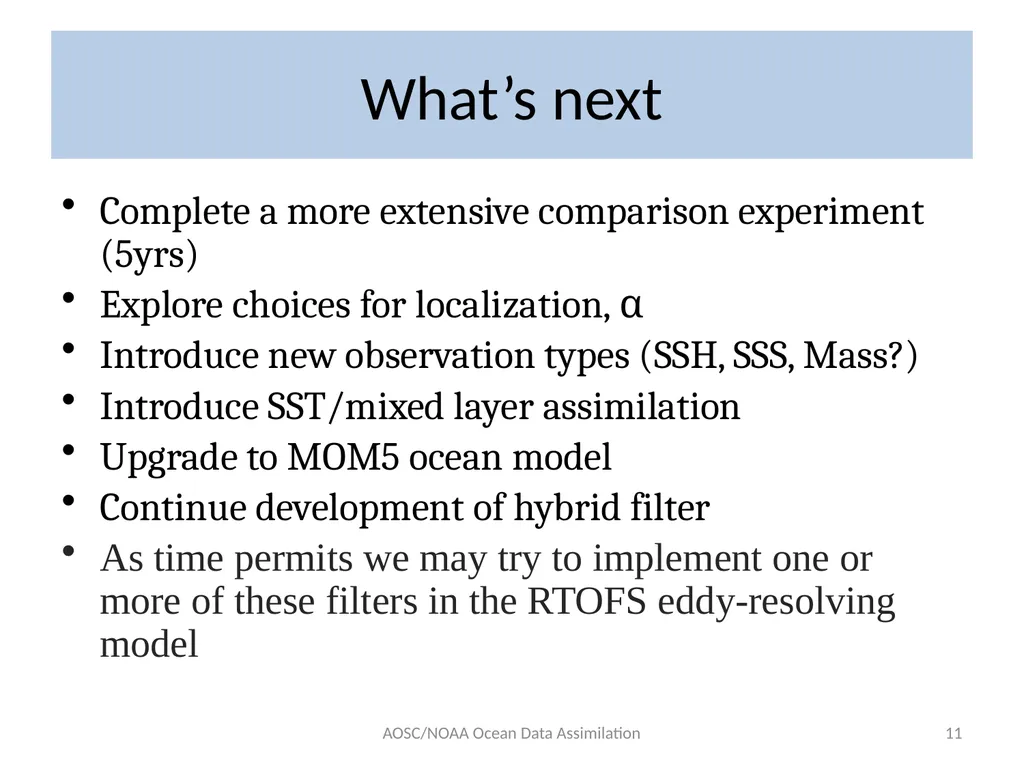
What’s next Complete a more extensive comparison experiment (5yrs)
Explore choices for localization, α
Introduce new observation types (SSH, SSS, Mass?)
Introduce SST/mixed layer assimilation
Upgrade to MOM5 ocean model
Continue development of hybrid filter
As time permits we may try to implement one or more of these filters in the RTOFS eddy-resolving model AOSC/NOAA Ocean Data Assimilation 11<br>