
2014 Final Year Engineering Student Survey -


Description: 2014 Final Year Engineering Student Survey - Atlantic Report Conducted by Ipsos Reid on behalf of Engineers Canada May 2014 Table of Contents Research Objectives 3 Methodology 4 Key Highlights 6 Executive Summary 7 Future Plans 11 Intention
Related Topics
Download Presentation
"2014 Final Year Engineering Student Survey -" is the property of its rightful owner. Permission is granted to download and print the materials on this website for personal, non-commercial use only, and to display it on your personal computer provided you do not modify the materials and that you retain all copyright notices contained in the materials. By downloading content from our website, you accept the terms of this agreement.
Presentation Transcript
slide1. 2014 Final Year Engineering Student Survey - Atlantic Report
Conducted by Ipsos Reid on behalf of Engineers Canada May 2014<br>
slide2. Table of Contents Research Objectives 3
Methodology 4
Key Highlights 6
Executive Summary 7
Future Plans 11
Intention to Apply for Licensure 17
Licensing Knowledge 28
Knowledge of Association of Professional Engineers 34
Knowledge of Professional Engineers Act 37
Appetite for Career Assessment Tool 40
Demographics 45
Additional Analysis: Impact on Intention to Pursue
Attendance at Workshop/Seminar 49
Knowledge of PEA 52
Knowledge of Licensing and Roles 55
Knowledge of Organizational Responsibility 58 2<br>
slide3. Research Objectives The primary objective of this research is to understand the reasons why graduates of CEAB accredited engineering programs at Atlantic universities do or do not intend to apply for their licence.
In order to achieve this objective, the research seeks to understand the following:
The future career and/or education plans of final year engineering students;
The percentage of final year engineering students who intend to pursue a career in Engineering and the percentage who intend to apply for their P.Eng licence;
Final year engineering students’ level of knowledge of the Professional Engineers Act of their province. 3<br>
slide4. Methodology The online survey was conducted between January 27 to March 14, 2014 with final year engineering students.
All university Faculties of Engineering with CEAB accredited programs were invited to participate in the study and were asked to send the online survey to all final year engineering students registered in their Engineering program.
The link to the online survey was sent to the universities and each school was requested to send the survey link to all qualified students on January 27, 2014.
The survey was offered in both English and French.
A total of 39 universities participated in the research and 2,046 students completed the survey. Within Atlantic provinces specifically, 4 schools participated and a total of n=154 students completed the survey.
The margin of error for this study (n=154) is ± 8.0%, 19 times out of 20. 4<br>
slide5. Methodology (cont’d) For certain questions, the base size was too low to include in reporting. These include:
Q16, Q17 and Q18 (only n=3 responded to these questions)
Q23 (only n=3 responded to this question)
Please note: base sizes under n=30 are considered very small and should be interpreted with caution 5<br>
slide6. Key Highlights Compared to last year, we have observed little statistically significant movement in terms of students’ intentions to pursue a career in engineering or to apply for licensure.
There has however been a slight softening of definite intentions to pursue a career in engineering, however overall intentions remain strong. We have also noticed the opposite in terms of intentions to apply for licensure with a directional increase in definite intentions. These measures will be important to watch moving forward to see if the incremental movement observed this year develops into a trend.
While virtually all students continue to report they are likely (definitely/ probably) to pursue a career in engineering (98% vs. 98% in 2013), directionally fewer students definitely will than in the past (76% down from 83% last year).
Overall, two thirds (66%) of final year engineering students are at least probably likely to apply for licensure, unchanged over the past year (68% in 2013), however the proportion who are definitely likely has increased slightly versus 2013 (45% vs. 40%).
There has also been some declines in terms of students’ knowledge regarding the engineering profession year over year. Compared to 2013, we notice an increase in those students’ who have a low level of knowledge regarding licensing and roles within the profession (8% vs. 2% in 2013), however the vast majority continue to have a high or moderate level of knowledge (90% vs. 94%).
Specifically, there has been a directional decline in the proportion of students who know that a licence is required to perform engineering work independently (87% vs. 92% in 2013). 6<br>
slide7. Executive Summary Future Intentions: Continuing Education Versus Entering Workforce
More than eight in ten (85%) final year engineering students say they intend to go into the workforce after graduating with their bachelors degree in Engineering, while one in ten (9%) students intend to pursue more education.
Of those who intend on pursuing more education, the vast majority (n=12) plan to pursue a graduate degree in engineering. Due to very small base sizes, results should be interpreted with caution.
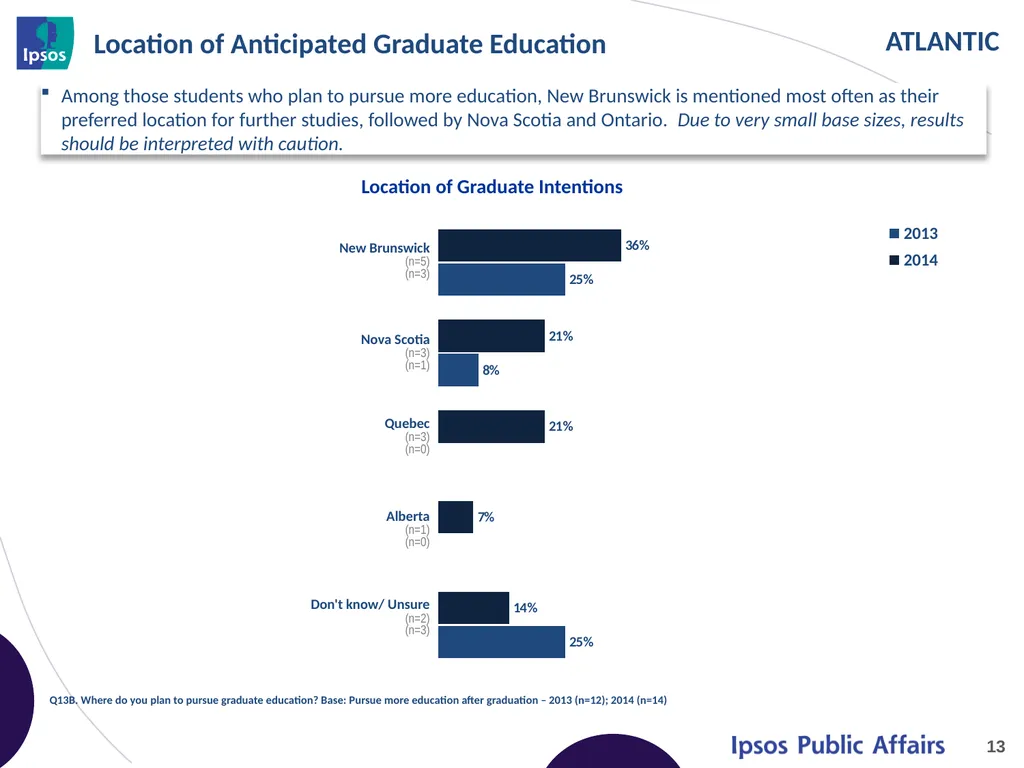
Among those students who plan to pursue more education, New Brunswick is mentioned most often as their preferred location for further studies, followed by Nova Scotia and Ontario.
Future Intentions: Engineering Career
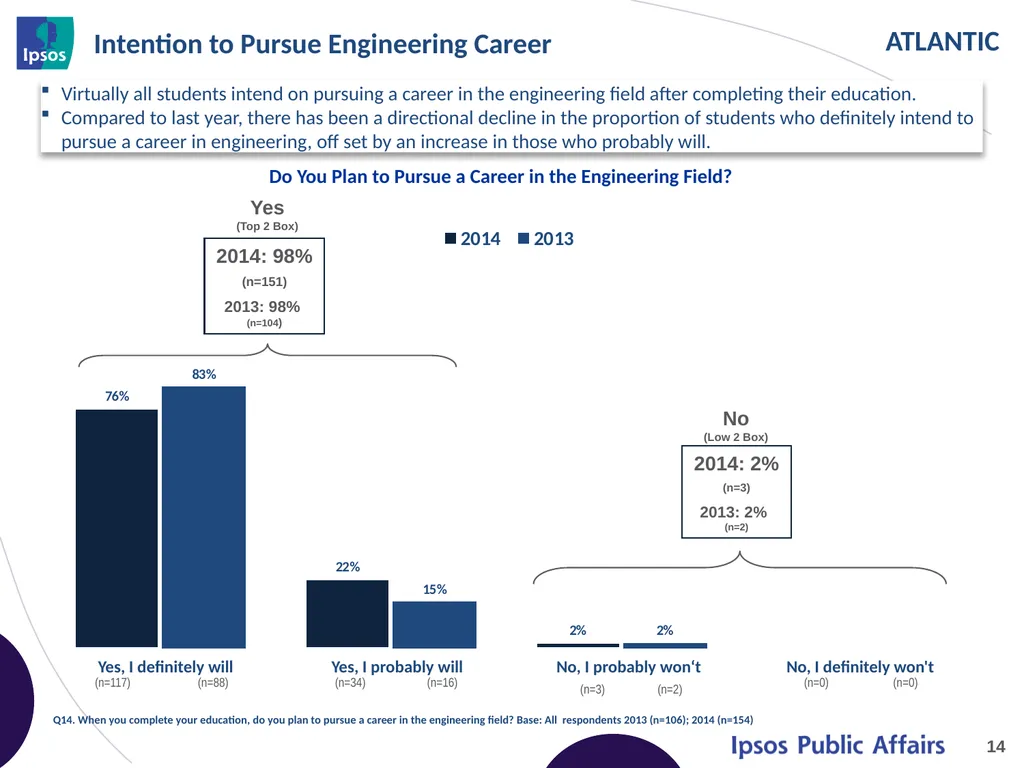
Virtually all students (98%) say they are likely to pursue a career in engineering, three quarters definitely will (76%) while slightly more than two in ten probably will (22%). Very few students (2%) probably will not pursue a career in engineering, while none indicate they definitely will not.
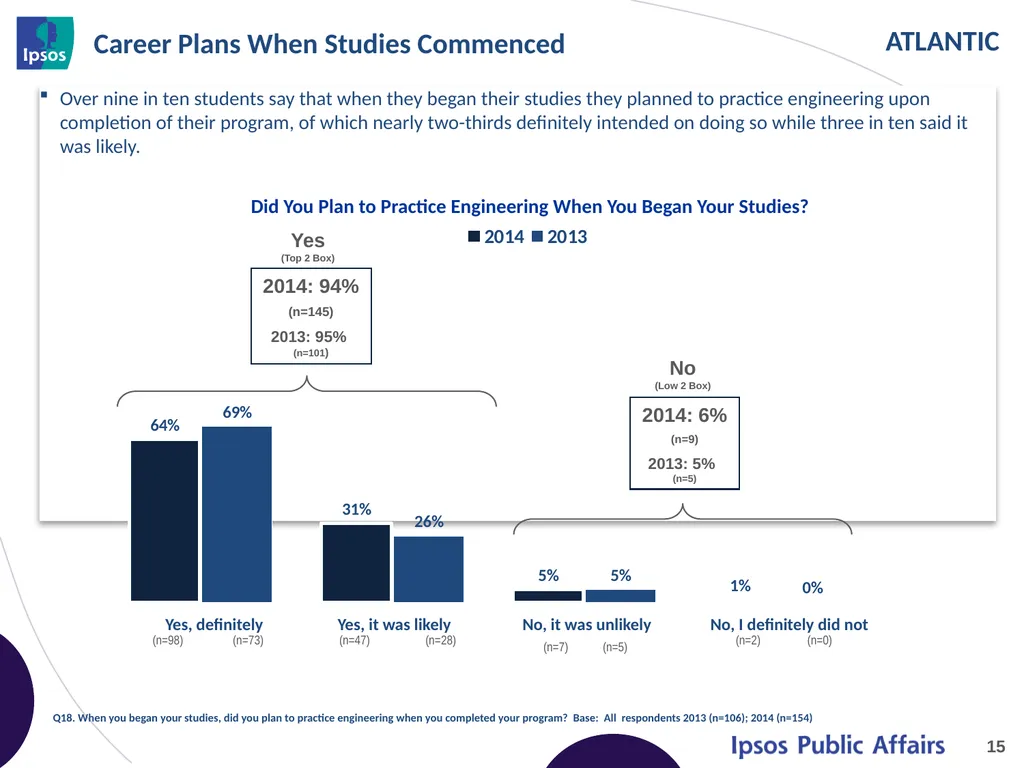
Over nine in ten (94%) students say that when they began their studies they planned to practice engineering upon completion of their program. Two thirds of students began their undergraduate studies with a definite intention to pursue an engineering career (64%), while three in ten said it was likely (31%). 7<br>
slide8. Executive Summary (continued) Future Intentions: Engineering Career (continued)
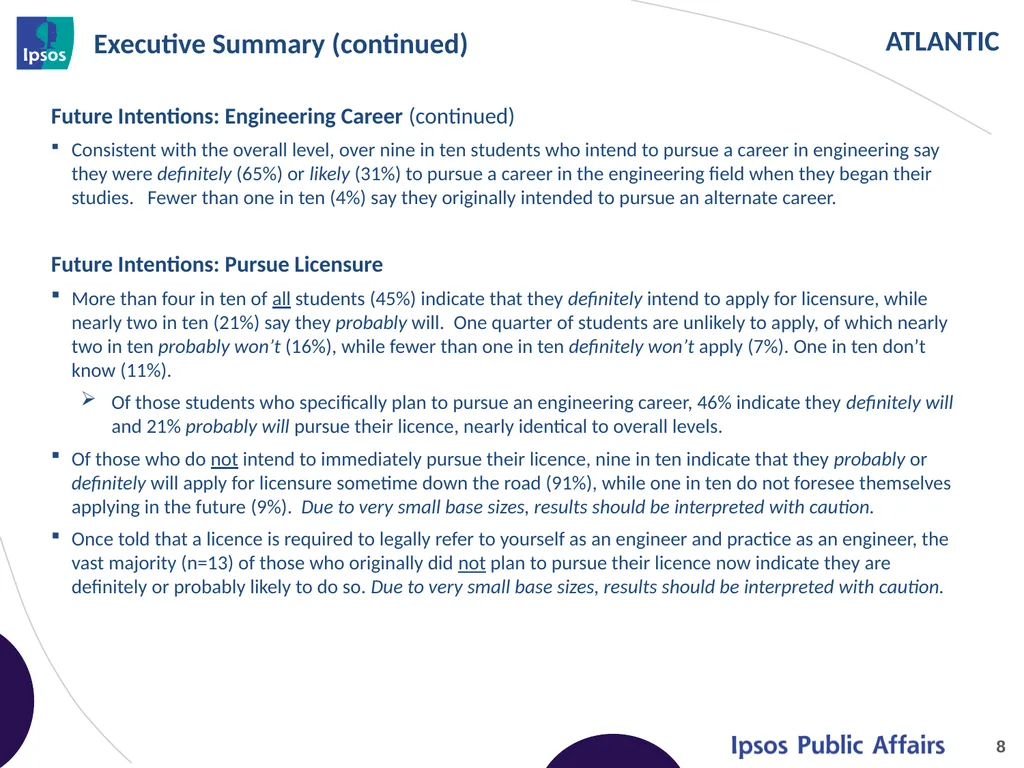
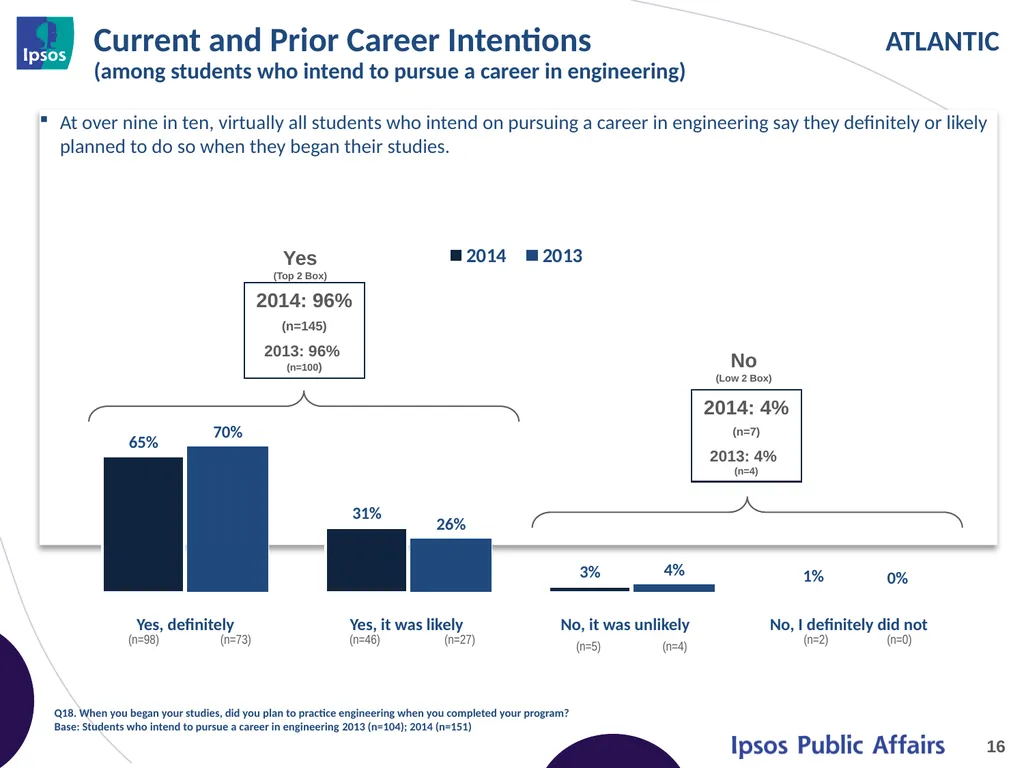
Consistent with the overall level, over nine in ten students who intend to pursue a career in engineering say they were definitely (65%) or likely (31%) to pursue a career in the engineering field when they began their studies. Fewer than one in ten (4%) say they originally intended to pursue an alternate career.
Future Intentions: Pursue Licensure
More than four in ten of all students (45%) indicate that they definitely intend to apply for licensure, while nearly two in ten (21%) say they probably will. One quarter of students are unlikely to apply, of which nearly two in ten probably won’t (16%), while fewer than one in ten definitely won’t apply (7%). One in ten don’t know (11%).
Of those students who specifically plan to pursue an engineering career, 46% indicate they definitely will and 21% probably will pursue their licence, nearly identical to overall levels.
Of those who do not intend to immediately pursue their licence, nine in ten indicate that they probably or definitely will apply for licensure sometime down the road (91%), while one in ten do not foresee themselves applying in the future (9%). Due to very small base sizes, results should be interpreted with caution.
Once told that a licence is required to legally refer to yourself as an engineer and practice as an engineer, the vast majority (n=13) of those who originally did not plan to pursue their licence now indicate they are definitely or probably likely to do so. Due to very small base sizes, results should be interpreted with caution. 8<br>
slide9. Executive Summary (continued) Future Intentions: Pursue Licensure (continued)
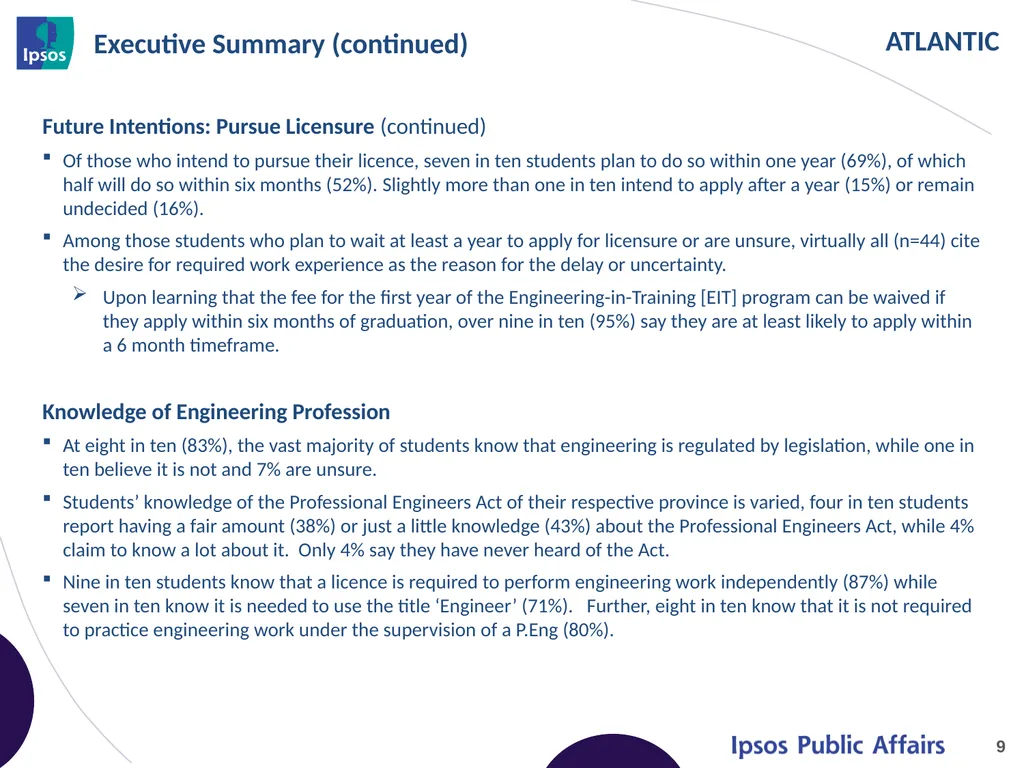
Of those who intend to pursue their licence, seven in ten students plan to do so within one year (69%), of which half will do so within six months (52%). Slightly more than one in ten intend to apply after a year (15%) or remain undecided (16%).
Among those students who plan to wait at least a year to apply for licensure or are unsure, virtually all (n=44) cite the desire for required work experience as the reason for the delay or uncertainty.
Upon learning that the fee for the first year of the Engineering-in-Training [EIT] program can be waived if they apply within six months of graduation, over nine in ten (95%) say they are at least likely to apply within a 6 month timeframe.
Knowledge of Engineering Profession
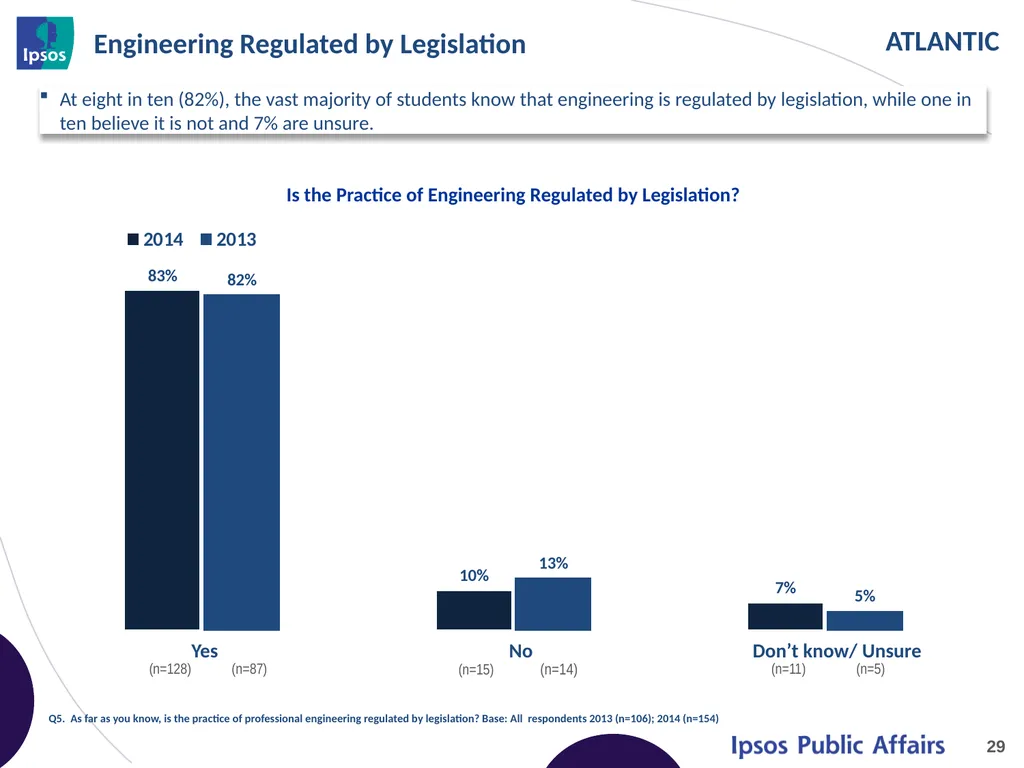
At eight in ten (83%), the vast majority of students know that engineering is regulated by legislation, while one in ten believe it is not and 7% are unsure.
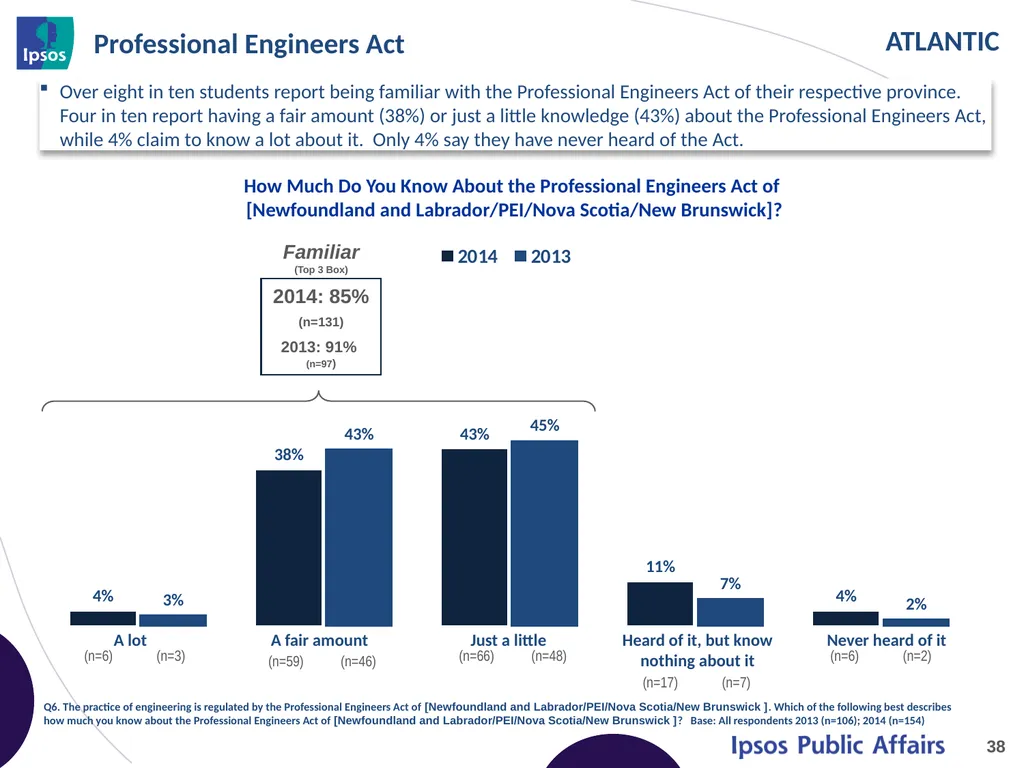
Students’ knowledge of the Professional Engineers Act of their respective province is varied, four in ten students report having a fair amount (38%) or just a little knowledge (43%) about the Professional Engineers Act, while 4% claim to know a lot about it. Only 4% say they have never heard of the Act.
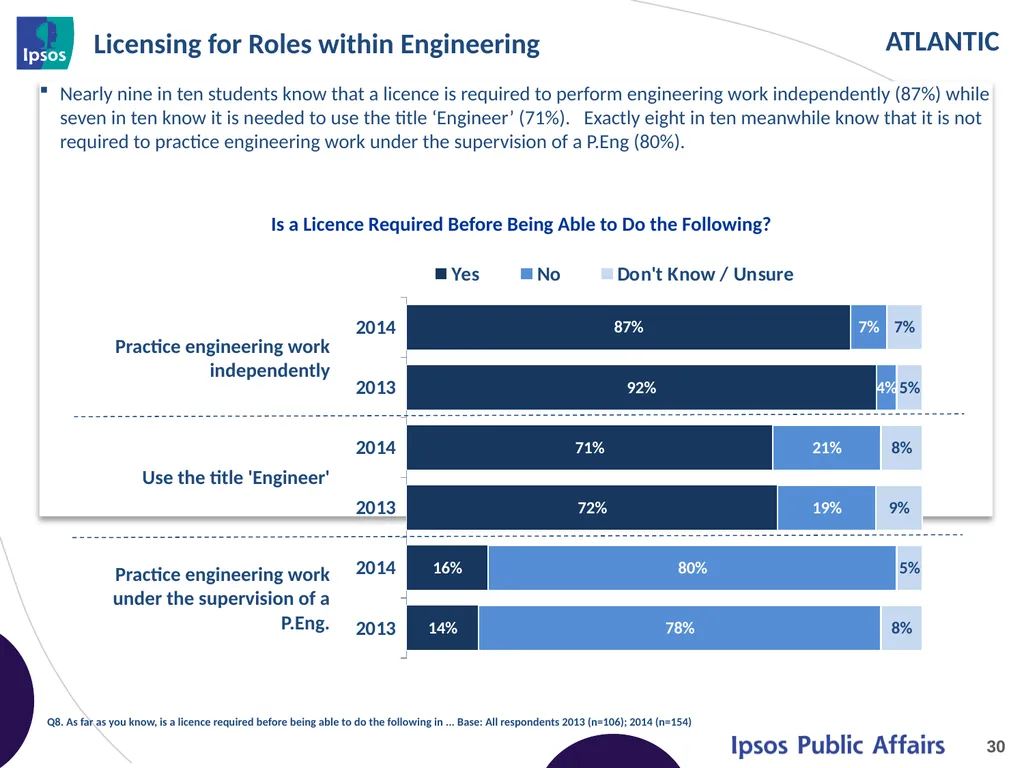
Nine in ten students know that a licence is required to perform engineering work independently (87%) while seven in ten know it is needed to use the title ‘Engineer’ (71%). Further, eight in ten know that it is not required to practice engineering work under the supervision of a P.Eng (80%). 9<br>
slide10. Executive Summary (continued) Knowledge of Engineering Profession (continued)
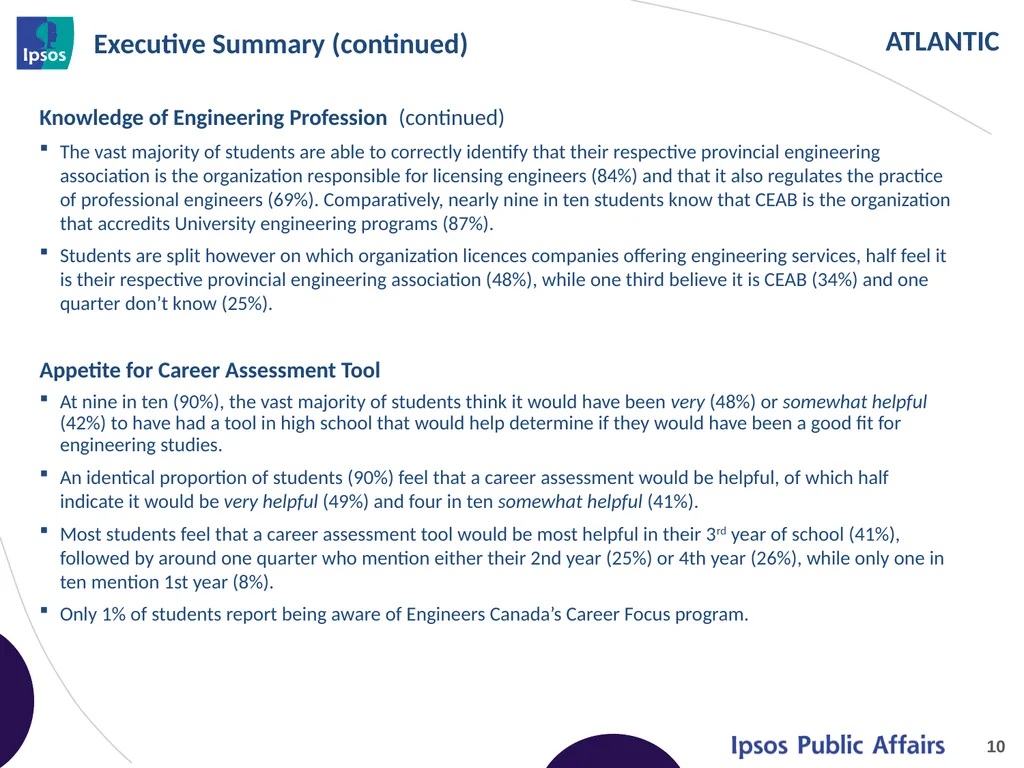
The vast majority of students are able to correctly identify that their respective provincial engineering association is the organization responsible for licensing engineers (84%) and that it also regulates the practice of professional engineers (69%). Comparatively, nearly nine in ten students know that CEAB is the organization that accredits University engineering programs (87%).
Students are split however on which organization licences companies offering engineering services, half feel it is their respective provincial engineering association (48%), while one third believe it is CEAB (34%) and one quarter don’t know (25%).
Appetite for Career Assessment Tool
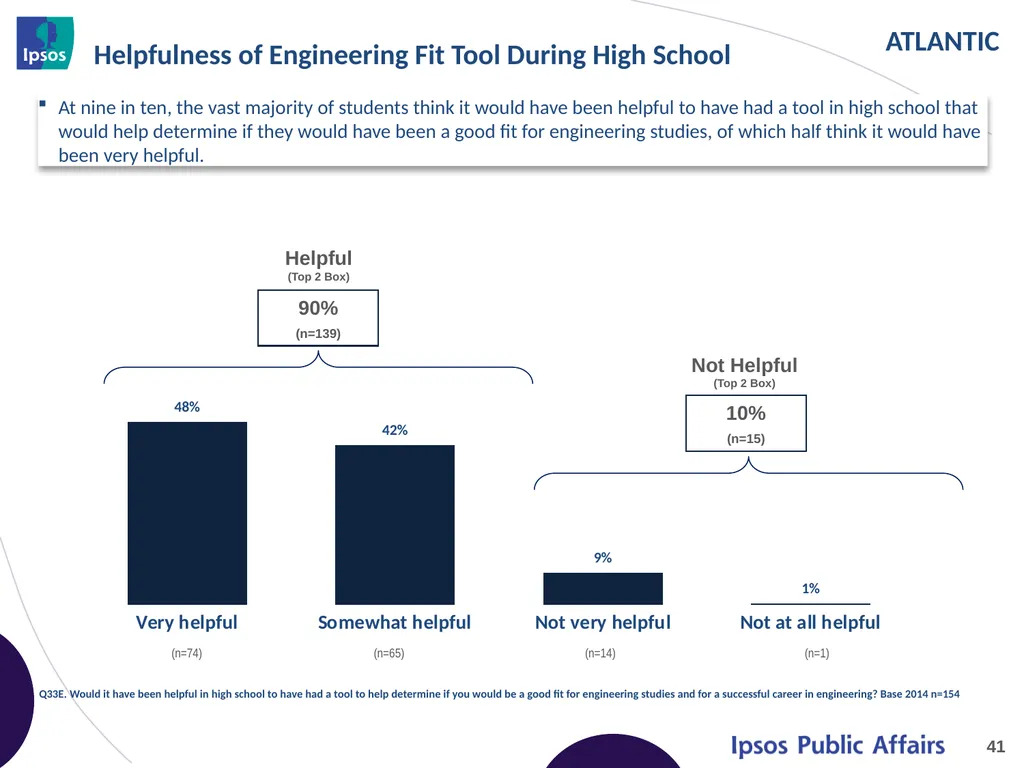
At nine in ten (90%), the vast majority of students think it would have been very (48%) or somewhat helpful (42%) to have had a tool in high school that would help determine if they would have been a good fit for engineering studies.
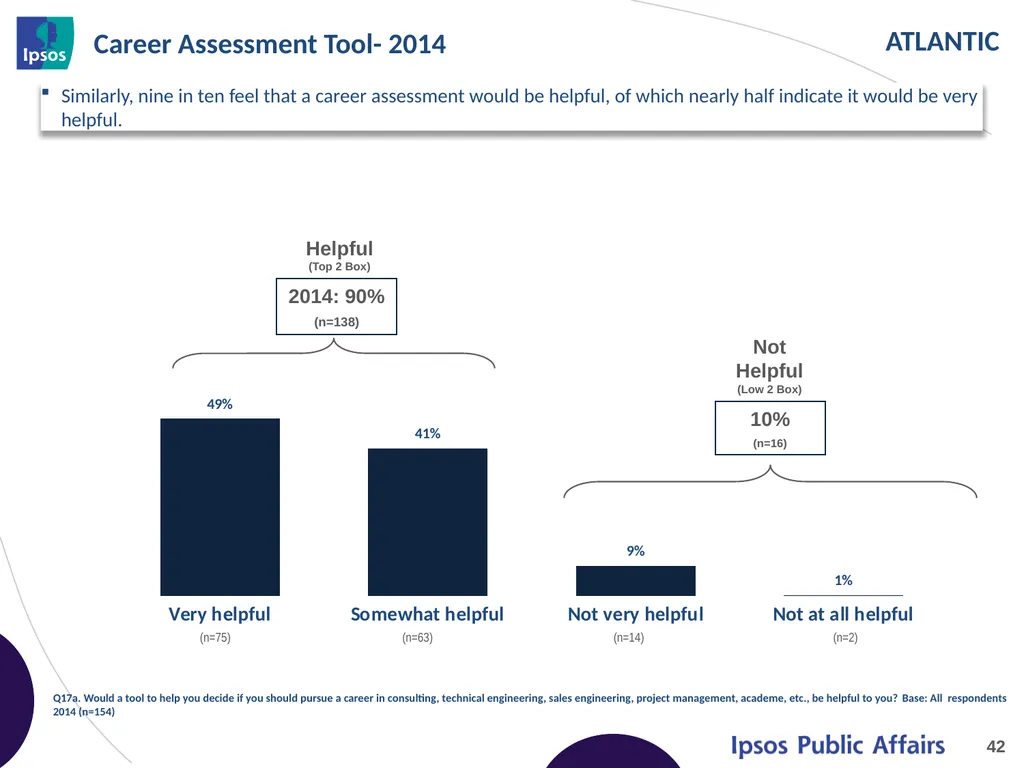
An identical proportion of students (90%) feel that a career assessment would be helpful, of which half indicate it would be very helpful (49%) and four in ten somewhat helpful (41%).
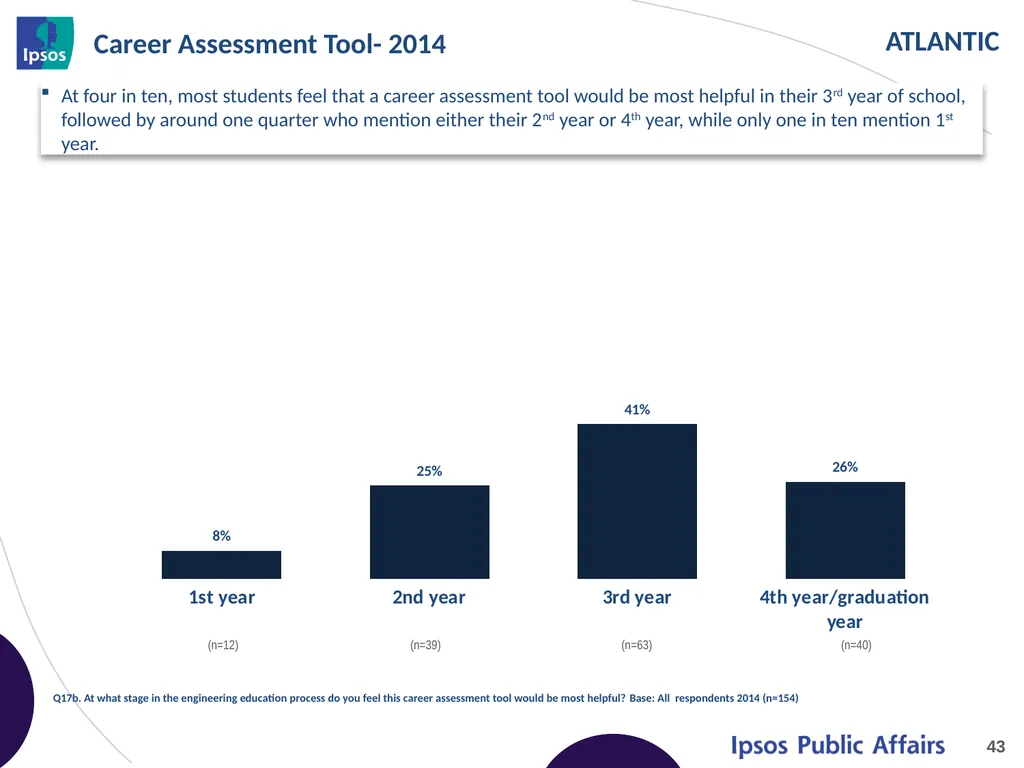
Most students feel that a career assessment tool would be most helpful in their 3rd year of school (41%), followed by around one quarter who mention either their 2nd year (25%) or 4th year (26%), while only one in ten mention 1st year (8%).
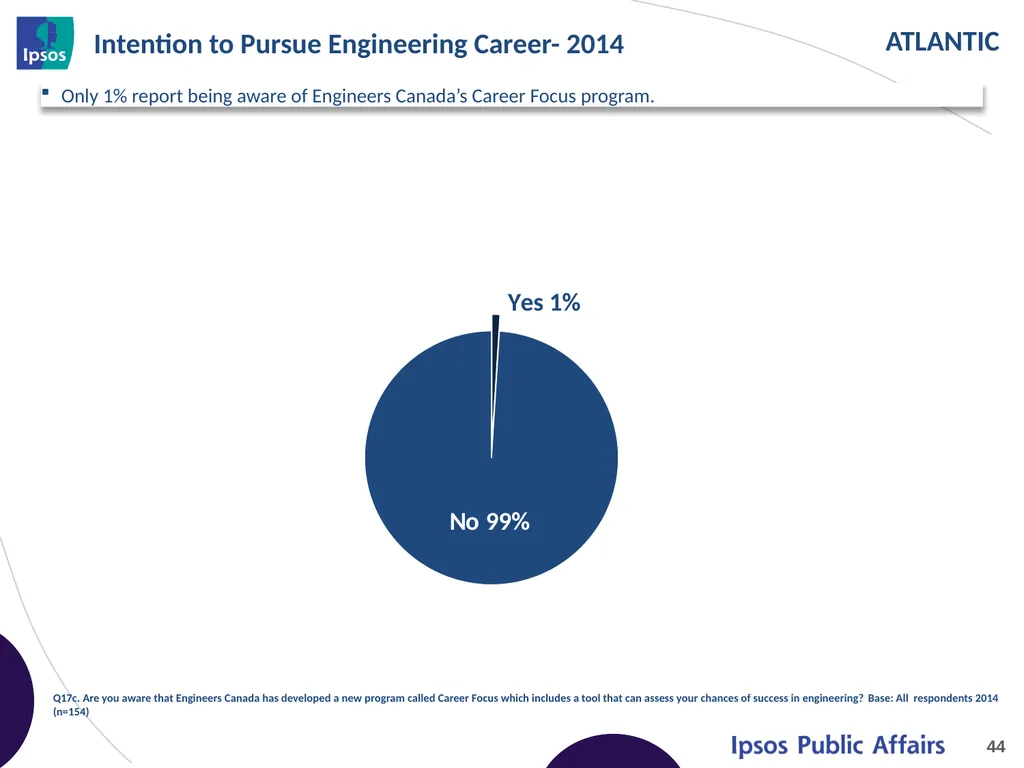
Only 1% of students report being aware of Engineers Canada’s Career Focus program. 10<br>
slide11. Future Plans 11<br>
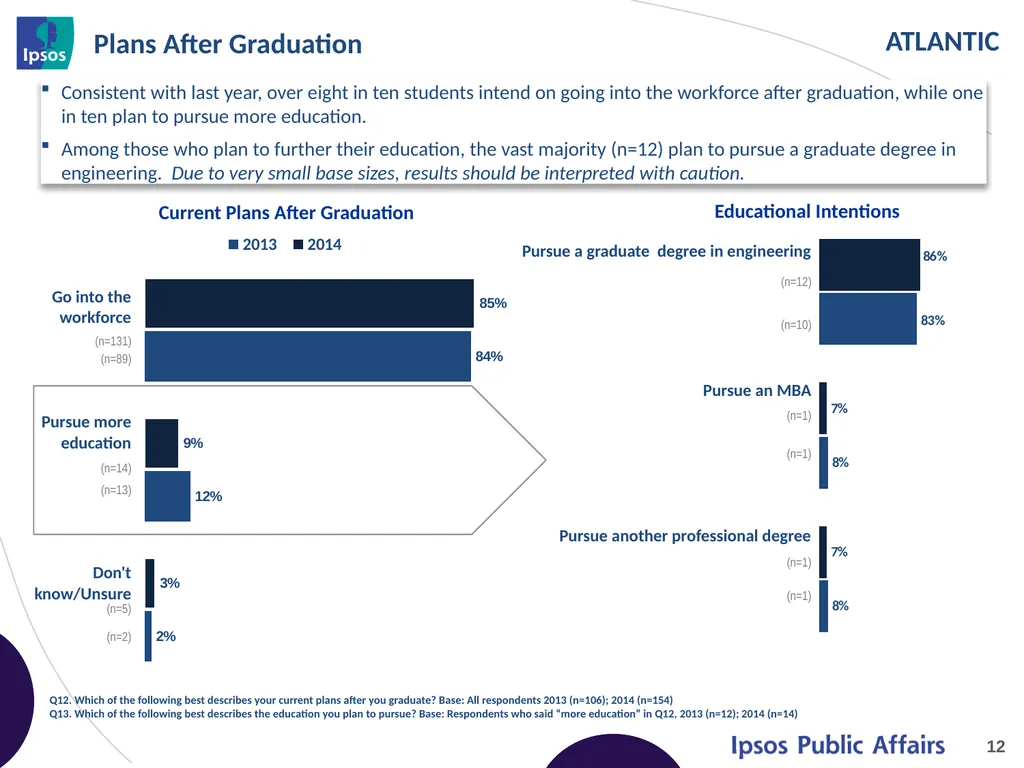
slide12. Plans After Graduation 12 Q12. Which of the following best describes your current plans after you graduate? Base: All respondents 2013 (n=106); 2014 (n=154) Q13. Which of the following best describes the education you plan to pursue? Base: Respondents who said “more education” in Q12, 2013 (n=12); 2014 (n=14) Current Plans After Graduation Educational Intentions Consistent with last year, over eight in ten students intend on going into the workforce after graduation, while one in ten plan to pursue more education.
Among those who plan to further their education, the vast majority (n=12) plan to pursue a graduate degree in engineering. Due to very small base sizes, results should be interpreted with caution.<br>
slide13. Location of Anticipated Graduate Education 13 Q13B. Where do you plan to pursue graduate education? Base: Pursue more education after graduation – 2013 (n=12); 2014 (n=14) Location of Graduate Intentions Among those students who plan to pursue more education, New Brunswick is mentioned most often as their preferred location for further studies, followed by Nova Scotia and Ontario. Due to very small base sizes, results should be interpreted with caution.<br>
slide14. Intention to Pursue Engineering Career 14 Q14. When you complete your education, do you plan to pursue a career in the engineering field? Base: All respondents 2013 (n=106); 2014 (n=154) Do You Plan to Pursue a Career in the Engineering Field? Virtually all students intend on pursuing a career in the engineering field after completing their education.
Compared to last year, there has been a directional decline in the proportion of students who definitely intend to pursue a career in engineering, off set by an increase in those who probably will. No (Low 2 Box) 2014: 98%
(n=151)
2013: 98% (n=104) 2014: 2%
(n=3)
2013: 2% (n=2) Yes (Top 2 Box)<br>
slide15. Career Plans When Studies Commenced Over nine in ten students say that when they began their studies they planned to practice engineering upon completion of their program, of which nearly two-thirds definitely intended on doing so while three in ten said it was likely. 15 Q18. When you began your studies, did you plan to practice engineering when you completed your program? Base: All respondents 2013 (n=106); 2014 (n=154) Did You Plan to Practice Engineering When You Began Your Studies? Yes (Top 2 Box) No (Low 2 Box) 2014: 94%
(n=145)
2013: 95% (n=101) 2014: 6%
(n=9)
2013: 5% (n=5)<br>
slide16. Current and Prior Career Intentions (among students who intend to pursue a career in engineering) At over nine in ten, virtually all students who intend on pursuing a career in engineering say they definitely or likely planned to do so when they began their studies. 16 Q18. When you began your studies, did you plan to practice engineering when you completed your program? Base: Students who intend to pursue a career in engineering 2013 (n=104); 2014 (n=151) No (Low 2 Box) Yes (Top 2 Box) 2014: 96%
(n=145)
2013: 96% (n=100) 2014: 4%
(n=7)
2013: 4% (n=4)<br>
slide17. Application Intentions for Professional Engineering Licensure 17<br>
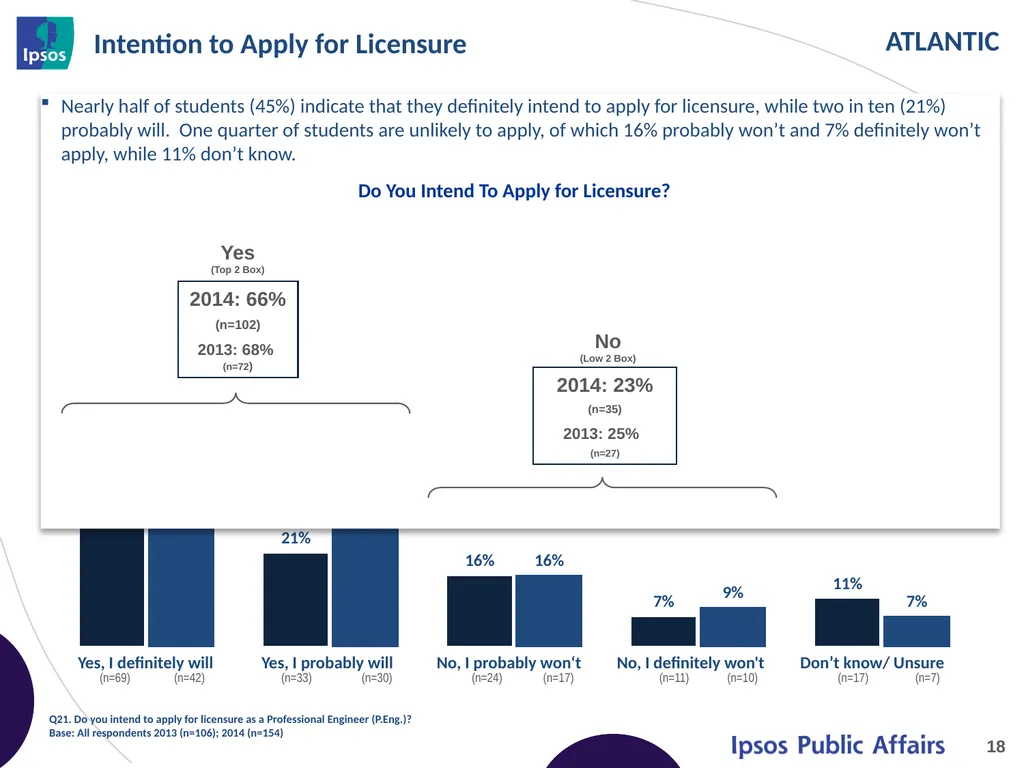
slide18. Intention to Apply for Licensure Nearly half of students (45%) indicate that they definitely intend to apply for licensure, while two in ten (21%) probably will. One quarter of students are unlikely to apply, of which 16% probably won’t and 7% definitely won’t apply, while 11% don’t know. 18 Q21. Do you intend to apply for licensure as a Professional Engineer (P.Eng.)? Base: All respondents 2013 (n=106); 2014 (n=154) Do You Intend To Apply for Licensure? No (Low 2 Box) Yes (Top 2 Box) 2014: 66%
(n=102)
2013: 68% (n=72) 2014: 23%
(n=35)
2013: 25%
(n=27)<br>
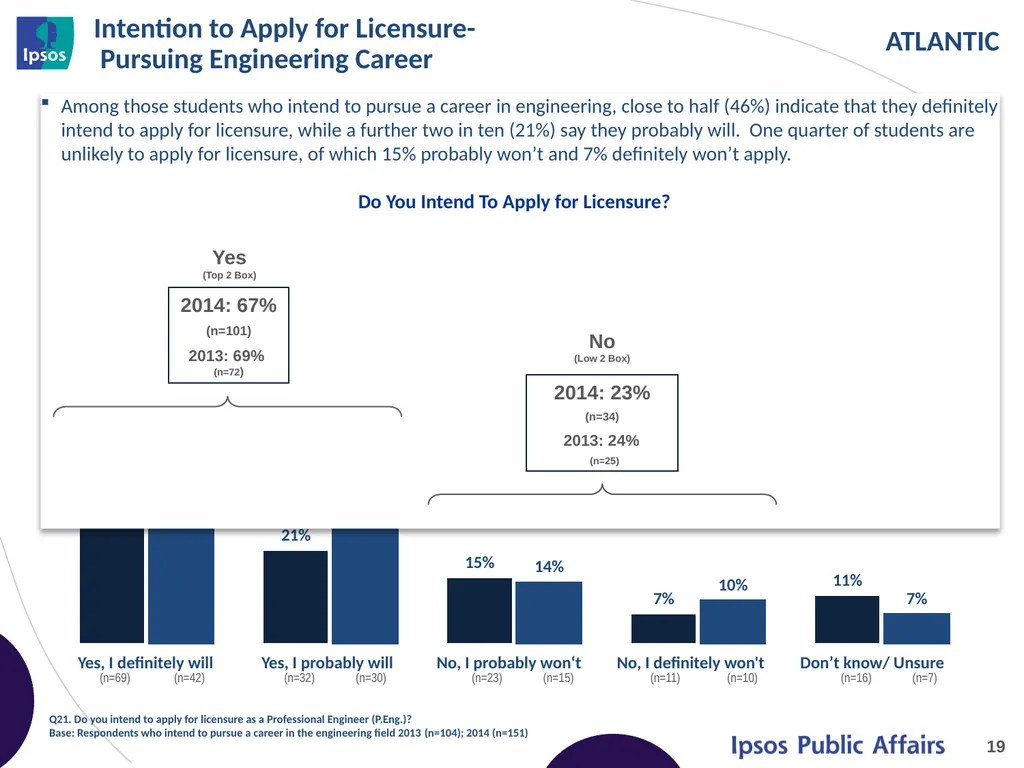
slide19. Intention to Apply for Licensure- Pursuing Engineering Career Among those students who intend to pursue a career in engineering, close to half (46%) indicate that they definitely intend to apply for licensure, while a further two in ten (21%) say they probably will. One quarter of students are unlikely to apply for licensure, of which 15% probably won’t and 7% definitely won’t apply. 19 Q21. Do you intend to apply for licensure as a Professional Engineer (P.Eng.)? Base: Respondents who intend to pursue a career in the engineering field 2013 (n=104); 2014 (n=151) Do You Intend To Apply for Licensure? No (Low 2 Box) Yes (Top 2 Box) 2014: 67%
(n=101)
2013: 69% (n=72) 2014: 23%
(n=34)
2013: 24%
(n=25)<br>
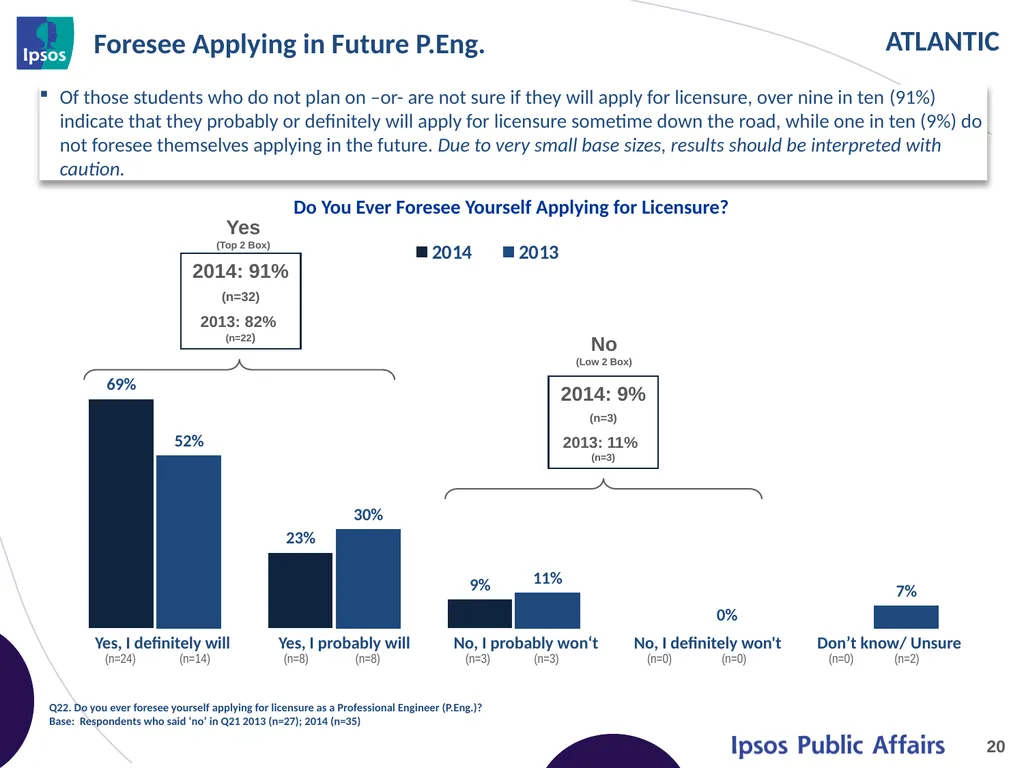
slide20. Do You Ever Foresee Yourself Applying for Licensure? Foresee Applying in Future P.Eng. 20 Q22. Do you ever foresee yourself applying for licensure as a Professional Engineer (P.Eng.)? Base: Respondents who said ‘no’ in Q21 2013 (n=27); 2014 (n=35) Of those students who do not plan on –or- are not sure if they will apply for licensure, over nine in ten (91%) indicate that they probably or definitely will apply for licensure sometime down the road, while one in ten (9%) do not foresee themselves applying in the future. Due to very small base sizes, results should be interpreted with caution. No (Low 2 Box) Yes (Top 2 Box) 2014: 91%
(n=32)
2013: 82% (n=22) 2014: 9%
(n=3)
2013: 11% (n=3)<br>
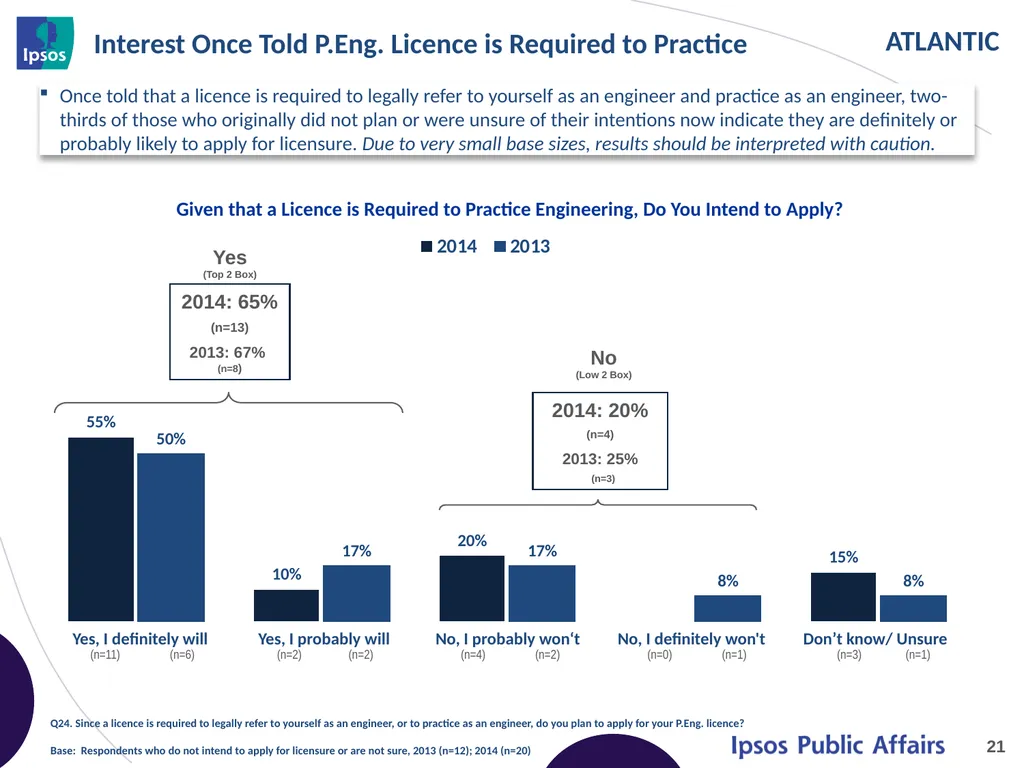
slide21. Interest Once Told P.Eng. Licence is Required to Practice 21 Q24. Since a licence is required to legally refer to yourself as an engineer, or to practice as an engineer, do you plan to apply for your P.Eng. licence? Base: Respondents who do not intend to apply for licensure or are not sure, 2013 (n=12); 2014 (n=20) Given that a Licence is Required to Practice Engineering, Do You Intend to Apply? Once told that a licence is required to legally refer to yourself as an engineer and practice as an engineer, two-thirds of those who originally did not plan or were unsure of their intentions now indicate they are definitely or probably likely to apply for licensure. Due to very small base sizes, results should be interpreted with caution. No (Low 2 Box) Yes (Top 2 Box) 2014: 65%
(n=13)
2013: 67% (n=8) 2014: 20%
(n=4)
2013: 25%
(n=3)<br>
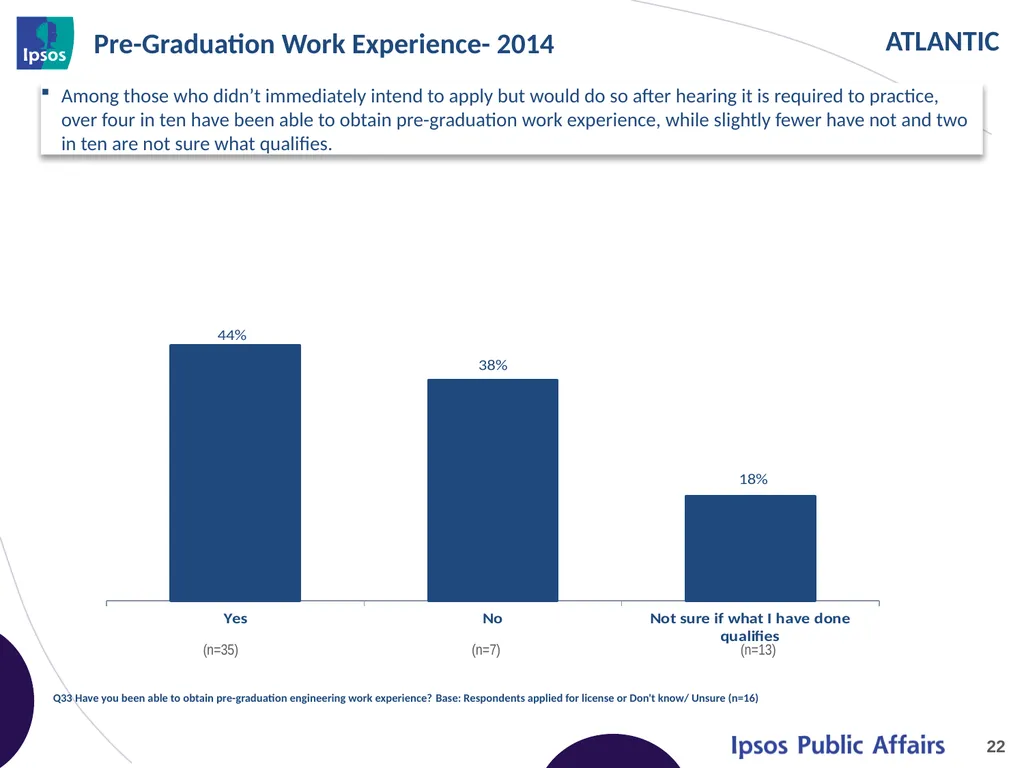
slide22. Pre-Graduation Work Experience- 2014 22 Q33 Have you been able to obtain pre-graduation engineering work experience? Base: Respondents applied for license or Don't know/ Unsure (n=16) Among those who didn’t immediately intend to apply but would do so after hearing it is required to practice, over four in ten have been able to obtain pre-graduation work experience, while slightly fewer have not and two in ten are not sure what qualifies.<br>
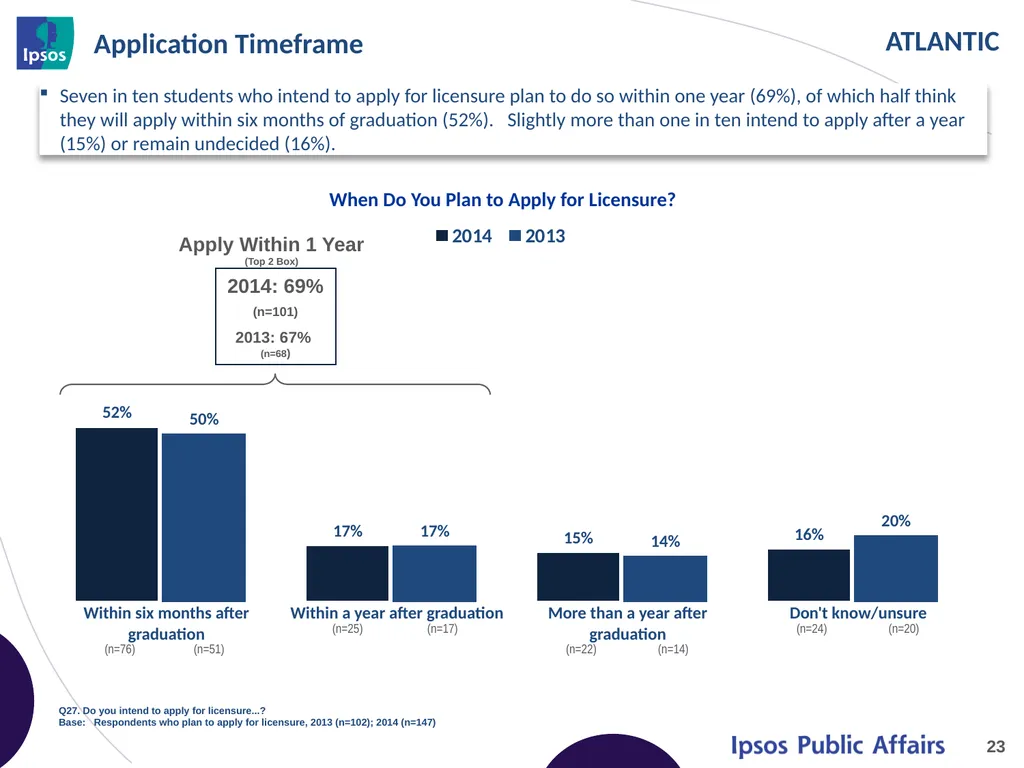
slide23. Application Timeframe 23 Apply Within 1 Year (Top 2 Box) When Do You Plan to Apply for Licensure? Q27. Do you intend to apply for licensure...? Base: Respondents who plan to apply for licensure, 2013 (n=102); 2014 (n=147) Seven in ten students who intend to apply for licensure plan to do so within one year (69%), of which half think they will apply within six months of graduation (52%). Slightly more than one in ten intend to apply after a year (15%) or remain undecided (16%). 2014: 69%
(n=101)
2013: 67% (n=68)<br>
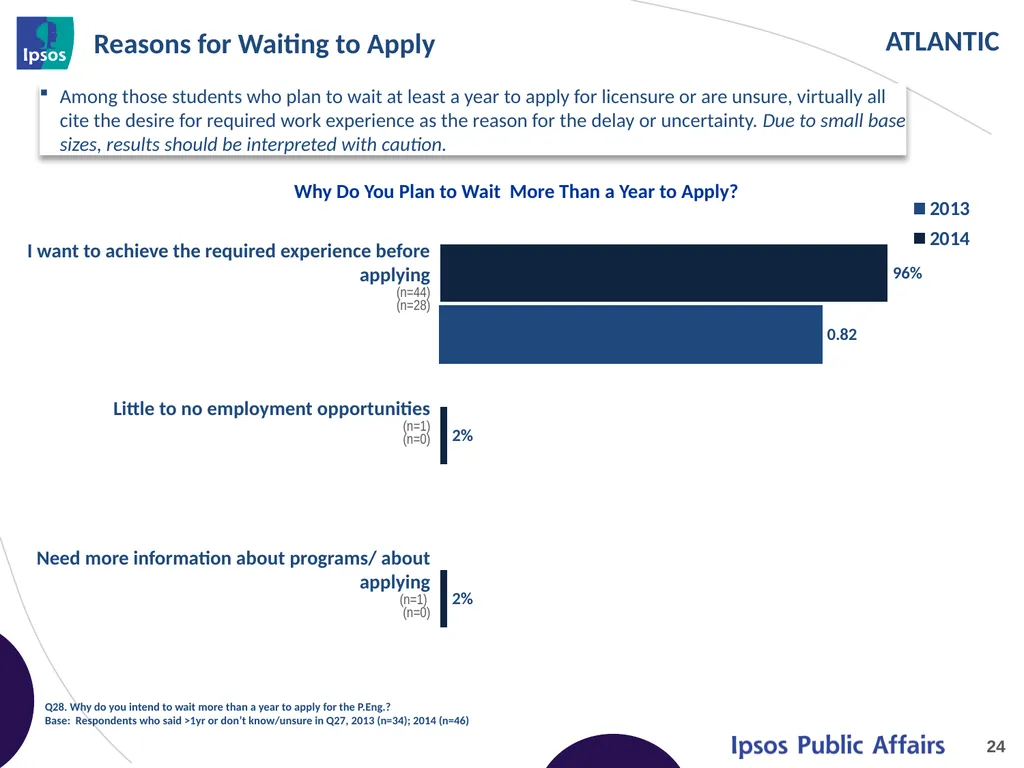
slide24. Reasons for Waiting to Apply 24 Q28. Why do you intend to wait more than a year to apply for the P.Eng.? Base: Respondents who said >1yr or don’t know/unsure in Q27, 2013 (n=34); 2014 (n=46) Why Do You Plan to Wait More Than a Year to Apply? Among those students who plan to wait at least a year to apply for licensure or are unsure, virtually all cite the desire for required work experience as the reason for the delay or uncertainty. Due to small base sizes, results should be interpreted with caution.<br>
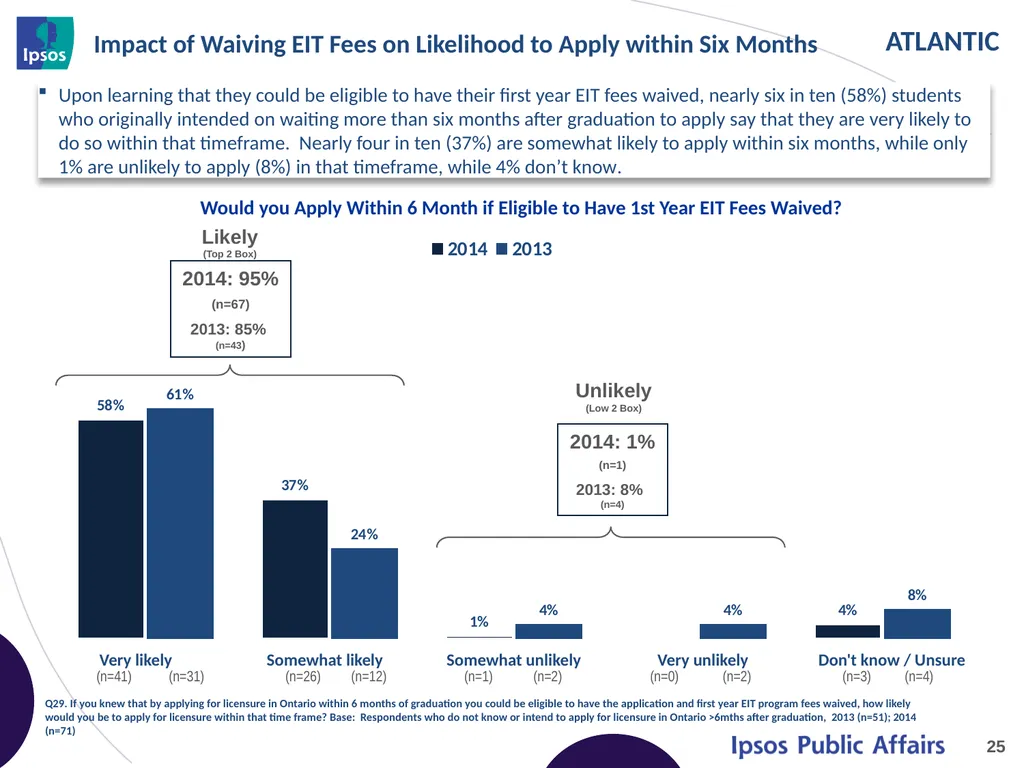
slide25. Would you Apply Within 6 Month if Eligible to Have 1st Year EIT Fees Waived? Impact of Waiving EIT Fees on Likelihood to Apply within Six Months 25 Q29. If you knew that by applying for licensure in Ontario within 6 months of graduation you could be eligible to have the application and first year EIT program fees waived, how likely would you be to apply for licensure within that time frame? Base: Respondents who do not know or intend to apply for licensure in Ontario >6mths after graduation, 2013 (n=51); 2014 (n=71) Likely (Top 2 Box) Unlikely (Low 2 Box) (n=81) Upon learning that they could be eligible to have their first year EIT fees waived, nearly six in ten (58%) students who originally intended on waiting more than six months after graduation to apply say that they are very likely to do so within that timeframe. Nearly four in ten (37%) are somewhat likely to apply within six months, while only 1% are unlikely to apply (8%) in that timeframe, while 4% don’t know. 2014: 95%
(n=67)
2013: 85% (n=43) 2014: 1%
(n=1)
2013: 8% (n=4)<br>
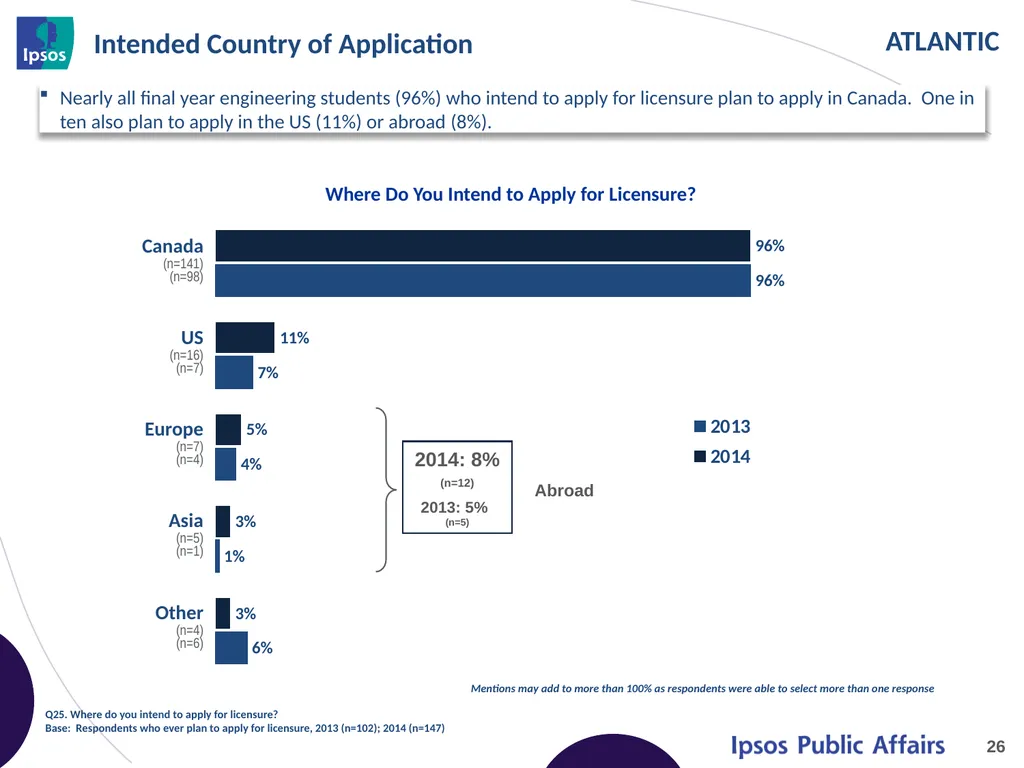
slide26. Intended Country of Application 26 Q25. Where do you intend to apply for licensure? Base: Respondents who ever plan to apply for licensure, 2013 (n=102); 2014 (n=147) Abroad Where Do You Intend to Apply for Licensure? Mentions may add to more than 100% as respondents were able to select more than one response Nearly all final year engineering students (96%) who intend to apply for licensure plan to apply in Canada. One in ten also plan to apply in the US (11%) or abroad (8%). 2014: 8%
(n=12)
2013: 5% (n=5)<br>
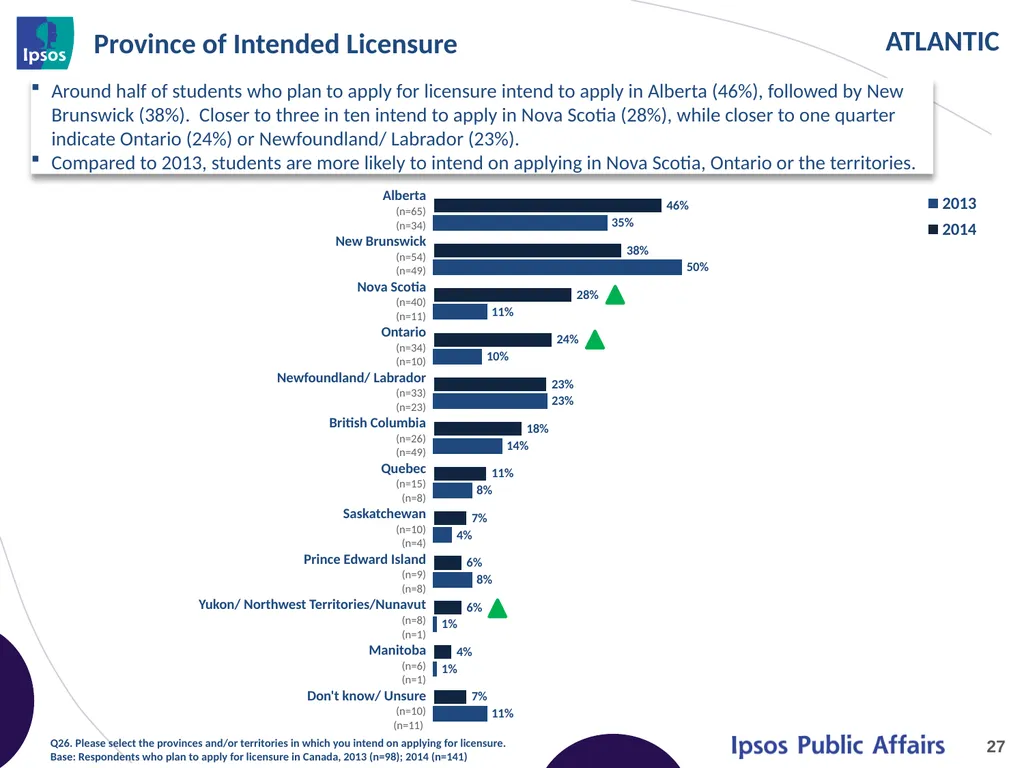
slide27. Province of Intended Licensure 27 Q26. Please select the provinces and/or territories in which you intend on applying for licensure. Base: Respondents who plan to apply for licensure in Canada, 2013 (n=98); 2014 (n=141) Around half of students who plan to apply for licensure intend to apply in Alberta (46%), followed by New Brunswick (38%). Closer to three in ten intend to apply in Nova Scotia (28%), while closer to one quarter indicate Ontario (24%) or Newfoundland/ Labrador (23%).
Compared to 2013, students are more likely to intend on applying in Nova Scotia, Ontario or the territories.<br>
slide28. Licensing Knowledge 28<br>
slide29. Engineering Regulated by Legislation 29 Q5. As far as you know, is the practice of professional engineering regulated by legislation? Base: All respondents 2013 (n=106); 2014 (n=154) Is the Practice of Engineering Regulated by Legislation? At eight in ten (82%), the vast majority of students know that engineering is regulated by legislation, while one in ten believe it is not and 7% are unsure.<br>
slide30. Licensing for Roles within Engineering Nearly nine in ten students know that a licence is required to perform engineering work independently (87%) while seven in ten know it is needed to use the title ‘Engineer’ (71%). Exactly eight in ten meanwhile know that it is not required to practice engineering work under the supervision of a P.Eng (80%). 30 Q8. As far as you know, is a licence required before being able to do the following in ... Base: All respondents 2013 (n=106); 2014 (n=154) Is a Licence Required Before Being Able to Do the Following?<br>
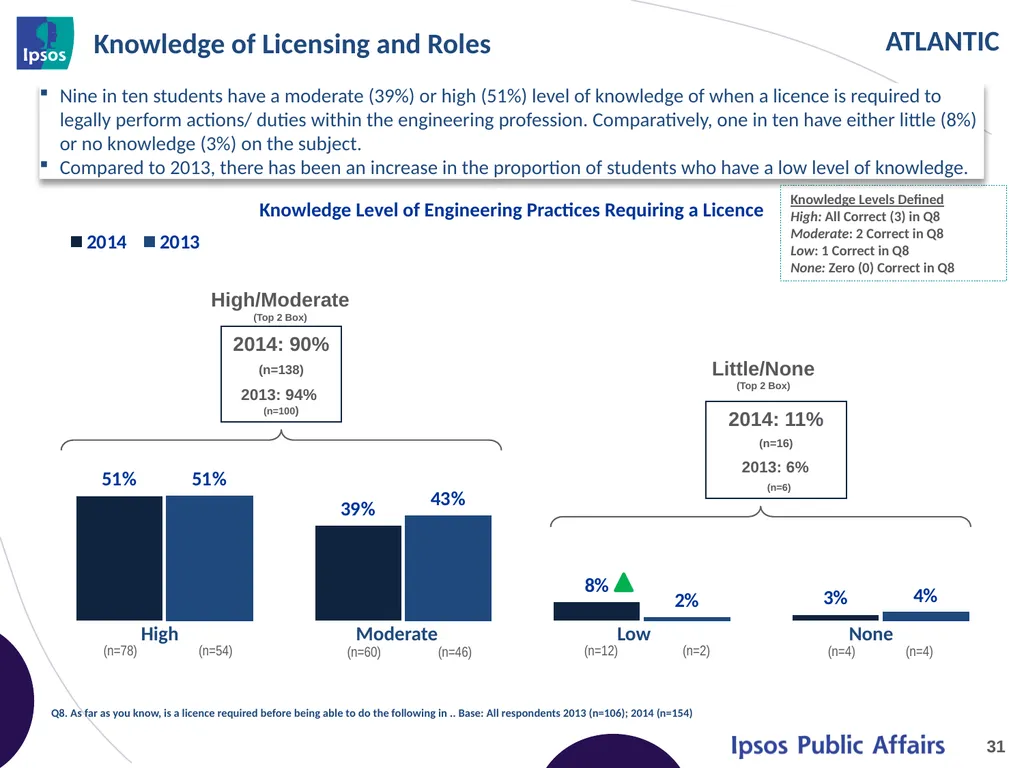
slide31. Knowledge of Licensing and Roles 31 Q8. As far as you know, is a licence required before being able to do the following in .. Base: All respondents 2013 (n=106); 2014 (n=154) Knowledge Levels Defined High: All Correct (3) in Q8 Moderate: 2 Correct in Q8 Low: 1 Correct in Q8 None: Zero (0) Correct in Q8 Knowledge Level of Engineering Practices Requiring a Licence High/Moderate (Top 2 Box) Little/None (Top 2 Box) Nine in ten students have a moderate (39%) or high (51%) level of knowledge of when a licence is required to legally perform actions/ duties within the engineering profession. Comparatively, one in ten have either little (8%) or no knowledge (3%) on the subject.
Compared to 2013, there has been an increase in the proportion of students who have a low level of knowledge. 2014: 90%
(n=138)
2013: 94% (n=100) 2014: 11%
(n=16)
2013: 6%
(n=6)<br>
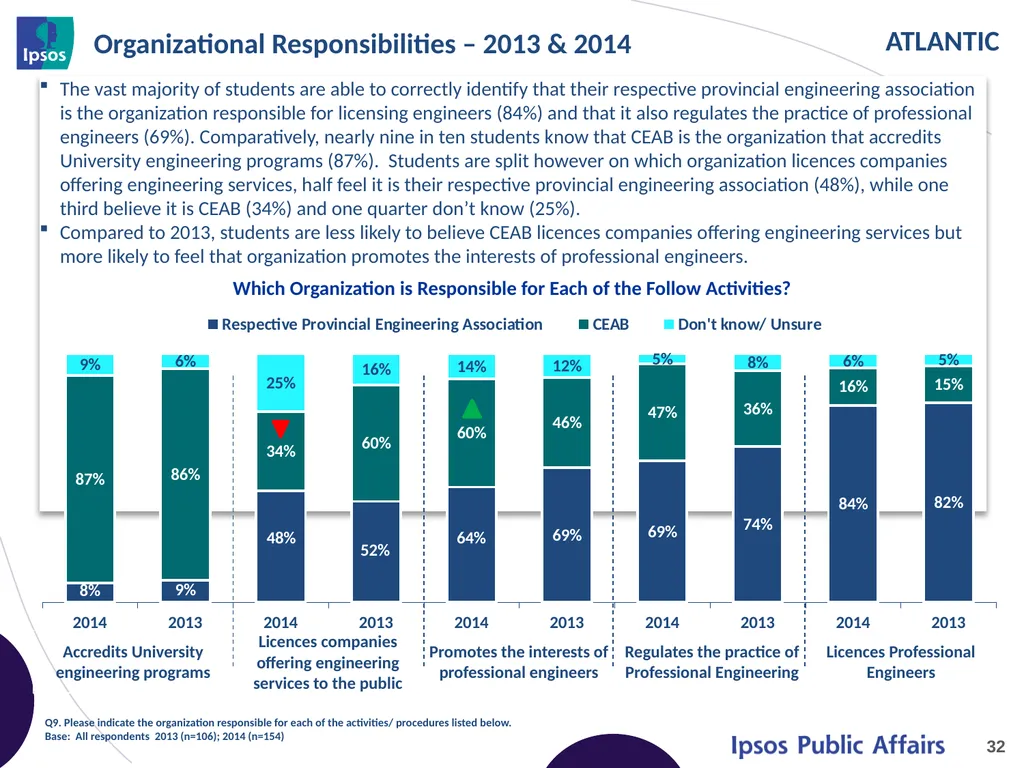
slide32. Organizational Responsibilities – 2013 & 2014 The vast majority of students are able to correctly identify that their respective provincial engineering association is the organization responsible for licensing engineers (84%) and that it also regulates the practice of professional engineers (69%). Comparatively, nearly nine in ten students know that CEAB is the organization that accredits University engineering programs (87%). Students are split however on which organization licences companies offering engineering services, half feel it is their respective provincial engineering association (48%), while one third believe it is CEAB (34%) and one quarter don’t know (25%).
Compared to 2013, students are less likely to believe CEAB licences companies offering engineering services but more likely to feel that organization promotes the interests of professional engineers. 32 Q9. Please indicate the organization responsible for each of the activities/ procedures listed below. Base: All respondents 2013 (n=106); 2014 (n=154)<br>
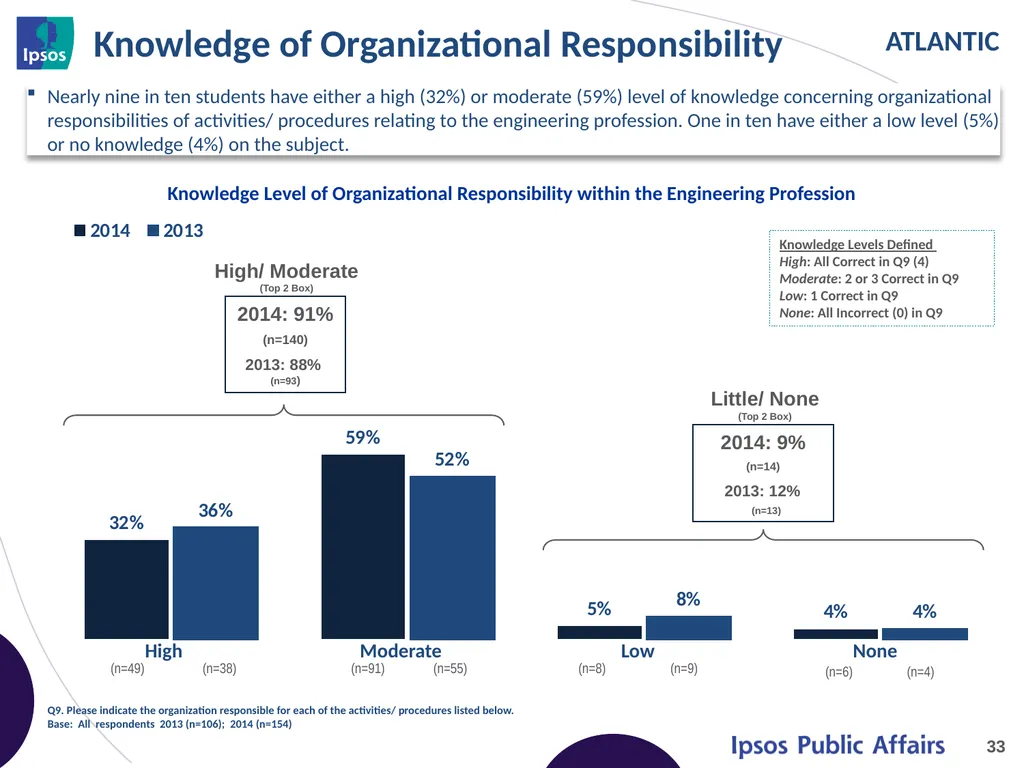
slide33. Knowledge of Organizational Responsibility 33 Knowledge Level of Organizational Responsibility within the Engineering Profession Q9. Please indicate the organization responsible for each of the activities/ procedures listed below. Base: All respondents 2013 (n=106); 2014 (n=154) High/ Moderate (Top 2 Box) Little/ None (Top 2 Box) Nearly nine in ten students have either a high (32%) or moderate (59%) level of knowledge concerning organizational responsibilities of activities/ procedures relating to the engineering profession. One in ten have either a low level (5%) or no knowledge (4%) on the subject. Knowledge Levels Defined
High: All Correct in Q9 (4) Moderate: 2 or 3 Correct in Q9 Low: 1 Correct in Q9 None: All Incorrect (0) in Q9 2014: 91%
(n=140)
2013: 88% (n=93) 2014: 9%
(n=14)
2013: 12%
(n=13)<br>
slide34. Provincial Engineering Association 34 Attendance at seminar(s) and awareness of SMP program<br>
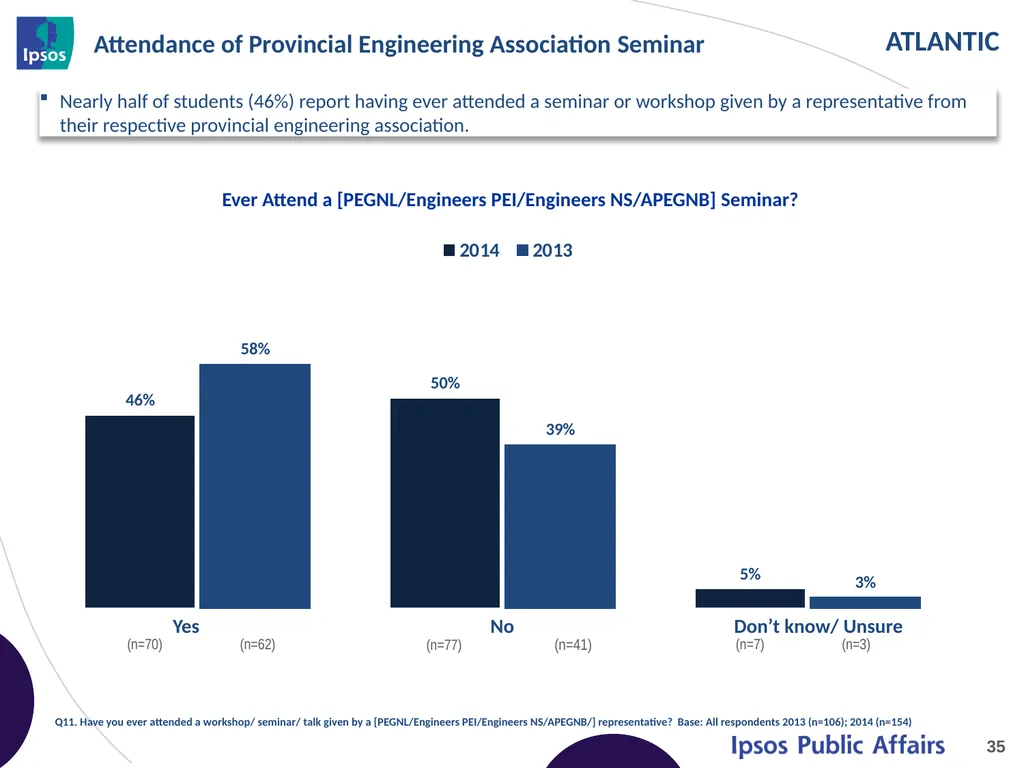
slide35. Attendance of Provincial Engineering Association Seminar 35 Q11. Have you ever attended a workshop/ seminar/ talk given by a [PEGNL/Engineers PEI/Engineers NS/APEGNB/] representative? Base: All respondents 2013 (n=106); 2014 (n=154) Ever Attend a [PEGNL/Engineers PEI/Engineers NS/APEGNB] Seminar? Nearly half of students (46%) report having ever attended a seminar or workshop given by a representative from their respective provincial engineering association.<br>
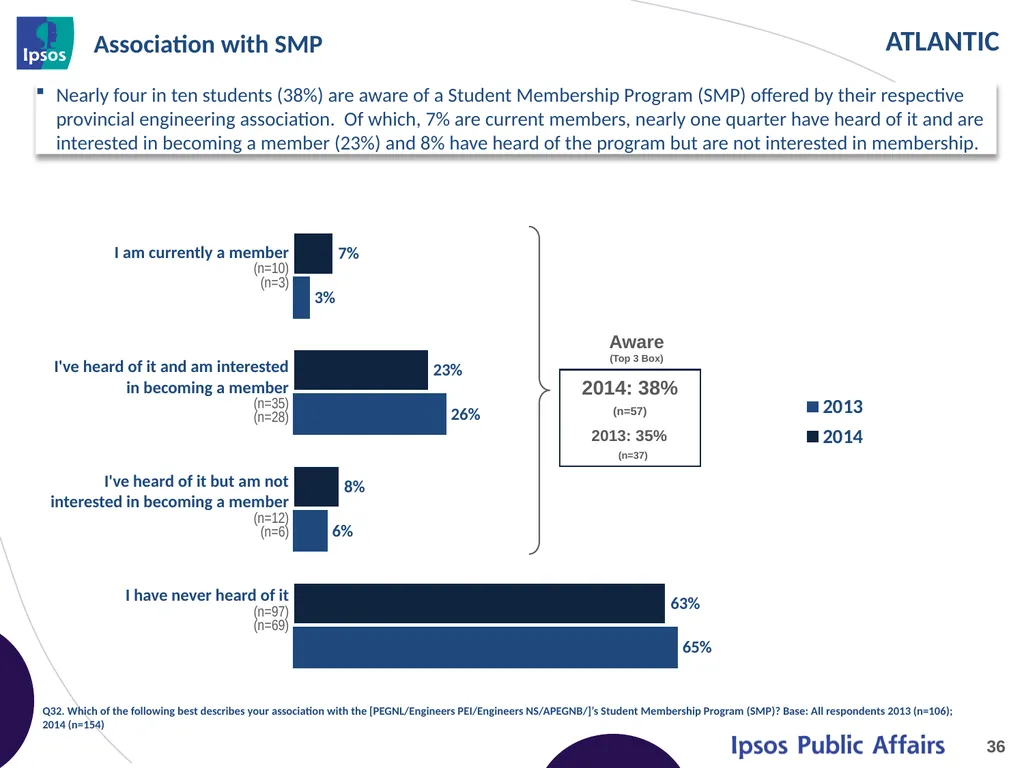
slide36. Association with SMP 36 Q32. Which of the following best describes your association with the [PEGNL/Engineers PEI/Engineers NS/APEGNB/]’s Student Membership Program (SMP)? Base: All respondents 2013 (n=106); 2014 (n=154) Aware (Top 3 Box) Nearly four in ten students (38%) are aware of a Student Membership Program (SMP) offered by their respective provincial engineering association. Of which, 7% are current members, nearly one quarter have heard of it and are interested in becoming a member (23%) and 8% have heard of the program but are not interested in membership. 2014: 38%
(n=57)
2013: 35%
(n=37)<br>
slide37. Professional Engineers Act 37<br>
slide38. Professional Engineers Act 38 Q6. The practice of engineering is regulated by the Professional Engineers Act of [Newfoundland and Labrador/PEI/Nova Scotia/New Brunswick ]. Which of the following best describes how much you know about the Professional Engineers Act of [Newfoundland and Labrador/PEI/Nova Scotia/New Brunswick ]? Base: All respondents 2013 (n=106); 2014 (n=154) Familiar (Top 3 Box) How Much Do You Know About the Professional Engineers Act of
[Newfoundland and Labrador/PEI/Nova Scotia/New Brunswick]? Over eight in ten students report being familiar with the Professional Engineers Act of their respective province. Four in ten report having a fair amount (38%) or just a little knowledge (43%) about the Professional Engineers Act, while 4% claim to know a lot about it. Only 4% say they have never heard of the Act. 2014: 85%
(n=131)
2013: 91% (n=97)<br>
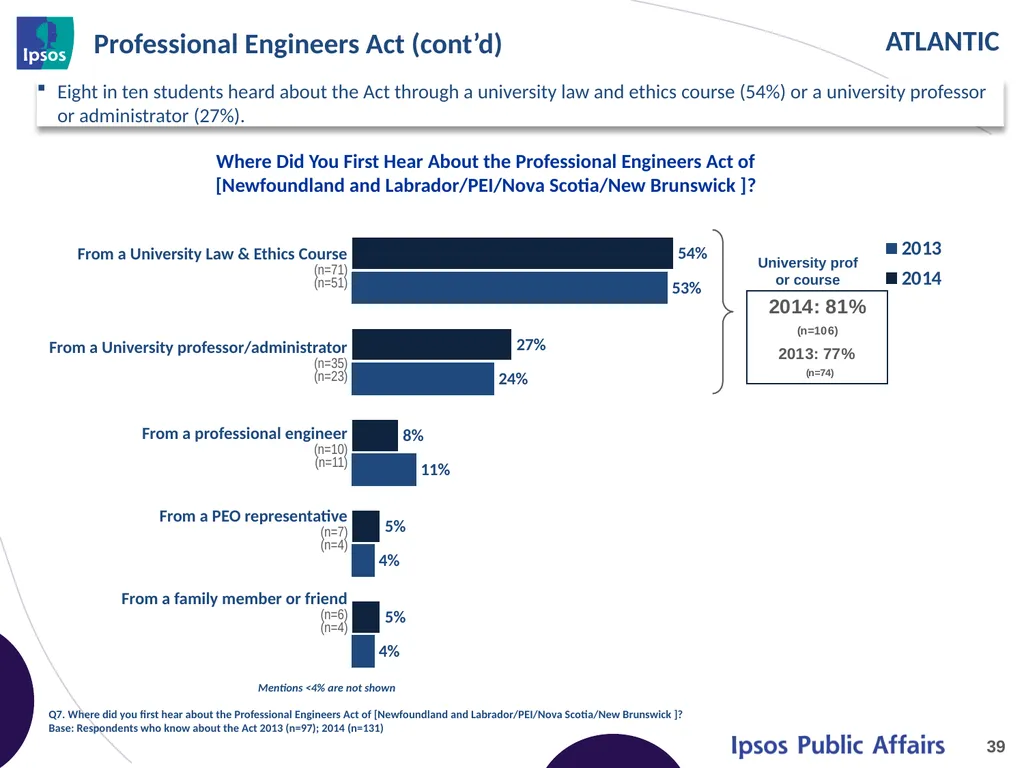
slide39. Professional Engineers Act (cont’d) 39 Q7. Where did you first hear about the Professional Engineers Act of [Newfoundland and Labrador/PEI/Nova Scotia/New Brunswick ]? Base: Respondents who know about the Act 2013 (n=97); 2014 (n=131) Where Did You First Hear About the Professional Engineers Act of [Newfoundland and Labrador/PEI/Nova Scotia/New Brunswick ]? Mentions <4% are not shown University prof or course Eight in ten students heard about the Act through a university law and ethics course (54%) or a university professor or administrator (27%).<br>
slide40. Appetite for Career Assessment Tool 40<br>
slide41. Helpfulness of Engineering Fit Tool During High School 41 Q33E. Would it have been helpful in high school to have had a tool to help determine if you would be a good fit for engineering studies and for a successful career in engineering? Base 2014 n=154 At nine in ten, the vast majority of students think it would have been helpful to have had a tool in high school that would help determine if they would have been a good fit for engineering studies, of which half think it would have been very helpful. (n=42) Helpful (Top 2 Box) 10%
(n=15) Not Helpful (Top 2 Box) 90%
(n=139)<br>
slide42. Career Assessment Tool- 2014 42 Q17a. Would a tool to help you decide if you should pursue a career in consulting, technical engineering, sales engineering, project management, academe, etc., be helpful to you? Base: All respondents 2014 (n=154) Similarly, nine in ten feel that a career assessment would be helpful, of which nearly half indicate it would be very helpful. Not Helpful (Low 2 Box) 2014: 90%
(n=138) 10%
(n=16) Helpful (Top 2 Box)<br>
slide43. Career Assessment Tool- 2014 43 Q17b. At what stage in the engineering education process do you feel this career assessment tool would be most helpful? Base: All respondents 2014 (n=154) At four in ten, most students feel that a career assessment tool would be most helpful in their 3rd year of school, followed by around one quarter who mention either their 2nd year or 4th year, while only one in ten mention 1st year.<br>
slide44. Intention to Pursue Engineering Career- 2014 44 Q17c. Are you aware that Engineers Canada has developed a new program called Career Focus which includes a tool that can assess your chances of success in engineering? Base: All respondents 2014 (n=154) Only 1% report being aware of Engineers Canada’s Career Focus program.<br>
slide45. Demographics 45<br>
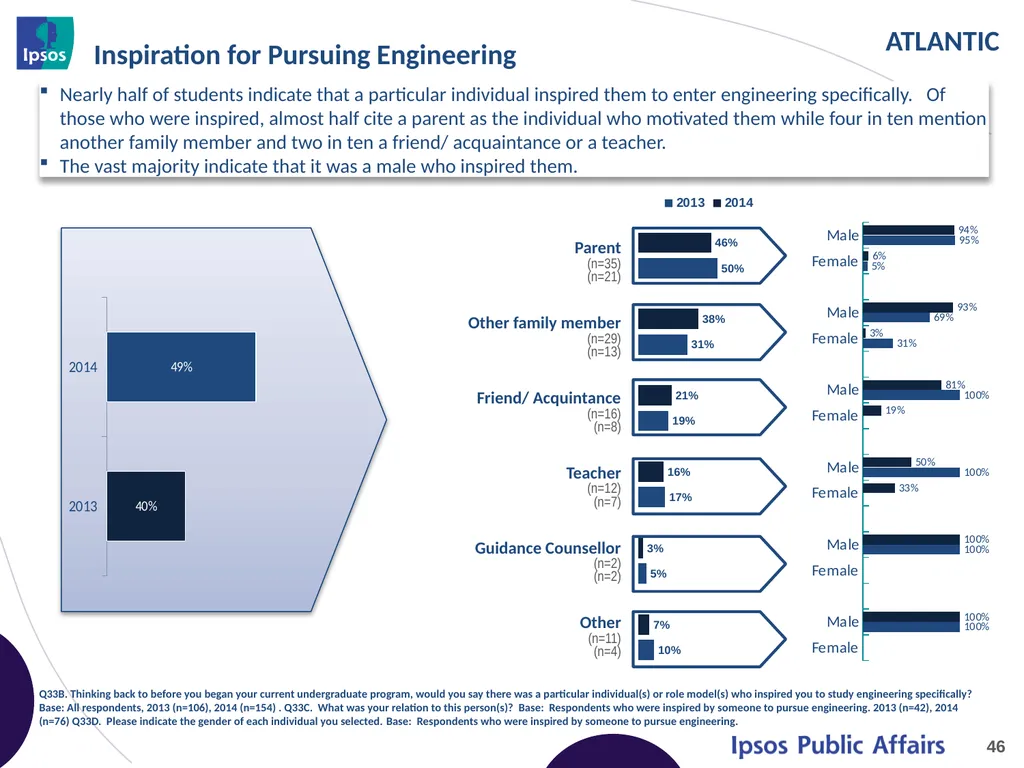
slide46. Inspiration for Pursuing Engineering 46 Q33B. Thinking back to before you began your current undergraduate program, would you say there was a particular individual(s) or role model(s) who inspired you to study engineering specifically? Base: All respondents, 2013 (n=106), 2014 (n=154) . Q33C. What was your relation to this person(s)? Base: Respondents who were inspired by someone to pursue engineering. 2013 (n=42), 2014 (n=76) Q33D. Please indicate the gender of each individual you selected. Base: Respondents who were inspired by someone to pursue engineering. Nearly half of students indicate that a particular individual inspired them to enter engineering specifically. Of those who were inspired, almost half cite a parent as the individual who motivated them while four in ten mention another family member and two in ten a friend/ acquaintance or a teacher.
The vast majority indicate that it was a male who inspired them. (n=42)<br>
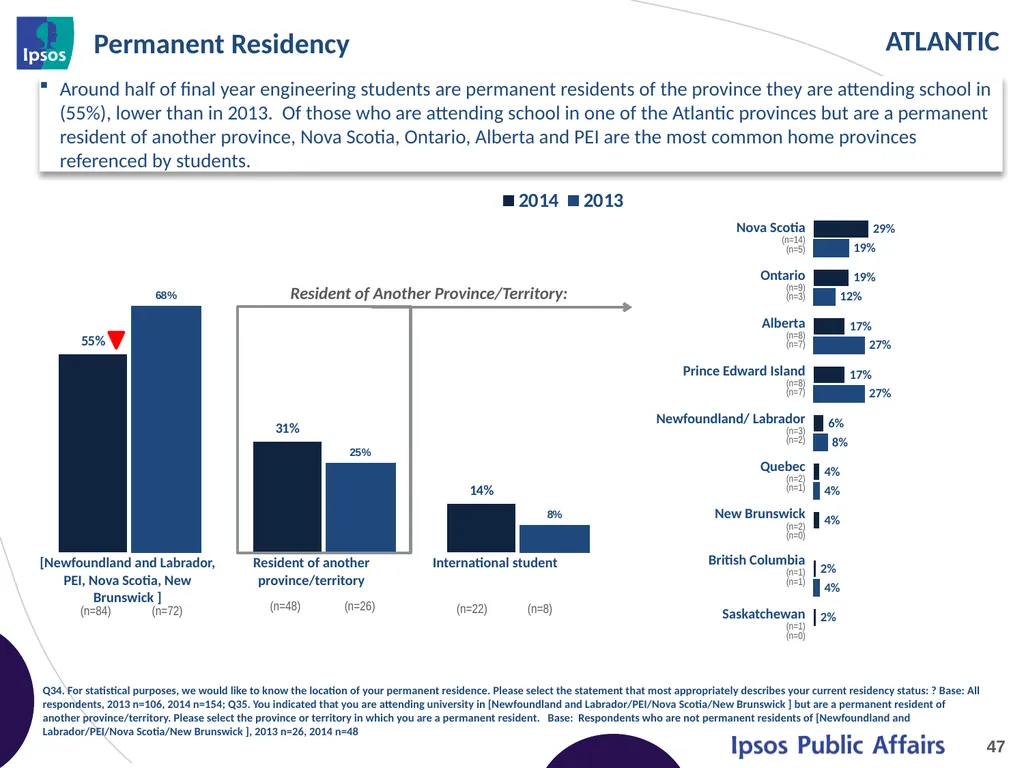
slide47. Permanent Residency 47 Q34. For statistical purposes, we would like to know the location of your permanent residence. Please select the statement that most appropriately describes your current residency status: ? Base: All respondents, 2013 n=106, 2014 n=154; Q35. You indicated that you are attending university in [Newfoundland and Labrador/PEI/Nova Scotia/New Brunswick ] but are a permanent resident of another province/territory. Please select the province or territory in which you are a permanent resident. Base: Respondents who are not permanent residents of [Newfoundland and Labrador/PEI/Nova Scotia/New Brunswick ], 2013 n=26, 2014 n=48 Around half of final year engineering students are permanent residents of the province they are attending school in (55%), lower than in 2013. Of those who are attending school in one of the Atlantic provinces but are a permanent resident of another province, Nova Scotia, Ontario, Alberta and PEI are the most common home provinces referenced by students. Resident of Another Province/Territory:<br>
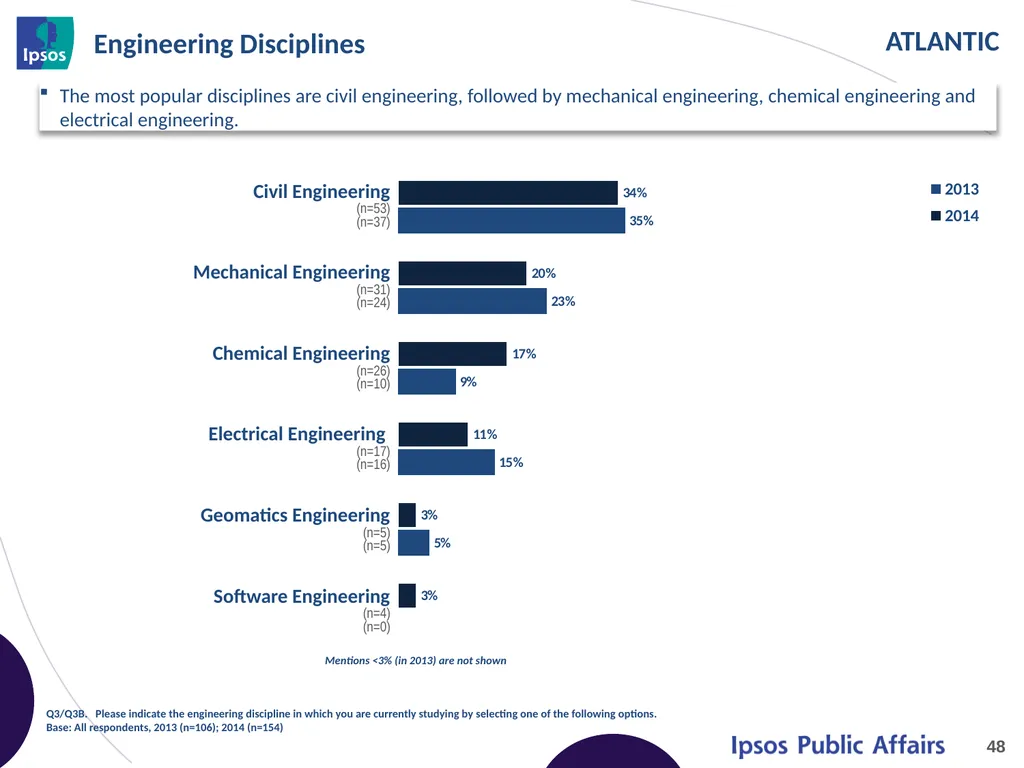
slide48. Engineering Disciplines 48 Q3/Q3B. Please indicate the engineering discipline in which you are currently studying by selecting one of the following options. Base: All respondents, 2013 (n=106); 2014 (n=154) Mentions <3% (in 2013) are not shown The most popular disciplines are civil engineering, followed by mechanical engineering, chemical engineering and electrical engineering.<br>
slide49. Impact of Seminar/ Workshop Attendance 49<br>
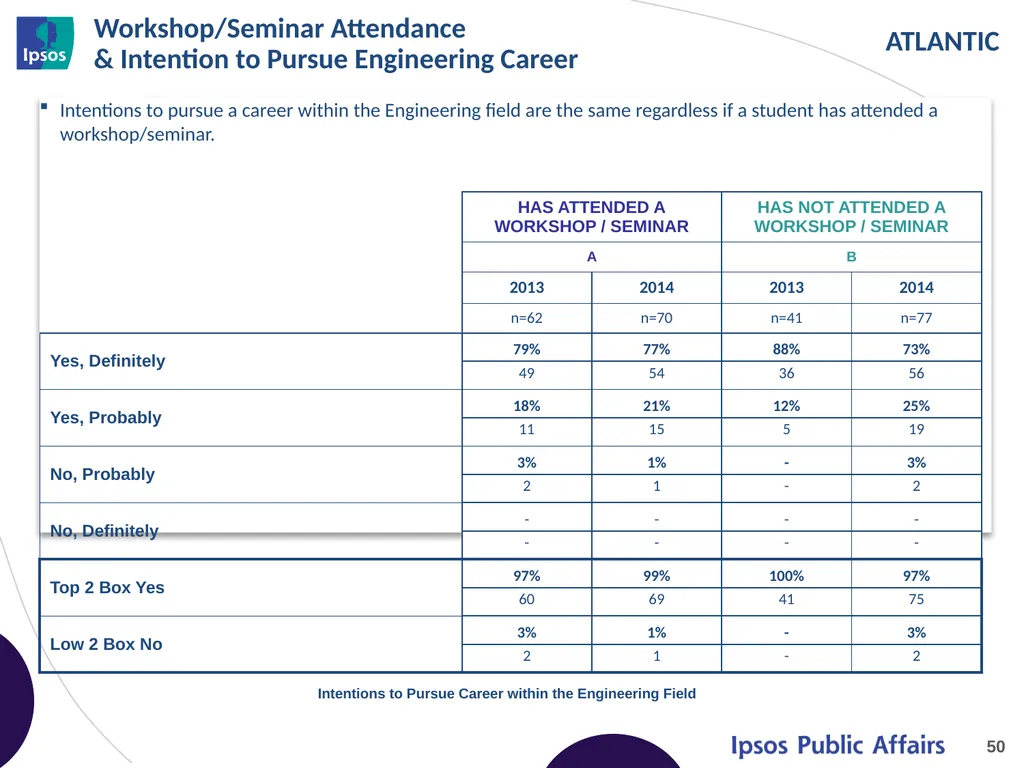
slide50. Workshop/Seminar Attendance & Intention to Pursue Engineering Career Intentions to pursue a career within the Engineering field are the same regardless if a student has attended a workshop/seminar. 50 Intentions to Pursue Career within the Engineering Field<br>
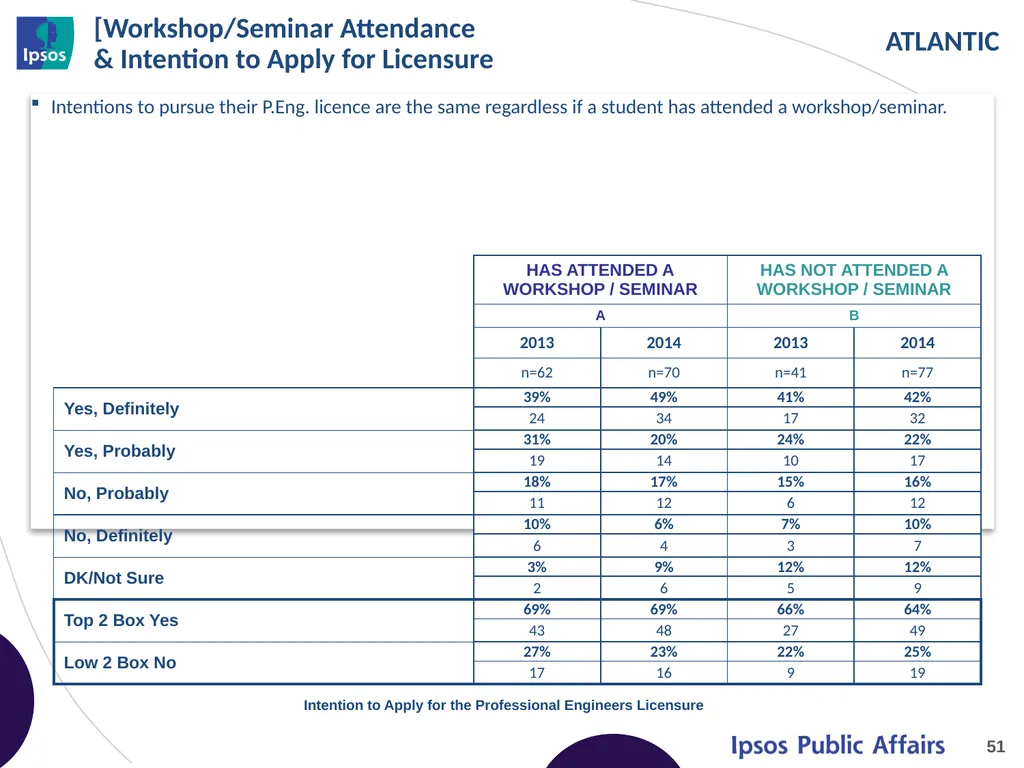
slide51. [Workshop/Seminar Attendance & Intention to Apply for Licensure Intentions to pursue their P.Eng. licence are the same regardless if a student has attended a workshop/seminar. 51 Intention to Apply for the Professional Engineers Licensure<br>
slide52. Impact of Knowledge of the Professional Engineers Act 52<br>
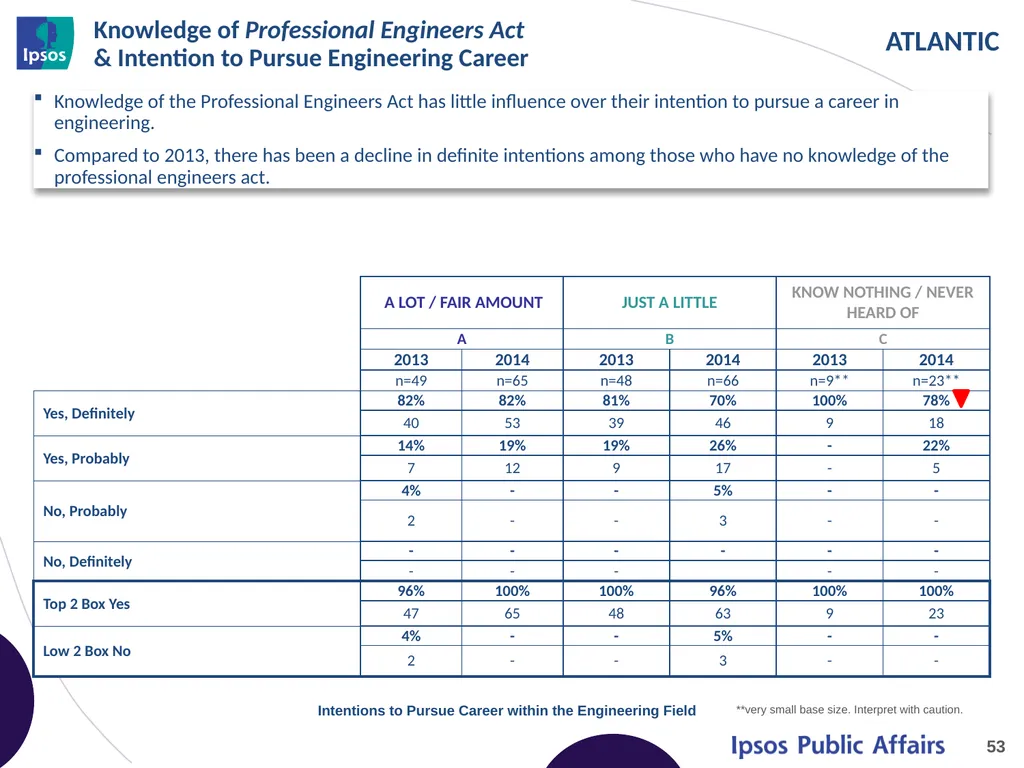
slide53. Knowledge of Professional Engineers Act & Intention to Pursue Engineering Career 53 Intentions to Pursue Career within the Engineering Field Knowledge of the Professional Engineers Act has little influence over their intention to pursue a career in engineering.
Compared to 2013, there has been a decline in definite intentions among those who have no knowledge of the professional engineers act. **very small base size. Interpret with caution.<br>
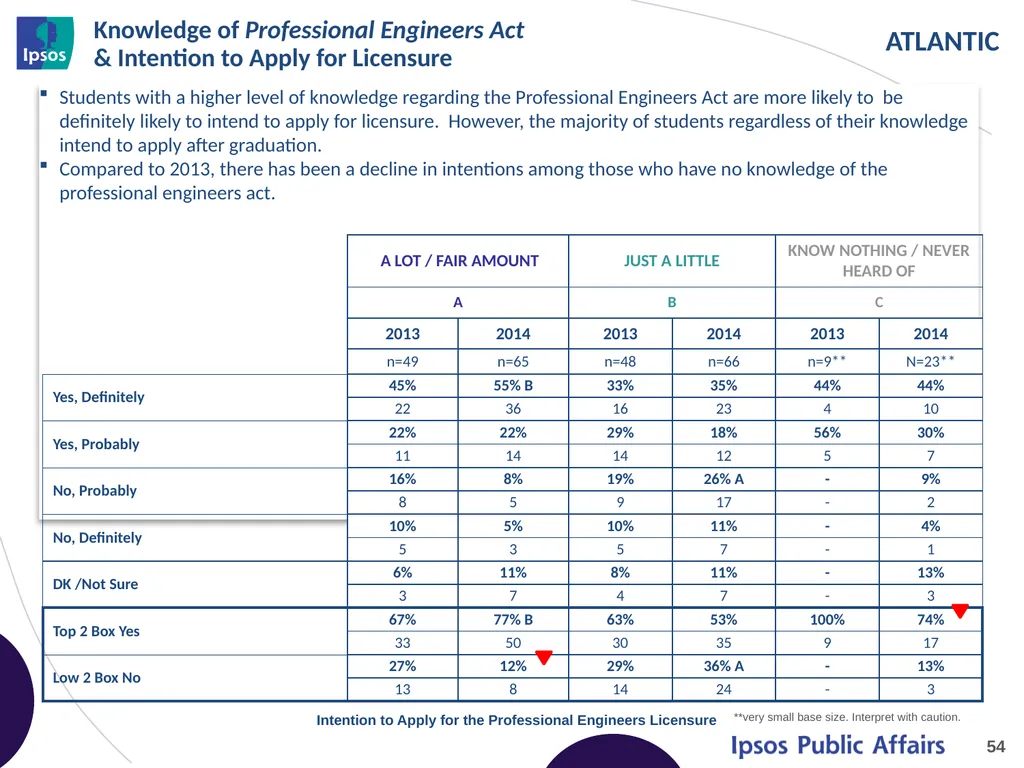
slide54. Knowledge of Professional Engineers Act & Intention to Apply for Licensure Students with a higher level of knowledge regarding the Professional Engineers Act are more likely to be definitely likely to intend to apply for licensure. However, the majority of students regardless of their knowledge intend to apply after graduation.
Compared to 2013, there has been a decline in intentions among those who have no knowledge of the professional engineers act. 54 Intention to Apply for the Professional Engineers Licensure **very small base size. Interpret with caution.<br>
slide55. Impact of Knowledge of Licensing and Roles 55<br>
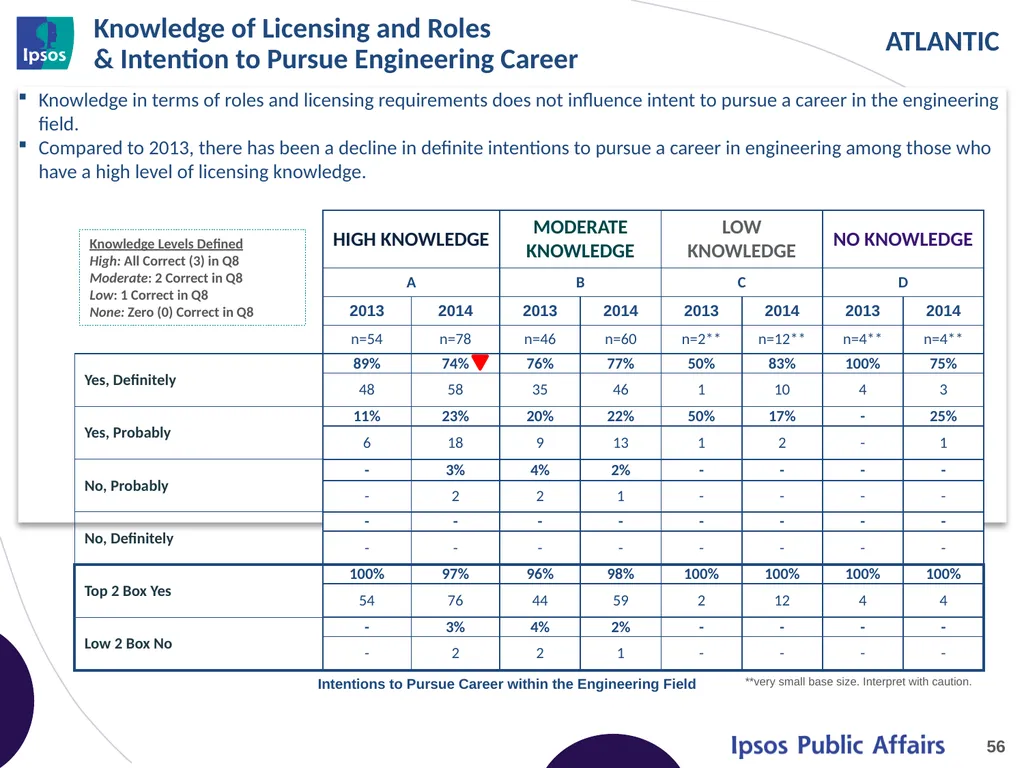
slide56. Knowledge of Licensing and Roles & Intention to Pursue Engineering Career Knowledge in terms of roles and licensing requirements does not influence intent to pursue a career in the engineering field.
Compared to 2013, there has been a decline in definite intentions to pursue a career in engineering among those who have a high level of licensing knowledge. 56 Intentions to Pursue Career within the Engineering Field **very small base size. Interpret with caution. Knowledge Levels Defined High: All Correct (3) in Q8 Moderate: 2 Correct in Q8 Low: 1 Correct in Q8 None: Zero (0) Correct in Q8<br>
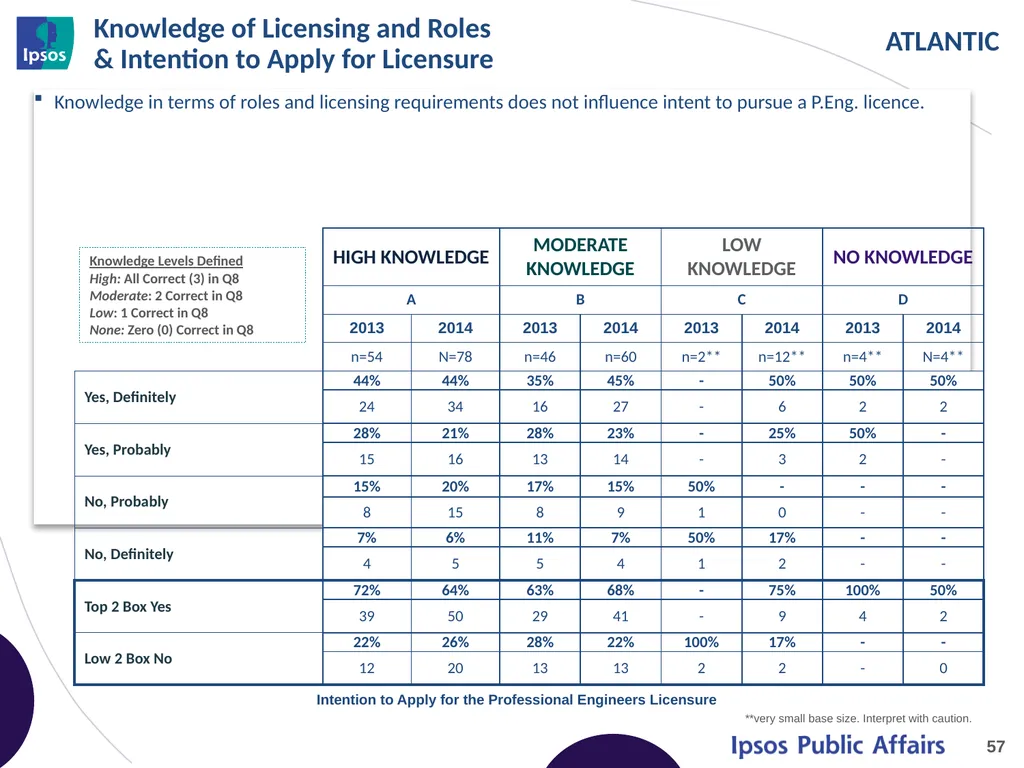
slide57. Knowledge of Licensing and Roles & Intention to Apply for Licensure Knowledge in terms of roles and licensing requirements does not influence intent to pursue a P.Eng. licence. 57 Intention to Apply for the Professional Engineers Licensure **very small base size. Interpret with caution. Knowledge Levels Defined High: All Correct (3) in Q8 Moderate: 2 Correct in Q8 Low: 1 Correct in Q8 None: Zero (0) Correct in Q8<br>
slide58. Impact of Knowledge of Organizational Responsibility 58<br>
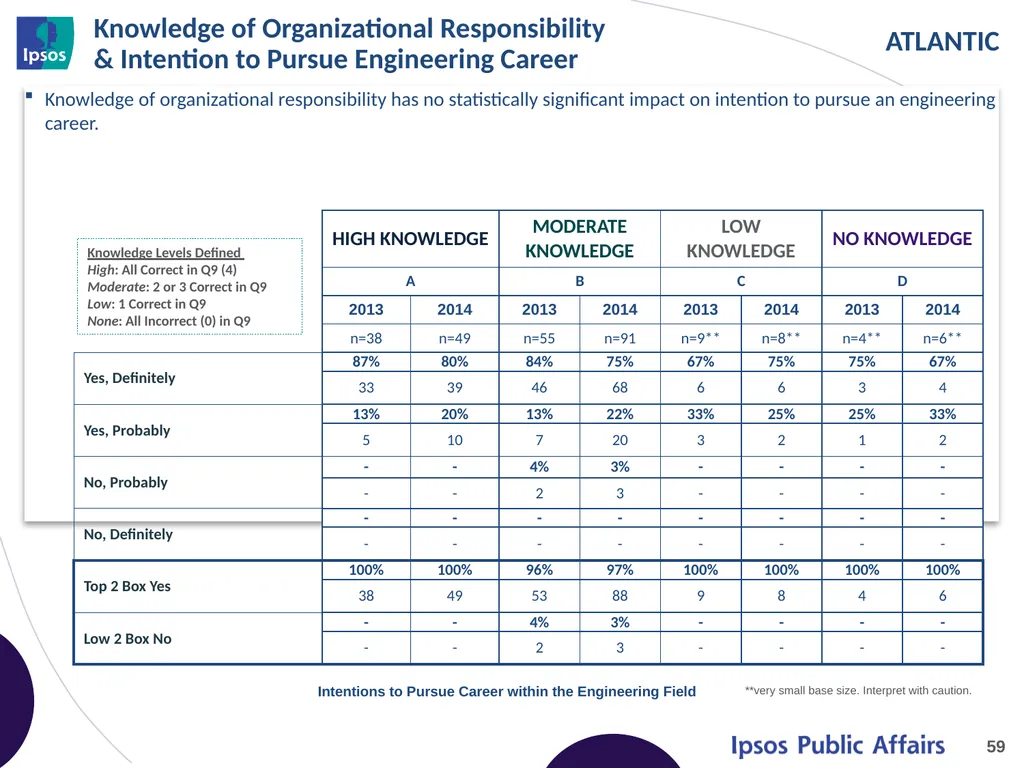
slide59. Knowledge of Organizational Responsibility & Intention to Pursue Engineering Career Knowledge of organizational responsibility has no statistically significant impact on intention to pursue an engineering career. 59 Intentions to Pursue Career within the Engineering Field **very small base size. Interpret with caution. Knowledge Levels Defined
High: All Correct in Q9 (4) Moderate: 2 or 3 Correct in Q9 Low: 1 Correct in Q9 None: All Incorrect (0) in Q9<br>
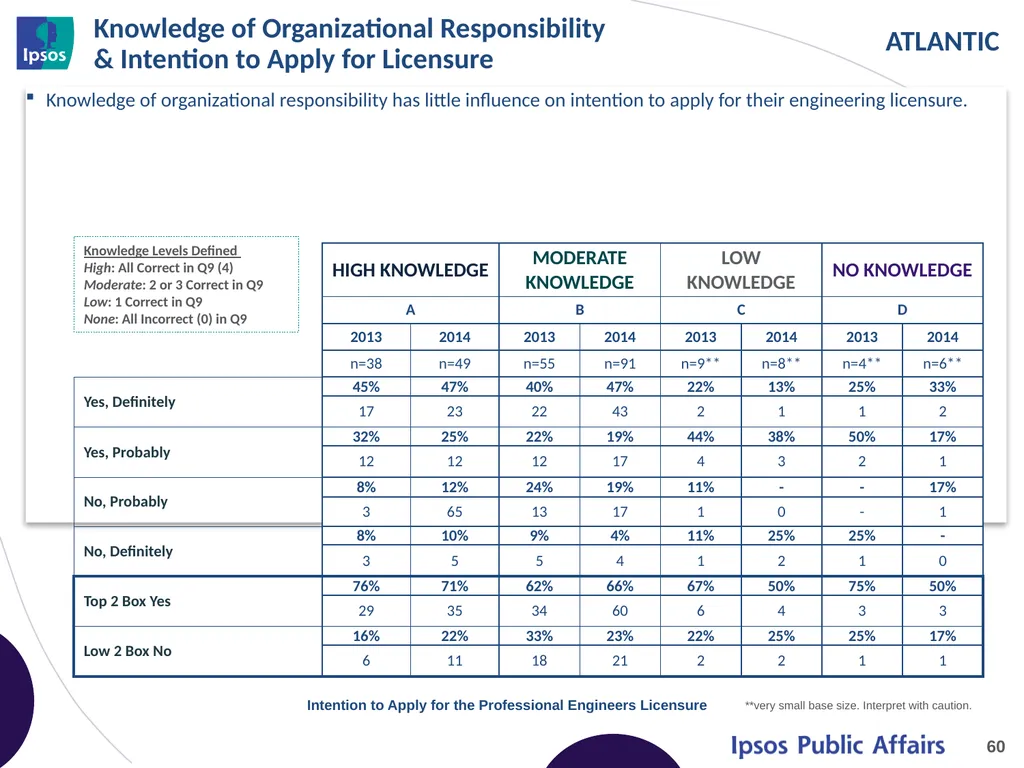
slide60. Knowledge of Organizational Responsibility & Intention to Apply for Licensure Knowledge of organizational responsibility has little influence on intention to apply for their engineering licensure. 60 Intention to Apply for the Professional Engineers Licensure **very small base size. Interpret with caution. Knowledge Levels Defined
High: All Correct in Q9 (4) Moderate: 2 or 3 Correct in Q9 Low: 1 Correct in Q9 None: All Incorrect (0) in Q9<br>
slide61. May 2014 Ipsos Reid Public Affairs
300 -160 Bloor Street East
Toronto, Ontario, Canada M4W 1B9
Sandra Guiry, Vice President
Phone: 416-324-2018
eMail: Sandra.Guiry@ipsos.com
Michael Howell, Associate Vice President
Phone: 416-572-4407
eMail: Michael.Howell@ipsos.com<br>
slide2. Table of Contents Research Objectives 3
Methodology 4
Key Highlights 6
Executive Summary 7
Future Plans 11
Intention to Apply for Licensure 17
Licensing Knowledge 28
Knowledge of Association of Professional Engineers 34
Knowledge of Professional Engineers Act 37
Appetite for Career Assessment Tool 40
Demographics 45
Additional Analysis: Impact on Intention to Pursue
Attendance at Workshop/Seminar 49
Knowledge of PEA 52
Knowledge of Licensing and Roles 55
Knowledge of Organizational Responsibility 58 2<br>
slide3. Research Objectives The primary objective of this research is to understand the reasons why graduates of CEAB accredited engineering programs at Atlantic universities do or do not intend to apply for their licence.
In order to achieve this objective, the research seeks to understand the following:
The future career and/or education plans of final year engineering students;
The percentage of final year engineering students who intend to pursue a career in Engineering and the percentage who intend to apply for their P.Eng licence;
Final year engineering students’ level of knowledge of the Professional Engineers Act of their province. 3<br>
slide4. Methodology The online survey was conducted between January 27 to March 14, 2014 with final year engineering students.
All university Faculties of Engineering with CEAB accredited programs were invited to participate in the study and were asked to send the online survey to all final year engineering students registered in their Engineering program.
The link to the online survey was sent to the universities and each school was requested to send the survey link to all qualified students on January 27, 2014.
The survey was offered in both English and French.
A total of 39 universities participated in the research and 2,046 students completed the survey. Within Atlantic provinces specifically, 4 schools participated and a total of n=154 students completed the survey.
The margin of error for this study (n=154) is ± 8.0%, 19 times out of 20. 4<br>
slide5. Methodology (cont’d) For certain questions, the base size was too low to include in reporting. These include:
Q16, Q17 and Q18 (only n=3 responded to these questions)
Q23 (only n=3 responded to this question)
Please note: base sizes under n=30 are considered very small and should be interpreted with caution 5<br>
slide6. Key Highlights Compared to last year, we have observed little statistically significant movement in terms of students’ intentions to pursue a career in engineering or to apply for licensure.
There has however been a slight softening of definite intentions to pursue a career in engineering, however overall intentions remain strong. We have also noticed the opposite in terms of intentions to apply for licensure with a directional increase in definite intentions. These measures will be important to watch moving forward to see if the incremental movement observed this year develops into a trend.
While virtually all students continue to report they are likely (definitely/ probably) to pursue a career in engineering (98% vs. 98% in 2013), directionally fewer students definitely will than in the past (76% down from 83% last year).
Overall, two thirds (66%) of final year engineering students are at least probably likely to apply for licensure, unchanged over the past year (68% in 2013), however the proportion who are definitely likely has increased slightly versus 2013 (45% vs. 40%).
There has also been some declines in terms of students’ knowledge regarding the engineering profession year over year. Compared to 2013, we notice an increase in those students’ who have a low level of knowledge regarding licensing and roles within the profession (8% vs. 2% in 2013), however the vast majority continue to have a high or moderate level of knowledge (90% vs. 94%).
Specifically, there has been a directional decline in the proportion of students who know that a licence is required to perform engineering work independently (87% vs. 92% in 2013). 6<br>
slide7. Executive Summary Future Intentions: Continuing Education Versus Entering Workforce
More than eight in ten (85%) final year engineering students say they intend to go into the workforce after graduating with their bachelors degree in Engineering, while one in ten (9%) students intend to pursue more education.
Of those who intend on pursuing more education, the vast majority (n=12) plan to pursue a graduate degree in engineering. Due to very small base sizes, results should be interpreted with caution.
Among those students who plan to pursue more education, New Brunswick is mentioned most often as their preferred location for further studies, followed by Nova Scotia and Ontario.
Future Intentions: Engineering Career
Virtually all students (98%) say they are likely to pursue a career in engineering, three quarters definitely will (76%) while slightly more than two in ten probably will (22%). Very few students (2%) probably will not pursue a career in engineering, while none indicate they definitely will not.
Over nine in ten (94%) students say that when they began their studies they planned to practice engineering upon completion of their program. Two thirds of students began their undergraduate studies with a definite intention to pursue an engineering career (64%), while three in ten said it was likely (31%). 7<br>
slide8. Executive Summary (continued) Future Intentions: Engineering Career (continued)
Consistent with the overall level, over nine in ten students who intend to pursue a career in engineering say they were definitely (65%) or likely (31%) to pursue a career in the engineering field when they began their studies. Fewer than one in ten (4%) say they originally intended to pursue an alternate career.
Future Intentions: Pursue Licensure
More than four in ten of all students (45%) indicate that they definitely intend to apply for licensure, while nearly two in ten (21%) say they probably will. One quarter of students are unlikely to apply, of which nearly two in ten probably won’t (16%), while fewer than one in ten definitely won’t apply (7%). One in ten don’t know (11%).
Of those students who specifically plan to pursue an engineering career, 46% indicate they definitely will and 21% probably will pursue their licence, nearly identical to overall levels.
Of those who do not intend to immediately pursue their licence, nine in ten indicate that they probably or definitely will apply for licensure sometime down the road (91%), while one in ten do not foresee themselves applying in the future (9%). Due to very small base sizes, results should be interpreted with caution.
Once told that a licence is required to legally refer to yourself as an engineer and practice as an engineer, the vast majority (n=13) of those who originally did not plan to pursue their licence now indicate they are definitely or probably likely to do so. Due to very small base sizes, results should be interpreted with caution. 8<br>
slide9. Executive Summary (continued) Future Intentions: Pursue Licensure (continued)
Of those who intend to pursue their licence, seven in ten students plan to do so within one year (69%), of which half will do so within six months (52%). Slightly more than one in ten intend to apply after a year (15%) or remain undecided (16%).
Among those students who plan to wait at least a year to apply for licensure or are unsure, virtually all (n=44) cite the desire for required work experience as the reason for the delay or uncertainty.
Upon learning that the fee for the first year of the Engineering-in-Training [EIT] program can be waived if they apply within six months of graduation, over nine in ten (95%) say they are at least likely to apply within a 6 month timeframe.
Knowledge of Engineering Profession
At eight in ten (83%), the vast majority of students know that engineering is regulated by legislation, while one in ten believe it is not and 7% are unsure.
Students’ knowledge of the Professional Engineers Act of their respective province is varied, four in ten students report having a fair amount (38%) or just a little knowledge (43%) about the Professional Engineers Act, while 4% claim to know a lot about it. Only 4% say they have never heard of the Act.
Nine in ten students know that a licence is required to perform engineering work independently (87%) while seven in ten know it is needed to use the title ‘Engineer’ (71%). Further, eight in ten know that it is not required to practice engineering work under the supervision of a P.Eng (80%). 9<br>
slide10. Executive Summary (continued) Knowledge of Engineering Profession (continued)
The vast majority of students are able to correctly identify that their respective provincial engineering association is the organization responsible for licensing engineers (84%) and that it also regulates the practice of professional engineers (69%). Comparatively, nearly nine in ten students know that CEAB is the organization that accredits University engineering programs (87%).
Students are split however on which organization licences companies offering engineering services, half feel it is their respective provincial engineering association (48%), while one third believe it is CEAB (34%) and one quarter don’t know (25%).
Appetite for Career Assessment Tool
At nine in ten (90%), the vast majority of students think it would have been very (48%) or somewhat helpful (42%) to have had a tool in high school that would help determine if they would have been a good fit for engineering studies.
An identical proportion of students (90%) feel that a career assessment would be helpful, of which half indicate it would be very helpful (49%) and four in ten somewhat helpful (41%).
Most students feel that a career assessment tool would be most helpful in their 3rd year of school (41%), followed by around one quarter who mention either their 2nd year (25%) or 4th year (26%), while only one in ten mention 1st year (8%).
Only 1% of students report being aware of Engineers Canada’s Career Focus program. 10<br>
slide11. Future Plans 11<br>
slide12. Plans After Graduation 12 Q12. Which of the following best describes your current plans after you graduate? Base: All respondents 2013 (n=106); 2014 (n=154) Q13. Which of the following best describes the education you plan to pursue? Base: Respondents who said “more education” in Q12, 2013 (n=12); 2014 (n=14) Current Plans After Graduation Educational Intentions Consistent with last year, over eight in ten students intend on going into the workforce after graduation, while one in ten plan to pursue more education.
Among those who plan to further their education, the vast majority (n=12) plan to pursue a graduate degree in engineering. Due to very small base sizes, results should be interpreted with caution.<br>
slide13. Location of Anticipated Graduate Education 13 Q13B. Where do you plan to pursue graduate education? Base: Pursue more education after graduation – 2013 (n=12); 2014 (n=14) Location of Graduate Intentions Among those students who plan to pursue more education, New Brunswick is mentioned most often as their preferred location for further studies, followed by Nova Scotia and Ontario. Due to very small base sizes, results should be interpreted with caution.<br>
slide14. Intention to Pursue Engineering Career 14 Q14. When you complete your education, do you plan to pursue a career in the engineering field? Base: All respondents 2013 (n=106); 2014 (n=154) Do You Plan to Pursue a Career in the Engineering Field? Virtually all students intend on pursuing a career in the engineering field after completing their education.
Compared to last year, there has been a directional decline in the proportion of students who definitely intend to pursue a career in engineering, off set by an increase in those who probably will. No (Low 2 Box) 2014: 98%
(n=151)
2013: 98% (n=104) 2014: 2%
(n=3)
2013: 2% (n=2) Yes (Top 2 Box)<br>
slide15. Career Plans When Studies Commenced Over nine in ten students say that when they began their studies they planned to practice engineering upon completion of their program, of which nearly two-thirds definitely intended on doing so while three in ten said it was likely. 15 Q18. When you began your studies, did you plan to practice engineering when you completed your program? Base: All respondents 2013 (n=106); 2014 (n=154) Did You Plan to Practice Engineering When You Began Your Studies? Yes (Top 2 Box) No (Low 2 Box) 2014: 94%
(n=145)
2013: 95% (n=101) 2014: 6%
(n=9)
2013: 5% (n=5)<br>
slide16. Current and Prior Career Intentions (among students who intend to pursue a career in engineering) At over nine in ten, virtually all students who intend on pursuing a career in engineering say they definitely or likely planned to do so when they began their studies. 16 Q18. When you began your studies, did you plan to practice engineering when you completed your program? Base: Students who intend to pursue a career in engineering 2013 (n=104); 2014 (n=151) No (Low 2 Box) Yes (Top 2 Box) 2014: 96%
(n=145)
2013: 96% (n=100) 2014: 4%
(n=7)
2013: 4% (n=4)<br>
slide17. Application Intentions for Professional Engineering Licensure 17<br>
slide18. Intention to Apply for Licensure Nearly half of students (45%) indicate that they definitely intend to apply for licensure, while two in ten (21%) probably will. One quarter of students are unlikely to apply, of which 16% probably won’t and 7% definitely won’t apply, while 11% don’t know. 18 Q21. Do you intend to apply for licensure as a Professional Engineer (P.Eng.)? Base: All respondents 2013 (n=106); 2014 (n=154) Do You Intend To Apply for Licensure? No (Low 2 Box) Yes (Top 2 Box) 2014: 66%
(n=102)
2013: 68% (n=72) 2014: 23%
(n=35)
2013: 25%
(n=27)<br>
slide19. Intention to Apply for Licensure- Pursuing Engineering Career Among those students who intend to pursue a career in engineering, close to half (46%) indicate that they definitely intend to apply for licensure, while a further two in ten (21%) say they probably will. One quarter of students are unlikely to apply for licensure, of which 15% probably won’t and 7% definitely won’t apply. 19 Q21. Do you intend to apply for licensure as a Professional Engineer (P.Eng.)? Base: Respondents who intend to pursue a career in the engineering field 2013 (n=104); 2014 (n=151) Do You Intend To Apply for Licensure? No (Low 2 Box) Yes (Top 2 Box) 2014: 67%
(n=101)
2013: 69% (n=72) 2014: 23%
(n=34)
2013: 24%
(n=25)<br>
slide20. Do You Ever Foresee Yourself Applying for Licensure? Foresee Applying in Future P.Eng. 20 Q22. Do you ever foresee yourself applying for licensure as a Professional Engineer (P.Eng.)? Base: Respondents who said ‘no’ in Q21 2013 (n=27); 2014 (n=35) Of those students who do not plan on –or- are not sure if they will apply for licensure, over nine in ten (91%) indicate that they probably or definitely will apply for licensure sometime down the road, while one in ten (9%) do not foresee themselves applying in the future. Due to very small base sizes, results should be interpreted with caution. No (Low 2 Box) Yes (Top 2 Box) 2014: 91%
(n=32)
2013: 82% (n=22) 2014: 9%
(n=3)
2013: 11% (n=3)<br>
slide21. Interest Once Told P.Eng. Licence is Required to Practice 21 Q24. Since a licence is required to legally refer to yourself as an engineer, or to practice as an engineer, do you plan to apply for your P.Eng. licence? Base: Respondents who do not intend to apply for licensure or are not sure, 2013 (n=12); 2014 (n=20) Given that a Licence is Required to Practice Engineering, Do You Intend to Apply? Once told that a licence is required to legally refer to yourself as an engineer and practice as an engineer, two-thirds of those who originally did not plan or were unsure of their intentions now indicate they are definitely or probably likely to apply for licensure. Due to very small base sizes, results should be interpreted with caution. No (Low 2 Box) Yes (Top 2 Box) 2014: 65%
(n=13)
2013: 67% (n=8) 2014: 20%
(n=4)
2013: 25%
(n=3)<br>
slide22. Pre-Graduation Work Experience- 2014 22 Q33 Have you been able to obtain pre-graduation engineering work experience? Base: Respondents applied for license or Don't know/ Unsure (n=16) Among those who didn’t immediately intend to apply but would do so after hearing it is required to practice, over four in ten have been able to obtain pre-graduation work experience, while slightly fewer have not and two in ten are not sure what qualifies.<br>
slide23. Application Timeframe 23 Apply Within 1 Year (Top 2 Box) When Do You Plan to Apply for Licensure? Q27. Do you intend to apply for licensure...? Base: Respondents who plan to apply for licensure, 2013 (n=102); 2014 (n=147) Seven in ten students who intend to apply for licensure plan to do so within one year (69%), of which half think they will apply within six months of graduation (52%). Slightly more than one in ten intend to apply after a year (15%) or remain undecided (16%). 2014: 69%
(n=101)
2013: 67% (n=68)<br>
slide24. Reasons for Waiting to Apply 24 Q28. Why do you intend to wait more than a year to apply for the P.Eng.? Base: Respondents who said >1yr or don’t know/unsure in Q27, 2013 (n=34); 2014 (n=46) Why Do You Plan to Wait More Than a Year to Apply? Among those students who plan to wait at least a year to apply for licensure or are unsure, virtually all cite the desire for required work experience as the reason for the delay or uncertainty. Due to small base sizes, results should be interpreted with caution.<br>
slide25. Would you Apply Within 6 Month if Eligible to Have 1st Year EIT Fees Waived? Impact of Waiving EIT Fees on Likelihood to Apply within Six Months 25 Q29. If you knew that by applying for licensure in Ontario within 6 months of graduation you could be eligible to have the application and first year EIT program fees waived, how likely would you be to apply for licensure within that time frame? Base: Respondents who do not know or intend to apply for licensure in Ontario >6mths after graduation, 2013 (n=51); 2014 (n=71) Likely (Top 2 Box) Unlikely (Low 2 Box) (n=81) Upon learning that they could be eligible to have their first year EIT fees waived, nearly six in ten (58%) students who originally intended on waiting more than six months after graduation to apply say that they are very likely to do so within that timeframe. Nearly four in ten (37%) are somewhat likely to apply within six months, while only 1% are unlikely to apply (8%) in that timeframe, while 4% don’t know. 2014: 95%
(n=67)
2013: 85% (n=43) 2014: 1%
(n=1)
2013: 8% (n=4)<br>
slide26. Intended Country of Application 26 Q25. Where do you intend to apply for licensure? Base: Respondents who ever plan to apply for licensure, 2013 (n=102); 2014 (n=147) Abroad Where Do You Intend to Apply for Licensure? Mentions may add to more than 100% as respondents were able to select more than one response Nearly all final year engineering students (96%) who intend to apply for licensure plan to apply in Canada. One in ten also plan to apply in the US (11%) or abroad (8%). 2014: 8%
(n=12)
2013: 5% (n=5)<br>
slide27. Province of Intended Licensure 27 Q26. Please select the provinces and/or territories in which you intend on applying for licensure. Base: Respondents who plan to apply for licensure in Canada, 2013 (n=98); 2014 (n=141) Around half of students who plan to apply for licensure intend to apply in Alberta (46%), followed by New Brunswick (38%). Closer to three in ten intend to apply in Nova Scotia (28%), while closer to one quarter indicate Ontario (24%) or Newfoundland/ Labrador (23%).
Compared to 2013, students are more likely to intend on applying in Nova Scotia, Ontario or the territories.<br>
slide28. Licensing Knowledge 28<br>
slide29. Engineering Regulated by Legislation 29 Q5. As far as you know, is the practice of professional engineering regulated by legislation? Base: All respondents 2013 (n=106); 2014 (n=154) Is the Practice of Engineering Regulated by Legislation? At eight in ten (82%), the vast majority of students know that engineering is regulated by legislation, while one in ten believe it is not and 7% are unsure.<br>
slide30. Licensing for Roles within Engineering Nearly nine in ten students know that a licence is required to perform engineering work independently (87%) while seven in ten know it is needed to use the title ‘Engineer’ (71%). Exactly eight in ten meanwhile know that it is not required to practice engineering work under the supervision of a P.Eng (80%). 30 Q8. As far as you know, is a licence required before being able to do the following in ... Base: All respondents 2013 (n=106); 2014 (n=154) Is a Licence Required Before Being Able to Do the Following?<br>
slide31. Knowledge of Licensing and Roles 31 Q8. As far as you know, is a licence required before being able to do the following in .. Base: All respondents 2013 (n=106); 2014 (n=154) Knowledge Levels Defined High: All Correct (3) in Q8 Moderate: 2 Correct in Q8 Low: 1 Correct in Q8 None: Zero (0) Correct in Q8 Knowledge Level of Engineering Practices Requiring a Licence High/Moderate (Top 2 Box) Little/None (Top 2 Box) Nine in ten students have a moderate (39%) or high (51%) level of knowledge of when a licence is required to legally perform actions/ duties within the engineering profession. Comparatively, one in ten have either little (8%) or no knowledge (3%) on the subject.
Compared to 2013, there has been an increase in the proportion of students who have a low level of knowledge. 2014: 90%
(n=138)
2013: 94% (n=100) 2014: 11%
(n=16)
2013: 6%
(n=6)<br>
slide32. Organizational Responsibilities – 2013 & 2014 The vast majority of students are able to correctly identify that their respective provincial engineering association is the organization responsible for licensing engineers (84%) and that it also regulates the practice of professional engineers (69%). Comparatively, nearly nine in ten students know that CEAB is the organization that accredits University engineering programs (87%). Students are split however on which organization licences companies offering engineering services, half feel it is their respective provincial engineering association (48%), while one third believe it is CEAB (34%) and one quarter don’t know (25%).
Compared to 2013, students are less likely to believe CEAB licences companies offering engineering services but more likely to feel that organization promotes the interests of professional engineers. 32 Q9. Please indicate the organization responsible for each of the activities/ procedures listed below. Base: All respondents 2013 (n=106); 2014 (n=154)<br>
slide33. Knowledge of Organizational Responsibility 33 Knowledge Level of Organizational Responsibility within the Engineering Profession Q9. Please indicate the organization responsible for each of the activities/ procedures listed below. Base: All respondents 2013 (n=106); 2014 (n=154) High/ Moderate (Top 2 Box) Little/ None (Top 2 Box) Nearly nine in ten students have either a high (32%) or moderate (59%) level of knowledge concerning organizational responsibilities of activities/ procedures relating to the engineering profession. One in ten have either a low level (5%) or no knowledge (4%) on the subject. Knowledge Levels Defined
High: All Correct in Q9 (4) Moderate: 2 or 3 Correct in Q9 Low: 1 Correct in Q9 None: All Incorrect (0) in Q9 2014: 91%
(n=140)
2013: 88% (n=93) 2014: 9%
(n=14)
2013: 12%
(n=13)<br>
slide34. Provincial Engineering Association 34 Attendance at seminar(s) and awareness of SMP program<br>
slide35. Attendance of Provincial Engineering Association Seminar 35 Q11. Have you ever attended a workshop/ seminar/ talk given by a [PEGNL/Engineers PEI/Engineers NS/APEGNB/] representative? Base: All respondents 2013 (n=106); 2014 (n=154) Ever Attend a [PEGNL/Engineers PEI/Engineers NS/APEGNB] Seminar? Nearly half of students (46%) report having ever attended a seminar or workshop given by a representative from their respective provincial engineering association.<br>
slide36. Association with SMP 36 Q32. Which of the following best describes your association with the [PEGNL/Engineers PEI/Engineers NS/APEGNB/]’s Student Membership Program (SMP)? Base: All respondents 2013 (n=106); 2014 (n=154) Aware (Top 3 Box) Nearly four in ten students (38%) are aware of a Student Membership Program (SMP) offered by their respective provincial engineering association. Of which, 7% are current members, nearly one quarter have heard of it and are interested in becoming a member (23%) and 8% have heard of the program but are not interested in membership. 2014: 38%
(n=57)
2013: 35%
(n=37)<br>
slide37. Professional Engineers Act 37<br>
slide38. Professional Engineers Act 38 Q6. The practice of engineering is regulated by the Professional Engineers Act of [Newfoundland and Labrador/PEI/Nova Scotia/New Brunswick ]. Which of the following best describes how much you know about the Professional Engineers Act of [Newfoundland and Labrador/PEI/Nova Scotia/New Brunswick ]? Base: All respondents 2013 (n=106); 2014 (n=154) Familiar (Top 3 Box) How Much Do You Know About the Professional Engineers Act of
[Newfoundland and Labrador/PEI/Nova Scotia/New Brunswick]? Over eight in ten students report being familiar with the Professional Engineers Act of their respective province. Four in ten report having a fair amount (38%) or just a little knowledge (43%) about the Professional Engineers Act, while 4% claim to know a lot about it. Only 4% say they have never heard of the Act. 2014: 85%
(n=131)
2013: 91% (n=97)<br>
slide39. Professional Engineers Act (cont’d) 39 Q7. Where did you first hear about the Professional Engineers Act of [Newfoundland and Labrador/PEI/Nova Scotia/New Brunswick ]? Base: Respondents who know about the Act 2013 (n=97); 2014 (n=131) Where Did You First Hear About the Professional Engineers Act of [Newfoundland and Labrador/PEI/Nova Scotia/New Brunswick ]? Mentions <4% are not shown University prof or course Eight in ten students heard about the Act through a university law and ethics course (54%) or a university professor or administrator (27%).<br>
slide40. Appetite for Career Assessment Tool 40<br>
slide41. Helpfulness of Engineering Fit Tool During High School 41 Q33E. Would it have been helpful in high school to have had a tool to help determine if you would be a good fit for engineering studies and for a successful career in engineering? Base 2014 n=154 At nine in ten, the vast majority of students think it would have been helpful to have had a tool in high school that would help determine if they would have been a good fit for engineering studies, of which half think it would have been very helpful. (n=42) Helpful (Top 2 Box) 10%
(n=15) Not Helpful (Top 2 Box) 90%
(n=139)<br>
slide42. Career Assessment Tool- 2014 42 Q17a. Would a tool to help you decide if you should pursue a career in consulting, technical engineering, sales engineering, project management, academe, etc., be helpful to you? Base: All respondents 2014 (n=154) Similarly, nine in ten feel that a career assessment would be helpful, of which nearly half indicate it would be very helpful. Not Helpful (Low 2 Box) 2014: 90%
(n=138) 10%
(n=16) Helpful (Top 2 Box)<br>
slide43. Career Assessment Tool- 2014 43 Q17b. At what stage in the engineering education process do you feel this career assessment tool would be most helpful? Base: All respondents 2014 (n=154) At four in ten, most students feel that a career assessment tool would be most helpful in their 3rd year of school, followed by around one quarter who mention either their 2nd year or 4th year, while only one in ten mention 1st year.<br>
slide44. Intention to Pursue Engineering Career- 2014 44 Q17c. Are you aware that Engineers Canada has developed a new program called Career Focus which includes a tool that can assess your chances of success in engineering? Base: All respondents 2014 (n=154) Only 1% report being aware of Engineers Canada’s Career Focus program.<br>
slide45. Demographics 45<br>
slide46. Inspiration for Pursuing Engineering 46 Q33B. Thinking back to before you began your current undergraduate program, would you say there was a particular individual(s) or role model(s) who inspired you to study engineering specifically? Base: All respondents, 2013 (n=106), 2014 (n=154) . Q33C. What was your relation to this person(s)? Base: Respondents who were inspired by someone to pursue engineering. 2013 (n=42), 2014 (n=76) Q33D. Please indicate the gender of each individual you selected. Base: Respondents who were inspired by someone to pursue engineering. Nearly half of students indicate that a particular individual inspired them to enter engineering specifically. Of those who were inspired, almost half cite a parent as the individual who motivated them while four in ten mention another family member and two in ten a friend/ acquaintance or a teacher.
The vast majority indicate that it was a male who inspired them. (n=42)<br>
slide47. Permanent Residency 47 Q34. For statistical purposes, we would like to know the location of your permanent residence. Please select the statement that most appropriately describes your current residency status: ? Base: All respondents, 2013 n=106, 2014 n=154; Q35. You indicated that you are attending university in [Newfoundland and Labrador/PEI/Nova Scotia/New Brunswick ] but are a permanent resident of another province/territory. Please select the province or territory in which you are a permanent resident. Base: Respondents who are not permanent residents of [Newfoundland and Labrador/PEI/Nova Scotia/New Brunswick ], 2013 n=26, 2014 n=48 Around half of final year engineering students are permanent residents of the province they are attending school in (55%), lower than in 2013. Of those who are attending school in one of the Atlantic provinces but are a permanent resident of another province, Nova Scotia, Ontario, Alberta and PEI are the most common home provinces referenced by students. Resident of Another Province/Territory:<br>
slide48. Engineering Disciplines 48 Q3/Q3B. Please indicate the engineering discipline in which you are currently studying by selecting one of the following options. Base: All respondents, 2013 (n=106); 2014 (n=154) Mentions <3% (in 2013) are not shown The most popular disciplines are civil engineering, followed by mechanical engineering, chemical engineering and electrical engineering.<br>
slide49. Impact of Seminar/ Workshop Attendance 49<br>
slide50. Workshop/Seminar Attendance & Intention to Pursue Engineering Career Intentions to pursue a career within the Engineering field are the same regardless if a student has attended a workshop/seminar. 50 Intentions to Pursue Career within the Engineering Field<br>
slide51. [Workshop/Seminar Attendance & Intention to Apply for Licensure Intentions to pursue their P.Eng. licence are the same regardless if a student has attended a workshop/seminar. 51 Intention to Apply for the Professional Engineers Licensure<br>
slide52. Impact of Knowledge of the Professional Engineers Act 52<br>
slide53. Knowledge of Professional Engineers Act & Intention to Pursue Engineering Career 53 Intentions to Pursue Career within the Engineering Field Knowledge of the Professional Engineers Act has little influence over their intention to pursue a career in engineering.
Compared to 2013, there has been a decline in definite intentions among those who have no knowledge of the professional engineers act. **very small base size. Interpret with caution.<br>
slide54. Knowledge of Professional Engineers Act & Intention to Apply for Licensure Students with a higher level of knowledge regarding the Professional Engineers Act are more likely to be definitely likely to intend to apply for licensure. However, the majority of students regardless of their knowledge intend to apply after graduation.
Compared to 2013, there has been a decline in intentions among those who have no knowledge of the professional engineers act. 54 Intention to Apply for the Professional Engineers Licensure **very small base size. Interpret with caution.<br>
slide55. Impact of Knowledge of Licensing and Roles 55<br>
slide56. Knowledge of Licensing and Roles & Intention to Pursue Engineering Career Knowledge in terms of roles and licensing requirements does not influence intent to pursue a career in the engineering field.
Compared to 2013, there has been a decline in definite intentions to pursue a career in engineering among those who have a high level of licensing knowledge. 56 Intentions to Pursue Career within the Engineering Field **very small base size. Interpret with caution. Knowledge Levels Defined High: All Correct (3) in Q8 Moderate: 2 Correct in Q8 Low: 1 Correct in Q8 None: Zero (0) Correct in Q8<br>
slide57. Knowledge of Licensing and Roles & Intention to Apply for Licensure Knowledge in terms of roles and licensing requirements does not influence intent to pursue a P.Eng. licence. 57 Intention to Apply for the Professional Engineers Licensure **very small base size. Interpret with caution. Knowledge Levels Defined High: All Correct (3) in Q8 Moderate: 2 Correct in Q8 Low: 1 Correct in Q8 None: Zero (0) Correct in Q8<br>
slide58. Impact of Knowledge of Organizational Responsibility 58<br>
slide59. Knowledge of Organizational Responsibility & Intention to Pursue Engineering Career Knowledge of organizational responsibility has no statistically significant impact on intention to pursue an engineering career. 59 Intentions to Pursue Career within the Engineering Field **very small base size. Interpret with caution. Knowledge Levels Defined
High: All Correct in Q9 (4) Moderate: 2 or 3 Correct in Q9 Low: 1 Correct in Q9 None: All Incorrect (0) in Q9<br>
slide60. Knowledge of Organizational Responsibility & Intention to Apply for Licensure Knowledge of organizational responsibility has little influence on intention to apply for their engineering licensure. 60 Intention to Apply for the Professional Engineers Licensure **very small base size. Interpret with caution. Knowledge Levels Defined
High: All Correct in Q9 (4) Moderate: 2 or 3 Correct in Q9 Low: 1 Correct in Q9 None: All Incorrect (0) in Q9<br>
slide61. May 2014 Ipsos Reid Public Affairs
300 -160 Bloor Street East
Toronto, Ontario, Canada M4W 1B9
Sandra Guiry, Vice President
Phone: 416-324-2018
eMail: Sandra.Guiry@ipsos.com
Michael Howell, Associate Vice President
Phone: 416-572-4407
eMail: Michael.Howell@ipsos.com<br>