
2018 Protocol Changes Greater Miami Valley EMS
MJ
Published · 35 slides · 0 views
1 / 1

Description
2018 Protocol Changes Greater Miami Valley EMS Council This PowerPoint will cover topics related to all levels of Ohio EMS Providers including EMR, EMT, AEMT, and PM. Some of the material may be beyond your scope of practice but is
Related Topics
Share
Embed code
Download this presentation From Below
"2018 Protocol Changes Greater Miami Valley EMS" is the property of its rightful owner. Permission is granted to download and print the materials on this website for personal, non-commercial use only, and to display it on your personal computer provided you do not modify the materials and that you retain all copyright notices contained in the materials. By downloading content from our website, you accept the terms of this agreement.
Presentation Transcript
01
2018 Protocol Changes Greater Miami Valley EMS Council<br>
02
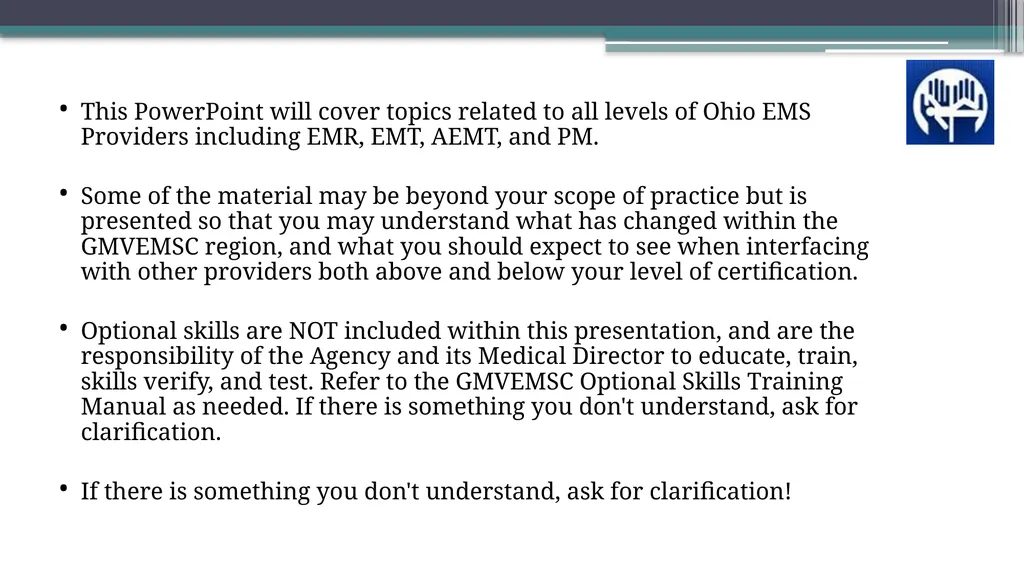
This PowerPoint will cover topics related to all levels of Ohio EMS Providers including EMR, EMT, AEMT, and PM.
Some of the material may be beyond your scope of practice but is presented so that you may understand what has changed within the GMVEMSC region, and what you should expect to see when interfacing with other providers both above and below your level of certification.
Optional skills are NOT included within this presentation, and are the responsibility of the Agency and its Medical Director to educate, train, skills verify, and test. Refer to the GMVEMSC Optional Skills Training Manual as needed. If there is something you don't understand, ask for clarification.
If there is something you don't understand, ask for clarification!<br>
Some of the material may be beyond your scope of practice but is presented so that you may understand what has changed within the GMVEMSC region, and what you should expect to see when interfacing with other providers both above and below your level of certification.
Optional skills are NOT included within this presentation, and are the responsibility of the Agency and its Medical Director to educate, train, skills verify, and test. Refer to the GMVEMSC Optional Skills Training Manual as needed. If there is something you don't understand, ask for clarification.
If there is something you don't understand, ask for clarification!<br>
03
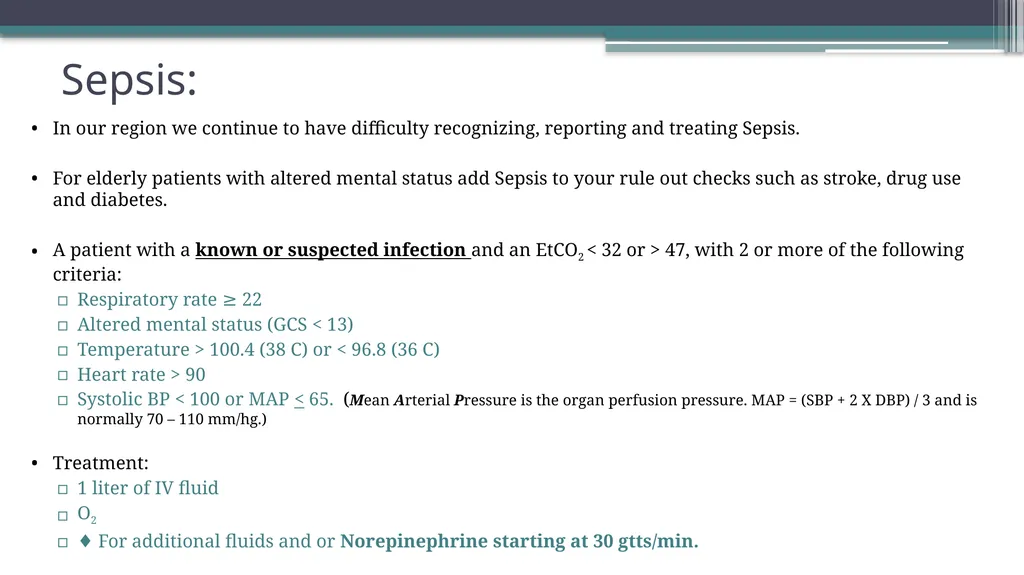
Sepsis: In our region we continue to have difficulty recognizing, reporting and treating Sepsis.
For elderly patients with altered mental status add Sepsis to your rule out checks such as stroke, drug use and diabetes.
A patient with a known or suspected infection and an EtCO2 < 32 or > 47, with 2 or more of the following criteria:
Respiratory rate ≥ 22
Altered mental status (GCS < 13)
Temperature > 100.4 (38 C) or < 96.8 (36 C)
Heart rate > 90
Systolic BP < 100 or MAP < 65. (Mean Arterial Pressure is the organ perfusion pressure. MAP = (SBP + 2 X DBP) / 3 and is normally 70 – 110 mm/hg.)
Treatment:
1 liter of IV fluid
O2
♦ For additional fluids and or Norepinephrine starting at 30 gtts/min.<br>
For elderly patients with altered mental status add Sepsis to your rule out checks such as stroke, drug use and diabetes.
A patient with a known or suspected infection and an EtCO2 < 32 or > 47, with 2 or more of the following criteria:
Respiratory rate ≥ 22
Altered mental status (GCS < 13)
Temperature > 100.4 (38 C) or < 96.8 (36 C)
Heart rate > 90
Systolic BP < 100 or MAP < 65. (Mean Arterial Pressure is the organ perfusion pressure. MAP = (SBP + 2 X DBP) / 3 and is normally 70 – 110 mm/hg.)
Treatment:
1 liter of IV fluid
O2
♦ For additional fluids and or Norepinephrine starting at 30 gtts/min.<br>
04
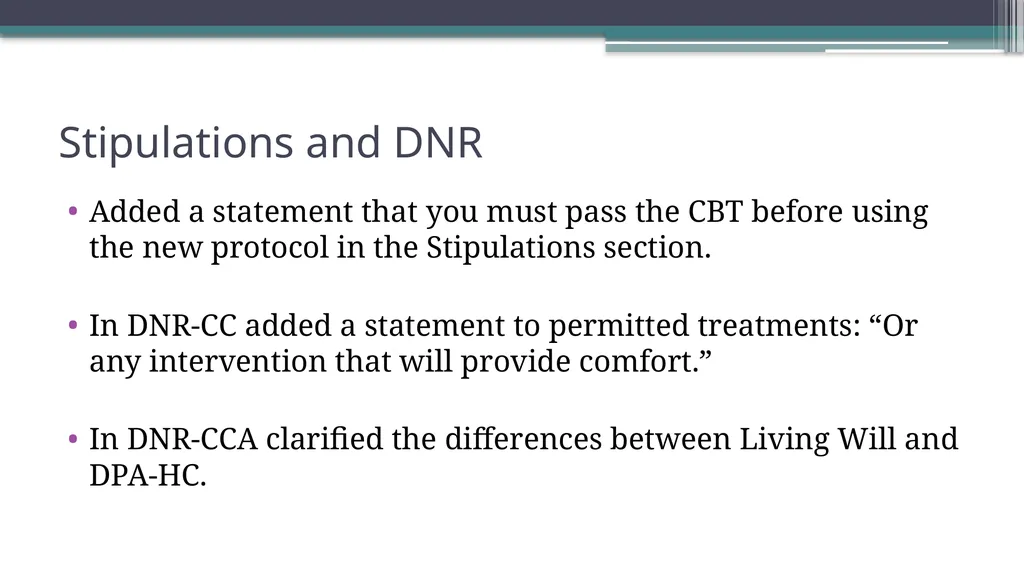
Stipulations and DNR Added a statement that you must pass the CBT before using the new protocol in the Stipulations section.
In DNR-CC added a statement to permitted treatments: “Or any intervention that will provide comfort.”
In DNR-CCA clarified the differences between Living Will and DPA-HC.<br>
In DNR-CC added a statement to permitted treatments: “Or any intervention that will provide comfort.”
In DNR-CCA clarified the differences between Living Will and DPA-HC.<br>
05
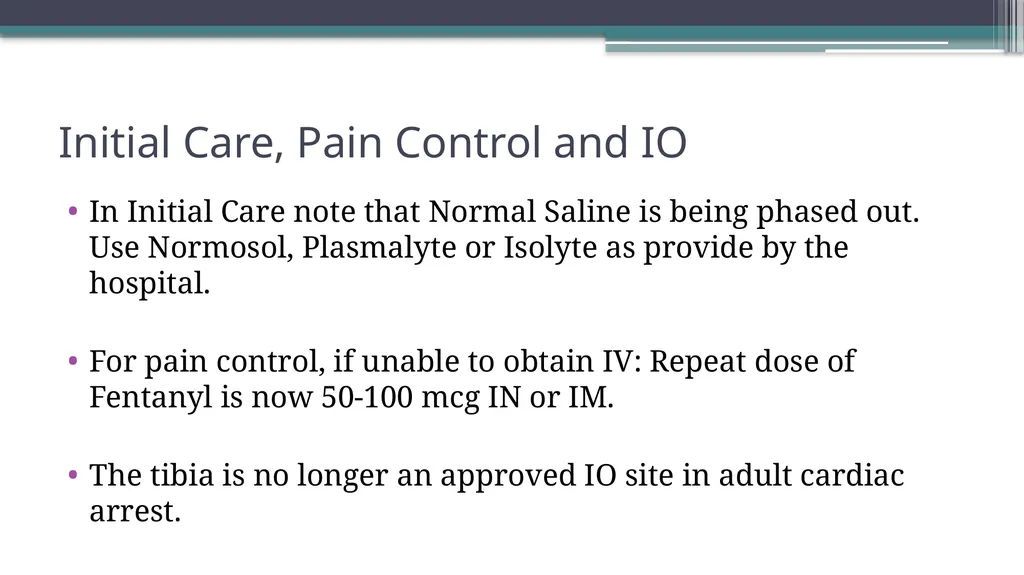
Initial Care, Pain Control and IO In Initial Care note that Normal Saline is being phased out. Use Normosol, Plasmalyte or Isolyte as provide by the hospital.
For pain control, if unable to obtain IV: Repeat dose of Fentanyl is now 50-100 mcg IN or IM.
The tibia is no longer an approved IO site in adult cardiac arrest.<br>
For pain control, if unable to obtain IV: Repeat dose of Fentanyl is now 50-100 mcg IN or IM.
The tibia is no longer an approved IO site in adult cardiac arrest.<br>
06
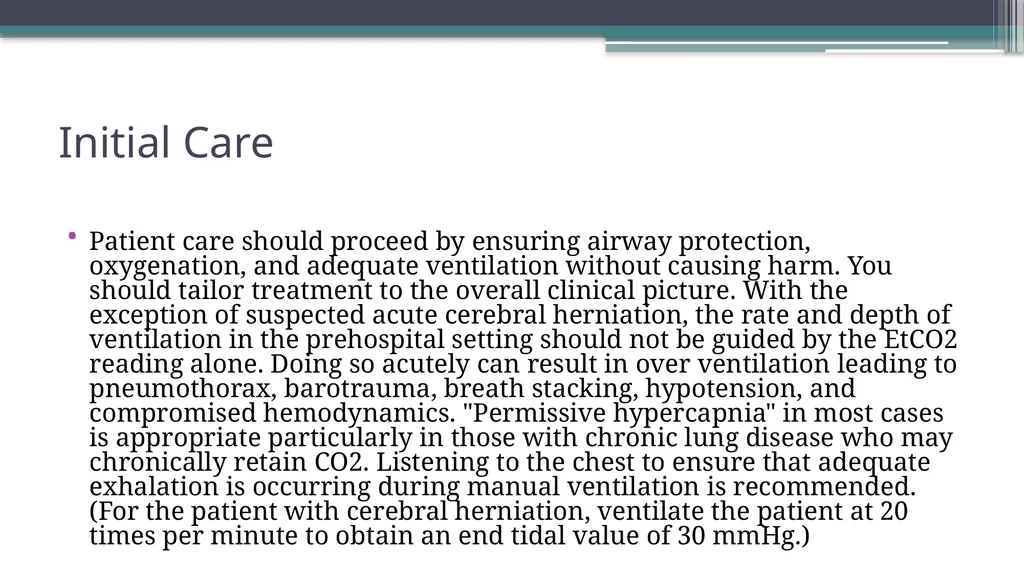
Initial Care Patient care should proceed by ensuring airway protection, oxygenation, and adequate ventilation without causing harm. You should tailor treatment to the overall clinical picture. With the exception of suspected acute cerebral herniation, the rate and depth of ventilation in the prehospital setting should not be guided by the EtCO2 reading alone. Doing so acutely can result in over ventilation leading to pneumothorax, barotrauma, breath stacking, hypotension, and compromised hemodynamics. "Permissive hypercapnia" in most cases is appropriate particularly in those with chronic lung disease who may chronically retain CO2. Listening to the chest to ensure that adequate exhalation is occurring during manual ventilation is recommended. (For the patient with cerebral herniation, ventilate the patient at 20 times per minute to obtain an end tidal value of 30 mmHg.)<br>
07
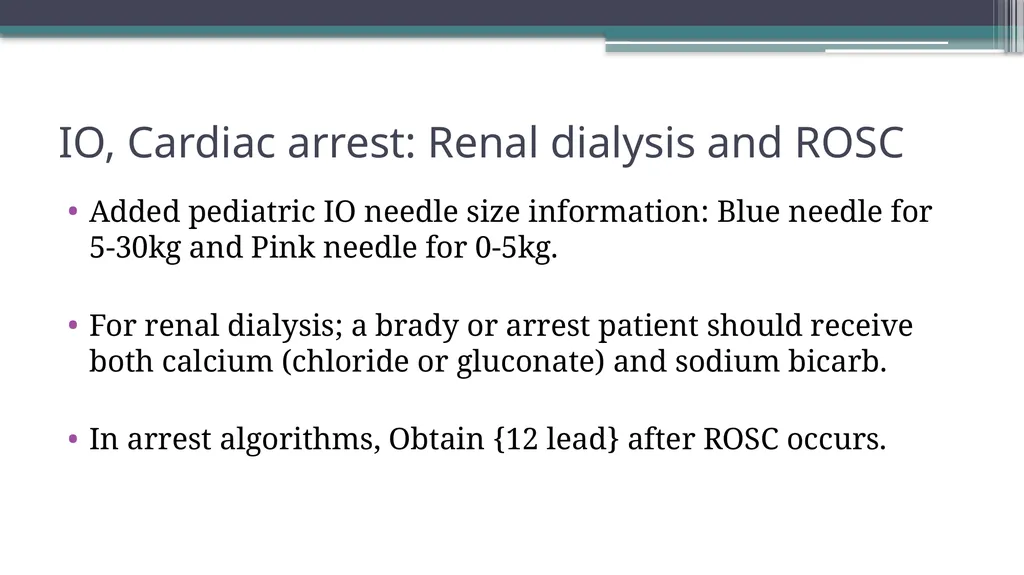
IO, Cardiac arrest: Renal dialysis and ROSC Added pediatric IO needle size information: Blue needle for 5-30kg and Pink needle for 0-5kg.
For renal dialysis; a brady or arrest patient should receive both calcium (chloride or gluconate) and sodium bicarb.
In arrest algorithms, Obtain {12 lead} after ROSC occurs.<br>
For renal dialysis; a brady or arrest patient should receive both calcium (chloride or gluconate) and sodium bicarb.
In arrest algorithms, Obtain {12 lead} after ROSC occurs.<br>
08
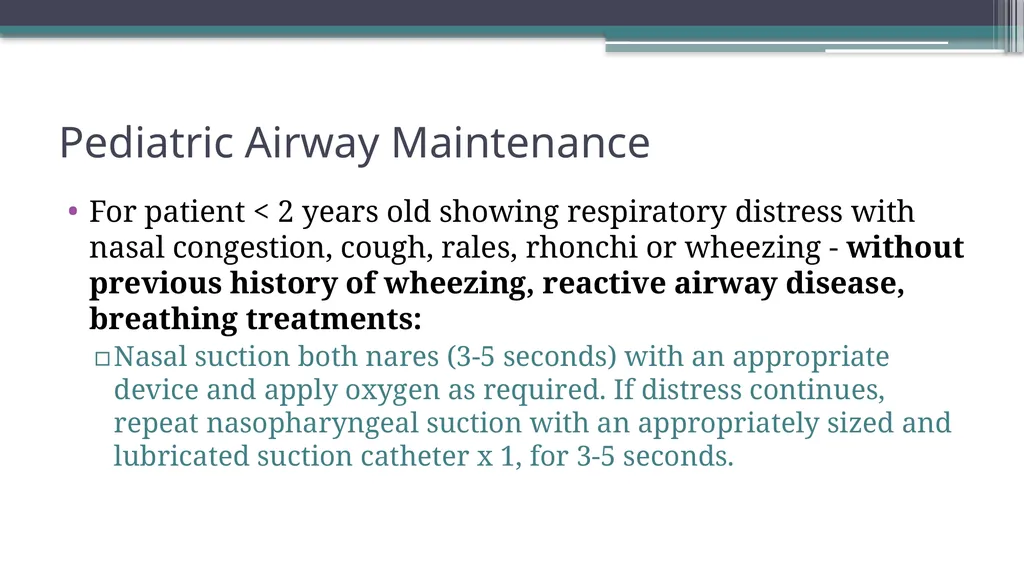
Pediatric Airway Maintenance For patient < 2 years old showing respiratory distress with nasal congestion, cough, rales, rhonchi or wheezing - without previous history of wheezing, reactive airway disease, breathing treatments:
Nasal suction both nares (3-5 seconds) with an appropriate device and apply oxygen as required. If distress continues, repeat nasopharyngeal suction with an appropriately sized and lubricated suction catheter x 1, for 3-5 seconds.<br>
Nasal suction both nares (3-5 seconds) with an appropriate device and apply oxygen as required. If distress continues, repeat nasopharyngeal suction with an appropriately sized and lubricated suction catheter x 1, for 3-5 seconds.<br>
09
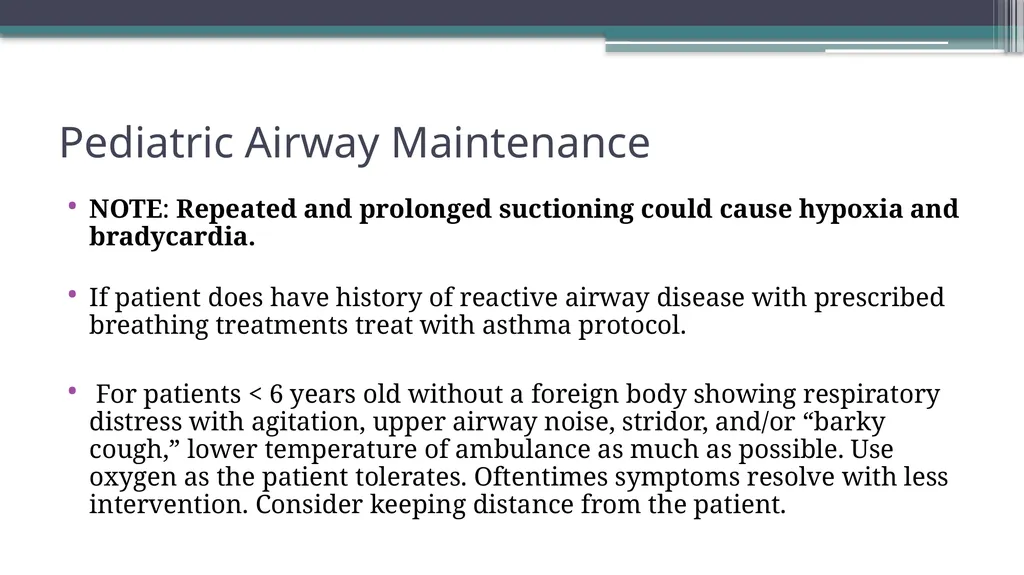
Pediatric Airway Maintenance NOTE: Repeated and prolonged suctioning could cause hypoxia and bradycardia.
If patient does have history of reactive airway disease with prescribed breathing treatments treat with asthma protocol.
For patients < 6 years old without a foreign body showing respiratory distress with agitation, upper airway noise, stridor, and/or “barky cough,” lower temperature of ambulance as much as possible. Use oxygen as the patient tolerates. Oftentimes symptoms resolve with less intervention. Consider keeping distance from the patient.<br>
If patient does have history of reactive airway disease with prescribed breathing treatments treat with asthma protocol.
For patients < 6 years old without a foreign body showing respiratory distress with agitation, upper airway noise, stridor, and/or “barky cough,” lower temperature of ambulance as much as possible. Use oxygen as the patient tolerates. Oftentimes symptoms resolve with less intervention. Consider keeping distance from the patient.<br>
10
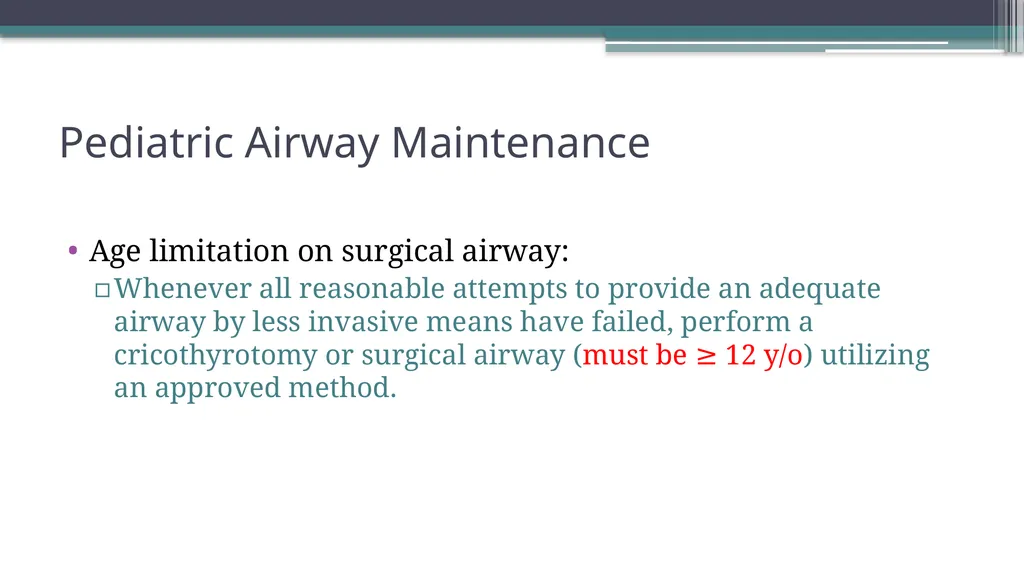
Pediatric Airway Maintenance Age limitation on surgical airway:
Whenever all reasonable attempts to provide an adequate airway by less invasive means have failed, perform a cricothyrotomy or surgical airway (must be ≥ 12 y/o) utilizing an approved method.<br>
Whenever all reasonable attempts to provide an adequate airway by less invasive means have failed, perform a cricothyrotomy or surgical airway (must be ≥ 12 y/o) utilizing an approved method.<br>
11
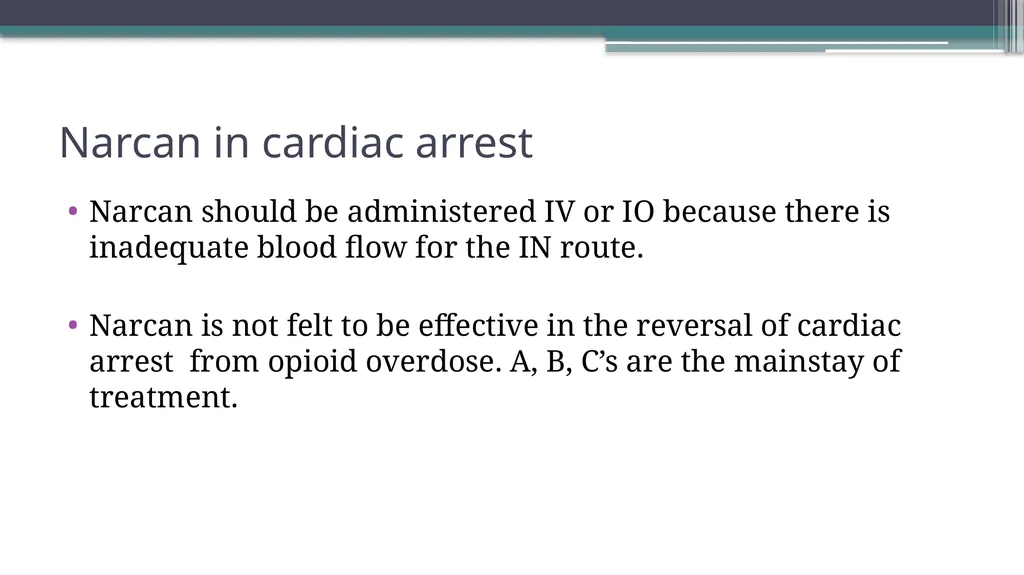
Narcan in cardiac arrest Narcan should be administered IV or IO because there is inadequate blood flow for the IN route.
Narcan is not felt to be effective in the reversal of cardiac arrest from opioid overdose. A, B, C’s are the mainstay of treatment.<br>
Narcan is not felt to be effective in the reversal of cardiac arrest from opioid overdose. A, B, C’s are the mainstay of treatment.<br>
12
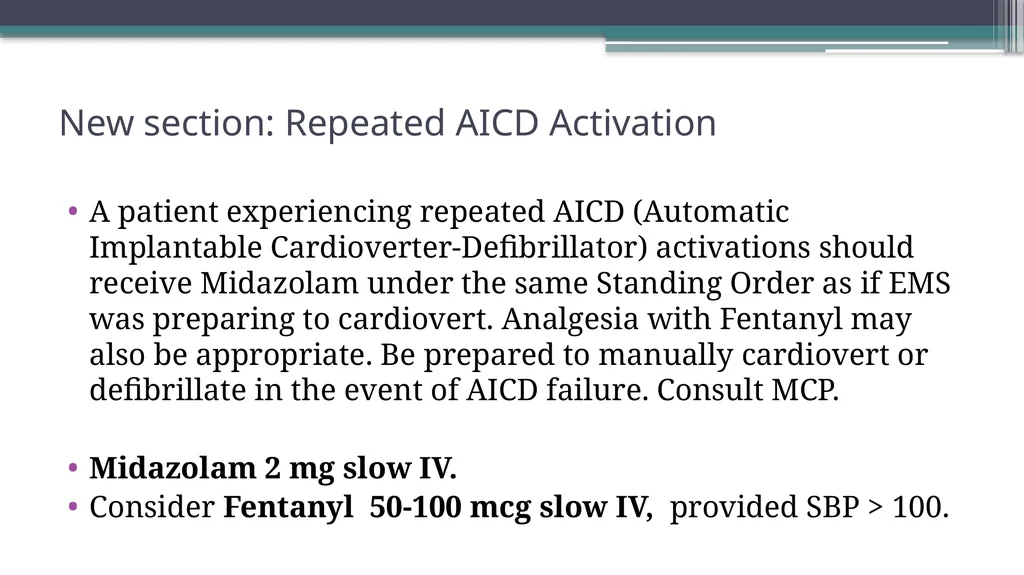
New section: Repeated AICD Activation A patient experiencing repeated AICD (Automatic Implantable Cardioverter-Defibrillator) activations should receive Midazolam under the same Standing Order as if EMS was preparing to cardiovert. Analgesia with Fentanyl may also be appropriate. Be prepared to manually cardiovert or defibrillate in the event of AICD failure. Consult MCP.
Midazolam 2 mg slow IV.
Consider Fentanyl 50-100 mcg slow IV, provided SBP > 100.<br>
Midazolam 2 mg slow IV.
Consider Fentanyl 50-100 mcg slow IV, provided SBP > 100.<br>
13
Adult Bradycardia and Stroke Sodium Bicarb 100 mEq is added to wide complex bradycardia algorithm.
In the stroke section O2 administration and Stroke Center information is added.
There is improved verbiage for times and documentation in stroke care.<br>
In the stroke section O2 administration and Stroke Center information is added.
There is improved verbiage for times and documentation in stroke care.<br>
14
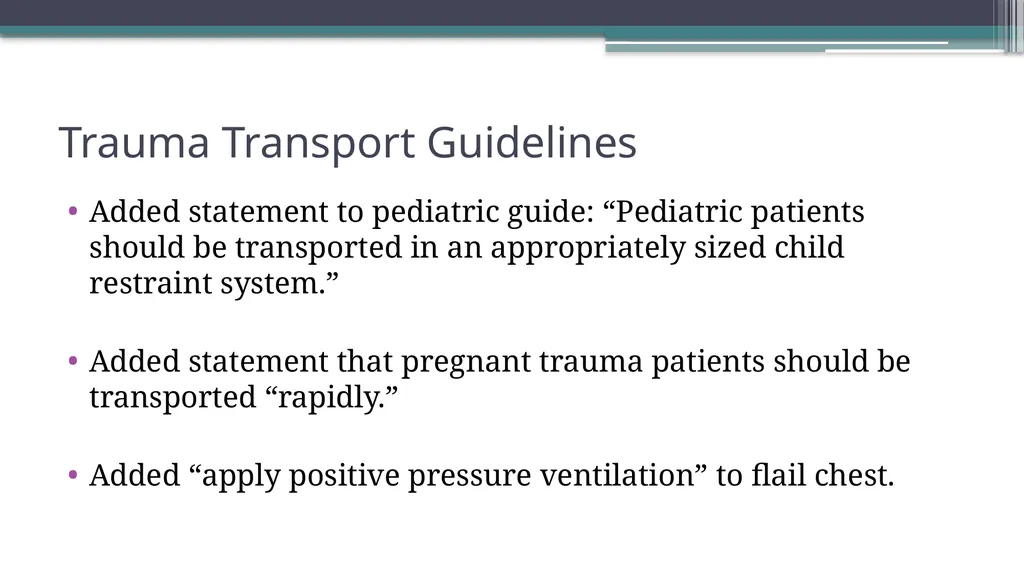
Trauma Transport Guidelines Added statement to pediatric guide: “Pediatric patients should be transported in an appropriately sized child restraint system.”
Added statement that pregnant trauma patients should be transported “rapidly.”
Added “apply positive pressure ventilation” to flail chest.<br>
Added statement that pregnant trauma patients should be transported “rapidly.”
Added “apply positive pressure ventilation” to flail chest.<br>
15
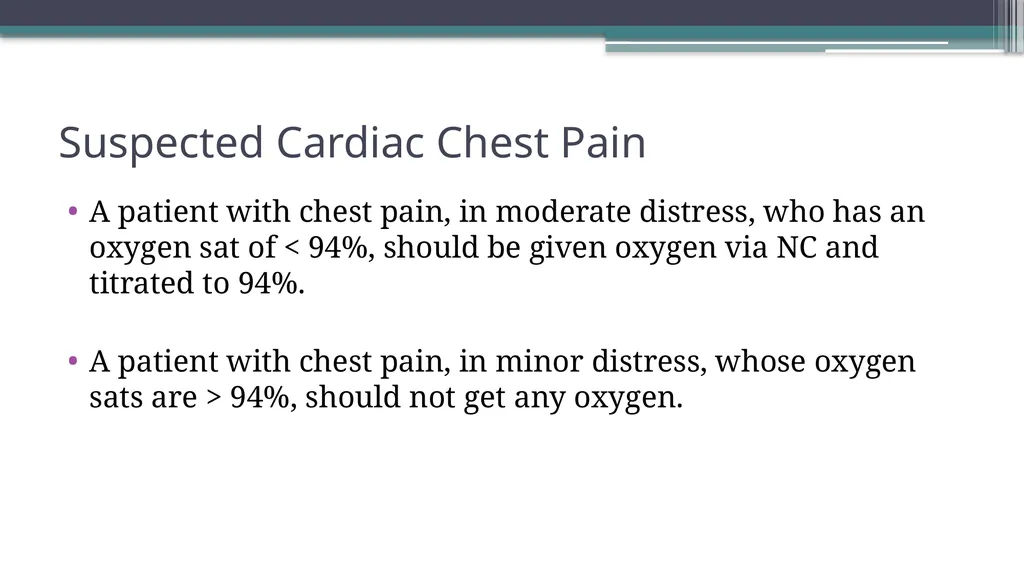
Suspected Cardiac Chest Pain A patient with chest pain, in moderate distress, who has an oxygen sat of < 94%, should be given oxygen via NC and titrated to 94%.
A patient with chest pain, in minor distress, whose oxygen sats are > 94%, should not get any oxygen.<br>
A patient with chest pain, in minor distress, whose oxygen sats are > 94%, should not get any oxygen.<br>
16
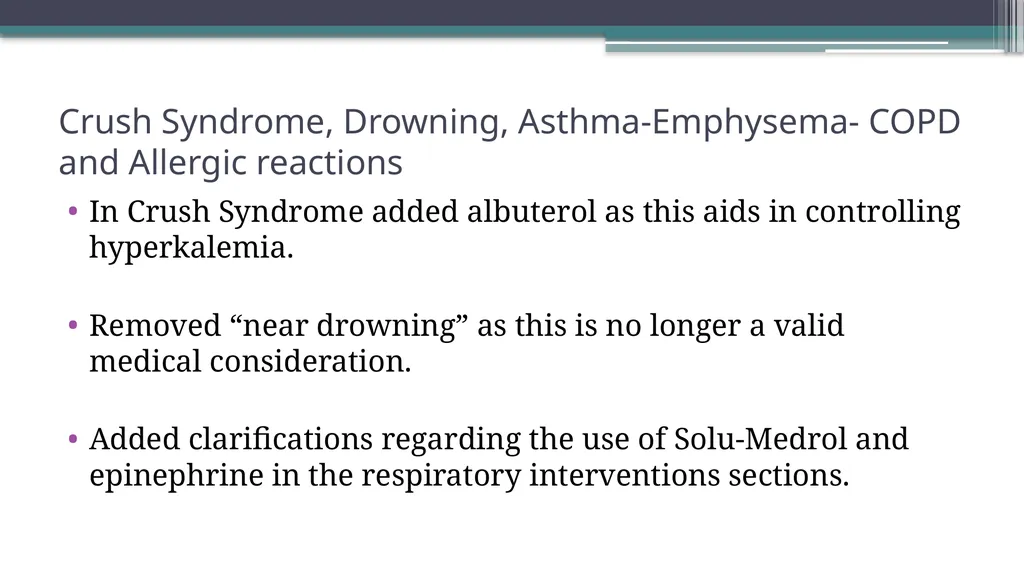
Crush Syndrome, Drowning, Asthma-Emphysema- COPD and Allergic reactions In Crush Syndrome added albuterol as this aids in controlling hyperkalemia.
Removed “near drowning” as this is no longer a valid medical consideration.
Added clarifications regarding the use of Solu-Medrol and epinephrine in the respiratory interventions sections.<br>
Removed “near drowning” as this is no longer a valid medical consideration.
Added clarifications regarding the use of Solu-Medrol and epinephrine in the respiratory interventions sections.<br>
17
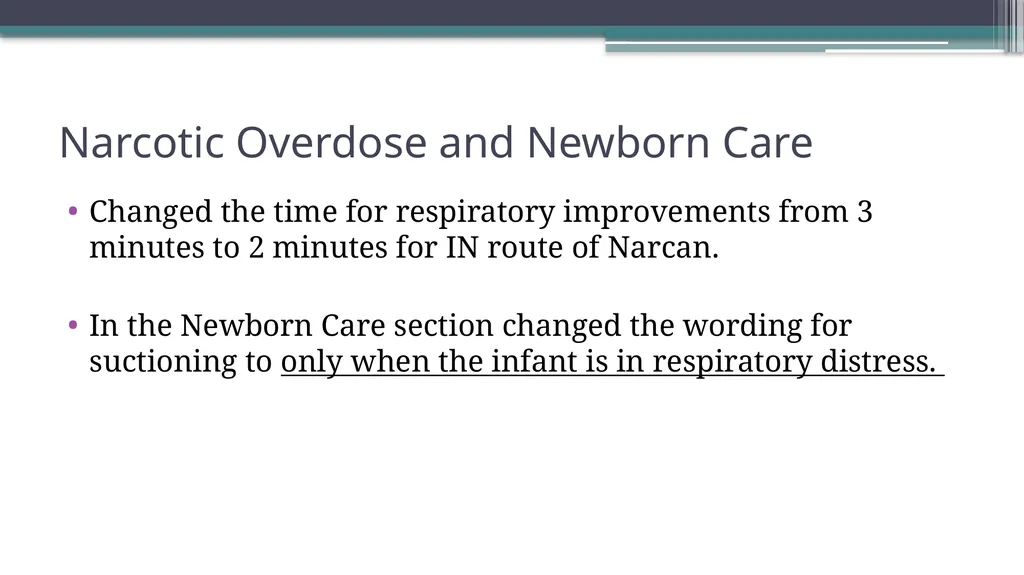
Narcotic Overdose and Newborn Care Changed the time for respiratory improvements from 3 minutes to 2 minutes for IN route of Narcan.
In the Newborn Care section changed the wording for suctioning to only when the infant is in respiratory distress.<br>
In the Newborn Care section changed the wording for suctioning to only when the infant is in respiratory distress.<br>
18
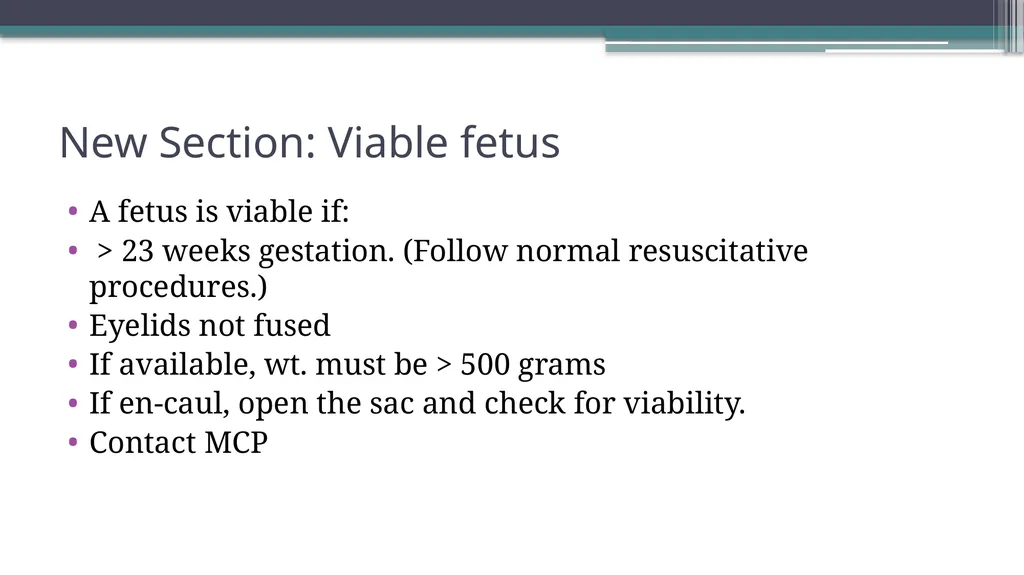
New Section: Viable fetus A fetus is viable if:
> 23 weeks gestation. (Follow normal resuscitative procedures.)
Eyelids not fused
If available, wt. must be > 500 grams
If en-caul, open the sac and check for viability.
Contact MCP<br>
> 23 weeks gestation. (Follow normal resuscitative procedures.)
Eyelids not fused
If available, wt. must be > 500 grams
If en-caul, open the sac and check for viability.
Contact MCP<br>
19
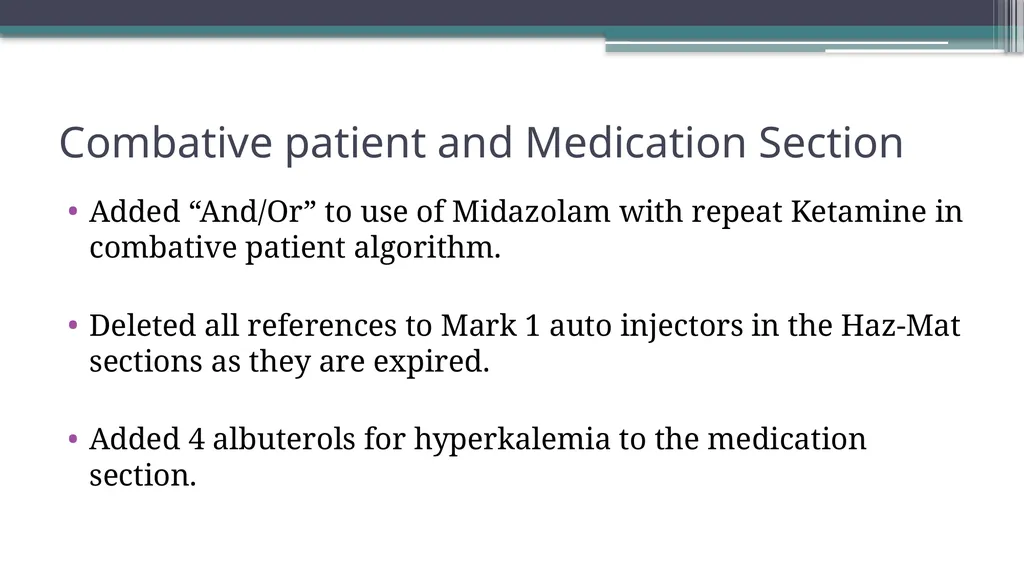
Combative patient and Medication Section Added “And/Or” to use of Midazolam with repeat Ketamine in combative patient algorithm.
Deleted all references to Mark 1 auto injectors in the Haz-Mat sections as they are expired.
Added 4 albuterols for hyperkalemia to the medication section.<br>
Deleted all references to Mark 1 auto injectors in the Haz-Mat sections as they are expired.
Added 4 albuterols for hyperkalemia to the medication section.<br>
20
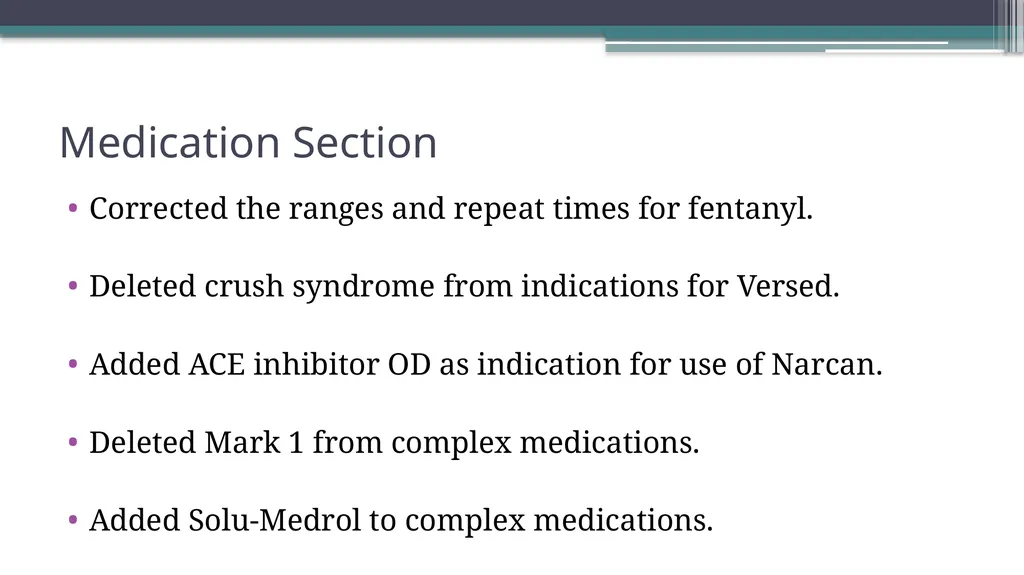
Medication Section Corrected the ranges and repeat times for fentanyl.
Deleted crush syndrome from indications for Versed.
Added ACE inhibitor OD as indication for use of Narcan.
Deleted Mark 1 from complex medications.
Added Solu-Medrol to complex medications.<br>
Deleted crush syndrome from indications for Versed.
Added ACE inhibitor OD as indication for use of Narcan.
Deleted Mark 1 from complex medications.
Added Solu-Medrol to complex medications.<br>
21
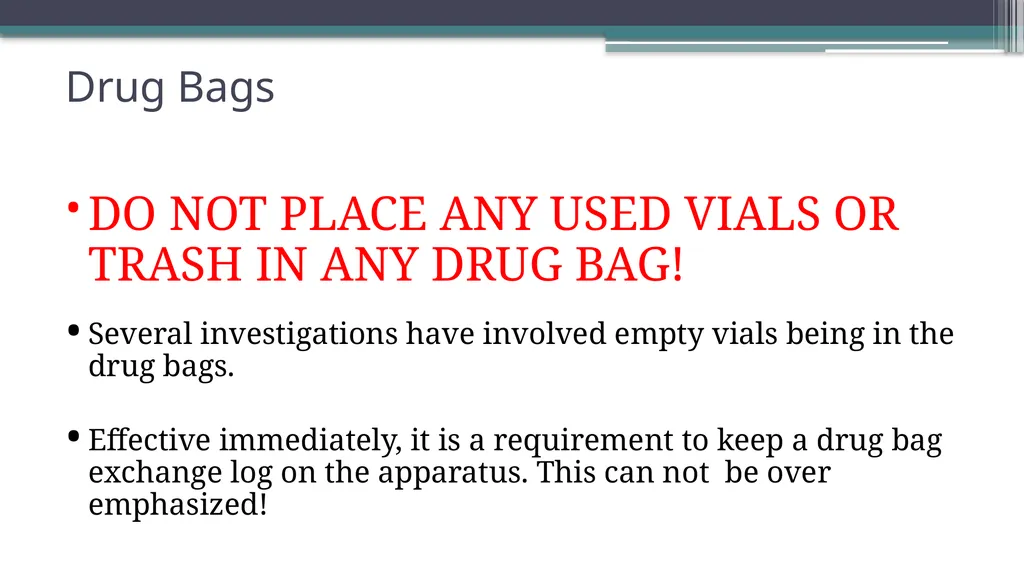
Drug Bags Do not place any used vials or trash in any drug bag!
Several investigations have involved empty vials being in the drug bags.
Effective immediately, it is a requirement to keep a drug bag exchange log on the apparatus. This can not be over emphasized!<br>
Several investigations have involved empty vials being in the drug bags.
Effective immediately, it is a requirement to keep a drug bag exchange log on the apparatus. This can not be over emphasized!<br>
22
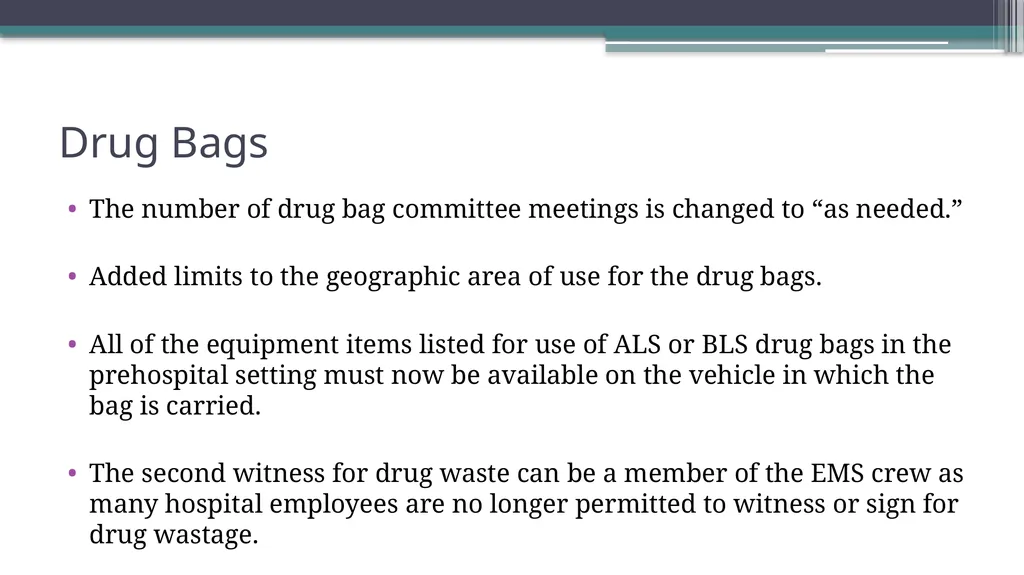
Drug Bags The number of drug bag committee meetings is changed to “as needed.”
Added limits to the geographic area of use for the drug bags.
All of the equipment items listed for use of ALS or BLS drug bags in the prehospital setting must now be available on the vehicle in which the bag is carried.
The second witness for drug waste can be a member of the EMS crew as many hospital employees are no longer permitted to witness or sign for drug wastage.<br>
Added limits to the geographic area of use for the drug bags.
All of the equipment items listed for use of ALS or BLS drug bags in the prehospital setting must now be available on the vehicle in which the bag is carried.
The second witness for drug waste can be a member of the EMS crew as many hospital employees are no longer permitted to witness or sign for drug wastage.<br>
23
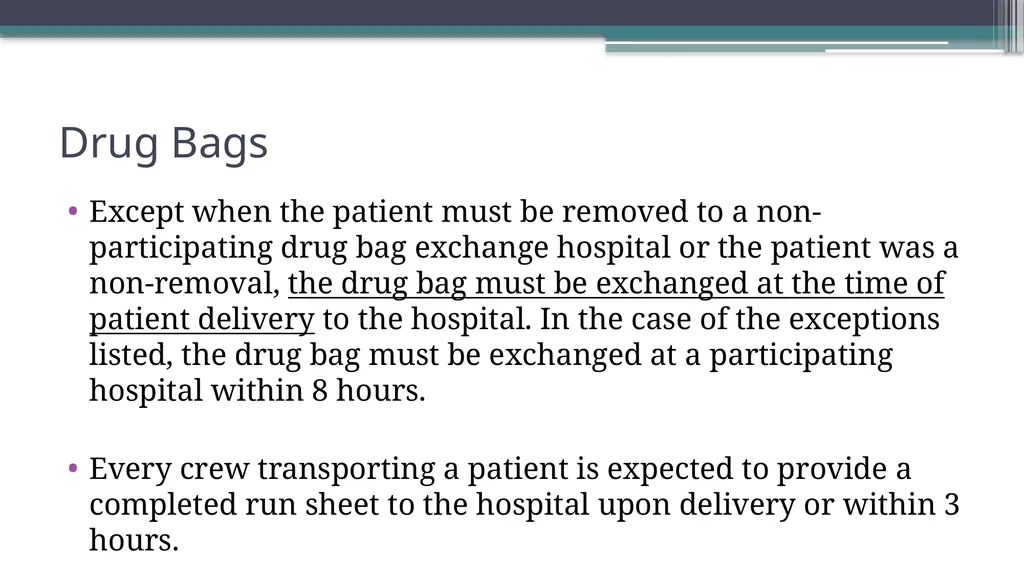
Drug Bags Except when the patient must be removed to a non-participating drug bag exchange hospital or the patient was a non-removal, the drug bag must be exchanged at the time of patient delivery to the hospital. In the case of the exceptions listed, the drug bag must be exchanged at a participating hospital within 8 hours.
Every crew transporting a patient is expected to provide a completed run sheet to the hospital upon delivery or within 3 hours.<br>
Every crew transporting a patient is expected to provide a completed run sheet to the hospital upon delivery or within 3 hours.<br>
24
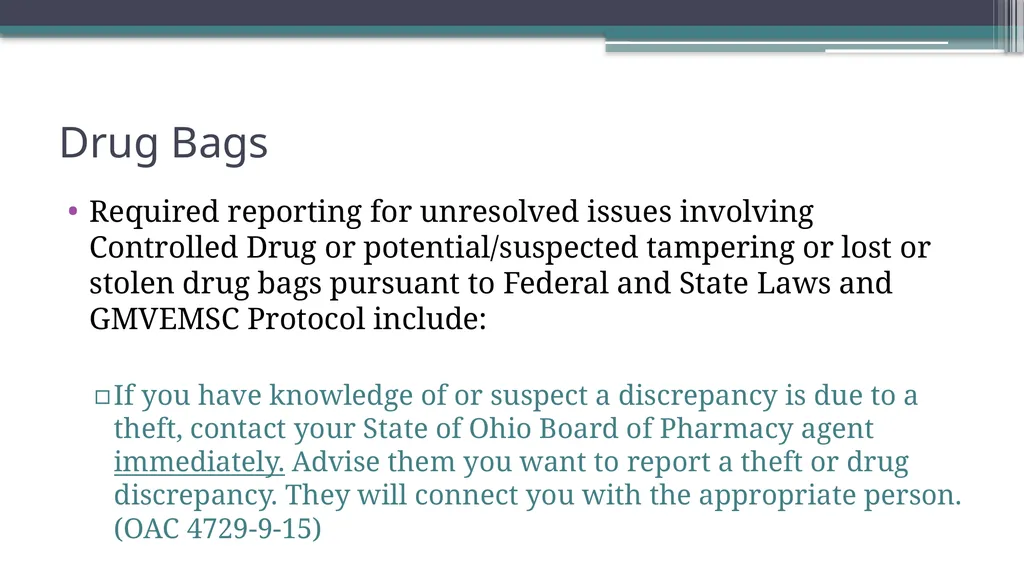
Drug Bags Required reporting for unresolved issues involving Controlled Drug or potential/suspected tampering or lost or stolen drug bags pursuant to Federal and State Laws and GMVEMSC Protocol include:
If you have knowledge of or suspect a discrepancy is due to a theft, contact your State of Ohio Board of Pharmacy agent immediately. Advise them you want to report a theft or drug discrepancy. They will connect you with the appropriate person. (OAC 4729-9-15)<br>
If you have knowledge of or suspect a discrepancy is due to a theft, contact your State of Ohio Board of Pharmacy agent immediately. Advise them you want to report a theft or drug discrepancy. They will connect you with the appropriate person. (OAC 4729-9-15)<br>
25
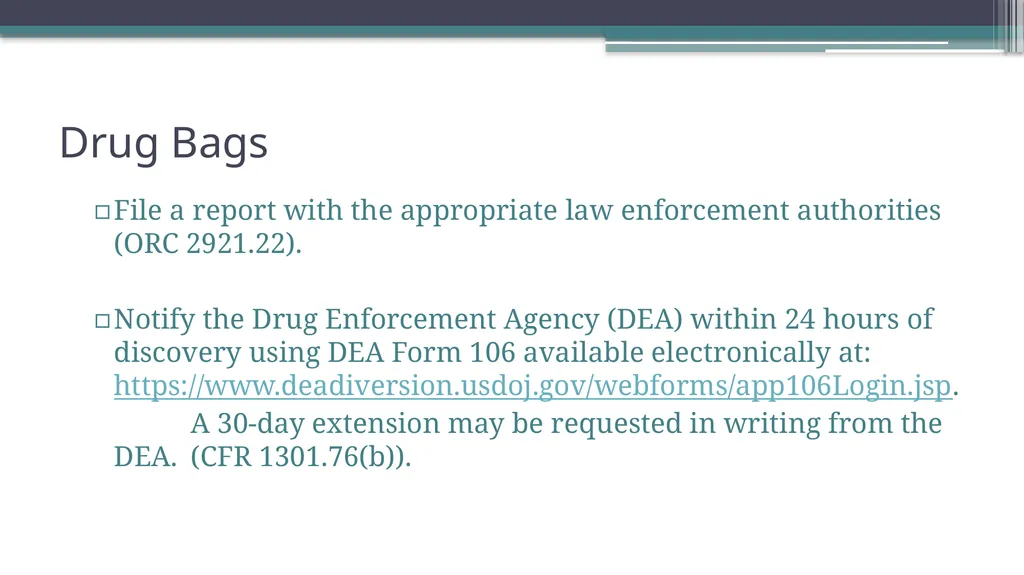
Drug Bags File a report with the appropriate law enforcement authorities (ORC 2921.22).
Notify the Drug Enforcement Agency (DEA) within 24 hours of discovery using DEA Form 106 available electronically at: https://www.deadiversion.usdoj.gov/webforms/app106Login.jsp. A 30-day extension may be requested in writing from the DEA. (CFR 1301.76(b)).<br>
Notify the Drug Enforcement Agency (DEA) within 24 hours of discovery using DEA Form 106 available electronically at: https://www.deadiversion.usdoj.gov/webforms/app106Login.jsp. A 30-day extension may be requested in writing from the DEA. (CFR 1301.76(b)).<br>
26
Drug Bags Submit a completed GMVEMSC Drug Bag Discrepancy Report located in Addendum #E, with appropriate supporting documentation, to the GMVEMSC.<br>
27
Drug Definitions “Dangerous drug" means any of the following:
(1) Any drug to which either of the following applies:<br>
(1) Any drug to which either of the following applies:<br>
28
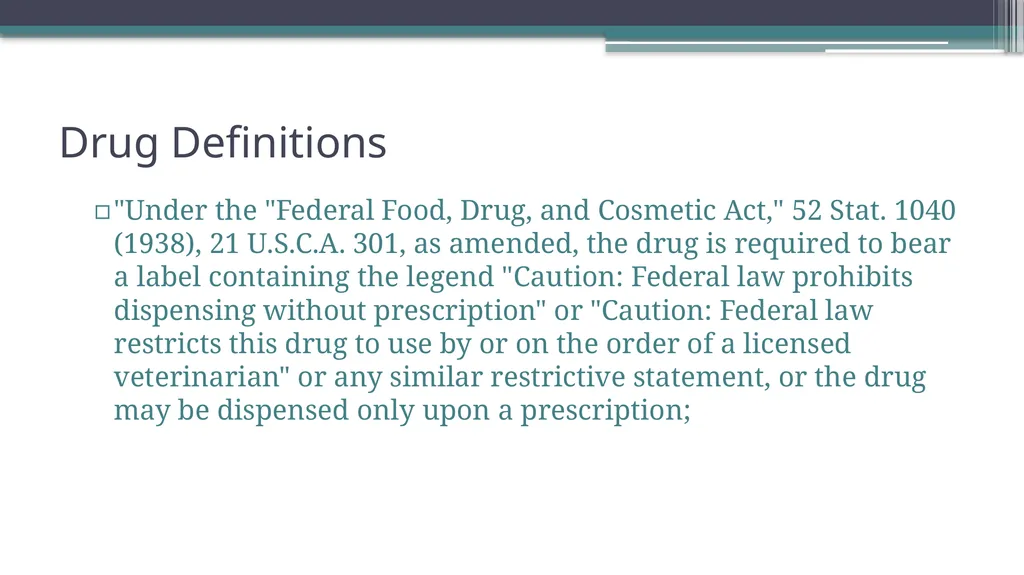
Drug Definitions "Under the "Federal Food, Drug, and Cosmetic Act," 52 Stat. 1040 (1938), 21 U.S.C.A. 301, as amended, the drug is required to bear a label containing the legend "Caution: Federal law prohibits dispensing without prescription" or "Caution: Federal law restricts this drug to use by or on the order of a licensed veterinarian" or any similar restrictive statement, or the drug may be dispensed only upon a prescription;<br>
29
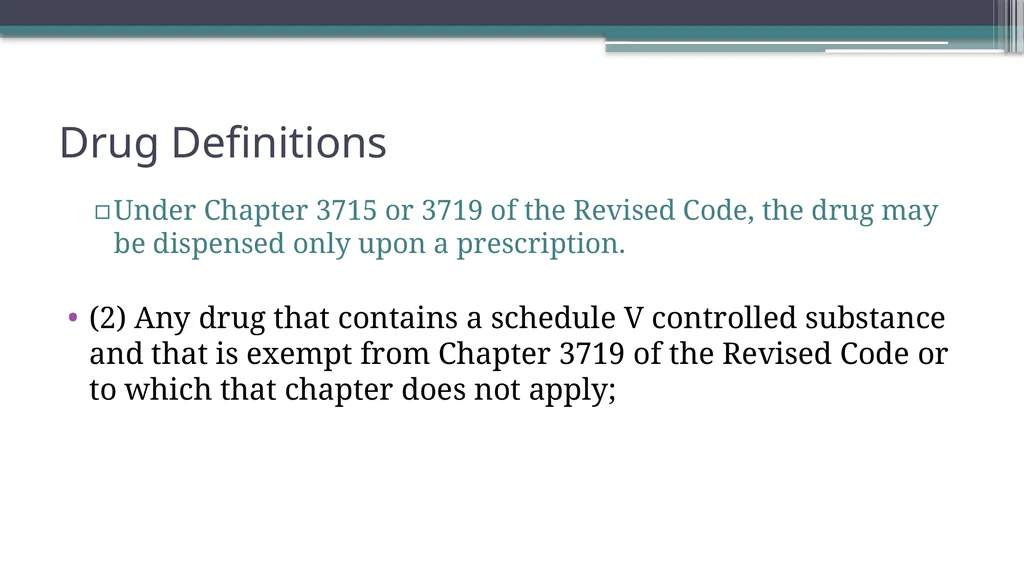
Drug Definitions Under Chapter 3715 or 3719 of the Revised Code, the drug may be dispensed only upon a prescription.
(2) Any drug that contains a schedule V controlled substance and that is exempt from Chapter 3719 of the Revised Code or to which that chapter does not apply;<br>
(2) Any drug that contains a schedule V controlled substance and that is exempt from Chapter 3719 of the Revised Code or to which that chapter does not apply;<br>
30
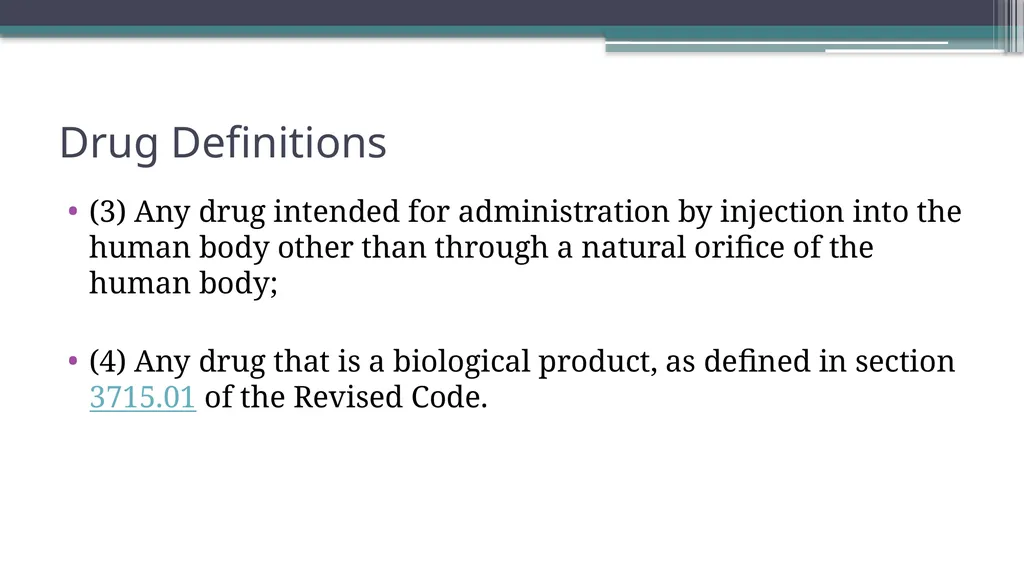
Drug Definitions (3) Any drug intended for administration by injection into the human body other than through a natural orifice of the human body;
(4) Any drug that is a biological product, as defined in section 3715.01 of the Revised Code.<br>
(4) Any drug that is a biological product, as defined in section 3715.01 of the Revised Code.<br>
31
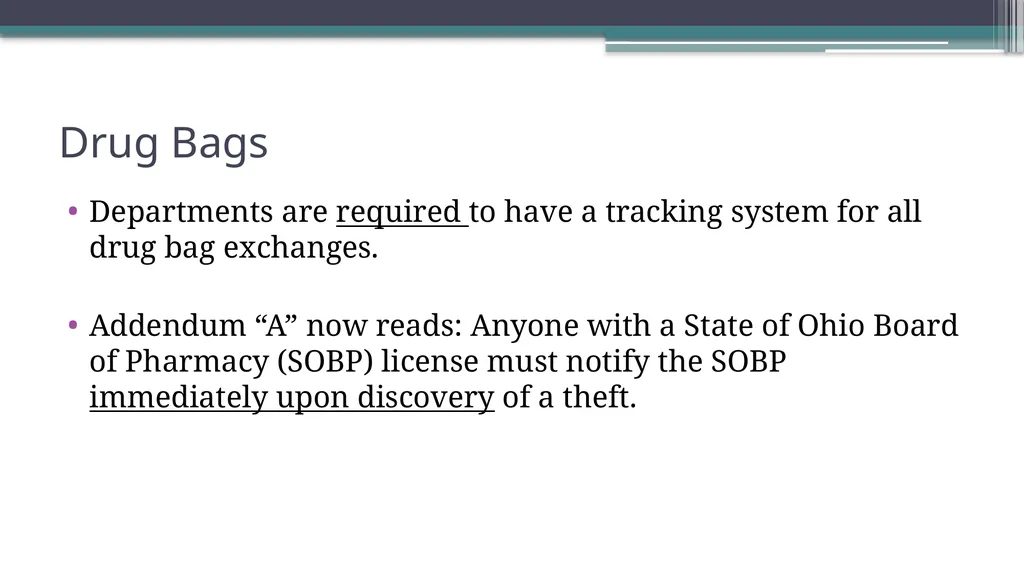
Drug Bags Departments are required to have a tracking system for all drug bag exchanges.
Addendum “A” now reads: Anyone with a State of Ohio Board of Pharmacy (SOBP) license must notify the SOBP immediately upon discovery of a theft.<br>
Addendum “A” now reads: Anyone with a State of Ohio Board of Pharmacy (SOBP) license must notify the SOBP immediately upon discovery of a theft.<br>
32
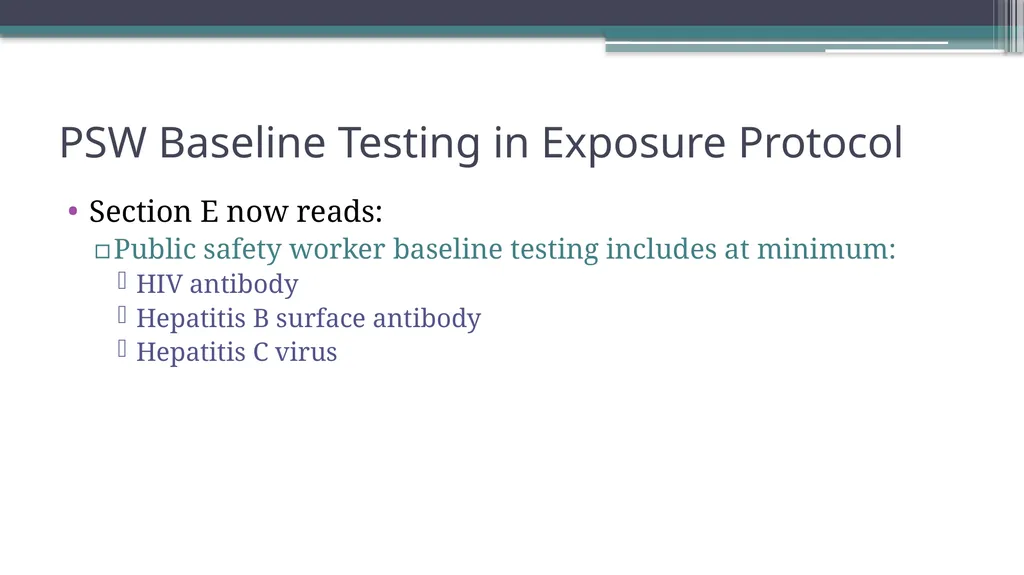
PSW Baseline Testing in Exposure Protocol Section E now reads:
Public safety worker baseline testing includes at minimum:
HIV antibody
Hepatitis B surface antibody
Hepatitis C virus<br>
Public safety worker baseline testing includes at minimum:
HIV antibody
Hepatitis B surface antibody
Hepatitis C virus<br>
33
PSW Baseline Testing, Flow Chart, Rule of Nines Section F now reads:
A positive Hepatitis and/or HIV test of the SOURCE PATIENT should trigger viral load testing of the SOURCE PATIENT.
The PSW exposure flow chart has been updated to reflect the changes in sections E and F.
A Rule of Nines chart has been added to the protocol.<br>
A positive Hepatitis and/or HIV test of the SOURCE PATIENT should trigger viral load testing of the SOURCE PATIENT.
The PSW exposure flow chart has been updated to reflect the changes in sections E and F.
A Rule of Nines chart has been added to the protocol.<br>
34
Questions?<br>
35
Thank You for Your Service & Dedication!
GMVEMSC is on Facebook!<br>
GMVEMSC is on Facebook!<br>