
2021 NMHED / NMAEA VIRTUAL SPRING CONFERENCE



Description: 2021 NMHED NMAEA VIRTUAL SPRING CONFERENCE Overview of Fiscal Business Processes Procedures March 11, 2021 11:30-12:40 Cesaria (Cia) J. Padilla Adult Education New Mexico Higher Education Department Introduction context Sound fiscal
Related Topics
Download Presentation
"2021 NMHED / NMAEA VIRTUAL SPRING CONFERENCE" is the property of its rightful owner. Permission is granted to download and print the materials on this website for personal, non-commercial use only, and to display it on your personal computer provided you do not modify the materials and that you retain all copyright notices contained in the materials. By downloading content from our website, you accept the terms of this agreement.
Presentation Transcript
slide1. 2021 NMHED / NMAEA
VIRTUAL SPRING CONFERENCE Overview of Fiscal Business Processes & Procedures
March 11, 2021
11:30-12:40
Cesaria (Cia) J. Padilla
Adult Education
New Mexico Higher Education Department<br>
slide2. Introduction & context Sound fiscal / business practices support adult education program success. This document describes the policies and procedures necessary for adult education programs to be and remain in compliance with state and federal regulations and guidelines.<br>
slide3. GENERAL INFORMATION claims are due to nmhed on or before the 15th day following the close of business each month. Separate accounts must be maintained for State and Federal funding, as well as the integrated English literacy and civics education program (IELCE), and the Literacy grant if you are a part of that initiative. Failure to do so will impact program allocations. Absolutely no co-mingling of funds.
Virtual site visits will be conducted at least every other year, or more often if necessary for fiscal review. An e-mail will be sent (2 weeks lead time) announcing the date of the visit. At that time, the state office may ask to see documents pertaining to requests for reimbursement and / or may ask to see instructional materials or equipment purchased with adult education grant monies.<br>
slide4. GENERAL INFORMATION (CONTINUED) Late submissions will not be declined, however late submissions are a “red” flag for out internal auditors as well as our external auditors. Claims are processed as they are received. Late claims create a backlog, please be conscientious about the timeliness of your claim submittals.
There are 24 programs in Adult Education each with 2 grants and 7 programs with 3 grants. Adult Education also handles the Literacy grant with 8 grantees participating in this initiative. There are also additional grants and agreements with individual programs that are handled through adult education. incomplete or incorrect claims are more time consuming and can delay the process.<br>
slide5. General Information (continued) E-mail is the method of submission. It is not necessary to submit an original copy of the reimbursement request with an original signature. e-mailed copies must contain all supporting documentation, including payroll registers, check copies, receipts, purchase orders, travel authorizations, travel reimbursements etc. scanned e-mail copies must be legible.
Please utilize the request for reimbursement forms provided every year and follow the instructions on the form for reporting the month date and PO # sequence.
Your balances will be provided to you beginning in December of each fiscal year and monthly proceeding that. Please make sure you are monitoring these balances. At the end of March, I will be asking programs if they are going to be able to expend their funds fully, and if your program is not going to be able to, I will request a e-mail from you with the amount you feel you are not going to expend so that I can re-distribute your excess to another program. I will request all programs to inform me if they are going to need additional funds for this purpose.<br>
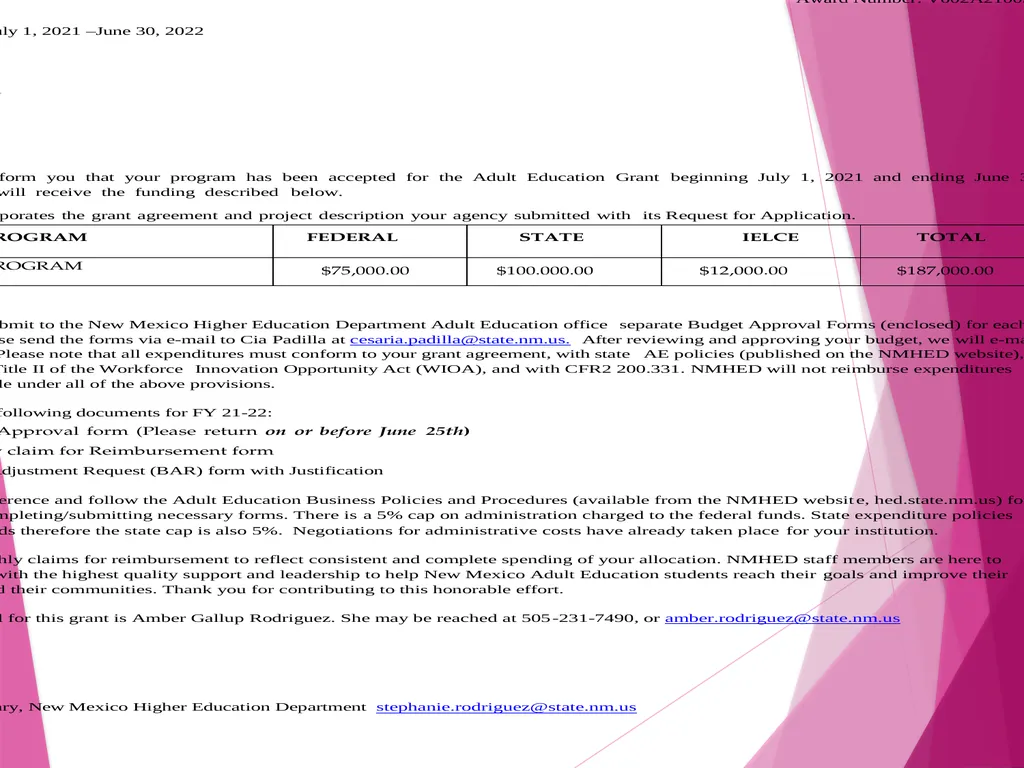
slide6. AWARD LETTERS Award letters will be sent in June of each fiscal year for the following fiscal year.
The letter will contain the amount of your award for Federal, state, & IELCE (if you are a part of that initiative).
If you are a part of literacy initiative, you will receive a separate award letter for that grant.
The Letter will also contain the forms to be submitted & the deadlines for the forms.
It will also contain the references to the Federal guidelines for expenditures<br>
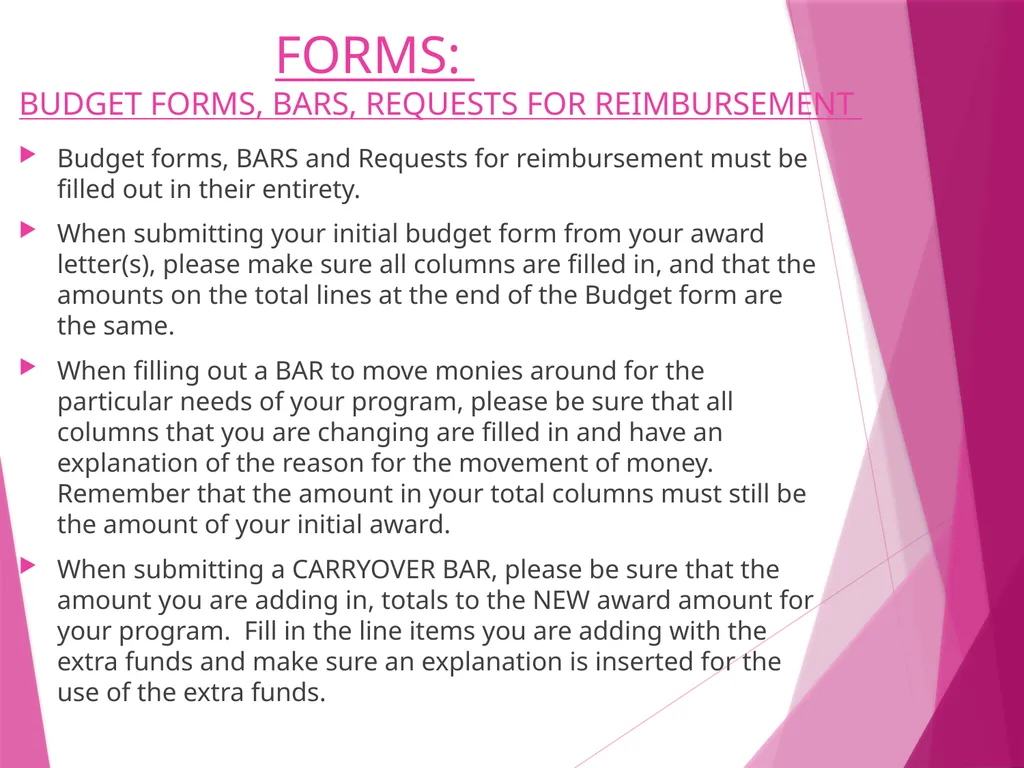
slide8. FORMS: BUDGET FORMS, BARS, REQUESTS FOR REIMBURSEMENT Budget forms, BARS and Requests for reimbursement must be filled out in their entirety.
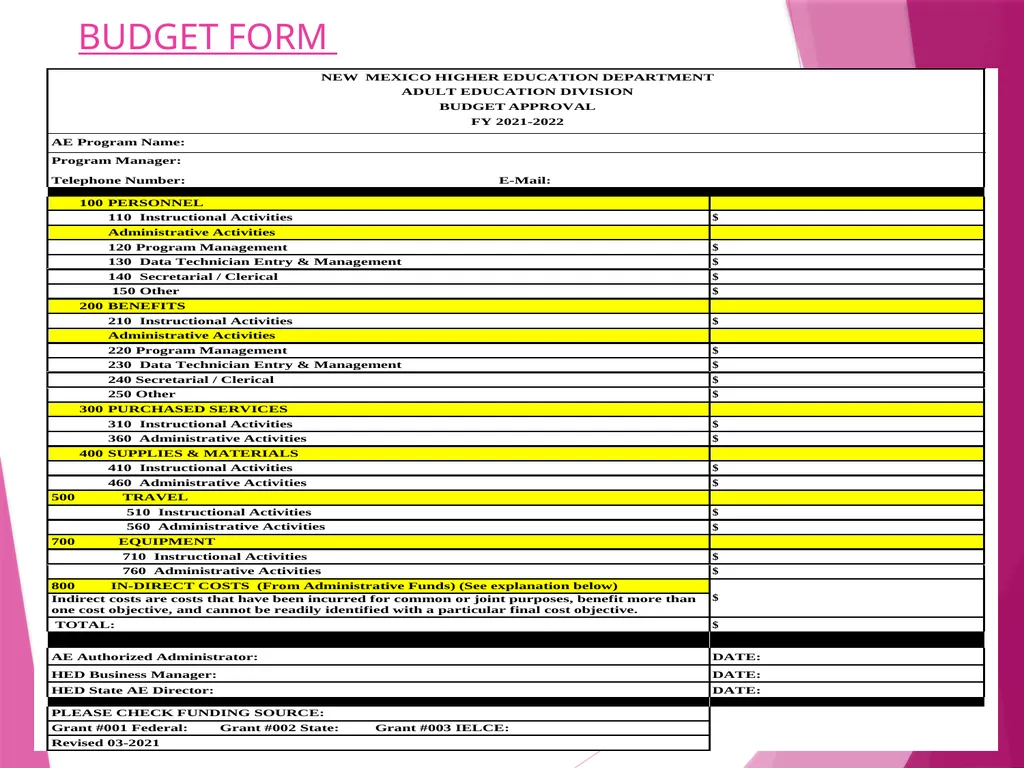
When submitting your initial budget form from your award letter(s), please make sure all columns are filled in, and that the amounts on the total lines at the end of the Budget form are the same.
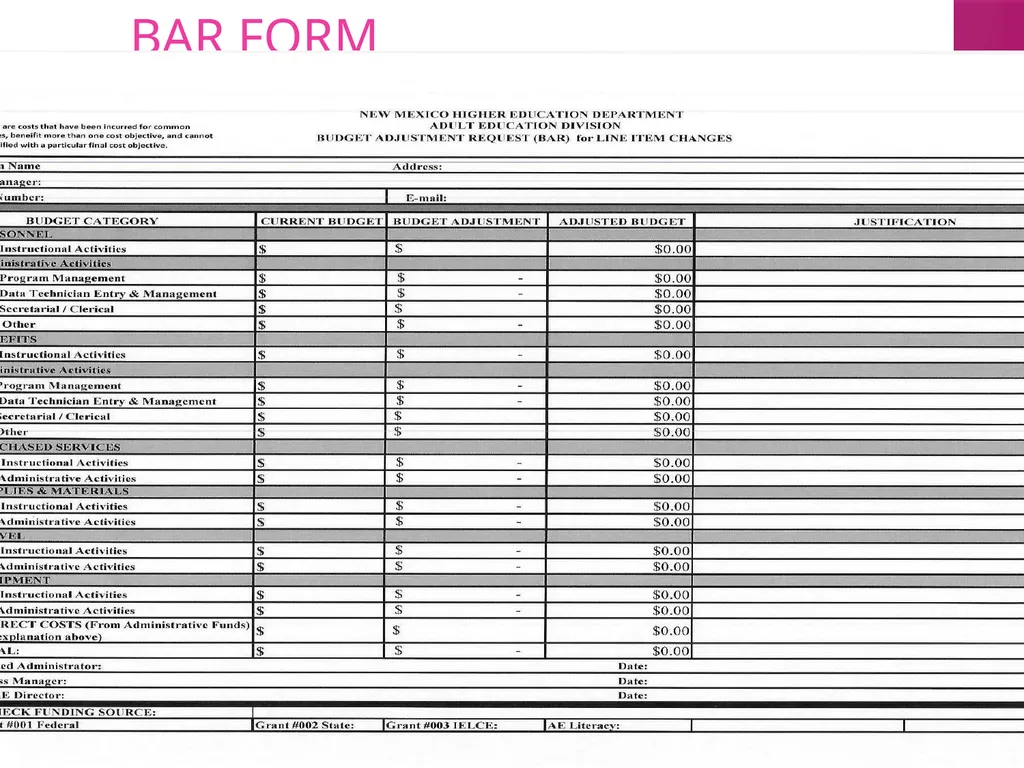
When filling out a BAR to move monies around for the particular needs of your program, please be sure that all columns that you are changing are filled in and have an explanation of the reason for the movement of money. Remember that the amount in your total columns must still be the amount of your initial award.
When submitting a CARRYOVER BAR, please be sure that the amount you are adding in, totals to the NEW award amount for your program. Fill in the line items you are adding with the extra funds and make sure an explanation is inserted for the use of the extra funds.<br>
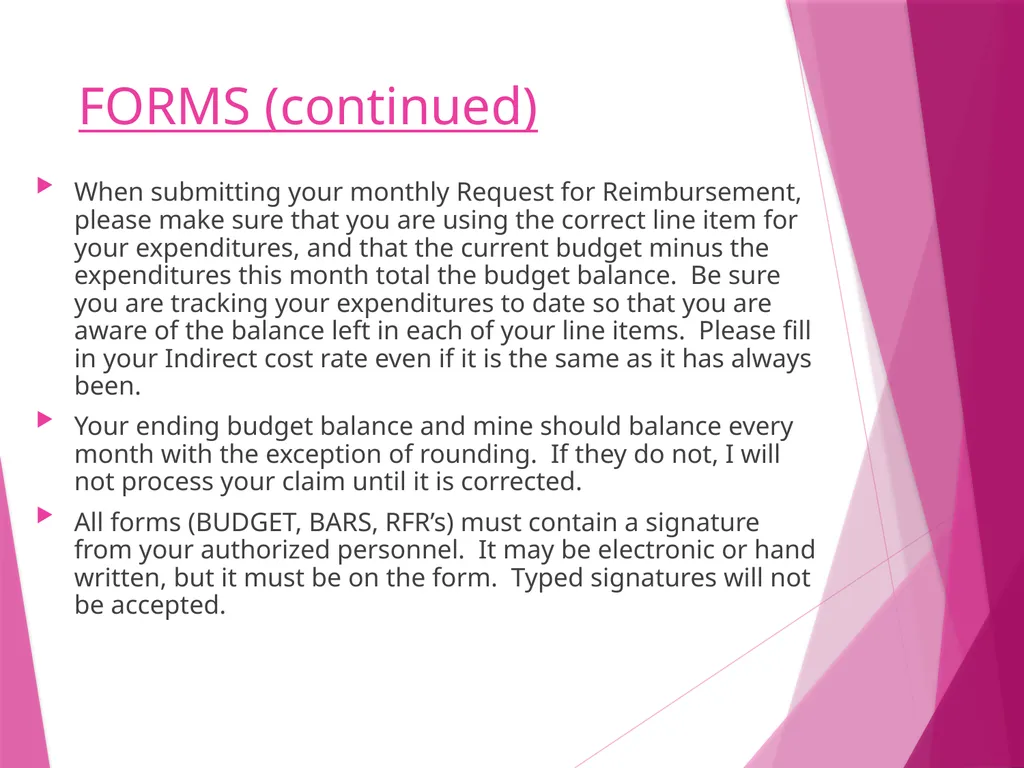
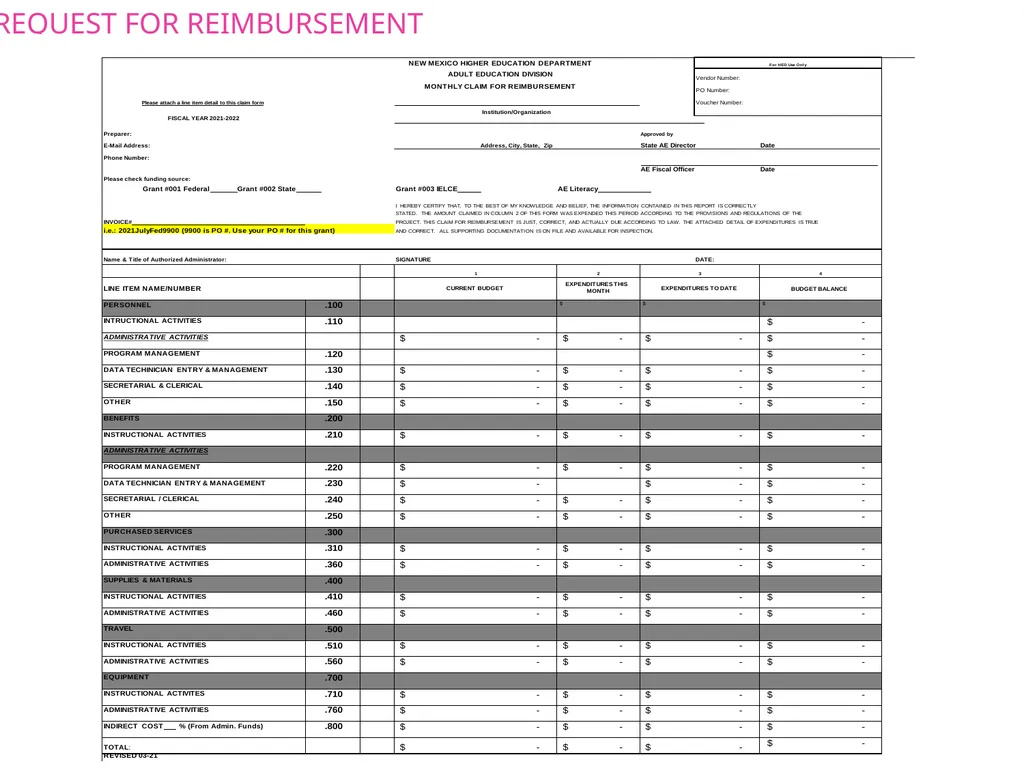
slide9. FORMS (continued) When submitting your monthly Request for Reimbursement, please make sure that you are using the correct line item for your expenditures, and that the current budget minus the expenditures this month total the budget balance. Be sure you are tracking your expenditures to date so that you are aware of the balance left in each of your line items. Please fill in your Indirect cost rate even if it is the same as it has always been.
Your ending budget balance and mine should balance every month with the exception of rounding. If they do not, I will not process your claim until it is corrected.
All forms (BUDGET, BARS, RFR’s) must contain a signature from your authorized personnel. It may be electronic or hand written, but it must be on the form. Typed signatures will not be accepted.<br>
slide10. BUDGET FORM<br>
slide11. BAR FORM<br>
slide12. REQUEST FOR REIMBURSEMENT<br>
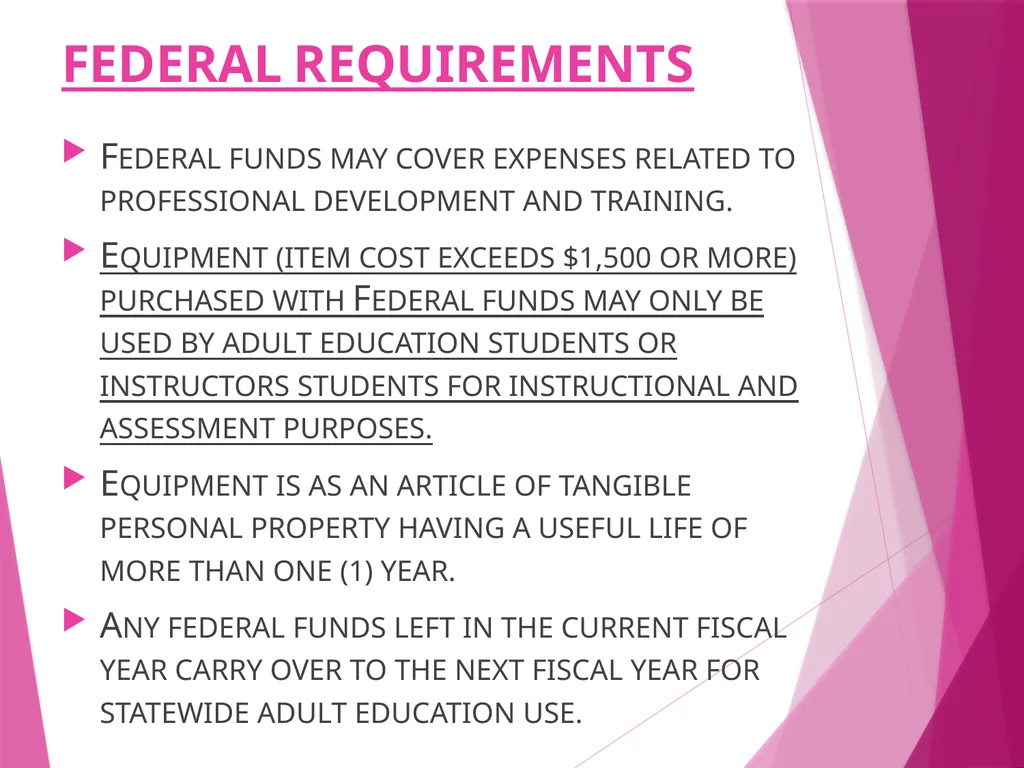
slide13. FEDERAL REQUIREMENTS Federal funds may cover expenses related to professional development and training.
Equipment (item cost exceeds $1,500 or more) purchased with Federal funds may only be used by adult education students or instructors students for instructional and assessment purposes.
Equipment is as an article of tangible personal property having a useful life of more than one (1) year.
Any federal funds left in the current fiscal year carry over to the next fiscal year for statewide adult education use.<br>
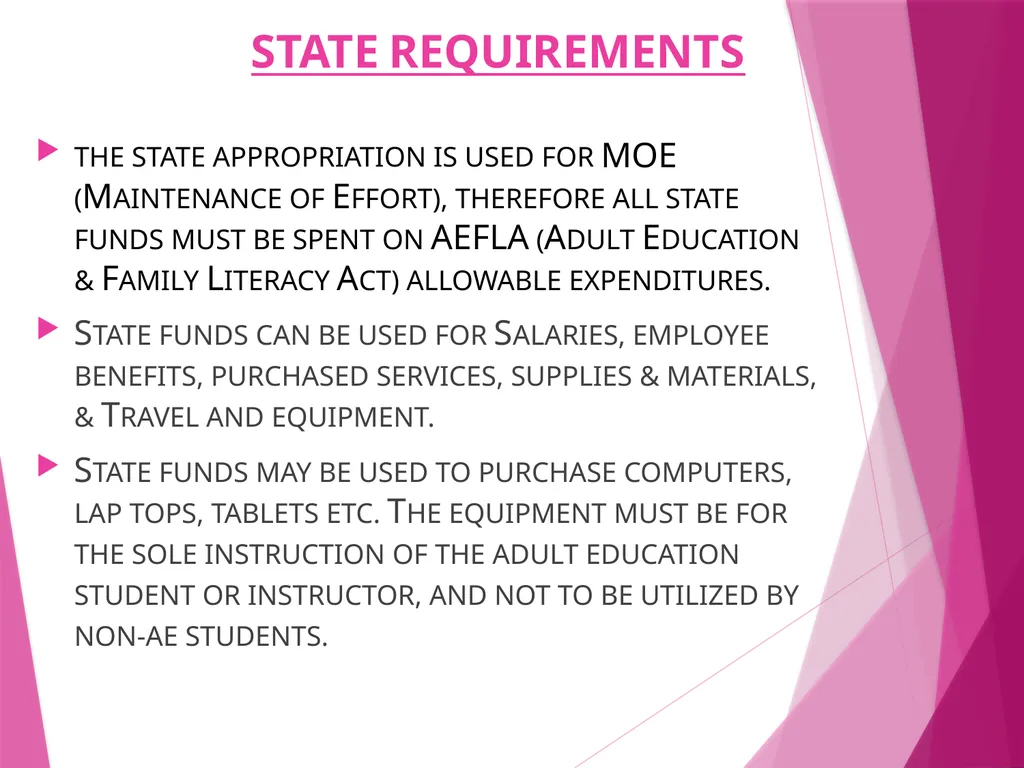
slide14. STATE REQUIREMENTS the state appropriation is used for MOE (Maintenance of Effort), therefore all state funds must be spent on AEFLA (Adult Education & Family Literacy Act) allowable expenditures.
State funds can be used for Salaries, employee benefits, purchased services, supplies & materials, & Travel and equipment.
State funds may be used to purchase computers, lap tops, tablets etc. The equipment must be for the sole instruction of the adult education student or instructor, and not to be utilized by non-ae students.<br>
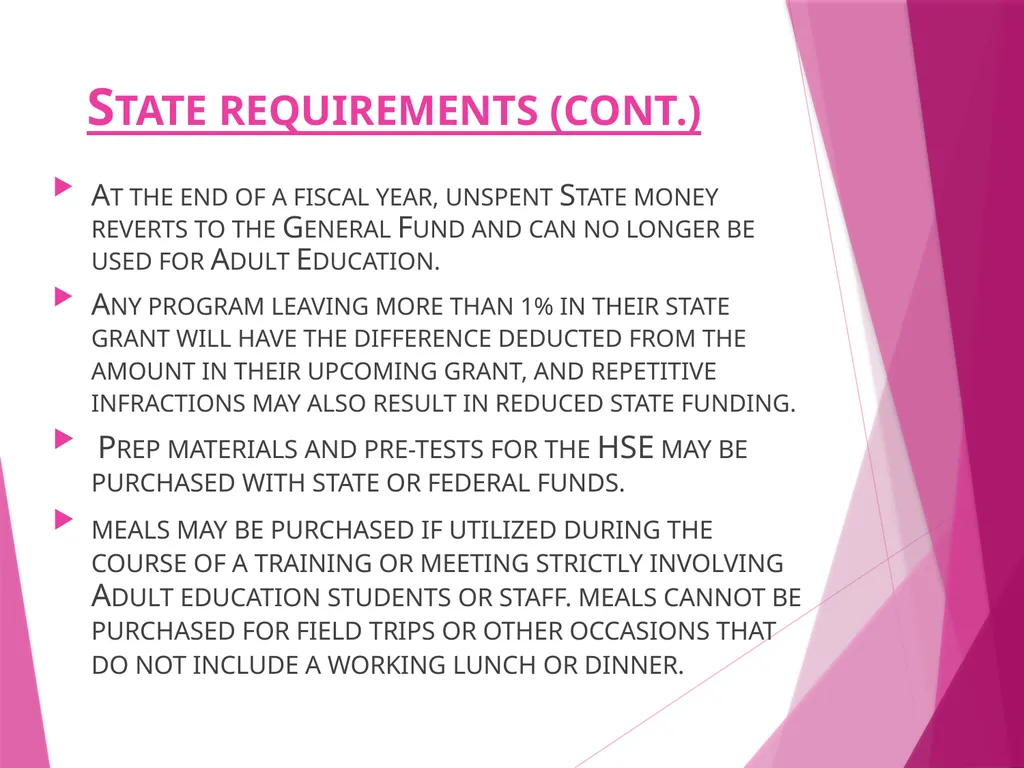
slide15. State requirements (cont.) At the end of a fiscal year, unspent State money reverts to the General Fund and can no longer be used for Adult Education.
Any program leaving more than 1% in their state grant will have the difference deducted from the amount in their upcoming grant, and repetitive infractions may also result in reduced state funding.
Prep materials and pre-tests for the HSE may be purchased with state or federal funds.
meals may be purchased if utilized during the course of a training or meeting strictly involving Adult education students or staff. meals cannot be purchased for field trips or other occasions that do not include a working lunch or dinner.<br>
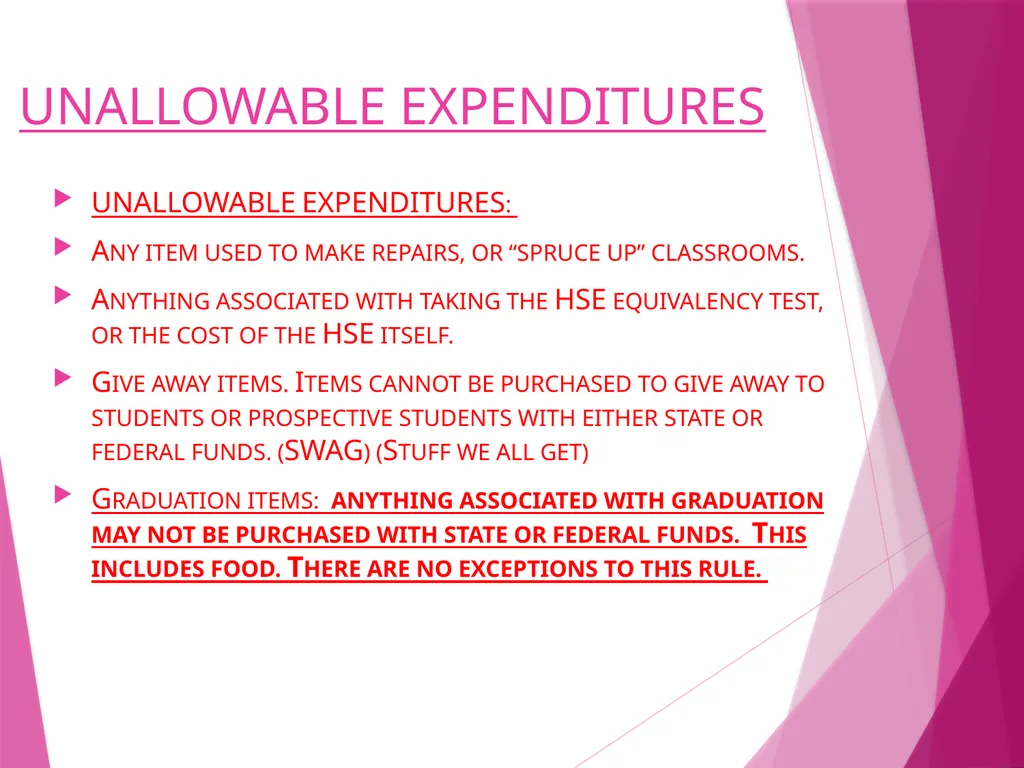
slide16. UNALLOWABLE EXPENDITURES UNALLOWABLE EXPENDITURES:
Any item used to make repairs, or “spruce up” classrooms.
Anything associated with taking the HSE equivalency test, or the cost of the HSE itself.
Give away items. Items cannot be purchased to give away to students or prospective students with either state or federal funds. (SWAG) (Stuff we all get)
Graduation items: anything associated with graduation may not be purchased with state or federal funds. This includes food. There are no exceptions to this rule.<br>
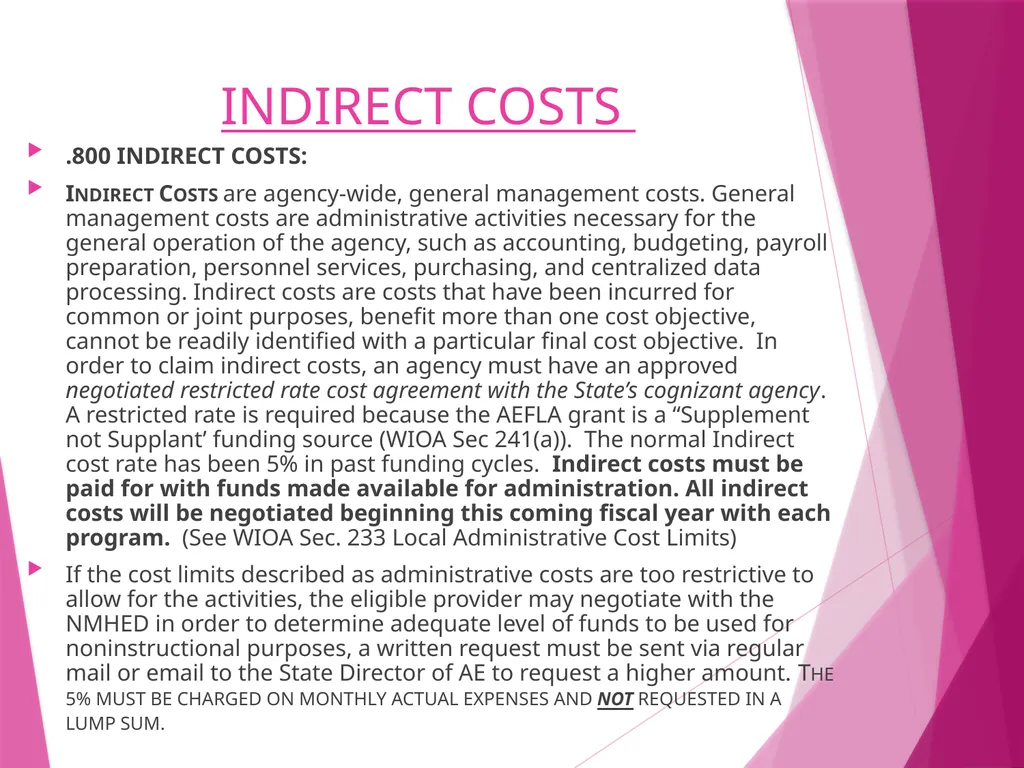
slide17. INDIRECT COSTS .800 INDIRECT COSTS:
Indirect Costs are agency-wide, general management costs. General management costs are administrative activities necessary for the general operation of the agency, such as accounting, budgeting, payroll preparation, personnel services, purchasing, and centralized data processing. Indirect costs are costs that have been incurred for common or joint purposes, benefit more than one cost objective, cannot be readily identified with a particular final cost objective. In order to claim indirect costs, an agency must have an approved negotiated restricted rate cost agreement with the State’s cognizant agency. A restricted rate is required because the AEFLA grant is a “Supplement not Supplant’ funding source (WIOA Sec 241(a)). The normal Indirect cost rate has been 5% in past funding cycles. Indirect costs must be paid for with funds made available for administration. All indirect costs will be negotiated beginning this coming fiscal year with each program. (See WIOA Sec. 233 Local Administrative Cost Limits)
If the cost limits described as administrative costs are too restrictive to allow for the activities, the eligible provider may negotiate with the NMHED in order to determine adequate level of funds to be used for noninstructional purposes, a written request must be sent via regular mail or email to the State Director of AE to request a higher amount. The 5% must be charged on monthly actual expenses and not requested in a lump sum.<br>
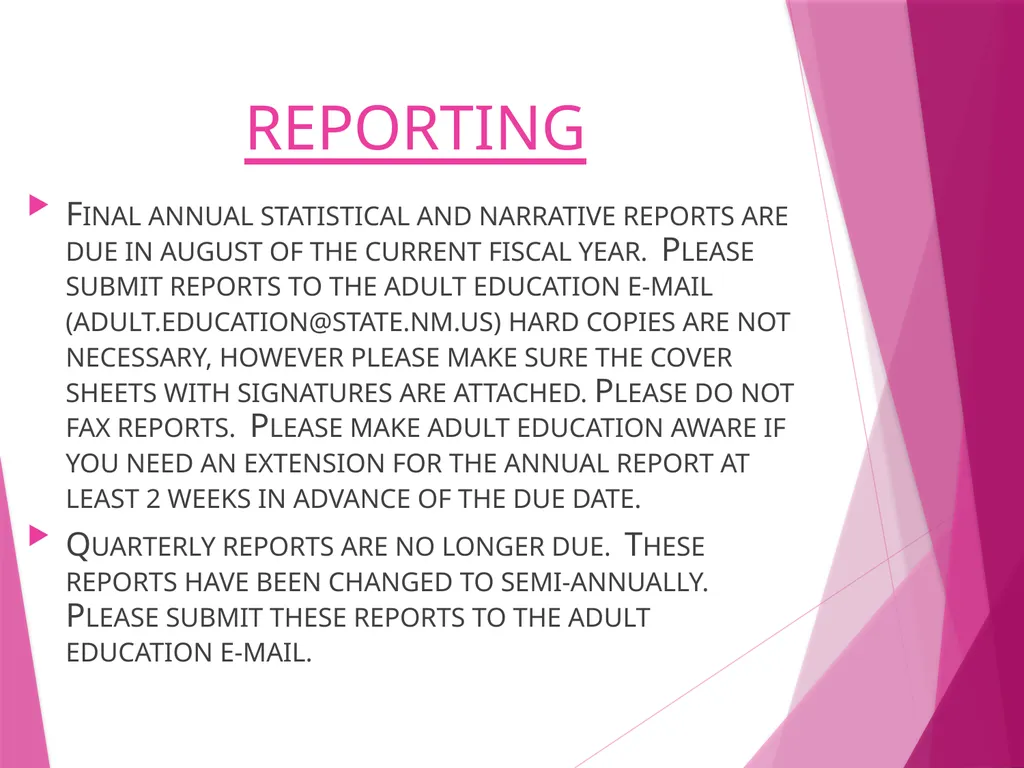
slide18. reporting Final annual statistical and narrative reports are due in august of the current fiscal year. Please submit reports to the adult education e-mail (adult.education@state.nm.us) hard copies are not necessary, however please make sure the cover sheets with signatures are attached. Please do not fax reports. Please make adult education aware if you need an extension for the annual report at least 2 weeks in advance of the due date.
Quarterly reports are no longer due. These reports have been changed to semi-annually. Please submit these reports to the adult education e-mail.<br>
slide19. TIME AND EFFORT REPORTING All Adult Education employees that conduct activities supported by adult Education grant funds must maintain records documenting the time spent on activity. If they also conduct non-ae related activities their time sheets shall document, on a bi-weekly basis, the type and proportion of activities conducted by each employee, and the source of funds for these activities.
programs are not required to submit regular timesheets to nmhed, but shall maintain these records for a period of five years and provide time and effort documentation upon request.
if an employee only conducts aefla activities and is paid only from nmhed state and/or federal funds, their supervisor must certify the time and effort reports at least quarterly. the employee must also sign off on these reports.<br>
slide20. Submissions new mexico higher education department, adult education division expects the reimbursement requests submitted to reflect consistent and complete spending of the program allocations. nmhed adult education also expects that adult education programs spend their money wisely, efficiently, and timely. spending should take place throughout the year, and the majority of the spending should not happen the last month of the year.
line items should not be negative. if a line item is showing a negative balance, please submit a bar to move funds to that line before submitting a claim for reimbursement.<br>
slide21. SUBMISSIONS (cont.) line item .110 is professional salaries. all employees who are instructing in adult education should be paid out of line .110, unless they are on contract. these should be paid out of line item .310, purchased services. please ensure your personnel are being reported in the correct line items.
Data technicians line .230, technician.
Line item .150 should be used for work study students, unless they are graduate assistants in which case line item .120 should be used.
Reminder: all unspent state funds are reverted at the end of the fiscal year. Reversion of funds may result in reduced state funding from the legislature.<br>
slide22. TRAVEL All out of state travel must be pre-approved and included in the program grant application. Any exceptions must be granted by the ae state director, Amber Gallup-Rodriguez before the travel occurs.
Travel is reimbursable. However if paying for travel with a credit card, that credit card bill cannot be paid until the travel occurs, and the request for payment has been made and payment has occurred.
Travel is for adult education purposes only. Please ensure that the trip you are taking is adult education related. If you are unsure, please contact Amber Gallup-Rodriguez or Amy Anderson for guidance.<br>
slide23. TRAVEL (Continued) PLEASE REMEMBER THAT ALL TRAVEL MUST HAVE DOCUMENTATION OF THE TRIP. NECESSARY DOCUMENTS ARE AGENDA, MEETING HANDOUTS, RECEIPTS, AIRLINE TICKETS ETC.
TRAVEL DURING THE PANDEMIC CAN BE VIRTUAL ATTENDANCE AT A CONFERNECE OR TRAINING. THE SAME RULES APPLY AS ABOVE.
A SUMMARY OF THE TRAVEL SHOULD BE WRITTEN UP AND A RECAP OF YOUR TRAVEL MAY BE REQUESTED. YOU MAY BE ASKED TO SHARE YOUR RECAP WITH THE REST OF THE FIELD.<br>
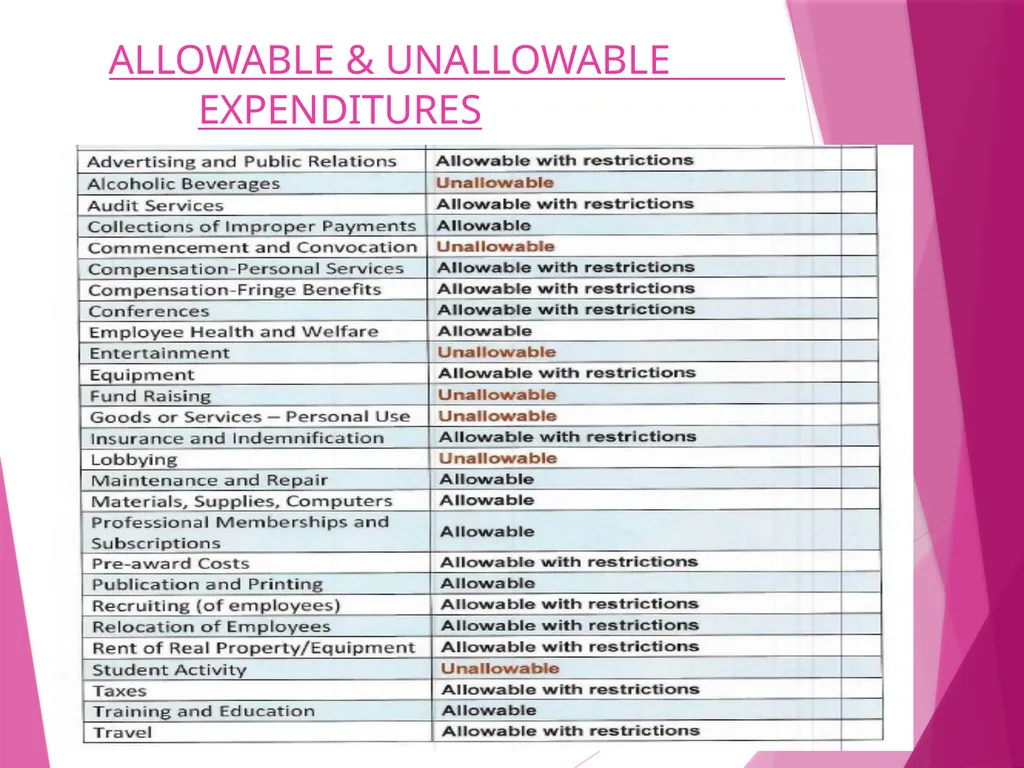
slide24. ALLOWABLE & UNALLOWABLE EXPENDITURES<br>
slide25. Unallowable Expenditures (continued) Any item used to “spruce up” classrooms. Repairs are allowable.
Anything associated with taking the HSE equivalency test, or the cost of the HSE itself.
Give away items. Items cannot be purchased to give away to students or prospective students with either state or federal funds. (SWAG) (Stuff we all get)
Graduation items: anything associated with graduation may not be purchased with state or federal funds. This includes food. There are no exceptions to this rule.<br>
slide26. WORKFORCE ONE-STOP REPORTING ALL PROGRAMS SHOULD BE COLLBORATING WITH THE ONE STOP WORKFORCE PROGRAMS IN THEIR REGION. ALL PROGRAMS SHOULD HAVE AN AGREEMENT IN PLACE WITH THE ONE STOP IN THEIR REGION.
ALL PROGRAMS SHOULD BE KEEPING TRACK OF THE ONE STOP COSTS FOR THEIR PROGRAMS IN ORDER TO REPORT THOSE COSTS ON THE SEMI-ANNUAL AND ANNUAL REPORTS TO ADULT EDUCATION.
COSTS FOR THE ONE STOP ARE REPORTED ON THE ANNUAL FEDERAL FINANCIAL REPORT TO THE OFFICE OF CAREER TECHNICAL AND ADULT EDUCATION.<br>
slide27. IN KIND CONTRIBUTIONS ALL PROGRAMS ARE REQUIRED TO REPORT IN KIND CONTRIBUTIONS ON THEIR SEMI-ANNUAL AND ANNUAL REPORTS.
IN KIND CONTRIBUTIONS ARE USED TO CALCULATE THE MAINTENANCE OF EFFORT (MOE) FOR THE FEDERAL FINANCIAL REPORT AT THE END OF THE CALENDAR YEAR.
WHEN CALCULATING IN KIND CONTRIBUTIONS BE SURE TO INCLUDE DONATED SPACE USED BY YOUR PROGRAM AT YOUR COLLEGE, INSTITUTION OR BUSINESS, VOLUNTEER TIME BY TEACHERS, TUTORS, BOARDS OF DIRECTORS ETC. “IT” RELATED SERVICES THAT ARE GIVEN THROUGH YOUR UNIVERSITY ARE ALSO INCLUDED. CALCULATE AT THE GOING RATE FOR THESE SERVICES, AND AT THE GOING SQUARE FOOTAGE FOR YOUR DONATED SPACE.
OTHER GRANTS OR SCHOLARSIPS RECEIVED BY YOUR PROGRAM FOR ADULT EDUCATION ARE ALSO CONSIDERED IN KIND CONTRIBUTIONS OR DONATIONS THAT ARE MADE THROUGH A GRANTOR (SUCH AS DOLLAR TREE ETC.)<br>
slide28. Questions? Contact information
CESARIA J. (CIA) Padilla
cesaria.padilla@state.nm.us
505-476-8421 (OFFICE)
505-469-6440 (CELL)
2044 Galisteo Street Suite #4
Santa Fe, NM 87505
Adult.education@state.nm.us<br>
March 11, 2021
11:30-12:40
Cesaria (Cia) J. Padilla
Adult Education
New Mexico Higher Education Department<br>
slide2. Introduction & context Sound fiscal / business practices support adult education program success. This document describes the policies and procedures necessary for adult education programs to be and remain in compliance with state and federal regulations and guidelines.<br>
slide3. GENERAL INFORMATION claims are due to nmhed on or before the 15th day following the close of business each month. Separate accounts must be maintained for State and Federal funding, as well as the integrated English literacy and civics education program (IELCE), and the Literacy grant if you are a part of that initiative. Failure to do so will impact program allocations. Absolutely no co-mingling of funds.
Virtual site visits will be conducted at least every other year, or more often if necessary for fiscal review. An e-mail will be sent (2 weeks lead time) announcing the date of the visit. At that time, the state office may ask to see documents pertaining to requests for reimbursement and / or may ask to see instructional materials or equipment purchased with adult education grant monies.<br>
slide4. GENERAL INFORMATION (CONTINUED) Late submissions will not be declined, however late submissions are a “red” flag for out internal auditors as well as our external auditors. Claims are processed as they are received. Late claims create a backlog, please be conscientious about the timeliness of your claim submittals.
There are 24 programs in Adult Education each with 2 grants and 7 programs with 3 grants. Adult Education also handles the Literacy grant with 8 grantees participating in this initiative. There are also additional grants and agreements with individual programs that are handled through adult education. incomplete or incorrect claims are more time consuming and can delay the process.<br>
slide5. General Information (continued) E-mail is the method of submission. It is not necessary to submit an original copy of the reimbursement request with an original signature. e-mailed copies must contain all supporting documentation, including payroll registers, check copies, receipts, purchase orders, travel authorizations, travel reimbursements etc. scanned e-mail copies must be legible.
Please utilize the request for reimbursement forms provided every year and follow the instructions on the form for reporting the month date and PO # sequence.
Your balances will be provided to you beginning in December of each fiscal year and monthly proceeding that. Please make sure you are monitoring these balances. At the end of March, I will be asking programs if they are going to be able to expend their funds fully, and if your program is not going to be able to, I will request a e-mail from you with the amount you feel you are not going to expend so that I can re-distribute your excess to another program. I will request all programs to inform me if they are going to need additional funds for this purpose.<br>
slide6. AWARD LETTERS Award letters will be sent in June of each fiscal year for the following fiscal year.
The letter will contain the amount of your award for Federal, state, & IELCE (if you are a part of that initiative).
If you are a part of literacy initiative, you will receive a separate award letter for that grant.
The Letter will also contain the forms to be submitted & the deadlines for the forms.
It will also contain the references to the Federal guidelines for expenditures<br>
slide8. FORMS: BUDGET FORMS, BARS, REQUESTS FOR REIMBURSEMENT Budget forms, BARS and Requests for reimbursement must be filled out in their entirety.
When submitting your initial budget form from your award letter(s), please make sure all columns are filled in, and that the amounts on the total lines at the end of the Budget form are the same.
When filling out a BAR to move monies around for the particular needs of your program, please be sure that all columns that you are changing are filled in and have an explanation of the reason for the movement of money. Remember that the amount in your total columns must still be the amount of your initial award.
When submitting a CARRYOVER BAR, please be sure that the amount you are adding in, totals to the NEW award amount for your program. Fill in the line items you are adding with the extra funds and make sure an explanation is inserted for the use of the extra funds.<br>
slide9. FORMS (continued) When submitting your monthly Request for Reimbursement, please make sure that you are using the correct line item for your expenditures, and that the current budget minus the expenditures this month total the budget balance. Be sure you are tracking your expenditures to date so that you are aware of the balance left in each of your line items. Please fill in your Indirect cost rate even if it is the same as it has always been.
Your ending budget balance and mine should balance every month with the exception of rounding. If they do not, I will not process your claim until it is corrected.
All forms (BUDGET, BARS, RFR’s) must contain a signature from your authorized personnel. It may be electronic or hand written, but it must be on the form. Typed signatures will not be accepted.<br>
slide10. BUDGET FORM<br>
slide11. BAR FORM<br>
slide12. REQUEST FOR REIMBURSEMENT<br>
slide13. FEDERAL REQUIREMENTS Federal funds may cover expenses related to professional development and training.
Equipment (item cost exceeds $1,500 or more) purchased with Federal funds may only be used by adult education students or instructors students for instructional and assessment purposes.
Equipment is as an article of tangible personal property having a useful life of more than one (1) year.
Any federal funds left in the current fiscal year carry over to the next fiscal year for statewide adult education use.<br>
slide14. STATE REQUIREMENTS the state appropriation is used for MOE (Maintenance of Effort), therefore all state funds must be spent on AEFLA (Adult Education & Family Literacy Act) allowable expenditures.
State funds can be used for Salaries, employee benefits, purchased services, supplies & materials, & Travel and equipment.
State funds may be used to purchase computers, lap tops, tablets etc. The equipment must be for the sole instruction of the adult education student or instructor, and not to be utilized by non-ae students.<br>
slide15. State requirements (cont.) At the end of a fiscal year, unspent State money reverts to the General Fund and can no longer be used for Adult Education.
Any program leaving more than 1% in their state grant will have the difference deducted from the amount in their upcoming grant, and repetitive infractions may also result in reduced state funding.
Prep materials and pre-tests for the HSE may be purchased with state or federal funds.
meals may be purchased if utilized during the course of a training or meeting strictly involving Adult education students or staff. meals cannot be purchased for field trips or other occasions that do not include a working lunch or dinner.<br>
slide16. UNALLOWABLE EXPENDITURES UNALLOWABLE EXPENDITURES:
Any item used to make repairs, or “spruce up” classrooms.
Anything associated with taking the HSE equivalency test, or the cost of the HSE itself.
Give away items. Items cannot be purchased to give away to students or prospective students with either state or federal funds. (SWAG) (Stuff we all get)
Graduation items: anything associated with graduation may not be purchased with state or federal funds. This includes food. There are no exceptions to this rule.<br>
slide17. INDIRECT COSTS .800 INDIRECT COSTS:
Indirect Costs are agency-wide, general management costs. General management costs are administrative activities necessary for the general operation of the agency, such as accounting, budgeting, payroll preparation, personnel services, purchasing, and centralized data processing. Indirect costs are costs that have been incurred for common or joint purposes, benefit more than one cost objective, cannot be readily identified with a particular final cost objective. In order to claim indirect costs, an agency must have an approved negotiated restricted rate cost agreement with the State’s cognizant agency. A restricted rate is required because the AEFLA grant is a “Supplement not Supplant’ funding source (WIOA Sec 241(a)). The normal Indirect cost rate has been 5% in past funding cycles. Indirect costs must be paid for with funds made available for administration. All indirect costs will be negotiated beginning this coming fiscal year with each program. (See WIOA Sec. 233 Local Administrative Cost Limits)
If the cost limits described as administrative costs are too restrictive to allow for the activities, the eligible provider may negotiate with the NMHED in order to determine adequate level of funds to be used for noninstructional purposes, a written request must be sent via regular mail or email to the State Director of AE to request a higher amount. The 5% must be charged on monthly actual expenses and not requested in a lump sum.<br>
slide18. reporting Final annual statistical and narrative reports are due in august of the current fiscal year. Please submit reports to the adult education e-mail (adult.education@state.nm.us) hard copies are not necessary, however please make sure the cover sheets with signatures are attached. Please do not fax reports. Please make adult education aware if you need an extension for the annual report at least 2 weeks in advance of the due date.
Quarterly reports are no longer due. These reports have been changed to semi-annually. Please submit these reports to the adult education e-mail.<br>
slide19. TIME AND EFFORT REPORTING All Adult Education employees that conduct activities supported by adult Education grant funds must maintain records documenting the time spent on activity. If they also conduct non-ae related activities their time sheets shall document, on a bi-weekly basis, the type and proportion of activities conducted by each employee, and the source of funds for these activities.
programs are not required to submit regular timesheets to nmhed, but shall maintain these records for a period of five years and provide time and effort documentation upon request.
if an employee only conducts aefla activities and is paid only from nmhed state and/or federal funds, their supervisor must certify the time and effort reports at least quarterly. the employee must also sign off on these reports.<br>
slide20. Submissions new mexico higher education department, adult education division expects the reimbursement requests submitted to reflect consistent and complete spending of the program allocations. nmhed adult education also expects that adult education programs spend their money wisely, efficiently, and timely. spending should take place throughout the year, and the majority of the spending should not happen the last month of the year.
line items should not be negative. if a line item is showing a negative balance, please submit a bar to move funds to that line before submitting a claim for reimbursement.<br>
slide21. SUBMISSIONS (cont.) line item .110 is professional salaries. all employees who are instructing in adult education should be paid out of line .110, unless they are on contract. these should be paid out of line item .310, purchased services. please ensure your personnel are being reported in the correct line items.
Data technicians line .230, technician.
Line item .150 should be used for work study students, unless they are graduate assistants in which case line item .120 should be used.
Reminder: all unspent state funds are reverted at the end of the fiscal year. Reversion of funds may result in reduced state funding from the legislature.<br>
slide22. TRAVEL All out of state travel must be pre-approved and included in the program grant application. Any exceptions must be granted by the ae state director, Amber Gallup-Rodriguez before the travel occurs.
Travel is reimbursable. However if paying for travel with a credit card, that credit card bill cannot be paid until the travel occurs, and the request for payment has been made and payment has occurred.
Travel is for adult education purposes only. Please ensure that the trip you are taking is adult education related. If you are unsure, please contact Amber Gallup-Rodriguez or Amy Anderson for guidance.<br>
slide23. TRAVEL (Continued) PLEASE REMEMBER THAT ALL TRAVEL MUST HAVE DOCUMENTATION OF THE TRIP. NECESSARY DOCUMENTS ARE AGENDA, MEETING HANDOUTS, RECEIPTS, AIRLINE TICKETS ETC.
TRAVEL DURING THE PANDEMIC CAN BE VIRTUAL ATTENDANCE AT A CONFERNECE OR TRAINING. THE SAME RULES APPLY AS ABOVE.
A SUMMARY OF THE TRAVEL SHOULD BE WRITTEN UP AND A RECAP OF YOUR TRAVEL MAY BE REQUESTED. YOU MAY BE ASKED TO SHARE YOUR RECAP WITH THE REST OF THE FIELD.<br>
slide24. ALLOWABLE & UNALLOWABLE EXPENDITURES<br>
slide25. Unallowable Expenditures (continued) Any item used to “spruce up” classrooms. Repairs are allowable.
Anything associated with taking the HSE equivalency test, or the cost of the HSE itself.
Give away items. Items cannot be purchased to give away to students or prospective students with either state or federal funds. (SWAG) (Stuff we all get)
Graduation items: anything associated with graduation may not be purchased with state or federal funds. This includes food. There are no exceptions to this rule.<br>
slide26. WORKFORCE ONE-STOP REPORTING ALL PROGRAMS SHOULD BE COLLBORATING WITH THE ONE STOP WORKFORCE PROGRAMS IN THEIR REGION. ALL PROGRAMS SHOULD HAVE AN AGREEMENT IN PLACE WITH THE ONE STOP IN THEIR REGION.
ALL PROGRAMS SHOULD BE KEEPING TRACK OF THE ONE STOP COSTS FOR THEIR PROGRAMS IN ORDER TO REPORT THOSE COSTS ON THE SEMI-ANNUAL AND ANNUAL REPORTS TO ADULT EDUCATION.
COSTS FOR THE ONE STOP ARE REPORTED ON THE ANNUAL FEDERAL FINANCIAL REPORT TO THE OFFICE OF CAREER TECHNICAL AND ADULT EDUCATION.<br>
slide27. IN KIND CONTRIBUTIONS ALL PROGRAMS ARE REQUIRED TO REPORT IN KIND CONTRIBUTIONS ON THEIR SEMI-ANNUAL AND ANNUAL REPORTS.
IN KIND CONTRIBUTIONS ARE USED TO CALCULATE THE MAINTENANCE OF EFFORT (MOE) FOR THE FEDERAL FINANCIAL REPORT AT THE END OF THE CALENDAR YEAR.
WHEN CALCULATING IN KIND CONTRIBUTIONS BE SURE TO INCLUDE DONATED SPACE USED BY YOUR PROGRAM AT YOUR COLLEGE, INSTITUTION OR BUSINESS, VOLUNTEER TIME BY TEACHERS, TUTORS, BOARDS OF DIRECTORS ETC. “IT” RELATED SERVICES THAT ARE GIVEN THROUGH YOUR UNIVERSITY ARE ALSO INCLUDED. CALCULATE AT THE GOING RATE FOR THESE SERVICES, AND AT THE GOING SQUARE FOOTAGE FOR YOUR DONATED SPACE.
OTHER GRANTS OR SCHOLARSIPS RECEIVED BY YOUR PROGRAM FOR ADULT EDUCATION ARE ALSO CONSIDERED IN KIND CONTRIBUTIONS OR DONATIONS THAT ARE MADE THROUGH A GRANTOR (SUCH AS DOLLAR TREE ETC.)<br>
slide28. Questions? Contact information
CESARIA J. (CIA) Padilla
cesaria.padilla@state.nm.us
505-476-8421 (OFFICE)
505-469-6440 (CELL)
2044 Galisteo Street Suite #4
Santa Fe, NM 87505
Adult.education@state.nm.us<br>