
2022/2023 Phase 2a Revision Session 19/04/23
JO
Published · 62 slides · 0 views

1 / 1




Description
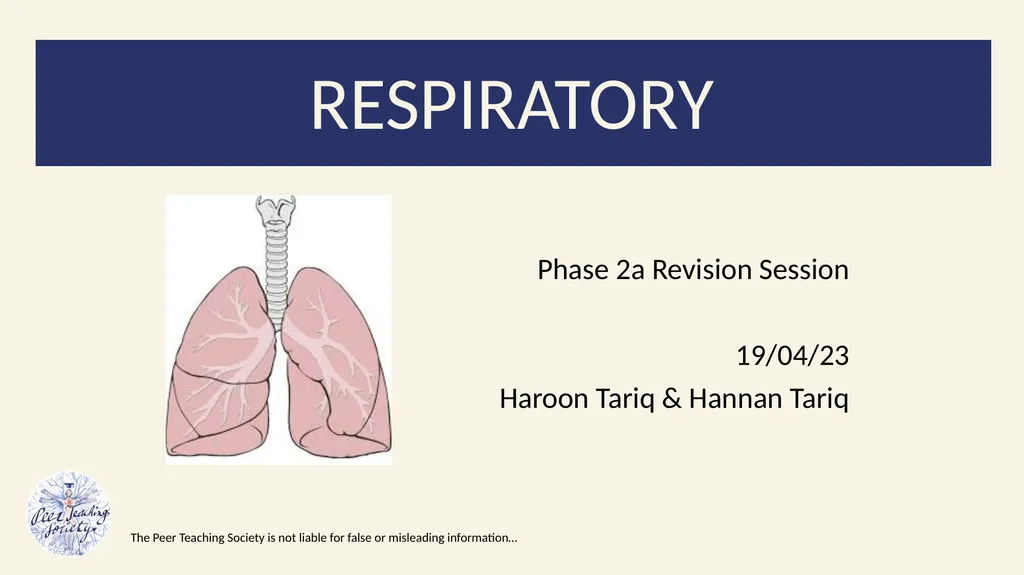
20222023 Phase 2a Revision Session 190423 Haroon Tariq Hannan Tariq RESPIRATORY The Peer Teaching Society is not liable for false or misleading information The Peer Teaching Society is not liable for false or misleading information
Related Topics
Share
Embed code
Download this presentation From Below
"2022/2023 Phase 2a Revision Session 19/04/23" is the property of its rightful owner. Permission is granted to download and print the materials on this website for personal, non-commercial use only, and to display it on your personal computer provided you do not modify the materials and that you retain all copyright notices contained in the materials. By downloading content from our website, you accept the terms of this agreement.
Presentation Transcript
01
2022/2023<br>
02
Phase 2a Revision Session
19/04/23
Haroon Tariq & Hannan Tariq RESPIRATORY The Peer Teaching Society is not liable for false or misleading information…<br>
19/04/23
Haroon Tariq & Hannan Tariq RESPIRATORY The Peer Teaching Society is not liable for false or misleading information…<br>
03
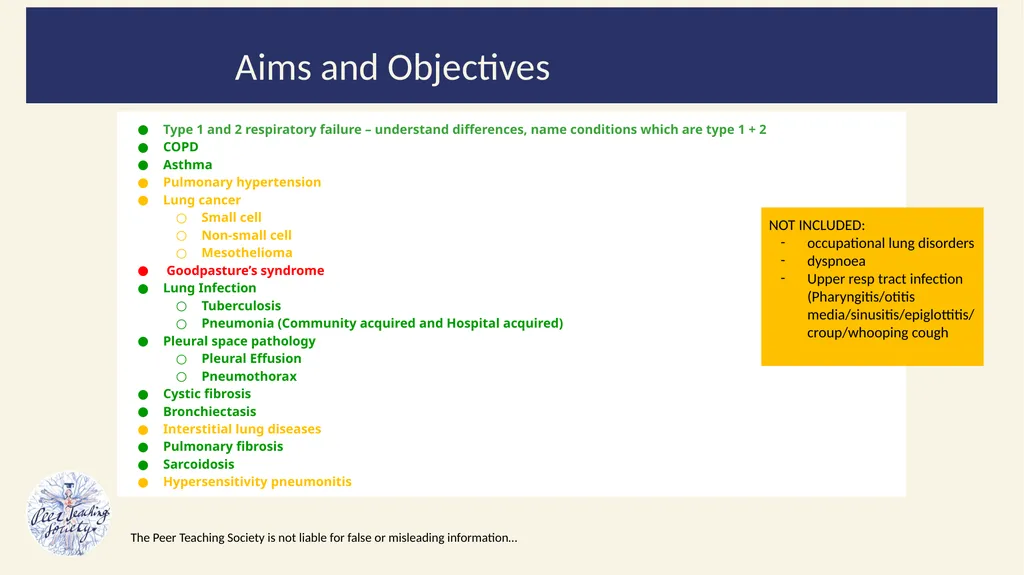
The Peer Teaching Society is not liable for false or misleading information… Aims and Objectives Type 1 and 2 respiratory failure – understand differences, name conditions which are type 1 + 2
COPD
Asthma
Pulmonary hypertension
Lung cancer
Small cell
Non-small cell
Mesothelioma
Goodpasture’s syndrome
Lung Infection
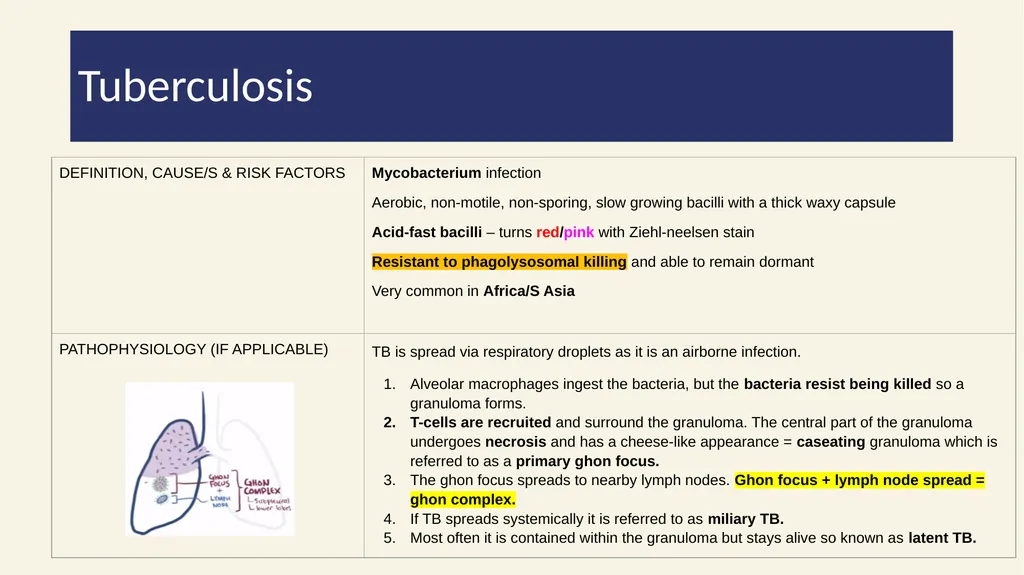
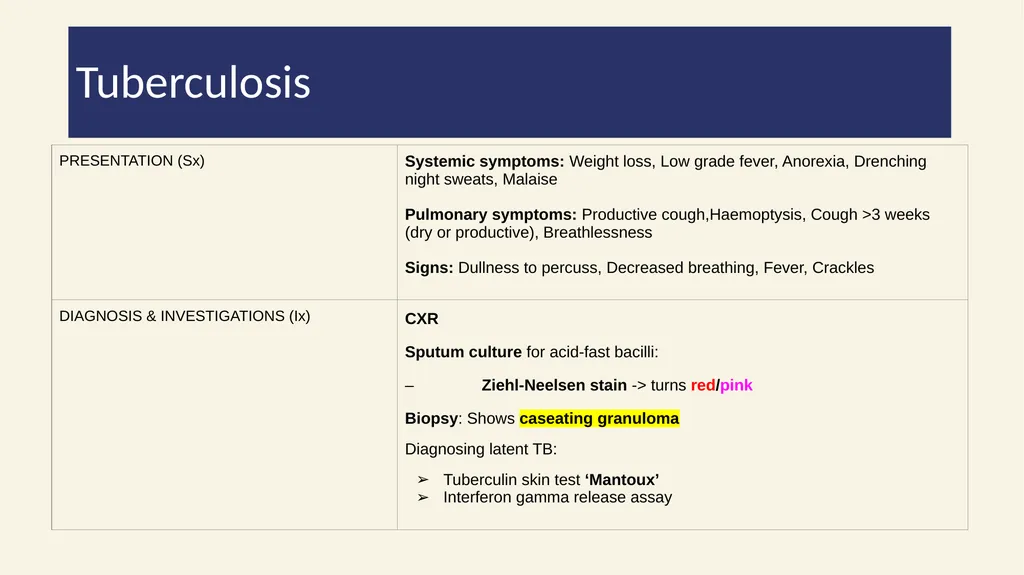
Tuberculosis
Pneumonia (Community acquired and Hospital acquired)
Pleural space pathology
Pleural Effusion
Pneumothorax
Cystic fibrosis
Bronchiectasis
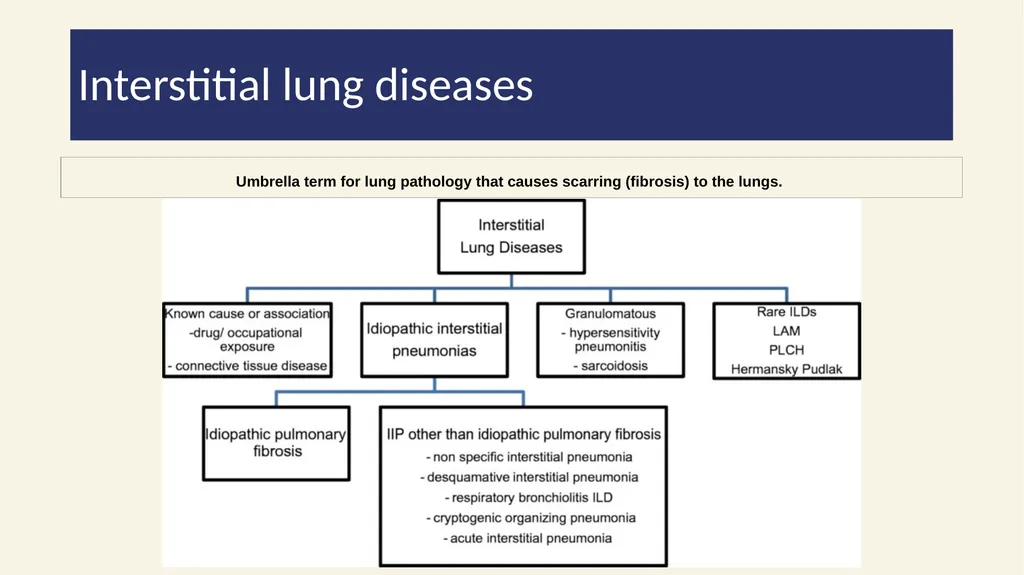
Interstitial lung diseases
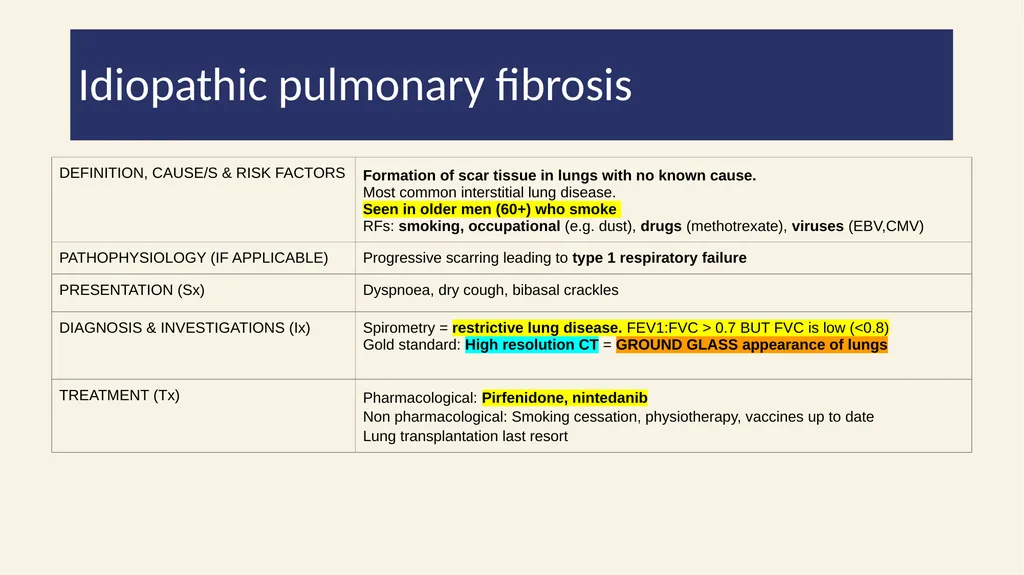
Pulmonary fibrosis
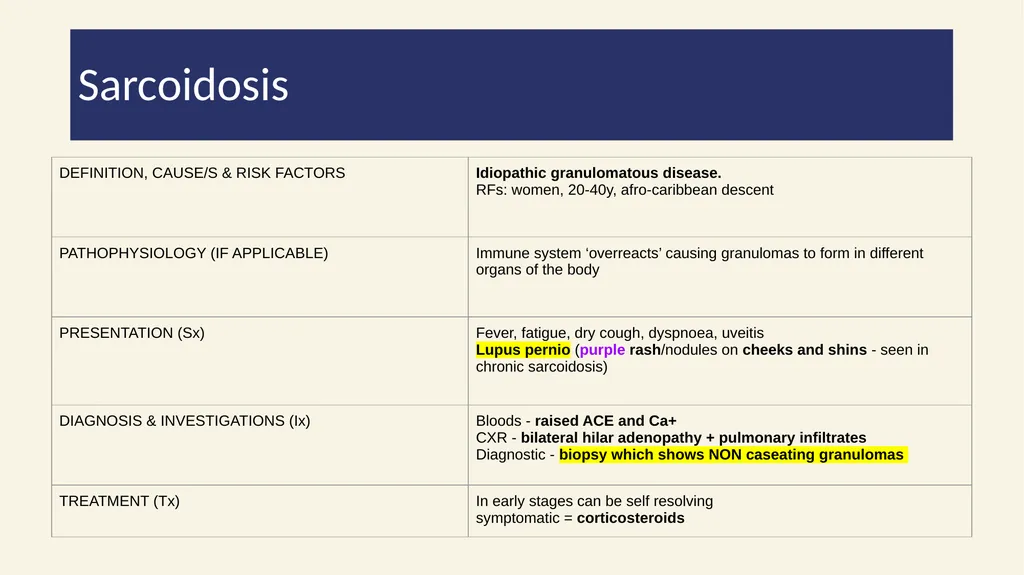
Sarcoidosis
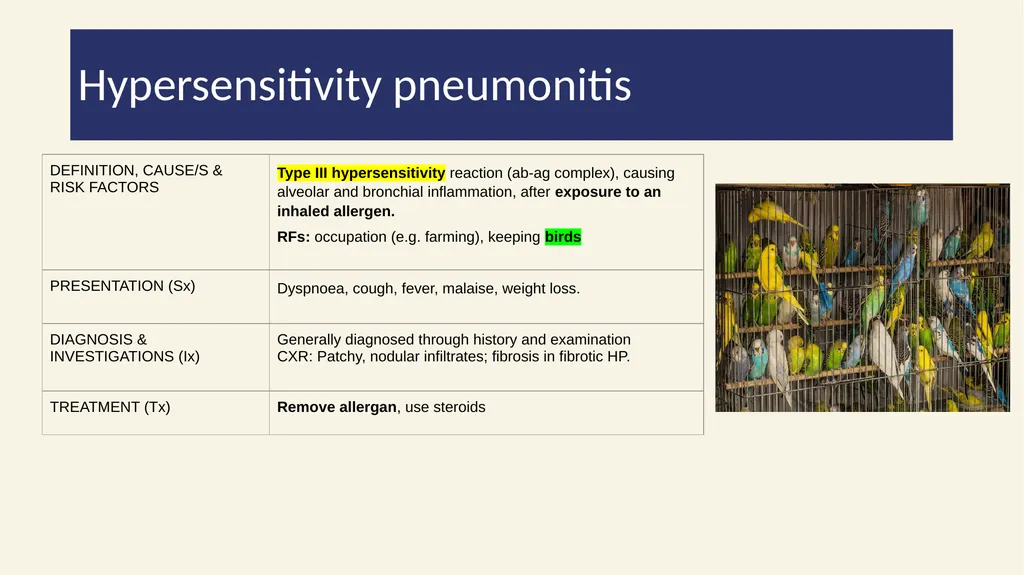
Hypersensitivity pneumonitis NOT INCLUDED:
occupational lung disorders
dyspnoea
Upper resp tract infection (Pharyngitis/otitis media/sinusitis/epiglottitis/croup/whooping cough<br>
COPD
Asthma
Pulmonary hypertension
Lung cancer
Small cell
Non-small cell
Mesothelioma
Goodpasture’s syndrome
Lung Infection
Tuberculosis
Pneumonia (Community acquired and Hospital acquired)
Pleural space pathology
Pleural Effusion
Pneumothorax
Cystic fibrosis
Bronchiectasis
Interstitial lung diseases
Pulmonary fibrosis
Sarcoidosis
Hypersensitivity pneumonitis NOT INCLUDED:
occupational lung disorders
dyspnoea
Upper resp tract infection (Pharyngitis/otitis media/sinusitis/epiglottitis/croup/whooping cough<br>
04
CONDITIONS Content - WHAT TO INCLUDE? The Peer Teaching Society is not liable for false or misleading information…<br>
05
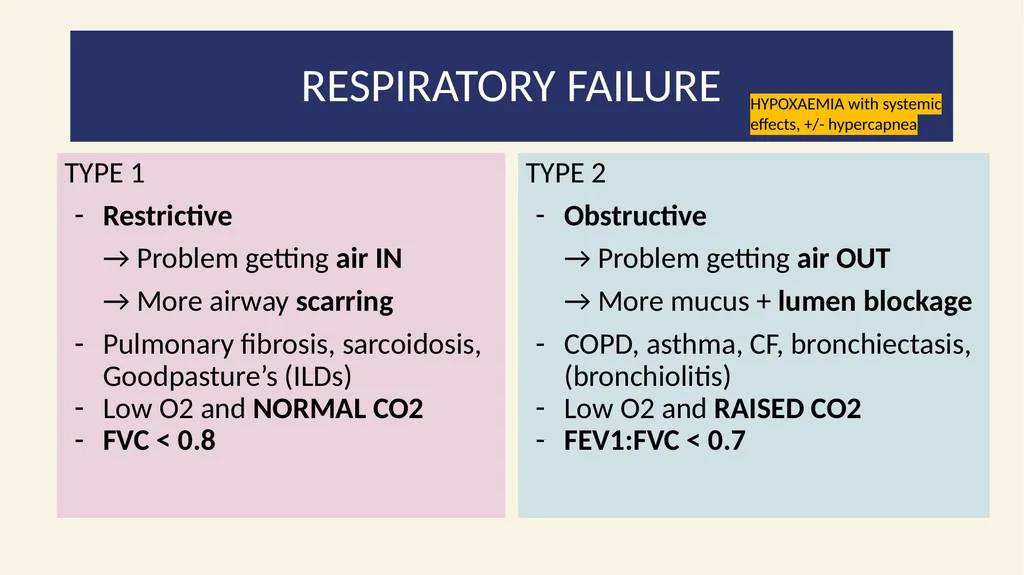
TYPE 1
Restrictive
→ Problem getting air IN
→ More airway scarring
Pulmonary fibrosis, sarcoidosis, Goodpasture’s (ILDs)
Low O2 and NORMAL CO2
FVC < 0.8 TYPE 2
Obstructive
→ Problem getting air OUT
→ More mucus + lumen blockage
COPD, asthma, CF, bronchiectasis, (bronchiolitis)
Low O2 and RAISED CO2
FEV1:FVC < 0.7 RESPIRATORY FAILURE HYPOXAEMIA with systemic effects, +/- hypercapnea<br>
Restrictive
→ Problem getting air IN
→ More airway scarring
Pulmonary fibrosis, sarcoidosis, Goodpasture’s (ILDs)
Low O2 and NORMAL CO2
FVC < 0.8 TYPE 2
Obstructive
→ Problem getting air OUT
→ More mucus + lumen blockage
COPD, asthma, CF, bronchiectasis, (bronchiolitis)
Low O2 and RAISED CO2
FEV1:FVC < 0.7 RESPIRATORY FAILURE HYPOXAEMIA with systemic effects, +/- hypercapnea<br>
06
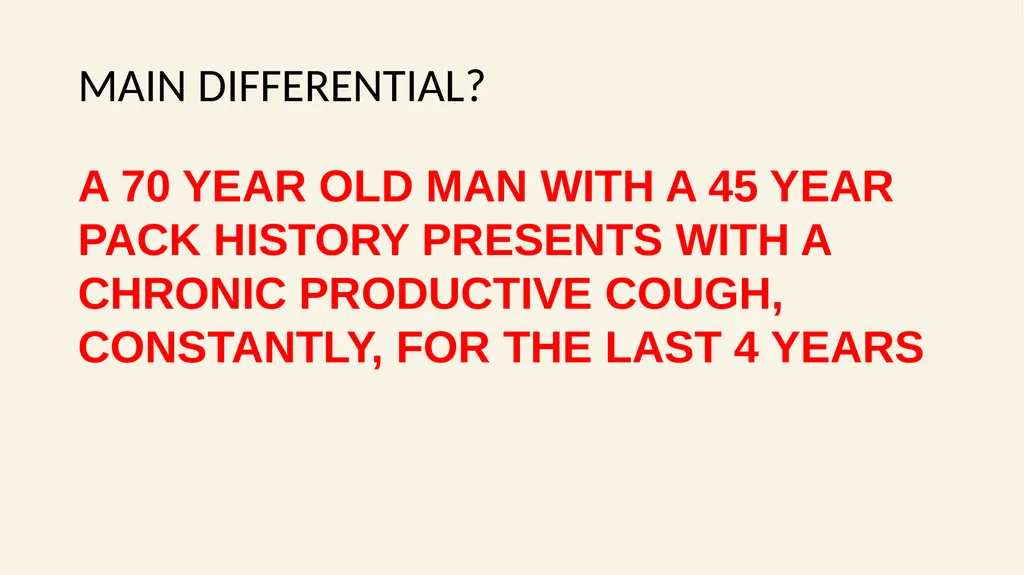
MAIN DIFFERENTIAL? A 70 YEAR OLD MAN WITH A 45 YEAR PACK HISTORY PRESENTS WITH A CHRONIC PRODUCTIVE COUGH, CONSTANTLY, FOR THE LAST 4 YEARS<br>
07
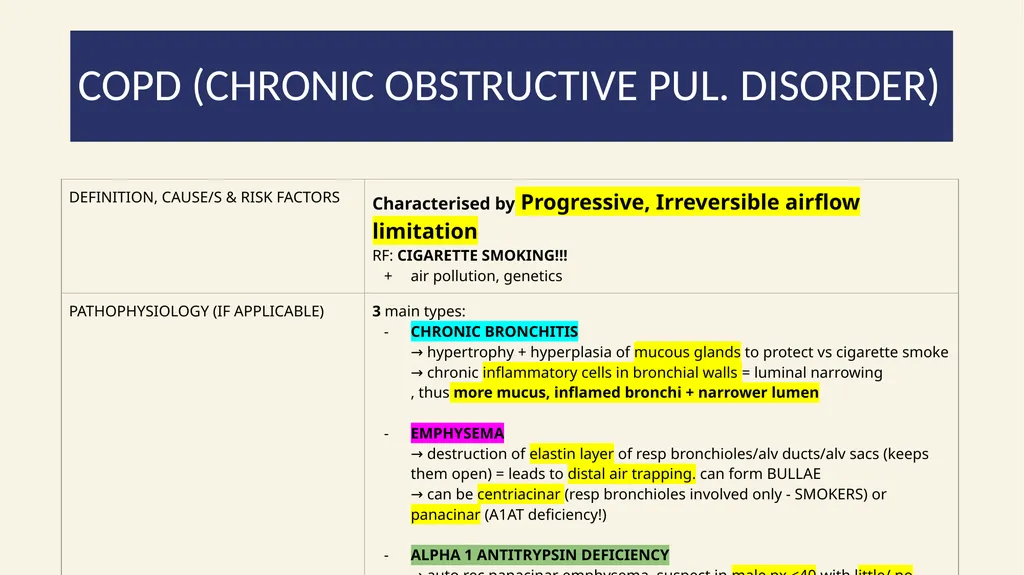
COPD (CHRONIC OBSTRUCTIVE PUL. DISORDER)<br>
08
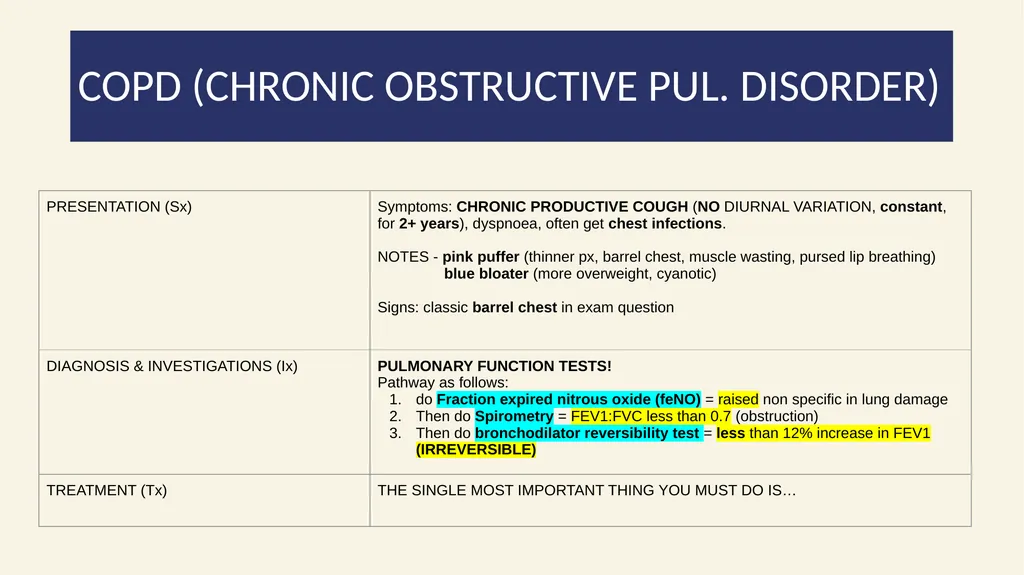
COPD (CHRONIC OBSTRUCTIVE PUL. DISORDER)<br>
09
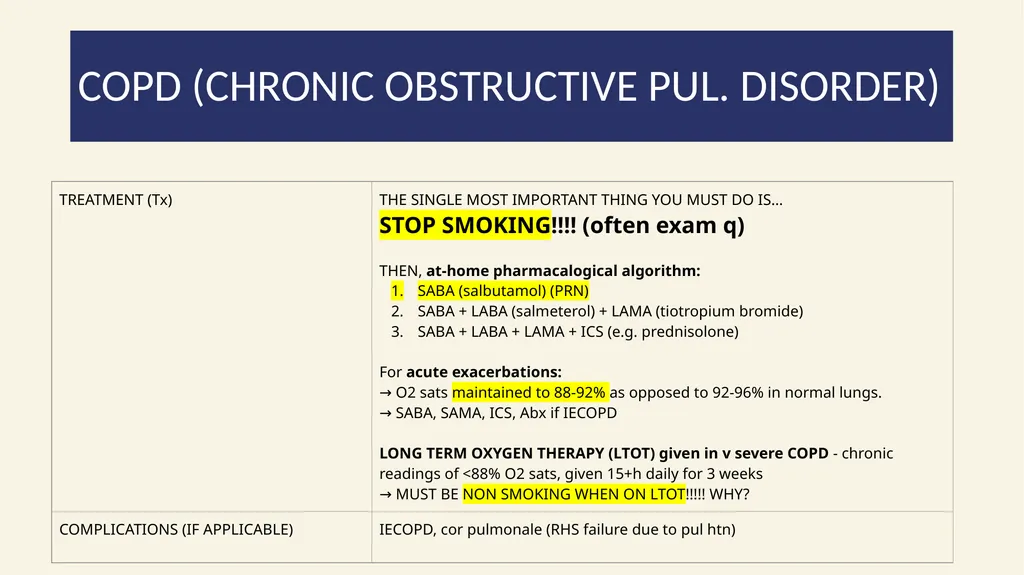
COPD (CHRONIC OBSTRUCTIVE PUL. DISORDER)<br>
10
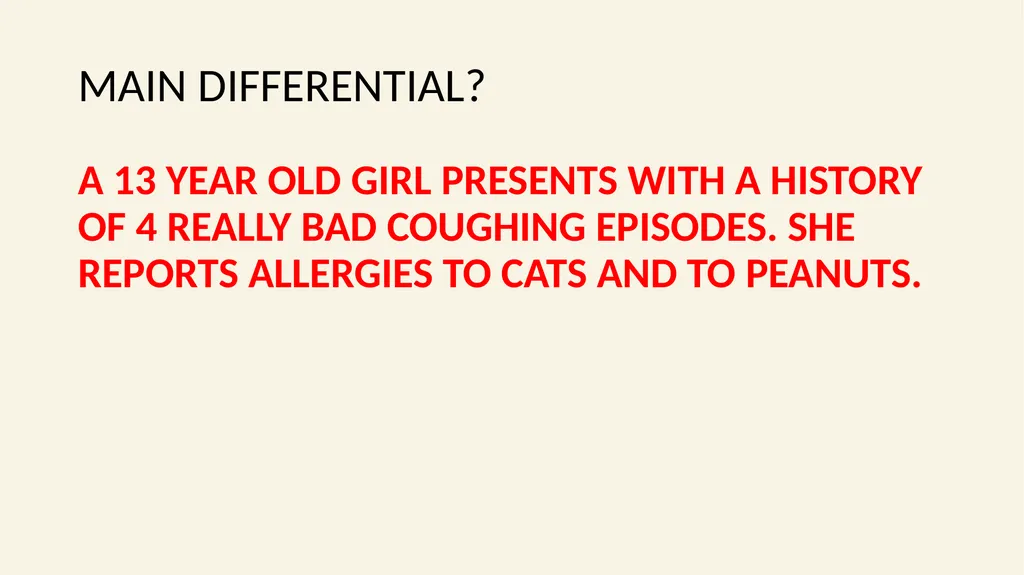
MAIN DIFFERENTIAL? A 13 YEAR OLD GIRL PRESENTS WITH A HISTORY OF 4 REALLY BAD COUGHING EPISODES. SHE REPORTS ALLERGIES TO CATS AND TO PEANUTS.<br>
11
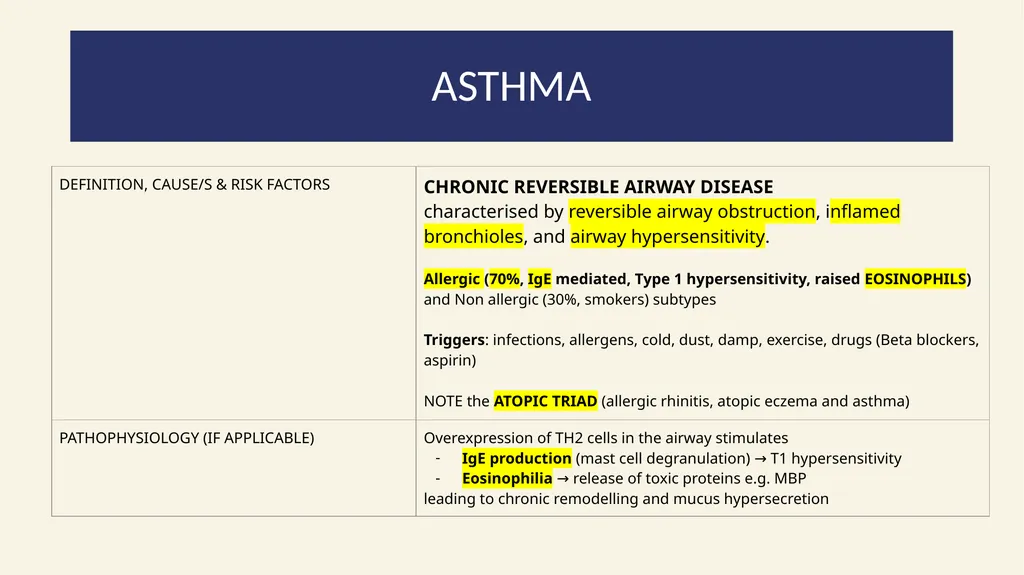
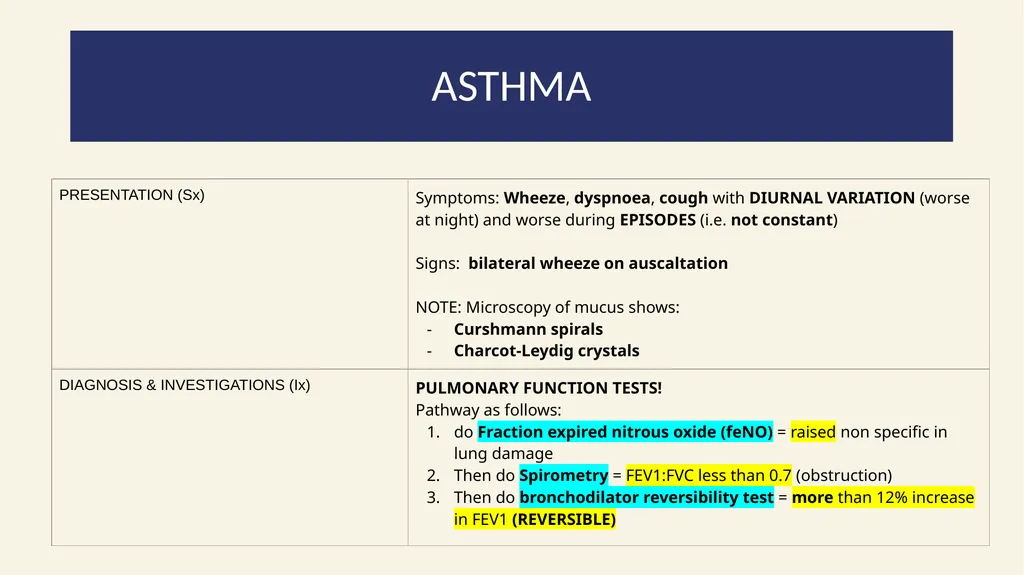
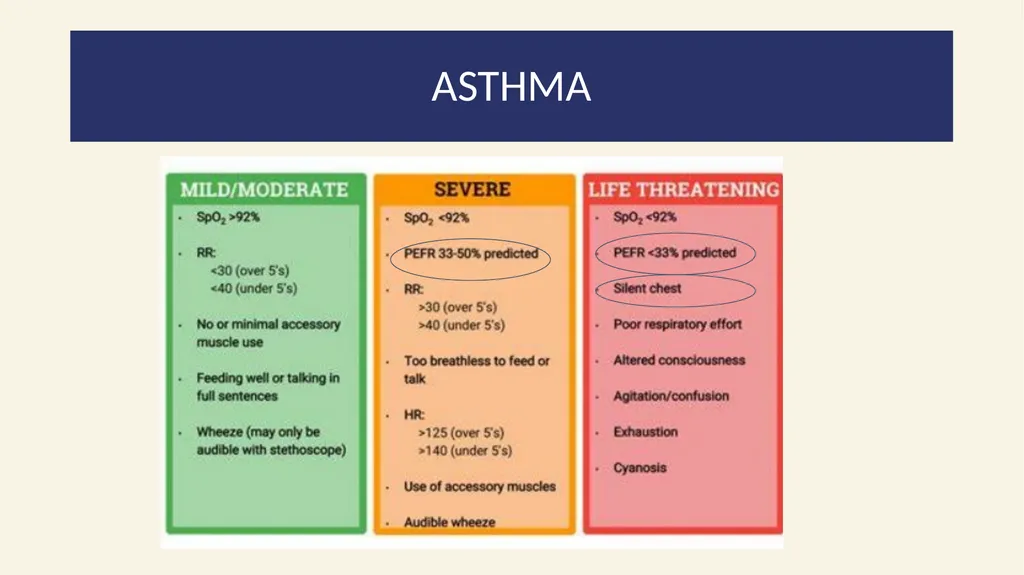
ASTHMA<br>
12
ASTHMA<br>
13
ASTHMA<br>
14
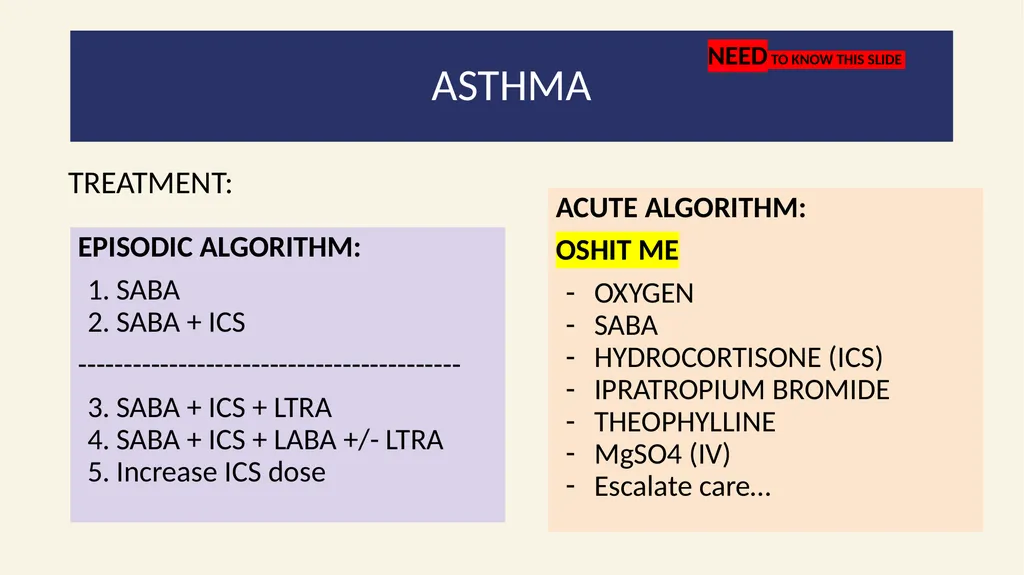
EPISODIC ALGORITHM:
SABA
SABA + ICS
------------------------------------------
SABA + ICS + LTRA
SABA + ICS + LABA +/- LTRA
Increase ICS dose ACUTE ALGORITHM:
OSHIT ME
OXYGEN
SABA
HYDROCORTISONE (ICS)
IPRATROPIUM BROMIDE
THEOPHYLLINE
MgSO4 (IV)
Escalate care… ASTHMA NEED TO KNOW THIS SLIDE TREATMENT:<br>
SABA
SABA + ICS
------------------------------------------
SABA + ICS + LTRA
SABA + ICS + LABA +/- LTRA
Increase ICS dose ACUTE ALGORITHM:
OSHIT ME
OXYGEN
SABA
HYDROCORTISONE (ICS)
IPRATROPIUM BROMIDE
THEOPHYLLINE
MgSO4 (IV)
Escalate care… ASTHMA NEED TO KNOW THIS SLIDE TREATMENT:<br>
15
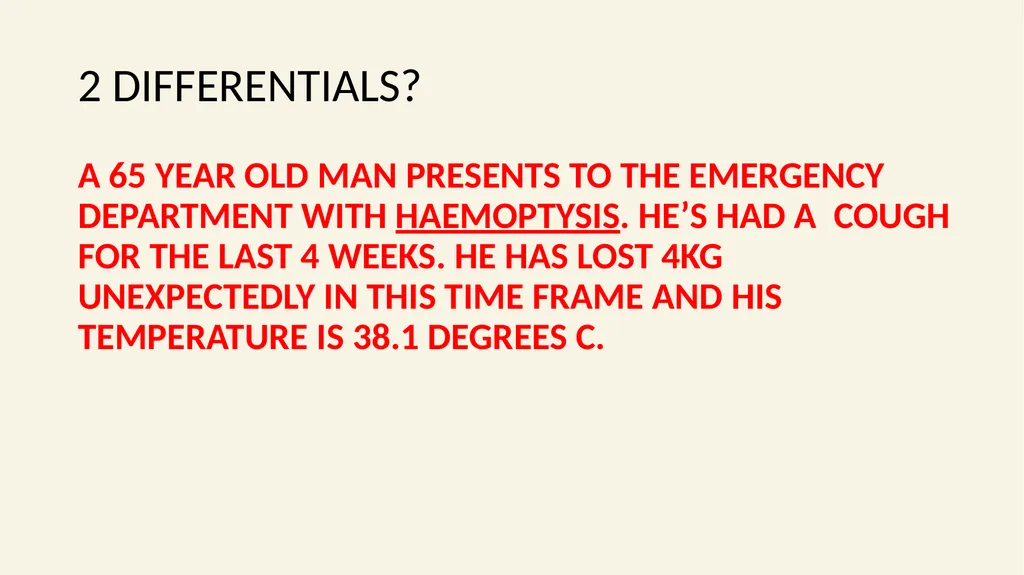
2 DIFFERENTIALS? A 65 YEAR OLD MAN PRESENTS TO THE EMERGENCY DEPARTMENT WITH HAEMOPTYSIS. HE’S HAD A COUGH FOR THE LAST 4 WEEKS. HE HAS LOST 4KG UNEXPECTEDLY IN THIS TIME FRAME AND HIS TEMPERATURE IS 38.1 DEGREES C.<br>
16
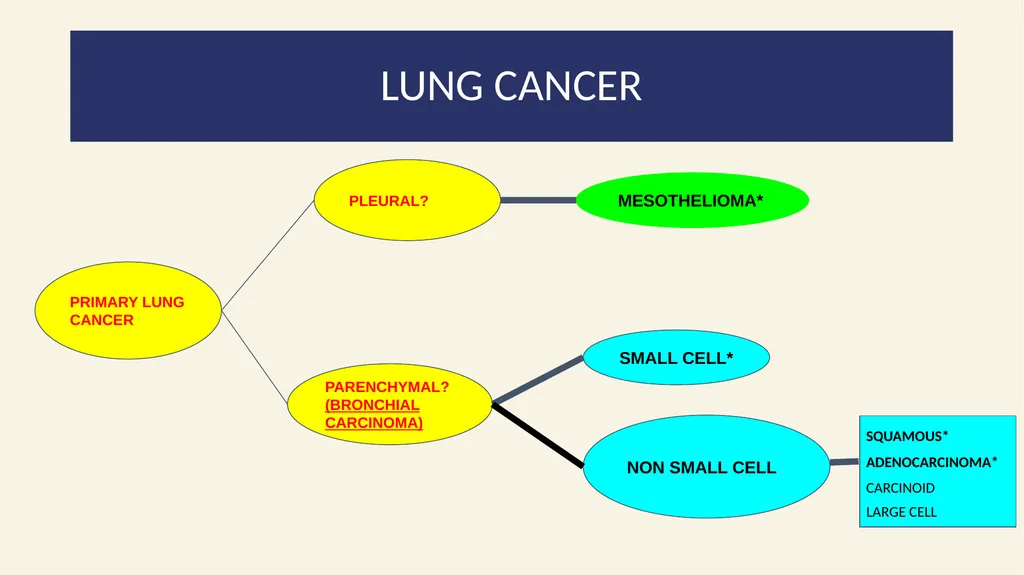
LUNG CANCER PRIMARY LUNG CANCER MESOTHELIOMA* PARENCHYMAL?
(BRONCHIAL CARCINOMA) PLEURAL? NON SMALL CELL SMALL CELL* SQUAMOUS* ADENOCARCINOMA* CARCINOID LARGE CELL<br>
(BRONCHIAL CARCINOMA) PLEURAL? NON SMALL CELL SMALL CELL* SQUAMOUS* ADENOCARCINOMA* CARCINOID LARGE CELL<br>
17
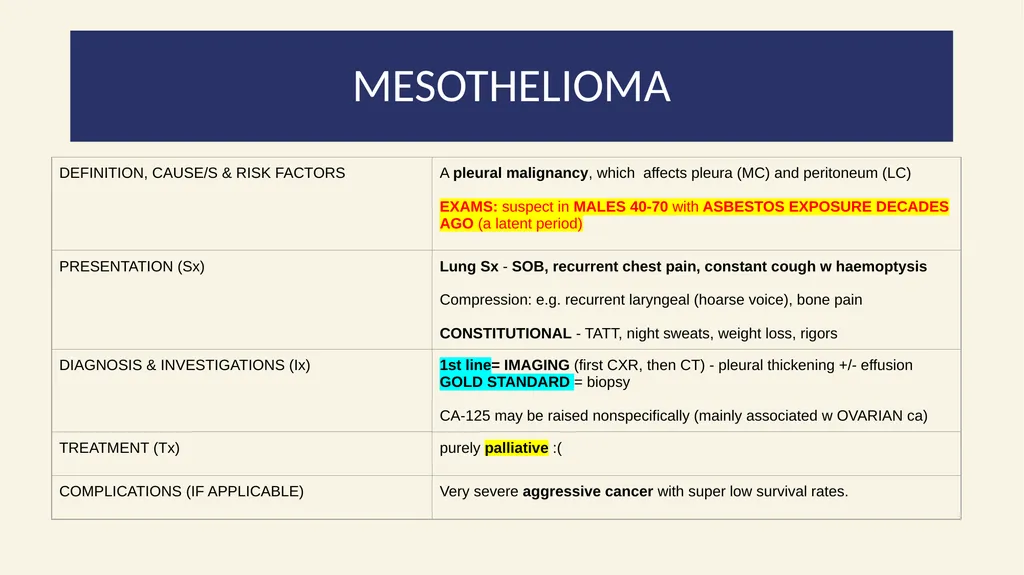
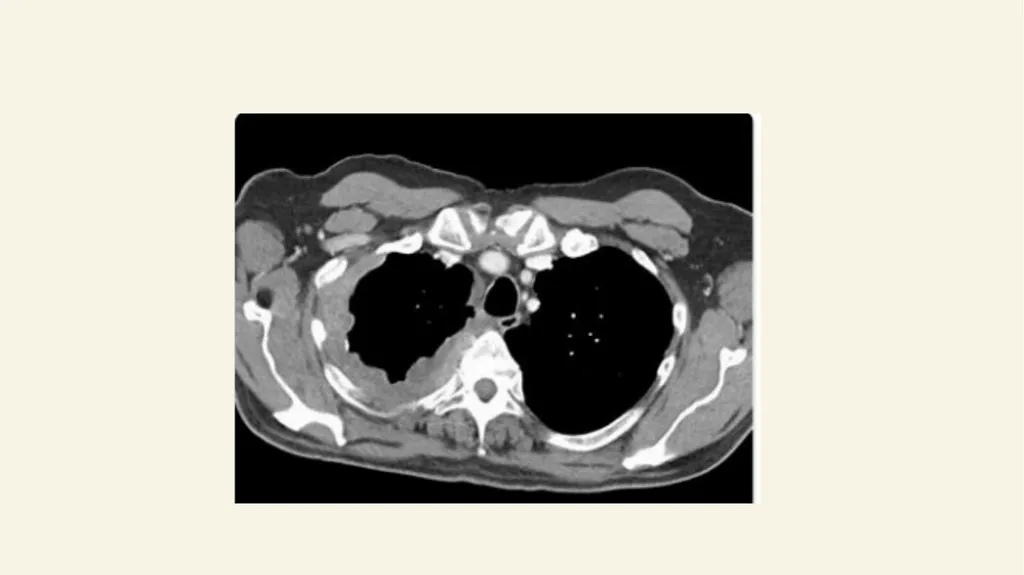
MESOTHELIOMA<br>
18
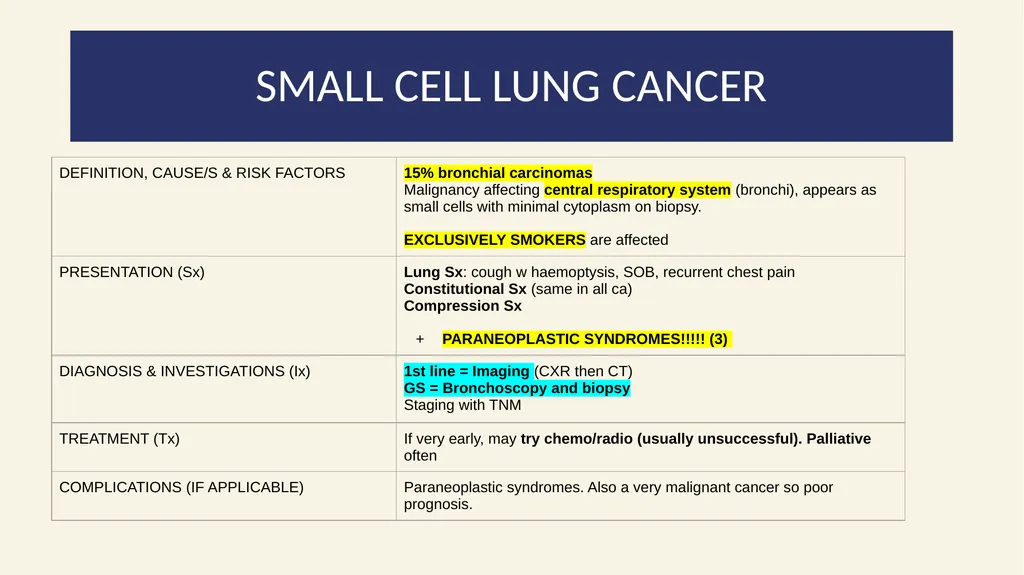
SMALL CELL LUNG CANCER<br>
19
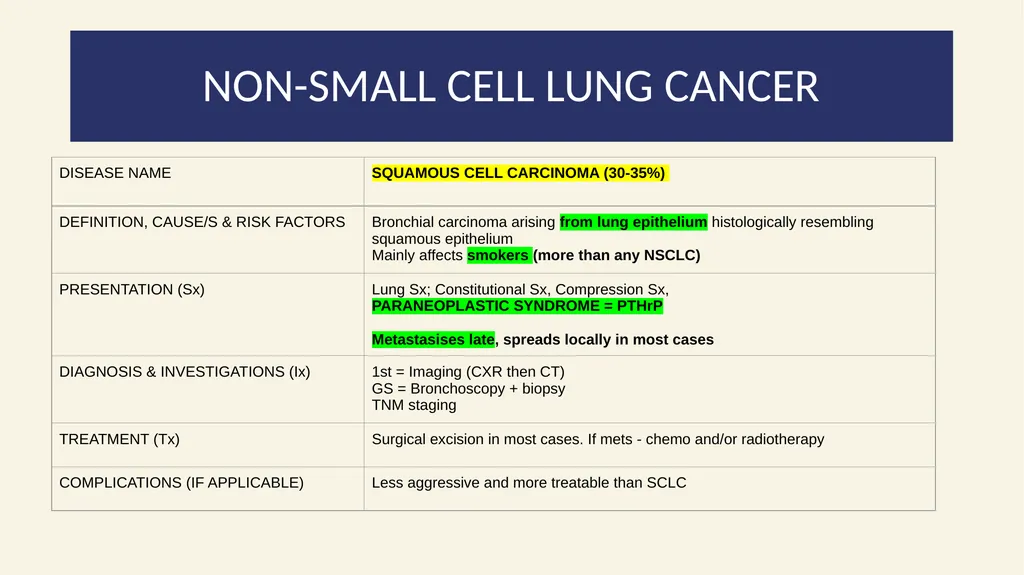
NON-SMALL CELL LUNG CANCER<br>
20
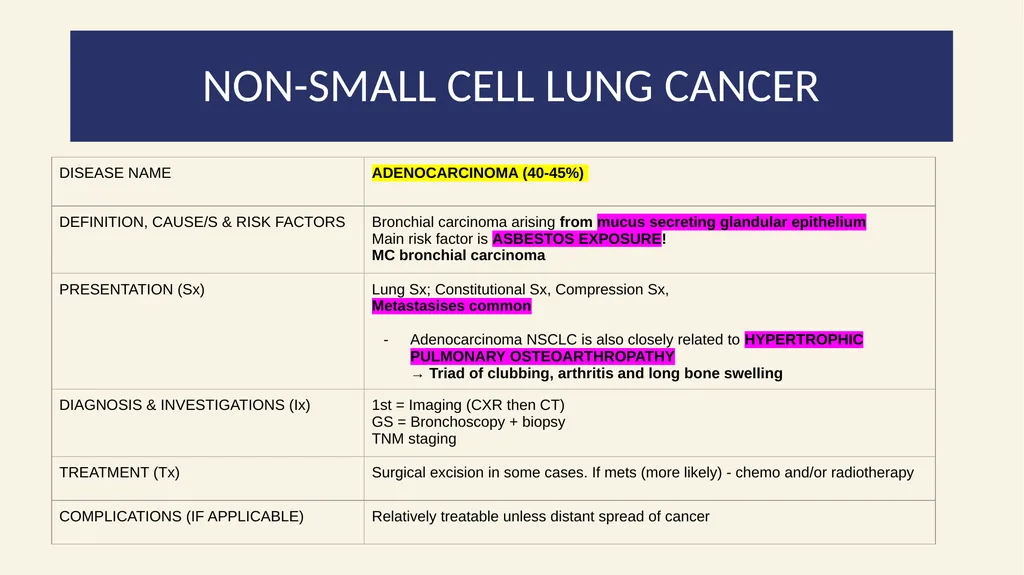
NON-SMALL CELL LUNG CANCER<br>
21
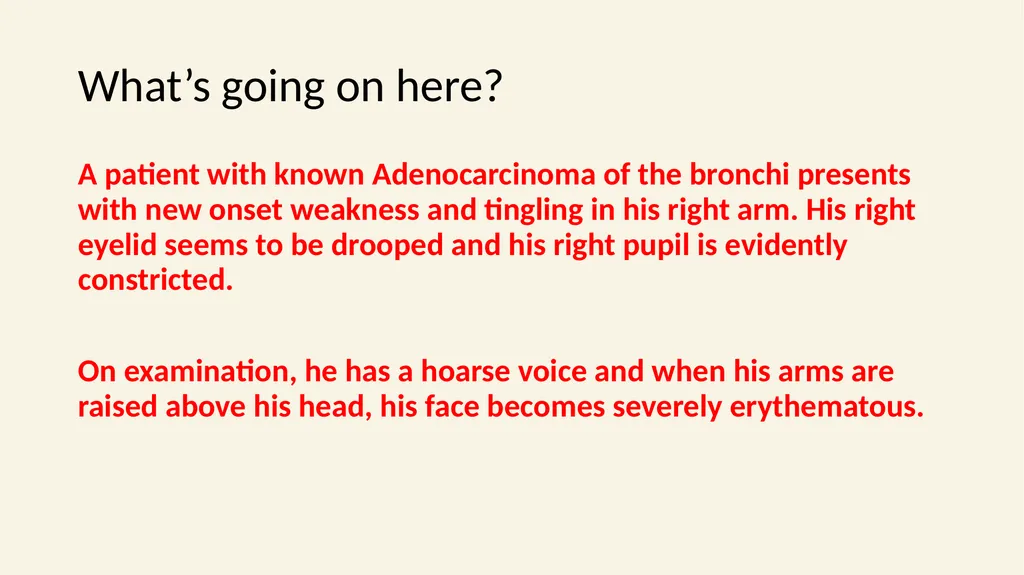
What’s going on here? A patient with known Adenocarcinoma of the bronchi presents with new onset weakness and tingling in his right arm. His right eyelid seems to be drooped and his right pupil is evidently constricted.
On examination, he has a hoarse voice and when his arms are raised above his head, his face becomes severely erythematous.<br>
On examination, he has a hoarse voice and when his arms are raised above his head, his face becomes severely erythematous.<br>
22
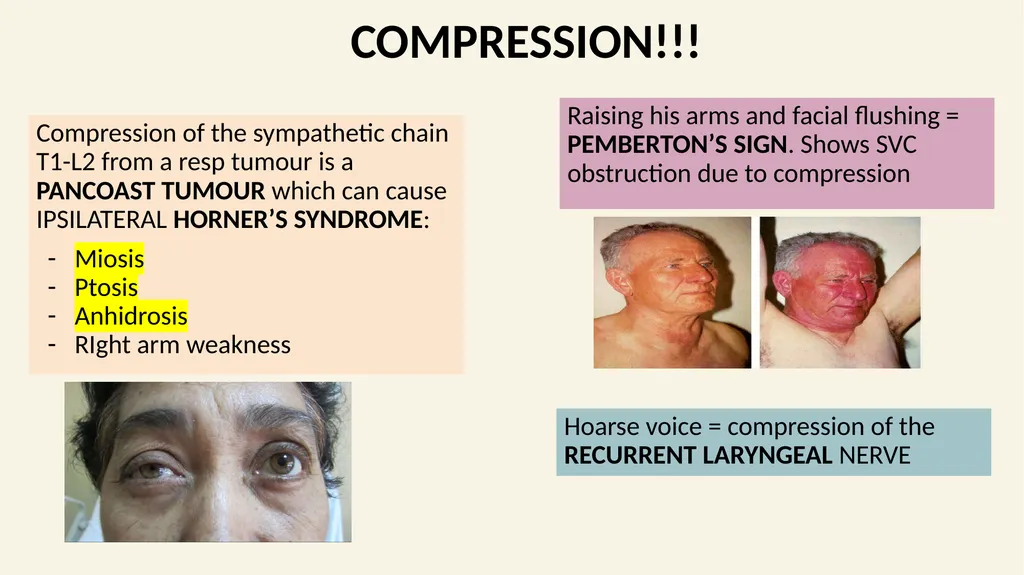
COMPRESSION!!! Compression of the sympathetic chain T1-L2 from a resp tumour is a PANCOAST TUMOUR which can cause IPSILATERAL HORNER’S SYNDROME:
Miosis
Ptosis
Anhidrosis
RIght arm weakness Raising his arms and facial flushing = PEMBERTON’S SIGN. Shows SVC obstruction due to compression Hoarse voice = compression of the RECURRENT LARYNGEAL NERVE<br>
Miosis
Ptosis
Anhidrosis
RIght arm weakness Raising his arms and facial flushing = PEMBERTON’S SIGN. Shows SVC obstruction due to compression Hoarse voice = compression of the RECURRENT LARYNGEAL NERVE<br>
23
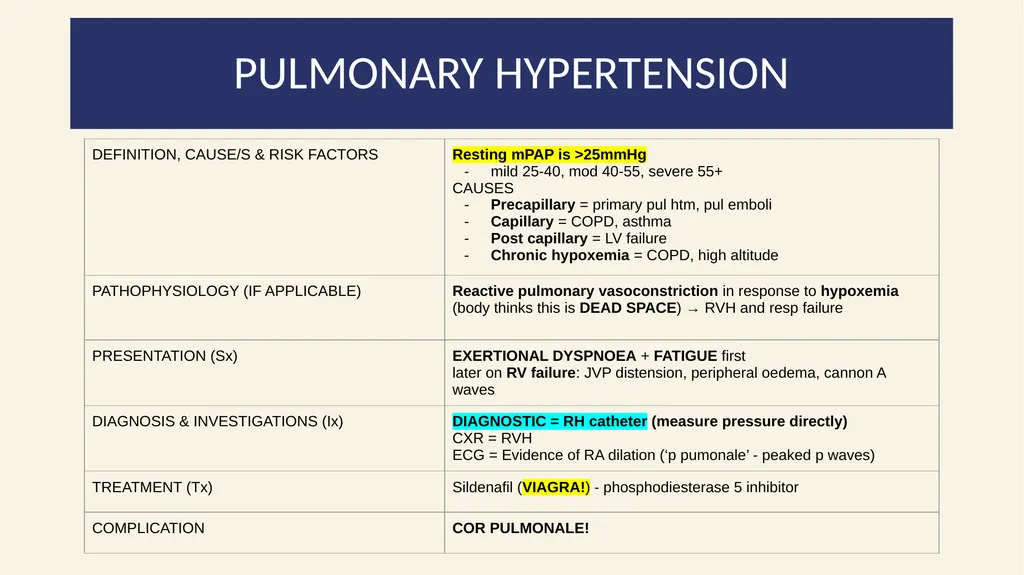
PULMONARY HYPERTENSION<br>
24
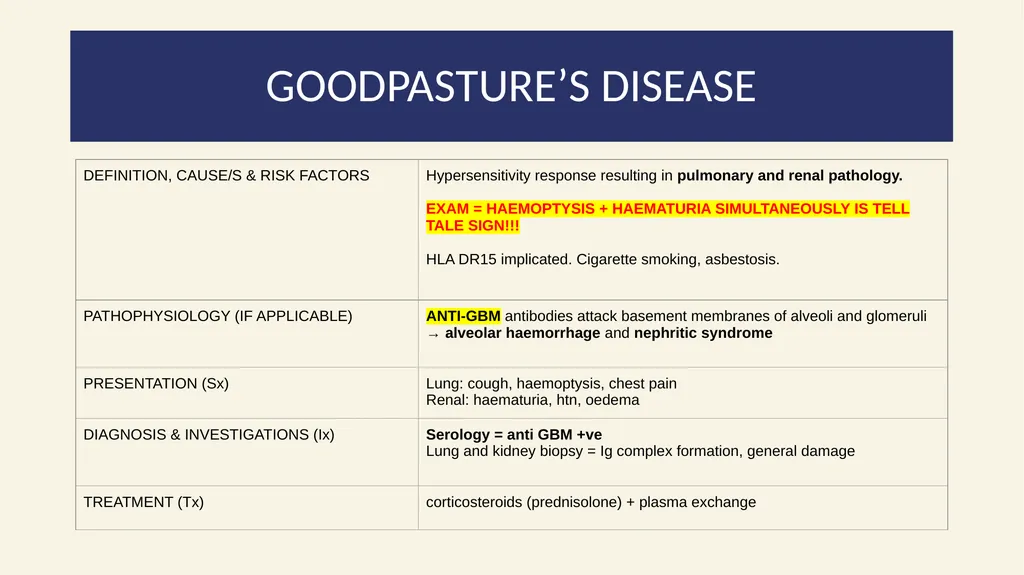
GOODPASTURE’S DISEASE<br>
25
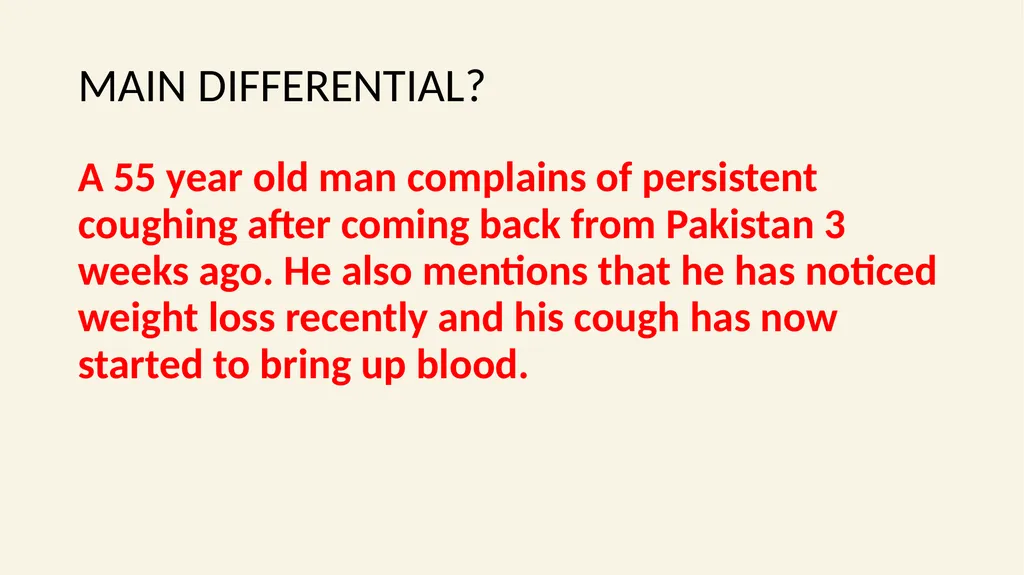
MAIN DIFFERENTIAL? A 55 year old man complains of persistent coughing after coming back from Pakistan 3 weeks ago. He also mentions that he has noticed weight loss recently and his cough has now started to bring up blood.<br>
26
Tuberculosis<br>
27
Tuberculosis<br>
28
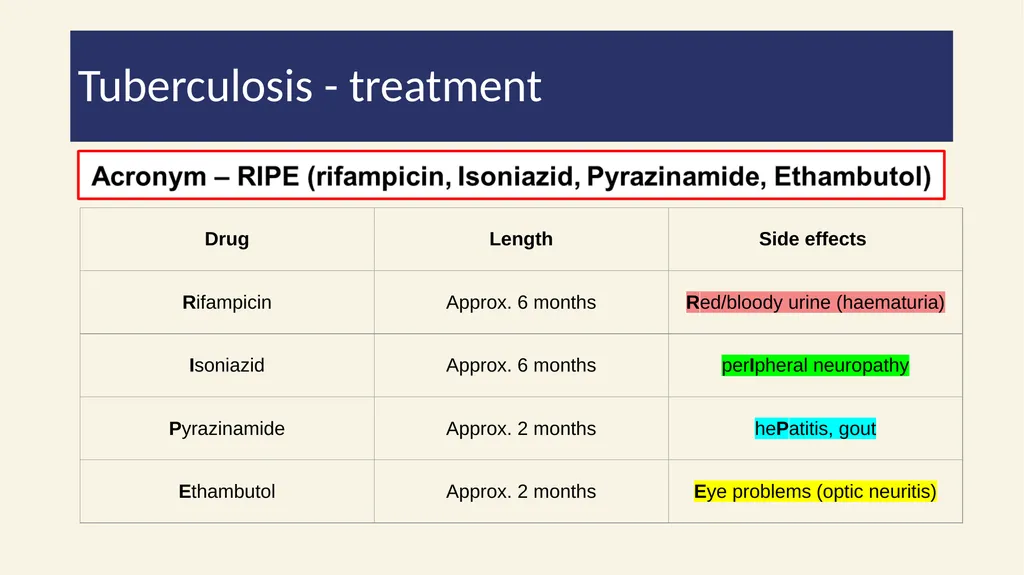
Tuberculosis - treatment<br>
29
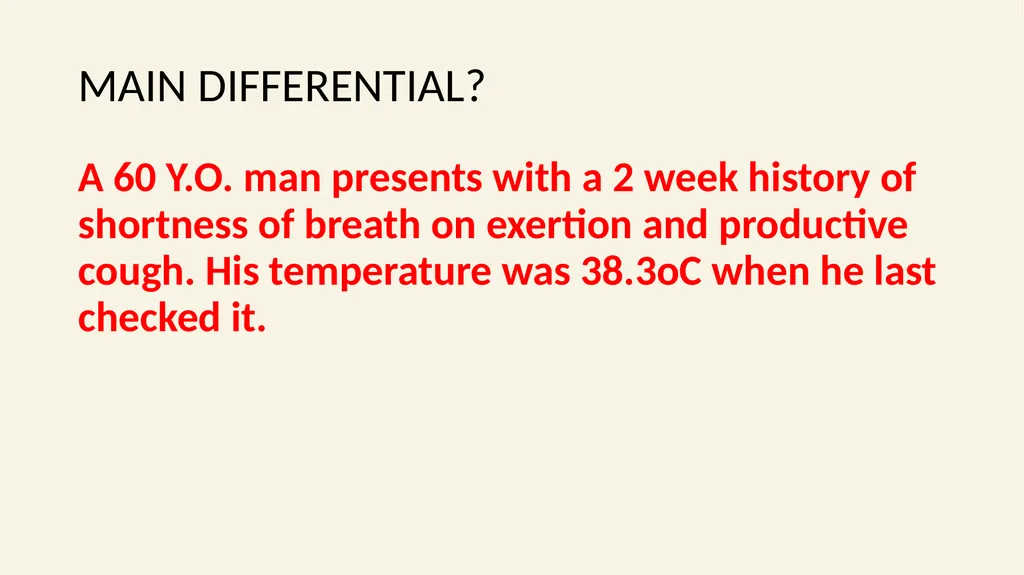
MAIN DIFFERENTIAL? A 60 Y.O. man presents with a 2 week history of shortness of breath on exertion and productive cough. His temperature was 38.3oC when he last checked it.<br>
30
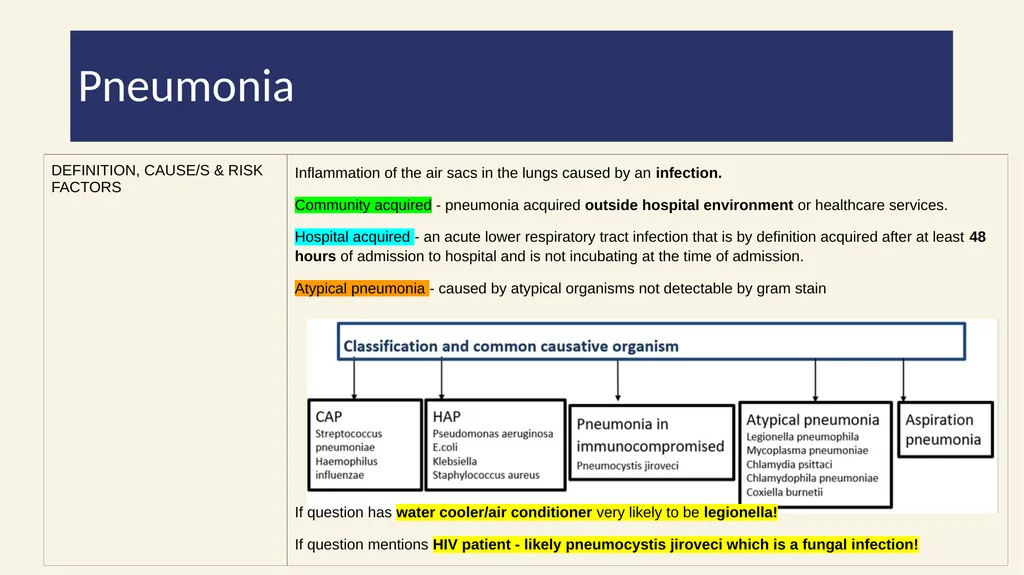
Pneumonia<br>
31
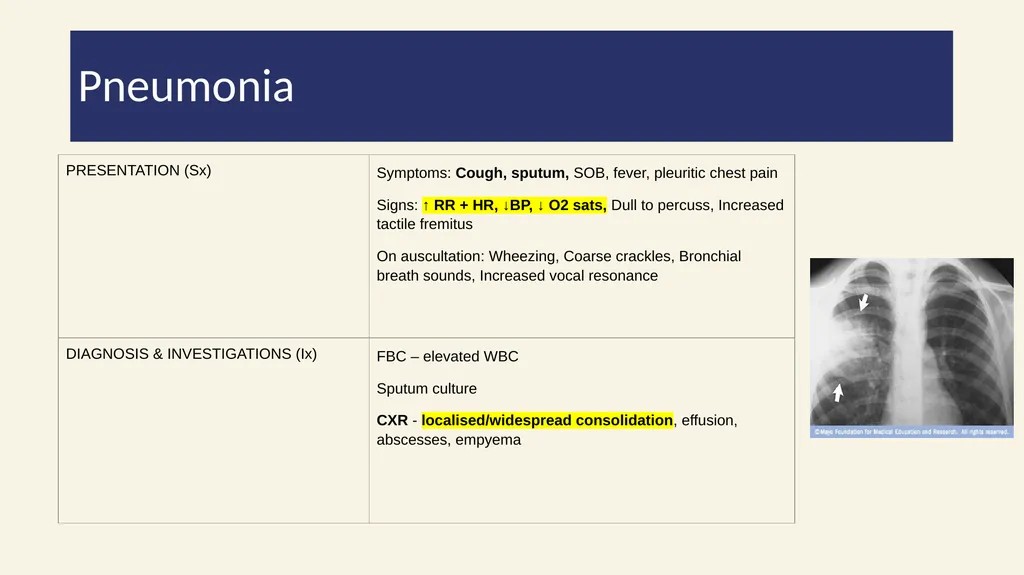
Pneumonia<br>
32
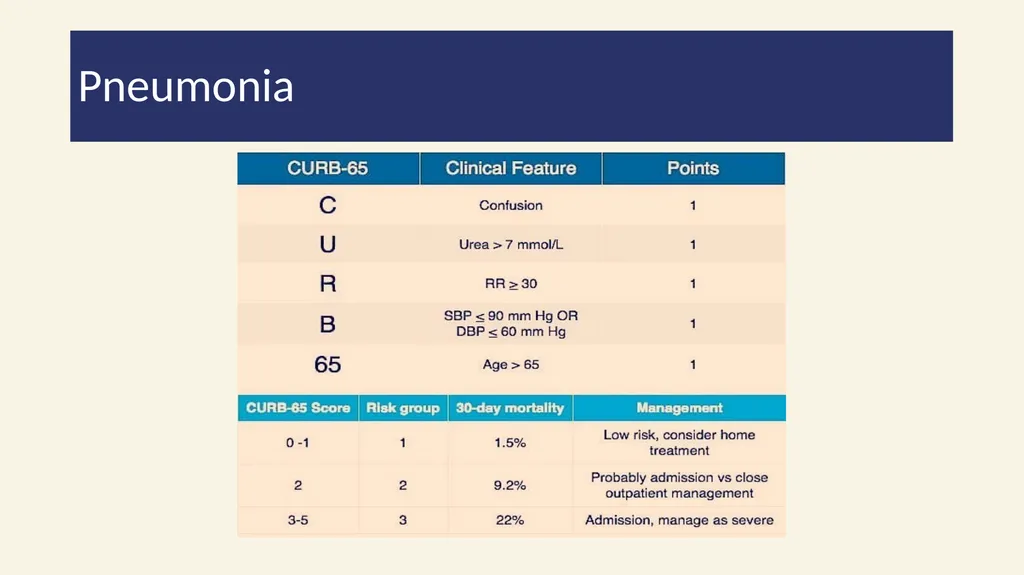
Pneumonia<br>
33
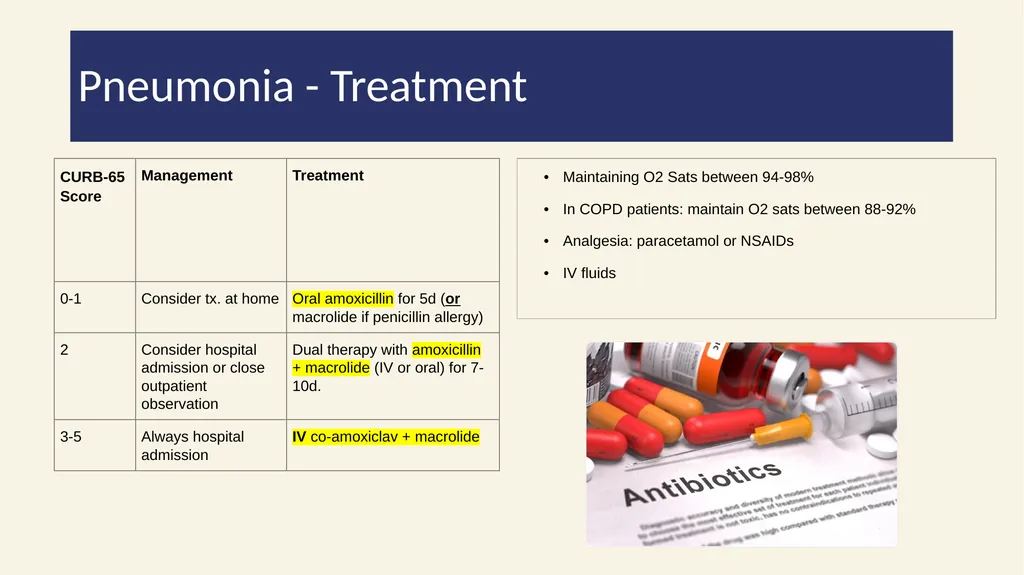
Pneumonia - Treatment<br>
34
MAIN DIFFERENTIAL? A 33 y.o. lady presents with a 12 day history of left sided pleuritic chest pain. She also reports difficulty breathing and occasional cough.<br>
35
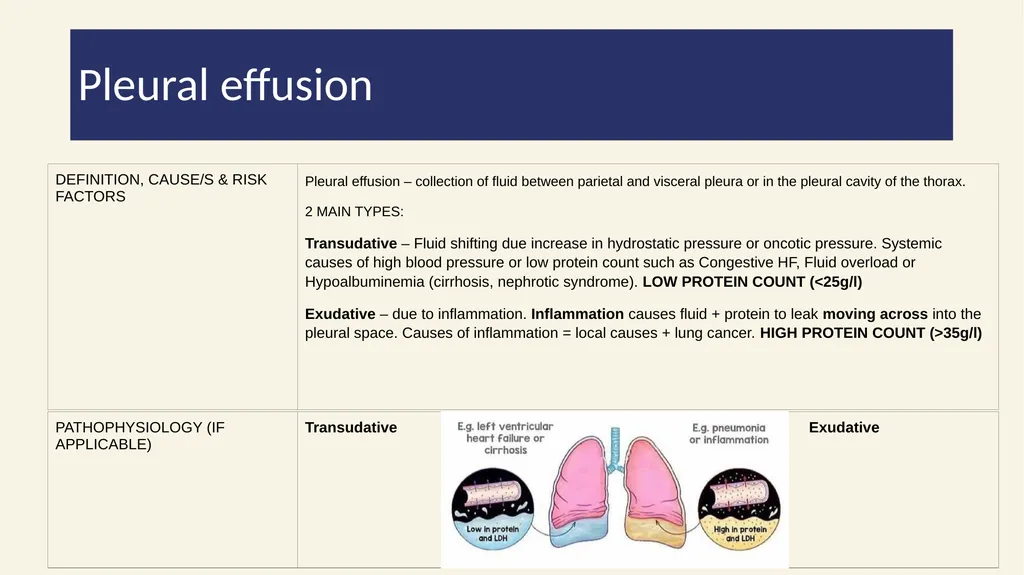
Pleural effusion<br>
36
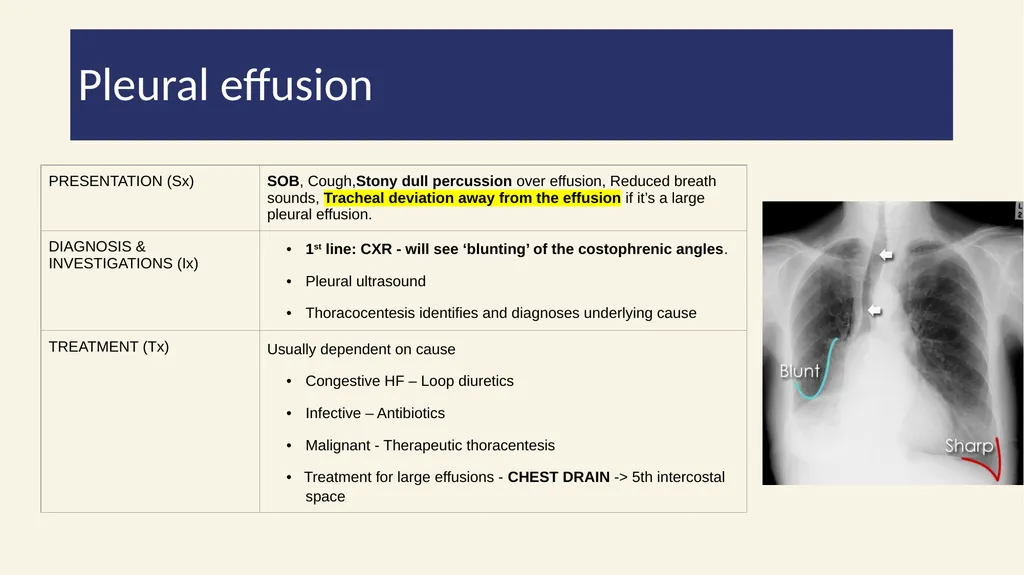
Pleural effusion<br>
37
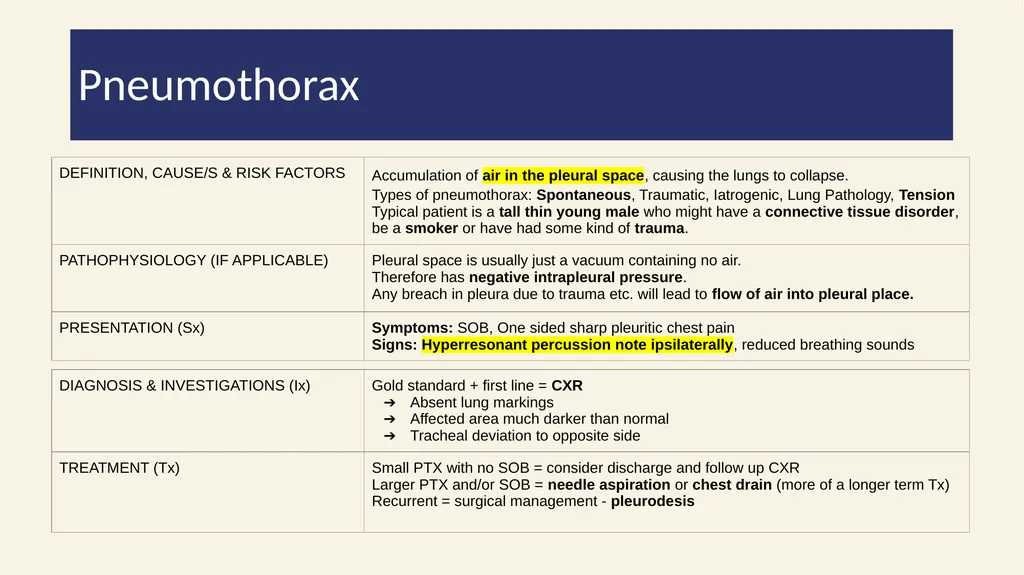
MAIN DIFFERENTIAL? A 22 y.o. male presents with sudden onset sharp chest pain in his left side. He has previously been diagnosed with Marfan’s and has a BMI of 20.1<br>
38
Pneumothorax<br>
39
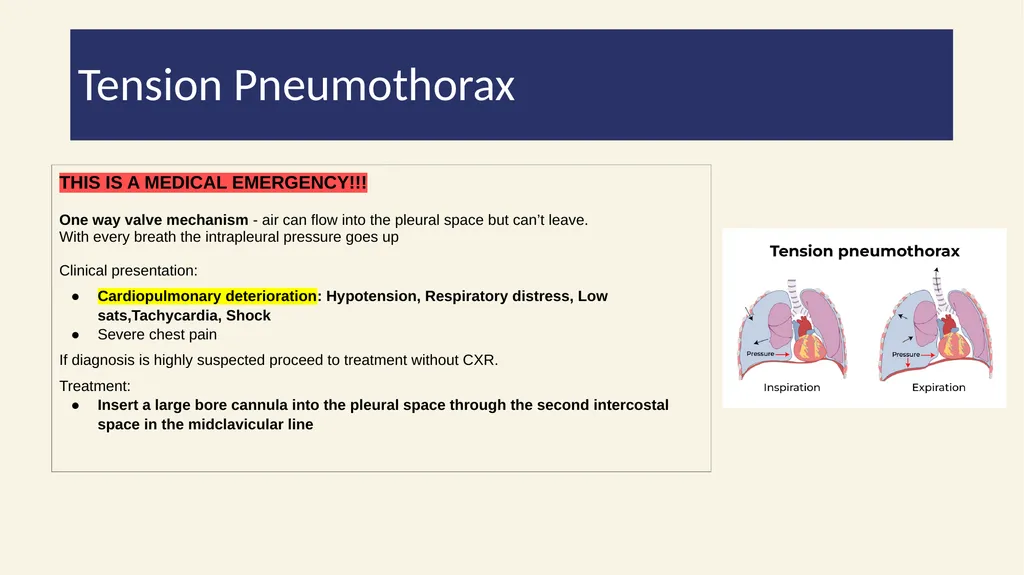
Tension Pneumothorax<br>
40
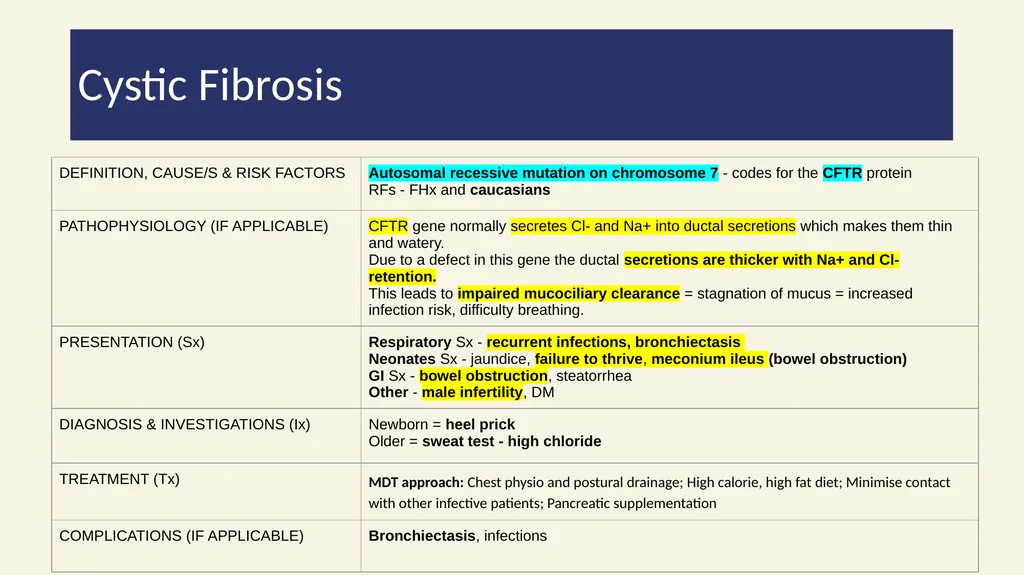
Cystic Fibrosis<br>
41
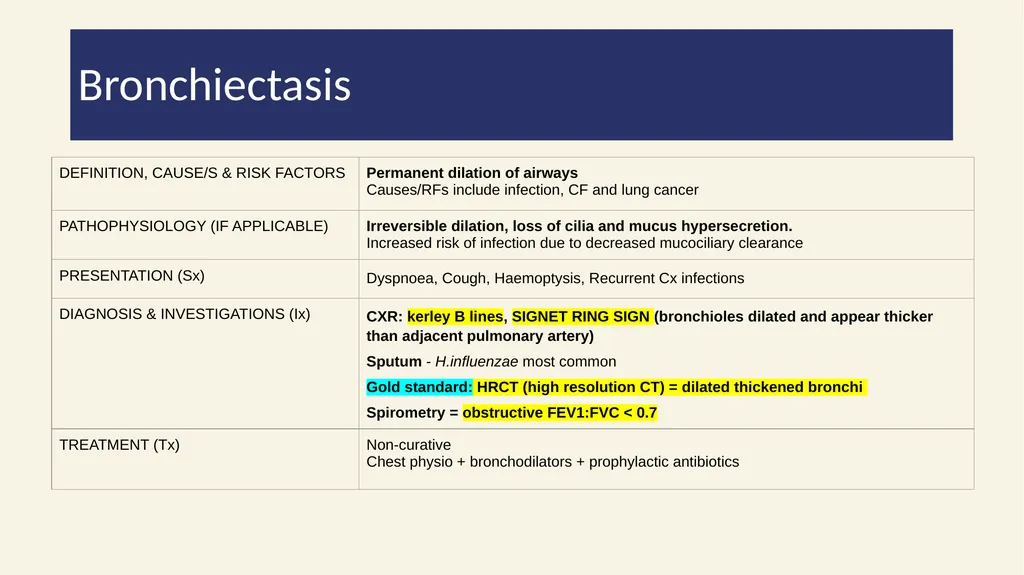
Bronchiectasis<br>
42
Interstitial lung diseases<br>
43
Idiopathic pulmonary fibrosis<br>
44
Sarcoidosis<br>
45
Hypersensitivity pneumonitis<br>
46
The Peer Teaching Society is not liable for false or misleading information… Feedback https://forms.gle/1dB25dn7m25JeUHd7<br>
47
1 A 34 year old software engineer presents to his GP with a productive cough that’s bugged him for the last 3 years or so. His grandfather had similar problems when he was 42. He has a 2 year pack history but quit 5 years ago.
What is the most likely finding on a chest CT of this patient?
Signet ring sign
Centriacinar emphysema
Empyema
Panacinar emphysema
Prominent bronchial margins<br>
What is the most likely finding on a chest CT of this patient?
Signet ring sign
Centriacinar emphysema
Empyema
Panacinar emphysema
Prominent bronchial margins<br>
48
1 A 34 year old software engineer presents to his GP with a productive cough that’s bugged him for the last 3 years or so. His grandfather had similar problems when he was 42. He has a 2 year pack history but quit 5 years ago.
What is the most likely finding on a chest CT of this patient?
Signet ring sign
Centriacinar emphysema
Empyema
Panacinar emphysema
Prominent bronchial margins<br>
What is the most likely finding on a chest CT of this patient?
Signet ring sign
Centriacinar emphysema
Empyema
Panacinar emphysema
Prominent bronchial margins<br>
49
2 A 67 year old male is currently in hospital for treatment of a pneumonia. He has a past medical history of cystic fibrosis and produces copious volumes of thick green phlegm. Spirometry reveals an FEV1:FVC of 0.64. What investigation is diagnostic for the most likely differential?
Chest X ray
Sputum MC & S
Bronchoscopy biopsy
Non-contrast CT chest
High resolution CT chest<br>
Chest X ray
Sputum MC & S
Bronchoscopy biopsy
Non-contrast CT chest
High resolution CT chest<br>
50
2 A 67 year old male is currently in hospital for treatment of a pneumonia. He has a past medical history of cystic fibrosis and produces copious volumes of thick green phlegm. Spirometry reveals an FEV1:FVC of 0.64. What investigation is diagnostic for the most likely differential?
Chest X ray
Sputum MC & S
Bronchoscopy biopsy
Non-contrast CT chest
High resolution CT chest<br>
Chest X ray
Sputum MC & S
Bronchoscopy biopsy
Non-contrast CT chest
High resolution CT chest<br>
51
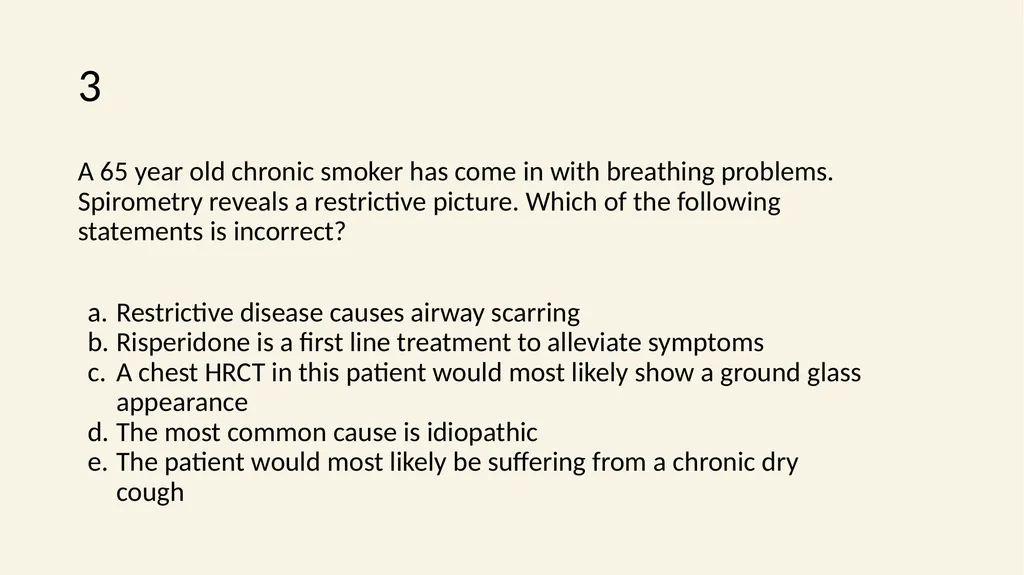
3 A 65 year old chronic smoker has come in with breathing problems. Spirometry reveals a restrictive picture. Which of the following statements is incorrect?
Restrictive disease causes airway scarring
Risperidone is a first line treatment to alleviate symptoms
A chest HRCT in this patient would most likely show a ground glass appearance
The most common cause is idiopathic
The patient would most likely be suffering from a chronic dry cough<br>
Restrictive disease causes airway scarring
Risperidone is a first line treatment to alleviate symptoms
A chest HRCT in this patient would most likely show a ground glass appearance
The most common cause is idiopathic
The patient would most likely be suffering from a chronic dry cough<br>
52
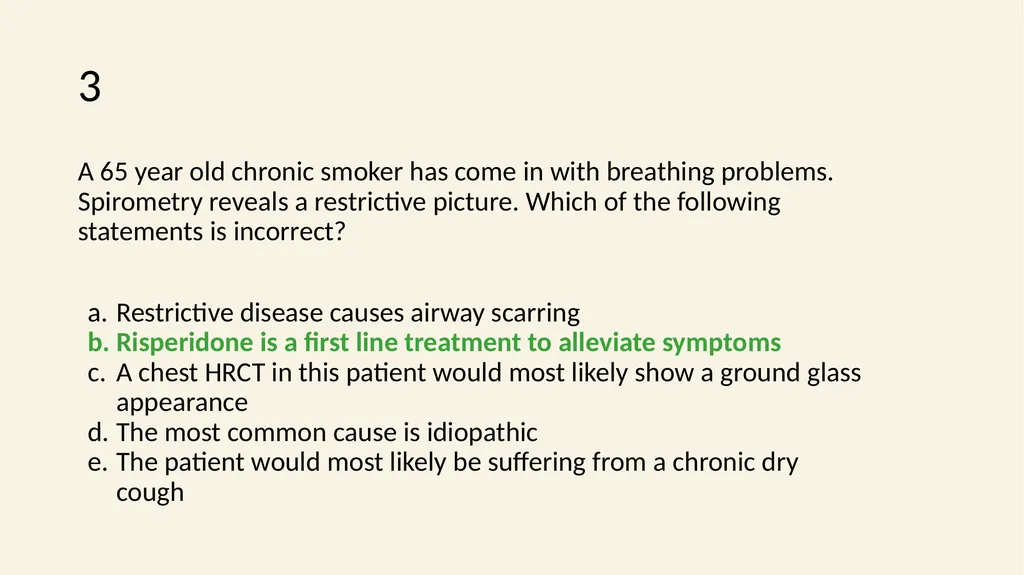
3 A 65 year old chronic smoker has come in with breathing problems. Spirometry reveals a restrictive picture. Which of the following statements is incorrect?
Restrictive disease causes airway scarring
Risperidone is a first line treatment to alleviate symptoms
A chest HRCT in this patient would most likely show a ground glass appearance
The most common cause is idiopathic
The patient would most likely be suffering from a chronic dry cough<br>
Restrictive disease causes airway scarring
Risperidone is a first line treatment to alleviate symptoms
A chest HRCT in this patient would most likely show a ground glass appearance
The most common cause is idiopathic
The patient would most likely be suffering from a chronic dry cough<br>
53
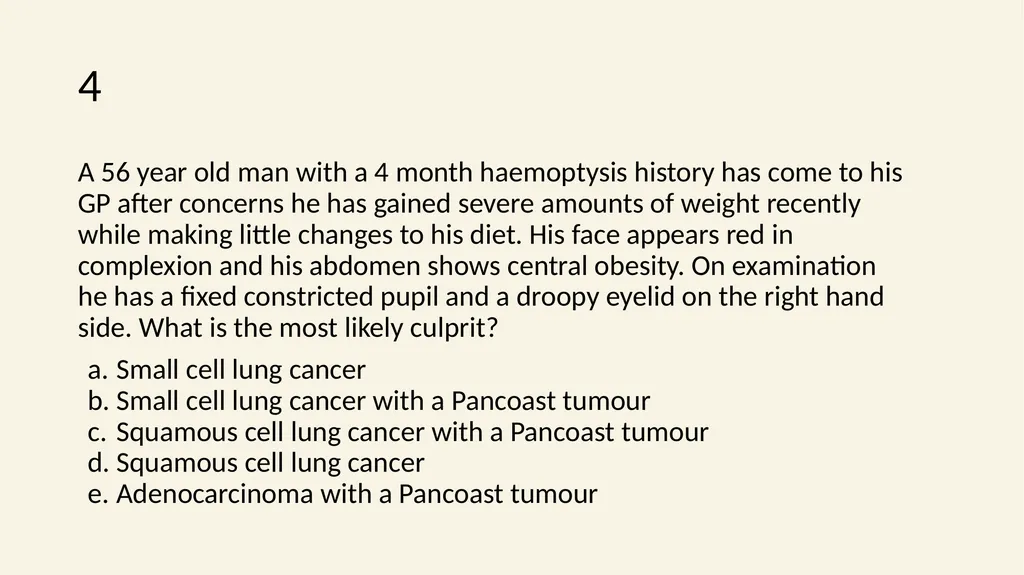
4 A 56 year old man with a 4 month haemoptysis history has come to his GP after concerns he has gained severe amounts of weight recently while making little changes to his diet. His face appears red in complexion and his abdomen shows central obesity. On examination he has a fixed constricted pupil and a droopy eyelid on the right hand side. What is the most likely culprit?
Small cell lung cancer
Small cell lung cancer with a Pancoast tumour
Squamous cell lung cancer with a Pancoast tumour
Squamous cell lung cancer
Adenocarcinoma with a Pancoast tumour<br>
Small cell lung cancer
Small cell lung cancer with a Pancoast tumour
Squamous cell lung cancer with a Pancoast tumour
Squamous cell lung cancer
Adenocarcinoma with a Pancoast tumour<br>
54
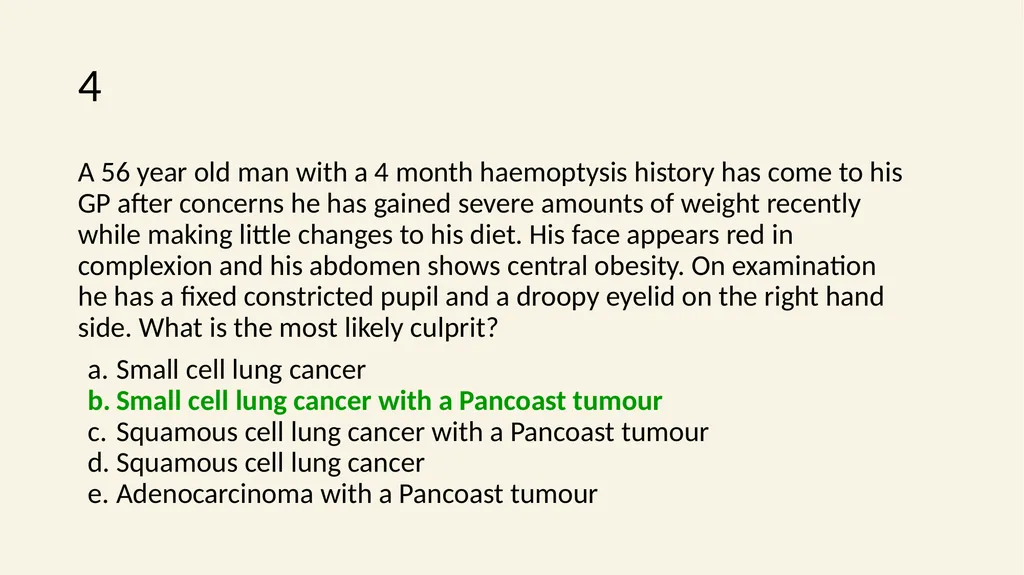
4 A 56 year old man with a 4 month haemoptysis history has come to his GP after concerns he has gained severe amounts of weight recently while making little changes to his diet. His face appears red in complexion and his abdomen shows central obesity. On examination he has a fixed constricted pupil and a droopy eyelid on the right hand side. What is the most likely culprit?
Small cell lung cancer
Small cell lung cancer with a Pancoast tumour
Squamous cell lung cancer with a Pancoast tumour
Squamous cell lung cancer
Adenocarcinoma with a Pancoast tumour<br>
Small cell lung cancer
Small cell lung cancer with a Pancoast tumour
Squamous cell lung cancer with a Pancoast tumour
Squamous cell lung cancer
Adenocarcinoma with a Pancoast tumour<br>
55
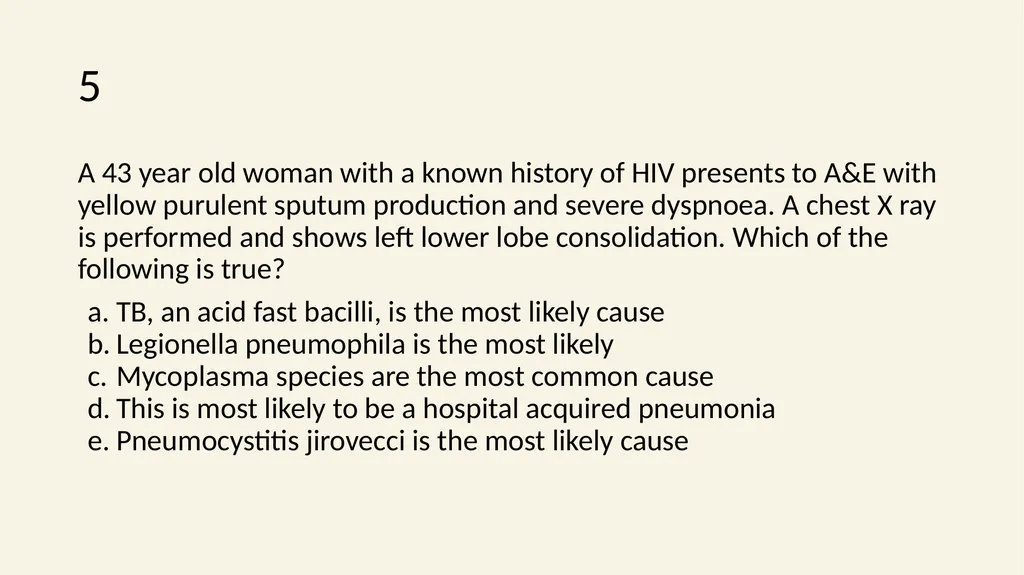
5 A 43 year old woman with a known history of HIV presents to A&E with yellow purulent sputum production and severe dyspnoea. A chest X ray is performed and shows left lower lobe consolidation. Which of the following is true?
TB, an acid fast bacilli, is the most likely cause
Legionella pneumophila is the most likely
Mycoplasma species are the most common cause
This is most likely to be a hospital acquired pneumonia
Pneumocystitis jirovecci is the most likely cause<br>
TB, an acid fast bacilli, is the most likely cause
Legionella pneumophila is the most likely
Mycoplasma species are the most common cause
This is most likely to be a hospital acquired pneumonia
Pneumocystitis jirovecci is the most likely cause<br>
56
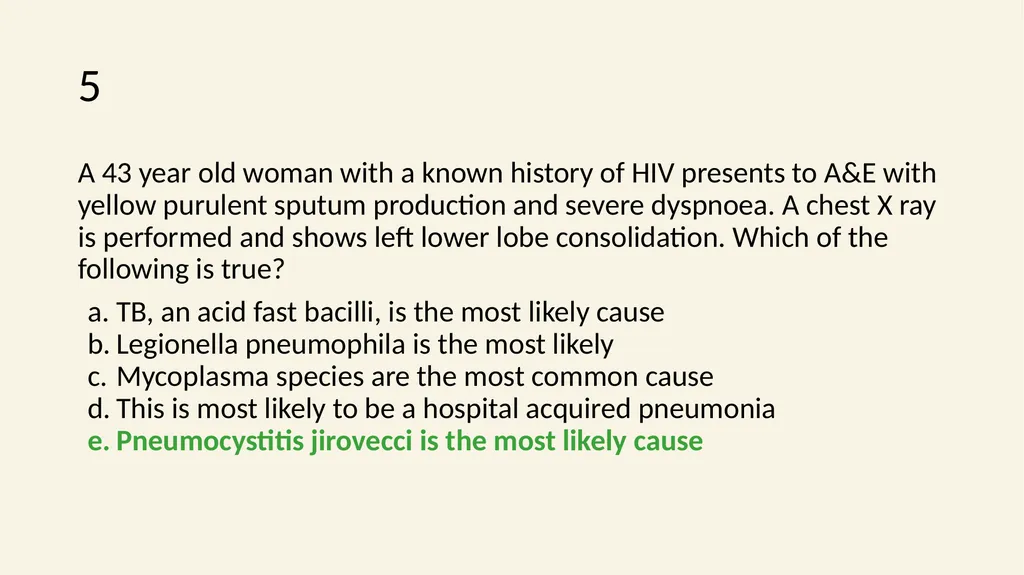
5 A 43 year old woman with a known history of HIV presents to A&E with yellow purulent sputum production and severe dyspnoea. A chest X ray is performed and shows left lower lobe consolidation. Which of the following is true?
TB, an acid fast bacilli, is the most likely cause
Legionella pneumophila is the most likely
Mycoplasma species are the most common cause
This is most likely to be a hospital acquired pneumonia
Pneumocystitis jirovecci is the most likely cause<br>
TB, an acid fast bacilli, is the most likely cause
Legionella pneumophila is the most likely
Mycoplasma species are the most common cause
This is most likely to be a hospital acquired pneumonia
Pneumocystitis jirovecci is the most likely cause<br>
57
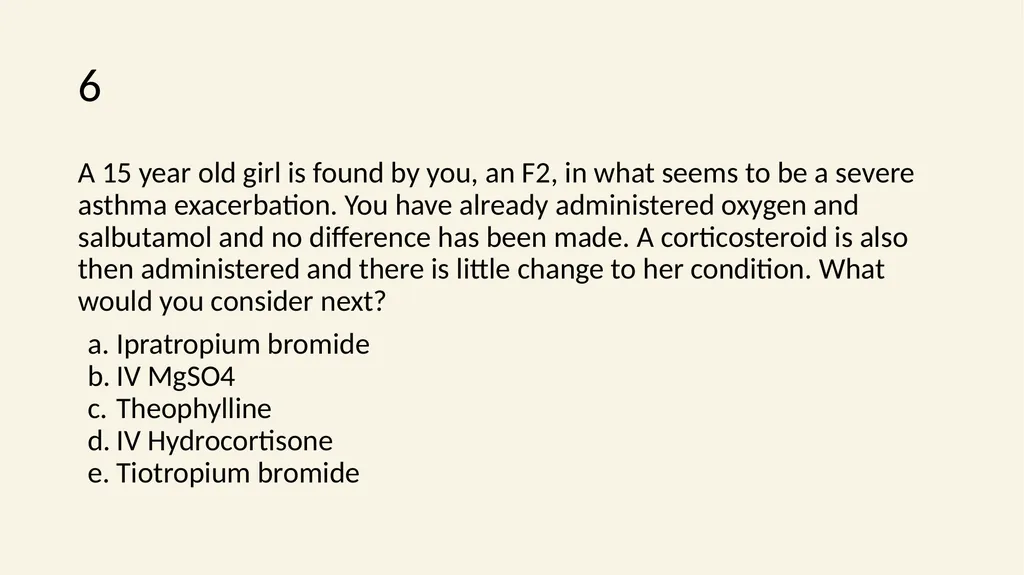
6 A 15 year old girl is found by you, an F2, in what seems to be a severe asthma exacerbation. You have already administered oxygen and salbutamol and no difference has been made. A corticosteroid is also then administered and there is little change to her condition. What would you consider next?
Ipratropium bromide
IV MgSO4
Theophylline
IV Hydrocortisone
Tiotropium bromide<br>
Ipratropium bromide
IV MgSO4
Theophylline
IV Hydrocortisone
Tiotropium bromide<br>
58
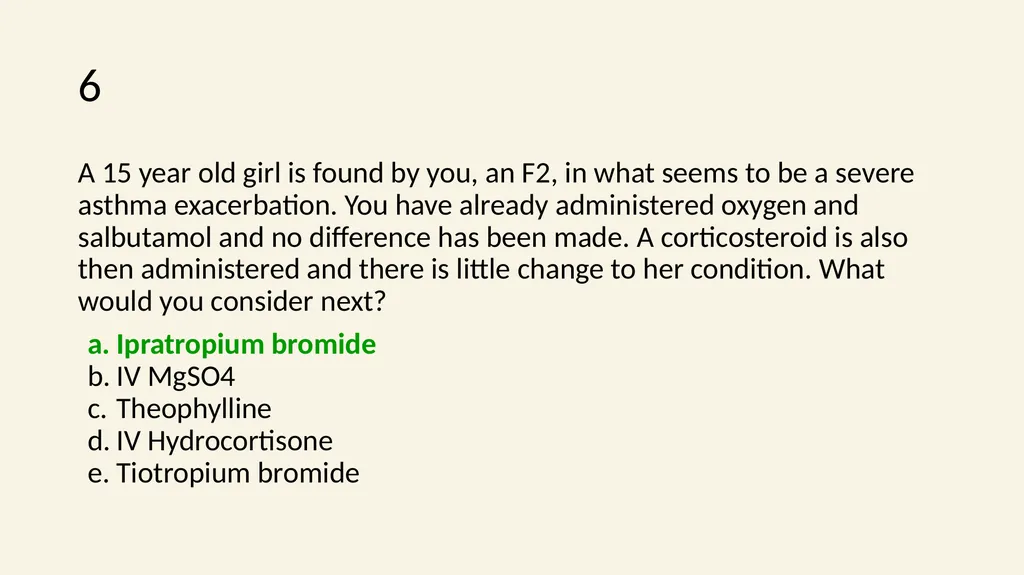
6 A 15 year old girl is found by you, an F2, in what seems to be a severe asthma exacerbation. You have already administered oxygen and salbutamol and no difference has been made. A corticosteroid is also then administered and there is little change to her condition. What would you consider next?
Ipratropium bromide
IV MgSO4
Theophylline
IV Hydrocortisone
Tiotropium bromide<br>
Ipratropium bromide
IV MgSO4
Theophylline
IV Hydrocortisone
Tiotropium bromide<br>
59
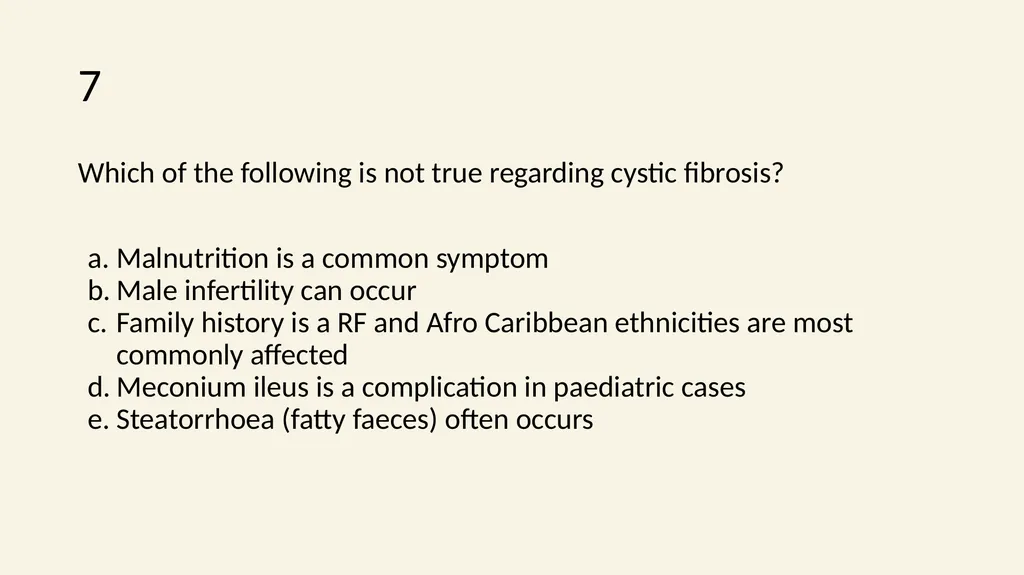
7 Which of the following is not true regarding cystic fibrosis?
Malnutrition is a common symptom
Male infertility can occur
Family history is a RF and Afro Caribbean ethnicities are most commonly affected
Meconium ileus is a complication in paediatric cases
Steatorrhoea (fatty faeces) often occurs<br>
Malnutrition is a common symptom
Male infertility can occur
Family history is a RF and Afro Caribbean ethnicities are most commonly affected
Meconium ileus is a complication in paediatric cases
Steatorrhoea (fatty faeces) often occurs<br>
60
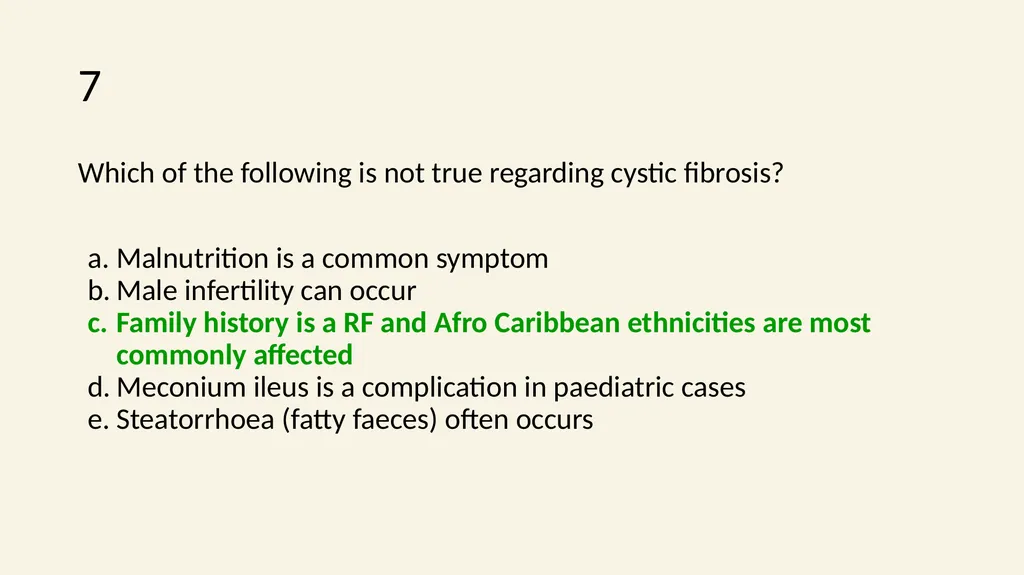
7 Which of the following is not true regarding cystic fibrosis?
Malnutrition is a common symptom
Male infertility can occur
Family history is a RF and Afro Caribbean ethnicities are most commonly affected
Meconium ileus is a complication in paediatric cases
Steatorrhoea (fatty faeces) often occurs<br>
Malnutrition is a common symptom
Male infertility can occur
Family history is a RF and Afro Caribbean ethnicities are most commonly affected
Meconium ileus is a complication in paediatric cases
Steatorrhoea (fatty faeces) often occurs<br>