
2023/24 QUARTER 1 SPENDING OUTCOMES Standing

Description: 202324 QUARTER 1 SPENDING OUTCOMES Standing Committee on Appropriations PRESENTED BY: DR MAMPHO MODISE Title: DDG Public Finance Date: August 2023 CONTENTS Summary of spending Spending outcome by Chief Directorate grouping: Administrative
Related Topics
Download Presentation
"2023/24 QUARTER 1 SPENDING OUTCOMES Standing" is the property of its rightful owner. Permission is granted to download and print the materials on this website for personal, non-commercial use only, and to display it on your personal computer provided you do not modify the materials and that you retain all copyright notices contained in the materials. By downloading content from our website, you accept the terms of this agreement.
Presentation Transcript
slide1. 2023/24 QUARTER 1
SPENDING OUTCOMES Standing Committee on Appropriations PRESENTED BY:
DR MAMPHO
MODISE
Title: DDG
Public Finance
Date: August 2023<br>
slide2. CONTENTS Summary of spending
Spending outcome by Chief Directorate grouping:
Administrative Services
Education and Related departments
Health and Social Development
Protection Services
Economic Services
Urban Development and Infrastructure<br>
slide3. ADMINISTRATIVE SERVICES Vote 1: Presidency
Vote 4: Government Communication and Information System
Vote 5: Home Affairs
Vote 6: International Relations and Cooperation
Vote 7: National School of Government
Vote 8: National Treasury
Vote 9: Planning, Monitoring and Evaluation
Vote 11: Public Service and Administration
Vote 12: Public Service Commission
Vote 13: Public Works and Infrastructure
Vote 14: Statistics South Africa<br>
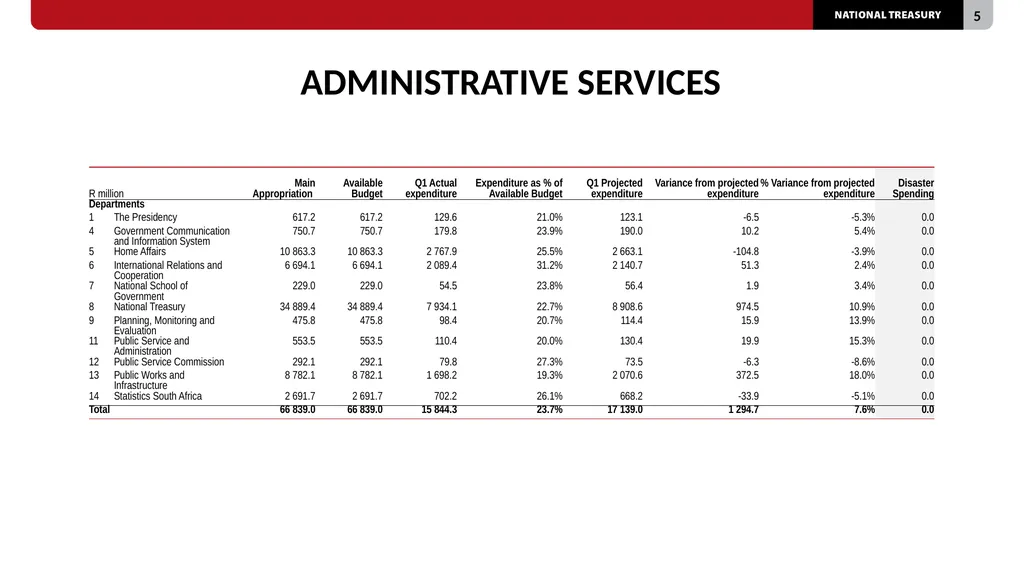
slide4. ADMINISTRATIVE SERVICES<br>
slide5. ADMINISTRATIVE SERVICES<br>
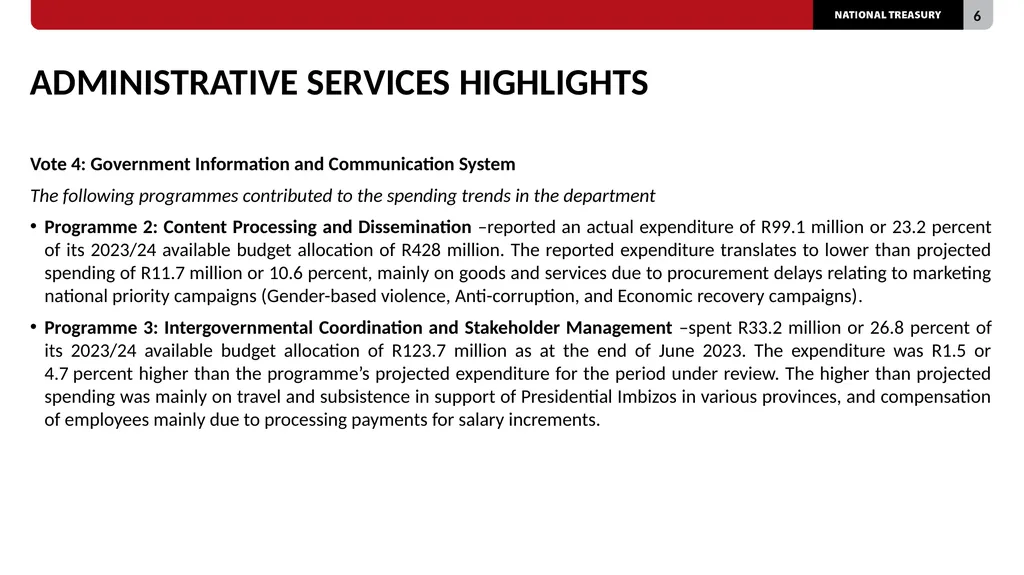
slide6. ADMINISTRATIVE SERVICES HIGHLIGHTS Vote 4: Government Information and Communication System
The following programmes contributed to the spending trends in the department
Programme 2: Content Processing and Dissemination –reported an actual expenditure of R99.1 million or 23.2 percent of its 2023/24 available budget allocation of R428 million. The reported expenditure translates to lower than projected spending of R11.7 million or 10.6 percent, mainly on goods and services due to procurement delays relating to marketing national priority campaigns (Gender-based violence, Anti-corruption, and Economic recovery campaigns).
Programme 3: Intergovernmental Coordination and Stakeholder Management –spent R33.2 million or 26.8 percent of its 2023/24 available budget allocation of R123.7 million as at the end of June 2023. The expenditure was R1.5 or 4.7 percent higher than the programme’s projected expenditure for the period under review. The higher than projected spending was mainly on travel and subsistence in support of Presidential Imbizos in various provinces, and compensation of employees mainly due to processing payments for salary increments.<br>
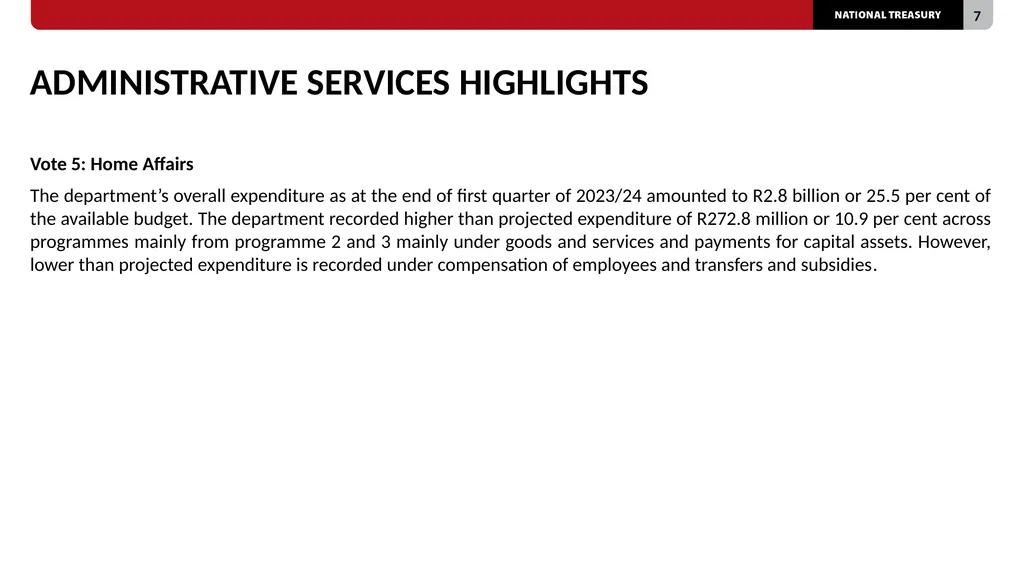
slide7. ADMINISTRATIVE SERVICES HIGHLIGHTS Vote 5: Home Affairs
The department’s overall expenditure as at the end of first quarter of 2023/24 amounted to R2.8 billion or 25.5 per cent of the available budget. The department recorded higher than projected expenditure of R272.8 million or 10.9 per cent across programmes mainly from programme 2 and 3 mainly under goods and services and payments for capital assets. However, lower than projected expenditure is recorded under compensation of employees and transfers and subsidies.<br>
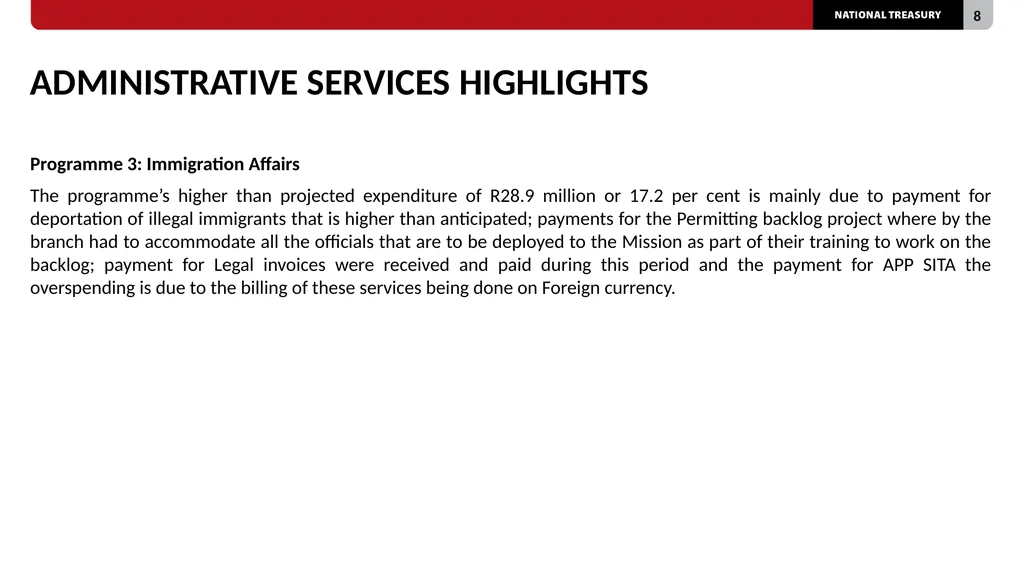
slide8. ADMINISTRATIVE SERVICES HIGHLIGHTS Programme 3: Immigration Affairs
The programme’s higher than projected expenditure of R28.9 million or 17.2 per cent is mainly due to payment for deportation of illegal immigrants that is higher than anticipated; payments for the Permitting backlog project where by the branch had to accommodate all the officials that are to be deployed to the Mission as part of their training to work on the backlog; payment for Legal invoices were received and paid during this period and the payment for APP SITA the overspending is due to the billing of these services being done on Foreign currency.<br>
slide9. ADMINISTRATIVE SERVICES HIGHLIGHTS Vote 6: International Relations and Cooperation
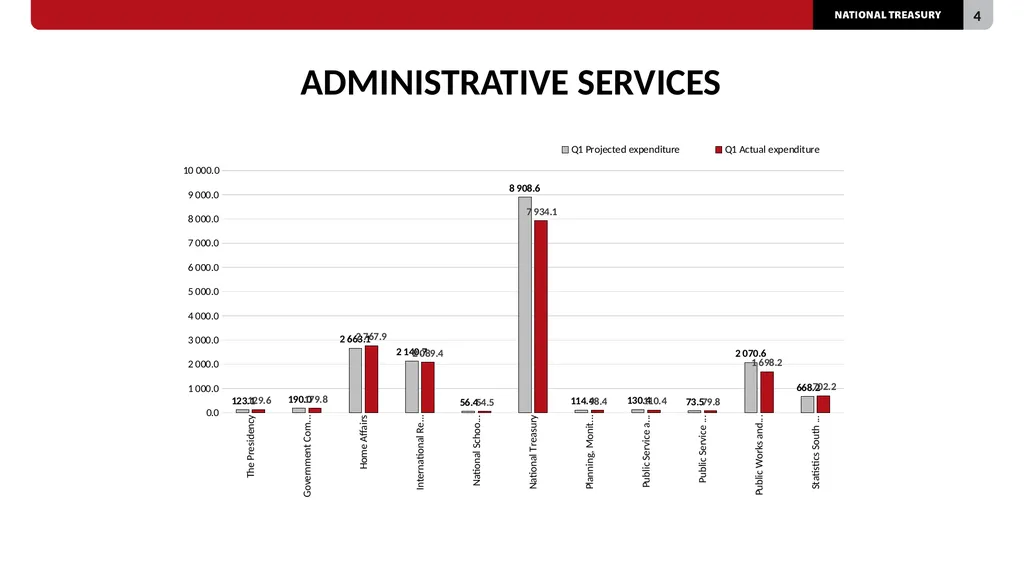
The Department of International Relations and Cooperation has spent R2.089 billion or 31.2 per cent of its 2023/24 budget allocation of R6.694 billion as at the end of June 2023. The R2.089 billion in actual spending to date is R51.3 million lower than the projected expenditure of R2.140 billion. The lower than projected expenditure is mainly attributed to low spending on goods and services and transfers and subsidies.
Low spending on goods and services is due to lower than planned receipts of invoices for operating payments, operating leases, and property payments. The underspending on transfers and subsidies is as a result of the non-payment of funds to the Comprehensive Nuclear-Test Ban Treaty arising from the outstanding requisite assessment letter for membership fees, and lower than projected payments to the Southern African Development Community and African Union for membership fees as a result of the appreciation of the Rand against the relevant major currencies at the time the payments were made.<br>
slide10. ADMINISTRATIVE SERVICES HIGHLIGHTS Vote 7: National School of Government
The National School of Government spent R54.5 million or 23.8 per cent of its 2023/24 available budget allocation of R229 million as at the end of June 2023. The R54.5 million in actual spending is R1.9 million lower than the projected spending of R56.4 million. The lower than planned spending is mainly evident in the budgets for compensation of employees and transfers and subsidies.
The lower than planned spending on compensation of employees is as a result of funded vacant positions. Lower than planned spending on transfers and subsidies is attributed to the non-transfer of the planned transfer payment to the National School of Government’s training trading account due to a breakdown of the payment system.<br>
slide11. ADMINISTRATIVE SERVICES HIGHLIGHTS Vote 8: National Treasury
The department projected to spend R8.909 billion as at the end of the first quarter of 2023/24. The actual expenditure amounted to R7.934 billion, which is R975 million or 10.9 per cent lower than the projected expenditure for the period under review. The lower than anticipated spending was mainly due to the Land and Agricultural Development Bank of South Africa for which negotiations are still ongoing with the lenders regarding the liability solution. The payment to the bank is anticipated to be made in the fourth quarter of 2023/24 once the negotiations are concluded.<br>
slide12. ADMINISTRATIVE SERVICES HIGHLIGHTS Vote 9: Planning, Monitoring and Evaluation
The Department of Planning, Monitoring and Evaluation (DPME) spent R98.4 million or 20.7 per cent of its 2023/24 available budget allocation of R475.8 million. The R98.4 million in actual spending was R15.9 million or 13.9 per cent lower than the projected expenditure, mainly reported under goods and services due to outstanding invoices for the two leased office buildings, the Presidential hotline, and the delays in the implementation of the Centralised Data Management System (CDMAS) projects.
DPME also incurred lower than projected spending of R4.1 million or 5.1 per cent on compensation of employees due to vacant funded positions. In addition, the DPME incurred lower than the projected expenditure of R300 000 on payments capital assets affected by the delays in the appointment of a service provider for the Local Government Management Improvement Model.<br>
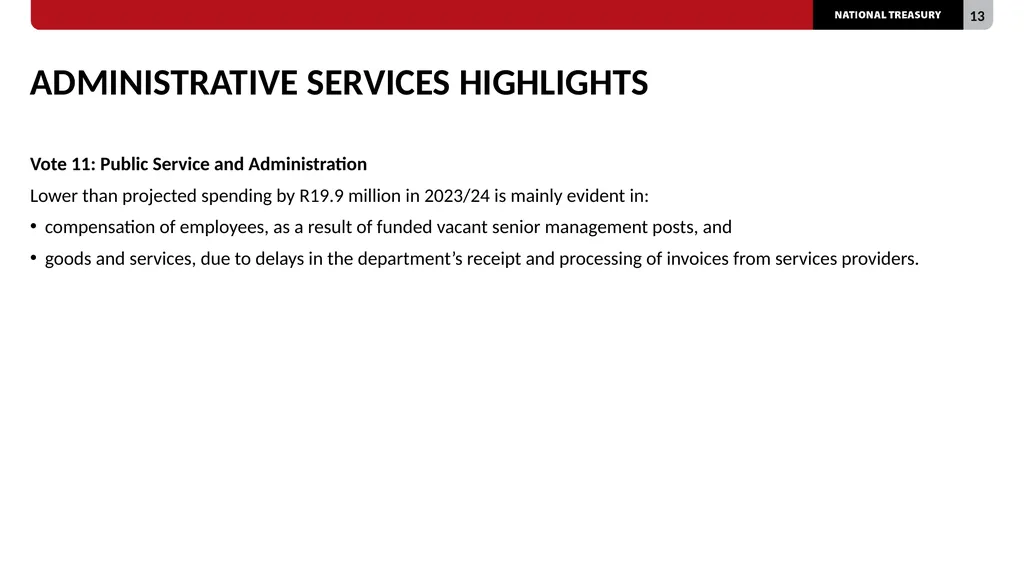
slide13. ADMINISTRATIVE SERVICES HIGHLIGHTS Vote 11: Public Service and Administration
Lower than projected spending by R19.9 million in 2023/24 is mainly evident in:
compensation of employees, as a result of funded vacant senior management posts, and
goods and services, due to delays in the department’s receipt and processing of invoices from services providers.<br>
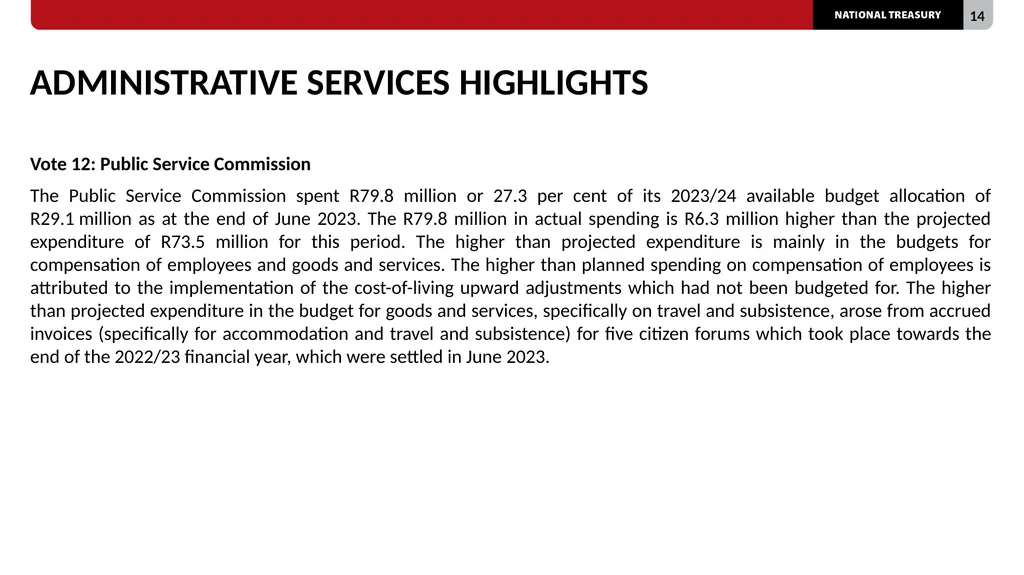
slide14. ADMINISTRATIVE SERVICES HIGHLIGHTS Vote 12: Public Service Commission
The Public Service Commission spent R79.8 million or 27.3 per cent of its 2023/24 available budget allocation of R29.1 million as at the end of June 2023. The R79.8 million in actual spending is R6.3 million higher than the projected expenditure of R73.5 million for this period. The higher than projected expenditure is mainly in the budgets for compensation of employees and goods and services. The higher than planned spending on compensation of employees is attributed to the implementation of the cost-of-living upward adjustments which had not been budgeted for. The higher than projected expenditure in the budget for goods and services, specifically on travel and subsistence, arose from accrued invoices (specifically for accommodation and travel and subsistence) for five citizen forums which took place towards the end of the 2022/23 financial year, which were settled in June 2023.<br>
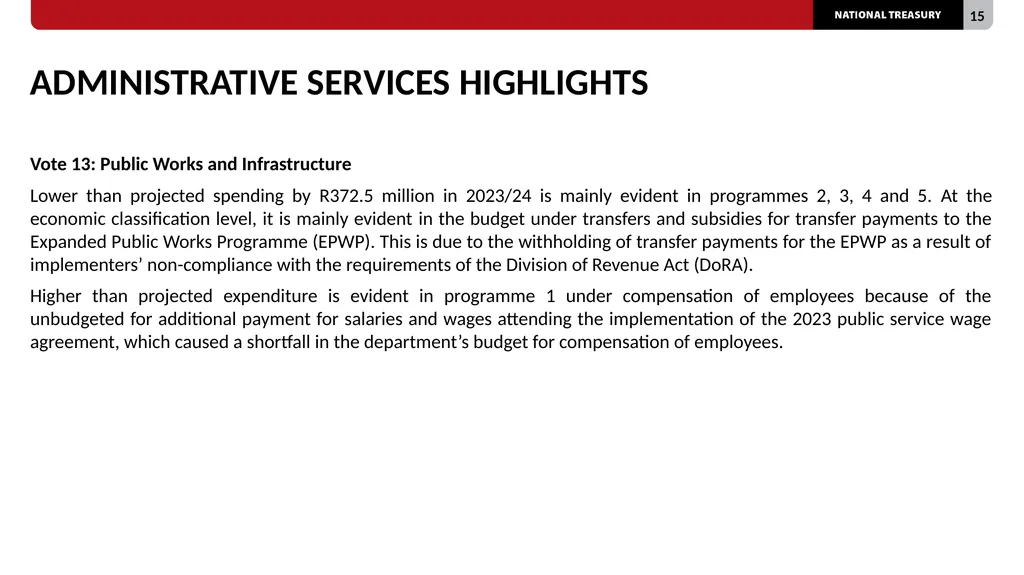
slide15. ADMINISTRATIVE SERVICES HIGHLIGHTS Vote 13: Public Works and Infrastructure
Lower than projected spending by R372.5 million in 2023/24 is mainly evident in programmes 2, 3, 4 and 5. At the economic classification level, it is mainly evident in the budget under transfers and subsidies for transfer payments to the Expanded Public Works Programme (EPWP). This is due to the withholding of transfer payments for the EPWP as a result of implementers’ non-compliance with the requirements of the Division of Revenue Act (DoRA).
Higher than projected expenditure is evident in programme 1 under compensation of employees because of the unbudgeted for additional payment for salaries and wages attending the implementation of the 2023 public service wage agreement, which caused a shortfall in the department’s budget for compensation of employees.<br>
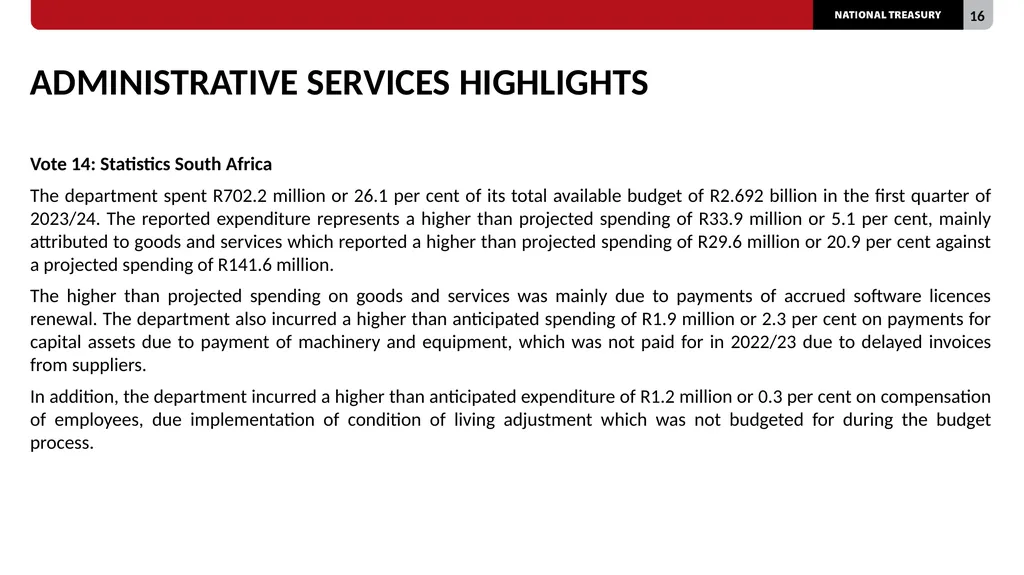
slide16. ADMINISTRATIVE SERVICES HIGHLIGHTS Vote 14: Statistics South Africa
The department spent R702.2 million or 26.1 per cent of its total available budget of R2.692 billion in the first quarter of 2023/24. The reported expenditure represents a higher than projected spending of R33.9 million or 5.1 per cent, mainly attributed to goods and services which reported a higher than projected spending of R29.6 million or 20.9 per cent against a projected spending of R141.6 million.
The higher than projected spending on goods and services was mainly due to payments of accrued software licences renewal. The department also incurred a higher than anticipated spending of R1.9 million or 2.3 per cent on payments for capital assets due to payment of machinery and equipment, which was not paid for in 2022/23 due to delayed invoices from suppliers.
In addition, the department incurred a higher than anticipated expenditure of R1.2 million or 0.3 per cent on compensation of employees, due implementation of condition of living adjustment which was not budgeted for during the budget process.<br>
slide17. VOTE 1: PRESIDENCY Programme 1: Administration expenditure at the end of the first quarter amounts to R119 million or 21.8 per cent of the approved budget of R544.9 million. The programme expenditure is R12.7 million or 12 per cent higher than the projected expenditure of R106.3 million.
The higher than projected spending occurred mainly on compensation of employees, goods and services, transfers and subsidies and payments for capital assets. This is due to accruals and payables that were processed in the current year and expenditures relating to the new Ministries.
Programme 2: Executive Support expenditure at the end of the first quarter amounts to R7.2 million or 13.9 per cent of the approved budget of R51.7 million. The programme expenditure is R5.6 million or 43.7 per cent lower than the first quarter projected expenditure of R12.7 million. The underspending occurred mainly on good and services and compensation of employees due to vacancies and delays in signing of the service level agreement for the e-Cabinet system.
Programme 3: Policy and Research Services expenditure at the end of the first quarter amounts to R3.5 million or 16.9 per cent of the total available budget of R20.6 million. The programme expenditure is R0.6 million or 14.9 per cent lower than the first quarter projected expenditure of R4.1 million. The underspending occurred mainly on compensation of employees due to vacancies within the programme.<br>
slide18. VOTE 4: GOVERNMENT COMMUNICATION AND INFORMATION SYSTEM The Government Communication and Information System (GCIS) spent R179.8 million or 23.9 percent of its 2023/24 available budget allocation of R750.7 million. The spending was R10.2 million or 5.4 percent lower than the department’s projected spending, mainly under goods and services, which spent R12.1 million or 21.6 percent lower against a projected spending of R55.8 million mainly under National priority campaigns (Gender-based violence, Anti-corruption, and Economic recovery campaigns) as a result of procurement delays.
Furthermore, the department incurred lower than projected spending on payments for capital assets mainly due to delays in the procurement of computer equipment.
Whilst noting the overall lower than projected spending, the GCIS also incurred higher than projected spending on compensation of employees mainly due to processing payments for salary following the Public Service Co-ordinating Bargaining Council resolution 2 of 2023.<br>
slide19. VOTE 5: HOME AFFAIRS Programme 1: Administration: The programme’s higher than projected expenditure of R12.9 million or 1.7 per cent is mainly due to as an interim measure of the department that has a shared service agreement with Border Management Authority (BMA) and this results expenditure that is being paid under financial services that will later be claimed back from BMA also under payment for legal services due to high level of caseload than projected.
Programme 2: Citizen Affairs: The programme’s higher than projected expenditure of R224.2 million or 27 per cent is mainly due to expenditure incurred on the printing of face value forms for the front offices, as well as courier services for the delivering of identity and passport documents to offices and that this expenditure is paid through self-financing which will only be approved and allocated during the 2023 AENE process.
Programme 3: Immigration Affairs: The programme’s higher than projected expenditure of R28.9 million or 17.2 per cent is mainly due to payment for deportation of illegal immigrants that is higher than anticipated; payments for the Permitting backlog project where by the branch had to accommodate all the officials that are to be deployed to the Mission as part of their training to work on the backlog; payment for Legal invoices were received and paid during this period and the payment for APP SITA the overspending is due to the billing of these services being done on Foreign currency.<br>
slide20. VOTE 6: INTERNATIONAL RELATIONS AND COOPERATION Programme 1: Administration spent R427.3 million or 0.5 per cent higher than the projected spending of R425.1 million. The R427.3 million in actual spending is R2.2 million higher than the projected expenditure of R425.1 million. The higher than projected spending is mainly on the budget for payments for capital assets. Higher than projected spending on the budget for payments for capital assets is due to payments for the Global Wan network equipment which were planned to take place in April but only happened in June.
Programme 2: International Relations spent R970 million or 3.3 per cent lower than the projected spending of R1.004 billion. The R970 million in actual expenditure is R33.6 million lower than the projected expenditure, mainly because of low spending on the goods and services’ budget. Lower than planned spending on goods and services is mainly on operating leases and operating payments for missions abroad whose actual cost turned out lower than the planned budget for the services in question.
Programme 3: International Cooperation spent R151.3 million or 6 per cent lower than the projected spending of R160.9 million. The R151.3 million in actual expenditure is R9.6 million lower than the projected expenditure. Lower than planned expenditure is evident under goods and services, mainly as a result of invoices for property payments, operating payments and travel and subsistence whose actual value turned out lower than projections.<br>
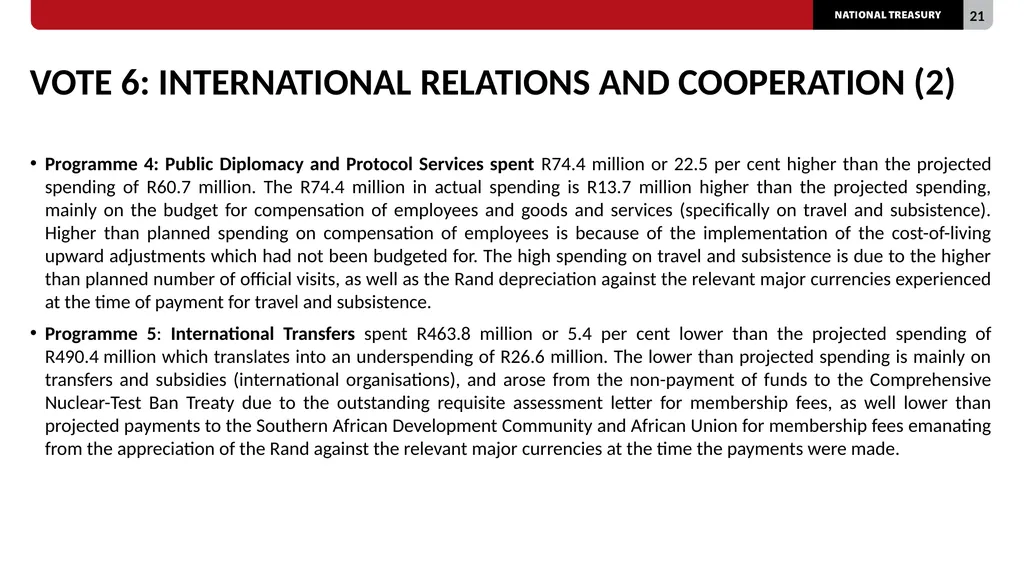
slide21. VOTE 6: INTERNATIONAL RELATIONS AND COOPERATION (2) Programme 4: Public Diplomacy and Protocol Services spent R74.4 million or 22.5 per cent higher than the projected spending of R60.7 million. The R74.4 million in actual spending is R13.7 million higher than the projected spending, mainly on the budget for compensation of employees and goods and services (specifically on travel and subsistence). Higher than planned spending on compensation of employees is because of the implementation of the cost-of-living upward adjustments which had not been budgeted for. The high spending on travel and subsistence is due to the higher than planned number of official visits, as well as the Rand depreciation against the relevant major currencies experienced at the time of payment for travel and subsistence.
Programme 5: International Transfers spent R463.8 million or 5.4 per cent lower than the projected spending of R490.4 million which translates into an underspending of R26.6 million. The lower than projected spending is mainly on transfers and subsidies (international organisations), and arose from the non-payment of funds to the Comprehensive Nuclear-Test Ban Treaty due to the outstanding requisite assessment letter for membership fees, as well lower than projected payments to the Southern African Development Community and African Union for membership fees emanating from the appreciation of the Rand against the relevant major currencies at the time the payments were made.<br>
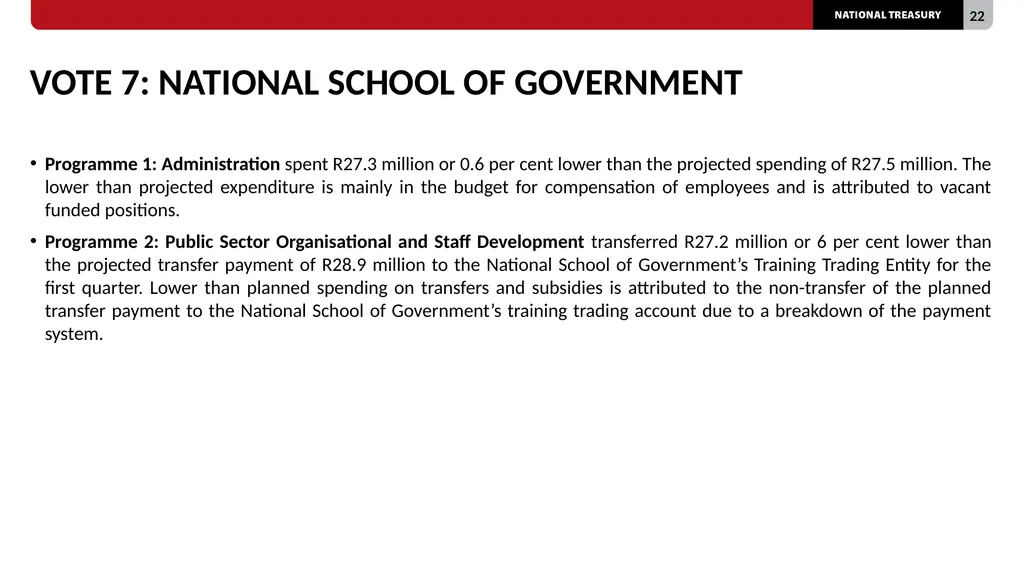
slide22. VOTE 7: NATIONAL SCHOOL OF GOVERNMENT Programme 1: Administration spent R27.3 million or 0.6 per cent lower than the projected spending of R27.5 million. The lower than projected expenditure is mainly in the budget for compensation of employees and is attributed to vacant funded positions.
Programme 2: Public Sector Organisational and Staff Development transferred R27.2 million or 6 per cent lower than the projected transfer payment of R28.9 million to the National School of Government’s Training Trading Entity for the first quarter. Lower than planned spending on transfers and subsidies is attributed to the non-transfer of the planned transfer payment to the National School of Government’s training trading account due to a breakdown of the payment system.<br>
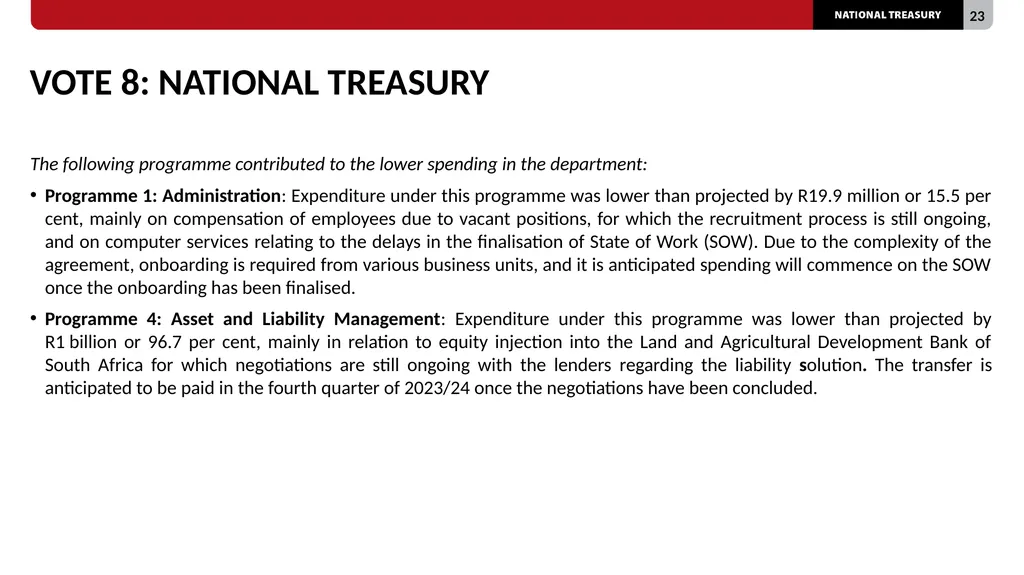
slide23. VOTE 8: NATIONAL TREASURY The following programme contributed to the lower spending in the department:
Programme 1: Administration: Expenditure under this programme was lower than projected by R19.9 million or 15.5 per cent, mainly on compensation of employees due to vacant positions, for which the recruitment process is still ongoing, and on computer services relating to the delays in the finalisation of State of Work (SOW). Due to the complexity of the agreement, onboarding is required from various business units, and it is anticipated spending will commence on the SOW once the onboarding has been finalised.
Programme 4: Asset and Liability Management: Expenditure under this programme was lower than projected by R1 billion or 96.7 per cent, mainly in relation to equity injection into the Land and Agricultural Development Bank of South Africa for which negotiations are still ongoing with the lenders regarding the liability solution. The transfer is anticipated to be paid in the fourth quarter of 2023/24 once the negotiations have been concluded.<br>
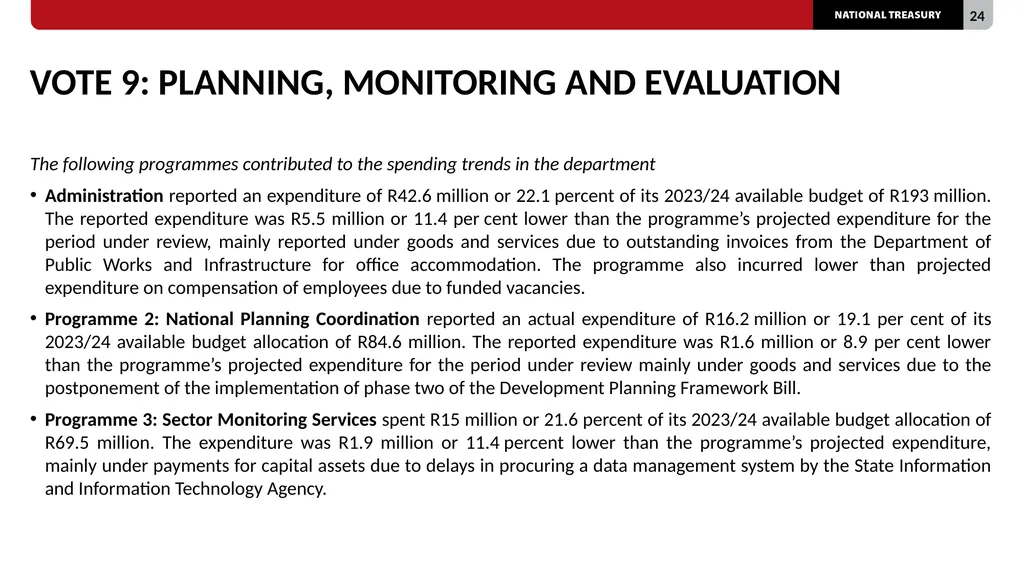
slide24. VOTE 9: PLANNING, MONITORING AND EVALUATION The following programmes contributed to the spending trends in the department
Administration reported an expenditure of R42.6 million or 22.1 percent of its 2023/24 available budget of R193 million. The reported expenditure was R5.5 million or 11.4 per cent lower than the programme’s projected expenditure for the period under review, mainly reported under goods and services due to outstanding invoices from the Department of Public Works and Infrastructure for office accommodation. The programme also incurred lower than projected expenditure on compensation of employees due to funded vacancies.
Programme 2: National Planning Coordination reported an actual expenditure of R16.2 million or 19.1 per cent of its 2023/24 available budget allocation of R84.6 million. The reported expenditure was R1.6 million or 8.9 per cent lower than the programme’s projected expenditure for the period under review mainly under goods and services due to the postponement of the implementation of phase two of the Development Planning Framework Bill.
Programme 3: Sector Monitoring Services spent R15 million or 21.6 percent of its 2023/24 available budget allocation of R69.5 million. The expenditure was R1.9 million or 11.4 percent lower than the programme’s projected expenditure, mainly under payments for capital assets due to delays in procuring a data management system by the State Information and Information Technology Agency.<br>
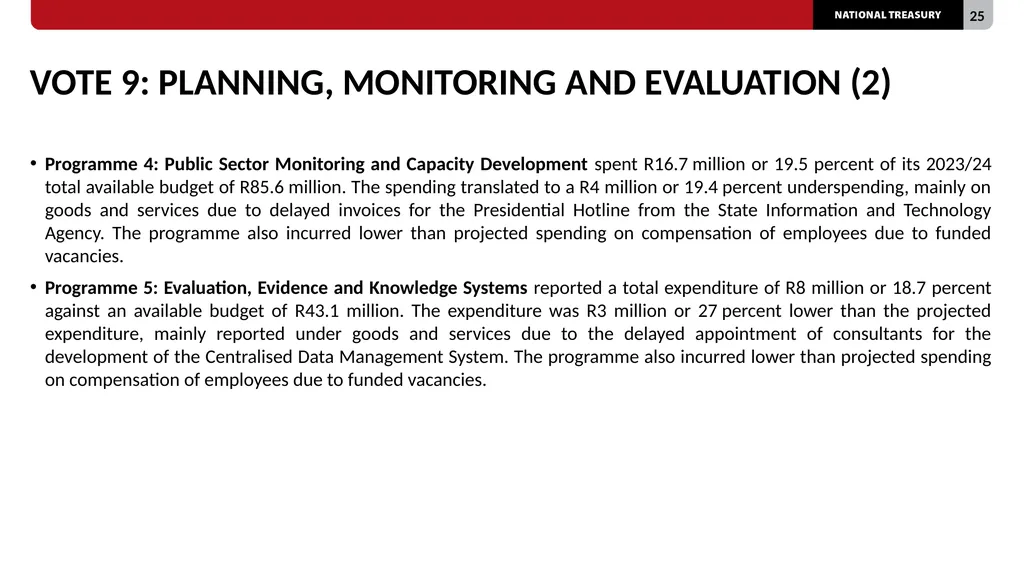
slide25. VOTE 9: PLANNING, MONITORING AND EVALUATION (2) Programme 4: Public Sector Monitoring and Capacity Development spent R16.7 million or 19.5 percent of its 2023/24 total available budget of R85.6 million. The spending translated to a R4 million or 19.4 percent underspending, mainly on goods and services due to delayed invoices for the Presidential Hotline from the State Information and Technology Agency. The programme also incurred lower than projected spending on compensation of employees due to funded vacancies.
Programme 5: Evaluation, Evidence and Knowledge Systems reported a total expenditure of R8 million or 18.7 percent against an available budget of R43.1 million. The expenditure was R3 million or 27 percent lower than the projected expenditure, mainly reported under goods and services due to the delayed appointment of consultants for the development of the Centralised Data Management System. The programme also incurred lower than projected spending on compensation of employees due to funded vacancies.<br>
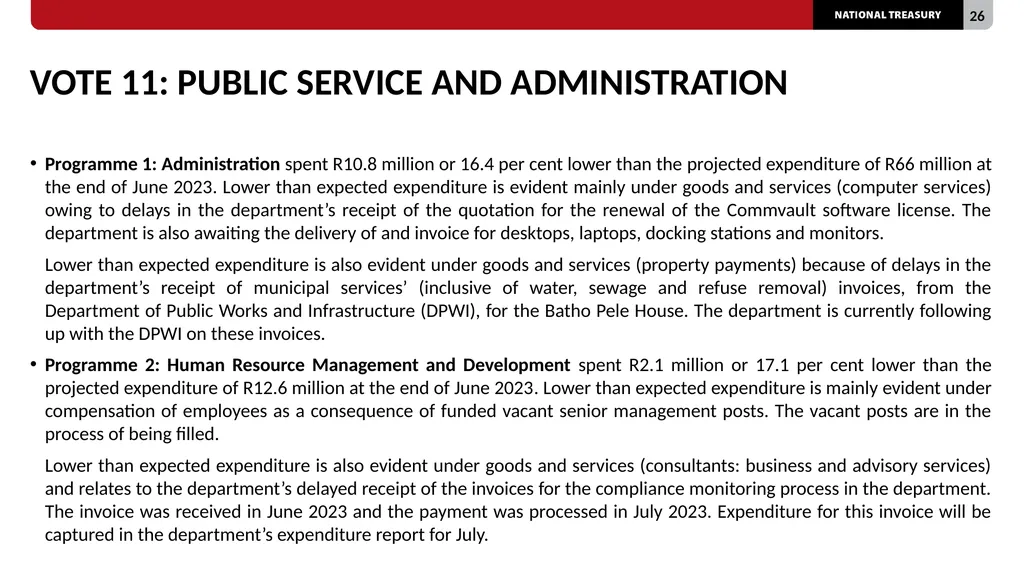
slide26. VOTE 11: PUBLIC SERVICE AND ADMINISTRATION Programme 1: Administration spent R10.8 million or 16.4 per cent lower than the projected expenditure of R66 million at the end of June 2023. Lower than expected expenditure is evident mainly under goods and services (computer services) owing to delays in the department’s receipt of the quotation for the renewal of the Commvault software license. The department is also awaiting the delivery of and invoice for desktops, laptops, docking stations and monitors.
Lower than expected expenditure is also evident under goods and services (property payments) because of delays in the department’s receipt of municipal services’ (inclusive of water, sewage and refuse removal) invoices, from the Department of Public Works and Infrastructure (DPWI), for the Batho Pele House. The department is currently following up with the DPWI on these invoices.
Programme 2: Human Resource Management and Development spent R2.1 million or 17.1 per cent lower than the projected expenditure of R12.6 million at the end of June 2023. Lower than expected expenditure is mainly evident under compensation of employees as a consequence of funded vacant senior management posts. The vacant posts are in the process of being filled.
Lower than expected expenditure is also evident under goods and services (consultants: business and advisory services) and relates to the department’s delayed receipt of the invoices for the compliance monitoring process in the department. The invoice was received in June 2023 and the payment was processed in July 2023. Expenditure for this invoice will be captured in the department’s expenditure report for July.<br>
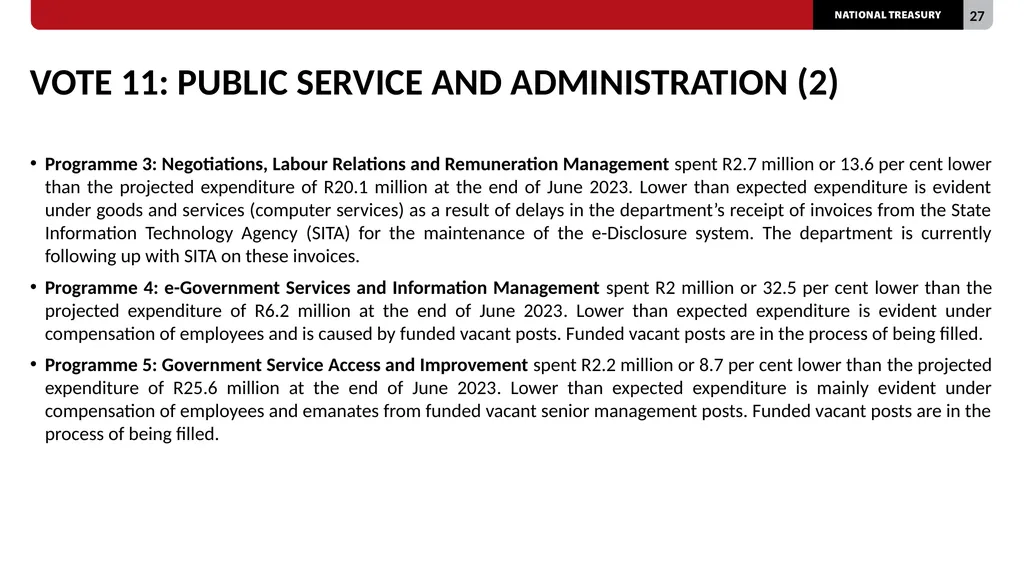
slide27. VOTE 11: PUBLIC SERVICE AND ADMINISTRATION (2) Programme 3: Negotiations, Labour Relations and Remuneration Management spent R2.7 million or 13.6 per cent lower than the projected expenditure of R20.1 million at the end of June 2023. Lower than expected expenditure is evident under goods and services (computer services) as a result of delays in the department’s receipt of invoices from the State Information Technology Agency (SITA) for the maintenance of the e-Disclosure system. The department is currently following up with SITA on these invoices.
Programme 4: e-Government Services and Information Management spent R2 million or 32.5 per cent lower than the projected expenditure of R6.2 million at the end of June 2023. Lower than expected expenditure is evident under compensation of employees and is caused by funded vacant posts. Funded vacant posts are in the process of being filled.
Programme 5: Government Service Access and Improvement spent R2.2 million or 8.7 per cent lower than the projected expenditure of R25.6 million at the end of June 2023. Lower than expected expenditure is mainly evident under compensation of employees and emanates from funded vacant senior management posts. Funded vacant posts are in the process of being filled.<br>
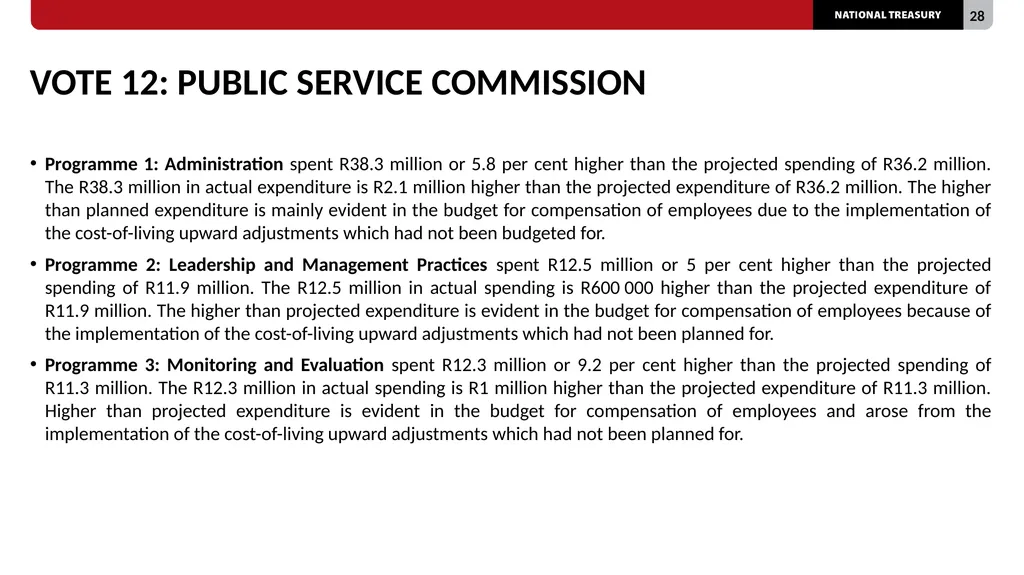
slide28. VOTE 12: PUBLIC SERVICE COMMISSION Programme 1: Administration spent R38.3 million or 5.8 per cent higher than the projected spending of R36.2 million. The R38.3 million in actual expenditure is R2.1 million higher than the projected expenditure of R36.2 million. The higher than planned expenditure is mainly evident in the budget for compensation of employees due to the implementation of the cost-of-living upward adjustments which had not been budgeted for.
Programme 2: Leadership and Management Practices spent R12.5 million or 5 per cent higher than the projected spending of R11.9 million. The R12.5 million in actual spending is R600 000 higher than the projected expenditure of R11.9 million. The higher than projected expenditure is evident in the budget for compensation of employees because of the implementation of the cost-of-living upward adjustments which had not been planned for.
Programme 3: Monitoring and Evaluation spent R12.3 million or 9.2 per cent higher than the projected spending of R11.3 million. The R12.3 million in actual spending is R1 million higher than the projected expenditure of R11.3 million. Higher than projected expenditure is evident in the budget for compensation of employees and arose from the implementation of the cost-of-living upward adjustments which had not been planned for.<br>
slide29. VOTE 12: PUBLIC SERVICE COMMISSION (2) Programme 4: Integrity and Anti-Corruption spent R16.7 million or 18.1 per cent higher than the projected spending of R14.1 million. The R16.7 million in actual spending is R2.6 million higher than the projected spending of R14.1 million. The higher than projected spending is evident in the budget for compensation of employees and goods and services owing to the implementation of the cost-of-living upward adjustments which had not been budgeted for, as well as higher than planned spending specifically on travel and subsistence and accommodation arising from accrued invoices for five citizen forums which took place towards the end of the 2022/23 financial year, which were settled in June 2023.<br>
slide30. VOTE 13: PUBLIC WORKS AND INFRASTRUCTURE Programme 1: Administration spent R184 000 or 0.2 per cent higher than the projected expenditure of R115.1 million at the end of June 2023. Higher than expected expenditure is mainly evident in the budget for compensation of employees because of the unbudgeted for additional payment for salaries and wages attending the implementation of the 2023 public service wage agreement, which caused a shortfall in the department’s budget for compensation of employees.
Programme 2: Intergovernmental Coordination spent R3.2 million or 22.3 per cent lower than the projected expenditure of R14.2 million at the end of June 2023. Lower than expected expenditure is evident under compensation of employees as a result of vacant senior management posts. Following the appointment of the new Minister, the department has placed a moratorium on the filling of funded vacant posts. No date has been communicated yet by the department on when the funded vacant posts will be filled.
Lower than expected expenditure is also evident under goods and services (venues and facilities, and training and development) and arises from the postponement of events due to the delays in the department’s procurement of adequate venues, and delays in the department’s coordination of training programmes.
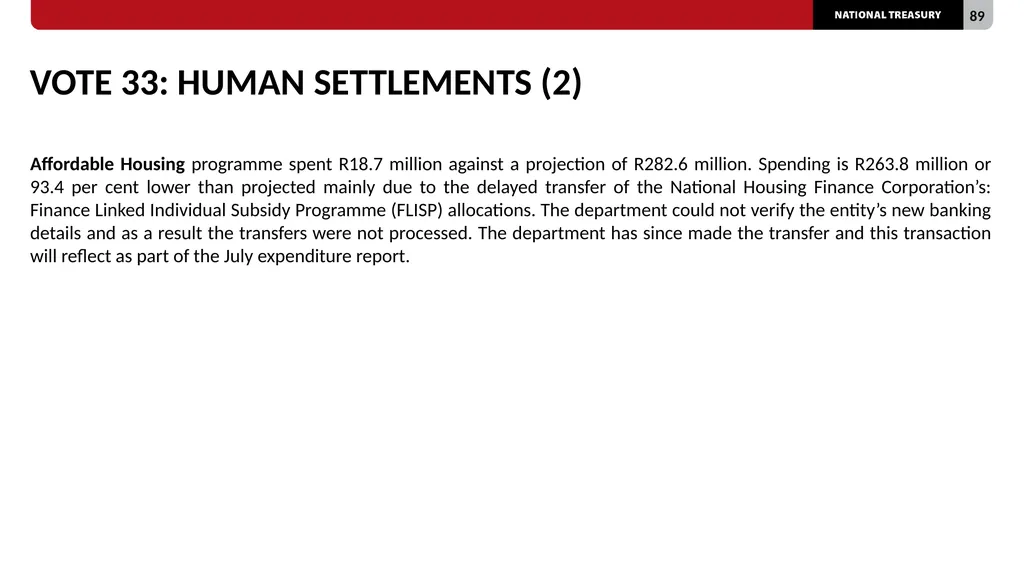
Programme 3: Expanded Public Works Programme spent R300 million or 53.2 per cent lower than the projected expenditure of R564 million at the end of June 2023. Lower than expected expenditure is mainly evident under transfers and subsidies as a result of transfer payments of R263 million for the EPWP Non-State Sector Programme and R23 million for the EPWP Integrated Grant for Provinces which were not effected as a result of implementers’ non-compliance with the requirements of DoRA.<br>
slide31. VOTE 13: PUBLIC WORKS AND INFRASTRUCTURE (2) Programme 4: Property and Construction Industry Policy and Research spent R68.6 million or 5 per cent lower than the projected expenditure of R1.36 billion at the end of June 2023. Lower than expected expenditure is mainly evident under goods and services (consultants) and resulted from the delays in the appointment of consultants by Infrastructure South Africa for project preparation services.
Programme 5: Prestige Policy spent R1 million or 6 per cent lower than the projected expenditure of R16.2 million at the end of June 2023. Lower than expected expenditure is mainly evident under goods and services (minor assets) as a result of delays in the delivery of furniture and household appliances procured for the parliamentary village.<br>
slide32. VOTE 14: STATISTICS SOUTH AFRICA The following programme contributed to the higher spending in the department:
Programme 5: Statistical Support and Informatics: The programme spent R91.3 million or 28.2 per cent of its total available budget of R324.2 million as at the end of June 2023. The actual expenditure represents a higher than anticipated spending of R42.5 million or 87.1 per cent of the projected spending for the period under review mainly due payment of accrued software development services which was not paid for in 2022/23 due to delayed invoices from suppliers.
Programme 6: Statistical Operations and Provincial Coordinatio: The programme spent R217.6 million or 25.8 per cent of its total available budget of R842.7 million in the first quarter of 2023/24. The actual expenditure in the programme represents a higher than projected spending of R10.8 million or 5.2 per cent, against the programme’s projected spending of R206.8 million. The higher than projected expenditure is mainly due to payment of leased vehicles, which was not paid for in 2022/23 due to delayed invoices from suppliers as well as the implementation of condition of living adjustment which was not budgeted for during the budget process.<br>
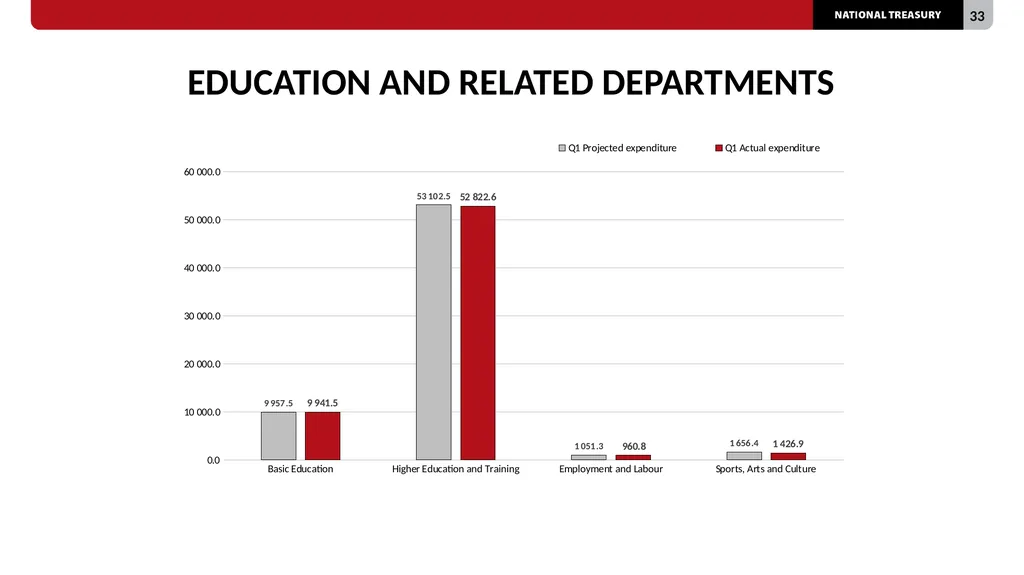
slide33. EDUCATION AND RELATED DEPARTMENTS<br>
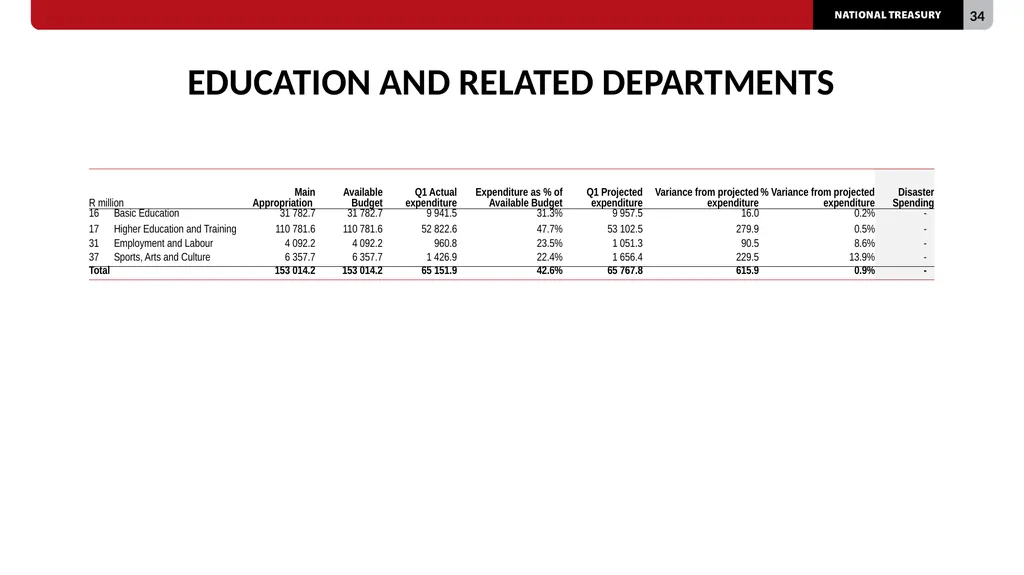
slide34. EDUCATION AND RELATED DEPARTMENTS<br>
slide35. VOTE 16: BASIC EDUCATION The department spent R9.9 billion which is R16 million or 0.2 per cent lower than projected.
Programme 1: Administration: Higher spending of R6.7 million or 4.9 per cent is mainly under Goods and services viz. travel and subsistence due to the attendance by the Deputy Minister and a delegation from the department at the 16th E-learning Africa International conference in Cuba and the Sahrawi Republic from 20 May to 1 June 2023.
Programme 2: Curriculum Policy, Support and Monitoring: Higher spending of R39.6 million or 7.6 per cent is mainly under Goods and services due to the payment of accruals from 2022/23 where invoices for workbooks received after the closure of the financial year. The department has applied for a roll-over to cover these accruals.
Programme 3: Teachers, Education Human Resources and Institutional Development: Lower spending of R9.8 million or 0.7 per cent is broadly in line with projections.
Programme 4: Planning, Information and Assessment: Lower spending of R53.4 million or 1.1 per cent, is mainly under Payments for capital assets in the school infrastructure backlogs grant due to late submission of invoices from implementing agents.<br>
slide36. VOTE 17: HIGHER EDUCATION & TRAINING The department spent R52.8 billion, which is 0.5 per cent or R279.9 million lower than projected.
Programme 1: Administration: Lower spending of R23.3 million or 17.8 per cent is mainly under Compensation of employees due to unfilled vacant posts and under Goods and services where invoices were not received for operational activities.
Programme 2: Planning, Policy and Strategy: Lower spending of R294.6 million or 82.9 per cent, mainly under transfer payments for infrastructure and efficiency grants as some TVET colleges have not complied with the necessary financial reporting requirements.
Programme 4: Technical and Vocational Education and Training: Higher spending of R72.2 million or 2.2 per cent is mainly under transfer payments for cash shortfalls at some TVET colleges.
Programme 5: Skills Development: Lower spending of R37.5 million or 34.7 per cent is mainly due to delays in transfers to the National Skills Fund for the Demand-Led Skills Programme. The contract to appoint the service provider for the programme is in the final stages of approval.<br>
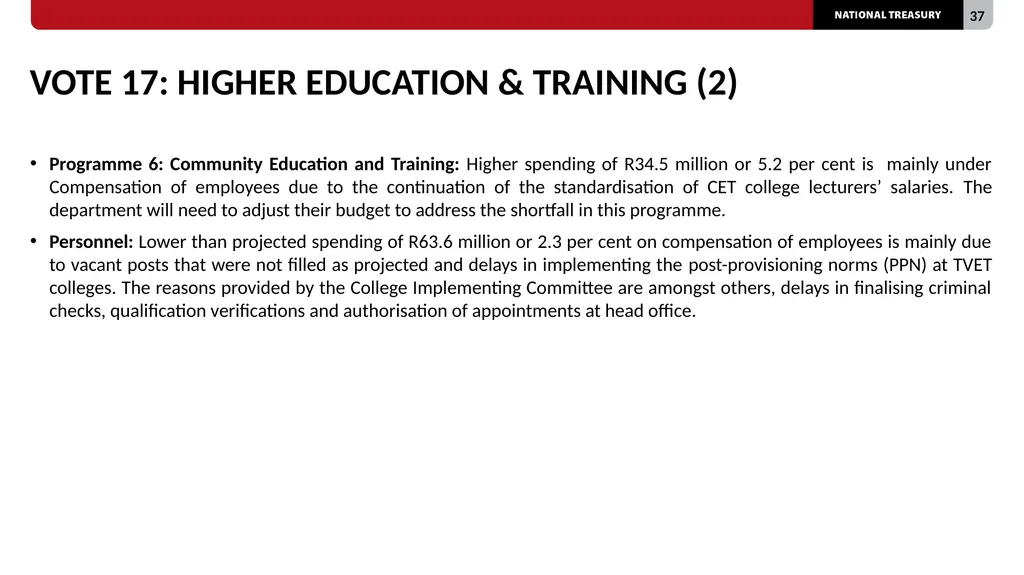
slide37. VOTE 17: HIGHER EDUCATION & TRAINING (2) Programme 6: Community Education and Training: Higher spending of R34.5 million or 5.2 per cent is mainly under Compensation of employees due to the continuation of the standardisation of CET college lecturers’ salaries. The department will need to adjust their budget to address the shortfall in this programme.
Personnel: Lower than projected spending of R63.6 million or 2.3 per cent on compensation of employees is mainly due to vacant posts that were not filled as projected and delays in implementing the post-provisioning norms (PPN) at TVET colleges. The reasons provided by the College Implementing Committee are amongst others, delays in finalising criminal checks, qualification verifications and authorisation of appointments at head office.<br>
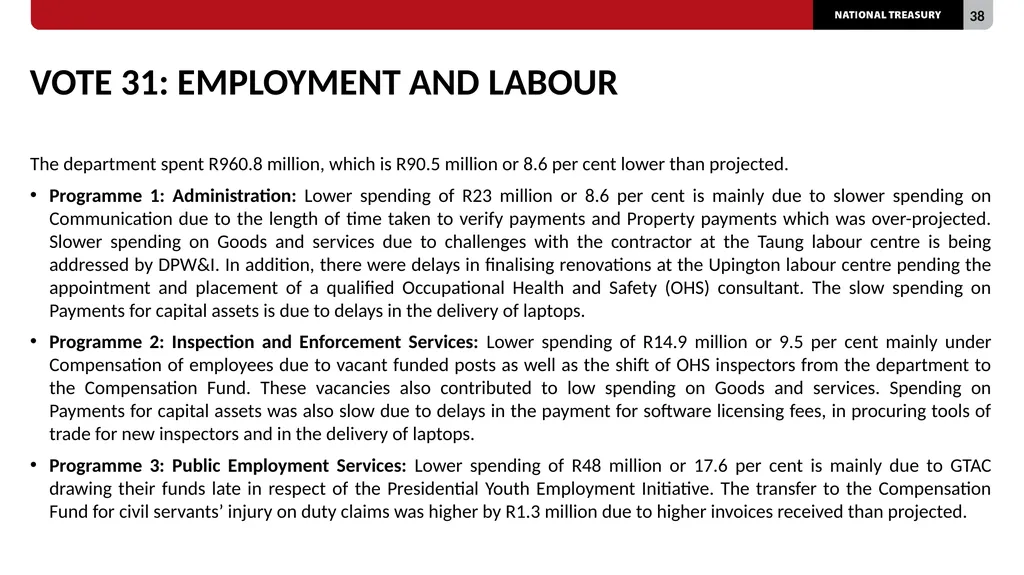
slide38. VOTE 31: EMPLOYMENT AND LABOUR The department spent R960.8 million, which is R90.5 million or 8.6 per cent lower than projected.
Programme 1: Administration: Lower spending of R23 million or 8.6 per cent is mainly due to slower spending on Communication due to the length of time taken to verify payments and Property payments which was over-projected. Slower spending on Goods and services due to challenges with the contractor at the Taung labour centre is being addressed by DPW&I. In addition, there were delays in finalising renovations at the Upington labour centre pending the appointment and placement of a qualified Occupational Health and Safety (OHS) consultant. The slow spending on Payments for capital assets is due to delays in the delivery of laptops.
Programme 2: Inspection and Enforcement Services: Lower spending of R14.9 million or 9.5 per cent mainly under Compensation of employees due to vacant funded posts as well as the shift of OHS inspectors from the department to the Compensation Fund. These vacancies also contributed to low spending on Goods and services. Spending on Payments for capital assets was also slow due to delays in the payment for software licensing fees, in procuring tools of trade for new inspectors and in the delivery of laptops.
Programme 3: Public Employment Services: Lower spending of R48 million or 17.6 per cent is mainly due to GTAC drawing their funds late in respect of the Presidential Youth Employment Initiative. The transfer to the Compensation Fund for civil servants’ injury on duty claims was higher by R1.3 million due to higher invoices received than projected.<br>
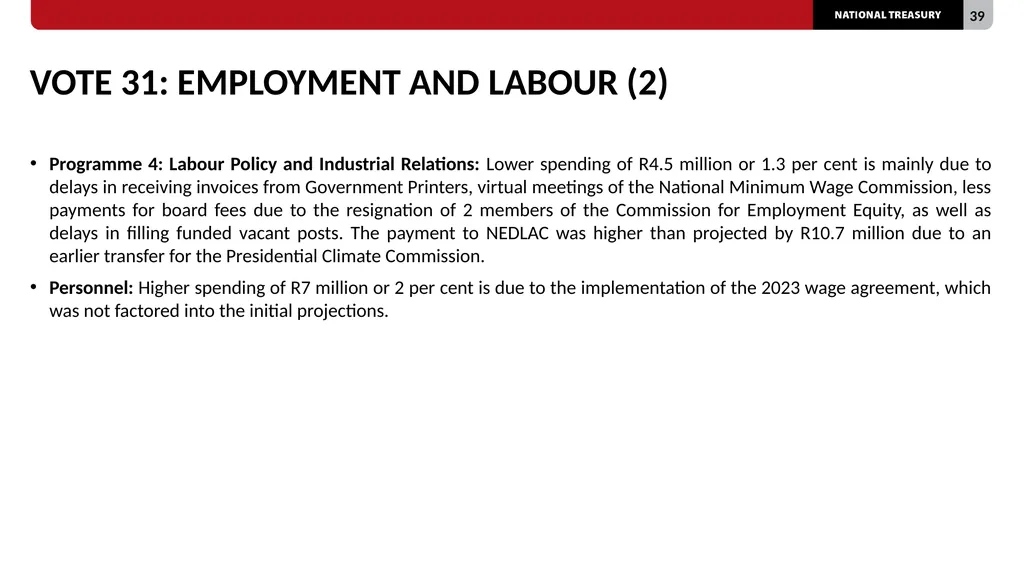
slide39. VOTE 31: EMPLOYMENT AND LABOUR (2) Programme 4: Labour Policy and Industrial Relations: Lower spending of R4.5 million or 1.3 per cent is mainly due to delays in receiving invoices from Government Printers, virtual meetings of the National Minimum Wage Commission, less payments for board fees due to the resignation of 2 members of the Commission for Employment Equity, as well as delays in filling funded vacant posts. The payment to NEDLAC was higher than projected by R10.7 million due to an earlier transfer for the Presidential Climate Commission.
Personnel: Higher spending of R7 million or 2 per cent is due to the implementation of the 2023 wage agreement, which was not factored into the initial projections.<br>
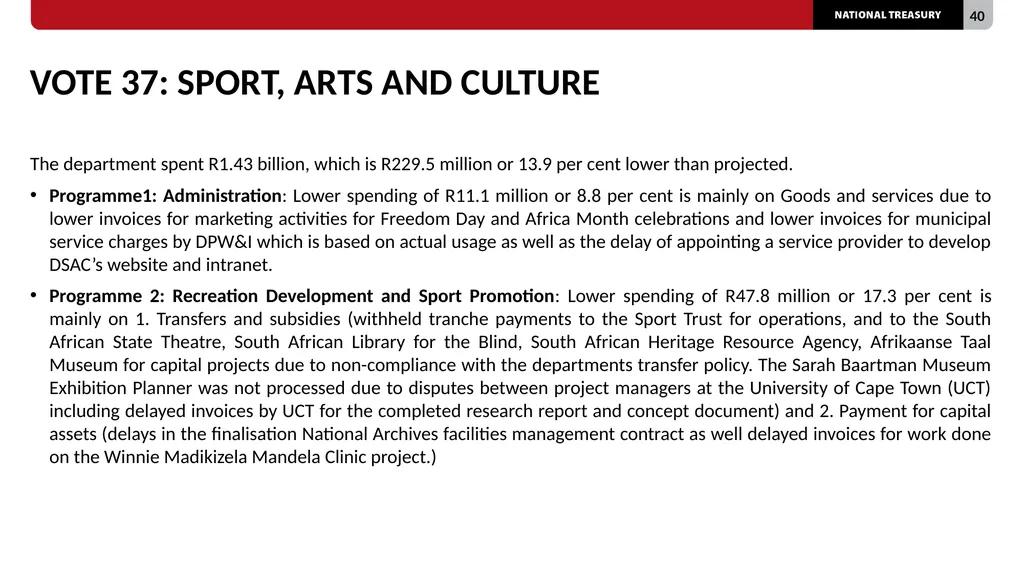
slide40. VOTE 37: SPORT, ARTS AND CULTURE The department spent R1.43 billion, which is R229.5 million or 13.9 per cent lower than projected.
Programme1: Administration: Lower spending of R11.1 million or 8.8 per cent is mainly on Goods and services due to lower invoices for marketing activities for Freedom Day and Africa Month celebrations and lower invoices for municipal service charges by DPW&I which is based on actual usage as well as the delay of appointing a service provider to develop DSAC’s website and intranet.
Programme 2: Recreation Development and Sport Promotion: Lower spending of R47.8 million or 17.3 per cent is mainly on 1. Transfers and subsidies (withheld tranche payments to the Sport Trust for operations, and to the South African State Theatre, South African Library for the Blind, South African Heritage Resource Agency, Afrikaanse Taal Museum for capital projects due to non-compliance with the departments transfer policy. The Sarah Baartman Museum Exhibition Planner was not processed due to disputes between project managers at the University of Cape Town (UCT) including delayed invoices by UCT for the completed research report and concept document) and 2. Payment for capital assets (delays in the finalisation National Archives facilities management contract as well delayed invoices for work done on the Winnie Madikizela Mandela Clinic project.)<br>
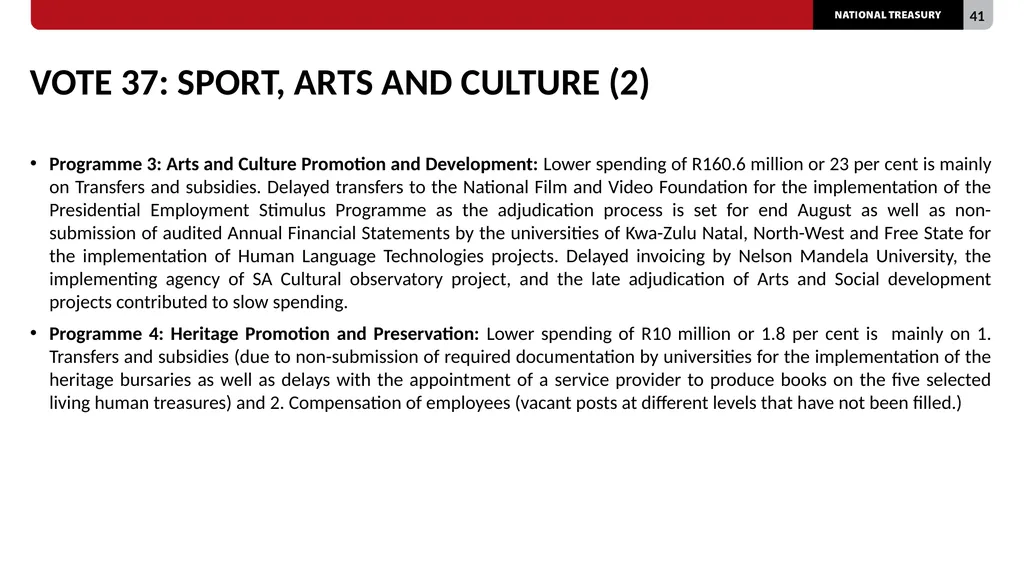
slide41. VOTE 37: SPORT, ARTS AND CULTURE (2) Programme 3: Arts and Culture Promotion and Development: Lower spending of R160.6 million or 23 per cent is mainly on Transfers and subsidies. Delayed transfers to the National Film and Video Foundation for the implementation of the Presidential Employment Stimulus Programme as the adjudication process is set for end August as well as non-submission of audited Annual Financial Statements by the universities of Kwa-Zulu Natal, North-West and Free State for the implementation of Human Language Technologies projects. Delayed invoicing by Nelson Mandela University, the implementing agency of SA Cultural observatory project, and the late adjudication of Arts and Social development projects contributed to slow spending.
Programme 4: Heritage Promotion and Preservation: Lower spending of R10 million or 1.8 per cent is mainly on 1. Transfers and subsidies (due to non-submission of required documentation by universities for the implementation of the heritage bursaries as well as delays with the appointment of a service provider to produce books on the five selected living human treasures) and 2. Compensation of employees (vacant posts at different levels that have not been filled.)<br>
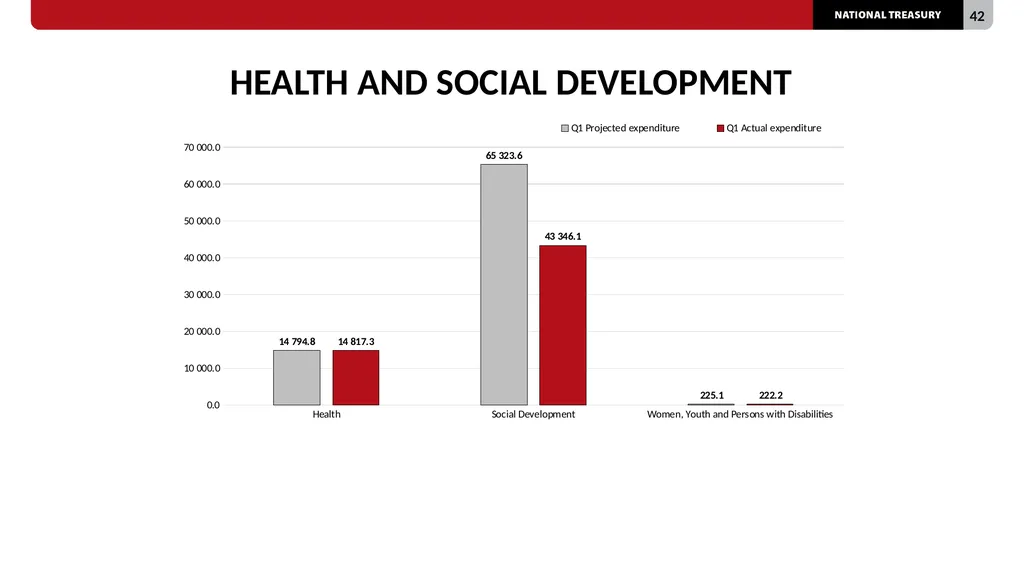
slide42. HEALTH AND SOCIAL DEVELOPMENT<br>
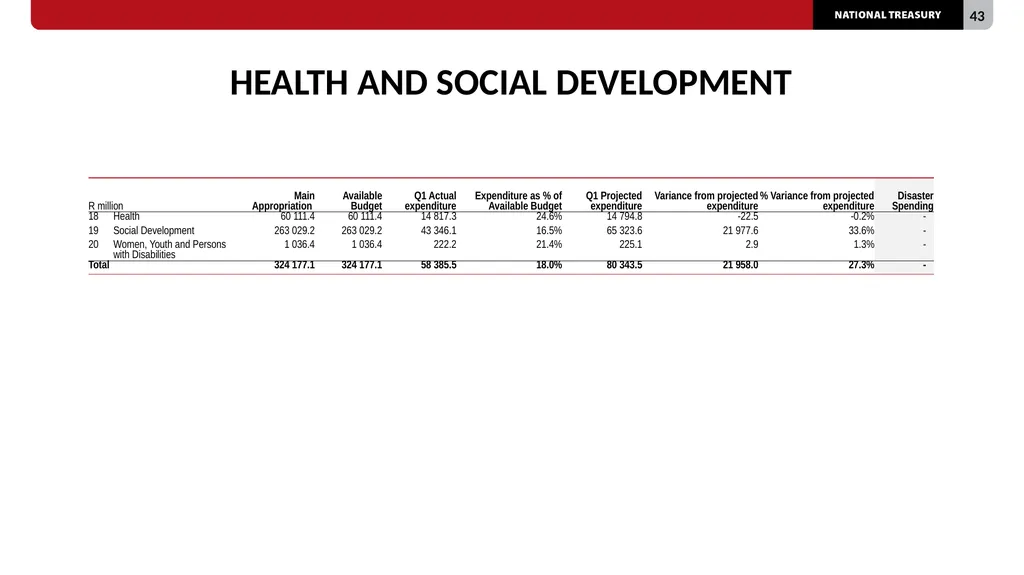
slide43. HEALTH AND SOCIAL DEVELOPMENT<br>
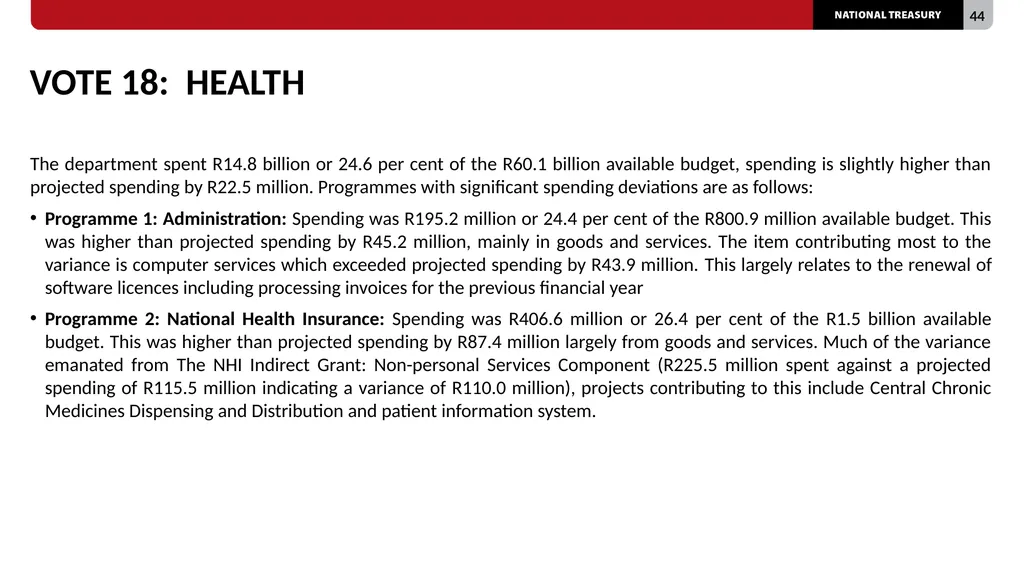
slide44. VOTE 18: HEALTH The department spent R14.8 billion or 24.6 per cent of the R60.1 billion available budget, spending is slightly higher than projected spending by R22.5 million. Programmes with significant spending deviations are as follows:
Programme 1: Administration: Spending was R195.2 million or 24.4 per cent of the R800.9 million available budget. This was higher than projected spending by R45.2 million, mainly in goods and services. The item contributing most to the variance is computer services which exceeded projected spending by R43.9 million. This largely relates to the renewal of software licences including processing invoices for the previous financial year
Programme 2: National Health Insurance: Spending was R406.6 million or 26.4 per cent of the R1.5 billion available budget. This was higher than projected spending by R87.4 million largely from goods and services. Much of the variance emanated from The NHI Indirect Grant: Non-personal Services Component (R225.5 million spent against a projected spending of R115.5 million indicating a variance of R110.0 million), projects contributing to this include Central Chronic Medicines Dispensing and Distribution and patient information system.<br>
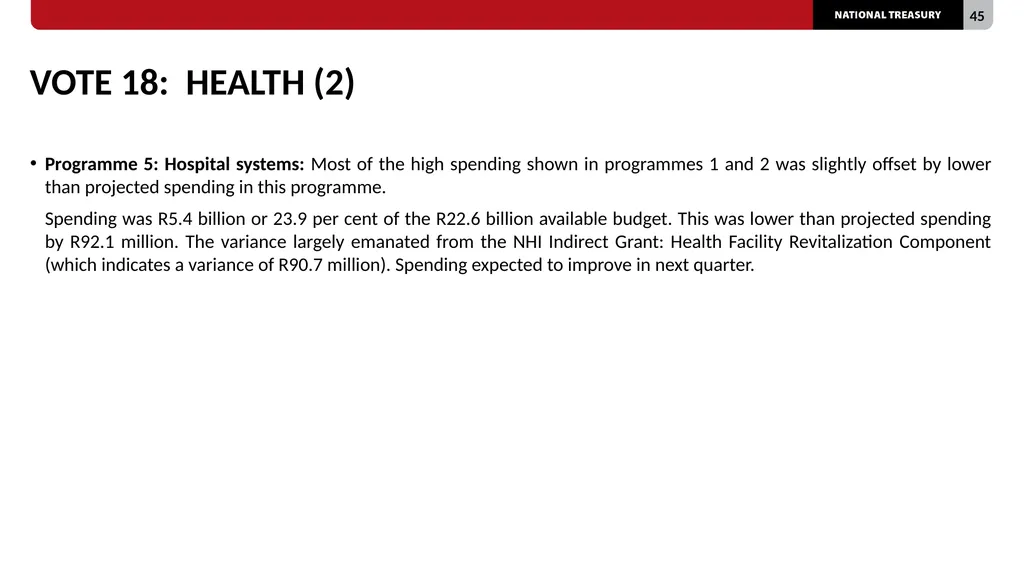
slide45. VOTE 18: HEALTH (2) Programme 5: Hospital systems: Most of the high spending shown in programmes 1 and 2 was slightly offset by lower than projected spending in this programme.
Spending was R5.4 billion or 23.9 per cent of the R22.6 billion available budget. This was lower than projected spending by R92.1 million. The variance largely emanated from the NHI Indirect Grant: Health Facility Revitalization Component (which indicates a variance of R90.7 million). Spending expected to improve in next quarter.<br>
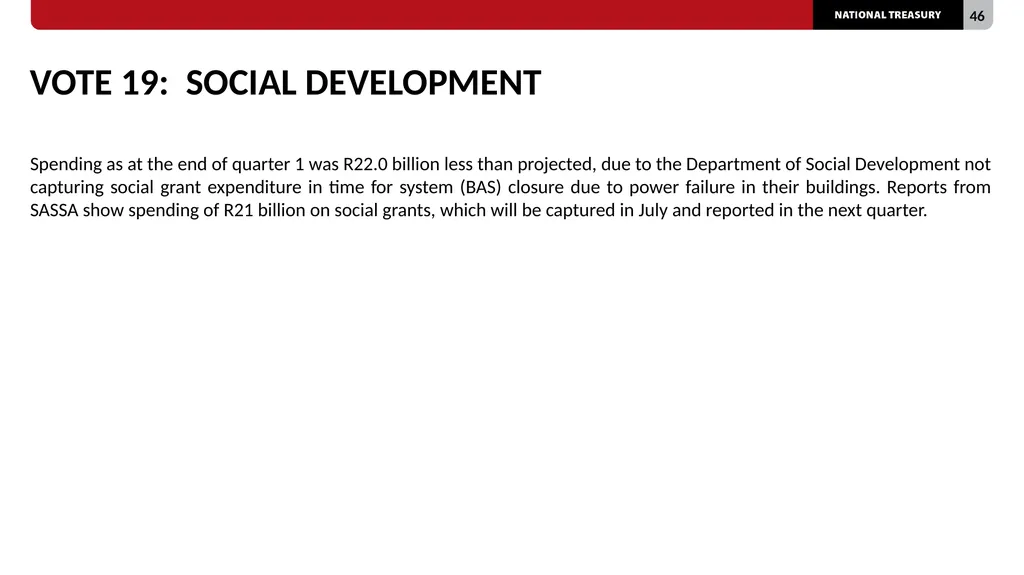
slide46. VOTE 19: SOCIAL DEVELOPMENT Spending as at the end of quarter 1 was R22.0 billion less than projected, due to the Department of Social Development not capturing social grant expenditure in time for system (BAS) closure due to power failure in their buildings. Reports from SASSA show spending of R21 billion on social grants, which will be captured in July and reported in the next quarter.<br>
slide47. JUSTICE AND PROTECTION SERVICES<br>
slide48. JUSTICE AND PROTECTION SERVICES<br>
slide49. JUSTICE AND PROTECTION SERVICES HIGHLIGHTS Vote 21: Civilian Secretariat for the Police Service
Vote 22: Correctional Services
Vote 23: Defence
Vote 24: Independent Police Investigative Directorate
Vote 25: Justice and Constitutional Development
Vote 26: Military Veterans
Vote 27: Office of the Chief Justice and Judicial Administration
Vote 28: Police<br>
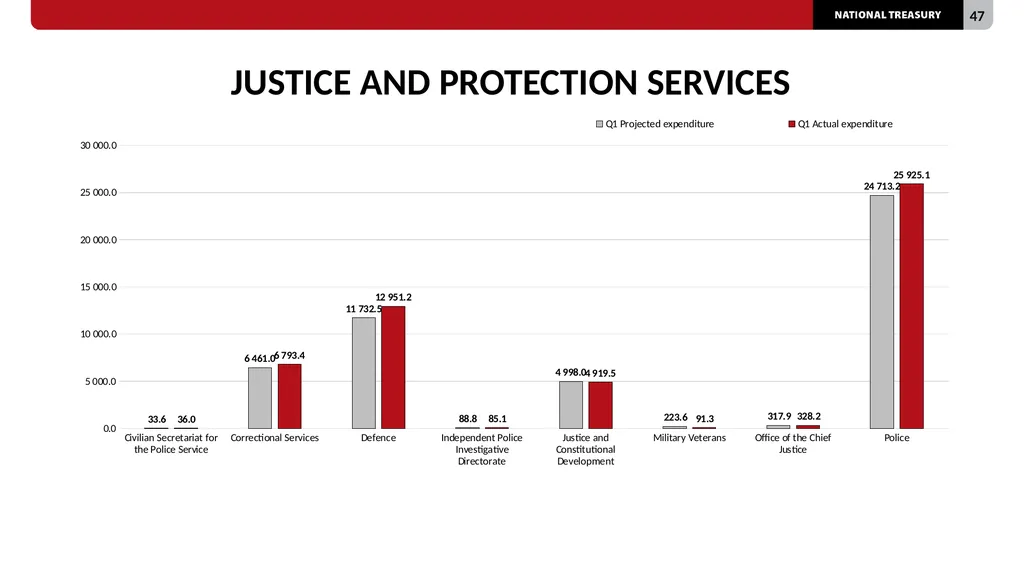
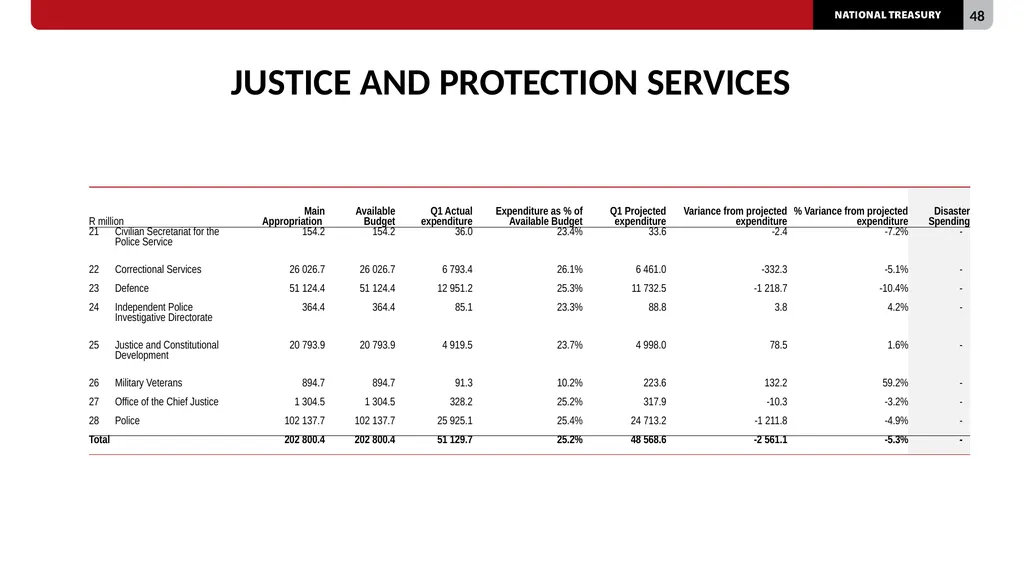
slide50. JUSTICE AND PROTECTION SERVICES HIGHLIGHTS Vote 21: Civilian Secretariat for Police Service: Higher than projected spending of R2.4 million, mainly on goods and services due to the audit process by the Auditor-General of South Africa, progressing faster than anticipated as well as payment of late submission of invoices for services rendered in the months of January and February 2023 by the State Information Technology Agency (SITA).
Vote 22: Correctional Services: The department spent R6.79 billion or 26.1 per cent of its available budget of R26.03 billion, thus recording higher than projected spending of R332.3 million. Contributing to the higher than planned spending was mainly due to the implementation of the 2023/24 wage agreement as per the Public Service Co-ordinating Bargaining Council (PSCBC) Resolution 02 of 2023 as well as due to fuel inflation.
Vote 23: Defence: Higher than projected spending of R1.2 billion was mainly on compensation of employees due to the compensation of employees ceiling which does not support the current personnel numbers of the department as well as the implementation of the 2023/24 wage agreement as per the Public Service Co-ordinating Bargaining Council (PSCBC) Resolution 02 of 2023.<br>
slide51. JUSTICE AND PROTECTION SERVICES HIGHLIGHTS Vote 24: Independent Police Investigative Directorate: Lower than projected spending of R3.8 million, mainly on goods and services (R3.3 million) and on payments for capital assets (R1.4 million), due to delayed receipt of invoices from the SITA and the Department of Public Works and Infrastructure (DPW-I) for ICT and municipal services, as well as delayed delivery of procured vehicles for investigators.
Vote 25: Justice and Constitutional Development: Spent R5.5 billion (or 23.6 per cent) of the available budget of R23.2 billion and this is lower by R110.1 million when compared with the projection to spend R5.6 billion. This lower spending is mainly due to to delays in the processing of computer services invoices and reduced spending on municipal services due to load shedding as well as delayed delivery of infrastructure projects by DPWI and procurement of laptops.
Vote 26: Military Veterans: Lower than projected spending of R132.2 million mainly on transfers and subsidies, and goods and services mainly due to delays in the payment of socio-economic benefits to deserving military veterans and payment of accruals for office accommodation to DPWI.<br>
slide52. JUSTICE AND PROTECTION SERVICES HIGHLIGHTS Vote 27: Office of the Chief Justice and Judicial Administration: The department spent R612.4 million or 25.2 per cent of the R2.4 billion available budget, thus a higher than planned spending of R22.8 million. Higher than planned spending was mainly on compensation of employees and goods and services. Respectively, this is due to the implementation of the 2023/24 wage agreement as per the Public Service Co-ordinating Bargaining Council (PSCBC) resolution 02 of 2023 and payment for a cloud-based solution currently being used to host the court online system.
Vote 28: Police: Higher than projected spending of R1.2 billion, mainly on compensation of employees (R581.2 million), and goods and services (R546.8 million), as well as on transfers and subsidies (R106.4 million). The high spending on compensation of employees was due to 1 957 excess filled posts as at the end of the first quarter of 2023/24 as well as the implementation of the 2023/24 public service wage agreement. With reference to goods and services, the high spending was mainly due to license fee payments in relation to the annual Adobe Enterprise Agreement for the 2023/24 financial year as well as expenditure for S&T and meal allowances resulting from the deployment of police officials.<br>
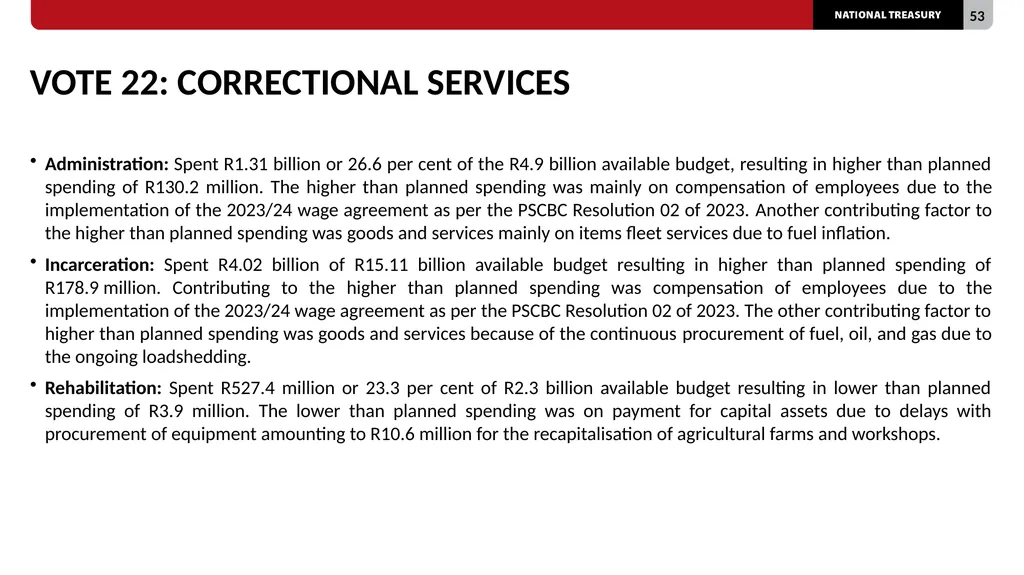
slide53. VOTE 22: CORRECTIONAL SERVICES Administration: Spent R1.31 billion or 26.6 per cent of the R4.9 billion available budget, resulting in higher than planned spending of R130.2 million. The higher than planned spending was mainly on compensation of employees due to the implementation of the 2023/24 wage agreement as per the PSCBC Resolution 02 of 2023. Another contributing factor to the higher than planned spending was goods and services mainly on items fleet services due to fuel inflation.
Incarceration: Spent R4.02 billion of R15.11 billion available budget resulting in higher than planned spending of R178.9 million. Contributing to the higher than planned spending was compensation of employees due to the implementation of the 2023/24 wage agreement as per the PSCBC Resolution 02 of 2023. The other contributing factor to higher than planned spending was goods and services because of the continuous procurement of fuel, oil, and gas due to the ongoing loadshedding.
Rehabilitation: Spent R527.4 million or 23.3 per cent of R2.3 billion available budget resulting in lower than planned spending of R3.9 million. The lower than planned spending was on payment for capital assets due to delays with procurement of equipment amounting to R10.6 million for the recapitalisation of agricultural farms and workshops.<br>
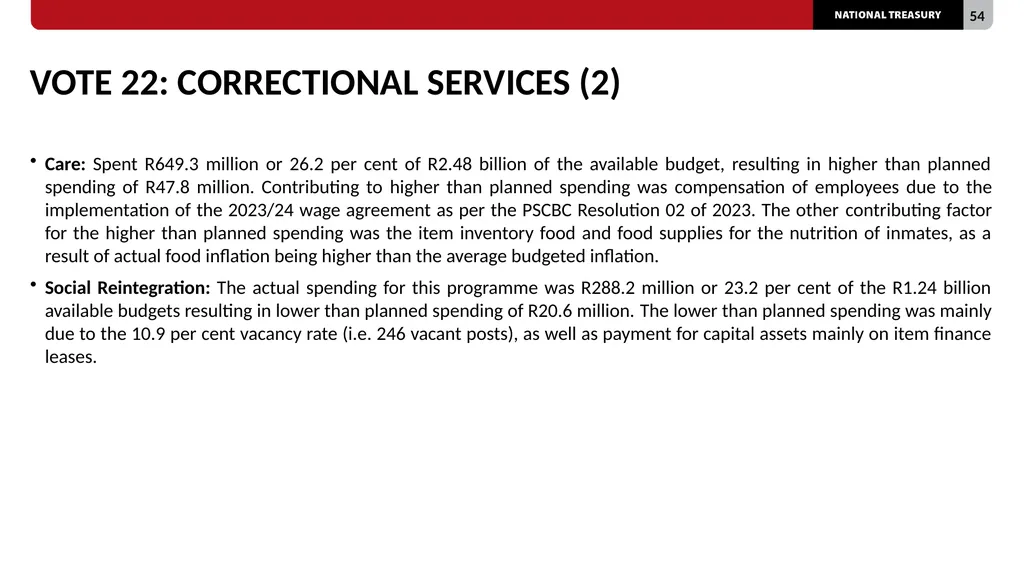
slide54. VOTE 22: CORRECTIONAL SERVICES (2) Care: Spent R649.3 million or 26.2 per cent of R2.48 billion of the available budget, resulting in higher than planned spending of R47.8 million. Contributing to higher than planned spending was compensation of employees due to the implementation of the 2023/24 wage agreement as per the PSCBC Resolution 02 of 2023. The other contributing factor for the higher than planned spending was the item inventory food and food supplies for the nutrition of inmates, as a result of actual food inflation being higher than the average budgeted inflation.
Social Reintegration: The actual spending for this programme was R288.2 million or 23.2 per cent of the R1.24 billion available budgets resulting in lower than planned spending of R20.6 million. The lower than planned spending was mainly due to the 10.9 per cent vacancy rate (i.e. 246 vacant posts), as well as payment for capital assets mainly on item finance leases.<br>
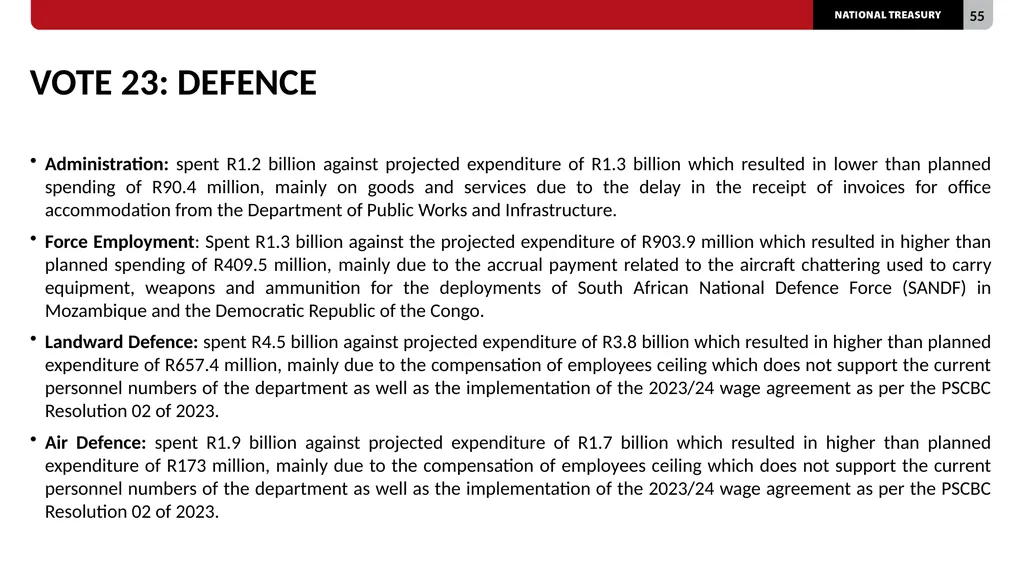
slide55. Vote 23: DEFENCE Administration: spent R1.2 billion against projected expenditure of R1.3 billion which resulted in lower than planned spending of R90.4 million, mainly on goods and services due to the delay in the receipt of invoices for office accommodation from the Department of Public Works and Infrastructure.
Force Employment: Spent R1.3 billion against the projected expenditure of R903.9 million which resulted in higher than planned spending of R409.5 million, mainly due to the accrual payment related to the aircraft chattering used to carry equipment, weapons and ammunition for the deployments of South African National Defence Force (SANDF) in Mozambique and the Democratic Republic of the Congo.
Landward Defence: spent R4.5 billion against projected expenditure of R3.8 billion which resulted in higher than planned expenditure of R657.4 million, mainly due to the compensation of employees ceiling which does not support the current personnel numbers of the department as well as the implementation of the 2023/24 wage agreement as per the PSCBC Resolution 02 of 2023.
Air Defence: spent R1.9 billion against projected expenditure of R1.7 billion which resulted in higher than planned expenditure of R173 million, mainly due to the compensation of employees ceiling which does not support the current personnel numbers of the department as well as the implementation of the 2023/24 wage agreement as per the PSCBC Resolution 02 of 2023.<br>
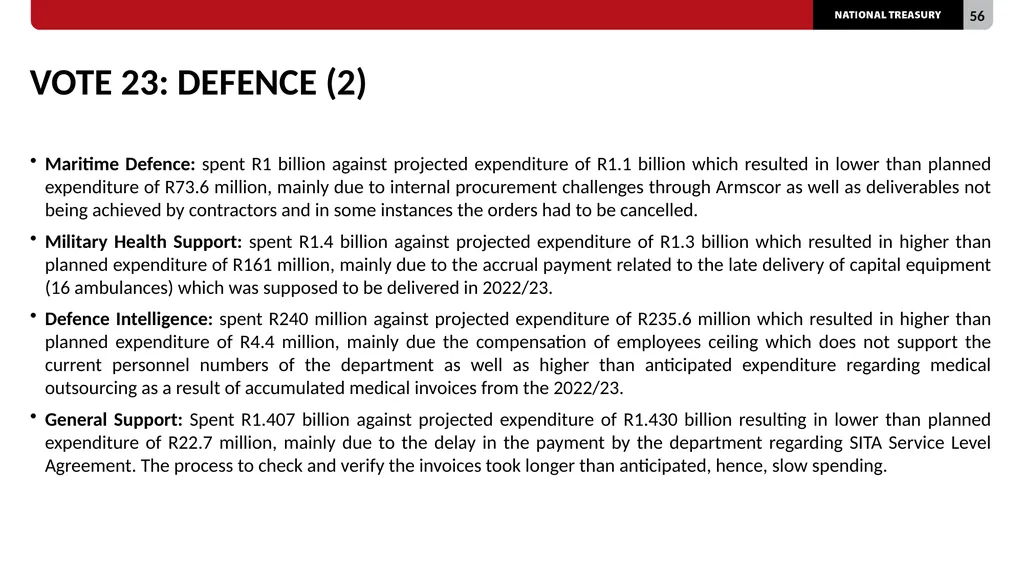
slide56. Vote 23: DEFENCE (2) Maritime Defence: spent R1 billion against projected expenditure of R1.1 billion which resulted in lower than planned expenditure of R73.6 million, mainly due to internal procurement challenges through Armscor as well as deliverables not being achieved by contractors and in some instances the orders had to be cancelled.
Military Health Support: spent R1.4 billion against projected expenditure of R1.3 billion which resulted in higher than planned expenditure of R161 million, mainly due to the accrual payment related to the late delivery of capital equipment (16 ambulances) which was supposed to be delivered in 2022/23.
Defence Intelligence: spent R240 million against projected expenditure of R235.6 million which resulted in higher than planned expenditure of R4.4 million, mainly due the compensation of employees ceiling which does not support the current personnel numbers of the department as well as higher than anticipated expenditure regarding medical outsourcing as a result of accumulated medical invoices from the 2022/23.
General Support: Spent R1.407 billion against projected expenditure of R1.430 billion resulting in lower than planned expenditure of R22.7 million, mainly due to the delay in the payment by the department regarding SITA Service Level Agreement. The process to check and verify the invoices took longer than anticipated, hence, slow spending.<br>
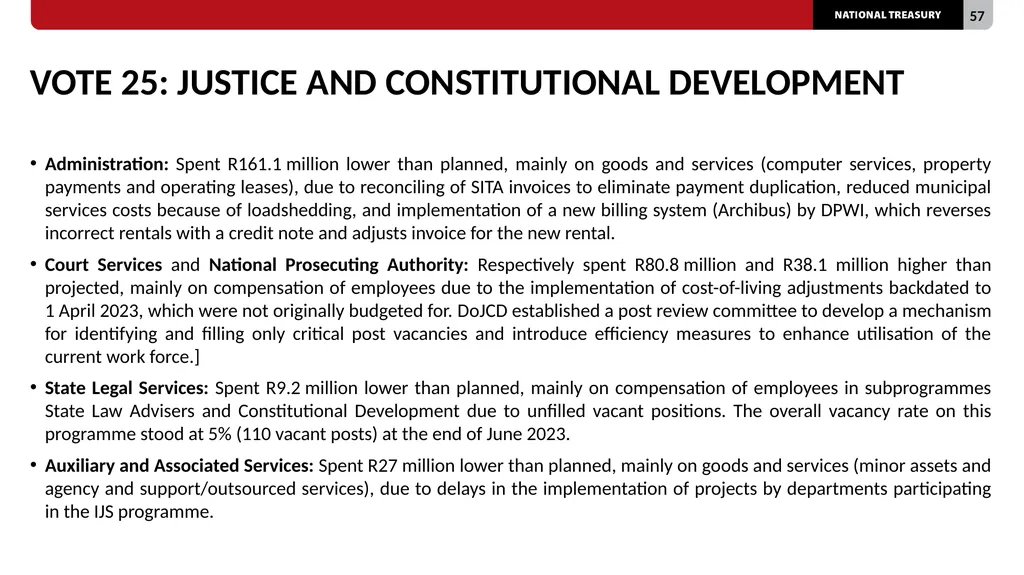
slide57. Vote 25: Justice and constitutional Development Administration: Spent R161.1 million lower than planned, mainly on goods and services (computer services, property payments and operating leases), due to reconciling of SITA invoices to eliminate payment duplication, reduced municipal services costs because of loadshedding, and implementation of a new billing system (Archibus) by DPWI, which reverses incorrect rentals with a credit note and adjusts invoice for the new rental.
Court Services and National Prosecuting Authority: Respectively spent R80.8 million and R38.1 million higher than projected, mainly on compensation of employees due to the implementation of cost-of-living adjustments backdated to 1 April 2023, which were not originally budgeted for. DoJCD established a post review committee to develop a mechanism for identifying and filling only critical post vacancies and introduce efficiency measures to enhance utilisation of the current work force.]
State Legal Services: Spent R9.2 million lower than planned, mainly on compensation of employees in subprogrammes State Law Advisers and Constitutional Development due to unfilled vacant positions. The overall vacancy rate on this programme stood at 5% (110 vacant posts) at the end of June 2023.
Auxiliary and Associated Services: Spent R27 million lower than planned, mainly on goods and services (minor assets and agency and support/outsourced services), due to delays in the implementation of projects by departments participating in the IJS programme.<br>
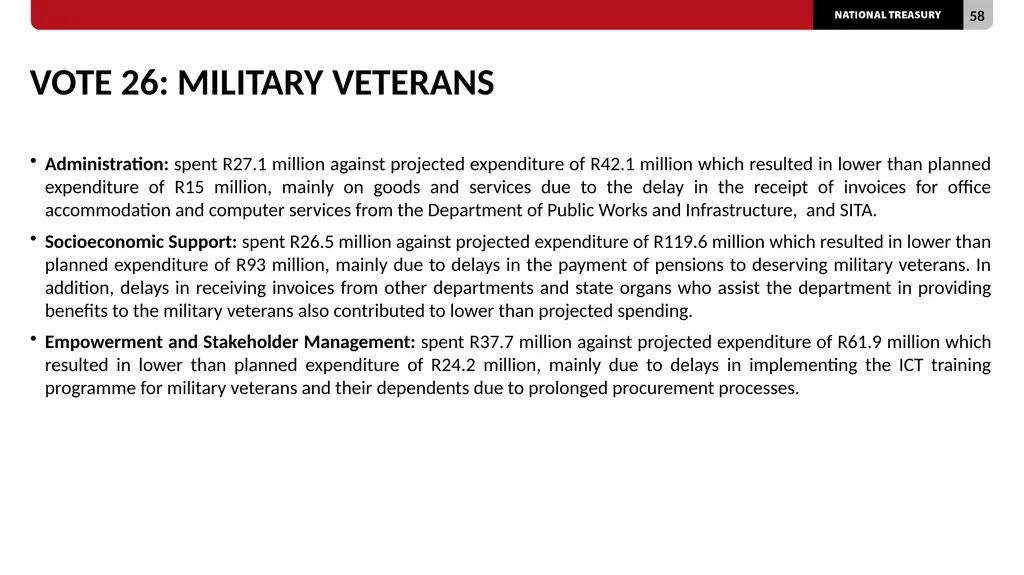
slide58. Vote 26: MILITARY VETERANS Administration: spent R27.1 million against projected expenditure of R42.1 million which resulted in lower than planned expenditure of R15 million, mainly on goods and services due to the delay in the receipt of invoices for office accommodation and computer services from the Department of Public Works and Infrastructure, and SITA.
Socioeconomic Support: spent R26.5 million against projected expenditure of R119.6 million which resulted in lower than planned expenditure of R93 million, mainly due to delays in the payment of pensions to deserving military veterans. In addition, delays in receiving invoices from other departments and state organs who assist the department in providing benefits to the military veterans also contributed to lower than projected spending.
Empowerment and Stakeholder Management: spent R37.7 million against projected expenditure of R61.9 million which resulted in lower than planned expenditure of R24.2 million, mainly due to delays in implementing the ICT training programme for military veterans and their dependents due to prolonged procurement processes.<br>
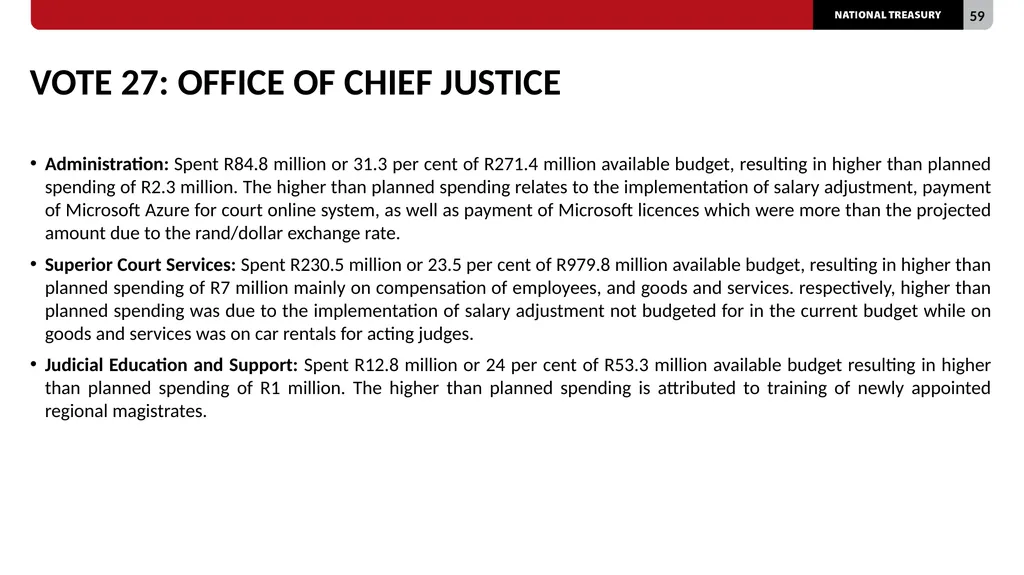
slide59. VOTE 27: OFFICE OF CHIEF JUSTICE Administration: Spent R84.8 million or 31.3 per cent of R271.4 million available budget, resulting in higher than planned spending of R2.3 million. The higher than planned spending relates to the implementation of salary adjustment, payment of Microsoft Azure for court online system, as well as payment of Microsoft licences which were more than the projected amount due to the rand/dollar exchange rate.
Superior Court Services: Spent R230.5 million or 23.5 per cent of R979.8 million available budget, resulting in higher than planned spending of R7 million mainly on compensation of employees, and goods and services. respectively, higher than planned spending was due to the implementation of salary adjustment not budgeted for in the current budget while on goods and services was on car rentals for acting judges.
Judicial Education and Support: Spent R12.8 million or 24 per cent of R53.3 million available budget resulting in higher than planned spending of R1 million. The higher than planned spending is attributed to training of newly appointed regional magistrates.<br>
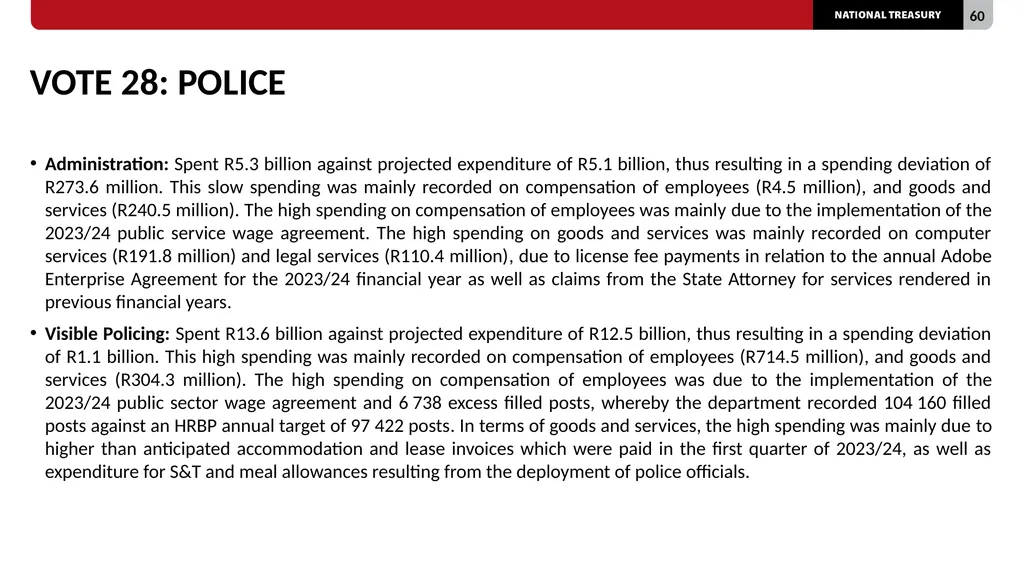
slide60. Vote 28: POLICE Administration: Spent R5.3 billion against projected expenditure of R5.1 billion, thus resulting in a spending deviation of R273.6 million. This slow spending was mainly recorded on compensation of employees (R4.5 million), and goods and services (R240.5 million). The high spending on compensation of employees was mainly due to the implementation of the 2023/24 public service wage agreement. The high spending on goods and services was mainly recorded on computer services (R191.8 million) and legal services (R110.4 million), due to license fee payments in relation to the annual Adobe Enterprise Agreement for the 2023/24 financial year as well as claims from the State Attorney for services rendered in previous financial years.
Visible Policing: Spent R13.6 billion against projected expenditure of R12.5 billion, thus resulting in a spending deviation of R1.1 billion. This high spending was mainly recorded on compensation of employees (R714.5 million), and goods and services (R304.3 million). The high spending on compensation of employees was due to the implementation of the 2023/24 public sector wage agreement and 6 738 excess filled posts, whereby the department recorded 104 160 filled posts against an HRBP annual target of 97 422 posts. In terms of goods and services, the high spending was mainly due to higher than anticipated accommodation and lease invoices which were paid in the first quarter of 2023/24, as well as expenditure for S&T and meal allowances resulting from the deployment of police officials.<br>
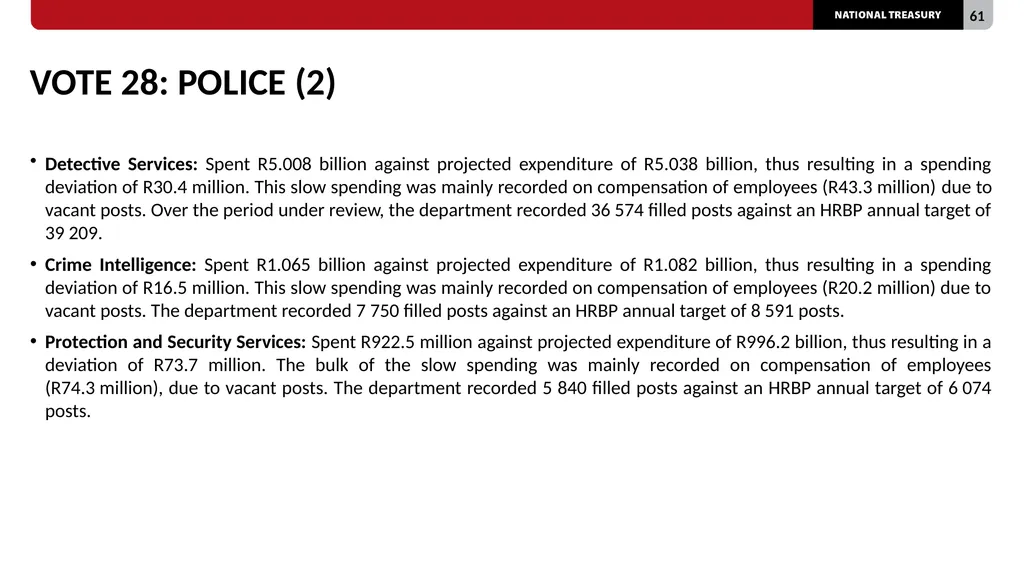
slide61. Vote 28: POLICE (2) Detective Services: Spent R5.008 billion against projected expenditure of R5.038 billion, thus resulting in a spending deviation of R30.4 million. This slow spending was mainly recorded on compensation of employees (R43.3 million) due to vacant posts. Over the period under review, the department recorded 36 574 filled posts against an HRBP annual target of 39 209.
Crime Intelligence: Spent R1.065 billion against projected expenditure of R1.082 billion, thus resulting in a spending deviation of R16.5 million. This slow spending was mainly recorded on compensation of employees (R20.2 million) due to vacant posts. The department recorded 7 750 filled posts against an HRBP annual target of 8 591 posts.
Protection and Security Services: Spent R922.5 million against projected expenditure of R996.2 billion, thus resulting in a deviation of R73.7 million. The bulk of the slow spending was mainly recorded on compensation of employees (R74.3 million), due to vacant posts. The department recorded 5 840 filled posts against an HRBP annual target of 6 074 posts.<br>
slide62. ECONOMIC SERVICES<br>
slide63. ECONOMIC SERVICES<br>
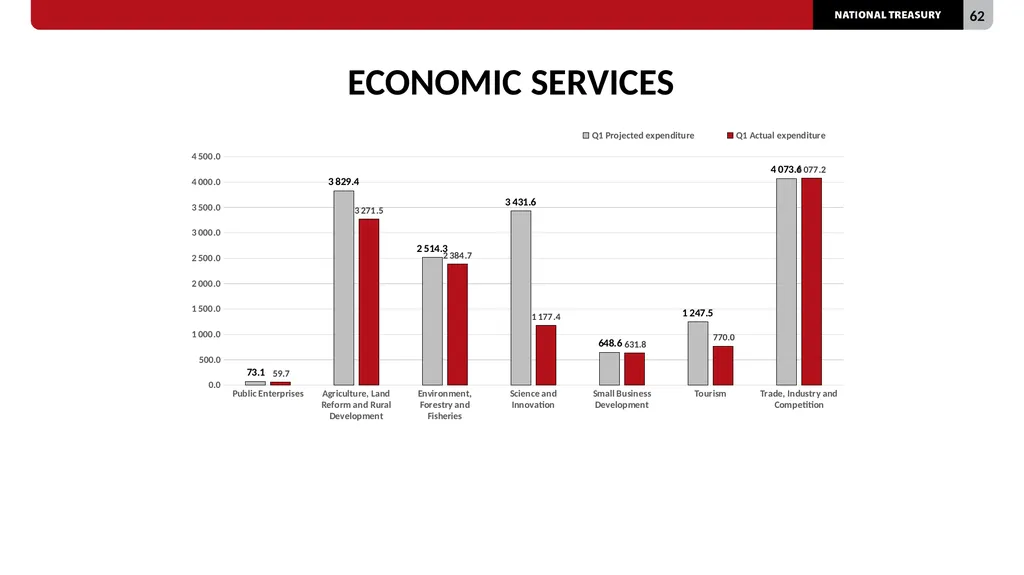
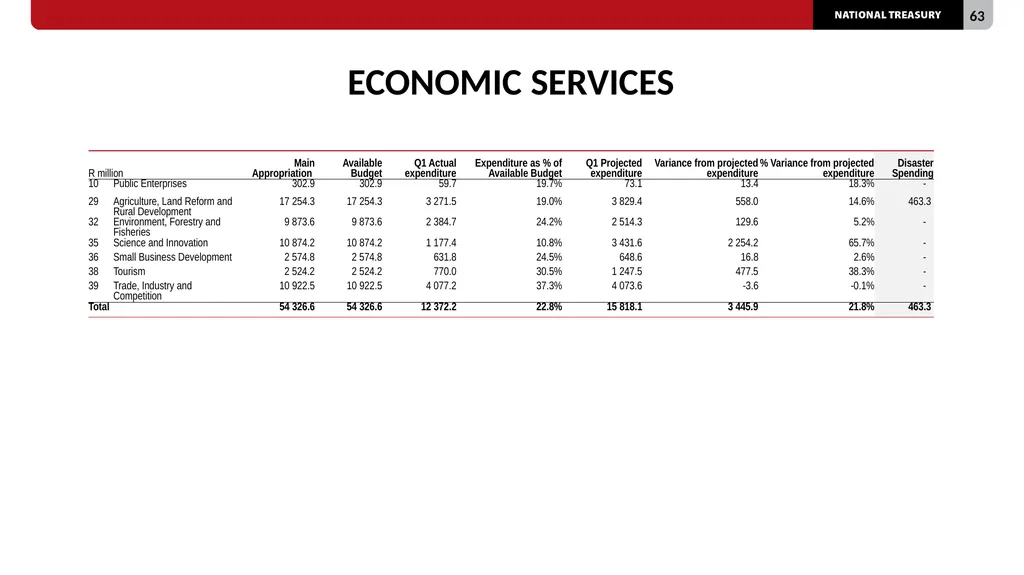
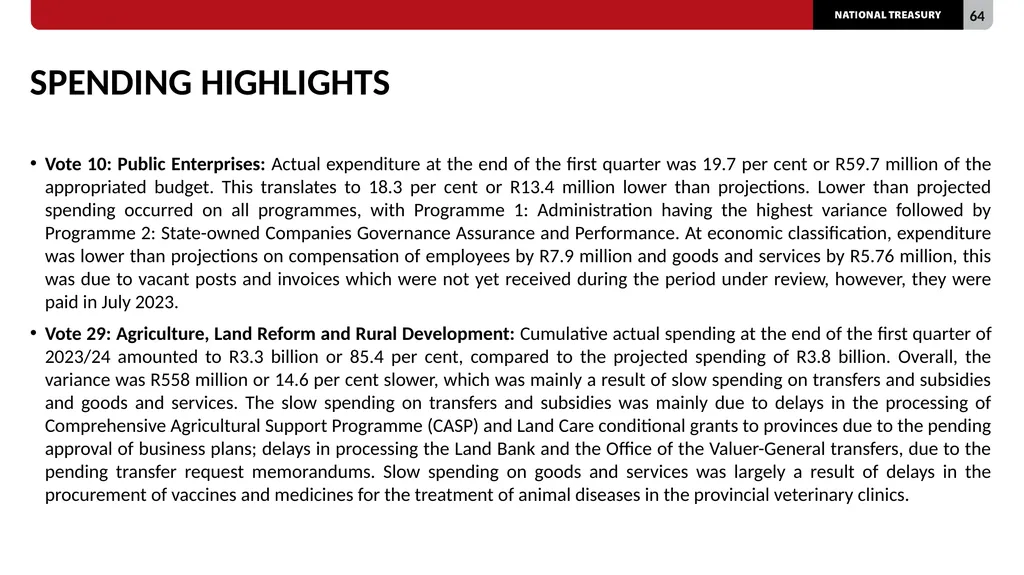
slide64. SPENDING HIGHLIGHTS Vote 10: Public Enterprises: Actual expenditure at the end of the first quarter was 19.7 per cent or R59.7 million of the appropriated budget. This translates to 18.3 per cent or R13.4 million lower than projections. Lower than projected spending occurred on all programmes, with Programme 1: Administration having the highest variance followed by Programme 2: State-owned Companies Governance Assurance and Performance. At economic classification, expenditure was lower than projections on compensation of employees by R7.9 million and goods and services by R5.76 million, this was due to vacant posts and invoices which were not yet received during the period under review, however, they were paid in July 2023.
Vote 29: Agriculture, Land Reform and Rural Development: Cumulative actual spending at the end of the first quarter of 2023/24 amounted to R3.3 billion or 85.4 per cent, compared to the projected spending of R3.8 billion. Overall, the variance was R558 million or 14.6 per cent slower, which was mainly a result of slow spending on transfers and subsidies and goods and services. The slow spending on transfers and subsidies was mainly due to delays in the processing of Comprehensive Agricultural Support Programme (CASP) and Land Care conditional grants to provinces due to the pending approval of business plans; delays in processing the Land Bank and the Office of the Valuer-General transfers, due to the pending transfer request memorandums. Slow spending on goods and services was largely a result of delays in the procurement of vaccines and medicines for the treatment of animal diseases in the provincial veterinary clinics.<br>
slide65. SPENDING HIGHLIGHTS Vote 32: Forestry, Fisheries and the Environment: The department’s main appropriation for 2023/24 amounts to R9.9 billion. At the end of the first quarter, actual spending was R2.4 billion or 24.2 per cent of the available budget, mainly towards transfers and subsidies and goods and services. Actual spending of R2.4 billion was 5.2 per cent or R129.6 million slower than projected expenditure of R2.5 billion. The slower spending is mainly due to delays with the commencement of projects and signing of agreement regarding Expanded Public Works Programmes (EPWP) related projects. Furthermore, Supply Chain Management has backlog on finalising tender processes with service providers for training EPWP contract workers and implementors for clearing alien species.
Vote 35: Science and Innovation: Actual spending was R1.2 billion against projected spending of R3.4 billion. Spending was therefore, R2.3 billion or 65.7 per cent slower than projected. Notable slow spending was mainly reflected in the Research, Development and Support and the Technology Innovation programmes. This was due to the 90 per cent required expenditure threshold that was not reached on previous tranches which resulted in planned payments under the Astronomy, Cyber Infrastructure, Basic Science Development and Support subprogrammes being delayed for projects such as the South African Population Research Infrastructure Network (SAPRIN) and the South African National Space Agency for the National Earth Observations and Space Secretariat. In addition, the transfer to the South African National Space Agency was not made in the fist quarter because the entity is still addressing the conditions attached to the budget facility for infrastructure project funding.<br>
slide66. SPENDING HIGHLIGHTS Vote 36:Small Business Development: The Department of Small Business Development spent R631.8 million or 97.4 per cent compared to the projected spending of R648.6 million by the end of quarter one. This represents broad-based R16.8 million (2.6 per cent) slower spending in the Administration, Development Finance and Enterprise Development programmes. The biggest driver of underspending was transfers and subsidies due to funds that were not transferred under the Craft Customised Sector Programme (CCSP), due to delays in finalizing Memorandum of Agreements with the implementing agencies. The slow spending under the compensation of employees was due to vacancies
Vote 38: Tourism: The department’s main appropriation amounted to R2.5 billion for the 2023/24 financial year. At the end of the first quarter, the department spent R770 million or 30.5 per cent of the available budget of R2.5 billion. This translates to a slow spending of R477.5 million or 38.3 per cent, against the projected spending of R1.3 billion. The slow spending was mainly on goods and services as a result of delays in the implementation of the Expanded Public Works Programme (EPWP), reduced transfer payments to the South African Tourism, delays in transfer payments to the United Nations World Tourism Organisation (UNWTO), delays in processing of invoices within the Tourism Incentives Programme; and delayed payments to the Federated Hospitality Association of South Africa and the National Tourism Careers Expo.<br>
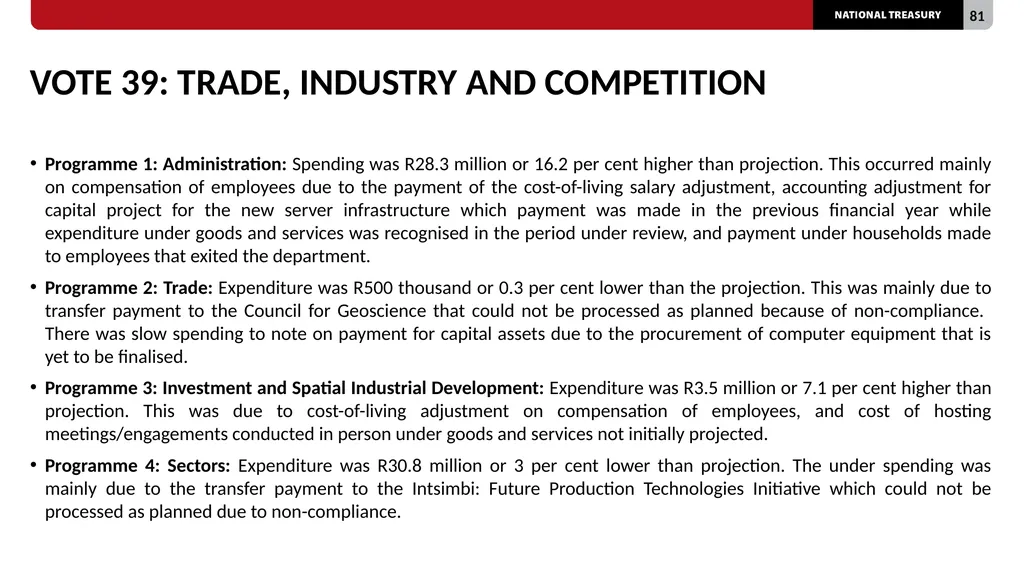
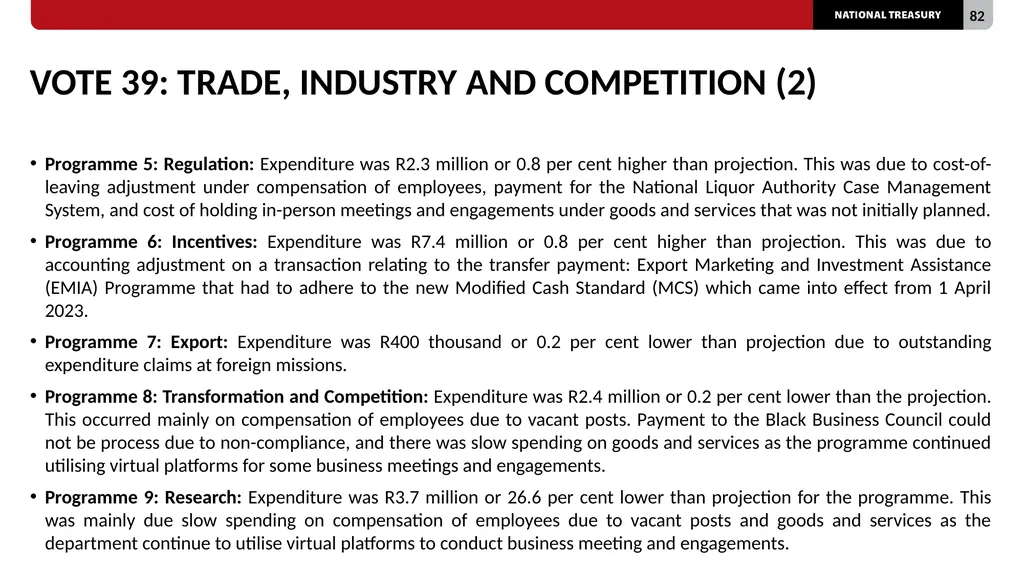
slide67. SPENDING HIGHLIGHTS Vote 39: Trade, Industry and Competition: During the first quarter total spending was R4.077 billion against projected spending of R4.074 billion. Spending was therefore, R3.6 million or 0.1 per cent higher than projected. Notable higher than projected spending occurred mainly on Programme 1: Administration, Programme 3: Investment and Spatial Industrial Development, Programme 5: Regulation, and Programme 6: Incentives. At economic classification, spending above projection occurred on compensation of employees and payment for capital assets. Higher than projected spending was attributed mainly to cost-of-living adjustments and the accounting adjustment for capital project for the new server infrastructure where payment was made in the previous financial year while expenditure under goods and services was recognised in the period under review.<br>
slide68. VOTE 10: PUBLIC ENTERPRISES Programme 1: Administration: Expenditure was R34.8 million against projected spending of R42 million, resulting in a lower than projected spending of R7.2 million. Lower than projected spending occurred on all subprogrammes except for the Chief Financial Officer and Office Accommodation subprogrammes which recorded overspending. At economic classification, the lower than projected spending was on compensation of employees and goods and services. This was due to vacant posts and the delayed receipt of invoices which were paid in July 2023. The overspending on the Chief Financial Officer and Office Accommodation subprogrammes is attributed to increase in the number of auditors allocated to the department and annual increase in property lease.
Programme 2: State-owned Companies Governance Assurance and Performance: Spending under the programme was R13.9 million against a projected budget of R15.6 million, this translates to underspending of R1.6 million lower than projections. Although, there was overall lower than projected spending for the programme, there was significantly higher than projected spending on the Legal subprogramme. This is due to is due to payment of invoices relating to 2022/23 financial year.
Programme 3: Business Enhancement, Transformation, and Industrialisation: Spending amounted to R11 million against projected spending of R15.5 million, resulting in a lower than projected spending of R4.5 million. Underspending occurred on all subprogrammes and was mainly driven by compensation of employees because of vacant posts.<br>
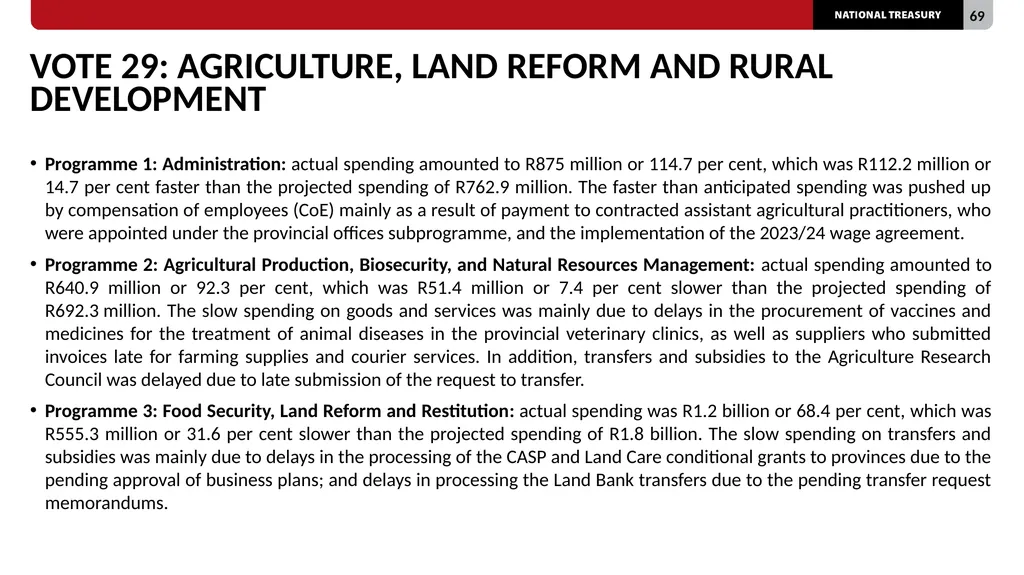
slide69. VOTE 29: AGRICULTURE, LAND REFORM AND RURAL DEVELOPMENT Programme 1: Administration: actual spending amounted to R875 million or 114.7 per cent, which was R112.2 million or 14.7 per cent faster than the projected spending of R762.9 million. The faster than anticipated spending was pushed up by compensation of employees (CoE) mainly as a result of payment to contracted assistant agricultural practitioners, who were appointed under the provincial offices subprogramme, and the implementation of the 2023/24 wage agreement.
Programme 2: Agricultural Production, Biosecurity, and Natural Resources Management: actual spending amounted to R640.9 million or 92.3 per cent, which was R51.4 million or 7.4 per cent slower than the projected spending of R692.3 million. The slow spending on goods and services was mainly due to delays in the procurement of vaccines and medicines for the treatment of animal diseases in the provincial veterinary clinics, as well as suppliers who submitted invoices late for farming supplies and courier services. In addition, transfers and subsidies to the Agriculture Research Council was delayed due to late submission of the request to transfer.
Programme 3: Food Security, Land Reform and Restitution: actual spending was R1.2 billion or 68.4 per cent, which was R555.3 million or 31.6 per cent slower than the projected spending of R1.8 billion. The slow spending on transfers and subsidies was mainly due to delays in the processing of the CASP and Land Care conditional grants to provinces due to the pending approval of business plans; and delays in processing the Land Bank transfers due to the pending transfer request memorandums.<br>
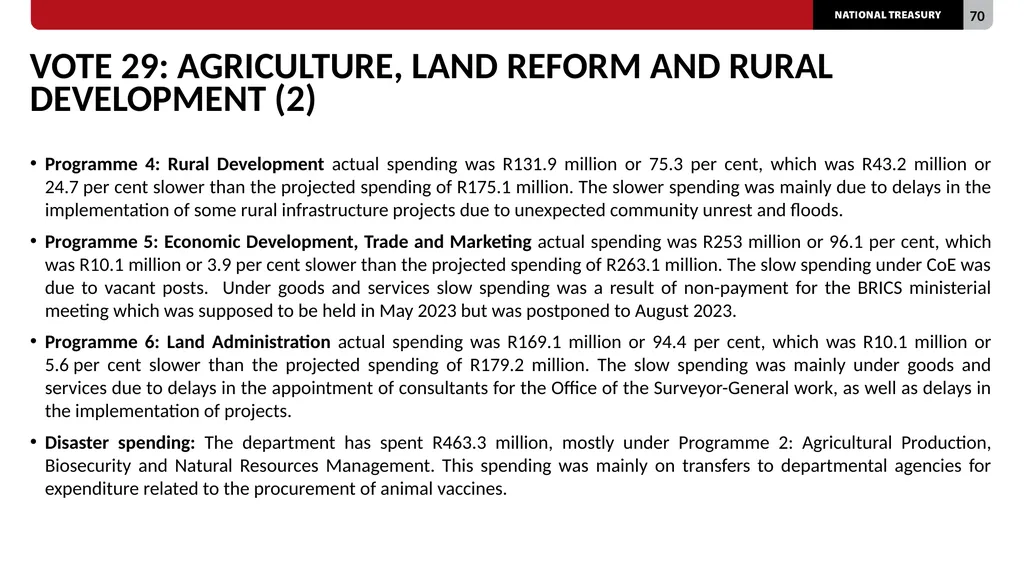
slide70. VOTE 29: AGRICULTURE, LAND REFORM AND RURAL DEVELOPMENT (2) Programme 4: Rural Development actual spending was R131.9 million or 75.3 per cent, which was R43.2 million or 24.7 per cent slower than the projected spending of R175.1 million. The slower spending was mainly due to delays in the implementation of some rural infrastructure projects due to unexpected community unrest and floods.
Programme 5: Economic Development, Trade and Marketing actual spending was R253 million or 96.1 per cent, which was R10.1 million or 3.9 per cent slower than the projected spending of R263.1 million. The slow spending under CoE was due to vacant posts. Under goods and services slow spending was a result of non-payment for the BRICS ministerial meeting which was supposed to be held in May 2023 but was postponed to August 2023.
Programme 6: Land Administration actual spending was R169.1 million or 94.4 per cent, which was R10.1 million or 5.6 per cent slower than the projected spending of R179.2 million. The slow spending was mainly under goods and services due to delays in the appointment of consultants for the Office of the Surveyor-General work, as well as delays in the implementation of projects.
Disaster spending: The department has spent R463.3 million, mostly under Programme 2: Agricultural Production, Biosecurity and Natural Resources Management. This spending was mainly on transfers to departmental agencies for expenditure related to the procurement of animal vaccines.<br>
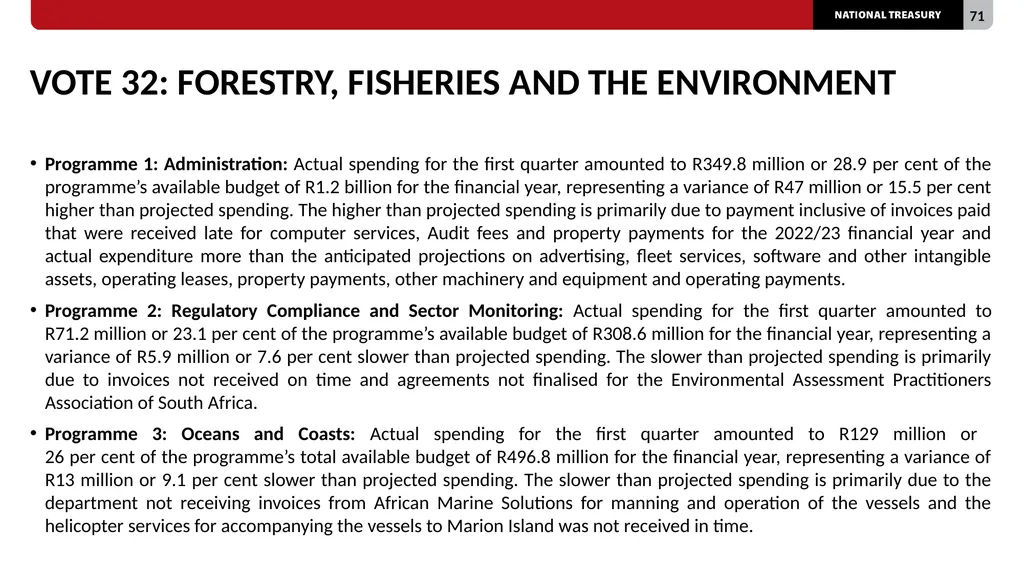
slide71. VOTE 32: FORESTRY, FISHERIES AND THE ENVIRONMENT Programme 1: Administration: Actual spending for the first quarter amounted to R349.8 million or 28.9 per cent of the programme’s available budget of R1.2 billion for the financial year, representing a variance of R47 million or 15.5 per cent higher than projected spending. The higher than projected spending is primarily due to payment inclusive of invoices paid that were received late for computer services, Audit fees and property payments for the 2022/23 financial year and actual expenditure more than the anticipated projections on advertising, fleet services, software and other intangible assets, operating leases, property payments, other machinery and equipment and operating payments.
Programme 2: Regulatory Compliance and Sector Monitoring: Actual spending for the first quarter amounted to R71.2 million or 23.1 per cent of the programme’s available budget of R308.6 million for the financial year, representing a variance of R5.9 million or 7.6 per cent slower than projected spending. The slower than projected spending is primarily due to invoices not received on time and agreements not finalised for the Environmental Assessment Practitioners Association of South Africa.
Programme 3: Oceans and Coasts: Actual spending for the first quarter amounted to R129 million or 26 per cent of the programme’s total available budget of R496.8 million for the financial year, representing a variance of R13 million or 9.1 per cent slower than projected spending. The slower than projected spending is primarily due to the department not receiving invoices from African Marine Solutions for manning and operation of the vessels and the helicopter services for accompanying the vessels to Marion Island was not received in time.<br>
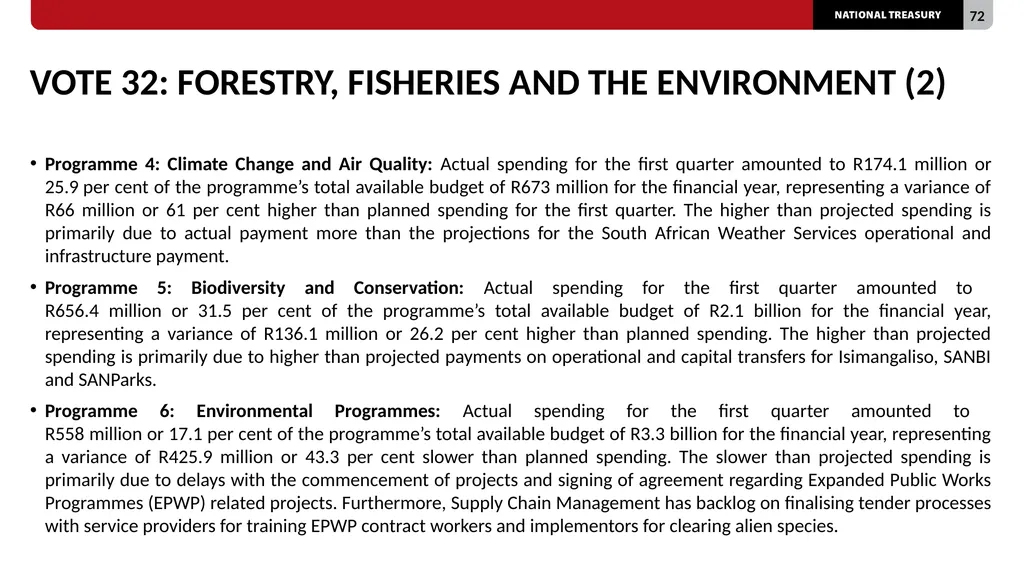
slide72. VOTE 32: FORESTRY, FISHERIES AND THE ENVIRONMENT (2) Programme 4: Climate Change and Air Quality: Actual spending for the first quarter amounted to R174.1 million or 25.9 per cent of the programme’s total available budget of R673 million for the financial year, representing a variance of R66 million or 61 per cent higher than planned spending for the first quarter. The higher than projected spending is primarily due to actual payment more than the projections for the South African Weather Services operational and infrastructure payment.
Programme 5: Biodiversity and Conservation: Actual spending for the first quarter amounted to R656.4 million or 31.5 per cent of the programme’s total available budget of R2.1 billion for the financial year, representing a variance of R136.1 million or 26.2 per cent higher than planned spending. The higher than projected spending is primarily due to higher than projected payments on operational and capital transfers for Isimangaliso, SANBI and SANParks.
Programme 6: Environmental Programmes: Actual spending for the first quarter amounted to R558 million or 17.1 per cent of the programme’s total available budget of R3.3 billion for the financial year, representing a variance of R425.9 million or 43.3 per cent slower than planned spending. The slower than projected spending is primarily due to delays with the commencement of projects and signing of agreement regarding Expanded Public Works Programmes (EPWP) related projects. Furthermore, Supply Chain Management has backlog on finalising tender processes with service providers for training EPWP contract workers and implementors for clearing alien species.<br>
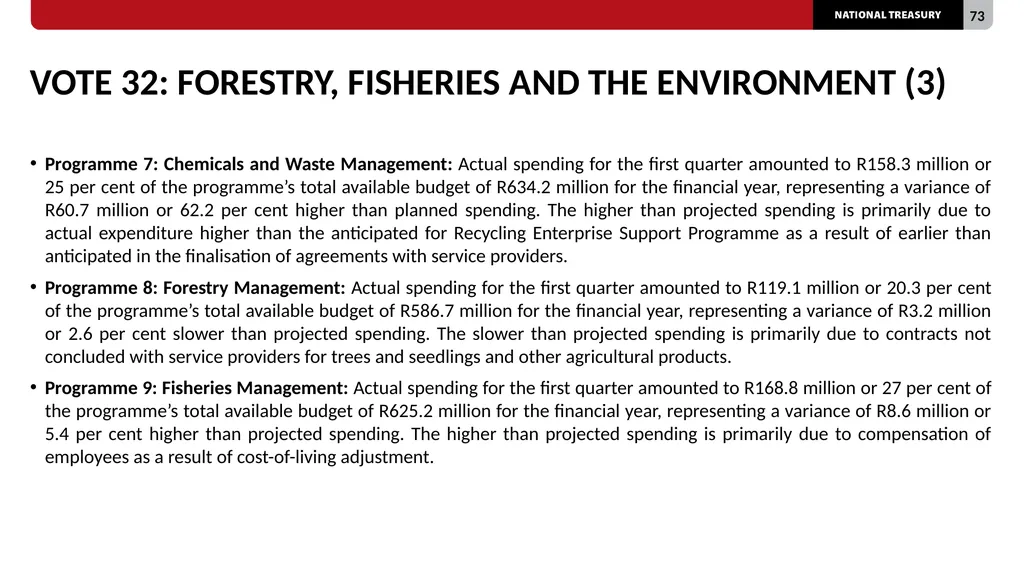
slide73. VOTE 32: FORESTRY, FISHERIES AND THE ENVIRONMENT (3) Programme 7: Chemicals and Waste Management: Actual spending for the first quarter amounted to R158.3 million or 25 per cent of the programme’s total available budget of R634.2 million for the financial year, representing a variance of R60.7 million or 62.2 per cent higher than planned spending. The higher than projected spending is primarily due to actual expenditure higher than the anticipated for Recycling Enterprise Support Programme as a result of earlier than anticipated in the finalisation of agreements with service providers.
Programme 8: Forestry Management: Actual spending for the first quarter amounted to R119.1 million or 20.3 per cent of the programme’s total available budget of R586.7 million for the financial year, representing a variance of R3.2 million or 2.6 per cent slower than projected spending. The slower than projected spending is primarily due to contracts not concluded with service providers for trees and seedlings and other agricultural products.
Programme 9: Fisheries Management: Actual spending for the first quarter amounted to R168.8 million or 27 per cent of the programme’s total available budget of R625.2 million for the financial year, representing a variance of R8.6 million or 5.4 per cent higher than projected spending. The higher than projected spending is primarily due to compensation of employees as a result of cost-of-living adjustment.<br>
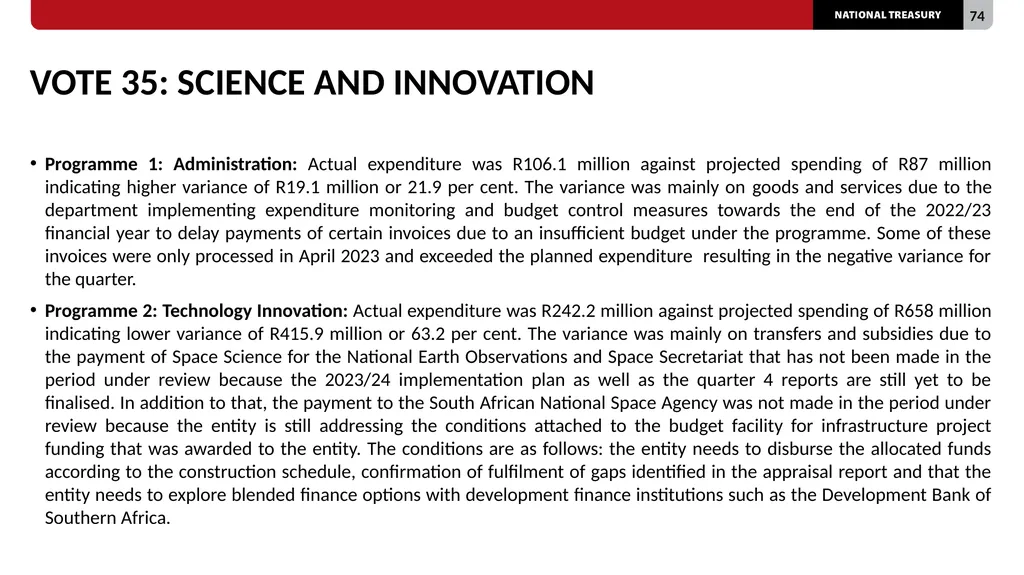
slide74. VOTE 35: SCIENCE AND INNOVATION Programme 1: Administration: Actual expenditure was R106.1 million against projected spending of R87 million indicating higher variance of R19.1 million or 21.9 per cent. The variance was mainly on goods and services due to the department implementing expenditure monitoring and budget control measures towards the end of the 2022/23 financial year to delay payments of certain invoices due to an insufficient budget under the programme. Some of these invoices were only processed in April 2023 and exceeded the planned expenditure resulting in the negative variance for the quarter.
Programme 2: Technology Innovation: Actual expenditure was R242.2 million against projected spending of R658 million indicating lower variance of R415.9 million or 63.2 per cent. The variance was mainly on transfers and subsidies due to the payment of Space Science for the National Earth Observations and Space Secretariat that has not been made in the period under review because the 2023/24 implementation plan as well as the quarter 4 reports are still yet to be finalised. In addition to that, the payment to the South African National Space Agency was not made in the period under review because the entity is still addressing the conditions attached to the budget facility for infrastructure project funding that was awarded to the entity. The conditions are as follows: the entity needs to disburse the allocated funds according to the construction schedule, confirmation of fulfilment of gaps identified in the appraisal report and that the entity needs to explore blended finance options with development finance institutions such as the Development Bank of Southern Africa.<br>
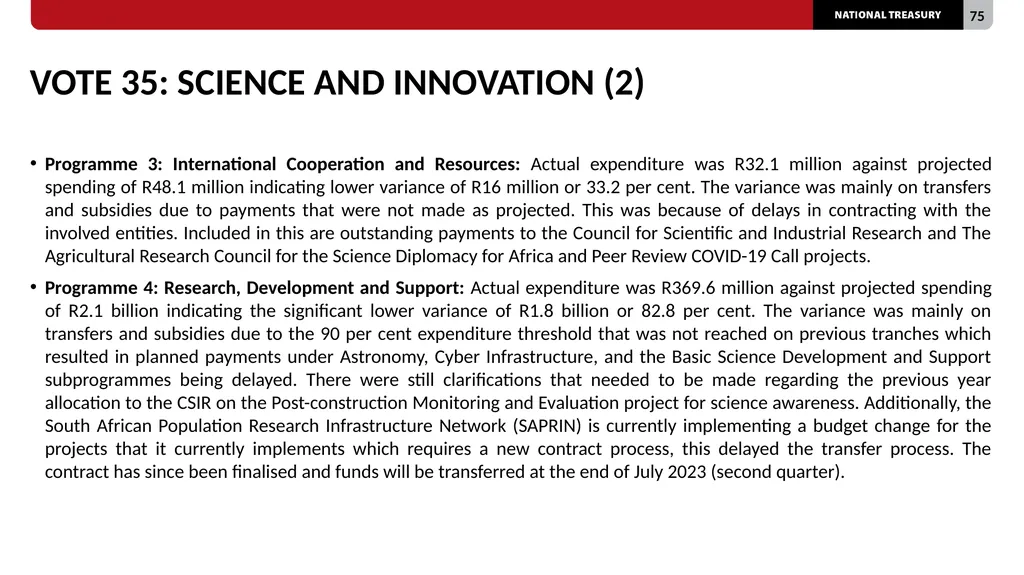
slide75. VOTE 35: SCIENCE AND INNOVATION (2) Programme 3: International Cooperation and Resources: Actual expenditure was R32.1 million against projected spending of R48.1 million indicating lower variance of R16 million or 33.2 per cent. The variance was mainly on transfers and subsidies due to payments that were not made as projected. This was because of delays in contracting with the involved entities. Included in this are outstanding payments to the Council for Scientific and Industrial Research and The Agricultural Research Council for the Science Diplomacy for Africa and Peer Review COVID-19 Call projects.
Programme 4: Research, Development and Support: Actual expenditure was R369.6 million against projected spending of R2.1 billion indicating the significant lower variance of R1.8 billion or 82.8 per cent. The variance was mainly on transfers and subsidies due to the 90 per cent expenditure threshold that was not reached on previous tranches which resulted in planned payments under Astronomy, Cyber Infrastructure, and the Basic Science Development and Support subprogrammes being delayed. There were still clarifications that needed to be made regarding the previous year allocation to the CSIR on the Post-construction Monitoring and Evaluation project for science awareness. Additionally, the South African Population Research Infrastructure Network (SAPRIN) is currently implementing a budget change for the projects that it currently implements which requires a new contract process, this delayed the transfer process. The contract has since been finalised and funds will be transferred at the end of July 2023 (second quarter).<br>
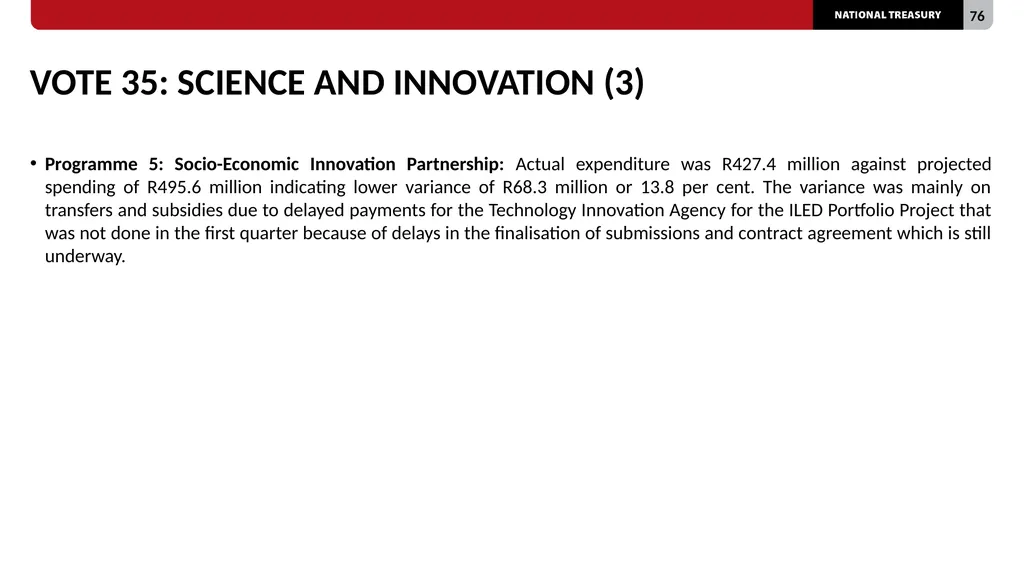
slide76. VOTE 35: SCIENCE AND INNOVATION (3) Programme 5: Socio-Economic Innovation Partnership: Actual expenditure was R427.4 million against projected spending of R495.6 million indicating lower variance of R68.3 million or 13.8 per cent. The variance was mainly on transfers and subsidies due to delayed payments for the Technology Innovation Agency for the ILED Portfolio Project that was not done in the first quarter because of delays in the finalisation of submissions and contract agreement which is still underway.<br>
slide77. VOTE 36: SMALL BUSINESS DEVELOPMENT Programme 1: Administration: Spending was R28.5 million or 89.3 per cent compared to the projected spending of R32 million at the end of quarter one, indicating slower spending of R3.4 million (10.7 per cent). This was mainly attributable to the slow spending on compensation of employees, resulting from vacancies.
Programme 2: Sector and Market Development: Spending was R19.6 million or 105 per cent compared to the projected spending of R18.7 million, indicating faster spending of R900 000 (5 per cent). The faster than projected spending on this programme was under payment for capital assets due to a payment made to Volkswagen of SA for two Ministerial vehicles that were ordered in July 2022, but were only received and paid for in the first quarter of 2023 due to delays in the production of vehicles.
Programme 3: Development Finance: Spending was R291.2 million or 95.6 per cent compared to the projected spending of R304.6 million, indicating slower spending of R13.4 million (4.4 per cent). The department's decision to move the implementation of the Cooperatives Development Support Programme (CDSP) together with funds from Sefa to Seda before the President assented to the 2023 Appropriation Act, has led to delays in the implementation of the CDSP and slow spending under the programme. The other key reason for the slower than anticipated spending was due to funds that were not transferred for the CCSP, as a result of delays in finalizing the Memorandum of Agreements with agencies that are approved to implement the programme in the 2023/24 financial year.<br>
slide78. VOTE 36: SMALL BUSINESS DEVELOPMENT (2) Programme 4: Enterprise Development: Spending was R292.4 million or 99.07 per cent compared to the projected spending of R293.4 million by the end of quarter one, indicating slower spending of R1 million (0.3 per cent). The slower spending was mainly on goods and services due to a delay in processing the Microsoft annual license renewal invoice.<br>
slide79. VOTE 38: TOURISM Programme 1: Administration: Expenditure for quarter 1 amounted to R75.8 million or 23.3 per cent of the programme’s available budget of R324.9 million. This translates to a slowspending of R1.6 million or 2.1 per cent relative to the projected expenditure of R77.4 million, due to slow spending in operational payments within the Corporate Management subprogramme together with payments linked to office accommodation, due to delayed invoices from Department of Public Works and Infrastructure.
Programme 2: Tourism Research, Policy and International Relations: Expenditure for quarter 1 amounted to R606.1 million or 42.2 per cent of the programme’s available budget of R1.4 billion. This translates to a slowspending of R360.7 million or 37.3 per cent relative to the projected expenditure of R966.8 million, due to reduced transfer payments to the South African Tourism, this is in line with lower than anticipated funding requirements by the entity as well as delays in transfer payments to the United Nations World Tourism Organisation to defray foreign exchange losses, the transfer required a virement process.
Programme 3: Destination Development: Expenditure for quarter 1 amounted to R50.8 million or 12.7 per cent of the programme’s total available budget of R401.1 million. This translates to a slowspending of R93.1 million or 64.7 per cent relative to the projected expenditure of R143.9 million, due to slow spending within the Expanded Public Works Programmes owing to delays in receiving invoices and signing of contracts with implementing agencies.<br>
slide80. VOTE 38: TOURISM (2) Programme 4: Tourism Sector Support Services: Expenditure for quarter 1 amounted to R37.3 million or 10.3 per cent of the programme’s total available budget of R363 million. This translates to a slowspending of R22.1 million or 37.2 relative to the projected expenditure of R59.4 million due to delays in receiving invoices and signing of contracts with implementing agencies for implementation of the Tourism Incentives Programme, together with delayed payments to the Federated Hospitality Association of South Africa and the National Tourism Careers Expo.<br>
slide81. VOTE 39: TRADE, INDUSTRY AND COMPETITION Programme 1: Administration: Spending was R28.3 million or 16.2 per cent higher than projection. This occurred mainly on compensation of employees due to the payment of the cost-of-living salary adjustment, accounting adjustment for capital project for the new server infrastructure which payment was made in the previous financial year while expenditure under goods and services was recognised in the period under review, and payment under households made to employees that exited the department.
Programme 2: Trade: Expenditure was R500 thousand or 0.3 per cent lower than the projection. This was mainly due to transfer payment to the Council for Geoscience that could not be processed as planned because of non-compliance. There was slow spending to note on payment for capital assets due to the procurement of computer equipment that is yet to be finalised.
Programme 3: Investment and Spatial Industrial Development: Expenditure was R3.5 million or 7.1 per cent higher than projection. This was due to cost-of-living adjustment on compensation of employees, and cost of hosting meetings/engagements conducted in person under goods and services not initially projected.
Programme 4: Sectors: Expenditure was R30.8 million or 3 per cent lower than projection. The under spending was mainly due to the transfer payment to the Intsimbi: Future Production Technologies Initiative which could not be processed as planned due to non-compliance.<br>
slide82. VOTE 39: TRADE, INDUSTRY AND COMPETITION (2) Programme 5: Regulation: Expenditure was R2.3 million or 0.8 per cent higher than projection. This was due to cost-of-leaving adjustment under compensation of employees, payment for the National Liquor Authority Case Management System, and cost of holding in-person meetings and engagements under goods and services that was not initially planned.
Programme 6: Incentives: Expenditure was R7.4 million or 0.8 per cent higher than projection. This was due to accounting adjustment on a transaction relating to the transfer payment: Export Marketing and Investment Assistance (EMIA) Programme that had to adhere to the new Modified Cash Standard (MCS) which came into effect from 1 April 2023.
Programme 7: Export: Expenditure was R400 thousand or 0.2 per cent lower than projection due to outstanding expenditure claims at foreign missions.
Programme 8: Transformation and Competition: Expenditure was R2.4 million or 0.2 per cent lower than the projection. This occurred mainly on compensation of employees due to vacant posts. Payment to the Black Business Council could not be process due to non-compliance, and there was slow spending on goods and services as the programme continued utilising virtual platforms for some business meetings and engagements.
Programme 9: Research: Expenditure was R3.7 million or 26.6 per cent lower than projection for the programme. This was mainly due slow spending on compensation of employees due to vacant posts and goods and services as the department continue to utilise virtual platforms to conduct business meeting and engagements.<br>
slide83. URBAN DEVELOPMENT AND INFRASTRUCTURE<br>
slide84. URBAN DEVELOPMENT AND INFRASTRUCTURE<br>
slide85. VOTE 3: COOPERATIVE GOVERNANCE The department spent R1.3 billion or 1.1 per cent of the available budget:
Programme 2: Intergovernmental Support spent R154 million or 87 per cent lower than projected, mainly due to vacancies, delays in constituting planned engagements to finalise the draft regulations in terms of the Intergovernmental Relations Framework Act and the delays in transfers to the Municipal Infrastructure Support Agent, as the agency did not timely submit a budget drawn-down request.
Programme 3: Intergovernmental Policy and Governance spent R37 million or 39.4 per cent lower than projected mainly due to delays in the inception of the Municipal Systems Improvement Grant’s projects due to governance instabilities in the targeted 21 water services authorities and delays in appointing the service provider to implement the Smart Cities Framework.
Programme 4: National Disaster Management Centre spent R117.5 million or 47.9 per cent higher than projected as higher than expected transfers on the Municipal Disaster Response Grant due to heavy rains that caused floods affecting 46 municipalities in 6 provinces earlier this year.
Programme 5: Community Work Programme spent R218.4 million or 20.9 per cent lower than projected due to the termination of the implementing agent contracts. The department will be taking over the implementation of the programme.<br>
slide86. VOTE 15: TRADITIONAL AFFAIRS The department spent R44.3 million or 22.9 per cent of the total available budget of R193.1 million. Spending is R3.3 million or 6.8 per cent lower than the projected expenditure of R47.5 million.
Programme 1: Administration spent R600 000 or 3.6 per cent lower than projected mainly due to the vacant positions as well as the procurement process of risk management software as it is not yet finalised.
Programme 2: Research, Policy and Legislation spent R2.2 million or 26.3 per cent lower than projected, mainly driven by the vacant positions. Additionally, the publishing process of the gazette to determine the number of kingship/queenship, and principal traditional council is yet to be finalised.
Programme 3: Institutional Support and Coordination spent R500 000 or 2 per cent lower than projected mainly due to vacant positions that were not filled and planned provincial physical meetings relating to the National Initiation Oversight Committee, held virtually.<br>
slide87. VOTE 30: COMMUNICATIONS AND DIGITAL TECHNOLOGIES The Department spent R662 million or 18.8 per cent of the total budget. Spending at the end of the first quarter is R141.3 million or 17.6 per cent lower than projected.
Programme 4: ICT Enterprise and Public Entity Oversight spent R496.2 million against a projection of R396.9 million. Spending is R99.3 million or 25 per cent higher than project, mainly due to the financial challenges that SAPO is currently facing. SAPO approached the department to request for an advance from funds that were scheduled for a second quarter drawdown amounting to R131 million that was scheduled to be paid in July as per approved drawings. The department will transfer the difference during the month of July in this regard. The department has remained within its overall drawings allocation while performing this transfer.
Programme 5: ICT Infrastructure Development and Support spent R83.4 million against a projection of R276.5 million. Spending is R193 million or 69.8 per cent lower than projected SITA’s SA Connect Phase 1 invoices that are yet to be paid as the new government order was undergoing the approval process. According to the department, the order has since been approved and the processing of payment is underway. SA Connect Phase 2 implementation plans from implementing entities have not yet been finalised or approved to enable payment.<br>
slide88. VOTE 33: HUMAN SETTLEMENTS The department spent R4.2 billion or 12.1 per cent of the available budget of R34.9 billion. Spending is R2.2 billion or 33.8 per cent lower than projected
Integrated Human Settlements Planning and Development programme spent R762.1 million or 18.1 per cent lower than projected mainly due to lower than planned transfers of the human settlements development grant. The first quarter transfers were adjusted downwards to align with the approved payment schedule which was only finalised in April.
Informal Settlements programme spent R877.9 million or 60.2 per cent lower than projected mainly due to lower than planned transfers of the informal settlements upgrading partnership grant. There is also no spending on emergency housing.
Rental and Social Housing programme spent R250.4 million or 76.9 per cent lower than projected mainly due to the delayed transfers of the Social Housing Regulatory Authority (SHRA) and the significantly low spending on goods and services. The department only processed the SHRA’s operational transfer while the consolidated capital grant and institutional investment grant transfers were processed towards the end of June. Spending on goods and services amounts to only R301 106 (or 2.7 per cent) of the three-month projection of R11.3 million. Approximately 90 per cent of the quarterly estimated budget for goods and services was allocated to consultants yet the department has not incurred any expense related to the appointment of professional resource teams.<br>
slide89. VOTE 33: HUMAN SETTLEMENTS (2) Affordable Housing programme spent R18.7 million against a projection of R282.6 million. Spending is R263.8 million or 93.4 per cent lower than projected mainly due to the delayed transfer of the National Housing Finance Corporation’s: Finance Linked Individual Subsidy Programme (FLISP) allocations. The department could not verify the entity’s new banking details and as a result the transfers were not processed. The department has since made the transfer and this transaction will reflect as part of the July expenditure report.<br>
slide90. VOTE 34: MINERAL RESOURCES AND ENERGY The Department spent R1.9 billion or 17.6 per cent of the total budget. Spending at the end of the first quarter is R26 million or 1.4 per cent lower than projected
Programme 1: Administration spent R20.4 million or 14.9 per cent higher than projected due to costs carried over from the previous financial year due to the late submission of invoices by the Department of Public Works and Infrastructure (DPWI) for office accommodation.
Programme 2: Minerals and Petroleum Regulation spent R4.9 million or 3.7 per cent higher than projected mainly due to delayed legal claims carried over from the previous financial year and received late from the Department of Justice and Constitutional Development. Higher spending on transfers and subsidies is due to a payment of 2023/24 membership fees to the African Petroleum Producers' Organization (APPO) which was higher than the amount budgeted for. There was also higher spending on compensation of employees due to overtime payments carried forward from 2022/23 financial year.
Programme 5: Mineral and Energy Resources Programmes and Projects spent R42.1 million or 8.6 per cent lower than projected mainly on operating payments due to the ongoing arbitration processes with the suppliers which have resulted in delaying payments for the storage of the solar water heater storage fees.<br>
slide91. VOTE 40: TRANSPORT The department spent R17.2 billion against a projection of R18.1 billion. Spending is R876.1 million or 4.8 per cent lower than projected.
Programme 4: Road Transport spent R748.8 million lower than projected due to the transfer to the Road Traffic Infringement Agency that was not made for the administrative adjudication of road traffic offences roll-out and payments not made on the Provincial Roads Maintenance Grant for the refurbishment component as the conditions of the component have not been met.<br>
slide92. VOTE 41: WATER AND SANITATION The department spent R3.1 billion or 13.8 per cent of the available budget of R22.3 billion. This equates to a lower than projected spending of R526.8 million or 41.6 per cent.
Programme 2: Water Resources Management spent R145 million or 7.5 per cent lower than projected, mainly due to payment to the Komati Basin Water Authority that was expected to be made in the first quarter but will only be done in September 2023. The department also expected to pay for digital monitoring equipment and the development and establishment of surface water monitoring network project in the first quarter of the year, but this is only expected to be completed in the third quarter.
Programme 3: Water Services Management spent R372.5 million or 33.1 per cent lower than projected, mainly due to vacant posts, transfers to water boards not made as project reallocations are being finalised and the lower spending of the indirect Regional Bulk Infrastructure and Water Services Infrastructure Grants due to the non-processing of invoices.<br>
DR MAMPHO
MODISE
Title: DDG
Public Finance
Date: August 2023<br>
slide2. CONTENTS Summary of spending
Spending outcome by Chief Directorate grouping:
Administrative Services
Education and Related departments
Health and Social Development
Protection Services
Economic Services
Urban Development and Infrastructure<br>
slide3. ADMINISTRATIVE SERVICES Vote 1: Presidency
Vote 4: Government Communication and Information System
Vote 5: Home Affairs
Vote 6: International Relations and Cooperation
Vote 7: National School of Government
Vote 8: National Treasury
Vote 9: Planning, Monitoring and Evaluation
Vote 11: Public Service and Administration
Vote 12: Public Service Commission
Vote 13: Public Works and Infrastructure
Vote 14: Statistics South Africa<br>
slide4. ADMINISTRATIVE SERVICES<br>
slide5. ADMINISTRATIVE SERVICES<br>
slide6. ADMINISTRATIVE SERVICES HIGHLIGHTS Vote 4: Government Information and Communication System
The following programmes contributed to the spending trends in the department
Programme 2: Content Processing and Dissemination –reported an actual expenditure of R99.1 million or 23.2 percent of its 2023/24 available budget allocation of R428 million. The reported expenditure translates to lower than projected spending of R11.7 million or 10.6 percent, mainly on goods and services due to procurement delays relating to marketing national priority campaigns (Gender-based violence, Anti-corruption, and Economic recovery campaigns).
Programme 3: Intergovernmental Coordination and Stakeholder Management –spent R33.2 million or 26.8 percent of its 2023/24 available budget allocation of R123.7 million as at the end of June 2023. The expenditure was R1.5 or 4.7 percent higher than the programme’s projected expenditure for the period under review. The higher than projected spending was mainly on travel and subsistence in support of Presidential Imbizos in various provinces, and compensation of employees mainly due to processing payments for salary increments.<br>
slide7. ADMINISTRATIVE SERVICES HIGHLIGHTS Vote 5: Home Affairs
The department’s overall expenditure as at the end of first quarter of 2023/24 amounted to R2.8 billion or 25.5 per cent of the available budget. The department recorded higher than projected expenditure of R272.8 million or 10.9 per cent across programmes mainly from programme 2 and 3 mainly under goods and services and payments for capital assets. However, lower than projected expenditure is recorded under compensation of employees and transfers and subsidies.<br>
slide8. ADMINISTRATIVE SERVICES HIGHLIGHTS Programme 3: Immigration Affairs
The programme’s higher than projected expenditure of R28.9 million or 17.2 per cent is mainly due to payment for deportation of illegal immigrants that is higher than anticipated; payments for the Permitting backlog project where by the branch had to accommodate all the officials that are to be deployed to the Mission as part of their training to work on the backlog; payment for Legal invoices were received and paid during this period and the payment for APP SITA the overspending is due to the billing of these services being done on Foreign currency.<br>
slide9. ADMINISTRATIVE SERVICES HIGHLIGHTS Vote 6: International Relations and Cooperation
The Department of International Relations and Cooperation has spent R2.089 billion or 31.2 per cent of its 2023/24 budget allocation of R6.694 billion as at the end of June 2023. The R2.089 billion in actual spending to date is R51.3 million lower than the projected expenditure of R2.140 billion. The lower than projected expenditure is mainly attributed to low spending on goods and services and transfers and subsidies.
Low spending on goods and services is due to lower than planned receipts of invoices for operating payments, operating leases, and property payments. The underspending on transfers and subsidies is as a result of the non-payment of funds to the Comprehensive Nuclear-Test Ban Treaty arising from the outstanding requisite assessment letter for membership fees, and lower than projected payments to the Southern African Development Community and African Union for membership fees as a result of the appreciation of the Rand against the relevant major currencies at the time the payments were made.<br>
slide10. ADMINISTRATIVE SERVICES HIGHLIGHTS Vote 7: National School of Government
The National School of Government spent R54.5 million or 23.8 per cent of its 2023/24 available budget allocation of R229 million as at the end of June 2023. The R54.5 million in actual spending is R1.9 million lower than the projected spending of R56.4 million. The lower than planned spending is mainly evident in the budgets for compensation of employees and transfers and subsidies.
The lower than planned spending on compensation of employees is as a result of funded vacant positions. Lower than planned spending on transfers and subsidies is attributed to the non-transfer of the planned transfer payment to the National School of Government’s training trading account due to a breakdown of the payment system.<br>
slide11. ADMINISTRATIVE SERVICES HIGHLIGHTS Vote 8: National Treasury
The department projected to spend R8.909 billion as at the end of the first quarter of 2023/24. The actual expenditure amounted to R7.934 billion, which is R975 million or 10.9 per cent lower than the projected expenditure for the period under review. The lower than anticipated spending was mainly due to the Land and Agricultural Development Bank of South Africa for which negotiations are still ongoing with the lenders regarding the liability solution. The payment to the bank is anticipated to be made in the fourth quarter of 2023/24 once the negotiations are concluded.<br>
slide12. ADMINISTRATIVE SERVICES HIGHLIGHTS Vote 9: Planning, Monitoring and Evaluation
The Department of Planning, Monitoring and Evaluation (DPME) spent R98.4 million or 20.7 per cent of its 2023/24 available budget allocation of R475.8 million. The R98.4 million in actual spending was R15.9 million or 13.9 per cent lower than the projected expenditure, mainly reported under goods and services due to outstanding invoices for the two leased office buildings, the Presidential hotline, and the delays in the implementation of the Centralised Data Management System (CDMAS) projects.
DPME also incurred lower than projected spending of R4.1 million or 5.1 per cent on compensation of employees due to vacant funded positions. In addition, the DPME incurred lower than the projected expenditure of R300 000 on payments capital assets affected by the delays in the appointment of a service provider for the Local Government Management Improvement Model.<br>
slide13. ADMINISTRATIVE SERVICES HIGHLIGHTS Vote 11: Public Service and Administration
Lower than projected spending by R19.9 million in 2023/24 is mainly evident in:
compensation of employees, as a result of funded vacant senior management posts, and
goods and services, due to delays in the department’s receipt and processing of invoices from services providers.<br>
slide14. ADMINISTRATIVE SERVICES HIGHLIGHTS Vote 12: Public Service Commission
The Public Service Commission spent R79.8 million or 27.3 per cent of its 2023/24 available budget allocation of R29.1 million as at the end of June 2023. The R79.8 million in actual spending is R6.3 million higher than the projected expenditure of R73.5 million for this period. The higher than projected expenditure is mainly in the budgets for compensation of employees and goods and services. The higher than planned spending on compensation of employees is attributed to the implementation of the cost-of-living upward adjustments which had not been budgeted for. The higher than projected expenditure in the budget for goods and services, specifically on travel and subsistence, arose from accrued invoices (specifically for accommodation and travel and subsistence) for five citizen forums which took place towards the end of the 2022/23 financial year, which were settled in June 2023.<br>
slide15. ADMINISTRATIVE SERVICES HIGHLIGHTS Vote 13: Public Works and Infrastructure
Lower than projected spending by R372.5 million in 2023/24 is mainly evident in programmes 2, 3, 4 and 5. At the economic classification level, it is mainly evident in the budget under transfers and subsidies for transfer payments to the Expanded Public Works Programme (EPWP). This is due to the withholding of transfer payments for the EPWP as a result of implementers’ non-compliance with the requirements of the Division of Revenue Act (DoRA).
Higher than projected expenditure is evident in programme 1 under compensation of employees because of the unbudgeted for additional payment for salaries and wages attending the implementation of the 2023 public service wage agreement, which caused a shortfall in the department’s budget for compensation of employees.<br>
slide16. ADMINISTRATIVE SERVICES HIGHLIGHTS Vote 14: Statistics South Africa
The department spent R702.2 million or 26.1 per cent of its total available budget of R2.692 billion in the first quarter of 2023/24. The reported expenditure represents a higher than projected spending of R33.9 million or 5.1 per cent, mainly attributed to goods and services which reported a higher than projected spending of R29.6 million or 20.9 per cent against a projected spending of R141.6 million.
The higher than projected spending on goods and services was mainly due to payments of accrued software licences renewal. The department also incurred a higher than anticipated spending of R1.9 million or 2.3 per cent on payments for capital assets due to payment of machinery and equipment, which was not paid for in 2022/23 due to delayed invoices from suppliers.
In addition, the department incurred a higher than anticipated expenditure of R1.2 million or 0.3 per cent on compensation of employees, due implementation of condition of living adjustment which was not budgeted for during the budget process.<br>
slide17. VOTE 1: PRESIDENCY Programme 1: Administration expenditure at the end of the first quarter amounts to R119 million or 21.8 per cent of the approved budget of R544.9 million. The programme expenditure is R12.7 million or 12 per cent higher than the projected expenditure of R106.3 million.
The higher than projected spending occurred mainly on compensation of employees, goods and services, transfers and subsidies and payments for capital assets. This is due to accruals and payables that were processed in the current year and expenditures relating to the new Ministries.
Programme 2: Executive Support expenditure at the end of the first quarter amounts to R7.2 million or 13.9 per cent of the approved budget of R51.7 million. The programme expenditure is R5.6 million or 43.7 per cent lower than the first quarter projected expenditure of R12.7 million. The underspending occurred mainly on good and services and compensation of employees due to vacancies and delays in signing of the service level agreement for the e-Cabinet system.
Programme 3: Policy and Research Services expenditure at the end of the first quarter amounts to R3.5 million or 16.9 per cent of the total available budget of R20.6 million. The programme expenditure is R0.6 million or 14.9 per cent lower than the first quarter projected expenditure of R4.1 million. The underspending occurred mainly on compensation of employees due to vacancies within the programme.<br>
slide18. VOTE 4: GOVERNMENT COMMUNICATION AND INFORMATION SYSTEM The Government Communication and Information System (GCIS) spent R179.8 million or 23.9 percent of its 2023/24 available budget allocation of R750.7 million. The spending was R10.2 million or 5.4 percent lower than the department’s projected spending, mainly under goods and services, which spent R12.1 million or 21.6 percent lower against a projected spending of R55.8 million mainly under National priority campaigns (Gender-based violence, Anti-corruption, and Economic recovery campaigns) as a result of procurement delays.
Furthermore, the department incurred lower than projected spending on payments for capital assets mainly due to delays in the procurement of computer equipment.
Whilst noting the overall lower than projected spending, the GCIS also incurred higher than projected spending on compensation of employees mainly due to processing payments for salary following the Public Service Co-ordinating Bargaining Council resolution 2 of 2023.<br>
slide19. VOTE 5: HOME AFFAIRS Programme 1: Administration: The programme’s higher than projected expenditure of R12.9 million or 1.7 per cent is mainly due to as an interim measure of the department that has a shared service agreement with Border Management Authority (BMA) and this results expenditure that is being paid under financial services that will later be claimed back from BMA also under payment for legal services due to high level of caseload than projected.
Programme 2: Citizen Affairs: The programme’s higher than projected expenditure of R224.2 million or 27 per cent is mainly due to expenditure incurred on the printing of face value forms for the front offices, as well as courier services for the delivering of identity and passport documents to offices and that this expenditure is paid through self-financing which will only be approved and allocated during the 2023 AENE process.
Programme 3: Immigration Affairs: The programme’s higher than projected expenditure of R28.9 million or 17.2 per cent is mainly due to payment for deportation of illegal immigrants that is higher than anticipated; payments for the Permitting backlog project where by the branch had to accommodate all the officials that are to be deployed to the Mission as part of their training to work on the backlog; payment for Legal invoices were received and paid during this period and the payment for APP SITA the overspending is due to the billing of these services being done on Foreign currency.<br>
slide20. VOTE 6: INTERNATIONAL RELATIONS AND COOPERATION Programme 1: Administration spent R427.3 million or 0.5 per cent higher than the projected spending of R425.1 million. The R427.3 million in actual spending is R2.2 million higher than the projected expenditure of R425.1 million. The higher than projected spending is mainly on the budget for payments for capital assets. Higher than projected spending on the budget for payments for capital assets is due to payments for the Global Wan network equipment which were planned to take place in April but only happened in June.
Programme 2: International Relations spent R970 million or 3.3 per cent lower than the projected spending of R1.004 billion. The R970 million in actual expenditure is R33.6 million lower than the projected expenditure, mainly because of low spending on the goods and services’ budget. Lower than planned spending on goods and services is mainly on operating leases and operating payments for missions abroad whose actual cost turned out lower than the planned budget for the services in question.
Programme 3: International Cooperation spent R151.3 million or 6 per cent lower than the projected spending of R160.9 million. The R151.3 million in actual expenditure is R9.6 million lower than the projected expenditure. Lower than planned expenditure is evident under goods and services, mainly as a result of invoices for property payments, operating payments and travel and subsistence whose actual value turned out lower than projections.<br>
slide21. VOTE 6: INTERNATIONAL RELATIONS AND COOPERATION (2) Programme 4: Public Diplomacy and Protocol Services spent R74.4 million or 22.5 per cent higher than the projected spending of R60.7 million. The R74.4 million in actual spending is R13.7 million higher than the projected spending, mainly on the budget for compensation of employees and goods and services (specifically on travel and subsistence). Higher than planned spending on compensation of employees is because of the implementation of the cost-of-living upward adjustments which had not been budgeted for. The high spending on travel and subsistence is due to the higher than planned number of official visits, as well as the Rand depreciation against the relevant major currencies experienced at the time of payment for travel and subsistence.
Programme 5: International Transfers spent R463.8 million or 5.4 per cent lower than the projected spending of R490.4 million which translates into an underspending of R26.6 million. The lower than projected spending is mainly on transfers and subsidies (international organisations), and arose from the non-payment of funds to the Comprehensive Nuclear-Test Ban Treaty due to the outstanding requisite assessment letter for membership fees, as well lower than projected payments to the Southern African Development Community and African Union for membership fees emanating from the appreciation of the Rand against the relevant major currencies at the time the payments were made.<br>
slide22. VOTE 7: NATIONAL SCHOOL OF GOVERNMENT Programme 1: Administration spent R27.3 million or 0.6 per cent lower than the projected spending of R27.5 million. The lower than projected expenditure is mainly in the budget for compensation of employees and is attributed to vacant funded positions.
Programme 2: Public Sector Organisational and Staff Development transferred R27.2 million or 6 per cent lower than the projected transfer payment of R28.9 million to the National School of Government’s Training Trading Entity for the first quarter. Lower than planned spending on transfers and subsidies is attributed to the non-transfer of the planned transfer payment to the National School of Government’s training trading account due to a breakdown of the payment system.<br>
slide23. VOTE 8: NATIONAL TREASURY The following programme contributed to the lower spending in the department:
Programme 1: Administration: Expenditure under this programme was lower than projected by R19.9 million or 15.5 per cent, mainly on compensation of employees due to vacant positions, for which the recruitment process is still ongoing, and on computer services relating to the delays in the finalisation of State of Work (SOW). Due to the complexity of the agreement, onboarding is required from various business units, and it is anticipated spending will commence on the SOW once the onboarding has been finalised.
Programme 4: Asset and Liability Management: Expenditure under this programme was lower than projected by R1 billion or 96.7 per cent, mainly in relation to equity injection into the Land and Agricultural Development Bank of South Africa for which negotiations are still ongoing with the lenders regarding the liability solution. The transfer is anticipated to be paid in the fourth quarter of 2023/24 once the negotiations have been concluded.<br>
slide24. VOTE 9: PLANNING, MONITORING AND EVALUATION The following programmes contributed to the spending trends in the department
Administration reported an expenditure of R42.6 million or 22.1 percent of its 2023/24 available budget of R193 million. The reported expenditure was R5.5 million or 11.4 per cent lower than the programme’s projected expenditure for the period under review, mainly reported under goods and services due to outstanding invoices from the Department of Public Works and Infrastructure for office accommodation. The programme also incurred lower than projected expenditure on compensation of employees due to funded vacancies.
Programme 2: National Planning Coordination reported an actual expenditure of R16.2 million or 19.1 per cent of its 2023/24 available budget allocation of R84.6 million. The reported expenditure was R1.6 million or 8.9 per cent lower than the programme’s projected expenditure for the period under review mainly under goods and services due to the postponement of the implementation of phase two of the Development Planning Framework Bill.
Programme 3: Sector Monitoring Services spent R15 million or 21.6 percent of its 2023/24 available budget allocation of R69.5 million. The expenditure was R1.9 million or 11.4 percent lower than the programme’s projected expenditure, mainly under payments for capital assets due to delays in procuring a data management system by the State Information and Information Technology Agency.<br>
slide25. VOTE 9: PLANNING, MONITORING AND EVALUATION (2) Programme 4: Public Sector Monitoring and Capacity Development spent R16.7 million or 19.5 percent of its 2023/24 total available budget of R85.6 million. The spending translated to a R4 million or 19.4 percent underspending, mainly on goods and services due to delayed invoices for the Presidential Hotline from the State Information and Technology Agency. The programme also incurred lower than projected spending on compensation of employees due to funded vacancies.
Programme 5: Evaluation, Evidence and Knowledge Systems reported a total expenditure of R8 million or 18.7 percent against an available budget of R43.1 million. The expenditure was R3 million or 27 percent lower than the projected expenditure, mainly reported under goods and services due to the delayed appointment of consultants for the development of the Centralised Data Management System. The programme also incurred lower than projected spending on compensation of employees due to funded vacancies.<br>
slide26. VOTE 11: PUBLIC SERVICE AND ADMINISTRATION Programme 1: Administration spent R10.8 million or 16.4 per cent lower than the projected expenditure of R66 million at the end of June 2023. Lower than expected expenditure is evident mainly under goods and services (computer services) owing to delays in the department’s receipt of the quotation for the renewal of the Commvault software license. The department is also awaiting the delivery of and invoice for desktops, laptops, docking stations and monitors.
Lower than expected expenditure is also evident under goods and services (property payments) because of delays in the department’s receipt of municipal services’ (inclusive of water, sewage and refuse removal) invoices, from the Department of Public Works and Infrastructure (DPWI), for the Batho Pele House. The department is currently following up with the DPWI on these invoices.
Programme 2: Human Resource Management and Development spent R2.1 million or 17.1 per cent lower than the projected expenditure of R12.6 million at the end of June 2023. Lower than expected expenditure is mainly evident under compensation of employees as a consequence of funded vacant senior management posts. The vacant posts are in the process of being filled.
Lower than expected expenditure is also evident under goods and services (consultants: business and advisory services) and relates to the department’s delayed receipt of the invoices for the compliance monitoring process in the department. The invoice was received in June 2023 and the payment was processed in July 2023. Expenditure for this invoice will be captured in the department’s expenditure report for July.<br>
slide27. VOTE 11: PUBLIC SERVICE AND ADMINISTRATION (2) Programme 3: Negotiations, Labour Relations and Remuneration Management spent R2.7 million or 13.6 per cent lower than the projected expenditure of R20.1 million at the end of June 2023. Lower than expected expenditure is evident under goods and services (computer services) as a result of delays in the department’s receipt of invoices from the State Information Technology Agency (SITA) for the maintenance of the e-Disclosure system. The department is currently following up with SITA on these invoices.
Programme 4: e-Government Services and Information Management spent R2 million or 32.5 per cent lower than the projected expenditure of R6.2 million at the end of June 2023. Lower than expected expenditure is evident under compensation of employees and is caused by funded vacant posts. Funded vacant posts are in the process of being filled.
Programme 5: Government Service Access and Improvement spent R2.2 million or 8.7 per cent lower than the projected expenditure of R25.6 million at the end of June 2023. Lower than expected expenditure is mainly evident under compensation of employees and emanates from funded vacant senior management posts. Funded vacant posts are in the process of being filled.<br>
slide28. VOTE 12: PUBLIC SERVICE COMMISSION Programme 1: Administration spent R38.3 million or 5.8 per cent higher than the projected spending of R36.2 million. The R38.3 million in actual expenditure is R2.1 million higher than the projected expenditure of R36.2 million. The higher than planned expenditure is mainly evident in the budget for compensation of employees due to the implementation of the cost-of-living upward adjustments which had not been budgeted for.
Programme 2: Leadership and Management Practices spent R12.5 million or 5 per cent higher than the projected spending of R11.9 million. The R12.5 million in actual spending is R600 000 higher than the projected expenditure of R11.9 million. The higher than projected expenditure is evident in the budget for compensation of employees because of the implementation of the cost-of-living upward adjustments which had not been planned for.
Programme 3: Monitoring and Evaluation spent R12.3 million or 9.2 per cent higher than the projected spending of R11.3 million. The R12.3 million in actual spending is R1 million higher than the projected expenditure of R11.3 million. Higher than projected expenditure is evident in the budget for compensation of employees and arose from the implementation of the cost-of-living upward adjustments which had not been planned for.<br>
slide29. VOTE 12: PUBLIC SERVICE COMMISSION (2) Programme 4: Integrity and Anti-Corruption spent R16.7 million or 18.1 per cent higher than the projected spending of R14.1 million. The R16.7 million in actual spending is R2.6 million higher than the projected spending of R14.1 million. The higher than projected spending is evident in the budget for compensation of employees and goods and services owing to the implementation of the cost-of-living upward adjustments which had not been budgeted for, as well as higher than planned spending specifically on travel and subsistence and accommodation arising from accrued invoices for five citizen forums which took place towards the end of the 2022/23 financial year, which were settled in June 2023.<br>
slide30. VOTE 13: PUBLIC WORKS AND INFRASTRUCTURE Programme 1: Administration spent R184 000 or 0.2 per cent higher than the projected expenditure of R115.1 million at the end of June 2023. Higher than expected expenditure is mainly evident in the budget for compensation of employees because of the unbudgeted for additional payment for salaries and wages attending the implementation of the 2023 public service wage agreement, which caused a shortfall in the department’s budget for compensation of employees.
Programme 2: Intergovernmental Coordination spent R3.2 million or 22.3 per cent lower than the projected expenditure of R14.2 million at the end of June 2023. Lower than expected expenditure is evident under compensation of employees as a result of vacant senior management posts. Following the appointment of the new Minister, the department has placed a moratorium on the filling of funded vacant posts. No date has been communicated yet by the department on when the funded vacant posts will be filled.
Lower than expected expenditure is also evident under goods and services (venues and facilities, and training and development) and arises from the postponement of events due to the delays in the department’s procurement of adequate venues, and delays in the department’s coordination of training programmes.
Programme 3: Expanded Public Works Programme spent R300 million or 53.2 per cent lower than the projected expenditure of R564 million at the end of June 2023. Lower than expected expenditure is mainly evident under transfers and subsidies as a result of transfer payments of R263 million for the EPWP Non-State Sector Programme and R23 million for the EPWP Integrated Grant for Provinces which were not effected as a result of implementers’ non-compliance with the requirements of DoRA.<br>
slide31. VOTE 13: PUBLIC WORKS AND INFRASTRUCTURE (2) Programme 4: Property and Construction Industry Policy and Research spent R68.6 million or 5 per cent lower than the projected expenditure of R1.36 billion at the end of June 2023. Lower than expected expenditure is mainly evident under goods and services (consultants) and resulted from the delays in the appointment of consultants by Infrastructure South Africa for project preparation services.
Programme 5: Prestige Policy spent R1 million or 6 per cent lower than the projected expenditure of R16.2 million at the end of June 2023. Lower than expected expenditure is mainly evident under goods and services (minor assets) as a result of delays in the delivery of furniture and household appliances procured for the parliamentary village.<br>
slide32. VOTE 14: STATISTICS SOUTH AFRICA The following programme contributed to the higher spending in the department:
Programme 5: Statistical Support and Informatics: The programme spent R91.3 million or 28.2 per cent of its total available budget of R324.2 million as at the end of June 2023. The actual expenditure represents a higher than anticipated spending of R42.5 million or 87.1 per cent of the projected spending for the period under review mainly due payment of accrued software development services which was not paid for in 2022/23 due to delayed invoices from suppliers.
Programme 6: Statistical Operations and Provincial Coordinatio: The programme spent R217.6 million or 25.8 per cent of its total available budget of R842.7 million in the first quarter of 2023/24. The actual expenditure in the programme represents a higher than projected spending of R10.8 million or 5.2 per cent, against the programme’s projected spending of R206.8 million. The higher than projected expenditure is mainly due to payment of leased vehicles, which was not paid for in 2022/23 due to delayed invoices from suppliers as well as the implementation of condition of living adjustment which was not budgeted for during the budget process.<br>
slide33. EDUCATION AND RELATED DEPARTMENTS<br>
slide34. EDUCATION AND RELATED DEPARTMENTS<br>
slide35. VOTE 16: BASIC EDUCATION The department spent R9.9 billion which is R16 million or 0.2 per cent lower than projected.
Programme 1: Administration: Higher spending of R6.7 million or 4.9 per cent is mainly under Goods and services viz. travel and subsistence due to the attendance by the Deputy Minister and a delegation from the department at the 16th E-learning Africa International conference in Cuba and the Sahrawi Republic from 20 May to 1 June 2023.
Programme 2: Curriculum Policy, Support and Monitoring: Higher spending of R39.6 million or 7.6 per cent is mainly under Goods and services due to the payment of accruals from 2022/23 where invoices for workbooks received after the closure of the financial year. The department has applied for a roll-over to cover these accruals.
Programme 3: Teachers, Education Human Resources and Institutional Development: Lower spending of R9.8 million or 0.7 per cent is broadly in line with projections.
Programme 4: Planning, Information and Assessment: Lower spending of R53.4 million or 1.1 per cent, is mainly under Payments for capital assets in the school infrastructure backlogs grant due to late submission of invoices from implementing agents.<br>
slide36. VOTE 17: HIGHER EDUCATION & TRAINING The department spent R52.8 billion, which is 0.5 per cent or R279.9 million lower than projected.
Programme 1: Administration: Lower spending of R23.3 million or 17.8 per cent is mainly under Compensation of employees due to unfilled vacant posts and under Goods and services where invoices were not received for operational activities.
Programme 2: Planning, Policy and Strategy: Lower spending of R294.6 million or 82.9 per cent, mainly under transfer payments for infrastructure and efficiency grants as some TVET colleges have not complied with the necessary financial reporting requirements.
Programme 4: Technical and Vocational Education and Training: Higher spending of R72.2 million or 2.2 per cent is mainly under transfer payments for cash shortfalls at some TVET colleges.
Programme 5: Skills Development: Lower spending of R37.5 million or 34.7 per cent is mainly due to delays in transfers to the National Skills Fund for the Demand-Led Skills Programme. The contract to appoint the service provider for the programme is in the final stages of approval.<br>
slide37. VOTE 17: HIGHER EDUCATION & TRAINING (2) Programme 6: Community Education and Training: Higher spending of R34.5 million or 5.2 per cent is mainly under Compensation of employees due to the continuation of the standardisation of CET college lecturers’ salaries. The department will need to adjust their budget to address the shortfall in this programme.
Personnel: Lower than projected spending of R63.6 million or 2.3 per cent on compensation of employees is mainly due to vacant posts that were not filled as projected and delays in implementing the post-provisioning norms (PPN) at TVET colleges. The reasons provided by the College Implementing Committee are amongst others, delays in finalising criminal checks, qualification verifications and authorisation of appointments at head office.<br>
slide38. VOTE 31: EMPLOYMENT AND LABOUR The department spent R960.8 million, which is R90.5 million or 8.6 per cent lower than projected.
Programme 1: Administration: Lower spending of R23 million or 8.6 per cent is mainly due to slower spending on Communication due to the length of time taken to verify payments and Property payments which was over-projected. Slower spending on Goods and services due to challenges with the contractor at the Taung labour centre is being addressed by DPW&I. In addition, there were delays in finalising renovations at the Upington labour centre pending the appointment and placement of a qualified Occupational Health and Safety (OHS) consultant. The slow spending on Payments for capital assets is due to delays in the delivery of laptops.
Programme 2: Inspection and Enforcement Services: Lower spending of R14.9 million or 9.5 per cent mainly under Compensation of employees due to vacant funded posts as well as the shift of OHS inspectors from the department to the Compensation Fund. These vacancies also contributed to low spending on Goods and services. Spending on Payments for capital assets was also slow due to delays in the payment for software licensing fees, in procuring tools of trade for new inspectors and in the delivery of laptops.
Programme 3: Public Employment Services: Lower spending of R48 million or 17.6 per cent is mainly due to GTAC drawing their funds late in respect of the Presidential Youth Employment Initiative. The transfer to the Compensation Fund for civil servants’ injury on duty claims was higher by R1.3 million due to higher invoices received than projected.<br>
slide39. VOTE 31: EMPLOYMENT AND LABOUR (2) Programme 4: Labour Policy and Industrial Relations: Lower spending of R4.5 million or 1.3 per cent is mainly due to delays in receiving invoices from Government Printers, virtual meetings of the National Minimum Wage Commission, less payments for board fees due to the resignation of 2 members of the Commission for Employment Equity, as well as delays in filling funded vacant posts. The payment to NEDLAC was higher than projected by R10.7 million due to an earlier transfer for the Presidential Climate Commission.
Personnel: Higher spending of R7 million or 2 per cent is due to the implementation of the 2023 wage agreement, which was not factored into the initial projections.<br>
slide40. VOTE 37: SPORT, ARTS AND CULTURE The department spent R1.43 billion, which is R229.5 million or 13.9 per cent lower than projected.
Programme1: Administration: Lower spending of R11.1 million or 8.8 per cent is mainly on Goods and services due to lower invoices for marketing activities for Freedom Day and Africa Month celebrations and lower invoices for municipal service charges by DPW&I which is based on actual usage as well as the delay of appointing a service provider to develop DSAC’s website and intranet.
Programme 2: Recreation Development and Sport Promotion: Lower spending of R47.8 million or 17.3 per cent is mainly on 1. Transfers and subsidies (withheld tranche payments to the Sport Trust for operations, and to the South African State Theatre, South African Library for the Blind, South African Heritage Resource Agency, Afrikaanse Taal Museum for capital projects due to non-compliance with the departments transfer policy. The Sarah Baartman Museum Exhibition Planner was not processed due to disputes between project managers at the University of Cape Town (UCT) including delayed invoices by UCT for the completed research report and concept document) and 2. Payment for capital assets (delays in the finalisation National Archives facilities management contract as well delayed invoices for work done on the Winnie Madikizela Mandela Clinic project.)<br>
slide41. VOTE 37: SPORT, ARTS AND CULTURE (2) Programme 3: Arts and Culture Promotion and Development: Lower spending of R160.6 million or 23 per cent is mainly on Transfers and subsidies. Delayed transfers to the National Film and Video Foundation for the implementation of the Presidential Employment Stimulus Programme as the adjudication process is set for end August as well as non-submission of audited Annual Financial Statements by the universities of Kwa-Zulu Natal, North-West and Free State for the implementation of Human Language Technologies projects. Delayed invoicing by Nelson Mandela University, the implementing agency of SA Cultural observatory project, and the late adjudication of Arts and Social development projects contributed to slow spending.
Programme 4: Heritage Promotion and Preservation: Lower spending of R10 million or 1.8 per cent is mainly on 1. Transfers and subsidies (due to non-submission of required documentation by universities for the implementation of the heritage bursaries as well as delays with the appointment of a service provider to produce books on the five selected living human treasures) and 2. Compensation of employees (vacant posts at different levels that have not been filled.)<br>
slide42. HEALTH AND SOCIAL DEVELOPMENT<br>
slide43. HEALTH AND SOCIAL DEVELOPMENT<br>
slide44. VOTE 18: HEALTH The department spent R14.8 billion or 24.6 per cent of the R60.1 billion available budget, spending is slightly higher than projected spending by R22.5 million. Programmes with significant spending deviations are as follows:
Programme 1: Administration: Spending was R195.2 million or 24.4 per cent of the R800.9 million available budget. This was higher than projected spending by R45.2 million, mainly in goods and services. The item contributing most to the variance is computer services which exceeded projected spending by R43.9 million. This largely relates to the renewal of software licences including processing invoices for the previous financial year
Programme 2: National Health Insurance: Spending was R406.6 million or 26.4 per cent of the R1.5 billion available budget. This was higher than projected spending by R87.4 million largely from goods and services. Much of the variance emanated from The NHI Indirect Grant: Non-personal Services Component (R225.5 million spent against a projected spending of R115.5 million indicating a variance of R110.0 million), projects contributing to this include Central Chronic Medicines Dispensing and Distribution and patient information system.<br>
slide45. VOTE 18: HEALTH (2) Programme 5: Hospital systems: Most of the high spending shown in programmes 1 and 2 was slightly offset by lower than projected spending in this programme.
Spending was R5.4 billion or 23.9 per cent of the R22.6 billion available budget. This was lower than projected spending by R92.1 million. The variance largely emanated from the NHI Indirect Grant: Health Facility Revitalization Component (which indicates a variance of R90.7 million). Spending expected to improve in next quarter.<br>
slide46. VOTE 19: SOCIAL DEVELOPMENT Spending as at the end of quarter 1 was R22.0 billion less than projected, due to the Department of Social Development not capturing social grant expenditure in time for system (BAS) closure due to power failure in their buildings. Reports from SASSA show spending of R21 billion on social grants, which will be captured in July and reported in the next quarter.<br>
slide47. JUSTICE AND PROTECTION SERVICES<br>
slide48. JUSTICE AND PROTECTION SERVICES<br>
slide49. JUSTICE AND PROTECTION SERVICES HIGHLIGHTS Vote 21: Civilian Secretariat for the Police Service
Vote 22: Correctional Services
Vote 23: Defence
Vote 24: Independent Police Investigative Directorate
Vote 25: Justice and Constitutional Development
Vote 26: Military Veterans
Vote 27: Office of the Chief Justice and Judicial Administration
Vote 28: Police<br>
slide50. JUSTICE AND PROTECTION SERVICES HIGHLIGHTS Vote 21: Civilian Secretariat for Police Service: Higher than projected spending of R2.4 million, mainly on goods and services due to the audit process by the Auditor-General of South Africa, progressing faster than anticipated as well as payment of late submission of invoices for services rendered in the months of January and February 2023 by the State Information Technology Agency (SITA).
Vote 22: Correctional Services: The department spent R6.79 billion or 26.1 per cent of its available budget of R26.03 billion, thus recording higher than projected spending of R332.3 million. Contributing to the higher than planned spending was mainly due to the implementation of the 2023/24 wage agreement as per the Public Service Co-ordinating Bargaining Council (PSCBC) Resolution 02 of 2023 as well as due to fuel inflation.
Vote 23: Defence: Higher than projected spending of R1.2 billion was mainly on compensation of employees due to the compensation of employees ceiling which does not support the current personnel numbers of the department as well as the implementation of the 2023/24 wage agreement as per the Public Service Co-ordinating Bargaining Council (PSCBC) Resolution 02 of 2023.<br>
slide51. JUSTICE AND PROTECTION SERVICES HIGHLIGHTS Vote 24: Independent Police Investigative Directorate: Lower than projected spending of R3.8 million, mainly on goods and services (R3.3 million) and on payments for capital assets (R1.4 million), due to delayed receipt of invoices from the SITA and the Department of Public Works and Infrastructure (DPW-I) for ICT and municipal services, as well as delayed delivery of procured vehicles for investigators.
Vote 25: Justice and Constitutional Development: Spent R5.5 billion (or 23.6 per cent) of the available budget of R23.2 billion and this is lower by R110.1 million when compared with the projection to spend R5.6 billion. This lower spending is mainly due to to delays in the processing of computer services invoices and reduced spending on municipal services due to load shedding as well as delayed delivery of infrastructure projects by DPWI and procurement of laptops.
Vote 26: Military Veterans: Lower than projected spending of R132.2 million mainly on transfers and subsidies, and goods and services mainly due to delays in the payment of socio-economic benefits to deserving military veterans and payment of accruals for office accommodation to DPWI.<br>
slide52. JUSTICE AND PROTECTION SERVICES HIGHLIGHTS Vote 27: Office of the Chief Justice and Judicial Administration: The department spent R612.4 million or 25.2 per cent of the R2.4 billion available budget, thus a higher than planned spending of R22.8 million. Higher than planned spending was mainly on compensation of employees and goods and services. Respectively, this is due to the implementation of the 2023/24 wage agreement as per the Public Service Co-ordinating Bargaining Council (PSCBC) resolution 02 of 2023 and payment for a cloud-based solution currently being used to host the court online system.
Vote 28: Police: Higher than projected spending of R1.2 billion, mainly on compensation of employees (R581.2 million), and goods and services (R546.8 million), as well as on transfers and subsidies (R106.4 million). The high spending on compensation of employees was due to 1 957 excess filled posts as at the end of the first quarter of 2023/24 as well as the implementation of the 2023/24 public service wage agreement. With reference to goods and services, the high spending was mainly due to license fee payments in relation to the annual Adobe Enterprise Agreement for the 2023/24 financial year as well as expenditure for S&T and meal allowances resulting from the deployment of police officials.<br>
slide53. VOTE 22: CORRECTIONAL SERVICES Administration: Spent R1.31 billion or 26.6 per cent of the R4.9 billion available budget, resulting in higher than planned spending of R130.2 million. The higher than planned spending was mainly on compensation of employees due to the implementation of the 2023/24 wage agreement as per the PSCBC Resolution 02 of 2023. Another contributing factor to the higher than planned spending was goods and services mainly on items fleet services due to fuel inflation.
Incarceration: Spent R4.02 billion of R15.11 billion available budget resulting in higher than planned spending of R178.9 million. Contributing to the higher than planned spending was compensation of employees due to the implementation of the 2023/24 wage agreement as per the PSCBC Resolution 02 of 2023. The other contributing factor to higher than planned spending was goods and services because of the continuous procurement of fuel, oil, and gas due to the ongoing loadshedding.
Rehabilitation: Spent R527.4 million or 23.3 per cent of R2.3 billion available budget resulting in lower than planned spending of R3.9 million. The lower than planned spending was on payment for capital assets due to delays with procurement of equipment amounting to R10.6 million for the recapitalisation of agricultural farms and workshops.<br>
slide54. VOTE 22: CORRECTIONAL SERVICES (2) Care: Spent R649.3 million or 26.2 per cent of R2.48 billion of the available budget, resulting in higher than planned spending of R47.8 million. Contributing to higher than planned spending was compensation of employees due to the implementation of the 2023/24 wage agreement as per the PSCBC Resolution 02 of 2023. The other contributing factor for the higher than planned spending was the item inventory food and food supplies for the nutrition of inmates, as a result of actual food inflation being higher than the average budgeted inflation.
Social Reintegration: The actual spending for this programme was R288.2 million or 23.2 per cent of the R1.24 billion available budgets resulting in lower than planned spending of R20.6 million. The lower than planned spending was mainly due to the 10.9 per cent vacancy rate (i.e. 246 vacant posts), as well as payment for capital assets mainly on item finance leases.<br>
slide55. Vote 23: DEFENCE Administration: spent R1.2 billion against projected expenditure of R1.3 billion which resulted in lower than planned spending of R90.4 million, mainly on goods and services due to the delay in the receipt of invoices for office accommodation from the Department of Public Works and Infrastructure.
Force Employment: Spent R1.3 billion against the projected expenditure of R903.9 million which resulted in higher than planned spending of R409.5 million, mainly due to the accrual payment related to the aircraft chattering used to carry equipment, weapons and ammunition for the deployments of South African National Defence Force (SANDF) in Mozambique and the Democratic Republic of the Congo.
Landward Defence: spent R4.5 billion against projected expenditure of R3.8 billion which resulted in higher than planned expenditure of R657.4 million, mainly due to the compensation of employees ceiling which does not support the current personnel numbers of the department as well as the implementation of the 2023/24 wage agreement as per the PSCBC Resolution 02 of 2023.
Air Defence: spent R1.9 billion against projected expenditure of R1.7 billion which resulted in higher than planned expenditure of R173 million, mainly due to the compensation of employees ceiling which does not support the current personnel numbers of the department as well as the implementation of the 2023/24 wage agreement as per the PSCBC Resolution 02 of 2023.<br>
slide56. Vote 23: DEFENCE (2) Maritime Defence: spent R1 billion against projected expenditure of R1.1 billion which resulted in lower than planned expenditure of R73.6 million, mainly due to internal procurement challenges through Armscor as well as deliverables not being achieved by contractors and in some instances the orders had to be cancelled.
Military Health Support: spent R1.4 billion against projected expenditure of R1.3 billion which resulted in higher than planned expenditure of R161 million, mainly due to the accrual payment related to the late delivery of capital equipment (16 ambulances) which was supposed to be delivered in 2022/23.
Defence Intelligence: spent R240 million against projected expenditure of R235.6 million which resulted in higher than planned expenditure of R4.4 million, mainly due the compensation of employees ceiling which does not support the current personnel numbers of the department as well as higher than anticipated expenditure regarding medical outsourcing as a result of accumulated medical invoices from the 2022/23.
General Support: Spent R1.407 billion against projected expenditure of R1.430 billion resulting in lower than planned expenditure of R22.7 million, mainly due to the delay in the payment by the department regarding SITA Service Level Agreement. The process to check and verify the invoices took longer than anticipated, hence, slow spending.<br>
slide57. Vote 25: Justice and constitutional Development Administration: Spent R161.1 million lower than planned, mainly on goods and services (computer services, property payments and operating leases), due to reconciling of SITA invoices to eliminate payment duplication, reduced municipal services costs because of loadshedding, and implementation of a new billing system (Archibus) by DPWI, which reverses incorrect rentals with a credit note and adjusts invoice for the new rental.
Court Services and National Prosecuting Authority: Respectively spent R80.8 million and R38.1 million higher than projected, mainly on compensation of employees due to the implementation of cost-of-living adjustments backdated to 1 April 2023, which were not originally budgeted for. DoJCD established a post review committee to develop a mechanism for identifying and filling only critical post vacancies and introduce efficiency measures to enhance utilisation of the current work force.]
State Legal Services: Spent R9.2 million lower than planned, mainly on compensation of employees in subprogrammes State Law Advisers and Constitutional Development due to unfilled vacant positions. The overall vacancy rate on this programme stood at 5% (110 vacant posts) at the end of June 2023.
Auxiliary and Associated Services: Spent R27 million lower than planned, mainly on goods and services (minor assets and agency and support/outsourced services), due to delays in the implementation of projects by departments participating in the IJS programme.<br>
slide58. Vote 26: MILITARY VETERANS Administration: spent R27.1 million against projected expenditure of R42.1 million which resulted in lower than planned expenditure of R15 million, mainly on goods and services due to the delay in the receipt of invoices for office accommodation and computer services from the Department of Public Works and Infrastructure, and SITA.
Socioeconomic Support: spent R26.5 million against projected expenditure of R119.6 million which resulted in lower than planned expenditure of R93 million, mainly due to delays in the payment of pensions to deserving military veterans. In addition, delays in receiving invoices from other departments and state organs who assist the department in providing benefits to the military veterans also contributed to lower than projected spending.
Empowerment and Stakeholder Management: spent R37.7 million against projected expenditure of R61.9 million which resulted in lower than planned expenditure of R24.2 million, mainly due to delays in implementing the ICT training programme for military veterans and their dependents due to prolonged procurement processes.<br>
slide59. VOTE 27: OFFICE OF CHIEF JUSTICE Administration: Spent R84.8 million or 31.3 per cent of R271.4 million available budget, resulting in higher than planned spending of R2.3 million. The higher than planned spending relates to the implementation of salary adjustment, payment of Microsoft Azure for court online system, as well as payment of Microsoft licences which were more than the projected amount due to the rand/dollar exchange rate.
Superior Court Services: Spent R230.5 million or 23.5 per cent of R979.8 million available budget, resulting in higher than planned spending of R7 million mainly on compensation of employees, and goods and services. respectively, higher than planned spending was due to the implementation of salary adjustment not budgeted for in the current budget while on goods and services was on car rentals for acting judges.
Judicial Education and Support: Spent R12.8 million or 24 per cent of R53.3 million available budget resulting in higher than planned spending of R1 million. The higher than planned spending is attributed to training of newly appointed regional magistrates.<br>
slide60. Vote 28: POLICE Administration: Spent R5.3 billion against projected expenditure of R5.1 billion, thus resulting in a spending deviation of R273.6 million. This slow spending was mainly recorded on compensation of employees (R4.5 million), and goods and services (R240.5 million). The high spending on compensation of employees was mainly due to the implementation of the 2023/24 public service wage agreement. The high spending on goods and services was mainly recorded on computer services (R191.8 million) and legal services (R110.4 million), due to license fee payments in relation to the annual Adobe Enterprise Agreement for the 2023/24 financial year as well as claims from the State Attorney for services rendered in previous financial years.
Visible Policing: Spent R13.6 billion against projected expenditure of R12.5 billion, thus resulting in a spending deviation of R1.1 billion. This high spending was mainly recorded on compensation of employees (R714.5 million), and goods and services (R304.3 million). The high spending on compensation of employees was due to the implementation of the 2023/24 public sector wage agreement and 6 738 excess filled posts, whereby the department recorded 104 160 filled posts against an HRBP annual target of 97 422 posts. In terms of goods and services, the high spending was mainly due to higher than anticipated accommodation and lease invoices which were paid in the first quarter of 2023/24, as well as expenditure for S&T and meal allowances resulting from the deployment of police officials.<br>
slide61. Vote 28: POLICE (2) Detective Services: Spent R5.008 billion against projected expenditure of R5.038 billion, thus resulting in a spending deviation of R30.4 million. This slow spending was mainly recorded on compensation of employees (R43.3 million) due to vacant posts. Over the period under review, the department recorded 36 574 filled posts against an HRBP annual target of 39 209.
Crime Intelligence: Spent R1.065 billion against projected expenditure of R1.082 billion, thus resulting in a spending deviation of R16.5 million. This slow spending was mainly recorded on compensation of employees (R20.2 million) due to vacant posts. The department recorded 7 750 filled posts against an HRBP annual target of 8 591 posts.
Protection and Security Services: Spent R922.5 million against projected expenditure of R996.2 billion, thus resulting in a deviation of R73.7 million. The bulk of the slow spending was mainly recorded on compensation of employees (R74.3 million), due to vacant posts. The department recorded 5 840 filled posts against an HRBP annual target of 6 074 posts.<br>
slide62. ECONOMIC SERVICES<br>
slide63. ECONOMIC SERVICES<br>
slide64. SPENDING HIGHLIGHTS Vote 10: Public Enterprises: Actual expenditure at the end of the first quarter was 19.7 per cent or R59.7 million of the appropriated budget. This translates to 18.3 per cent or R13.4 million lower than projections. Lower than projected spending occurred on all programmes, with Programme 1: Administration having the highest variance followed by Programme 2: State-owned Companies Governance Assurance and Performance. At economic classification, expenditure was lower than projections on compensation of employees by R7.9 million and goods and services by R5.76 million, this was due to vacant posts and invoices which were not yet received during the period under review, however, they were paid in July 2023.
Vote 29: Agriculture, Land Reform and Rural Development: Cumulative actual spending at the end of the first quarter of 2023/24 amounted to R3.3 billion or 85.4 per cent, compared to the projected spending of R3.8 billion. Overall, the variance was R558 million or 14.6 per cent slower, which was mainly a result of slow spending on transfers and subsidies and goods and services. The slow spending on transfers and subsidies was mainly due to delays in the processing of Comprehensive Agricultural Support Programme (CASP) and Land Care conditional grants to provinces due to the pending approval of business plans; delays in processing the Land Bank and the Office of the Valuer-General transfers, due to the pending transfer request memorandums. Slow spending on goods and services was largely a result of delays in the procurement of vaccines and medicines for the treatment of animal diseases in the provincial veterinary clinics.<br>
slide65. SPENDING HIGHLIGHTS Vote 32: Forestry, Fisheries and the Environment: The department’s main appropriation for 2023/24 amounts to R9.9 billion. At the end of the first quarter, actual spending was R2.4 billion or 24.2 per cent of the available budget, mainly towards transfers and subsidies and goods and services. Actual spending of R2.4 billion was 5.2 per cent or R129.6 million slower than projected expenditure of R2.5 billion. The slower spending is mainly due to delays with the commencement of projects and signing of agreement regarding Expanded Public Works Programmes (EPWP) related projects. Furthermore, Supply Chain Management has backlog on finalising tender processes with service providers for training EPWP contract workers and implementors for clearing alien species.
Vote 35: Science and Innovation: Actual spending was R1.2 billion against projected spending of R3.4 billion. Spending was therefore, R2.3 billion or 65.7 per cent slower than projected. Notable slow spending was mainly reflected in the Research, Development and Support and the Technology Innovation programmes. This was due to the 90 per cent required expenditure threshold that was not reached on previous tranches which resulted in planned payments under the Astronomy, Cyber Infrastructure, Basic Science Development and Support subprogrammes being delayed for projects such as the South African Population Research Infrastructure Network (SAPRIN) and the South African National Space Agency for the National Earth Observations and Space Secretariat. In addition, the transfer to the South African National Space Agency was not made in the fist quarter because the entity is still addressing the conditions attached to the budget facility for infrastructure project funding.<br>
slide66. SPENDING HIGHLIGHTS Vote 36:Small Business Development: The Department of Small Business Development spent R631.8 million or 97.4 per cent compared to the projected spending of R648.6 million by the end of quarter one. This represents broad-based R16.8 million (2.6 per cent) slower spending in the Administration, Development Finance and Enterprise Development programmes. The biggest driver of underspending was transfers and subsidies due to funds that were not transferred under the Craft Customised Sector Programme (CCSP), due to delays in finalizing Memorandum of Agreements with the implementing agencies. The slow spending under the compensation of employees was due to vacancies
Vote 38: Tourism: The department’s main appropriation amounted to R2.5 billion for the 2023/24 financial year. At the end of the first quarter, the department spent R770 million or 30.5 per cent of the available budget of R2.5 billion. This translates to a slow spending of R477.5 million or 38.3 per cent, against the projected spending of R1.3 billion. The slow spending was mainly on goods and services as a result of delays in the implementation of the Expanded Public Works Programme (EPWP), reduced transfer payments to the South African Tourism, delays in transfer payments to the United Nations World Tourism Organisation (UNWTO), delays in processing of invoices within the Tourism Incentives Programme; and delayed payments to the Federated Hospitality Association of South Africa and the National Tourism Careers Expo.<br>
slide67. SPENDING HIGHLIGHTS Vote 39: Trade, Industry and Competition: During the first quarter total spending was R4.077 billion against projected spending of R4.074 billion. Spending was therefore, R3.6 million or 0.1 per cent higher than projected. Notable higher than projected spending occurred mainly on Programme 1: Administration, Programme 3: Investment and Spatial Industrial Development, Programme 5: Regulation, and Programme 6: Incentives. At economic classification, spending above projection occurred on compensation of employees and payment for capital assets. Higher than projected spending was attributed mainly to cost-of-living adjustments and the accounting adjustment for capital project for the new server infrastructure where payment was made in the previous financial year while expenditure under goods and services was recognised in the period under review.<br>
slide68. VOTE 10: PUBLIC ENTERPRISES Programme 1: Administration: Expenditure was R34.8 million against projected spending of R42 million, resulting in a lower than projected spending of R7.2 million. Lower than projected spending occurred on all subprogrammes except for the Chief Financial Officer and Office Accommodation subprogrammes which recorded overspending. At economic classification, the lower than projected spending was on compensation of employees and goods and services. This was due to vacant posts and the delayed receipt of invoices which were paid in July 2023. The overspending on the Chief Financial Officer and Office Accommodation subprogrammes is attributed to increase in the number of auditors allocated to the department and annual increase in property lease.
Programme 2: State-owned Companies Governance Assurance and Performance: Spending under the programme was R13.9 million against a projected budget of R15.6 million, this translates to underspending of R1.6 million lower than projections. Although, there was overall lower than projected spending for the programme, there was significantly higher than projected spending on the Legal subprogramme. This is due to is due to payment of invoices relating to 2022/23 financial year.
Programme 3: Business Enhancement, Transformation, and Industrialisation: Spending amounted to R11 million against projected spending of R15.5 million, resulting in a lower than projected spending of R4.5 million. Underspending occurred on all subprogrammes and was mainly driven by compensation of employees because of vacant posts.<br>
slide69. VOTE 29: AGRICULTURE, LAND REFORM AND RURAL DEVELOPMENT Programme 1: Administration: actual spending amounted to R875 million or 114.7 per cent, which was R112.2 million or 14.7 per cent faster than the projected spending of R762.9 million. The faster than anticipated spending was pushed up by compensation of employees (CoE) mainly as a result of payment to contracted assistant agricultural practitioners, who were appointed under the provincial offices subprogramme, and the implementation of the 2023/24 wage agreement.
Programme 2: Agricultural Production, Biosecurity, and Natural Resources Management: actual spending amounted to R640.9 million or 92.3 per cent, which was R51.4 million or 7.4 per cent slower than the projected spending of R692.3 million. The slow spending on goods and services was mainly due to delays in the procurement of vaccines and medicines for the treatment of animal diseases in the provincial veterinary clinics, as well as suppliers who submitted invoices late for farming supplies and courier services. In addition, transfers and subsidies to the Agriculture Research Council was delayed due to late submission of the request to transfer.
Programme 3: Food Security, Land Reform and Restitution: actual spending was R1.2 billion or 68.4 per cent, which was R555.3 million or 31.6 per cent slower than the projected spending of R1.8 billion. The slow spending on transfers and subsidies was mainly due to delays in the processing of the CASP and Land Care conditional grants to provinces due to the pending approval of business plans; and delays in processing the Land Bank transfers due to the pending transfer request memorandums.<br>
slide70. VOTE 29: AGRICULTURE, LAND REFORM AND RURAL DEVELOPMENT (2) Programme 4: Rural Development actual spending was R131.9 million or 75.3 per cent, which was R43.2 million or 24.7 per cent slower than the projected spending of R175.1 million. The slower spending was mainly due to delays in the implementation of some rural infrastructure projects due to unexpected community unrest and floods.
Programme 5: Economic Development, Trade and Marketing actual spending was R253 million or 96.1 per cent, which was R10.1 million or 3.9 per cent slower than the projected spending of R263.1 million. The slow spending under CoE was due to vacant posts. Under goods and services slow spending was a result of non-payment for the BRICS ministerial meeting which was supposed to be held in May 2023 but was postponed to August 2023.
Programme 6: Land Administration actual spending was R169.1 million or 94.4 per cent, which was R10.1 million or 5.6 per cent slower than the projected spending of R179.2 million. The slow spending was mainly under goods and services due to delays in the appointment of consultants for the Office of the Surveyor-General work, as well as delays in the implementation of projects.
Disaster spending: The department has spent R463.3 million, mostly under Programme 2: Agricultural Production, Biosecurity and Natural Resources Management. This spending was mainly on transfers to departmental agencies for expenditure related to the procurement of animal vaccines.<br>
slide71. VOTE 32: FORESTRY, FISHERIES AND THE ENVIRONMENT Programme 1: Administration: Actual spending for the first quarter amounted to R349.8 million or 28.9 per cent of the programme’s available budget of R1.2 billion for the financial year, representing a variance of R47 million or 15.5 per cent higher than projected spending. The higher than projected spending is primarily due to payment inclusive of invoices paid that were received late for computer services, Audit fees and property payments for the 2022/23 financial year and actual expenditure more than the anticipated projections on advertising, fleet services, software and other intangible assets, operating leases, property payments, other machinery and equipment and operating payments.
Programme 2: Regulatory Compliance and Sector Monitoring: Actual spending for the first quarter amounted to R71.2 million or 23.1 per cent of the programme’s available budget of R308.6 million for the financial year, representing a variance of R5.9 million or 7.6 per cent slower than projected spending. The slower than projected spending is primarily due to invoices not received on time and agreements not finalised for the Environmental Assessment Practitioners Association of South Africa.
Programme 3: Oceans and Coasts: Actual spending for the first quarter amounted to R129 million or 26 per cent of the programme’s total available budget of R496.8 million for the financial year, representing a variance of R13 million or 9.1 per cent slower than projected spending. The slower than projected spending is primarily due to the department not receiving invoices from African Marine Solutions for manning and operation of the vessels and the helicopter services for accompanying the vessels to Marion Island was not received in time.<br>
slide72. VOTE 32: FORESTRY, FISHERIES AND THE ENVIRONMENT (2) Programme 4: Climate Change and Air Quality: Actual spending for the first quarter amounted to R174.1 million or 25.9 per cent of the programme’s total available budget of R673 million for the financial year, representing a variance of R66 million or 61 per cent higher than planned spending for the first quarter. The higher than projected spending is primarily due to actual payment more than the projections for the South African Weather Services operational and infrastructure payment.
Programme 5: Biodiversity and Conservation: Actual spending for the first quarter amounted to R656.4 million or 31.5 per cent of the programme’s total available budget of R2.1 billion for the financial year, representing a variance of R136.1 million or 26.2 per cent higher than planned spending. The higher than projected spending is primarily due to higher than projected payments on operational and capital transfers for Isimangaliso, SANBI and SANParks.
Programme 6: Environmental Programmes: Actual spending for the first quarter amounted to R558 million or 17.1 per cent of the programme’s total available budget of R3.3 billion for the financial year, representing a variance of R425.9 million or 43.3 per cent slower than planned spending. The slower than projected spending is primarily due to delays with the commencement of projects and signing of agreement regarding Expanded Public Works Programmes (EPWP) related projects. Furthermore, Supply Chain Management has backlog on finalising tender processes with service providers for training EPWP contract workers and implementors for clearing alien species.<br>
slide73. VOTE 32: FORESTRY, FISHERIES AND THE ENVIRONMENT (3) Programme 7: Chemicals and Waste Management: Actual spending for the first quarter amounted to R158.3 million or 25 per cent of the programme’s total available budget of R634.2 million for the financial year, representing a variance of R60.7 million or 62.2 per cent higher than planned spending. The higher than projected spending is primarily due to actual expenditure higher than the anticipated for Recycling Enterprise Support Programme as a result of earlier than anticipated in the finalisation of agreements with service providers.
Programme 8: Forestry Management: Actual spending for the first quarter amounted to R119.1 million or 20.3 per cent of the programme’s total available budget of R586.7 million for the financial year, representing a variance of R3.2 million or 2.6 per cent slower than projected spending. The slower than projected spending is primarily due to contracts not concluded with service providers for trees and seedlings and other agricultural products.
Programme 9: Fisheries Management: Actual spending for the first quarter amounted to R168.8 million or 27 per cent of the programme’s total available budget of R625.2 million for the financial year, representing a variance of R8.6 million or 5.4 per cent higher than projected spending. The higher than projected spending is primarily due to compensation of employees as a result of cost-of-living adjustment.<br>
slide74. VOTE 35: SCIENCE AND INNOVATION Programme 1: Administration: Actual expenditure was R106.1 million against projected spending of R87 million indicating higher variance of R19.1 million or 21.9 per cent. The variance was mainly on goods and services due to the department implementing expenditure monitoring and budget control measures towards the end of the 2022/23 financial year to delay payments of certain invoices due to an insufficient budget under the programme. Some of these invoices were only processed in April 2023 and exceeded the planned expenditure resulting in the negative variance for the quarter.
Programme 2: Technology Innovation: Actual expenditure was R242.2 million against projected spending of R658 million indicating lower variance of R415.9 million or 63.2 per cent. The variance was mainly on transfers and subsidies due to the payment of Space Science for the National Earth Observations and Space Secretariat that has not been made in the period under review because the 2023/24 implementation plan as well as the quarter 4 reports are still yet to be finalised. In addition to that, the payment to the South African National Space Agency was not made in the period under review because the entity is still addressing the conditions attached to the budget facility for infrastructure project funding that was awarded to the entity. The conditions are as follows: the entity needs to disburse the allocated funds according to the construction schedule, confirmation of fulfilment of gaps identified in the appraisal report and that the entity needs to explore blended finance options with development finance institutions such as the Development Bank of Southern Africa.<br>
slide75. VOTE 35: SCIENCE AND INNOVATION (2) Programme 3: International Cooperation and Resources: Actual expenditure was R32.1 million against projected spending of R48.1 million indicating lower variance of R16 million or 33.2 per cent. The variance was mainly on transfers and subsidies due to payments that were not made as projected. This was because of delays in contracting with the involved entities. Included in this are outstanding payments to the Council for Scientific and Industrial Research and The Agricultural Research Council for the Science Diplomacy for Africa and Peer Review COVID-19 Call projects.
Programme 4: Research, Development and Support: Actual expenditure was R369.6 million against projected spending of R2.1 billion indicating the significant lower variance of R1.8 billion or 82.8 per cent. The variance was mainly on transfers and subsidies due to the 90 per cent expenditure threshold that was not reached on previous tranches which resulted in planned payments under Astronomy, Cyber Infrastructure, and the Basic Science Development and Support subprogrammes being delayed. There were still clarifications that needed to be made regarding the previous year allocation to the CSIR on the Post-construction Monitoring and Evaluation project for science awareness. Additionally, the South African Population Research Infrastructure Network (SAPRIN) is currently implementing a budget change for the projects that it currently implements which requires a new contract process, this delayed the transfer process. The contract has since been finalised and funds will be transferred at the end of July 2023 (second quarter).<br>
slide76. VOTE 35: SCIENCE AND INNOVATION (3) Programme 5: Socio-Economic Innovation Partnership: Actual expenditure was R427.4 million against projected spending of R495.6 million indicating lower variance of R68.3 million or 13.8 per cent. The variance was mainly on transfers and subsidies due to delayed payments for the Technology Innovation Agency for the ILED Portfolio Project that was not done in the first quarter because of delays in the finalisation of submissions and contract agreement which is still underway.<br>
slide77. VOTE 36: SMALL BUSINESS DEVELOPMENT Programme 1: Administration: Spending was R28.5 million or 89.3 per cent compared to the projected spending of R32 million at the end of quarter one, indicating slower spending of R3.4 million (10.7 per cent). This was mainly attributable to the slow spending on compensation of employees, resulting from vacancies.
Programme 2: Sector and Market Development: Spending was R19.6 million or 105 per cent compared to the projected spending of R18.7 million, indicating faster spending of R900 000 (5 per cent). The faster than projected spending on this programme was under payment for capital assets due to a payment made to Volkswagen of SA for two Ministerial vehicles that were ordered in July 2022, but were only received and paid for in the first quarter of 2023 due to delays in the production of vehicles.
Programme 3: Development Finance: Spending was R291.2 million or 95.6 per cent compared to the projected spending of R304.6 million, indicating slower spending of R13.4 million (4.4 per cent). The department's decision to move the implementation of the Cooperatives Development Support Programme (CDSP) together with funds from Sefa to Seda before the President assented to the 2023 Appropriation Act, has led to delays in the implementation of the CDSP and slow spending under the programme. The other key reason for the slower than anticipated spending was due to funds that were not transferred for the CCSP, as a result of delays in finalizing the Memorandum of Agreements with agencies that are approved to implement the programme in the 2023/24 financial year.<br>
slide78. VOTE 36: SMALL BUSINESS DEVELOPMENT (2) Programme 4: Enterprise Development: Spending was R292.4 million or 99.07 per cent compared to the projected spending of R293.4 million by the end of quarter one, indicating slower spending of R1 million (0.3 per cent). The slower spending was mainly on goods and services due to a delay in processing the Microsoft annual license renewal invoice.<br>
slide79. VOTE 38: TOURISM Programme 1: Administration: Expenditure for quarter 1 amounted to R75.8 million or 23.3 per cent of the programme’s available budget of R324.9 million. This translates to a slowspending of R1.6 million or 2.1 per cent relative to the projected expenditure of R77.4 million, due to slow spending in operational payments within the Corporate Management subprogramme together with payments linked to office accommodation, due to delayed invoices from Department of Public Works and Infrastructure.
Programme 2: Tourism Research, Policy and International Relations: Expenditure for quarter 1 amounted to R606.1 million or 42.2 per cent of the programme’s available budget of R1.4 billion. This translates to a slowspending of R360.7 million or 37.3 per cent relative to the projected expenditure of R966.8 million, due to reduced transfer payments to the South African Tourism, this is in line with lower than anticipated funding requirements by the entity as well as delays in transfer payments to the United Nations World Tourism Organisation to defray foreign exchange losses, the transfer required a virement process.
Programme 3: Destination Development: Expenditure for quarter 1 amounted to R50.8 million or 12.7 per cent of the programme’s total available budget of R401.1 million. This translates to a slowspending of R93.1 million or 64.7 per cent relative to the projected expenditure of R143.9 million, due to slow spending within the Expanded Public Works Programmes owing to delays in receiving invoices and signing of contracts with implementing agencies.<br>
slide80. VOTE 38: TOURISM (2) Programme 4: Tourism Sector Support Services: Expenditure for quarter 1 amounted to R37.3 million or 10.3 per cent of the programme’s total available budget of R363 million. This translates to a slowspending of R22.1 million or 37.2 relative to the projected expenditure of R59.4 million due to delays in receiving invoices and signing of contracts with implementing agencies for implementation of the Tourism Incentives Programme, together with delayed payments to the Federated Hospitality Association of South Africa and the National Tourism Careers Expo.<br>
slide81. VOTE 39: TRADE, INDUSTRY AND COMPETITION Programme 1: Administration: Spending was R28.3 million or 16.2 per cent higher than projection. This occurred mainly on compensation of employees due to the payment of the cost-of-living salary adjustment, accounting adjustment for capital project for the new server infrastructure which payment was made in the previous financial year while expenditure under goods and services was recognised in the period under review, and payment under households made to employees that exited the department.
Programme 2: Trade: Expenditure was R500 thousand or 0.3 per cent lower than the projection. This was mainly due to transfer payment to the Council for Geoscience that could not be processed as planned because of non-compliance. There was slow spending to note on payment for capital assets due to the procurement of computer equipment that is yet to be finalised.
Programme 3: Investment and Spatial Industrial Development: Expenditure was R3.5 million or 7.1 per cent higher than projection. This was due to cost-of-living adjustment on compensation of employees, and cost of hosting meetings/engagements conducted in person under goods and services not initially projected.
Programme 4: Sectors: Expenditure was R30.8 million or 3 per cent lower than projection. The under spending was mainly due to the transfer payment to the Intsimbi: Future Production Technologies Initiative which could not be processed as planned due to non-compliance.<br>
slide82. VOTE 39: TRADE, INDUSTRY AND COMPETITION (2) Programme 5: Regulation: Expenditure was R2.3 million or 0.8 per cent higher than projection. This was due to cost-of-leaving adjustment under compensation of employees, payment for the National Liquor Authority Case Management System, and cost of holding in-person meetings and engagements under goods and services that was not initially planned.
Programme 6: Incentives: Expenditure was R7.4 million or 0.8 per cent higher than projection. This was due to accounting adjustment on a transaction relating to the transfer payment: Export Marketing and Investment Assistance (EMIA) Programme that had to adhere to the new Modified Cash Standard (MCS) which came into effect from 1 April 2023.
Programme 7: Export: Expenditure was R400 thousand or 0.2 per cent lower than projection due to outstanding expenditure claims at foreign missions.
Programme 8: Transformation and Competition: Expenditure was R2.4 million or 0.2 per cent lower than the projection. This occurred mainly on compensation of employees due to vacant posts. Payment to the Black Business Council could not be process due to non-compliance, and there was slow spending on goods and services as the programme continued utilising virtual platforms for some business meetings and engagements.
Programme 9: Research: Expenditure was R3.7 million or 26.6 per cent lower than projection for the programme. This was mainly due slow spending on compensation of employees due to vacant posts and goods and services as the department continue to utilise virtual platforms to conduct business meeting and engagements.<br>
slide83. URBAN DEVELOPMENT AND INFRASTRUCTURE<br>
slide84. URBAN DEVELOPMENT AND INFRASTRUCTURE<br>
slide85. VOTE 3: COOPERATIVE GOVERNANCE The department spent R1.3 billion or 1.1 per cent of the available budget:
Programme 2: Intergovernmental Support spent R154 million or 87 per cent lower than projected, mainly due to vacancies, delays in constituting planned engagements to finalise the draft regulations in terms of the Intergovernmental Relations Framework Act and the delays in transfers to the Municipal Infrastructure Support Agent, as the agency did not timely submit a budget drawn-down request.
Programme 3: Intergovernmental Policy and Governance spent R37 million or 39.4 per cent lower than projected mainly due to delays in the inception of the Municipal Systems Improvement Grant’s projects due to governance instabilities in the targeted 21 water services authorities and delays in appointing the service provider to implement the Smart Cities Framework.
Programme 4: National Disaster Management Centre spent R117.5 million or 47.9 per cent higher than projected as higher than expected transfers on the Municipal Disaster Response Grant due to heavy rains that caused floods affecting 46 municipalities in 6 provinces earlier this year.
Programme 5: Community Work Programme spent R218.4 million or 20.9 per cent lower than projected due to the termination of the implementing agent contracts. The department will be taking over the implementation of the programme.<br>
slide86. VOTE 15: TRADITIONAL AFFAIRS The department spent R44.3 million or 22.9 per cent of the total available budget of R193.1 million. Spending is R3.3 million or 6.8 per cent lower than the projected expenditure of R47.5 million.
Programme 1: Administration spent R600 000 or 3.6 per cent lower than projected mainly due to the vacant positions as well as the procurement process of risk management software as it is not yet finalised.
Programme 2: Research, Policy and Legislation spent R2.2 million or 26.3 per cent lower than projected, mainly driven by the vacant positions. Additionally, the publishing process of the gazette to determine the number of kingship/queenship, and principal traditional council is yet to be finalised.
Programme 3: Institutional Support and Coordination spent R500 000 or 2 per cent lower than projected mainly due to vacant positions that were not filled and planned provincial physical meetings relating to the National Initiation Oversight Committee, held virtually.<br>
slide87. VOTE 30: COMMUNICATIONS AND DIGITAL TECHNOLOGIES The Department spent R662 million or 18.8 per cent of the total budget. Spending at the end of the first quarter is R141.3 million or 17.6 per cent lower than projected.
Programme 4: ICT Enterprise and Public Entity Oversight spent R496.2 million against a projection of R396.9 million. Spending is R99.3 million or 25 per cent higher than project, mainly due to the financial challenges that SAPO is currently facing. SAPO approached the department to request for an advance from funds that were scheduled for a second quarter drawdown amounting to R131 million that was scheduled to be paid in July as per approved drawings. The department will transfer the difference during the month of July in this regard. The department has remained within its overall drawings allocation while performing this transfer.
Programme 5: ICT Infrastructure Development and Support spent R83.4 million against a projection of R276.5 million. Spending is R193 million or 69.8 per cent lower than projected SITA’s SA Connect Phase 1 invoices that are yet to be paid as the new government order was undergoing the approval process. According to the department, the order has since been approved and the processing of payment is underway. SA Connect Phase 2 implementation plans from implementing entities have not yet been finalised or approved to enable payment.<br>
slide88. VOTE 33: HUMAN SETTLEMENTS The department spent R4.2 billion or 12.1 per cent of the available budget of R34.9 billion. Spending is R2.2 billion or 33.8 per cent lower than projected
Integrated Human Settlements Planning and Development programme spent R762.1 million or 18.1 per cent lower than projected mainly due to lower than planned transfers of the human settlements development grant. The first quarter transfers were adjusted downwards to align with the approved payment schedule which was only finalised in April.
Informal Settlements programme spent R877.9 million or 60.2 per cent lower than projected mainly due to lower than planned transfers of the informal settlements upgrading partnership grant. There is also no spending on emergency housing.
Rental and Social Housing programme spent R250.4 million or 76.9 per cent lower than projected mainly due to the delayed transfers of the Social Housing Regulatory Authority (SHRA) and the significantly low spending on goods and services. The department only processed the SHRA’s operational transfer while the consolidated capital grant and institutional investment grant transfers were processed towards the end of June. Spending on goods and services amounts to only R301 106 (or 2.7 per cent) of the three-month projection of R11.3 million. Approximately 90 per cent of the quarterly estimated budget for goods and services was allocated to consultants yet the department has not incurred any expense related to the appointment of professional resource teams.<br>
slide89. VOTE 33: HUMAN SETTLEMENTS (2) Affordable Housing programme spent R18.7 million against a projection of R282.6 million. Spending is R263.8 million or 93.4 per cent lower than projected mainly due to the delayed transfer of the National Housing Finance Corporation’s: Finance Linked Individual Subsidy Programme (FLISP) allocations. The department could not verify the entity’s new banking details and as a result the transfers were not processed. The department has since made the transfer and this transaction will reflect as part of the July expenditure report.<br>
slide90. VOTE 34: MINERAL RESOURCES AND ENERGY The Department spent R1.9 billion or 17.6 per cent of the total budget. Spending at the end of the first quarter is R26 million or 1.4 per cent lower than projected
Programme 1: Administration spent R20.4 million or 14.9 per cent higher than projected due to costs carried over from the previous financial year due to the late submission of invoices by the Department of Public Works and Infrastructure (DPWI) for office accommodation.
Programme 2: Minerals and Petroleum Regulation spent R4.9 million or 3.7 per cent higher than projected mainly due to delayed legal claims carried over from the previous financial year and received late from the Department of Justice and Constitutional Development. Higher spending on transfers and subsidies is due to a payment of 2023/24 membership fees to the African Petroleum Producers' Organization (APPO) which was higher than the amount budgeted for. There was also higher spending on compensation of employees due to overtime payments carried forward from 2022/23 financial year.
Programme 5: Mineral and Energy Resources Programmes and Projects spent R42.1 million or 8.6 per cent lower than projected mainly on operating payments due to the ongoing arbitration processes with the suppliers which have resulted in delaying payments for the storage of the solar water heater storage fees.<br>
slide91. VOTE 40: TRANSPORT The department spent R17.2 billion against a projection of R18.1 billion. Spending is R876.1 million or 4.8 per cent lower than projected.
Programme 4: Road Transport spent R748.8 million lower than projected due to the transfer to the Road Traffic Infringement Agency that was not made for the administrative adjudication of road traffic offences roll-out and payments not made on the Provincial Roads Maintenance Grant for the refurbishment component as the conditions of the component have not been met.<br>
slide92. VOTE 41: WATER AND SANITATION The department spent R3.1 billion or 13.8 per cent of the available budget of R22.3 billion. This equates to a lower than projected spending of R526.8 million or 41.6 per cent.
Programme 2: Water Resources Management spent R145 million or 7.5 per cent lower than projected, mainly due to payment to the Komati Basin Water Authority that was expected to be made in the first quarter but will only be done in September 2023. The department also expected to pay for digital monitoring equipment and the development and establishment of surface water monitoring network project in the first quarter of the year, but this is only expected to be completed in the third quarter.
Programme 3: Water Services Management spent R372.5 million or 33.1 per cent lower than projected, mainly due to vacant posts, transfers to water boards not made as project reallocations are being finalised and the lower spending of the indirect Regional Bulk Infrastructure and Water Services Infrastructure Grants due to the non-processing of invoices.<br>