2023 Design Oversight Working Group (DOWG) Update DOWG Background Design Oversight Working Group (DOWG) was originally formed in 2017 out of the Nuclear Promise Standard Design Process (SDP) initiative, ENG-003 Provides a permanent industry
"2023 Design Oversight Working Group (DOWG) Update" is the property of its rightful owner. Permission is granted to
download and print the materials on this website for personal, non-commercial use only, and to display it
on your personal computer provided you do not modify the materials and that you retain all copyright
notices contained in the materials. By downloading content from our website, you accept the terms of this
agreement.
Presentation Transcript
01
2023 Design Oversight Working Group (DOWG) Update<br>
02
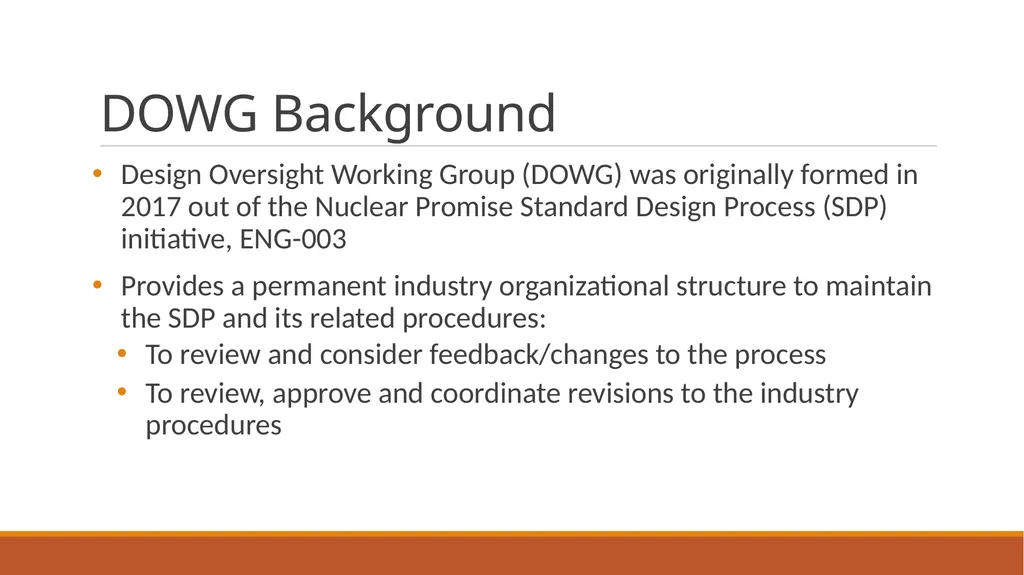
DOWG Background Design Oversight Working Group (DOWG) was originally formed in 2017 out of the Nuclear Promise Standard Design Process (SDP) initiative, ENG-003
Provides a permanent industry organizational structure to maintain the SDP and its related procedures:
To review and consider feedback/changes to the process
To review, approve and coordinate revisions to the industry procedures<br>
03
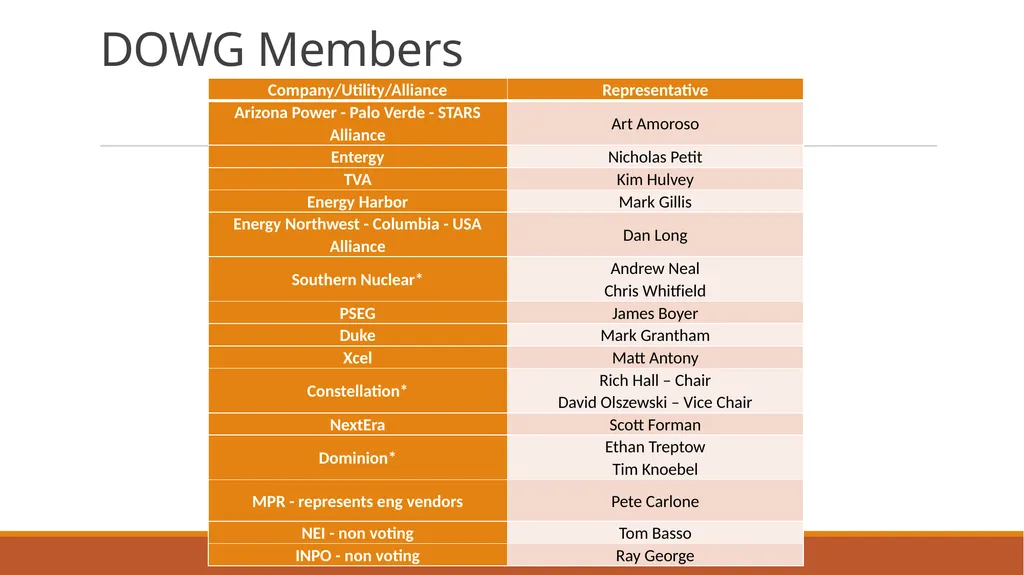
DOWG Members<br>
04
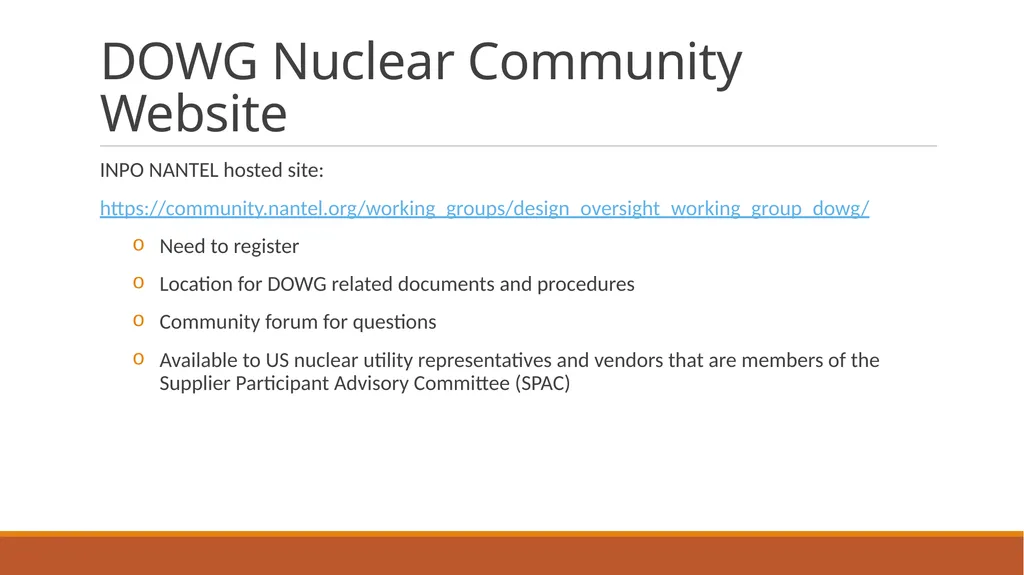
DOWG Nuclear Community Website INPO NANTEL hosted site:
https://community.nantel.org/working_groups/design_oversight_working_group_dowg/
Need to register
Location for DOWG related documents and procedures
Community forum for questions
Available to US nuclear utility representatives and vendors that are members of the Supplier Participant Advisory Committee (SPAC)<br>
05
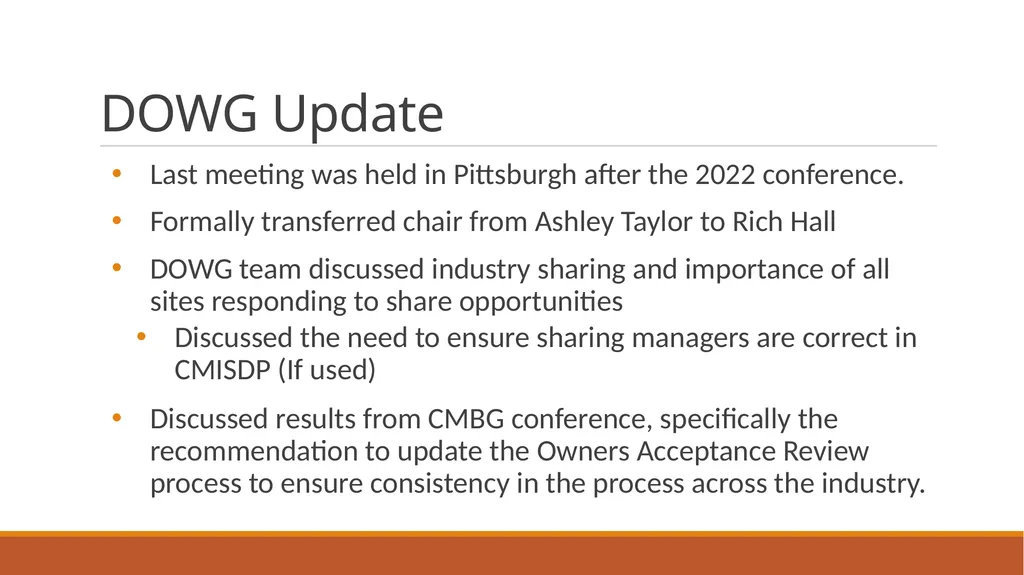
DOWG Update Last meeting was held in Pittsburgh after the 2022 conference.
Formally transferred chair from Ashley Taylor to Rich Hall
DOWG team discussed industry sharing and importance of all sites responding to share opportunities
Discussed the need to ensure sharing managers are correct in CMISDP (If used)
Discussed results from CMBG conference, specifically the recommendation to update the Owners Acceptance Review process to ensure consistency in the process across the industry.<br>
06
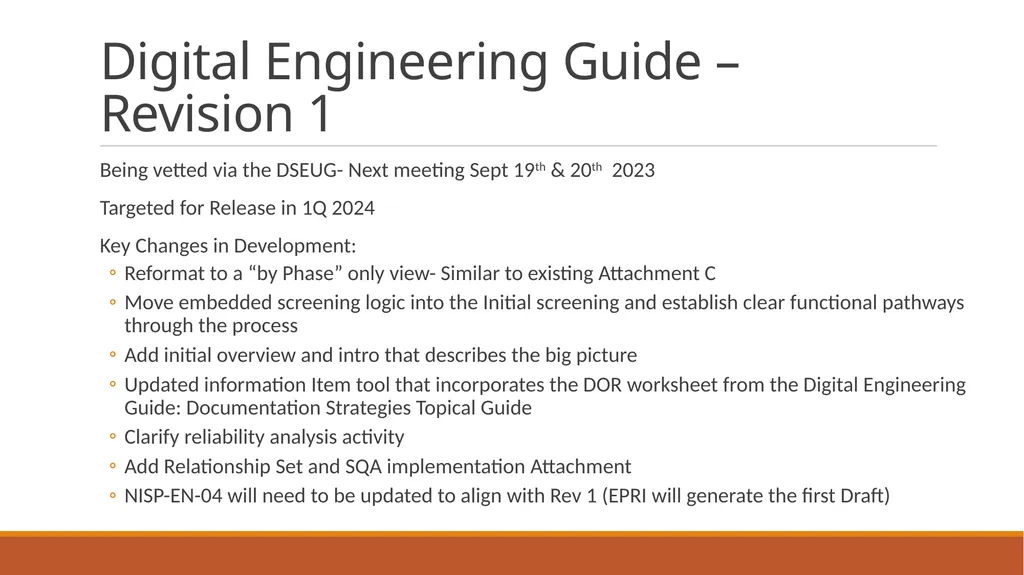
Digital Engineering Guide – Revision 1 Being vetted via the DSEUG- Next meeting Sept 19th & 20th 2023
Targeted for Release in 1Q 2024
Key Changes in Development:
Reformat to a “by Phase” only view- Similar to existing Attachment C
Move embedded screening logic into the Initial screening and establish clear functional pathways through the process
Add initial overview and intro that describes the big picture
Updated information Item tool that incorporates the DOR worksheet from the Digital Engineering Guide: Documentation Strategies Topical Guide
Clarify reliability analysis activity
Add Relationship Set and SQA implementation Attachment
NISP-EN-04 will need to be updated to align with Rev 1 (EPRI will generate the first Draft)<br>
07
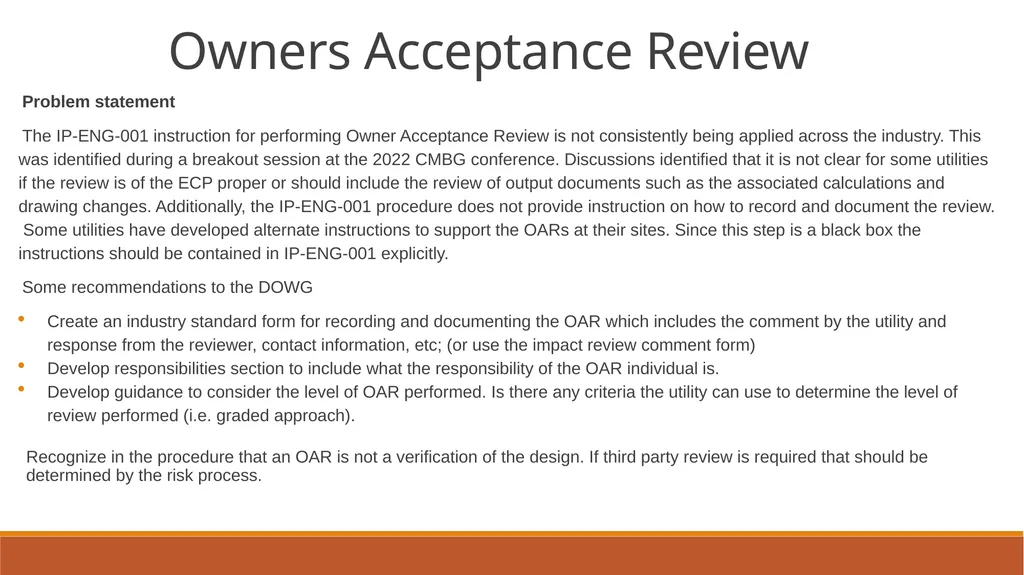
Owners Acceptance Review Problem statement
The IP-ENG-001 instruction for performing Owner Acceptance Review is not consistently being applied across the industry. This was identified during a breakout session at the 2022 CMBG conference. Discussions identified that it is not clear for some utilities if the review is of the ECP proper or should include the review of output documents such as the associated calculations and drawing changes. Additionally, the IP-ENG-001 procedure does not provide instruction on how to record and document the review. Some utilities have developed alternate instructions to support the OARs at their sites. Since this step is a black box the instructions should be contained in IP-ENG-001 explicitly.
Some recommendations to the DOWG
Create an industry standard form for recording and documenting the OAR which includes the comment by the utility and response from the reviewer, contact information, etc; (or use the impact review comment form)
Develop responsibilities section to include what the responsibility of the OAR individual is.
Develop guidance to consider the level of OAR performed. Is there any criteria the utility can use to determine the level of review performed (i.e. graded approach).
Recognize in the procedure that an OAR is not a verification of the design. If third party review is required that should be determined by the risk process.<br>