
2025 CDBG Compliance Workshop Administrator









Description: 2025 CDBG Compliance Workshop Administrator Training January 28, 2025 Grant Award and Project Setup Awards and Contracting Once approved by TNECD Grant Committee award letters are issued Award letters signal when the following work can
Related Topics
Download Presentation
"2025 CDBG Compliance Workshop Administrator" is the property of its rightful owner. Permission is granted to download and print the materials on this website for personal, non-commercial use only, and to display it on your personal computer provided you do not modify the materials and that you retain all copyright notices contained in the materials. By downloading content from our website, you accept the terms of this agreement.
Presentation Transcript
slide1. 2025 CDBG Compliance Workshop Administrator Training January 28, 2025<br>
slide2. Grant Award and Project Setup<br>
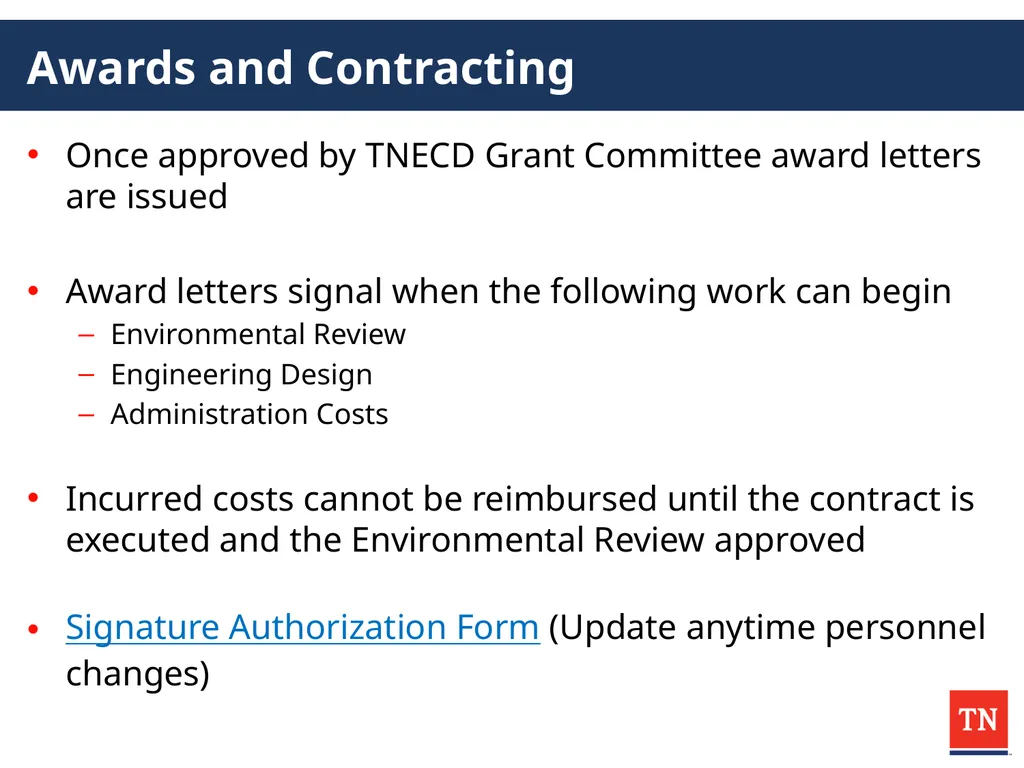
slide3. Awards and Contracting Once approved by TNECD Grant Committee award letters are issued
Award letters signal when the following work can begin
Environmental Review
Engineering Design
Administration Costs
Incurred costs cannot be reimbursed until the contract is executed and the Environmental Review approved
Signature Authorization Form (Update anytime personnel changes)<br>
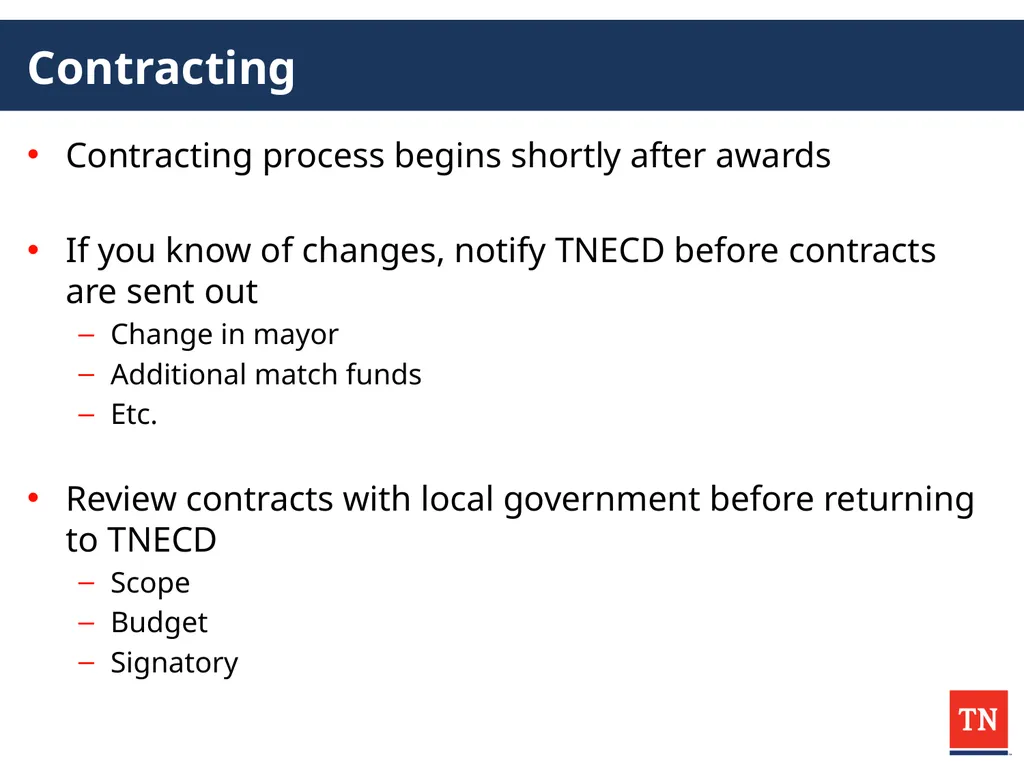
slide4. Contracting Contracting process begins shortly after awards
If you know of changes, notify TNECD before contracts are sent out
Change in mayor
Additional match funds
Etc.
Review contracts with local government before returning to TNECD
Scope
Budget
Signatory<br>
slide5. Title VI Compliance Title VI compliance and training occurs after awards
Title VI Survey and non-discrimination policy are required for new grantees
Grantees Title VI information good for 3 years
Only needed for 7 grantees for 2024 awards
Select the “Audit & Title VI” tab on our Grant Administration page to find the Title VI training and to submit Title VI documents<br>
slide6. Audit Reviews and Risk Assessments Audit reviews are conducted annually for all grantees with open grants
Risk assessments are conducted annually for all open grants
Monitoring is determined by looking at both the most recent audit performance and the risk assessments
Risk Levels and Monitoring
Low: Phone Call
Medium: Desk Review
High: In-Person<br>
slide7. Fair Housing All CDBG activities must include a fair housing activity that addresses at least one fair housing impediment
Fair housing activities must be approved by ECD
This should be planned and/or conducted as early as possible<br>
slide8. Project Timeline – Construction Projects ERR Due: Varies, 60-120 days after award
Plans and Specs Due: 90 days after LOREC/FNORCC
Bid Opening: 45 days after Plans & Specs Approval
Bid Tabs Due: 14 days after Bid Opening
PCC: After bid award before start of construction
Notice of Start of: After PCC and before construction begins
Construction (Include first HUD-2516 submission)
Project Monitoring: Approximately 50% construction completion
Final Public Hearing: Within 30 days after construction completion
Closeout Due: 15 days after Final Public Hearing
(Closeout will not be approved until final RFP is processed.)<br>
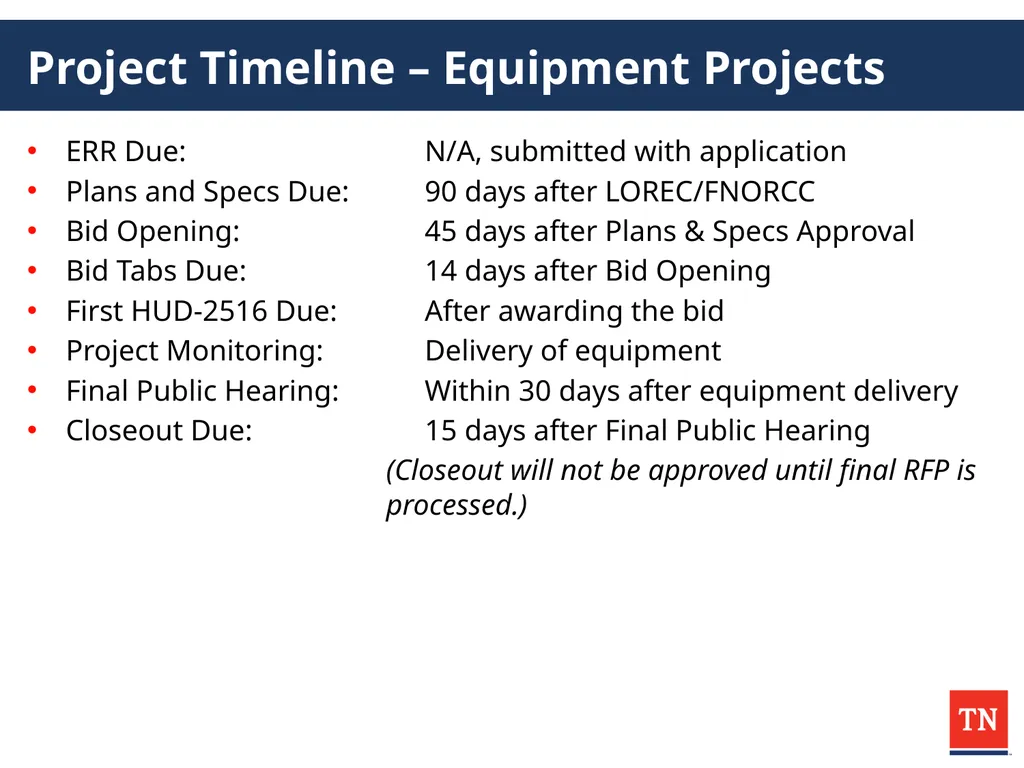
slide9. Project Timeline – Equipment Projects ERR Due: N/A, submitted with application
Plans and Specs Due: 90 days after LOREC/FNORCC
Bid Opening: 45 days after Plans & Specs Approval
Bid Tabs Due: 14 days after Bid Opening
First HUD-2516 Due: After awarding the bid
Project Monitoring: Delivery of equipment
Final Public Hearing: Within 30 days after equipment delivery
Closeout Due: 15 days after Final Public Hearing
(Closeout will not be approved until final RFP is processed.)<br>
slide10. Environmental Review<br>
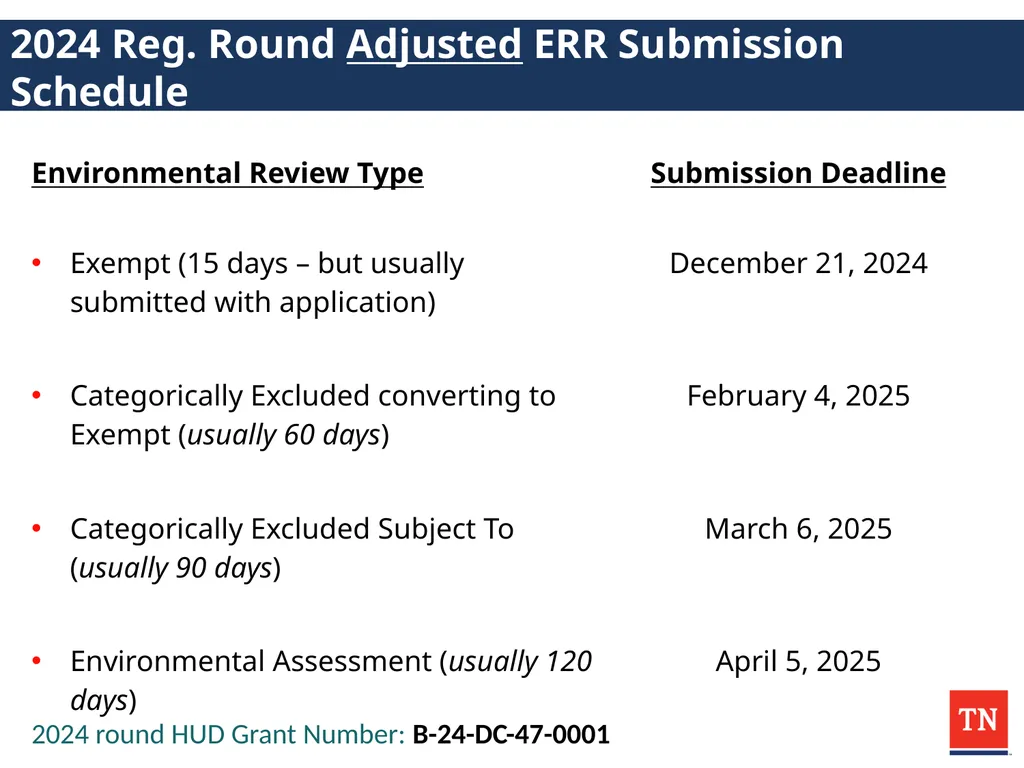
slide11. 2024 Reg. Round Adjusted ERR Submission Schedule 2024 round HUD Grant Number: B-24-DC-47-0001<br>
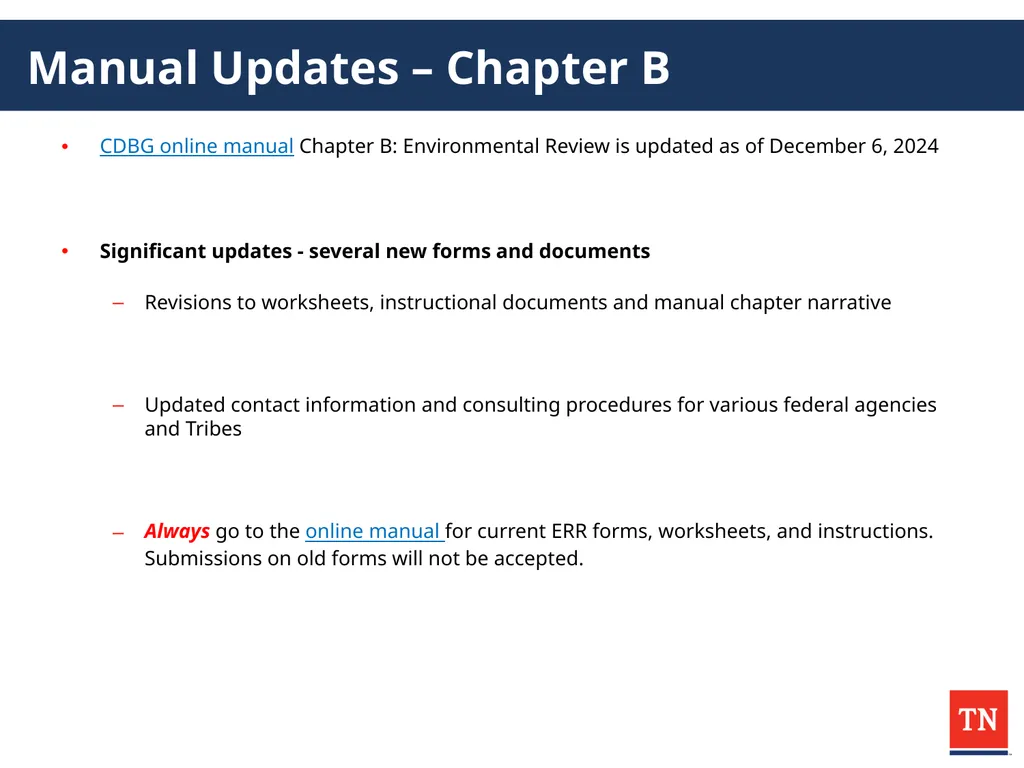
slide12. Manual Updates – Chapter B CDBG online manual Chapter B: Environmental Review is updated as of December 6, 2024
Significant updates - several new forms and documents
Revisions to worksheets, instructional documents and manual chapter narrative
Updated contact information and consulting procedures for various federal agencies and Tribes
Always go to the online manual for current ERR forms, worksheets, and instructions. Submissions on old forms will not be accepted.<br>
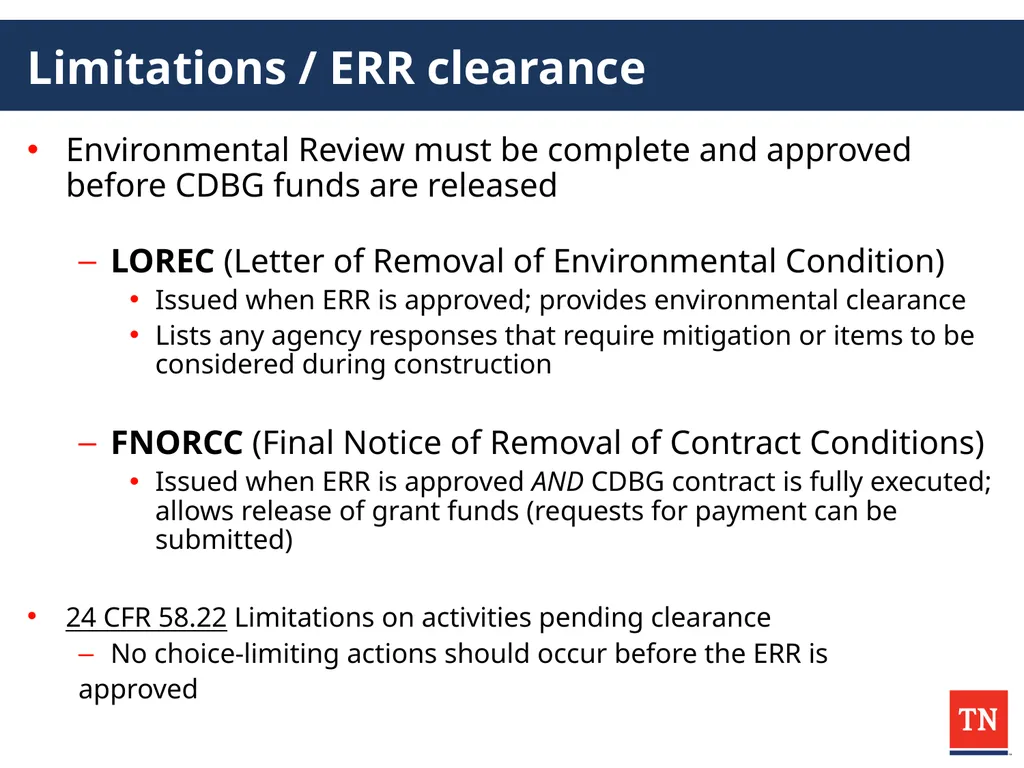
slide13. Limitations / ERR clearance Environmental Review must be complete and approved before CDBG funds are released
LOREC (Letter of Removal of Environmental Condition)
Issued when ERR is approved; provides environmental clearance
Lists any agency responses that require mitigation or items to be considered during construction
FNORCC (Final Notice of Removal of Contract Conditions)
Issued when ERR is approved AND CDBG contract is fully executed; allows release of grant funds (requests for payment can be submitted)
24 CFR 58.22 Limitations on activities pending clearance
No choice-limiting actions should occur before the ERR is
approved<br>
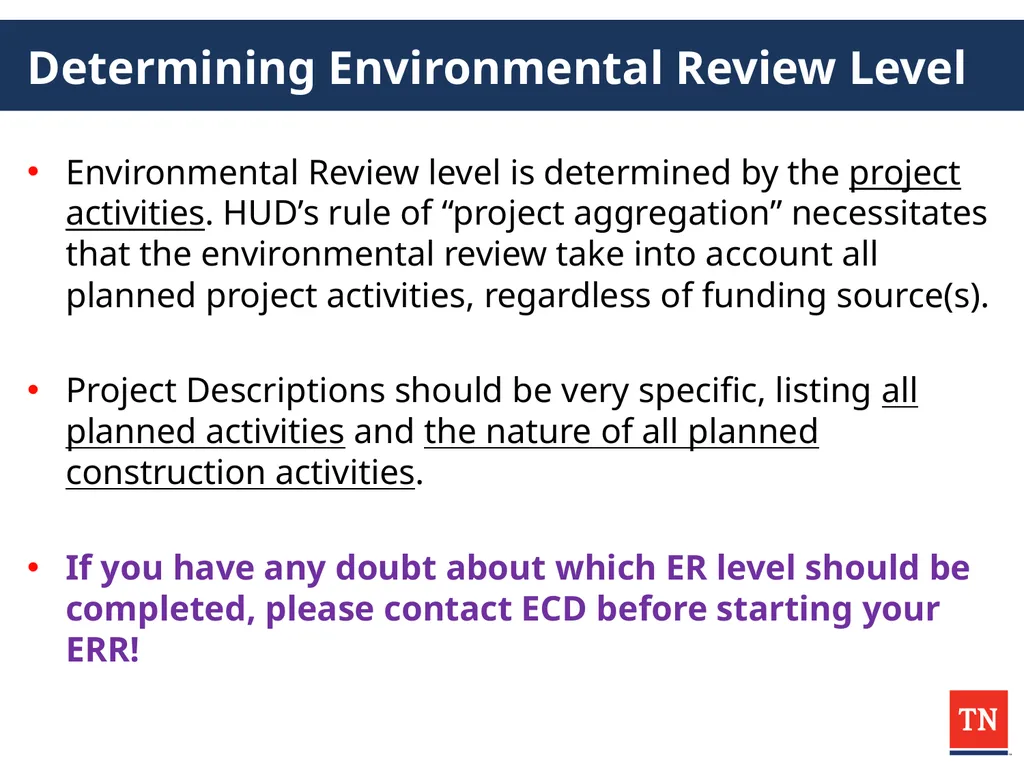
slide14. Determining Environmental Review Level Environmental Review level is determined by the project activities. HUD’s rule of “project aggregation” necessitates that the environmental review take into account all planned project activities, regardless of funding source(s).
Project Descriptions should be very specific, listing all planned activities and the nature of all planned construction activities.
If you have any doubt about which ER level should be completed, please contact ECD before starting your ERR!<br>
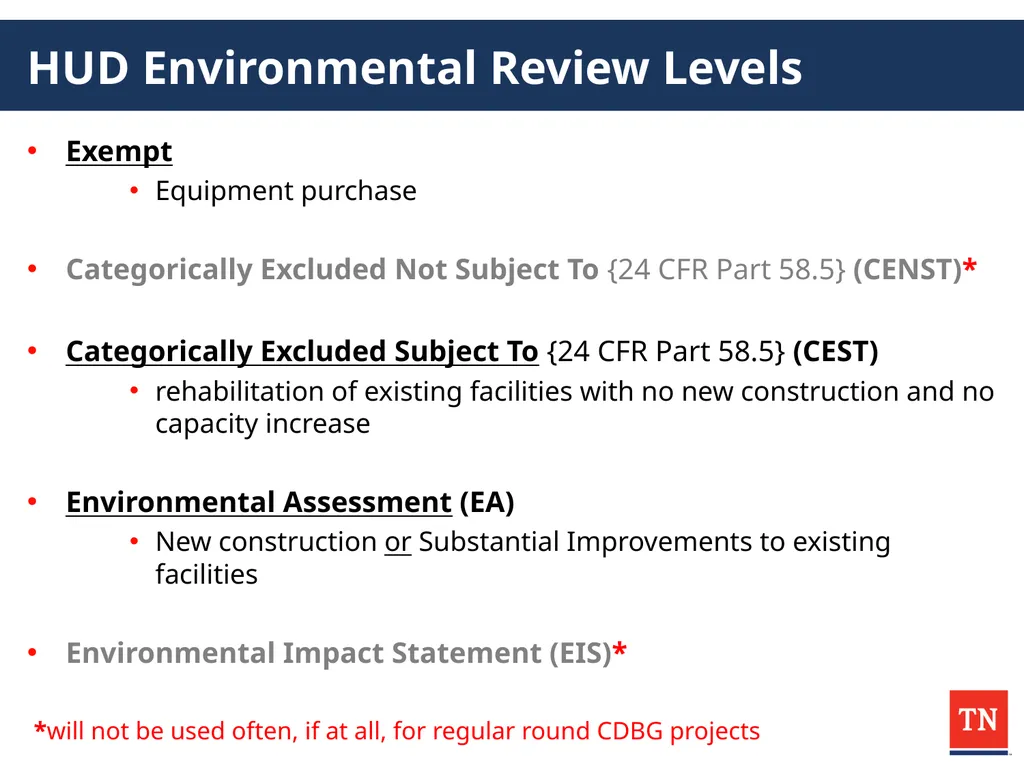
slide15. HUD Environmental Review Levels Exempt
Equipment purchase
Categorically Excluded Not Subject To {24 CFR Part 58.5} (CENST)*
Categorically Excluded Subject To {24 CFR Part 58.5} (CEST)
rehabilitation of existing facilities with no new construction and no capacity increase
Environmental Assessment (EA)
New construction or Substantial Improvements to existing facilities
Environmental Impact Statement (EIS)*
*will not be used often, if at all, for regular round CDBG projects<br>
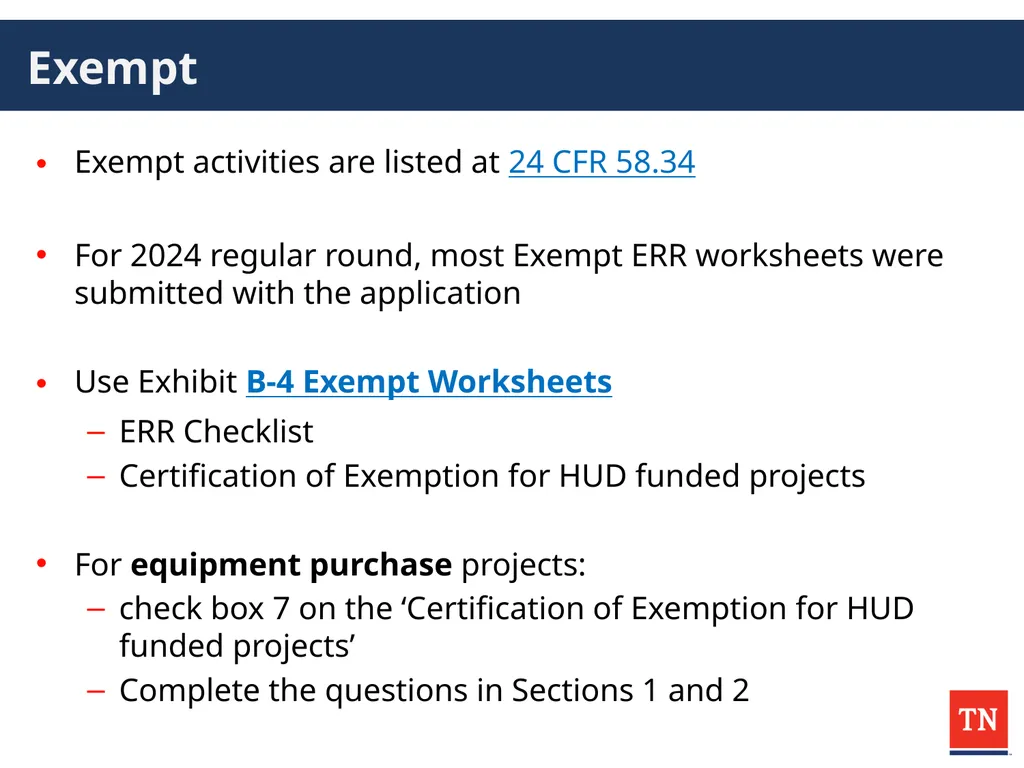
slide16. Exempt Exempt activities are listed at 24 CFR 58.34
For 2024 regular round, most Exempt ERR worksheets were submitted with the application
Use Exhibit B-4 Exempt Worksheets
ERR Checklist
Certification of Exemption for HUD funded projects
For equipment purchase projects:
check box 7 on the ‘Certification of Exemption for HUD funded projects’
Complete the questions in Sections 1 and 2<br>
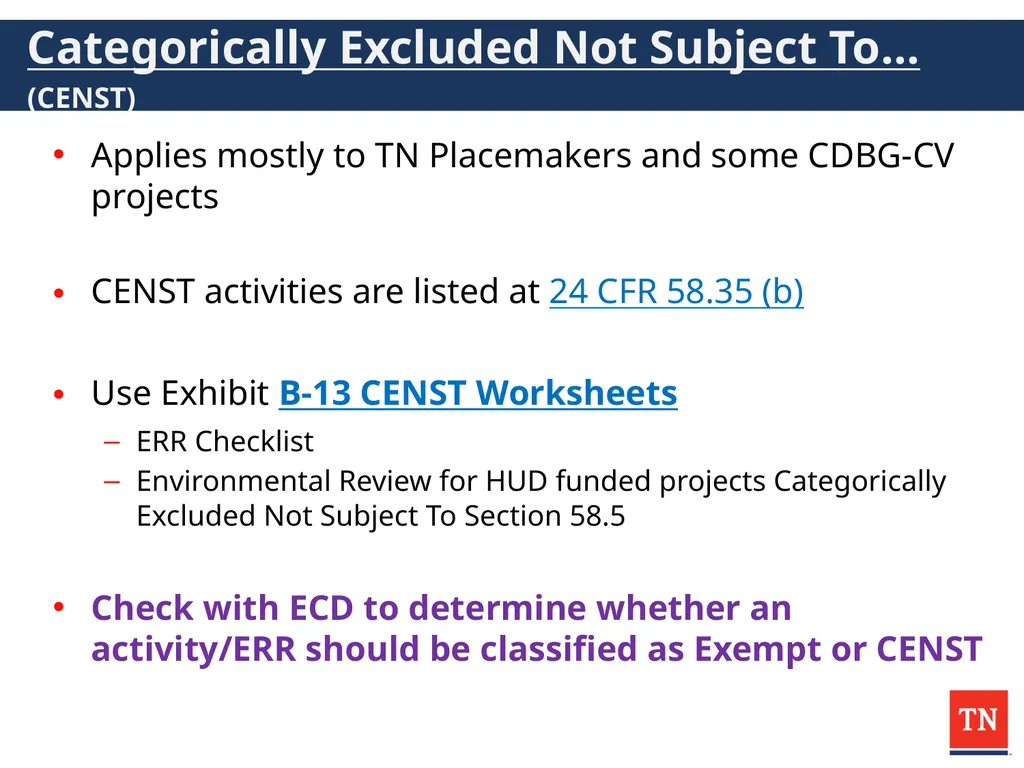
slide17. Categorically Excluded Not Subject To… (CENST) Applies mostly to TN Placemakers and some CDBG-CV projects
CENST activities are listed at 24 CFR 58.35 (b)
Use Exhibit B-13 CENST Worksheets
ERR Checklist
Environmental Review for HUD funded projects Categorically Excluded Not Subject To Section 58.5
Check with ECD to determine whether an activity/ERR should be classified as Exempt or CENST<br>
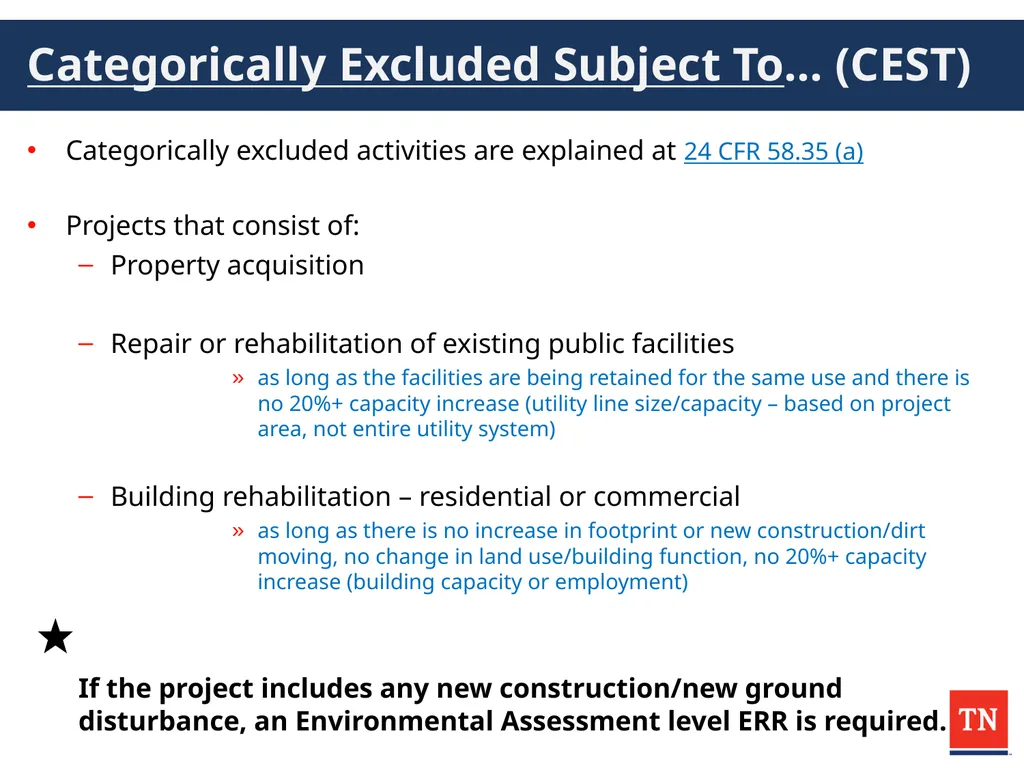
slide18. Categorically Excluded Subject To… (CEST) Categorically excluded activities are explained at 24 CFR 58.35 (a)
Projects that consist of:
Property acquisition
Repair or rehabilitation of existing public facilities
as long as the facilities are being retained for the same use and there is no 20%+ capacity increase (utility line size/capacity – based on project area, not entire utility system)
Building rehabilitation – residential or commercial
as long as there is no increase in footprint or new construction/dirt moving, no change in land use/building function, no 20%+ capacity increase (building capacity or employment)
If the project includes any new construction/new ground disturbance, an Environmental Assessment level ERR is required.<br>
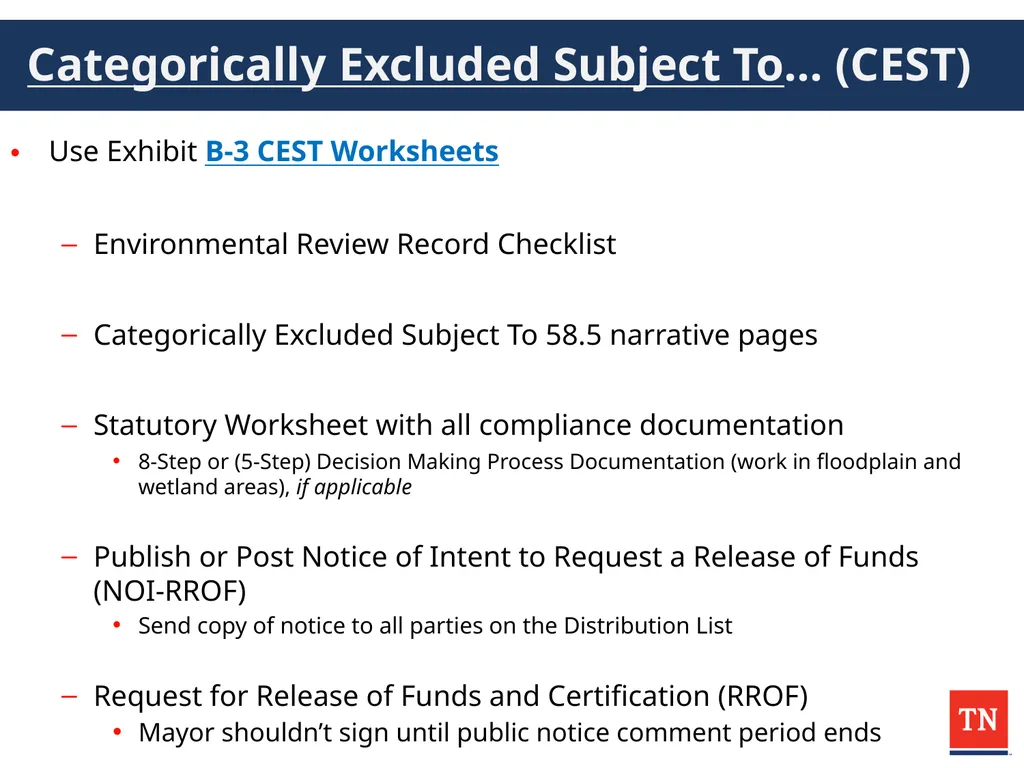
slide19. Categorically Excluded Subject To… (CEST) Use Exhibit B-3 CEST Worksheets
Environmental Review Record Checklist
Categorically Excluded Subject To 58.5 narrative pages
Statutory Worksheet with all compliance documentation
8-Step or (5-Step) Decision Making Process Documentation (work in floodplain and wetland areas), if applicable
Publish or Post Notice of Intent to Request a Release of Funds (NOI-RROF)
Send copy of notice to all parties on the Distribution List
Request for Release of Funds and Certification (RROF)
Mayor shouldn’t sign until public notice comment period ends<br>
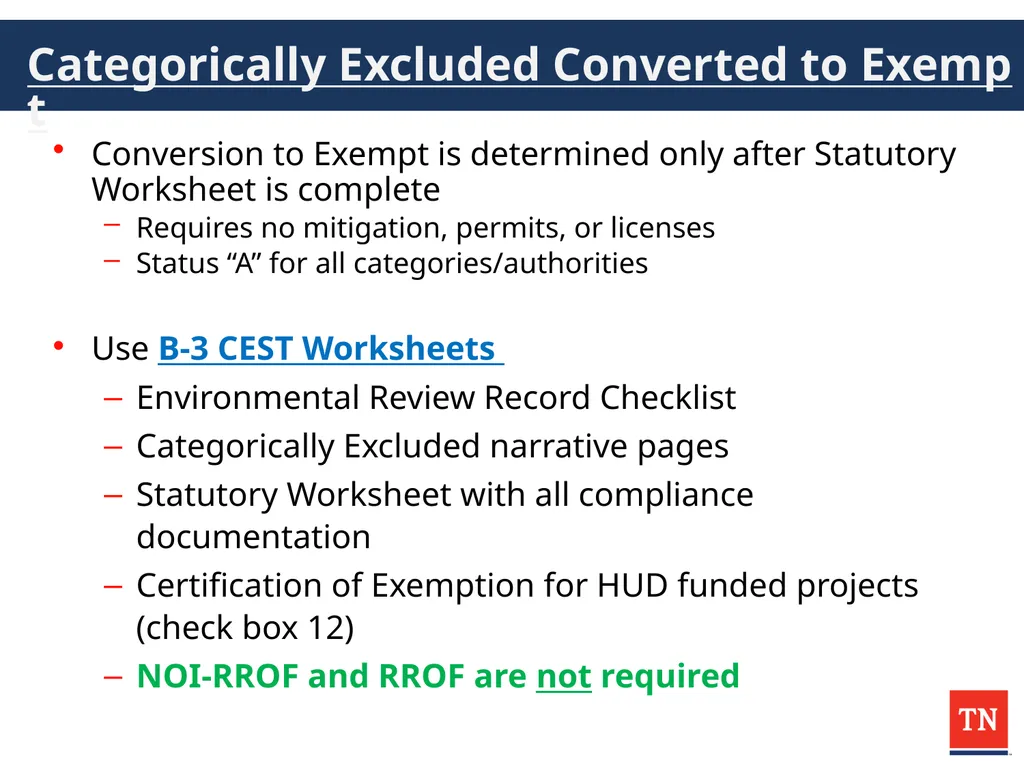
slide20. Categorically Excluded Converted to Exempt Conversion to Exempt is determined only after Statutory Worksheet is complete
Requires no mitigation, permits, or licenses
Status “A” for all categories/authorities
Use B-3 CEST Worksheets
Environmental Review Record Checklist
Categorically Excluded narrative pages
Statutory Worksheet with all compliance documentation
Certification of Exemption for HUD funded projects (check box 12)
NOI-RROF and RROF are not required<br>
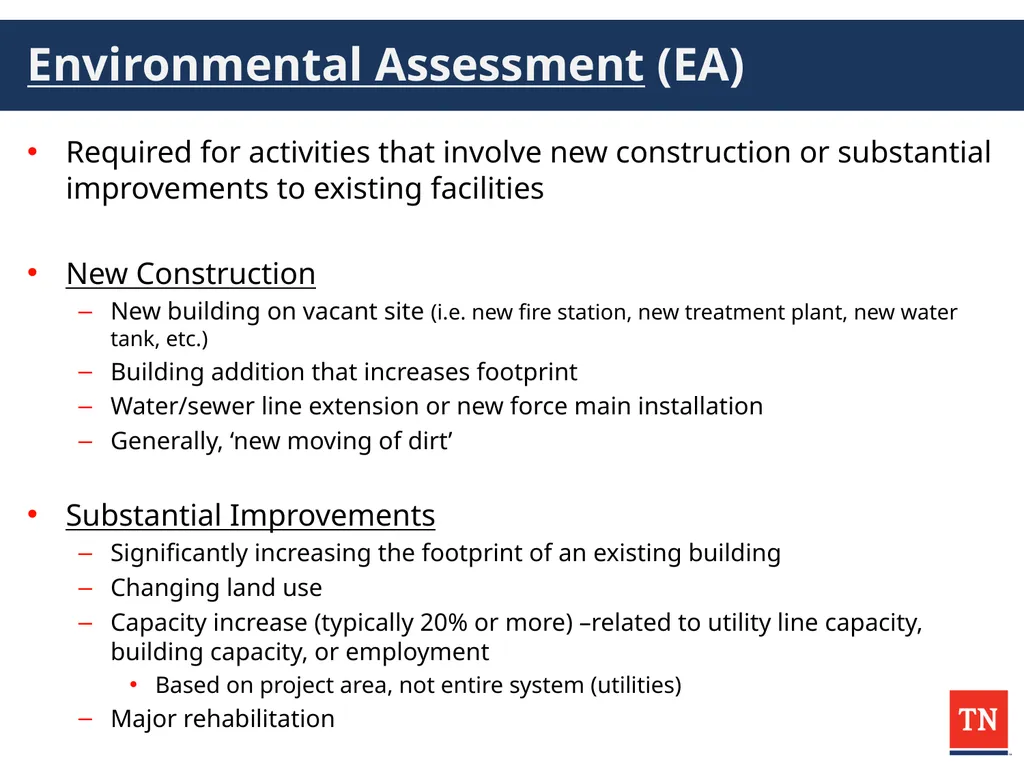
slide21. Environmental Assessment (EA) Required for activities that involve new construction or substantial improvements to existing facilities
New Construction
New building on vacant site (i.e. new fire station, new treatment plant, new water tank, etc.)
Building addition that increases footprint
Water/sewer line extension or new force main installation
Generally, ‘new moving of dirt’
Substantial Improvements
Significantly increasing the footprint of an existing building
Changing land use
Capacity increase (typically 20% or more) –related to utility line capacity, building capacity, or employment
Based on project area, not entire system (utilities)
Major rehabilitation<br>
slide22. Environmental Assessment (EA) Use Exhibit B-2 EA Worksheets
Environmental Review Record Checklist
Environmental Assessment Narrative pages
Statutory Worksheet with all compliance documentation
8-Step or (5-Step) Decision Making Process Documentation, (work in floodplain and wetland areas), if applicable
NEPA Environmental Assessment Factors Checklist with all documentation
Publish or post Concurrent Notice
Send copy of notice to all parties on the Distribution List
Request for Release of Funds and Certification (RROF)
Mayor shouldn’t sign until public notice comment period ends<br>
slide23. Environmental Impact Statement (EIS) The project is determined to have a potentially significant impact on the human environment;
The project would provide a site(s) for hospitals and nursing homes containing a total of 2,500 or more beds;
The project would remove, demolish, convert, or substantially rehabilitate 2,500 or more existing housing units; or
The project would provide enough additional water and sewer capacity to support 2,500 or more additional housing units.
Contact ECD before moving forward!<br>
slide24. Use of a Previous ERR Aggregate
For activities that are geographically or functionally similar, grantees may reuse a previous ERR if the previous ERR:
Is less than 5 years old
Covers the same project area
Has the same scope
Submit the previously approved ERR, a map, Addendum of Validity and RROF
Addenda
Required if a project location changes, new work is proposed, or there is any change from what was approved in the initial ERR
Must complete a new Statutory Worksheet
Check with ECD to determine whether an addendum or a full new ERR will be needed after a scope change<br>
slide25. Rules and Regulations – Statutory Worksheet Federally funded projects require National Environmental Policy Act (NEPA) compliance
24 CFR Part 58.5 & 58.6 are the primary regulations for all ERRs Historic Preservation
Floodplain Management*
Wetland Protection
Coastal Zones*
Sole Source Aquifers
Endangered Species
Wild and Scenic Rivers
Air Quality
Farmland Protection
Explosives/Flammable Hazards
Noise Abatement
Airport Clear Zones*
Contamination/Toxic Substances
Environmental Justice * Apply to all levels of environmental review<br>
slide26. Statutory Worksheet Use Exhibit B-8 Statutory Worksheet Directions and CDBG Manual for reference
Significant Updates (Dec. 2024) to consultation processes and/or required documentation!
In the final ERR, all Statutory Worksheet compliance documentation should appear in the order listed on the Statutory Worksheet
Statutory Worksheet must be complete before NOI-RROF or Concurrent Notice can be published.
“Complete” means that tribes have been given the required 30 or 35-day response period, responses have been received from all required agencies, etc.<br>
slide27. Statutory Worksheet – Historic Preservation Historic Preservation - State Historic Preservation Office (SHPO)
e106 online review portal
Historic Preservation - Tribal Consultations
Use B-6 Required Tribal Consultation by County and B-7 Tribal Consultation Process & Contacts as a guide
Updates to THPOs and other tribal contacts (Dec. 2024)
Must use B-6 and B-7 updated versions for all ERRs started 12/6/24 or after
Complete SHPO consultation before sending tribal consultation requests (include SHPO response in initial emails/letters to tribes)
Send consult request to all contacts listed for a particular tribe on the B-7; draft a separate letter to each contact
Consult request letters must be on City/County letterhead
Email consultation requests must be sent by City/County staff; email should be used if the B-7 states that the tribe prefers email contact<br>
slide28. Statutory Worksheet – Historic Preservation HUD’s “When to Consult with Tribes Under Section 106” checklist is now part of our process (found on last page of B-7)
Remember: tribes must also be contacted every time there is a required publication (tribes are on the Distribution List). Distribution List letters can now be sent via email or via postal mail as hardcopies.
EN-PR (Early Notice-Public Review)
FN-PE (Final Notice-Public Explanation)
Concurrent Notice or Notice of Intent to Request a Release of Funds<br>
slide29. Statutory Worksheet – Floodplain Management Floodplain Management
24 CFR Part 55 – major updates in 2024
New Floodplain Management Worksheet added to B-2 and B-3 worksheets
FFRMS Floodplain report now required – generate using the Federal Flood Standard Support Tool
If in FFRMS floodplain, FEMA FIRM panel or FIRMette with project area delineated also required (to check for location in the floodway)
Entire property parcel must be delineated for building/non-linear infrastructure projects
8-Step (or modified 5-Step) Decision Making Process Required for most activities in the FFRMS Floodplain
New 8-Step Decision Making Process Documentation forms added to B-2 and B-3 worksheets<br>
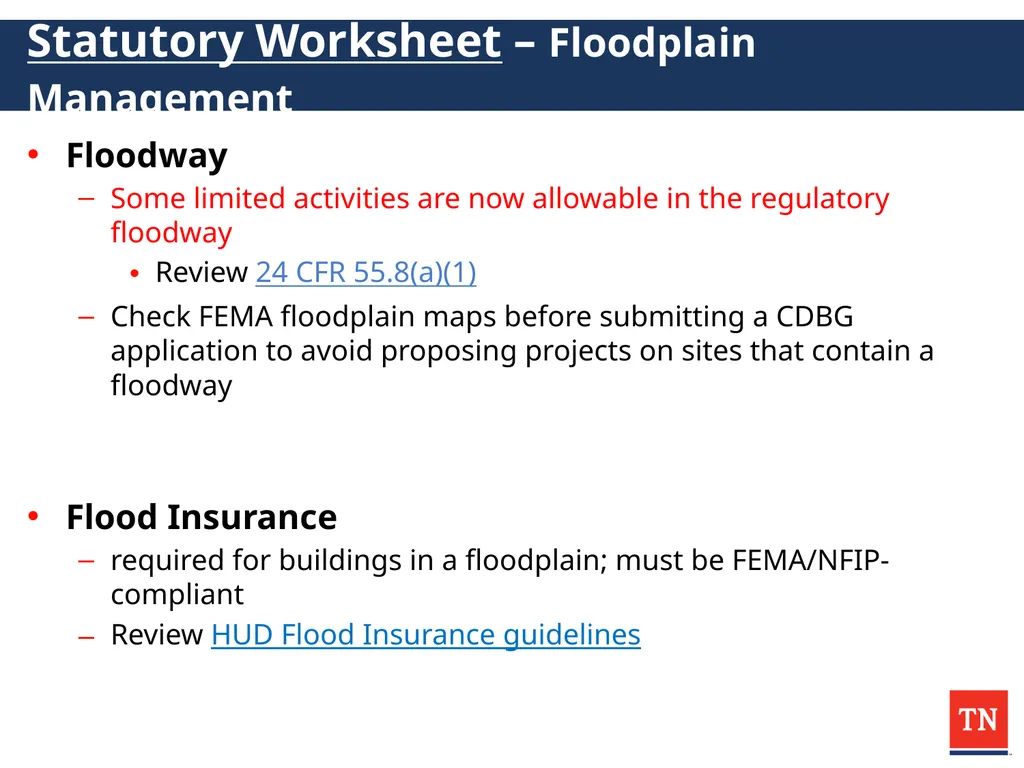
slide30. Statutory Worksheet – Floodplain Management Floodway
Some limited activities are now allowable in the regulatory floodway
Review 24 CFR 55.8(a)(1)
Check FEMA floodplain maps before submitting a CDBG application to avoid proposing projects on sites that contain a floodway
Flood Insurance
required for buildings in a floodplain; must be FEMA/NFIP-compliant
Review HUD Flood Insurance guidelines<br>
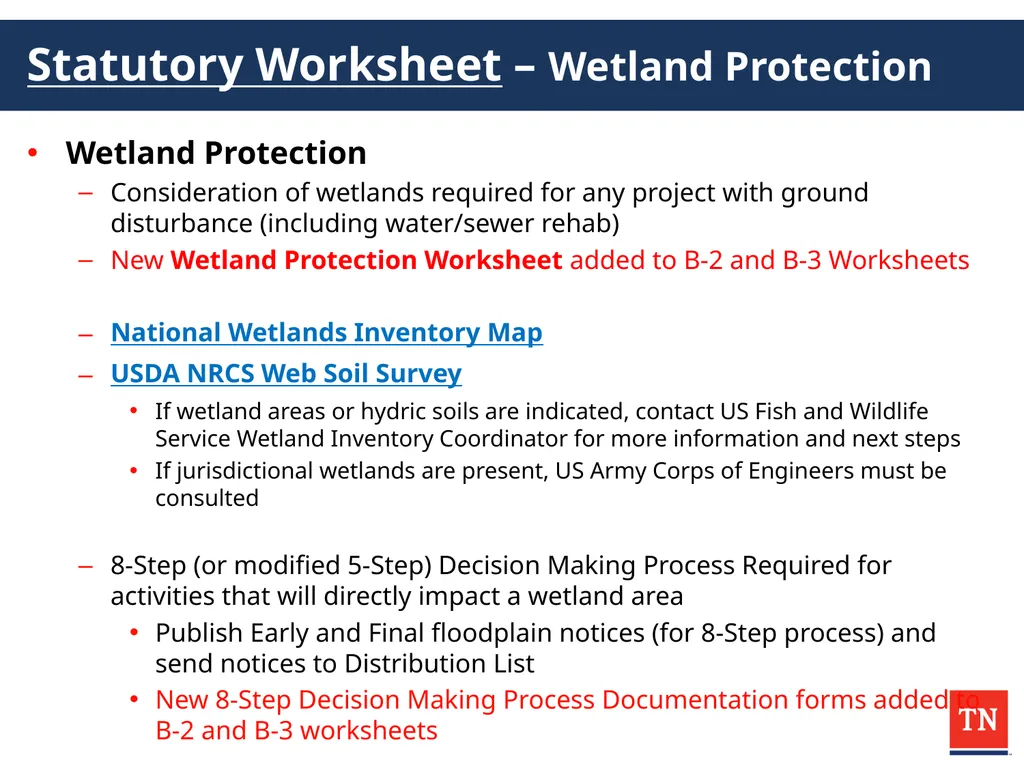
slide31. Statutory Worksheet – Wetland Protection Wetland Protection
Consideration of wetlands required for any project with ground disturbance (including water/sewer rehab)
New Wetland Protection Worksheet added to B-2 and B-3 Worksheets
National Wetlands Inventory Map
USDA NRCS Web Soil Survey
If wetland areas or hydric soils are indicated, contact US Fish and Wildlife Service Wetland Inventory Coordinator for more information and next steps
If jurisdictional wetlands are present, US Army Corps of Engineers must be consulted
8-Step (or modified 5-Step) Decision Making Process Required for activities that will directly impact a wetland area
Publish Early and Final floodplain notices (for 8-Step process) and send notices to Distribution List
New 8-Step Decision Making Process Documentation forms added to B-2 and B-3 worksheets<br>
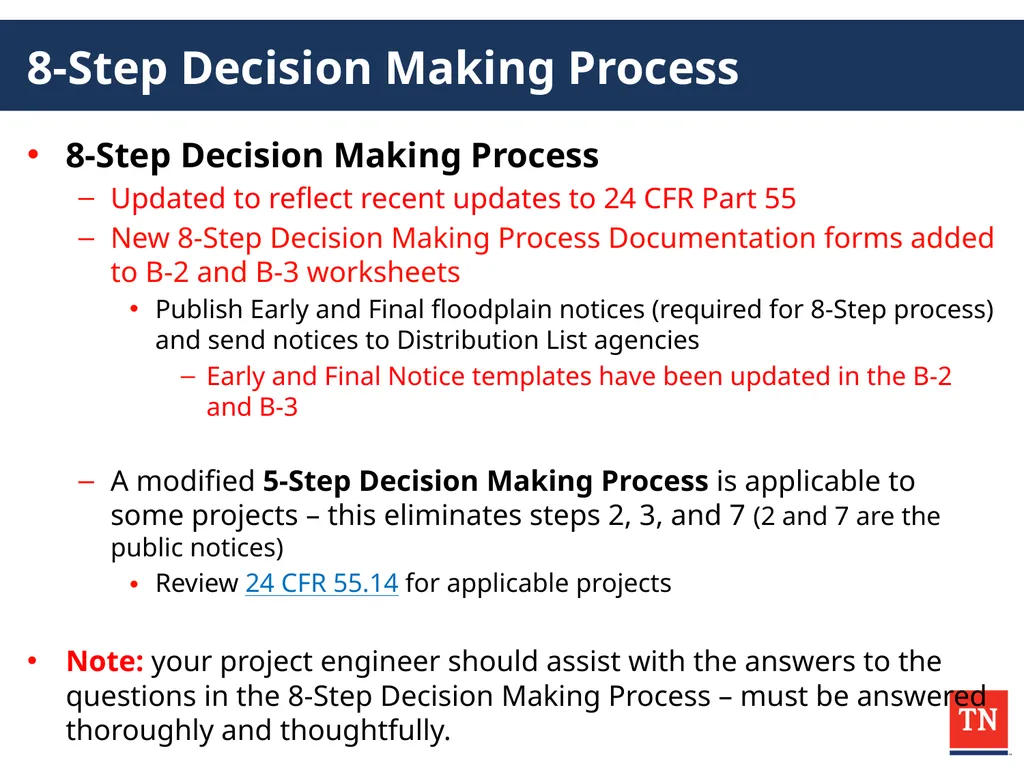
slide32. 8-Step Decision Making Process 8-Step Decision Making Process
Updated to reflect recent updates to 24 CFR Part 55
New 8-Step Decision Making Process Documentation forms added to B-2 and B-3 worksheets
Publish Early and Final floodplain notices (required for 8-Step process) and send notices to Distribution List agencies
Early and Final Notice templates have been updated in the B-2 and B-3
A modified 5-Step Decision Making Process is applicable to some projects – this eliminates steps 2, 3, and 7 (2 and 7 are the public notices)
Review 24 CFR 55.14 for applicable projects
Note: your project engineer should assist with the answers to the questions in the 8-Step Decision Making Process – must be answered thoroughly and thoughtfully.<br>
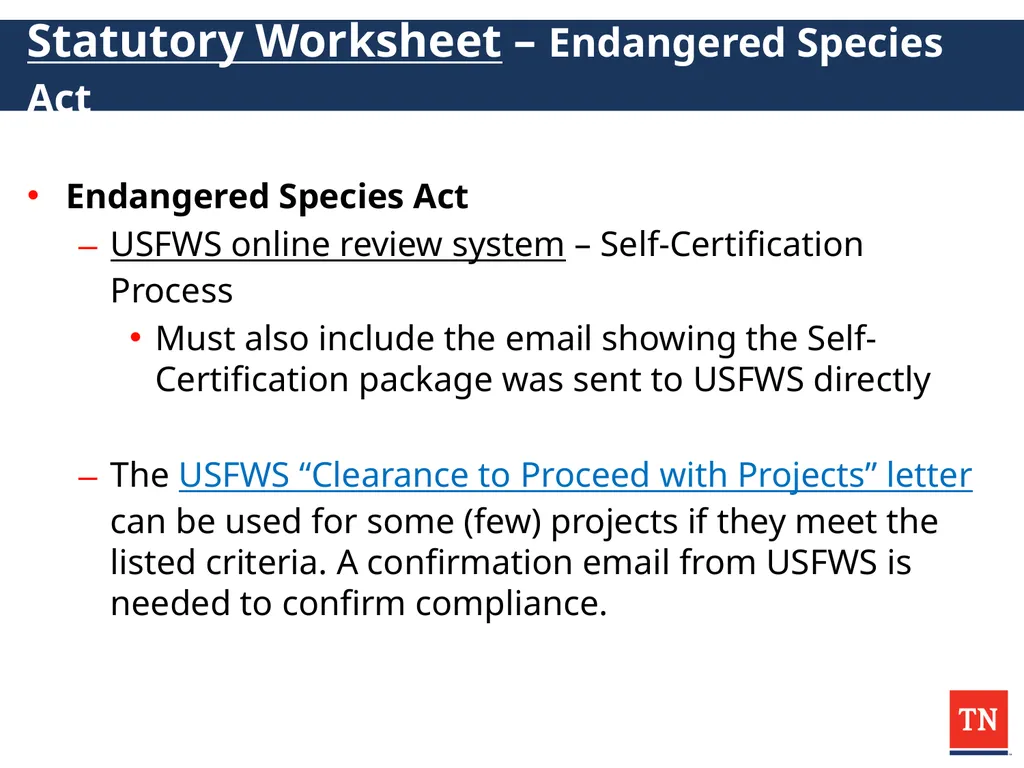
slide33. Statutory Worksheet – Endangered Species Act Endangered Species Act
USFWS online review system – Self-Certification Process
Must also include the email showing the Self-Certification package was sent to USFWS directly
The USFWS “Clearance to Proceed with Projects” letter can be used for some (few) projects if they meet the listed criteria. A confirmation email from USFWS is needed to confirm compliance.<br>
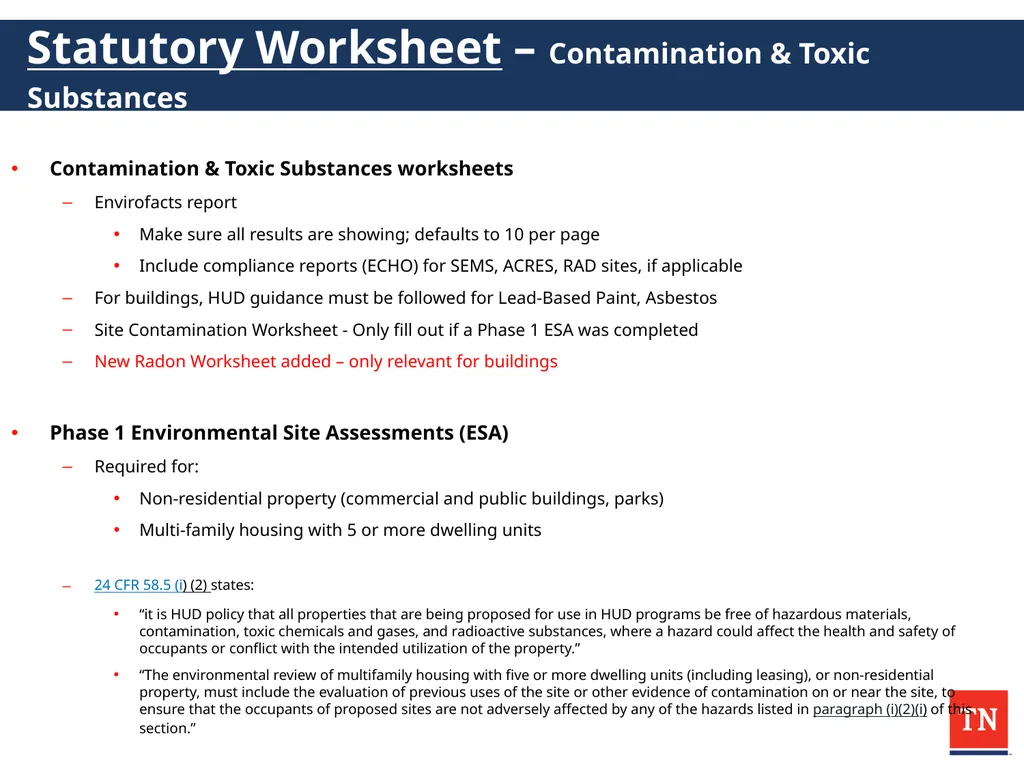
slide34. Statutory Worksheet – Contamination & Toxic Substances Contamination & Toxic Substances worksheets
Envirofacts report
Make sure all results are showing; defaults to 10 per page
Include compliance reports (ECHO) for SEMS, ACRES, RAD sites, if applicable
For buildings, HUD guidance must be followed for Lead-Based Paint, Asbestos
Site Contamination Worksheet - Only fill out if a Phase 1 ESA was completed
New Radon Worksheet added – only relevant for buildings
Phase 1 Environmental Site Assessments (ESA)
Required for:
Non-residential property (commercial and public buildings, parks)
Multi-family housing with 5 or more dwelling units
24 CFR 58.5 (i) (2) states:
“it is HUD policy that all properties that are being proposed for use in HUD programs be free of hazardous materials, contamination, toxic chemicals and gases, and radioactive substances, where a hazard could affect the health and safety of occupants or conflict with the intended utilization of the property.”
“The environmental review of multifamily housing with five or more dwelling units (including leasing), or non-residential property, must include the evaluation of previous uses of the site or other evidence of contamination on or near the site, to ensure that the occupants of proposed sites are not adversely affected by any of the hazards listed in paragraph (i)(2)(i) of this section.”<br>
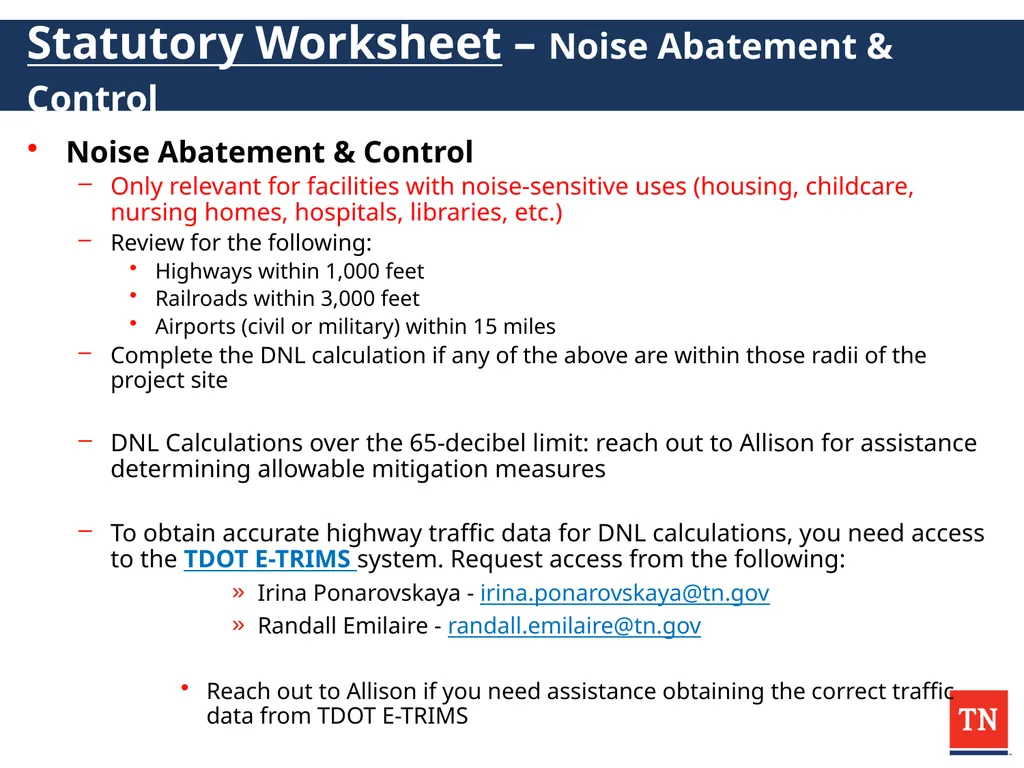
slide35. Statutory Worksheet – Noise Abatement & Control Noise Abatement & Control
Only relevant for facilities with noise-sensitive uses (housing, childcare, nursing homes, hospitals, libraries, etc.)
Review for the following:
Highways within 1,000 feet
Railroads within 3,000 feet
Airports (civil or military) within 15 miles
Complete the DNL calculation if any of the above are within those radii of the project site
DNL Calculations over the 65-decibel limit: reach out to Allison for assistance determining allowable mitigation measures
To obtain accurate highway traffic data for DNL calculations, you need access to the TDOT E-TRIMS system. Request access from the following:
Irina Ponarovskaya - irina.ponarovskaya@tn.gov
Randall Emilaire - randall.emilaire@tn.gov
Reach out to Allison if you need assistance obtaining the correct traffic data from TDOT E-TRIMS<br>
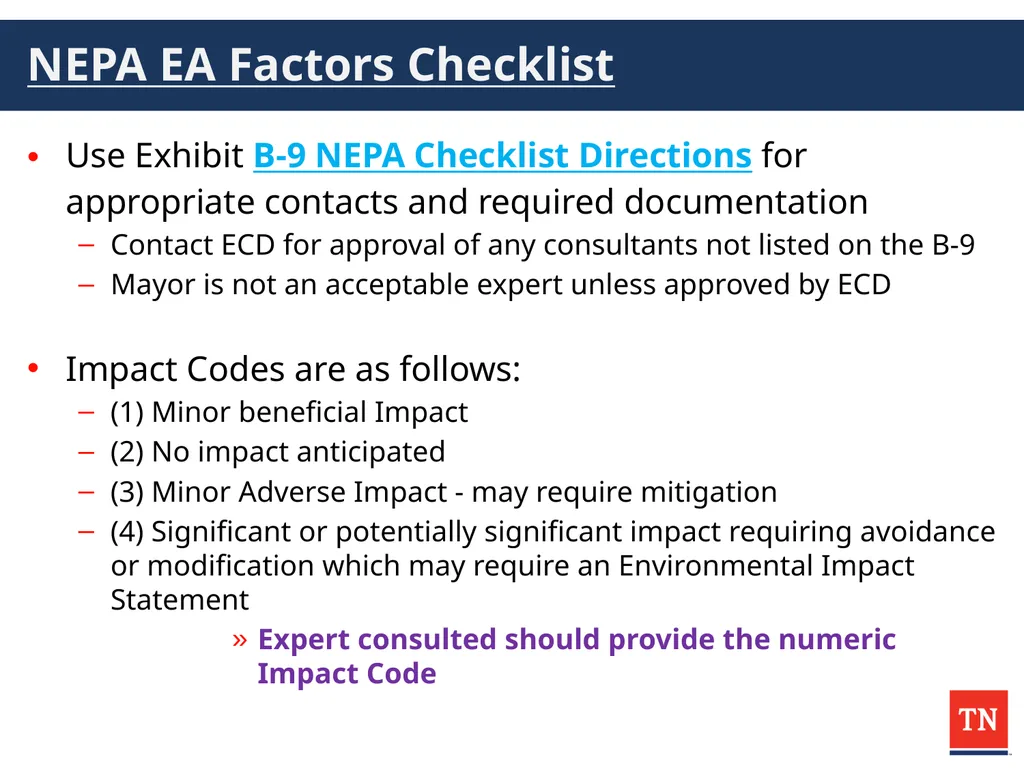
slide36. NEPA EA Factors Checklist Use Exhibit B-9 NEPA Checklist Directions for appropriate contacts and required documentation
Contact ECD for approval of any consultants not listed on the B-9
Mayor is not an acceptable expert unless approved by ECD
Impact Codes are as follows:
(1) Minor beneficial Impact
(2) No impact anticipated
(3) Minor Adverse Impact - may require mitigation
(4) Significant or potentially significant impact requiring avoidance or modification which may require an Environmental Impact Statement
Expert consulted should provide the numeric Impact Code<br>
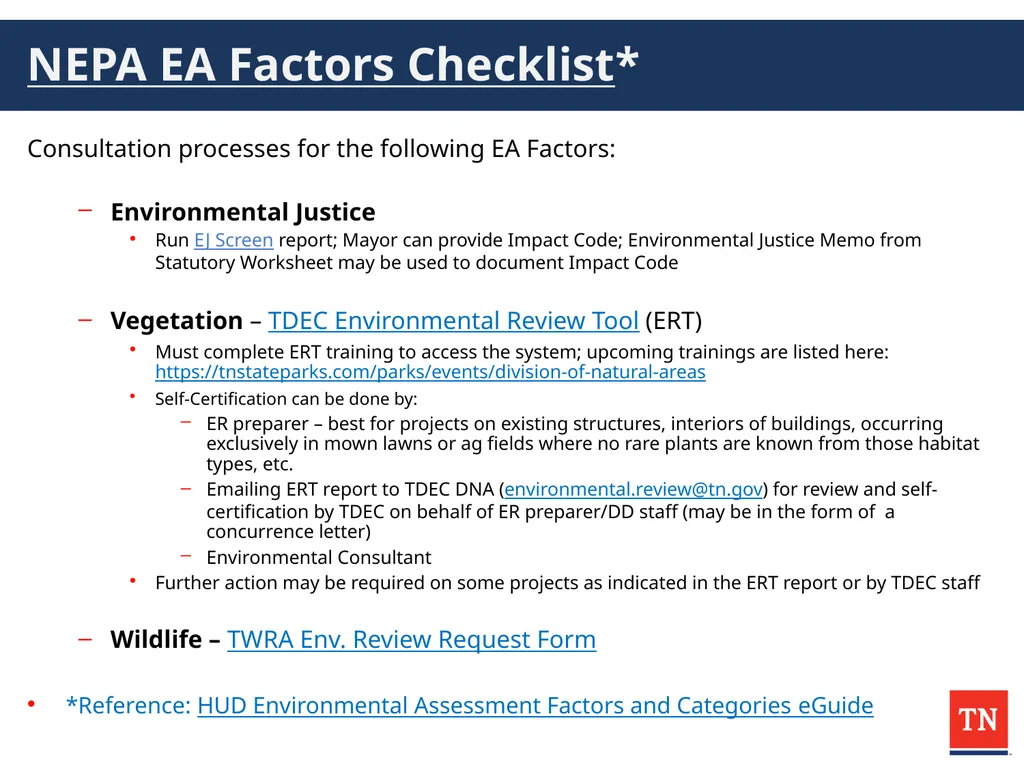
slide37. NEPA EA Factors Checklist* Consultation processes for the following EA Factors:
Environmental Justice
Run EJ Screen report; Mayor can provide Impact Code; Environmental Justice Memo from Statutory Worksheet may be used to document Impact Code
Vegetation – TDEC Environmental Review Tool (ERT)
Must complete ERT training to access the system; upcoming trainings are listed here: https://tnstateparks.com/parks/events/division-of-natural-areas
Self-Certification can be done by:
ER preparer – best for projects on existing structures, interiors of buildings, occurring exclusively in mown lawns or ag fields where no rare plants are known from those habitat types, etc.
Emailing ERT report to TDEC DNA (environmental.review@tn.gov) for review and self-certification by TDEC on behalf of ER preparer/DD staff (may be in the form of a concurrence letter)
Environmental Consultant
Further action may be required on some projects as indicated in the ERT report or by TDEC staff
Wildlife – TWRA Env. Review Request Form
*Reference: HUD Environmental Assessment Factors and Categories eGuide<br>
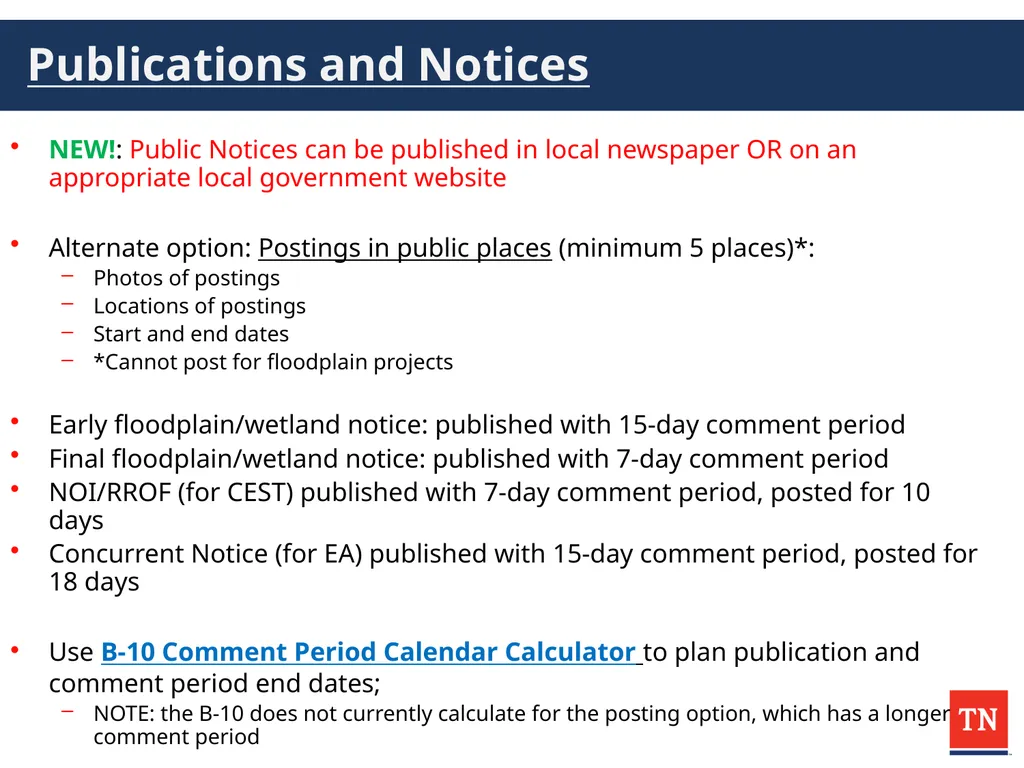
slide38. Publications and Notices NEW!: Public Notices can be published in local newspaper OR on an appropriate local government website
Alternate option: Postings in public places (minimum 5 places)*:
Photos of postings
Locations of postings
Start and end dates
*Cannot post for floodplain projects
Early floodplain/wetland notice: published with 15-day comment period
Final floodplain/wetland notice: published with 7-day comment period
NOI/RROF (for CEST) published with 7-day comment period, posted for 10 days
Concurrent Notice (for EA) published with 15-day comment period, posted for 18 days
Use B-10 Comment Period Calendar Calculator to plan publication and comment period end dates;
NOTE: the B-10 does not currently calculate for the posting option, which has a longer comment period<br>
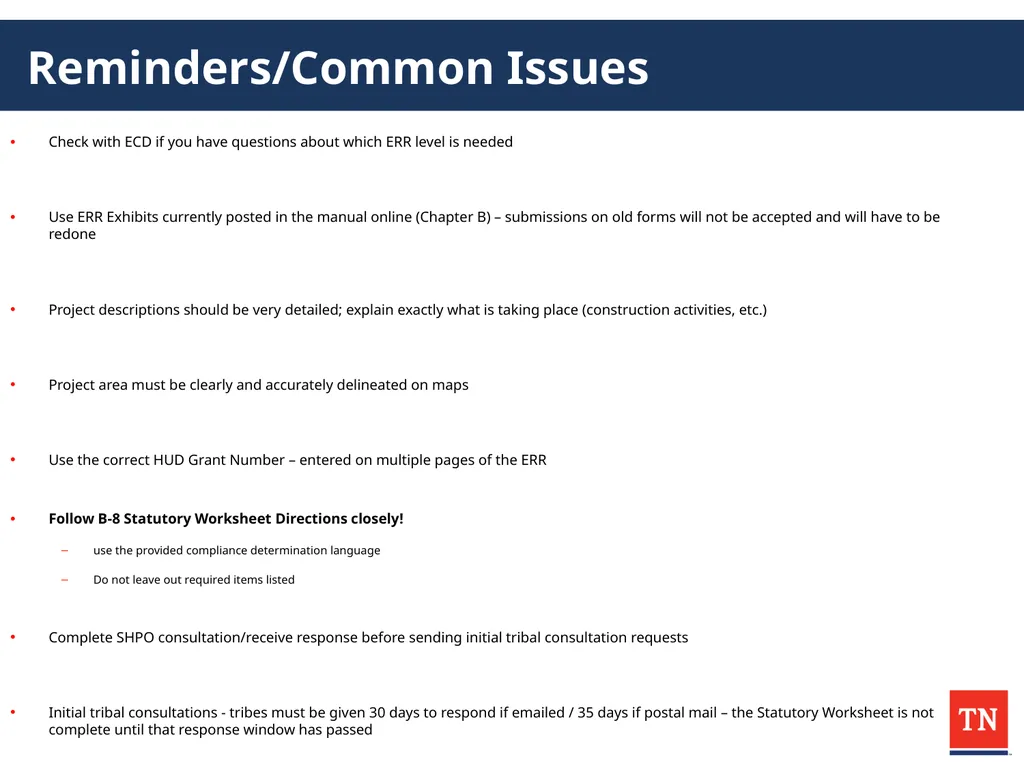
slide39. Reminders/Common Issues Check with ECD if you have questions about which ERR level is needed
Use ERR Exhibits currently posted in the manual online (Chapter B) – submissions on old forms will not be accepted and will have to be redone
Project descriptions should be very detailed; explain exactly what is taking place (construction activities, etc.)
Project area must be clearly and accurately delineated on maps
Use the correct HUD Grant Number – entered on multiple pages of the ERR
Follow B-8 Statutory Worksheet Directions closely!
use the provided compliance determination language
Do not leave out required items listed
Complete SHPO consultation/receive response before sending initial tribal consultation requests
Initial tribal consultations - tribes must be given 30 days to respond if emailed / 35 days if postal mail – the Statutory Worksheet is not complete until that response window has passed<br>
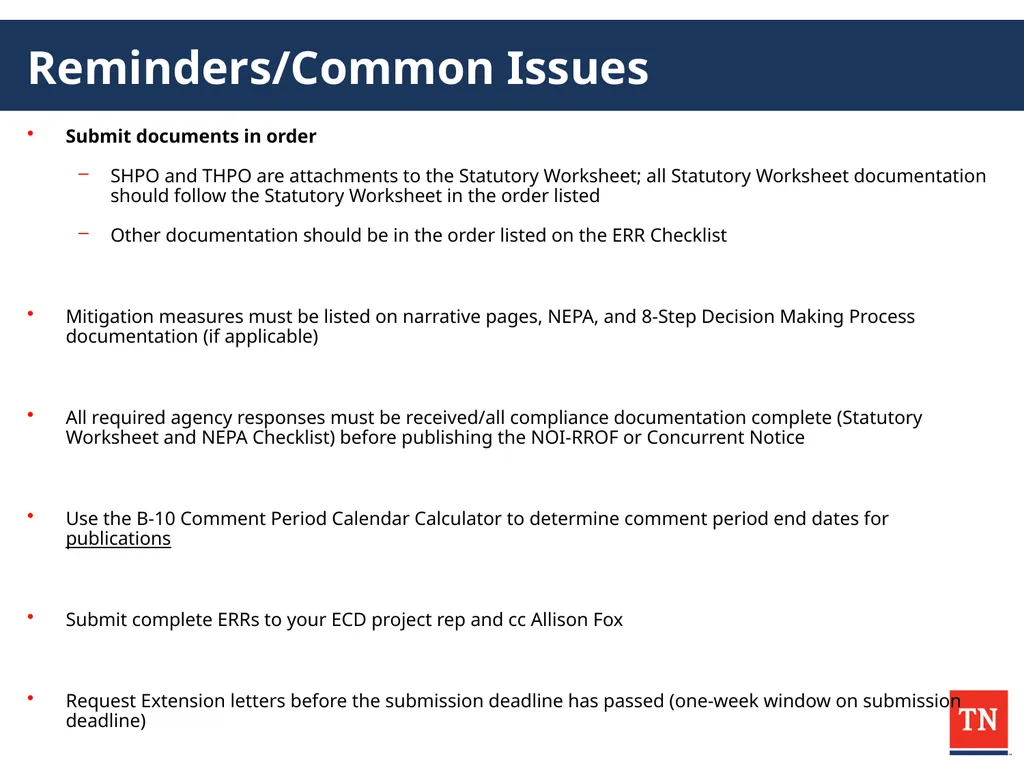
slide40. Reminders/Common Issues Submit documents in order
SHPO and THPO are attachments to the Statutory Worksheet; all Statutory Worksheet documentation should follow the Statutory Worksheet in the order listed
Other documentation should be in the order listed on the ERR Checklist
Mitigation measures must be listed on narrative pages, NEPA, and 8-Step Decision Making Process documentation (if applicable)
All required agency responses must be received/all compliance documentation complete (Statutory Worksheet and NEPA Checklist) before publishing the NOI-RROF or Concurrent Notice
Use the B-10 Comment Period Calendar Calculator to determine comment period end dates for publications
Submit complete ERRs to your ECD project rep and cc Allison Fox
Request Extension letters before the submission deadline has passed (one-week window on submission deadline)<br>
slide41. We’re here to help! Our office will schedule a few more ‘ERR troubleshooting’ sessions in the next couple of months
We can also conduct training sessions for your agency’s team to clarify processes or troubleshoot specific ERR issues
Please read CDBG Manual Chapter B narrative, review exhibits, and familiarize yourself with ERR forms and instructions before requesting additional training <br>
slide42. Helpful Resources TNECD CDBG Manual – Environmental Review Chapter
HUD Environmental Guidance for Tennessee
Consultation Resource Useful Web Links
HUD Environmental Review Orientation
HUD WISER Training Modules<br>
slide43. Acquisition<br>
slide44. Basic Requirements and Application Must follow the Uniform Relocation Act (49 CFR Pat 24)
Applies to any activity that is funded, in whole or in part, with CDBG funds
Includes any acquisition of real property
Land
Easements
Buildings
Houses
Cannot begin acquisition until ERR is approved<br>
slide45. URA Process Inform property owner(s) of intention to acquire property
Send a "Preliminary Acquisition Notice" to each property owner (Exhibit D-1)
Include the booklet When a Public Agency Acquires Your Property (Exhibit D-2)
Include the "Waiver of Rights and Benefits of the Uniform Relocation Assistance and Real Property Acquisition Policies of 1970" (Exhibit D-3)
To be used when a property owner chooses to donate property
Consult with property owners to see who wishes to donate
Collect “Waivers of Rights…” and record the acquisitions<br>
slide46. URA Process Property owners who choose not to donate may request a valuation of the property to be purchased
Estimated property value $10,000 or greater requires appraisal and review appraisal to determine just compensation
Estimated property value under $10,000 may request just compensation value without appraisal and review appraisal
If going through the appraisal process, two qualified professionals must be procured:
The first to conduct the appraisal
The second to conduct the review appraisal
If conducting an appraisal, the property owner must be provided with a copy of the Invitation to Accompany an Appraiser (Exhibit D-4)<br>
slide47. URA Process Provide a "Statement of the Basis for the Determination of Just Compensation“ to the property owner
Negotiate with property owner
Settle on price
Donate
Refuse
Complete the settlement<br>
slide48. Plans and Specifications<br>
slide49. Plans and Specifications Plans and specifications are to be submitted after approval of the Environmental Review
Plans and specifications must be approved by TNECD prior to bidding or procurement
TNECD documents may be added to, but not altered<br>
slide50. Plans and Specifications - All The following documents are included in all plans and specifications (construction and equipment):
Advertisement for Bids
Information for Bidders
Acknowledgement Regarding Bidder SAM Registration
Non-Boycott of Israel Certification
Iran Divestment Act<br>
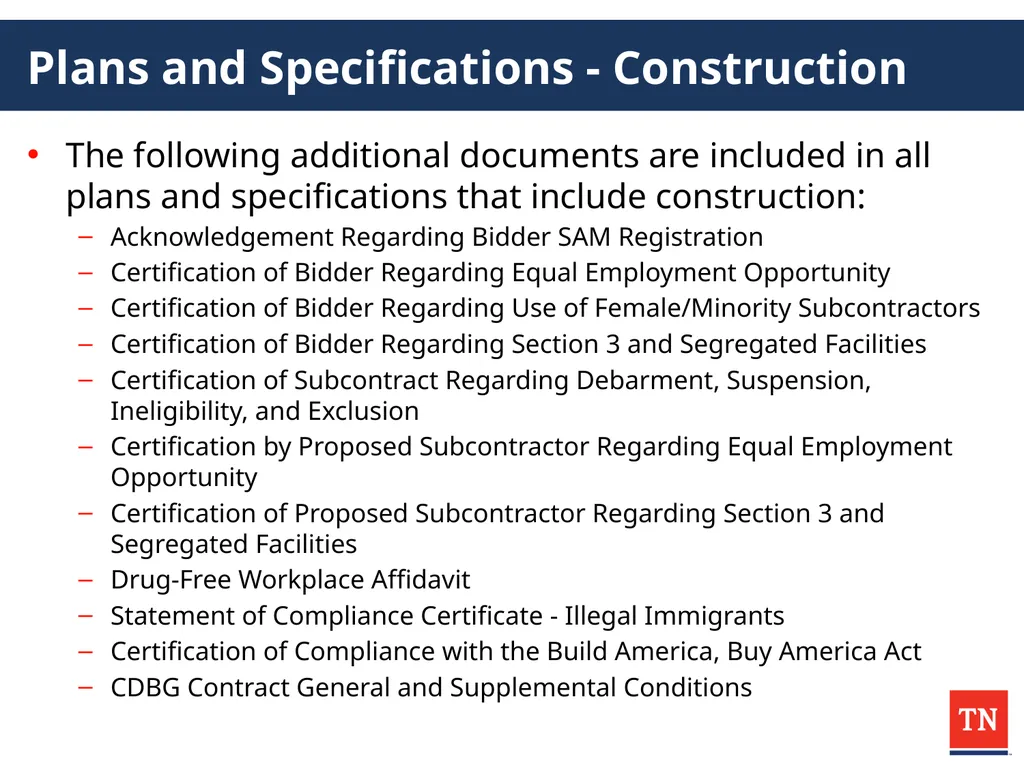
slide51. Plans and Specifications - Construction The following additional documents are included in all plans and specifications that include construction:
Acknowledgement Regarding Bidder SAM Registration
Certification of Bidder Regarding Equal Employment Opportunity
Certification of Bidder Regarding Use of Female/Minority Subcontractors
Certification of Bidder Regarding Section 3 and Segregated Facilities
Certification of Subcontract Regarding Debarment, Suspension, Ineligibility, and Exclusion
Certification by Proposed Subcontractor Regarding Equal Employment Opportunity
Certification of Proposed Subcontractor Regarding Section 3 and Segregated Facilities
Drug-Free Workplace Affidavit
Statement of Compliance Certificate - Illegal Immigrants
Certification of Compliance with the Build America, Buy America Act
CDBG Contract General and Supplemental Conditions<br>
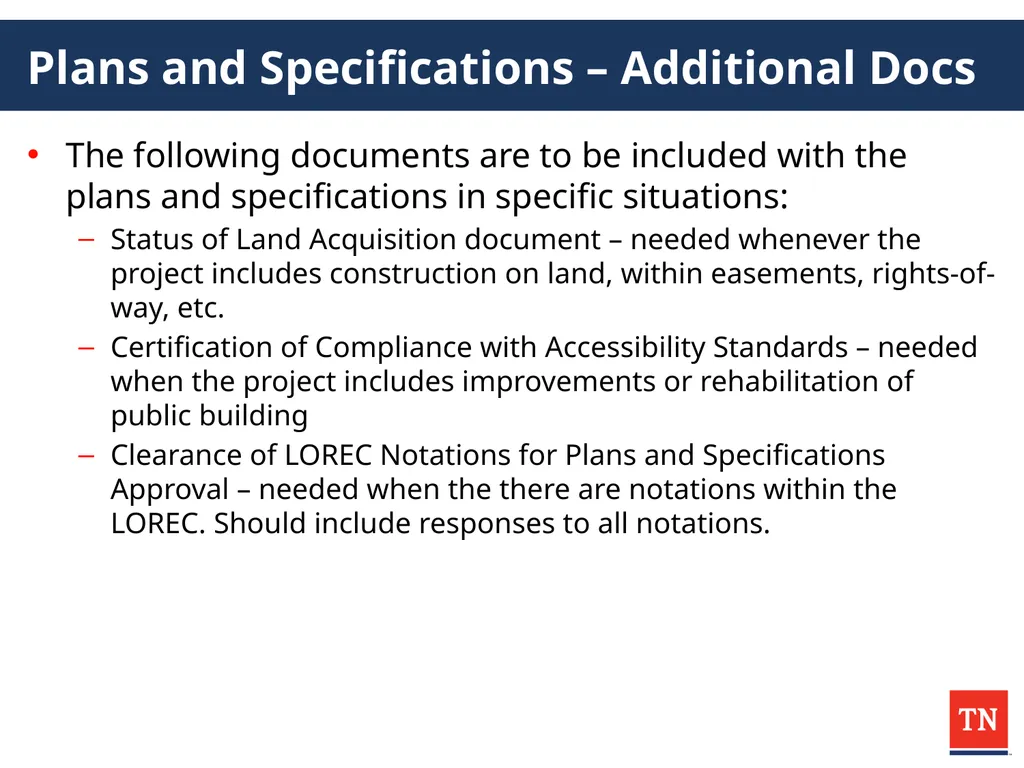
slide52. Plans and Specifications – Additional Docs The following documents are to be included with the plans and specifications in specific situations:
Status of Land Acquisition document – needed whenever the project includes construction on land, within easements, rights-of-way, etc.
Certification of Compliance with Accessibility Standards – needed when the project includes improvements or rehabilitation of public building
Clearance of LOREC Notations for Plans and Specifications Approval – needed when the there are notations within the LOREC. Should include responses to all notations.<br>
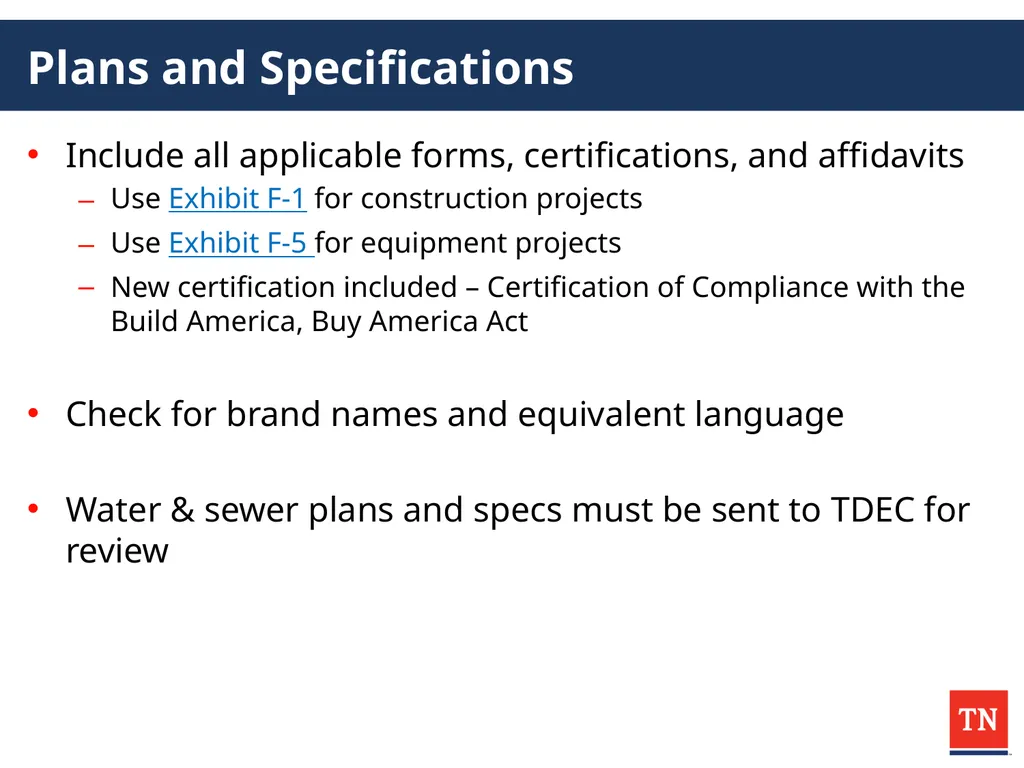
slide53. Plans and Specifications Include all applicable forms, certifications, and affidavits
Use Exhibit F-1 for construction projects
Use Exhibit F-5 for equipment projects
New certification included – Certification of Compliance with the Build America, Buy America Act
Check for brand names and equivalent language
Water & sewer plans and specs must be sent to TDEC for review<br>
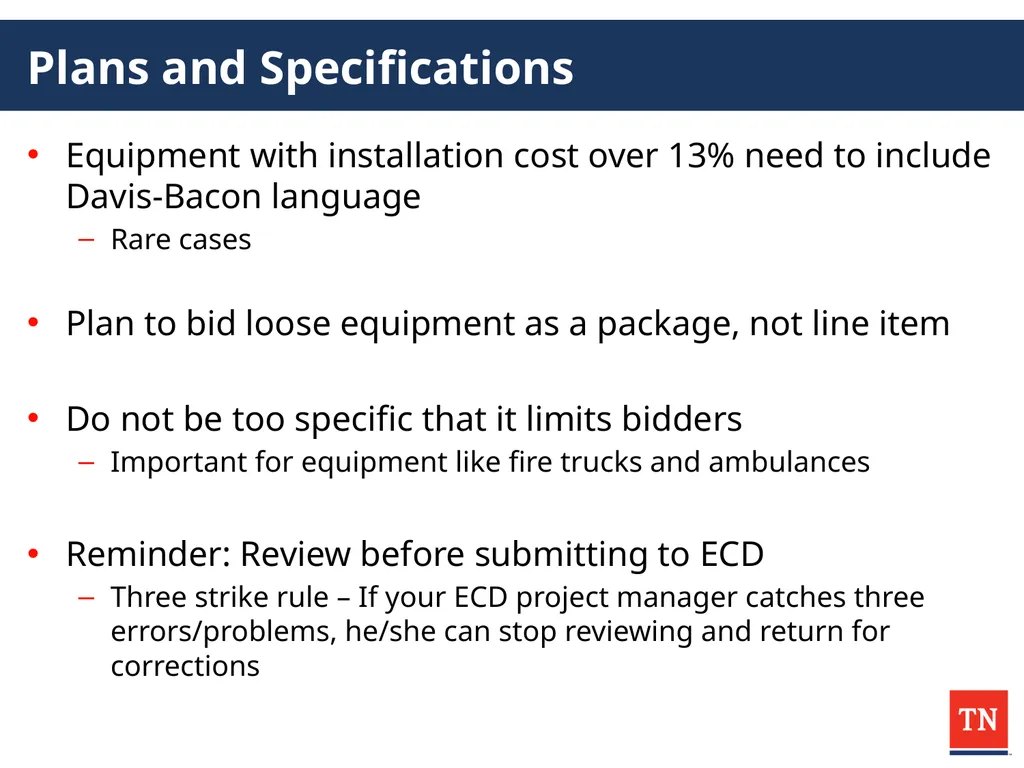
slide54. Plans and Specifications Equipment with installation cost over 13% need to include Davis-Bacon language
Rare cases
Plan to bid loose equipment as a package, not line item
Do not be too specific that it limits bidders
Important for equipment like fire trucks and ambulances
Reminder: Review before submitting to ECD
Three strike rule – If your ECD project manager catches three errors/problems, he/she can stop reviewing and return for corrections<br>
slide55. Plans and Specifications – Bid Alternates Consider bid alternates
Additive
Deductive
Provides flexibility and limits chances of rebidding
Additive Alternates
Start with a base amount and add items as funding permits
Clearly specify the order in which items will be added
Deductive Alternates
Start with a complete project and remove items as needed to bring the project in-line with funding
Clearly specify the order in which items will be removed
Be careful to not reduce the scope<br>
slide56. Plans and Specifications Statewide Contract:
Documentation of listing on Active Statewide Contract list
Request letter from mayor
Submitted to ECD prior to contacting vendor
Cooperative Agreement:
Request letter from mayor
Documentation from the other governmental entity or service
If using a service/platform, documentation the method of procurement is compliant with the State of TN
Adopted resolution agreeing to the terms of the master agreement of the cooperative purchase service/platform
Must comply with local procurement policies<br>
slide57. Build America, Buy America (BABA)<br>
slide58. Build America, Buy America (BABA) BABA requires any “infrastructure project” funded by any “Federal Financial Assistance” (FFA) apply a domestic content procurement preference, meaning that all iron, steel, manufactured products, and construction materials used in the infrastructure project have been produced in the United States, unless the awarding agency has issued a waiver of this requirement.
Implemented differently by each federal funding agency
HUD BABA website<br>
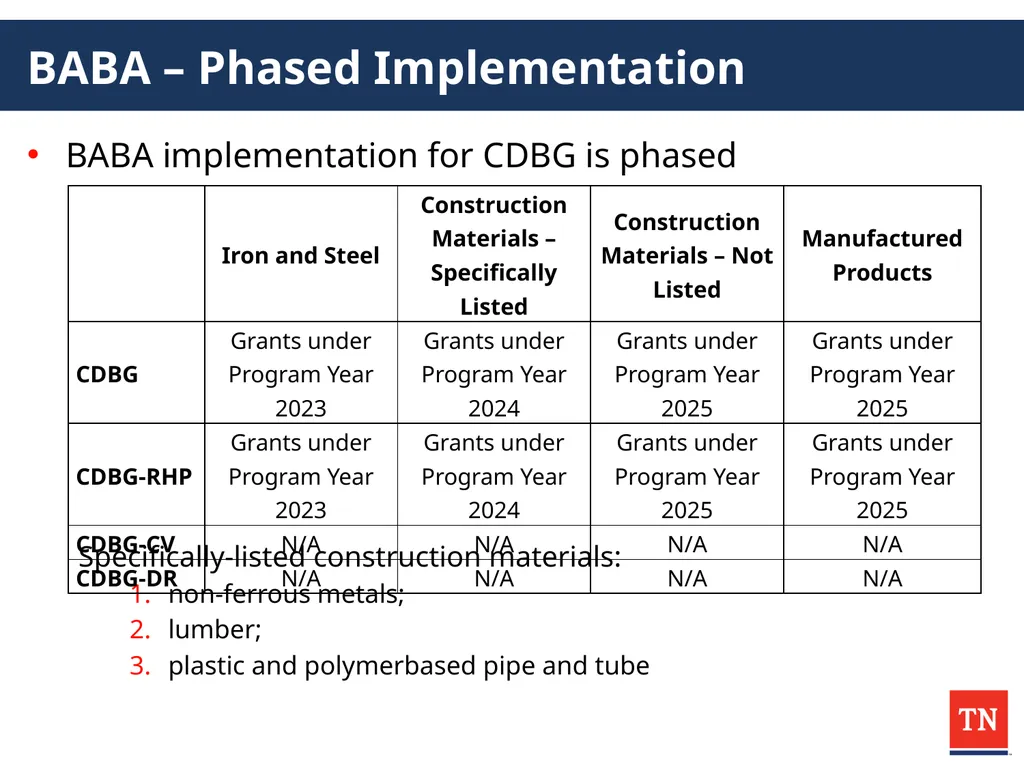
slide59. BABA – Phased Implementation BABA implementation for CDBG is phased
Specifically-listed construction materials:
non-ferrous metals;
lumber;
plastic and polymerbased pipe and tube<br>
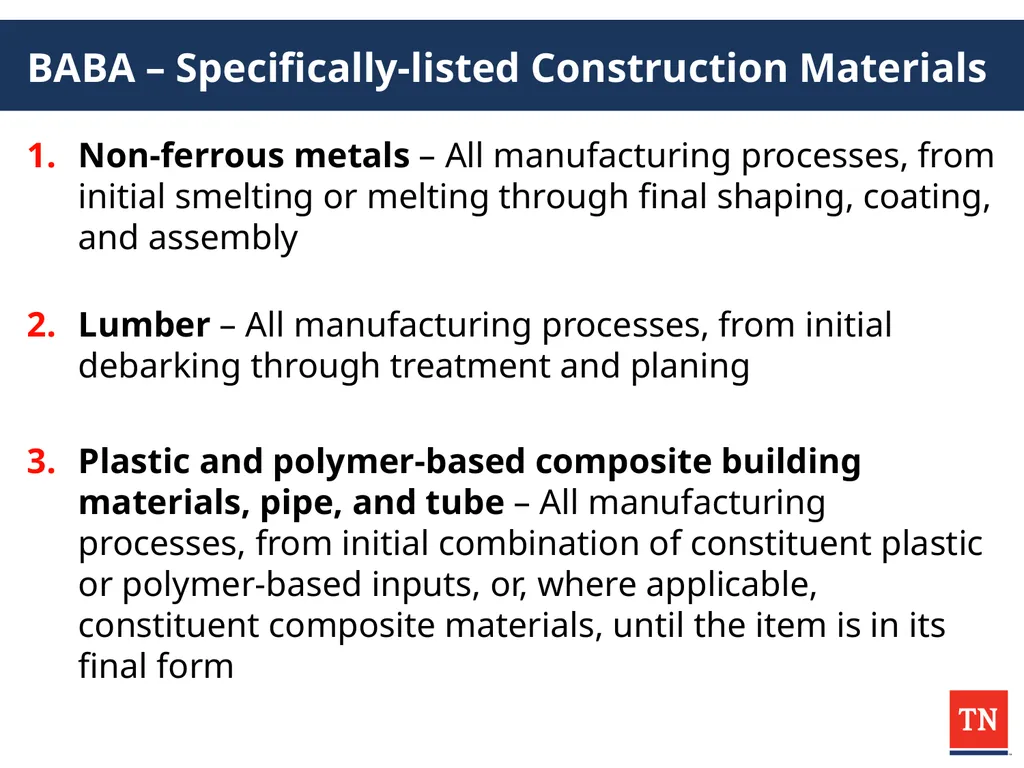
slide60. BABA – Specifically-listed Construction Materials Non-ferrous metals – All manufacturing processes, from initial smelting or melting through final shaping, coating, and assembly
Lumber – All manufacturing processes, from initial debarking through treatment and planing
Plastic and polymer-based composite building materials, pipe, and tube – All manufacturing processes, from initial combination of constituent plastic or polymer-based inputs, or, where applicable, constituent composite materials, until the item is in its final form<br>
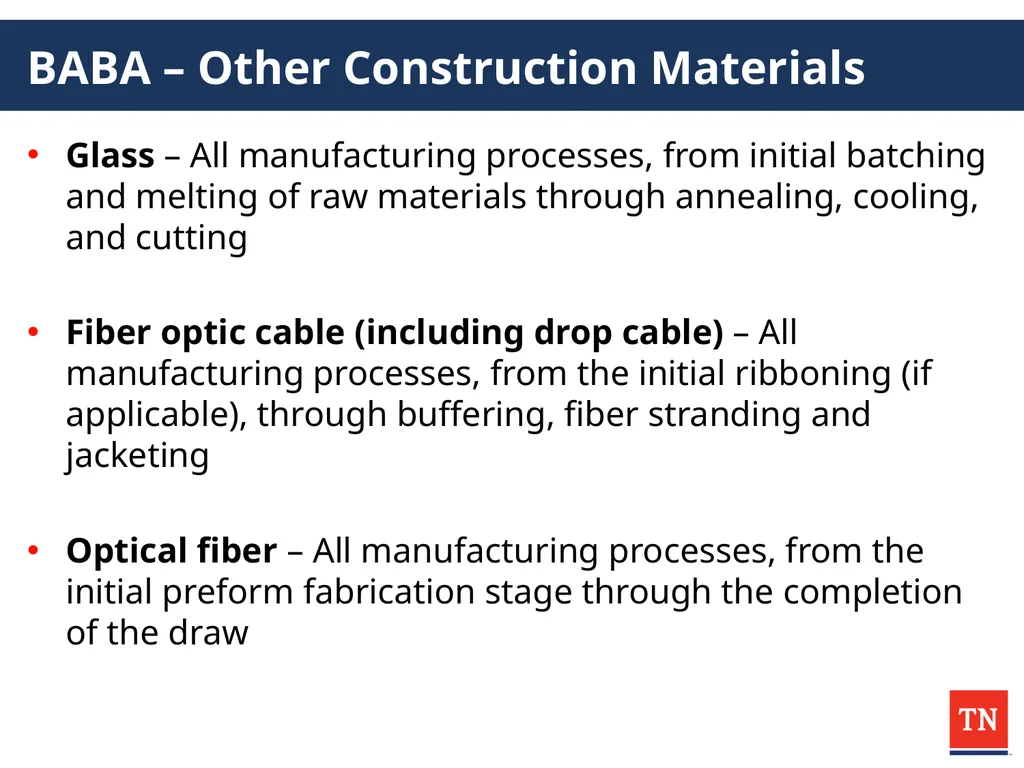
slide61. BABA – Other Construction Materials Glass – All manufacturing processes, from initial batching and melting of raw materials through annealing, cooling, and cutting
Fiber optic cable (including drop cable) – All manufacturing processes, from the initial ribboning (if applicable), through buffering, fiber stranding and jacketing
Optical fiber – All manufacturing processes, from the initial preform fabrication stage through the completion of the draw<br>
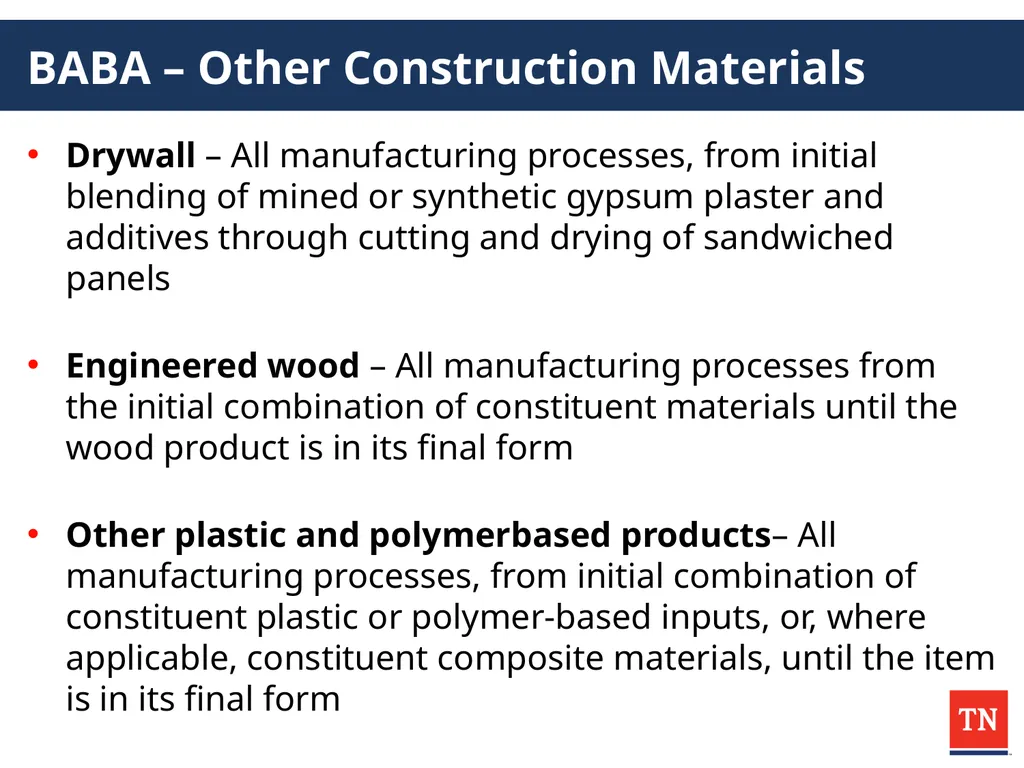
slide62. BABA – Other Construction Materials Drywall – All manufacturing processes, from initial blending of mined or synthetic gypsum plaster and additives through cutting and drying of sandwiched panels
Engineered wood – All manufacturing processes from the initial combination of constituent materials until the wood product is in its final form
Other plastic and polymerbased products– All manufacturing processes, from initial combination of constituent plastic or polymer-based inputs, or, where applicable, constituent composite materials, until the item is in its final form<br>
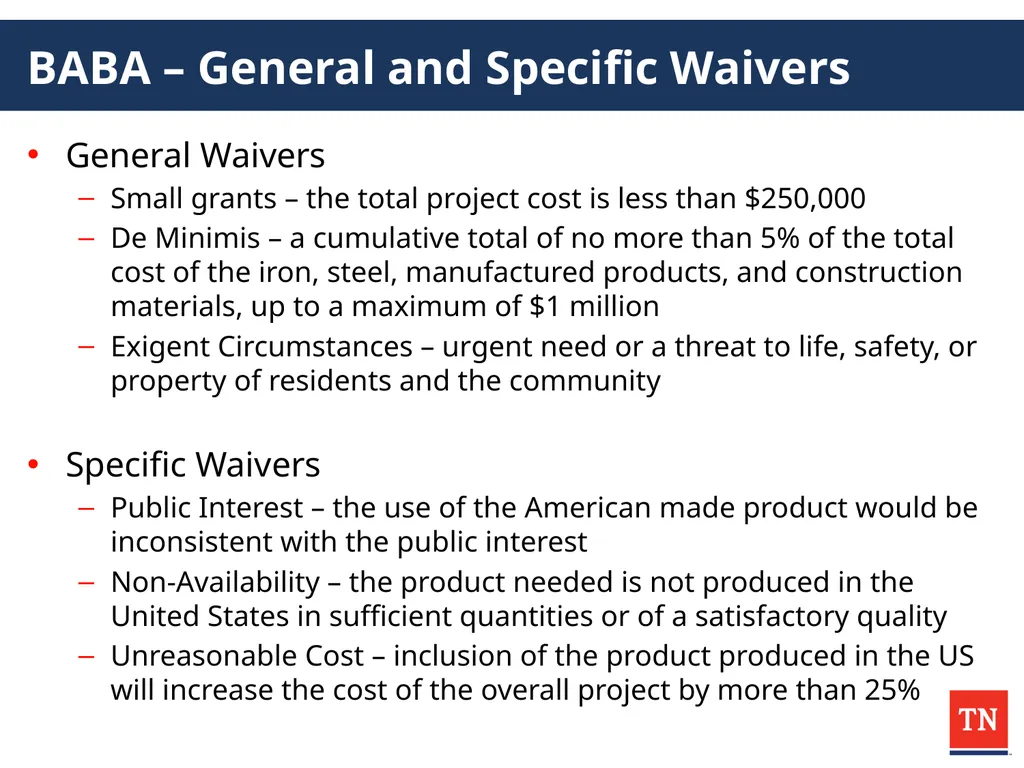
slide63. BABA – General and Specific Waivers General Waivers
Small grants – the total project cost is less than $250,000
De Minimis – a cumulative total of no more than 5% of the total cost of the iron, steel, manufactured products, and construction materials, up to a maximum of $1 million
Exigent Circumstances – urgent need or a threat to life, safety, or property of residents and the community
Specific Waivers
Public Interest – the use of the American made product would be inconsistent with the public interest
Non-Availability – the product needed is not produced in the United States in sufficient quantities or of a satisfactory quality
Unreasonable Cost – inclusion of the product produced in the US will increase the cost of the overall project by more than 25%<br>
slide64. BABA – Project Specific Waivers Request for a project specific waiver must be submitted using the Build America, Buy America Waiver Request form (Exhibit M-1)
Project specific waivers will require review by HUD and the Made in America Office
Expect at least 6 weeks for specific waiver reviews
Design projects expecting not to get specific waivers<br>
slide65. BABA Compliance The BABA Applicability Checklist (Exhibit M-2) is available to assist in determining BABA applicability
Contractors should submit the BABA Covered Materials and Manufactured Goods List (Exhibit M-3) to the local administrator at the following intervals of the project:
Start of construction
Addition of new materials (typically coinciding with a change order)
With the submission of final invoice
This will be reviewed at monitoring<br>
slide66. Bidding and Procurement<br>
slide67. Levels of Procurement Formal Bidding
Informal Purchases
Micro-purchases
Statewide Contract
Cooperative Purchase
Sole Source
Competitive Negotiation<br>
slide68. Procurement Requirements Procurements made as part of a CDBG project must meet federal, state, and local procurement requirements.
When requirements conflict, the strictest prevails
Engage the local government procurement officer early
Cost plus percentage of cost contracts are specifically prohibited if CDBG funds are involved<br>
slide69. Formal Bidding Bid opening must be advertised in a newspaper
Does not have to be daily
Consider other actions to solicit bidders
14 days minimum between advertisement and bid opening
Consider pre-bid meeting for complex projects
Check the wage determinations 10 days prior to bid opening
Addendum must be issued if determinations have changed
All addenda must be approved by ECD
Submit at least 4 days prior to bid opening
State law requires 48 hours notice to bidders<br>
slide70. Formal Bidding - Participation Must submit to GoDBE portal for construction
Decide who will submit. Typically submitted by the engineer.
Equipment projects must document how DBEs are solicited and encouraged to bid
Document direct solicitation of DBEs or save a copy of a DBE database search that returned ‘no results’ for the equipment type you are procuring
Think of ways to encourage participation from bidders
Utilize plans rooms
Industry networks (Dodge Report)
Keep a catalogue of potential bidders from previous projects<br>
slide71. Bid Opening The administrator should attend and coordinate bid openings
Keep a sign-in sheet of attendees and minutes
Submitted bids are kept sealed and opened one at a time, publicly at the bid opening
Bids submissions that do not meet the submission requirements in the plans and specs shall not be opened and are disallowed
Announce who is the apparent low bidder, contingent on review of the entire bid proposal.<br>
slide72. Informal Purchases Purchases that fall under the threshold for formal bidding may use the informal purchase method.
The administrator will assist the grantee in obtaining at least three (3) quotes for goods or services.
Each of the quotes must be recorded.
The selected vendor must still agree to sign all applicable certifications and affidavits.
Inform your project manager if using this method.<br>
slide73. Micropurchases In rare cases, purchases that fall under the threshold for informal purchase may use the micropurchase method.
Quotes are not required, but grantees are encouraged to shop for the best price.
The selected vendor must still agree to sign all applicable certifications and affidavits.
Inform your project manager if using this method.<br>
slide74. Statewide Contract Purchases Local government grantees can take advantage of the statewide contracts that have already been procured by the State of Tennessee.
List of active statewide contracts
Check the usage instructions
The selected vendor must still agree to sign all applicable certifications and affidavits.
Inform your project manager if using this method.<br>
slide75. Cooperative Agreement Purchase Under T.C.A. § 12-3-1205 local governments are allowed to utilize cooperative purchases agreements with other governments inside or outside the state.
Typically used for equipment
Adopted resolution agreeing to the terms of the master agreement of the cooperative purchase service/platform
Must comply with local procurement policies
The selected vendor must still agree to sign all applicable certifications and affidavits.
Inform your project manager if using this method.<br>
slide76. Sole Source May be allowed in very special circumstances
Single source of availability
Compatibility
The selected vendor must still agree to sign all applicable certifications and affidavits.
Inform your project manager if using this method.<br>
slide77. Competitive Negotiation Used when procuring professional services
Typically, will follow the request for proposals (RFP) process
Qualification is most important. Price may or may not be a factor.
Inform your project manager if using this method.<br>
slide78. Recommendations for Bid Award If recommendation comes from engineer, letter from mayor must be included (or adopted resolution if community requires a resolution)
All executed certifications and affidavits from bidder must be included
If local procurement policy requires council/commission approval, minutes must be included
Bid advertisement with the date of ad run must be included
Minutes of bid opening must be included<br>
slide79. Recommendations for Bid Award If low bidder is not selected, justification must be included*
If selected bid exceeds budget amount, resolution for additional funding must be included. Resolution should note match amount and overage amount.
If only one bidder submits and you wish to accept the bid, the following must be included:
Efforts to solicit bids
Interest from potential bidders
Justification why rebidding with additional efforts or changes to the plans and specs won’t result in increased competition*
*Justification must be compelling. Does not guarantee TNECD approval<br>
slide80. Recommendations for Bid Award Any potential bidders must be registered on SAM.gov and have a SAM number (UEI).
Should a low bidder not be SAM registered, then their bid may be deemed non-compliant, and the next lowest bidder can be recommended.
UEI numbers cannot be used in place of SAM numbers.<br>
slide81. Recommendations for Bid Award If performing multiple procurement and bidding rounds of various methods and types, please use a tracking form to assist with tracking and monitoring purposes. It should include:
Procurement Type – Construction or Equipment
If Equipment – Equipment unit cost
Equipment Procurement Method – Formal, Informal, Cooperative Agreement, State Contract, Micro-purchase
Awarded contractor or vendor
Award amount
Said tracking form would "mirror" Contractor/Sub-Contractor Activity Report
Will be reviewed during monitoring<br>
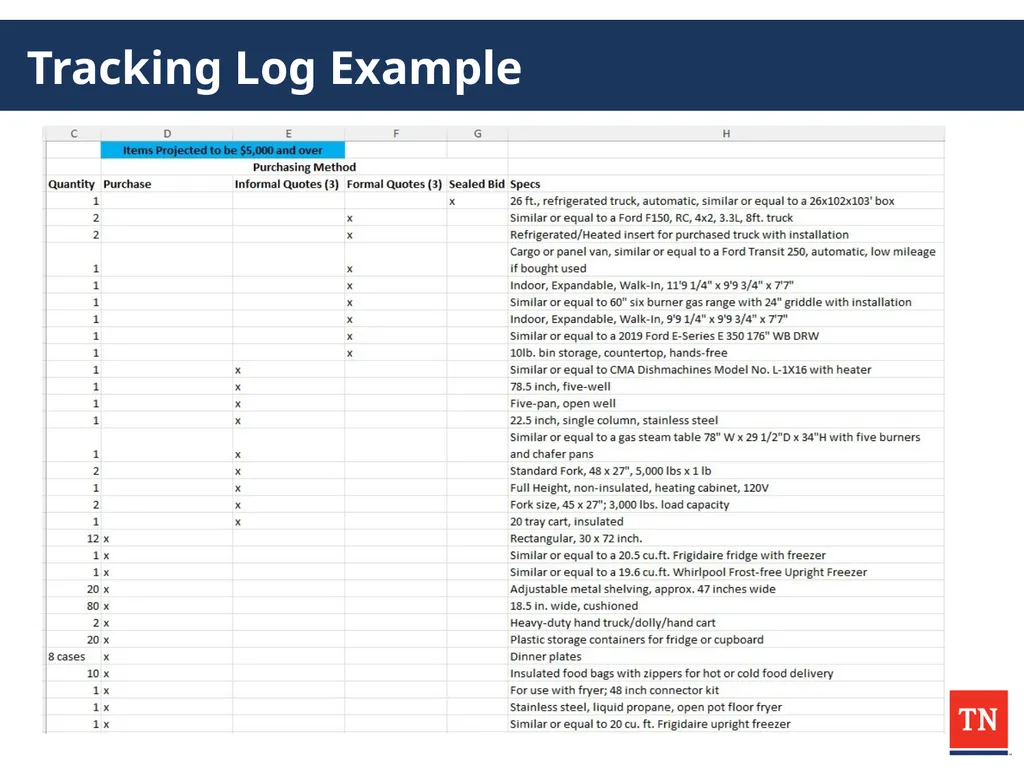
slide82. Tracking Log Example<br>
slide83. Construction and Labor<br>
slide84. Pre-Construction Conference All construction projects should conduct a pre-construction conference prior to the start of construction
Typically, this is when the contract is signed
All details and of roles individuals should be discussed<br>
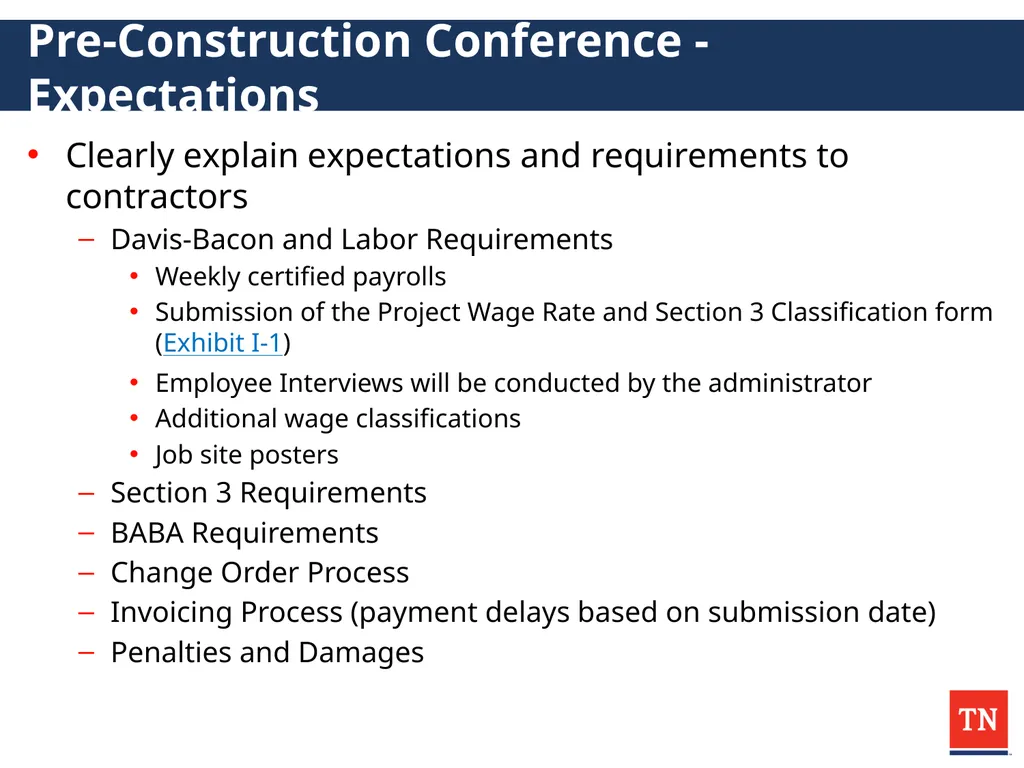
slide85. Pre-Construction Conference - Expectations Clearly explain expectations and requirements to contractors
Davis-Bacon and Labor Requirements
Weekly certified payrolls
Submission of the Project Wage Rate and Section 3 Classification form (Exhibit I-1)
Employee Interviews will be conducted by the administrator
Additional wage classifications
Job site posters
Section 3 Requirements
BABA Requirements
Change Order Process
Invoicing Process (payment delays based on submission date)
Penalties and Damages<br>
slide86. Start of Construction Submit Notice of Start of Construction to ECD once date is set. Link: Notice of Start of Construction
Include initial Contract/Subcontract Activity Report with Notice of Start of Construction. Link: Form HUD-2516<br>
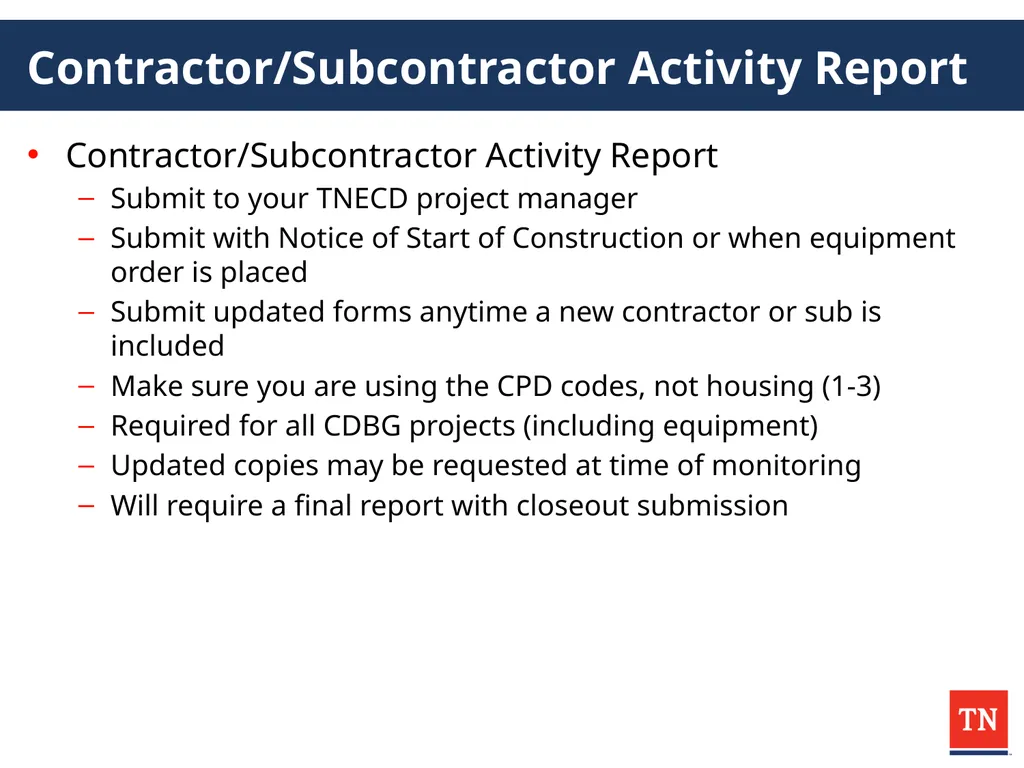
slide87. Contractor/Subcontractor Activity Report Contractor/Subcontractor Activity Report
Submit to your TNECD project manager
Submit with Notice of Start of Construction or when equipment order is placed
Submit updated forms anytime a new contractor or sub is included
Make sure you are using the CPD codes, not housing (1-3)
Required for all CDBG projects (including equipment)
Updated copies may be requested at time of monitoring
Will require a final report with closeout submission<br>
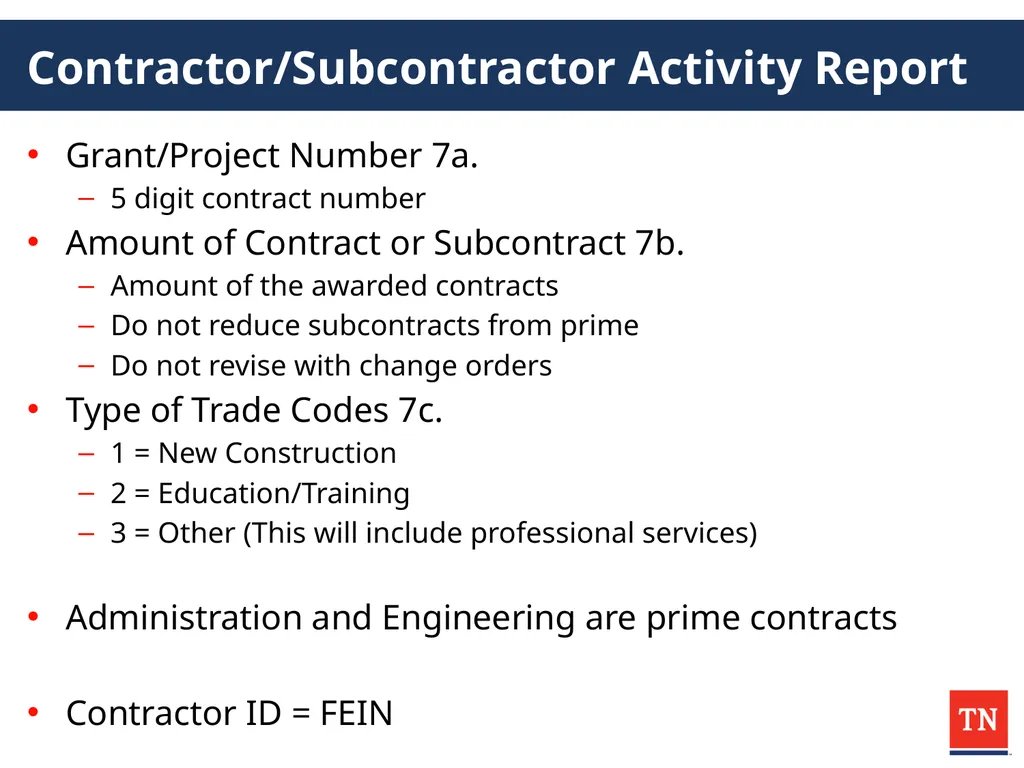
slide88. Contractor/Subcontractor Activity Report Grant/Project Number 7a.
5 digit contract number
Amount of Contract or Subcontract 7b.
Amount of the awarded contracts
Do not reduce subcontracts from prime
Do not revise with change orders
Type of Trade Codes 7c.
1 = New Construction
2 = Education/Training
3 = Other (This will include professional services)
Administration and Engineering are prime contracts
Contractor ID = FEIN<br>
slide89. Change Orders We allow increases work by more than 20% if the attorney provides a letter
There will still need to be scope changes for a decrease in work of 20% or more
Change orders cannot be used for cost increases, only quantities and time
Justification/explanation from engineer must be included
Letter of concurrence from mayor included
Adjustments to professional services require approval
We are still having some trouble here<br>
slide90. Davis-Bacon and Labor Requirements Interview employees early in the project to catch problems early
At least once a month, minimum
Get enough interviews to cover all wage classifications used
Make sure the employee interviews and payrolls match the job classification
Review the first few payrolls CLOSELY and fix the problems early on – check for any inconsistencies and errors<br>
slide91. Davis-Bacon and Labor Requirements Information on these documents should be consistent:
Project Wage Rate and Section 3 Classification form
Certified payrolls
Employee interviews
All required posters and applicable wage decision must be clearly posted at the job site
Will result in a finding at monitoring if not<br>
slide92. Additional Wage Classification Requests Submit requests to your TNECD project manager before work is done, as soon after contracting as you can
DOL at times takes 2-3 months to respond to requests
Things to consider
Communicate with contractors about reasonableness
Make sure requests include justification
Other classifications don’t always work as justification
If the additional classification is a skill position, use a published skilled rate as a basis; DOL will<br>
slide93. Section 3<br>
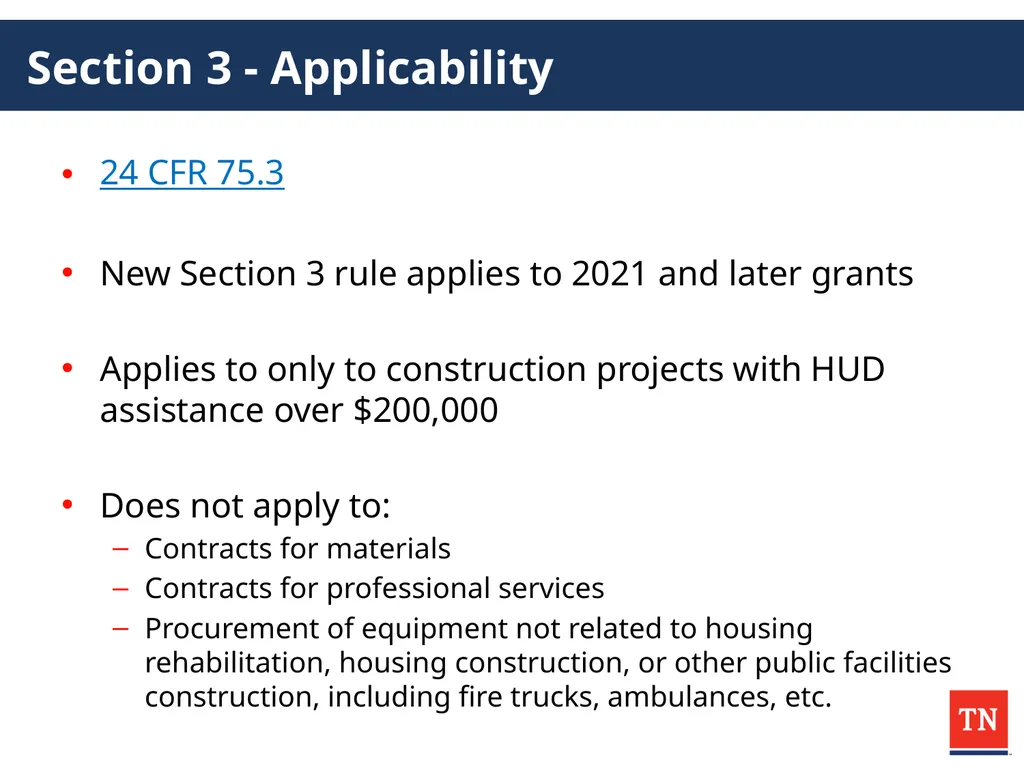
slide94. Section 3 - Applicability 24 CFR 75.3
New Section 3 rule applies to 2021 and later grants
Applies to only to construction projects with HUD assistance over $200,000
Does not apply to:
Contracts for materials
Contracts for professional services
Procurement of equipment not related to housing rehabilitation, housing construction, or other public facilities construction, including fire trucks, ambulances, etc.<br>
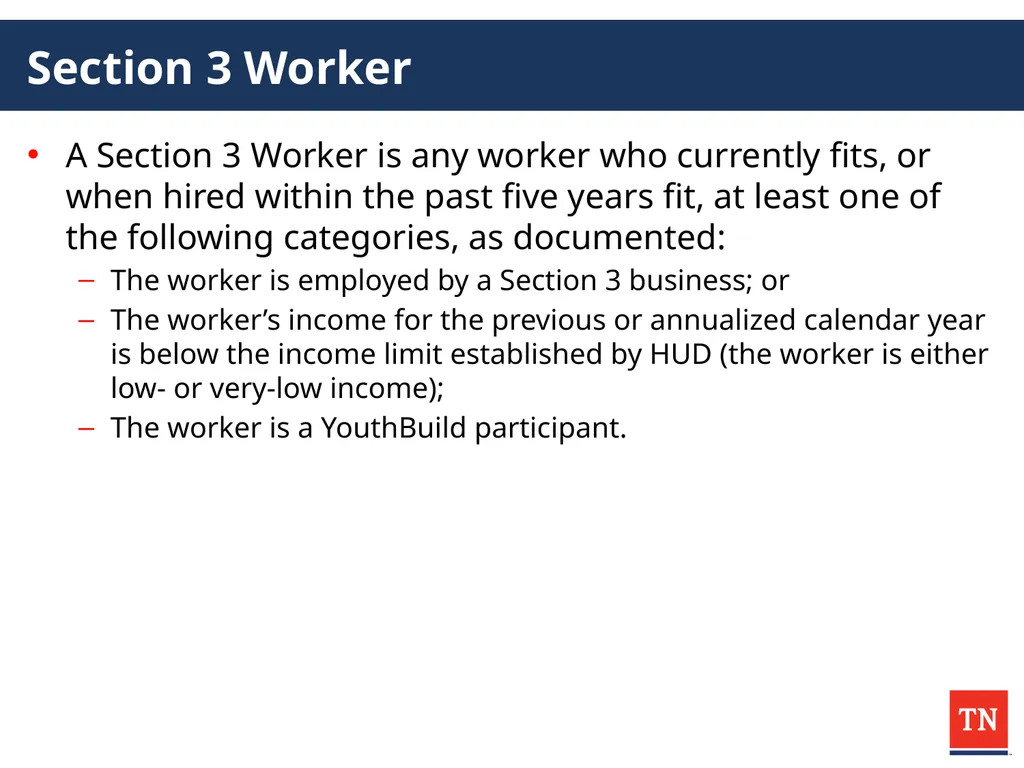
slide95. Section 3 Worker A Section 3 Worker is any worker who currently fits, or when hired within the past five years fit, at least one of the following categories, as documented:
The worker is employed by a Section 3 business; or
The worker’s income for the previous or annualized calendar year is below the income limit established by HUD (the worker is either low- or very-low income);
The worker is a YouthBuild participant.<br>
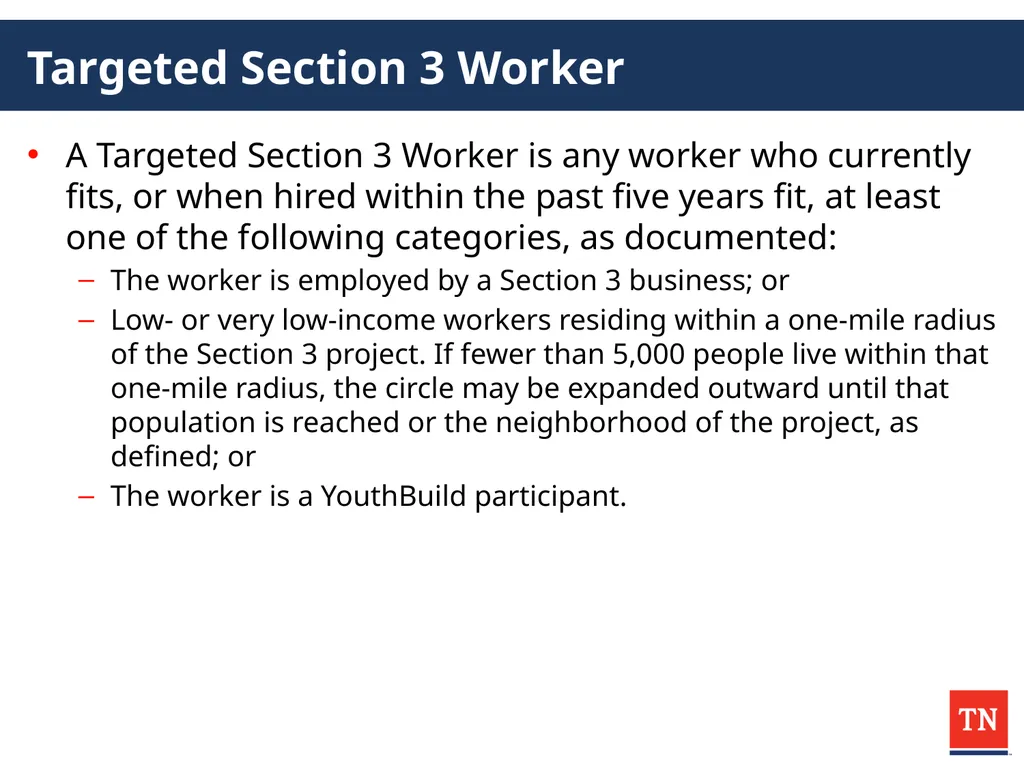
slide96. Targeted Section 3 Worker A Targeted Section 3 Worker is any worker who currently fits, or when hired within the past five years fit, at least one of the following categories, as documented:
The worker is employed by a Section 3 business; or
Low- or very low-income workers residing within a one-mile radius of the Section 3 project. If fewer than 5,000 people live within that one-mile radius, the circle may be expanded outward until that population is reached or the neighborhood of the project, as defined; or
The worker is a YouthBuild participant.<br>
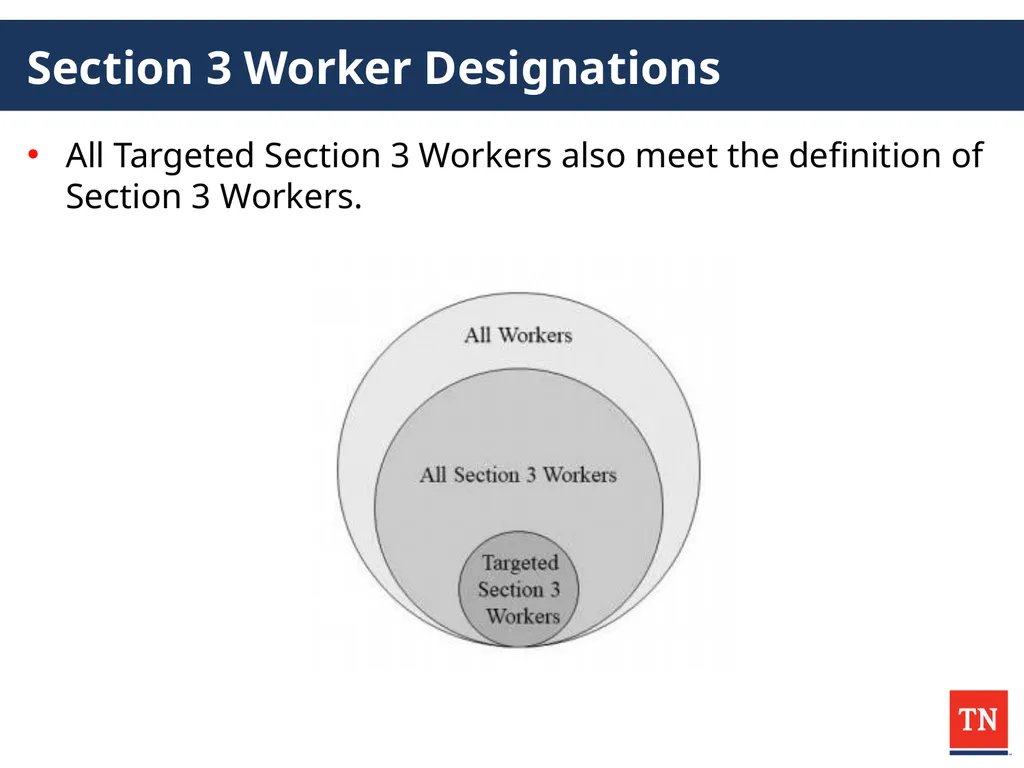
slide97. Section 3 Worker Designations All Targeted Section 3 Workers also meet the definition of Section 3 Workers.<br>
slide98. Section 3 Benchmarks Section 3 Workers = 25% of total labor hours
Targeted Section 3 Workers = 5% of total labor hours
Any labor hours counted toward the total for Targeted Section 3 Workers will also count toward the total for Section 3 Workers.<br>
slide99. Determining Section 3 Worker Status The status workers on Section 3 projects can be determined using the following methods.
Worker income self-certification – the use of certification forms provided to contractors and subcontractors working on the project. Each worker on the project must complete the provided certification form to be kept in the grant record for reference when tracking and aggregating labor hours worked.
Section 3 Worker Certification (Exhibit L-1)
Worker is employed by a Section 3 Business Concern – The contractor or subcontractor is able to provide documentation that it qualifies as a Section 3 Business Concern. All employees of a qualifying business will be considered Section 3 workers.<br>
slide100. Determining Section 3 Worker Status Worker is a Youthbuild participant – Verifiable documentation must be provided by the worker or the employer showing the worker is participating in a Youthbuild program.
* Documentation submitted by employers should only contain employee names, state and county of residence, annual income, and a certifying signature and date. Do not include any information such as social security numbers or bank account information.<br>
slide101. Section 3 Business Concern The definition of a Section 3 Business Concern has been changed that a qualifying business must meet one of the following criteria, documented within the past 6 months:
The business is at least 51 percent owned and controlled by low- or very low-income persons
At least 75 percent of the labor hours performed for the business over the prior three-month period are performed by Section 3 workers
The business is at least 51 percent owned and controlled by current public housing residents or residents who currently live in Section 8-assisted housing
The Section 3 Business Self-Certification (Exhibit L-2), and necessary backup documentation must be submitted by the qualifying business.<br>
slide102. Subrecipient/Grantee Responsibilities Establish and maintain a list of resources and organizations that offer training and employment opportunities in the area.
Temp services
Jobs centers
Youthbuild programs
Etc.
Maintain Section 3 tracking
Make TNECD aware of Section 3 Businesses in your area.
Make contractors and subs aware of Section 3 at the pre-construction conference.<br>
slide103. Subrecipient/Grantee Responsibilities Monitor contractors and subcontractors for Section 3 compliance.
Make best efforts to meet Section 3 and Targeted Section 3 Worker benchmarks.
Report on efforts if benchmarks are not met.
Establishing the geography of the Targeted Section 3 Worker area if fewer then 5,000 people live within a 1-mile radius of the project area.
(Usually this will be the community.)<br>
slide104. Contractor Responsibilities Ensure subcontractors are aware of Section 3 requirements and responsibilities.
Maintain and provide a list of permanent employees working on the Section 3 project who were hired within the last 5 years and their Section 3 status. This will be completed as part of the Project Wage Rate and Section 3 Classification form (Exhibit I-1) .
Make a best effort to hire Section 3 or Targeted Section 3 Workers when new hires are necessary.<br>
slide105. Reporting Subrecipients are required to report the following at project closeout:
The total number of labor hours worked
The total number of labor hours worked by Section 3 workers
The total number of labor hours worked by Targeted Section 3 workers
The percentage of labor hours worked by Section 3 workers
The percentage of labor hours worked by Targeted Section 3 workers
If benchmarks are unmet, qualitative efforts and explanation of those efforts<br>
slide106. Reporting The Section 3 Labor Hours Tracking Form (Exhibit L-4) has been provided simplify tracking of labor hours a best we can.
Labor hours can be verified using weekly payrolls and the Project Wage Rate and Section 3 Classification form (Exhibit I-1).
A complete and accurate I-1 form for each contractor and subcontractor is essential.<br>
slide107. Financial Management<br>
slide108. Invoicing The grant invoice template will be sent from ecd.tefmsadmin@tn.gov after the grant contract is fully executed
Invoices should be submitted every 1 to 3 months
Submit to ECD.Invoices@tn.gov
Typically takes 30 days to review and process (if everything is correct)<br>
slide109. Invoice Template Four tabs in Excel workbook
Grant Budget
Invoice
Backup Detail
Instructions
Data can only be entered into blue cells
Read the instructions
If you are unsure, ask you TNECD project manager<br>
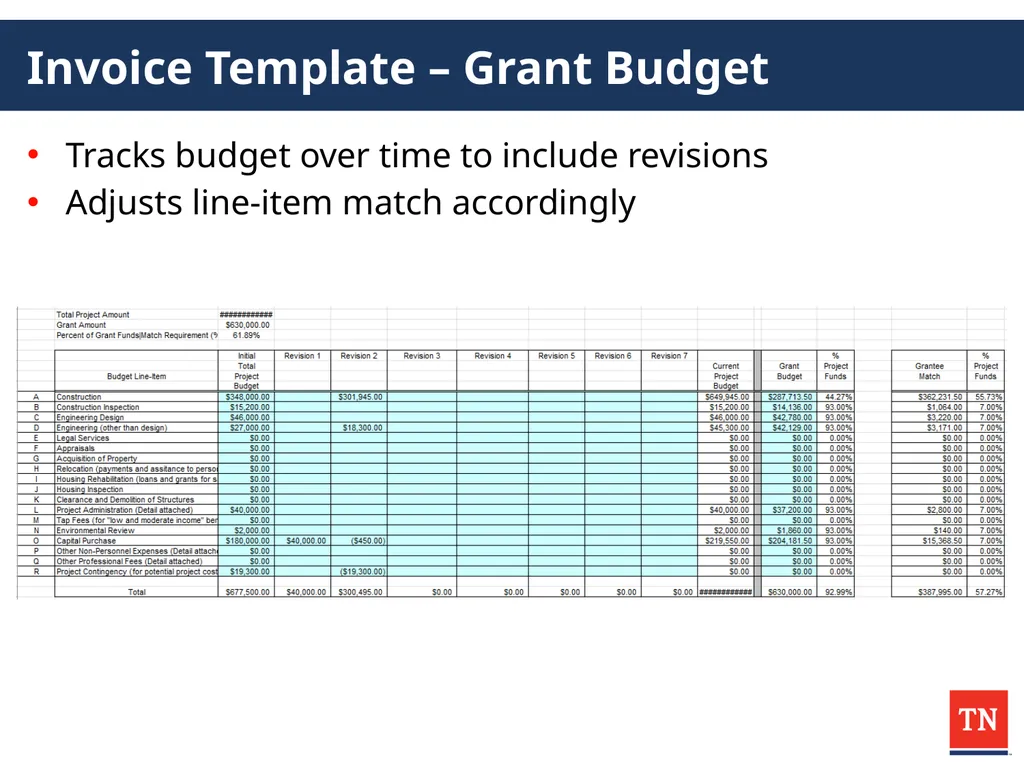
slide110. Invoice Template – Grant Budget Tracks budget over time to include revisions
Adjusts line-item match accordingly<br>
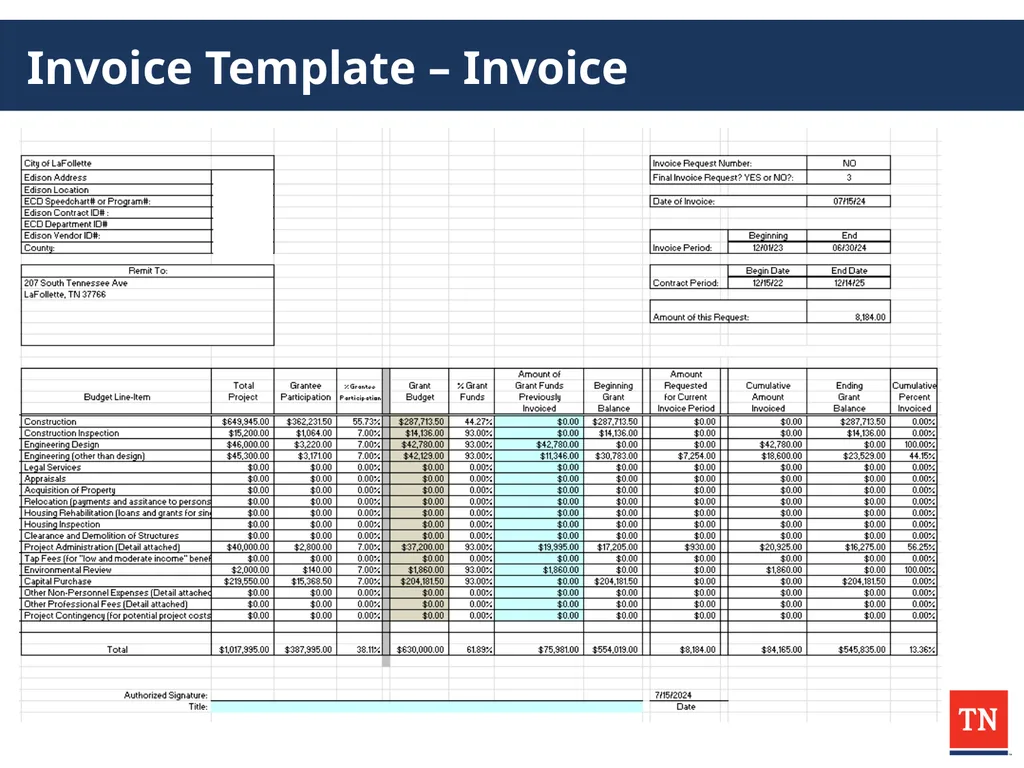
slide111. Invoice Template – Invoice<br>
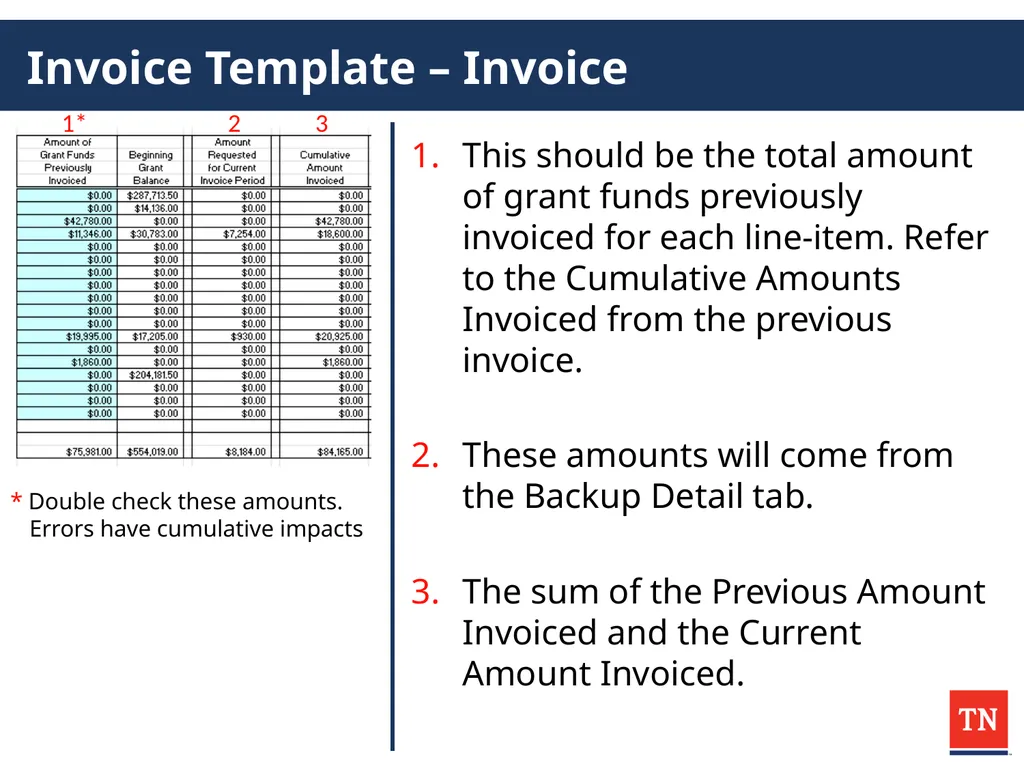
slide112. Invoice Template – Invoice This should be the total amount of grant funds previously invoiced for each line-item. Refer to the Cumulative Amounts Invoiced from the previous invoice.
These amounts will come from the Backup Detail tab.
The sum of the Previous Amount Invoiced and the Current Amount Invoiced. 1* 2 * Double check these amounts. Errors have cumulative impacts 3<br>
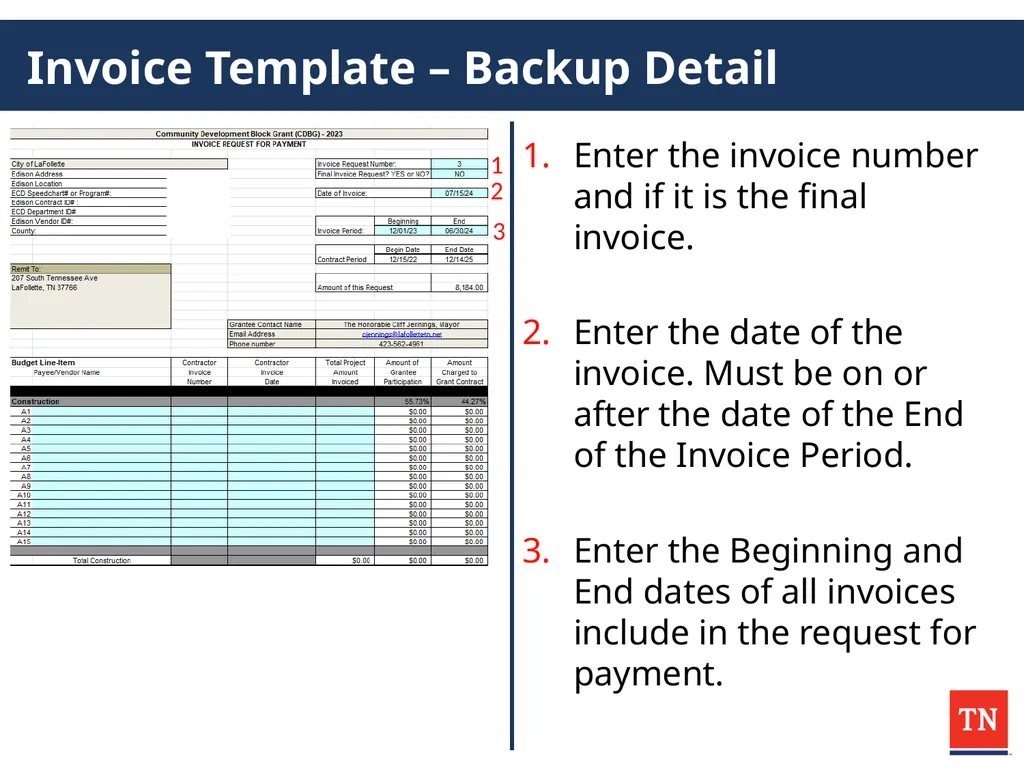
slide113. Invoice Template – Backup Detail Enter the invoice number and if it is the final invoice.
Enter the date of the invoice. Must be on or after the date of the End of the Invoice Period.
Enter the Beginning and End dates of all invoices include in the request for payment. 1 2 3<br>
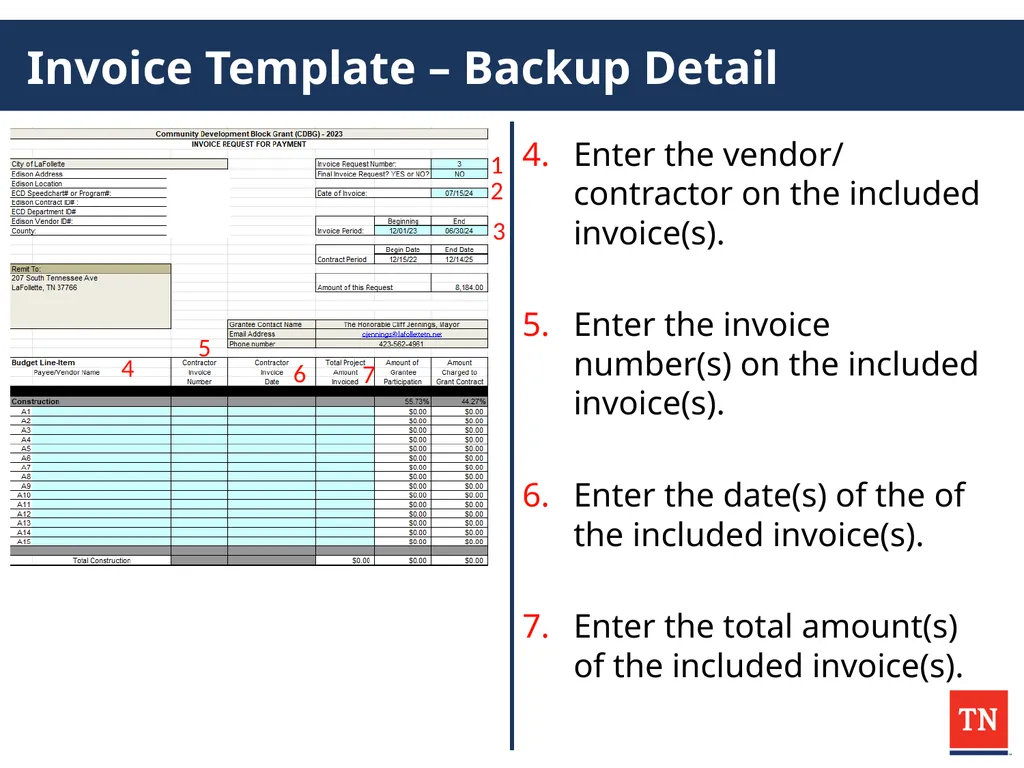
slide114. Invoice Template – Backup Detail Enter the vendor/ contractor on the included invoice(s).
Enter the invoice number(s) on the included invoice(s).
Enter the date(s) of the of the included invoice(s).
Enter the total amount(s) of the included invoice(s). 1 2 3 4 5 6 7<br>
slide115. Invoice Template – Additional Guidance Make sure to include the line-item number on the Backup Detail tab on the corresponding included invoice.
Make sure included invoice dates all fall within the Invoice Period.
Make sure included invoice dates all fall within the Contract Period.
If the grantee has already paid for the service or good, a copy of proof of payment is included.<br>
slide116. Invoice Template – Backup Documentation Copies and scans must be legible (amounts, dates, names, etc.).
Backup documentation should always be in order and consistent with the Backup Detail tab.
Professional services invoices must include a description of the work performed.
Overall line-item invoicing should be consistent with the project timeline. (ie. Don’t invoice 75% of Grant Admin if the project hasn’t been bid yet.)<br>
slide117. Budget Revisions Submit anytime the budget is adjusted
Bid Awards
Change Orders
Submit to your TNECD project manager at the same time as the bid award, change order, etc.
The Budget Revision Template (Exhibit A-3) must be used.
Only enter data in blue cells.
Each line item must contain at least the minimum required match percentage.<br>
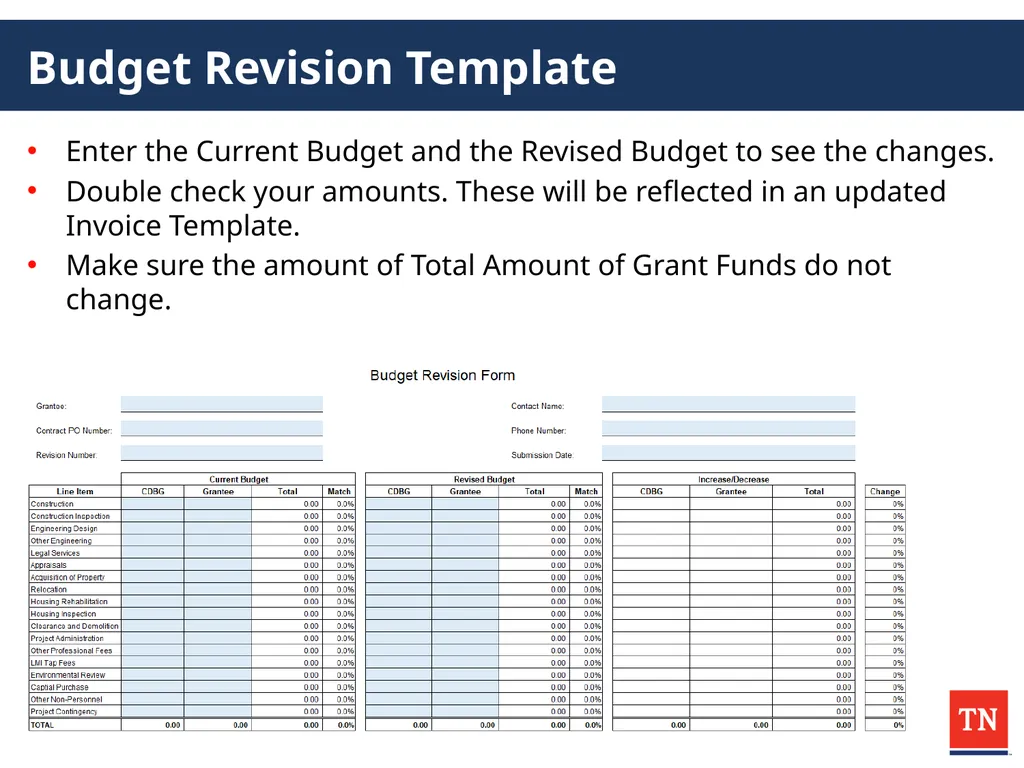
slide118. Budget Revision Template Enter the Current Budget and the Revised Budget to see the changes.
Double check your amounts. These will be reflected in an updated Invoice Template.
Make sure the amount of Total Amount of Grant Funds do not change.<br>
slide119. Grant Monitoring<br>
slide120. Monitoring Generally, set at 50% construction completion or equipment delivery
Make sure enough employee interviews have been conducted
Make sure Fair Housing activity is complete
Davis-Bacon is the biggest challenge, pay careful attention here
Labor findings generally take the longest to resolve
Make sure to review grant documents before submitting for monitoring.
Too many times we have projects submitted for monitoring then pushed out because the administrator is not ready.<br>
slide121. Monitoring Submit requests for monitoring online
Link: CDBG Monitoring Request Form
Submit requested monitoring documentation to the SharedDrive one week prior to monitoring date. This gives ECD staff time to review in advance.
Webform must be completed and documents submitted at least one week prior to monitoring appointment
Link: CDBG Electronic Monitoring
Review the monitoring workbooks so you know what we are looking at.
Sample Monitoring Workbook (Exhibit K-1)
Sample Labor Monitoring Checklist (Exhibit K-2)<br>
slide122. Monitoring For construction projects, please have Section 3 documentation and Section 3 Labour Hours Tracking Form current. (CDBG Manual: Chapter L)
Grantee (City/County) should have copies of all documents on file.
City Hall
County Courthouse
If requested, please provide TAS surveys and have them ready for review.
For construction projects, take pictures of work progress during employee interviews.<br>
slide123. Monitoring Should you experience problems with submitting documentation to the SharedDrive for an electronic monitoring, please let Kent or Lynn know immediately.
Be mindful of monitoring timeline. TNECD staff receives monitoring assignments on the 5th of every month.
TNECD will provide grantees one week after monitoring date to submit missing documentation before report letter is issued.
Final RFP cannot be processed until monitoring is complete. (all documentation received, and any findings addressed)<br>
slide124. Grant Closeout<br>
slide125. Grant Closeout The following items must be complete to trigger closeout procedures:
Completion of construction or delivery of equipment
Release of lien by the contractor (construction)
Notice of Completion run in the local newspaper (construction)
Monitoring is completed and any findings are cleared
Final request for payment has been submitted
Closeout public hearing has been held
Link: CDBG Closeout Report
Be sure to select Closeout Report<br>
slide126. Closeout Public Hearing Closeout public hearings should be held within 30 days of the end of construction
Advertisement must run in the local newspaper at least 14 days prior to public hearing
Items to be addressed at the public hearing:
The project as completed versus application
Final cost of the project as completed
Note of any significant adjustments
Allow the public to voice and questions or concerns
Collect signatures of attendees and keep minutes<br>
slide127. Additional Grant Administration<br>
slide128. Contract Amendments Reasons to amend a contract
Extension of contract period
Change in scope
Budget adjustment to zero-dollar line items
Contract Extension
Request contract extension using the new online form. Select the “Contract Amendment” tab on our Grant Administration page.
Include the current budget
Submit at least 90 days prior to contract expiration<br>
slide129. Monthly and Annual Reports Monthly Status Reports are required to be submitted by the 25th of each month
Make sure the form fields are being updated as needed
Annual Reports due at the end of December
Will take the place of the December monthly report
Link: CDBG Annual Report
Be sure to select Annual Report
Performance measures should match those in application<br>
slide130. Grantee Recordkeeping Full grant files must be kept by the grantee at all times
Grant files must be kept by the grantee 5 years after the closeout date of the grant
Consider keeping electronic records that are accessible by both the grantee and grant administration agency
TNECD only accepts electronic record submissions<br>
slide131. Contact Information Kent Archer kent.archer@tn.gov 615-354-3591
Lynn Tutor p.lynn.tutor@tn.gov 615-674-0175
Allison Fox allison.fox@tn.gov 615-306-0539
Kayla Baxter kayla.baxter@tn.gov 615-308-3601
Tracey Davis tracey.l.davis@tn.gov 615-878-1896
Jill White (ARC) jill.white@tn.gov 615-981-7884
Lindsay Gainous lindsay.gainous@tn.gov 615-585-1533<br>
slide132. Kent Archer
(615) 354-3591
kent.archer@tn.gov<br>
slide2. Grant Award and Project Setup<br>
slide3. Awards and Contracting Once approved by TNECD Grant Committee award letters are issued
Award letters signal when the following work can begin
Environmental Review
Engineering Design
Administration Costs
Incurred costs cannot be reimbursed until the contract is executed and the Environmental Review approved
Signature Authorization Form (Update anytime personnel changes)<br>
slide4. Contracting Contracting process begins shortly after awards
If you know of changes, notify TNECD before contracts are sent out
Change in mayor
Additional match funds
Etc.
Review contracts with local government before returning to TNECD
Scope
Budget
Signatory<br>
slide5. Title VI Compliance Title VI compliance and training occurs after awards
Title VI Survey and non-discrimination policy are required for new grantees
Grantees Title VI information good for 3 years
Only needed for 7 grantees for 2024 awards
Select the “Audit & Title VI” tab on our Grant Administration page to find the Title VI training and to submit Title VI documents<br>
slide6. Audit Reviews and Risk Assessments Audit reviews are conducted annually for all grantees with open grants
Risk assessments are conducted annually for all open grants
Monitoring is determined by looking at both the most recent audit performance and the risk assessments
Risk Levels and Monitoring
Low: Phone Call
Medium: Desk Review
High: In-Person<br>
slide7. Fair Housing All CDBG activities must include a fair housing activity that addresses at least one fair housing impediment
Fair housing activities must be approved by ECD
This should be planned and/or conducted as early as possible<br>
slide8. Project Timeline – Construction Projects ERR Due: Varies, 60-120 days after award
Plans and Specs Due: 90 days after LOREC/FNORCC
Bid Opening: 45 days after Plans & Specs Approval
Bid Tabs Due: 14 days after Bid Opening
PCC: After bid award before start of construction
Notice of Start of: After PCC and before construction begins
Construction (Include first HUD-2516 submission)
Project Monitoring: Approximately 50% construction completion
Final Public Hearing: Within 30 days after construction completion
Closeout Due: 15 days after Final Public Hearing
(Closeout will not be approved until final RFP is processed.)<br>
slide9. Project Timeline – Equipment Projects ERR Due: N/A, submitted with application
Plans and Specs Due: 90 days after LOREC/FNORCC
Bid Opening: 45 days after Plans & Specs Approval
Bid Tabs Due: 14 days after Bid Opening
First HUD-2516 Due: After awarding the bid
Project Monitoring: Delivery of equipment
Final Public Hearing: Within 30 days after equipment delivery
Closeout Due: 15 days after Final Public Hearing
(Closeout will not be approved until final RFP is processed.)<br>
slide10. Environmental Review<br>
slide11. 2024 Reg. Round Adjusted ERR Submission Schedule 2024 round HUD Grant Number: B-24-DC-47-0001<br>
slide12. Manual Updates – Chapter B CDBG online manual Chapter B: Environmental Review is updated as of December 6, 2024
Significant updates - several new forms and documents
Revisions to worksheets, instructional documents and manual chapter narrative
Updated contact information and consulting procedures for various federal agencies and Tribes
Always go to the online manual for current ERR forms, worksheets, and instructions. Submissions on old forms will not be accepted.<br>
slide13. Limitations / ERR clearance Environmental Review must be complete and approved before CDBG funds are released
LOREC (Letter of Removal of Environmental Condition)
Issued when ERR is approved; provides environmental clearance
Lists any agency responses that require mitigation or items to be considered during construction
FNORCC (Final Notice of Removal of Contract Conditions)
Issued when ERR is approved AND CDBG contract is fully executed; allows release of grant funds (requests for payment can be submitted)
24 CFR 58.22 Limitations on activities pending clearance
No choice-limiting actions should occur before the ERR is
approved<br>
slide14. Determining Environmental Review Level Environmental Review level is determined by the project activities. HUD’s rule of “project aggregation” necessitates that the environmental review take into account all planned project activities, regardless of funding source(s).
Project Descriptions should be very specific, listing all planned activities and the nature of all planned construction activities.
If you have any doubt about which ER level should be completed, please contact ECD before starting your ERR!<br>
slide15. HUD Environmental Review Levels Exempt
Equipment purchase
Categorically Excluded Not Subject To {24 CFR Part 58.5} (CENST)*
Categorically Excluded Subject To {24 CFR Part 58.5} (CEST)
rehabilitation of existing facilities with no new construction and no capacity increase
Environmental Assessment (EA)
New construction or Substantial Improvements to existing facilities
Environmental Impact Statement (EIS)*
*will not be used often, if at all, for regular round CDBG projects<br>
slide16. Exempt Exempt activities are listed at 24 CFR 58.34
For 2024 regular round, most Exempt ERR worksheets were submitted with the application
Use Exhibit B-4 Exempt Worksheets
ERR Checklist
Certification of Exemption for HUD funded projects
For equipment purchase projects:
check box 7 on the ‘Certification of Exemption for HUD funded projects’
Complete the questions in Sections 1 and 2<br>
slide17. Categorically Excluded Not Subject To… (CENST) Applies mostly to TN Placemakers and some CDBG-CV projects
CENST activities are listed at 24 CFR 58.35 (b)
Use Exhibit B-13 CENST Worksheets
ERR Checklist
Environmental Review for HUD funded projects Categorically Excluded Not Subject To Section 58.5
Check with ECD to determine whether an activity/ERR should be classified as Exempt or CENST<br>
slide18. Categorically Excluded Subject To… (CEST) Categorically excluded activities are explained at 24 CFR 58.35 (a)
Projects that consist of:
Property acquisition
Repair or rehabilitation of existing public facilities
as long as the facilities are being retained for the same use and there is no 20%+ capacity increase (utility line size/capacity – based on project area, not entire utility system)
Building rehabilitation – residential or commercial
as long as there is no increase in footprint or new construction/dirt moving, no change in land use/building function, no 20%+ capacity increase (building capacity or employment)
If the project includes any new construction/new ground disturbance, an Environmental Assessment level ERR is required.<br>
slide19. Categorically Excluded Subject To… (CEST) Use Exhibit B-3 CEST Worksheets
Environmental Review Record Checklist
Categorically Excluded Subject To 58.5 narrative pages
Statutory Worksheet with all compliance documentation
8-Step or (5-Step) Decision Making Process Documentation (work in floodplain and wetland areas), if applicable
Publish or Post Notice of Intent to Request a Release of Funds (NOI-RROF)
Send copy of notice to all parties on the Distribution List
Request for Release of Funds and Certification (RROF)
Mayor shouldn’t sign until public notice comment period ends<br>
slide20. Categorically Excluded Converted to Exempt Conversion to Exempt is determined only after Statutory Worksheet is complete
Requires no mitigation, permits, or licenses
Status “A” for all categories/authorities
Use B-3 CEST Worksheets
Environmental Review Record Checklist
Categorically Excluded narrative pages
Statutory Worksheet with all compliance documentation
Certification of Exemption for HUD funded projects (check box 12)
NOI-RROF and RROF are not required<br>
slide21. Environmental Assessment (EA) Required for activities that involve new construction or substantial improvements to existing facilities
New Construction
New building on vacant site (i.e. new fire station, new treatment plant, new water tank, etc.)
Building addition that increases footprint
Water/sewer line extension or new force main installation
Generally, ‘new moving of dirt’
Substantial Improvements
Significantly increasing the footprint of an existing building
Changing land use
Capacity increase (typically 20% or more) –related to utility line capacity, building capacity, or employment
Based on project area, not entire system (utilities)
Major rehabilitation<br>
slide22. Environmental Assessment (EA) Use Exhibit B-2 EA Worksheets
Environmental Review Record Checklist
Environmental Assessment Narrative pages
Statutory Worksheet with all compliance documentation
8-Step or (5-Step) Decision Making Process Documentation, (work in floodplain and wetland areas), if applicable
NEPA Environmental Assessment Factors Checklist with all documentation
Publish or post Concurrent Notice
Send copy of notice to all parties on the Distribution List
Request for Release of Funds and Certification (RROF)
Mayor shouldn’t sign until public notice comment period ends<br>
slide23. Environmental Impact Statement (EIS) The project is determined to have a potentially significant impact on the human environment;
The project would provide a site(s) for hospitals and nursing homes containing a total of 2,500 or more beds;
The project would remove, demolish, convert, or substantially rehabilitate 2,500 or more existing housing units; or
The project would provide enough additional water and sewer capacity to support 2,500 or more additional housing units.
Contact ECD before moving forward!<br>
slide24. Use of a Previous ERR Aggregate
For activities that are geographically or functionally similar, grantees may reuse a previous ERR if the previous ERR:
Is less than 5 years old
Covers the same project area
Has the same scope
Submit the previously approved ERR, a map, Addendum of Validity and RROF
Addenda
Required if a project location changes, new work is proposed, or there is any change from what was approved in the initial ERR
Must complete a new Statutory Worksheet
Check with ECD to determine whether an addendum or a full new ERR will be needed after a scope change<br>
slide25. Rules and Regulations – Statutory Worksheet Federally funded projects require National Environmental Policy Act (NEPA) compliance
24 CFR Part 58.5 & 58.6 are the primary regulations for all ERRs Historic Preservation
Floodplain Management*
Wetland Protection
Coastal Zones*
Sole Source Aquifers
Endangered Species
Wild and Scenic Rivers
Air Quality
Farmland Protection
Explosives/Flammable Hazards
Noise Abatement
Airport Clear Zones*
Contamination/Toxic Substances
Environmental Justice * Apply to all levels of environmental review<br>
slide26. Statutory Worksheet Use Exhibit B-8 Statutory Worksheet Directions and CDBG Manual for reference
Significant Updates (Dec. 2024) to consultation processes and/or required documentation!
In the final ERR, all Statutory Worksheet compliance documentation should appear in the order listed on the Statutory Worksheet
Statutory Worksheet must be complete before NOI-RROF or Concurrent Notice can be published.
“Complete” means that tribes have been given the required 30 or 35-day response period, responses have been received from all required agencies, etc.<br>
slide27. Statutory Worksheet – Historic Preservation Historic Preservation - State Historic Preservation Office (SHPO)
e106 online review portal
Historic Preservation - Tribal Consultations
Use B-6 Required Tribal Consultation by County and B-7 Tribal Consultation Process & Contacts as a guide
Updates to THPOs and other tribal contacts (Dec. 2024)
Must use B-6 and B-7 updated versions for all ERRs started 12/6/24 or after
Complete SHPO consultation before sending tribal consultation requests (include SHPO response in initial emails/letters to tribes)
Send consult request to all contacts listed for a particular tribe on the B-7; draft a separate letter to each contact
Consult request letters must be on City/County letterhead
Email consultation requests must be sent by City/County staff; email should be used if the B-7 states that the tribe prefers email contact<br>
slide28. Statutory Worksheet – Historic Preservation HUD’s “When to Consult with Tribes Under Section 106” checklist is now part of our process (found on last page of B-7)
Remember: tribes must also be contacted every time there is a required publication (tribes are on the Distribution List). Distribution List letters can now be sent via email or via postal mail as hardcopies.
EN-PR (Early Notice-Public Review)
FN-PE (Final Notice-Public Explanation)
Concurrent Notice or Notice of Intent to Request a Release of Funds<br>
slide29. Statutory Worksheet – Floodplain Management Floodplain Management
24 CFR Part 55 – major updates in 2024
New Floodplain Management Worksheet added to B-2 and B-3 worksheets
FFRMS Floodplain report now required – generate using the Federal Flood Standard Support Tool
If in FFRMS floodplain, FEMA FIRM panel or FIRMette with project area delineated also required (to check for location in the floodway)
Entire property parcel must be delineated for building/non-linear infrastructure projects
8-Step (or modified 5-Step) Decision Making Process Required for most activities in the FFRMS Floodplain
New 8-Step Decision Making Process Documentation forms added to B-2 and B-3 worksheets<br>
slide30. Statutory Worksheet – Floodplain Management Floodway
Some limited activities are now allowable in the regulatory floodway
Review 24 CFR 55.8(a)(1)
Check FEMA floodplain maps before submitting a CDBG application to avoid proposing projects on sites that contain a floodway
Flood Insurance
required for buildings in a floodplain; must be FEMA/NFIP-compliant
Review HUD Flood Insurance guidelines<br>
slide31. Statutory Worksheet – Wetland Protection Wetland Protection
Consideration of wetlands required for any project with ground disturbance (including water/sewer rehab)
New Wetland Protection Worksheet added to B-2 and B-3 Worksheets
National Wetlands Inventory Map
USDA NRCS Web Soil Survey
If wetland areas or hydric soils are indicated, contact US Fish and Wildlife Service Wetland Inventory Coordinator for more information and next steps
If jurisdictional wetlands are present, US Army Corps of Engineers must be consulted
8-Step (or modified 5-Step) Decision Making Process Required for activities that will directly impact a wetland area
Publish Early and Final floodplain notices (for 8-Step process) and send notices to Distribution List
New 8-Step Decision Making Process Documentation forms added to B-2 and B-3 worksheets<br>
slide32. 8-Step Decision Making Process 8-Step Decision Making Process
Updated to reflect recent updates to 24 CFR Part 55
New 8-Step Decision Making Process Documentation forms added to B-2 and B-3 worksheets
Publish Early and Final floodplain notices (required for 8-Step process) and send notices to Distribution List agencies
Early and Final Notice templates have been updated in the B-2 and B-3
A modified 5-Step Decision Making Process is applicable to some projects – this eliminates steps 2, 3, and 7 (2 and 7 are the public notices)
Review 24 CFR 55.14 for applicable projects
Note: your project engineer should assist with the answers to the questions in the 8-Step Decision Making Process – must be answered thoroughly and thoughtfully.<br>
slide33. Statutory Worksheet – Endangered Species Act Endangered Species Act
USFWS online review system – Self-Certification Process
Must also include the email showing the Self-Certification package was sent to USFWS directly
The USFWS “Clearance to Proceed with Projects” letter can be used for some (few) projects if they meet the listed criteria. A confirmation email from USFWS is needed to confirm compliance.<br>
slide34. Statutory Worksheet – Contamination & Toxic Substances Contamination & Toxic Substances worksheets
Envirofacts report
Make sure all results are showing; defaults to 10 per page
Include compliance reports (ECHO) for SEMS, ACRES, RAD sites, if applicable
For buildings, HUD guidance must be followed for Lead-Based Paint, Asbestos
Site Contamination Worksheet - Only fill out if a Phase 1 ESA was completed
New Radon Worksheet added – only relevant for buildings
Phase 1 Environmental Site Assessments (ESA)
Required for:
Non-residential property (commercial and public buildings, parks)
Multi-family housing with 5 or more dwelling units
24 CFR 58.5 (i) (2) states:
“it is HUD policy that all properties that are being proposed for use in HUD programs be free of hazardous materials, contamination, toxic chemicals and gases, and radioactive substances, where a hazard could affect the health and safety of occupants or conflict with the intended utilization of the property.”
“The environmental review of multifamily housing with five or more dwelling units (including leasing), or non-residential property, must include the evaluation of previous uses of the site or other evidence of contamination on or near the site, to ensure that the occupants of proposed sites are not adversely affected by any of the hazards listed in paragraph (i)(2)(i) of this section.”<br>
slide35. Statutory Worksheet – Noise Abatement & Control Noise Abatement & Control
Only relevant for facilities with noise-sensitive uses (housing, childcare, nursing homes, hospitals, libraries, etc.)
Review for the following:
Highways within 1,000 feet
Railroads within 3,000 feet
Airports (civil or military) within 15 miles
Complete the DNL calculation if any of the above are within those radii of the project site
DNL Calculations over the 65-decibel limit: reach out to Allison for assistance determining allowable mitigation measures
To obtain accurate highway traffic data for DNL calculations, you need access to the TDOT E-TRIMS system. Request access from the following:
Irina Ponarovskaya - irina.ponarovskaya@tn.gov
Randall Emilaire - randall.emilaire@tn.gov
Reach out to Allison if you need assistance obtaining the correct traffic data from TDOT E-TRIMS<br>
slide36. NEPA EA Factors Checklist Use Exhibit B-9 NEPA Checklist Directions for appropriate contacts and required documentation
Contact ECD for approval of any consultants not listed on the B-9
Mayor is not an acceptable expert unless approved by ECD
Impact Codes are as follows:
(1) Minor beneficial Impact
(2) No impact anticipated
(3) Minor Adverse Impact - may require mitigation
(4) Significant or potentially significant impact requiring avoidance or modification which may require an Environmental Impact Statement
Expert consulted should provide the numeric Impact Code<br>
slide37. NEPA EA Factors Checklist* Consultation processes for the following EA Factors:
Environmental Justice
Run EJ Screen report; Mayor can provide Impact Code; Environmental Justice Memo from Statutory Worksheet may be used to document Impact Code
Vegetation – TDEC Environmental Review Tool (ERT)
Must complete ERT training to access the system; upcoming trainings are listed here: https://tnstateparks.com/parks/events/division-of-natural-areas
Self-Certification can be done by:
ER preparer – best for projects on existing structures, interiors of buildings, occurring exclusively in mown lawns or ag fields where no rare plants are known from those habitat types, etc.
Emailing ERT report to TDEC DNA (environmental.review@tn.gov) for review and self-certification by TDEC on behalf of ER preparer/DD staff (may be in the form of a concurrence letter)
Environmental Consultant
Further action may be required on some projects as indicated in the ERT report or by TDEC staff
Wildlife – TWRA Env. Review Request Form
*Reference: HUD Environmental Assessment Factors and Categories eGuide<br>
slide38. Publications and Notices NEW!: Public Notices can be published in local newspaper OR on an appropriate local government website
Alternate option: Postings in public places (minimum 5 places)*:
Photos of postings
Locations of postings
Start and end dates
*Cannot post for floodplain projects
Early floodplain/wetland notice: published with 15-day comment period
Final floodplain/wetland notice: published with 7-day comment period
NOI/RROF (for CEST) published with 7-day comment period, posted for 10 days
Concurrent Notice (for EA) published with 15-day comment period, posted for 18 days
Use B-10 Comment Period Calendar Calculator to plan publication and comment period end dates;
NOTE: the B-10 does not currently calculate for the posting option, which has a longer comment period<br>
slide39. Reminders/Common Issues Check with ECD if you have questions about which ERR level is needed
Use ERR Exhibits currently posted in the manual online (Chapter B) – submissions on old forms will not be accepted and will have to be redone
Project descriptions should be very detailed; explain exactly what is taking place (construction activities, etc.)
Project area must be clearly and accurately delineated on maps
Use the correct HUD Grant Number – entered on multiple pages of the ERR
Follow B-8 Statutory Worksheet Directions closely!
use the provided compliance determination language
Do not leave out required items listed
Complete SHPO consultation/receive response before sending initial tribal consultation requests
Initial tribal consultations - tribes must be given 30 days to respond if emailed / 35 days if postal mail – the Statutory Worksheet is not complete until that response window has passed<br>
slide40. Reminders/Common Issues Submit documents in order
SHPO and THPO are attachments to the Statutory Worksheet; all Statutory Worksheet documentation should follow the Statutory Worksheet in the order listed
Other documentation should be in the order listed on the ERR Checklist
Mitigation measures must be listed on narrative pages, NEPA, and 8-Step Decision Making Process documentation (if applicable)
All required agency responses must be received/all compliance documentation complete (Statutory Worksheet and NEPA Checklist) before publishing the NOI-RROF or Concurrent Notice
Use the B-10 Comment Period Calendar Calculator to determine comment period end dates for publications
Submit complete ERRs to your ECD project rep and cc Allison Fox
Request Extension letters before the submission deadline has passed (one-week window on submission deadline)<br>
slide41. We’re here to help! Our office will schedule a few more ‘ERR troubleshooting’ sessions in the next couple of months
We can also conduct training sessions for your agency’s team to clarify processes or troubleshoot specific ERR issues
Please read CDBG Manual Chapter B narrative, review exhibits, and familiarize yourself with ERR forms and instructions before requesting additional training <br>
slide42. Helpful Resources TNECD CDBG Manual – Environmental Review Chapter
HUD Environmental Guidance for Tennessee
Consultation Resource Useful Web Links
HUD Environmental Review Orientation
HUD WISER Training Modules<br>
slide43. Acquisition<br>
slide44. Basic Requirements and Application Must follow the Uniform Relocation Act (49 CFR Pat 24)
Applies to any activity that is funded, in whole or in part, with CDBG funds
Includes any acquisition of real property
Land
Easements
Buildings
Houses
Cannot begin acquisition until ERR is approved<br>
slide45. URA Process Inform property owner(s) of intention to acquire property
Send a "Preliminary Acquisition Notice" to each property owner (Exhibit D-1)
Include the booklet When a Public Agency Acquires Your Property (Exhibit D-2)
Include the "Waiver of Rights and Benefits of the Uniform Relocation Assistance and Real Property Acquisition Policies of 1970" (Exhibit D-3)
To be used when a property owner chooses to donate property
Consult with property owners to see who wishes to donate
Collect “Waivers of Rights…” and record the acquisitions<br>
slide46. URA Process Property owners who choose not to donate may request a valuation of the property to be purchased
Estimated property value $10,000 or greater requires appraisal and review appraisal to determine just compensation
Estimated property value under $10,000 may request just compensation value without appraisal and review appraisal
If going through the appraisal process, two qualified professionals must be procured:
The first to conduct the appraisal
The second to conduct the review appraisal
If conducting an appraisal, the property owner must be provided with a copy of the Invitation to Accompany an Appraiser (Exhibit D-4)<br>
slide47. URA Process Provide a "Statement of the Basis for the Determination of Just Compensation“ to the property owner
Negotiate with property owner
Settle on price
Donate
Refuse
Complete the settlement<br>
slide48. Plans and Specifications<br>
slide49. Plans and Specifications Plans and specifications are to be submitted after approval of the Environmental Review
Plans and specifications must be approved by TNECD prior to bidding or procurement
TNECD documents may be added to, but not altered<br>
slide50. Plans and Specifications - All The following documents are included in all plans and specifications (construction and equipment):
Advertisement for Bids
Information for Bidders
Acknowledgement Regarding Bidder SAM Registration
Non-Boycott of Israel Certification
Iran Divestment Act<br>
slide51. Plans and Specifications - Construction The following additional documents are included in all plans and specifications that include construction:
Acknowledgement Regarding Bidder SAM Registration
Certification of Bidder Regarding Equal Employment Opportunity
Certification of Bidder Regarding Use of Female/Minority Subcontractors
Certification of Bidder Regarding Section 3 and Segregated Facilities
Certification of Subcontract Regarding Debarment, Suspension, Ineligibility, and Exclusion
Certification by Proposed Subcontractor Regarding Equal Employment Opportunity
Certification of Proposed Subcontractor Regarding Section 3 and Segregated Facilities
Drug-Free Workplace Affidavit
Statement of Compliance Certificate - Illegal Immigrants
Certification of Compliance with the Build America, Buy America Act
CDBG Contract General and Supplemental Conditions<br>
slide52. Plans and Specifications – Additional Docs The following documents are to be included with the plans and specifications in specific situations:
Status of Land Acquisition document – needed whenever the project includes construction on land, within easements, rights-of-way, etc.
Certification of Compliance with Accessibility Standards – needed when the project includes improvements or rehabilitation of public building
Clearance of LOREC Notations for Plans and Specifications Approval – needed when the there are notations within the LOREC. Should include responses to all notations.<br>
slide53. Plans and Specifications Include all applicable forms, certifications, and affidavits
Use Exhibit F-1 for construction projects
Use Exhibit F-5 for equipment projects
New certification included – Certification of Compliance with the Build America, Buy America Act
Check for brand names and equivalent language
Water & sewer plans and specs must be sent to TDEC for review<br>
slide54. Plans and Specifications Equipment with installation cost over 13% need to include Davis-Bacon language
Rare cases
Plan to bid loose equipment as a package, not line item
Do not be too specific that it limits bidders
Important for equipment like fire trucks and ambulances
Reminder: Review before submitting to ECD
Three strike rule – If your ECD project manager catches three errors/problems, he/she can stop reviewing and return for corrections<br>
slide55. Plans and Specifications – Bid Alternates Consider bid alternates
Additive
Deductive
Provides flexibility and limits chances of rebidding
Additive Alternates
Start with a base amount and add items as funding permits
Clearly specify the order in which items will be added
Deductive Alternates
Start with a complete project and remove items as needed to bring the project in-line with funding
Clearly specify the order in which items will be removed
Be careful to not reduce the scope<br>
slide56. Plans and Specifications Statewide Contract:
Documentation of listing on Active Statewide Contract list
Request letter from mayor
Submitted to ECD prior to contacting vendor
Cooperative Agreement:
Request letter from mayor
Documentation from the other governmental entity or service
If using a service/platform, documentation the method of procurement is compliant with the State of TN
Adopted resolution agreeing to the terms of the master agreement of the cooperative purchase service/platform
Must comply with local procurement policies<br>
slide57. Build America, Buy America (BABA)<br>
slide58. Build America, Buy America (BABA) BABA requires any “infrastructure project” funded by any “Federal Financial Assistance” (FFA) apply a domestic content procurement preference, meaning that all iron, steel, manufactured products, and construction materials used in the infrastructure project have been produced in the United States, unless the awarding agency has issued a waiver of this requirement.
Implemented differently by each federal funding agency
HUD BABA website<br>
slide59. BABA – Phased Implementation BABA implementation for CDBG is phased
Specifically-listed construction materials:
non-ferrous metals;
lumber;
plastic and polymerbased pipe and tube<br>
slide60. BABA – Specifically-listed Construction Materials Non-ferrous metals – All manufacturing processes, from initial smelting or melting through final shaping, coating, and assembly
Lumber – All manufacturing processes, from initial debarking through treatment and planing
Plastic and polymer-based composite building materials, pipe, and tube – All manufacturing processes, from initial combination of constituent plastic or polymer-based inputs, or, where applicable, constituent composite materials, until the item is in its final form<br>
slide61. BABA – Other Construction Materials Glass – All manufacturing processes, from initial batching and melting of raw materials through annealing, cooling, and cutting
Fiber optic cable (including drop cable) – All manufacturing processes, from the initial ribboning (if applicable), through buffering, fiber stranding and jacketing
Optical fiber – All manufacturing processes, from the initial preform fabrication stage through the completion of the draw<br>
slide62. BABA – Other Construction Materials Drywall – All manufacturing processes, from initial blending of mined or synthetic gypsum plaster and additives through cutting and drying of sandwiched panels
Engineered wood – All manufacturing processes from the initial combination of constituent materials until the wood product is in its final form
Other plastic and polymerbased products– All manufacturing processes, from initial combination of constituent plastic or polymer-based inputs, or, where applicable, constituent composite materials, until the item is in its final form<br>
slide63. BABA – General and Specific Waivers General Waivers
Small grants – the total project cost is less than $250,000
De Minimis – a cumulative total of no more than 5% of the total cost of the iron, steel, manufactured products, and construction materials, up to a maximum of $1 million
Exigent Circumstances – urgent need or a threat to life, safety, or property of residents and the community
Specific Waivers
Public Interest – the use of the American made product would be inconsistent with the public interest
Non-Availability – the product needed is not produced in the United States in sufficient quantities or of a satisfactory quality
Unreasonable Cost – inclusion of the product produced in the US will increase the cost of the overall project by more than 25%<br>
slide64. BABA – Project Specific Waivers Request for a project specific waiver must be submitted using the Build America, Buy America Waiver Request form (Exhibit M-1)
Project specific waivers will require review by HUD and the Made in America Office
Expect at least 6 weeks for specific waiver reviews
Design projects expecting not to get specific waivers<br>
slide65. BABA Compliance The BABA Applicability Checklist (Exhibit M-2) is available to assist in determining BABA applicability
Contractors should submit the BABA Covered Materials and Manufactured Goods List (Exhibit M-3) to the local administrator at the following intervals of the project:
Start of construction
Addition of new materials (typically coinciding with a change order)
With the submission of final invoice
This will be reviewed at monitoring<br>
slide66. Bidding and Procurement<br>
slide67. Levels of Procurement Formal Bidding
Informal Purchases
Micro-purchases
Statewide Contract
Cooperative Purchase
Sole Source
Competitive Negotiation<br>
slide68. Procurement Requirements Procurements made as part of a CDBG project must meet federal, state, and local procurement requirements.
When requirements conflict, the strictest prevails
Engage the local government procurement officer early
Cost plus percentage of cost contracts are specifically prohibited if CDBG funds are involved<br>
slide69. Formal Bidding Bid opening must be advertised in a newspaper
Does not have to be daily
Consider other actions to solicit bidders
14 days minimum between advertisement and bid opening
Consider pre-bid meeting for complex projects
Check the wage determinations 10 days prior to bid opening
Addendum must be issued if determinations have changed
All addenda must be approved by ECD
Submit at least 4 days prior to bid opening
State law requires 48 hours notice to bidders<br>
slide70. Formal Bidding - Participation Must submit to GoDBE portal for construction
Decide who will submit. Typically submitted by the engineer.
Equipment projects must document how DBEs are solicited and encouraged to bid
Document direct solicitation of DBEs or save a copy of a DBE database search that returned ‘no results’ for the equipment type you are procuring
Think of ways to encourage participation from bidders
Utilize plans rooms
Industry networks (Dodge Report)
Keep a catalogue of potential bidders from previous projects<br>
slide71. Bid Opening The administrator should attend and coordinate bid openings
Keep a sign-in sheet of attendees and minutes
Submitted bids are kept sealed and opened one at a time, publicly at the bid opening
Bids submissions that do not meet the submission requirements in the plans and specs shall not be opened and are disallowed
Announce who is the apparent low bidder, contingent on review of the entire bid proposal.<br>
slide72. Informal Purchases Purchases that fall under the threshold for formal bidding may use the informal purchase method.
The administrator will assist the grantee in obtaining at least three (3) quotes for goods or services.
Each of the quotes must be recorded.
The selected vendor must still agree to sign all applicable certifications and affidavits.
Inform your project manager if using this method.<br>
slide73. Micropurchases In rare cases, purchases that fall under the threshold for informal purchase may use the micropurchase method.
Quotes are not required, but grantees are encouraged to shop for the best price.
The selected vendor must still agree to sign all applicable certifications and affidavits.
Inform your project manager if using this method.<br>
slide74. Statewide Contract Purchases Local government grantees can take advantage of the statewide contracts that have already been procured by the State of Tennessee.
List of active statewide contracts
Check the usage instructions
The selected vendor must still agree to sign all applicable certifications and affidavits.
Inform your project manager if using this method.<br>
slide75. Cooperative Agreement Purchase Under T.C.A. § 12-3-1205 local governments are allowed to utilize cooperative purchases agreements with other governments inside or outside the state.
Typically used for equipment
Adopted resolution agreeing to the terms of the master agreement of the cooperative purchase service/platform
Must comply with local procurement policies
The selected vendor must still agree to sign all applicable certifications and affidavits.
Inform your project manager if using this method.<br>
slide76. Sole Source May be allowed in very special circumstances
Single source of availability
Compatibility
The selected vendor must still agree to sign all applicable certifications and affidavits.
Inform your project manager if using this method.<br>
slide77. Competitive Negotiation Used when procuring professional services
Typically, will follow the request for proposals (RFP) process
Qualification is most important. Price may or may not be a factor.
Inform your project manager if using this method.<br>
slide78. Recommendations for Bid Award If recommendation comes from engineer, letter from mayor must be included (or adopted resolution if community requires a resolution)
All executed certifications and affidavits from bidder must be included
If local procurement policy requires council/commission approval, minutes must be included
Bid advertisement with the date of ad run must be included
Minutes of bid opening must be included<br>
slide79. Recommendations for Bid Award If low bidder is not selected, justification must be included*
If selected bid exceeds budget amount, resolution for additional funding must be included. Resolution should note match amount and overage amount.
If only one bidder submits and you wish to accept the bid, the following must be included:
Efforts to solicit bids
Interest from potential bidders
Justification why rebidding with additional efforts or changes to the plans and specs won’t result in increased competition*
*Justification must be compelling. Does not guarantee TNECD approval<br>
slide80. Recommendations for Bid Award Any potential bidders must be registered on SAM.gov and have a SAM number (UEI).
Should a low bidder not be SAM registered, then their bid may be deemed non-compliant, and the next lowest bidder can be recommended.
UEI numbers cannot be used in place of SAM numbers.<br>
slide81. Recommendations for Bid Award If performing multiple procurement and bidding rounds of various methods and types, please use a tracking form to assist with tracking and monitoring purposes. It should include:
Procurement Type – Construction or Equipment
If Equipment – Equipment unit cost
Equipment Procurement Method – Formal, Informal, Cooperative Agreement, State Contract, Micro-purchase
Awarded contractor or vendor
Award amount
Said tracking form would "mirror" Contractor/Sub-Contractor Activity Report
Will be reviewed during monitoring<br>
slide82. Tracking Log Example<br>
slide83. Construction and Labor<br>
slide84. Pre-Construction Conference All construction projects should conduct a pre-construction conference prior to the start of construction
Typically, this is when the contract is signed
All details and of roles individuals should be discussed<br>
slide85. Pre-Construction Conference - Expectations Clearly explain expectations and requirements to contractors
Davis-Bacon and Labor Requirements
Weekly certified payrolls
Submission of the Project Wage Rate and Section 3 Classification form (Exhibit I-1)
Employee Interviews will be conducted by the administrator
Additional wage classifications
Job site posters
Section 3 Requirements
BABA Requirements
Change Order Process
Invoicing Process (payment delays based on submission date)
Penalties and Damages<br>
slide86. Start of Construction Submit Notice of Start of Construction to ECD once date is set. Link: Notice of Start of Construction
Include initial Contract/Subcontract Activity Report with Notice of Start of Construction. Link: Form HUD-2516<br>
slide87. Contractor/Subcontractor Activity Report Contractor/Subcontractor Activity Report
Submit to your TNECD project manager
Submit with Notice of Start of Construction or when equipment order is placed
Submit updated forms anytime a new contractor or sub is included
Make sure you are using the CPD codes, not housing (1-3)
Required for all CDBG projects (including equipment)
Updated copies may be requested at time of monitoring
Will require a final report with closeout submission<br>
slide88. Contractor/Subcontractor Activity Report Grant/Project Number 7a.
5 digit contract number
Amount of Contract or Subcontract 7b.
Amount of the awarded contracts
Do not reduce subcontracts from prime
Do not revise with change orders
Type of Trade Codes 7c.
1 = New Construction
2 = Education/Training
3 = Other (This will include professional services)
Administration and Engineering are prime contracts
Contractor ID = FEIN<br>
slide89. Change Orders We allow increases work by more than 20% if the attorney provides a letter
There will still need to be scope changes for a decrease in work of 20% or more
Change orders cannot be used for cost increases, only quantities and time
Justification/explanation from engineer must be included
Letter of concurrence from mayor included
Adjustments to professional services require approval
We are still having some trouble here<br>
slide90. Davis-Bacon and Labor Requirements Interview employees early in the project to catch problems early
At least once a month, minimum
Get enough interviews to cover all wage classifications used
Make sure the employee interviews and payrolls match the job classification
Review the first few payrolls CLOSELY and fix the problems early on – check for any inconsistencies and errors<br>
slide91. Davis-Bacon and Labor Requirements Information on these documents should be consistent:
Project Wage Rate and Section 3 Classification form
Certified payrolls
Employee interviews
All required posters and applicable wage decision must be clearly posted at the job site
Will result in a finding at monitoring if not<br>
slide92. Additional Wage Classification Requests Submit requests to your TNECD project manager before work is done, as soon after contracting as you can
DOL at times takes 2-3 months to respond to requests
Things to consider
Communicate with contractors about reasonableness
Make sure requests include justification
Other classifications don’t always work as justification
If the additional classification is a skill position, use a published skilled rate as a basis; DOL will<br>
slide93. Section 3<br>
slide94. Section 3 - Applicability 24 CFR 75.3
New Section 3 rule applies to 2021 and later grants
Applies to only to construction projects with HUD assistance over $200,000
Does not apply to:
Contracts for materials
Contracts for professional services
Procurement of equipment not related to housing rehabilitation, housing construction, or other public facilities construction, including fire trucks, ambulances, etc.<br>
slide95. Section 3 Worker A Section 3 Worker is any worker who currently fits, or when hired within the past five years fit, at least one of the following categories, as documented:
The worker is employed by a Section 3 business; or
The worker’s income for the previous or annualized calendar year is below the income limit established by HUD (the worker is either low- or very-low income);
The worker is a YouthBuild participant.<br>
slide96. Targeted Section 3 Worker A Targeted Section 3 Worker is any worker who currently fits, or when hired within the past five years fit, at least one of the following categories, as documented:
The worker is employed by a Section 3 business; or
Low- or very low-income workers residing within a one-mile radius of the Section 3 project. If fewer than 5,000 people live within that one-mile radius, the circle may be expanded outward until that population is reached or the neighborhood of the project, as defined; or
The worker is a YouthBuild participant.<br>
slide97. Section 3 Worker Designations All Targeted Section 3 Workers also meet the definition of Section 3 Workers.<br>
slide98. Section 3 Benchmarks Section 3 Workers = 25% of total labor hours
Targeted Section 3 Workers = 5% of total labor hours
Any labor hours counted toward the total for Targeted Section 3 Workers will also count toward the total for Section 3 Workers.<br>
slide99. Determining Section 3 Worker Status The status workers on Section 3 projects can be determined using the following methods.
Worker income self-certification – the use of certification forms provided to contractors and subcontractors working on the project. Each worker on the project must complete the provided certification form to be kept in the grant record for reference when tracking and aggregating labor hours worked.
Section 3 Worker Certification (Exhibit L-1)
Worker is employed by a Section 3 Business Concern – The contractor or subcontractor is able to provide documentation that it qualifies as a Section 3 Business Concern. All employees of a qualifying business will be considered Section 3 workers.<br>
slide100. Determining Section 3 Worker Status Worker is a Youthbuild participant – Verifiable documentation must be provided by the worker or the employer showing the worker is participating in a Youthbuild program.
* Documentation submitted by employers should only contain employee names, state and county of residence, annual income, and a certifying signature and date. Do not include any information such as social security numbers or bank account information.<br>
slide101. Section 3 Business Concern The definition of a Section 3 Business Concern has been changed that a qualifying business must meet one of the following criteria, documented within the past 6 months:
The business is at least 51 percent owned and controlled by low- or very low-income persons
At least 75 percent of the labor hours performed for the business over the prior three-month period are performed by Section 3 workers
The business is at least 51 percent owned and controlled by current public housing residents or residents who currently live in Section 8-assisted housing
The Section 3 Business Self-Certification (Exhibit L-2), and necessary backup documentation must be submitted by the qualifying business.<br>
slide102. Subrecipient/Grantee Responsibilities Establish and maintain a list of resources and organizations that offer training and employment opportunities in the area.
Temp services
Jobs centers
Youthbuild programs
Etc.
Maintain Section 3 tracking
Make TNECD aware of Section 3 Businesses in your area.
Make contractors and subs aware of Section 3 at the pre-construction conference.<br>
slide103. Subrecipient/Grantee Responsibilities Monitor contractors and subcontractors for Section 3 compliance.
Make best efforts to meet Section 3 and Targeted Section 3 Worker benchmarks.
Report on efforts if benchmarks are not met.
Establishing the geography of the Targeted Section 3 Worker area if fewer then 5,000 people live within a 1-mile radius of the project area.
(Usually this will be the community.)<br>
slide104. Contractor Responsibilities Ensure subcontractors are aware of Section 3 requirements and responsibilities.
Maintain and provide a list of permanent employees working on the Section 3 project who were hired within the last 5 years and their Section 3 status. This will be completed as part of the Project Wage Rate and Section 3 Classification form (Exhibit I-1) .
Make a best effort to hire Section 3 or Targeted Section 3 Workers when new hires are necessary.<br>
slide105. Reporting Subrecipients are required to report the following at project closeout:
The total number of labor hours worked
The total number of labor hours worked by Section 3 workers
The total number of labor hours worked by Targeted Section 3 workers
The percentage of labor hours worked by Section 3 workers
The percentage of labor hours worked by Targeted Section 3 workers
If benchmarks are unmet, qualitative efforts and explanation of those efforts<br>
slide106. Reporting The Section 3 Labor Hours Tracking Form (Exhibit L-4) has been provided simplify tracking of labor hours a best we can.
Labor hours can be verified using weekly payrolls and the Project Wage Rate and Section 3 Classification form (Exhibit I-1).
A complete and accurate I-1 form for each contractor and subcontractor is essential.<br>
slide107. Financial Management<br>
slide108. Invoicing The grant invoice template will be sent from ecd.tefmsadmin@tn.gov after the grant contract is fully executed
Invoices should be submitted every 1 to 3 months
Submit to ECD.Invoices@tn.gov
Typically takes 30 days to review and process (if everything is correct)<br>
slide109. Invoice Template Four tabs in Excel workbook
Grant Budget
Invoice
Backup Detail
Instructions
Data can only be entered into blue cells
Read the instructions
If you are unsure, ask you TNECD project manager<br>
slide110. Invoice Template – Grant Budget Tracks budget over time to include revisions
Adjusts line-item match accordingly<br>
slide111. Invoice Template – Invoice<br>
slide112. Invoice Template – Invoice This should be the total amount of grant funds previously invoiced for each line-item. Refer to the Cumulative Amounts Invoiced from the previous invoice.
These amounts will come from the Backup Detail tab.
The sum of the Previous Amount Invoiced and the Current Amount Invoiced. 1* 2 * Double check these amounts. Errors have cumulative impacts 3<br>
slide113. Invoice Template – Backup Detail Enter the invoice number and if it is the final invoice.
Enter the date of the invoice. Must be on or after the date of the End of the Invoice Period.
Enter the Beginning and End dates of all invoices include in the request for payment. 1 2 3<br>
slide114. Invoice Template – Backup Detail Enter the vendor/ contractor on the included invoice(s).
Enter the invoice number(s) on the included invoice(s).
Enter the date(s) of the of the included invoice(s).
Enter the total amount(s) of the included invoice(s). 1 2 3 4 5 6 7<br>
slide115. Invoice Template – Additional Guidance Make sure to include the line-item number on the Backup Detail tab on the corresponding included invoice.
Make sure included invoice dates all fall within the Invoice Period.
Make sure included invoice dates all fall within the Contract Period.
If the grantee has already paid for the service or good, a copy of proof of payment is included.<br>
slide116. Invoice Template – Backup Documentation Copies and scans must be legible (amounts, dates, names, etc.).
Backup documentation should always be in order and consistent with the Backup Detail tab.
Professional services invoices must include a description of the work performed.
Overall line-item invoicing should be consistent with the project timeline. (ie. Don’t invoice 75% of Grant Admin if the project hasn’t been bid yet.)<br>
slide117. Budget Revisions Submit anytime the budget is adjusted
Bid Awards
Change Orders
Submit to your TNECD project manager at the same time as the bid award, change order, etc.
The Budget Revision Template (Exhibit A-3) must be used.
Only enter data in blue cells.
Each line item must contain at least the minimum required match percentage.<br>
slide118. Budget Revision Template Enter the Current Budget and the Revised Budget to see the changes.
Double check your amounts. These will be reflected in an updated Invoice Template.
Make sure the amount of Total Amount of Grant Funds do not change.<br>
slide119. Grant Monitoring<br>
slide120. Monitoring Generally, set at 50% construction completion or equipment delivery
Make sure enough employee interviews have been conducted
Make sure Fair Housing activity is complete
Davis-Bacon is the biggest challenge, pay careful attention here
Labor findings generally take the longest to resolve
Make sure to review grant documents before submitting for monitoring.
Too many times we have projects submitted for monitoring then pushed out because the administrator is not ready.<br>
slide121. Monitoring Submit requests for monitoring online
Link: CDBG Monitoring Request Form
Submit requested monitoring documentation to the SharedDrive one week prior to monitoring date. This gives ECD staff time to review in advance.
Webform must be completed and documents submitted at least one week prior to monitoring appointment
Link: CDBG Electronic Monitoring
Review the monitoring workbooks so you know what we are looking at.
Sample Monitoring Workbook (Exhibit K-1)
Sample Labor Monitoring Checklist (Exhibit K-2)<br>
slide122. Monitoring For construction projects, please have Section 3 documentation and Section 3 Labour Hours Tracking Form current. (CDBG Manual: Chapter L)
Grantee (City/County) should have copies of all documents on file.
City Hall
County Courthouse
If requested, please provide TAS surveys and have them ready for review.
For construction projects, take pictures of work progress during employee interviews.<br>
slide123. Monitoring Should you experience problems with submitting documentation to the SharedDrive for an electronic monitoring, please let Kent or Lynn know immediately.
Be mindful of monitoring timeline. TNECD staff receives monitoring assignments on the 5th of every month.
TNECD will provide grantees one week after monitoring date to submit missing documentation before report letter is issued.
Final RFP cannot be processed until monitoring is complete. (all documentation received, and any findings addressed)<br>
slide124. Grant Closeout<br>
slide125. Grant Closeout The following items must be complete to trigger closeout procedures:
Completion of construction or delivery of equipment
Release of lien by the contractor (construction)
Notice of Completion run in the local newspaper (construction)
Monitoring is completed and any findings are cleared
Final request for payment has been submitted
Closeout public hearing has been held
Link: CDBG Closeout Report
Be sure to select Closeout Report<br>
slide126. Closeout Public Hearing Closeout public hearings should be held within 30 days of the end of construction
Advertisement must run in the local newspaper at least 14 days prior to public hearing
Items to be addressed at the public hearing:
The project as completed versus application
Final cost of the project as completed
Note of any significant adjustments
Allow the public to voice and questions or concerns
Collect signatures of attendees and keep minutes<br>
slide127. Additional Grant Administration<br>
slide128. Contract Amendments Reasons to amend a contract
Extension of contract period
Change in scope
Budget adjustment to zero-dollar line items
Contract Extension
Request contract extension using the new online form. Select the “Contract Amendment” tab on our Grant Administration page.
Include the current budget
Submit at least 90 days prior to contract expiration<br>
slide129. Monthly and Annual Reports Monthly Status Reports are required to be submitted by the 25th of each month
Make sure the form fields are being updated as needed
Annual Reports due at the end of December
Will take the place of the December monthly report
Link: CDBG Annual Report
Be sure to select Annual Report
Performance measures should match those in application<br>
slide130. Grantee Recordkeeping Full grant files must be kept by the grantee at all times
Grant files must be kept by the grantee 5 years after the closeout date of the grant
Consider keeping electronic records that are accessible by both the grantee and grant administration agency
TNECD only accepts electronic record submissions<br>
slide131. Contact Information Kent Archer kent.archer@tn.gov 615-354-3591
Lynn Tutor p.lynn.tutor@tn.gov 615-674-0175
Allison Fox allison.fox@tn.gov 615-306-0539
Kayla Baxter kayla.baxter@tn.gov 615-308-3601
Tracey Davis tracey.l.davis@tn.gov 615-878-1896
Jill White (ARC) jill.white@tn.gov 615-981-7884
Lindsay Gainous lindsay.gainous@tn.gov 615-585-1533<br>
slide132. Kent Archer
(615) 354-3591
kent.archer@tn.gov<br>