2026 COMPLETE GUIDE AI in Finance How Artificial Intelligence Is Transforming Financial Services 15 Slides Fraud Detection, Trading, Risk, Banking More pingax.com What Is AI in Finance? Quick Answer AI in finance refers to the use of
"2026 COMPLETE GUIDE AI in Finance How Artificial" is the property of its rightful owner. Permission is granted to
download and print the materials on this website for personal, non-commercial use only, and to display it
on your personal computer provided you do not modify the materials and that you retain all copyright
notices contained in the materials. By downloading content from our website, you accept the terms of this
agreement.
Presentation Transcript
01
2026 COMPLETE GUIDE AI in Finance How Artificial Intelligence Is Transforming Financial Services 15 Slides • Fraud Detection, Trading, Risk, Banking & More • pingax.com<br>
02
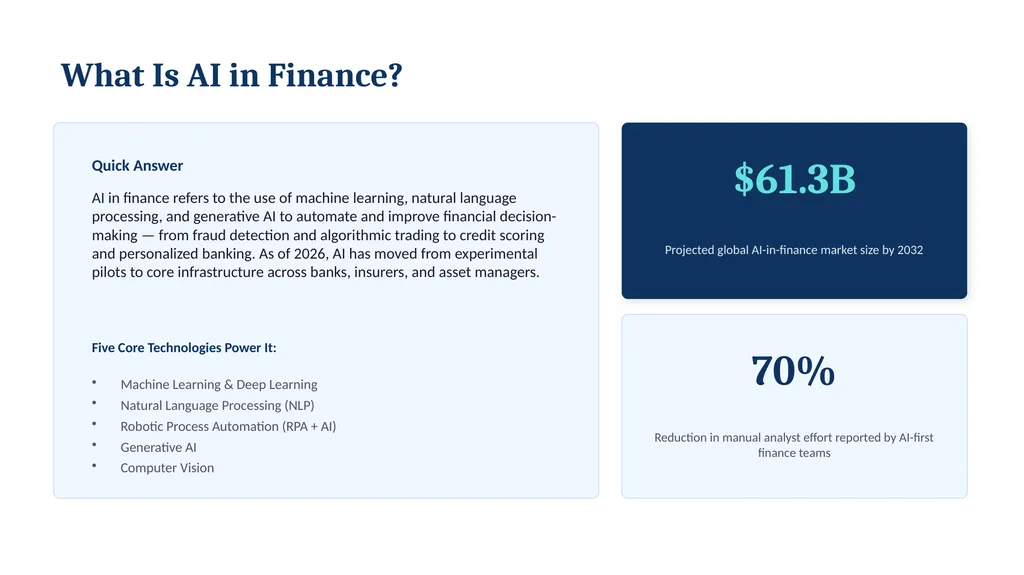
What Is AI in Finance? Quick Answer AI in finance refers to the use of machine learning, natural language processing, and generative AI to automate and improve financial decision-making — from fraud detection and algorithmic trading to credit scoring and personalized banking. As of 2026, AI has moved from experimental pilots to core infrastructure across banks, insurers, and asset managers. Five Core Technologies Power It: Machine Learning & Deep Learning
Natural Language Processing (NLP)
Robotic Process Automation (RPA + AI)
Generative AI
Computer Vision $61.3B Projected global AI-in-finance market size by 2032 70% Reduction in manual analyst effort reported by AI-first finance teams<br>
03
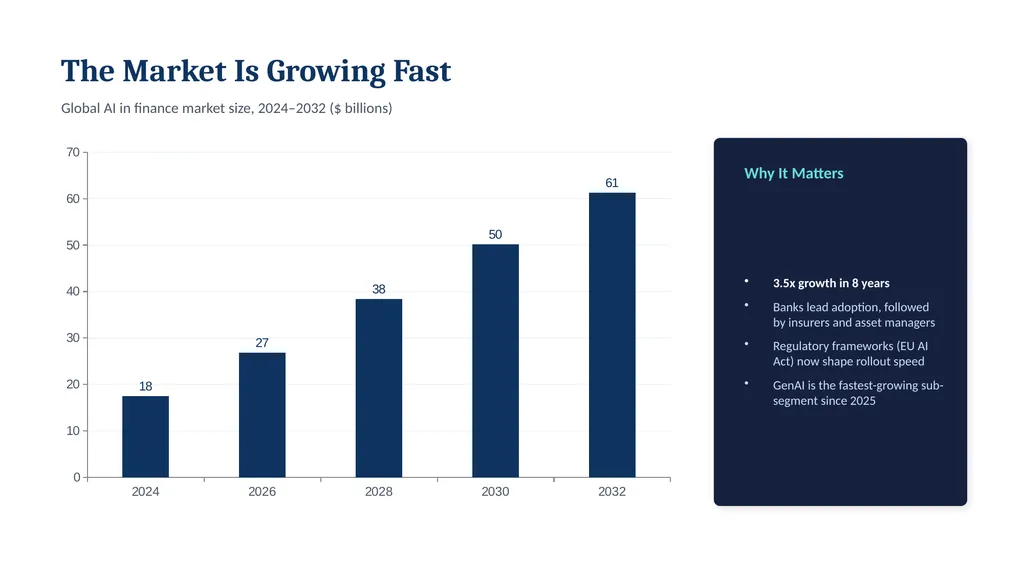
The Market Is Growing Fast Global AI in finance market size, 2024–2032 ($ billions) Why It Matters 3.5x growth in 8 years
Banks lead adoption, followed by insurers and asset managers
Regulatory frameworks (EU AI Act) now shape rollout speed
GenAI is the fastest-growing sub-segment since 2025<br>
04
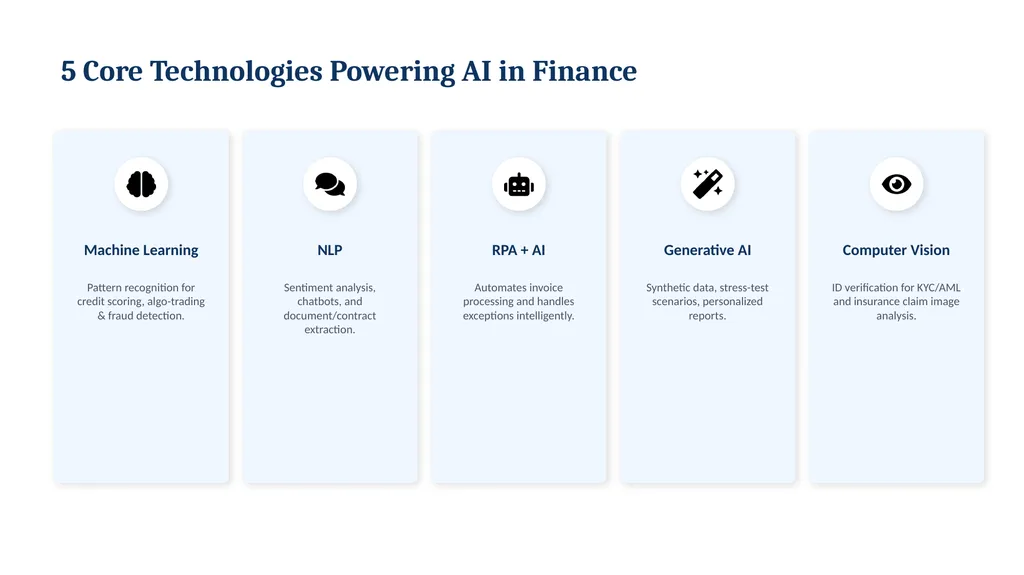
5 Core Technologies Powering AI in Finance Machine Learning Pattern recognition for credit scoring, algo-trading & fraud detection. NLP Sentiment analysis, chatbots, and document/contract extraction. RPA + AI Automates invoice processing and handles exceptions intelligently. Generative AI Synthetic data, stress-test scenarios, personalized reports. Computer Vision ID verification for KYC/AML and insurance claim image analysis.<br>
05
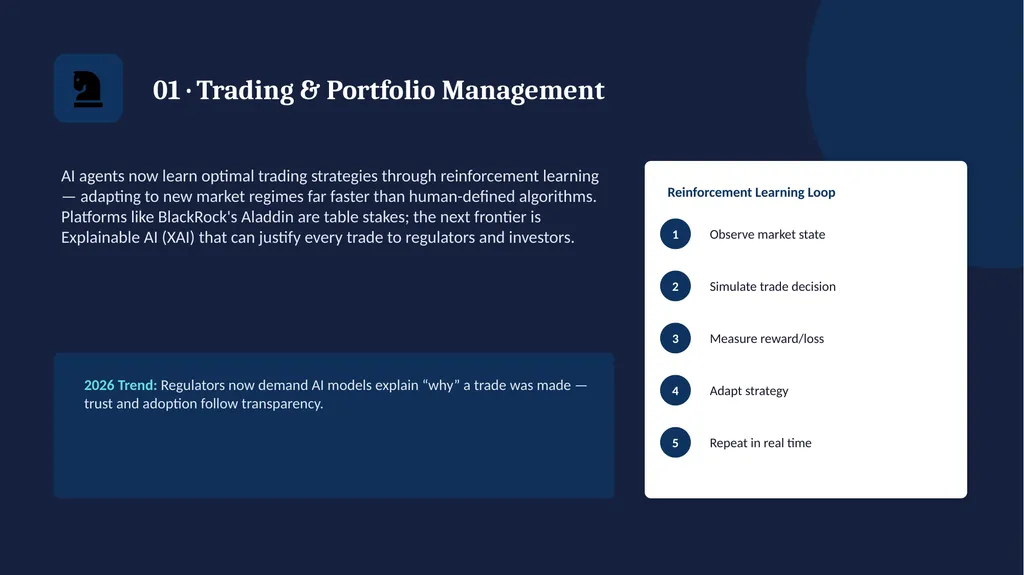
01 · Trading & Portfolio Management AI agents now learn optimal trading strategies through reinforcement learning — adapting to new market regimes far faster than human-defined algorithms. Platforms like BlackRock's Aladdin are table stakes; the next frontier is Explainable AI (XAI) that can justify every trade to regulators and investors. 2026 Trend: Regulators now demand AI models explain “why” a trade was made — trust and adoption follow transparency. Reinforcement Learning Loop 1 Observe market state 2 Simulate trade decision 3 Measure reward/loss 4 Adapt strategy 5 Repeat in real time<br>
06
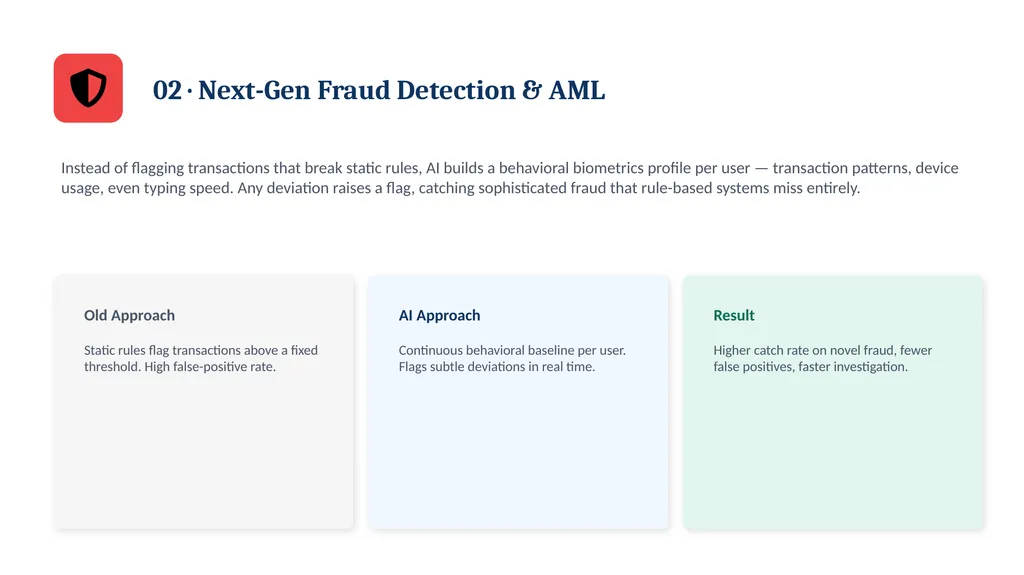
02 · Next-Gen Fraud Detection & AML Instead of flagging transactions that break static rules, AI builds a behavioral biometrics profile per user — transaction patterns, device usage, even typing speed. Any deviation raises a flag, catching sophisticated fraud that rule-based systems miss entirely. Old Approach Static rules flag transactions above a fixed threshold. High false-positive rate. AI Approach Continuous behavioral baseline per user. Flags subtle deviations in real time. Result Higher catch rate on novel fraud, fewer false positives, faster investigation.<br>
07
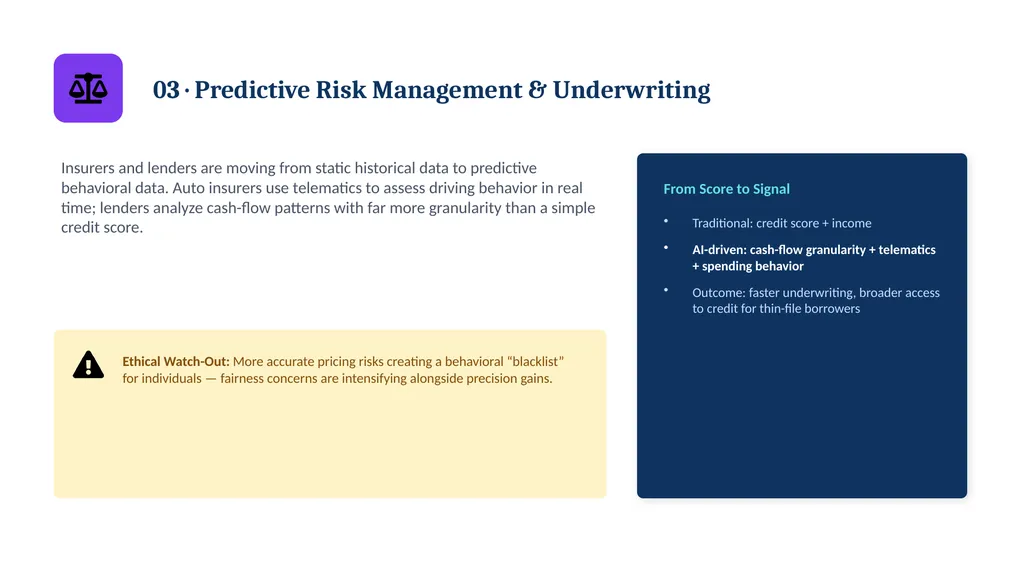
03 · Predictive Risk Management & Underwriting Insurers and lenders are moving from static historical data to predictive behavioral data. Auto insurers use telematics to assess driving behavior in real time; lenders analyze cash-flow patterns with far more granularity than a simple credit score. Ethical Watch-Out: More accurate pricing risks creating a behavioral “blacklist” for individuals — fairness concerns are intensifying alongside precision gains. From Score to Signal Traditional: credit score + income
AI-driven: cash-flow granularity + telematics + spending behavior
Outcome: faster underwriting, broader access to credit for thin-file borrowers<br>
08
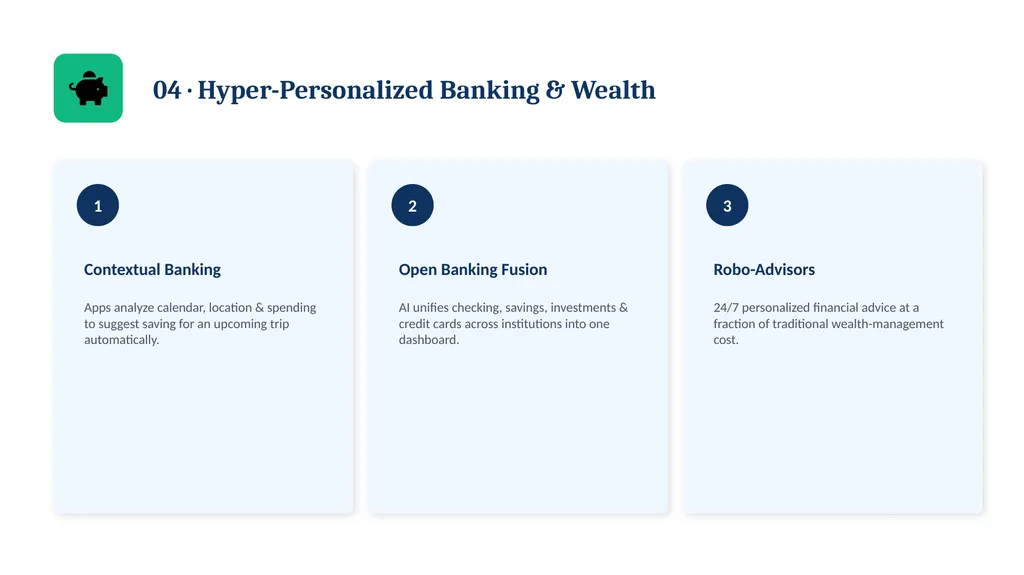
04 · Hyper-Personalized Banking & Wealth 1 Contextual Banking Apps analyze calendar, location & spending to suggest saving for an upcoming trip automatically. 2 Open Banking Fusion AI unifies checking, savings, investments & credit cards across institutions into one dashboard. 3 Robo-Advisors 24/7 personalized financial advice at a fraction of traditional wealth-management cost.<br>
09
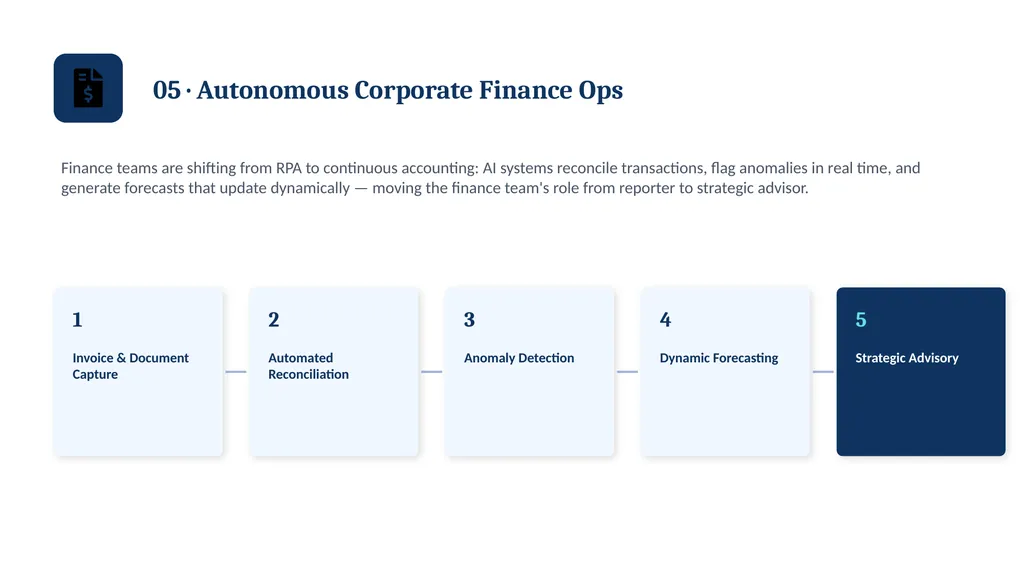
05 · Autonomous Corporate Finance Ops Finance teams are shifting from RPA to continuous accounting: AI systems reconcile transactions, flag anomalies in real time, and generate forecasts that update dynamically — moving the finance team's role from reporter to strategic advisor. 1 Invoice & Document Capture 2 Automated Reconciliation 3 Anomaly Detection 4 Dynamic Forecasting 5 Strategic Advisory<br>
10
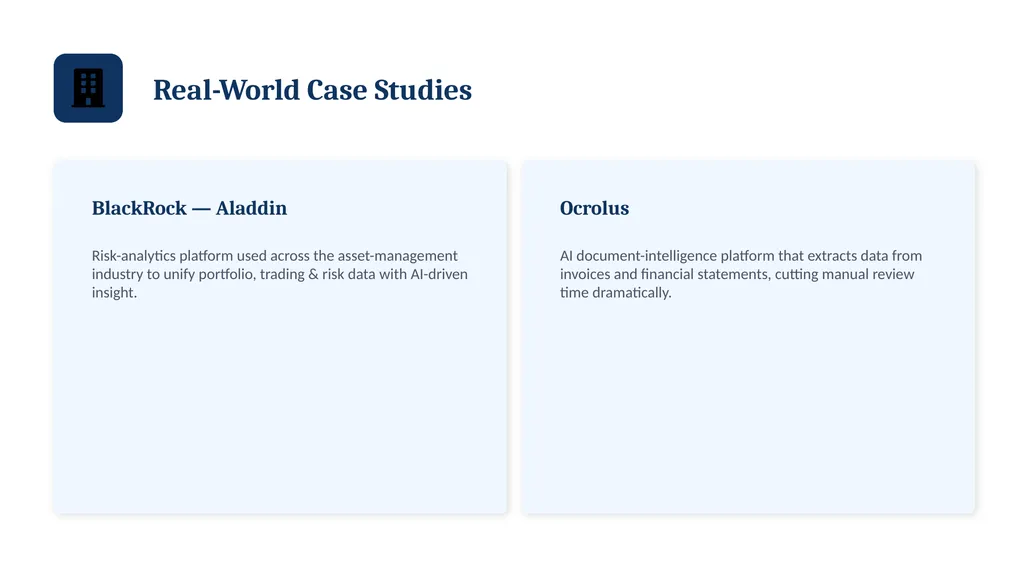
Real-World Case Studies BlackRock — Aladdin Risk-analytics platform used across the asset-management industry to unify portfolio, trading & risk data with AI-driven insight. Ocrolus AI document-intelligence platform that extracts data from invoices and financial statements, cutting manual review time dramatically.<br>
11
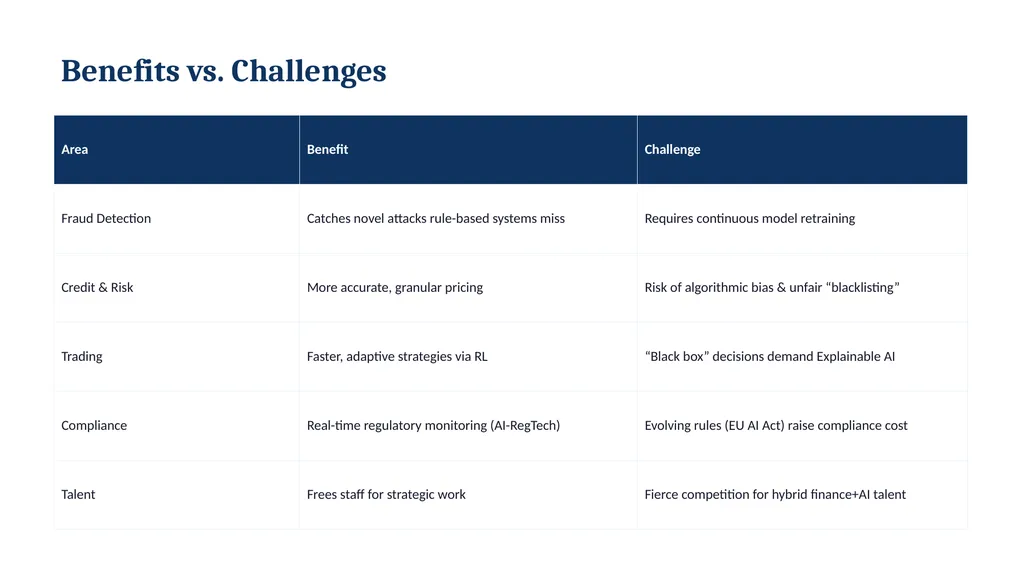
Benefits vs. Challenges<br>
12
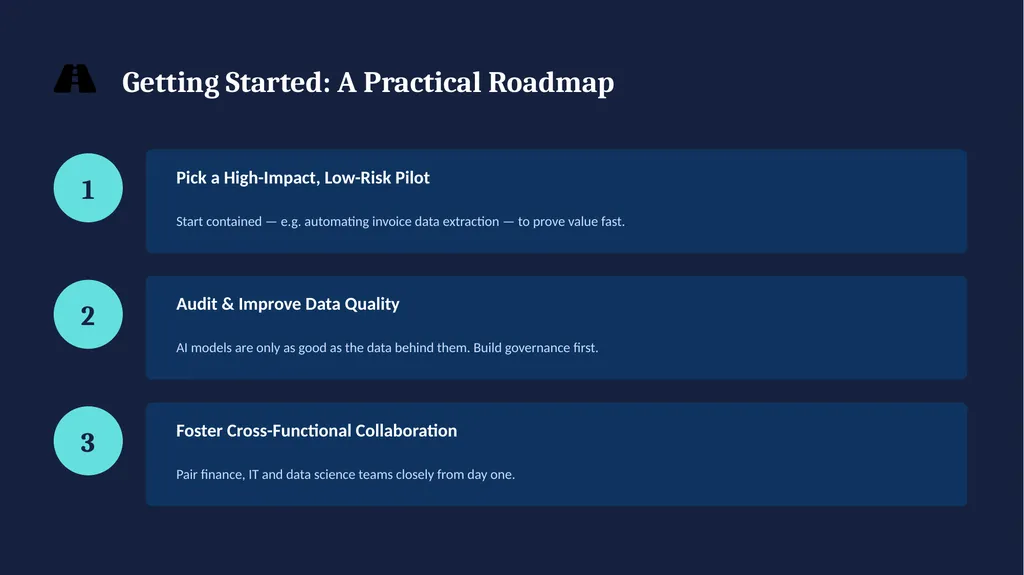
Getting Started: A Practical Roadmap 1 Pick a High-Impact, Low-Risk Pilot Start contained — e.g. automating invoice data extraction — to prove value fast. 2 Audit & Improve Data Quality AI models are only as good as the data behind them. Build governance first. 3 Foster Cross-Functional Collaboration Pair finance, IT and data science teams closely from day one.<br>
13
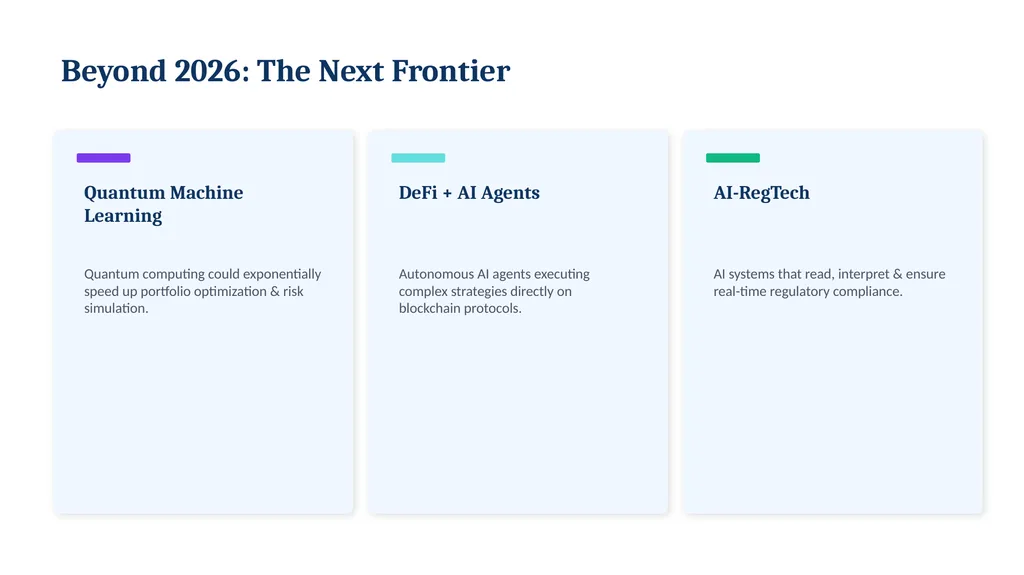
Beyond 2026: The Next Frontier Quantum Machine Learning Quantum computing could exponentially speed up portfolio optimization & risk simulation. DeFi + AI Agents Autonomous AI agents executing complex strategies directly on blockchain protocols. AI-RegTech AI systems that read, interpret & ensure real-time regulatory compliance.<br>
14
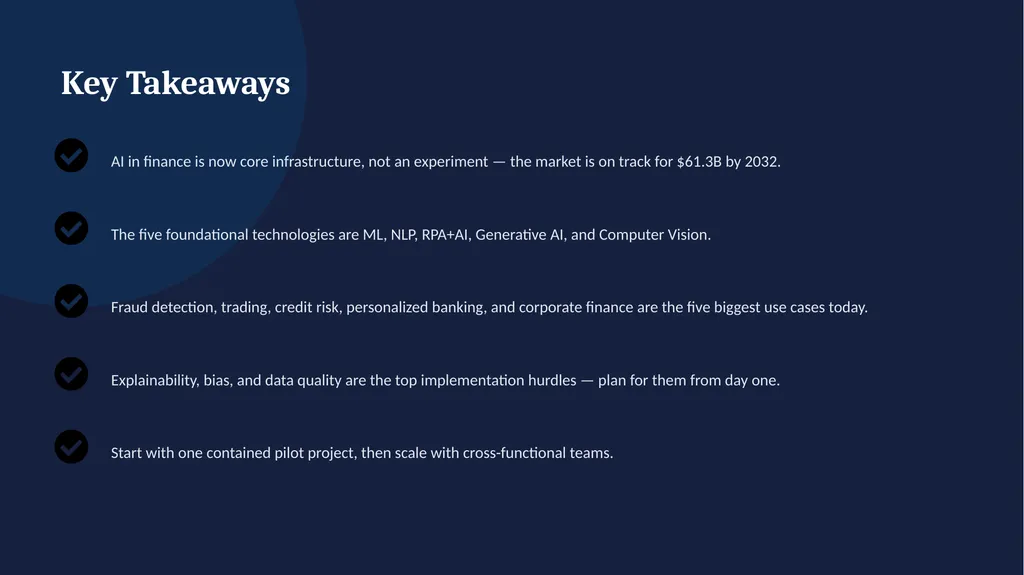
Key Takeaways AI in finance is now core infrastructure, not an experiment — the market is on track for $61.3B by 2032. The five foundational technologies are ML, NLP, RPA+AI, Generative AI, and Computer Vision. Fraud detection, trading, credit risk, personalized banking, and corporate finance are the five biggest use cases today. Explainability, bias, and data quality are the top implementation hurdles — plan for them from day one. Start with one contained pilot project, then scale with cross-functional teams.<br>
15
Want the Full Deck + Templates? This free presentation is part of Pingax's AI & Data Analytics guide series — practical resources for finance professionals, analysts, and educators. pingax.com AI · Data Analytics · Power BI · Python · Free Guides & Templates<br>