
21st Century Community Learning Centers (CCLC)
DP
Published · 40 slides · 0 views

1 / 1
Description
21st Century Community Learning Centers (CCLC) Grant Application Assistance Webinar April 12, 2018 Webinar Agenda Application Overview Part 1: General Information Part 2: Application Procedures Part 3: Application Requirements Part 4:
Related Topics
Share
Embed code
Download this presentation From Below
"21st Century Community Learning Centers (CCLC)" is the property of its rightful owner. Permission is granted to download and print the materials on this website for personal, non-commercial use only, and to display it on your personal computer provided you do not modify the materials and that you retain all copyright notices contained in the materials. By downloading content from our website, you accept the terms of this agreement.
Presentation Transcript
01
21st Century Community Learning Centers (CCLC) Grant Application Assistance Webinar
April 12, 2018<br>
April 12, 2018<br>
02
Webinar Agenda Application Overview
Part 1: General Information
Part 2: Application Procedures
Part 3: Application Requirements
Part 4: Questions Application materials are available for download on the ODE 21st CCLC website at:
http://www.oregon.gov/ode/schools-and-districts/grants/ESEA/21stCCLC/Pages/Grants-Guidance.aspx<br>
Part 1: General Information
Part 2: Application Procedures
Part 3: Application Requirements
Part 4: Questions Application materials are available for download on the ODE 21st CCLC website at:
http://www.oregon.gov/ode/schools-and-districts/grants/ESEA/21stCCLC/Pages/Grants-Guidance.aspx<br>
03
Part 1:
General Information<br>
04
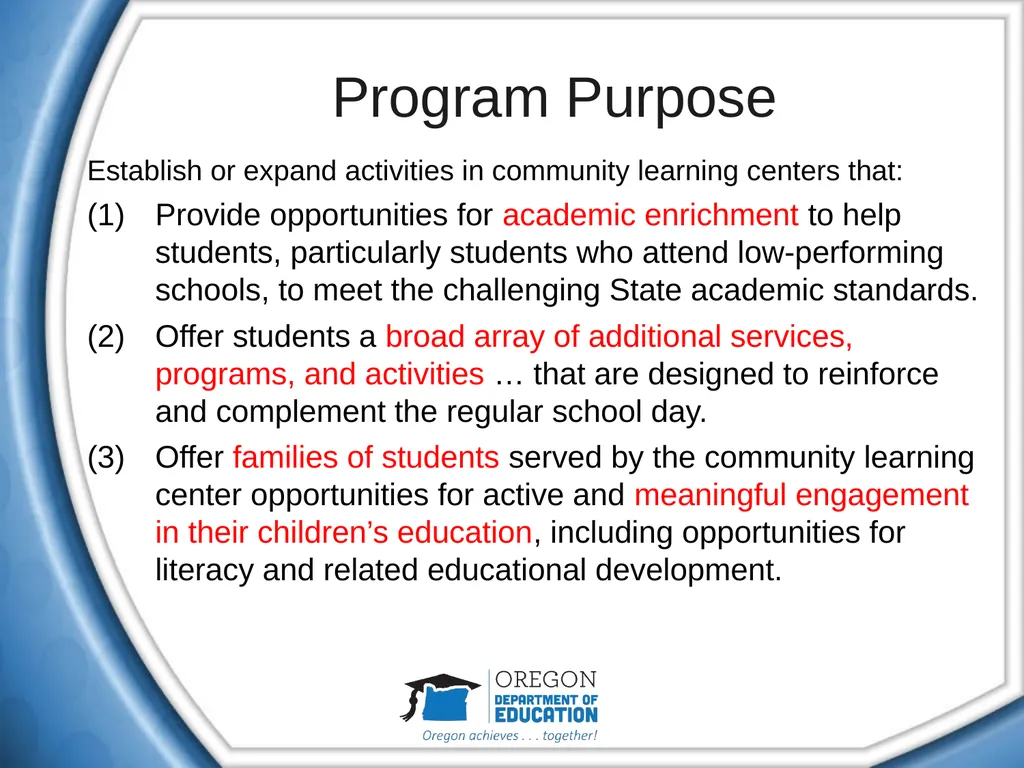
Program Purpose Establish or expand activities in community learning centers that:
Provide opportunities for academic enrichment to help students, particularly students who attend low-performing schools, to meet the challenging State academic standards.
Offer students a broad array of additional services, programs, and activities … that are designed to reinforce and complement the regular school day.
Offer families of students served by the community learning center opportunities for active and meaningful engagement in their children’s education, including opportunities for literacy and related educational development.<br>
Provide opportunities for academic enrichment to help students, particularly students who attend low-performing schools, to meet the challenging State academic standards.
Offer students a broad array of additional services, programs, and activities … that are designed to reinforce and complement the regular school day.
Offer families of students served by the community learning center opportunities for active and meaningful engagement in their children’s education, including opportunities for literacy and related educational development.<br>
05
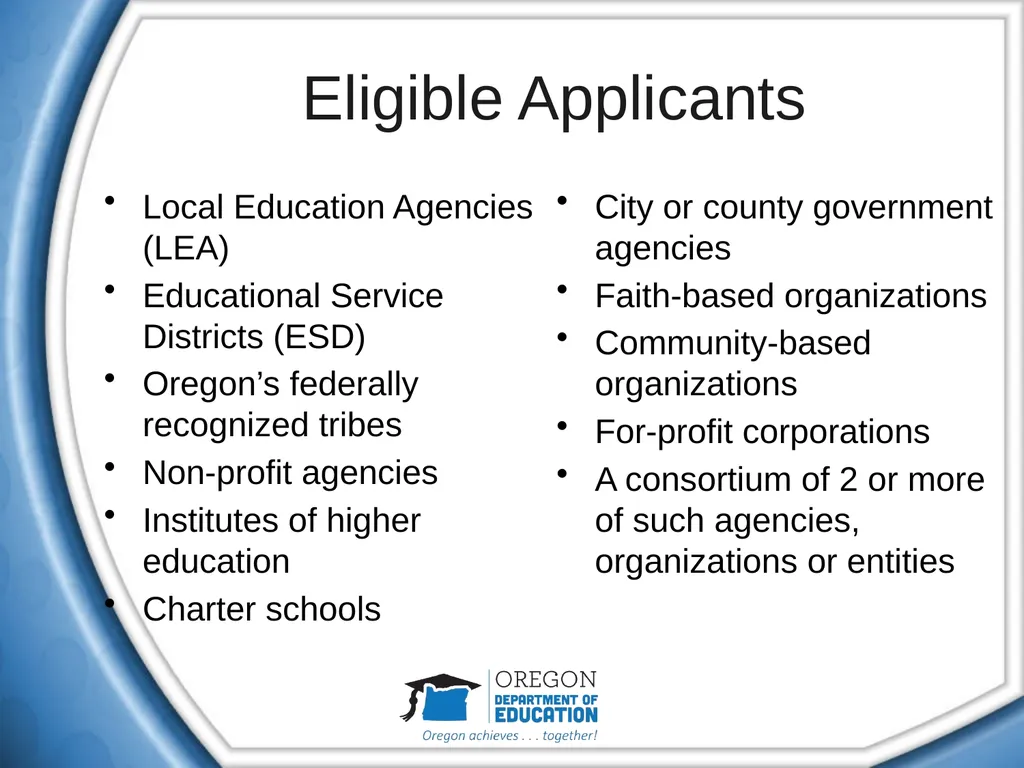
Eligible Applicants Local Education Agencies (LEA)
Educational Service Districts (ESD)
Oregon’s federally recognized tribes
Non-profit agencies
Institutes of higher education
Charter schools City or county government agencies
Faith-based organizations
Community-based organizations
For-profit corporations
A consortium of 2 or more of such agencies, organizations or entities<br>
Educational Service Districts (ESD)
Oregon’s federally recognized tribes
Non-profit agencies
Institutes of higher education
Charter schools City or county government agencies
Faith-based organizations
Community-based organizations
For-profit corporations
A consortium of 2 or more of such agencies, organizations or entities<br>
06
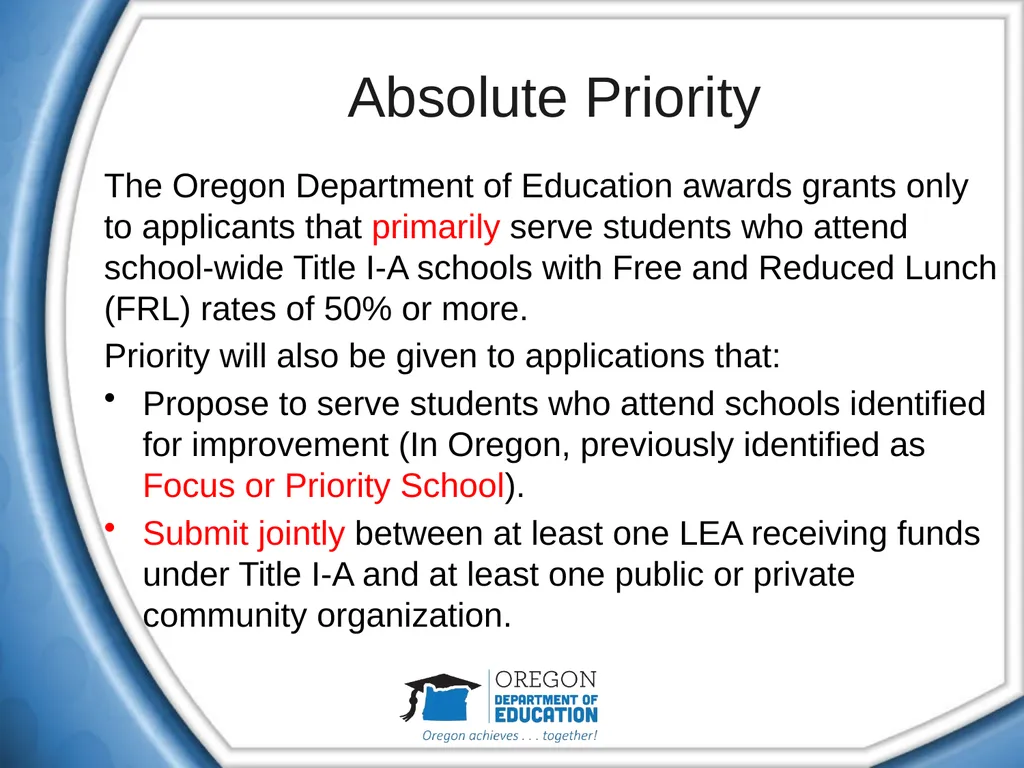
Absolute Priority The Oregon Department of Education awards grants only to applicants that primarily serve students who attend school-wide Title I-A schools with Free and Reduced Lunch (FRL) rates of 50% or more.
Priority will also be given to applications that:
Propose to serve students who attend schools identified for improvement (In Oregon, previously identified as Focus or Priority School).
Submit jointly between at least one LEA receiving funds under Title I-A and at least one public or private community organization.<br>
Priority will also be given to applications that:
Propose to serve students who attend schools identified for improvement (In Oregon, previously identified as Focus or Priority School).
Submit jointly between at least one LEA receiving funds under Title I-A and at least one public or private community organization.<br>
07
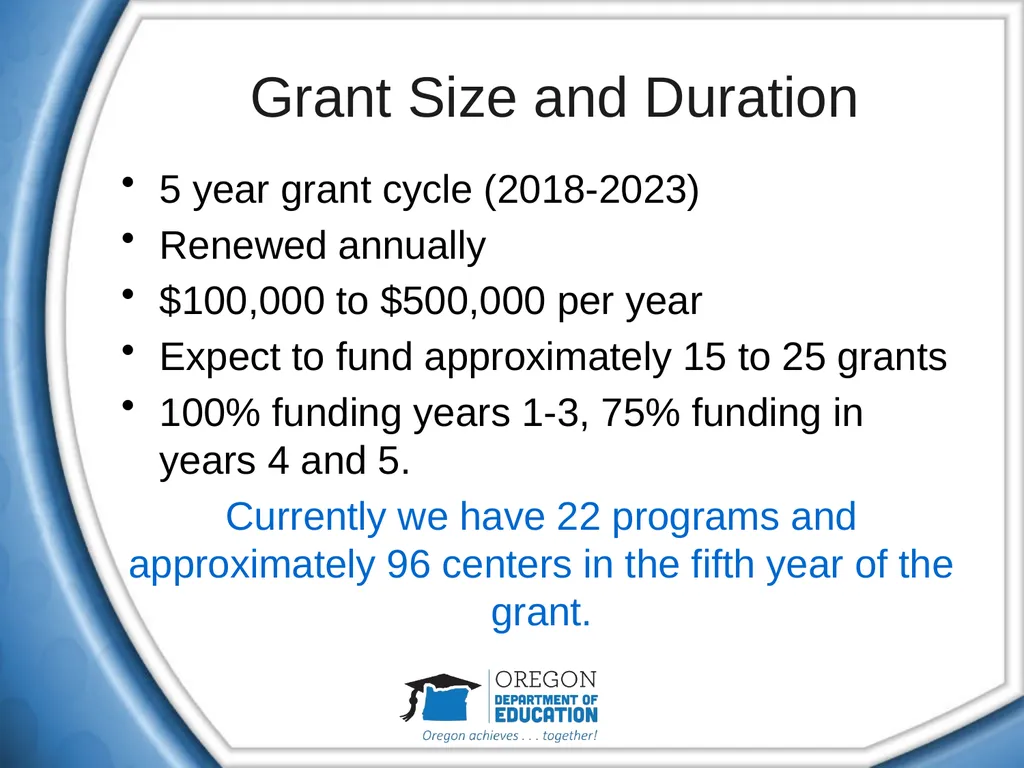
Grant Size and Duration 5 year grant cycle (2018-2023)
Renewed annually
$100,000 to $500,000 per year
Expect to fund approximately 15 to 25 grants
100% funding years 1-3, 75% funding in years 4 and 5.
Currently we have 22 programs and approximately 96 centers in the fifth year of the grant.<br>
Renewed annually
$100,000 to $500,000 per year
Expect to fund approximately 15 to 25 grants
100% funding years 1-3, 75% funding in years 4 and 5.
Currently we have 22 programs and approximately 96 centers in the fifth year of the grant.<br>
08
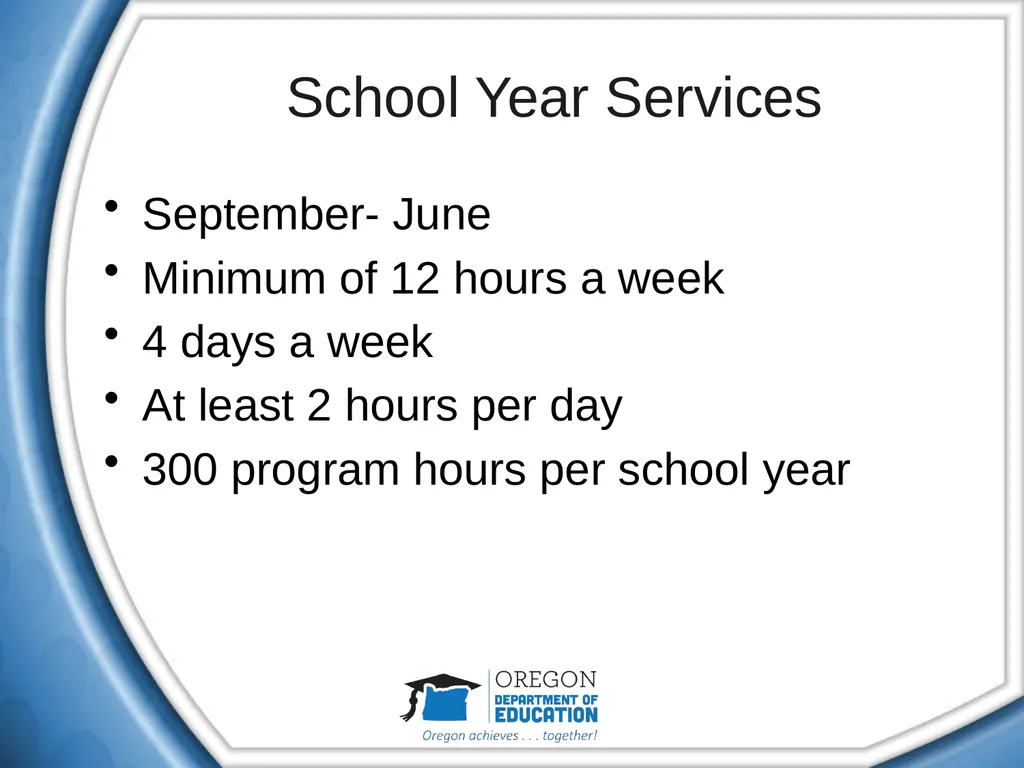
School Year Services September- June
Minimum of 12 hours a week
4 days a week
At least 2 hours per day
300 program hours per school year<br>
Minimum of 12 hours a week
4 days a week
At least 2 hours per day
300 program hours per school year<br>
09
Regular Attendee The 21st CCLC program is not a drop-in program. To be considered a regular attendee a student must attend a minimum of 30 days. 60 percent of regular attendees are expected to attend 60 + days to benefit significantly from the program. It is expected that 75 percent of enrollees will be regular attendees.<br>
10
Summer Learning Summer school (optional programming)
Operate a minimum of 20 hours a week
Minimum of 4 weeks
Prioritize regular attendees for 4 weeks
Collaborate with other programs providing summer services<br>
Operate a minimum of 20 hours a week
Minimum of 4 weeks
Prioritize regular attendees for 4 weeks
Collaborate with other programs providing summer services<br>
11
Authorized Activities ESSA Changes
New language adds:
Emphasis on well-rounded education
Literacy, including financial and environmental
Programs to support a healthy and active lifestyle
Services for individuals with disabilities
Cultural programs
Parenting skills
STEM
Partnerships with in-demand field of the local workforce/career competencies and readiness<br>
New language adds:
Emphasis on well-rounded education
Literacy, including financial and environmental
Programs to support a healthy and active lifestyle
Services for individuals with disabilities
Cultural programs
Parenting skills
STEM
Partnerships with in-demand field of the local workforce/career competencies and readiness<br>
12
Linking with the School Day Align and coordinate with regular school day curriculum and teachers
Incorporate Oregon state standards
Align district and school initiatives supporting social, emotional and behavioral needs of students
Support school and district goals<br>
Incorporate Oregon state standards
Align district and school initiatives supporting social, emotional and behavioral needs of students
Support school and district goals<br>
13
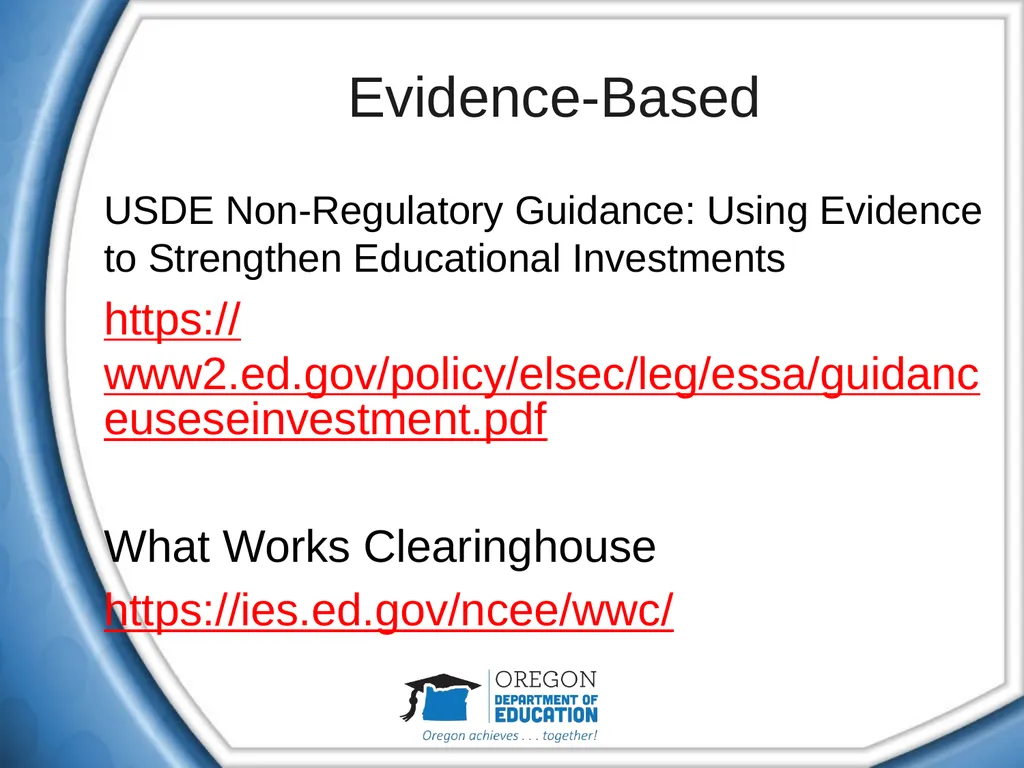
Evidence-Based USDE Non-Regulatory Guidance: Using Evidence to Strengthen Educational Investments
https://www2.ed.gov/policy/elsec/leg/essa/guidanceuseseinvestment.pdf
What Works Clearinghouse
https://ies.ed.gov/ncee/wwc/<br>
https://www2.ed.gov/policy/elsec/leg/essa/guidanceuseseinvestment.pdf
What Works Clearinghouse
https://ies.ed.gov/ncee/wwc/<br>
14
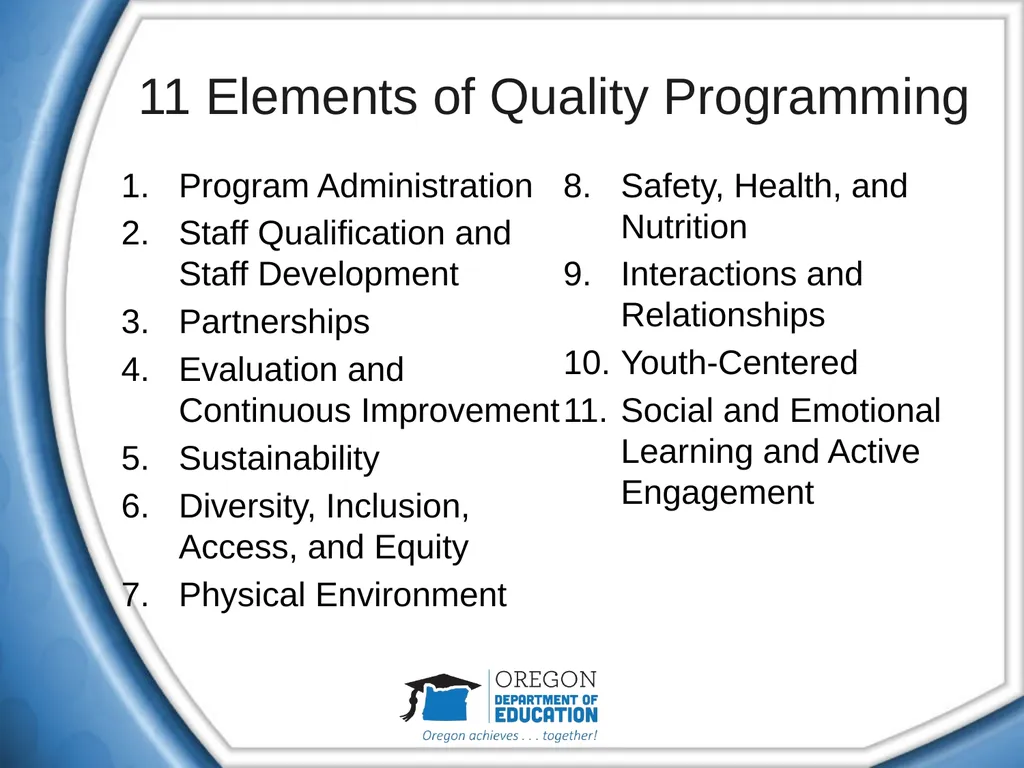
11 Elements of Quality Programming Program Administration
Staff Qualification and Staff Development
Partnerships
Evaluation and Continuous Improvement
Sustainability
Diversity, Inclusion, Access, and Equity
Physical Environment
Safety, Health, and Nutrition
Interactions and Relationships
Youth-Centered
Social and Emotional Learning and Active Engagement<br>
Staff Qualification and Staff Development
Partnerships
Evaluation and Continuous Improvement
Sustainability
Diversity, Inclusion, Access, and Equity
Physical Environment
Safety, Health, and Nutrition
Interactions and Relationships
Youth-Centered
Social and Emotional Learning and Active Engagement<br>
15
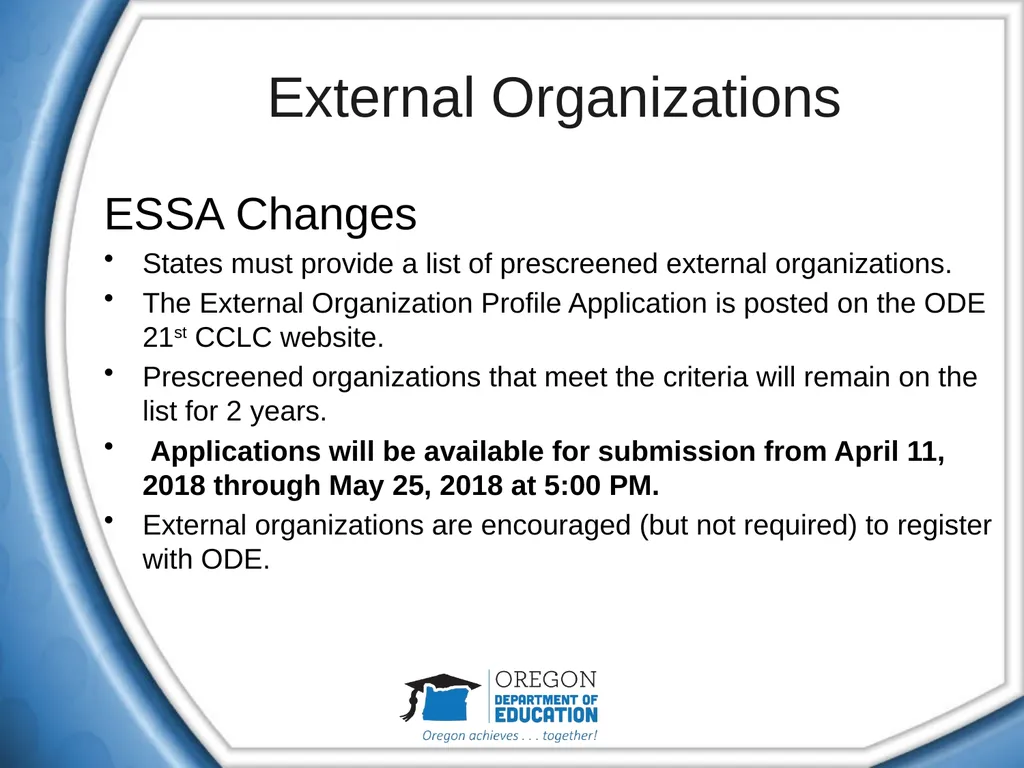
External Organizations ESSA Changes
States must provide a list of prescreened external organizations.
The External Organization Profile Application is posted on the ODE 21st CCLC website.
Prescreened organizations that meet the criteria will remain on the list for 2 years.
Applications will be available for submission from April 11, 2018 through May 25, 2018 at 5:00 PM.
External organizations are encouraged (but not required) to register with ODE.<br>
States must provide a list of prescreened external organizations.
The External Organization Profile Application is posted on the ODE 21st CCLC website.
Prescreened organizations that meet the criteria will remain on the list for 2 years.
Applications will be available for submission from April 11, 2018 through May 25, 2018 at 5:00 PM.
External organizations are encouraged (but not required) to register with ODE.<br>
16
Part 2:
Application Procedures<br>
17
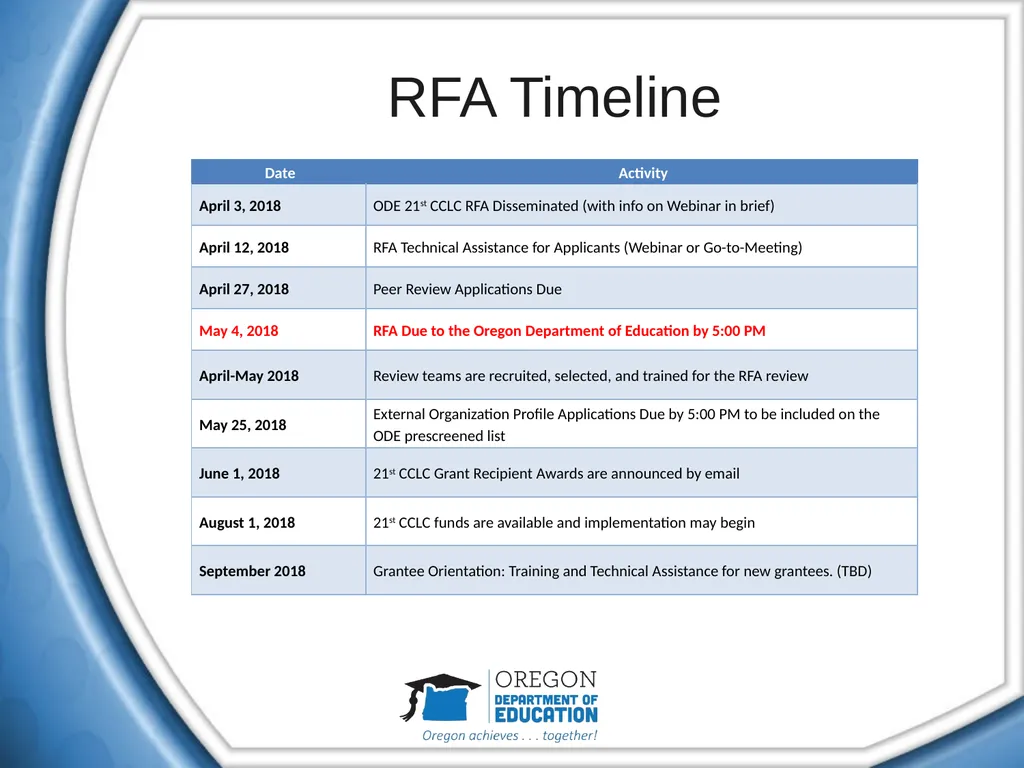
RFA Timeline<br>
18
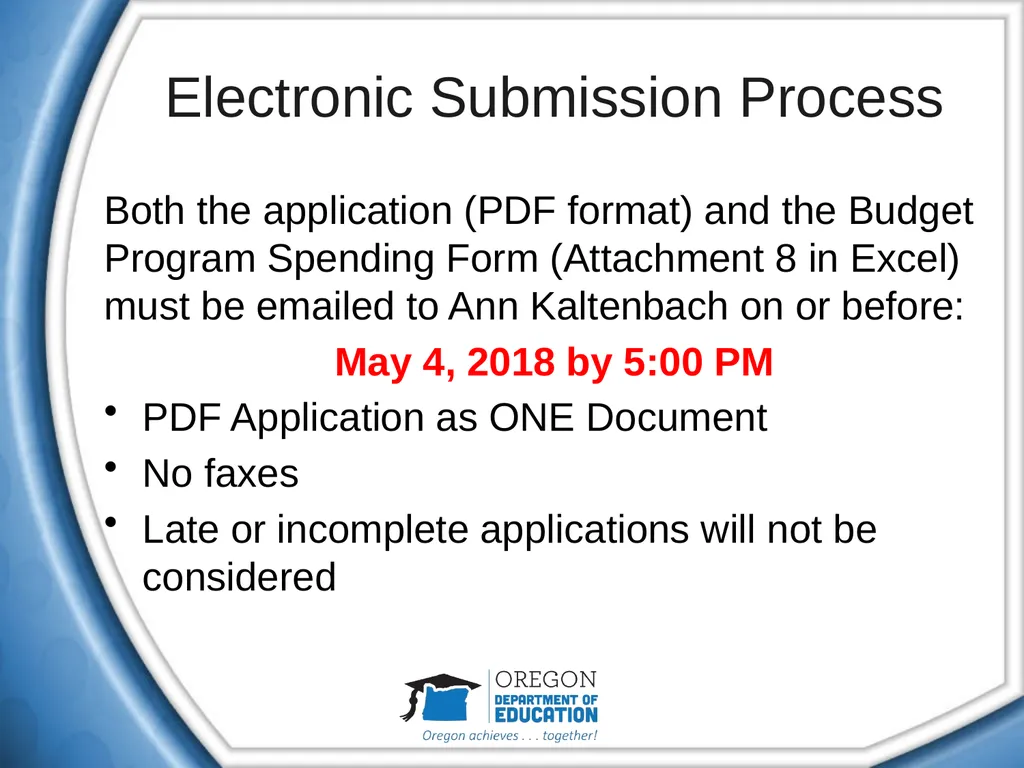
Electronic Submission Process Both the application (PDF format) and the Budget Program Spending Form (Attachment 8 in Excel) must be emailed to Ann Kaltenbach on or before:
May 4, 2018 by 5:00 PM
PDF Application as ONE Document
No faxes
Late or incomplete applications will not be considered<br>
May 4, 2018 by 5:00 PM
PDF Application as ONE Document
No faxes
Late or incomplete applications will not be considered<br>
19
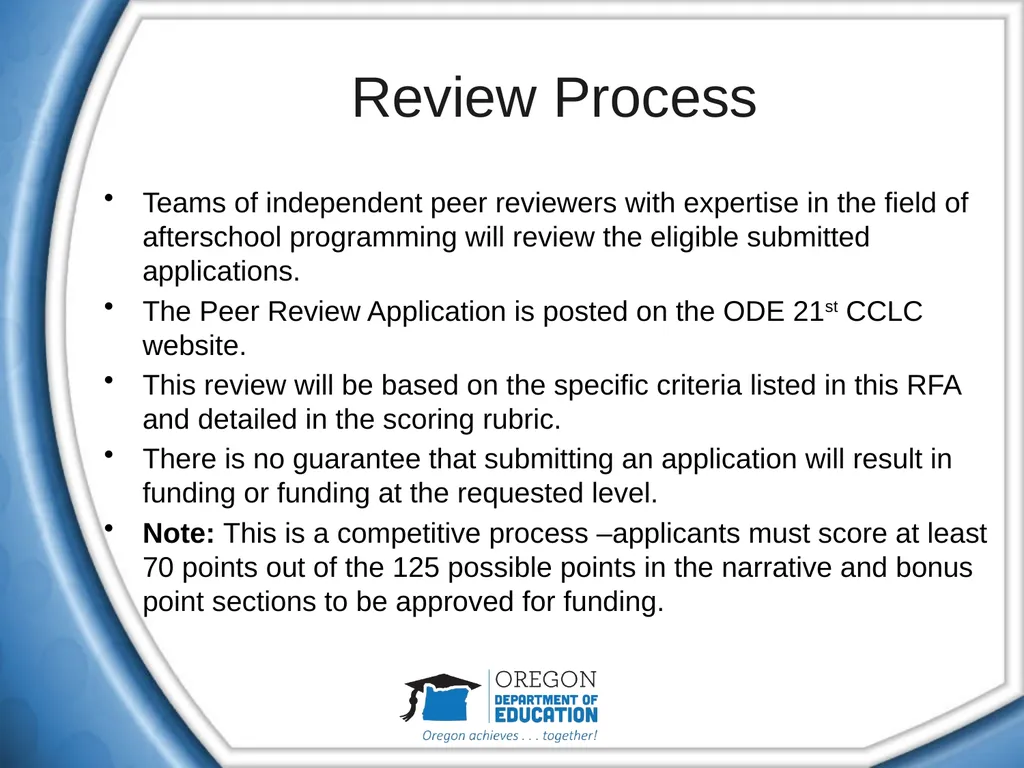
Review Process Teams of independent peer reviewers with expertise in the field of afterschool programming will review the eligible submitted applications.
The Peer Review Application is posted on the ODE 21st CCLC website.
This review will be based on the specific criteria listed in this RFA and detailed in the scoring rubric.
There is no guarantee that submitting an application will result in funding or funding at the requested level.
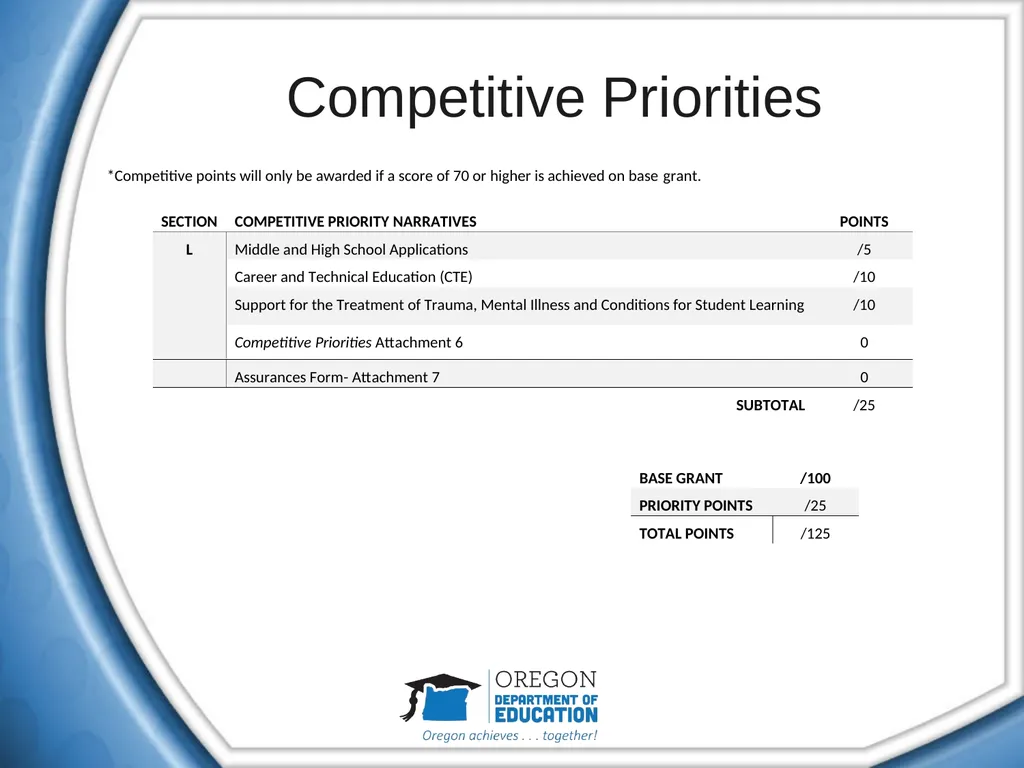
Note: This is a competitive process –applicants must score at least 70 points out of the 125 possible points in the narrative and bonus point sections to be approved for funding.<br>
The Peer Review Application is posted on the ODE 21st CCLC website.
This review will be based on the specific criteria listed in this RFA and detailed in the scoring rubric.
There is no guarantee that submitting an application will result in funding or funding at the requested level.
Note: This is a competitive process –applicants must score at least 70 points out of the 125 possible points in the narrative and bonus point sections to be approved for funding.<br>
20
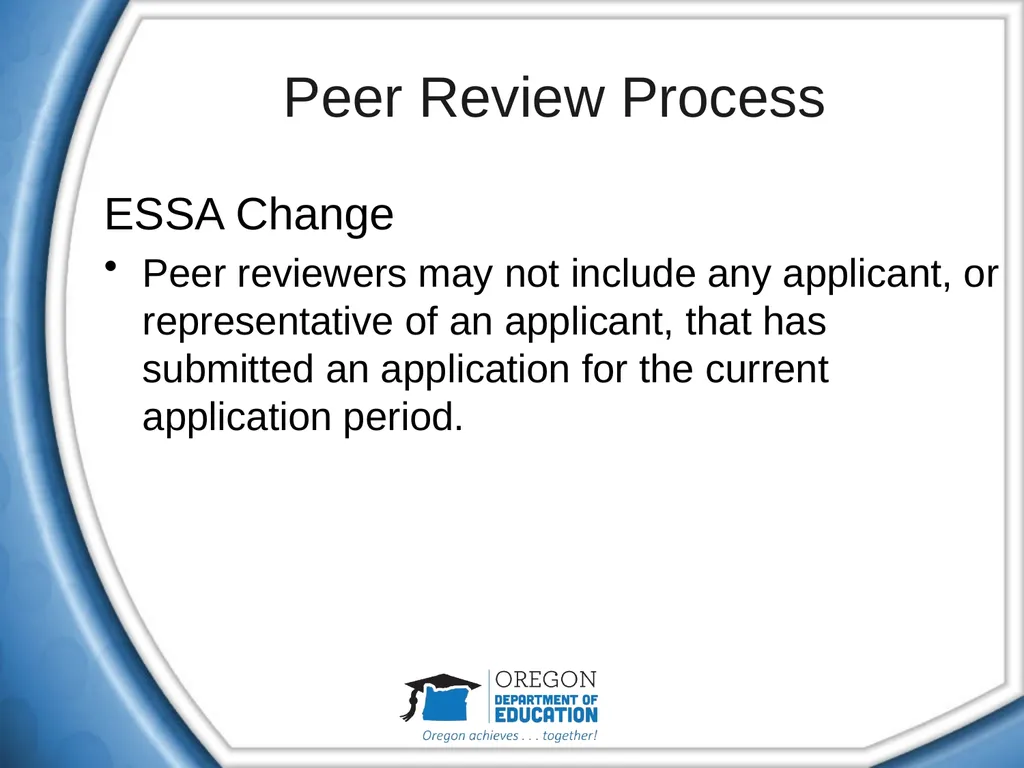
Peer Review Process ESSA Change
Peer reviewers may not include any applicant, or representative of an applicant, that has submitted an application for the current application period.<br>
Peer reviewers may not include any applicant, or representative of an applicant, that has submitted an application for the current application period.<br>
21
Part 3:
Application Requirements<br>
22
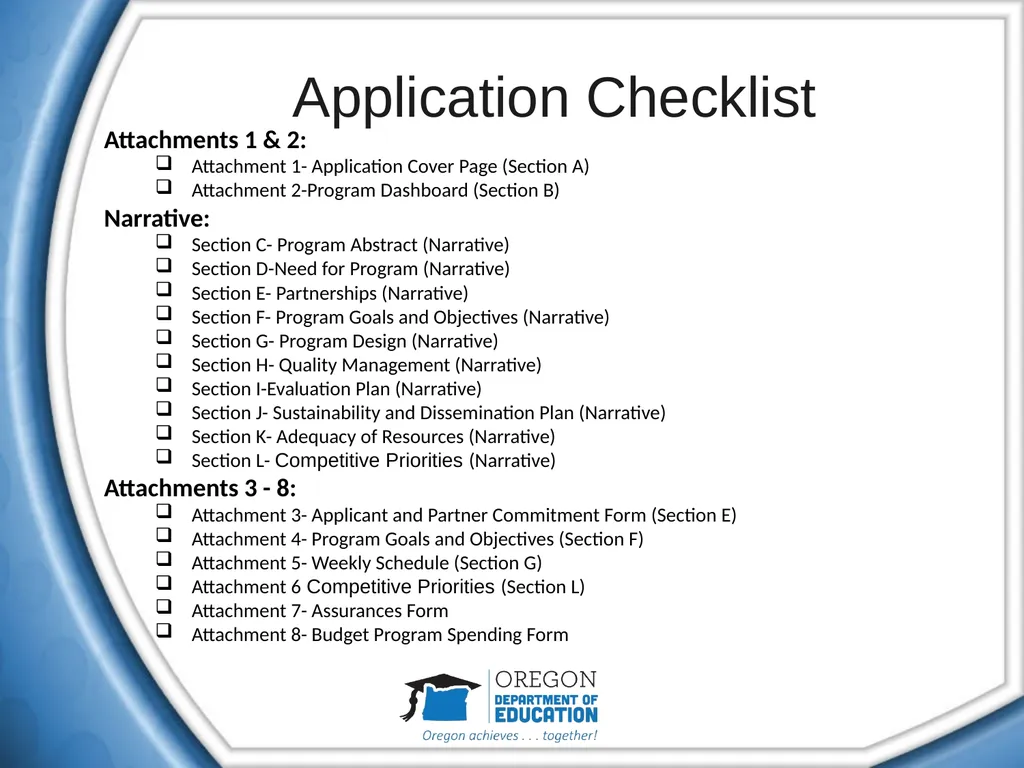
Application Checklist Attachments 1 & 2:
Attachment 1- Application Cover Page (Section A)
Attachment 2-Program Dashboard (Section B)
Narrative:
Section C- Program Abstract (Narrative)
Section D-Need for Program (Narrative)
Section E- Partnerships (Narrative)
Section F- Program Goals and Objectives (Narrative)
Section G- Program Design (Narrative)
Section H- Quality Management (Narrative)
Section I-Evaluation Plan (Narrative)
Section J- Sustainability and Dissemination Plan (Narrative)
Section K- Adequacy of Resources (Narrative)
Section L- Competitive Priorities (Narrative)
Attachments 3 - 8:
Attachment 3- Applicant and Partner Commitment Form (Section E)
Attachment 4- Program Goals and Objectives (Section F)
Attachment 5- Weekly Schedule (Section G)
Attachment 6 Competitive Priorities (Section L)
Attachment 7- Assurances Form
Attachment 8- Budget Program Spending Form<br>
Attachment 1- Application Cover Page (Section A)
Attachment 2-Program Dashboard (Section B)
Narrative:
Section C- Program Abstract (Narrative)
Section D-Need for Program (Narrative)
Section E- Partnerships (Narrative)
Section F- Program Goals and Objectives (Narrative)
Section G- Program Design (Narrative)
Section H- Quality Management (Narrative)
Section I-Evaluation Plan (Narrative)
Section J- Sustainability and Dissemination Plan (Narrative)
Section K- Adequacy of Resources (Narrative)
Section L- Competitive Priorities (Narrative)
Attachments 3 - 8:
Attachment 3- Applicant and Partner Commitment Form (Section E)
Attachment 4- Program Goals and Objectives (Section F)
Attachment 5- Weekly Schedule (Section G)
Attachment 6 Competitive Priorities (Section L)
Attachment 7- Assurances Form
Attachment 8- Budget Program Spending Form<br>
23
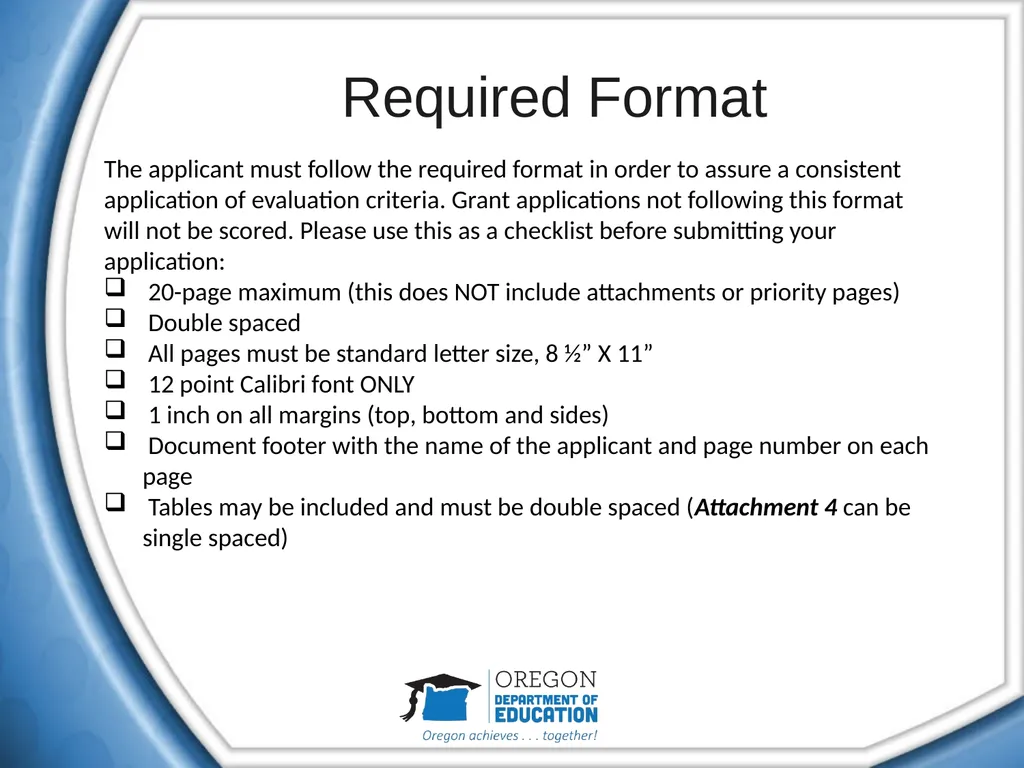
Required Format The applicant must follow the required format in order to assure a consistent application of evaluation criteria. Grant applications not following this format will not be scored. Please use this as a checklist before submitting your application:
20-page maximum (this does NOT include attachments or priority pages)
Double spaced
All pages must be standard letter size, 8 ½” X 11”
12 point Calibri font ONLY
1 inch on all margins (top, bottom and sides)
Document footer with the name of the applicant and page number on each page
Tables may be included and must be double spaced (Attachment 4 can be single spaced)<br>
20-page maximum (this does NOT include attachments or priority pages)
Double spaced
All pages must be standard letter size, 8 ½” X 11”
12 point Calibri font ONLY
1 inch on all margins (top, bottom and sides)
Document footer with the name of the applicant and page number on each page
Tables may be included and must be double spaced (Attachment 4 can be single spaced)<br>
24
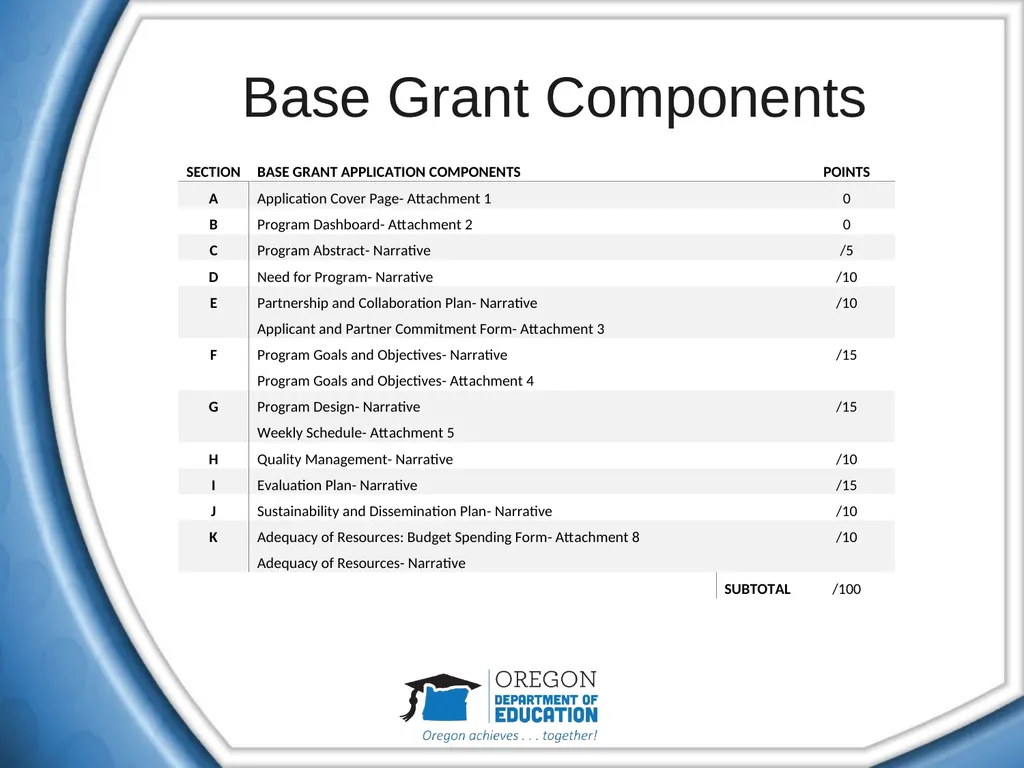
Base Grant Components<br>
25
Need for Program Describe the community where students and their families live and go to school
Based on local data (Be specific!)
Poverty / Free and Reduced Lunch rates
Literacy / education levels
Needs of the community
Describe process for determining need
Provide services not currently available<br>
Based on local data (Be specific!)
Poverty / Free and Reduced Lunch rates
Literacy / education levels
Needs of the community
Describe process for determining need
Provide services not currently available<br>
26
Partnerships At least one LEA and one community-based organization
Collaboration in planning and design
History of working together
Substantial roles in delivery of services, sharing grant resources and having significant involvement in management and oversight
Linkage with the school day
Program activities are integrated with the regular school day program
Clear communication<br>
Collaboration in planning and design
History of working together
Substantial roles in delivery of services, sharing grant resources and having significant involvement in management and oversight
Linkage with the school day
Program activities are integrated with the regular school day program
Clear communication<br>
27
Program Goals and Objectives Create SMART Objectives!
At least all three Grant Purposes
At least two objectives for each grant purpose
At least 3 activities for each objective
All aligned to Oregon’s Long Term Goals (Start strong, Transition Successfully, and Graduate College and Career Ready)<br>
At least all three Grant Purposes
At least two objectives for each grant purpose
At least 3 activities for each objective
All aligned to Oregon’s Long Term Goals (Start strong, Transition Successfully, and Graduate College and Career Ready)<br>
28
Evaluation Plan The evaluation plan must include the following:
How the applicant will be accountable for monitoring and reporting on program effectiveness;
Describe the applicants capacity, or how the applicant would acquire capacity, to complete the required evaluation components;
Describe the evaluation process to complete each required component; and
Describe how each proposed program will use formal and informal data to inform program continuous improvement.<br>
How the applicant will be accountable for monitoring and reporting on program effectiveness;
Describe the applicants capacity, or how the applicant would acquire capacity, to complete the required evaluation components;
Describe the evaluation process to complete each required component; and
Describe how each proposed program will use formal and informal data to inform program continuous improvement.<br>
29
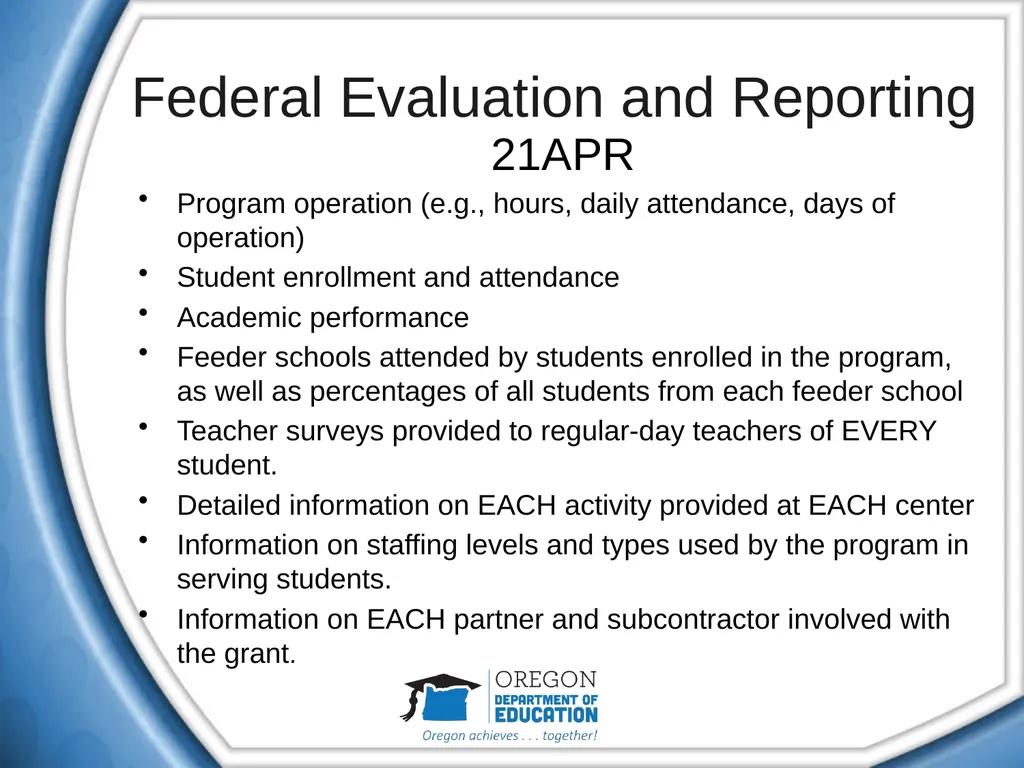
Federal Evaluation and Reporting 21APR
Program operation (e.g., hours, daily attendance, days of operation)
Student enrollment and attendance
Academic performance
Feeder schools attended by students enrolled in the program, as well as percentages of all students from each feeder school
Teacher surveys provided to regular-day teachers of EVERY student.
Detailed information on EACH activity provided at EACH center
Information on staffing levels and types used by the program in serving students.
Information on EACH partner and subcontractor involved with the grant.<br>
Program operation (e.g., hours, daily attendance, days of operation)
Student enrollment and attendance
Academic performance
Feeder schools attended by students enrolled in the program, as well as percentages of all students from each feeder school
Teacher surveys provided to regular-day teachers of EVERY student.
Detailed information on EACH activity provided at EACH center
Information on staffing levels and types used by the program in serving students.
Information on EACH partner and subcontractor involved with the grant.<br>
30
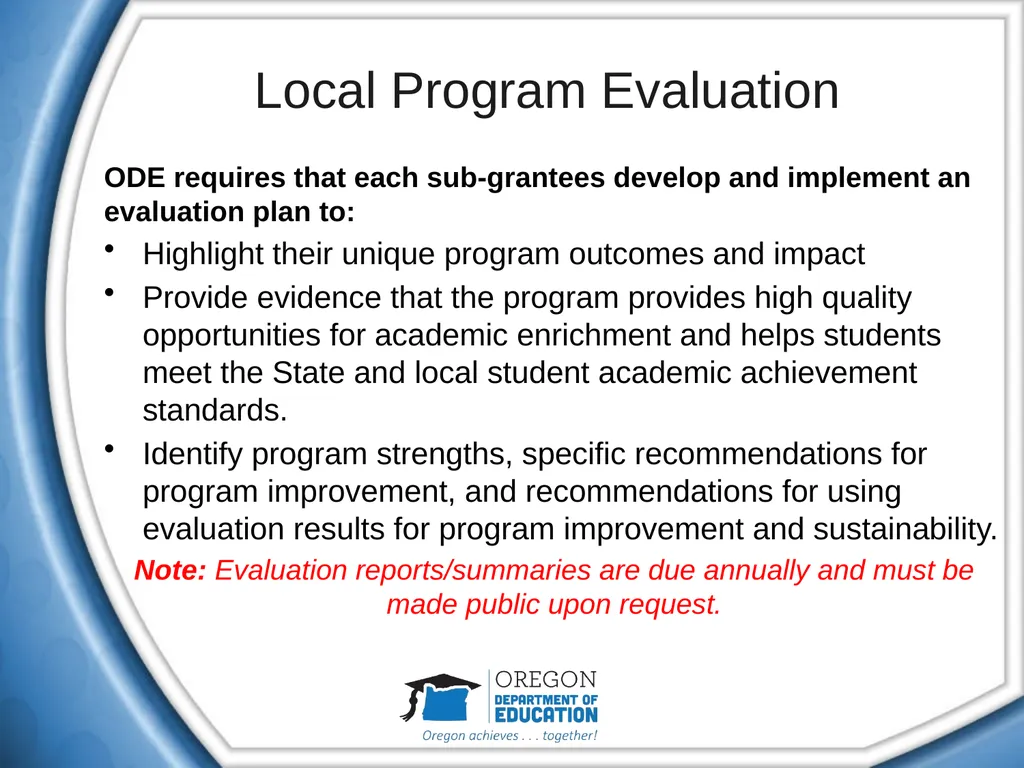
Local Program Evaluation ODE requires that each sub-grantees develop and implement an evaluation plan to:
Highlight their unique program outcomes and impact
Provide evidence that the program provides high quality opportunities for academic enrichment and helps students meet the State and local student academic achievement standards.
Identify program strengths, specific recommendations for program improvement, and recommendations for using evaluation results for program improvement and sustainability.
Note: Evaluation reports/summaries are due annually and must be made public upon request.<br>
Highlight their unique program outcomes and impact
Provide evidence that the program provides high quality opportunities for academic enrichment and helps students meet the State and local student academic achievement standards.
Identify program strengths, specific recommendations for program improvement, and recommendations for using evaluation results for program improvement and sustainability.
Note: Evaluation reports/summaries are due annually and must be made public upon request.<br>
31
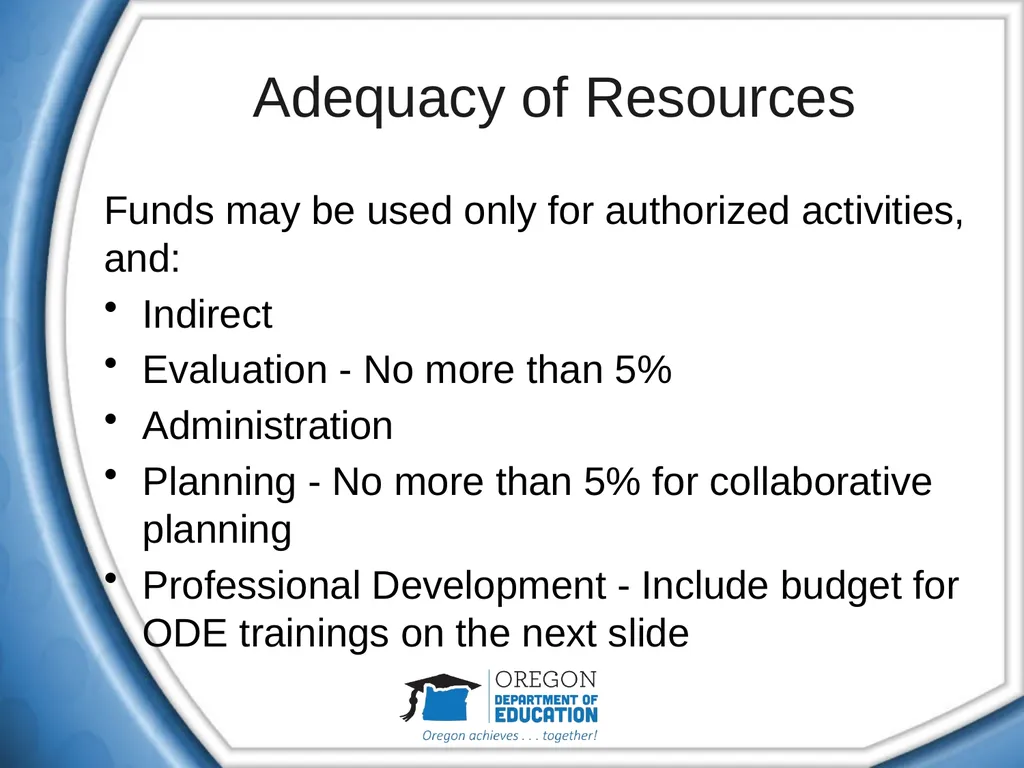
Adequacy of Resources Funds may be used only for authorized activities, and:
Indirect
Evaluation - No more than 5%
Administration
Planning - No more than 5% for collaborative planning
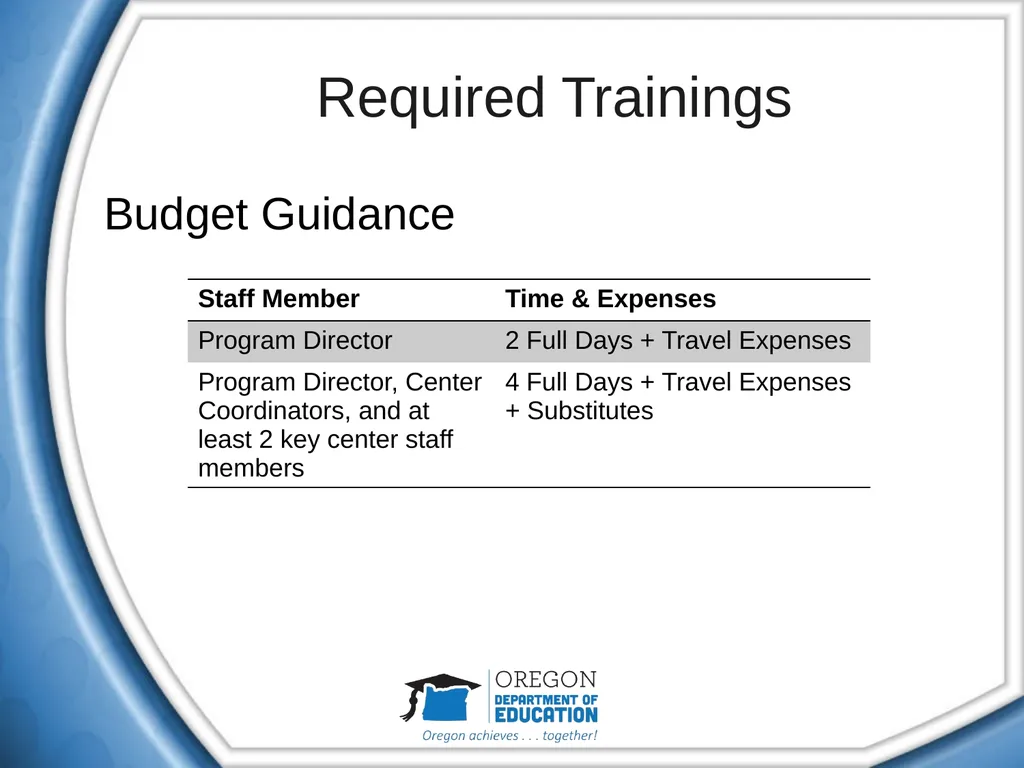
Professional Development - Include budget for ODE trainings on the next slide<br>
Indirect
Evaluation - No more than 5%
Administration
Planning - No more than 5% for collaborative planning
Professional Development - Include budget for ODE trainings on the next slide<br>
32
Required Trainings Budget Guidance<br>
33
Competitive Priorities<br>
34
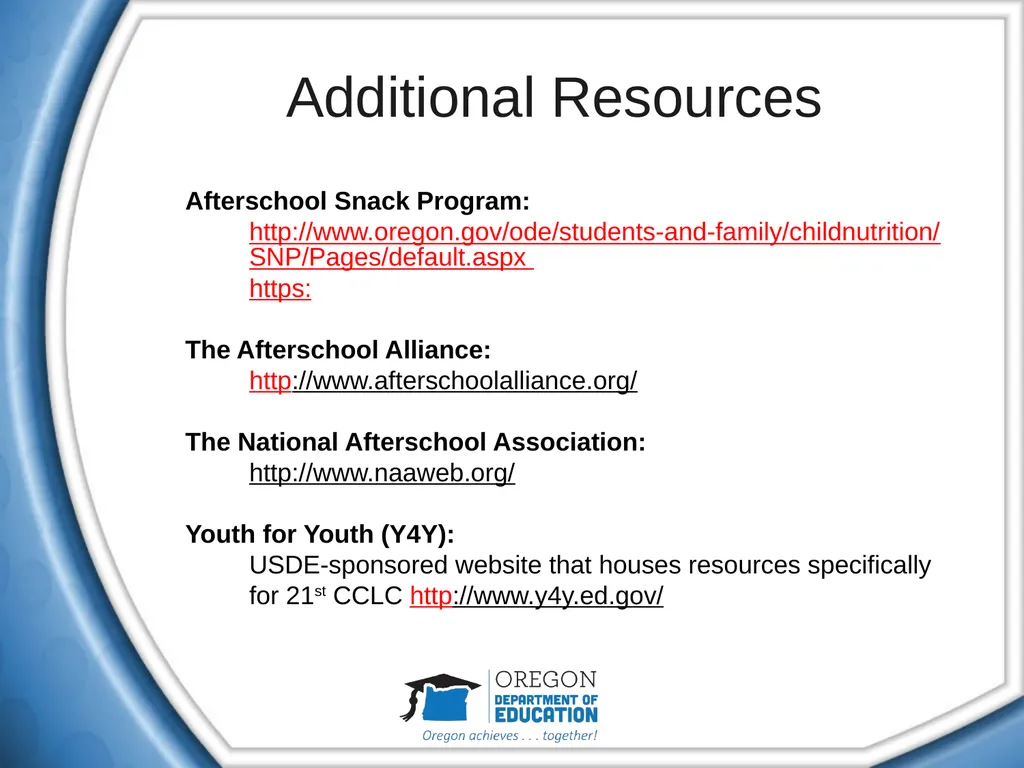
Additional Resources Afterschool Snack Program:
http://www.oregon.gov/ode/students-and-family/childnutrition/SNP/Pages/default.aspx https:
The Afterschool Alliance:
http://www.afterschoolalliance.org/
The National Afterschool Association:
http://www.naaweb.org/
Youth for Youth (Y4Y):
USDE-sponsored website that houses resources specifically for 21st CCLC http://www.y4y.ed.gov/<br>
http://www.oregon.gov/ode/students-and-family/childnutrition/SNP/Pages/default.aspx https:
The Afterschool Alliance:
http://www.afterschoolalliance.org/
The National Afterschool Association:
http://www.naaweb.org/
Youth for Youth (Y4Y):
USDE-sponsored website that houses resources specifically for 21st CCLC http://www.y4y.ed.gov/<br>
35
Part 4:
Questions<br>
36
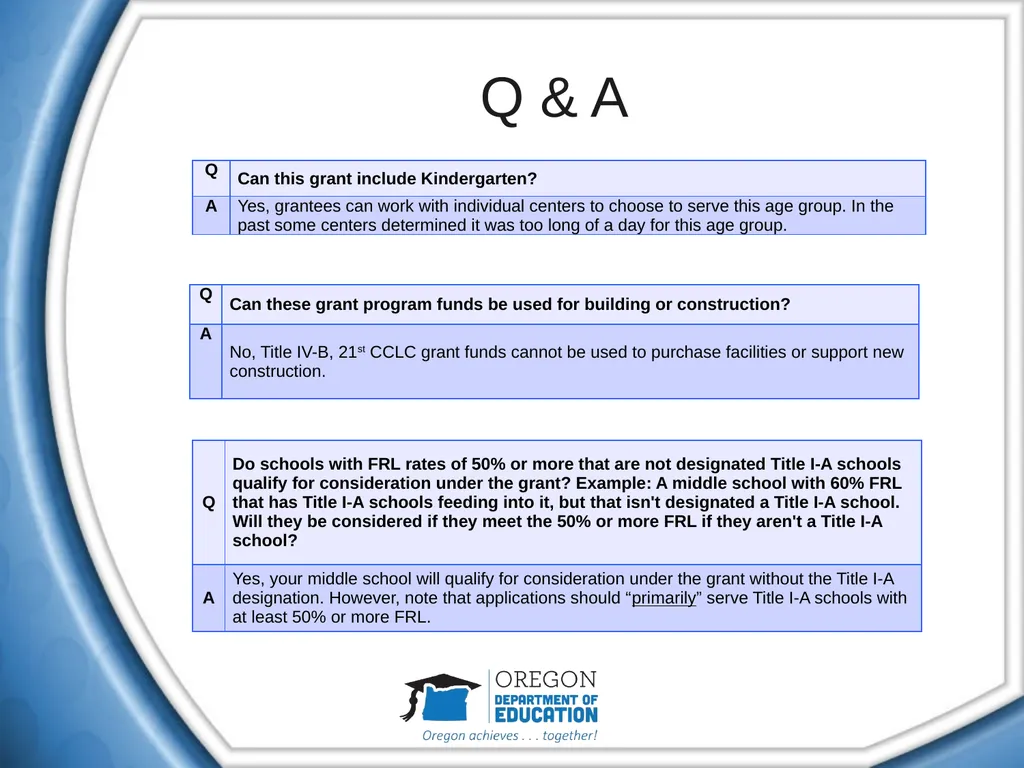
Q & A<br>
37
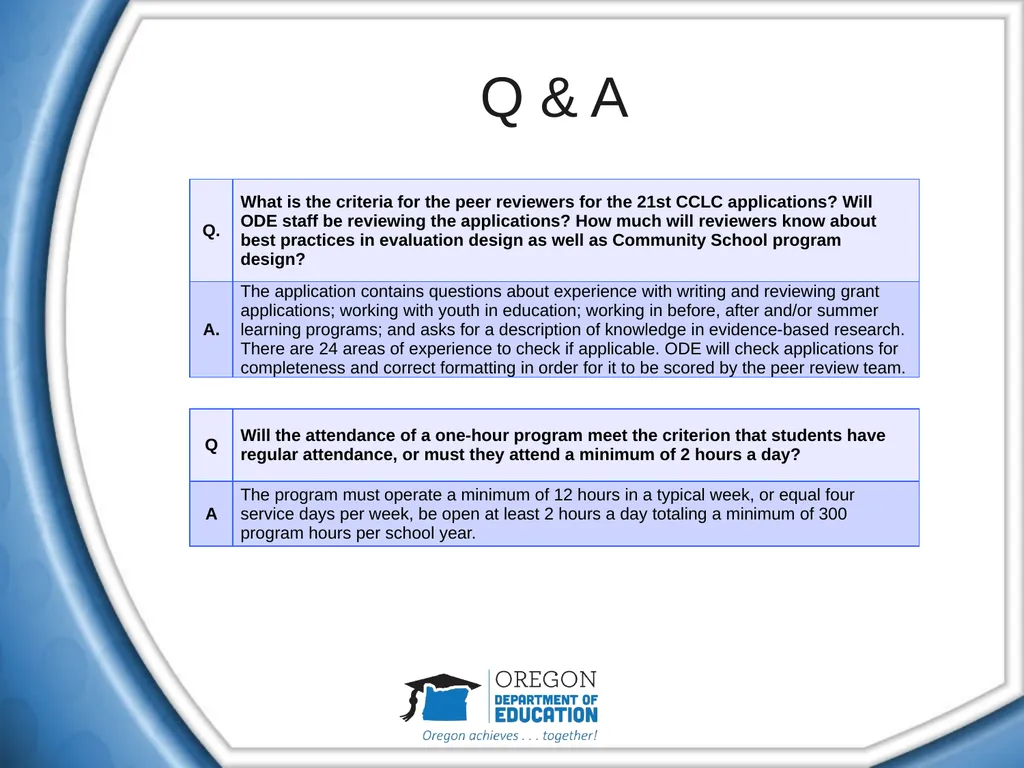
Q & A<br>
38
Q & A<br>
39
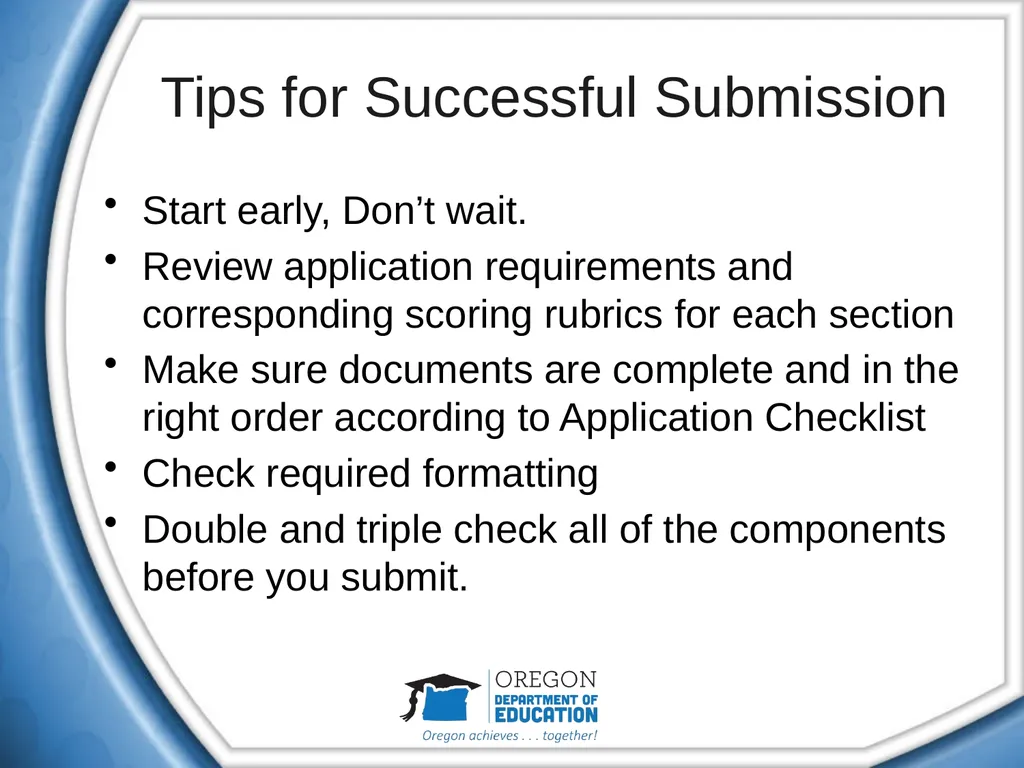
Tips for Successful Submission Start early, Don’t wait.
Review application requirements and corresponding scoring rubrics for each section
Make sure documents are complete and in the right order according to Application Checklist
Check required formatting
Double and triple check all of the components before you submit.<br>
Review application requirements and corresponding scoring rubrics for each section
Make sure documents are complete and in the right order according to Application Checklist
Check required formatting
Double and triple check all of the components before you submit.<br>
40
Additional Questions Raquel Gwynn- Raquel.gwynn@state.or.us
Ann Kaltenbach- ann.kaltenbach@state.or.us<br>
Ann Kaltenbach- ann.kaltenbach@state.or.us<br>