
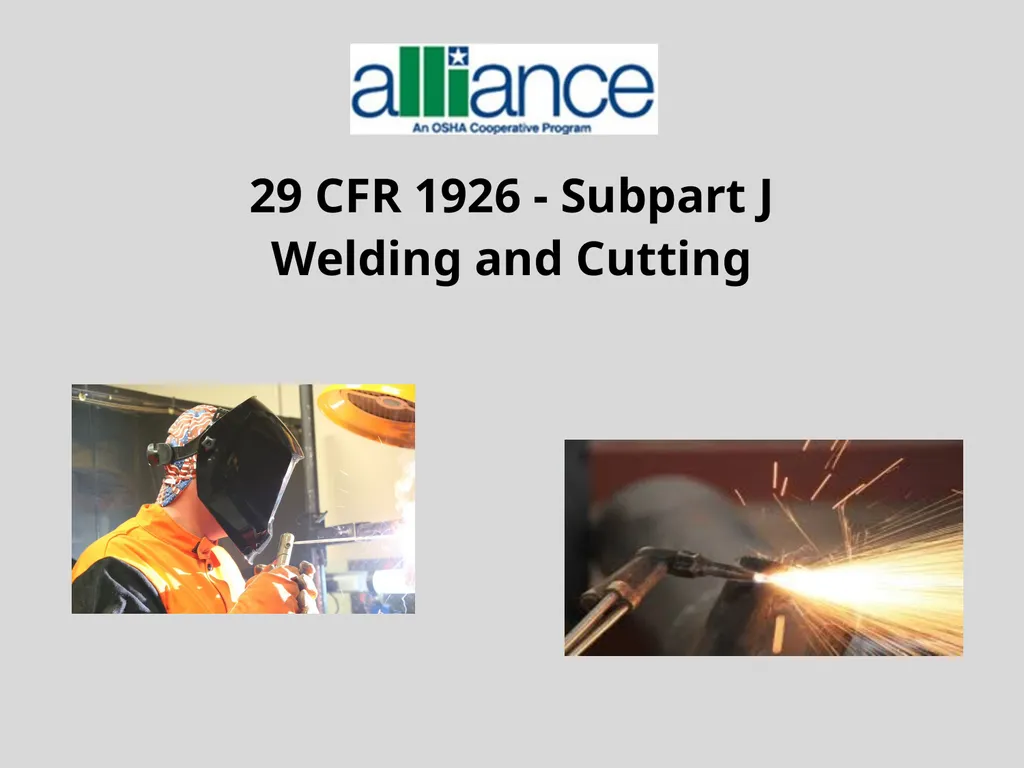
29 CFR 1926 - Subpart J Welding and Cutting
LV
Published · 52 slides · 0 views

1 / 1








Description
29 CFR 1926 - Subpart J Welding and Cutting Welding and Cutting 1926 Subpart J provides the requirements for welding and cutting including fire prevention and protection, confined spaces, personal protective equipment , ventilation, and
Related Topics
Download this presentation From Below
"29 CFR 1926 - Subpart J Welding and Cutting" is the property of its rightful owner. Permission is granted to download and print the materials on this website for personal, non-commercial use only, and to display it on your personal computer provided you do not modify the materials and that you retain all copyright notices contained in the materials. By downloading content from our website, you accept the terms of this agreement.
Share
Embed code
Presentation Transcript
01
29 CFR 1926 - Subpart J
Welding and Cutting<br>
02
Welding and Cutting 1926 Subpart J provides the requirements for welding and cutting including fire prevention and protection, confined spaces, personal protective equipment , ventilation, and securing cylinders. Overview:<br>
03
Subpart J
1926.350 - Gas Welding and Cutting
1926.351 - Arc Welding and Cutting
1926.352 - Fire Prevention
1926.353 - Ventilation and Protection in Welding, Cutting, and Heating
1926.354 – Welding, Cutting, and heating in way of preservative coatings Welding and Cutting<br>
1926.350 - Gas Welding and Cutting
1926.351 - Arc Welding and Cutting
1926.352 - Fire Prevention
1926.353 - Ventilation and Protection in Welding, Cutting, and Heating
1926.354 – Welding, Cutting, and heating in way of preservative coatings Welding and Cutting<br>
04
Objectives:
By the end of this session, students will be able to: Describe employee responsibilities when welding and oxy-acetylene cutting Identify equipment commonly used in welding and oxy-acetylene cutting Identify hazards and implement proper safety procedures for use and storage of welding and oxy-acetylene cutting equipment Describe employer responsibilities for protection when welding and oxy-acetylene cutting Welding and Cutting<br>
By the end of this session, students will be able to: Describe employee responsibilities when welding and oxy-acetylene cutting Identify equipment commonly used in welding and oxy-acetylene cutting Identify hazards and implement proper safety procedures for use and storage of welding and oxy-acetylene cutting equipment Describe employer responsibilities for protection when welding and oxy-acetylene cutting Welding and Cutting<br>
05
29 CFR 1926 Subpart J covers requirements for welding and cutting in the construction environment. There are some additional requirements that are covered in other Standards. These are referred to as horizontal standards.
Horizontal Standards
Horizontal standards are the OSHA standards that apply to most workplaces.
Examples of horizontal standards include:
PPE (1910 Subpart I)
Fire Protection (1910 Subpart L)
Hazard Communication (1910.1200)
Vertical Standards
Vertical standards apply to specific industries or operations, practices, conditions, processes, means, methods, equipment, or installations.
Examples of OSHA vertical standards include:
OSHA's 1926 Construction Standards
OSHA's 1915 Shipyard Standards Welding and Cutting Vertical and Horizontal OSHA Standards<br>
Horizontal Standards
Horizontal standards are the OSHA standards that apply to most workplaces.
Examples of horizontal standards include:
PPE (1910 Subpart I)
Fire Protection (1910 Subpart L)
Hazard Communication (1910.1200)
Vertical Standards
Vertical standards apply to specific industries or operations, practices, conditions, processes, means, methods, equipment, or installations.
Examples of OSHA vertical standards include:
OSHA's 1926 Construction Standards
OSHA's 1915 Shipyard Standards Welding and Cutting Vertical and Horizontal OSHA Standards<br>
06
Integrating Vertical and Horizontal Standards
Almost all workplaces have vertical standards to implement along with the horizontal standards.
For example, restaurants follow the horizontal standards of fire safety, but they also follow specific vertical standards regarding open flames, food safety and public health.
The same applies to construction. The construction industry follows the common horizontal regulations, but it also has specific vertical standards to follow on machinery, tools, ventilation and safety equipment.
This presentation will reference the 1926 vertical standard for construction but will also reference any applicable horizontal standard.
Knowing both types of standards is critical for the conveyance industry to keep its workers safe. Welding and Cutting Vertical and Horizontal OSHA Standards<br>
Almost all workplaces have vertical standards to implement along with the horizontal standards.
For example, restaurants follow the horizontal standards of fire safety, but they also follow specific vertical standards regarding open flames, food safety and public health.
The same applies to construction. The construction industry follows the common horizontal regulations, but it also has specific vertical standards to follow on machinery, tools, ventilation and safety equipment.
This presentation will reference the 1926 vertical standard for construction but will also reference any applicable horizontal standard.
Knowing both types of standards is critical for the conveyance industry to keep its workers safe. Welding and Cutting Vertical and Horizontal OSHA Standards<br>
07
§1910.253 — Gas Welding and Cutting General requirements: Flammable mixture.
Mixtures of fuel gases and air or oxygen may be explosive and shall be guarded against Maximum pressure.
Under no condition shall acetylene be generated, piped (except in approved cylinder manifolds) or utilized at a pressure in excess of 15 psig (103 kPa gauge pressure) or 30 psia (206 kPa absolute). Apparatus.
Only approved apparatus such as torches, regulators or pressure-reducing valves, acetylene generators, and manifolds shall be used Welding and Cutting<br>
Mixtures of fuel gases and air or oxygen may be explosive and shall be guarded against Maximum pressure.
Under no condition shall acetylene be generated, piped (except in approved cylinder manifolds) or utilized at a pressure in excess of 15 psig (103 kPa gauge pressure) or 30 psia (206 kPa absolute). Apparatus.
Only approved apparatus such as torches, regulators or pressure-reducing valves, acetylene generators, and manifolds shall be used Welding and Cutting<br>
08
§1910.253 — Oxygen-fuel gas welding and cutting Cylinders and containers: Compressed gas cylinders shall be legibly marked, for the purpose of identifying the gas content, with either the chemical or the trade name of the gas. Such marking shall be by means of stenciling, stamping, or labeling, and shall not be readily removable. Whenever practical, the marking shall be located on the shoulder of the cylinder. Welding and Cutting<br>
09
§1926.350 and 1910.253 — Oxygen-fuel gas welding and cutting Storage of Cylinders: Cylinders shall be kept away from radiators and other sources of heat Inside of buildings, cylinders shall be stored in a well-protected, well-ventilated, dry location, at least 20 (6.1 m) feet from highly combustible
materials in an assigned location Assigned storage spaces shall be located where cylinders will not be knocked over or damaged by passing or falling objects, or subject to tampering by unauthorized persons Cylinders shall not be kept in unventilated enclosures such as lockers and cupboards Empty cylinders shall have their valves closed Welding and Cutting<br>
10
Storage of Cylinders cont: Oxygen cylinders in storage shall be separated from fuel-gas cylinders or combustible materials (especially oil or grease), a minimum distance of 20 feet (6.1 m) or by a noncombustible barrier at least 5 feet (1.5 m) high having a fire-resistance rating of at least one-half hour Valve protection caps, where cylinder is designed to accept a cap, shall always be in place except when cylinders are in use or connected for use Welding and Cutting §1926.350 — Oxygen-fuel gas welding and cutting<br>
11
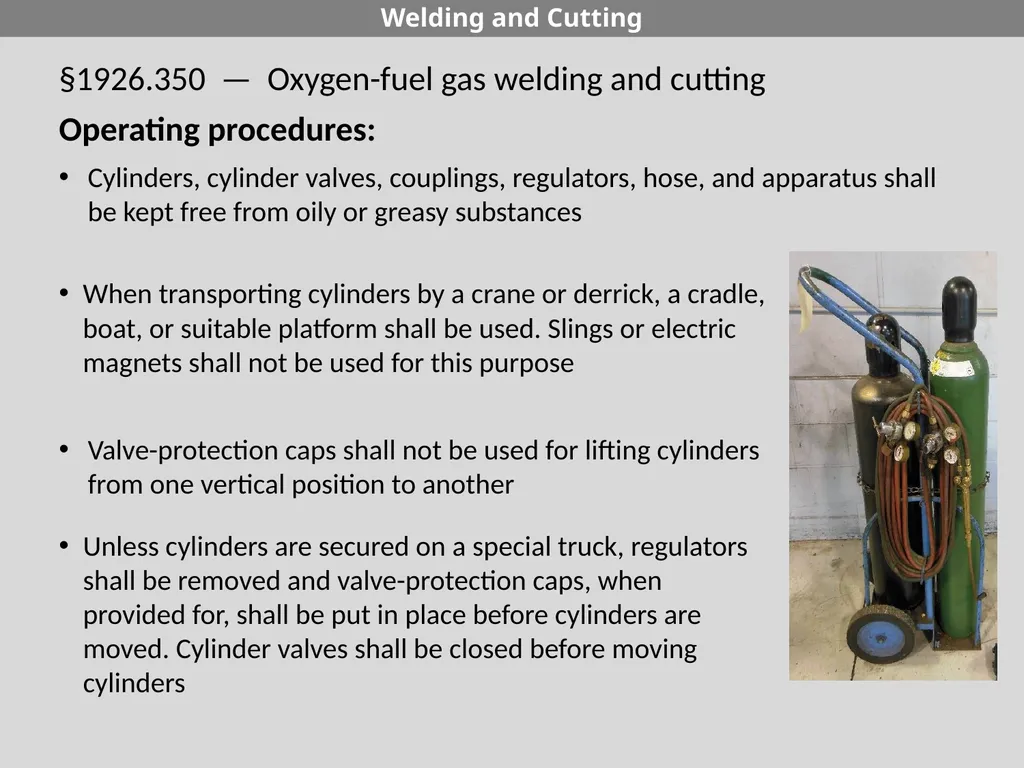
Operating procedures: Cylinders, cylinder valves, couplings, regulators, hose, and apparatus shall be kept free from oily or greasy substances When transporting cylinders by a crane or derrick, a cradle, boat, or suitable platform shall be used. Slings or electric magnets shall not be used for this purpose Valve-protection caps shall not be used for lifting cylinders from one vertical position to another Unless cylinders are secured on a special truck, regulators shall be removed and valve-protection caps, when provided for, shall be put in place before cylinders are moved. Cylinder valves shall be closed before moving cylinders Welding and Cutting §1926.350 — Oxygen-fuel gas welding and cutting<br>
12
§1926.350 — Oxygen-fuel gas welding and cutting Operating procedures cont.: Cylinders shall be kept far enough away from the actual welding or cutting operation so that sparks, hot slag, or flame will not reach them, or fire-resistant shields shall be provided Cylinders shall not be placed where they might become part of an electric circuit Cylinders shall be kept away from radiators, piping systems, layout tables, etc., that may be used for grounding electric circuits such as for arc welding machines Any practice such as the tapping of an electrode against a cylinder to strike an arc shall be prohibited Cylinders shall never be used as rollers or supports, whether full or empty. Welding and Cutting<br>
13
§1926.350 — Oxygen-fuel gas welding and cutting Operating procedures cont.: Before connecting the regulator to the cylinder valve, the valve shall be opened slightly for an instant and then closed. Always stand to one side of the outlet when opening the cylinder valve Never crack a fuel-gas cylinder valve near other welding work or near sparks, flame, or other possible sources of ignition Before a regulator is removed from a cylinder valve, the cylinder valve shall be closed, and the gas released from the regulator An acetylene cylinder valve shall not be opened more than one and one-half turns of the spindle, and preferably no more than three-fourths of a turn Where a special wrench is required, it shall be left in position on the stem of the valve while the cylinder is in use so that the fuel-gas flow can be quickly turned off in case of emergency Welding and Cutting<br>
14
§1910.253 — Oxygen-fuel gas welding and cutting Protective equipment, hose, and regulators: Equipment shall be installed and used only in the service for which it is approved and as
recommended by the manufacturer Hose for oxy-fuel gas service shall comply with the Specification for Rubber Welding Hose, 1958, Compressed Gas Association and Rubber
Manufacturers Association When parallel lengths of oxygen and acetylene
hose are taped together for convenience and to
prevent tangling, not more than 4 inches (10.2
cm) out of 12 inches (30.5 cm) shall be covered
by tape. Welding and Cutting<br>
15
§1910.253 — Oxygen-fuel gas welding and cutting Protective equipment, hose, and regulators cont.: Hose connections shall be clamped or otherwise securely fastened in a manner that will withstand, without leakage, twice the pressure to which they are normally subjected in service Hose showing leaks, burns, worn places, or other defects rendering it unfit for service shall be repaired or replaced Welding and Cutting<br>
16
§1910.253 — Oxygen-fuel gas welding and cutting Pressure-Reducing regulators: Pressure-reducing regulators shall be used only for the gas and pressures for which they are intended When regulators or parts of regulators, including gages, need repair, the work shall be performed by skilled mechanics who have been properly instructed Gages on oxygen regulators shall be marked "USE NO OIL." Union nuts and connections on regulators shall be inspected before use to detect faulty seats which may cause leakage of gas when the regulators are attached to the cylinder valves Welding and Cutting<br>
17
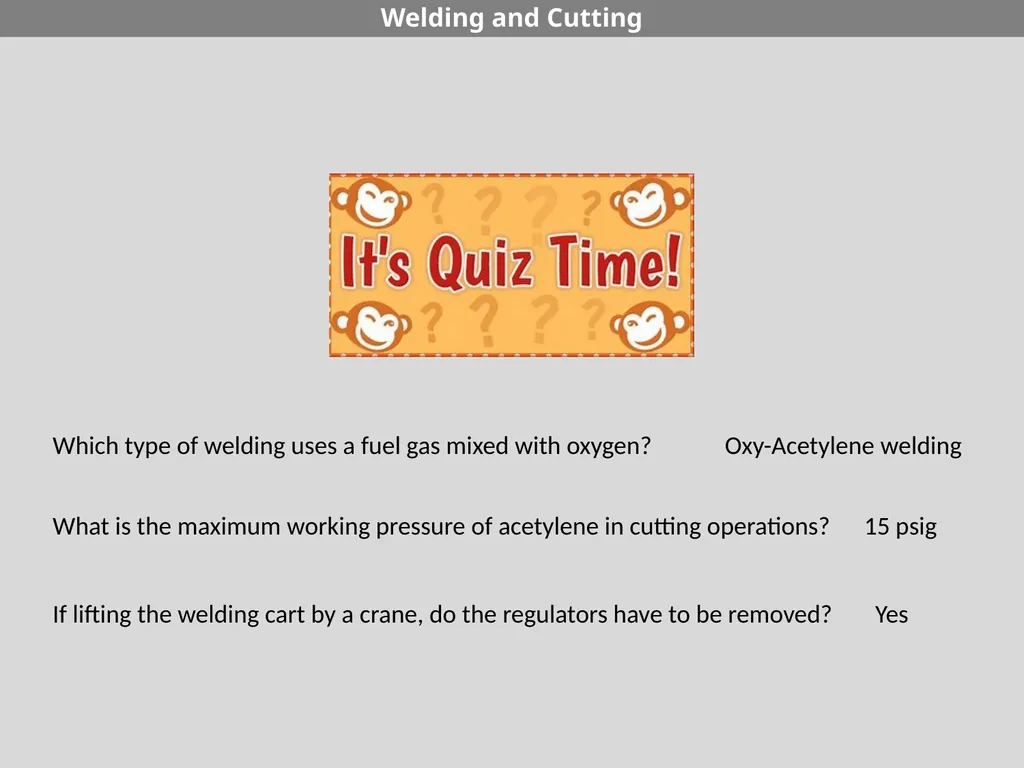
What is the maximum working pressure of acetylene in cutting operations? 15 psig If lifting the welding cart by a crane, do the regulators have to be removed? Yes Which type of welding uses a fuel gas mixed with oxygen? Oxy-Acetylene welding Welding and Cutting<br>
18
§1926.351 — Arc welding and cutting In the arc welding process, an electric current passing through the welding rod or electrode is forced to jump or arc across a gap. The resulting arc produces the intense heat necessary for the arc welding and cutting operation. Arc welding is used to fabricate nearly all types of carbon and alloy steels, the common nonferrous metals, and is indispensable in the repair and reclamation of metallic machine parts Welding and Cutting<br>
19
§1910.254 — Arc welding and cutting General: Welding equipment shall be chosen for safe application to the work to be done Welding equipment shall be installed safely Workmen designated to operate arc welding equipment shall have been properly instructed and qualified to operate such equipment Welding and Cutting<br>
20
§1910.254 — Arc welding and cutting Environmental Conditions: Standard machines for arc welding service shall be designed and constructed to carry their rated load with rated temperature rises Unusual service conditions may exist, and in such circumstances, machines shall be especially designed to safely meet the requirements of the service: Exposure to steam or excessive humidity Exposure to abnormal vibration or shock Exposure to excessive dust Exposure to weather Exposure to unusual seacoast or shipboard conditions Welding and Cutting<br>
21
§1910.254 — Arc welding and cutting Voltage - The following limits shall not be exceeded: Alternating-current machines Manual arc welding and cutting — 80 volts Automatic (machine or mechanized) arc welding and cutting — 100 volts Direct-current machines Manual arc welding and cutting — 100 volts Automatic (machine or mechanized) arc welding and cutting-100 volts When special welding and cutting processes require values of open circuit voltages higher than the above, means shall be provided to prevent the operator from making accidental contact with the high voltage by adequate insulation or other means. Welding and Cutting<br>
22
§1910.254 — Arc welding and cutting On all types of arc welding machines, control apparatus shall be enclosed except for the operating wheels, levers, or handles. Design Terminals for welding leads should be protected from accidental electrical contact by personnel or by metal objects i.e., vehicles, crane hooks, etc. Installation The frame or case of the welding machine (except engine-driven machines) shall be grounded Chains, wire ropes, cranes, hoists, and elevators shall not be used to carry welding current All ground connections shall be checked to determine that they are mechanically strong and electrically adequate for the required current Welding and Cutting<br>
23
§1910.254 — Arc welding and cutting Supply connections and conductors A disconnecting switch or controller shall be provided at or near each welding machine which is not equipped with such a switch or controller mounted as an integral part of the machine. Operation and maintenance The rated current-carrying capacity of the supply conductors shall be not less than the rated primary current of the welding machines Workers assigned to operate or maintain arc welding equipment shall be acquainted with the requirements of this section and with 1910.252* Before starting operations all connections to the machine shall be checked to make certain they are properly made, and coiled welding cable shall be spread out before use to avoid serious overheating and damage to insulation. Welding and Cutting<br>
24
§1910.254 — Arc welding and cutting Operation and maintenance cont. Grounding of the welding machine frame shall be checked. Special attention shall be given to safety ground connections of portable machines Electrode holders when not in use shall be so placed that they cannot make electrical contact with persons, conducting objects, fuel or compressed gas tanks Electric Shock Hazard: Cables with splices within 10 feet (3 m) of the holder shall not be used. The welder should not coil or loop welding electrode cable around parts of his body The operator should report any equipment defect or safety hazard to his supervisor and the use of the equipment shall be discontinued until its safety has been assured. Repairs shall be made only by qualified personnel Maintenance Cables with damaged insulation or exposed bare conductors shall be replaced. Joining lengths of work and electrode cables shall be done by the use of connecting means specifically intended for the purpose. The connecting means shall have insulation adequate for the service conditions Welding and Cutting<br>
25
29-Year-Old Welder Electrocuted At approximately 3:45 a.m. a 29-year-old maintenance worker was electrocuted as he attempted to turn off a welder. A maintenance man at a steel treatment plant was walking along a metal walkway in the plant, when he discovered the victim lying on his back in a convulsive state. Electrical arcs were visible from the handle of the welding cart to the floor. As other employees arrived at the scene, one pulled the plug on the welder. The police and the fire department rescue squad were called. The rescue squad transported the victim to a local hospital, where he was pronounced dead at 5:08 a.m. The examination of the welder at the local police station revealed that the cables on the welder (particularly the positive or electrode cable) had exposed conductors. Numerous cuts and abrasions exposed large areas of the conductor cables. Continuity checks on the four terminals of the welder plug indicated that the wiring of the plug cable provided an adequate ground path. The insulation on the welder’s electrode holder was broken with large pieces of insulation completely missing. Inspection of the receptacle box revealed that the cover plate was designed for a different style receptacle. Additionally, the receptacle box did not have a conductor (wire) attached to the ground terminal. A continuity check on the receptacle indicated an open circuit (no ground connection). Without a complete ground connection, the victim most likely completed an electrical conducting path from the frame of the welding machine or any one of the uninsulated areas on the cables. Water on the floor increased the area that could result in a ground fault and reduced the resistance of the path to ground. Welding and Cutting<br>
26
1926.352 and 1910.252 Fire Prevention Employer Responsibilities: Management shall recognize its responsibility for the safe usage of cutting and welding equipment on its property and provide employees proper PPE for the work they perform Based on fire potentials of the facility, establish areas for cutting and welding, and establish procedures for cutting and welding, in other areas Designate an individual responsible for authorizing cutting and welding operations in areas not specifically designed for such processes Ensure that cutters or welders and their supervisors are suitably trained in the safe operation of their equipment and the safe use of the process Advise all contractors about flammable materials or hazardous conditions they may not be aware. Welding and Cutting<br>
27
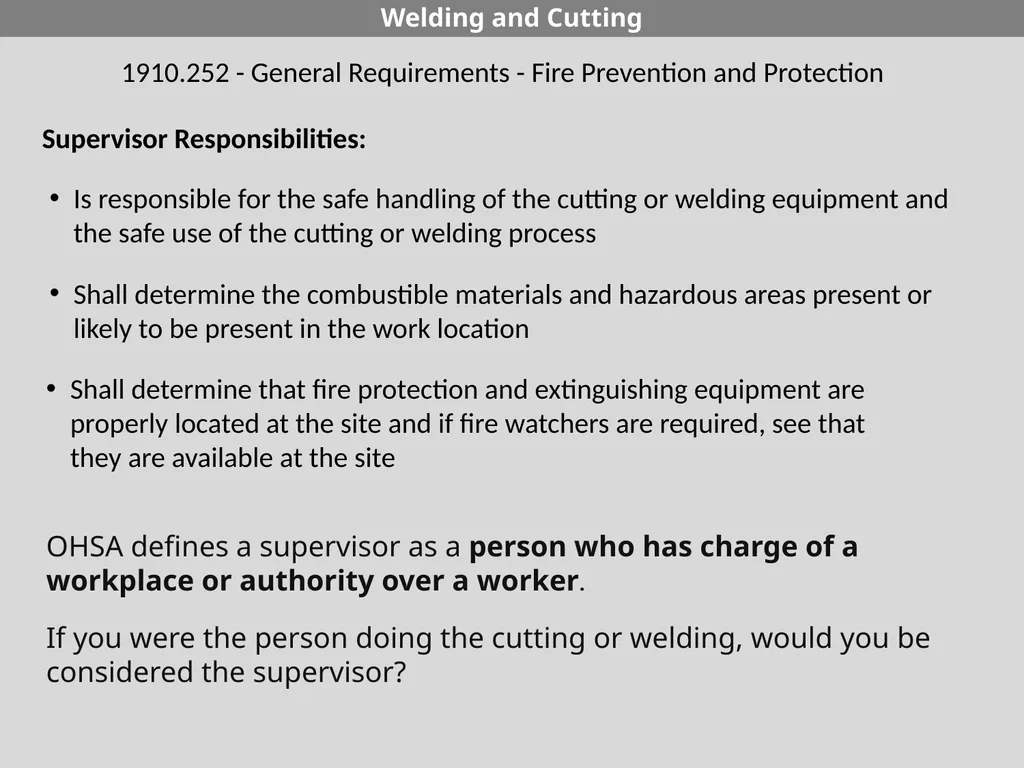
Supervisor Responsibilities: 1910.252 - General Requirements - Fire Prevention and Protection Is responsible for the safe handling of the cutting or welding equipment and the safe use of the cutting or welding process Shall determine the combustible materials and hazardous areas present or likely to be present in the work location Shall determine that fire protection and extinguishing equipment are properly located at the site and if fire watchers are required, see that they are available at the site OHSA defines a supervisor as a person who has charge of a workplace or authority over a worker.
If you were the person doing the cutting or welding, would you be considered the supervisor? Welding and Cutting<br>
If you were the person doing the cutting or welding, would you be considered the supervisor? Welding and Cutting<br>
28
Employee Responsibilities: 1910.252 - General Requirements - Fire Prevention and Protection Employees must follow all OSHA safety and health standards AND all rules issued by their employers that are intended to comply with OSHA’s health and safety standards and the OSH Act.
Workplace injuries and accidents have a cost. Fines and penalties, lost productivity, lost time and wages, lower morale. Everyone must do their part to keep the workers and workplace safe. Read and follow all health and safety postings Follow safe work practices Help reduce work hazards Report all occupational injuries, illnesses and hazardous conditions Cooperate during an OSHA inspection Exercise rights under the OSH Act in a responsible manner Welding and Cutting<br>
Workplace injuries and accidents have a cost. Fines and penalties, lost productivity, lost time and wages, lower morale. Everyone must do their part to keep the workers and workplace safe. Read and follow all health and safety postings Follow safe work practices Help reduce work hazards Report all occupational injuries, illnesses and hazardous conditions Cooperate during an OSHA inspection Exercise rights under the OSH Act in a responsible manner Welding and Cutting<br>
29
Who is responsible for supplying your welding and cutting PPE? The employer Who determines that fire protection and extinguishing equipment are properly located at the site? The supervisor Welding and Cutting<br>
30
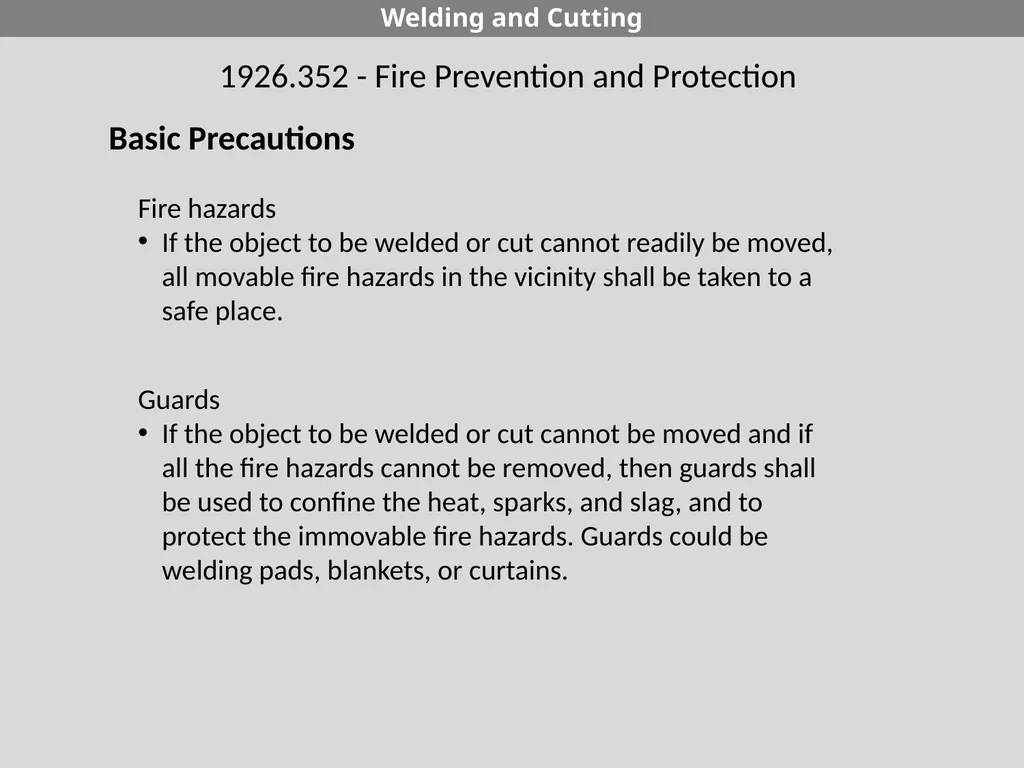
1926.352 - Fire Prevention and Protection Fire hazards
If the object to be welded or cut cannot readily be moved, all movable fire hazards in the vicinity shall be taken to a safe place. Guards
If the object to be welded or cut cannot be moved and if all the fire hazards cannot be removed, then guards shall be used to confine the heat, sparks, and slag, and to protect the immovable fire hazards. Guards could be welding pads, blankets, or curtains. Basic Precautions Welding and Cutting<br>
If the object to be welded or cut cannot readily be moved, all movable fire hazards in the vicinity shall be taken to a safe place. Guards
If the object to be welded or cut cannot be moved and if all the fire hazards cannot be removed, then guards shall be used to confine the heat, sparks, and slag, and to protect the immovable fire hazards. Guards could be welding pads, blankets, or curtains. Basic Precautions Welding and Cutting<br>
31
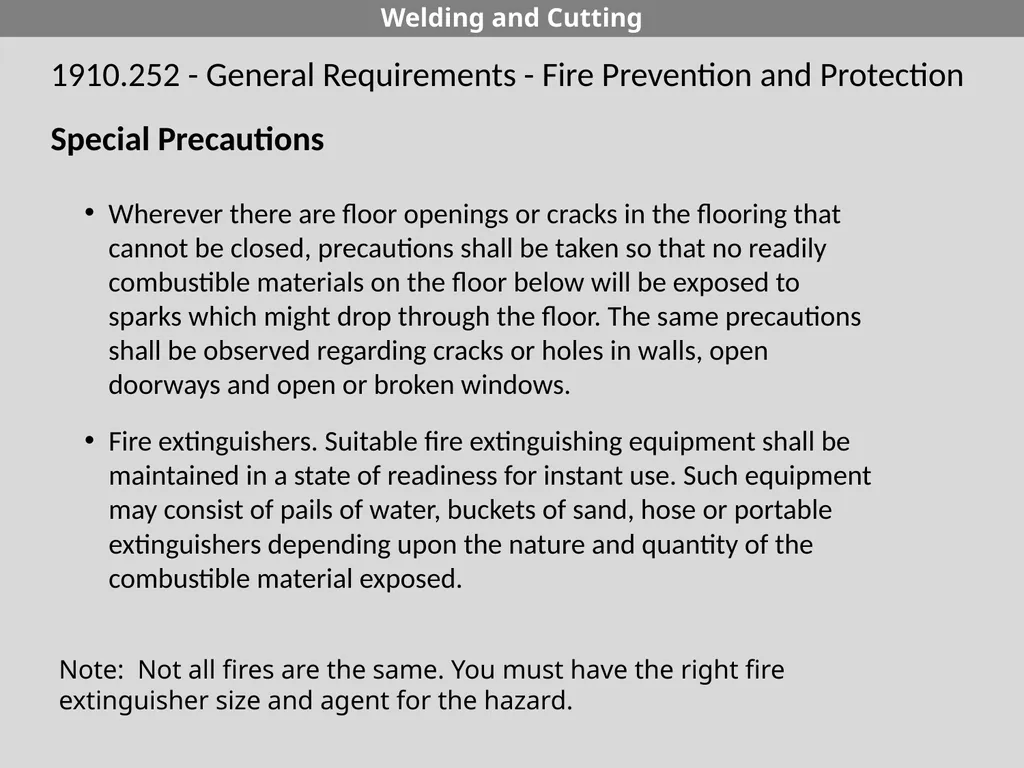
1910.252 - General Requirements - Fire Prevention and Protection Special Precautions Wherever there are floor openings or cracks in the flooring that cannot be closed, precautions shall be taken so that no readily combustible materials on the floor below will be exposed to sparks which might drop through the floor. The same precautions shall be observed regarding cracks or holes in walls, open doorways and open or broken windows. Fire extinguishers. Suitable fire extinguishing equipment shall be maintained in a state of readiness for instant use. Such equipment may consist of pails of water, buckets of sand, hose or portable extinguishers depending upon the nature and quantity of the combustible material exposed. Note: Not all fires are the same. You must have the right fire extinguisher size and agent for the hazard. Welding and Cutting<br>
32
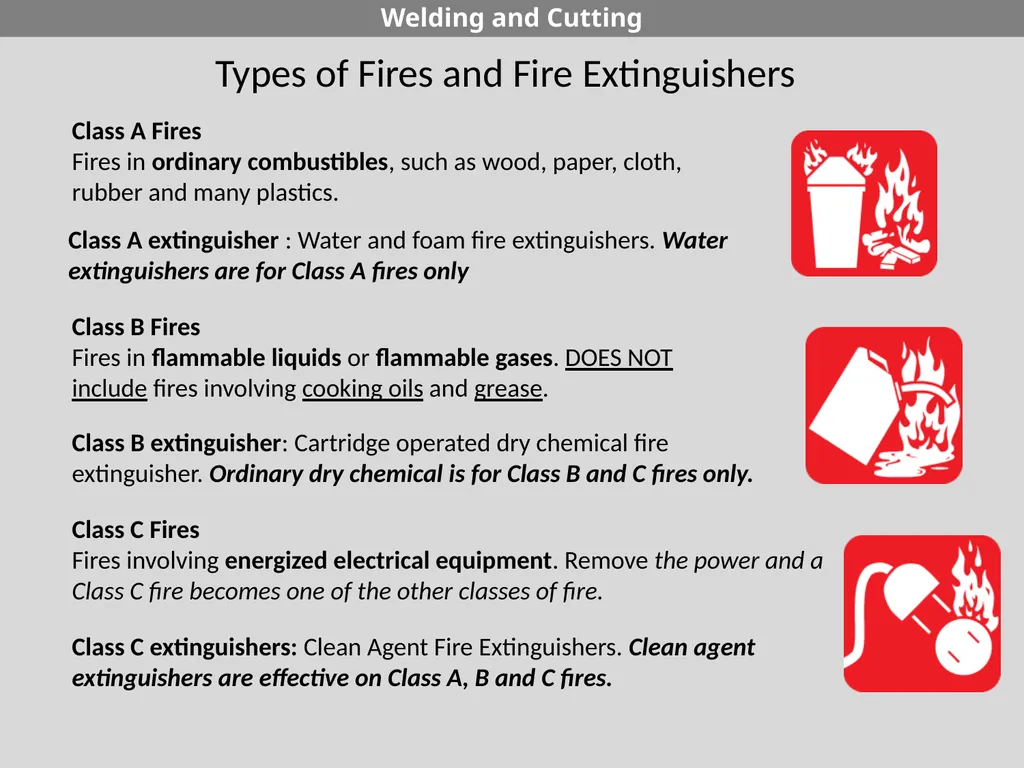
Class A extinguisher : Water and foam fire extinguishers. Water extinguishers are for Class A fires only Types of Fires and Fire Extinguishers Class A Fires
Fires in ordinary combustibles, such as wood, paper, cloth, rubber and many plastics. Class B Fires
Fires in flammable liquids or flammable gases. DOES NOT include fires involving cooking oils and grease. Class B extinguisher: Cartridge operated dry chemical fire extinguisher. Ordinary dry chemical is for Class B and C fires only. Class C Fires
Fires involving energized electrical equipment. Remove the power and a Class C fire becomes one of the other classes of fire. Class C extinguishers: Clean Agent Fire Extinguishers. Clean agent extinguishers are effective on Class A, B and C fires. Welding and Cutting<br>
Fires in ordinary combustibles, such as wood, paper, cloth, rubber and many plastics. Class B Fires
Fires in flammable liquids or flammable gases. DOES NOT include fires involving cooking oils and grease. Class B extinguisher: Cartridge operated dry chemical fire extinguisher. Ordinary dry chemical is for Class B and C fires only. Class C Fires
Fires involving energized electrical equipment. Remove the power and a Class C fire becomes one of the other classes of fire. Class C extinguishers: Clean Agent Fire Extinguishers. Clean agent extinguishers are effective on Class A, B and C fires. Welding and Cutting<br>
33
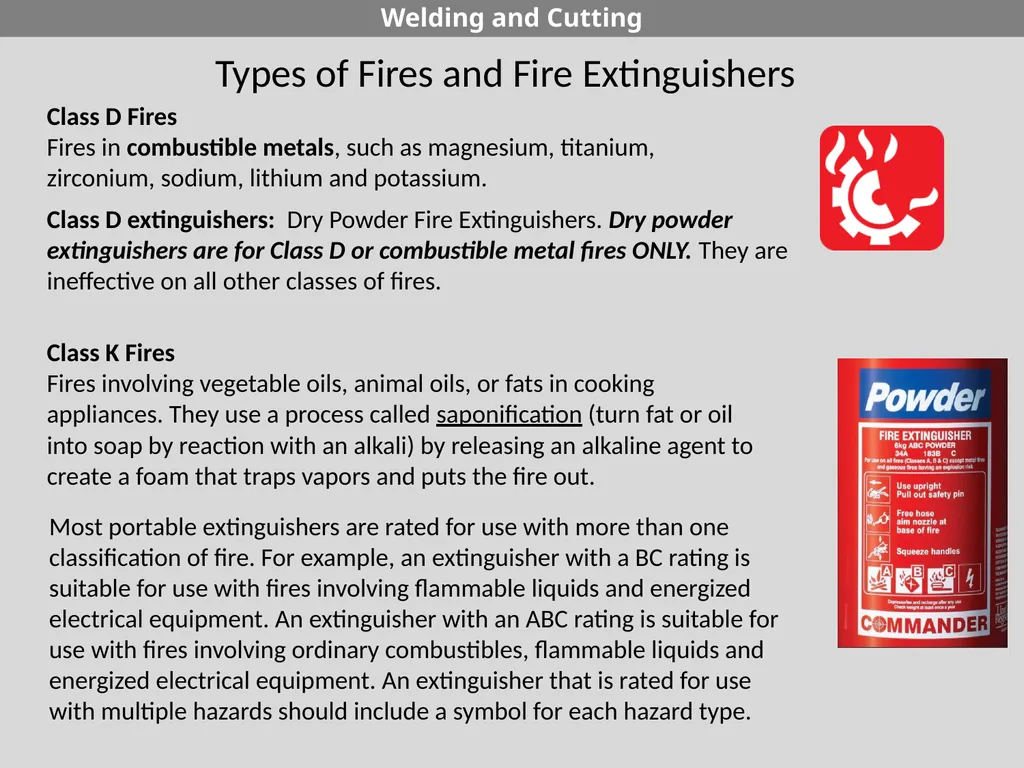
Class D Fires
Fires in combustible metals, such as magnesium, titanium, zirconium, sodium, lithium and potassium. Class D extinguishers: Dry Powder Fire Extinguishers. Dry powder extinguishers are for Class D or combustible metal fires ONLY. They are ineffective on all other classes of fires. Class K Fires
Fires involving vegetable oils, animal oils, or fats in cooking appliances. They use a process called saponification (turn fat or oil into soap by reaction with an alkali) by releasing an alkaline agent to create a foam that traps vapors and puts the fire out. Most portable extinguishers are rated for use with more than one classification of fire. For example, an extinguisher with a BC rating is suitable for use with fires involving flammable liquids and energized electrical equipment. An extinguisher with an ABC rating is suitable for use with fires involving ordinary combustibles, flammable liquids and energized electrical equipment. An extinguisher that is rated for use with multiple hazards should include a symbol for each hazard type. Welding and Cutting Types of Fires and Fire Extinguishers<br>
Fires in combustible metals, such as magnesium, titanium, zirconium, sodium, lithium and potassium. Class D extinguishers: Dry Powder Fire Extinguishers. Dry powder extinguishers are for Class D or combustible metal fires ONLY. They are ineffective on all other classes of fires. Class K Fires
Fires involving vegetable oils, animal oils, or fats in cooking appliances. They use a process called saponification (turn fat or oil into soap by reaction with an alkali) by releasing an alkaline agent to create a foam that traps vapors and puts the fire out. Most portable extinguishers are rated for use with more than one classification of fire. For example, an extinguisher with a BC rating is suitable for use with fires involving flammable liquids and energized electrical equipment. An extinguisher with an ABC rating is suitable for use with fires involving ordinary combustibles, flammable liquids and energized electrical equipment. An extinguisher that is rated for use with multiple hazards should include a symbol for each hazard type. Welding and Cutting Types of Fires and Fire Extinguishers<br>
34
Other Special Precautions 1910.252 - General Requirements - Fire Prevention and Protection Fire Watch:
Fire Watchers are required when: welding and cutting is performed in locations where other than a minor fire might develop. Appreciable combustible materials are closer than 35 feet to the point of operation Appreciable combustible materials are more than 35 feet away but are easily ignited by sparks Wall or floor openings within a 35-foot radius expose combustible material in adjacent areas including concealed spaces in walls or floors Combustible materials are adjacent to the opposite side of metal partitions, walls, ceilings, or roofs and are likely to be ignited by conduction or radiation A fire watch shall be maintained for at least one half hour** after the completion of welding or cutting operations and fire watchers must have fire extinguishing equipment available and be trained in it’s use Welding and Cutting<br>
Fire Watchers are required when: welding and cutting is performed in locations where other than a minor fire might develop. Appreciable combustible materials are closer than 35 feet to the point of operation Appreciable combustible materials are more than 35 feet away but are easily ignited by sparks Wall or floor openings within a 35-foot radius expose combustible material in adjacent areas including concealed spaces in walls or floors Combustible materials are adjacent to the opposite side of metal partitions, walls, ceilings, or roofs and are likely to be ignited by conduction or radiation A fire watch shall be maintained for at least one half hour** after the completion of welding or cutting operations and fire watchers must have fire extinguishing equipment available and be trained in it’s use Welding and Cutting<br>
35
1910.252 - General Requirements - Fire Prevention and Protection Prohibited Areas Cutting or welding shall not be permitted in the following situations: In areas not authorized by management In sprinkled buildings when protection is impaired In the presence of explosive atmospheres In areas near the storage of large quantities of exposed, readily ignitable materials Used containers.
No welding, cutting, or other hot work shall be performed on used drums, barrels, tanks or other containers until they have been cleaned so thoroughly as to make certain that there are no flammable materials present or any substances such as greases, tars, acids, or other materials which when subjected to heat, might produce flammable or toxic vapors. Any pipelines or connections to the drum or vessel shall be disconnected or blanked. Welding or cutting containers Welding and Cutting<br>
No welding, cutting, or other hot work shall be performed on used drums, barrels, tanks or other containers until they have been cleaned so thoroughly as to make certain that there are no flammable materials present or any substances such as greases, tars, acids, or other materials which when subjected to heat, might produce flammable or toxic vapors. Any pipelines or connections to the drum or vessel shall be disconnected or blanked. Welding or cutting containers Welding and Cutting<br>
36
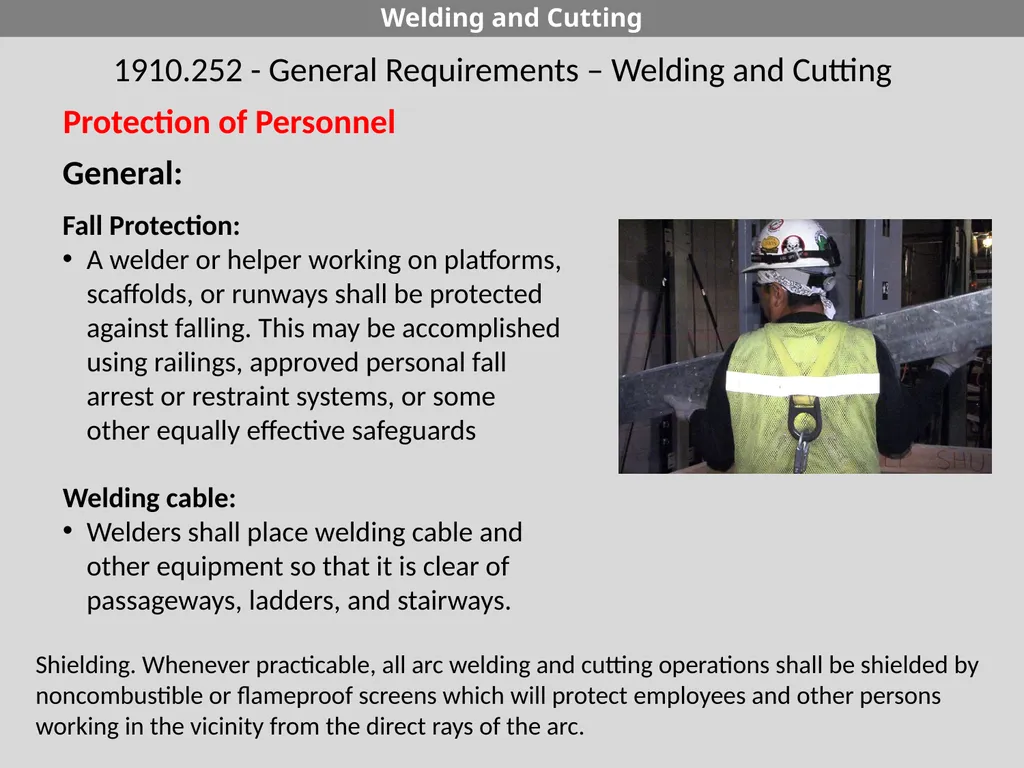
1910.252 - General Requirements – Welding and Cutting Fall Protection:
A welder or helper working on platforms, scaffolds, or runways shall be protected against falling. This may be accomplished using railings, approved personal fall arrest or restraint systems, or some other equally effective safeguards General: Welding cable:
Welders shall place welding cable and other equipment so that it is clear of passageways, ladders, and stairways. Protection of Personnel Welding and Cutting Shielding. Whenever practicable, all arc welding and cutting operations shall be shielded by noncombustible or flameproof screens which will protect employees and other persons working in the vicinity from the direct rays of the arc.<br>
A welder or helper working on platforms, scaffolds, or runways shall be protected against falling. This may be accomplished using railings, approved personal fall arrest or restraint systems, or some other equally effective safeguards General: Welding cable:
Welders shall place welding cable and other equipment so that it is clear of passageways, ladders, and stairways. Protection of Personnel Welding and Cutting Shielding. Whenever practicable, all arc welding and cutting operations shall be shielded by noncombustible or flameproof screens which will protect employees and other persons working in the vicinity from the direct rays of the arc.<br>
37
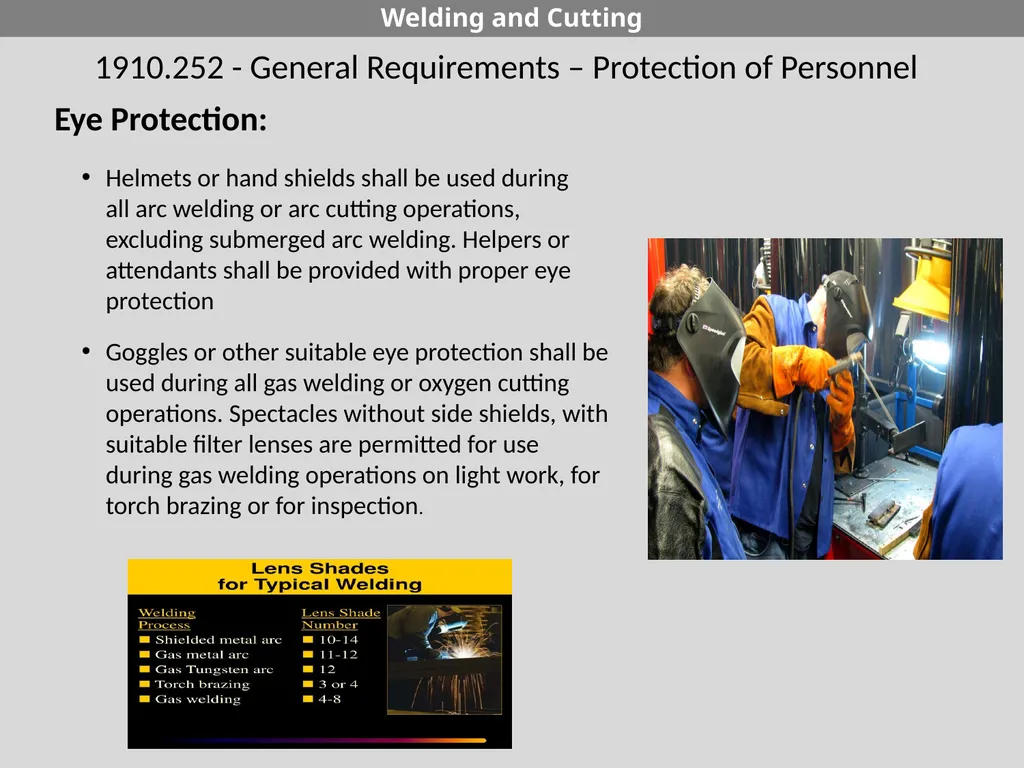
1910.252 - General Requirements – Protection of Personnel Eye Protection: Helmets or hand shields shall be used during all arc welding or arc cutting operations, excluding submerged arc welding. Helpers or attendants shall be provided with proper eye protection Goggles or other suitable eye protection shall be used during all gas welding or oxygen cutting operations. Spectacles without side shields, with suitable filter lenses are permitted for use
during gas welding operations on light work, for torch brazing or for inspection. Welding and Cutting<br>
38
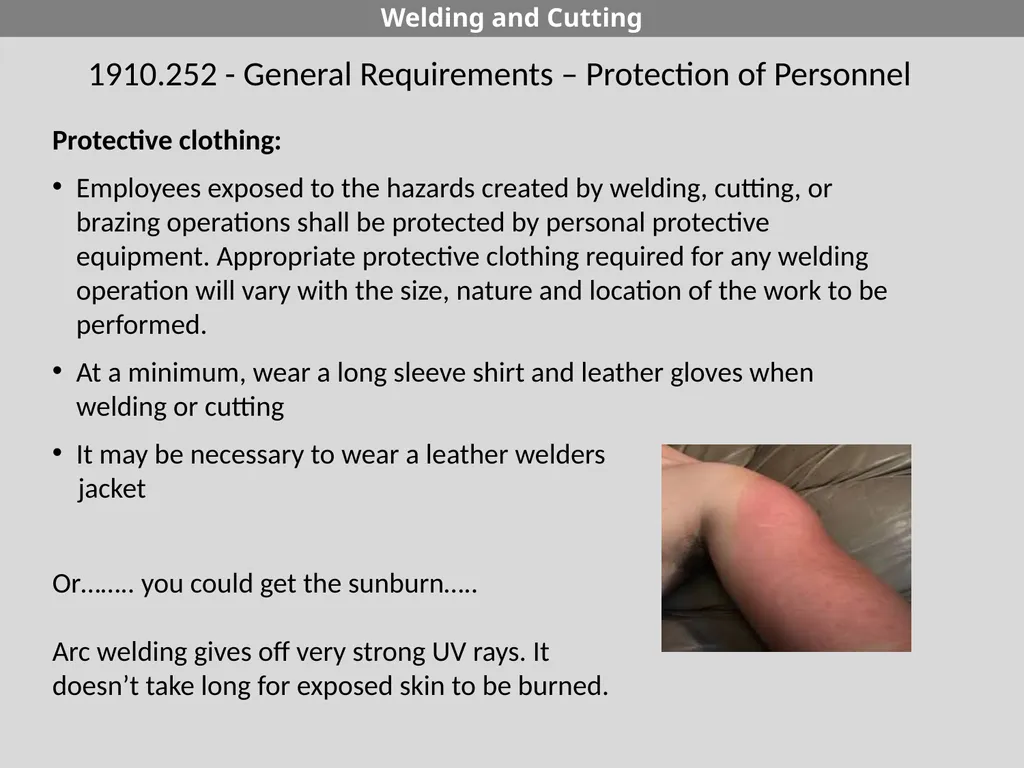
1910.252 - General Requirements – Protection of Personnel Protective clothing:
Employees exposed to the hazards created by welding, cutting, or brazing operations shall be protected by personal protective equipment. Appropriate protective clothing required for any welding operation will vary with the size, nature and location of the work to be performed.
At a minimum, wear a long sleeve shirt and leather gloves when welding or cutting
It may be necessary to wear a leather welders
jacket Or…….. you could get the sunburn…..
Arc welding gives off very strong UV rays. It doesn’t take long for exposed skin to be burned. Welding and Cutting<br>
Employees exposed to the hazards created by welding, cutting, or brazing operations shall be protected by personal protective equipment. Appropriate protective clothing required for any welding operation will vary with the size, nature and location of the work to be performed.
At a minimum, wear a long sleeve shirt and leather gloves when welding or cutting
It may be necessary to wear a leather welders
jacket Or…….. you could get the sunburn…..
Arc welding gives off very strong UV rays. It doesn’t take long for exposed skin to be burned. Welding and Cutting<br>
39
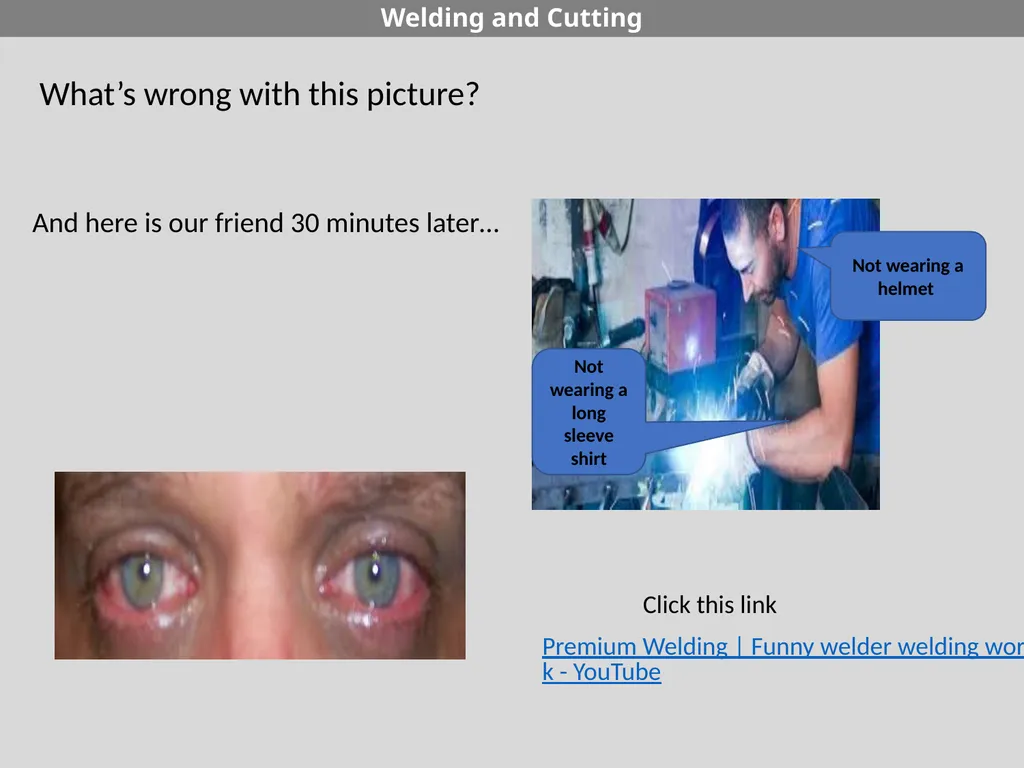
Not wearing a helmet Not wearing a long sleeve shirt Welding and Cutting What’s wrong with this picture? And here is our friend 30 minutes later… Premium Welding | Funny welder welding work - YouTube Click this link<br>
40
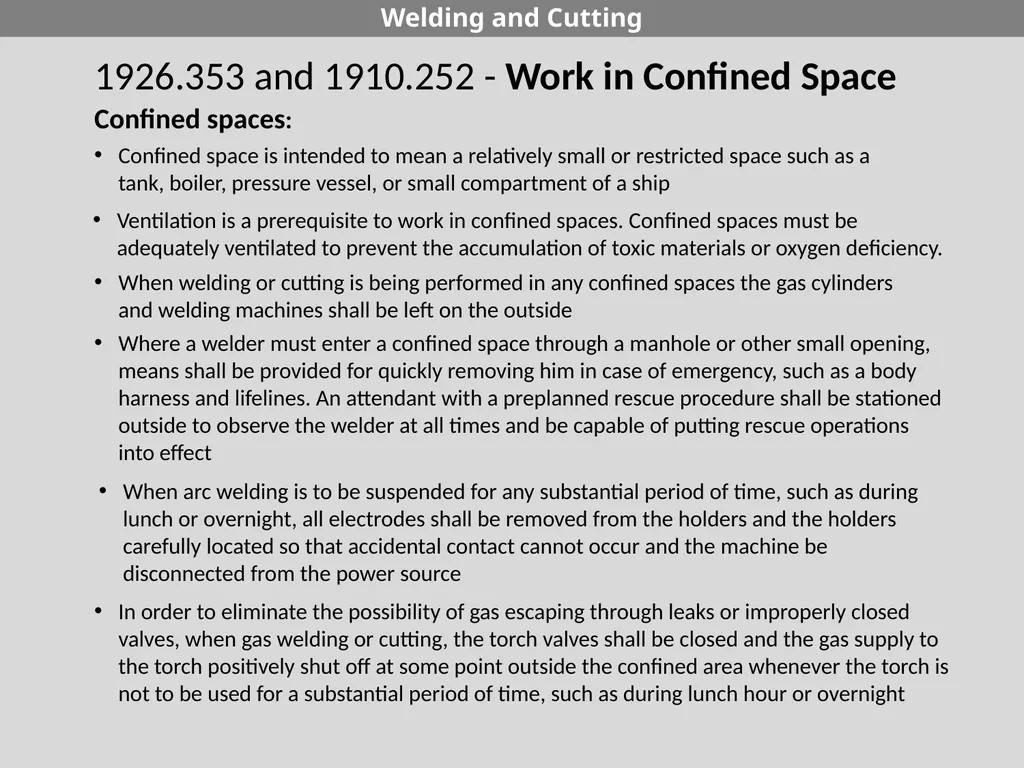
1926.353 and 1910.252 - Work in Confined Space Confined spaces: When arc welding is to be suspended for any substantial period of time, such as during lunch or overnight, all electrodes shall be removed from the holders and the holders carefully located so that accidental contact cannot occur and the machine be disconnected from the power source In order to eliminate the possibility of gas escaping through leaks or improperly closed valves, when gas welding or cutting, the torch valves shall be closed and the gas supply to the torch positively shut off at some point outside the confined area whenever the torch is not to be used for a substantial period of time, such as during lunch hour or overnight Confined space is intended to mean a relatively small or restricted space such as a tank, boiler, pressure vessel, or small compartment of a ship Ventilation is a prerequisite to work in confined spaces. Confined spaces must be adequately ventilated to prevent the accumulation of toxic materials or oxygen deficiency. When welding or cutting is being performed in any confined spaces the gas cylinders and welding machines shall be left on the outside Where a welder must enter a confined space through a manhole or other small opening, means shall be provided for quickly removing him in case of emergency, such as a body harness and lifelines. An attendant with a preplanned rescue procedure shall be stationed outside to observe the welder at all times and be capable of putting rescue operations into effect Welding and Cutting<br>
41
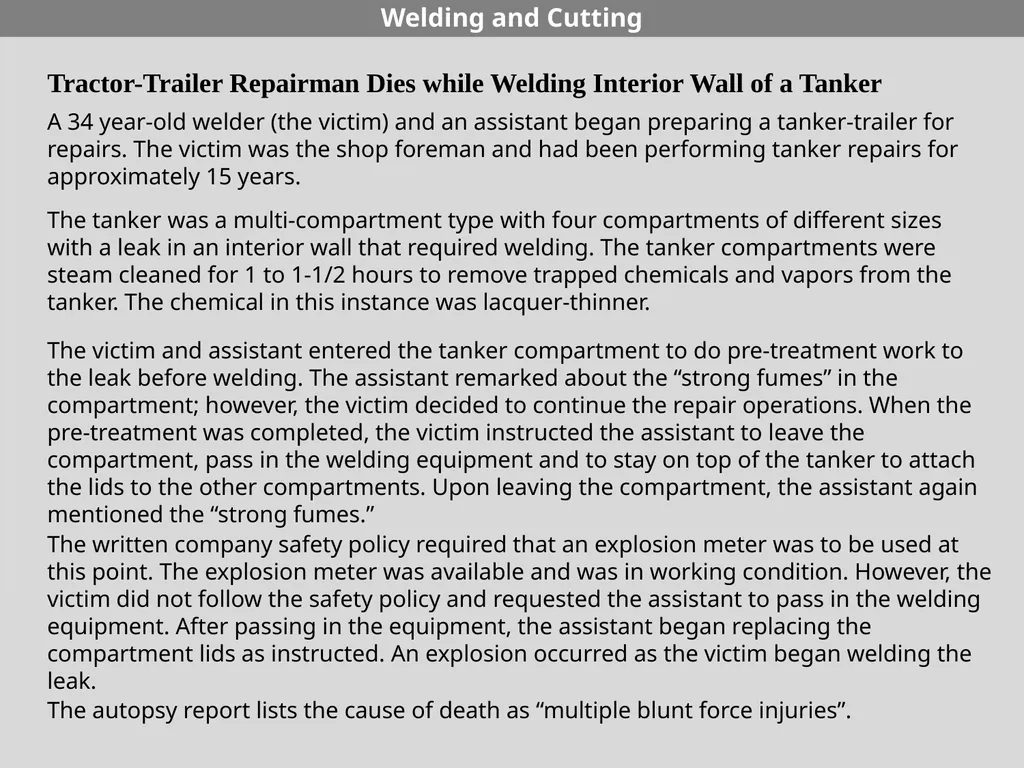
Tractor-Trailer Repairman Dies while Welding Interior Wall of a Tanker A 34 year-old welder (the victim) and an assistant began preparing a tanker-trailer for repairs. The victim was the shop foreman and had been performing tanker repairs for approximately 15 years. The tanker was a multi-compartment type with four compartments of different sizes with a leak in an interior wall that required welding. The tanker compartments were steam cleaned for 1 to 1-1/2 hours to remove trapped chemicals and vapors from the tanker. The chemical in this instance was lacquer-thinner. The victim and assistant entered the tanker compartment to do pre-treatment work to the leak before welding. The assistant remarked about the “strong fumes” in the compartment; however, the victim decided to continue the repair operations. When the pre-treatment was completed, the victim instructed the assistant to leave the compartment, pass in the welding equipment and to stay on top of the tanker to attach the lids to the other compartments. Upon leaving the compartment, the assistant again mentioned the “strong fumes.” The written company safety policy required that an explosion meter was to be used at this point. The explosion meter was available and was in working condition. However, the victim did not follow the safety policy and requested the assistant to pass in the welding equipment. After passing in the equipment, the assistant began replacing the compartment lids as instructed. An explosion occurred as the victim began welding the leak. The autopsy report lists the cause of death as “multiple blunt force injuries”. Welding and Cutting<br>
42
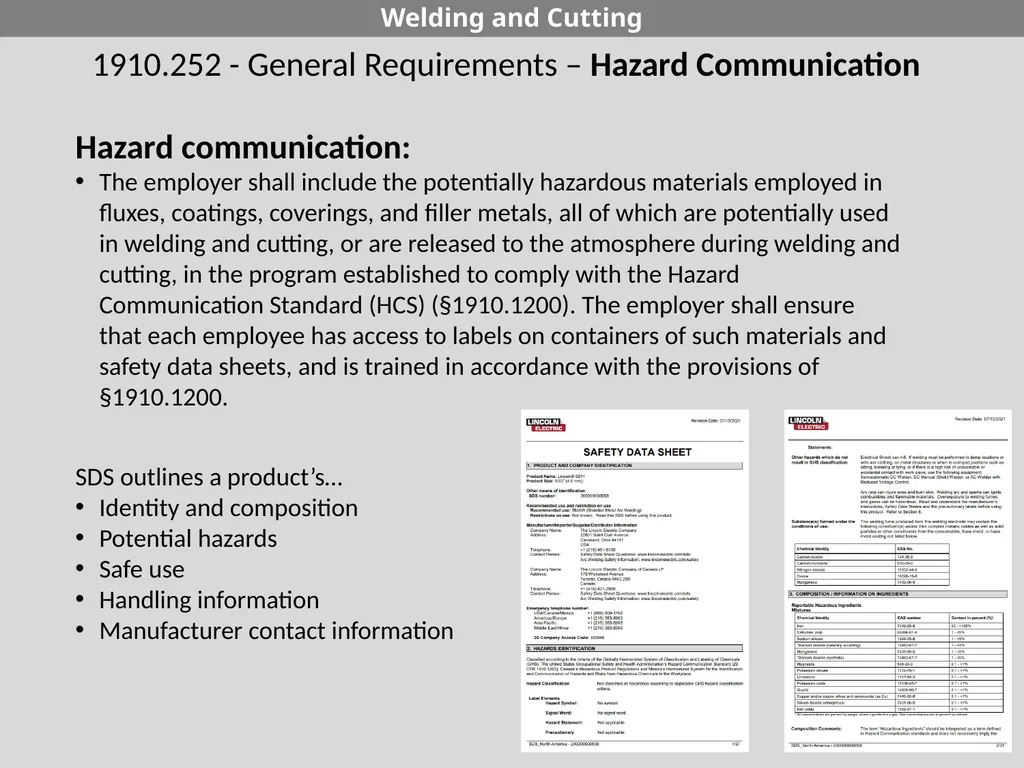
1910.252 - General Requirements – Hazard Communication Hazard communication:
The employer shall include the potentially hazardous materials employed in fluxes, coatings, coverings, and filler metals, all of which are potentially used in welding and cutting, or are released to the atmosphere during welding and cutting, in the program established to comply with the Hazard Communication Standard (HCS) (§1910.1200). The employer shall ensure that each employee has access to labels on containers of such materials and safety data sheets, and is trained in accordance with the provisions of §1910.1200. SDS outlines a product’s…
Identity and composition
Potential hazards
Safe use
Handling information
Manufacturer contact information Welding and Cutting<br>
The employer shall include the potentially hazardous materials employed in fluxes, coatings, coverings, and filler metals, all of which are potentially used in welding and cutting, or are released to the atmosphere during welding and cutting, in the program established to comply with the Hazard Communication Standard (HCS) (§1910.1200). The employer shall ensure that each employee has access to labels on containers of such materials and safety data sheets, and is trained in accordance with the provisions of §1910.1200. SDS outlines a product’s…
Identity and composition
Potential hazards
Safe use
Handling information
Manufacturer contact information Welding and Cutting<br>
43
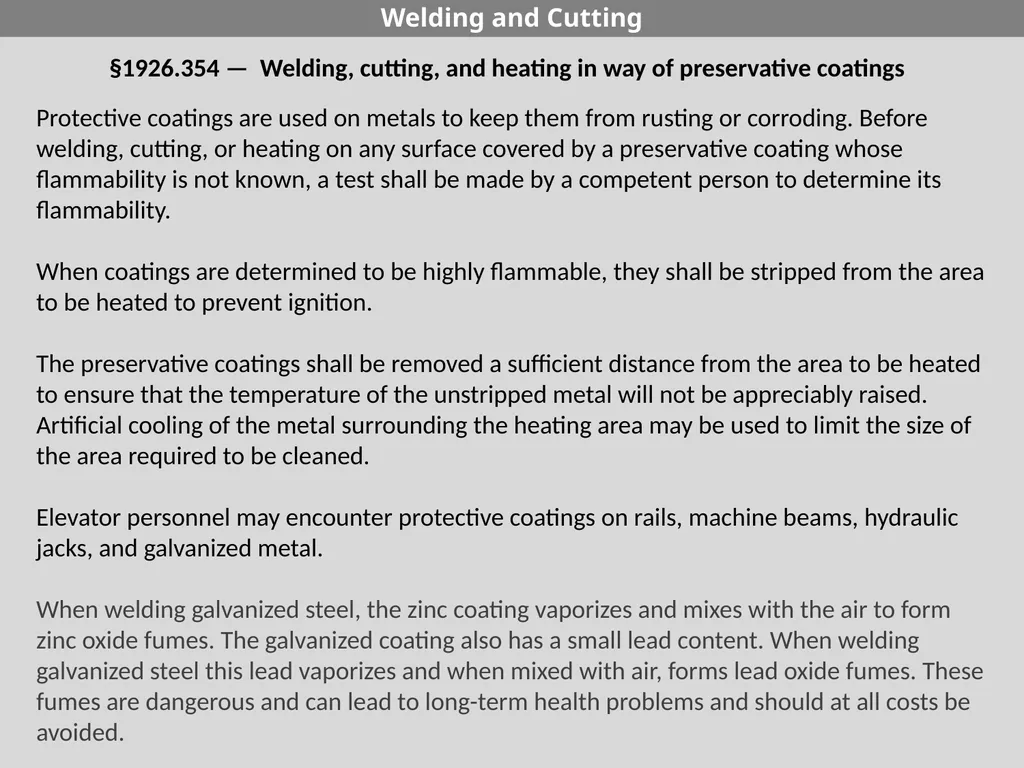
Welding and Cutting §1926.354 — Welding, cutting, and heating in way of preservative coatings Protective coatings are used on metals to keep them from rusting or corroding. Before welding, cutting, or heating on any surface covered by a preservative coating whose flammability is not known, a test shall be made by a competent person to determine its flammability.
When coatings are determined to be highly flammable, they shall be stripped from the area to be heated to prevent ignition.
The preservative coatings shall be removed a sufficient distance from the area to be heated to ensure that the temperature of the unstripped metal will not be appreciably raised. Artificial cooling of the metal surrounding the heating area may be used to limit the size of the area required to be cleaned.
Elevator personnel may encounter protective coatings on rails, machine beams, hydraulic jacks, and galvanized metal.
When welding galvanized steel, the zinc coating vaporizes and mixes with the air to form zinc oxide fumes. The galvanized coating also has a small lead content. When welding galvanized steel this lead vaporizes and when mixed with air, forms lead oxide fumes. These fumes are dangerous and can lead to long-term health problems and should at all costs be avoided.<br>
When coatings are determined to be highly flammable, they shall be stripped from the area to be heated to prevent ignition.
The preservative coatings shall be removed a sufficient distance from the area to be heated to ensure that the temperature of the unstripped metal will not be appreciably raised. Artificial cooling of the metal surrounding the heating area may be used to limit the size of the area required to be cleaned.
Elevator personnel may encounter protective coatings on rails, machine beams, hydraulic jacks, and galvanized metal.
When welding galvanized steel, the zinc coating vaporizes and mixes with the air to form zinc oxide fumes. The galvanized coating also has a small lead content. When welding galvanized steel this lead vaporizes and when mixed with air, forms lead oxide fumes. These fumes are dangerous and can lead to long-term health problems and should at all costs be avoided.<br>
44
There is a splice in your welding lead 6’ from the holder. Is it safe to use? No (10’ or more) Who can repair a welding machine? Only a qualified person can repair a welding machine Welding and Cutting<br>
45
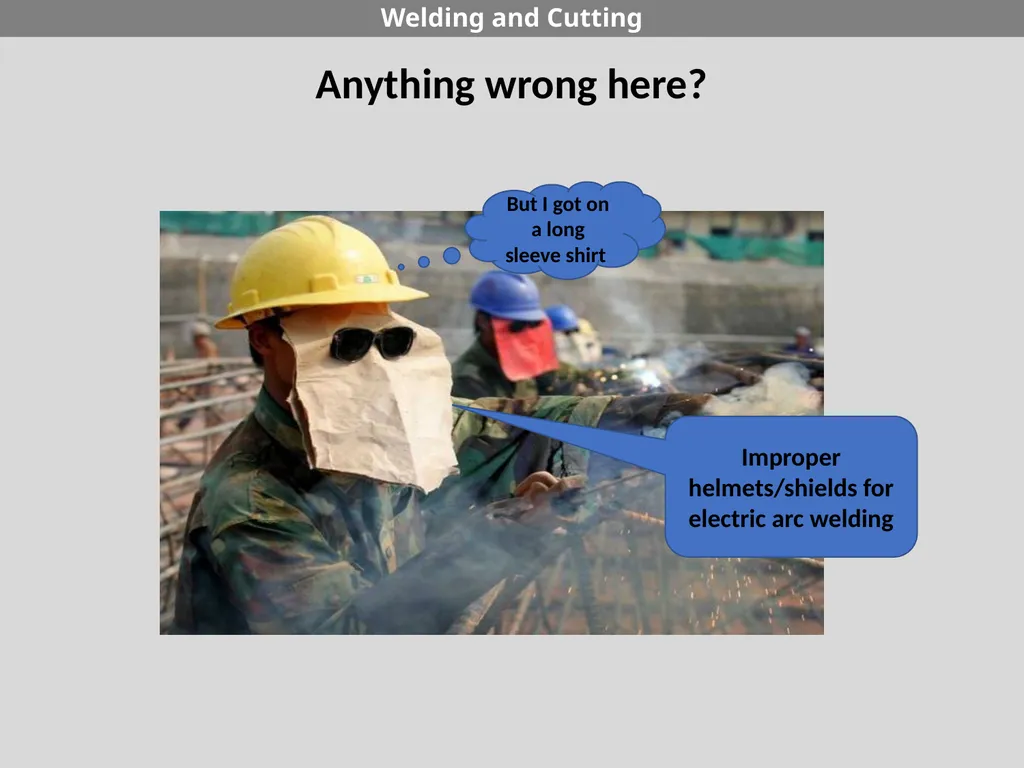
Improper helmets/shields for electric arc welding But I got on a long sleeve shirt Welding and Cutting Anything wrong here?<br>
46
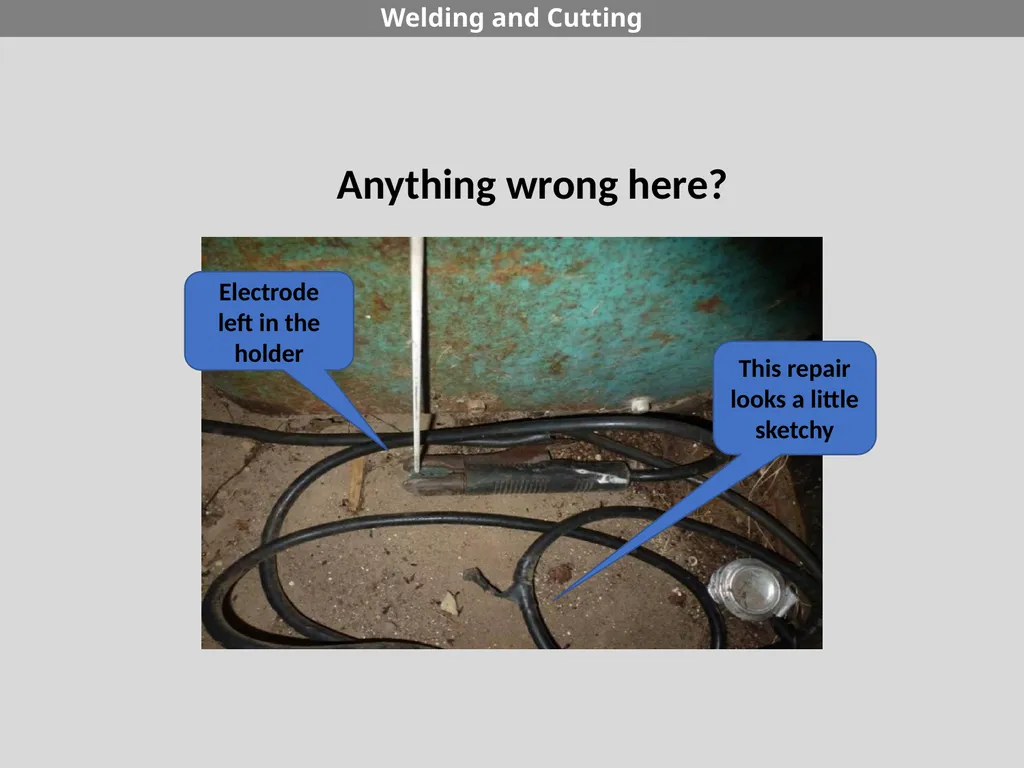
Electrode left in the holder This repair looks a little sketchy Anything wrong here? Welding and Cutting<br>
47
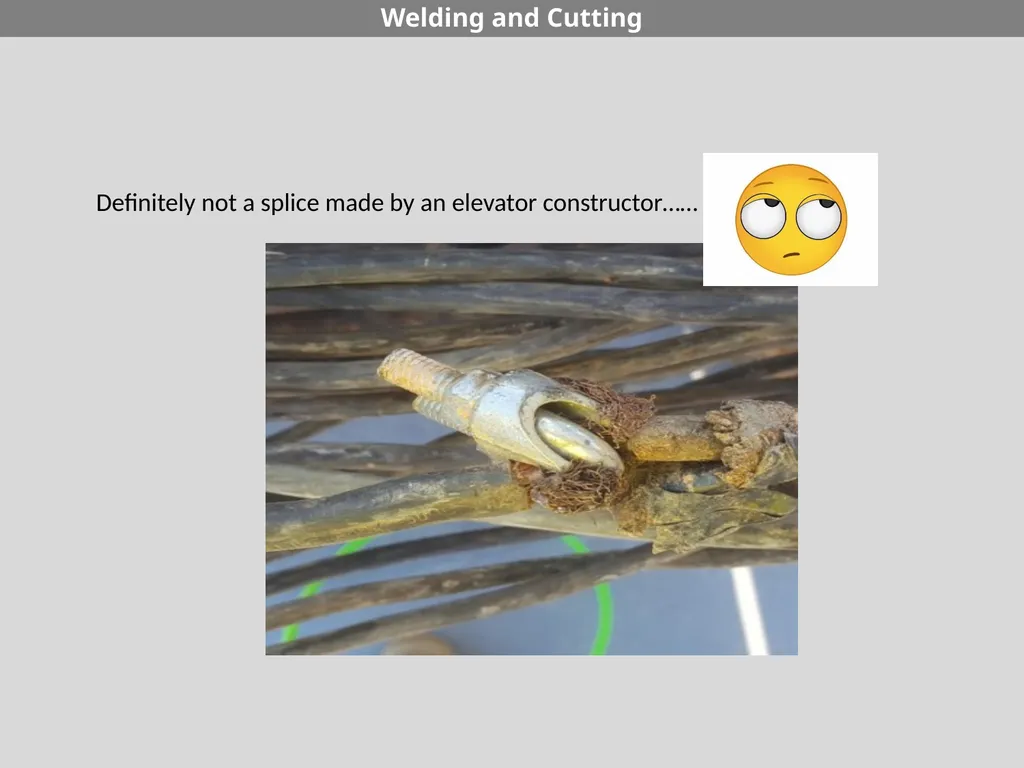
Definitely not a splice made by an elevator constructor…… Welding and Cutting<br>
48
Welding and Cutting<br>
49
Summary… We reviewed the OSHA Standards and discussed the different types of welding and cutting equipment covered by 1926 Subpart J and 1910 Subpart Q. Your employer must provide you training on the equipment you will be using, and you, the employee must always follow the proper safety procedures and use the proper PPE. Workplace accidents are costly:
Personal hardship (pain and suffering)
Loss of work and wages
Poor employee morale
Reduced productivity Your family needs you and they are counting on you. Don't let them down. Work safe! Welding and Cutting<br>
Personal hardship (pain and suffering)
Loss of work and wages
Poor employee morale
Reduced productivity Your family needs you and they are counting on you. Don't let them down. Work safe! Welding and Cutting<br>
50
A little humor with some wisdom 10 BIGGEST WELDING FAILS - YouTube<br>
51
Through the Alliance between OSHA’s 10 Regional Offices and the Elevator Contractors of America (ECA), Elevator Industry Work Preservation Fund (EIWPF), International Union of Elevator Constructors (IUEC), National Association of Elevator Contractors (NAEC), National Elevator Industry Educational Program (NEIEP), and National Elevator Industry Inc. (NEII), collectively known as The Elevator Industry Safety Partners, developed this Industry Specific Training for informational purposes only. It does not necessarily reflect the official views of OSHA or the U.S. Department of Labor. May 2021
Under the Occupational Safety and Health Act, employers are responsible (http://www.osha.gov/as/opa/worker/employer-responsibility.html) for providing a safe and healthy workplace and workers have rights (https://www.osha.gov/workers). OSHA can help answer questions or concerns from employers and workers. OSHA's On-Site Consultation Program (https://www.osha.gov/consultation) offers free and confidential advice to small and medium-sized businesses, with priority given to high-hazard worksites. For more information, contact your regional or area OSHA office (https://www.osha.gov/contactus/bystate), call 1-800-321-OSHA (6742), or visit https://www.osha.gov/.<br>
Under the Occupational Safety and Health Act, employers are responsible (http://www.osha.gov/as/opa/worker/employer-responsibility.html) for providing a safe and healthy workplace and workers have rights (https://www.osha.gov/workers). OSHA can help answer questions or concerns from employers and workers. OSHA's On-Site Consultation Program (https://www.osha.gov/consultation) offers free and confidential advice to small and medium-sized businesses, with priority given to high-hazard worksites. For more information, contact your regional or area OSHA office (https://www.osha.gov/contactus/bystate), call 1-800-321-OSHA (6742), or visit https://www.osha.gov/.<br>
52
Welding and Cutting<br>