3252022 PHY 742 -- Spring 2022 -- Lecture 21 1 PHY 742 Quantum Mechanics II 12-12:50 PM MWF in Olin 103 Plan for Lecture 21 Quantization of the Electromagnetic fields Review the raising and lowering operators presented in Professor
"3/25/2022 PHY 742 -- Spring 2022 -- Lecture 21 1" is the property of its rightful owner. Permission is granted to
download and print the materials on this website for personal, non-commercial use only, and to display it
on your personal computer provided you do not modify the materials and that you retain all copyright
notices contained in the materials. By downloading content from our website, you accept the terms of this
agreement.
Presentation Transcript
01
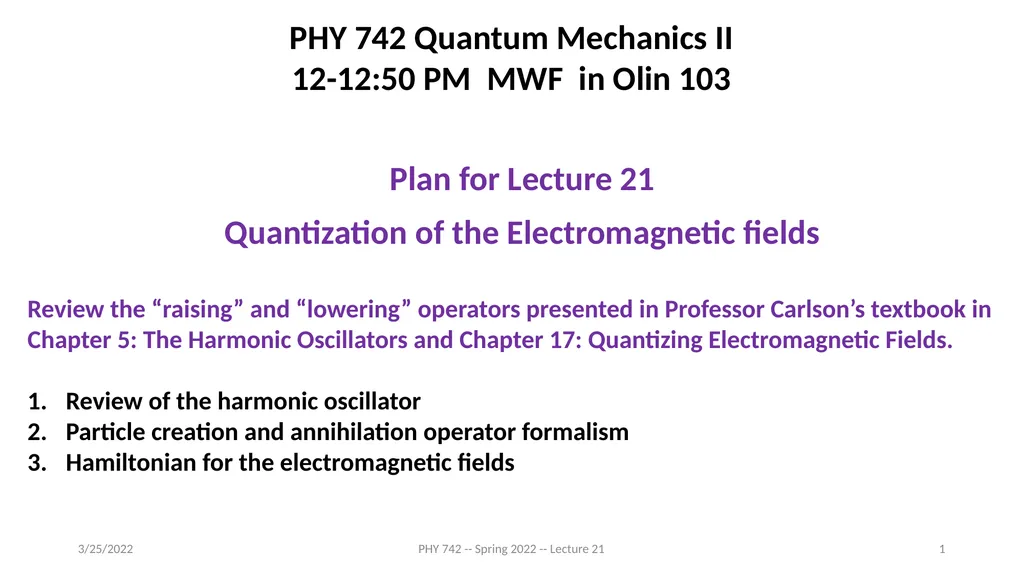
3/25/2022 PHY 742 -- Spring 2022 -- Lecture 21 1 PHY 742 Quantum Mechanics II
12-12:50 PM MWF in Olin 103 Plan for Lecture 21
Quantization of the Electromagnetic fields
Review the “raising” and “lowering” operators presented in Professor Carlson’s textbook in Chapter 5: The Harmonic Oscillators and Chapter 17: Quantizing Electromagnetic Fields.
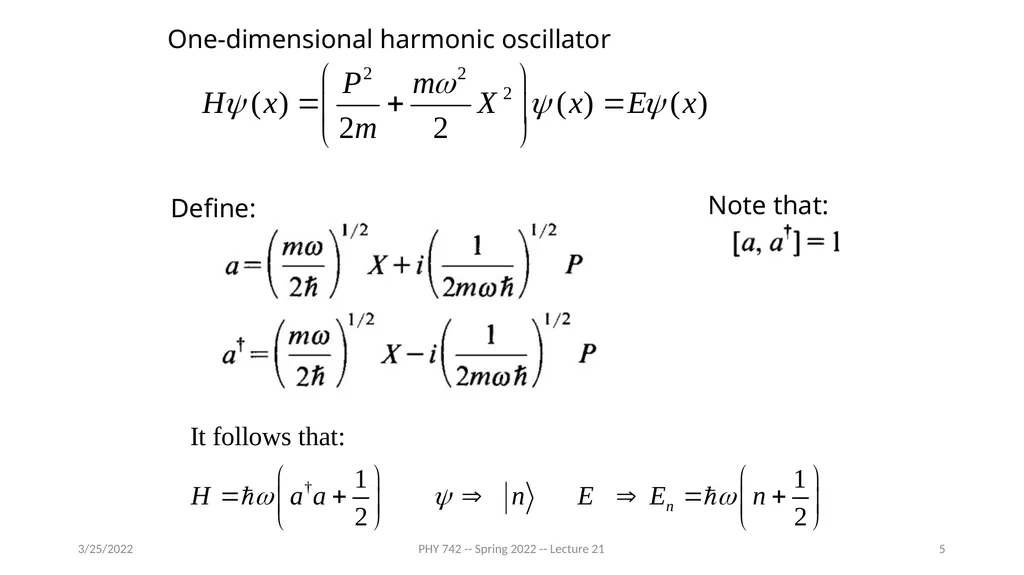
Review of the harmonic oscillator
Particle creation and annihilation operator formalism
Hamiltonian for the electromagnetic fields<br>
02
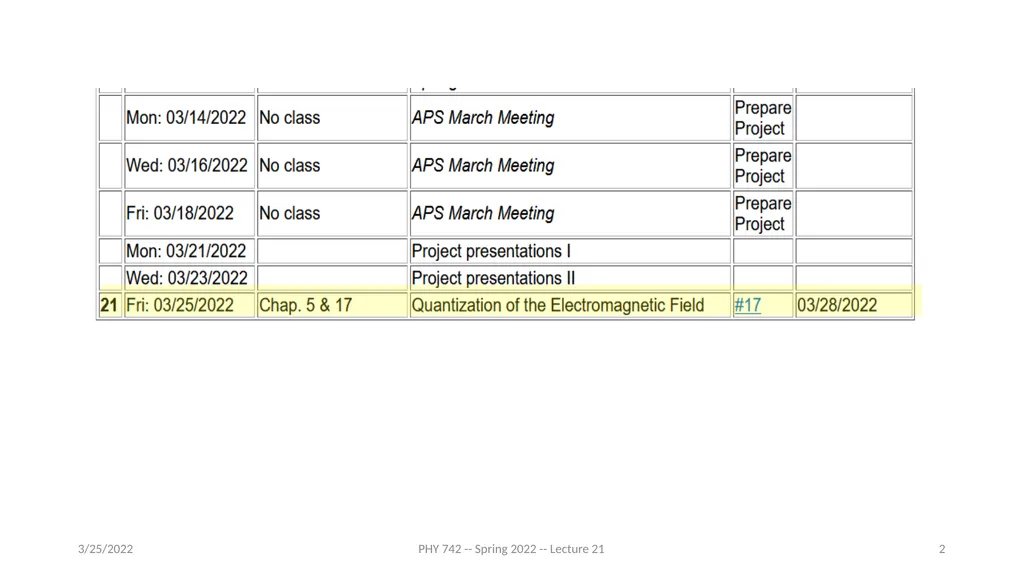
3/25/2022 PHY 742 -- Spring 2022 -- Lecture 21 2<br>
03
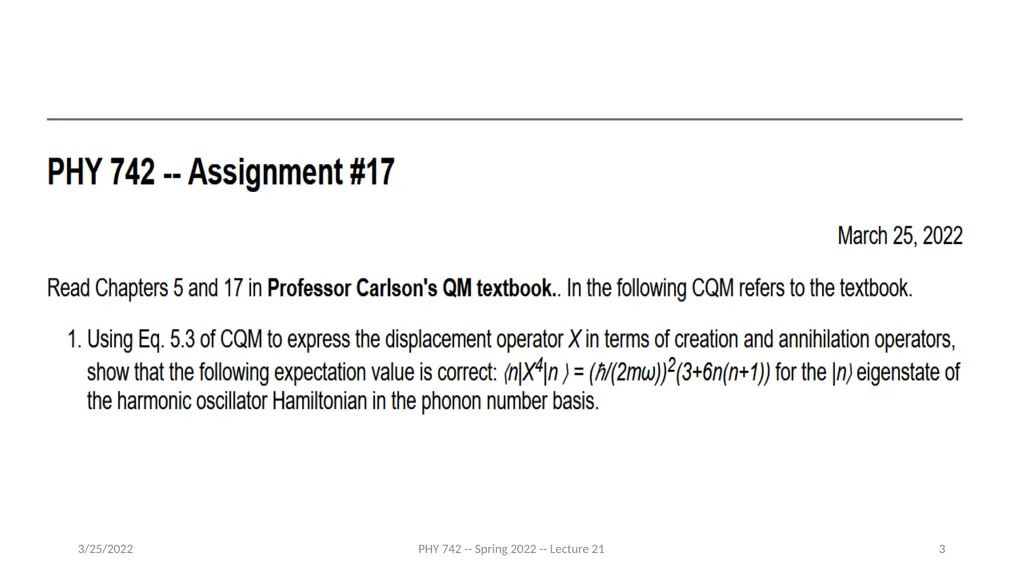
3/25/2022 PHY 742 -- Spring 2022 -- Lecture 21 3<br>
04
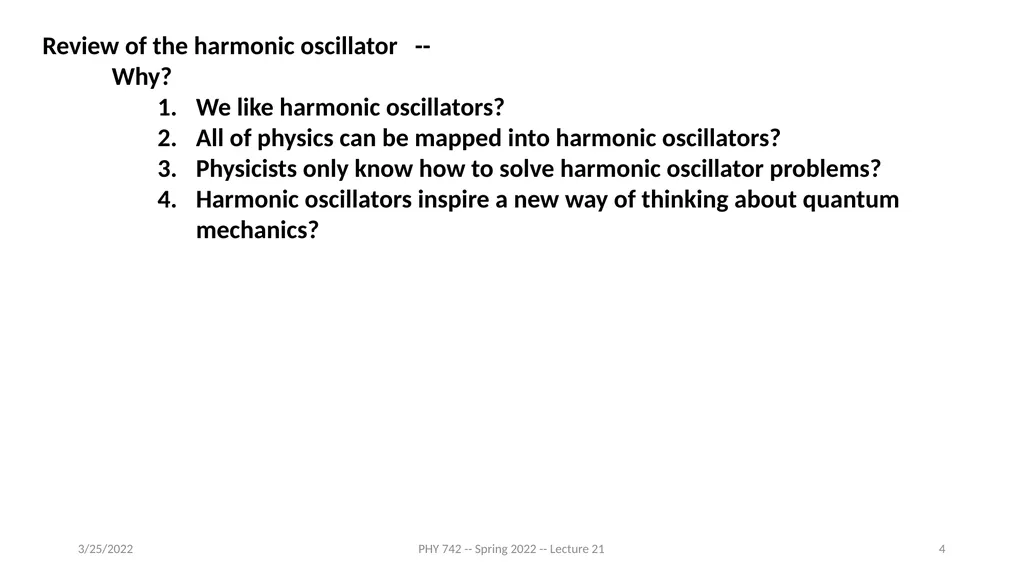
3/25/2022 PHY 742 -- Spring 2022 -- Lecture 21 4 Review of the harmonic oscillator --
Why?
We like harmonic oscillators?
All of physics can be mapped into harmonic oscillators?
Physicists only know how to solve harmonic oscillator problems?
Harmonic oscillators inspire a new way of thinking about quantum mechanics?<br>
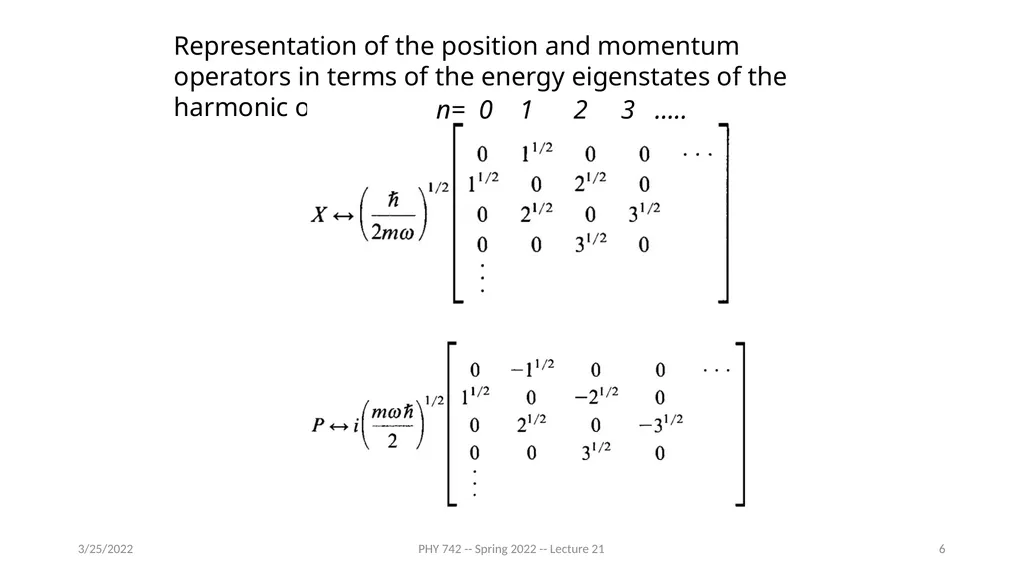
3/25/2022 PHY 742 -- Spring 2022 -- Lecture 21 6 Representation of the position and momentum operators in terms of the energy eigenstates of the harmonic oscillator: n= 0 1 2 3 …..<br>
07
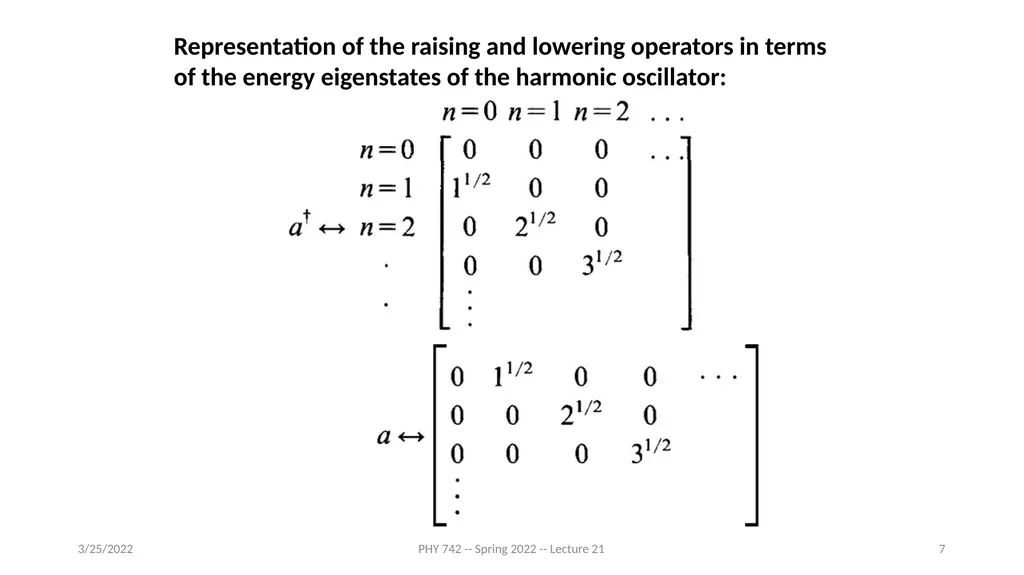
3/25/2022 PHY 742 -- Spring 2022 -- Lecture 21 7 Representation of the raising and lowering operators in terms of the energy eigenstates of the harmonic oscillator:<br>
08
3/25/2022 PHY 742 -- Spring 2022 -- Lecture 21 8<br>
09
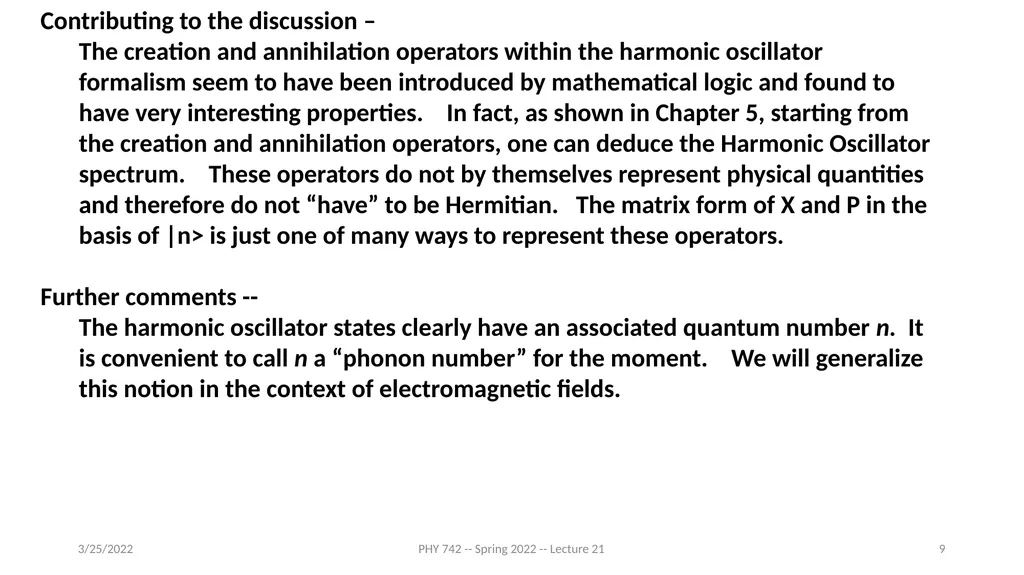
3/25/2022 PHY 742 -- Spring 2022 -- Lecture 21 9 Contributing to the discussion –
The creation and annihilation operators within the harmonic oscillator formalism seem to have been introduced by mathematical logic and found to have very interesting properties. In fact, as shown in Chapter 5, starting from the creation and annihilation operators, one can deduce the Harmonic Oscillator spectrum. These operators do not by themselves represent physical quantities and therefore do not “have” to be Hermitian. The matrix form of X and P in the basis of |n> is just one of many ways to represent these operators.
Further comments --
The harmonic oscillator states clearly have an associated quantum number n. It is convenient to call n a “phonon number” for the moment. We will generalize this notion in the context of electromagnetic fields.<br>
10
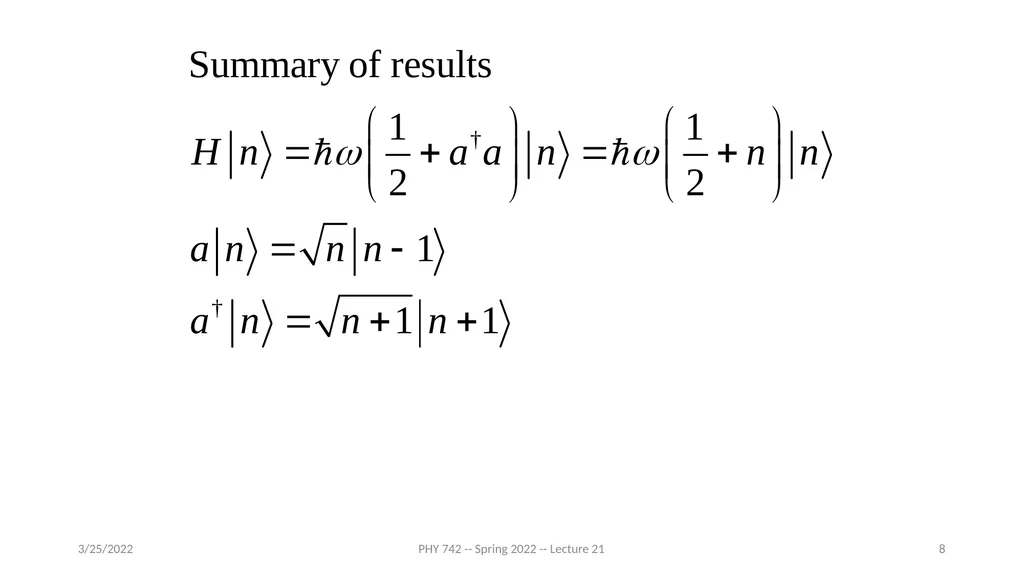
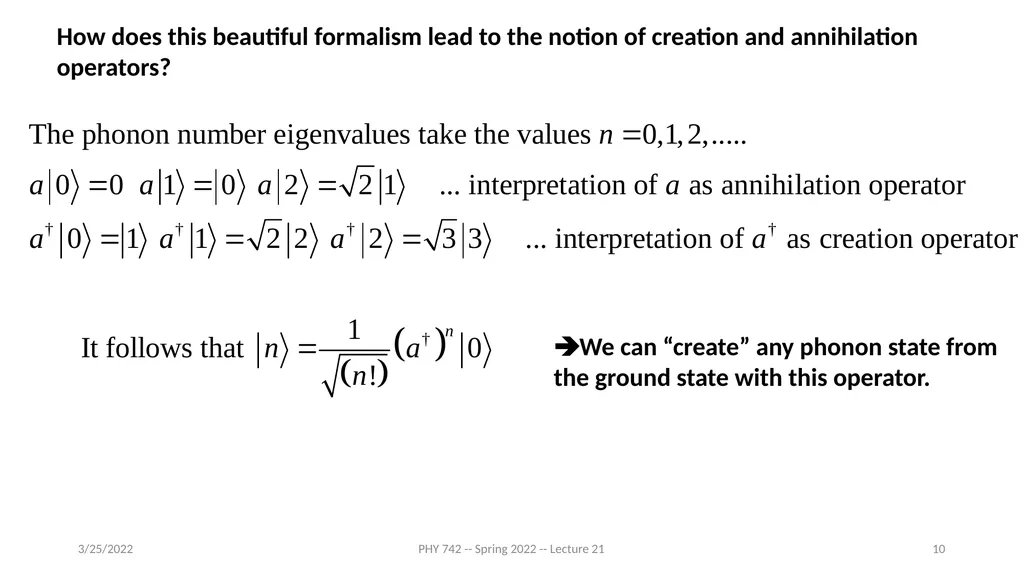
3/25/2022 PHY 742 -- Spring 2022 -- Lecture 21 10 How does this beautiful formalism lead to the notion of creation and annihilation operators? We can “create” any phonon state from the ground state with this operator.<br>
11
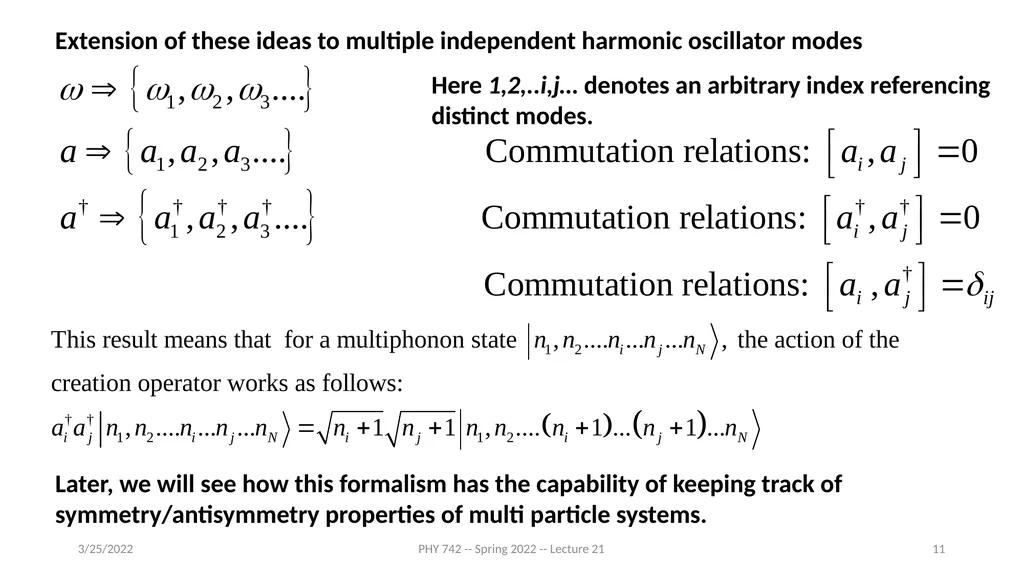
3/25/2022 PHY 742 -- Spring 2022 -- Lecture 21 11 Extension of these ideas to multiple independent harmonic oscillator modes Later, we will see how this formalism has the capability of keeping track of symmetry/antisymmetry properties of multi particle systems. Here 1,2,..i,j… denotes an arbitrary index referencing distinct modes.<br>
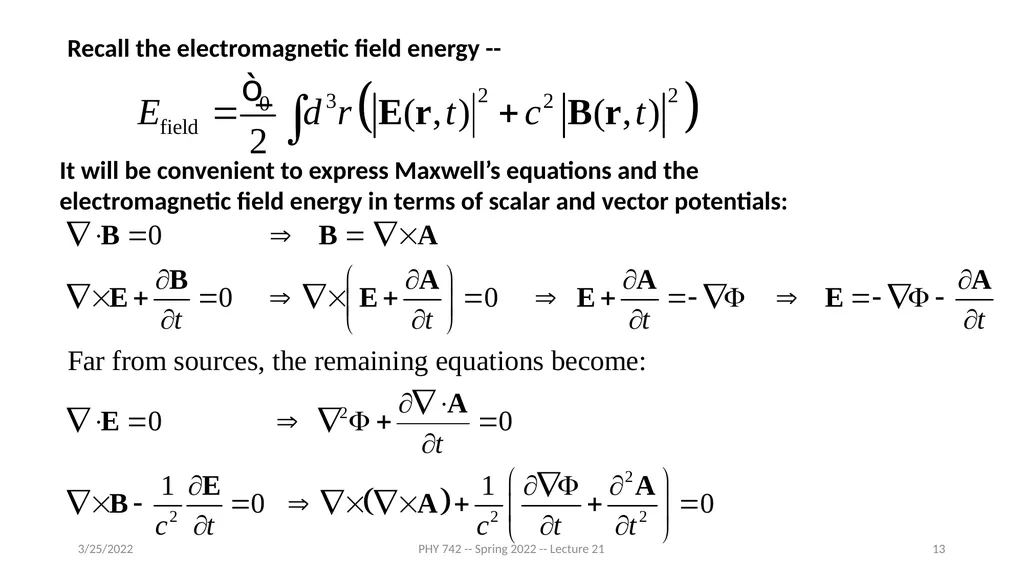
3/25/2022 PHY 742 -- Spring 2022 -- Lecture 21 13 Recall the electromagnetic field energy -- It will be convenient to express Maxwell’s equations and the
electromagnetic field energy in terms of scalar and vector potentials:<br>
14
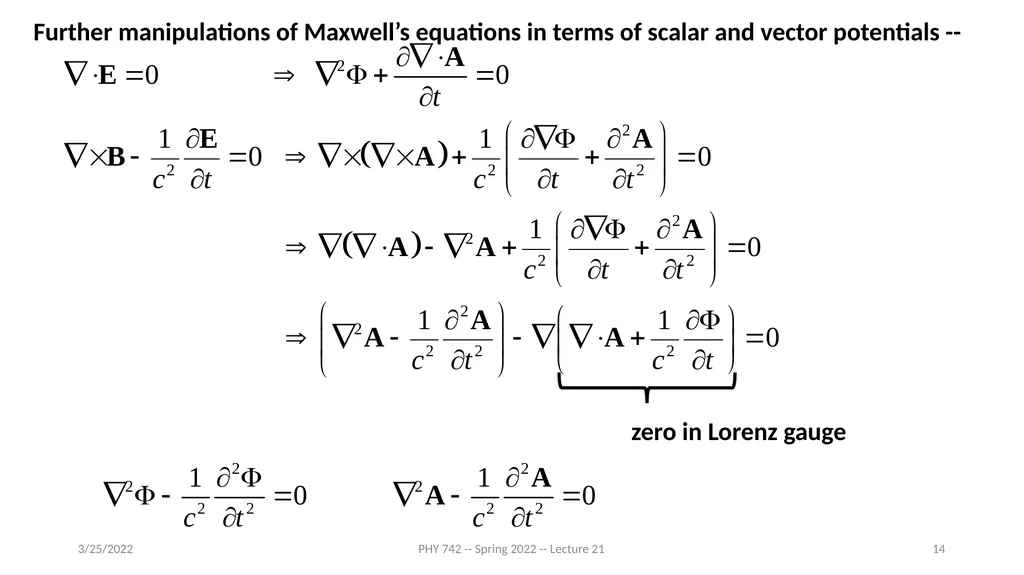
3/25/2022 PHY 742 -- Spring 2022 -- Lecture 21 14 Further manipulations of Maxwell’s equations in terms of scalar and vector potentials -- zero in Lorenz gauge<br>
15
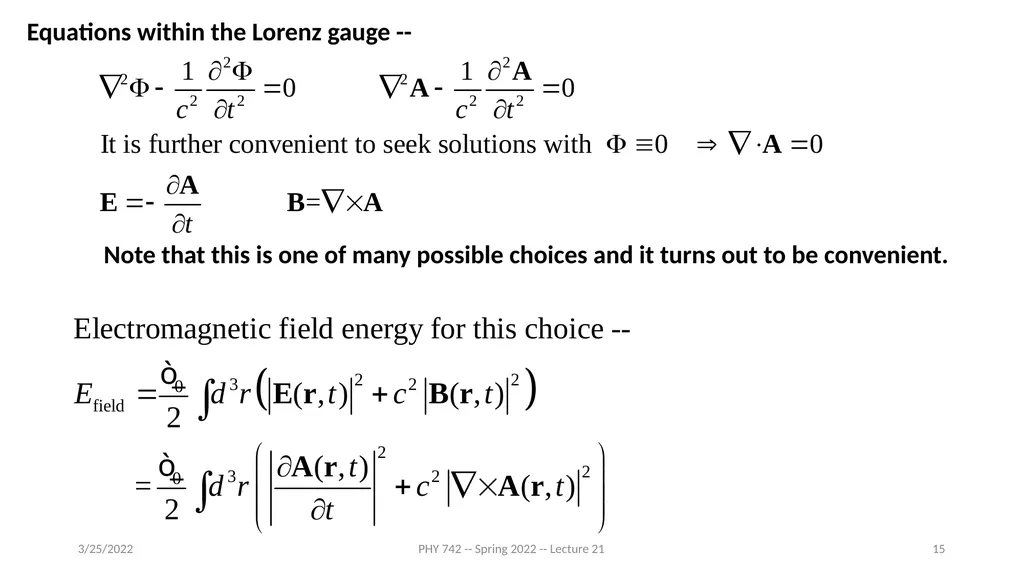
3/25/2022 PHY 742 -- Spring 2022 -- Lecture 21 15 Equations within the Lorenz gauge -- Note that this is one of many possible choices and it turns out to be convenient.<br>
16
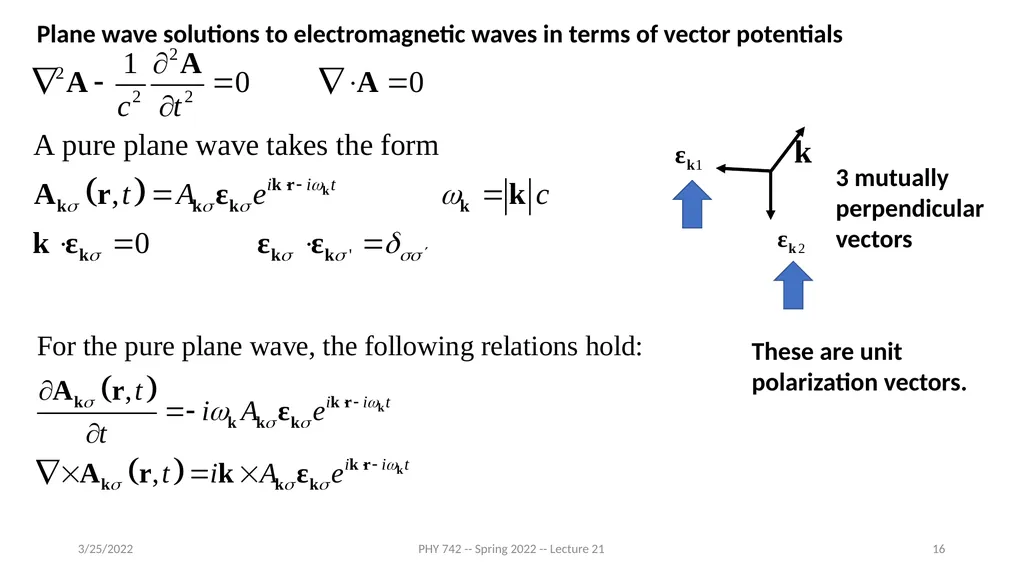
3/25/2022 PHY 742 -- Spring 2022 -- Lecture 21 16 Plane wave solutions to electromagnetic waves in terms of vector potentials 3 mutually perpendicular vectors These are unit polarization vectors.<br>
17
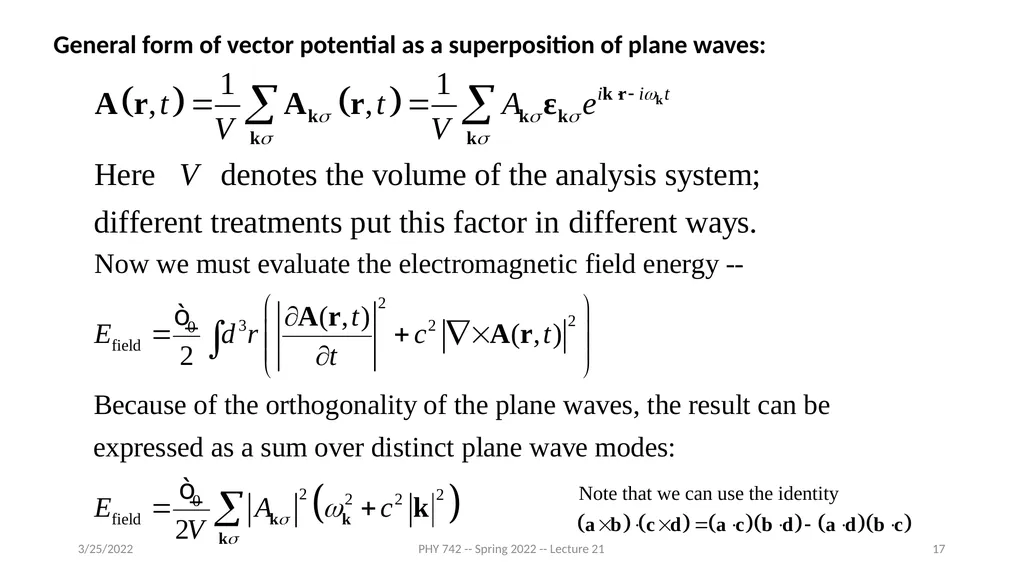
3/25/2022 PHY 742 -- Spring 2022 -- Lecture 21 17 General form of vector potential as a superposition of plane waves:<br>
18
3/25/2022 PHY 742 -- Spring 2022 -- Lecture 21 18 Up to now, we have treated classical electromagnetic waves. Next time, we will consider the quantum treatment of the electromagnetic field energy electromagnetic Hamiltonian<br>