
3. The Logic of Quantified Statements Sequences
LV
Published · 60 slides · 0 views

1 / 1

Description
3. The Logic of Quantified Statements Sequences Mathematical Induction I Mathematical Induction II Well-Ordering Principle Recurrence Relations 1 Aaron Tan 8. Mathematical Induction AY202627 Semester 1 2 Sequences Mathematical Induction I
Related Topics
Share
Embed code
Download this presentation From Below
"3. The Logic of Quantified Statements Sequences" is the property of its rightful owner. Permission is granted to download and print the materials on this website for personal, non-commercial use only, and to display it on your personal computer provided you do not modify the materials and that you retain all copyright notices contained in the materials. By downloading content from our website, you accept the terms of this agreement.
Presentation Transcript
01
3. The Logic of Quantified Statements Sequences Mathematical Induction I Mathematical Induction II Well-Ordering Principle Recurrence Relations 1 Aaron Tan 8. Mathematical Induction AY2026/27 Semester 1<br>
02
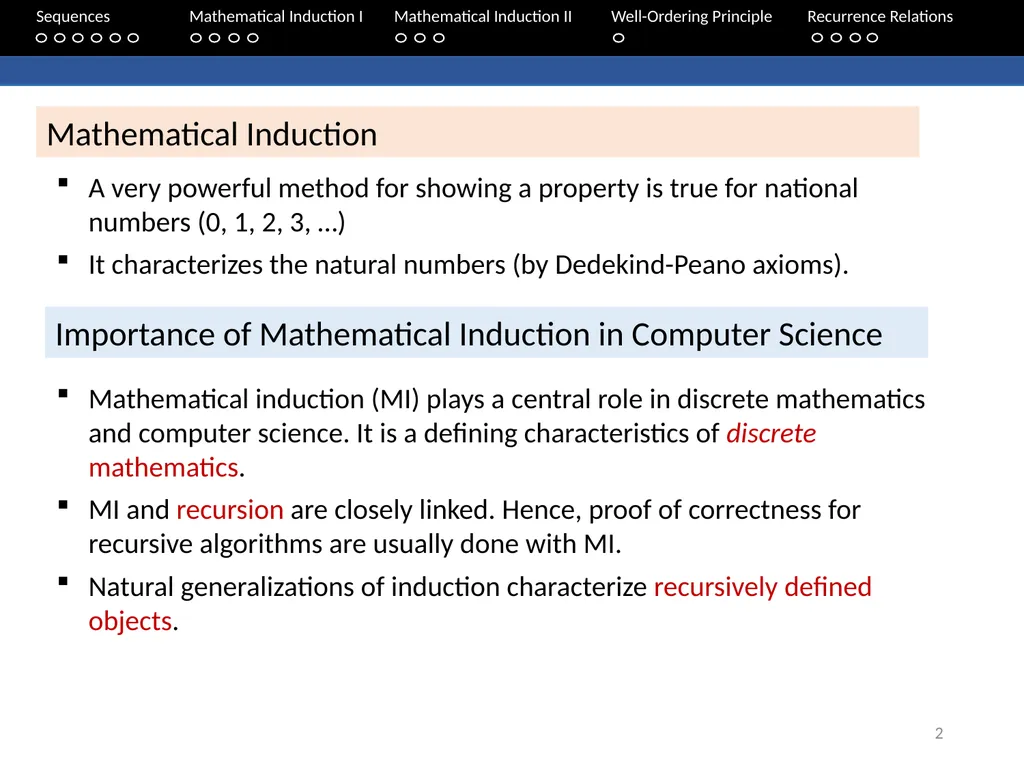
2 Sequences Mathematical Induction I Mathematical Induction II Well-Ordering Principle Recurrence Relations Mathematical Induction A very powerful method for showing a property is true for national numbers (0, 1, 2, 3, …)
It characterizes the natural numbers (by Dedekind-Peano axioms). Importance of Mathematical Induction in Computer Science Mathematical induction (MI) plays a central role in discrete mathematics and computer science. It is a defining characteristics of discrete mathematics.
MI and recursion are closely linked. Hence, proof of correctness for recursive algorithms are usually done with MI.
Natural generalizations of induction characterize recursively defined objects.<br>
It characterizes the natural numbers (by Dedekind-Peano axioms). Importance of Mathematical Induction in Computer Science Mathematical induction (MI) plays a central role in discrete mathematics and computer science. It is a defining characteristics of discrete mathematics.
MI and recursion are closely linked. Hence, proof of correctness for recursive algorithms are usually done with MI.
Natural generalizations of induction characterize recursively defined objects.<br>
03
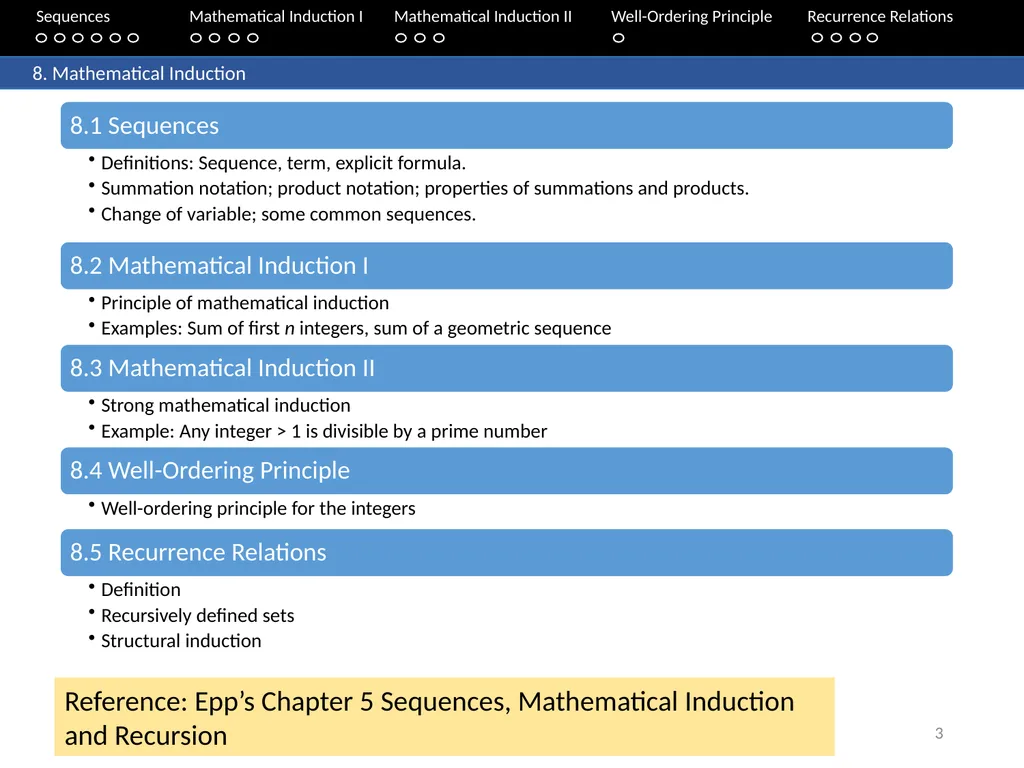
3 8. Mathematical Induction Sequences Mathematical Induction I Mathematical Induction II Well-Ordering Principle Recurrence Relations Reference: Epp’s Chapter 5 Sequences, Mathematical Induction and Recursion<br>
04
Sequences Mathematical Induction I Mathematical Induction II Well-Ordering Principle Recurrence Relations 4 8.1 Sequences<br>
05
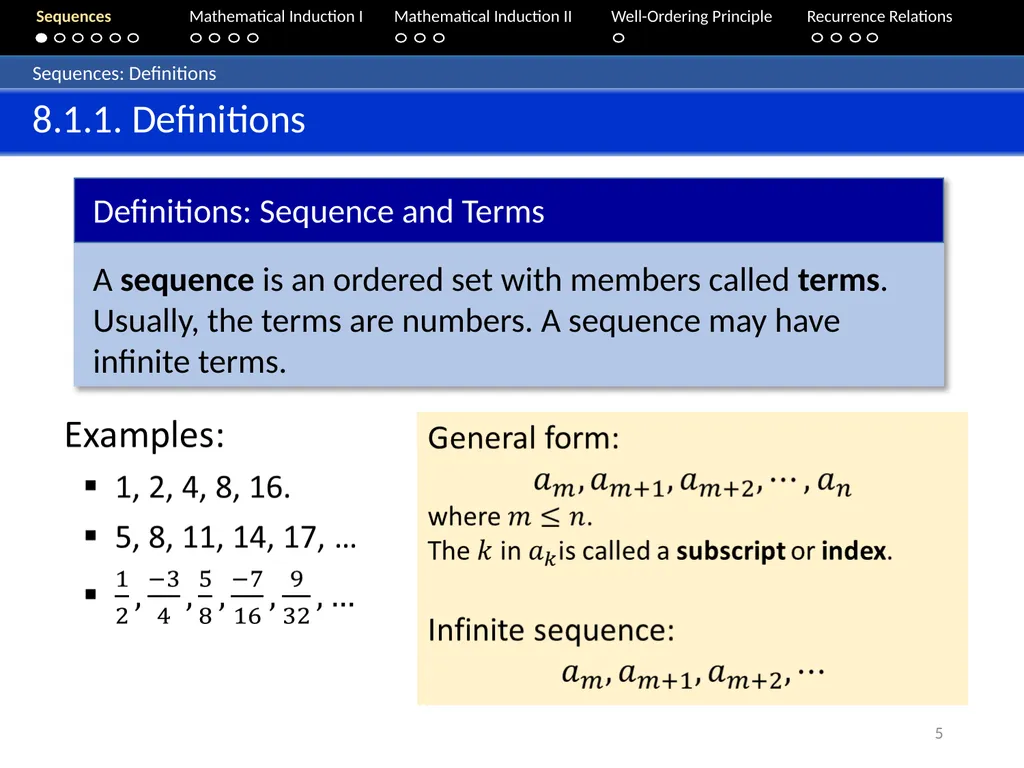
Sequences Mathematical Induction I Mathematical Induction II Well-Ordering Principle Recurrence Relations 5 5.1 Sequences Sequences: Definitions 8.1.1. Definitions<br>
06
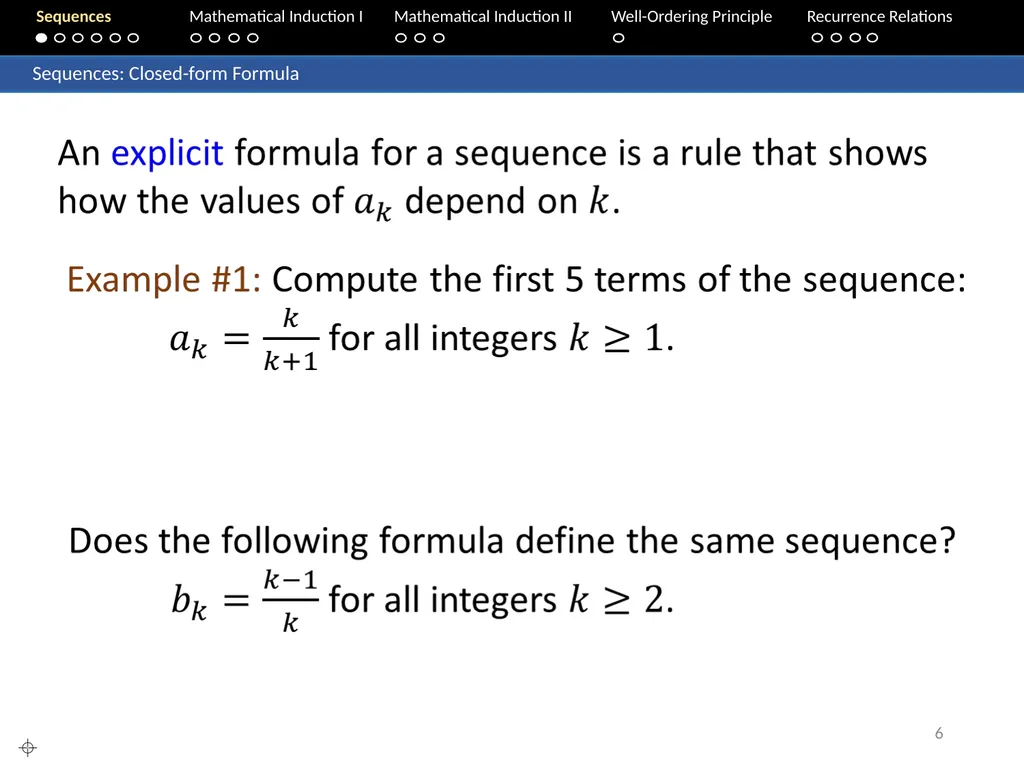
Sequences Mathematical Induction I Mathematical Induction II Well-Ordering Principle Recurrence Relations 6 5.1 Sequences Sequences: Closed-form Formula <br>
07
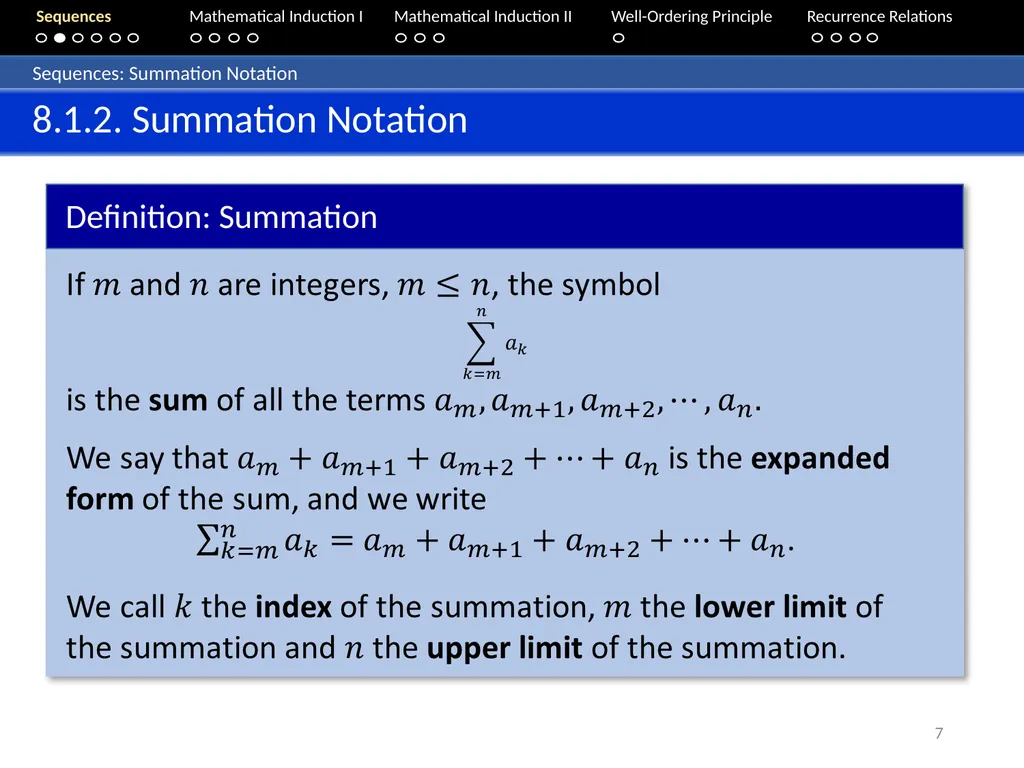
Sequences Mathematical Induction I Mathematical Induction II Well-Ordering Principle Recurrence Relations 7 Sequences: Summation Notation 8.1.2. Summation Notation<br>
08
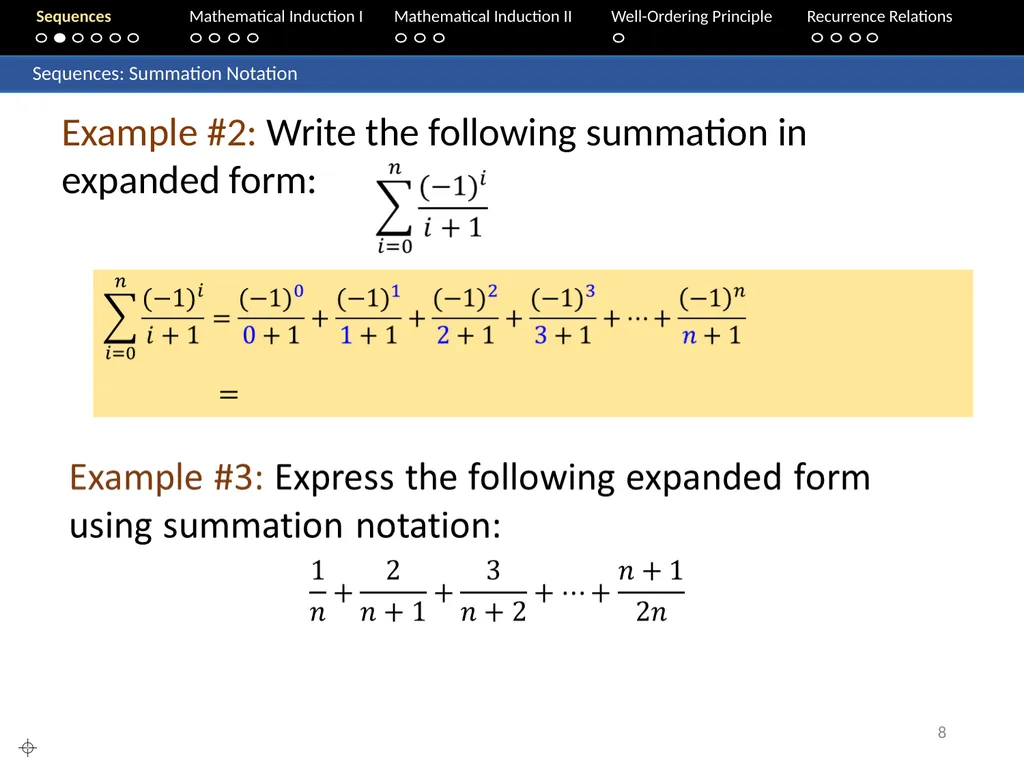
Sequences Mathematical Induction I Mathematical Induction II Well-Ordering Principle Recurrence Relations 8 Sequences: Summation Notation Example #2: Write the following summation in expanded form: <br>
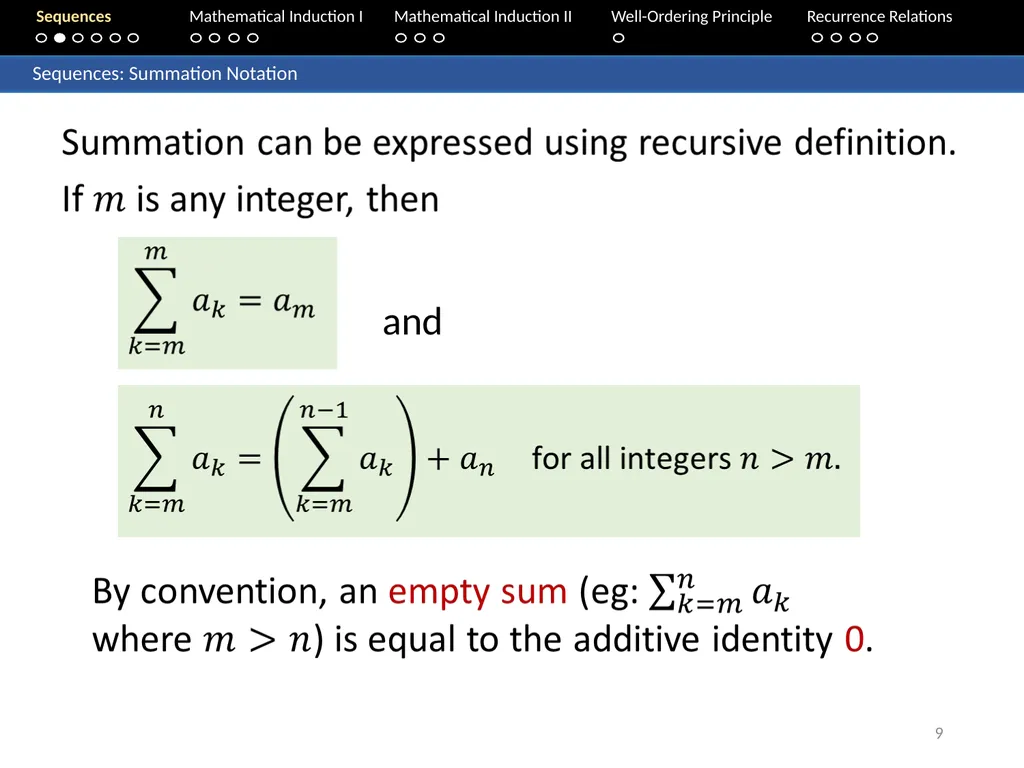
09
Sequences Mathematical Induction I Mathematical Induction II Well-Ordering Principle Recurrence Relations 9 Sequences: Summation Notation and<br>
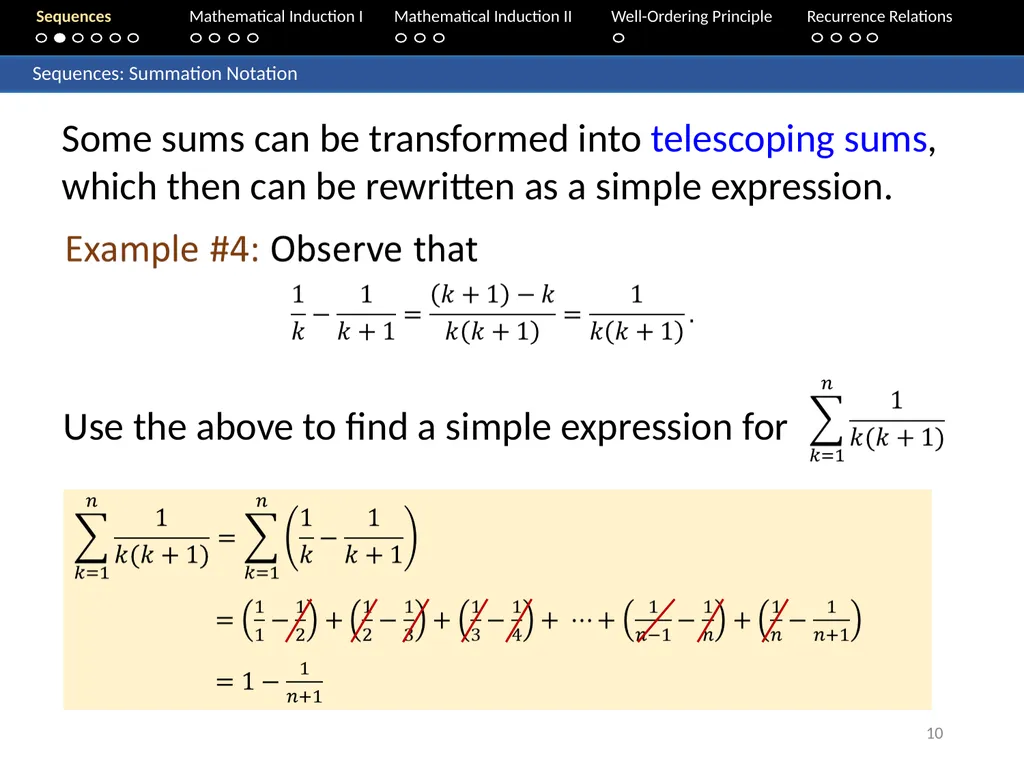
10
Sequences Mathematical Induction I Mathematical Induction II Well-Ordering Principle Recurrence Relations 10 Sequences: Summation Notation Some sums can be transformed into telescoping sums, which then can be rewritten as a simple expression. Use the above to find a simple expression for<br>
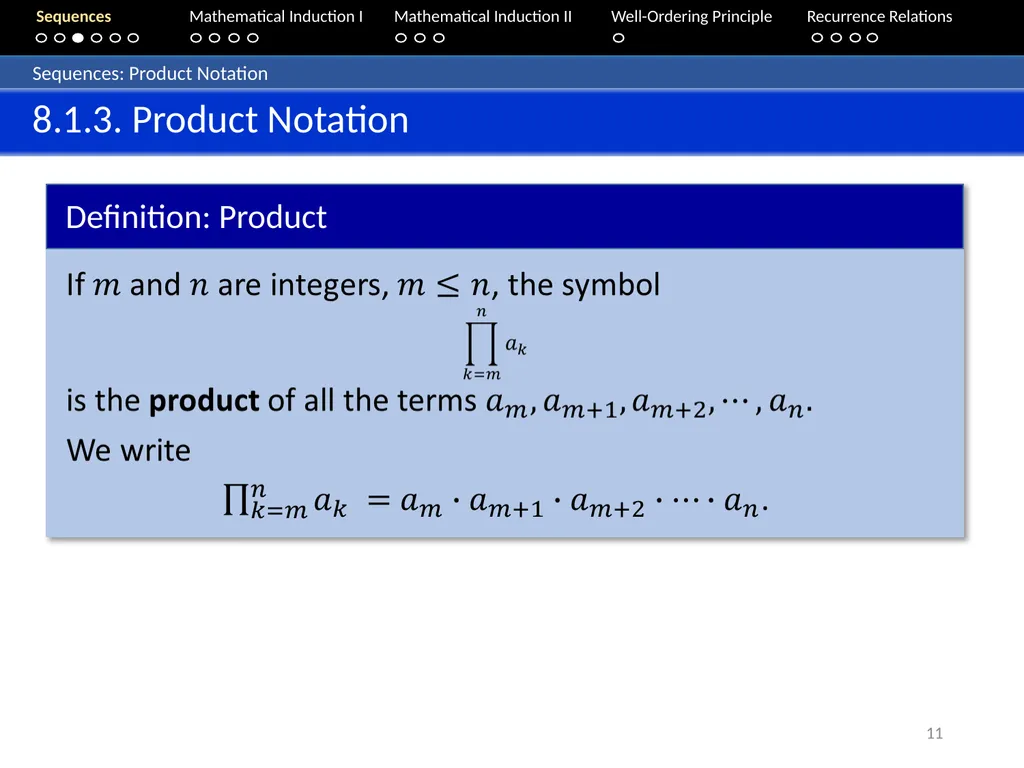
11
Sequences Mathematical Induction I Mathematical Induction II Well-Ordering Principle Recurrence Relations 11 Sequences: Product Notation The notation for the product of a sequence of numbers is analogous to the notation for their sum. 8.1.3. Product Notation<br>
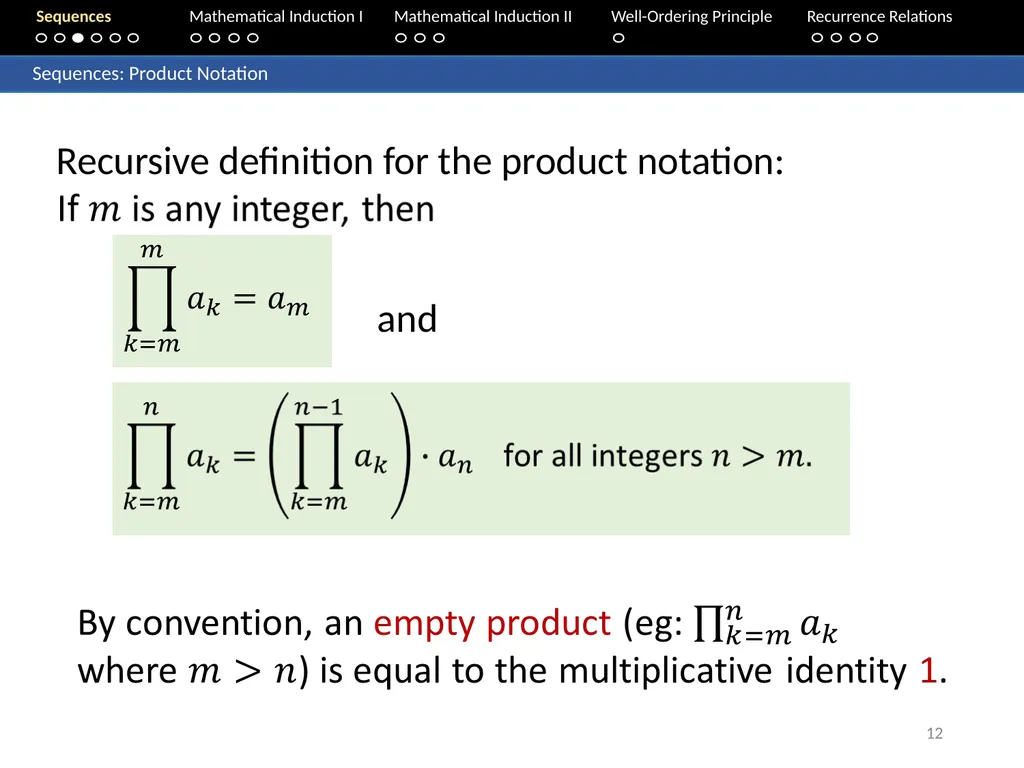
12
Sequences Mathematical Induction I Mathematical Induction II Well-Ordering Principle Recurrence Relations 12 Sequences: Product Notation Recursive definition for the product notation: and<br>
13
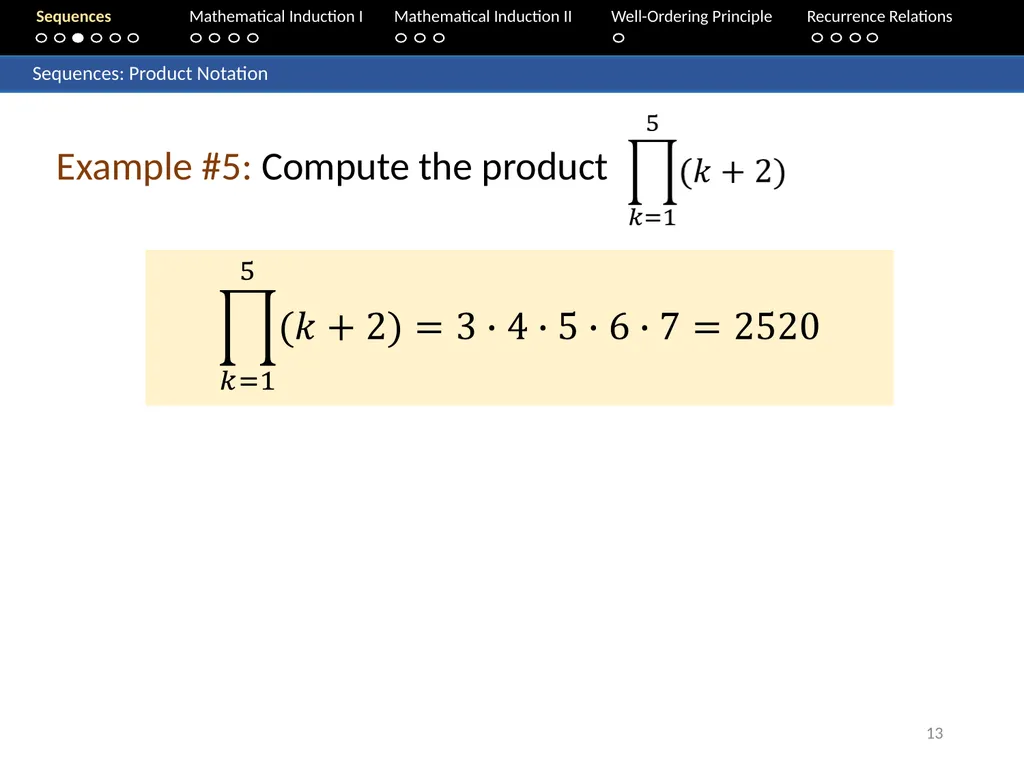
Sequences Mathematical Induction I Mathematical Induction II Well-Ordering Principle Recurrence Relations 13 Sequences: Product Notation Example #5: Compute the product<br>
14
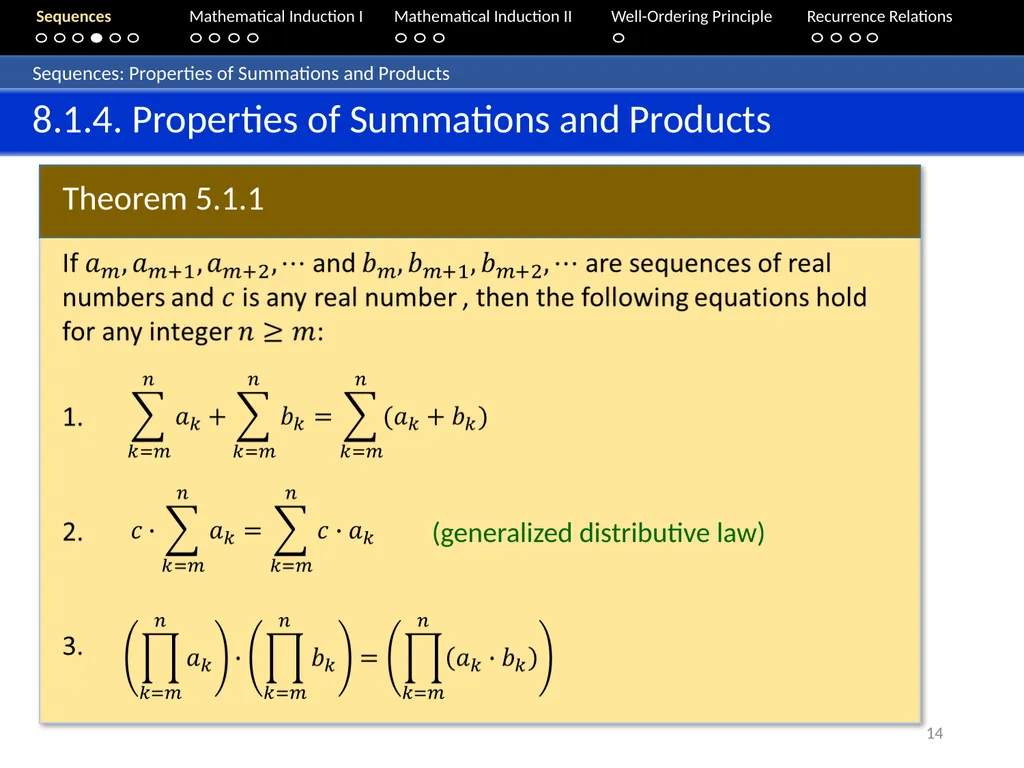
Sequences Mathematical Induction I Mathematical Induction II Well-Ordering Principle Recurrence Relations 14 Sequences: Properties of Summations and Products 8.1.4. Properties of Summations and Products (generalized distributive law)<br>
15
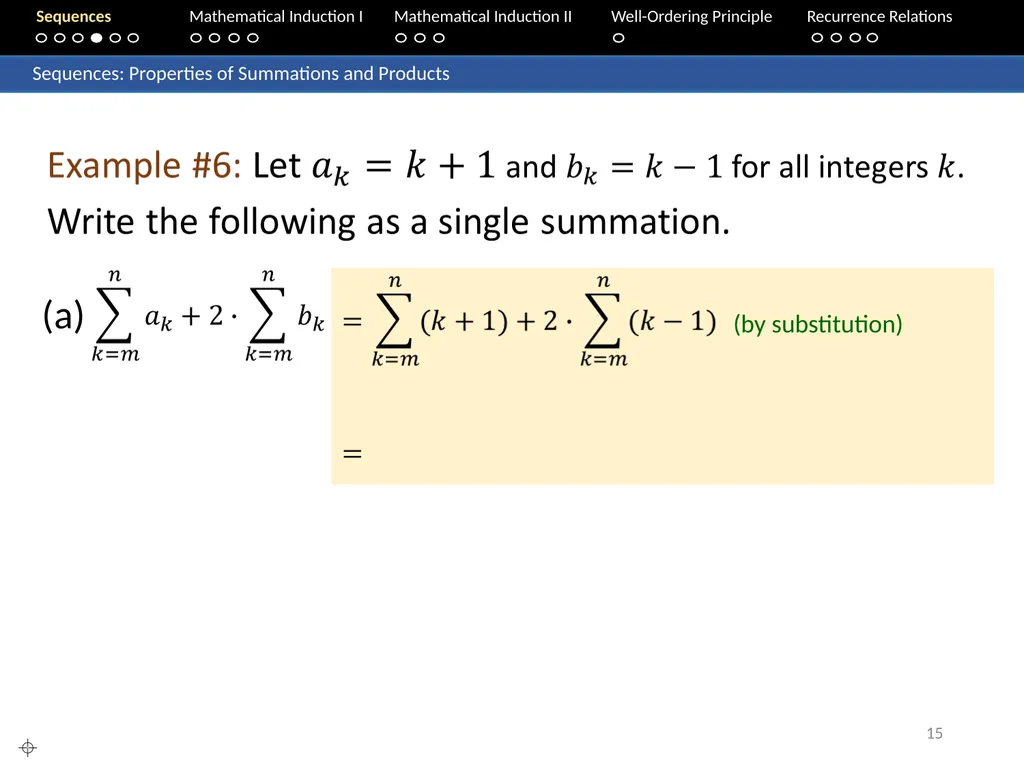
Sequences Mathematical Induction I Mathematical Induction II Well-Ordering Principle Recurrence Relations 15 Sequences: Properties of Summations and Products (a) <br>
16
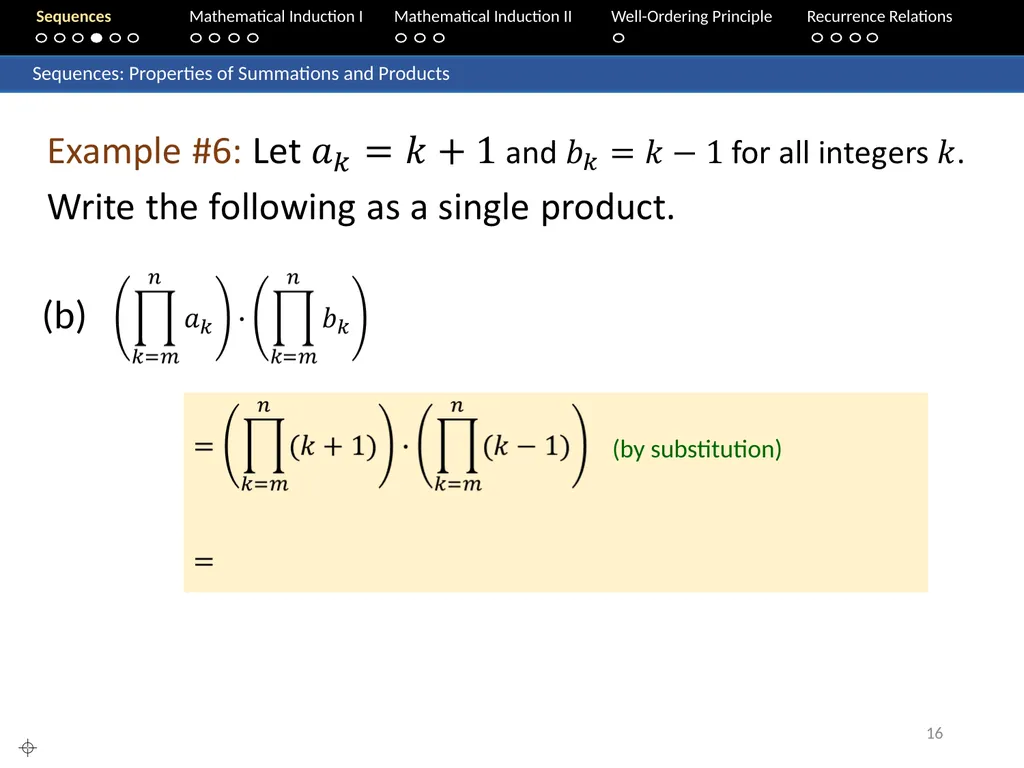
Sequences Mathematical Induction I Mathematical Induction II Well-Ordering Principle Recurrence Relations 16 Sequences: Properties of Summations and Products (b) <br>
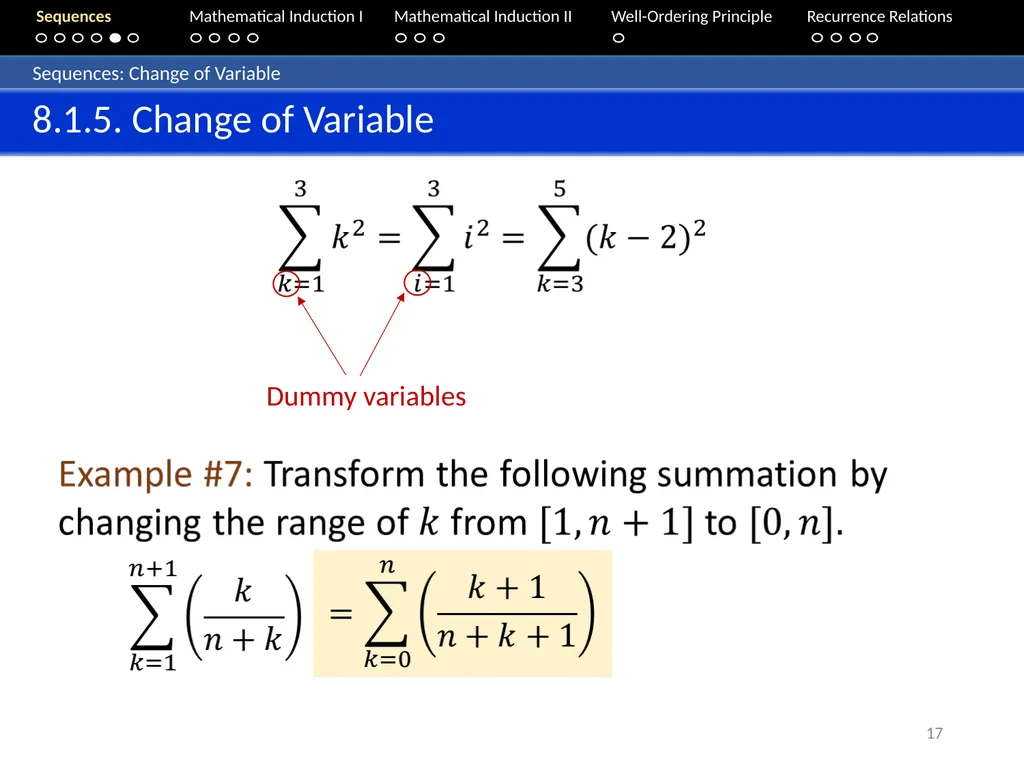
17
Sequences Mathematical Induction I Mathematical Induction II Well-Ordering Principle Recurrence Relations 17 Sequences: Change of Variable 8.1.5. Change of Variable<br>
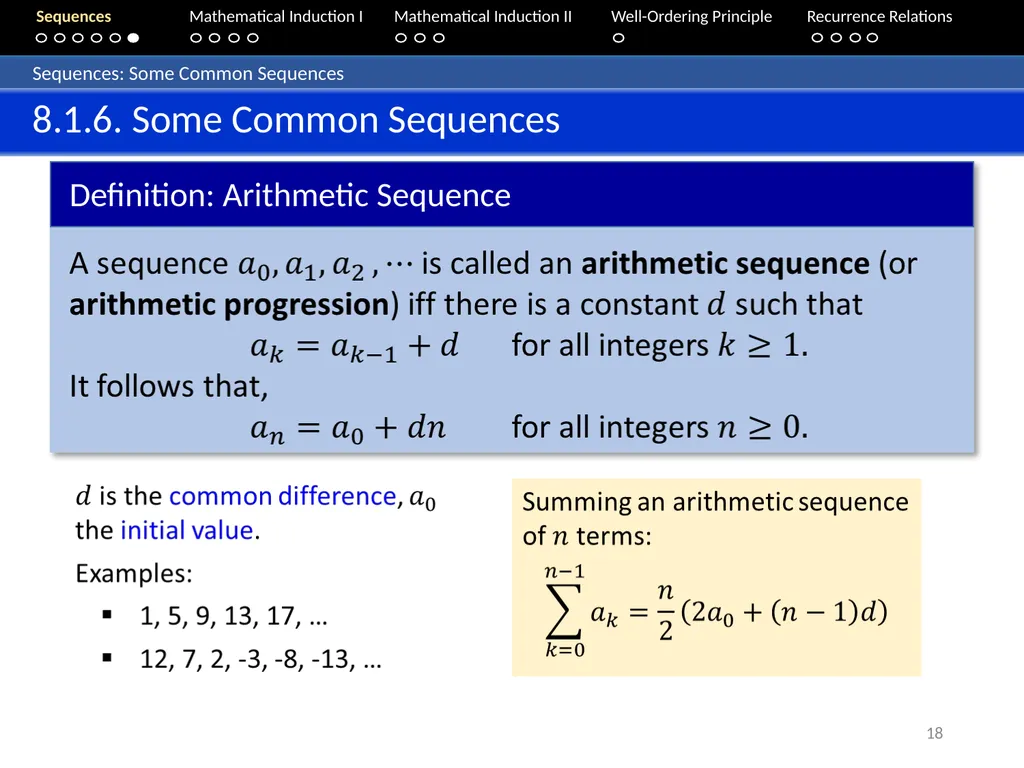
18
Sequences Mathematical Induction I Mathematical Induction II Well-Ordering Principle Recurrence Relations 18 Sequences: Some Common Sequences 8.1.6. Some Common Sequences<br>
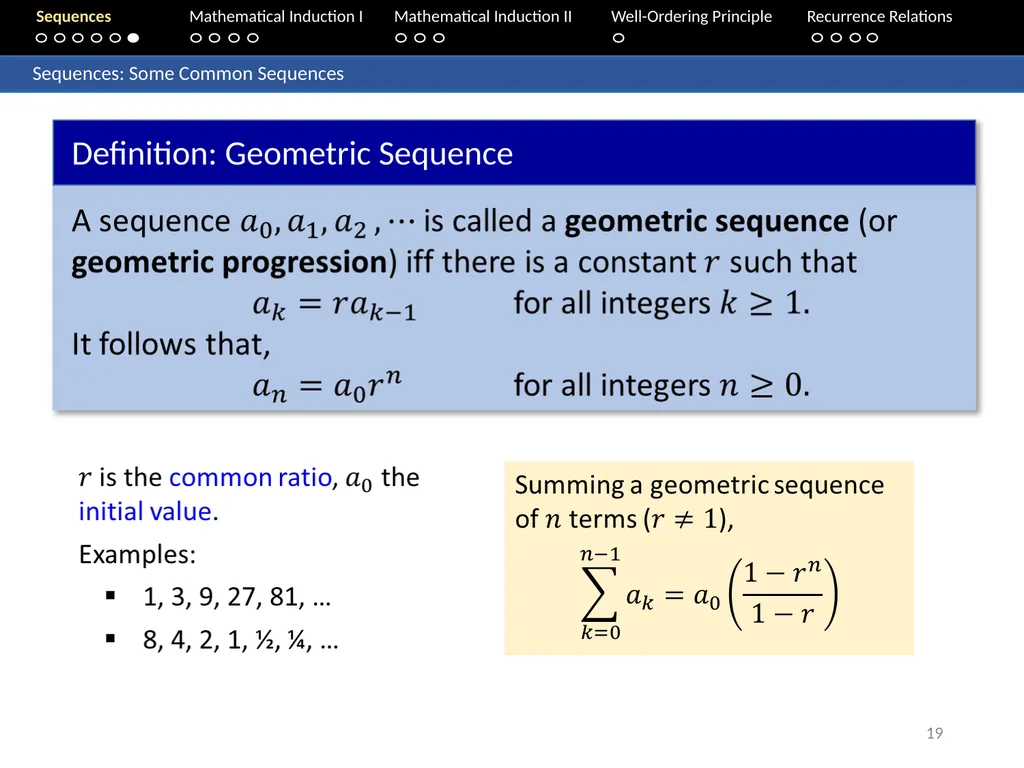
19
Sequences Mathematical Induction I Mathematical Induction II Well-Ordering Principle Recurrence Relations 19 Sequences: Some Common Sequences<br>
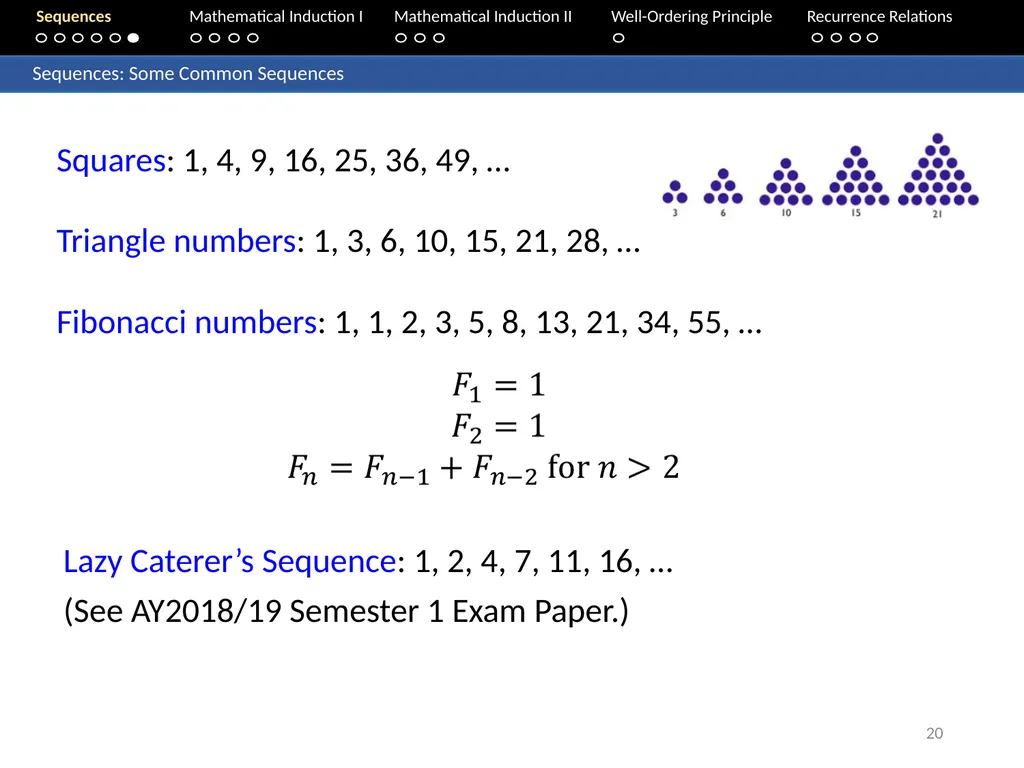
20
Sequences Mathematical Induction I Mathematical Induction II Well-Ordering Principle Recurrence Relations 20 Sequences: Some Common Sequences Squares: 1, 4, 9, 16, 25, 36, 49, … Triangle numbers: 1, 3, 6, 10, 15, 21, 28, … Fibonacci numbers: 1, 1, 2, 3, 5, 8, 13, 21, 34, 55, … Lazy Caterer’s Sequence: 1, 2, 4, 7, 11, 16, …
(See AY2018/19 Semester 1 Exam Paper.)<br>
(See AY2018/19 Semester 1 Exam Paper.)<br>
21
Sequences Mathematical Induction I Mathematical Induction II Well-Ordering Principle Recurrence Relations 21 8.2 Mathematical Induction I<br>
22
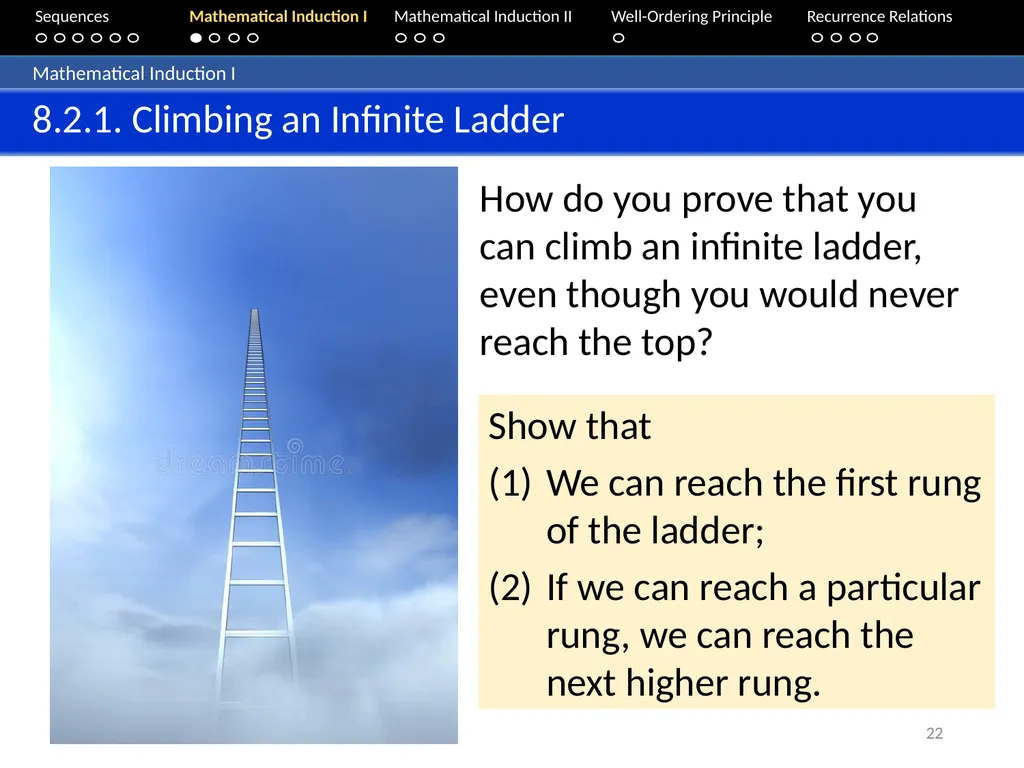
Sequences Mathematical Induction I Mathematical Induction II Well-Ordering Principle Recurrence Relations Mathematical Induction I How do you prove that you can climb an infinite ladder, even though you would never reach the top? 22 8.2.1. Climbing an Infinite Ladder Show that
We can reach the first rung of the ladder;
If we can reach a particular rung, we can reach the next higher rung.<br>
We can reach the first rung of the ladder;
If we can reach a particular rung, we can reach the next higher rung.<br>
23
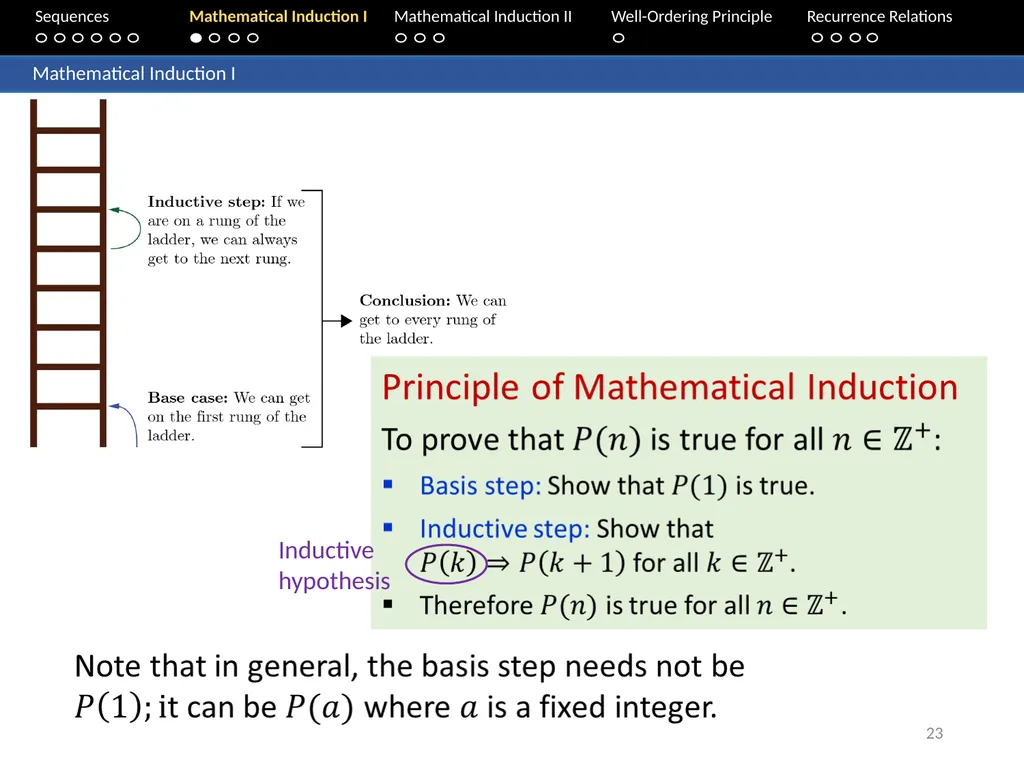
Sequences Mathematical Induction I Mathematical Induction II Well-Ordering Principle Recurrence Relations Mathematical Induction I 23<br>
24
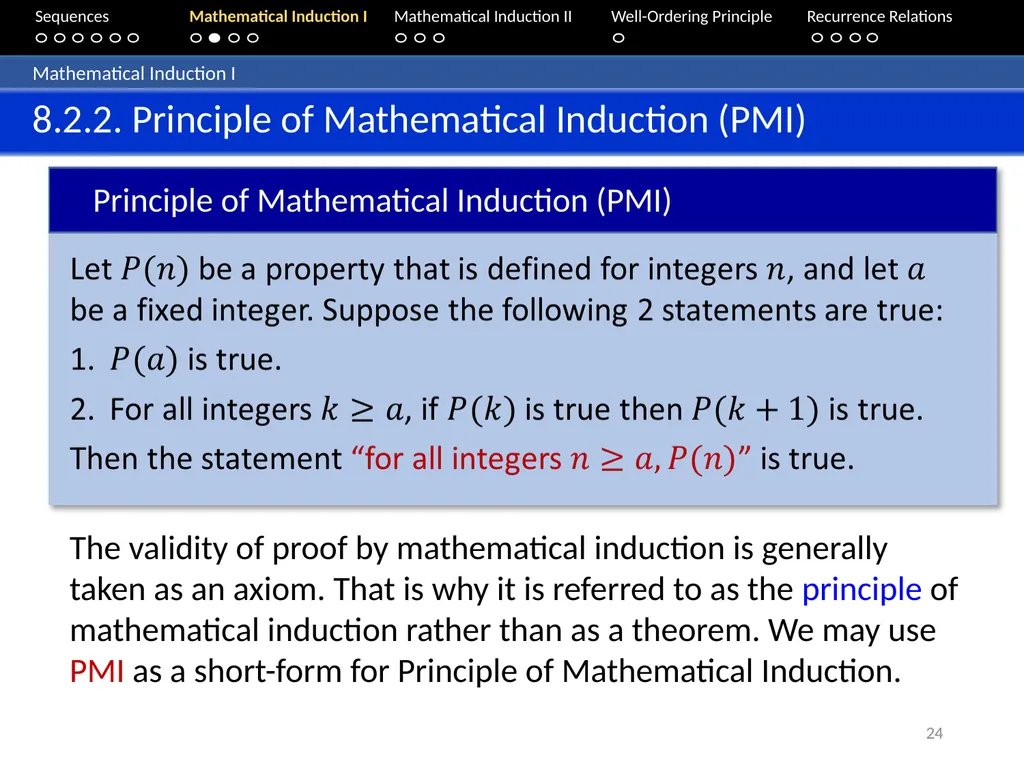
Sequences Mathematical Induction I Mathematical Induction II Well-Ordering Principle Recurrence Relations Mathematical Induction I 24 The validity of proof by mathematical induction is generally taken as an axiom. That is why it is referred to as the principle of mathematical induction rather than as a theorem. We may use PMI as a short-form for Principle of Mathematical Induction. 8.2.2. Principle of Mathematical Induction (PMI)<br>
25
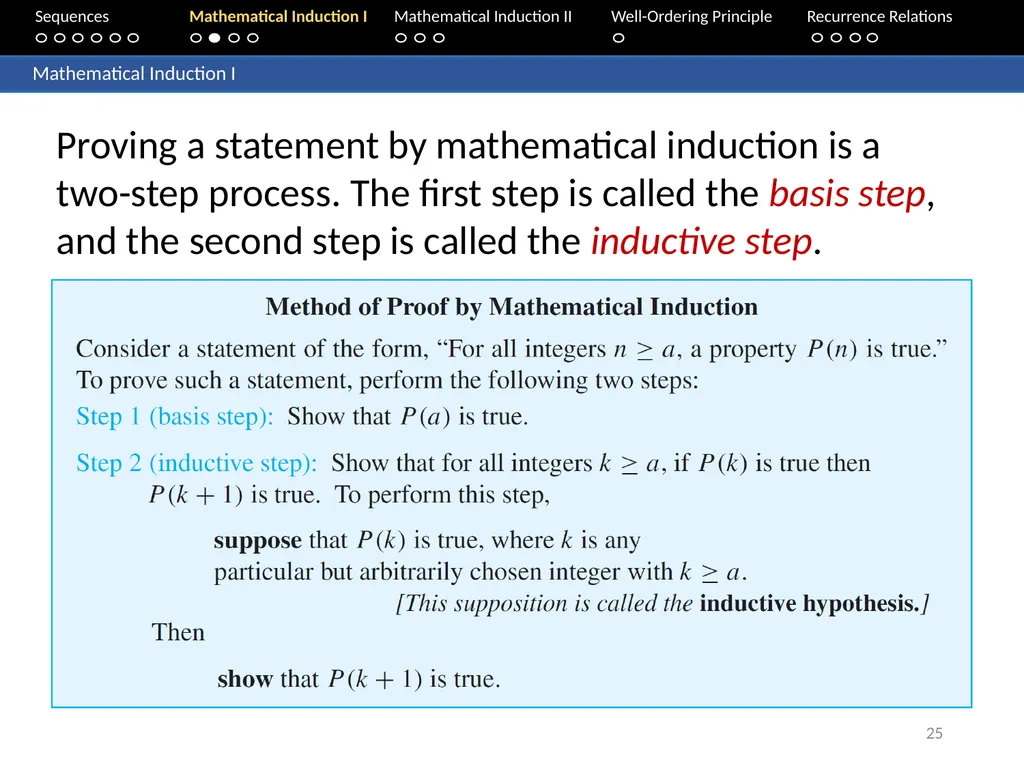
Sequences Mathematical Induction I Mathematical Induction II Well-Ordering Principle Recurrence Relations Mathematical Induction I 25 Proving a statement by mathematical induction is a two-step process. The first step is called the basis step, and the second step is called the inductive step.<br>
26
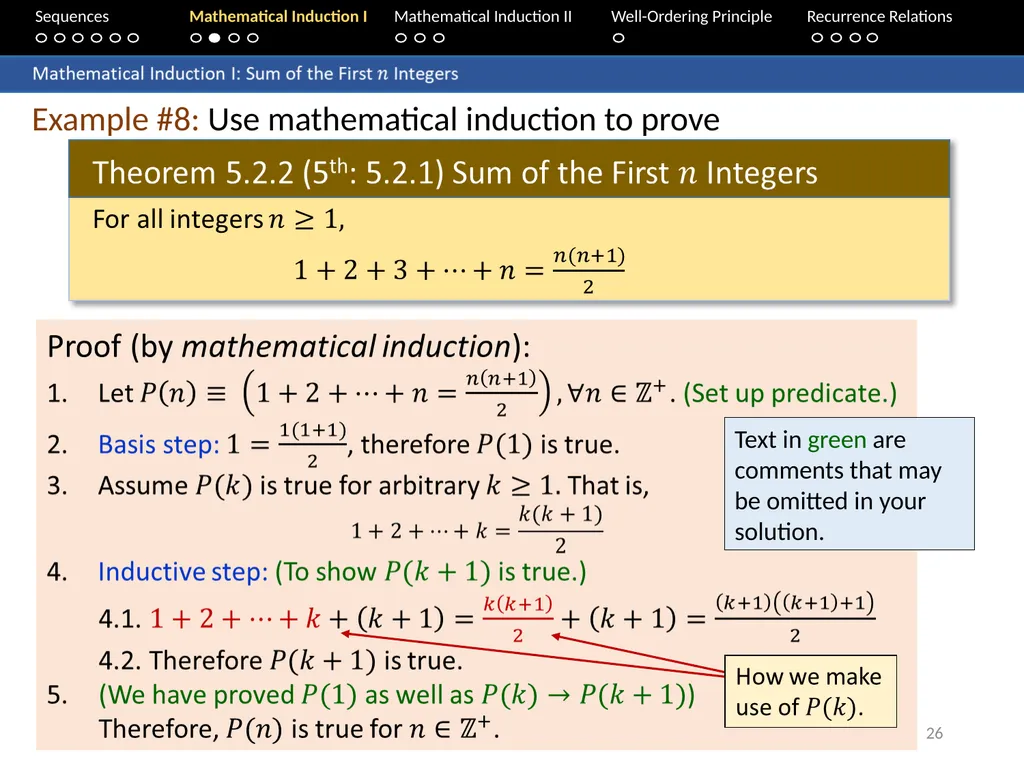
Sequences Mathematical Induction I Mathematical Induction II Well-Ordering Principle Recurrence Relations 26 Example #8: Use mathematical induction to prove Text in green are comments that may be omitted in your solution.<br>
27
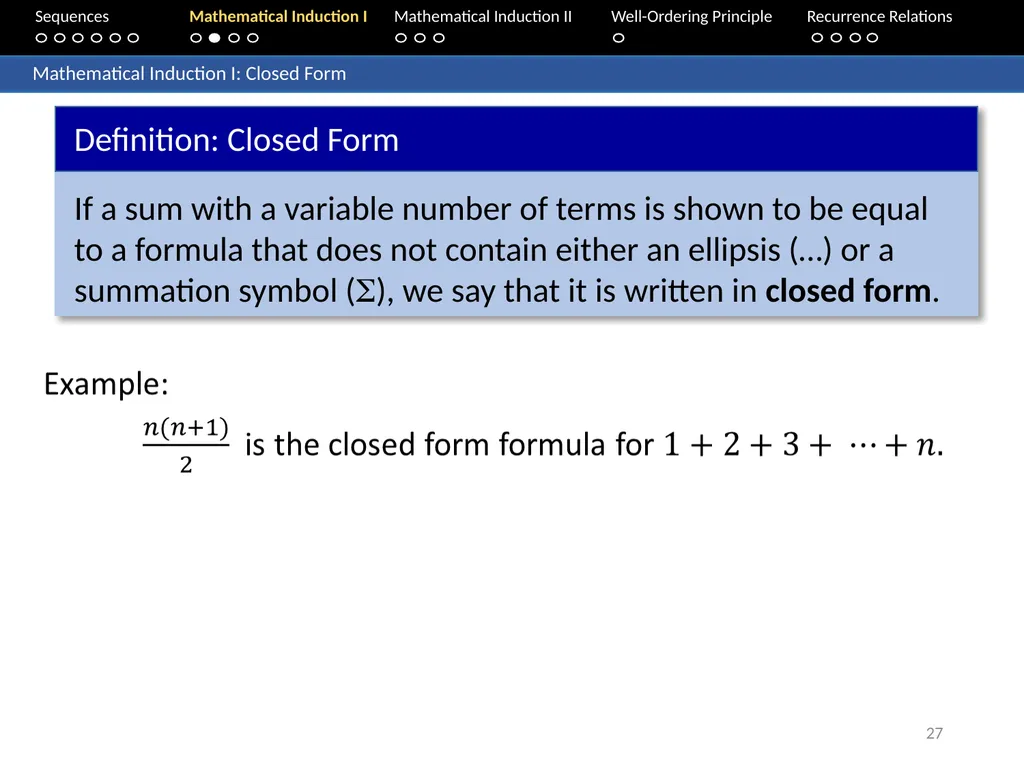
Sequences Mathematical Induction I Mathematical Induction II Well-Ordering Principle Recurrence Relations Mathematical Induction I: Closed Form 27<br>
28
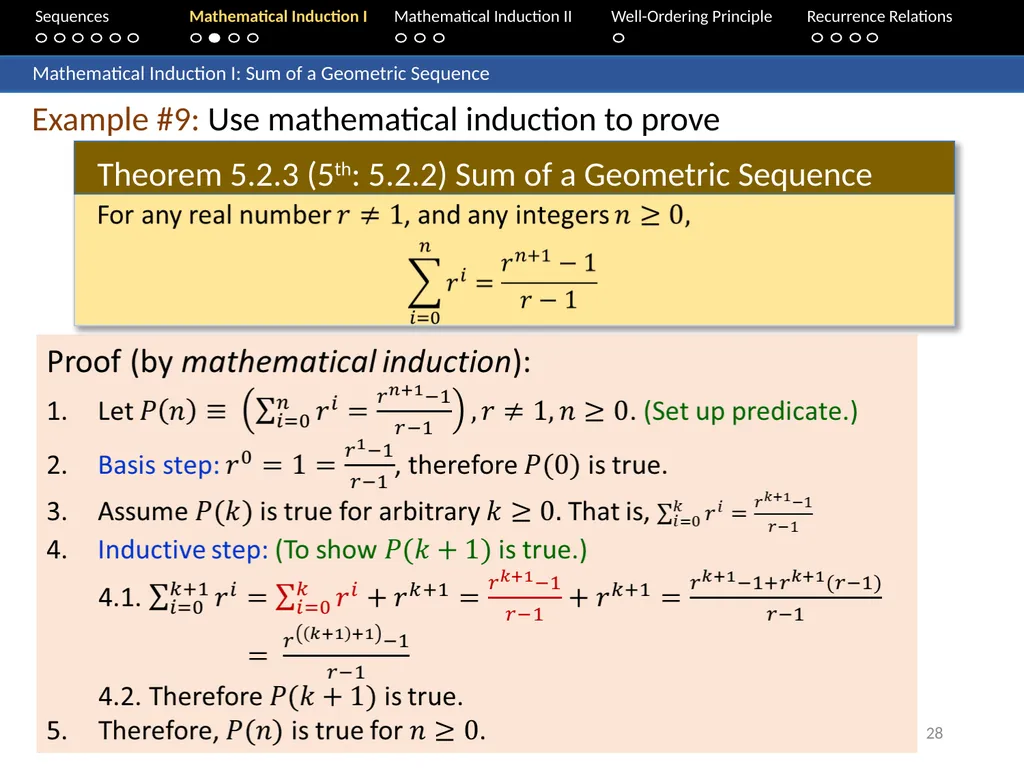
Sequences Mathematical Induction I Mathematical Induction II Well-Ordering Principle Recurrence Relations Mathematical Induction I: Sum of a Geometric Sequence 28 Example #9: Use mathematical induction to prove<br>
29
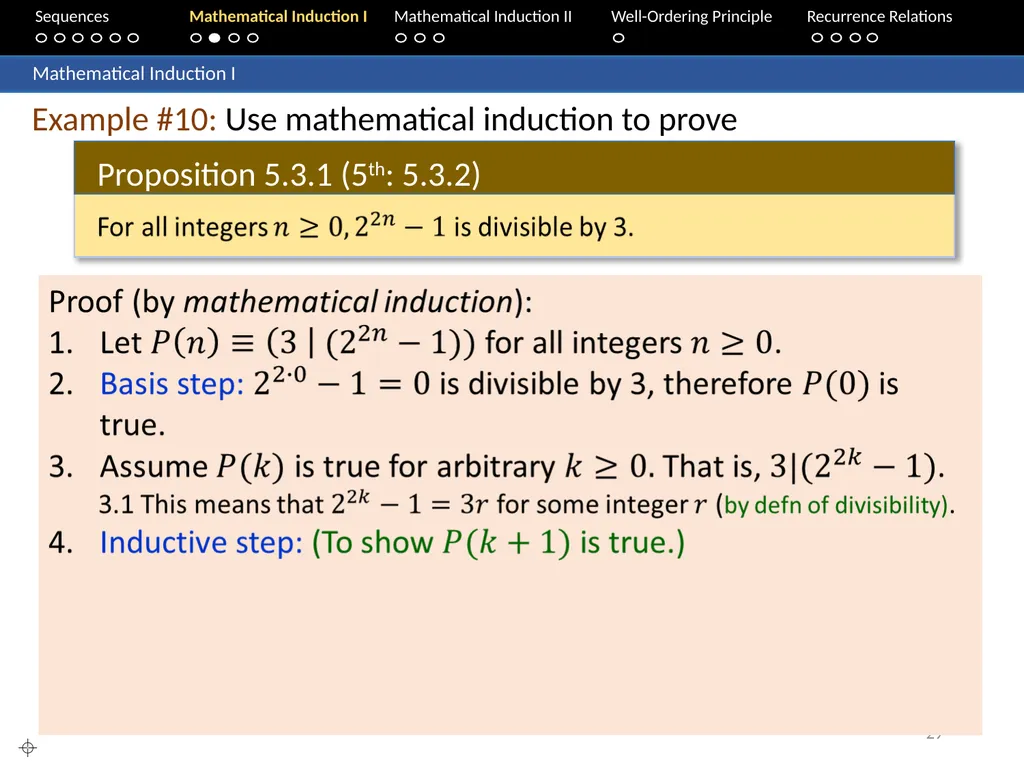
Sequences Mathematical Induction I Mathematical Induction II Well-Ordering Principle Recurrence Relations Mathematical Induction I 29 Example #10: Use mathematical induction to prove <br>
30
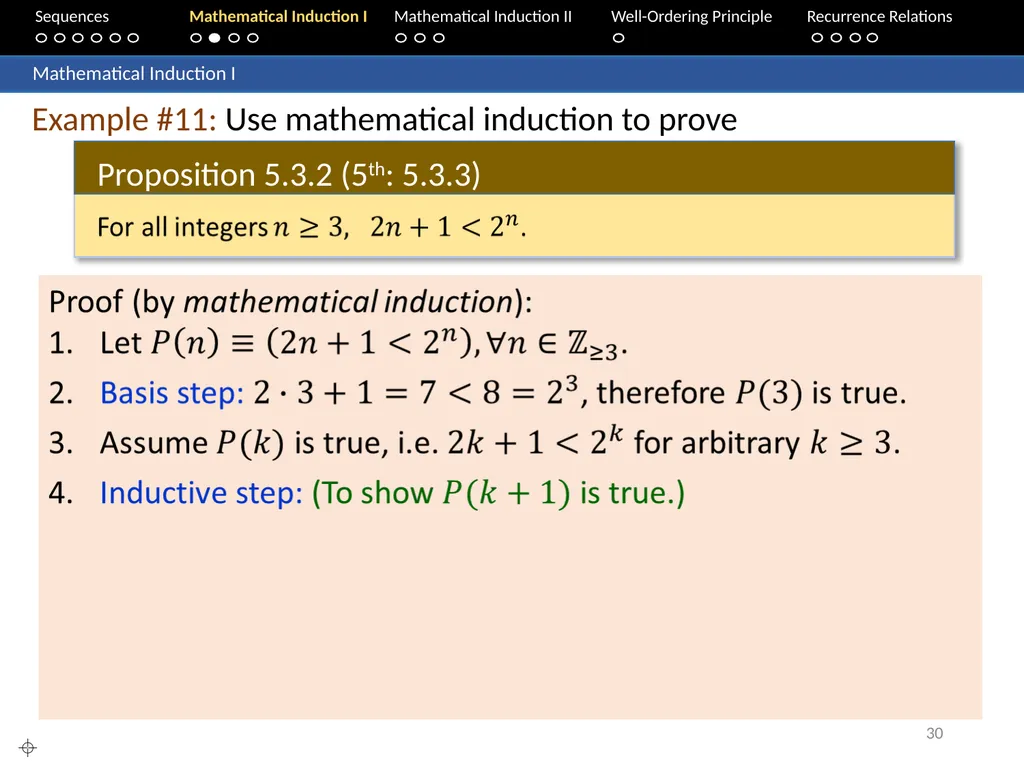
Sequences Mathematical Induction I Mathematical Induction II Well-Ordering Principle Recurrence Relations Mathematical Induction I 30 Example #11: Use mathematical induction to prove <br>
31
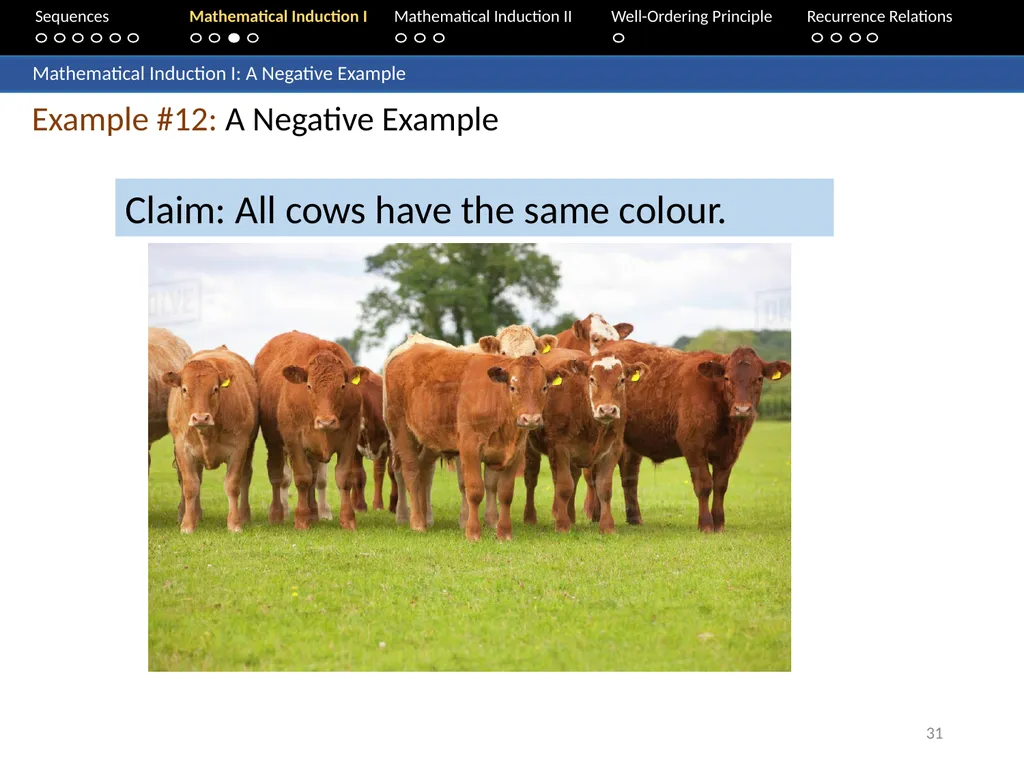
Sequences Mathematical Induction I Mathematical Induction II Well-Ordering Principle Recurrence Relations Mathematical Induction I: A Negative Example 31 Example #12: A Negative Example Claim: All cows have the same colour.<br>
32
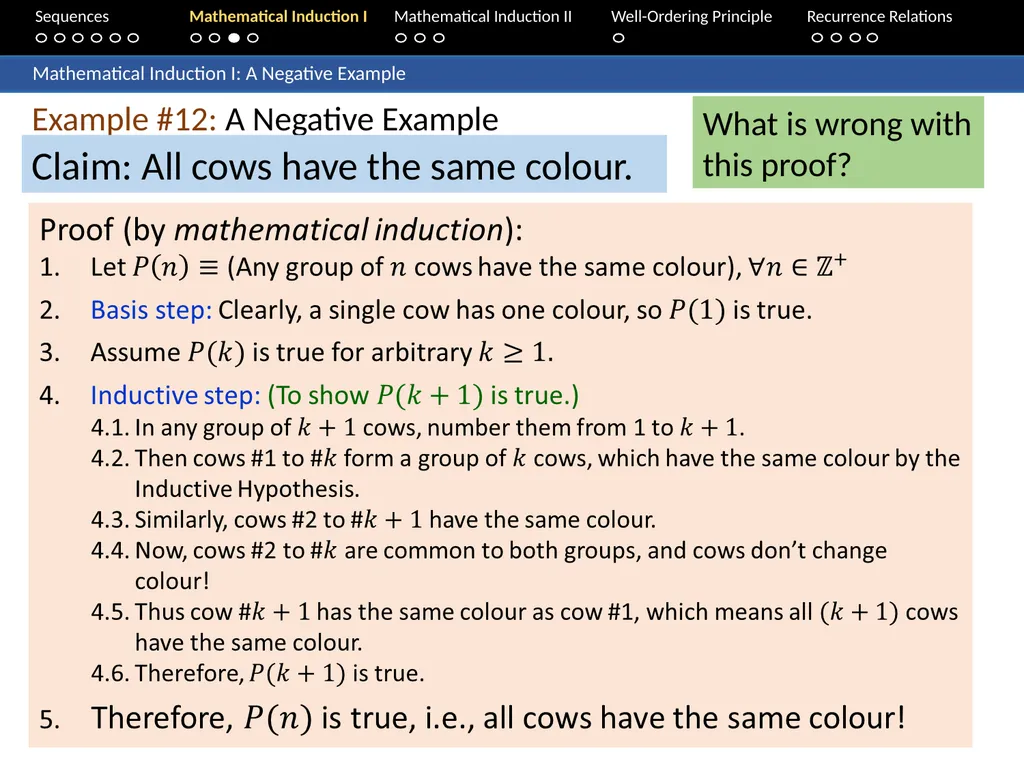
Sequences Mathematical Induction I Mathematical Induction II Well-Ordering Principle Recurrence Relations Mathematical Induction I: A Negative Example 32 Example #12: A Negative Example Claim: All cows have the same colour. What is wrong with this proof?<br>
33
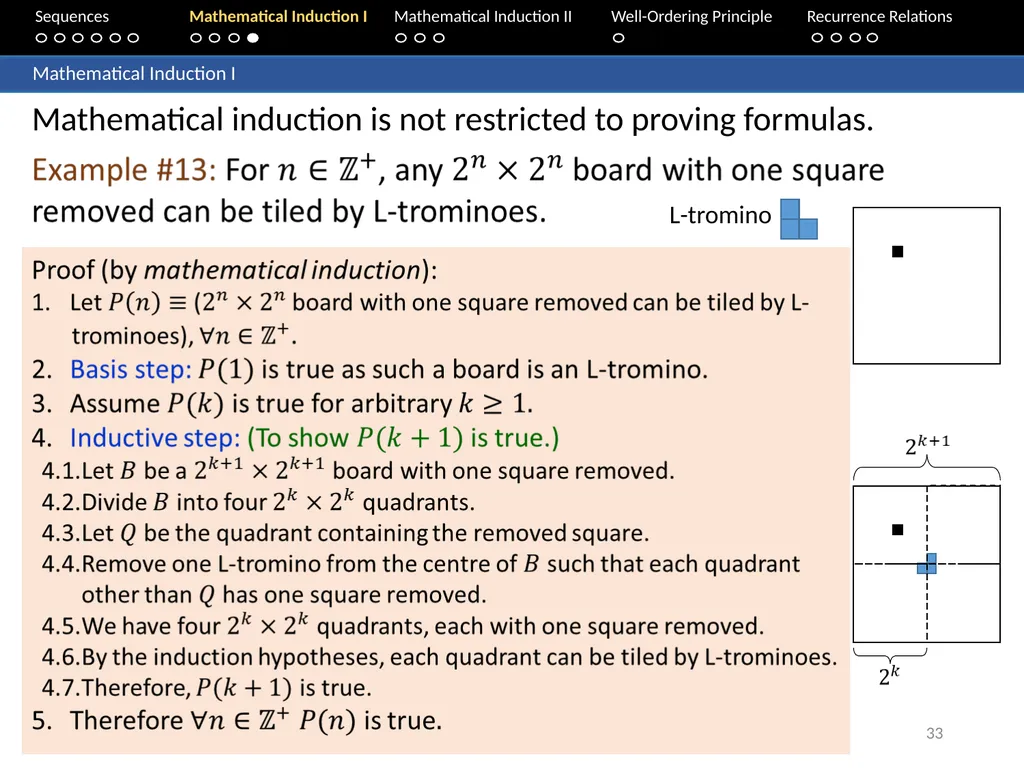
Sequences Mathematical Induction I Mathematical Induction II Well-Ordering Principle Recurrence Relations Mathematical Induction I 33 Mathematical induction is not restricted to proving formulas.<br>
34
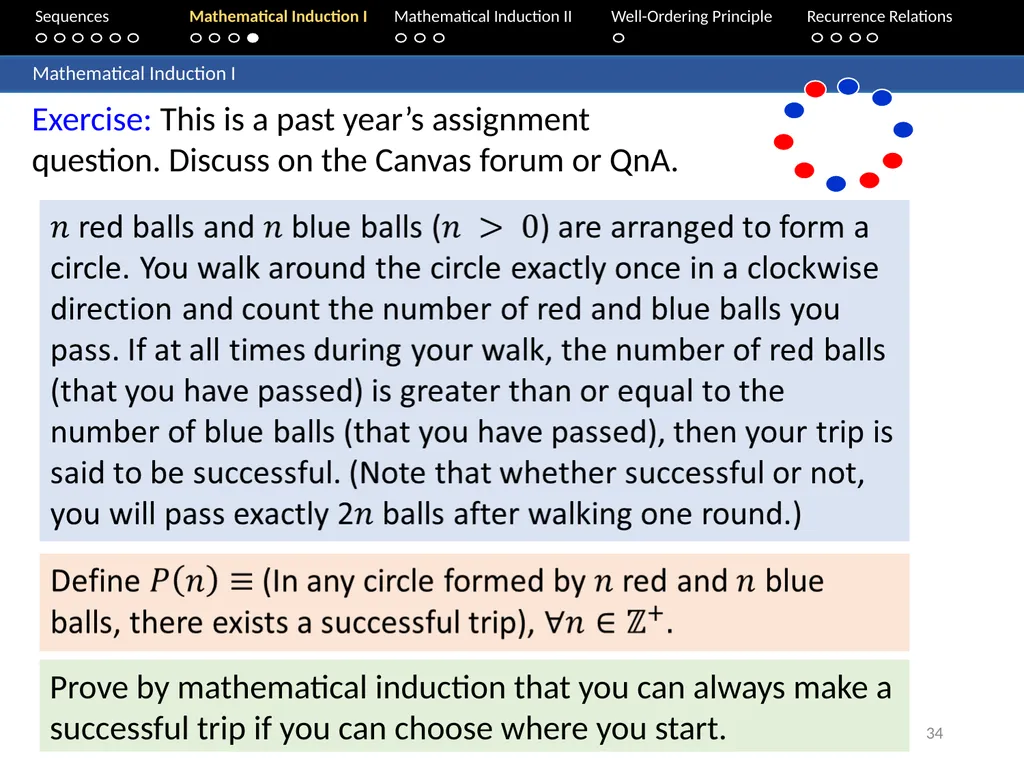
Sequences Mathematical Induction I Mathematical Induction II Well-Ordering Principle Recurrence Relations Mathematical Induction I 34 Prove by mathematical induction that you can always make a successful trip if you can choose where you start. Exercise: This is a past year’s assignment question. Discuss on the Canvas forum or QnA.<br>
35
Sequences Mathematical Induction I Mathematical Induction II Well-Ordering Principle Recurrence Relations 35 8.3 Mathematical Induction II<br>
36
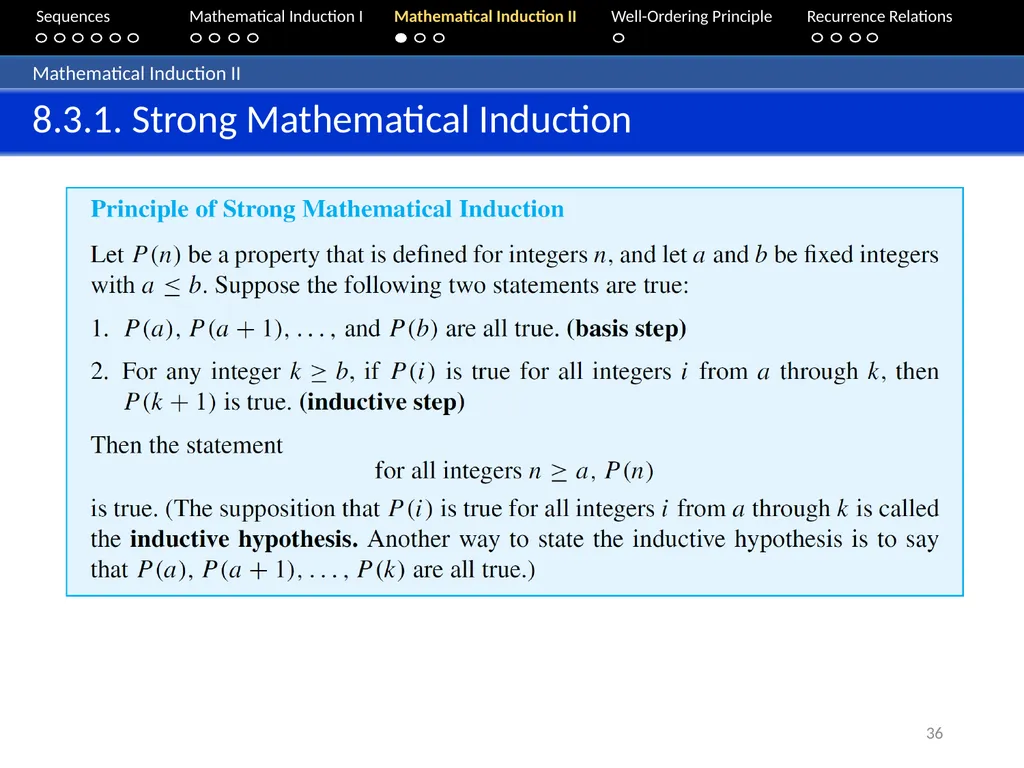
Sequences Mathematical Induction I Mathematical Induction II Well-Ordering Principle Recurrence Relations 36 Mathematical Induction II 8.3.1. Strong Mathematical Induction<br>
37
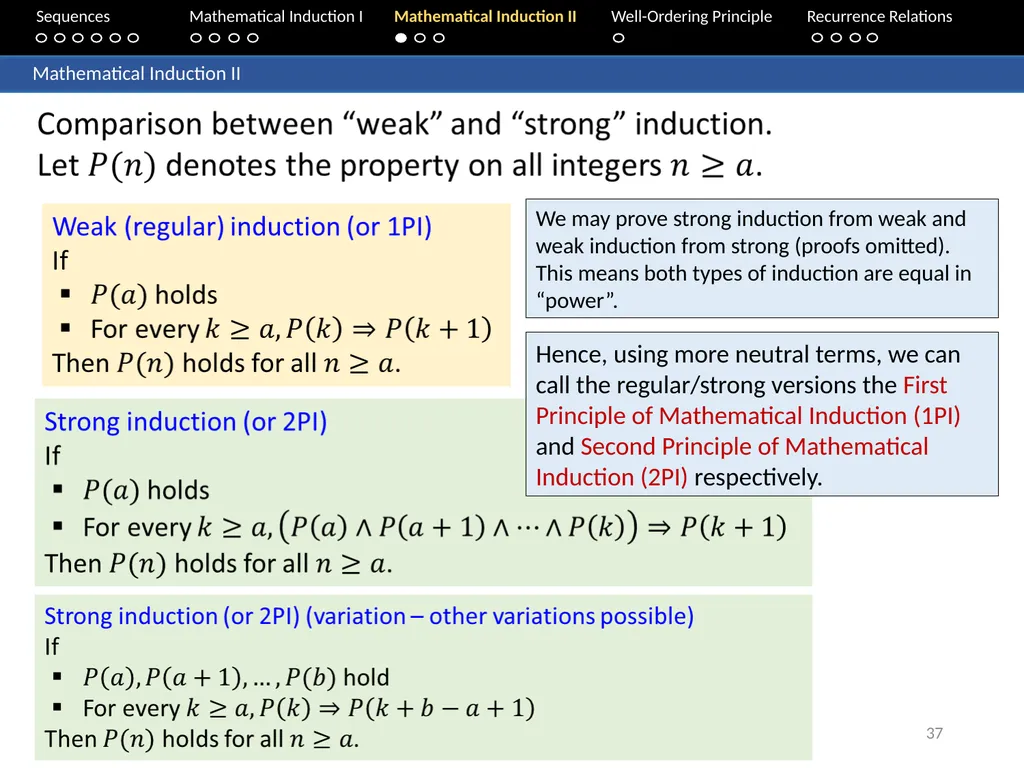
Sequences Mathematical Induction I Mathematical Induction II Well-Ordering Principle Recurrence Relations Mathematical Induction II We may prove strong induction from weak and weak induction from strong (proofs omitted).
This means both types of induction are equal in “power”. Hence, using more neutral terms, we can call the regular/strong versions the First Principle of Mathematical Induction (1PI) and Second Principle of Mathematical Induction (2PI) respectively. 37<br>
This means both types of induction are equal in “power”. Hence, using more neutral terms, we can call the regular/strong versions the First Principle of Mathematical Induction (1PI) and Second Principle of Mathematical Induction (2PI) respectively. 37<br>
38
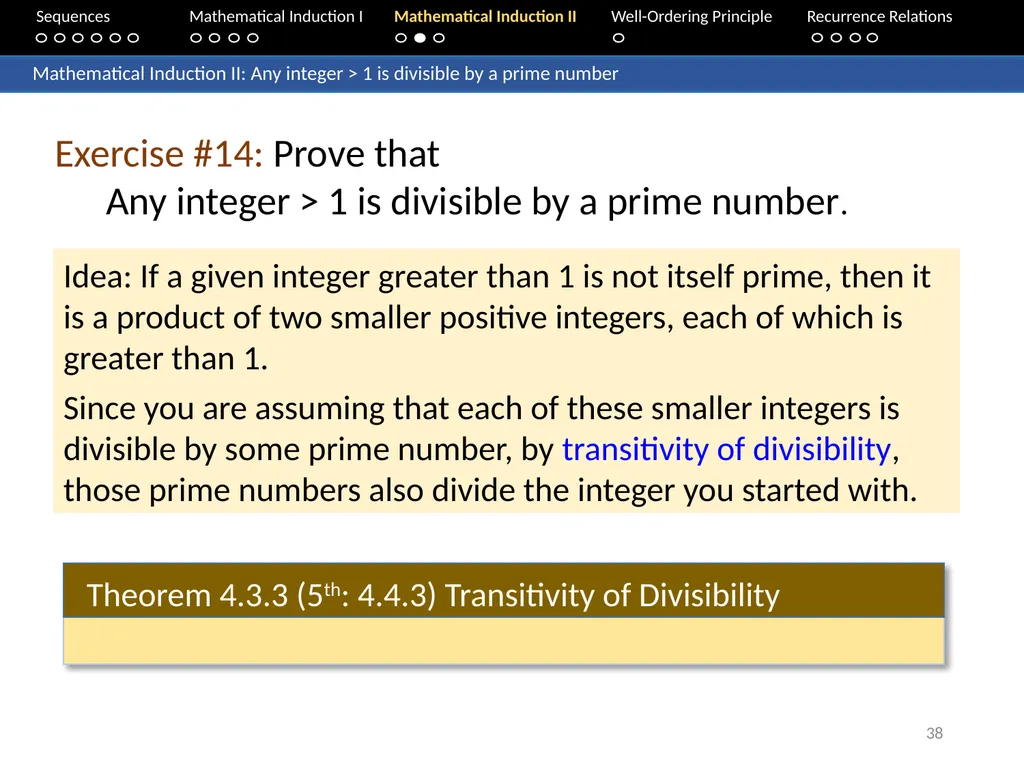
Sequences Mathematical Induction I Mathematical Induction II Well-Ordering Principle Recurrence Relations 38 Mathematical Induction II: Any integer > 1 is divisible by a prime number Exercise #14: Prove that
Any integer > 1 is divisible by a prime number. Idea: If a given integer greater than 1 is not itself prime, then it is a product of two smaller positive integers, each of which is greater than 1.
Since you are assuming that each of these smaller integers is divisible by some prime number, by transitivity of divisibility, those prime numbers also divide the integer you started with.<br>
Any integer > 1 is divisible by a prime number. Idea: If a given integer greater than 1 is not itself prime, then it is a product of two smaller positive integers, each of which is greater than 1.
Since you are assuming that each of these smaller integers is divisible by some prime number, by transitivity of divisibility, those prime numbers also divide the integer you started with.<br>
39
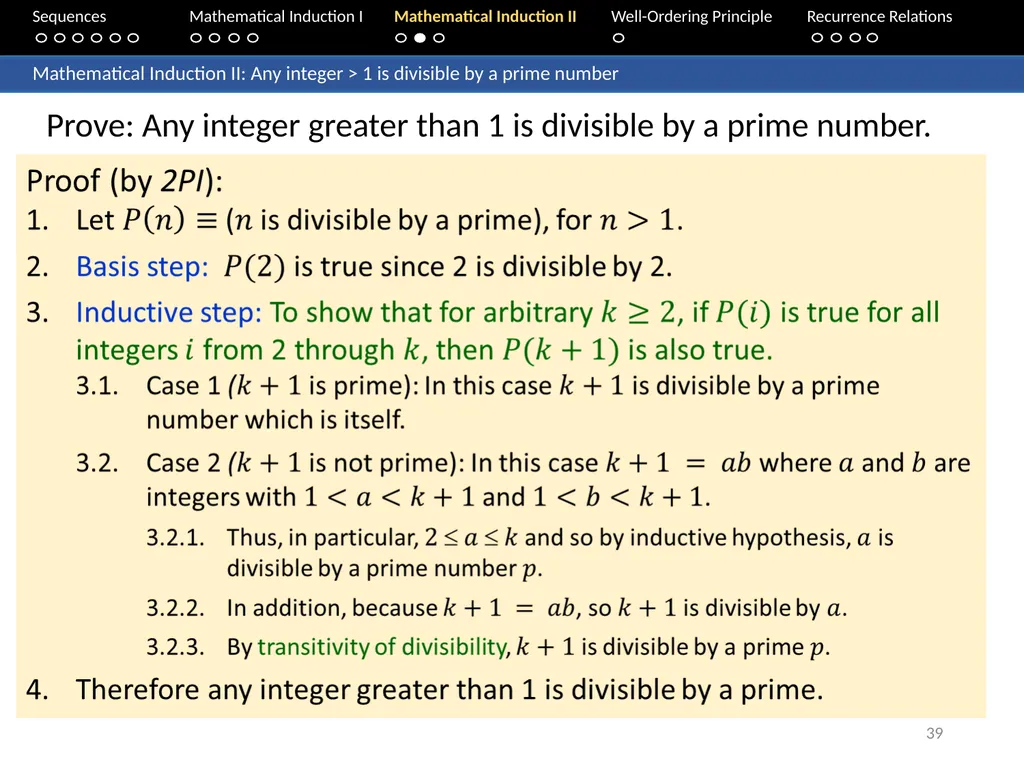
Sequences Mathematical Induction I Mathematical Induction II Well-Ordering Principle Recurrence Relations 39 Mathematical Induction II: Any integer > 1 is divisible by a prime number Prove: Any integer greater than 1 is divisible by a prime number.<br>
40
Sequences Mathematical Induction I Mathematical Induction II Well-Ordering Principle Recurrence Relations 40<br>
41
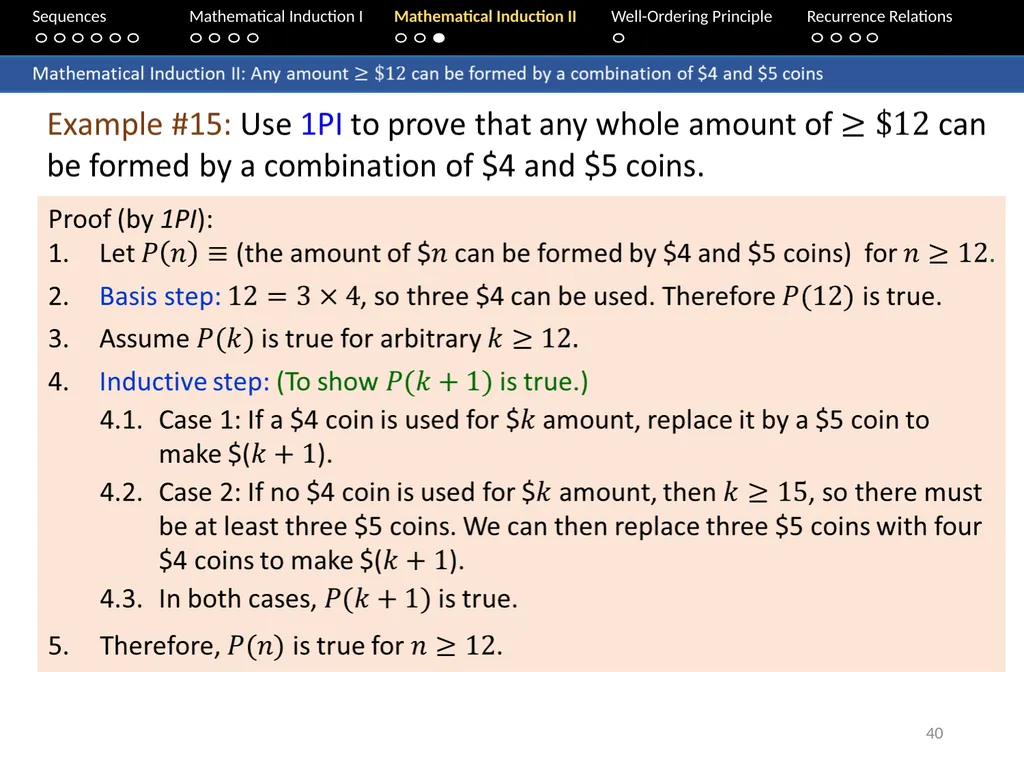
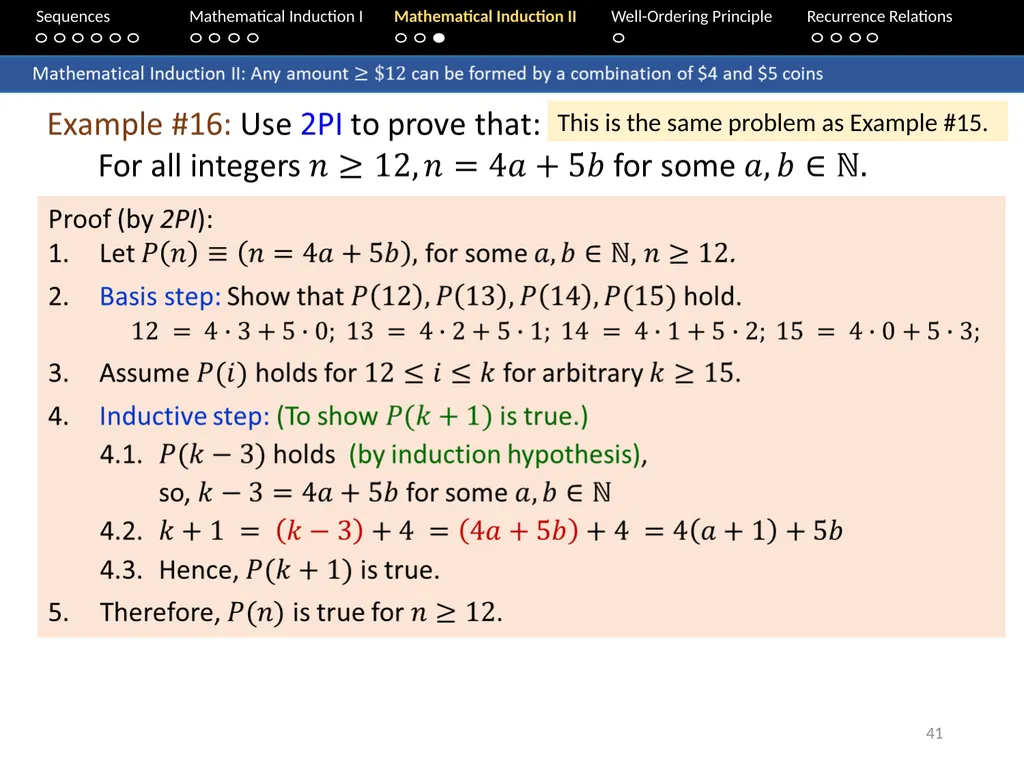
Sequences Mathematical Induction I Mathematical Induction II Well-Ordering Principle Recurrence Relations 41 This is the same problem as Example #15.<br>
42
Sequences Mathematical Induction I Mathematical Induction II Well-Ordering Principle Recurrence Relations 42 8.4 Well-Ordering Principle<br>
43
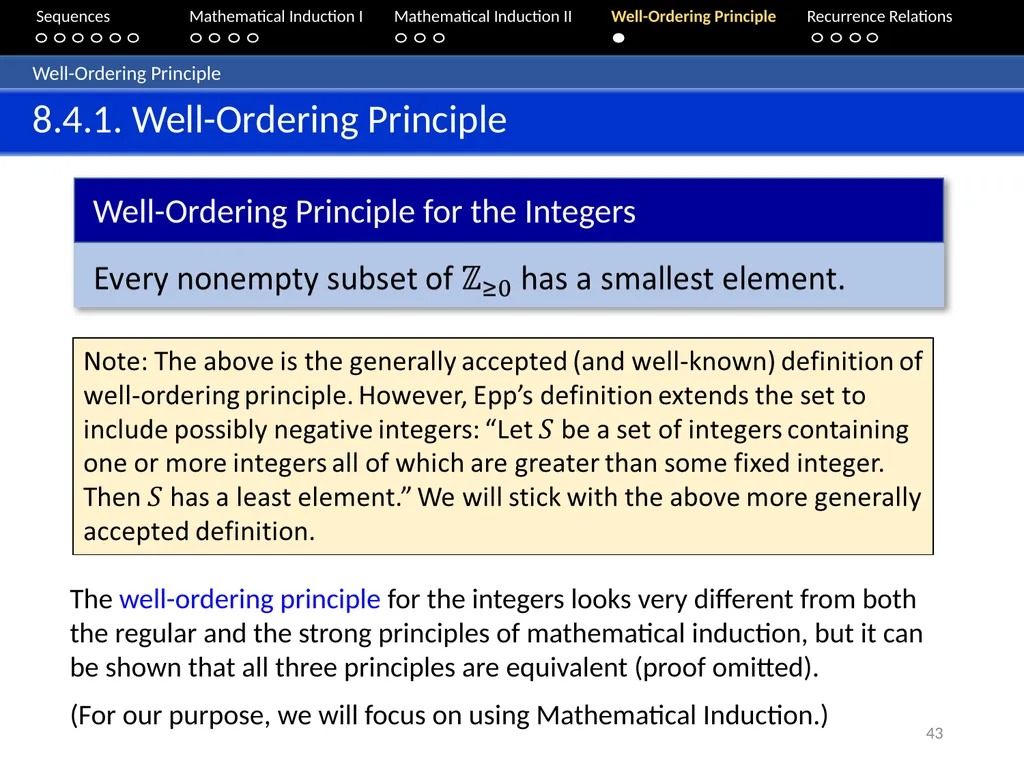
Sequences Mathematical Induction I Mathematical Induction II Well-Ordering Principle Recurrence Relations 43 Well-Ordering Principle 8.4.1. Well-Ordering Principle The well-ordering principle for the integers looks very different from both the regular and the strong principles of mathematical induction, but it can be shown that all three principles are equivalent (proof omitted). (For our purpose, we will focus on using Mathematical Induction.)<br>
44
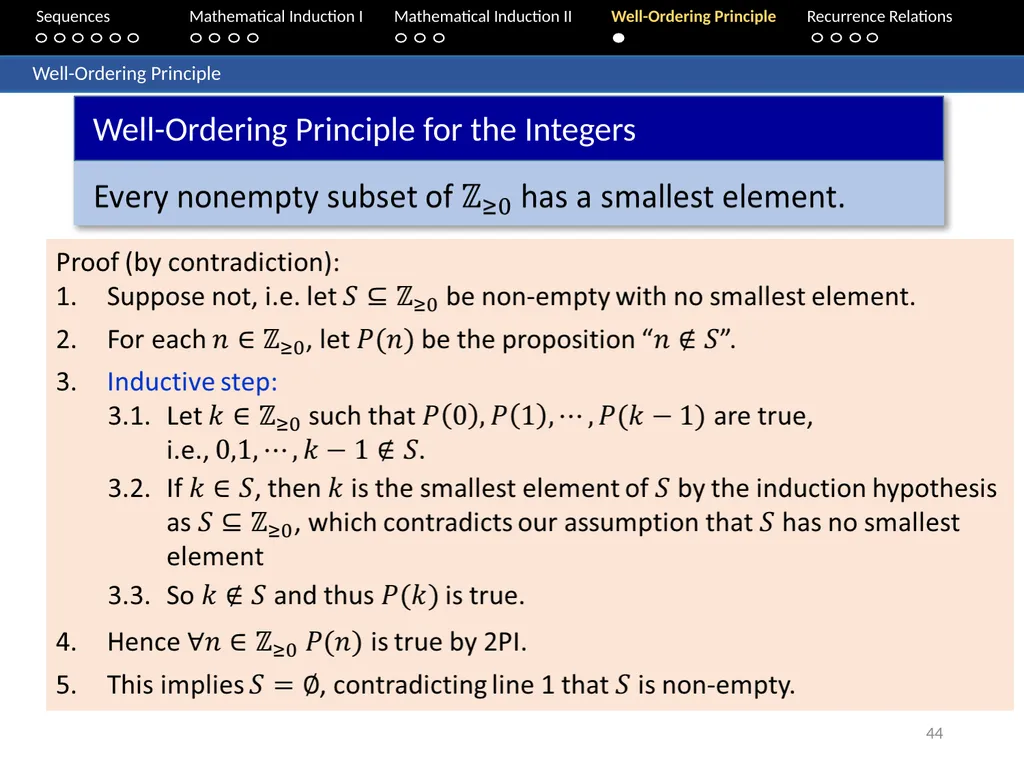
Sequences Mathematical Induction I Mathematical Induction II Well-Ordering Principle Recurrence Relations 44 Well-Ordering Principle<br>
45
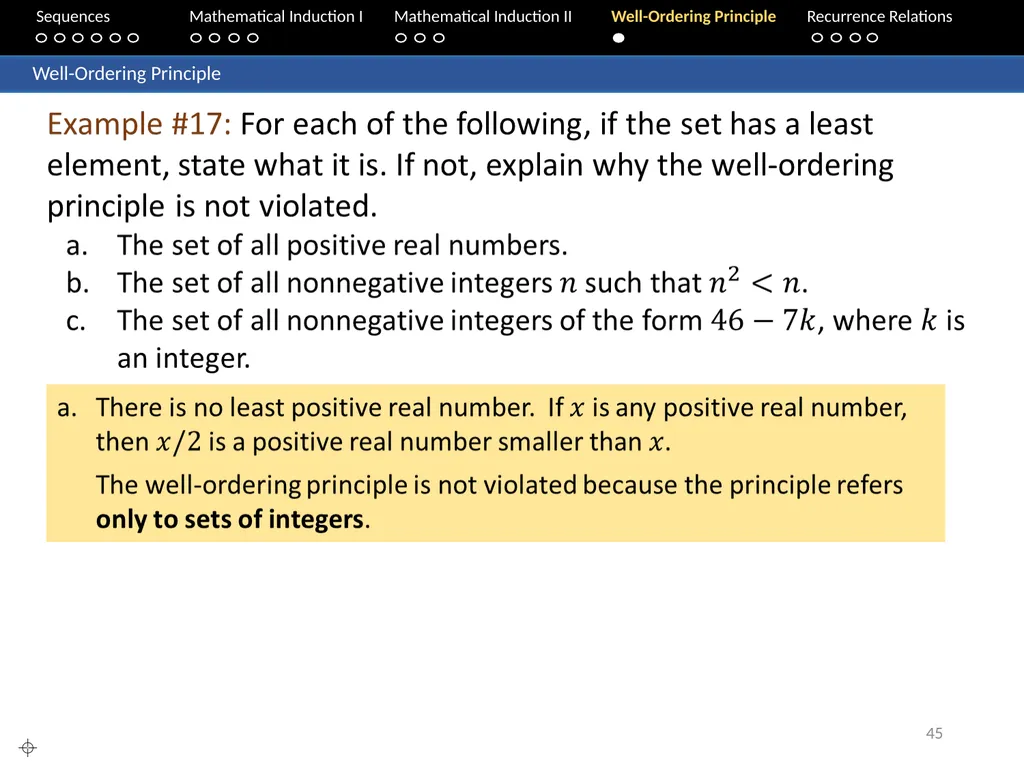
Sequences Mathematical Induction I Mathematical Induction II Well-Ordering Principle Recurrence Relations 45 Well-Ordering Principle <br>
46
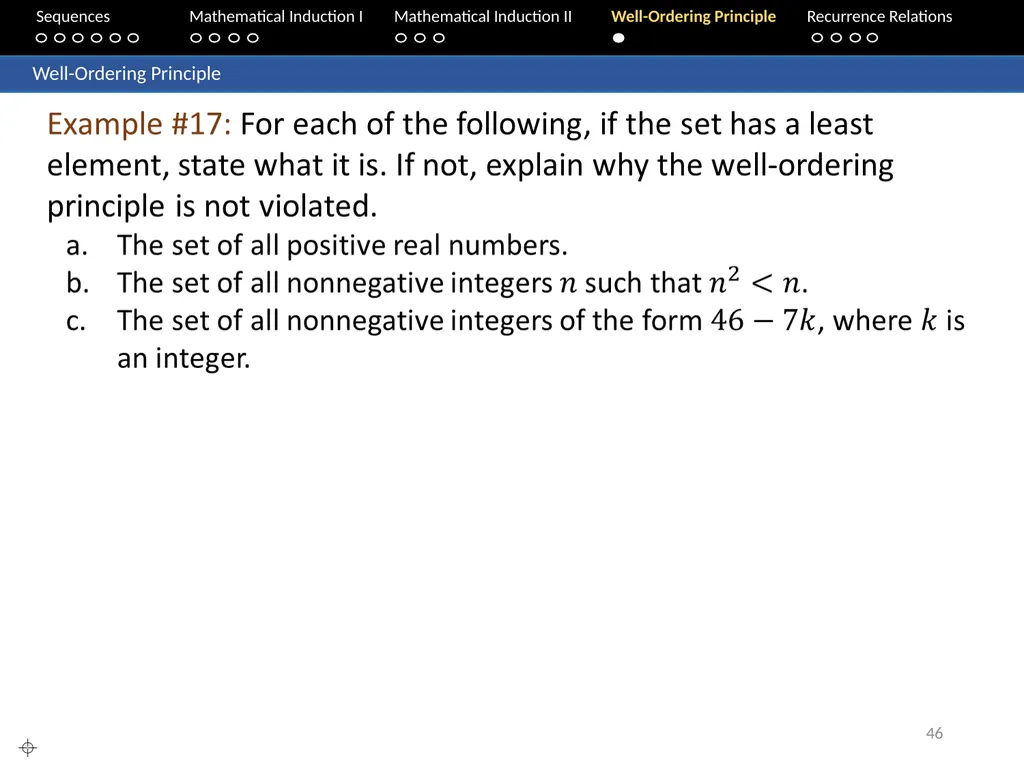
Sequences Mathematical Induction I Mathematical Induction II Well-Ordering Principle Recurrence Relations 46 Well-Ordering Principle <br>
47
Sequences Mathematical Induction I Mathematical Induction II Well-Ordering Principle Recurrence Relations 47 8.5 Recurrence Relations<br>
48
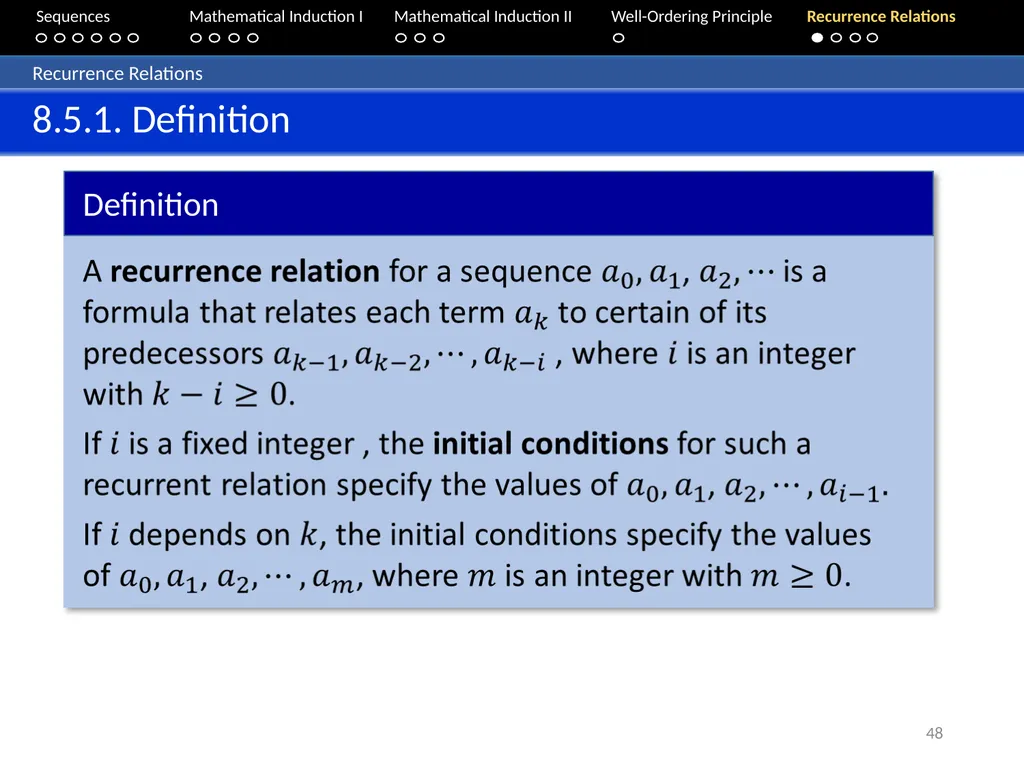
Sequences Mathematical Induction I Mathematical Induction II Well-Ordering Principle Recurrence Relations 48 Recurrence Relations 8.5.1. Definition<br>
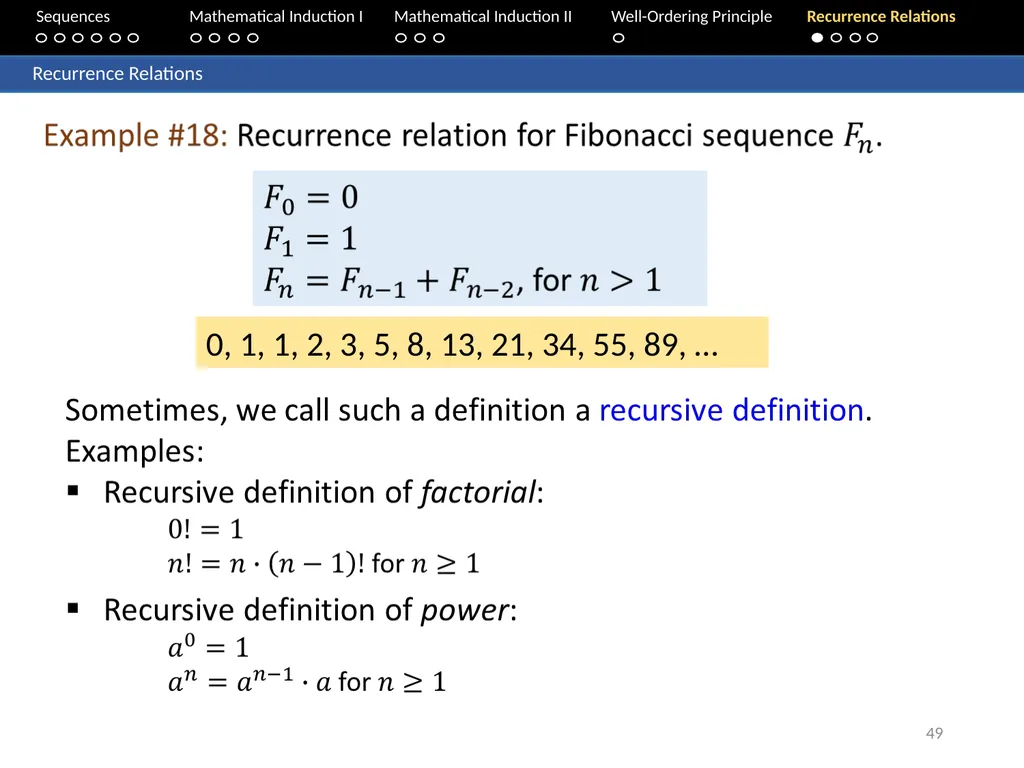
49
Sequences Mathematical Induction I Mathematical Induction II Well-Ordering Principle Recurrence Relations 49 Recurrence Relations 0, 1, 1, 2, 3, 5, 8, 13, 21, 34, 55, 89, …<br>
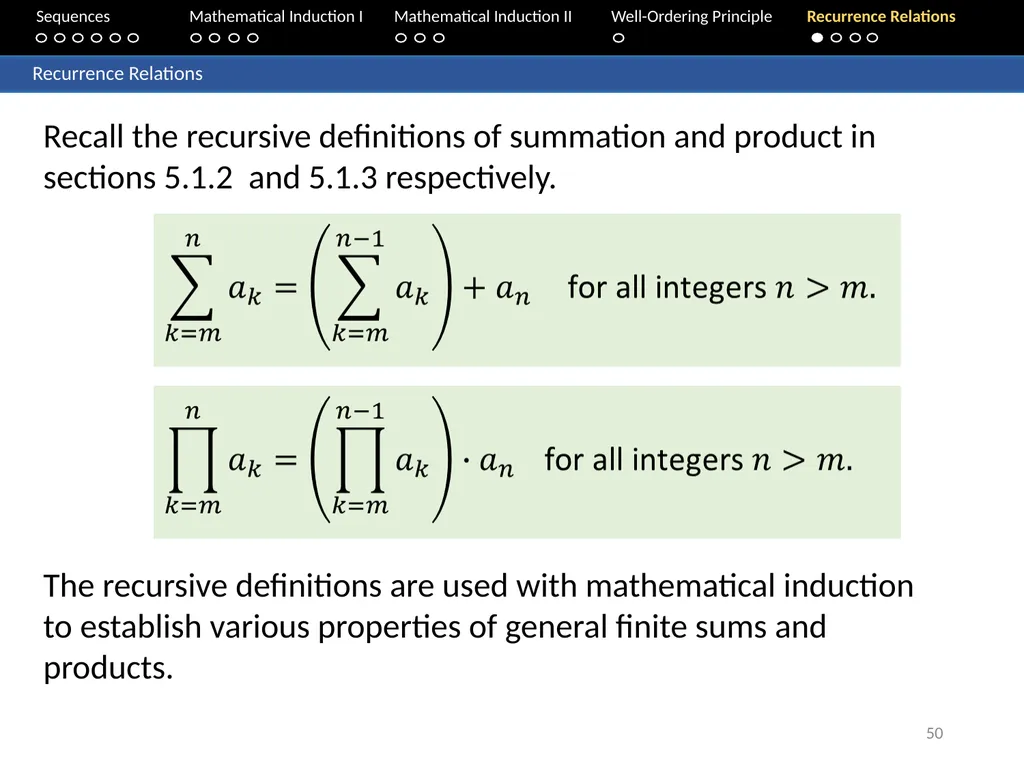
50
Sequences Mathematical Induction I Mathematical Induction II Well-Ordering Principle Recurrence Relations 50 Recurrence Relations Recall the recursive definitions of summation and product in sections 5.1.2 and 5.1.3 respectively. The recursive definitions are used with mathematical induction to establish various properties of general finite sums and products.<br>
51
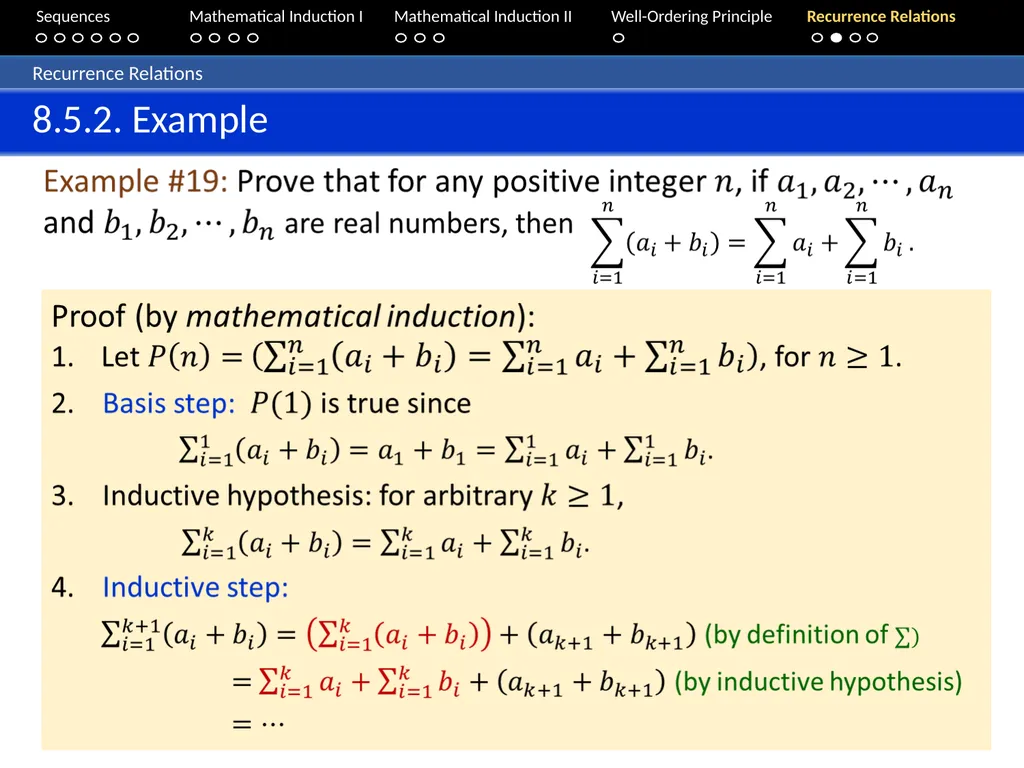
Sequences Mathematical Induction I Mathematical Induction II Well-Ordering Principle Recurrence Relations 51 Recurrence Relations 8.5.2. Example<br>
52
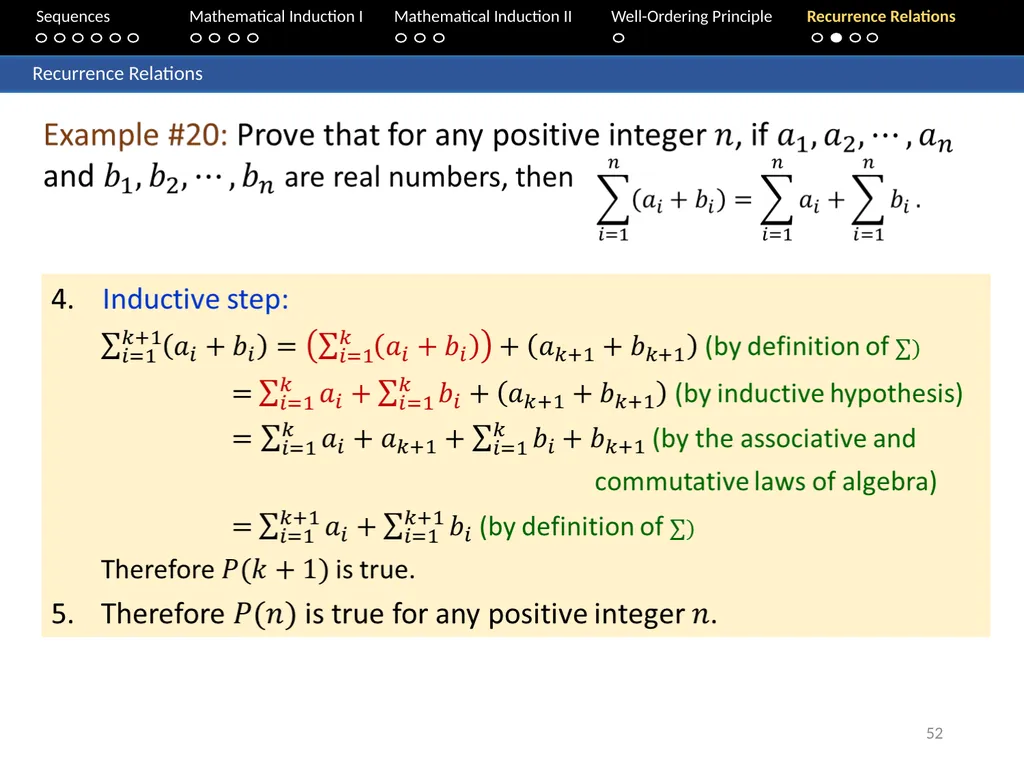
Sequences Mathematical Induction I Mathematical Induction II Well-Ordering Principle Recurrence Relations 52 Recurrence Relations<br>
53
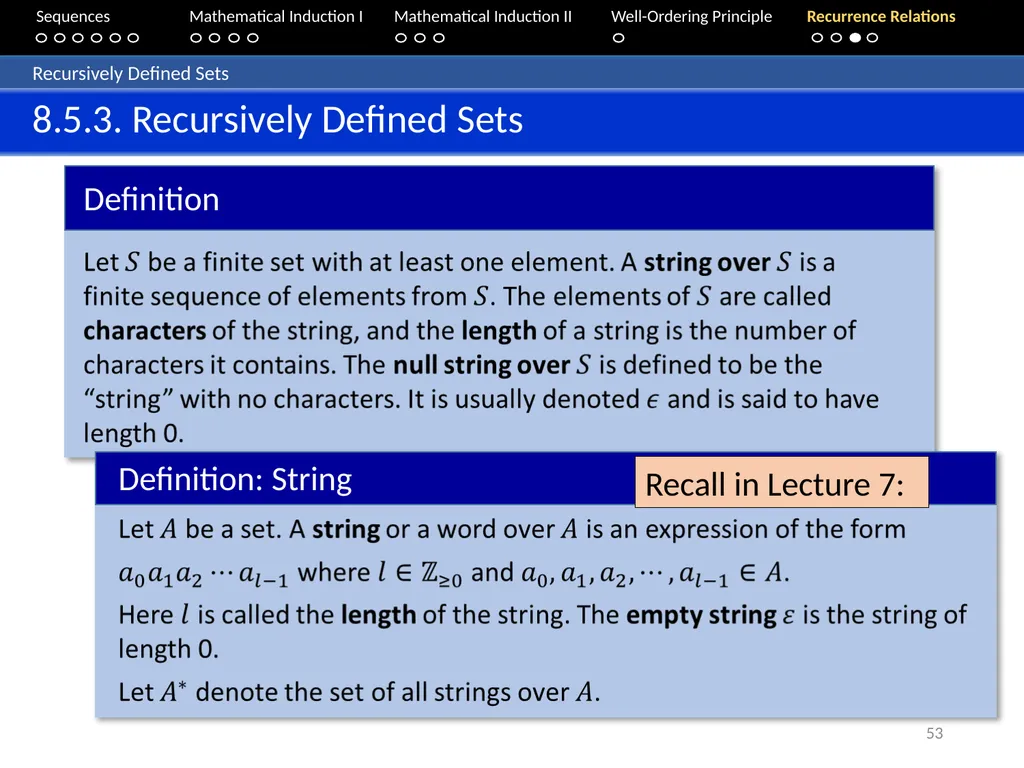
Sequences Mathematical Induction I Mathematical Induction II Well-Ordering Principle Recurrence Relations 53 Recursively Defined Sets 8.5.3. Recursively Defined Sets Recall in Lecture 7:<br>
54
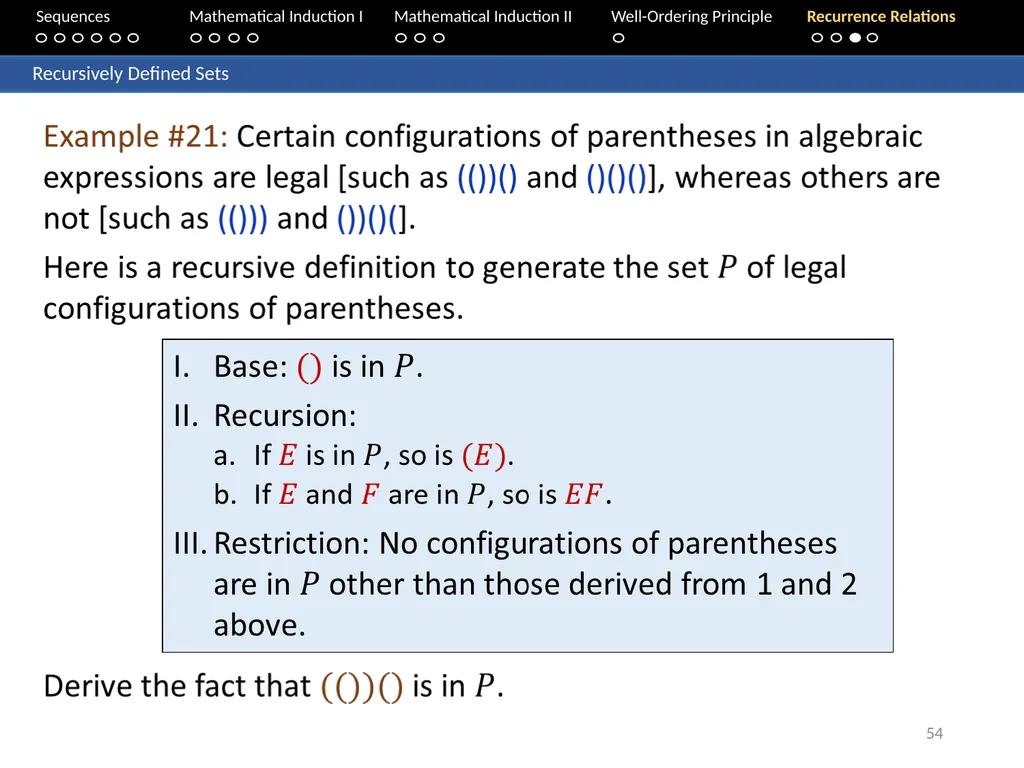
Sequences Mathematical Induction I Mathematical Induction II Well-Ordering Principle Recurrence Relations 54 Recursively Defined Sets<br>
55
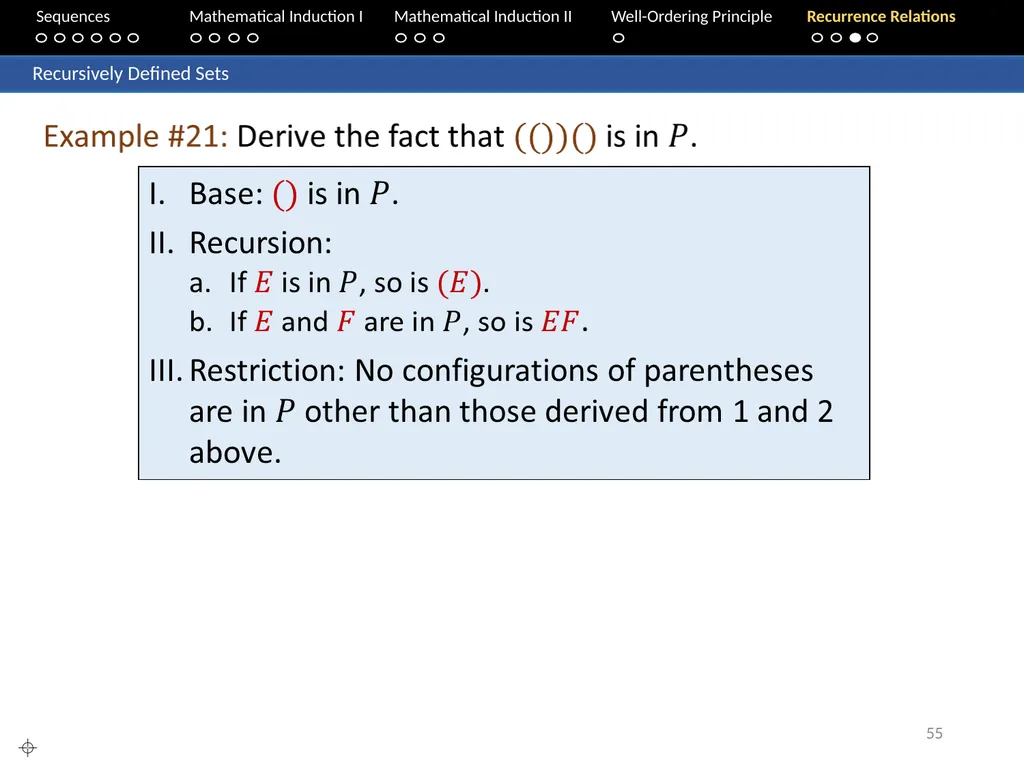
Sequences Mathematical Induction I Mathematical Induction II Well-Ordering Principle Recurrence Relations 55 Recursively Defined Sets <br>
56
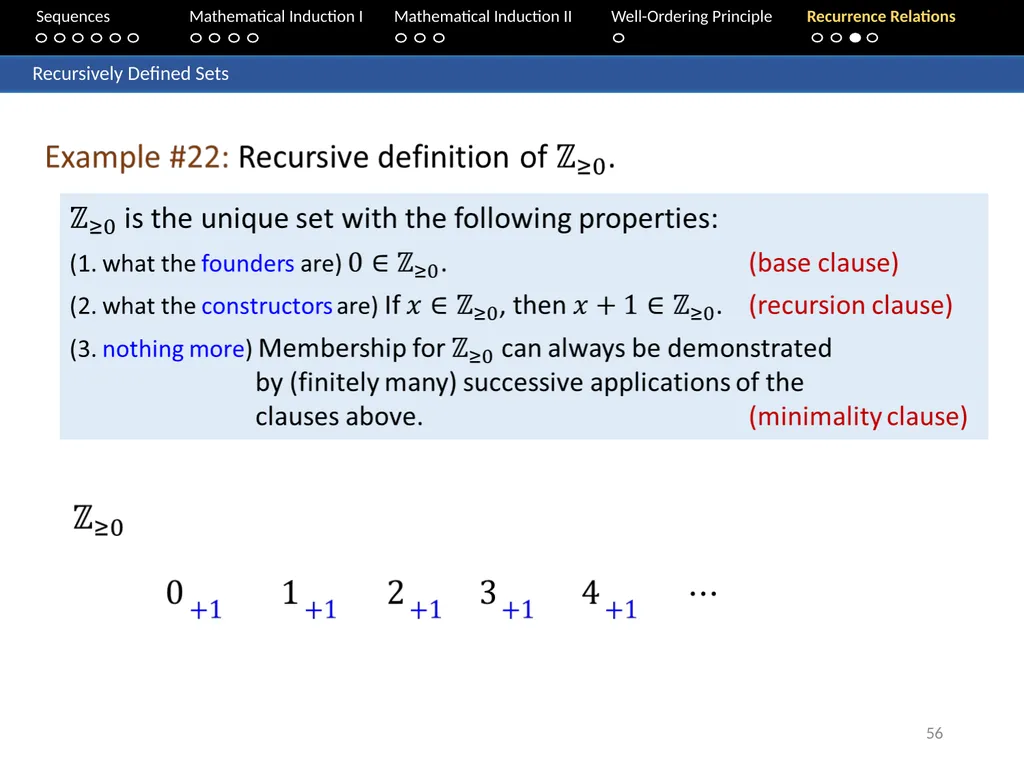
Sequences Mathematical Induction I Mathematical Induction II Well-Ordering Principle Recurrence Relations 56 Recursively Defined Sets<br>
57
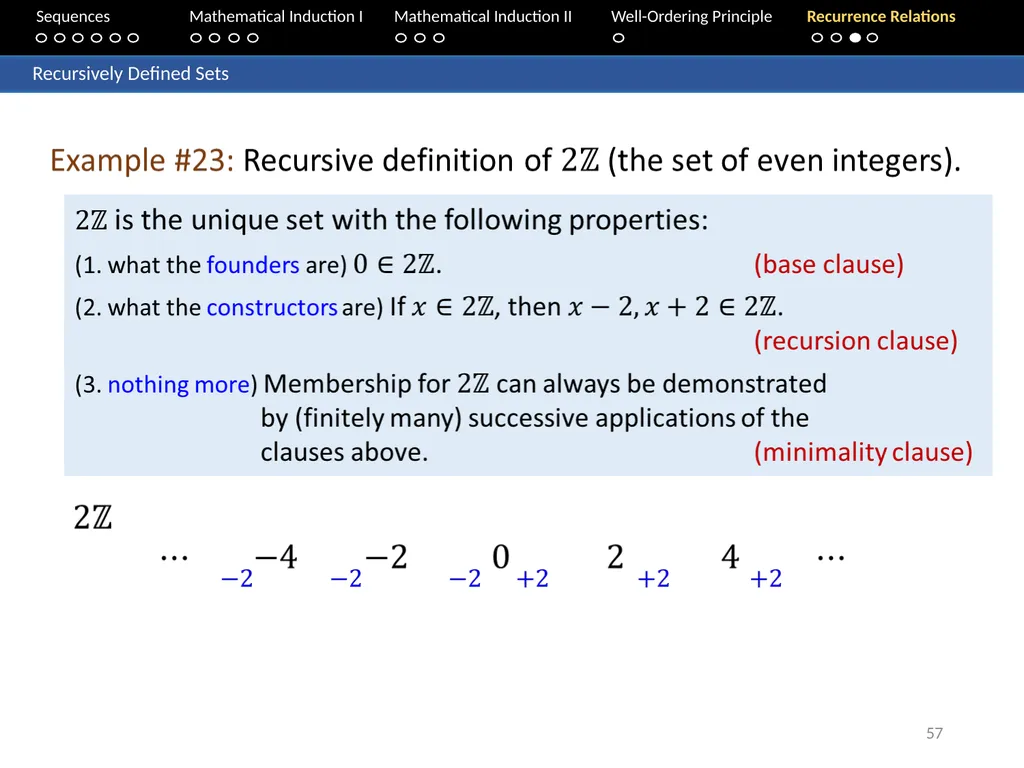
Sequences Mathematical Induction I Mathematical Induction II Well-Ordering Principle Recurrence Relations 57 Recursively Defined Sets<br>
58
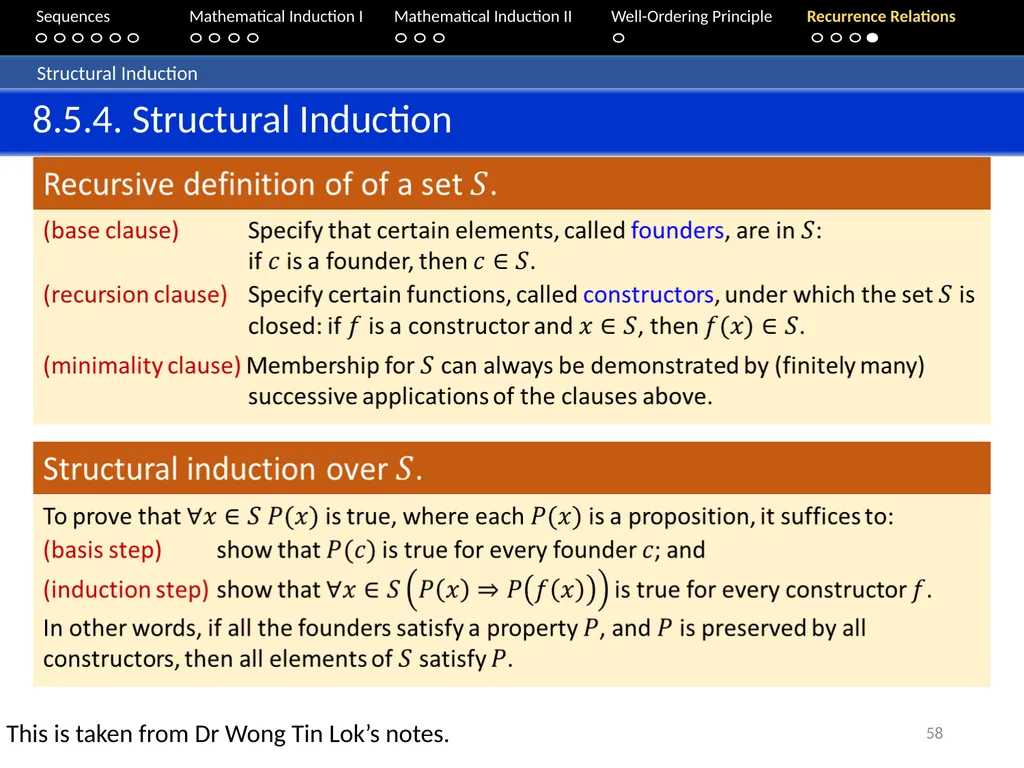
Sequences Mathematical Induction I Mathematical Induction II Well-Ordering Principle Recurrence Relations 58 Structural Induction 8.5.4. Structural Induction This is taken from Dr Wong Tin Lok’s notes.<br>
59
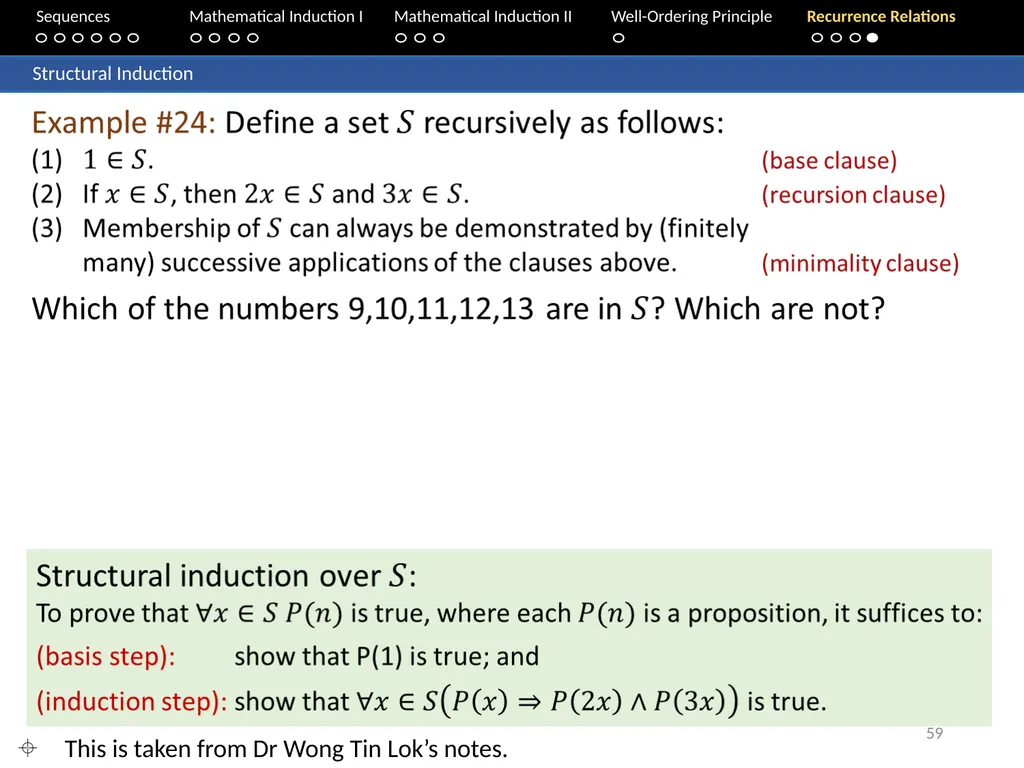
Sequences Mathematical Induction I Mathematical Induction II Well-Ordering Principle Recurrence Relations 59 Structural Induction This is taken from Dr Wong Tin Lok’s notes.<br>
60
60 END OF FILE<br>