
30th International Input-Output Association
Description: 30th International Input-Output Association Conference 1st - 5th July 2024, Santiago, Chile Institutional interrelations in distributive transactions seen through a magnifying glass. A proposal to improve national accounts data for use in
Related Topics
Download Presentation
"30th International Input-Output Association" is the property of its rightful owner. Permission is granted to download and print the materials on this website for personal, non-commercial use only, and to display it on your personal computer provided you do not modify the materials and that you retain all copyright notices contained in the materials. By downloading content from our website, you accept the terms of this agreement.
Presentation Transcript
slide1. 30th International Input-Output Association Conference
1st - 5th July 2024, Santiago, Chile Institutional interrelations in distributive transactions seen through a magnifying glass.
A proposal to improve national accounts data for use in input-output analysis.
Susana Santos
UECE (Research Unit on Complexity and Economics) - REM (Research in Economics and Mathematics)
ISEG - Lisbon School of Economics and Management, Universidade de Lisboa<br>
slide2. Institutional interrelations in distributive transactions seen through a magnifying glass. A proposal to improve national accounts data for use in input-output analysis. Santos, S.
Outline 2 1. Introduction
2. Carrying out input-output analysis in the study of income distribution with data from national accounts
3. Institutional sectors and distributive transactions in national accounts
4. Construction of from-whom-to-whom matrices for distributive transactions
5. A possible use of from-whom-to-whom matrices for distributive transactions to extend input-output analysis to income distribution
6. Concluding remarks<br>
slide3. Institutional interrelations in distributive transactions seen through a magnifying glass. A proposal to improve national accounts data for use in input-output analysis. Santos, S.
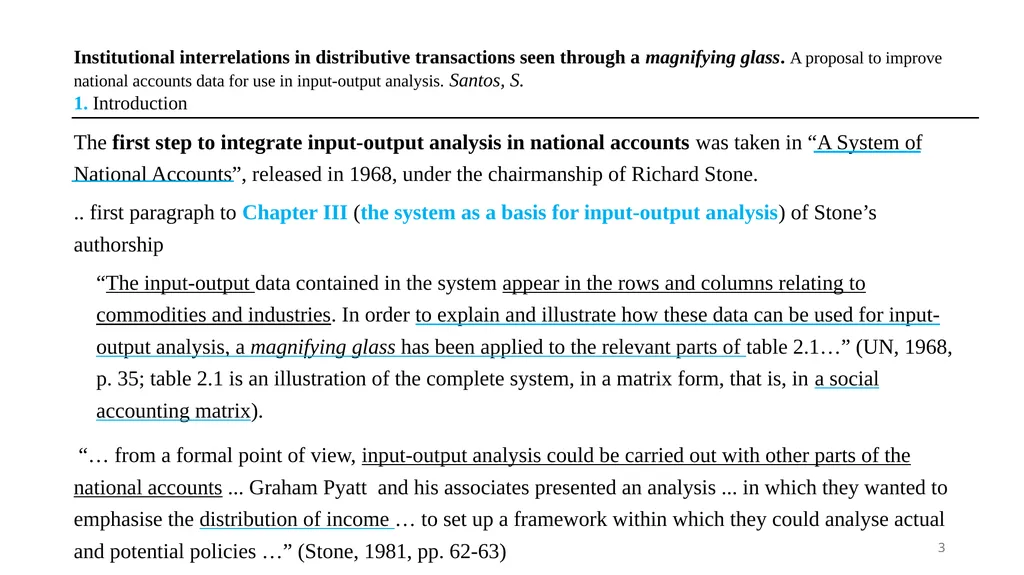
1. Introduction 3 The first step to integrate input-output analysis in national accounts was taken in “A System of National Accounts”, released in 1968, under the chairmanship of Richard Stone.
.. first paragraph to Chapter III (the system as a basis for input-output analysis) of Stone’s authorship
“The input-output data contained in the system appear in the rows and columns relating to commodities and industries. In order to explain and illustrate how these data can be used for input-output analysis, a magnifying glass has been applied to the relevant parts of table 2.1…” (UN, 1968, p. 35; table 2.1 is an illustration of the complete system, in a matrix form, that is, in a social accounting matrix).
“… from a formal point of view, input-output analysis could be carried out with other parts of the national accounts ... Graham Pyatt and his associates presented an analysis ... in which they wanted to emphasise the distribution of income … to set up a framework within which they could analyse actual and potential policies …” (Stone, 1981, pp. 62-63)<br>
slide4. Institutional interrelations in distributive transactions seen through a magnifying glass. A proposal to improve national accounts data for use in input-output analysis. Santos, S.
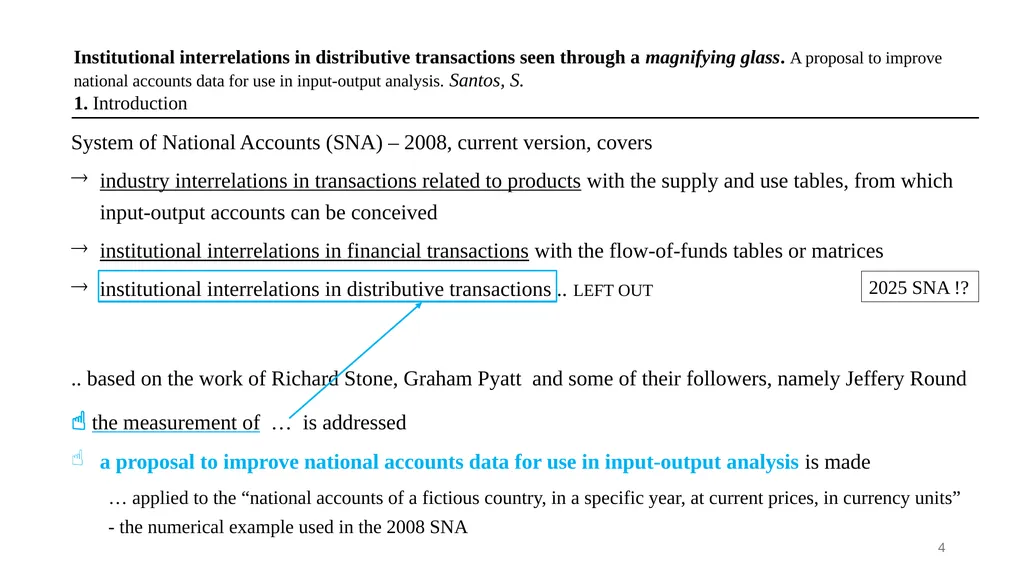
1. Introduction 4 System of National Accounts (SNA) – 2008, current version, covers
industry interrelations in transactions related to products with the supply and use tables, from which input-output accounts can be conceived
institutional interrelations in financial transactions with the flow-of-funds tables or matrices
institutional interrelations in distributive transactions .. left out
.. based on the work of Richard Stone, Graham Pyatt and some of their followers, namely Jeffery Round
the measurement of … is addressed
a proposal to improve national accounts data for use in input-output analysis is made
… applied to the “national accounts of a fictious country, in a specific year, at current prices, in currency units” - the numerical example used in the 2008 SNA 2025 SNA !?<br>
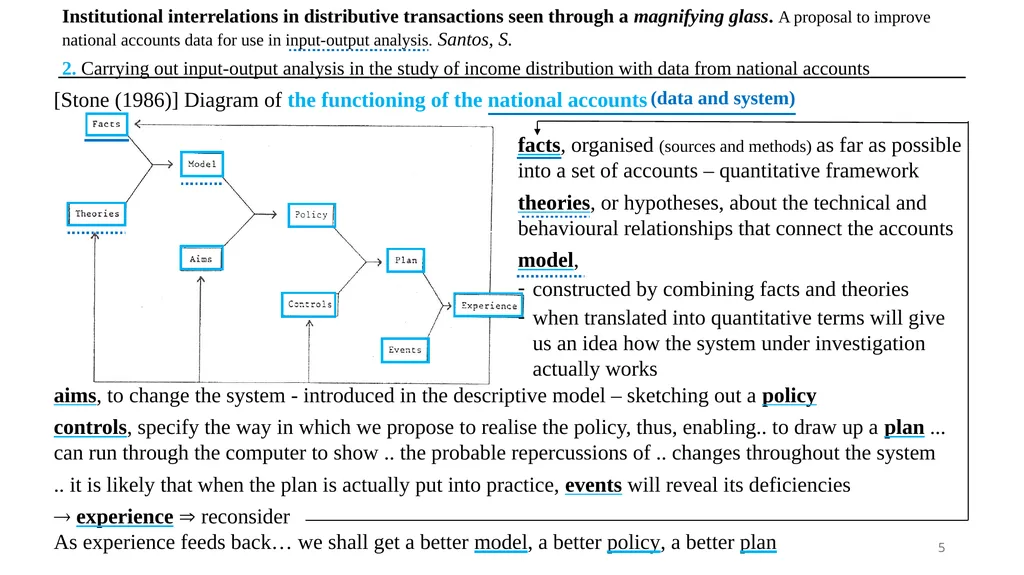
slide5. [Stone (1986)] Diagram of the functioning of the national accounts facts, organised (sources and methods) as far as possible into a set of accounts – quantitative framework
theories, or hypotheses, about the technical and behavioural relationships that connect the accounts
model,
constructed by combining facts and theories
when translated into quantitative terms will give us an idea how the system under investigation actually works aims, to change the system - introduced in the descriptive model – sketching out a policy
controls, specify the way in which we propose to realise the policy, thus, enabling.. to draw up a plan ...
can run through the computer to show .. the probable repercussions of .. changes throughout the system
.. it is likely that when the plan is actually put into practice, events will reveal its deficiencies
experience reconsider
As experience feeds back… we shall get a better model, a better policy, a better plan 5 Institutional interrelations in distributive transactions seen through a magnifying glass. A proposal to improve national accounts data for use in input-output analysis. Santos, S.
2. Carrying out input-output analysis in the study of income distribution with data from national accounts (data and system)<br>
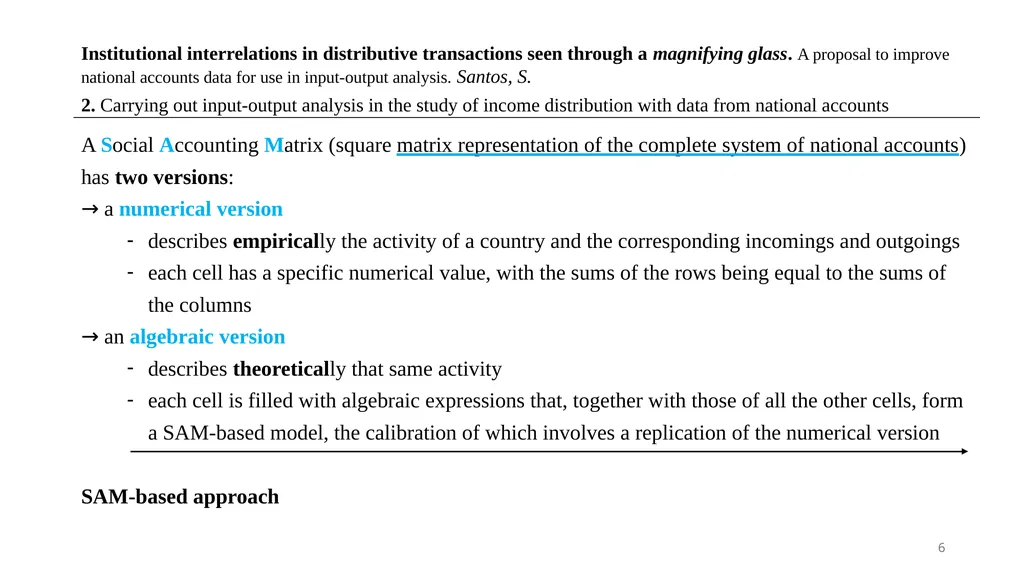
slide6. 6 A Social Accounting Matrix (square matrix representation of the complete system of national accounts)
has two versions:
a numerical version
describes empirically the activity of a country and the corresponding incomings and outgoings
each cell has a specific numerical value, with the sums of the rows being equal to the sums of the columns
an algebraic version
describes theoretically that same activity
each cell is filled with algebraic expressions that, together with those of all the other cells, form a SAM-based model, the calibration of which involves a replication of the numerical version
SAM-based approach Institutional interrelations in distributive transactions seen through a magnifying glass. A proposal to improve national accounts data for use in input-output analysis. Santos, S.
2. Carrying out input-output analysis in the study of income distribution with data from national accounts<br>
slide7. … changes associated to distribution and redistribution of income
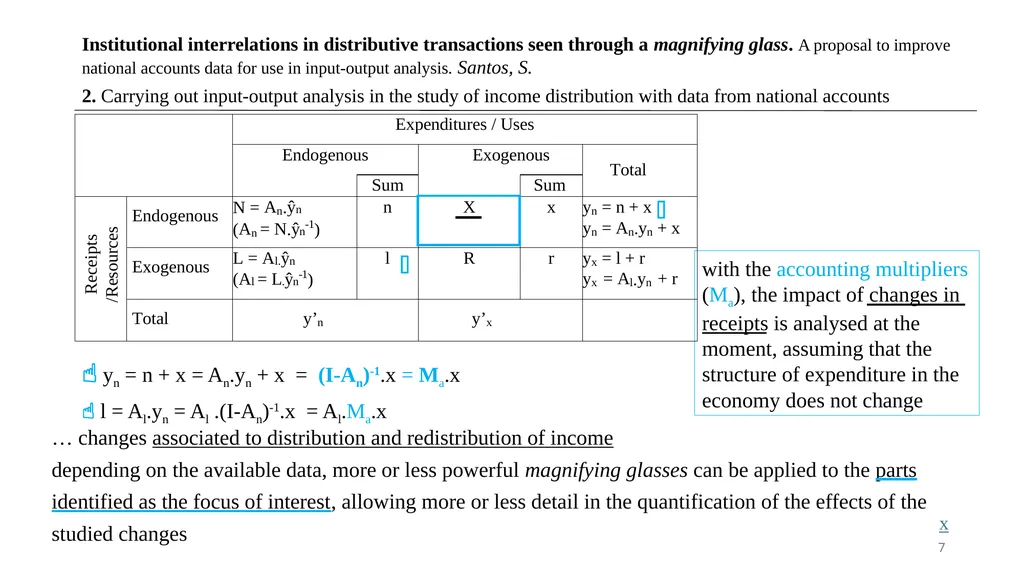
depending on the available data, more or less powerful magnifying glasses can be applied to the parts identified as the focus of interest, allowing more or less detail in the quantification of the effects of the studied changes with the accounting multipliers (Ma), the impact of changes in receipts is analysed at the moment, assuming that the structure of expenditure in the economy does not change 7 yn = n + x = An.yn + x = (I-An)-1.x = Ma.x
l = Al.yn = Al .(I-An)-1.x = Al.Ma.x Institutional interrelations in distributive transactions seen through a magnifying glass. A proposal to improve national accounts data for use in input-output analysis. Santos, S.
2. Carrying out input-output analysis in the study of income distribution with data from national accounts x <br>
slide8. Institutional interrelations in distributive transactions seen through a magnifying glass. A proposal to improve national accounts data for use in input-output analysis. Santos, S.
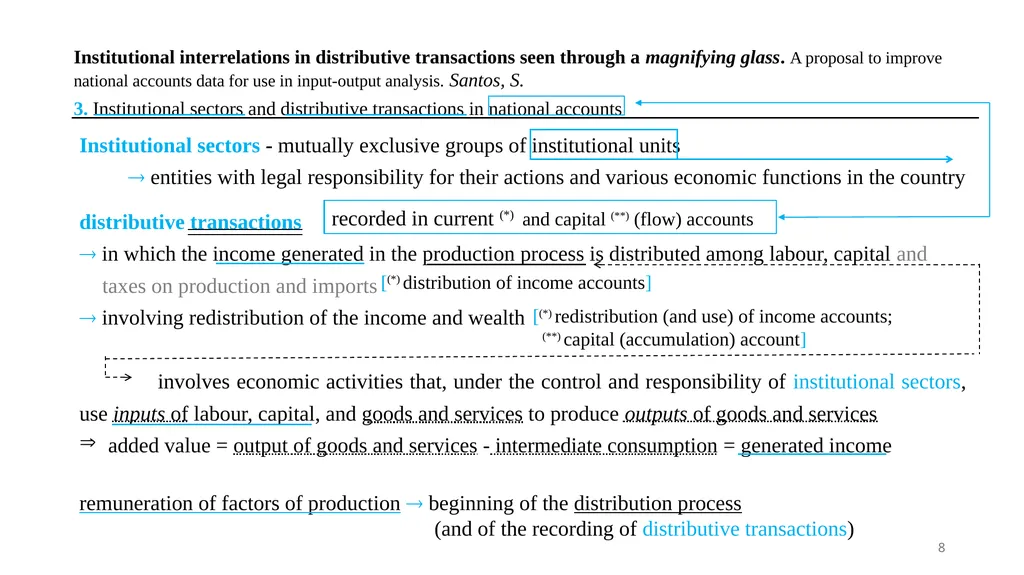
3. Institutional sectors and distributive transactions in national accounts 8 Institutional sectors - mutually exclusive groups of institutional units
entities with legal responsibility for their actions and various economic functions in the country
distributive transactions
in which the income generated in the production process is distributed among labour, capital and taxes on production and imports
involving redistribution of the income and wealth
involves economic activities that, under the control and responsibility of institutional sectors, use inputs of labour, capital, and goods and services to produce outputs of goods and services
added value = output of goods and services - intermediate consumption = generated income
remuneration of factors of production beginning of the distribution process
(and of the recording of distributive transactions) recorded in current (*) and capital (**) (flow) accounts [(*) distribution of income accounts] [(*) redistribution (and use) of income accounts;
(**) capital (accumulation) account]<br>
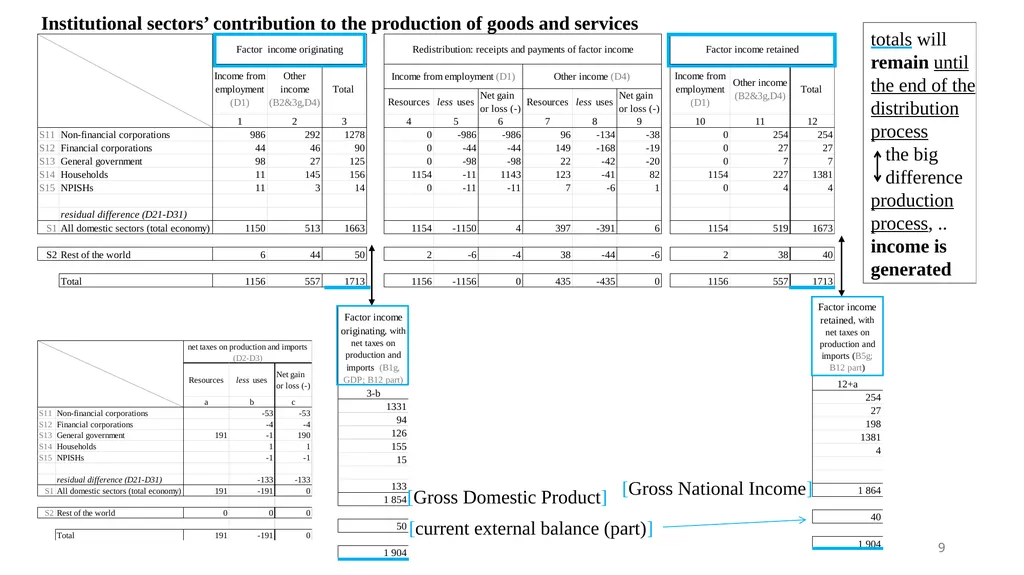
slide9. 9 Institutional sectors’ contribution to the production of goods and services [Gross Domestic Product] [Gross National Income] [current external balance (part)] totals will remain until the end of the distribution process
the big difference
production process, .. income is generated<br>
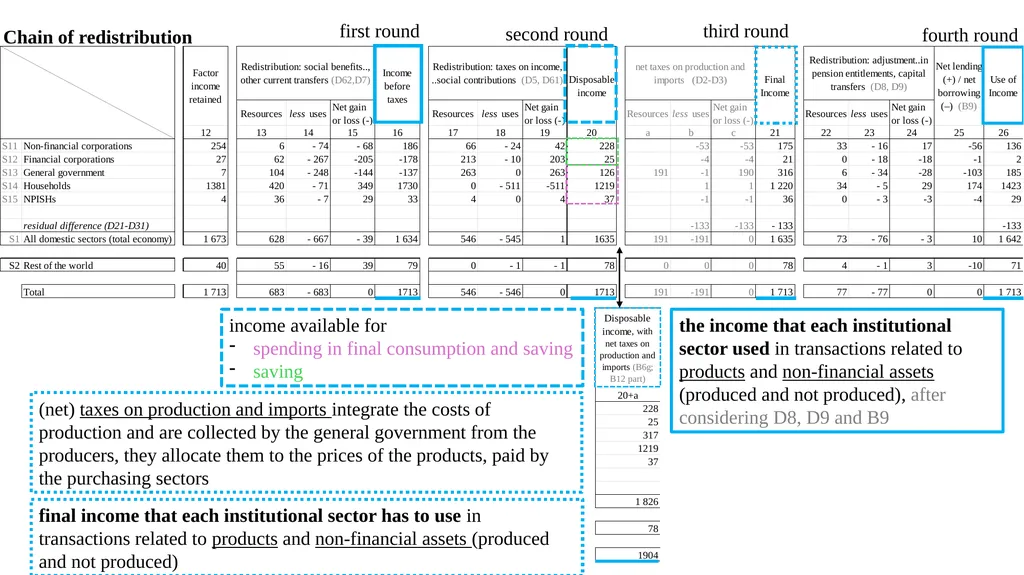
slide10. Chain of redistribution first round second round third round fourth round income available for
spending in final consumption and saving
saving (net) taxes on production and imports integrate the costs of production and are collected by the general government from the producers, they allocate them to the prices of the products, paid by the purchasing sectors final income that each institutional sector has to use in transactions related to products and non-financial assets (produced and not produced) the income that each institutional sector used in transactions related to products and non-financial assets (produced and not produced), after considering D8, D9 and B9<br>
slide11. Institutional interrelations in distributive transactions seen through a magnifying glass. A proposal to improve national accounts data for use in input-output analysis. Santos, S.
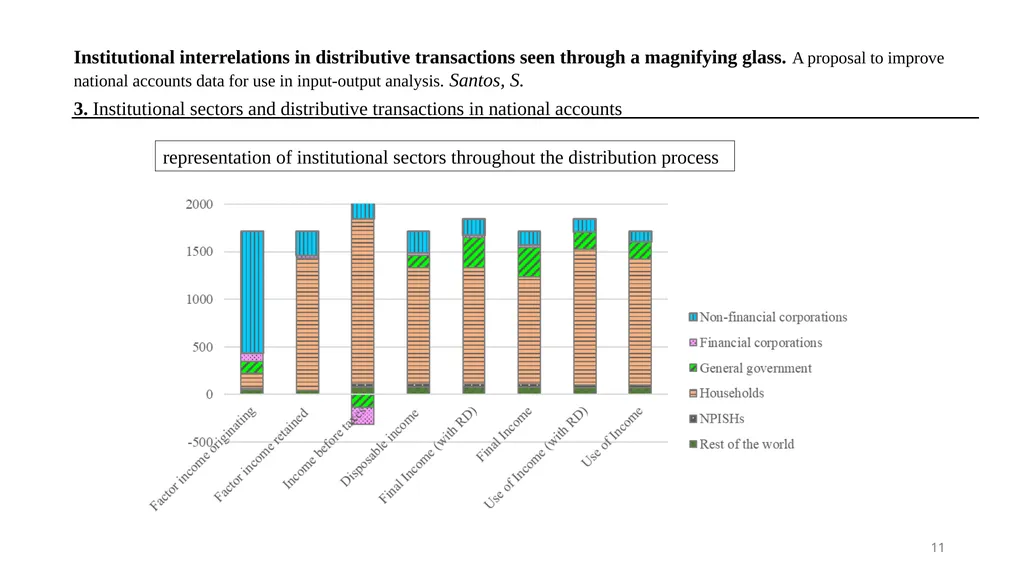
3. Institutional sectors and distributive transactions in national accounts 11 representation of institutional sectors throughout the distribution process<br>
slide12. Institutional interrelations in distributive transactions seen through a magnifying glass. A proposal to improve national accounts data for use in input-output analysis. Santos, S.
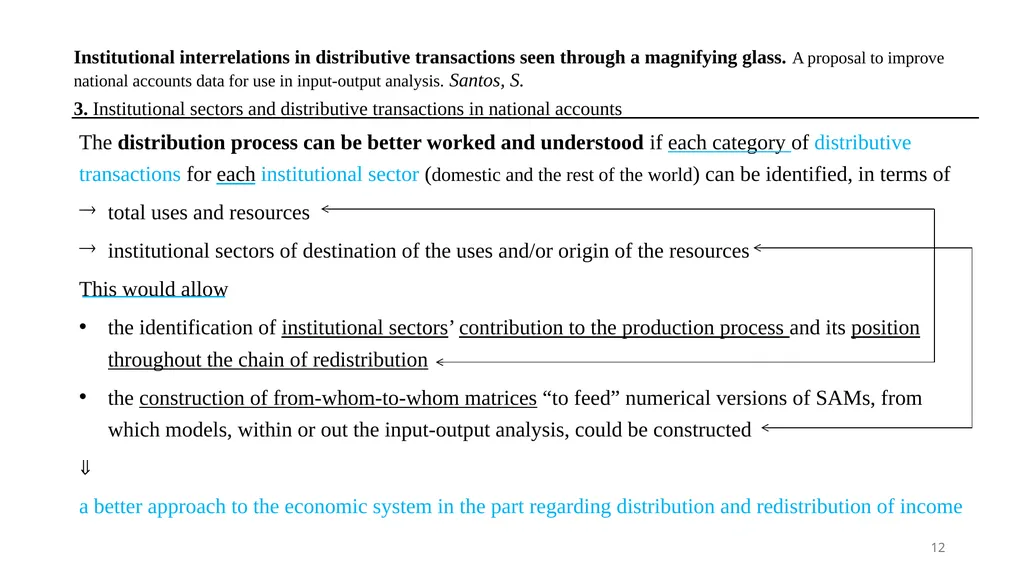
3. Institutional sectors and distributive transactions in national accounts 12 The distribution process can be better worked and understood if each category of distributive transactions for each institutional sector (domestic and the rest of the world) can be identified, in terms of
total uses and resources
institutional sectors of destination of the uses and/or origin of the resources
This would allow
the identification of institutional sectors’ contribution to the production process and its position throughout the chain of redistribution
the construction of from-whom-to-whom matrices “to feed” numerical versions of SAMs, from which models, within or out the input-output analysis, could be constructed
a better approach to the economic system in the part regarding distribution and redistribution of income<br>
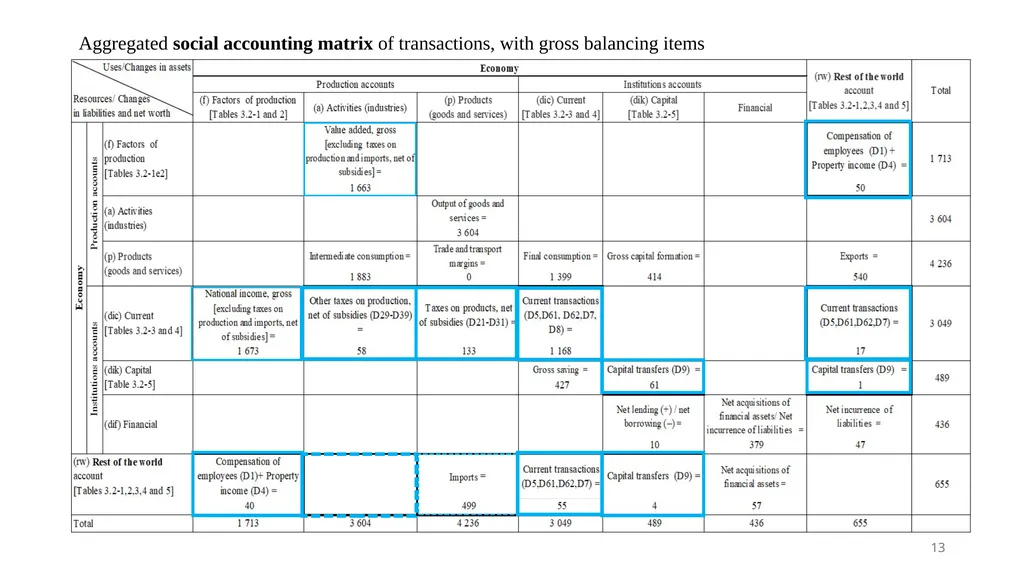
slide13. 13 Aggregated social accounting matrix of transactions, with gross balancing items<br>
slide14. Institutional interrelations in distributive transactions seen through a magnifying glass. A proposal to improve national accounts data for use in input-output analysis. Santos, S.
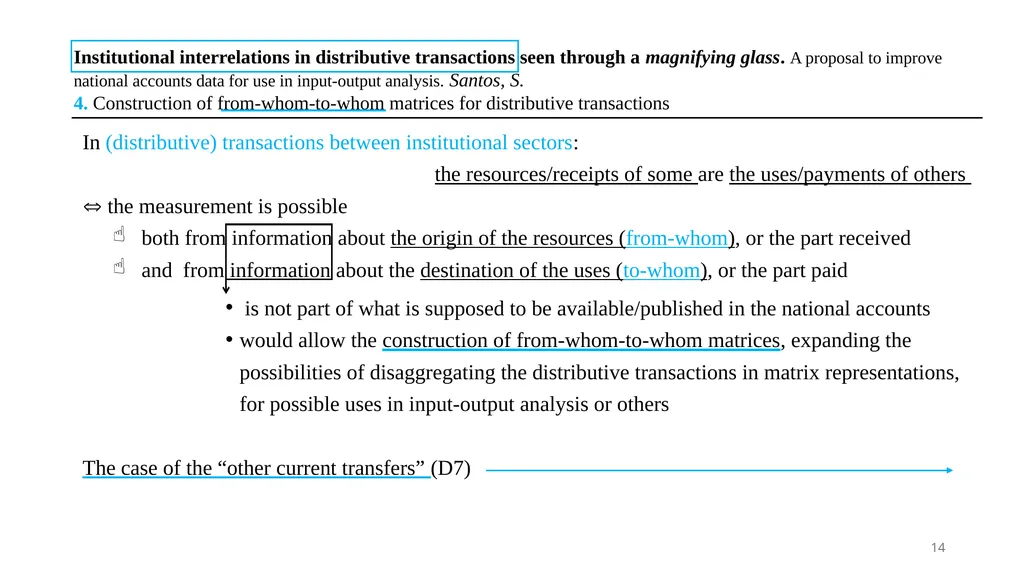
4. Construction of from-whom-to-whom matrices for distributive transactions 14 In (distributive) transactions between institutional sectors:
the resources/receipts of some are the uses/payments of others
the measurement is possible
both from information about the origin of the resources (from-whom), or the part received
and from information about the destination of the uses (to-whom), or the part paid
is not part of what is supposed to be available/published in the national accounts
would allow the construction of from-whom-to-whom matrices, expanding the possibilities of disaggregating the distributive transactions in matrix representations, for possible uses in input-output analysis or others
The case of the “other current transfers” (D7)<br>
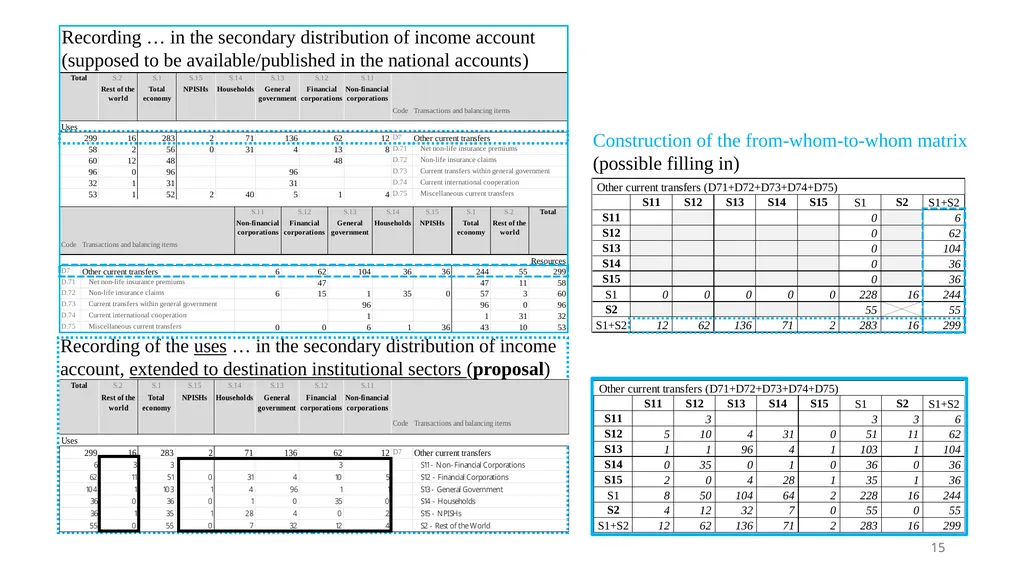
slide15. 15 Recording … in the secondary distribution of income account
(supposed to be available/published in the national accounts) Construction of the from-whom-to-whom matrix (possible filling in) Recording of the uses … in the secondary distribution of income account, extended to destination institutional sectors (proposal)<br>
slide16. Institutional interrelations in distributive transactions seen through a magnifying glass. A proposal to improve national accounts data for use in input-output analysis. Santos, S.
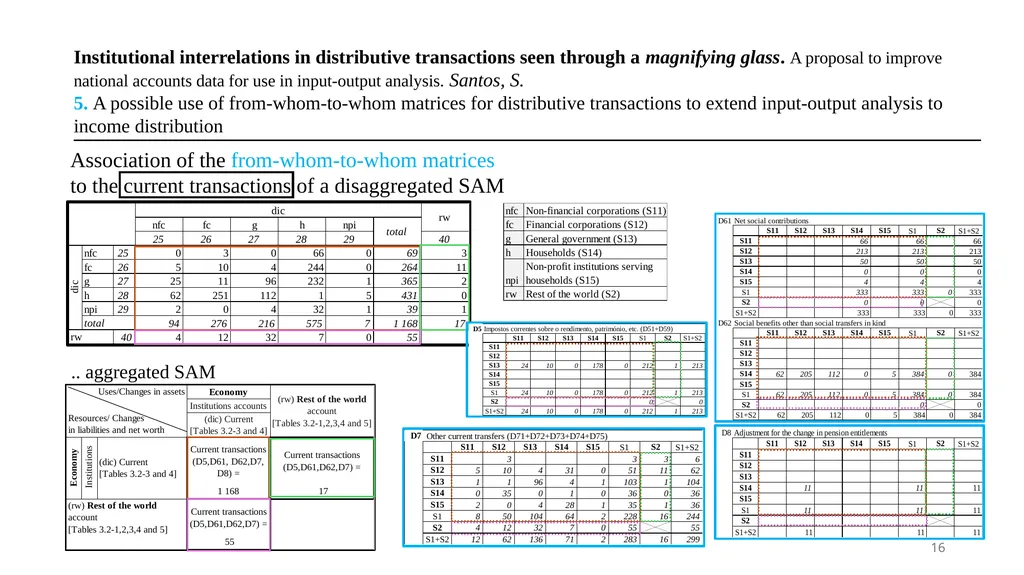
5. A possible use of from-whom-to-whom matrices for distributive transactions to extend input-output analysis to income distribution 16 .. aggregated SAM Association of the from-whom-to-whom matrices to the current transactions of a disaggregated SAM<br>
slide17. Institutional interrelations in distributive transactions seen through a magnifying glass. A proposal to improve national accounts data for use in input-output analysis. Santos, S.
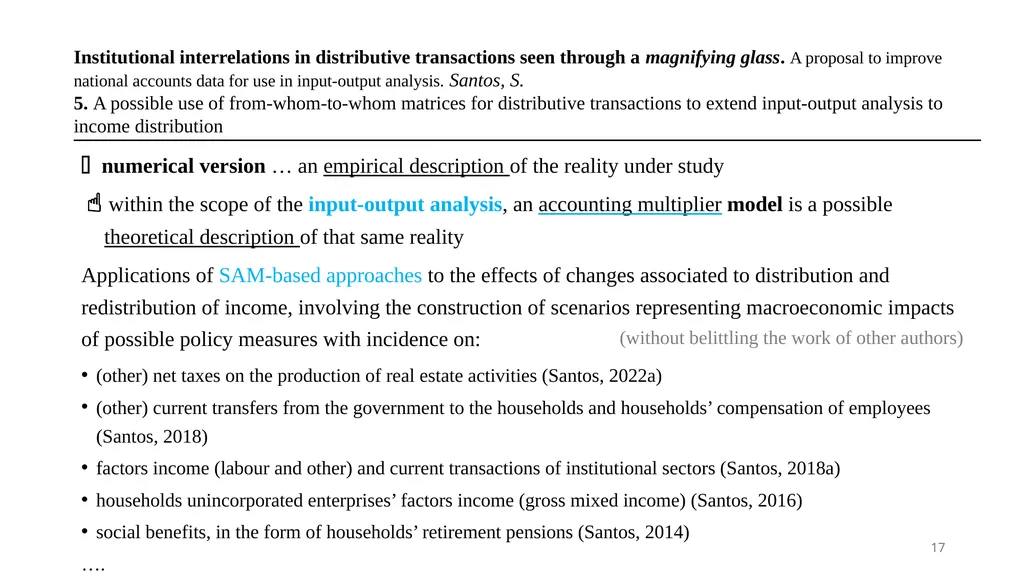
5. A possible use of from-whom-to-whom matrices for distributive transactions to extend input-output analysis to income distribution 17 numerical version … an empirical description of the reality under study
within the scope of the input-output analysis, an accounting multiplier model is a possible theoretical description of that same reality
Applications of SAM-based approaches to the effects of changes associated to distribution and redistribution of income, involving the construction of scenarios representing macroeconomic impacts of possible policy measures with incidence on:
(other) net taxes on the production of real estate activities (Santos, 2022a)
(other) current transfers from the government to the households and households’ compensation of employees (Santos, 2018)
factors income (labour and other) and current transactions of institutional sectors (Santos, 2018a)
households unincorporated enterprises’ factors income (gross mixed income) (Santos, 2016)
social benefits, in the form of households’ retirement pensions (Santos, 2014)
…. (without belittling the work of other authors)<br>
slide18. Institutional interrelations in distributive transactions seen through a magnifying glass. A proposal to improve national accounts data for use in input-output analysis. Santos, S.
6. Concluding remarks 18 “An economic system could be described as a vast machine which operates through decisions. Millions of people sit at the controls. Every time one of them takes a decision, a switch is turned and something happens in the machine… The machine is a very complicated one, a maze of interdependence and feedback… if it is to work well an economic system needs a great deal of information on which to base the innumerable decisions that have to be taken the whole time”.
To deal with the direct and indirect consequences of these decisions, Stone proposed the setting up of
“ .. a system of numerical relationships connecting the facts .. two things are essential .. to combine a synoptic view of the system as a whole with specific knowledge about its parts .. to construct a working model which is so readily computable that it can be used to examine the consequences of a wide variety of assumptions and thus provide a sound framework for … decisions”
(Stone, 1965, p.136-137)
A SAM-based approach - representative of the whole economic system (is terms of transactions)
.. a way of working with the national accounts within the scope of input-output analysis
.. to study the part related to the distribution and redistribution of income<br>
slide19. Institutional interrelations in distributive transactions seen through a magnifying glass. A proposal to improve national accounts data for use in input-output analysis. Santos, S.
6. Concluding remarks 19 institutional interrelations in distributive transactions should be identified and available
from-whom-to-whom matrices could be constructed …
A proposal to overcome the persistent lack of knowledge in the information published regularly, within the scope of the SNA: the extension of the national accounts data on the distributive transactions of the institutional sectors to the institutional sectors of destination of their uses (to-whom) and/or of origin of their resources (from-whom)
This would provide a kind of magnifying glass applied to the distribution process, the quantification of which would make it possible to use input-output analysis in its study
distribution and redistribution of income could be studied within a macroeconomic framework, involving each category of distributive transactions for each institutional sector (domestic and the rest of the world), the level of disaggregation of which could go as far as statistical secrecy, as well as sources and methods, allow
This would be a starting point for deeper studies, using other sources of information …<br>
slide20. Institutional interrelations in distributive transactions seen through a magnifying glass. A proposal to improve national accounts data for use in input-output analysis. Santos, S. 20 Thank you for your attention!
(ssantos@iseg.ulisboa.pt)<br>
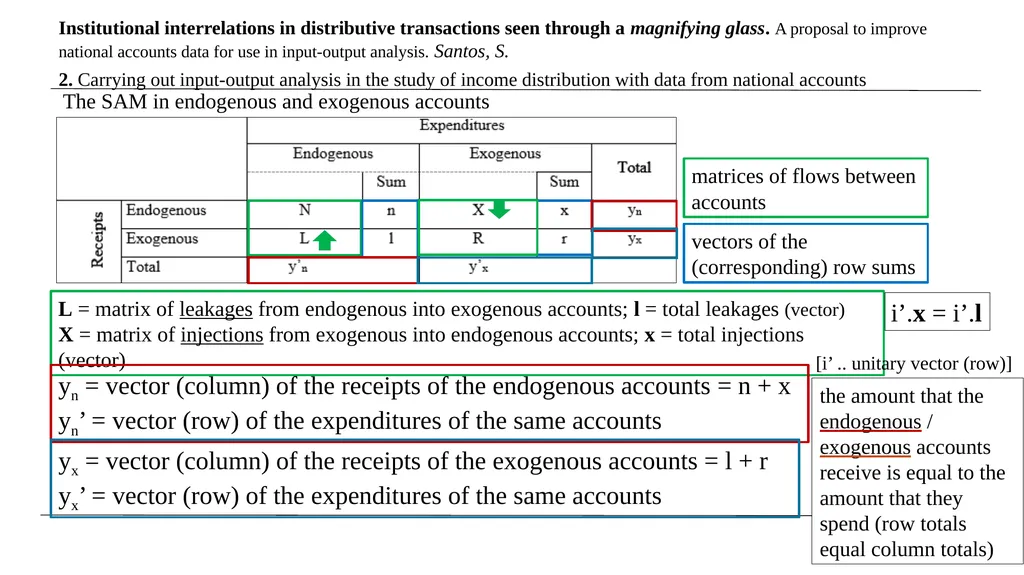
slide21. 21 The SAM in endogenous and exogenous accounts L = matrix of leakages from endogenous into exogenous accounts; l = total leakages (vector)
X = matrix of injections from exogenous into endogenous accounts; x = total injections (vector) vectors of the (corresponding) row sums matrices of flows between accounts yn = vector (column) of the receipts of the endogenous accounts = n + x
yn’ = vector (row) of the expenditures of the same accounts yx = vector (column) of the receipts of the exogenous accounts = l + r
yx’ = vector (row) of the expenditures of the same accounts i’.x = i’.l [i’ .. unitary vector (row)] the amount that the endogenous / exogenous accounts receive is equal to the amount that they spend (row totals equal column totals) Institutional interrelations in distributive transactions seen through a magnifying glass. A proposal to improve national accounts data for use in input-output analysis. Santos, S.
2. Carrying out input-output analysis in the study of income distribution with data from national accounts<br>
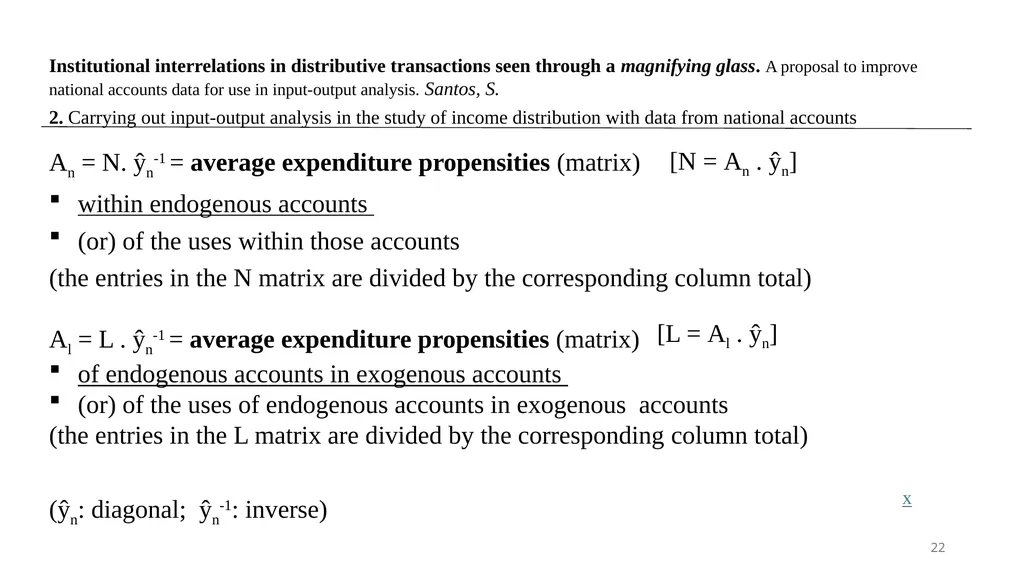
slide22. 22 An = N. ŷn-1 = average expenditure propensities (matrix)
within endogenous accounts
(or) of the uses within those accounts
(the entries in the N matrix are divided by the corresponding column total)
Al = L . ŷn-1 = average expenditure propensities (matrix)
of endogenous accounts in exogenous accounts
(or) of the uses of endogenous accounts in exogenous accounts
(the entries in the L matrix are divided by the corresponding column total)
(ŷn: diagonal; ŷn-1: inverse) [N = An . ŷn] [L = Al . ŷn] Institutional interrelations in distributive transactions seen through a magnifying glass. A proposal to improve national accounts data for use in input-output analysis. Santos, S.
2. Carrying out input-output analysis in the study of income distribution with data from national accounts x<br>
1st - 5th July 2024, Santiago, Chile Institutional interrelations in distributive transactions seen through a magnifying glass.
A proposal to improve national accounts data for use in input-output analysis.
Susana Santos
UECE (Research Unit on Complexity and Economics) - REM (Research in Economics and Mathematics)
ISEG - Lisbon School of Economics and Management, Universidade de Lisboa<br>
slide2. Institutional interrelations in distributive transactions seen through a magnifying glass. A proposal to improve national accounts data for use in input-output analysis. Santos, S.
Outline 2 1. Introduction
2. Carrying out input-output analysis in the study of income distribution with data from national accounts
3. Institutional sectors and distributive transactions in national accounts
4. Construction of from-whom-to-whom matrices for distributive transactions
5. A possible use of from-whom-to-whom matrices for distributive transactions to extend input-output analysis to income distribution
6. Concluding remarks<br>
slide3. Institutional interrelations in distributive transactions seen through a magnifying glass. A proposal to improve national accounts data for use in input-output analysis. Santos, S.
1. Introduction 3 The first step to integrate input-output analysis in national accounts was taken in “A System of National Accounts”, released in 1968, under the chairmanship of Richard Stone.
.. first paragraph to Chapter III (the system as a basis for input-output analysis) of Stone’s authorship
“The input-output data contained in the system appear in the rows and columns relating to commodities and industries. In order to explain and illustrate how these data can be used for input-output analysis, a magnifying glass has been applied to the relevant parts of table 2.1…” (UN, 1968, p. 35; table 2.1 is an illustration of the complete system, in a matrix form, that is, in a social accounting matrix).
“… from a formal point of view, input-output analysis could be carried out with other parts of the national accounts ... Graham Pyatt and his associates presented an analysis ... in which they wanted to emphasise the distribution of income … to set up a framework within which they could analyse actual and potential policies …” (Stone, 1981, pp. 62-63)<br>
slide4. Institutional interrelations in distributive transactions seen through a magnifying glass. A proposal to improve national accounts data for use in input-output analysis. Santos, S.
1. Introduction 4 System of National Accounts (SNA) – 2008, current version, covers
industry interrelations in transactions related to products with the supply and use tables, from which input-output accounts can be conceived
institutional interrelations in financial transactions with the flow-of-funds tables or matrices
institutional interrelations in distributive transactions .. left out
.. based on the work of Richard Stone, Graham Pyatt and some of their followers, namely Jeffery Round
the measurement of … is addressed
a proposal to improve national accounts data for use in input-output analysis is made
… applied to the “national accounts of a fictious country, in a specific year, at current prices, in currency units” - the numerical example used in the 2008 SNA 2025 SNA !?<br>
slide5. [Stone (1986)] Diagram of the functioning of the national accounts facts, organised (sources and methods) as far as possible into a set of accounts – quantitative framework
theories, or hypotheses, about the technical and behavioural relationships that connect the accounts
model,
constructed by combining facts and theories
when translated into quantitative terms will give us an idea how the system under investigation actually works aims, to change the system - introduced in the descriptive model – sketching out a policy
controls, specify the way in which we propose to realise the policy, thus, enabling.. to draw up a plan ...
can run through the computer to show .. the probable repercussions of .. changes throughout the system
.. it is likely that when the plan is actually put into practice, events will reveal its deficiencies
experience reconsider
As experience feeds back… we shall get a better model, a better policy, a better plan 5 Institutional interrelations in distributive transactions seen through a magnifying glass. A proposal to improve national accounts data for use in input-output analysis. Santos, S.
2. Carrying out input-output analysis in the study of income distribution with data from national accounts (data and system)<br>
slide6. 6 A Social Accounting Matrix (square matrix representation of the complete system of national accounts)
has two versions:
a numerical version
describes empirically the activity of a country and the corresponding incomings and outgoings
each cell has a specific numerical value, with the sums of the rows being equal to the sums of the columns
an algebraic version
describes theoretically that same activity
each cell is filled with algebraic expressions that, together with those of all the other cells, form a SAM-based model, the calibration of which involves a replication of the numerical version
SAM-based approach Institutional interrelations in distributive transactions seen through a magnifying glass. A proposal to improve national accounts data for use in input-output analysis. Santos, S.
2. Carrying out input-output analysis in the study of income distribution with data from national accounts<br>
slide7. … changes associated to distribution and redistribution of income
depending on the available data, more or less powerful magnifying glasses can be applied to the parts identified as the focus of interest, allowing more or less detail in the quantification of the effects of the studied changes with the accounting multipliers (Ma), the impact of changes in receipts is analysed at the moment, assuming that the structure of expenditure in the economy does not change 7 yn = n + x = An.yn + x = (I-An)-1.x = Ma.x
l = Al.yn = Al .(I-An)-1.x = Al.Ma.x Institutional interrelations in distributive transactions seen through a magnifying glass. A proposal to improve national accounts data for use in input-output analysis. Santos, S.
2. Carrying out input-output analysis in the study of income distribution with data from national accounts x <br>
slide8. Institutional interrelations in distributive transactions seen through a magnifying glass. A proposal to improve national accounts data for use in input-output analysis. Santos, S.
3. Institutional sectors and distributive transactions in national accounts 8 Institutional sectors - mutually exclusive groups of institutional units
entities with legal responsibility for their actions and various economic functions in the country
distributive transactions
in which the income generated in the production process is distributed among labour, capital and taxes on production and imports
involving redistribution of the income and wealth
involves economic activities that, under the control and responsibility of institutional sectors, use inputs of labour, capital, and goods and services to produce outputs of goods and services
added value = output of goods and services - intermediate consumption = generated income
remuneration of factors of production beginning of the distribution process
(and of the recording of distributive transactions) recorded in current (*) and capital (**) (flow) accounts [(*) distribution of income accounts] [(*) redistribution (and use) of income accounts;
(**) capital (accumulation) account]<br>
slide9. 9 Institutional sectors’ contribution to the production of goods and services [Gross Domestic Product] [Gross National Income] [current external balance (part)] totals will remain until the end of the distribution process
the big difference
production process, .. income is generated<br>
slide10. Chain of redistribution first round second round third round fourth round income available for
spending in final consumption and saving
saving (net) taxes on production and imports integrate the costs of production and are collected by the general government from the producers, they allocate them to the prices of the products, paid by the purchasing sectors final income that each institutional sector has to use in transactions related to products and non-financial assets (produced and not produced) the income that each institutional sector used in transactions related to products and non-financial assets (produced and not produced), after considering D8, D9 and B9<br>
slide11. Institutional interrelations in distributive transactions seen through a magnifying glass. A proposal to improve national accounts data for use in input-output analysis. Santos, S.
3. Institutional sectors and distributive transactions in national accounts 11 representation of institutional sectors throughout the distribution process<br>
slide12. Institutional interrelations in distributive transactions seen through a magnifying glass. A proposal to improve national accounts data for use in input-output analysis. Santos, S.
3. Institutional sectors and distributive transactions in national accounts 12 The distribution process can be better worked and understood if each category of distributive transactions for each institutional sector (domestic and the rest of the world) can be identified, in terms of
total uses and resources
institutional sectors of destination of the uses and/or origin of the resources
This would allow
the identification of institutional sectors’ contribution to the production process and its position throughout the chain of redistribution
the construction of from-whom-to-whom matrices “to feed” numerical versions of SAMs, from which models, within or out the input-output analysis, could be constructed
a better approach to the economic system in the part regarding distribution and redistribution of income<br>
slide13. 13 Aggregated social accounting matrix of transactions, with gross balancing items<br>
slide14. Institutional interrelations in distributive transactions seen through a magnifying glass. A proposal to improve national accounts data for use in input-output analysis. Santos, S.
4. Construction of from-whom-to-whom matrices for distributive transactions 14 In (distributive) transactions between institutional sectors:
the resources/receipts of some are the uses/payments of others
the measurement is possible
both from information about the origin of the resources (from-whom), or the part received
and from information about the destination of the uses (to-whom), or the part paid
is not part of what is supposed to be available/published in the national accounts
would allow the construction of from-whom-to-whom matrices, expanding the possibilities of disaggregating the distributive transactions in matrix representations, for possible uses in input-output analysis or others
The case of the “other current transfers” (D7)<br>
slide15. 15 Recording … in the secondary distribution of income account
(supposed to be available/published in the national accounts) Construction of the from-whom-to-whom matrix (possible filling in) Recording of the uses … in the secondary distribution of income account, extended to destination institutional sectors (proposal)<br>
slide16. Institutional interrelations in distributive transactions seen through a magnifying glass. A proposal to improve national accounts data for use in input-output analysis. Santos, S.
5. A possible use of from-whom-to-whom matrices for distributive transactions to extend input-output analysis to income distribution 16 .. aggregated SAM Association of the from-whom-to-whom matrices to the current transactions of a disaggregated SAM<br>
slide17. Institutional interrelations in distributive transactions seen through a magnifying glass. A proposal to improve national accounts data for use in input-output analysis. Santos, S.
5. A possible use of from-whom-to-whom matrices for distributive transactions to extend input-output analysis to income distribution 17 numerical version … an empirical description of the reality under study
within the scope of the input-output analysis, an accounting multiplier model is a possible theoretical description of that same reality
Applications of SAM-based approaches to the effects of changes associated to distribution and redistribution of income, involving the construction of scenarios representing macroeconomic impacts of possible policy measures with incidence on:
(other) net taxes on the production of real estate activities (Santos, 2022a)
(other) current transfers from the government to the households and households’ compensation of employees (Santos, 2018)
factors income (labour and other) and current transactions of institutional sectors (Santos, 2018a)
households unincorporated enterprises’ factors income (gross mixed income) (Santos, 2016)
social benefits, in the form of households’ retirement pensions (Santos, 2014)
…. (without belittling the work of other authors)<br>
slide18. Institutional interrelations in distributive transactions seen through a magnifying glass. A proposal to improve national accounts data for use in input-output analysis. Santos, S.
6. Concluding remarks 18 “An economic system could be described as a vast machine which operates through decisions. Millions of people sit at the controls. Every time one of them takes a decision, a switch is turned and something happens in the machine… The machine is a very complicated one, a maze of interdependence and feedback… if it is to work well an economic system needs a great deal of information on which to base the innumerable decisions that have to be taken the whole time”.
To deal with the direct and indirect consequences of these decisions, Stone proposed the setting up of
“ .. a system of numerical relationships connecting the facts .. two things are essential .. to combine a synoptic view of the system as a whole with specific knowledge about its parts .. to construct a working model which is so readily computable that it can be used to examine the consequences of a wide variety of assumptions and thus provide a sound framework for … decisions”
(Stone, 1965, p.136-137)
A SAM-based approach - representative of the whole economic system (is terms of transactions)
.. a way of working with the national accounts within the scope of input-output analysis
.. to study the part related to the distribution and redistribution of income<br>
slide19. Institutional interrelations in distributive transactions seen through a magnifying glass. A proposal to improve national accounts data for use in input-output analysis. Santos, S.
6. Concluding remarks 19 institutional interrelations in distributive transactions should be identified and available
from-whom-to-whom matrices could be constructed …
A proposal to overcome the persistent lack of knowledge in the information published regularly, within the scope of the SNA: the extension of the national accounts data on the distributive transactions of the institutional sectors to the institutional sectors of destination of their uses (to-whom) and/or of origin of their resources (from-whom)
This would provide a kind of magnifying glass applied to the distribution process, the quantification of which would make it possible to use input-output analysis in its study
distribution and redistribution of income could be studied within a macroeconomic framework, involving each category of distributive transactions for each institutional sector (domestic and the rest of the world), the level of disaggregation of which could go as far as statistical secrecy, as well as sources and methods, allow
This would be a starting point for deeper studies, using other sources of information …<br>
slide20. Institutional interrelations in distributive transactions seen through a magnifying glass. A proposal to improve national accounts data for use in input-output analysis. Santos, S. 20 Thank you for your attention!
(ssantos@iseg.ulisboa.pt)<br>
slide21. 21 The SAM in endogenous and exogenous accounts L = matrix of leakages from endogenous into exogenous accounts; l = total leakages (vector)
X = matrix of injections from exogenous into endogenous accounts; x = total injections (vector) vectors of the (corresponding) row sums matrices of flows between accounts yn = vector (column) of the receipts of the endogenous accounts = n + x
yn’ = vector (row) of the expenditures of the same accounts yx = vector (column) of the receipts of the exogenous accounts = l + r
yx’ = vector (row) of the expenditures of the same accounts i’.x = i’.l [i’ .. unitary vector (row)] the amount that the endogenous / exogenous accounts receive is equal to the amount that they spend (row totals equal column totals) Institutional interrelations in distributive transactions seen through a magnifying glass. A proposal to improve national accounts data for use in input-output analysis. Santos, S.
2. Carrying out input-output analysis in the study of income distribution with data from national accounts<br>
slide22. 22 An = N. ŷn-1 = average expenditure propensities (matrix)
within endogenous accounts
(or) of the uses within those accounts
(the entries in the N matrix are divided by the corresponding column total)
Al = L . ŷn-1 = average expenditure propensities (matrix)
of endogenous accounts in exogenous accounts
(or) of the uses of endogenous accounts in exogenous accounts
(the entries in the L matrix are divided by the corresponding column total)
(ŷn: diagonal; ŷn-1: inverse) [N = An . ŷn] [L = Al . ŷn] Institutional interrelations in distributive transactions seen through a magnifying glass. A proposal to improve national accounts data for use in input-output analysis. Santos, S.
2. Carrying out input-output analysis in the study of income distribution with data from national accounts x<br>