
38 CFR Part 4 Schedule for Rating Disabilities 1
TA
Published · 84 slides · 0 views

1 / 1

























Description
38 CFR Part 4 Schedule for Rating Disabilities 1 OVERVIEW This Class is designed to be a general overview and summary of 38 CFR Part 4 You do not need to memorize the regulations By the end of this session you will understand VA math After
Related Topics
Share
Embed code
Download this presentation From Below
"38 CFR Part 4 Schedule for Rating Disabilities 1" is the property of its rightful owner. Permission is granted to download and print the materials on this website for personal, non-commercial use only, and to display it on your personal computer provided you do not modify the materials and that you retain all copyright notices contained in the materials. By downloading content from our website, you accept the terms of this agreement.
Presentation Transcript
01
38 CFR Part 4
Schedule for Rating Disabilities 1<br>
02
OVERVIEW This Class is designed to be a general overview and summary of 38 CFR Part 4
You do not need to memorize the regulations
By the end of this session you will understand VA math
After the session we will use the breakout rooms to practice VA Math 2<br>
You do not need to memorize the regulations
By the end of this session you will understand VA math
After the session we will use the breakout rooms to practice VA Math 2<br>
03
SUBPART A
GENERAL POLICY IN RATING
38 CFR 4.1-38 CFR 4.31 3<br>
04
§ 4.1 ESSENTIALS OF EVALUATIVE
RATING Explains the purpose of the rating schedule including that rating percentages represent the Average Impairment of Earnings Capacity resulting from disabilities or diseases
Also explains that accurate Medical Exams are Required to determine the limitation of activity imposed by the disabling condition and that all evaluations must be viewed in relation to its history 4<br>
Also explains that accurate Medical Exams are Required to determine the limitation of activity imposed by the disabling condition and that all evaluations must be viewed in relation to its history 4<br>
05
§ 4.3 RESOLUTION OF REASONABLE DOUBT “When after careful consideration to all procurable and assembled data, a reasonable doubt arises regarding the degree of disability such doubt will be resolved in favor of the claimant”
One small paragraph, one giant effect!
Does NOT mean that the VA is required to prove the disability is not related to service
Require a relatively equal balance of positive and negative evidence (equipoise)
Refer to 38 C.F.R. 3.102 5<br>
One small paragraph, one giant effect!
Does NOT mean that the VA is required to prove the disability is not related to service
Require a relatively equal balance of positive and negative evidence (equipoise)
Refer to 38 C.F.R. 3.102 5<br>
06
§ 4.6 EVALUATION OF EVIDENCE This regulation explains that all evidence that is part of the claim must be thoroughly evaluated and considered prior to rendering a decision 6<br>
07
§ 4.7 HIGHER OF TWO EVALUATIONS “Where there is a question as to which of two evaluations shall be applied, the higher evaluation will be assigned if the disability picture more nearly approximates the criteria required for that rating. Otherwise the lower rating will be assigned.”
Arguably the most arguable regulation!
Arbitrary - allows for assigning either a higher, or lower evaluation???
Example:
A veteran has a disability with symptoms that warrant both a 30% and 40% rating. The rater should look at which rating most closely resembles the current severity of the disability and assign that rating percentage 7<br>
Arguably the most arguable regulation!
Arbitrary - allows for assigning either a higher, or lower evaluation???
Example:
A veteran has a disability with symptoms that warrant both a 30% and 40% rating. The rater should look at which rating most closely resembles the current severity of the disability and assign that rating percentage 7<br>
08
§ 4.9 CONGENITAL DEFECTS Congenital or developmental defects are NOT normally compensable or service-connected!
But… Is there a way??? 8<br>
But… Is there a way??? 8<br>
09
§ 4.10 FUNCTIONAL IMPAIRMENT The basis of an evaluation is the ability of the body, as a whole, to function under ordinary conditions of daily life.
Regardless of the body system affected, evaluations are based on the usefulness of the affected body part or system
The examiner must provide a full description of the effects of the disability on the veteran’s ordinary activity to include employment
Must be remembered that although the veteran may be up and about or can function at home, they still may be too disabled to maintain employment 9<br>
Regardless of the body system affected, evaluations are based on the usefulness of the affected body part or system
The examiner must provide a full description of the effects of the disability on the veteran’s ordinary activity to include employment
Must be remembered that although the veteran may be up and about or can function at home, they still may be too disabled to maintain employment 9<br>
10
§ 4.13 EFFECT OF CHANGE OF DIAGNOSIS This regulation explains that if the medical evidence shows that a change in diagnosis could be assigned it must be an actual medical change based on the symptoms not on the interpretation or thoroughness of the examiner
Repercussions of change
This regulation is often used when rating mental health disorders (38 CFR 4.125)
Ensure any changes in diagnosis align with 38 CFR 4.7 10<br>
Repercussions of change
This regulation is often used when rating mental health disorders (38 CFR 4.125)
Ensure any changes in diagnosis align with 38 CFR 4.7 10<br>
11
§ 4.14 AVOIDANCE OF PYRAMIDING VA will not rate the same disability or symptom more than once
Pay close attention to which symptoms relate to each disability as many body systems overlap and symptoms can often relate to more than one disability
Special rules (exemptions) are in the Rating Schedule
NSC versus SC etiologies
VA is very aware of this rule! 11<br>
Pay close attention to which symptoms relate to each disability as many body systems overlap and symptoms can often relate to more than one disability
Special rules (exemptions) are in the Rating Schedule
NSC versus SC etiologies
VA is very aware of this rule! 11<br>
12
§ 4.15 TOTAL DISABILITY RATINGS Disabilities can affect people differently
Ratings are based on the average impairment of earning capacity – not the individuals success in overcoming it
Individual success should still be measured as the VA can use it to determine a rating if the veteran does not have the average amount of success overcoming or adapting to the disability
Total Disability (P&T) Ratings – Disability is severe enough to prevent an average person from securing or maintaining employment
A total disability rating does not mean that the veteran is not allowed to work 12<br>
Ratings are based on the average impairment of earning capacity – not the individuals success in overcoming it
Individual success should still be measured as the VA can use it to determine a rating if the veteran does not have the average amount of success overcoming or adapting to the disability
Total Disability (P&T) Ratings – Disability is severe enough to prevent an average person from securing or maintaining employment
A total disability rating does not mean that the veteran is not allowed to work 12<br>
13
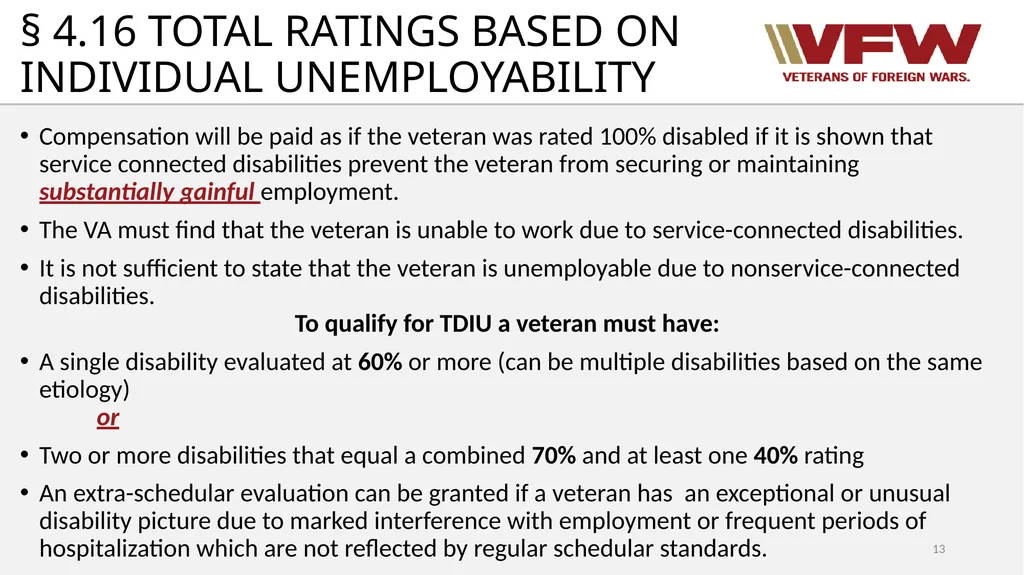
§ 4.16 TOTAL RATINGS BASED ON
INDIVIDUAL UNEMPLOYABILITY Compensation will be paid as if the veteran was rated 100% disabled if it is shown that service connected disabilities prevent the veteran from securing or maintaining substantially gainful employment.
The VA must find that the veteran is unable to work due to service-connected disabilities.
It is not sufficient to state that the veteran is unemployable due to nonservice-connected disabilities.
To qualify for TDIU a veteran must have:
A single disability evaluated at 60% or more (can be multiple disabilities based on the same etiology)
or
Two or more disabilities that equal a combined 70% and at least one 40% rating
An extra-schedular evaluation can be granted if a veteran has an exceptional or unusual disability picture due to marked interference with employment or frequent periods of hospitalization which are not reflected by regular schedular standards. 13<br>
The VA must find that the veteran is unable to work due to service-connected disabilities.
It is not sufficient to state that the veteran is unemployable due to nonservice-connected disabilities.
To qualify for TDIU a veteran must have:
A single disability evaluated at 60% or more (can be multiple disabilities based on the same etiology)
or
Two or more disabilities that equal a combined 70% and at least one 40% rating
An extra-schedular evaluation can be granted if a veteran has an exceptional or unusual disability picture due to marked interference with employment or frequent periods of hospitalization which are not reflected by regular schedular standards. 13<br>
14
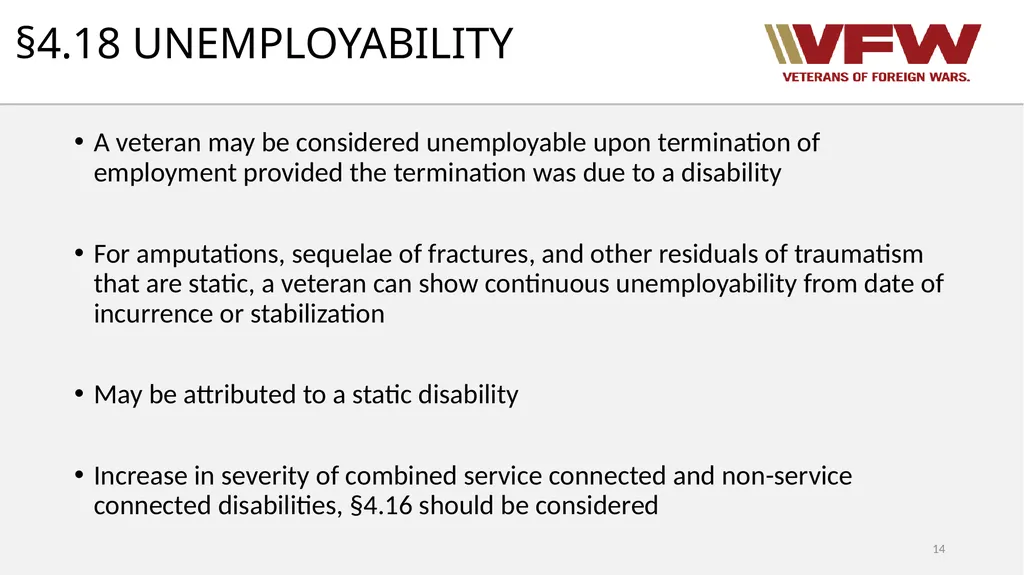
§4.18 UNEMPLOYABILITY A veteran may be considered unemployable upon termination of employment provided the termination was due to a disability
For amputations, sequelae of fractures, and other residuals of traumatism that are static, a veteran can show continuous unemployability from date of incurrence or stabilization
May be attributed to a static disability
Increase in severity of combined service connected and non-service connected disabilities, §4.16 should be considered 14<br>
For amputations, sequelae of fractures, and other residuals of traumatism that are static, a veteran can show continuous unemployability from date of incurrence or stabilization
May be attributed to a static disability
Increase in severity of combined service connected and non-service connected disabilities, §4.16 should be considered 14<br>
15
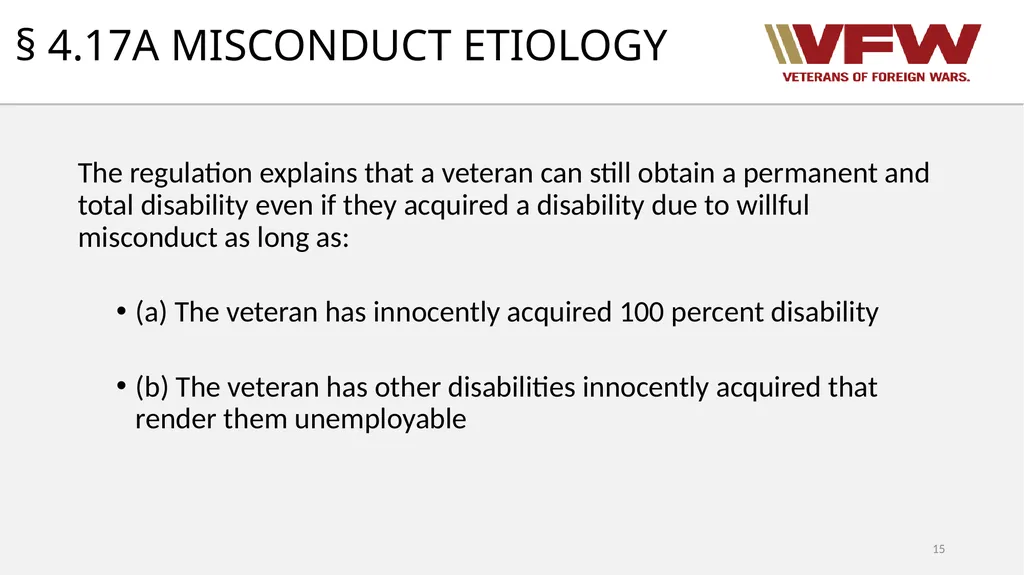
§ 4.17A MISCONDUCT ETIOLOGY The regulation explains that a veteran can still obtain a permanent and total disability even if they acquired a disability due to willful misconduct as long as:
(a) The veteran has innocently acquired 100 percent disability
(b) The veteran has other disabilities innocently acquired that render them unemployable 15<br>
(a) The veteran has innocently acquired 100 percent disability
(b) The veteran has other disabilities innocently acquired that render them unemployable 15<br>
16
§4.19 AGE IN SERVICE-CONNECTED CLAIMS May not be used
deciding service-connected disability or unemployability
as a basis to grant a total disability rating
Age can be a factor in evaluations of disability not resulting from service (Non-Service Connected Pension) 16<br>
deciding service-connected disability or unemployability
as a basis to grant a total disability rating
Age can be a factor in evaluations of disability not resulting from service (Non-Service Connected Pension) 16<br>
17
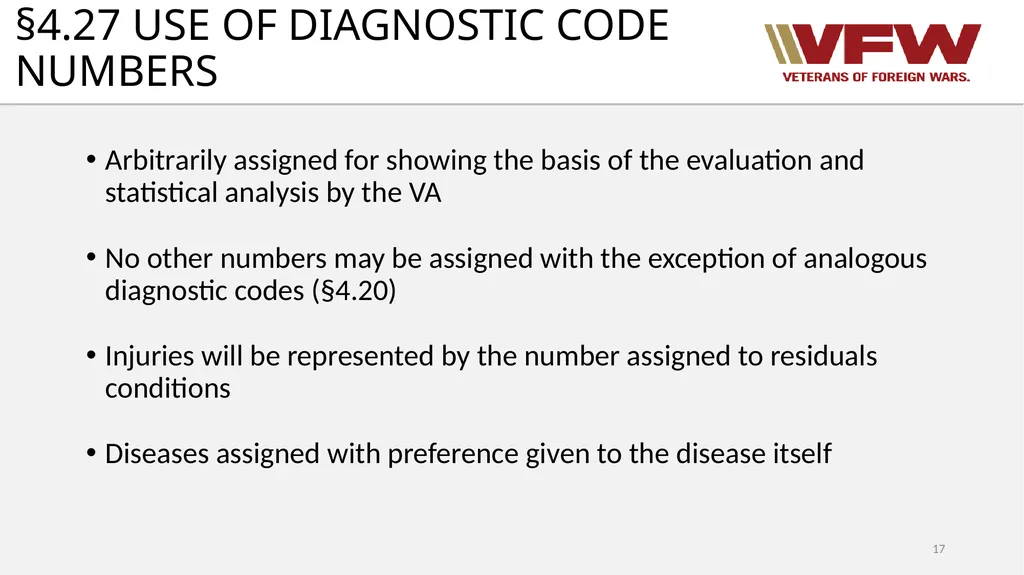
§4.27 USE OF DIAGNOSTIC CODE NUMBERS Arbitrarily assigned for showing the basis of the evaluation and statistical analysis by the VA
No other numbers may be assigned with the exception of analogous diagnostic codes (§4.20)
Injuries will be represented by the number assigned to residuals conditions
Diseases assigned with preference given to the disease itself 17<br>
No other numbers may be assigned with the exception of analogous diagnostic codes (§4.20)
Injuries will be represented by the number assigned to residuals conditions
Diseases assigned with preference given to the disease itself 17<br>
18
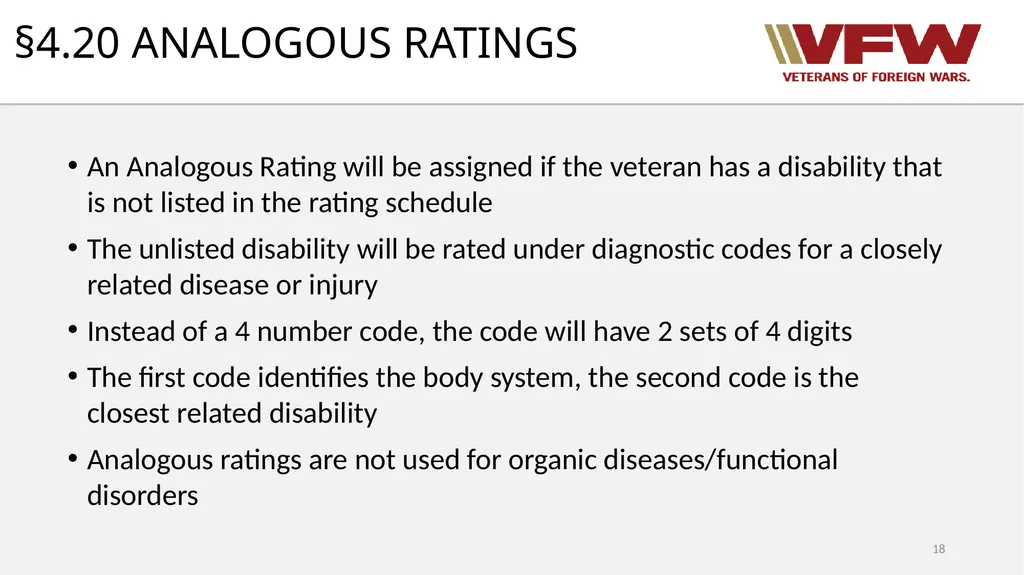
§4.20 ANALOGOUS RATINGS An Analogous Rating will be assigned if the veteran has a disability that is not listed in the rating schedule
The unlisted disability will be rated under diagnostic codes for a closely related disease or injury
Instead of a 4 number code, the code will have 2 sets of 4 digits
The first code identifies the body system, the second code is the closest related disability
Analogous ratings are not used for organic diseases/functional disorders 18<br>
The unlisted disability will be rated under diagnostic codes for a closely related disease or injury
Instead of a 4 number code, the code will have 2 sets of 4 digits
The first code identifies the body system, the second code is the closest related disability
Analogous ratings are not used for organic diseases/functional disorders 18<br>
19
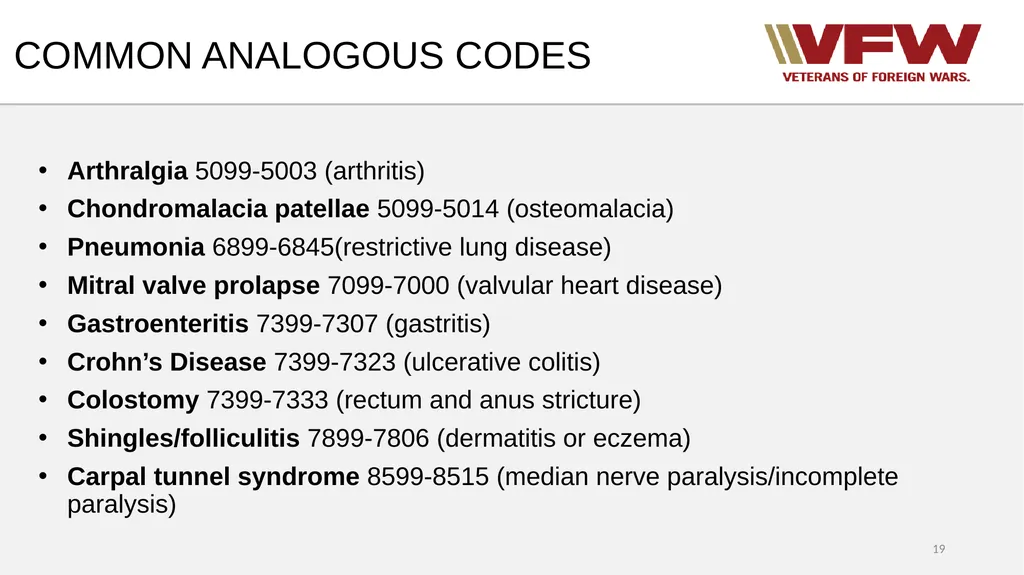
COMMON ANALOGOUS CODES Arthralgia 5099-5003 (arthritis)
Chondromalacia patellae 5099-5014 (osteomalacia)
Pneumonia 6899-6845(restrictive lung disease)
Mitral valve prolapse 7099-7000 (valvular heart disease)
Gastroenteritis 7399-7307 (gastritis)
Crohn’s Disease 7399-7323 (ulcerative colitis)
Colostomy 7399-7333 (rectum and anus stricture)
Shingles/folliculitis 7899-7806 (dermatitis or eczema)
Carpal tunnel syndrome 8599-8515 (median nerve paralysis/incomplete paralysis) 19<br>
Chondromalacia patellae 5099-5014 (osteomalacia)
Pneumonia 6899-6845(restrictive lung disease)
Mitral valve prolapse 7099-7000 (valvular heart disease)
Gastroenteritis 7399-7307 (gastritis)
Crohn’s Disease 7399-7323 (ulcerative colitis)
Colostomy 7399-7333 (rectum and anus stricture)
Shingles/folliculitis 7899-7806 (dermatitis or eczema)
Carpal tunnel syndrome 8599-8515 (median nerve paralysis/incomplete paralysis) 19<br>
20
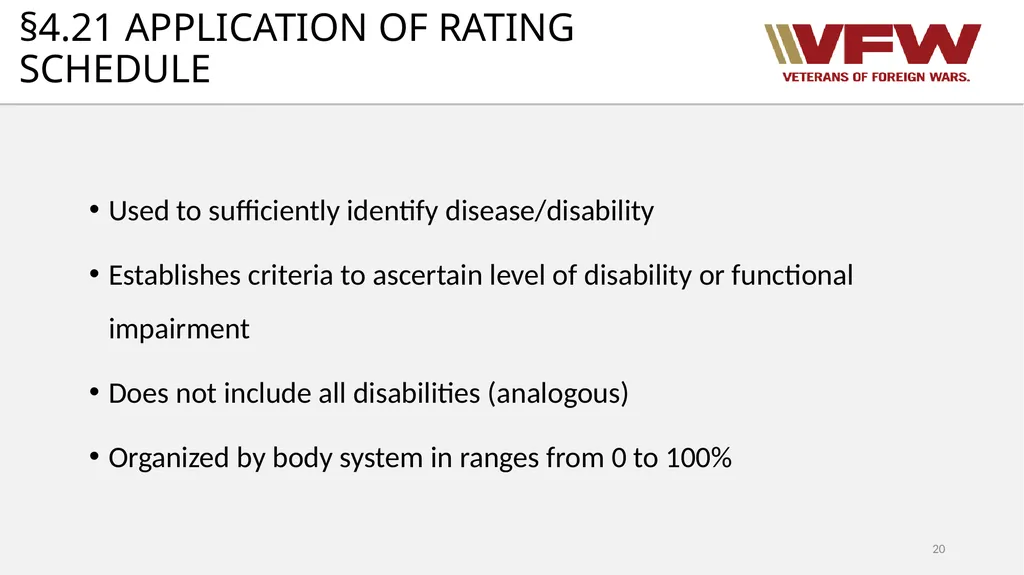
§4.21 APPLICATION OF RATING SCHEDULE Used to sufficiently identify disease/disability
Establishes criteria to ascertain level of disability or functional impairment
Does not include all disabilities (analogous)
Organized by body system in ranges from 0 to 100% 20<br>
Establishes criteria to ascertain level of disability or functional impairment
Does not include all disabilities (analogous)
Organized by body system in ranges from 0 to 100% 20<br>
21
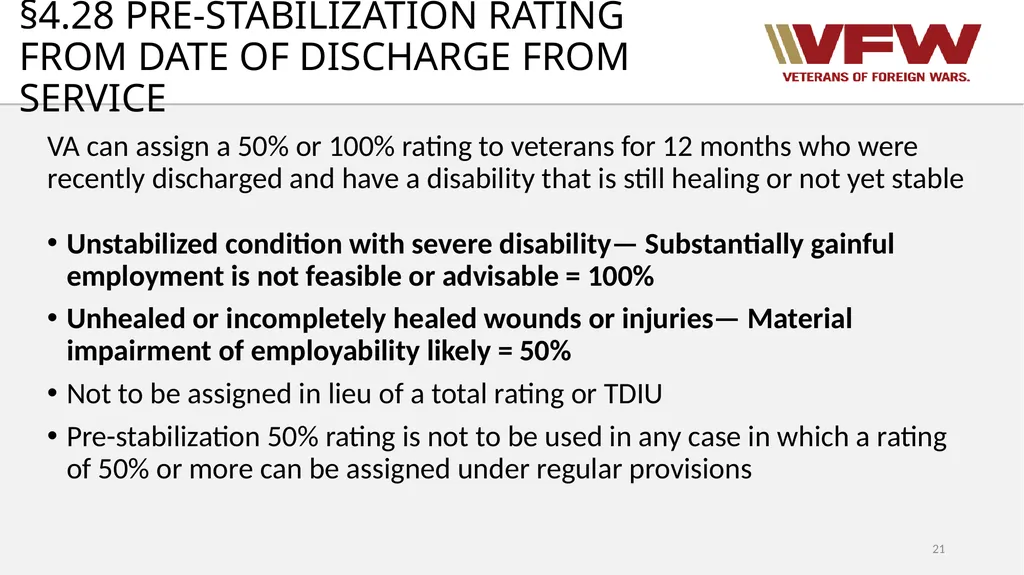
§4.28 PRE-STABILIZATION RATING FROM DATE OF DISCHARGE FROM SERVICE VA can assign a 50% or 100% rating to veterans for 12 months who were recently discharged and have a disability that is still healing or not yet stable
Unstabilized condition with severe disability— Substantially gainful employment is not feasible or advisable = 100%
Unhealed or incompletely healed wounds or injuries— Material impairment of employability likely = 50%
Not to be assigned in lieu of a total rating or TDIU
Pre-stabilization 50% rating is not to be used in any case in which a rating of 50% or more can be assigned under regular provisions 21<br>
Unstabilized condition with severe disability— Substantially gainful employment is not feasible or advisable = 100%
Unhealed or incompletely healed wounds or injuries— Material impairment of employability likely = 50%
Not to be assigned in lieu of a total rating or TDIU
Pre-stabilization 50% rating is not to be used in any case in which a rating of 50% or more can be assigned under regular provisions 21<br>
22
§4.29 HOSPITALIZATION 100% rating will be assigned for hospitalization for SC disability for a period in excess of 21 days
Temporary release approved by a VA doctor as part of treatment will not be considered an absence
If convalescence is required may be continued for an additional 1-3 months
Additional periods may be approved by the Veterans Service Center Manager (VSCM) 22<br>
Temporary release approved by a VA doctor as part of treatment will not be considered an absence
If convalescence is required may be continued for an additional 1-3 months
Additional periods may be approved by the Veterans Service Center Manager (VSCM) 22<br>
23
§4.30 CONVALESCENT RATINGS Total ratings will be assigned if convalescence is required or surgery with severe postoperative residuals
Immobilization by cast without surgery of one or more major joints
Extensions of 1-3 months beyond the initial 3 months may be made
Extensions of 1 or more months up to 6 months beyond the initial 6 months may be made by the VSCM 23<br>
Immobilization by cast without surgery of one or more major joints
Extensions of 1-3 months beyond the initial 3 months may be made
Extensions of 1 or more months up to 6 months beyond the initial 6 months may be made by the VSCM 23<br>
24
§4.31 ZERO PERCENT EVALUATIONS Every service connected condition can be granted a 0% rating if the criteria for the minimum compensable rating is not met
This means that if the veteran has a diagnosed disability that is related to service but does not have severe enough symptoms to warrant the minimum rating in the schedule, VA can assign a 0% rating 24<br>
This means that if the veteran has a diagnosed disability that is related to service but does not have severe enough symptoms to warrant the minimum rating in the schedule, VA can assign a 0% rating 24<br>
25
38 CFR Part 4
Subpart- B
Disability Rating
§4.40 - §4.150 25<br>
Subpart- B
Disability Rating
§4.40 - §4.150 25<br>
26
§4.40 FUNCTIONAL LOSS Functional loss is the inability to perform the normal working movements of the body and is determined by:
Strength
Speed
Coordination
Endurance
Weakness and Limitation of Motion are both important 26<br>
Strength
Speed
Coordination
Endurance
Weakness and Limitation of Motion are both important 26<br>
27
§4.40 FUNCTIONAL LOSS DeLuca v. Brown, 8 Vet.App. 202 (1995)
States that if a veteran has a disability of a joint that is painful upon motion or repetitive use, VA should assign the minimum compensable rating or increase the rating by one level if the veteran is already entitled to a compensable rating. 27<br>
States that if a veteran has a disability of a joint that is painful upon motion or repetitive use, VA should assign the minimum compensable rating or increase the rating by one level if the veteran is already entitled to a compensable rating. 27<br>
28
§4.41 HISTORY OF INJURY Residuals of an injury
Mechanism of Injury
Treatment
Effectiveness
Duration
The absence of clear cut evidence of injury, may reflect congenital or developmental etiology, or the effects of a healed disease 28<br>
Mechanism of Injury
Treatment
Effectiveness
Duration
The absence of clear cut evidence of injury, may reflect congenital or developmental etiology, or the effects of a healed disease 28<br>
29
§4.42 COMPLETE MEDICAL EXAMINATION
OF INJURY CASES Must include all systems of the body affected
General examination
Complete Neurological & Psychiatric
Special Exams as indicated
Orthopedic
Surgical 29<br>
General examination
Complete Neurological & Psychiatric
Special Exams as indicated
Orthopedic
Surgical 29<br>
30
§4.43 OSTEOMYELITIS DC 5000
Chronic or recurring
Considered continuously disabling
Unless removed by amputation
A permanent rating can be combined with other ratings for residual conditions 30<br>
Chronic or recurring
Considered continuously disabling
Unless removed by amputation
A permanent rating can be combined with other ratings for residual conditions 30<br>
31
§4.44 THE BONES Malunion
Disarticulation
Shortening
Consider strain on neighboring joints 31<br>
Disarticulation
Shortening
Consider strain on neighboring joints 31<br>
32
§4.45 THE JOINTS Less movement
More movement
Weakened movement
Fatigability
Incoordination
Pain
Major Joints – Shoulder, elbow, wrist, hip, knee, ankle
Minor Joints – Vertebrae, all smaller joints 32<br>
More movement
Weakened movement
Fatigability
Incoordination
Pain
Major Joints – Shoulder, elbow, wrist, hip, knee, ankle
Minor Joints – Vertebrae, all smaller joints 32<br>
33
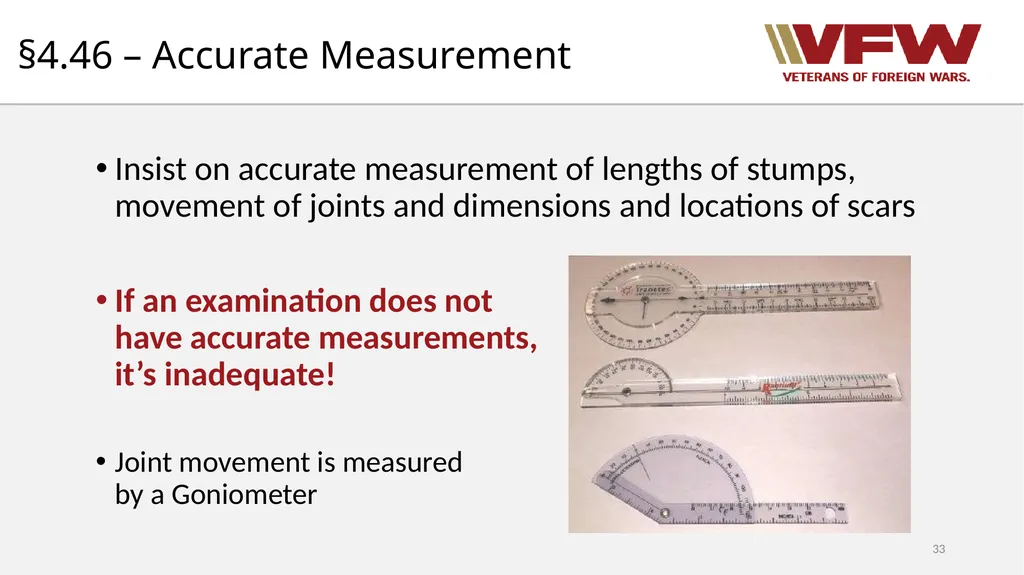
§4.46 – Accurate Measurement Insist on accurate measurement of lengths of stumps, movement of joints and dimensions and locations of scars
If an examination does not have accurate measurements, it’s inadequate!
Joint movement is measured by a Goniometer 33<br>
If an examination does not have accurate measurements, it’s inadequate!
Joint movement is measured by a Goniometer 33<br>
34
§4.55 PRINCIPLES OF COMBINED RATINGS
FOR MUSCLE INJURIES 38 CFR §4.73 – Schedule of Ratings
DC 5301-5323
32 groups
8 regions 34<br>
DC 5301-5323
32 groups
8 regions 34<br>
35
§4.55 PRINCIPLES OF COMBINED RATINGS
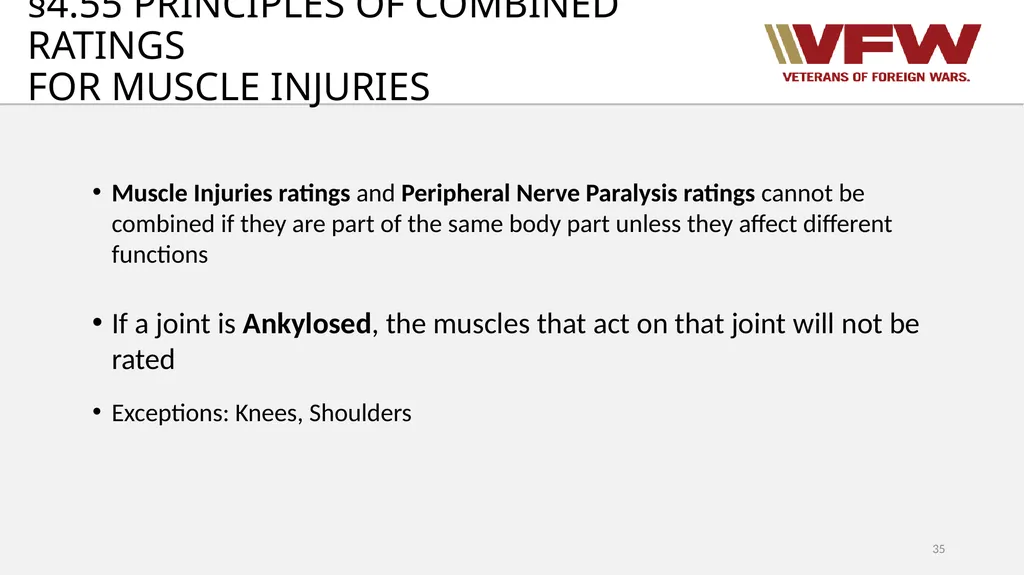
FOR MUSCLE INJURIES Muscle Injuries ratings and Peripheral Nerve Paralysis ratings cannot be combined if they are part of the same body part unless they affect different functions
If a joint is Ankylosed, the muscles that act on that joint will not be rated
Exceptions: Knees, Shoulders 35<br>
If a joint is Ankylosed, the muscles that act on that joint will not be rated
Exceptions: Knees, Shoulders 35<br>
36
§4.55 PRINCIPLES OF COMBINED RATINGS
FOR MUSCLE INJURIES Multiple muscles
Same Region but Different joint: The evaluation for the most severely injured muscle group will be raised one level and used as the evaluation for all muscle groups in the region.
Different Region: Rate separately 36<br>
Same Region but Different joint: The evaluation for the most severely injured muscle group will be raised one level and used as the evaluation for all muscle groups in the region.
Different Region: Rate separately 36<br>
37
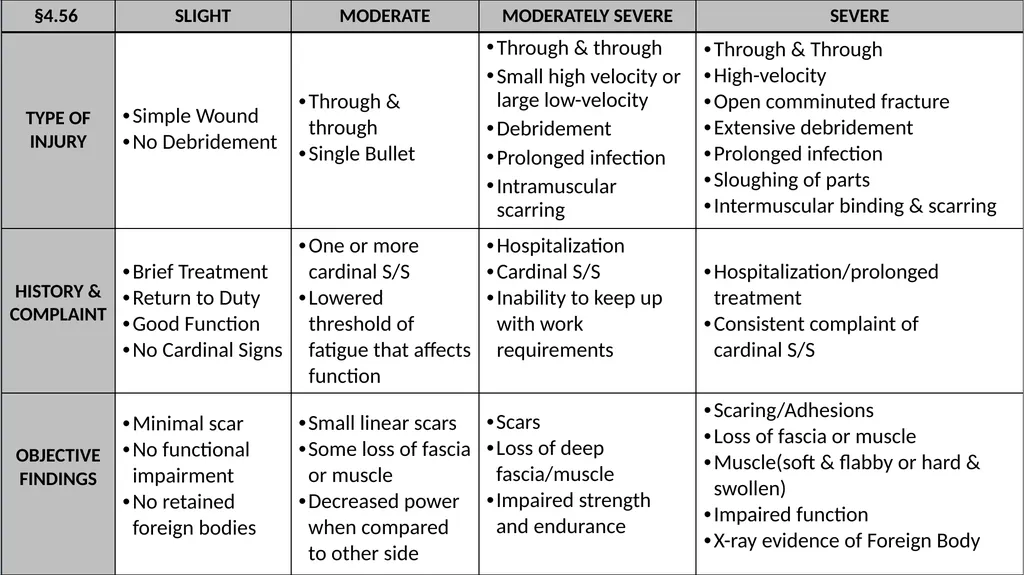
§4.56 EVALUATION OF MUSCLE DISABILITIES There are 4 levels of severity for muscle disabilities:
Severe
Moderately Severe
Moderate
Slight 37<br>
Severe
Moderately Severe
Moderate
Slight 37<br>
38
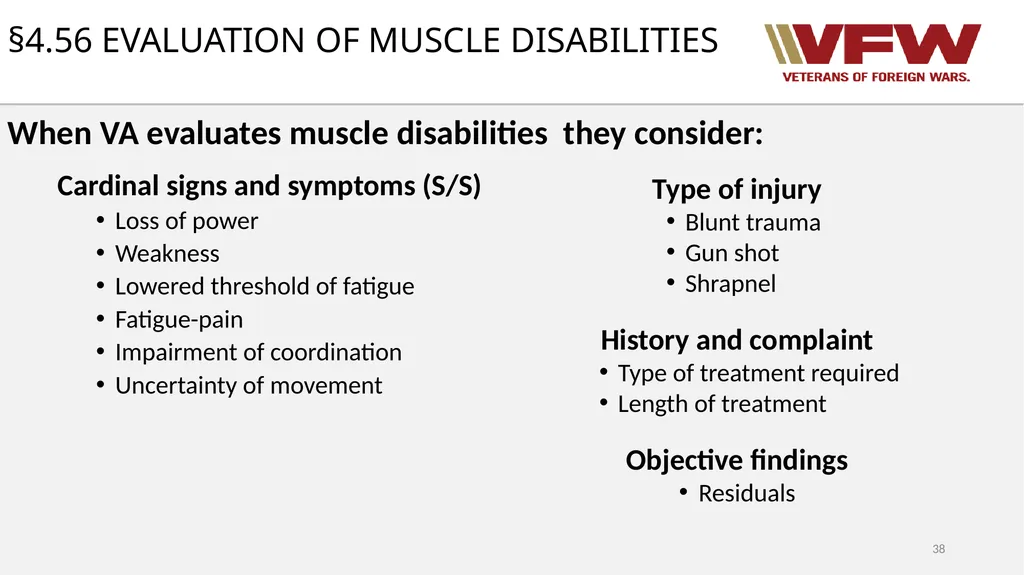
§4.56 EVALUATION OF MUSCLE DISABILITIES Cardinal signs and symptoms (S/S)
Loss of power
Weakness
Lowered threshold of fatigue
Fatigue-pain
Impairment of coordination
Uncertainty of movement 38 Type of injury
Blunt trauma
Gun shot
Shrapnel
History and complaint
Type of treatment required
Length of treatment
Objective findings
Residuals When VA evaluates muscle disabilities they consider:<br>
Loss of power
Weakness
Lowered threshold of fatigue
Fatigue-pain
Impairment of coordination
Uncertainty of movement 38 Type of injury
Blunt trauma
Gun shot
Shrapnel
History and complaint
Type of treatment required
Length of treatment
Objective findings
Residuals When VA evaluates muscle disabilities they consider:<br>
39
39<br>
40
§4.57 STATIC FOOT DEFORMITIES Bilateral Flatfoot – Must be determined if congenital or acquired
Congenital – Not service connected
Acquired – Rating based on:
Arch depression
Calluses
Tenderness
Rotation
Pain
With regard to exercise 40<br>
Congenital – Not service connected
Acquired – Rating based on:
Arch depression
Calluses
Tenderness
Rotation
Pain
With regard to exercise 40<br>
41
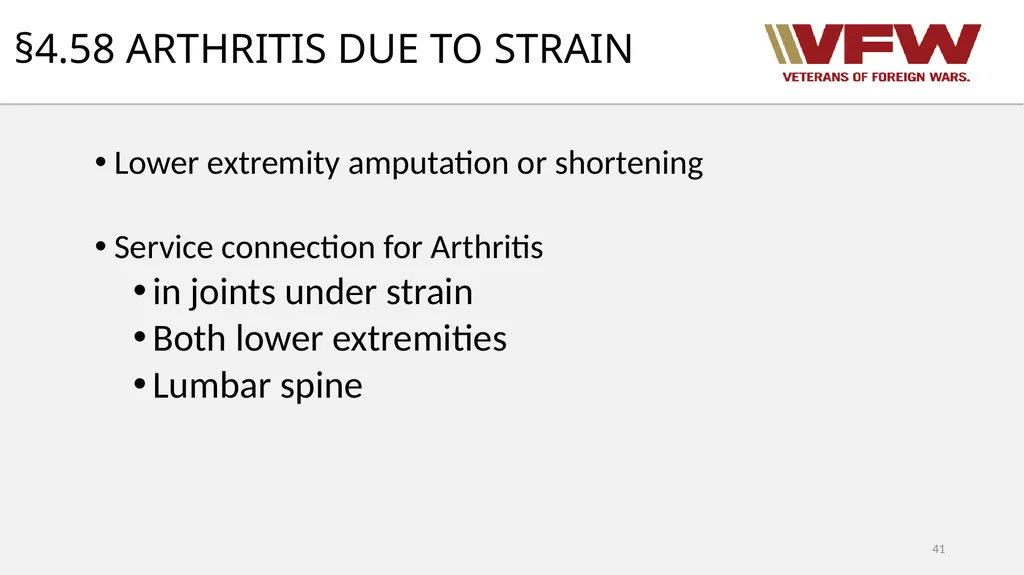
§4.58 ARTHRITIS DUE TO STRAIN Lower extremity amputation or shortening
Service connection for Arthritis
in joints under strain
Both lower extremities
Lumbar spine 41<br>
Service connection for Arthritis
in joints under strain
Both lower extremities
Lumbar spine 41<br>
42
§4.59 PAINFUL MOTION Recognize painful, unstable, or malaligned joints
…at least the minimal compensable rating for that joint.
Arthritis
Objective pain
Muscle spasm
Active/Passive motion
Weight-bearing/Non weight-bearing 42<br>
…at least the minimal compensable rating for that joint.
Arthritis
Objective pain
Muscle spasm
Active/Passive motion
Weight-bearing/Non weight-bearing 42<br>
43
§4.61 EXAMINATION Examinations for arthritis must cover all major joints
Exception – Traumatic arthritis 43<br>
Exception – Traumatic arthritis 43<br>
44
§4.62 CIRCULATORY DISTURBANCES Circulatory disturbances are generally rated as phlebitis
Pay close attention to the lower extremity in the popliteal space 44<br>
Pay close attention to the lower extremity in the popliteal space 44<br>
45
§4.63 LOSS OF USE OF HAND OR FOOT No function remains
Equally served by an amputation
Hand - Foot
Grasping - Balance
Manipulation - Propulsion
Unfavorable ankylosis
Complete paralysis
Special Monthly Compensation** (38 CFR 3.350) 45<br>
Equally served by an amputation
Hand - Foot
Grasping - Balance
Manipulation - Propulsion
Unfavorable ankylosis
Complete paralysis
Special Monthly Compensation** (38 CFR 3.350) 45<br>
46
§4.64 LOSS OF USE OF BOTH BUTTOCKS Cannot rise from sitting/stooped position without assistance
The assistance can be from their arms, another person, or an assistive device 46<br>
The assistance can be from their arms, another person, or an assistive device 46<br>
47
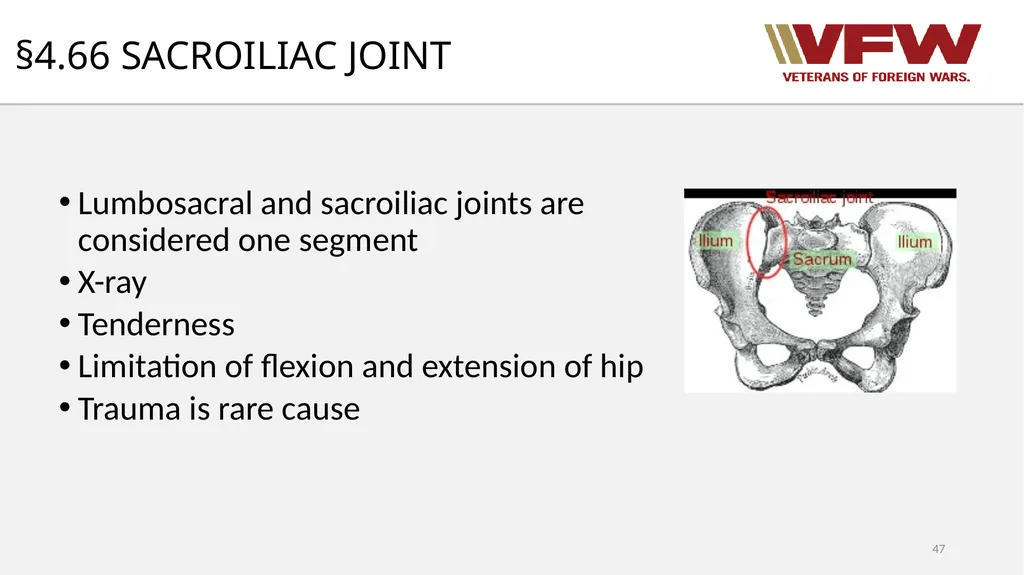
§4.66 SACROILIAC JOINT Lumbosacral and sacroiliac joints are considered one segment
X-ray
Tenderness
Limitation of flexion and extension of hip
Trauma is rare cause 47<br>
X-ray
Tenderness
Limitation of flexion and extension of hip
Trauma is rare cause 47<br>
48
§4.67 PELVIC BONES Rate the Residuals
Posture
Limitation of motion
Painful motion
Muscle spasm
Neuritis 48<br>
Posture
Limitation of motion
Painful motion
Muscle spasm
Neuritis 48<br>
49
§4.68 AMPUTATION RULE Combined rating of an extremity will not exceed the rating if there was an amputation at that level
Example:
Veteran has 5 disabilities of the left knee and ankle which when combined equal 70%
Knee level amputation (DC 5164) is rated at 60%
Veteran will be rated at 60% 49<br>
Example:
Veteran has 5 disabilities of the left knee and ankle which when combined equal 70%
Knee level amputation (DC 5164) is rated at 60%
Veteran will be rated at 60% 49<br>
50
§4.69 DOMINANT HAND Determined by evidence of record or testing at VA exam
Ambidextrous
Can only have one dominant hand
Injured or most severely injured is dominant 50<br>
Ambidextrous
Can only have one dominant hand
Injured or most severely injured is dominant 50<br>
51
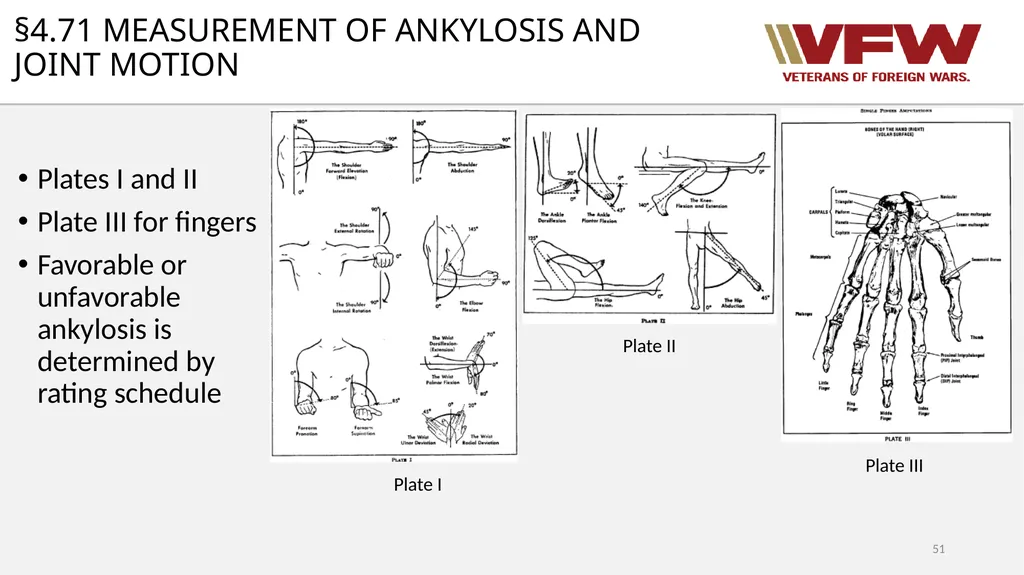
§4.71 MEASUREMENT OF ANKYLOSIS AND JOINT MOTION Plates I and II
Plate III for fingers
Favorable or unfavorable ankylosis is determined by rating schedule 51 Plate I Plate II Plate III<br>
Plate III for fingers
Favorable or unfavorable ankylosis is determined by rating schedule 51 Plate I Plate II Plate III<br>
52
§4.71A- §4.150
RATING SCHEDULE 52<br>
53
§4.71A & 4.73 SCHEDULE OF RATINGS-
MUSCULO-SKELETAL SYSTEM/MUSCLE INJURIES DC 5000-5298 pertain to musculo-skeletal system
DC 5301-5329 pertain to muscle injuries
*Remember §4.56 (how to evaluate muscle injuries) 53<br>
DC 5301-5329 pertain to muscle injuries
*Remember §4.56 (how to evaluate muscle injuries) 53<br>
54
§4.75 GENERAL CONSIDERATIONS FOR EVALUATING VISUAL IMPAIRMENT Visual impairment is based on impairment of visual acuity, visual field, and muscle function.
Developmental refractive errors cannot be service connected
Examination must be conducted by a optometrist or ophthalmologist and must identify the cause of any impairment
For rating purposes, if only 1 eye is service connected, the other eye will be considered 20/40
Maximum evaluation for 1 eye– cannot exceed 30% unless there is anatomical loss
Anatomical loss-no prosthesis add 10%
SMC (38 CFR 3.350) 54<br>
Developmental refractive errors cannot be service connected
Examination must be conducted by a optometrist or ophthalmologist and must identify the cause of any impairment
For rating purposes, if only 1 eye is service connected, the other eye will be considered 20/40
Maximum evaluation for 1 eye– cannot exceed 30% unless there is anatomical loss
Anatomical loss-no prosthesis add 10%
SMC (38 CFR 3.350) 54<br>
55
§4.76 - §4.77 VISUAL ACUITY & VISUAL FIELDS Vision examinations must include central uncorrected and corrected for distance (no glasses and with glasses)
Evaluation – if acuity falls between two ratings, give the higher one
4.76a contains graphs and charts used to determine visual fields
4.77 lists the types of authorized visual field tests, how to evaluate visual fields, and how to evaluate a combination of visual field and acuity disabilities 55<br>
Evaluation – if acuity falls between two ratings, give the higher one
4.76a contains graphs and charts used to determine visual fields
4.77 lists the types of authorized visual field tests, how to evaluate visual fields, and how to evaluate a combination of visual field and acuity disabilities 55<br>
56
§4.78 & §4.78 MUSCLE FUNCTION and SCHEDULE OF RATINGS-EYE 4.78 Explains which tests are authorized for use and examination requirements
4.79 contains the listing of eye disabilities DC 6000-6091 56<br>
4.79 contains the listing of eye disabilities DC 6000-6091 56<br>
57
§4.85 - §4.87 Hearing Impairment and Ears Exams for hearing loss must be performed by an State-licensed audiologist and must include a Maryland CNC speech discrimination test
Tables VI, VIA, VII are used to determine evaluations
How to determine non-exceptional hearing loss: (DC 6100)
Step 1: Determine the puretone threshold average by averaging the loss at 1000, 2000, 3000, & 4000 Hertz for each ear
Step 2: Locate the Speech discrimination score for each ear
Step 3: Determine the roman numeral for each ear using table VI using the puretone threshold average & speech discrimination score
Step 4: use Table VII to combine the roman numerals and determine the evaluation
4.86 explains when to use table VIA for exceptional patterns of hearing loss (Severe cases)
4.87 contains the listing of ear disabilities DC 6200-6260 57<br>
Tables VI, VIA, VII are used to determine evaluations
How to determine non-exceptional hearing loss: (DC 6100)
Step 1: Determine the puretone threshold average by averaging the loss at 1000, 2000, 3000, & 4000 Hertz for each ear
Step 2: Locate the Speech discrimination score for each ear
Step 3: Determine the roman numeral for each ear using table VI using the puretone threshold average & speech discrimination score
Step 4: use Table VII to combine the roman numerals and determine the evaluation
4.86 explains when to use table VIA for exceptional patterns of hearing loss (Severe cases)
4.87 contains the listing of ear disabilities DC 6200-6260 57<br>
58
§4.87a SCHEDULE OF RATINGS-
OTHER SENSE ORGANS Loss of Smell
DC 6275
Loss of Taste
DC 6276
Both are rated at 10% but can only be assigned if there is an anatomical or pathological basis for the condition 58<br>
DC 6275
Loss of Taste
DC 6276
Both are rated at 10% but can only be assigned if there is an anatomical or pathological basis for the condition 58<br>
59
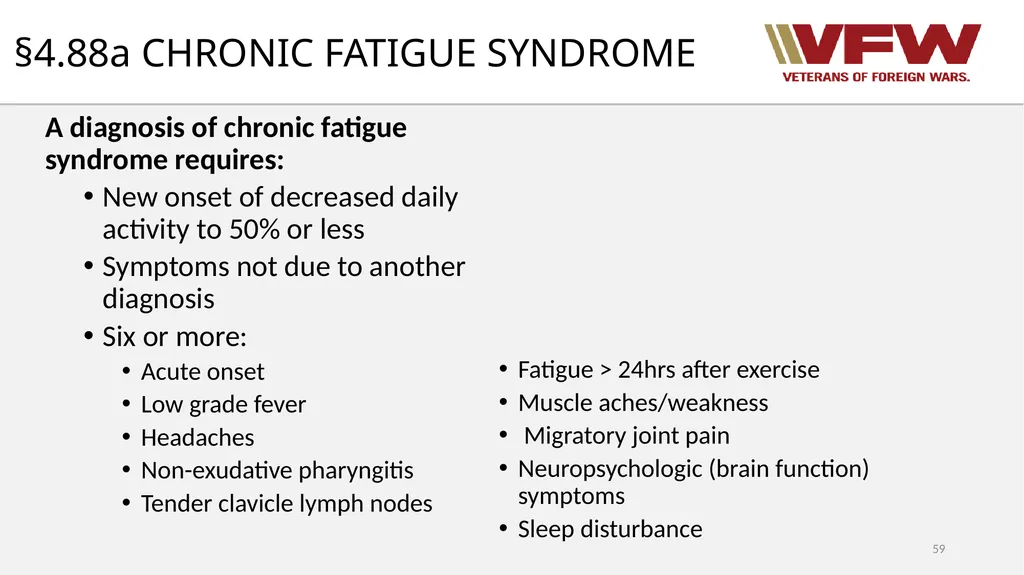
§4.88a CHRONIC FATIGUE SYNDROME A diagnosis of chronic fatigue syndrome requires:
New onset of decreased daily activity to 50% or less
Symptoms not due to another diagnosis
Six or more:
Acute onset
Low grade fever
Headaches
Non-exudative pharyngitis
Tender clavicle lymph nodes
Fatigue > 24hrs after exercise
Muscle aches/weakness
Migratory joint pain
Neuropsychologic (brain function) symptoms
Sleep disturbance 59<br>
New onset of decreased daily activity to 50% or less
Symptoms not due to another diagnosis
Six or more:
Acute onset
Low grade fever
Headaches
Non-exudative pharyngitis
Tender clavicle lymph nodes
Fatigue > 24hrs after exercise
Muscle aches/weakness
Migratory joint pain
Neuropsychologic (brain function) symptoms
Sleep disturbance 59<br>
60
§4.88b – §4.89 INFECTIOUS DISEASES, IMMUNE DISORDERS, NUTRITIONAL DEFICIENCIES, & TB 4.88b contains the listing of infectious diseases, immune disorders and nutritional deficiencies DC 6300-6354
4.88c explains how to rate inactive nonpulmonary tuberculosis for veterans who become entitled after August 19, 1968 (100% for 1 year after date of inactivity then rate residuals)
4.89 explains how VA rated inactive nonpulmonary tuberculosis for veterans who become entitled before August 19, 1968 (Graduated rating scale) 60<br>
4.88c explains how to rate inactive nonpulmonary tuberculosis for veterans who become entitled after August 19, 1968 (100% for 1 year after date of inactivity then rate residuals)
4.89 explains how VA rated inactive nonpulmonary tuberculosis for veterans who become entitled before August 19, 1968 (Graduated rating scale) 60<br>
61
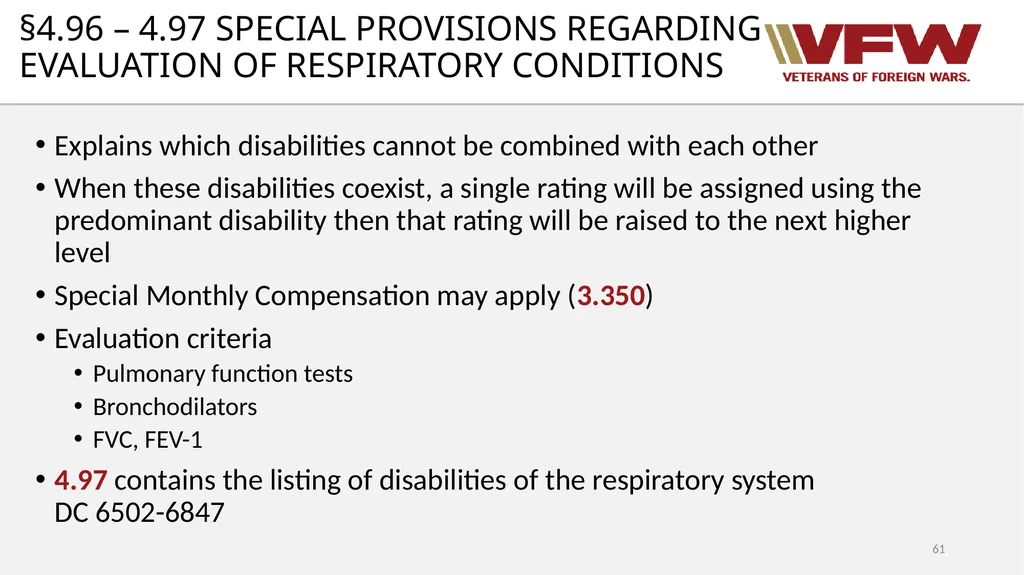
§4.96 – 4.97 SPECIAL PROVISIONS REGARDING EVALUATION OF RESPIRATORY CONDITIONS Explains which disabilities cannot be combined with each other
When these disabilities coexist, a single rating will be assigned using the predominant disability then that rating will be raised to the next higher level
Special Monthly Compensation may apply (3.350)
Evaluation criteria
Pulmonary function tests
Bronchodilators
FVC, FEV-1
4.97 contains the listing of disabilities of the respiratory system DC 6502-6847 61<br>
When these disabilities coexist, a single rating will be assigned using the predominant disability then that rating will be raised to the next higher level
Special Monthly Compensation may apply (3.350)
Evaluation criteria
Pulmonary function tests
Bronchodilators
FVC, FEV-1
4.97 contains the listing of disabilities of the respiratory system DC 6502-6847 61<br>
62
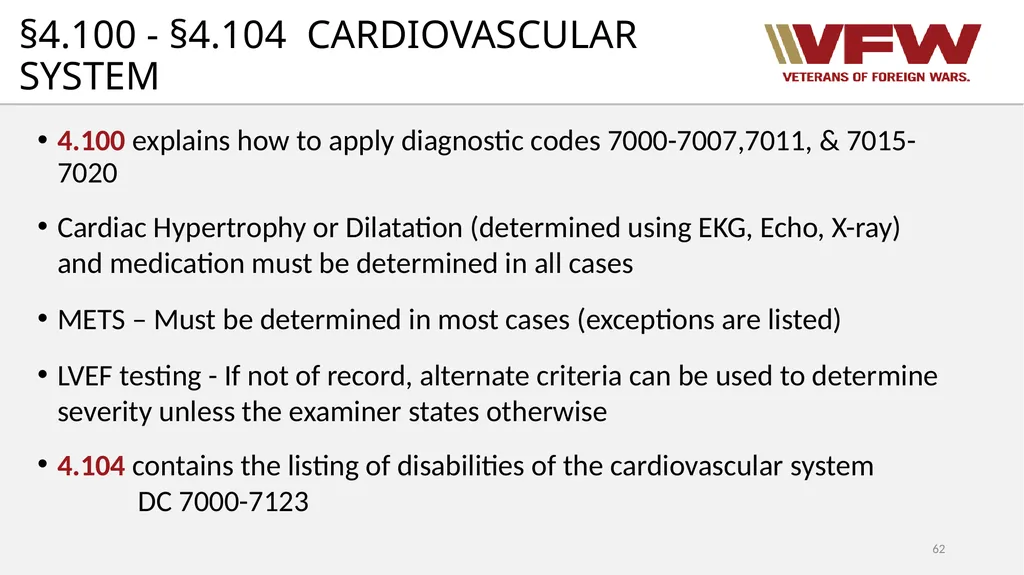
§4.100 - §4.104 CARDIOVASCULAR SYSTEM 62 4.100 explains how to apply diagnostic codes 7000-7007,7011, & 7015-7020
Cardiac Hypertrophy or Dilatation (determined using EKG, Echo, X-ray) and medication must be determined in all cases
METS – Must be determined in most cases (exceptions are listed)
LVEF testing - If not of record, alternate criteria can be used to determine severity unless the examiner states otherwise
4.104 contains the listing of disabilities of the cardiovascular system DC 7000-7123<br>
Cardiac Hypertrophy or Dilatation (determined using EKG, Echo, X-ray) and medication must be determined in all cases
METS – Must be determined in most cases (exceptions are listed)
LVEF testing - If not of record, alternate criteria can be used to determine severity unless the examiner states otherwise
4.104 contains the listing of disabilities of the cardiovascular system DC 7000-7123<br>
63
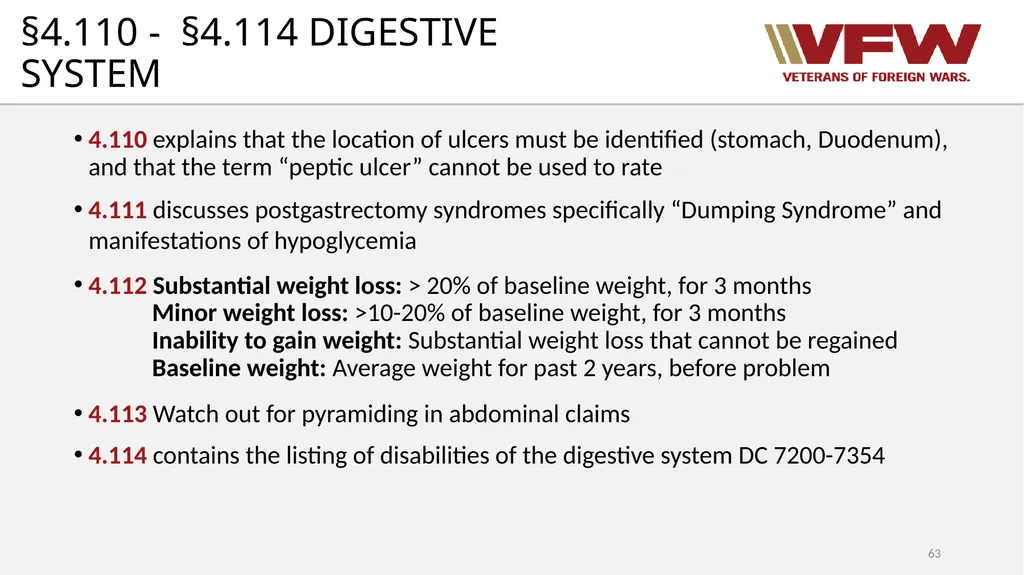
§4.110 - §4.114 DIGESTIVE SYSTEM 63 4.110 explains that the location of ulcers must be identified (stomach, Duodenum), and that the term “peptic ulcer” cannot be used to rate
4.111 discusses postgastrectomy syndromes specifically “Dumping Syndrome” and manifestations of hypoglycemia
4.112 Substantial weight loss: > 20% of baseline weight, for 3 months
Minor weight loss: >10-20% of baseline weight, for 3 months
Inability to gain weight: Substantial weight loss that cannot be regained
Baseline weight: Average weight for past 2 years, before problem
4.113 Watch out for pyramiding in abdominal claims
4.114 contains the listing of disabilities of the digestive system DC 7200-7354<br>
4.111 discusses postgastrectomy syndromes specifically “Dumping Syndrome” and manifestations of hypoglycemia
4.112 Substantial weight loss: > 20% of baseline weight, for 3 months
Minor weight loss: >10-20% of baseline weight, for 3 months
Inability to gain weight: Substantial weight loss that cannot be regained
Baseline weight: Average weight for past 2 years, before problem
4.113 Watch out for pyramiding in abdominal claims
4.114 contains the listing of disabilities of the digestive system DC 7200-7354<br>
64
§4.115 - §4.115b GENITOURINARY SYSTEM 64 4.115 discusses nephritis and its symptoms
Diseases of the heart & nephritis not rated separately unless there is only 1 kidney or dialysis is required
4.115a contains the ratings for dysfunctions of the genitourinary system and explains that only the predominant area of dysfunction shall be considered for rating purposes
4.115b contains the ratings for diagnoses of the genitourinary system<br>
Diseases of the heart & nephritis not rated separately unless there is only 1 kidney or dialysis is required
4.115a contains the ratings for dysfunctions of the genitourinary system and explains that only the predominant area of dysfunction shall be considered for rating purposes
4.115b contains the ratings for diagnoses of the genitourinary system<br>
65
§4.116 – §4.119 GYNECOLOGICAL CONDITIONS, DISORDERS OF THE BREAST, HEMIC & LYMPHATIC SYSTEMS, SKIN, ENDOCRINE SYSTEM 4.116 contains the ratings for diagnoses of the gynecological conditions & disorders of the breast DC 7610-7632
4.117 contains the ratings for diagnoses of the hemic and lymphatic systems DC 7702-7725
4.118 contains the ratings for diagnoses for skin conditions DC 7800-7833
Review of rating for DC 7800,7801,7803,7804,& 7805 before October 23, 2008
4.118 contains the ratings for diagnoses for endocrine conditions DC 7900-7919 (Type 2 Diabetes) 65<br>
4.117 contains the ratings for diagnoses of the hemic and lymphatic systems DC 7702-7725
4.118 contains the ratings for diagnoses for skin conditions DC 7800-7833
Review of rating for DC 7800,7801,7803,7804,& 7805 before October 23, 2008
4.118 contains the ratings for diagnoses for endocrine conditions DC 7900-7919 (Type 2 Diabetes) 65<br>
66
§4.120 – §4.124a Neurological Conditions 4.120 Explains the different symptoms that must be considered and used to rate neurological conditions in proportion to impairment
Refer to the appropriate schedule
4.121 explains that seizures must be witnessed or verified by a physician; frequency and effect can be by lay testimony
4.122 gives a description of psychomotor epilepsy and notes that seizures and chronic psychiatric disturbances are not uncommon 66<br>
Refer to the appropriate schedule
4.121 explains that seizures must be witnessed or verified by a physician; frequency and effect can be by lay testimony
4.122 gives a description of psychomotor epilepsy and notes that seizures and chronic psychiatric disturbances are not uncommon 66<br>
67
§4.120 – §4.124a NEUROLOGICAL CONDITIONS 4.123 discusses cranial or peripheral neuritis which is characterized by loss of reflexes, muscle atrophy, sensory disturbances, and constant pain at times excruciating. If there are no organic changes the highest rating is moderate, for sciatic nerve w/o organic change moderately severe
4.124 Explains that neuralgia is to be rated according to the nerve affected and is characterized by dull intermittent pain. It is rated according to the nerve affected
4.124a contains the ratings for neurological conditions DC 8000-8914 67<br>
4.124 Explains that neuralgia is to be rated according to the nerve affected and is characterized by dull intermittent pain. It is rated according to the nerve affected
4.124a contains the ratings for neurological conditions DC 8000-8914 67<br>
68
§4.125 DIAGNOSIS OF MENTAL DISORDERS Diagnosis must conform to DSM-5 criteria
If a diagnosis is changed the rater must determine if it is:
Progression of prior diagnosis
Correction of an error
Development of a new/separate condition 68<br>
If a diagnosis is changed the rater must determine if it is:
Progression of prior diagnosis
Correction of an error
Development of a new/separate condition 68<br>
69
§4.126 EVALUATION OF DISABILITY
FROM MENTAL DISORDERS Rater must consider full picture of disability
Frequency, severity, duration of symptoms
Length of remissions
Consider social impairment
Neurocognitive disorders (head injuries) will be rated separately and combined with evaluation
If rated as both physical and mental disorder the more dominant condition DC is utilized 69<br>
Frequency, severity, duration of symptoms
Length of remissions
Consider social impairment
Neurocognitive disorders (head injuries) will be rated separately and combined with evaluation
If rated as both physical and mental disorder the more dominant condition DC is utilized 69<br>
70
§4.127 INTELLECTUAL DISABILITY (INTELLECTUAL DEVELOPMENTAL DISORDER) & PERSONALITY DISORDER Not diseases or injuries for service connection
Consider aggravation §3.310(a)
Mental disorder superimposed may be service connected 70<br>
Consider aggravation §3.310(a)
Mental disorder superimposed may be service connected 70<br>
71
§4.128 CONVALESCENCE RATINGS FOLLOWING
EXTENDED HOSPITALIZATION Mental disorder at 100% due to continuous hospitalization, lasts 6 months or more
Must continue the 100% indefinitely until improvement is shown
Evaluation 6 months after release and may be decreased in accordance with §3.105(e) 71<br>
Must continue the 100% indefinitely until improvement is shown
Evaluation 6 months after release and may be decreased in accordance with §3.105(e) 71<br>
72
§4.129 MENTAL DISORDERS DUE TO TRAUMATIC STRESS If discharged due to this
Service connect at no less than 50%
Re-examination within 6 months 72<br>
Service connect at no less than 50%
Re-examination within 6 months 72<br>
73
§4.130 SCHEDULE OF RATINGS – MENTAL DISORDERS The General Rating Formula for Mental Disorders is used to rate all mental health conditions except for eating disorders
Pay close attention to symptoms when determining ratings 73<br>
Pay close attention to symptoms when determining ratings 73<br>
74
§4.150 SCHEDULE OF RATINGS-
DENTAL & ORAL CONDITIONS 4.150 contains the listings for Dental and Oral conditions DC 9900-9918
Separately evaluate loss of vocal articulation, loss of smell, loss of taste, neurological impairment, respiratory dysfunction, and other impairments under the appropriate diagnostic code and combine under §4.25 for each separately rated condition 74<br>
Separately evaluate loss of vocal articulation, loss of smell, loss of taste, neurological impairment, respiratory dysfunction, and other impairments under the appropriate diagnostic code and combine under §4.25 for each separately rated condition 74<br>
75
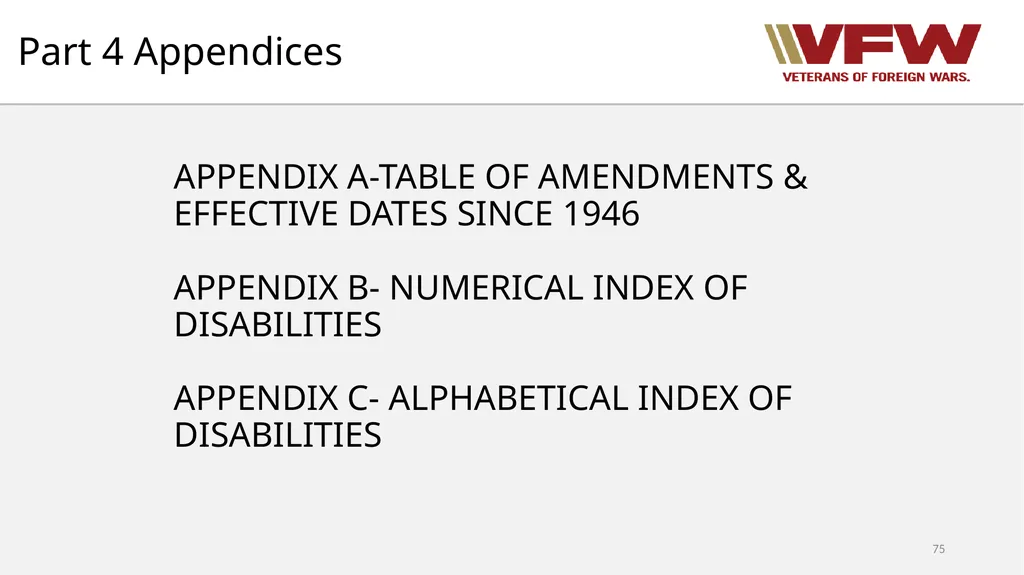
APPENDIX A-TABLE OF AMENDMENTS & EFFECTIVE DATES SINCE 1946
APPENDIX B- NUMERICAL INDEX OF DISABILITIES
APPENDIX C- ALPHABETICAL INDEX OF DISABILITIES 75 Part 4 Appendices<br>
76
VA MATH 76<br>
77
VA MATH CONCEPT VA does not add disability ratings together, rather they combine the disabilities using the combined ratings table
To help understand the concept of VA Math think of a sale:
A shirt costs $100 regular price
The store advertises 50% off – The new price is $50
The store takes off an additional 50% – New price is $25 you save 75% total
Why? Because you take the additional percentage from what’s left of the original price
The veteran is the original price, the disabilities are the sale, and the total saved is the combined rating 77<br>
To help understand the concept of VA Math think of a sale:
A shirt costs $100 regular price
The store advertises 50% off – The new price is $50
The store takes off an additional 50% – New price is $25 you save 75% total
Why? Because you take the additional percentage from what’s left of the original price
The veteran is the original price, the disabilities are the sale, and the total saved is the combined rating 77<br>
78
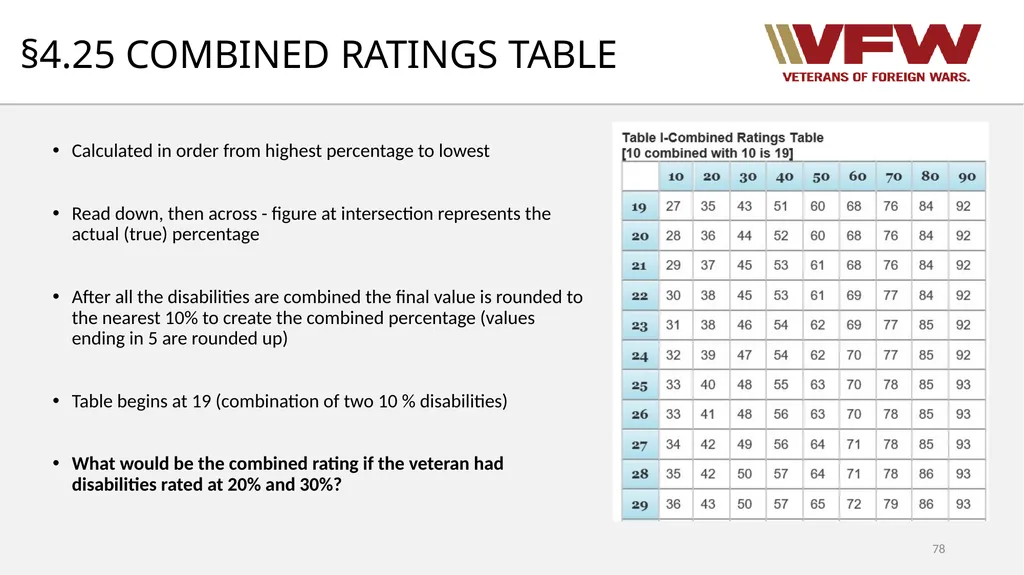
§4.25 COMBINED RATINGS TABLE Calculated in order from highest percentage to lowest
Read down, then across - figure at intersection represents the actual (true) percentage
After all the disabilities are combined the final value is rounded to the nearest 10% to create the combined percentage (values ending in 5 are rounded up)
Table begins at 19 (combination of two 10 % disabilities)
What would be the combined rating if the veteran had disabilities rated at 20% and 30%? 78<br>
Read down, then across - figure at intersection represents the actual (true) percentage
After all the disabilities are combined the final value is rounded to the nearest 10% to create the combined percentage (values ending in 5 are rounded up)
Table begins at 19 (combination of two 10 % disabilities)
What would be the combined rating if the veteran had disabilities rated at 20% and 30%? 78<br>
79
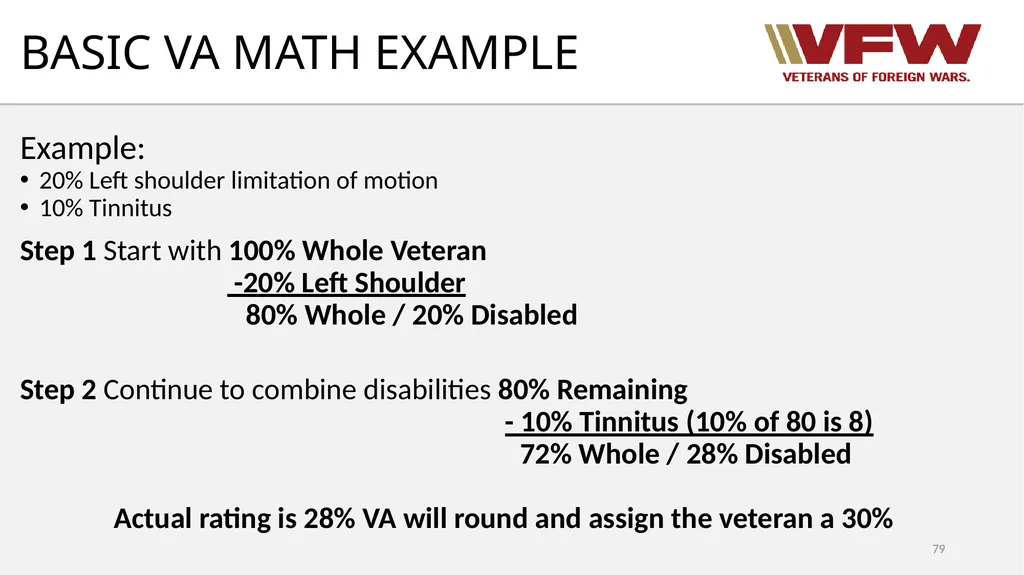
BASIC VA MATH EXAMPLE Example:
20% Left shoulder limitation of motion
10% Tinnitus
Step 1 Start with 100% Whole Veteran
-20% Left Shoulder
80% Whole / 20% Disabled
Step 2 Continue to combine disabilities 80% Remaining
- 10% Tinnitus (10% of 80 is 8)
72% Whole / 28% Disabled
Actual rating is 28% VA will round and assign the veteran a 30% 79<br>
20% Left shoulder limitation of motion
10% Tinnitus
Step 1 Start with 100% Whole Veteran
-20% Left Shoulder
80% Whole / 20% Disabled
Step 2 Continue to combine disabilities 80% Remaining
- 10% Tinnitus (10% of 80 is 8)
72% Whole / 28% Disabled
Actual rating is 28% VA will round and assign the veteran a 30% 79<br>
80
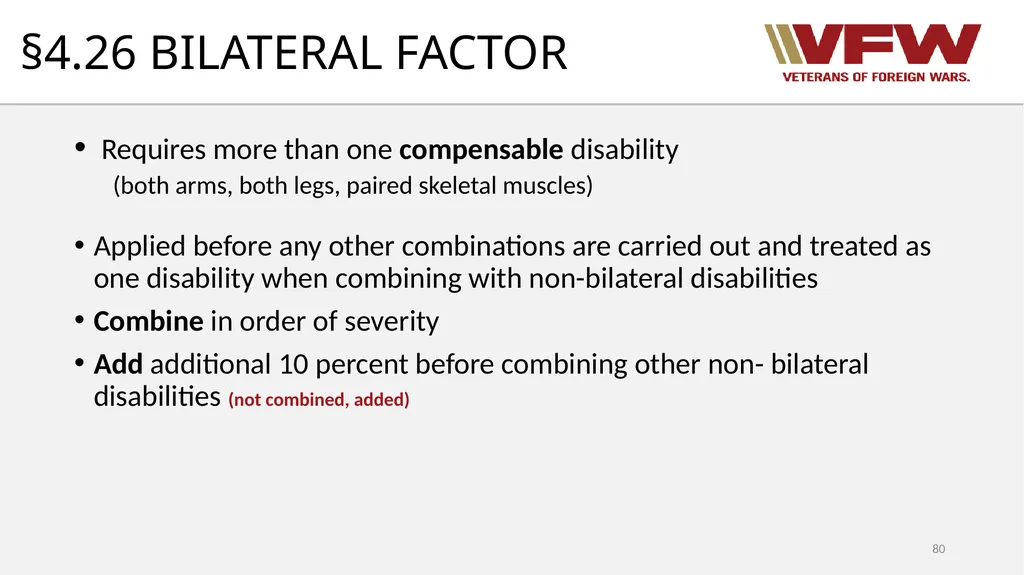
§4.26 BILATERAL FACTOR Requires more than one compensable disability
(both arms, both legs, paired skeletal muscles)
Applied before any other combinations are carried out and treated as one disability when combining with non-bilateral disabilities
Combine in order of severity
Add additional 10 percent before combining other non- bilateral disabilities (not combined, added) 80<br>
(both arms, both legs, paired skeletal muscles)
Applied before any other combinations are carried out and treated as one disability when combining with non-bilateral disabilities
Combine in order of severity
Add additional 10 percent before combining other non- bilateral disabilities (not combined, added) 80<br>
81
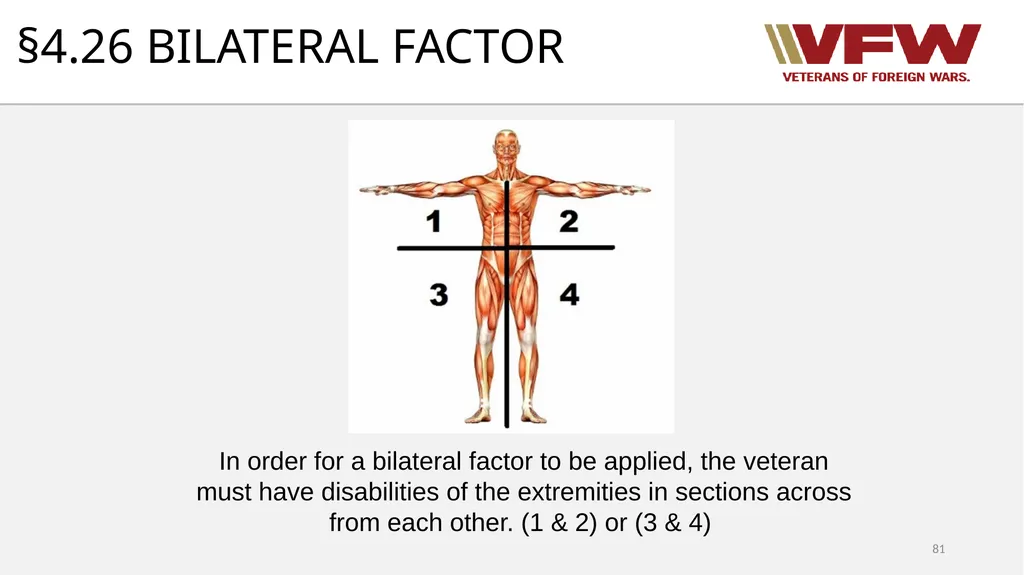
§4.26 BILATERAL FACTOR 81 In order for a bilateral factor to be applied, the veteran must have disabilities of the extremities in sections across from each other. (1 & 2) or (3 & 4)<br>
82
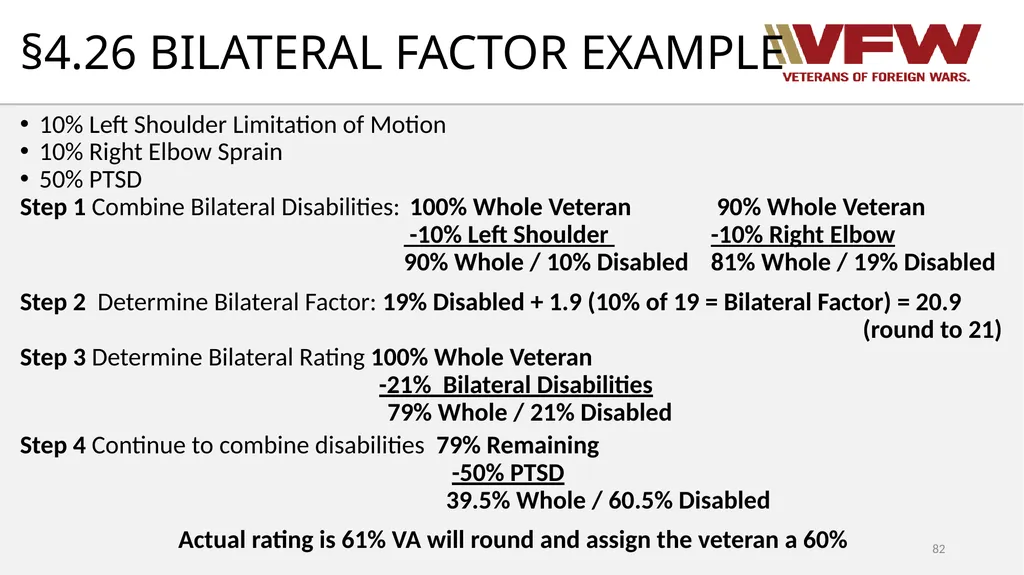
§4.26 BILATERAL FACTOR EXAMPLE 10% Left Shoulder Limitation of Motion
10% Right Elbow Sprain
50% PTSD
Step 1 Combine Bilateral Disabilities: 100% Whole Veteran 90% Whole Veteran
-10% Left Shoulder -10% Right Elbow
90% Whole / 10% Disabled 81% Whole / 19% Disabled
Step 2 Determine Bilateral Factor: 19% Disabled + 1.9 (10% of 19 = Bilateral Factor) = 20.9 (round to 21)
Step 3 Determine Bilateral Rating 100% Whole Veteran
-21% Bilateral Disabilities
79% Whole / 21% Disabled
Step 4 Continue to combine disabilities 79% Remaining
-50% PTSD
39.5% Whole / 60.5% Disabled
Actual rating is 61% VA will round and assign the veteran a 60% 82<br>
10% Right Elbow Sprain
50% PTSD
Step 1 Combine Bilateral Disabilities: 100% Whole Veteran 90% Whole Veteran
-10% Left Shoulder -10% Right Elbow
90% Whole / 10% Disabled 81% Whole / 19% Disabled
Step 2 Determine Bilateral Factor: 19% Disabled + 1.9 (10% of 19 = Bilateral Factor) = 20.9 (round to 21)
Step 3 Determine Bilateral Rating 100% Whole Veteran
-21% Bilateral Disabilities
79% Whole / 21% Disabled
Step 4 Continue to combine disabilities 79% Remaining
-50% PTSD
39.5% Whole / 60.5% Disabled
Actual rating is 61% VA will round and assign the veteran a 60% 82<br>
83
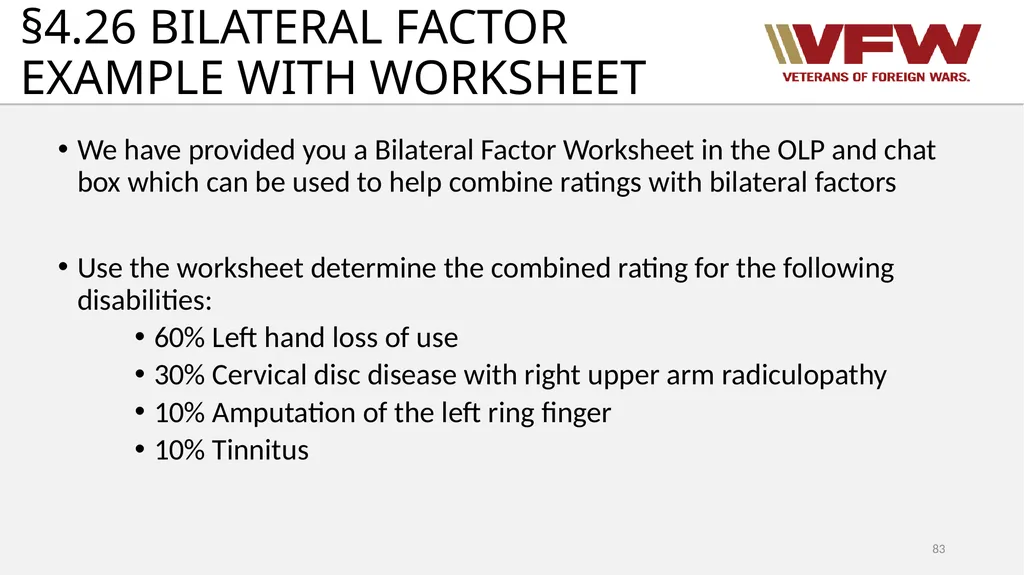
We have provided you a Bilateral Factor Worksheet in the OLP and chat box which can be used to help combine ratings with bilateral factors
Use the worksheet determine the combined rating for the following disabilities:
60% Left hand loss of use
30% Cervical disc disease with right upper arm radiculopathy
10% Amputation of the left ring finger
10% Tinnitus 83 §4.26 BILATERAL FACTOR EXAMPLE WITH WORKSHEET<br>
Use the worksheet determine the combined rating for the following disabilities:
60% Left hand loss of use
30% Cervical disc disease with right upper arm radiculopathy
10% Amputation of the left ring finger
10% Tinnitus 83 §4.26 BILATERAL FACTOR EXAMPLE WITH WORKSHEET<br>
84
QUESTIONS?<br>