
3rd Call for Proposals DRP LA seminar online, 8
MT
Published · 123 slides · 0 views

1 / 1

Description
3rd Call for Proposals DRP LA seminar online, 8 October 2025 Agenda Eligibility requirements Key rules, criteria, and partner requirements 08 October 2025 On-line Liholot Natalia Overview Abstract of eligibility check Nature
Related Topics
Share
Embed code
Download this presentation From Below
"3rd Call for Proposals DRP LA seminar online, 8" is the property of its rightful owner. Permission is granted to download and print the materials on this website for personal, non-commercial use only, and to display it on your personal computer provided you do not modify the materials and that you retain all copyright notices contained in the materials. By downloading content from our website, you accept the terms of this agreement.
Presentation Transcript
01
3rd Call for Proposals DRP LA seminar online, 8 October 2025<br>
02
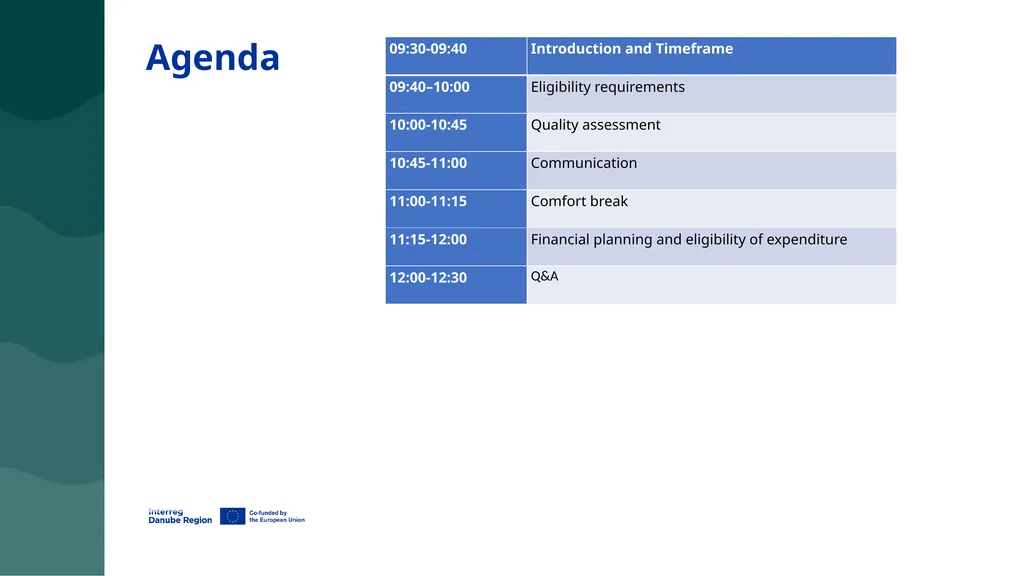
Agenda<br>
03
Eligibility requirements
Key rules, criteria, and partner requirements 08 October 2025 On-line – Liholot Natalia<br>
04
Overview Abstract of eligibility check
Nature & consequences of eligibility assessment
Criteria overview
How to meet the criteria
Documentation & annexes<br>
Nature & consequences of eligibility assessment
Criteria overview
How to meet the criteria
Documentation & annexes<br>
05
Purpose of Eligibility Check Confirms correctness of submitted information & documents;
Assessed by MA/JS with support from DRP NCPs;
Binary assessment: YES or NO;
Criteria are knock-out (non-negotiable).<br>
Assessed by MA/JS with support from DRP NCPs;
Binary assessment: YES or NO;
Criteria are knock-out (non-negotiable).<br>
06
Consequences of the Check Failure to meet criteria → rejection of:
Entire proposal (criteria 1–9)
Partner(s) with issues (criteria 10–12)<br>
Entire proposal (criteria 1–9)
Partner(s) with issues (criteria 10–12)<br>
07
Overall Proposal Criteria (1–9) 1. Application submitted within deadline
2. Submitted through Jems (no late submissions allowed)
3. Application compiled in English
4. Partnership composition (≥3 financing partners, ≥3 DRP partner countries, incl. 1 EU member state beneficiary)
5. Lead applicant must be eligible<br>
2. Submitted through Jems (no late submissions allowed)
3. Application compiled in English
4. Partnership composition (≥3 financing partners, ≥3 DRP partner countries, incl. 1 EU member state beneficiary)
5. Lead applicant must be eligible<br>
08
Overall Proposal Criteria (1–9) 6. At least 3 cooperation levels:
joint development, implementation, staffing, financing
7. Partnership agreement complete & signed
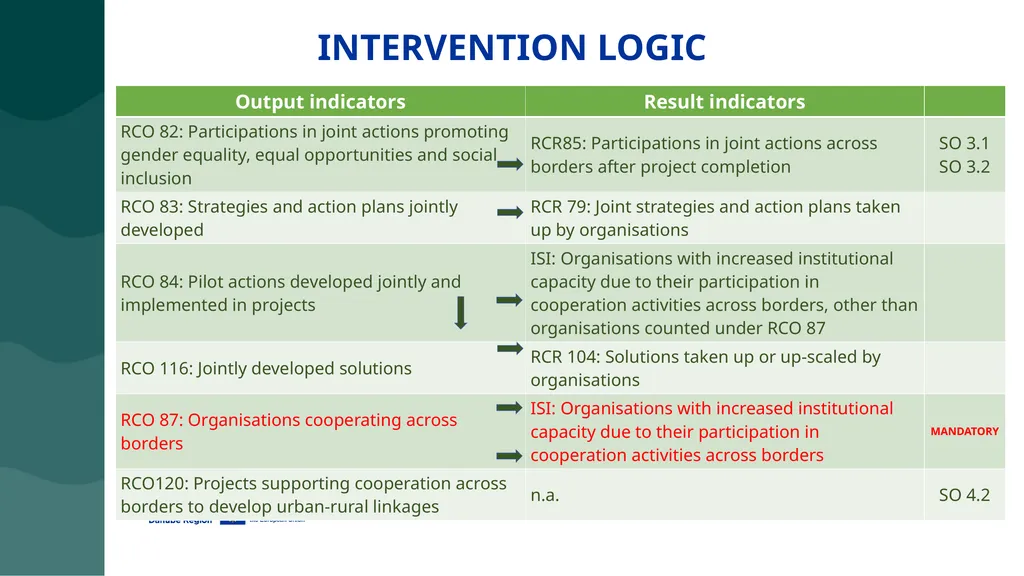
8. At least 2 programme output indicators
1 mandatory: RCO 87 Organisations cooperating across borders
9. At least 2 programme result indicators
1 mandatory: ISI - Organisations with increased institutional capacity due to their participation in cooperation activities across borders.<br>
joint development, implementation, staffing, financing
7. Partnership agreement complete & signed
8. At least 2 programme output indicators
1 mandatory: RCO 87 Organisations cooperating across borders
9. At least 2 programme result indicators
1 mandatory: ISI - Organisations with increased institutional capacity due to their participation in cooperation activities across borders.<br>
09
Partner Criteria
(10–12) 10. Financed partners must meet eligibility rules.
11. Completeness of submitted partner documents.
12. Completeness of ASP documents.<br>
11. Completeness of submitted partner documents.
12. Completeness of ASP documents.<br>
10
Healing
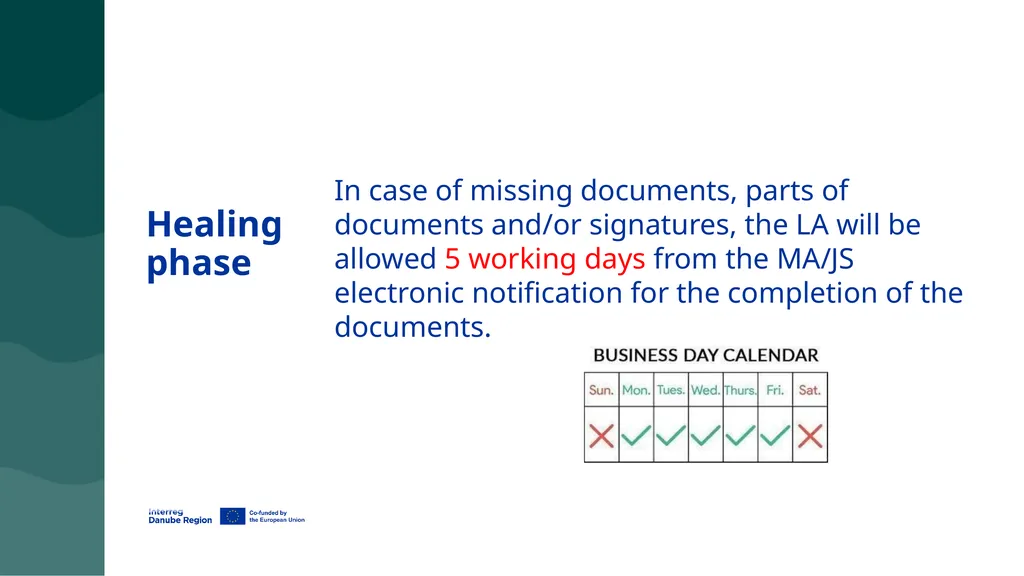
phase In case of missing documents, parts of documents and/or signatures, the LA will be allowed 5 working days from the MA/JS electronic notification for the completion of the documents.<br>
11
Who is Eligible? Public bodies (local, regional, national)
International organisations (under national (DRP Partner State) / international law)
Fulfil EU, programme and national requirements in terms of control, validation of costs and audits
Private bodies (non-profit & profit-making, with conditions)
Special case - Profit-making private bodies cannot be Lead Partner<br>
International organisations (under national (DRP Partner State) / international law)
Fulfil EU, programme and national requirements in terms of control, validation of costs and audits
Private bodies (non-profit & profit-making, with conditions)
Special case - Profit-making private bodies cannot be Lead Partner<br>
12
Programme Coverage & Geographic Scope Programme area coverage
14 countries total
9 EU Member States: Austria, Bulgaria, Croatia, Czech Republic, Hungary, Baden-Württemberg & Bavaria (Germany), Romania, Slovakia, Slovenia
5 Non-EU Member States: Bosnia and Herzegovina, Moldova, Montenegro, Serbia, Ukraine (4 specific provinces)
Key Geographic Rule
EU financing provided only to project partners located in the programme area.
Exception: Ukraine operations can extend beyond programme area if directly contributing to programme objectives.<br>
14 countries total
9 EU Member States: Austria, Bulgaria, Croatia, Czech Republic, Hungary, Baden-Württemberg & Bavaria (Germany), Romania, Slovakia, Slovenia
5 Non-EU Member States: Bosnia and Herzegovina, Moldova, Montenegro, Serbia, Ukraine (4 specific provinces)
Key Geographic Rule
EU financing provided only to project partners located in the programme area.
Exception: Ukraine operations can extend beyond programme area if directly contributing to programme objectives.<br>
13
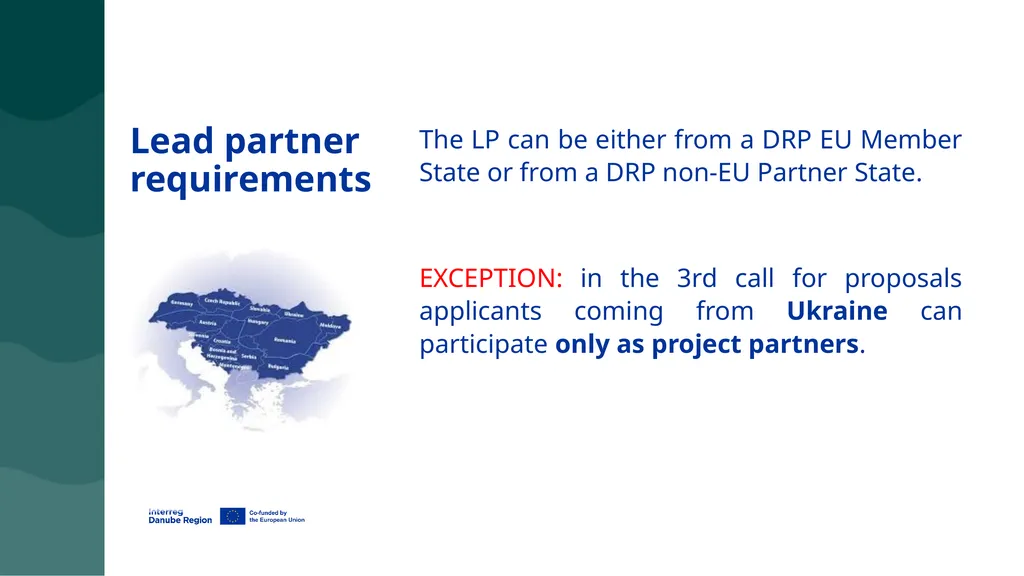
Lead partner requirements The LP can be either from a DRP EU Member State or from a DRP non-EU Partner State.
EXCEPTION: in the 3rd call for proposals applicants coming from Ukraine can participate only as project partners.<br>
EXCEPTION: in the 3rd call for proposals applicants coming from Ukraine can participate only as project partners.<br>
14
Associated strategic partners (ASPs) ASP’s expenditure is limited to the reimbursement from the programme of travel and accommodation costs related mainly to their participation in project meetings, which shall be finally borne by any institution acting as directly financed partner in order to be considered eligible EU countries
Non-EU countries of the programme area Part of a "sponsoring" directly financed partner budget<br>
Non-EU countries of the programme area Part of a "sponsoring" directly financed partner budget<br>
15
Required Documents Online Application Form.
Declaration of co-financing (for all directly financed partners).
State aid declaration (for all directly financed partners).
Partnership Agreement.
Declaration for International Organisations (only if applicable).
Associated strategic partner (ASP) declaration (only if applicable).
LP confirmation and signature. The annexes of the application form listed above are to be signed, stamped, if applicable, by the legal representative of the respective entity and the scanned versions of each document are to be uploaded to the Application annexes section in Jems.<br>
Declaration of co-financing (for all directly financed partners).
State aid declaration (for all directly financed partners).
Partnership Agreement.
Declaration for International Organisations (only if applicable).
Associated strategic partner (ASP) declaration (only if applicable).
LP confirmation and signature. The annexes of the application form listed above are to be signed, stamped, if applicable, by the legal representative of the respective entity and the scanned versions of each document are to be uploaded to the Application annexes section in Jems.<br>
16
Tips for Applicants - project consortium The partnership should reflect the territorial focus of the project and partners must poses the competences for achieving the project results.
Contact the EUSDR priority area coordinators
Transnational, i.e., some geographical coverage of the Danube region, no regional concentration
Relevance and competence of the partners (to achieve the project objectives) are crucial, clear roles and division of responsibilities
Ensure policy relevance - decision makers either as PPs / ASPs, or PPs with capacity to create strong links to relevant policy drivers
Do not underestimate the importance of Associated Strategic Partners (ASP). Try to reach and policy level!
Diversity of stakeholders: ideally across sectors and levels from administration, academia, business, and civil society
Partners from non-EU countries highly recommended!
(!Evaluation criterion)<br>
Contact the EUSDR priority area coordinators
Transnational, i.e., some geographical coverage of the Danube region, no regional concentration
Relevance and competence of the partners (to achieve the project objectives) are crucial, clear roles and division of responsibilities
Ensure policy relevance - decision makers either as PPs / ASPs, or PPs with capacity to create strong links to relevant policy drivers
Do not underestimate the importance of Associated Strategic Partners (ASP). Try to reach and policy level!
Diversity of stakeholders: ideally across sectors and levels from administration, academia, business, and civil society
Partners from non-EU countries highly recommended!
(!Evaluation criterion)<br>
17
Tips for Applicants Consult with the NCP in your country if you are not sure whether your organization is eligible or not.
Don’t wait until the last minute (Jems may overload).
Check submission status: must be “Submitted”.
Start preparing annexes early (time-consuming).
Ensure all partners’ signatures/stamps are collected.<br>
Don’t wait until the last minute (Jems may overload).
Check submission status: must be “Submitted”.
Start preparing annexes early (time-consuming).
Ensure all partners’ signatures/stamps are collected.<br>
18
Danube Region Programme
Managing Authority/ Joint Secretariat Thank you! Natália Liholot, Priority officer https://www.linkedin.com/in/interregdanube/
https://www.facebook.com/InterregDanube/ natalia.liholot@interreg-danube.eu<br>
Managing Authority/ Joint Secretariat Thank you! Natália Liholot, Priority officer https://www.linkedin.com/in/interregdanube/
https://www.facebook.com/InterregDanube/ natalia.liholot@interreg-danube.eu<br>
19
Quality assessment 3rd CfP – Lead Applicants webinar Online, 8th October 2025 Ana Leganel<br>
20
Presentation contents General information about the quality assessment
Strategic assessment explained
Operational assessment explained<br>
Strategic assessment explained
Operational assessment explained<br>
21
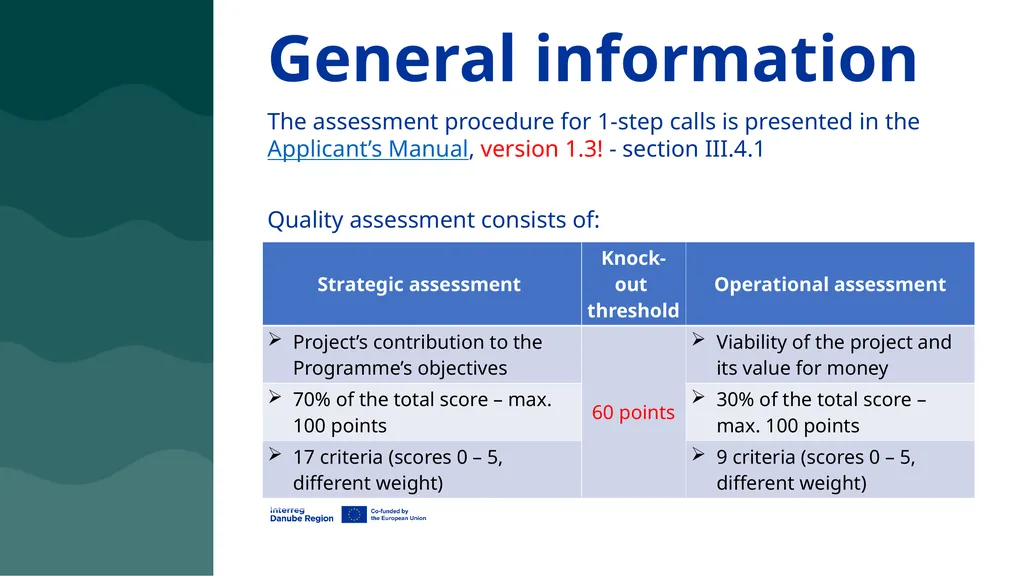
General information The assessment procedure for 1-step calls is presented in the Applicant’s Manual, version 1.3! - section III.4.1
Quality assessment consists of:<br>
Quality assessment consists of:<br>
22
Strategic assessment<br>
23
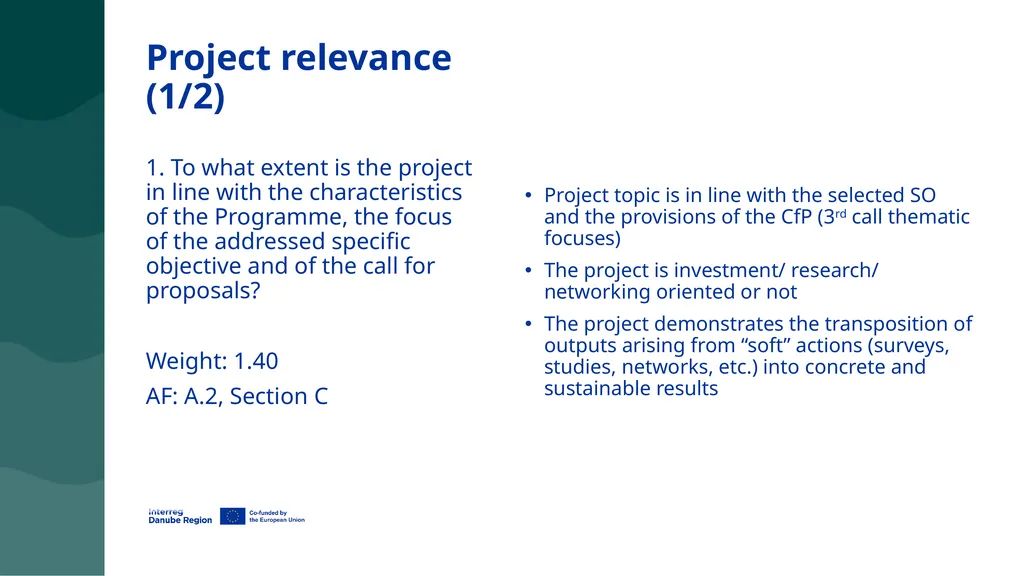
Project relevance (1/2) Project topic is in line with the selected SO and the provisions of the CfP (3rd call thematic focuses)
The project is investment/ research/ networking oriented or not
The project demonstrates the transposition of outputs arising from “soft” actions (surveys, studies, networks, etc.) into concrete and sustainable results 1. To what extent is the project in line with the characteristics of the Programme, the focus of the addressed specific objective and of the call for proposals?
Weight: 1.40
AF: A.2, Section C<br>
The project is investment/ research/ networking oriented or not
The project demonstrates the transposition of outputs arising from “soft” actions (surveys, studies, networks, etc.) into concrete and sustainable results 1. To what extent is the project in line with the characteristics of the Programme, the focus of the addressed specific objective and of the call for proposals?
Weight: 1.40
AF: A.2, Section C<br>
24
Common shortcomings
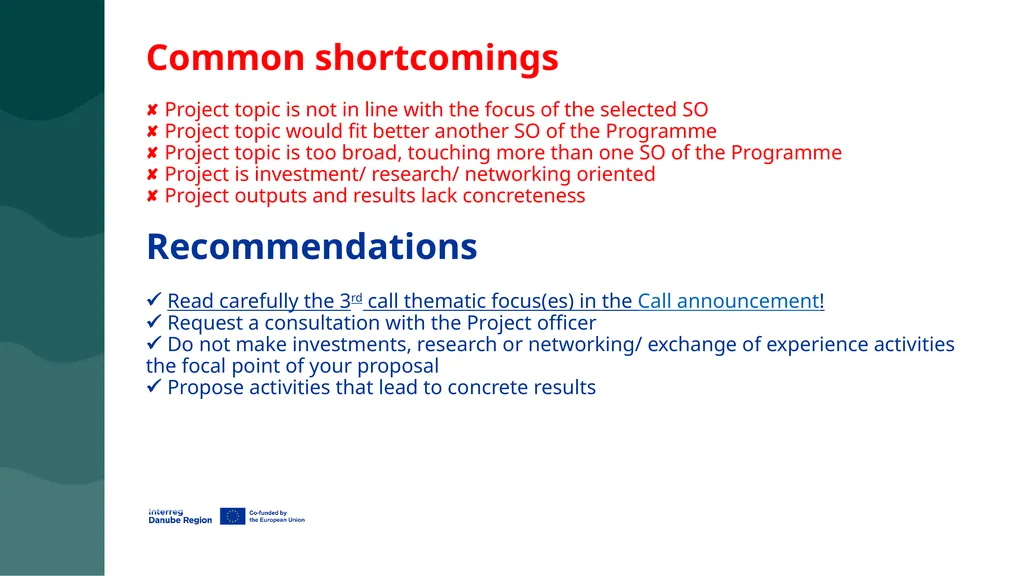
Project topic is not in line with the focus of the selected SO
Project topic would fit better another SO of the Programme
Project topic is too broad, touching more than one SO of the Programme
Project is investment/ research/ networking oriented
Project outputs and results lack concreteness
Recommendations
Read carefully the 3rd call thematic focus(es) in the Call announcement!
Request a consultation with the Project officer
Do not make investments, research or networking/ exchange of experience activities the focal point of your proposal
Propose activities that lead to concrete results<br>
25
Project relevance (2/2) Project main and specific objectives are thematically coherent with the Programme SO (and the 3rd call focus)
There’s a logical correlation between the project outputs and results and the Programme Output and Result Indicators
The project contributes to the objectives of the selected Programme SO 2. To what extent is the project intervention logic coherent with the programme one?
Weight: 1.00
AF: C.1, C.2, C.4, C.5<br>
There’s a logical correlation between the project outputs and results and the Programme Output and Result Indicators
The project contributes to the objectives of the selected Programme SO 2. To what extent is the project intervention logic coherent with the programme one?
Weight: 1.00
AF: C.1, C.2, C.4, C.5<br>
26
Common shortcomings
Clear coherence of project main and specific objectives with the focus of the SO is missing
Project outputs and results are not correlated with the programme output and result indicators
e.g. a scientific paper is linked to RCO83/ RCR79 [strategies/ action plans (taken up)]
e.g. the revision/update of a strategy is linked to RCO83/ RCR79 [strategies/ action plans (taken up)]
Project only brings a minor contribution to the objectives of the Programme SO as per proposed activities, outputs and results
e.g. limited work plan, shallow activities, contribution to the minimum number of Output and Result indicators
Recommendations
Read carefully Annex 1 of the Applicant’s Manual to understand Output and Result indicators!
Propose activities, outputs and results that are meaningful for the addressed field<br>
27
Territorial needs and challenges (1/3) Needs & challenges are relevant in the context of the programme’s objectives
Needs & challenges are clearly and comprehensively described
Country level information is provided for the area targeted by the project
If pilot actions are planned in certain areas, details about the particular needs of these areas are provided
Planned activities respond to the identified needs & challenges
Proposed approach is new/ innovative 3. To what extent are the territorial needs/ challenges coherently described, relevant for achieving the programme objectives and addressed by the proposal?
Weight: 2.00
AF: C.2.1, C.2.2, C.4<br>
Needs & challenges are clearly and comprehensively described
Country level information is provided for the area targeted by the project
If pilot actions are planned in certain areas, details about the particular needs of these areas are provided
Planned activities respond to the identified needs & challenges
Proposed approach is new/ innovative 3. To what extent are the territorial needs/ challenges coherently described, relevant for achieving the programme objectives and addressed by the proposal?
Weight: 2.00
AF: C.2.1, C.2.2, C.4<br>
28
Common shortcomings
General needs of the entire region are presented, without any specific information focussing on the area targeted by the project
There is a mismatch between the described needs/ challenges and planned activities
Not enough factual information about the particular needs of the areas where pilot actions are foreseen
Recommendations
Provide precise information about the identified needs/ challenges referring to the specific countries participating in the project (status quo regarding the addressed issue)
Make sure that planned activities are in line with the presented needs and challenges
Justify the selection of the pilot action areas
Innovative approaches are positively appreciated<br>
29
Territorial needs and challenges (2/3) Capitalisation: concrete details about the results of previous projects/ initiatives the project intends to capitalise and how (*capitalisation activities included in the work plan)
Synergies: potential synergies identified and how they will be fostered (*specific synergic activities included in the work plan)
Added value brought by the project by capitalising previous results and fostering synergies with other projects/ initiatives 4. To what extent does the proposal take into consideration the capitalisation of relevant previous projects/ initiatives/ practices and the synergies with on-going projects/ initiatives and brings added value to them?
Weight: 1.00
AF: C.2.6, C.2.7, C.4<br>
Synergies: potential synergies identified and how they will be fostered (*specific synergic activities included in the work plan)
Added value brought by the project by capitalising previous results and fostering synergies with other projects/ initiatives 4. To what extent does the proposal take into consideration the capitalisation of relevant previous projects/ initiatives/ practices and the synergies with on-going projects/ initiatives and brings added value to them?
Weight: 1.00
AF: C.2.6, C.2.7, C.4<br>
30
Common shortcomings
No/ ambiguous/ too general information about the past initiatives, relevant results of previous projects
Vague information about potential synergies or not reflected in the work plan
Added value not clearly explained/ demonstrated
Recommendations
Provide concrete information
Present compelling arguments that demonstrate the added value of your project<br>
31
Territorial needs and challenges (3/3) Durability: concrete, specific and logical explanations supporting the durability of the project results are provided (from an institutional, financial and political point of view)
Transferability: concrete information as to how project results can/ will be transferred towards other regions/ sectors
EUSDR involvement/ ASP role in ensuring the durability and/or transferability of the project outputs and results 5. To what extent are the durability and transferability of the outputs clearly ensured?
Weight: 1.00
AF: C.8.2, C.8.3, C.4, C.5<br>
Transferability: concrete information as to how project results can/ will be transferred towards other regions/ sectors
EUSDR involvement/ ASP role in ensuring the durability and/or transferability of the project outputs and results 5. To what extent are the durability and transferability of the outputs clearly ensured?
Weight: 1.00
AF: C.8.2, C.8.3, C.4, C.5<br>
32
Common shortcomings
Not enough/ vague information on how the durability (institutional, financial, political sustainability of project outputs) will be ensured + missing concrete measures ensuring uptake/ application of outputs by key stakeholders or target groups
Not enough/ vague information about outputs transferability potential/ plans
Involvement of EUSDR actors not taken into consideration
Recommendations
Provide concrete, plausible information to demonstrate the durability/ transferability
Plan to involve EUSDR actors in ensuring the durability/ transferability<br>
33
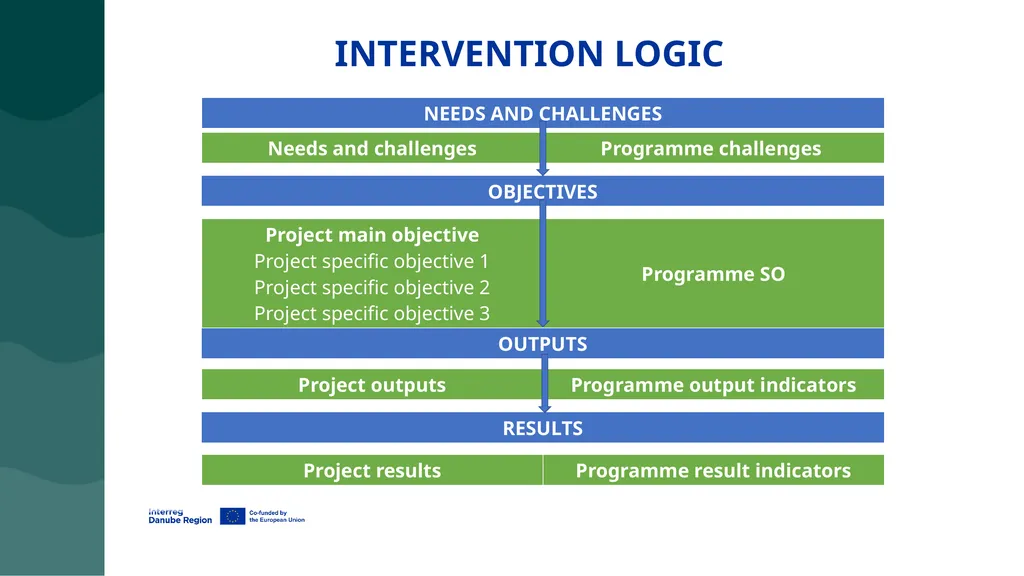
INTERVENTION LOGIC<br>
34
INTERVENTION LOGIC<br>
35
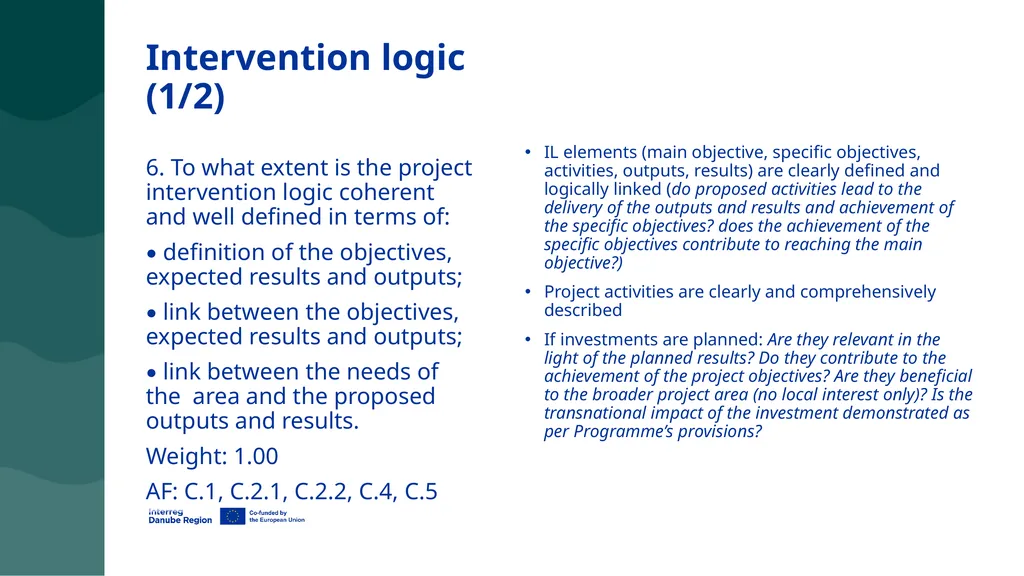
Intervention logic (1/2) IL elements (main objective, specific objectives, activities, outputs, results) are clearly defined and logically linked (do proposed activities lead to the delivery of the outputs and results and achievement of the specific objectives? does the achievement of the specific objectives contribute to reaching the main objective?)
Project activities are clearly and comprehensively described
If investments are planned: Are they relevant in the light of the planned results? Do they contribute to the achievement of the project objectives? Are they beneficial to the broader project area (no local interest only)? Is the transnational impact of the investment demonstrated as per Programme’s provisions? 6. To what extent is the project intervention logic coherent and well defined in terms of:
• definition of the objectives, expected results and outputs;
• link between the objectives, expected results and outputs;
• link between the needs of the area and the proposed outputs and results.
Weight: 1.00
AF: C.1, C.2.1, C.2.2, C.4, C.5<br>
Project activities are clearly and comprehensively described
If investments are planned: Are they relevant in the light of the planned results? Do they contribute to the achievement of the project objectives? Are they beneficial to the broader project area (no local interest only)? Is the transnational impact of the investment demonstrated as per Programme’s provisions? 6. To what extent is the project intervention logic coherent and well defined in terms of:
• definition of the objectives, expected results and outputs;
• link between the objectives, expected results and outputs;
• link between the needs of the area and the proposed outputs and results.
Weight: 1.00
AF: C.1, C.2.1, C.2.2, C.4, C.5<br>
36
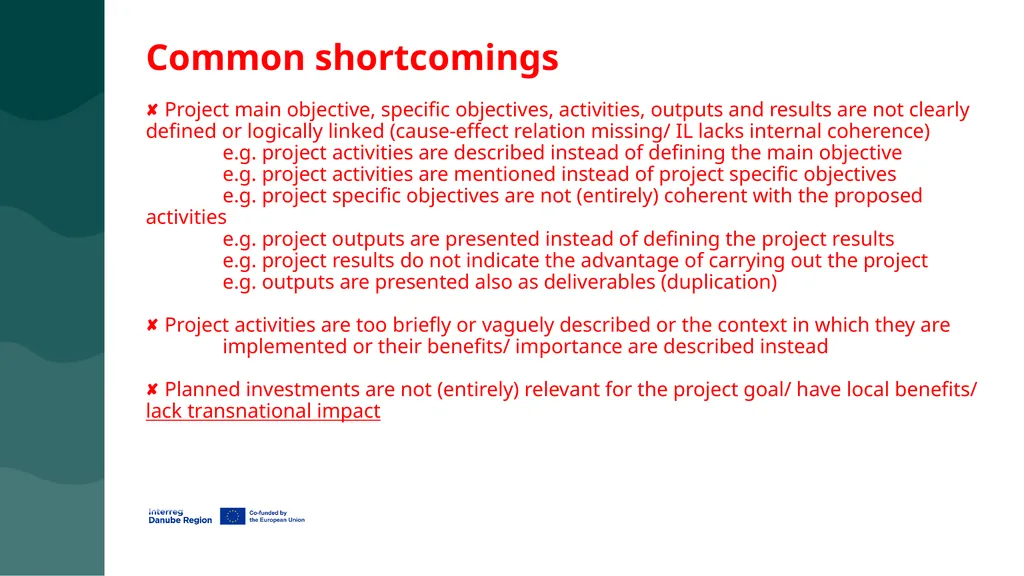
Common shortcomings
Project main objective, specific objectives, activities, outputs and results are not clearly defined or logically linked (cause-effect relation missing/ IL lacks internal coherence)
e.g. project activities are described instead of defining the main objective
e.g. project activities are mentioned instead of project specific objectives
e.g. project specific objectives are not (entirely) coherent with the proposed activities
e.g. project outputs are presented instead of defining the project results
e.g. project results do not indicate the advantage of carrying out the project
e.g. outputs are presented also as deliverables (duplication)
Project activities are too briefly or vaguely described or the context in which they are implemented or their benefits/ importance are described instead
Planned investments are not (entirely) relevant for the project goal/ have local benefits/ lack transnational impact<br>
37
Recommendations
Read carefully chapter II.7 of the Applicant’s Manual – Intervention logic, including definitions of IL elements
Provide as much information as possible when describing the activities (purpose, implementation steps, partners’ specific involvement, timeline, location) and make sure that the work plan is clear, accurate and straightforward
Check eligibility requirements for investments in the Eligibility of expenditure manual
Follow a transnational physical or functional link over the national border (e.g. transport corridors) which has been analysed from transnational point of view and has a clear impact over the national borders
OR
Create a transferable practical solution through a case study in one area, which is jointly evaluated by the project partners and transferred for testing in at least two other participating countries
Make sure planned investments are relevant and they bring a real contribution to the achievement of the project objectives<br>
38
Intervention logic (2/2) Proposed outputs and results are achievable within the project’s lifetime and by implementing the planned activities
Proposed outputs are realistically and correctly quantified 7. To what extent the envisaged activities can realistically reach the planned outputs and results?
Weight: 1.00
AF: C.4, C.5<br>
Proposed outputs are realistically and correctly quantified 7. To what extent the envisaged activities can realistically reach the planned outputs and results?
Weight: 1.00
AF: C.4, C.5<br>
39
Common shortcomings
Timeline of the activities is chronologically inconsistent raising questions on the outputs delivery time
Planned activities, as described, cannot lead to the delivery of said outputs
Target value of outputs is not realistically or correctly set
Recommendations
Ask a person not involved in the project preparation to read the proposal to spot any inconsistencies (succession/ interconnection of activities and their outputs)
Do not try to impress with big target values of outputs if not realistic or correctly quantified
Read carefully Annex 1 of the Applicant’s Manual to understand how Outputs and Results should be quantified!<br>
40
Contribution to EU strategies and policies (1/2) Relevant EU policies and strategies are listed
The contribution of the project to the indicated policies/ strategies (other than EUSDR) is clearly, comprehensively and concretely described 8. To what extent is the project concretely contributing to relevant EU strategies/ policies (other than EUSDR) of the thematic field addressed by the project?
Weight: 1.00
AF: C.2.5<br>
The contribution of the project to the indicated policies/ strategies (other than EUSDR) is clearly, comprehensively and concretely described 8. To what extent is the project concretely contributing to relevant EU strategies/ policies (other than EUSDR) of the thematic field addressed by the project?
Weight: 1.00
AF: C.2.5<br>
41
Common shortcomings
Unrelated policies/ strategies are mentioned
Project’s contribution thereto is not realistic/ specifically described
Recommendations
Select the policies/ strategies that are most relevant for your project
Be as specific as possible when describing the contribution of the project (references to planned activities, outputs, results)<br>
42
Contribution to EU strategies and policies (2/2) Project’s contribution to one or more actions of the EUSDR, as set out by the relevant Priority Areas in the Action Plan - clearly, logically and comprehensively described
EUSDR embeddedness at the level of:
needs and challenges
capitalisation, synergies
durability and transferability
work plan (e.g. involving the relevant EUSDR actors in the implementation of certain activities, proposing concrete activities to ensure the uptake of the project results by the EUSDR)
AF: C.2.5, C.2.1, C.2.6, C.2.7, C.4, C.5, C.8.2, C8.3 9. Contribution to EUSDR:
• To what extent does the project clearly contribute to the EUSDR Action Plan (one or more targets or actions of the selected EUSDR Priority Area(s))?
• To what extent is the EUSDR embedded in the proposal (at the level of needs and challenges, synergy/ capitalisation, work plan, durability and transferability)?
Weight: 1.00<br>
EUSDR embeddedness at the level of:
needs and challenges
capitalisation, synergies
durability and transferability
work plan (e.g. involving the relevant EUSDR actors in the implementation of certain activities, proposing concrete activities to ensure the uptake of the project results by the EUSDR)
AF: C.2.5, C.2.1, C.2.6, C.2.7, C.4, C.5, C.8.2, C8.3 9. Contribution to EUSDR:
• To what extent does the project clearly contribute to the EUSDR Action Plan (one or more targets or actions of the selected EUSDR Priority Area(s))?
• To what extent is the EUSDR embedded in the proposal (at the level of needs and challenges, synergy/ capitalisation, work plan, durability and transferability)?
Weight: 1.00<br>
43
Common shortcomings
Inappropriate EUSDR targets are mentioned
Project’s contribution to EUSDR targets is unclear/ provided information is too general
No specific actions proving EUSDR embedding in the proposal (work plan)
Recommendations
Refer to the targets that are relevant for your project
Be as specific as possible when describing the contribution of the project (references to planned activities, outputs, results)
Make sure that EUSDR is adequately embedded in the proposal<br>
44
Partnership (1/3) Territorial relevance of the partnership
Thematic expertise of the partners
Representation of relevant sectors
Representation of the relevant decision levels
Balanced partnership (no. of PPs/ country + budget)
Benefits for the participating countries 10. To what extent is the partnership representing the right mix of countries and competences according to the project topic, its geographic focus if relevant, and the proposed outputs and results?
Weight: 1.00
AF: B, C.3, C.4<br>
Thematic expertise of the partners
Representation of relevant sectors
Representation of the relevant decision levels
Balanced partnership (no. of PPs/ country + budget)
Benefits for the participating countries 10. To what extent is the partnership representing the right mix of countries and competences according to the project topic, its geographic focus if relevant, and the proposed outputs and results?
Weight: 1.00
AF: B, C.3, C.4<br>
45
Common shortcomings
Geographical coverage is limited even though the addressed topic is relevant for a wider area
Partners do not have the (most) appropriate expertise/competences to implement the planned activities
Some relevant sectors / levels of governance are missing
Organisations from 1-2 countries dominate the partnership
Benefits of the involved countries vary to a significant extent
Recommendations
Make sure that the partnership geographical scope matches the territories (area) that share the same need or face the same challenges
Involve organisations that hold appropriate thematic competences relevant for the project
Involve organisations representing the sectors/decision levels required by the planned activities (incl. ASPs)
Make sure the partnership is balanced enough and benefits for the countries are comparable<br>
46
Partnership (2/3) Partners’ involvement corresponds to their thematic expertise and territorial competences
Distribution of tasks among the partners is equitable and it contributes to the achievement of the project objective 11. To what extent is the role of the partners balanced and relevant for achieving the main objective?
Weight: 1.00
AF: B, C.3, C.4<br>
Distribution of tasks among the partners is equitable and it contributes to the achievement of the project objective 11. To what extent is the role of the partners balanced and relevant for achieving the main objective?
Weight: 1.00
AF: B, C.3, C.4<br>
47
Common shortcomings
Partners’ involvement is not coherent with their expertise or all partners are involved in all activities
Few partners share most of the tasks while others have a very small contribution
Recommendations
Ensure a logical and lucrative involvement of partner organisations based on their expertise and competences
Distribute tasks and responsibilities in a fairly equitable manner<br>
48
Partnership (3/3) Involvement of non-EU Danube countries in line with the project topic, addressed needs and challenges
The absence of PPs from non-EU countries despite the relevance of the identified needs and challenges to their territories, leads to a lower score 12. To what extent are the non-EU countries of the programme area involved in the partnership?
Weight: 1.40
AF: B, C.3, C.4<br>
The absence of PPs from non-EU countries despite the relevance of the identified needs and challenges to their territories, leads to a lower score 12. To what extent are the non-EU countries of the programme area involved in the partnership?
Weight: 1.40
AF: B, C.3, C.4<br>
49
Common shortcomings
No/ limited involvement of partners from non-EU DRP countries despite the relevance of the topic to their territories
Inadequate representation of such countries in the project consortium
Recommendations
Mind the separate assessment criterion and weight!
Ensure the involvement of relevant partners from non-EU DRP countries where required by the territorial relevance of the project topic and identified needs<br>
50
Transnational cooperation (1/2) The project is implemented in a broader area of the DR
The project addresses a shared need/ challenge (it is not a collection of local actions)
Transnational dimension: project topic, addressed challenge and contributing project activities have transnational, broader territorial and/or thematic character and relevance
Transnational impact: based on the planned activities and outputs the impact of the project can be considered relevant on transnational scale and not only on local level in different parts of the region 13. To what extent does the project have a clear transnational dimension and impact?
Weight: 2.00
AF: C.2.3, C.4, C.5<br>
The project addresses a shared need/ challenge (it is not a collection of local actions)
Transnational dimension: project topic, addressed challenge and contributing project activities have transnational, broader territorial and/or thematic character and relevance
Transnational impact: based on the planned activities and outputs the impact of the project can be considered relevant on transnational scale and not only on local level in different parts of the region 13. To what extent does the project have a clear transnational dimension and impact?
Weight: 2.00
AF: C.2.3, C.4, C.5<br>
51
Common shortcomings
No/ limited transnational dimension or impact due to limited geographical scope of the project
Topic, issue could be better addressed at local/ national/ cross-border level
The project puts together different local actions without joint, harmonised implementation and outcome
No/ limited transnational impact of the project outcomes
Recommendations
Propose activities that are transnationally-relevant
Propose outputs and results that will have an effect and impact on the wider region<br>
52
Transnational cooperation (2/2) The project clearly demonstrates that the identified common need/ challenge is best tackled on a transnational level (as opposed to a local/ regional/ cross-border approach) – added value of transnational cooperation
Project results are best achieved through transnational cooperation 14. To what extent the added value of the transnational cooperation is clearly described?
Weight: 1.00
AF: C.2.3, C.4<br>
Project results are best achieved through transnational cooperation 14. To what extent the added value of the transnational cooperation is clearly described?
Weight: 1.00
AF: C.2.3, C.4<br>
53
Common shortcomings
Added value of transnational cooperation is not clearly demonstrated, described
Recommendations
Clearly explain why a transnational approach is the best option (assessment is not done based on assumptions!)<br>
54
Target groups, durability & transferability, horizontal principles (1/3) Relevant target groups identified
The project properly details how the target groups (including EUSDR relevant bodies and stakeholders!) will be involved during the project implementation and how the proposed outputs answer their needs 15. To what extent is the target group (including EUSDR relevant bodies and stakeholders) clearly identified and involved throughout the project implementation?
Weight: 1.00
AF: C.2.4, C.4<br>
The project properly details how the target groups (including EUSDR relevant bodies and stakeholders!) will be involved during the project implementation and how the proposed outputs answer their needs 15. To what extent is the target group (including EUSDR relevant bodies and stakeholders) clearly identified and involved throughout the project implementation?
Weight: 1.00
AF: C.2.4, C.4<br>
55
Common shortcomings
Inappropriate target groups are mentioned
Involvement of the target groups is not clearly presented in the work plan
Recommendations
Select relevant target groups
Ensure coherence between the information provided in section C.2.4 (target groups) and work plan (activities, communication objectives)<br>
56
Target groups, durability & transferability, horizontal principles (2/3) The proposal clearly and concretely describes how the target groups will integrate the project outputs and will make further use of them after the end of the project (clear reference to the specific target groups / project outputs) 16. To what extent does the proposal clearly explain how the target group will integrate/use the project outputs?
Weight: 1.60
AF: C.2.4, C.4, C.5<br>
Weight: 1.60
AF: C.2.4, C.4, C.5<br>
57
Common shortcomings
It is not clear how the target groups will adopt/ use the project outputs
Recommendations
Be as specific as possible when explaining how the target groups will use/ integrate in their daily work project’s outputs after the end of the project<br>
58
Target groups, durability & transferability, horizontal principles (3/3) The appropriate type of contribution to sustainable development and gender equality and non-discrimination is selected and the contribution thereto is clearly and concretely described (either in relation to the implementation of the current project or in relation to its outcomes)
The applicant clearly explains why SEA is relevant or not in connection to any project deliverable, output or investment 17. To what extent does the project prove to make a positive contribution to the programme’s horizontal principles?
Weight: 0.60
AF: C.7.6<br>
The applicant clearly explains why SEA is relevant or not in connection to any project deliverable, output or investment 17. To what extent does the project prove to make a positive contribution to the programme’s horizontal principles?
Weight: 0.60
AF: C.7.6<br>
59
Common shortcomings
Description of project’s contribution to the horizontal principles is not clear/ concrete enough
If SEA is not relevant, explanation as to why is missing
Recommendations
Demonstrate a clear and direct connection between the planned activities/ outputs and the contribution to the horizontal principles.
Even if SEA is not relevant, do not forget to explain why.<br>
60
Operational assessment<br>
61
Work plan (1/2) Overall duration of the project and that of individual activities are realistic
The sequence of activities and the interdependencies between them are logical and coherent
Timeline of activities is coherent with the spending forecast (e.g. peak periods – higher amounts planned)
The work plan should demonstrate readiness to be implemented (all conditions, resources, and capabilities required to begin the project are in place) 1. To what extent are the proposed timetable and spending forecast coherent and realistic?
Weight: 3.00
AF: C.4, C.5, C.6, D.3<br>
The sequence of activities and the interdependencies between them are logical and coherent
Timeline of activities is coherent with the spending forecast (e.g. peak periods – higher amounts planned)
The work plan should demonstrate readiness to be implemented (all conditions, resources, and capabilities required to begin the project are in place) 1. To what extent are the proposed timetable and spending forecast coherent and realistic?
Weight: 3.00
AF: C.4, C.5, C.6, D.3<br>
62
Common shortcomings
Timeframes are not realistic (activities are too short/ long)
Work plan is not coherent (illogical sequence of activities, due dates of deliverables, outputs, results are not aligned with the timeframe of corresponding activities)
Work plan is not coherent with the spending forecast
Recommendations
When defining the timeline of the project, take into consideration possible initial delays, reporting times, plan parallel implementation of activities where possible
Ensure chronological coherence of activities
Make sure that the spending forecast reflects efforts made/ investment implementation, etc.<br>
63
Work plan (2/2) The activities are described in detail in terms of how they will be implemented, where, when and by whom
The activities are balanced in terms of geographical implementation 2. To what extent are the activities described in detail (how, where, when and by whom they will be undertaken) and balanced in terms of geographical implementation (national, regional, local)?
Weight: 2.00
AF: C.4<br>
The activities are balanced in terms of geographical implementation 2. To what extent are the activities described in detail (how, where, when and by whom they will be undertaken) and balanced in terms of geographical implementation (national, regional, local)?
Weight: 2.00
AF: C.4<br>
64
Common shortcomings
Ambiguous description of activities
Involvement of partners who do not have the most appropriate thematic competence for a certain activity
Activities are preponderantly implemented in 2-3 countries
Recommendations
When describing the activities, provide sufficient details but straight to the point
Pay attention to the involvement of the partners (expertise, yet balanced involvement)
Ensure a project-wide geographical span of activities
REMEMBER:
- to include capitalisation activities (mandatory) in the work plan and budget
- to explain how the target groups and EUSDR actors will be involved in the project implementation<br>
65
Project management (1/2) Project management and coordination (procedures, decision making process and structures, etc.) is clear
Internal communication and the transfer of know-how inside the partnership are adequately described
Quality assurance procedures are in place, independence of the quality manager assessing the outputs is demonstrated
The project explains how potential risks are managed and mitigated 3. To what extent are the management structures (e.g. project steering committee) and procedures (e.g. internal procedures, quality assurance etc.) clear, transparent, efficient and effective?
Weight: 2.00
AF: C.7.1, C.7.2<br>
Internal communication and the transfer of know-how inside the partnership are adequately described
Quality assurance procedures are in place, independence of the quality manager assessing the outputs is demonstrated
The project explains how potential risks are managed and mitigated 3. To what extent are the management structures (e.g. project steering committee) and procedures (e.g. internal procedures, quality assurance etc.) clear, transparent, efficient and effective?
Weight: 2.00
AF: C.7.1, C.7.2<br>
66
Common shortcomings
Managing structures are not proportionate to the needs of the project or tasks are not clear
Effective internal communication is not apparent
Quality management structure is missing or procedures are not clear
Risk management is not mentioned
Recommendations
Aim for an agile, adaptable project management structure able to respond to the needs of the project (main roles to be ensured by all partners)
Do not underestimate the importance of quality and risk management<br>
67
Project management (2/2) The lead applicant demonstrates having the knowledge and resources needed to manage the project and the partnership
Or, outlines concrete measures to ensure them 4. To what extent does the lead applicant demonstrate its capacity to manage EU co-financed projects or other international projects or can ensure adequate measures for management support?
Weight: 1.00
AF: B.1.1 (motivation)<br>
Or, outlines concrete measures to ensure them 4. To what extent does the lead applicant demonstrate its capacity to manage EU co-financed projects or other international projects or can ensure adequate measures for management support?
Weight: 1.00
AF: B.1.1 (motivation)<br>
68
Common shortcomings
LA is less experienced in implementing/ coordinating EU/ international projects or lacks necessary capacities to manage the project and does not explain clearly how they will ensure the necessary resources
LA does not provide clear explanation as to how the project coordination will be ensured in case not performed with internal staff
Recommendations
Read How to develop a transnational project, Chapter II - How to set up a partnership/ Lead Partner ideal profile
If PM is subcontracted, provide clear explanation as to how it will work<br>
69
Communication (1/2) Communication objectives are well correlated with the project specific objectives and corresponding activities
Communication tools are clear, consistent and appropriate to reach the project specific objectives 5. To what extent are the communication objectives clearly linked to the project specific objectives?
Weight: 3.00
AF: C.4, C.7.3<br>
Communication tools are clear, consistent and appropriate to reach the project specific objectives 5. To what extent are the communication objectives clearly linked to the project specific objectives?
Weight: 3.00
AF: C.4, C.7.3<br>
70
Common shortcomings
Communication objectives are too generally defined or are not supporting the achievement of the project specific objectives
Communication objectives refer to simple communication/ promotion/ dissemination activities
Recommendations
Connect clearly the communication objectives to the project specific objectives
When formulating the communication objectives, think also about how these objectives can influence the audience’s behaviour and enhance their awareness and knowledge level.<br>
71
Communication (2/2) Communication activities and deliverables are tailored to the needs and specificities of the target groups 6. To what extent are communication activities and deliverables appropriate to reach the relevant target groups and stakeholders?
Weight: 2.00
AF: C.4, C.7.3<br>
Weight: 2.00
AF: C.4, C.7.3<br>
72
Common shortcomings
Communication activities (including strategies, tools, channels, etc.) are not well tailored to the type of addressed stakeholders or target groups
Recommendations
Plan efficient communication activities tailored to the project content and target groups
Communication in AF:
• C.7.3 – who will coordinate project communication, how the involvement of all partners will be ensured, role of communication in transferring the project results. Remember the mandatory communication requirements
• Work plan:
- Communication objectives defined for each specific objective
- Communication activities described in the Activity description fields<br>
73
Project budget (1/3) Overall value of the proposal considering its size, proposed activities and outputs as well as its quality
Budget allocation of each project activity is realistic (considering that sufficient information is provided in the activity descriptions) 7. To what extent is the budget allocated to each project activity justified and correctly quantified?
Weight: 3.00
AF: C.4<br>
Budget allocation of each project activity is realistic (considering that sufficient information is provided in the activity descriptions) 7. To what extent is the budget allocated to each project activity justified and correctly quantified?
Weight: 3.00
AF: C.4<br>
74
Common shortcomings
Budget allocation for each activity is not indicated
Budget allocation for each activity is under/over estimated
The project does not prove the value for money
Recommendations
When allocating budget to each activity, think about the number of partners involved, their roles, as well as the outcomes of that activity – be realistic
REMEMBER:
- to indicate the budget allocation for each activity in the activity description field
- to include the preparation costs, if applicable
- to include ASPs travel costs in the sponsoring partner’s budget, if T&A real costs apply
- to include control costs (FLC) in the External expertise cost category (valid for PPs from DE, AT and MD)<br>
75
Project budget (2/3) Real costs are analysed at partner level:
Staff: justified by planned activities and partner involvement
Travel and accommodation (in special cases): justified by planned meetings, events
External expertise: justified by planned activities
Equipment: necessary to implement planned activities, realistic cost/ item
Infrastructure and works: eligible investment, realistic cost 8. To what extent is the budget of each cost category (based on real costs) coherent with the planned activities and involved partners?
Weight: 2.00
AF: C.4, D<br>
Staff: justified by planned activities and partner involvement
Travel and accommodation (in special cases): justified by planned meetings, events
External expertise: justified by planned activities
Equipment: necessary to implement planned activities, realistic cost/ item
Infrastructure and works: eligible investment, realistic cost 8. To what extent is the budget of each cost category (based on real costs) coherent with the planned activities and involved partners?
Weight: 2.00
AF: C.4, D<br>
76
Common shortcomings
Budget in certain cost categories is overestimated / not justified by planned activities
Some equipment items do not seem necessary for the implementation of activities
Requested amounts for equipment or infrastructure and works are under/overestimated
Recommendations
Develop a detailed internal budget per partner/ activity/ cost category/ period taking into consideration the project activities and the involvement of each partner
Make realistic estimations considering applicable rules and market prices<br>
77
Project budget (3/3) Total budget of each partner is analysed as per role, tasks, involvement and responsibilities
Staff / external expertise ratio is scrutinised 9. To what extent the partners’ budget is consistent with their involvement in the activities?
Weight: 2.00
AF: B, C.4, D<br>
Staff / external expertise ratio is scrutinised 9. To what extent the partners’ budget is consistent with their involvement in the activities?
Weight: 2.00
AF: B, C.4, D<br>
78
Common shortcomings
Partners’ involvement is not clear making it difficult to assess their budget
Amount allocated to external expertise is too high - raising the question of the relevance of the respective partner in the project
Recommendations
After developing the detailed budget, calculate percentages to appraise whether they correspond to each partner’s involvement (e.g. % of PPs total budget as compared to the total project budget, % of each cost category in a PP’s budget compared to their total budget)
REMEMBER:
- to indicate the proportion (%) of the total partner budget to be allocated for project management activities in section B, Motivation (2nd question)<br>
79
General advices for application
Read carefully 3rd call documents
Make sure that intervention logic and related DRP indicators are clearly understood
Check whether your application provides clear, concrete, well detailed information as per each assessment criteria
Contact DRP MA/JS - NCP if you have any questions<br>
80
Selection
Proposals scoring less than 60% overall will be recommended by the MA/JS for rejection
Proposals scoring more than 60% overall will be subject to further discussions and a final decision will be taken by the MC
Final decision on financing the proposals will be taken by the MC based on the results of the assessment, the ranking list and the funds available<br>
81
Support for applicants
DRP website - 3rd call webpage (information and documents)
Thematic webinars (presentations, recordings)
https://interreg-danube.eu/calls-for-proposals/third-call-for-proposals
DRP matchmaking platform for partner search
https://interreg-danube.eu/partner-search
Network of National Contact Points
https://interreg-danube.eu/contact-us#ncp
EUSDR PAs
https://danube-region.eu/about-eusdr/eusdr-governance-priority-areas/
JS: ad-hoc advice on technical/formal issues & one bilateral consultation<br>
82
Danube Region Programme
Managing Authority/ Joint Secretariat Thank you! Ana Leganel https://www.linkedin.com/in/interregdanube/
https://www.facebook.com/InterregDanube/ ana.leganel@interreg-danube.eu +36 70 642 2182<br>
Managing Authority/ Joint Secretariat Thank you! Ana Leganel https://www.linkedin.com/in/interregdanube/
https://www.facebook.com/InterregDanube/ ana.leganel@interreg-danube.eu +36 70 642 2182<br>
83
Communication 3rd CfP – Lead Applicants webinar Online, 8th October 2025 Mirjana Vidanović<br>
84
COMMUNICATION: ESSENTIAL ELEMENT OF A SUCCESSFUL PROJECT Communication is integral part of project implementation communication is horizontally planned and embedded within activities!
Communication objectives linked to project objectives and results:
Communication objectives and the related activities and tools should be clear, consistent, realistic and appropriate to reach the project specific objectives.
Communication activities and deliverables appropriate to reach the relevant target groups and stakeholders<br>
Communication objectives linked to project objectives and results:
Communication objectives and the related activities and tools should be clear, consistent, realistic and appropriate to reach the project specific objectives.
Communication activities and deliverables appropriate to reach the relevant target groups and stakeholders<br>
85
Internal communication
Goal: Build clarity, trust, and collaboration Plan it wisely as it is one of preconditions for successful project design:
Create a shared project charter accessible to all partners.
Promote inclusive communication and empathy.
Agree on main tools (Teams, Slack, email, etc.)
Ensure equal access to information and platforms
Hold scheduled check-ins (weekly/monthly)
Use standard templates for updates and reporting
Provide written summaries after meetings.<br>
Create a shared project charter accessible to all partners.
Promote inclusive communication and empathy.
Agree on main tools (Teams, Slack, email, etc.)
Ensure equal access to information and platforms
Hold scheduled check-ins (weekly/monthly)
Use standard templates for updates and reporting
Provide written summaries after meetings.<br>
86
Communication elements provided by DRP DRP will provide each project with a logo after the project approval Not eligible to design an own project logo
Project website provided by the DRP within the programme website
Not eligible to create an own project website
https://interreg-danube.eu/projects<br>
Project website provided by the DRP within the programme website
Not eligible to create an own project website
https://interreg-danube.eu/projects<br>
87
Mandatory communication elements to be planned POSTER - All project beneficiaries must place a poster or equivalent electronic display with information about the project at a location visible to the public.
Bilboards and plaques- For a physical investment or equipment purchase when the project budget exceeds EUR 100,000
Synergy building and capitalisation activities<br>
Bilboards and plaques- For a physical investment or equipment purchase when the project budget exceeds EUR 100,000
Synergy building and capitalisation activities<br>
88
Synergy building and capitalisation activities Capitalisation activities with other programs, projects, initiatives
Identify what has already been implemented (to avoid duplication)
relevant projects, initiatives
what achievements can be built upon, used
Synergy building with ongoing projects - bring added value
sharing complementary knowledge, outputs
strengthening networking
broader outreach & higher visibility potentials
Integrate capitalisation, synergy building activities in work plan<br>
Identify what has already been implemented (to avoid duplication)
relevant projects, initiatives
what achievements can be built upon, used
Synergy building with ongoing projects - bring added value
sharing complementary knowledge, outputs
strengthening networking
broader outreach & higher visibility potentials
Integrate capitalisation, synergy building activities in work plan<br>
89
Synergy building and capitalisation activities Common shortcomings:
Relevant projects, initiatives described only in general
unclear concretely what is to be capitalised and how (project output, element, achievements?)
added value of new project not demonstrated compared to what has already been achieved by previous projects, initiatives
Capitalisation activities, carried out during project implementation and in line with the programme capitalisation strategy as outlined above, are mandatory and the related budget has to be envisaged already in the Application Form. The capitalisation activities have to be included in the project work plan in a coherent manner, according to the project structure and the expenditures included in the concerned activities (Applicants Manual, pg. 34)<br>
Relevant projects, initiatives described only in general
unclear concretely what is to be capitalised and how (project output, element, achievements?)
added value of new project not demonstrated compared to what has already been achieved by previous projects, initiatives
Capitalisation activities, carried out during project implementation and in line with the programme capitalisation strategy as outlined above, are mandatory and the related budget has to be envisaged already in the Application Form. The capitalisation activities have to be included in the project work plan in a coherent manner, according to the project structure and the expenditures included in the concerned activities (Applicants Manual, pg. 34)<br>
90
Danube Region Programme
Managing Authority/ Joint Secretariat Thank you! Mirjana Vidanovic, Communication officer https://www.linkedin.com/in/interregdanube/
https://www.facebook.com/InterregDanube/ mirjana.vidanovic@interreg-danube.eu +36 1 7955688<br>
Managing Authority/ Joint Secretariat Thank you! Mirjana Vidanovic, Communication officer https://www.linkedin.com/in/interregdanube/
https://www.facebook.com/InterregDanube/ mirjana.vidanovic@interreg-danube.eu +36 1 7955688<br>
91
Time for coffee!<br>
92
Financial planning
and
eligibility of expenditure Online, 8th October 2025 3rd CfP – Lead Applicants webinar Mirjana Arsenic Petrovic<br>
93
Presentation contents Project budget planning
Eligibility of expenditure
Budget structure options<br>
Eligibility of expenditure
Budget structure options<br>
94
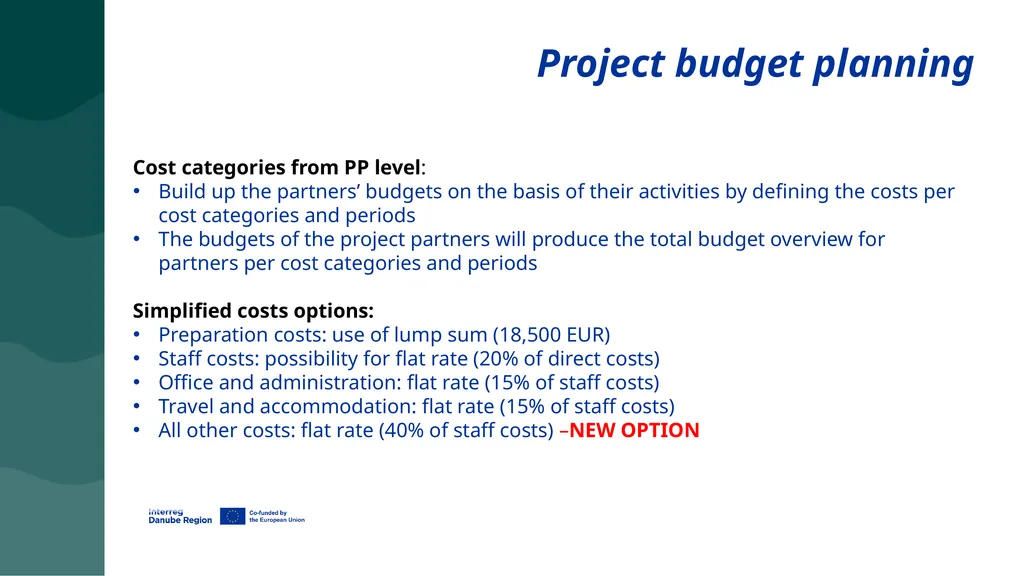
Project budget planning Cost categories from PP level:
Build up the partners’ budgets on the basis of their activities by defining the costs per cost categories and periods
The budgets of the project partners will produce the total budget overview for partners per cost categories and periods
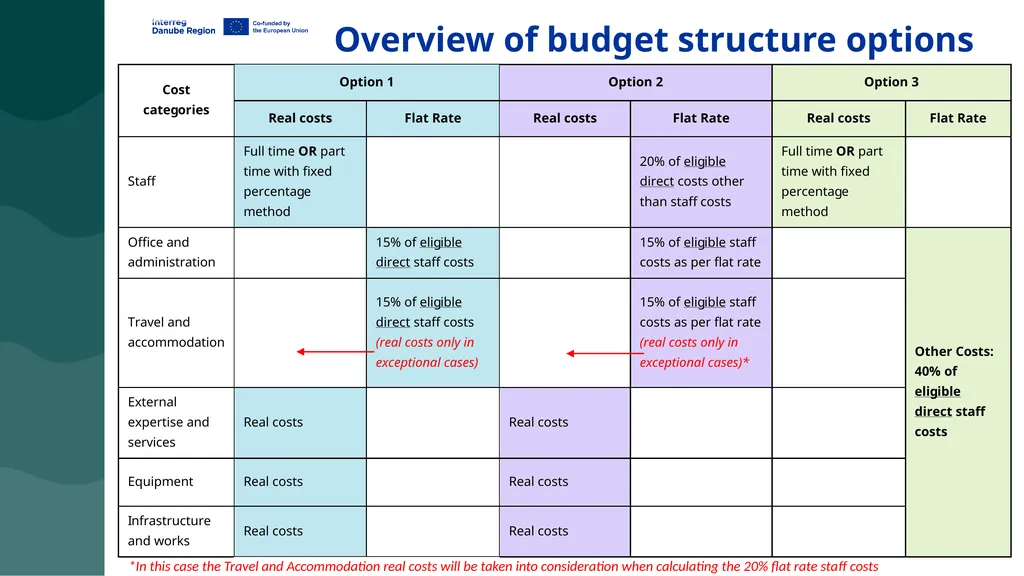
Simplified costs options:
Preparation costs: use of lump sum (18,500 EUR)
Staff costs: possibility for flat rate (20% of direct costs)
Office and administration: flat rate (15% of staff costs)
Travel and accommodation: flat rate (15% of staff costs)
All other costs: flat rate (40% of staff costs) –NEW OPTION<br>
Build up the partners’ budgets on the basis of their activities by defining the costs per cost categories and periods
The budgets of the project partners will produce the total budget overview for partners per cost categories and periods
Simplified costs options:
Preparation costs: use of lump sum (18,500 EUR)
Staff costs: possibility for flat rate (20% of direct costs)
Office and administration: flat rate (15% of staff costs)
Travel and accommodation: flat rate (15% of staff costs)
All other costs: flat rate (40% of staff costs) –NEW OPTION<br>
95
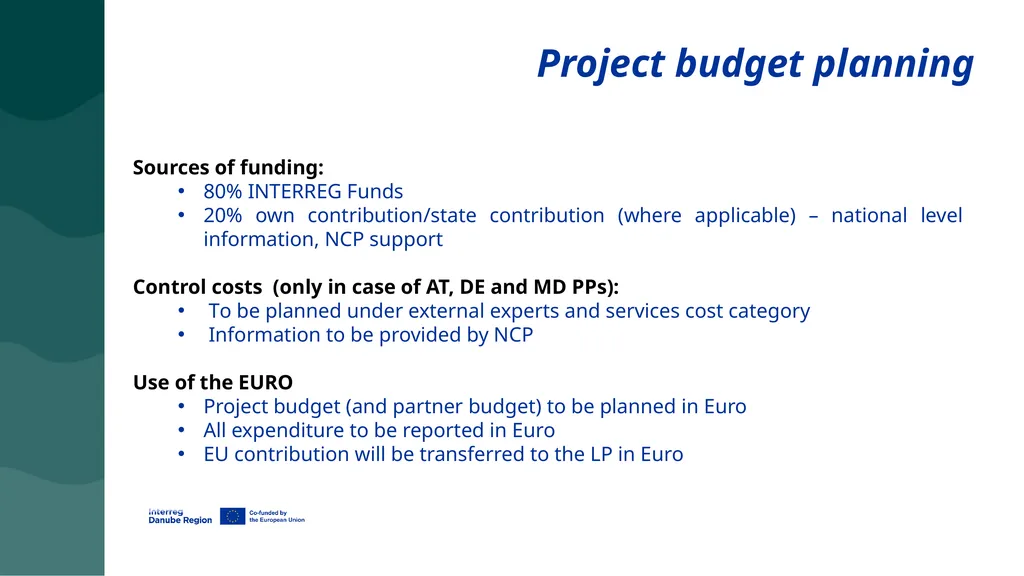
Project budget planning Sources of funding:
80% INTERREG Funds
20% own contribution/state contribution (where applicable) – national level information, NCP support
Control costs (only in case of AT, DE and MD PPs):
To be planned under external experts and services cost category
Information to be provided by NCP
Use of the EURO
Project budget (and partner budget) to be planned in Euro
All expenditure to be reported in Euro
EU contribution will be transferred to the LP in Euro<br>
80% INTERREG Funds
20% own contribution/state contribution (where applicable) – national level information, NCP support
Control costs (only in case of AT, DE and MD PPs):
To be planned under external experts and services cost category
Information to be provided by NCP
Use of the EURO
Project budget (and partner budget) to be planned in Euro
All expenditure to be reported in Euro
EU contribution will be transferred to the LP in Euro<br>
96
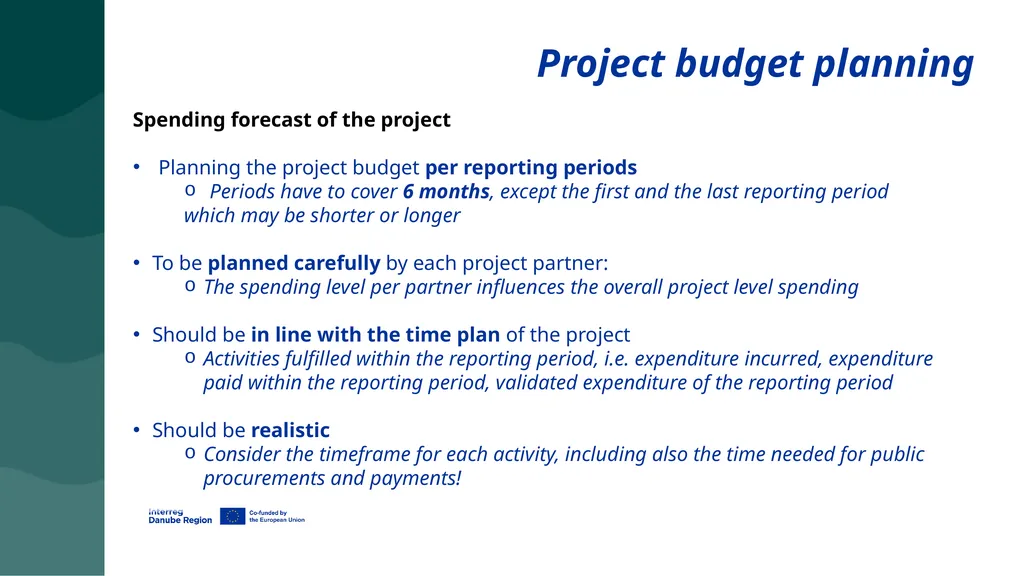
Project budget planning Spending forecast of the project
Planning the project budget per reporting periods
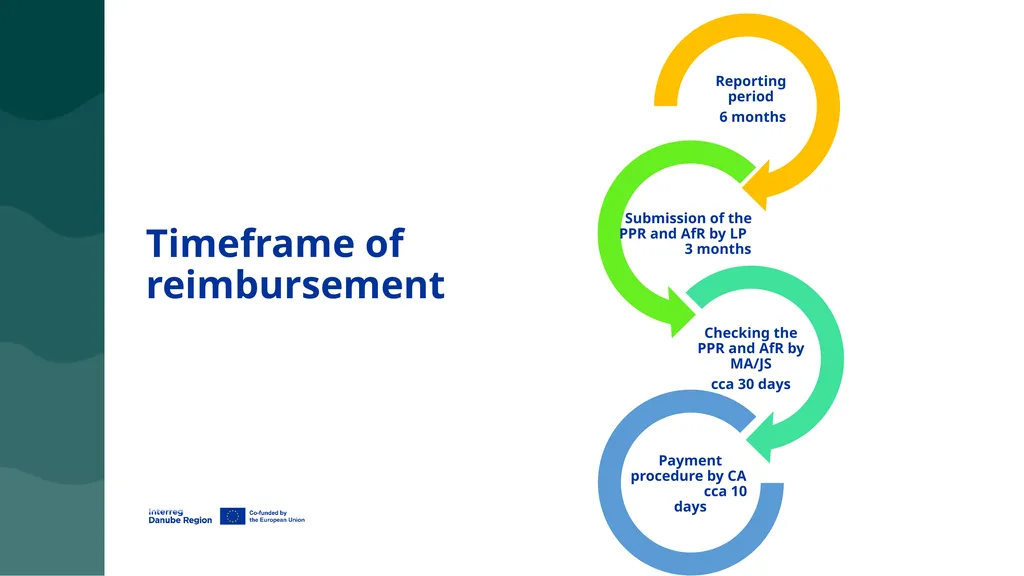
Periods have to cover 6 months, except the first and the last reporting period
which may be shorter or longer
To be planned carefully by each project partner:
The spending level per partner influences the overall project level spending
Should be in line with the time plan of the project
Activities fulfilled within the reporting period, i.e. expenditure incurred, expenditure paid within the reporting period, validated expenditure of the reporting period
Should be realistic
Consider the timeframe for each activity, including also the time needed for public procurements and payments!<br>
Planning the project budget per reporting periods
Periods have to cover 6 months, except the first and the last reporting period
which may be shorter or longer
To be planned carefully by each project partner:
The spending level per partner influences the overall project level spending
Should be in line with the time plan of the project
Activities fulfilled within the reporting period, i.e. expenditure incurred, expenditure paid within the reporting period, validated expenditure of the reporting period
Should be realistic
Consider the timeframe for each activity, including also the time needed for public procurements and payments!<br>
97
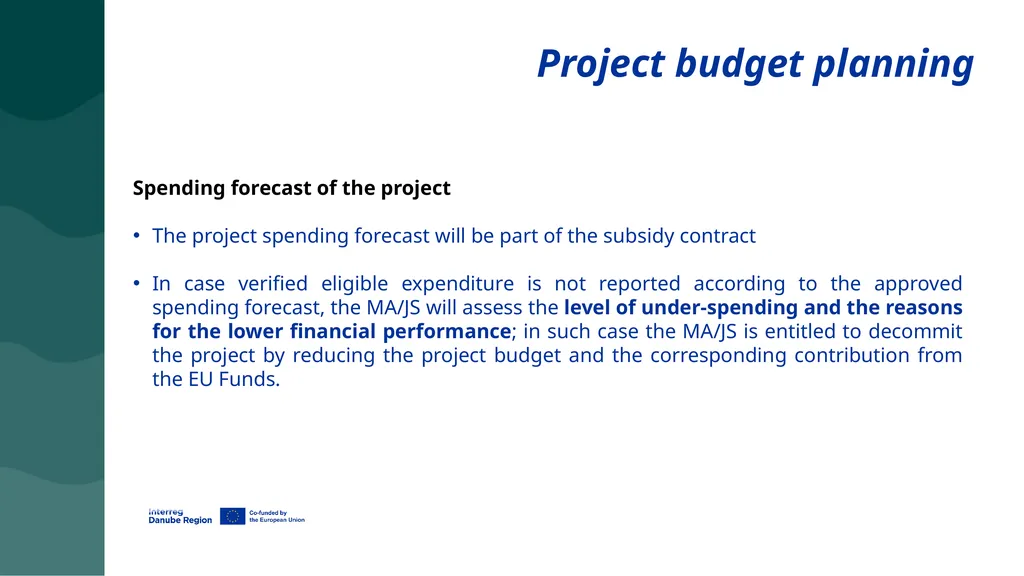
Project budget planning Spending forecast of the project
The project spending forecast will be part of the subsidy contract
In case verified eligible expenditure is not reported according to the approved spending forecast, the MA/JS will assess the level of under-spending and the reasons for the lower financial performance; in such case the MA/JS is entitled to decommit the project by reducing the project budget and the corresponding contribution from the EU Funds.<br>
The project spending forecast will be part of the subsidy contract
In case verified eligible expenditure is not reported according to the approved spending forecast, the MA/JS will assess the level of under-spending and the reasons for the lower financial performance; in such case the MA/JS is entitled to decommit the project by reducing the project budget and the corresponding contribution from the EU Funds.<br>
98
Timeframe of reimbursement<br>
99
Eligibility of expenditure Hierarchy of rules
Non-eligible costs
Eligibility in time
Eligibility of expenditure by cost categories<br>
Non-eligible costs
Eligibility in time
Eligibility of expenditure by cost categories<br>
100
Eligibility of expenditure Hierarchy of rules
1. EU Regulations
2. Programme rules
Manual on Eligibility of Expenditure (Version 2.2 - date: September 2025)
3. National (including specific institutional) rules
The eligibility rules laid down in the Manual on eligiblity of expenditure shall not be overruled by national or institutional legislation<br>
1. EU Regulations
2. Programme rules
Manual on Eligibility of Expenditure (Version 2.2 - date: September 2025)
3. National (including specific institutional) rules
The eligibility rules laid down in the Manual on eligiblity of expenditure shall not be overruled by national or institutional legislation<br>
101
Eligibility of expenditure Non-eligible costs
Interest on debt
Value added tax (‘VAT’), except:
- for operations the total cost of which is below EUR 5 000 000 (including VAT);
- for operations the total cost of which is at least EUR 5 000 000 (including VAT)
where it is non-recoverable under national VAT legislation
Fines, financial penalties and expenditure on legal disputes and litigation
Costs of gifts
Costs related to fluctuation of foreign exchange rate
Purchase of land and existing buildings
In-kind contribution (including unpaid voluntary work)
Project expenditure split among project partners (i.e. sharing of „common costs”)<br>
Interest on debt
Value added tax (‘VAT’), except:
- for operations the total cost of which is below EUR 5 000 000 (including VAT);
- for operations the total cost of which is at least EUR 5 000 000 (including VAT)
where it is non-recoverable under national VAT legislation
Fines, financial penalties and expenditure on legal disputes and litigation
Costs of gifts
Costs related to fluctuation of foreign exchange rate
Purchase of land and existing buildings
In-kind contribution (including unpaid voluntary work)
Project expenditure split among project partners (i.e. sharing of „common costs”)<br>
102
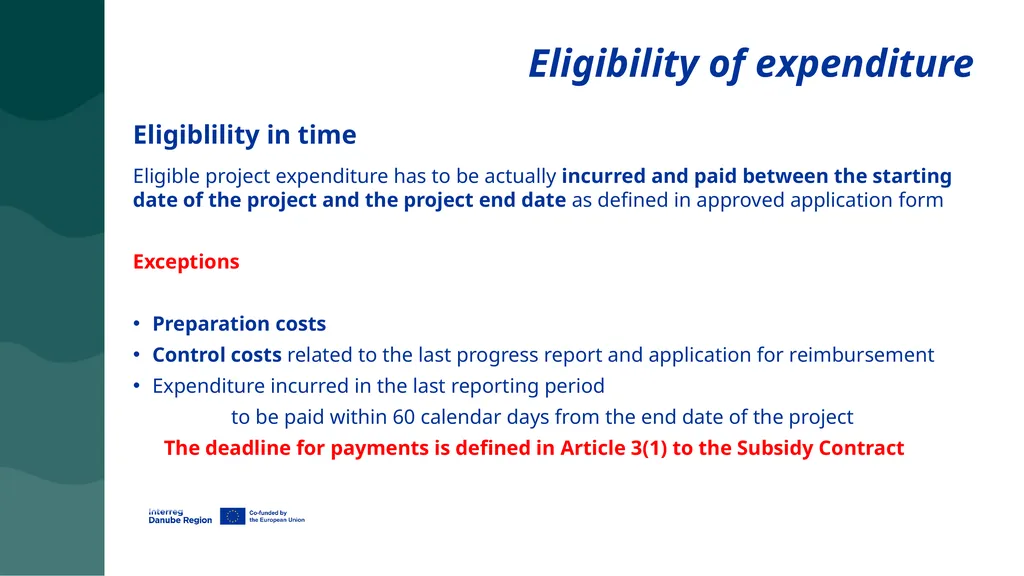
Eligibility of expenditure Eligiblility in time
Eligible project expenditure has to be actually incurred and paid between the starting date of the project and the project end date as defined in approved application form
Exceptions
Preparation costs
Control costs related to the last progress report and application for reimbursement
Expenditure incurred in the last reporting period
to be paid within 60 calendar days from the end date of the project
The deadline for payments is defined in Article 3(1) to the Subsidy Contract<br>
Eligible project expenditure has to be actually incurred and paid between the starting date of the project and the project end date as defined in approved application form
Exceptions
Preparation costs
Control costs related to the last progress report and application for reimbursement
Expenditure incurred in the last reporting period
to be paid within 60 calendar days from the end date of the project
The deadline for payments is defined in Article 3(1) to the Subsidy Contract<br>
103
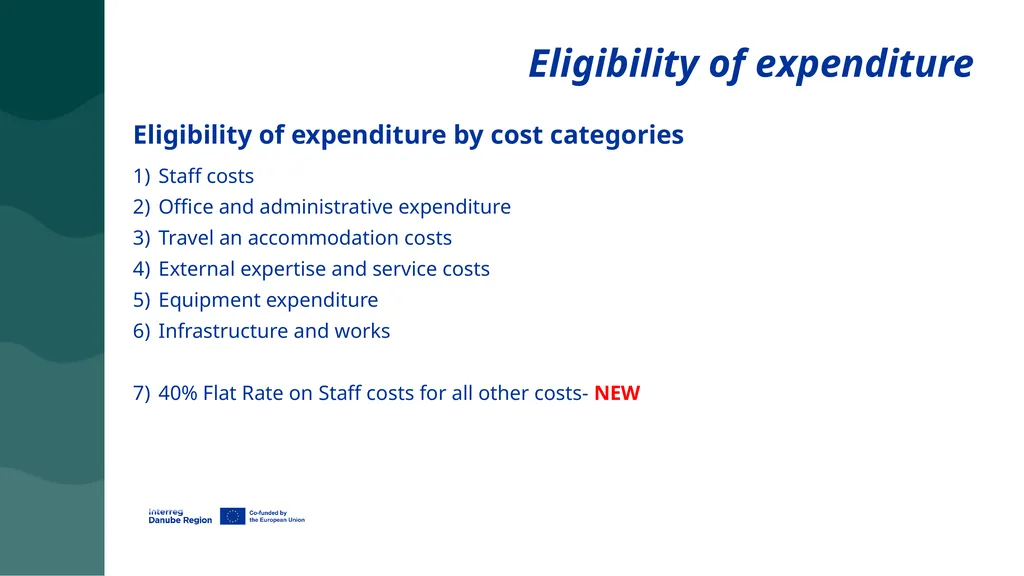
Eligibility of expenditure Eligibility of expenditure by cost categories
Staff costs
Office and administrative expenditure
Travel an accommodation costs
External expertise and service costs
Equipment expenditure
Infrastructure and works
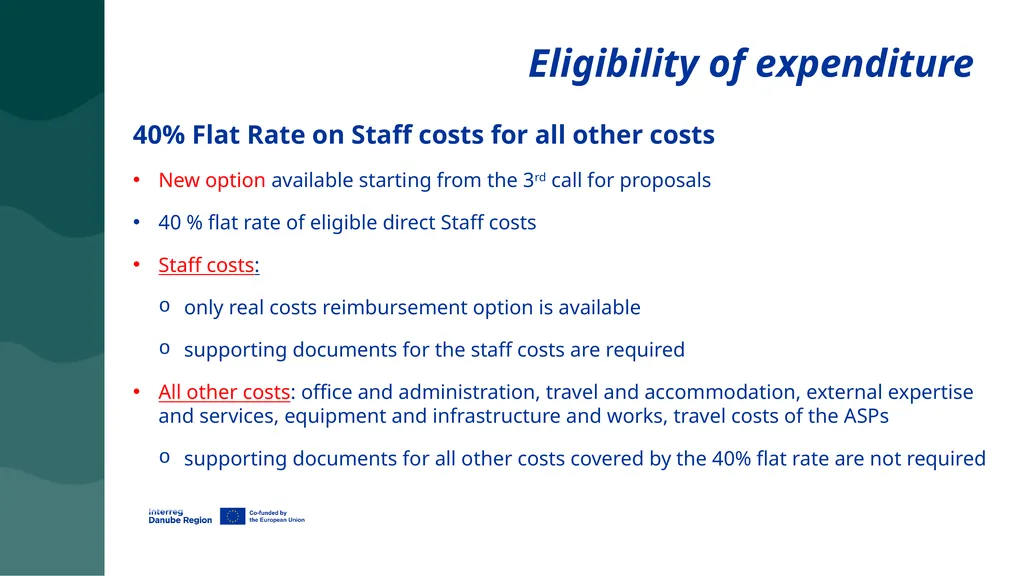
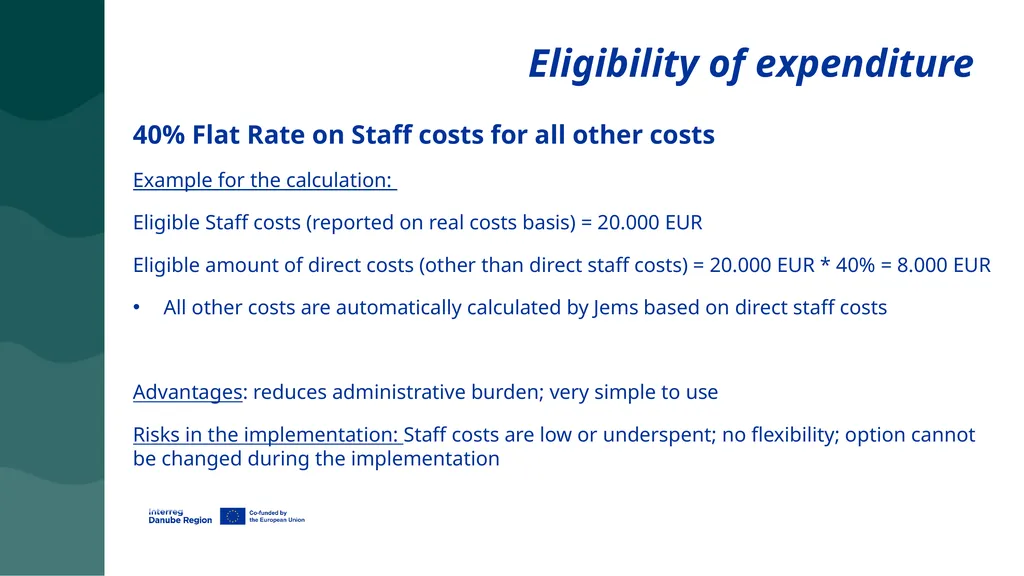
40% Flat Rate on Staff costs for all other costs- NEW<br>
Staff costs
Office and administrative expenditure
Travel an accommodation costs
External expertise and service costs
Equipment expenditure
Infrastructure and works
40% Flat Rate on Staff costs for all other costs- NEW<br>
104
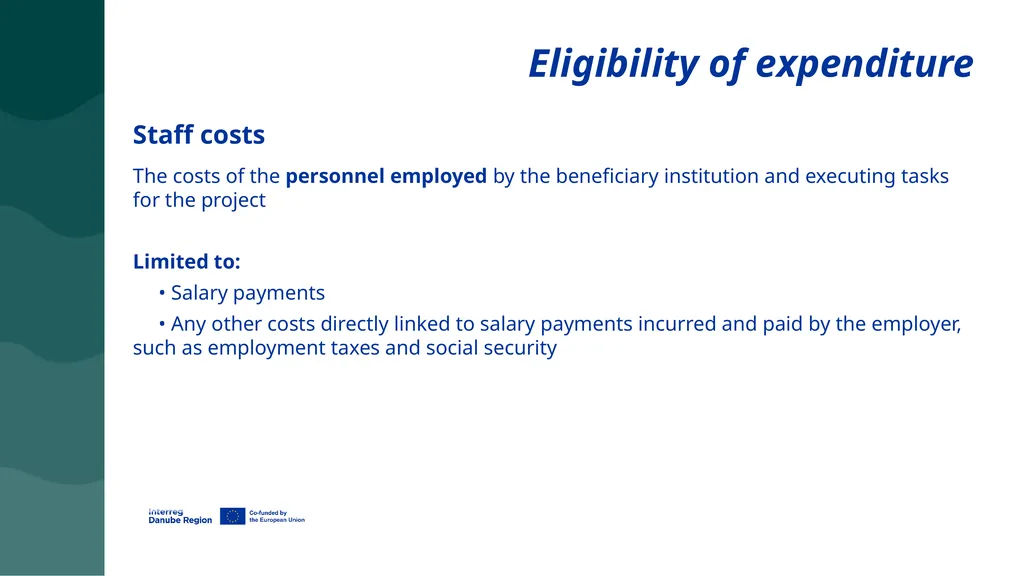
Eligibility of expenditure Staff costs
The costs of the personnel employed by the beneficiary institution and executing tasks for the project
Limited to:
• Salary payments
• Any other costs directly linked to salary payments incurred and paid by the employer, such as employment taxes and social security<br>
The costs of the personnel employed by the beneficiary institution and executing tasks for the project
Limited to:
• Salary payments
• Any other costs directly linked to salary payments incurred and paid by the employer, such as employment taxes and social security<br>
105
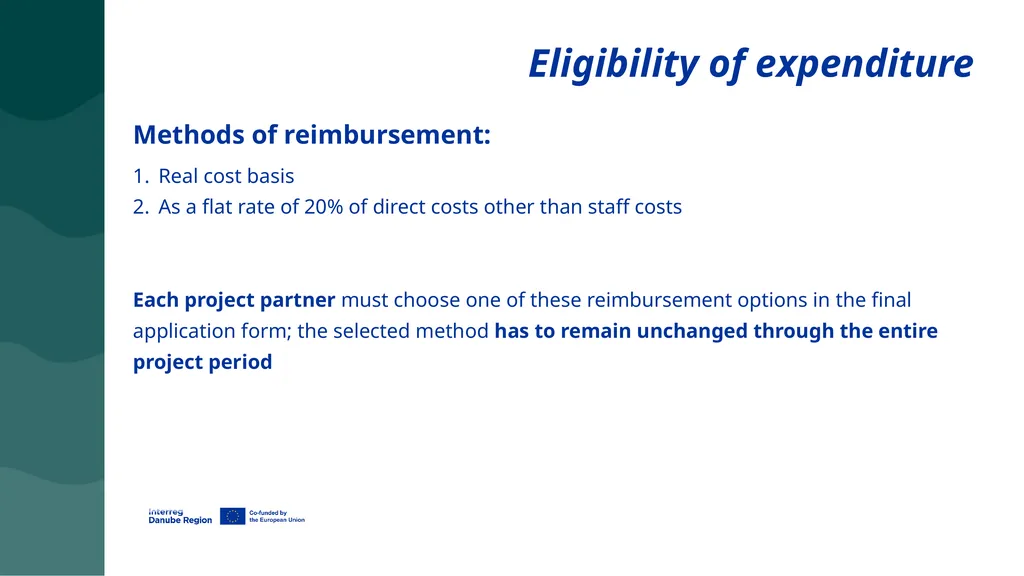
Eligibility of expenditure Methods of reimbursement:
Real cost basis
As a flat rate of 20% of direct costs other than staff costs
Each project partner must choose one of these reimbursement options in the final
application form; the selected method has to remain unchanged through the entire
project period<br>
Real cost basis
As a flat rate of 20% of direct costs other than staff costs
Each project partner must choose one of these reimbursement options in the final
application form; the selected method has to remain unchanged through the entire
project period<br>
106
Eligibility of expenditure Staff cost reimbursed on real costs basis:
Justification and supporting documents are required
Full-time working on the project (no timesheet necessary)
Part-time work on the project
Part-time with a fixed percentage of time worked per month on the operation (no timesheets)<br>
Justification and supporting documents are required
Full-time working on the project (no timesheet necessary)
Part-time work on the project
Part-time with a fixed percentage of time worked per month on the operation (no timesheets)<br>
107
Eligibility of expenditure Staff cost reimbursed on flat rate basis:
Flat rate of 20% of direct costs other than staff costs
20% flat rate shall be automatically applied by Jems for planned/ reported staff costs in each reporting period
No justification and supporting documents is required
In case of staff costs planned on flat rate basis, no further staff costs incurred on real costs basis can be reported under this cost category or under other cost categories
Eligibility of staff costs does not depend on the form of reimbursement<br>
Flat rate of 20% of direct costs other than staff costs
20% flat rate shall be automatically applied by Jems for planned/ reported staff costs in each reporting period
No justification and supporting documents is required
In case of staff costs planned on flat rate basis, no further staff costs incurred on real costs basis can be reported under this cost category or under other cost categories
Eligibility of staff costs does not depend on the form of reimbursement<br>
108
Eligibility of expenditure Office and administrative cost
Flat rate basis of 15% of the eligible staff costs
In order to use Office and administrative flat rate, the project partner has to select this method in the application form
No further justification or supporting document is required
If the staff costs are not eligible, office and administrative costs cannot be declared
If the staff costs are declared on flat rate basis, office and administrative costs are eligible
Office and administrative costs cannot be claimed as direct cost under other cost categories<br>
Flat rate basis of 15% of the eligible staff costs
In order to use Office and administrative flat rate, the project partner has to select this method in the application form
No further justification or supporting document is required
If the staff costs are not eligible, office and administrative costs cannot be declared
If the staff costs are declared on flat rate basis, office and administrative costs are eligible
Office and administrative costs cannot be claimed as direct cost under other cost categories<br>
109
Eligibility of expenditure The following types of expenditure are included under this cost category (exhaustive list):
a. Office rent
b. Insurance and taxes related to the buildings where the staff is located and to the equipment of the office (e.g. fire, theft insurances)
c. Utilities (e.g. electricity, heating, water)
d. Office supplies
e. General accounting provided inside the beneficiary organisation
f. Archives
g. Maintenance, cleaning and repairs
h. Security
i. IT systems
j. Communication (e.g. telephone, fax, internet, postal services, business cards)
k. Bank charges for opening and administering the account or accounts where the implementation of an operation requires a separate account to be opened
l. Charges for transnational financial transactions<br>
a. Office rent
b. Insurance and taxes related to the buildings where the staff is located and to the equipment of the office (e.g. fire, theft insurances)
c. Utilities (e.g. electricity, heating, water)
d. Office supplies
e. General accounting provided inside the beneficiary organisation
f. Archives
g. Maintenance, cleaning and repairs
h. Security
i. IT systems
j. Communication (e.g. telephone, fax, internet, postal services, business cards)
k. Bank charges for opening and administering the account or accounts where the implementation of an operation requires a separate account to be opened
l. Charges for transnational financial transactions<br>
110
Eligibility of expenditure Travel and accommodation costs
Project related travel costs of the project staff employed and Associated Strategic Partner(s) financed by the beneficiary
The travel and accommodation costs may be reimbursed based on:
the flat rate of the 15% of the staff costs and
real costs can be chosen in dully justified cases
Possible justified cases (non-exhaustive list):
PPs from not easily accessible areas, non-reimbursement of staff, very low staff costs etc.
The method will be set during condition clearing in the final application form and has to remain unchanged through the entire project period.<br>
Project related travel costs of the project staff employed and Associated Strategic Partner(s) financed by the beneficiary
The travel and accommodation costs may be reimbursed based on:
the flat rate of the 15% of the staff costs and
real costs can be chosen in dully justified cases
Possible justified cases (non-exhaustive list):
PPs from not easily accessible areas, non-reimbursement of staff, very low staff costs etc.
The method will be set during condition clearing in the final application form and has to remain unchanged through the entire project period.<br>
111
Eligibility of expenditure Travel and accommodation costs reimbursed on flat rate basis:
Flat rate basis of 15% of the eligible staff costs
No justification and supporting documents is required
In case travel and accommodation costs are planned on flat rate basis, further travel costs of the project staff and ASP(s) incurred on real cost bases cannot be planned under this or under other cost categories
travel and accommodation costs of the ASP are covered by the flat rate of the “sponsoring” PP- no need to provide justification or supporting documents
Eligibility of travel and accommodation costs does not depend on the form of reimbursement<br>
Flat rate basis of 15% of the eligible staff costs
No justification and supporting documents is required
In case travel and accommodation costs are planned on flat rate basis, further travel costs of the project staff and ASP(s) incurred on real cost bases cannot be planned under this or under other cost categories
travel and accommodation costs of the ASP are covered by the flat rate of the “sponsoring” PP- no need to provide justification or supporting documents
Eligibility of travel and accommodation costs does not depend on the form of reimbursement<br>
112
Eligibility of expenditure Travel and accommodation costs reimbursed on real cost basis:
Travel costs
Costs of meals
Accommodation costs
Visa costs
Daily allowances
Attention:
Travel and accommodation costs of the ASPs shall be planned in the sponsoring PP budget under Travel and accommodation cost category (and not CC External expertise)
Travels outside the programme area are subject of approval from JS: if possible, to be included already in the AF!<br>
Travel costs
Costs of meals
Accommodation costs
Visa costs
Daily allowances
Attention:
Travel and accommodation costs of the ASPs shall be planned in the sponsoring PP budget under Travel and accommodation cost category (and not CC External expertise)
Travels outside the programme area are subject of approval from JS: if possible, to be included already in the AF!<br>
113
Eligibility of expenditure External expertise and services costs
a. Studies or surveys (e.g. evaluations, strategies, concept notes, design plans,
handbooks)
b. Training
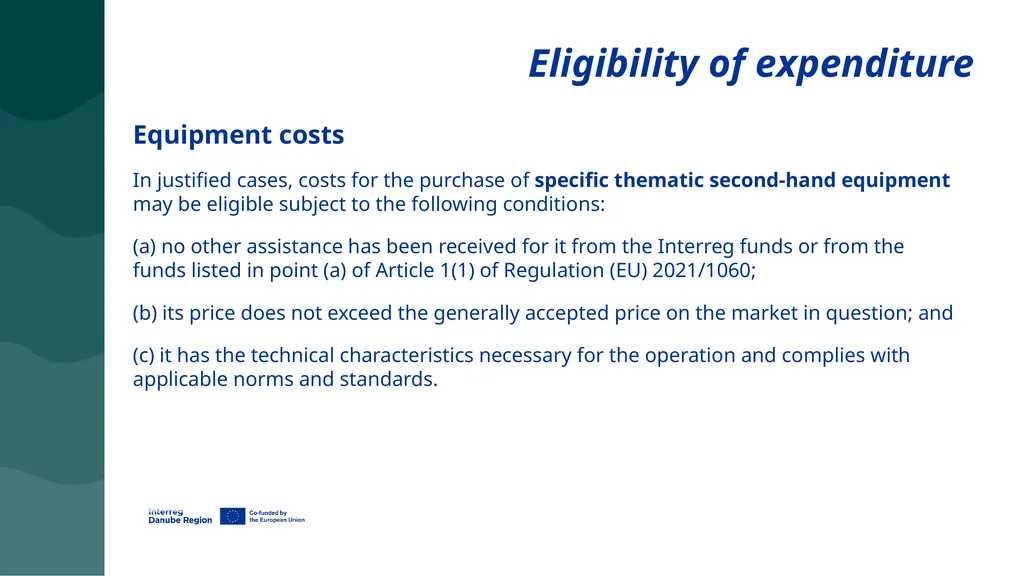
c. Translations
d. IT systems and website, development, modifications and updates
e. Promotion, communication, publicity or information linked to the project
f. Financial management
g. Services related to the organisation and implementation of events or meetings
(including rent, catering or interpretation)
h. Participation in events (e.g. registration fees)<br>
a. Studies or surveys (e.g. evaluations, strategies, concept notes, design plans,
handbooks)
b. Training
c. Translations
d. IT systems and website, development, modifications and updates
e. Promotion, communication, publicity or information linked to the project
f. Financial management
g. Services related to the organisation and implementation of events or meetings
(including rent, catering or interpretation)
h. Participation in events (e.g. registration fees)<br>
114
Eligibility of expenditure i. Legal consultancy and notarial services, technical and financial expertise, other
consultancy and accountancy services
j. Intellectual property rights
k. Verifications: Externalised control activities for the verification of the project
expenditure by authorised national controllers where it is relevant for the control
system of the concerned Partner State
l. The provision of guarantees by a bank or other financial institution where required
by Union or national law or in a programming document adopted by the monitoring
committee
m. Travel and accommodation for external experts, speakers, chairpersons of meetings
and service providers
n. Other specific expertise and services needed for the given project<br>
consultancy and accountancy services
j. Intellectual property rights
k. Verifications: Externalised control activities for the verification of the project
expenditure by authorised national controllers where it is relevant for the control
system of the concerned Partner State
l. The provision of guarantees by a bank or other financial institution where required
by Union or national law or in a programming document adopted by the monitoring
committee
m. Travel and accommodation for external experts, speakers, chairpersons of meetings
and service providers
n. Other specific expertise and services needed for the given project<br>
115
Eligibility of expenditure Attention!
Control costs to be planned under CC External expertise and services costs (relevant for the AT, DE and MD PPs only)
Stakeholders’ travel and accommodation costs to be planned under CC External expertise (and not under CC Travel and accommodation)
Costs of website and project logo created by PP as a simple communication tool are not eligible<br>
Control costs to be planned under CC External expertise and services costs (relevant for the AT, DE and MD PPs only)
Stakeholders’ travel and accommodation costs to be planned under CC External expertise (and not under CC Travel and accommodation)
Costs of website and project logo created by PP as a simple communication tool are not eligible<br>
116
Eligibility of expenditure Equipment costs
a. Office equipment
b. IT hardware and software
c. Furniture and fittings
d. Laboratory equipment
e. Machines and instruments
f. Tools or devices
g. Vehicles
h. Other specific equipment needed for operations<br>
a. Office equipment
b. IT hardware and software
c. Furniture and fittings
d. Laboratory equipment
e. Machines and instruments
f. Tools or devices
g. Vehicles
h. Other specific equipment needed for operations<br>
117
Eligibility of expenditure Equipment costs
Only equipment listed in the approved AF are eligible
Full costs of the equipment should be allocated to the project, if in line with national and institutional regulations
If not, only depreciation costs shall be allocated to the project
Rental or leasing costs for a certain period during the project lifetime are eligible<br>
Only equipment listed in the approved AF are eligible
Full costs of the equipment should be allocated to the project, if in line with national and institutional regulations
If not, only depreciation costs shall be allocated to the project
Rental or leasing costs for a certain period during the project lifetime are eligible<br>
118
Eligibility of expenditure Equipment costs
In justified cases, costs for the purchase of specific thematic second-hand equipment may be eligible subject to the following conditions:
(a) no other assistance has been received for it from the Interreg funds or from the funds listed in point (a) of Article 1(1) of Regulation (EU) 2021/1060;
(b) its price does not exceed the generally accepted price on the market in question; and
(c) it has the technical characteristics necessary for the operation and complies with applicable norms and standards.<br>
In justified cases, costs for the purchase of specific thematic second-hand equipment may be eligible subject to the following conditions:
(a) no other assistance has been received for it from the Interreg funds or from the funds listed in point (a) of Article 1(1) of Regulation (EU) 2021/1060;
(b) its price does not exceed the generally accepted price on the market in question; and
(c) it has the technical characteristics necessary for the operation and complies with applicable norms and standards.<br>
119
Eligibility of expenditure Costs for Infrastructure and works
a) Building permits;
b) Building material;
c) Labour;
d) Specialised interventions (e.g. soil remediation, mine-clearing)
Only small-scale infrastructure is eligible; the transnational character of the investment has to be demonstrated; the activity should be approved in the AF
This cost category should include execution or both design and execution of works as well as site preparation, delivery, handling installation, renovation<br>
a) Building permits;
b) Building material;
c) Labour;
d) Specialised interventions (e.g. soil remediation, mine-clearing)
Only small-scale infrastructure is eligible; the transnational character of the investment has to be demonstrated; the activity should be approved in the AF
This cost category should include execution or both design and execution of works as well as site preparation, delivery, handling installation, renovation<br>
120
Eligibility of expenditure 40% Flat Rate on Staff costs for all other costs
New option available starting from the 3rd call for proposals
40 % flat rate of eligible direct Staff costs
Staff costs:
only real costs reimbursement option is available
supporting documents for the staff costs are required
All other costs: office and administration, travel and accommodation, external expertise and services, equipment and infrastructure and works, travel costs of the ASPs
supporting documents for all other costs covered by the 40% flat rate are not required<br>
New option available starting from the 3rd call for proposals
40 % flat rate of eligible direct Staff costs
Staff costs:
only real costs reimbursement option is available
supporting documents for the staff costs are required
All other costs: office and administration, travel and accommodation, external expertise and services, equipment and infrastructure and works, travel costs of the ASPs
supporting documents for all other costs covered by the 40% flat rate are not required<br>
121
Eligibility of expenditure 40% Flat Rate on Staff costs for all other costs
Example for the calculation:
Eligible Staff costs (reported on real costs basis) = 20.000 EUR
Eligible amount of direct costs (other than direct staff costs) = 20.000 EUR * 40% = 8.000 EUR
All other costs are automatically calculated by Jems based on direct staff costs
Advantages: reduces administrative burden; very simple to use
Risks in the implementation: Staff costs are low or underspent; no flexibility; option cannot be changed during the implementation<br>
Example for the calculation:
Eligible Staff costs (reported on real costs basis) = 20.000 EUR
Eligible amount of direct costs (other than direct staff costs) = 20.000 EUR * 40% = 8.000 EUR
All other costs are automatically calculated by Jems based on direct staff costs
Advantages: reduces administrative burden; very simple to use
Risks in the implementation: Staff costs are low or underspent; no flexibility; option cannot be changed during the implementation<br>
122
Overview of budget structure options<br>
123
Danube Region Programme
Managing Authority/ Joint Secretariat Thank you! Mirjana Arsenić Petrović, Senior financial officer https://www.linkedin.com/in/interregdanube/
https://www.facebook.com/InterregDanube/ mirjana.arsenic.petrovic@ktm.gov.hu<br>
Managing Authority/ Joint Secretariat Thank you! Mirjana Arsenić Petrović, Senior financial officer https://www.linkedin.com/in/interregdanube/
https://www.facebook.com/InterregDanube/ mirjana.arsenic.petrovic@ktm.gov.hu<br>