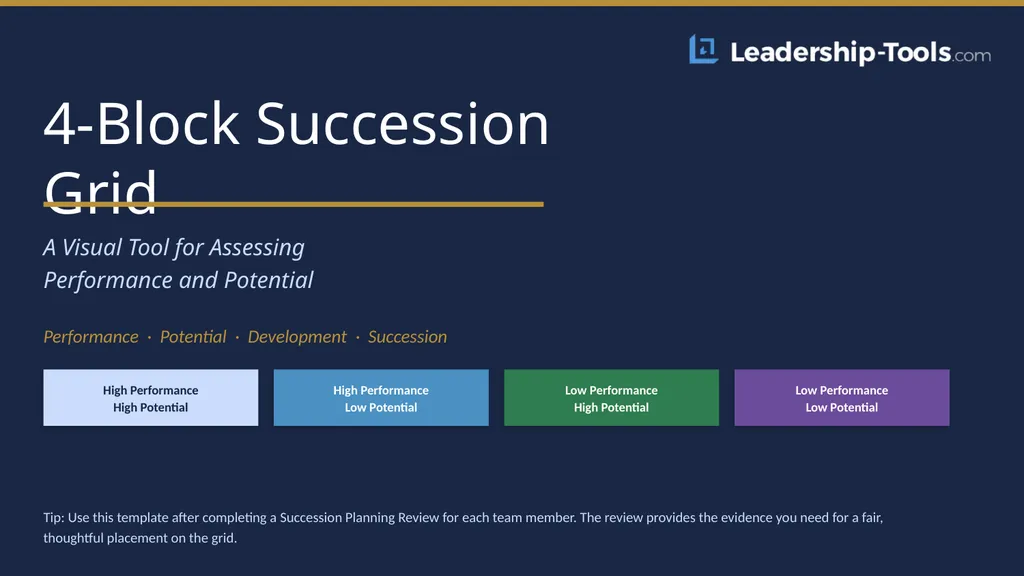
4-Block Succession Grid A Visual Tool for Assessing Performance and Potential Performance Potential Development Succession High Performance High Potential High Performance Low Potential Low Performance High Potential Low Performance
"4-Block Succession Grid A Visual Tool for" is the property of its rightful owner. Permission is granted to
download and print the materials on this website for personal, non-commercial use only, and to display it
on your personal computer provided you do not modify the materials and that you retain all copyright
notices contained in the materials. By downloading content from our website, you accept the terms of this
agreement.
Presentation Transcript
01
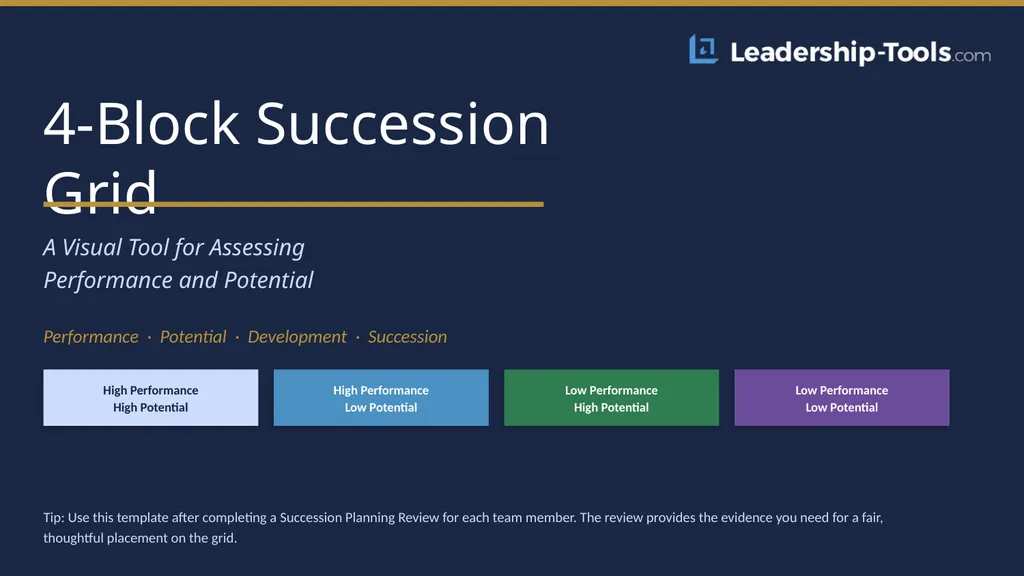
4-Block Succession Grid A Visual Tool for Assessing
Performance and Potential Performance · Potential · Development · Succession High Performance
High Potential High Performance
Low Potential Low Performance
High Potential Low Performance
Low Potential Tip: Use this template after completing a Succession Planning Review for each team member. The review provides the evidence you need for a fair, thoughtful placement on the grid.<br>
02
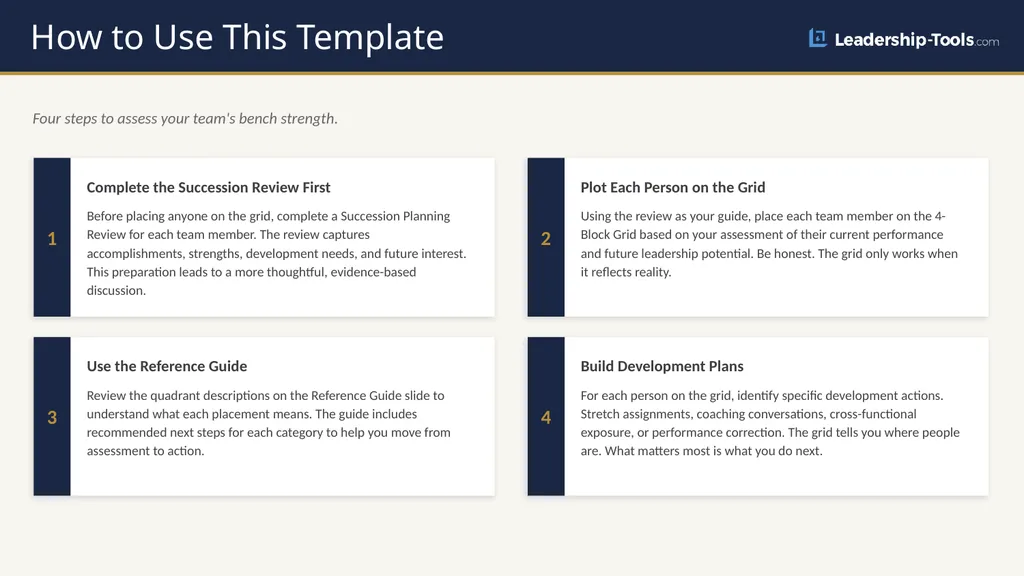
How to Use This Template Four steps to assess your team's bench strength. 1 Complete the Succession Review First Before placing anyone on the grid, complete a Succession Planning Review for each team member. The review captures accomplishments, strengths, development needs, and future interest. This preparation leads to a more thoughtful, evidence-based discussion. Plot Each Person on the Grid Using the review as your guide, place each team member on the 4-Block Grid based on your assessment of their current performance and future leadership potential. Be honest. The grid only works when it reflects reality. Use the Reference Guide Review the quadrant descriptions on the Reference Guide slide to understand what each placement means. The guide includes recommended next steps for each category to help you move from assessment to action. Build Development Plans For each person on the grid, identify specific development actions. Stretch assignments, coaching conversations, cross-functional exposure, or performance correction. The grid tells you where people are. What matters most is what you do next. 2 3 4<br>
03
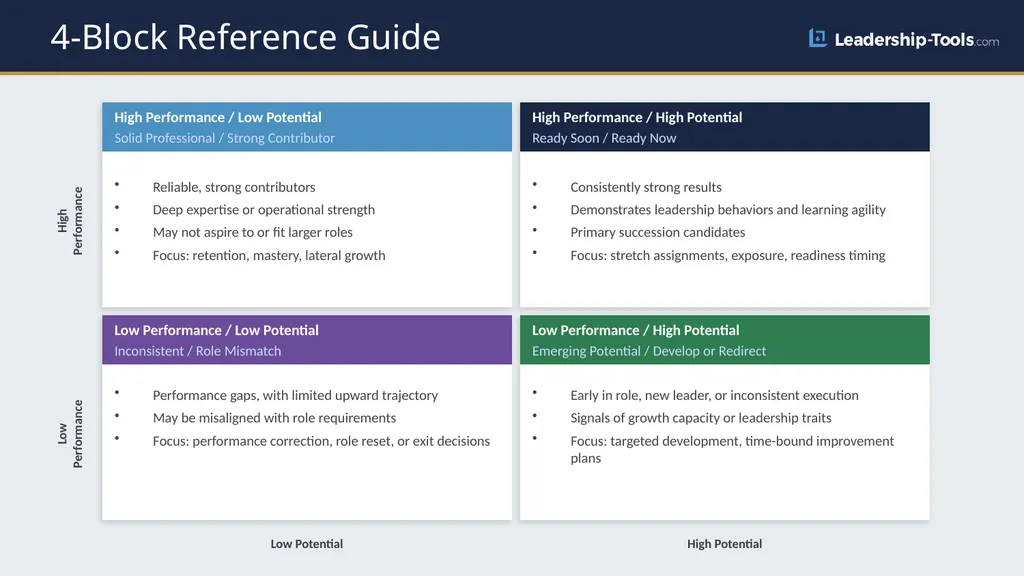
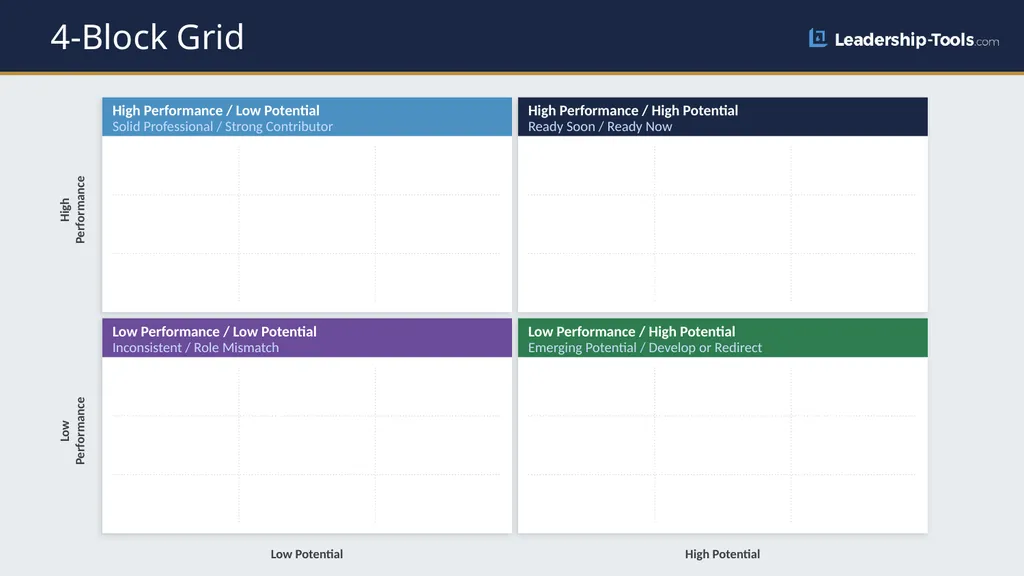
4-Block Reference Guide High Performance Low Performance Low Potential High Potential High Performance / Low Potential Solid Professional / Strong Contributor Reliable, strong contributors
Deep expertise or operational strength
May not aspire to or fit larger roles
Focus: retention, mastery, lateral growth High Performance / High Potential Ready Soon / Ready Now Consistently strong results
Demonstrates leadership behaviors and learning agility
Primary succession candidates
Focus: stretch assignments, exposure, readiness timing Low Performance / Low Potential Inconsistent / Role Mismatch Performance gaps, with limited upward trajectory
May be misaligned with role requirements
Focus: performance correction, role reset, or exit decisions Low Performance / High Potential Emerging Potential / Develop or Redirect Early in role, new leader, or inconsistent execution
Signals of growth capacity or leadership traits
Focus: targeted development, time-bound improvement plans<br>
04
4-Block Grid High Performance Low Performance Low Potential High Potential High Performance / Low Potential Solid Professional / Strong Contributor High Performance / High Potential Ready Soon / Ready Now Low Performance / Low Potential Inconsistent / Role Mismatch Low Performance / High Potential Emerging Potential / Develop or Redirect<br>
05
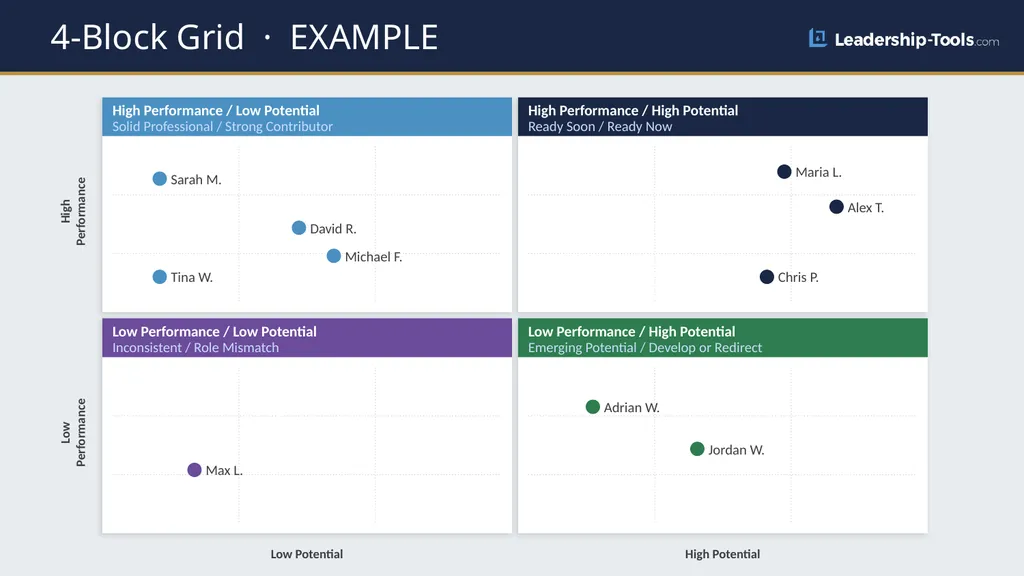
4-Block Grid · EXAMPLE High Performance Low Performance Low Potential High Potential High Performance / Low Potential Solid Professional / Strong Contributor High Performance / High Potential Ready Soon / Ready Now Low Performance / Low Potential Inconsistent / Role Mismatch Low Performance / High Potential Emerging Potential / Develop or Redirect Sarah M. David R. Michael F. Tina W. Maria L. Alex T. Chris P. Max L. Adrian W. Jordan W.<br>
06
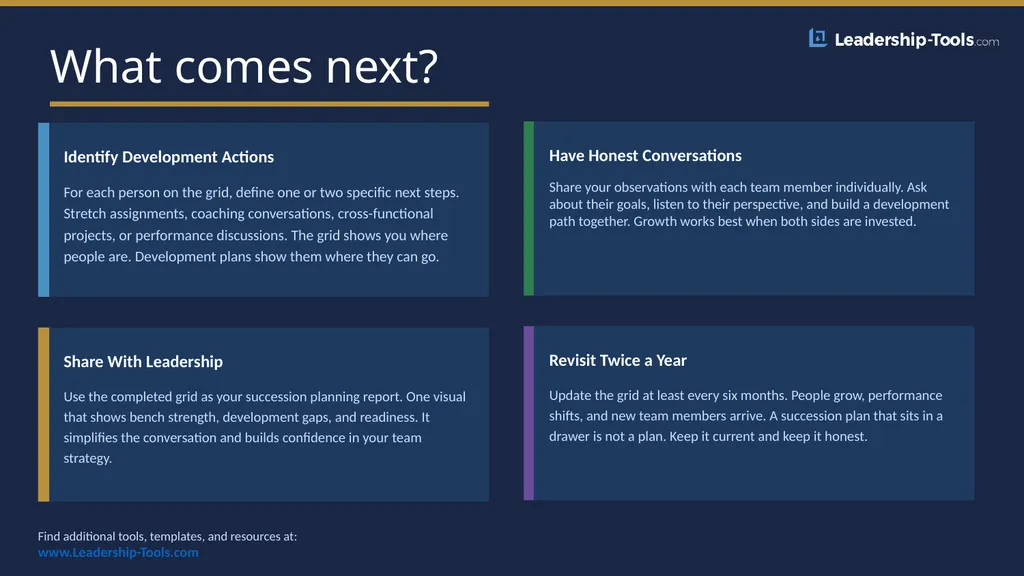
What comes next? Identify Development Actions For each person on the grid, define one or two specific next steps. Stretch assignments, coaching conversations, cross-functional projects, or performance discussions. The grid shows you where people are. Development plans show them where they can go. Have Honest Conversations Share your observations with each team member individually. Ask about their goals, listen to their perspective, and build a development path together. Growth works best when both sides are invested. Share With Leadership Use the completed grid as your succession planning report. One visual that shows bench strength, development gaps, and readiness. It simplifies the conversation and builds confidence in your team strategy. Revisit Twice a Year Update the grid at least every six months. People grow, performance shifts, and new team members arrive. A succession plan that sits in a drawer is not a plan. Keep it current and keep it honest. Find additional tools, templates, and resources at: www.Leadership-Tools.com<br>