4 Module 4 Contraception and family planning Integrating harm reduction and sexual and reproductive health and rights Module 4 Contraception and Family Planning Learning objectives 1 hour 50 mins To explore misbeliefs associated with
"4 Module 4 Contraception and family planning" is the property of its rightful owner. Permission is granted to
download and print the materials on this website for personal, non-commercial use only, and to display it
on your personal computer provided you do not modify the materials and that you retain all copyright
notices contained in the materials. By downloading content from our website, you accept the terms of this
agreement.
Presentation Transcript
01
4 Module 4
Contraception and family planning Integrating harm reduction and sexual and reproductive health and rights<br>
02
Module 4 Contraception and Family Planning Learning objectives 1 hour 50 mins To explore misbeliefs associated with contraception and the full range of contraceptive methods
To know the main components of family planning and contraceptive services
To provide quality counseling on contraception and contraceptive choices to women and gender non-conforming people who use drugs
To identify the main barriers to accessing contraception and potential approaches to overcome the barriers<br>
03
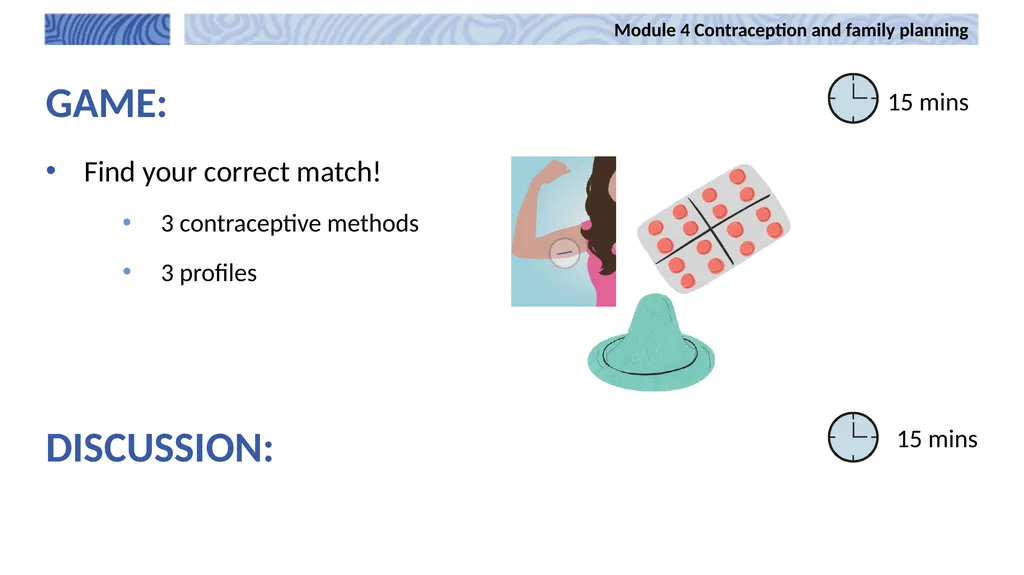
Module 4 Contraception and family planning Game: Find your correct match!
3 contraceptive methods
3 profiles
Discussion: 15 mins 15 mins<br>
04
Module 4 Contraception and family planning BASIC information and choices There are a lot of beliefs and misconceptions associated with contraceptives methods. For example:
Contraceptive methods can cause infertility
Women lose libido with hormonal contraception
Contraceptive methods can cause birth defects
Health professional and harm reduction providers may also share these beliefs.
The lack of accurate information will impact and limit people’s choices around pregnancy prevention.
Every person will have different needs and preferences for contraception.
Give them a choice!<br>
05
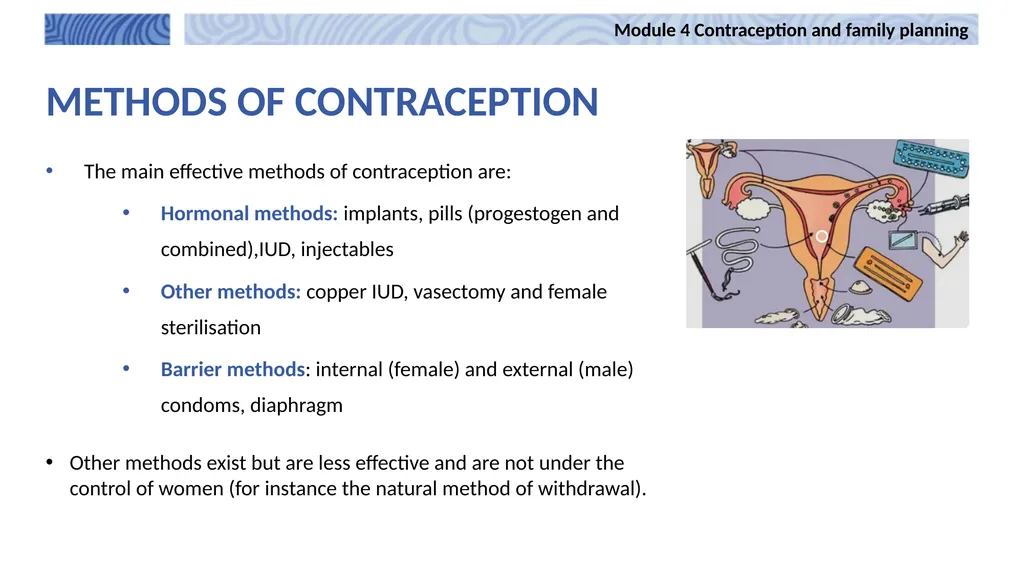
Module 4 Contraception and family planning METHODS OF CONTRACEPTION The main effective methods of contraception are:
Hormonal methods: implants, pills (progestogen and combined),IUD, injectables
Other methods: copper IUD, vasectomy and female sterilisation
Barrier methods: internal (female) and external (male) condoms, diaphragm
Other methods exist but are less effective and are not under the control of women (for instance the natural method of withdrawal).<br>
06
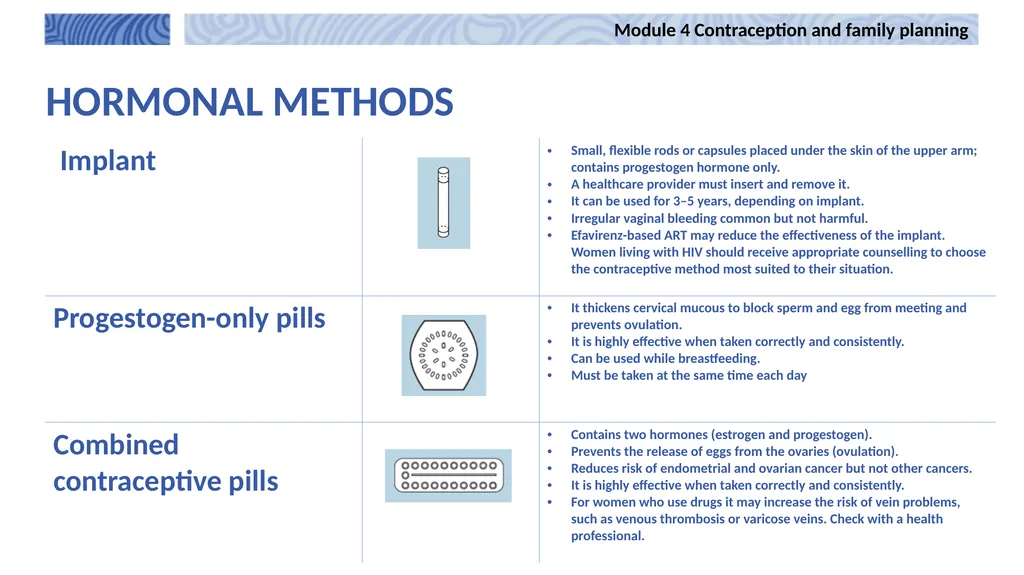
Module 4 Contraception and family planning HORMONAL METHODS<br>
07
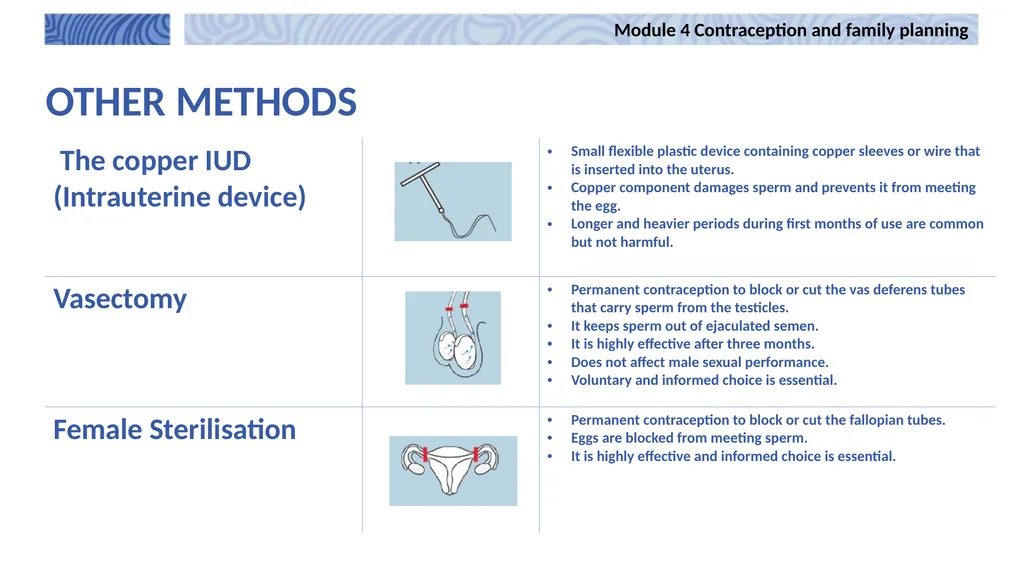
Module 4 Contraception and family planning Other methods<br>
08
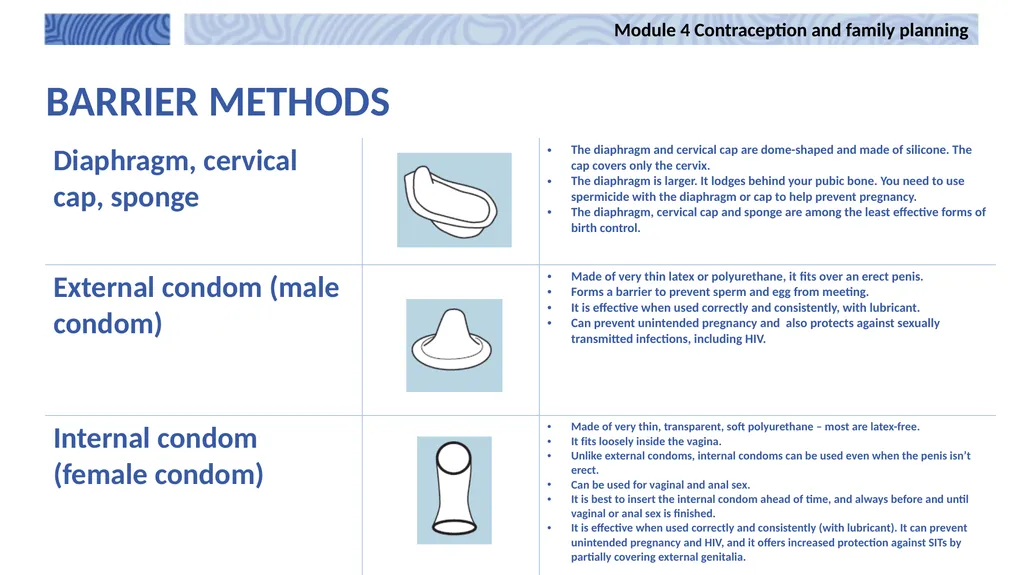
Module 4 Contraception and family planning barrier methods<br>
09
Module 4 Contraception and family planning EMERGENCY CONTRACEPTIVE PILLS Also called the ‘morning after’ pill.
Emergency contraception is not an abortive method as the pill helps avoid conception.
Pills are high dose hormonal pills that can be taken up to 72 hours AFTER intercourse but the sooner someone uses emergency contraception the more effective it is.
If it contains two pills, take both at the same time.
There are no major side effects, but some people may experience vomiting, headache or breast tenderness.
If the period does not start in three weeks after taking the pill, check for pregnancy.<br>
10
Module 4 Contraception and family planning Dual protection People who use drugs and their sexual partners must be counselled on dual protection strategies to prevent the transmission of HIV and STIs, as well as to avoid unintended pregnancy. These include:
Condoms, plus another contraceptive method
Condoms, plus emergency contraception if condom fails
Selectively using condoms and another method (for example, using the pill with the main partner, but the pill plus condoms with others).<br>
11
Module 4 Contraception and family planning Methadone and contraception Offering contraception services in conjunction with substance use treatment like methdaone could help the women and gender non-conforming people who use drugs meet their needs for contraception.
It can reduce unintended pregnancy. There is no evidence that methadone is incompatible with contraceptive methods.
HIV treatment and hormonal contraception
There is no evidence of incompatibility between ARVs and hormonal contraceptives.<br>
12
Module 4 Contraception and family planning FERTILITY/INFERTILITY Infertility is a problem for both men and women, but women are often the ones who are blamed.
Infections, some reproductive cancers, abnormalities of the reproductive tract (including blocked fallopian tubes), fibroids or long-term hormone use among trans-women can cause infertility. Environmental and lifestyle factors play also a role.
Contraceptives do not cause infertility problems.<br>
13
Module 4 Contraception and family planning KEY FAMILY PLANNING AND CONTRACEPTIVE SERVICES INCLUDE: Accurate information on a wide range of methods
Counselling about the desire to have children
Availability of condoms and lubricants and other contraceptives methods
Emergency contraception
Encouraging shared responsibility between partners
Addressing infertility issues and their social consequences<br>
14
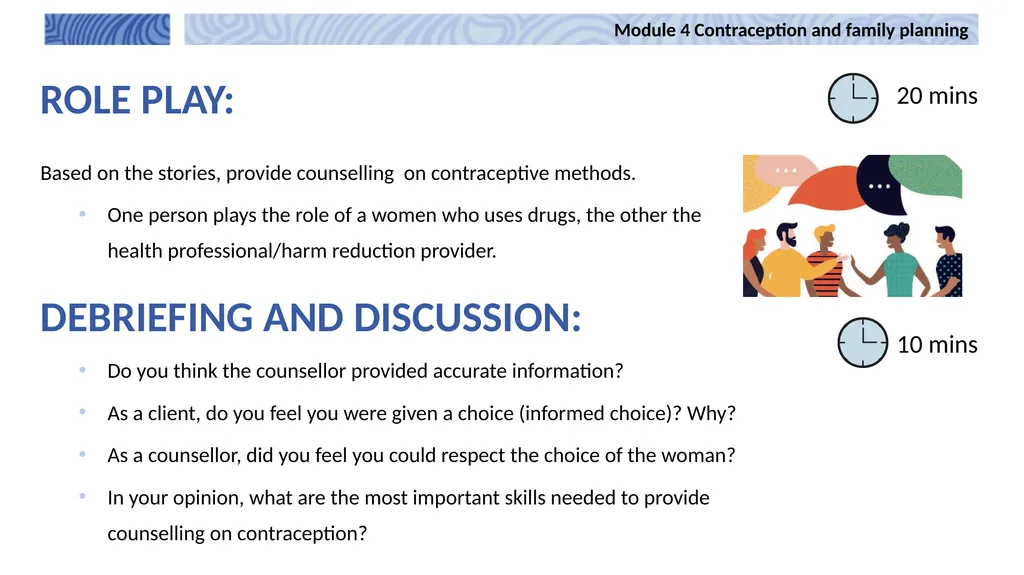
Module 4 Contraception and family planning Role play: Based on the stories, provide counselling on contraceptive methods.
One person plays the role of a women who uses drugs, the other the health professional/harm reduction provider.
Debriefing and discussion:
Do you think the counsellor provided accurate information?
As a client, do you feel you were given a choice (informed choice)? Why?
As a counsellor, did you feel you could respect the choice of the woman?
In your opinion, what are the most important skills needed to provide counselling on contraception? 20 mins 10 mins<br>
15
Module 4 Contraception and family planning Counselling skills Importance of providing accurate information
Non-judgmental attitudes
Active listening
Clear communication without technical words – use simple language
Respect people’s right to confidentiality, privacy and informed choice
Non-discrimination (regardless of their age, family or social status, sexual behaviour, kind and frequency of drug use, etc.)<br>
16
Module 4 Contraception and family planning BRAINSTORMING What are the main barriers to accessing contraception? 15 mins<br>
17
Module 4 Contraception and family planning GROUP EXERCISE: What do you need to do to address the barriers?
In groups of 5 or 6:
Consider the different barriers and propose approaches to overcome them
Think of 2 or 3 solutions/actions to improve access to contraception in your organisation/community
Discussion: 15 mins 10 mins<br>
18
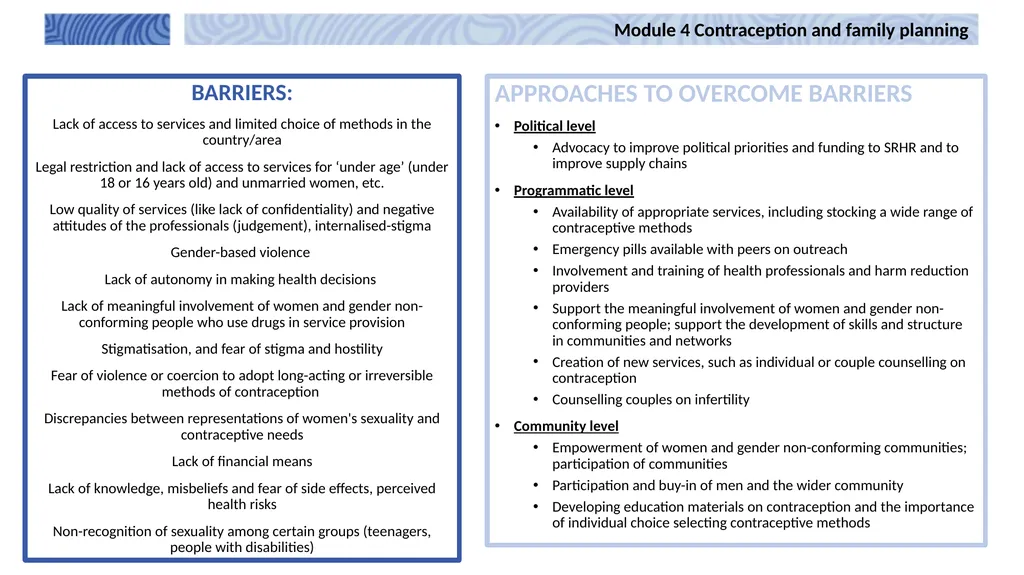
Module 4 Contraception and family planning BARRIERS:
Lack of access to services and limited choice of methods in the country/area
Legal restriction and lack of access to services for ‘under age’ (under 18 or 16 years old) and unmarried women, etc.
Low quality of services (like lack of confidentiality) and negative attitudes of the professionals (judgement), internalised-stigma
Gender-based violence
Lack of autonomy in making health decisions
Lack of meaningful involvement of women and gender non-conforming people who use drugs in service provision
Stigmatisation, and fear of stigma and hostility
Fear of violence or coercion to adopt long-acting or irreversible methods of contraception
Discrepancies between representations of women's sexuality and contraceptive needs
Lack of financial means
Lack of knowledge, misbeliefs and fear of side effects, perceived health risks
Non-recognition of sexuality among certain groups (teenagers, people with disabilities) APPROACHES TO OVERCOME BARRIERS
Political level
Advocacy to improve political priorities and funding to SRHR and to improve supply chains
Programmatic level
Availability of appropriate services, including stocking a wide range of contraceptive methods
Emergency pills available with peers on outreach
Involvement and training of health professionals and harm reduction providers
Support the meaningful involvement of women and gender non-conforming people; support the development of skills and structure in communities and networks
Creation of new services, such as individual or couple counselling on contraception
Counselling couples on infertility
Community level
Empowerment of women and gender non-conforming communities; participation of communities
Participation and buy-in of men and the wider community
Developing education materials on contraception and the importance of individual choice selecting contraceptive methods<br>