
40th IEEE International Conference on Data

Description: 40th IEEE International Conference on Data Engineering (ICDE2024) Utrecht, The Netherlands, 15 May 2024 Data Management in the Cloud: Trends and Directions C. Mohan Distinguished Professor of Science (Hong Kong Baptist University, China)
Related Topics
Download Presentation
"40th IEEE International Conference on Data" is the property of its rightful owner. Permission is granted to download and print the materials on this website for personal, non-commercial use only, and to display it on your personal computer provided you do not modify the materials and that you retain all copyright notices contained in the materials. By downloading content from our website, you accept the terms of this agreement.
Presentation Transcript
slide1. 40th IEEE International Conference on Data Engineering (ICDE2024)
Utrecht, The Netherlands, 15 May 2024 Data Management in the Cloud: Trends and Directions C. Mohan
Distinguished Professor of Science (Hong Kong Baptist University, China) Distinguished Visiting Professor (Tsinghua University, China) Retired IBM Fellow (Silicon Valley, USA) https://bit.ly/CMoTalks https://bit.ly/CMoDUK<br>
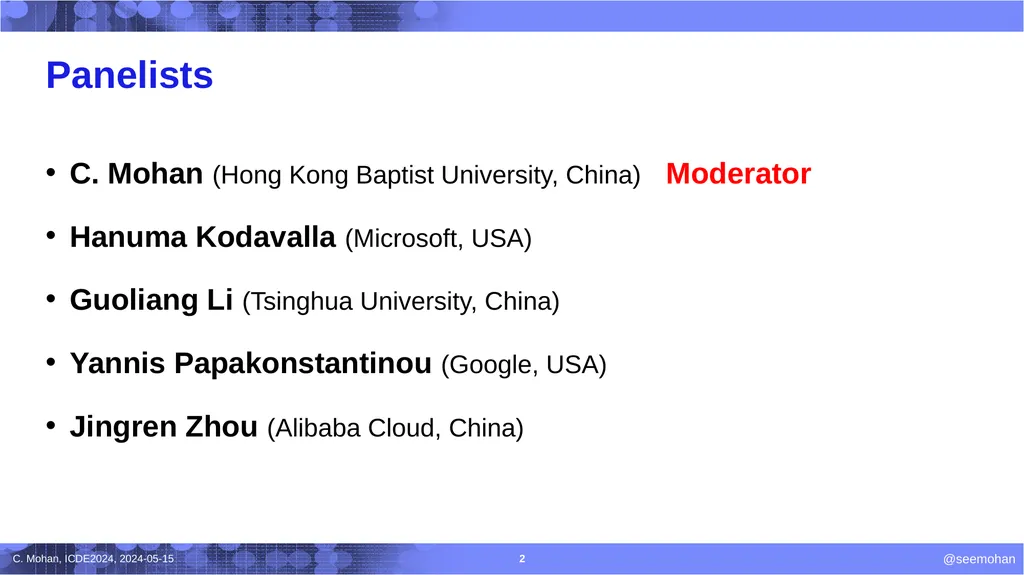
slide2. Panelists C. Mohan (Hong Kong Baptist University, China) Moderator
Hanuma Kodavalla (Microsoft, USA)
Guoliang Li (Tsinghua University, China)
Yannis Papakonstantinou (Google, USA)
Jingren Zhou (Alibaba Cloud, China)<br>
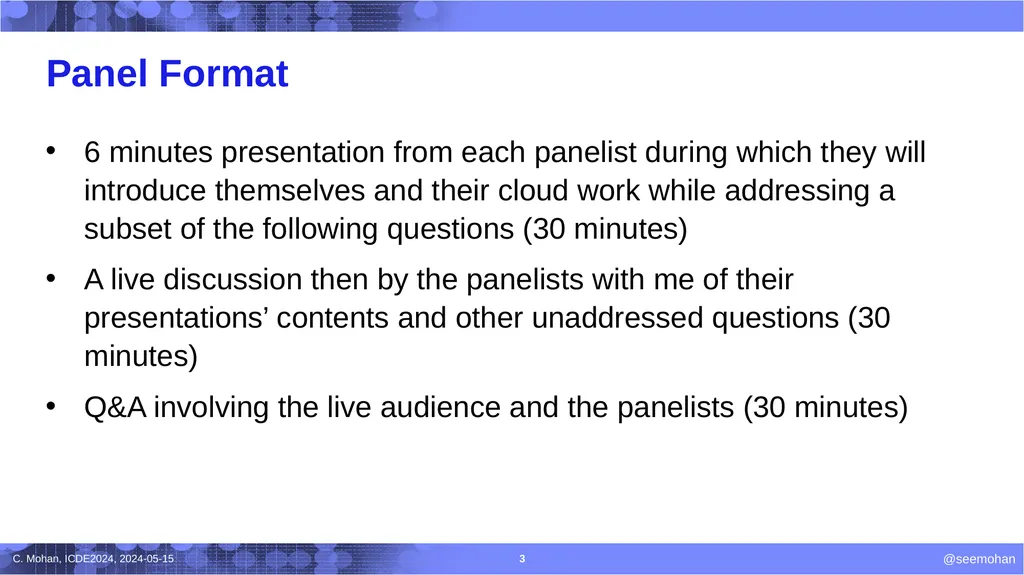
slide3. Panel Format 6 minutes presentation from each panelist during which they will introduce themselves and their cloud work while addressing a subset of the following questions (30 minutes)
A live discussion then by the panelists with me of their presentations’ contents and other unaddressed questions (30 minutes)
Q&A involving the live audience and the panelists (30 minutes)<br>
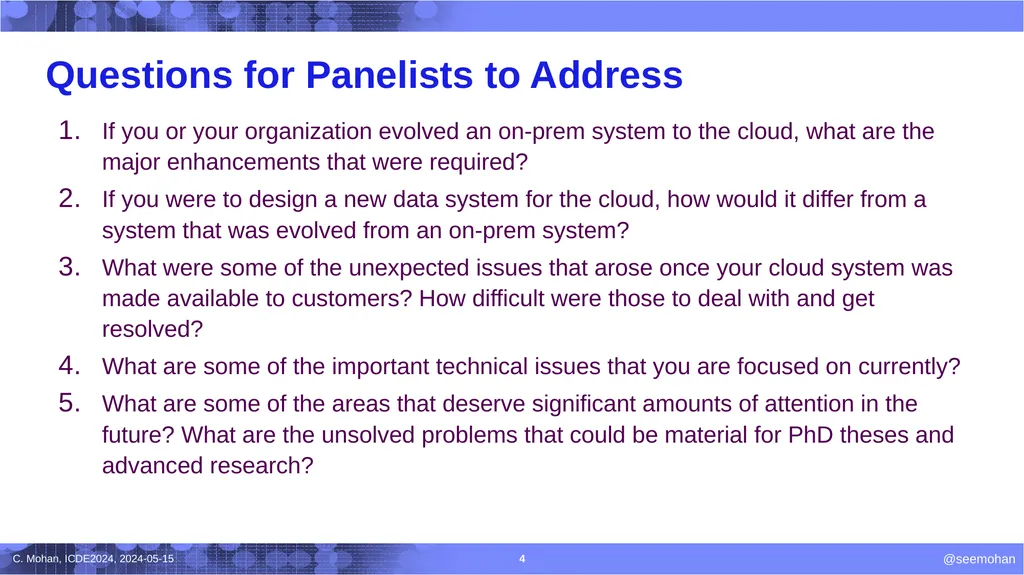
slide4. If you or your organization evolved an on-prem system to the cloud, what are the major enhancements that were required?
If you were to design a new data system for the cloud, how would it differ from a system that was evolved from an on-prem system?
What were some of the unexpected issues that arose once your cloud system was made available to customers? How difficult were those to deal with and get resolved?
What are some of the important technical issues that you are focused on currently?
What are some of the areas that deserve significant amounts of attention in the future? What are the unsolved problems that could be material for PhD theses and advanced research? Questions for Panelists to Address<br>
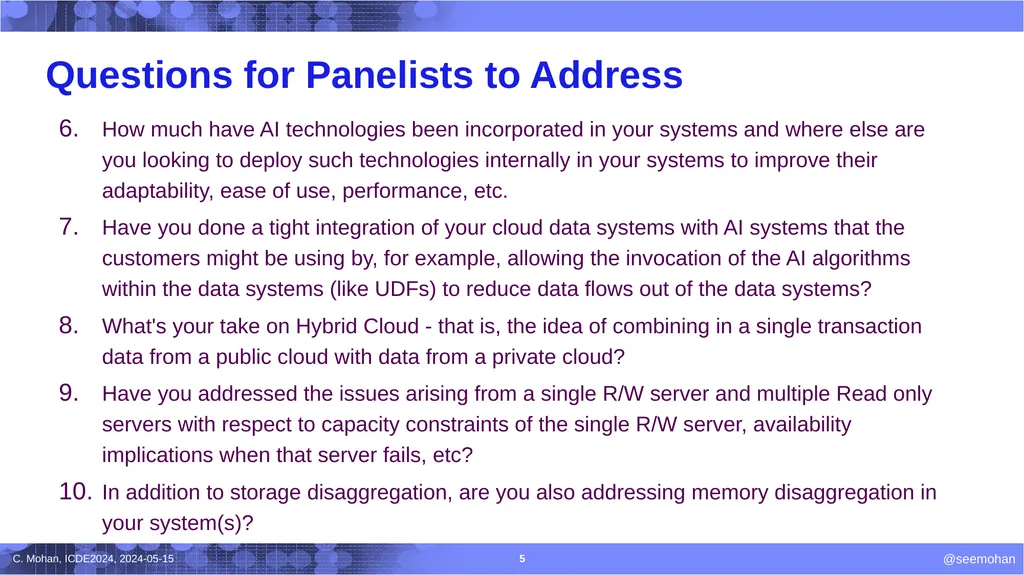
slide5. How much have AI technologies been incorporated in your systems and where else are you looking to deploy such technologies internally in your systems to improve their adaptability, ease of use, performance, etc.
Have you done a tight integration of your cloud data systems with AI systems that the customers might be using by, for example, allowing the invocation of the AI algorithms within the data systems (like UDFs) to reduce data flows out of the data systems?
What's your take on Hybrid Cloud - that is, the idea of combining in a single transaction data from a public cloud with data from a private cloud?
Have you addressed the issues arising from a single R/W server and multiple Read only servers with respect to capacity constraints of the single R/W server, availability implications when that server fails, etc?
In addition to storage disaggregation, are you also addressing memory disaggregation in your system(s)? Questions for Panelists to Address<br>
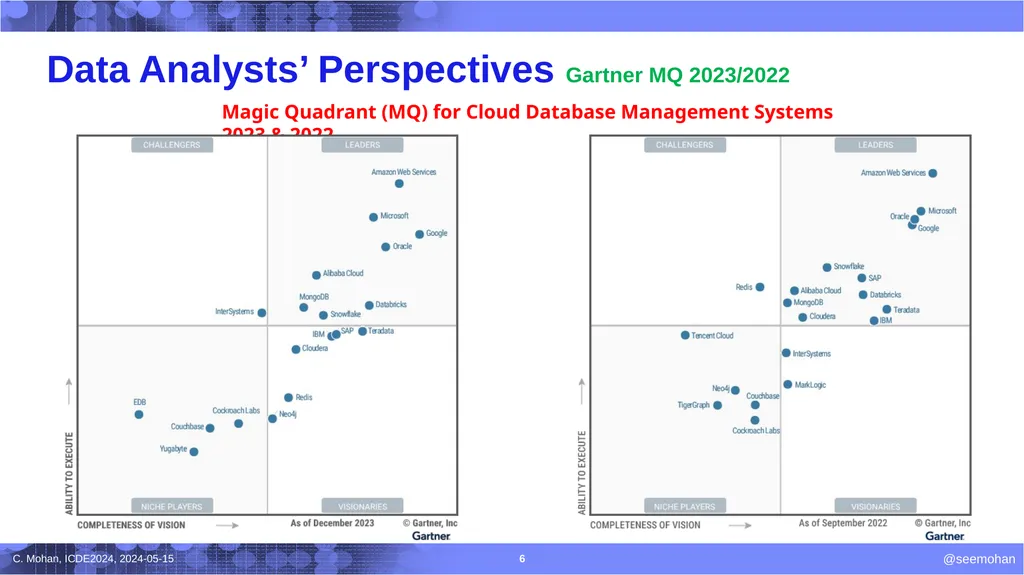
slide6. Data Analysts’ Perspectives Gartner MQ 2023/2022 Magic Quadrant (MQ) for Cloud Database Management Systems 2023 & 2022<br>
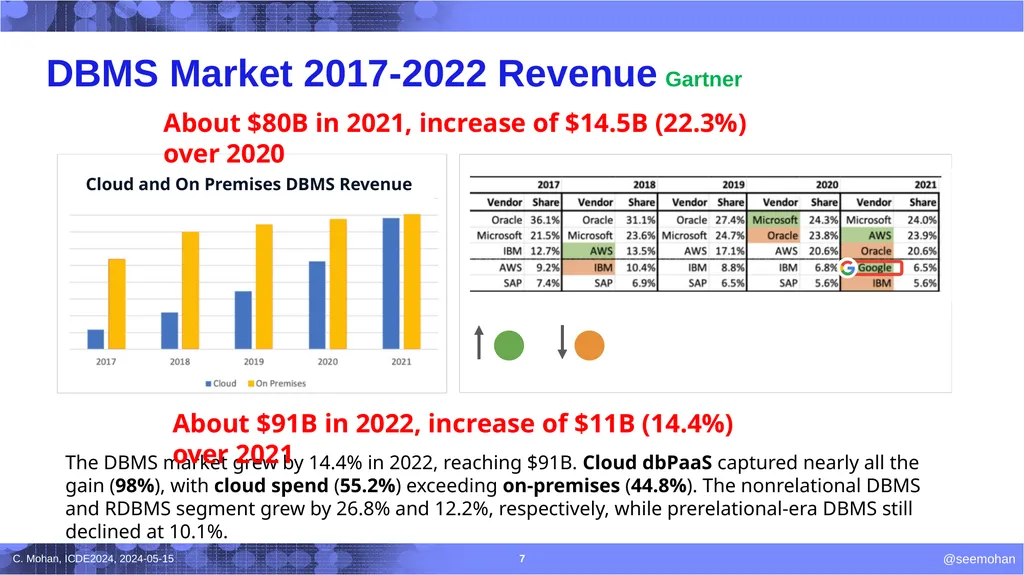
slide7. DBMS Market 2017-2022 Revenue Gartner About $80B in 2021, increase of $14.5B (22.3%) over 2020 Cloud and On Premises DBMS Revenue The DBMS market grew by 14.4% in 2022, reaching $91B. Cloud dbPaaS captured nearly all the gain (98%), with cloud spend (55.2%) exceeding on-premises (44.8%). The nonrelational DBMS and RDBMS segment grew by 26.8% and 12.2%, respectively, while prerelational-era DBMS still declined at 10.1%. About $91B in 2022, increase of $11B (14.4%) over 2021<br>
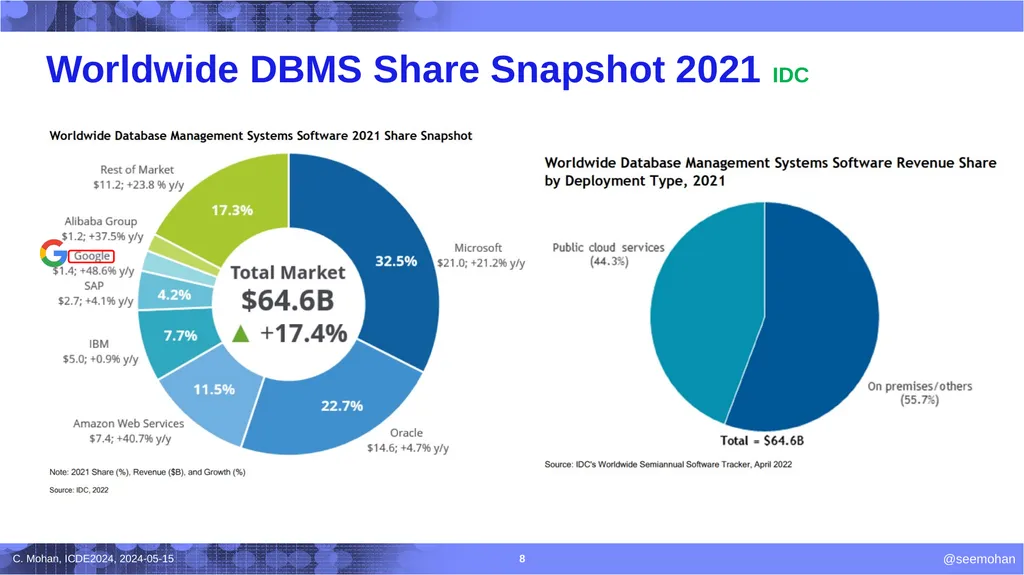
slide8. Worldwide DBMS Share Snapshot 2021 IDC<br>
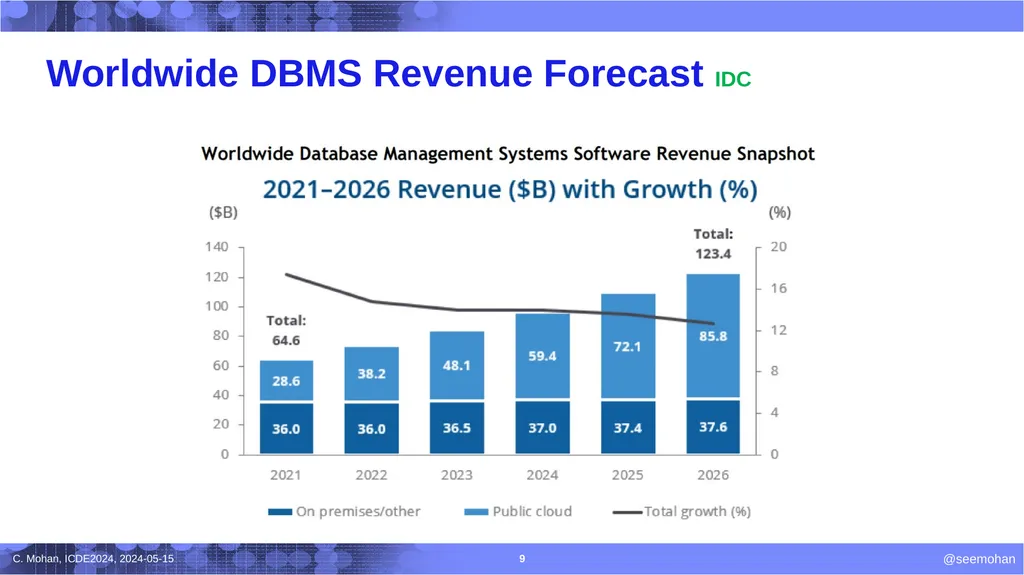
slide9. Worldwide DBMS Revenue Forecast IDC<br>
Distinguished Professor of Science (Hong Kong Baptist University, China) Distinguished Visiting Professor (Tsinghua University, China) Retired IBM Fellow (Silicon Valley, USA) https://bit.ly/CMoTalks https://bit.ly/CMoDUK<br>
slide2. Panelists C. Mohan (Hong Kong Baptist University, China) Moderator
Hanuma Kodavalla (Microsoft, USA)
Guoliang Li (Tsinghua University, China)
Yannis Papakonstantinou (Google, USA)
Jingren Zhou (Alibaba Cloud, China)<br>
slide3. Panel Format 6 minutes presentation from each panelist during which they will introduce themselves and their cloud work while addressing a subset of the following questions (30 minutes)
A live discussion then by the panelists with me of their presentations’ contents and other unaddressed questions (30 minutes)
Q&A involving the live audience and the panelists (30 minutes)<br>
slide4. If you or your organization evolved an on-prem system to the cloud, what are the major enhancements that were required?
If you were to design a new data system for the cloud, how would it differ from a system that was evolved from an on-prem system?
What were some of the unexpected issues that arose once your cloud system was made available to customers? How difficult were those to deal with and get resolved?
What are some of the important technical issues that you are focused on currently?
What are some of the areas that deserve significant amounts of attention in the future? What are the unsolved problems that could be material for PhD theses and advanced research? Questions for Panelists to Address<br>
slide5. How much have AI technologies been incorporated in your systems and where else are you looking to deploy such technologies internally in your systems to improve their adaptability, ease of use, performance, etc.
Have you done a tight integration of your cloud data systems with AI systems that the customers might be using by, for example, allowing the invocation of the AI algorithms within the data systems (like UDFs) to reduce data flows out of the data systems?
What's your take on Hybrid Cloud - that is, the idea of combining in a single transaction data from a public cloud with data from a private cloud?
Have you addressed the issues arising from a single R/W server and multiple Read only servers with respect to capacity constraints of the single R/W server, availability implications when that server fails, etc?
In addition to storage disaggregation, are you also addressing memory disaggregation in your system(s)? Questions for Panelists to Address<br>
slide6. Data Analysts’ Perspectives Gartner MQ 2023/2022 Magic Quadrant (MQ) for Cloud Database Management Systems 2023 & 2022<br>
slide7. DBMS Market 2017-2022 Revenue Gartner About $80B in 2021, increase of $14.5B (22.3%) over 2020 Cloud and On Premises DBMS Revenue The DBMS market grew by 14.4% in 2022, reaching $91B. Cloud dbPaaS captured nearly all the gain (98%), with cloud spend (55.2%) exceeding on-premises (44.8%). The nonrelational DBMS and RDBMS segment grew by 26.8% and 12.2%, respectively, while prerelational-era DBMS still declined at 10.1%. About $91B in 2022, increase of $11B (14.4%) over 2021<br>
slide8. Worldwide DBMS Share Snapshot 2021 IDC<br>
slide9. Worldwide DBMS Revenue Forecast IDC<br>