5. Electrochemistry 5.7: Electrolysis Describe electrolytic cells their relationship to galvanic cells Perform calculations related to electrolysis Electrolysis Electrolysis: a process that uses input of electrical energy to drive
"5. Electrochemistry 5.7: Electrolysis Describe" is the property of its rightful owner. Permission is granted to
download and print the materials on this website for personal, non-commercial use only, and to display it
on your personal computer provided you do not modify the materials and that you retain all copyright
notices contained in the materials. By downloading content from our website, you accept the terms of this
agreement.
Presentation Transcript
01
5. Electrochemistry 5.7: Electrolysis
Describe electrolytic cells & their relationship to galvanic cells
Perform calculations related to electrolysis<br>
02
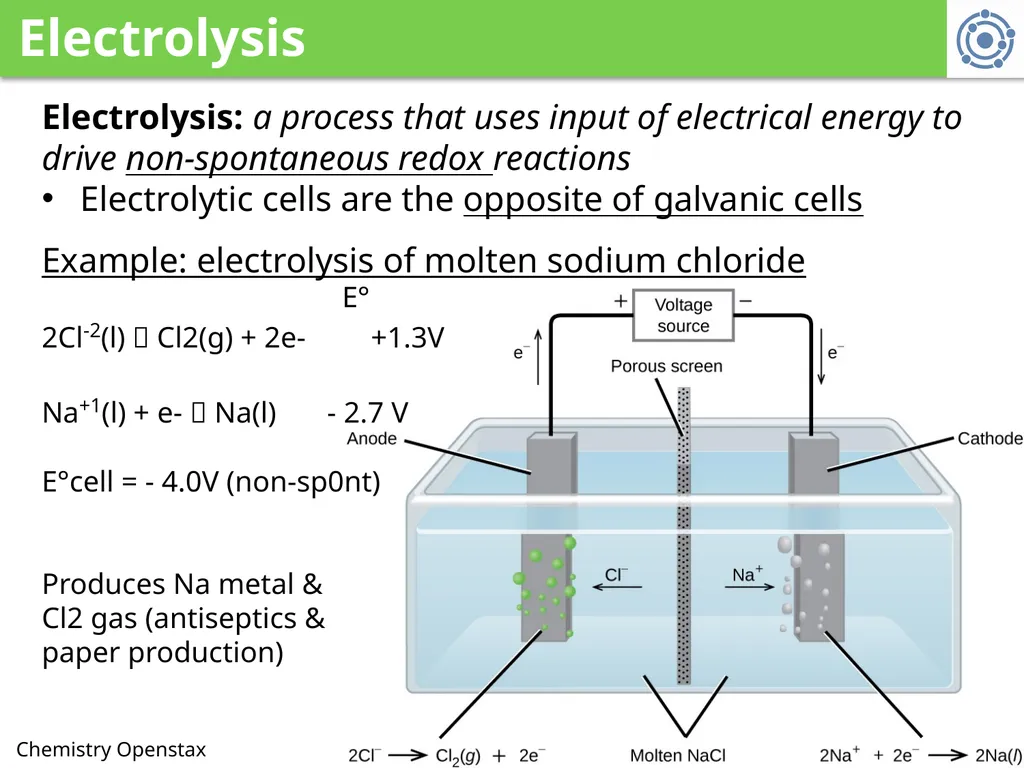
Electrolysis Electrolysis: a process that uses input of electrical energy to drive non-spontaneous redox reactions
Electrolytic cells are the opposite of galvanic cells Chemistry Openstax Example: electrolysis of molten sodium chloride
E°
2Cl-2(l) Cl2(g) + 2e- +1.3V
Na+1(l) + e- Na(l) - 2.7 V
E°cell = - 4.0V (non-sp0nt)
Produces Na metal & Cl2 gas (antiseptics & paper production)<br>
03
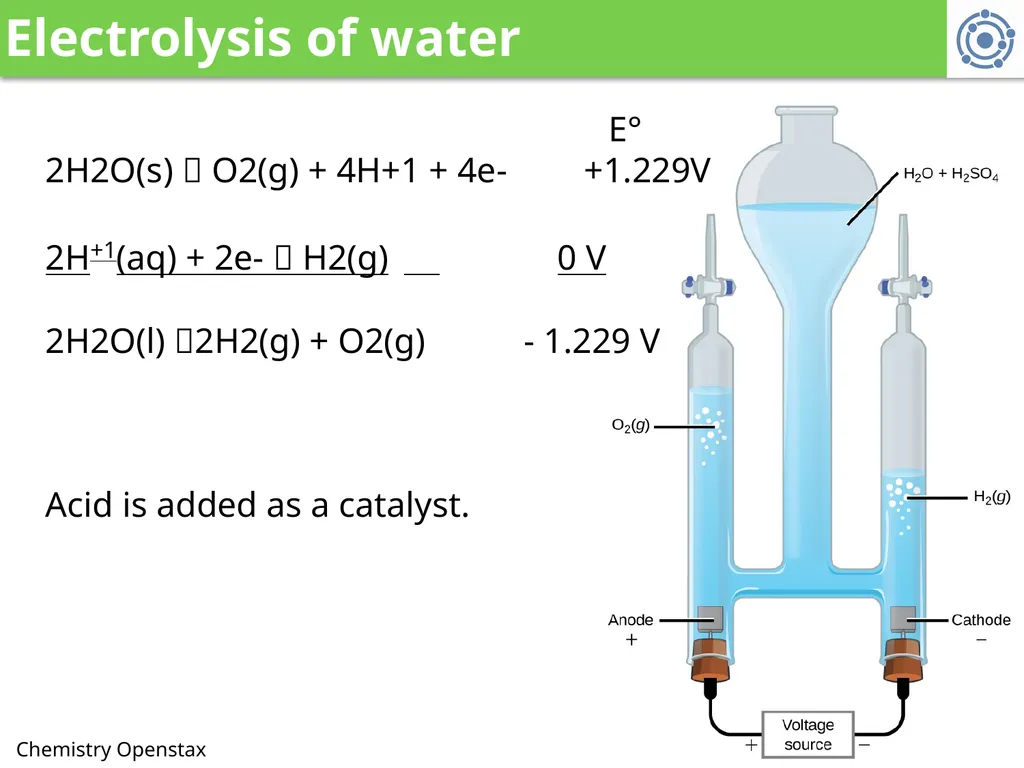
Electrolysis of water Chemistry Openstax E°
2H2O(s) O2(g) + 4H+1 + 4e- +1.229V
2H+1(aq) + 2e- H2(g) 0 V
2H2O(l) 2H2(g) + O2(g) - 1.229 V
Acid is added as a catalyst.<br>
04
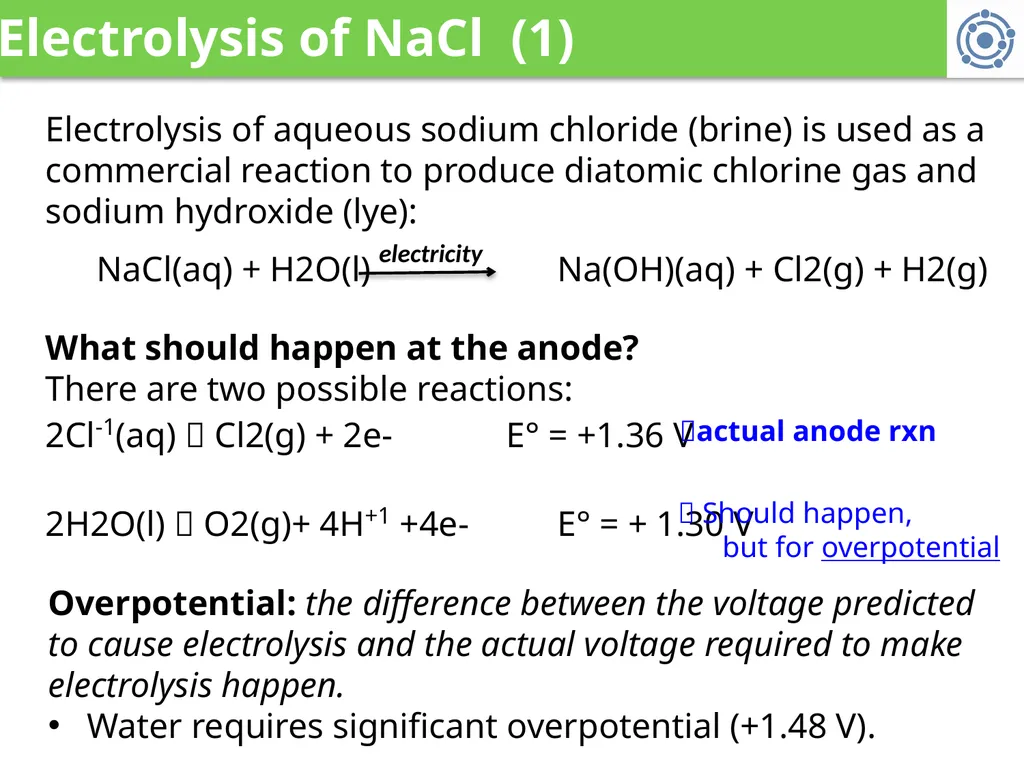
Electrolysis of NaCl (1) Electrolysis of aqueous sodium chloride (brine) is used as a commercial reaction to produce diatomic chlorine gas and sodium hydroxide (lye):
NaCl(aq) + H2O(l) Na(OH)(aq) + Cl2(g) + H2(g) electricity What should happen at the anode? There are two possible reactions:
2Cl-1(aq) Cl2(g) + 2e- E° = +1.36 V
2H2O(l) O2(g)+ 4H+1 +4e- E° = + 1.30 V Should happen, but for overpotential actual anode rxn Overpotential: the difference between the voltage predicted to cause electrolysis and the actual voltage required to make electrolysis happen.
Water requires significant overpotential (+1.48 V).<br>
05
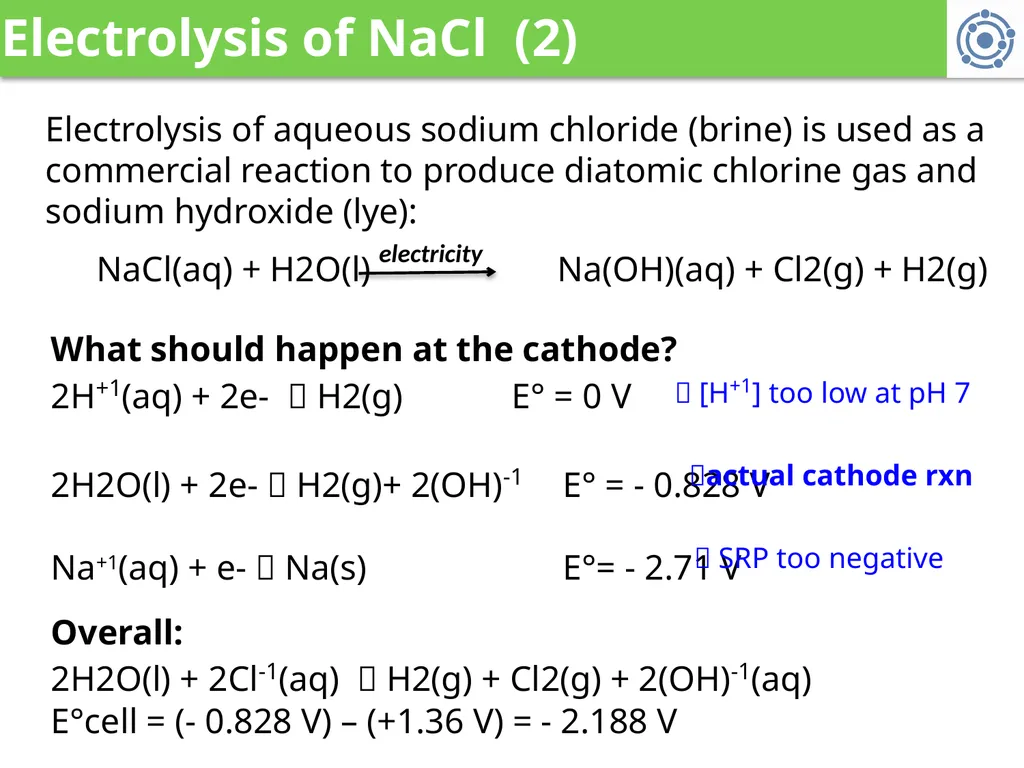
Electrolysis of NaCl (2) What should happen at the cathode?
2H+1(aq) + 2e- H2(g) E° = 0 V
2H2O(l) + 2e- H2(g)+ 2(OH)-1 E° = - 0.828 V
Na+1(aq) + e- Na(s) E°= - 2.71 V [H+1] too low at pH 7 actual cathode rxn Overall:
2H2O(l) + 2Cl-1(aq) H2(g) + Cl2(g) + 2(OH)-1(aq) E°cell = (- 0.828 V) – (+1.36 V) = - 2.188 V Electrolysis of aqueous sodium chloride (brine) is used as a commercial reaction to produce diatomic chlorine gas and sodium hydroxide (lye):
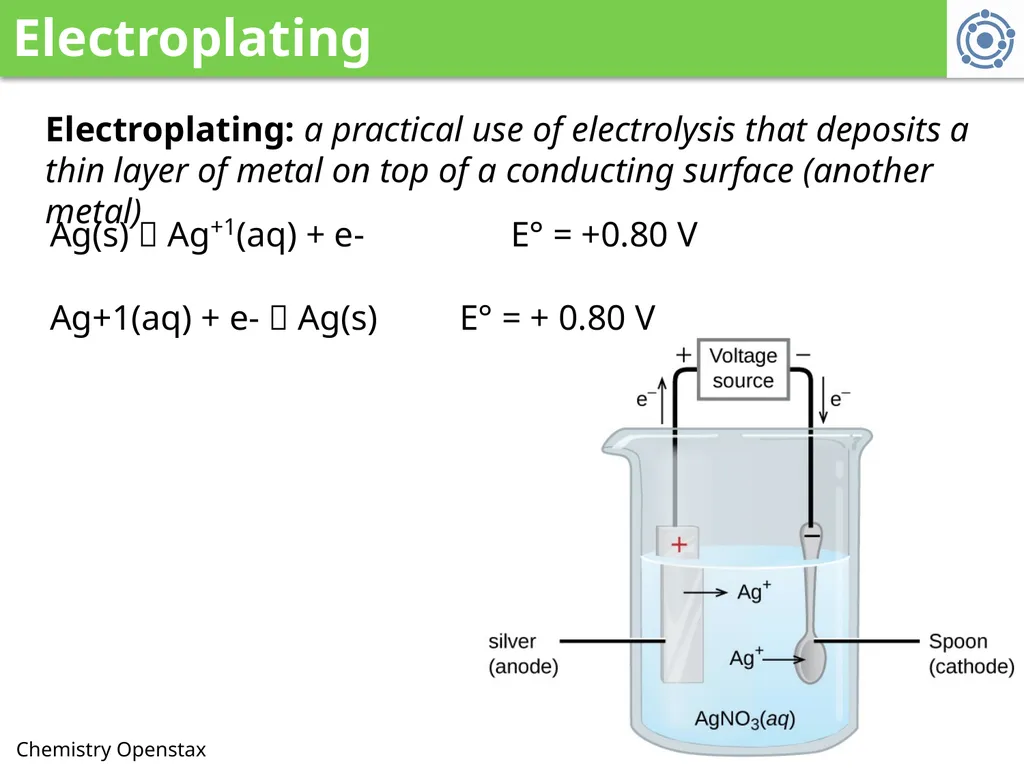
Electroplating Electroplating: a practical use of electrolysis that deposits a thin layer of metal on top of a conducting surface (another metal) Chemistry Openstax Ag(s) Ag+1(aq) + e- E° = +0.80 V
Ag+1(aq) + e- Ag(s) E° = + 0.80 V<br>
07
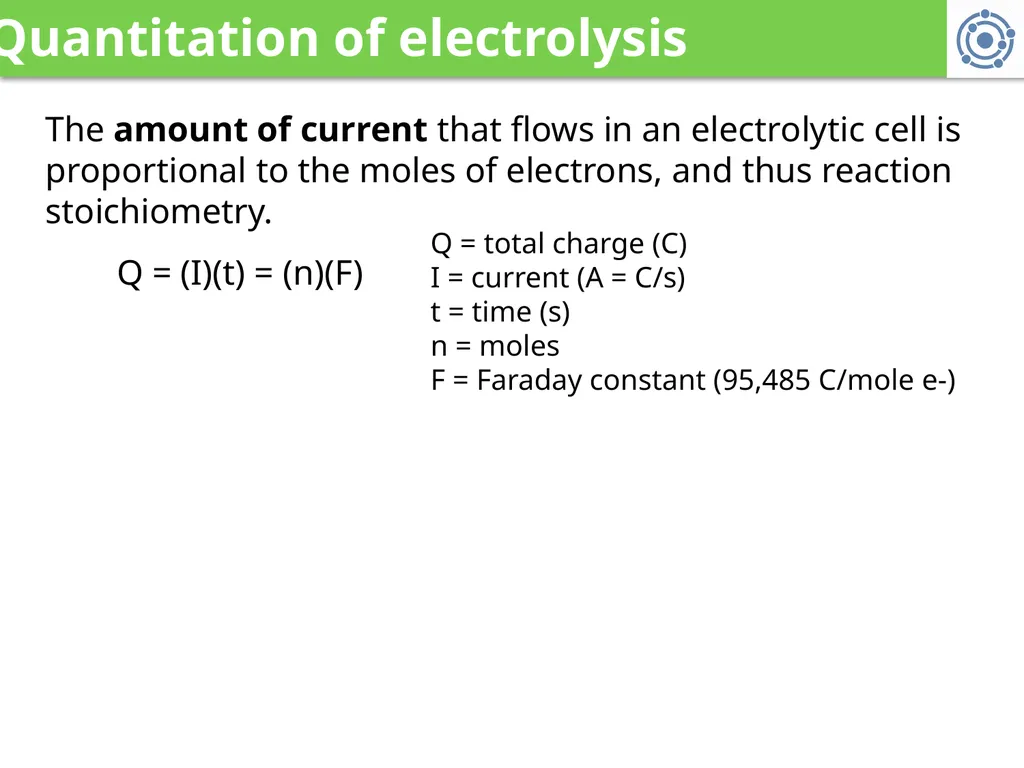
Quantitation of electrolysis The amount of current that flows in an electrolytic cell is proportional to the moles of electrons, and thus reaction stoichiometry. Q = (I)(t) = (n)(F) Q = total charge (C)
I = current (A = C/s)
t = time (s)
n = moles
F = Faraday constant (95,485 C/mole e-)<br>
08
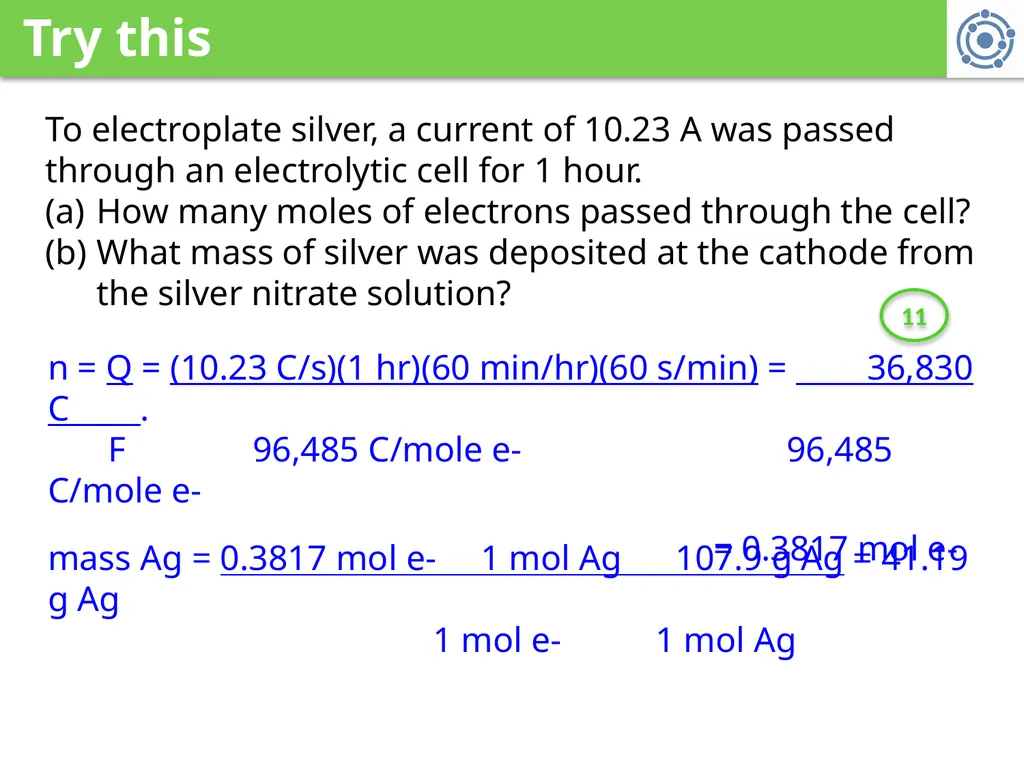
Try this To electroplate silver, a current of 10.23 A was passed through an electrolytic cell for 1 hour.
How many moles of electrons passed through the cell?
What mass of silver was deposited at the cathode from the silver nitrate solution? n = Q = (10.23 C/s)(1 hr)(60 min/hr)(60 s/min) = 36,830 C .
F 96,485 C/mole e- 96,485 C/mole e-
= 0.3817 mol e- mass Ag = 0.3817 mol e- 1 mol Ag 107.9 g Ag = 41.19 g Ag
1 mol e- 1 mol Ag 11<br>
09
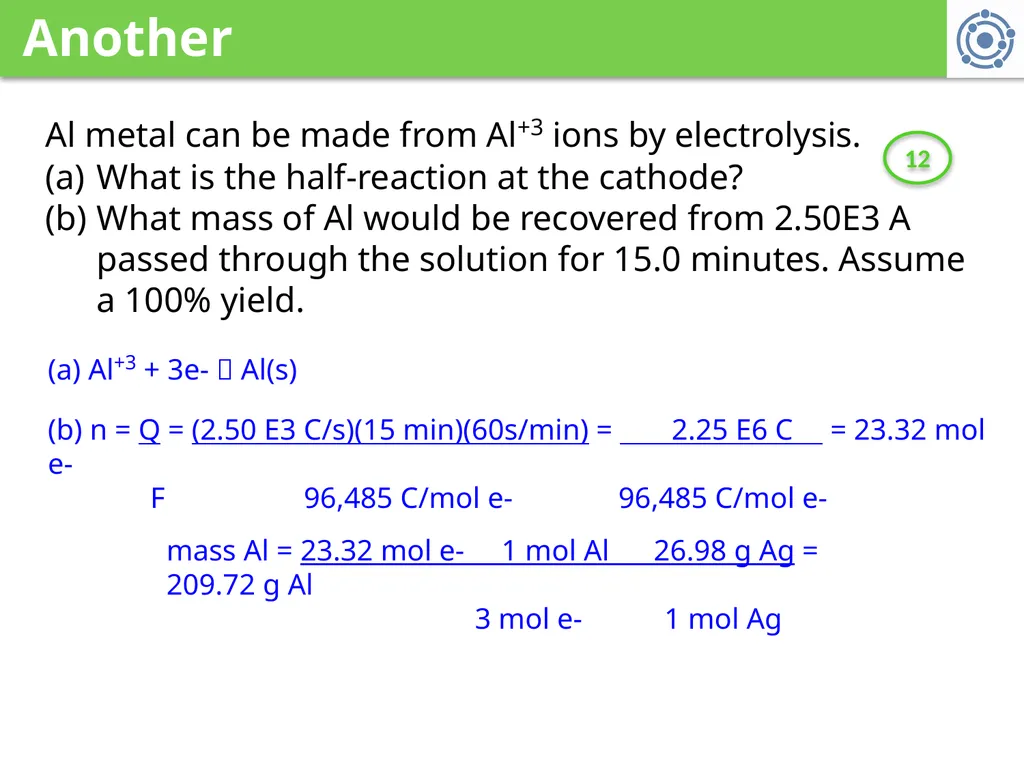
Another Al metal can be made from Al+3 ions by electrolysis.
What is the half-reaction at the cathode?
What mass of Al would be recovered from 2.50E3 A passed through the solution for 15.0 minutes. Assume a 100% yield. (a) Al+3 + 3e- Al(s) mass Al = 23.32 mol e- 1 mol Al 26.98 g Ag = 209.72 g Al
3 mol e- 1 mol Ag (b) n = Q = (2.50 E3 C/s)(15 min)(60s/min) = 2.25 E6 C .= 23.32 mol e-
F 96,485 C/mol e- 96,485 C/mol e- 12<br>
10
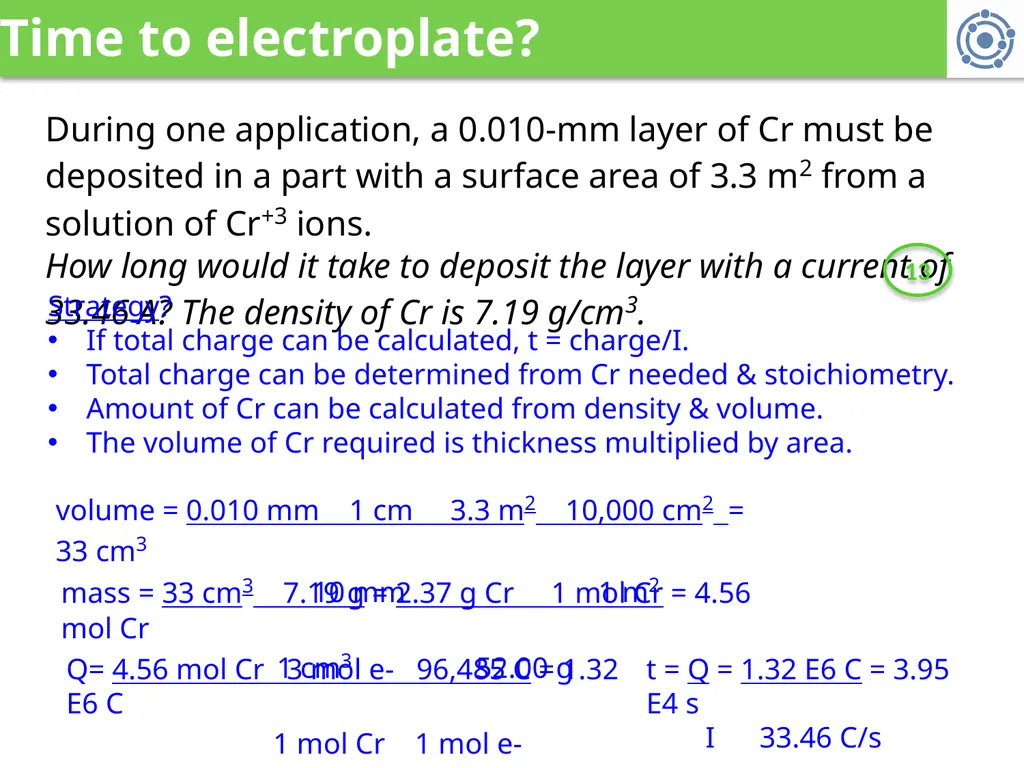
Time to electroplate? During one application, a 0.010-mm layer of Cr must be deposited in a part with a surface area of 3.3 m2 from a solution of Cr+3 ions.
How long would it take to deposit the layer with a current of 33.46 A? The density of Cr is 7.19 g/cm3. Strategy?
If total charge can be calculated, t = charge/I.
Total charge can be determined from Cr needed & stoichiometry.
Amount of Cr can be calculated from density & volume.
The volume of Cr required is thickness multiplied by area. volume = 0.010 mm 1 cm 3.3 m2 10,000 cm2 = 33 cm3
10 mm 1 m2 mass = 33 cm3 7.19 g = 2.37 g Cr 1 mol Cr = 4.56 mol Cr
1 cm3 52.00 g Q= 4.56 mol Cr 3 mol e- 96,485 C = 1.32 E6 C
1 mol Cr 1 mol e- t = Q = 1.32 E6 C = 3.95 E4 s
I 33.46 C/s 13<br>
11
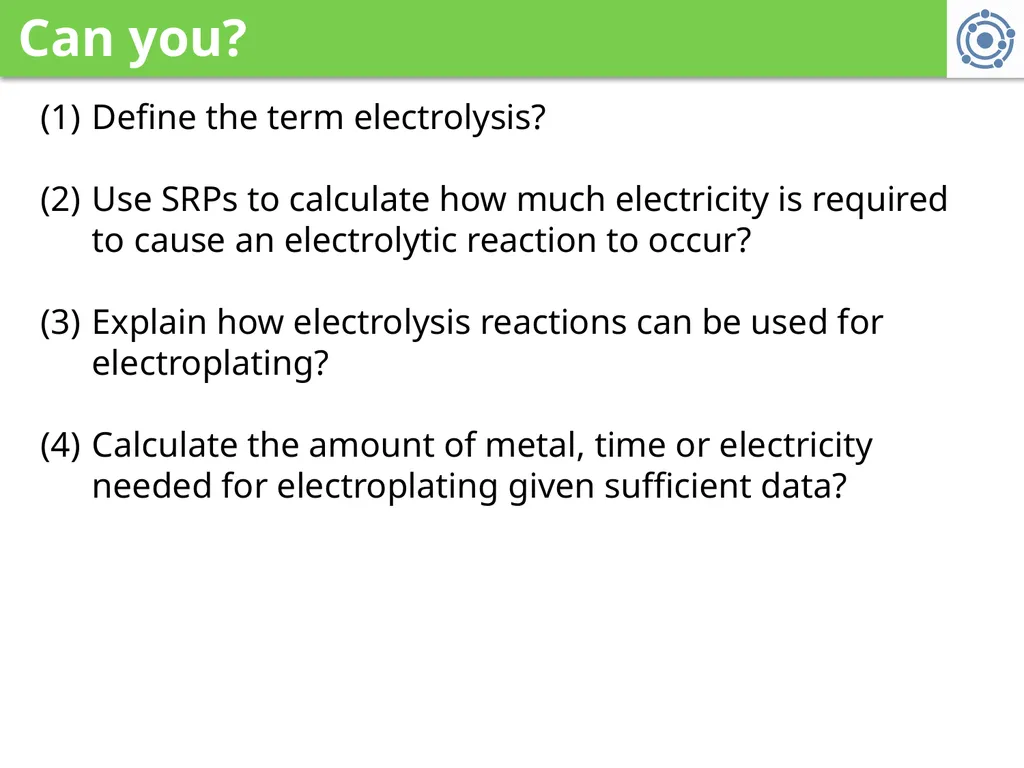
Can you? Define the term electrolysis?
Use SRPs to calculate how much electricity is required to cause an electrolytic reaction to occur?
Explain how electrolysis reactions can be used for electroplating?
Calculate the amount of metal, time or electricity needed for electroplating given sufficient data?<br>