6. Electronic structure, periodic properties 6.2: The Bohr model Describe the Bohr model of the hydrogen atom Use the Rydberg equation to calculate energies of light emitted or absorbed by hydrogen atoms Before this section, please check
"6. Electronic structure, periodic properties 6.2:" is the property of its rightful owner. Permission is granted to
download and print the materials on this website for personal, non-commercial use only, and to display it
on your personal computer provided you do not modify the materials and that you retain all copyright
notices contained in the materials. By downloading content from our website, you accept the terms of this
agreement.
Presentation Transcript
01
6. Electronic structure, periodic properties 6.2: The Bohr model
Describe the Bohr model of the hydrogen atom
Use the Rydberg equation to calculate energies of light emitted or absorbed by hydrogen atoms Before this section, please check for a Flip exercise!
(Posted on the Module 6 page)<br>
02
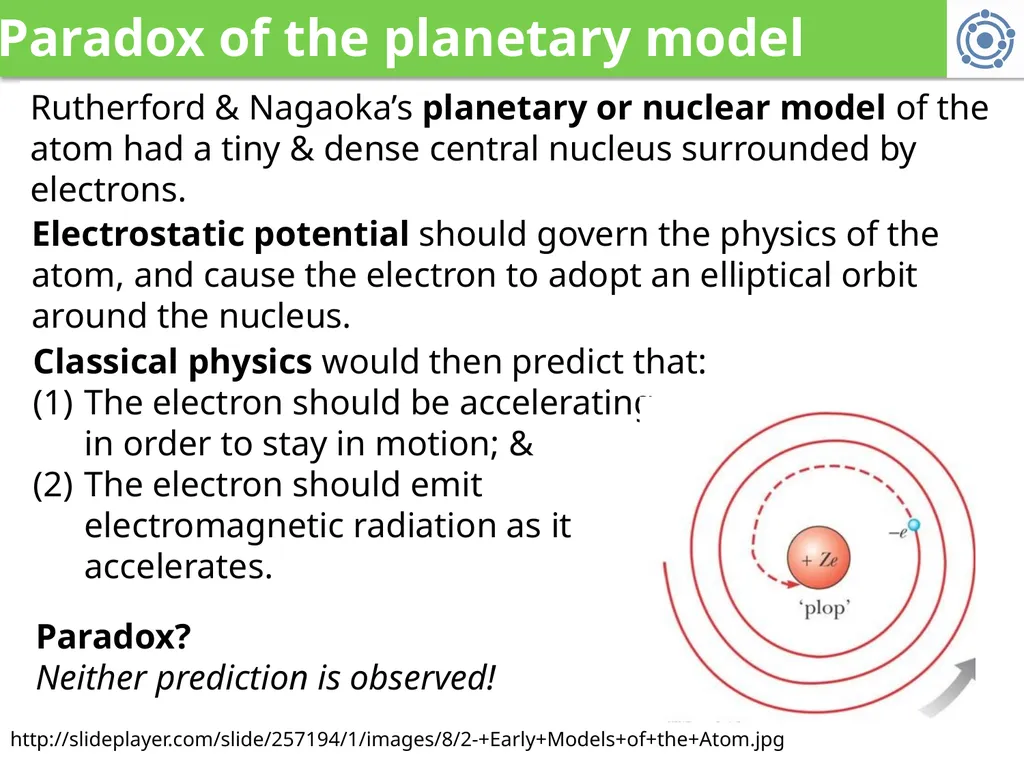
Paradox of the planetary model Rutherford & Nagaoka’s planetary or nuclear model of the atom had a tiny & dense central nucleus surrounded by electrons. http://slideplayer.com/slide/257194/1/images/8/2-+Early+Models+of+the+Atom.jpg Electrostatic potential should govern the physics of the atom, and cause the electron to adopt an elliptical orbit around the nucleus. Classical physics would then predict that:
The electron should be accelerating in order to stay in motion; &
The electron should emit electromagnetic radiation as it accelerates. Paradox? Neither prediction is observed!<br>
03
Bohr’s model 1913: Niels Bohr attempted to resolve the paradox by applying Planck & Einstein’s quantum work to the atom. New predictions:
Because their energies were quantized, electrons orbiting the nucleus wouldn’t emit energy.
If their energy level were increased by input of energy, electrons would experience a temporary increase in energy level and then emit energy as a photon when they returned to their original energy level. Energy absorbed or emitted:
|ΔE| = |Ef – Ei| = hν = hc/λ where Ef & Ei = final & initial orbital energies Quantized energy of electrons:
En = k where n = integer
n2<br>
04
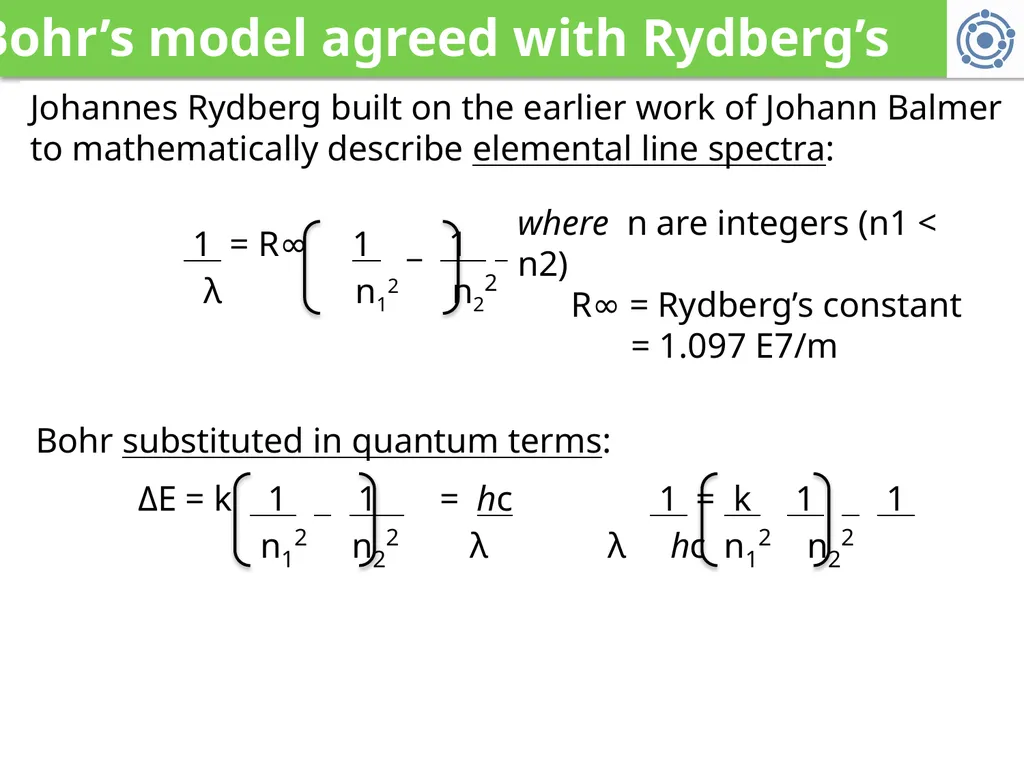
Bohr’s model agreed with Rydberg’s Johannes Rydberg built on the earlier work of Johann Balmer to mathematically describe elemental line spectra:
ΔE = k 1 1 = hc 1 = k 1 1
n12 n22 λ λ hc n12 n22 where n are integers (n1 < n2)
R∞ = Rydberg’s constant = 1.097 E7/m<br>
05
What is the energy (J) and the wavelength (m) of the line in the spectrum of H that represents the movement of an e- from a Bohr orbit of n = 4 to the orbit of n = 6?
Where do we see this in the electromagnetic spectrum? ΔE = E1 – E2 = 2.179 E-18 1 1
n12 n22 Calculating energy & wavelength ΔE = E1 – E2 = 2.179 E-18 1 1 = (2.179 E-18)(0.0625 - 0.0278)
42 62 = 7.561 E-20 J + energy
indicates excitation λ = hc = (6.626 E-34 J-s)(2.998 E8 m/s) = 2.627 E-6 m so infrared
E 7.561 E-20 J = 2627 nm 7<br>
06
What is the energy (J) and the wavelength (m) of the photon produced when an electron falls from the n = 5 to the n = 3 level in a He+1 ion (Z = 2)? ΔE = E1 – E2 = 2.179 E-18 1 1
n12 n22 Try this Chemistry Openstax ΔE = E1 – E2 = 2.179 E-18 1 1 = - 1.547 E-19 J
52 32 - energy
indicates fall back λ = hc = (6.626 E-34 J-s)(2.998 E8 m/s) = 1.284 E-6 m so infrared
E - 1.547 E-19 J = 1284 nm 8<br>
07
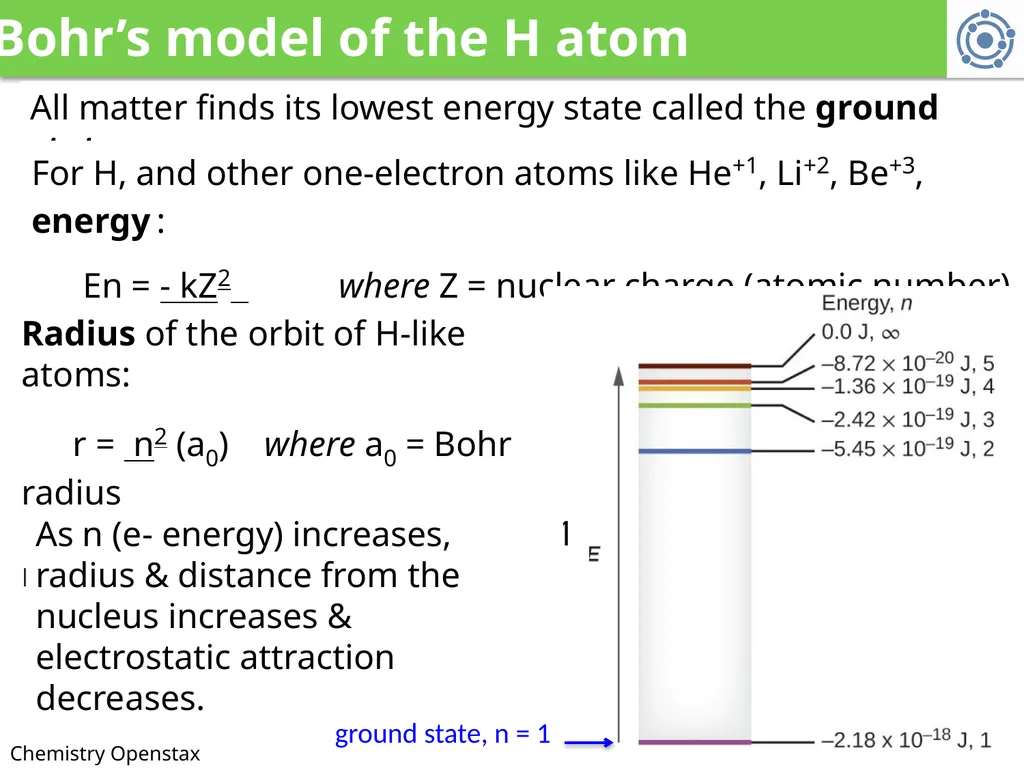
Bohr’s model of the H atom All matter finds its lowest energy state called the ground state. Chemistry Openstax For H, and other one-electron atoms like He+1, Li+2, Be+3, energy :
En = - kZ2 where Z = nuclear charge (atomic number)
n2 k = 2.179 E-18 J Radius of the orbit of H-like atoms:
r = n2 (a0) where a0 = Bohr radius
Z = 5.292 E-11 m As n (e- energy) increases, radius & distance from the nucleus increases & electrostatic attraction decreases. ground state, n = 1<br>
08
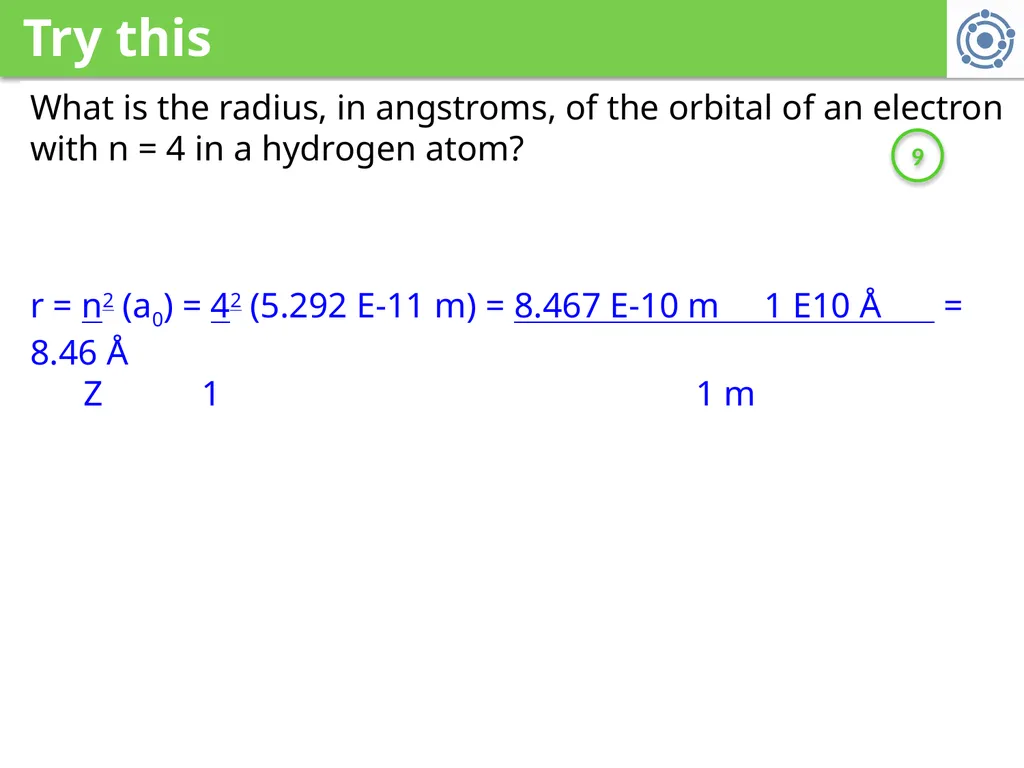
Try this What is the radius, in angstroms, of the orbital of an electron with n = 4 in a hydrogen atom? r = n2 (a0) = 42 (5.292 E-11 m) = 8.467 E-10 m 1 E10 Å = 8.46 Å
Z 1 1 m 9<br>
09
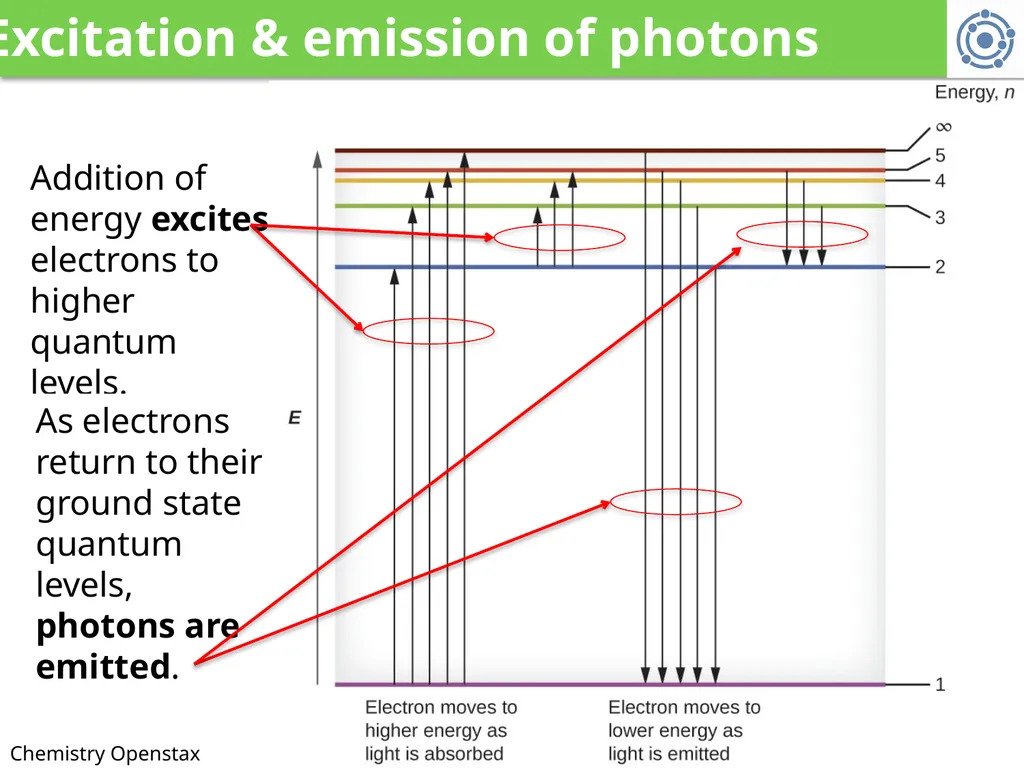
Addition of energy excites electrons to higher quantum levels. As electrons return to their ground state quantum levels, photons are emitted. Excitation & emission of photons Chemistry Openstax<br>
10
While Bohr’s model worked for H it failed for other atoms, even He with 2 electrons. Why?
The orbits of electrons around the nucleus were still based on classical Newtonian physics.
Microscopic matter, like atoms and electrons, cannot be described by Newtonian physics. Ultimately, Bohr’s model failed Bohr’s model did make progress:
Energies of electrons are quantized.
Electrons’ energy increases with increasing distance from the nucleus.
Discrete line spectra result from quantized electron energies<br>
11
Can you? (1) Describe the paradox and fatal flaw of the planetary model of the atom?
(2) Use Bohr’s equation to calculate energy of electrons, photons they absorb or emit, and the distance of electrons from the nucleus of atoms?
(3) Understand why Bohr’s model wasn’t sufficient to explain the nature of the atom?