
7. Get known: lead generation 7. Get known: lead
MS
Published · 39 slides · 0 views

1 / 1
Description
7. Get known: lead generation 7. Get known: lead generation 2 Lead generation is a marketing strategy aimed at acquiring contacts of potential customers interested in a specific product or service. It is part of the so-called Inbound
Related Topics
Share
Embed code
Download this presentation From Below
"7. Get known: lead generation 7. Get known: lead" is the property of its rightful owner. Permission is granted to download and print the materials on this website for personal, non-commercial use only, and to display it on your personal computer provided you do not modify the materials and that you retain all copyright notices contained in the materials. By downloading content from our website, you accept the terms of this agreement.
Presentation Transcript
01
7. Get known: lead generation<br>
02
7. Get known: lead generation 2 Lead generation is a marketing strategy aimed at acquiring contacts of potential customers interested in a specific product or service.
It is part of the so-called Inbound Marketing, i.e. of that digital marketing methodology which allows, through 4 phases, to identify people who do not know our brand, transforming them first into customers and then into spontaneous promoters of the brand.
Compared to the past, both lead generation and
inbound marketing have introduced a new element, as they leverage a type of so-called permissive marketing, that is, which requires the users' consent.<br>
It is part of the so-called Inbound Marketing, i.e. of that digital marketing methodology which allows, through 4 phases, to identify people who do not know our brand, transforming them first into customers and then into spontaneous promoters of the brand.
Compared to the past, both lead generation and
inbound marketing have introduced a new element, as they leverage a type of so-called permissive marketing, that is, which requires the users' consent.<br>
03
7. Get known: lead generation 3 In the past, the most widespread paradigm was that of interruption marketing: a more or less constant bombardment of advertising (billboards, television commercials, telemarketing), not requested by the consumer and often perceived in a negative way as it interfered with his normal activities interrupting them without your consent.
Permission marketing, on the other hand, is a strategy that maximizes conversion rates since it is aimed at users who are really interested in our product or service, who have freely given their consent to receive informational activities and promotional.<br>
Permission marketing, on the other hand, is a strategy that maximizes conversion rates since it is aimed at users who are really interested in our product or service, who have freely given their consent to receive informational activities and promotional.<br>
04
7. Get known: lead generation 4 What is lead generation
As mentioned, therefore, lead generation consists of that set of activities that lead to lead generation, i.e. the creation of contact lists of people who are really interested in our product or service.
The classic scheme of lead generation is as follows: the potential customer is intercepted through various channels, directed to a specially created landing page or to our website, and his email address is obtained.<br>
As mentioned, therefore, lead generation consists of that set of activities that lead to lead generation, i.e. the creation of contact lists of people who are really interested in our product or service.
The classic scheme of lead generation is as follows: the potential customer is intercepted through various channels, directed to a specially created landing page or to our website, and his email address is obtained.<br>
05
7. Get known: lead generation 5 To get the contact it is essential to offer the user a counterpart in terms of unique content and value, a counterpart that acts like a real magnet and is therefore called a lead magnet in jargon.<br>
06
6 Meaning of leads
Contacts do not consist exclusively in the acquisition of email addresses. The various forms of possible leads also include mobile phone numbers and chatbots, i.e. those fully automated software that allow you to manage conversations with users in the field of customer care service. 7. Get known: lead generation<br>
Contacts do not consist exclusively in the acquisition of email addresses. The various forms of possible leads also include mobile phone numbers and chatbots, i.e. those fully automated software that allow you to manage conversations with users in the field of customer care service. 7. Get known: lead generation<br>
07
7 A final form of contact, although weaker than the previous ones, is the push notification made through the browser, which many sites use to communicate information and updates to users.
The main advantage of push notification is to bypass all the privacy authorization issues raised by the recent wals, as this type of notification in addition to immediately requesting consent
of the interested party to send notifications, does not collect the user's IP address. 7. Get known: lead generation<br>
The main advantage of push notification is to bypass all the privacy authorization issues raised by the recent wals, as this type of notification in addition to immediately requesting consent
of the interested party to send notifications, does not collect the user's IP address. 7. Get known: lead generation<br>
08
8 It is therefore necessary to think at 360 degrees and think of the relationship with the user in a broader way, considering it in terms of an effective connection with the person concerned and not a mere acquisition of just the email address. 7. Get known: lead generation<br>
09
9 The advantages of lead generation
Lead generation is an extremely effective technique, which allows you to maximize conversion rates and, consequently, the return on investment (ROI).
Another advantage of this web strategy marketing consists in optimizing advertising costs. To identify users interested in our product or service, channeling their traffic to our website or to a specific landing page, it is generally necessary to incur advertising costs: both Facebook Ads and Google Ads, for example, are paid platforms. 7. Get known: lead generation<br>
Lead generation is an extremely effective technique, which allows you to maximize conversion rates and, consequently, the return on investment (ROI).
Another advantage of this web strategy marketing consists in optimizing advertising costs. To identify users interested in our product or service, channeling their traffic to our website or to a specific landing page, it is generally necessary to incur advertising costs: both Facebook Ads and Google Ads, for example, are paid platforms. 7. Get known: lead generation<br>
10
10 Lead generation, on the other hand, through the establishment of a direct relationship with the potential customer, allows you to avoid advertising costs at least in part. If the interested traffic is identified through search engine positioning techniques (SEO), advertising costs are completely cut down.
If the lead is instead obtained through an investment in advertising (Google Ads or Facebook Ads), the costs are in any case lower, because once the lead has been obtained, the relationship with the potential customer is internalized and nurtured through our organic channels (email , phone contacts). 7. Get known: lead generation<br>
If the lead is instead obtained through an investment in advertising (Google Ads or Facebook Ads), the costs are in any case lower, because once the lead has been obtained, the relationship with the potential customer is internalized and nurtured through our organic channels (email , phone contacts). 7. Get known: lead generation<br>
11
11 Finally, lead generation allows you to personally manage the various stages of the relationship with the person concerned, responding directly to any questions or specific needs.). 7. Get known: lead generation<br>
12
12 Lead nurturing
Not all acquired leads are the same, in the sense that not all contacts are in the same phase of the purchasing process (the so-called customer journey, represented as a funnel and therefore known as a funnel).
As can be easily understood, some people can be very close to the final purchase phase, because for example they have already inquired about our product or service, have made their evaluations and comparisons with similar competitor products and therefore are more inclined to buy, transforming from simple leads into real customers. 7. Get known: lead generation<br>
Not all acquired leads are the same, in the sense that not all contacts are in the same phase of the purchasing process (the so-called customer journey, represented as a funnel and therefore known as a funnel).
As can be easily understood, some people can be very close to the final purchase phase, because for example they have already inquired about our product or service, have made their evaluations and comparisons with similar competitor products and therefore are more inclined to buy, transforming from simple leads into real customers. 7. Get known: lead generation<br>
13
13 In this case, we are dealing with so-called warm leads, i.e. very close to the final stage of the customer journey.
On the other hand, there are people who are not particularly interested in our product or service, in the sense that they are in a phase where they are collecting information and opinions.
Perhaps they have not yet clearly made their purchase decision or are simply exploring a potential solution to a latent and not yet fully manifested need. 7. Get known: lead generation<br>
On the other hand, there are people who are not particularly interested in our product or service, in the sense that they are in a phase where they are collecting information and opinions.
Perhaps they have not yet clearly made their purchase decision or are simply exploring a potential solution to a latent and not yet fully manifested need. 7. Get known: lead generation<br>
14
14 In all these cases we are dealing with cold leads, which need to be "warmed up" through appropriate web marketing techniques called lead nurturing.
Lead nurturing typically consists of inserting the cold lead into an automated email marketing process which, through several steps, manages to warm up the contact and possibly transform it into a customer.
Once the e-mail contact has been acquired, a communication process begins through the e-mail channel which have the task of "feeding" the lead, gradually conveying valuable content, insights into the product or service, but also the credibility and authority of the brand. 7. Get known: lead generation<br>
Lead nurturing typically consists of inserting the cold lead into an automated email marketing process which, through several steps, manages to warm up the contact and possibly transform it into a customer.
Once the e-mail contact has been acquired, a communication process begins through the e-mail channel which have the task of "feeding" the lead, gradually conveying valuable content, insights into the product or service, but also the credibility and authority of the brand. 7. Get known: lead generation<br>
15
7. Get known: lead generation 15 Hot leads and cold leads: the different strategies
Cold leads have the advantage that they can be obtained quite easily and with lower acquisition costs. Often it is enough to work well on the positioning of your company blog to get contacts.
On the other hand, precisely because they are far from converting, these leads need targeted lead nurturing activities and lead magnet offers, actions which, when appropriately combined, are able to induce the person to purchase the product or service.<br>
Cold leads have the advantage that they can be obtained quite easily and with lower acquisition costs. Often it is enough to work well on the positioning of your company blog to get contacts.
On the other hand, precisely because they are far from converting, these leads need targeted lead nurturing activities and lead magnet offers, actions which, when appropriately combined, are able to induce the person to purchase the product or service.<br>
16
7. Get known: lead generation 16 In the case of hot leads, on the other hand, the methodologies to be implemented to acquire paying customers are very different, because both the position of the contact in the purchasing process and his/her search intent on the web are different.
Acquiring this type of lead is more difficult and usually more expensive, as it typically requires an investment in advertising. On the bright side, though, these leads are much closer to converting and don't require lead nurturing or lead magnet sending.<br>
Acquiring this type of lead is more difficult and usually more expensive, as it typically requires an investment in advertising. On the bright side, though, these leads are much closer to converting and don't require lead nurturing or lead magnet sending.<br>
17
7. Get known: lead generation 17 The typical scheme of acquiring a hot lead consists in publishing an advertisement that intercepts an intent very close to the purchase, directing the potential customer to a specific landing page.
At this point, if the lead executes the indicated call to action, which can consist of a request for a quote or an appointment, the company must contact the person again, and this normally takes place through a call (callback). At this stage it is essential that the call is timely. Even an extra hour can often make a difference to the conversion.<br>
At this point, if the lead executes the indicated call to action, which can consist of a request for a quote or an appointment, the company must contact the person again, and this normally takes place through a call (callback). At this stage it is essential that the call is timely. Even an extra hour can often make a difference to the conversion.<br>
18
7. Get known: lead generation 18 As we have just seen, the strategies to implement differ according to the "temperature" of the lead in front of us. There is no univocal and universally valid procedure.
There are quasi-customers, for whom perhaps a well-structured landing page with persuasive copywriting may be sufficient to determine the conversion process. And then there are the cold leads, which require time, attention and care, to be accomplished through an automated but well thought out lead nurturing process.<br>
There are quasi-customers, for whom perhaps a well-structured landing page with persuasive copywriting may be sufficient to determine the conversion process. And then there are the cold leads, which require time, attention and care, to be accomplished through an automated but well thought out lead nurturing process.<br>
19
19 The bargaining chip: the lead magnet
Many think that lead generation basically consists of landing users on a landing page, getting their e-mail address in exchange for sending an e-book and then starting to bombard the contact with a barrage of e-mails almost indiscriminately.
As we have already seen, the reality is quite different: the strategies to follow change according to the type of lead we have acquired. Furthermore, sending emails is never random, but takes place according to a precise logic that I will illustrate in the next paragraphs. 7. Get known: lead generation<br>
Many think that lead generation basically consists of landing users on a landing page, getting their e-mail address in exchange for sending an e-book and then starting to bombard the contact with a barrage of e-mails almost indiscriminately.
As we have already seen, the reality is quite different: the strategies to follow change according to the type of lead we have acquired. Furthermore, sending emails is never random, but takes place according to a precise logic that I will illustrate in the next paragraphs. 7. Get known: lead generation<br>
20
20 Finally, although the e-book is undoubtedly the most widespread form of lead magnet, it is not a standard rule, and sometimes even this counterpart may not be particularly congenial to our product or service.
In lead generation there are no magic formulas that are always valid for everyone.
The strategy, methodology and techniques must be the result of a reasoned analysis of our reference sector, of the type of product or service that we offer to the public and also of the search intent of users, which is directly linked to their position in the purchasing decision-making process. 7. Get known: lead generation<br>
In lead generation there are no magic formulas that are always valid for everyone.
The strategy, methodology and techniques must be the result of a reasoned analysis of our reference sector, of the type of product or service that we offer to the public and also of the search intent of users, which is directly linked to their position in the purchasing decision-making process. 7. Get known: lead generation<br>
21
Types of lead magnets
For these reasons, the e-book can represent a good bargaining chip for obtaining a lead, as it provides the user with quality and valuable content, but we can also evaluate other types of lead magnets as well.
In addition to the e-book, other interesting counterparts to offer to our leads can be:
White papers
Webinars
Trial version of a service
Podcasts
Recorded interviews
Infographics 20 7. Get known: lead generation<br>
For these reasons, the e-book can represent a good bargaining chip for obtaining a lead, as it provides the user with quality and valuable content, but we can also evaluate other types of lead magnets as well.
In addition to the e-book, other interesting counterparts to offer to our leads can be:
White papers
Webinars
Trial version of a service
Podcasts
Recorded interviews
Infographics 20 7. Get known: lead generation<br>
22
22 Lead nurturing through email marketing
As mentioned, the main lead generation strategy for so-called cold leads consists in carrying out lead nurturing actions through a well-structured and fully automated email marketing process.
In fact, these leads need specific and targeted marketing actions that lead them to conversion. For hot leads, on the other hand, it is generally sufficient to create an ad hoc landing page, which takes into account the decision-making phase in which these users are and above all it is necessary to interact with the leads in a timely manner. 7. Get known: lead generation<br>
As mentioned, the main lead generation strategy for so-called cold leads consists in carrying out lead nurturing actions through a well-structured and fully automated email marketing process.
In fact, these leads need specific and targeted marketing actions that lead them to conversion. For hot leads, on the other hand, it is generally sufficient to create an ad hoc landing page, which takes into account the decision-making phase in which these users are and above all it is necessary to interact with the leads in a timely manner. 7. Get known: lead generation<br>
23
7. Get known: lead generation 23 The first thing we need to set up an email automation process for our cold leads is clearly an email service provider. There are many on the market, more or less valid, but in choosing the one to use for our company we must take into consideration a specific factor.
The platform must offer the possibility of creating sequences (so-called workflows) triggered following the completion of a certain action by the user (trigger).<br>
The platform must offer the possibility of creating sequences (so-called workflows) triggered following the completion of a certain action by the user (trigger).<br>
24
7. Get known: lead generation 24 To better understand the optimal way to structure an automation process through email marketing, it is useful to use a practical example. Concretely, it is advisable to divide the user's journey into 2 preparatory steps and 3 levels of detail.
The first 2 steps are those necessary to start the process and respectively consist of a user action, typically the subscription to the newsletter, followed by the sending of a welcome mail by the company, accompanied by the offer of the lead magnet.<br>
The first 2 steps are those necessary to start the process and respectively consist of a user action, typically the subscription to the newsletter, followed by the sending of a welcome mail by the company, accompanied by the offer of the lead magnet.<br>
25
7. Get known: lead generation 25 The next 3 levels, on the other hand, enter more and more into the conversion process, and can be characterized by sending a single email or multiple and scheduled mailings over time. Each level of the process pursues a different goal.
The first level aims to illustrate the usefulness of the product or service we are offering, highlighting its advantages and benefits. If necessary, other lead magnets can be sent, for example the following chapters of the e-book sent previously, or other videos of a training course.<br>
The first level aims to illustrate the usefulness of the product or service we are offering, highlighting its advantages and benefits. If necessary, other lead magnets can be sent, for example the following chapters of the e-book sent previously, or other videos of a training course.<br>
26
7. Get known: lead generation 26 If the user still doesn't convert, we move to the next level, related to the concept of social proof.
One or more emails are sent with the aim of demonstrating the benefits that other people have obtained through the purchase of that particular product or service. You can send case studies built with storytelling techniques, video testimonials, etc.
The social proof mechanism is very powerful and generally has a strong appeal to the user.<br>
One or more emails are sent with the aim of demonstrating the benefits that other people have obtained through the purchase of that particular product or service. You can send case studies built with storytelling techniques, video testimonials, etc.
The social proof mechanism is very powerful and generally has a strong appeal to the user.<br>
27
7. Get known: lead generation 27 “People, on average, tend to consider the behaviors or choices that are made by a large number of people more valid”, argues Robert Cialdini about the mechanism of social proof.
It is the same psychological-social mechanism underlying the diffusion of fashions.
The last level consists in sending the call to action: an email is sent inviting the user to perform an action that is preparatory to the conversion.<br>
It is the same psychological-social mechanism underlying the diffusion of fashions.
The last level consists in sending the call to action: an email is sent inviting the user to perform an action that is preparatory to the conversion.<br>
28
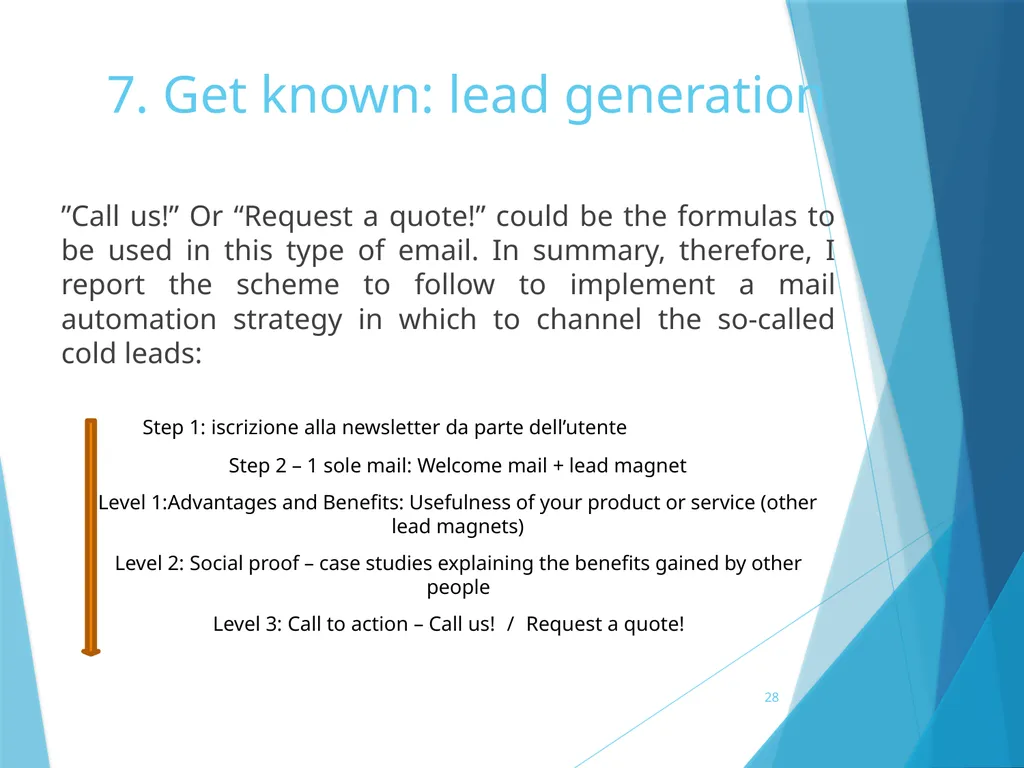
7. Get known: lead generation 28 ”Call us!” Or “Request a quote!” could be the formulas to be used in this type of email. In summary, therefore, I report the scheme to follow to implement a mail automation strategy in which to channel the so-called cold leads:
Step 1: iscrizione alla newsletter da parte dell’utente
Step 2 – 1 sole mail: Welcome mail + lead magnet
Level 1:Advantages and Benefits: Usefulness of your product or service (other lead magnets)
Level 2: Social proof – case studies explaining the benefits gained by other people
Level 3: Call to action – Call us! / Request a quote!<br>
Step 1: iscrizione alla newsletter da parte dell’utente
Step 2 – 1 sole mail: Welcome mail + lead magnet
Level 1:Advantages and Benefits: Usefulness of your product or service (other lead magnets)
Level 2: Social proof – case studies explaining the benefits gained by other people
Level 3: Call to action – Call us! / Request a quote!<br>
29
29 Lead generation tools
To direct users to the landing page where we offer our product or service, or simply to the pages of our website, there are different tools, and each of them requires different methodologies.
The main tools for lead generation are the following:
SEO (cold leads)
Google Ads (hot leads)
Facebook Advertising (cold leads) 7. Get known: lead generation<br>
To direct users to the landing page where we offer our product or service, or simply to the pages of our website, there are different tools, and each of them requires different methodologies.
The main tools for lead generation are the following:
SEO (cold leads)
Google Ads (hot leads)
Facebook Advertising (cold leads) 7. Get known: lead generation<br>
30
30 Lead generation with SEO
Search engine optimization (SEO) is usually not considered among the traffic sources useful for lead generation. In reality, if used intelligently, SEO can play a truly strategic role in acquiring interested contacts, with the competitive advantage of having no additional costs compared to advertising channels.
Through the use of SEO oriented content marketing in our company blog, we can go and intercept many queries of an informative nature, attributable to so-called cold leads. In this phase, the user recognizes that he has a problem and is looking for a solution on the internet. 7. Get known: lead generation<br>
Search engine optimization (SEO) is usually not considered among the traffic sources useful for lead generation. In reality, if used intelligently, SEO can play a truly strategic role in acquiring interested contacts, with the competitive advantage of having no additional costs compared to advertising channels.
Through the use of SEO oriented content marketing in our company blog, we can go and intercept many queries of an informative nature, attributable to so-called cold leads. In this phase, the user recognizes that he has a problem and is looking for a solution on the internet. 7. Get known: lead generation<br>
31
Often he is completely unaware of the existence of a specific product or service that can completely satisfy his need. For this reason, the implementation of a company blog built around the analysis of the most sought-after keywords in the respective reference sector can be an excellent channel for acquiring profiled organic traffic. 30 7. Get known: lead generation<br>
32
In addition to information queries, SEO can be useful in so-called brand queries, i.e. those searches in which the user searches for the name of a specific brand because they already know it and want more detailed information on its products and services. In this case, in addition to obtaining leads, the company blog can be useful for conveying authority and conveying the image of a brand that is a true leader as an expert in that sector. 30 7. Get known: lead generation<br>
33
33 But how is lead generation concretely done through SEO? It's very simple: once the user is on our company blog, an opt-in must be used, i.e. a software dedicated to collecting contact information.
Generally these software use pop-ups, but they can also use other tools. The important thing is that our lead is collected and inserted into the automation process, generally carried out through email marketing, which I mentioned in the previous paragraph. 7. Get known: lead generation<br>
Generally these software use pop-ups, but they can also use other tools. The important thing is that our lead is collected and inserted into the automation process, generally carried out through email marketing, which I mentioned in the previous paragraph. 7. Get known: lead generation<br>
34
34 The first recommended step is to offer the new lead a lead magnet that consists of a content upgrade, or the advanced version of the content you are talking about. 7. Get known: lead generation<br>
35
35 Lead generation with Google Ads
Getting interested traffic through Google Ads advertisements, which appear both at the top and bottom of the google search results page is a particularly suitable method for so-called warm leads.
It is necessary to create campaigns and ads that are optimized for this type of target, very close to the decision-making phase, and whose search intent can be represented through a "transactional" or at most navigational query. 7. Get known: lead generation<br>
Getting interested traffic through Google Ads advertisements, which appear both at the top and bottom of the google search results page is a particularly suitable method for so-called warm leads.
It is necessary to create campaigns and ads that are optimized for this type of target, very close to the decision-making phase, and whose search intent can be represented through a "transactional" or at most navigational query. 7. Get known: lead generation<br>
36
36 The transactional query is a type of search aimed at purchasing a service or product, therefore it contains keywords such as price/cost/quotation.
A navigational query, on the other hand, is a search directed towards a specific brand: we can intercept traffic through words related to the name of our brand and in some cases also exploit the name of our competitors to our advantage.
Once clicked on the ad, the user lands on a landing page specially created and structured for conversion. 7. Get known: lead generation<br>
A navigational query, on the other hand, is a search directed towards a specific brand: we can intercept traffic through words related to the name of our brand and in some cases also exploit the name of our competitors to our advantage.
Once clicked on the ad, the user lands on a landing page specially created and structured for conversion. 7. Get known: lead generation<br>
37
37 Lead generation with Facebook Ads
On Facebook Ads, the classic method for generating leads is to create a campaign that aims to drive traffic to a landing page specifically created to acquire contacts.
The main difference compared to the leads obtained with Google Ads is the temperature of the contacts. While with Google Ads we are dealing with people who have expressed a very specific search intent, on Facebook the public has often not expressed any desire to purchase nor even a request for a quote. 7. Get known: lead generation<br>
On Facebook Ads, the classic method for generating leads is to create a campaign that aims to drive traffic to a landing page specifically created to acquire contacts.
The main difference compared to the leads obtained with Google Ads is the temperature of the contacts. While with Google Ads we are dealing with people who have expressed a very specific search intent, on Facebook the public has often not expressed any desire to purchase nor even a request for a quote. 7. Get known: lead generation<br>
38
38 We must always keep in mind the context of reference: people go to social networks above all for the sake of leisure and entertainment. For this reason, on Facebook it can happen that a person clicks on a particular advertisement without really being interested in the product or service, automatically and almost unconsciously. 7. Get known: lead generation<br>
39
39 Basically, with Google Ads you go to identify hot leads, i.e. people who are very close to becoming paying customers. Those of Facebook, on the other hand, are almost always cold or even very cold leads, who will need lead nurturing activities through an automated email marketing process. 7. Get known: lead generation<br>