
7 Module 7 HIV and STIs Integrating harm reduction
AS
Published · 20 slides · 0 views
1 / 1
Description
7 Module 7 HIV and STIs Integrating harm reduction and sexual and reproductive health and rights Module 7 HIV and STIs LEARNING OBJECTIVES 2 hrs and 25 mins To explain basic information about HIV and other STIs, including ways of
Related Topics
Share
Embed code
Download this presentation From Below
"7 Module 7 HIV and STIs Integrating harm reduction" is the property of its rightful owner. Permission is granted to download and print the materials on this website for personal, non-commercial use only, and to display it on your personal computer provided you do not modify the materials and that you retain all copyright notices contained in the materials. By downloading content from our website, you accept the terms of this agreement.
Presentation Transcript
01
7 Module 7
HIV and STIs Integrating harm reduction and sexual and reproductive health and rights<br>
HIV and STIs Integrating harm reduction and sexual and reproductive health and rights<br>
02
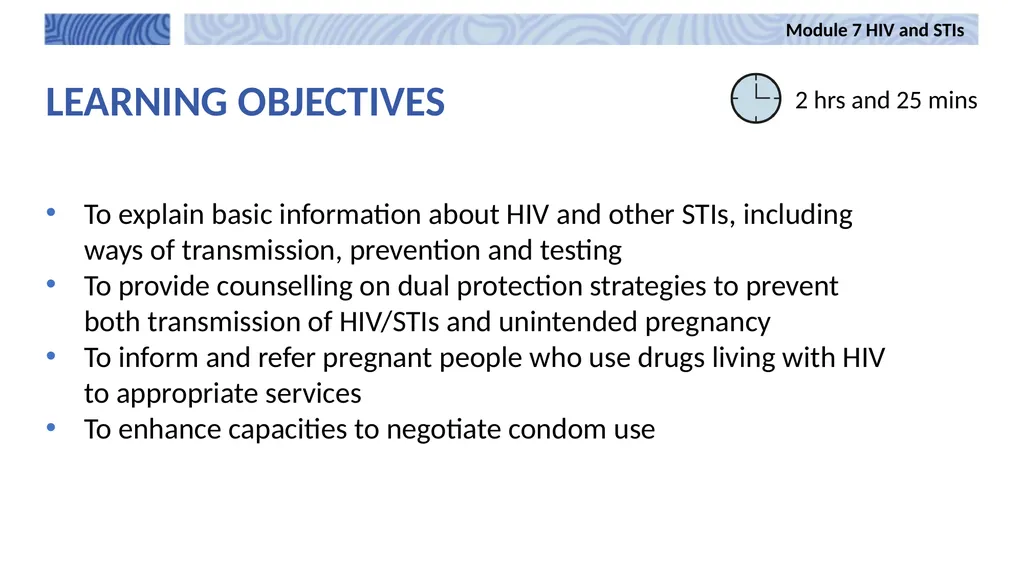
Module 7 HIV and STIs LEARNING OBJECTIVES 2 hrs and 25 mins To explain basic information about HIV and other STIs, including ways of transmission, prevention and testing
To provide counselling on dual protection strategies to prevent both transmission of HIV/STIs and unintended pregnancy
To inform and refer pregnant people who use drugs living with HIV to appropriate services
To enhance capacities to negotiate condom use<br>
To provide counselling on dual protection strategies to prevent both transmission of HIV/STIs and unintended pregnancy
To inform and refer pregnant people who use drugs living with HIV to appropriate services
To enhance capacities to negotiate condom use<br>
03
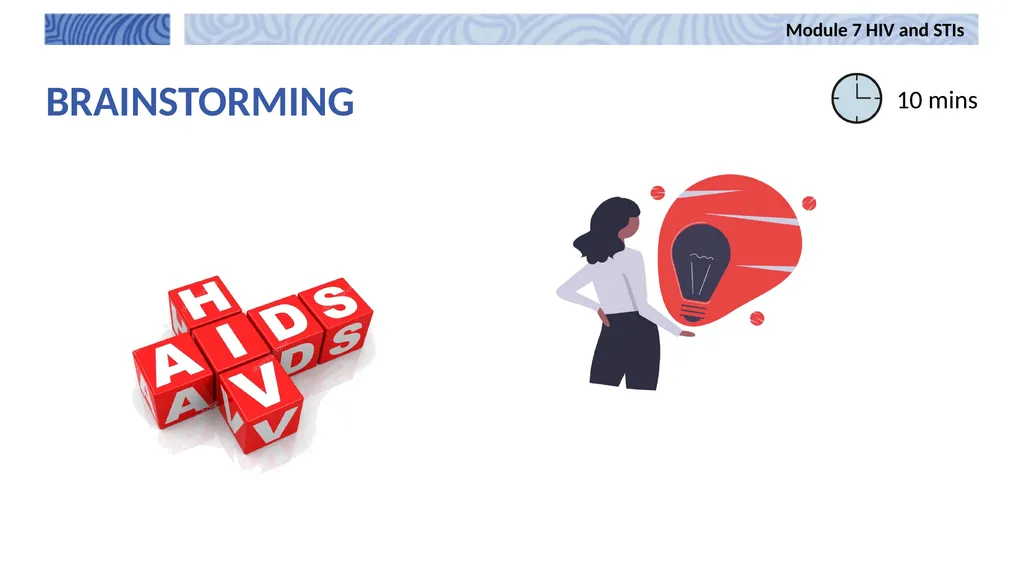
Module 7 HIV and STIs brainstorming 10 mins<br>
04
Module 7 HIV and STIs definitions HIV: Human immunodeficiency virus
It is a virus that attack the immune system. It also destroys a type of white blood cell in the immune system called CD4s and makes copies of itself inside these cells.
AIDS:
Acquired (to get from)
Immune (body’s defence)
Deficiency (lack of resistance)
Syndrome (signs, symptoms of disease)
AIDS is the late stage of HIV.
If left without treatment it can lead to death. People who take antiretroviral treatment (ART) can protect or restore their immune system and live a healthy life.
STIs: Sexually transmitted infections.
Infections passed primarily by sexual contact, including vaginal, oral, and anal sex. Some STIs can be transmitted by skin-to-skin contact. Example of STIs: HPV, syphilis, gonorrhoea, chlamydia, trichomonas, herpes. They can have serious health consequences for men and women. AIDS and syphilis can lead to death if untreated.<br>
It is a virus that attack the immune system. It also destroys a type of white blood cell in the immune system called CD4s and makes copies of itself inside these cells.
AIDS:
Acquired (to get from)
Immune (body’s defence)
Deficiency (lack of resistance)
Syndrome (signs, symptoms of disease)
AIDS is the late stage of HIV.
If left without treatment it can lead to death. People who take antiretroviral treatment (ART) can protect or restore their immune system and live a healthy life.
STIs: Sexually transmitted infections.
Infections passed primarily by sexual contact, including vaginal, oral, and anal sex. Some STIs can be transmitted by skin-to-skin contact. Example of STIs: HPV, syphilis, gonorrhoea, chlamydia, trichomonas, herpes. They can have serious health consequences for men and women. AIDS and syphilis can lead to death if untreated.<br>
05
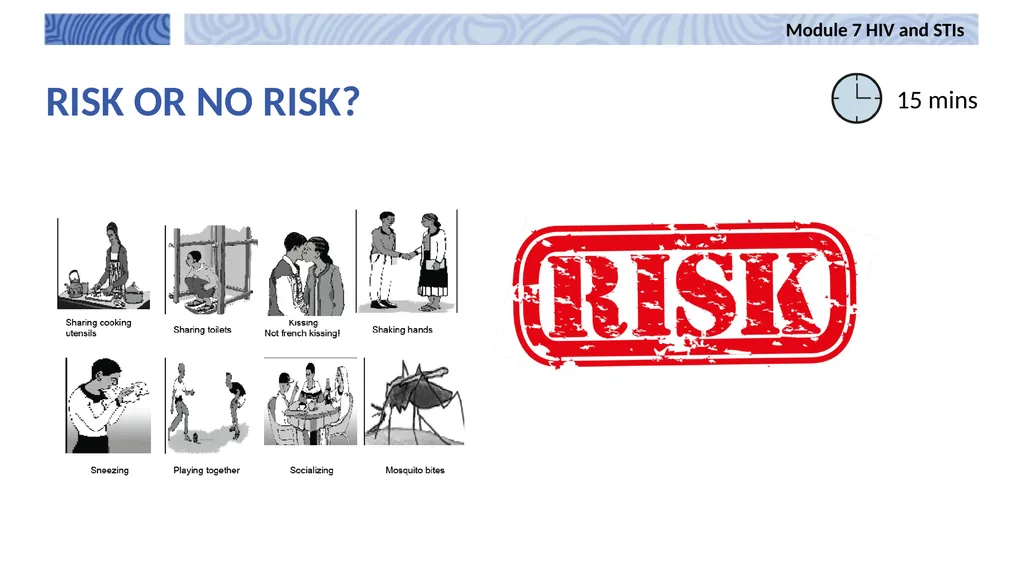
Module 7 HIV and STIs RISK OR NO RISK? 15 mins<br>
06
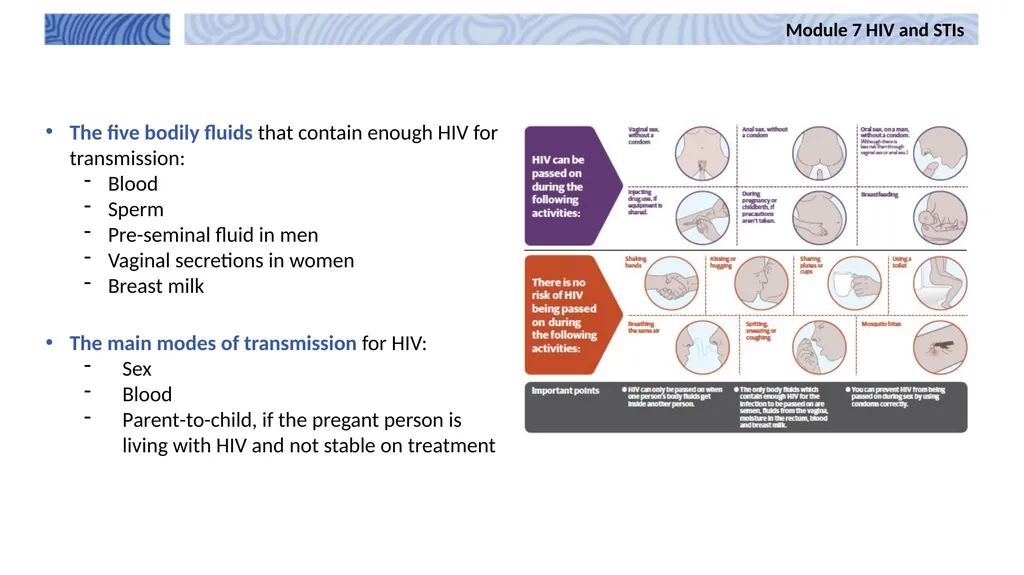
Module 7 HIV and STIs The five bodily fluids that contain enough HIV for transmission:
Blood
Sperm
Pre-seminal fluid in men
Vaginal secretions in women
Breast milk
The main modes of transmission for HIV:
Sex
Blood
Parent-to-child, if the pregant person is living with HIV and not stable on treatment<br>
Blood
Sperm
Pre-seminal fluid in men
Vaginal secretions in women
Breast milk
The main modes of transmission for HIV:
Sex
Blood
Parent-to-child, if the pregant person is living with HIV and not stable on treatment<br>
07
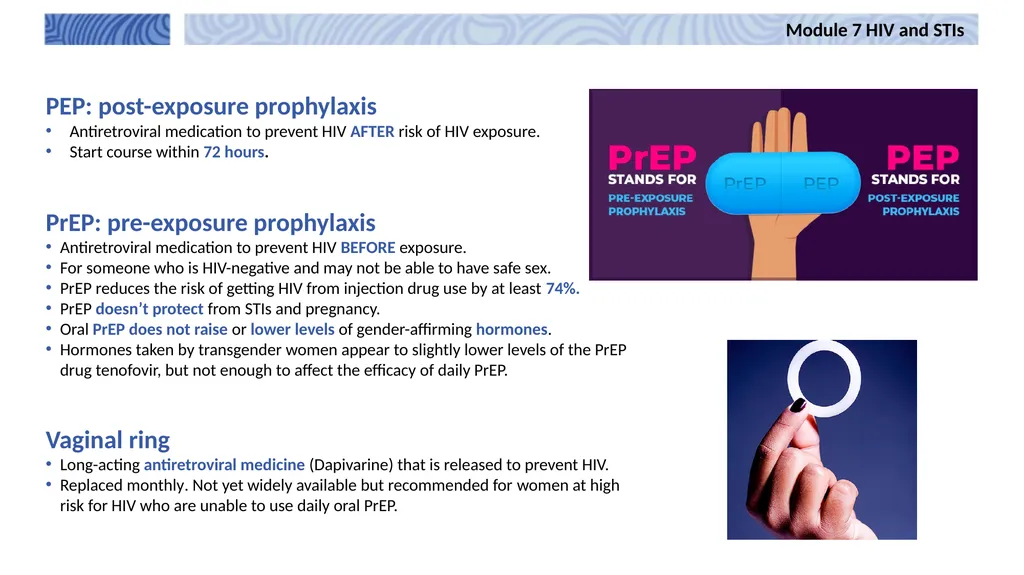
Module 7 HIV and STIs PEP: post-exposure prophylaxis
Antiretroviral medication to prevent HIV AFTER risk of HIV exposure.
Start course within 72 hours.
PrEP: pre-exposure prophylaxis
Antiretroviral medication to prevent HIV BEFORE exposure.
For someone who is HIV-negative and may not be able to have safe sex.
PrEP reduces the risk of getting HIV from injection drug use by at least 74%.
PrEP doesn’t protect from STIs and pregnancy.
Oral PrEP does not raise or lower levels of gender-affirming hormones.
Hormones taken by transgender women appear to slightly lower levels of the PrEP drug tenofovir, but not enough to affect the efficacy of daily PrEP.
Vaginal ring
Long-acting antiretroviral medicine (Dapivarine) that is released to prevent HIV.
Replaced monthly. Not yet widely available but recommended for women at high risk for HIV who are unable to use daily oral PrEP.<br>
Antiretroviral medication to prevent HIV AFTER risk of HIV exposure.
Start course within 72 hours.
PrEP: pre-exposure prophylaxis
Antiretroviral medication to prevent HIV BEFORE exposure.
For someone who is HIV-negative and may not be able to have safe sex.
PrEP reduces the risk of getting HIV from injection drug use by at least 74%.
PrEP doesn’t protect from STIs and pregnancy.
Oral PrEP does not raise or lower levels of gender-affirming hormones.
Hormones taken by transgender women appear to slightly lower levels of the PrEP drug tenofovir, but not enough to affect the efficacy of daily PrEP.
Vaginal ring
Long-acting antiretroviral medicine (Dapivarine) that is released to prevent HIV.
Replaced monthly. Not yet widely available but recommended for women at high risk for HIV who are unable to use daily oral PrEP.<br>
08
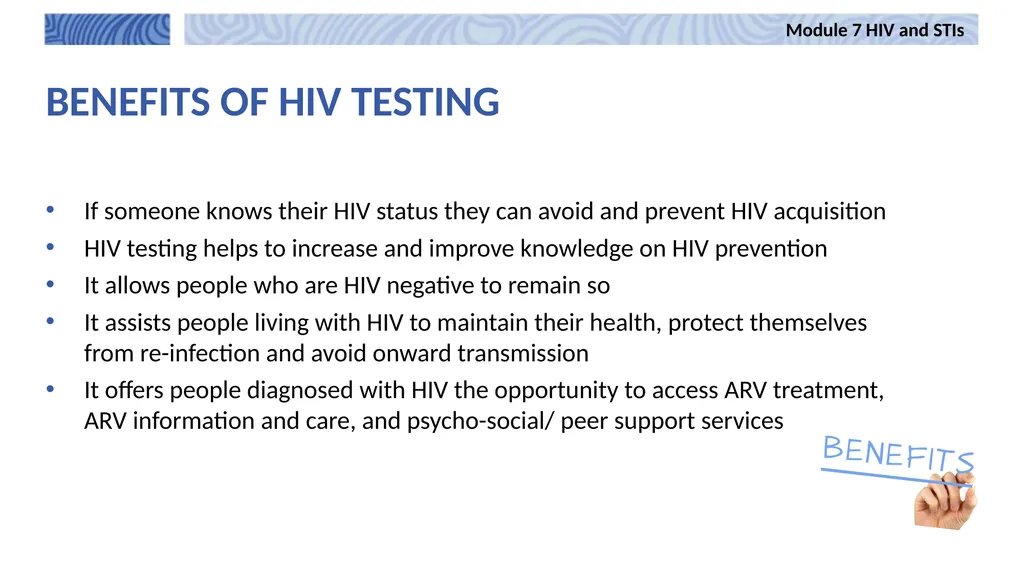
Module 7 HIV and STIs Benefits of hiv testing If someone knows their HIV status they can avoid and prevent HIV acquisition
HIV testing helps to increase and improve knowledge on HIV prevention
It allows people who are HIV negative to remain so
It assists people living with HIV to maintain their health, protect themselves from re-infection and avoid onward transmission
It offers people diagnosed with HIV the opportunity to access ARV treatment, ARV information and care, and psycho-social/ peer support services<br>
HIV testing helps to increase and improve knowledge on HIV prevention
It allows people who are HIV negative to remain so
It assists people living with HIV to maintain their health, protect themselves from re-infection and avoid onward transmission
It offers people diagnosed with HIV the opportunity to access ARV treatment, ARV information and care, and psycho-social/ peer support services<br>
09
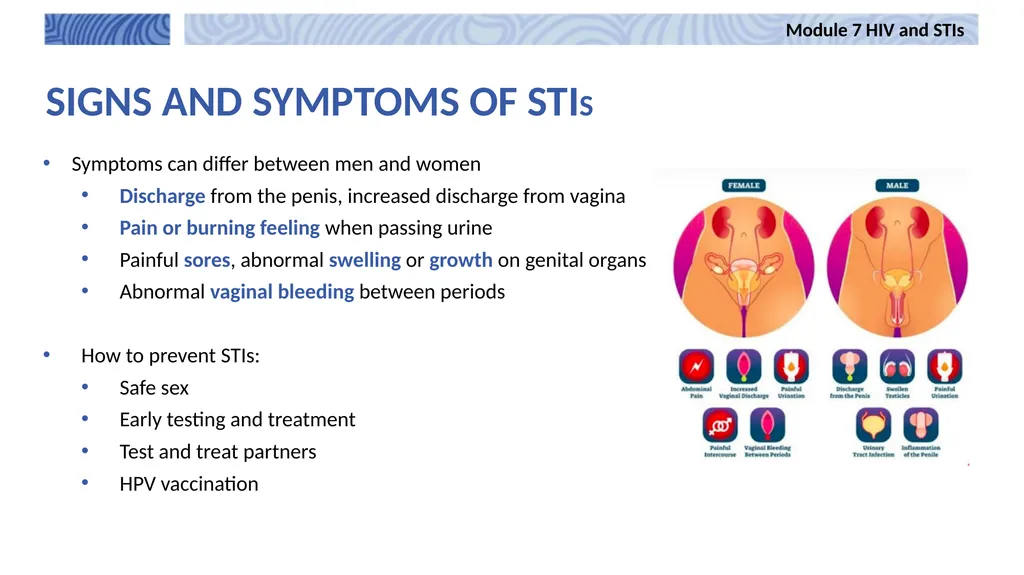
Module 7 HIV and STIs Signs and symptoms of stis Symptoms can differ between men and women
Discharge from the penis, increased discharge from vagina
Pain or burning feeling when passing urine
Painful sores, abnormal swelling or growth on genital organs
Abnormal vaginal bleeding between periods
How to prevent STIs:
Safe sex
Early testing and treatment
Test and treat partners
HPV vaccination<br>
Discharge from the penis, increased discharge from vagina
Pain or burning feeling when passing urine
Painful sores, abnormal swelling or growth on genital organs
Abnormal vaginal bleeding between periods
How to prevent STIs:
Safe sex
Early testing and treatment
Test and treat partners
HPV vaccination<br>
10
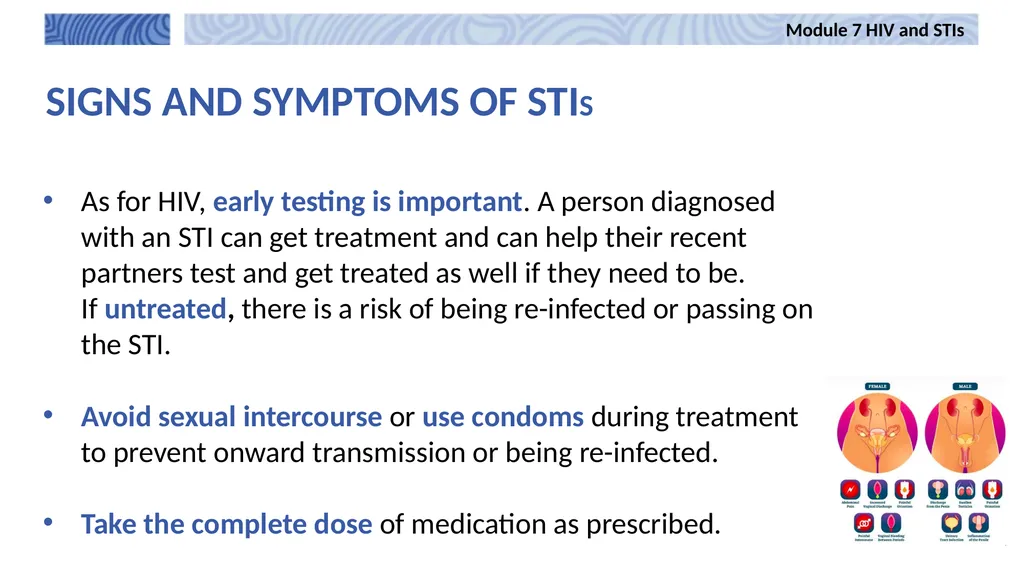
Module 7 HIV and STIs Signs and symptoms of stis As for HIV, early testing is important. A person diagnosed with an STI can get treatment and can help their recent partners test and get treated as well if they need to be.
If untreated, there is a risk of being re-infected or passing on the STI.
Avoid sexual intercourse or use condoms during treatment to prevent onward transmission or being re-infected.
Take the complete dose of medication as prescribed.<br>
If untreated, there is a risk of being re-infected or passing on the STI.
Avoid sexual intercourse or use condoms during treatment to prevent onward transmission or being re-infected.
Take the complete dose of medication as prescribed.<br>
11
Module 7 HIV and STIs counselling 15 mins In pairs
Prepare a role play: one person plays the counsellor, one person plays the client. If there is a group with three people, the third person can be a friend or the partner.
Objective: to discuss the risks of unsafe sex and dual protection strategies.<br>
Prepare a role play: one person plays the counsellor, one person plays the client. If there is a group with three people, the third person can be a friend or the partner.
Objective: to discuss the risks of unsafe sex and dual protection strategies.<br>
12
Module 7 HIV and STIs DISCUSSION 5 mins What was Sarah’s situation when she came to the counselling session?
What are the risks Sarah was exposed to, or likely resulting consequences?
What dual protection strategy did Sarah decide to use?
What are the other possible strategies she could use?<br>
What are the risks Sarah was exposed to, or likely resulting consequences?
What dual protection strategy did Sarah decide to use?
What are the other possible strategies she could use?<br>
13
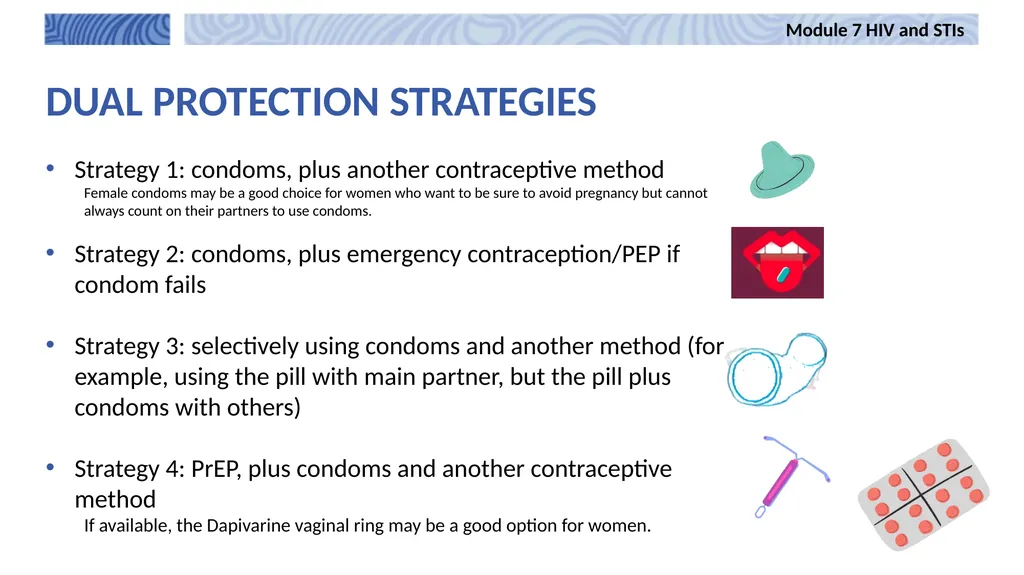
Module 7 HIV and STIs DUAL PROTECTION STRATEGIES Strategy 1: condoms, plus another contraceptive method
Female condoms may be a good choice for women who want to be sure to avoid pregnancy but cannot always count on their partners to use condoms.
Strategy 2: condoms, plus emergency contraception/PEP if condom fails
Strategy 3: selectively using condoms and another method (for example, using the pill with main partner, but the pill plus condoms with others)
Strategy 4: PrEP, plus condoms and another contraceptive method
If available, the Dapivarine vaginal ring may be a good option for women.<br>
Female condoms may be a good choice for women who want to be sure to avoid pregnancy but cannot always count on their partners to use condoms.
Strategy 2: condoms, plus emergency contraception/PEP if condom fails
Strategy 3: selectively using condoms and another method (for example, using the pill with main partner, but the pill plus condoms with others)
Strategy 4: PrEP, plus condoms and another contraceptive method
If available, the Dapivarine vaginal ring may be a good option for women.<br>
14
Module 7 HIV and STIs Group discussion 25 mins What are the risks for people living with HIV who are pregnant and plan to have a baby?
How could transmission of HIV to the baby occur? What are some methods to prevent transmission?
What are the benefits of preventing vertical transmission (PVT) services?
Where can a woman or gender non-conforming person who uses drugs access PVT services?<br>
How could transmission of HIV to the baby occur? What are some methods to prevent transmission?
What are the benefits of preventing vertical transmission (PVT) services?
Where can a woman or gender non-conforming person who uses drugs access PVT services?<br>
15
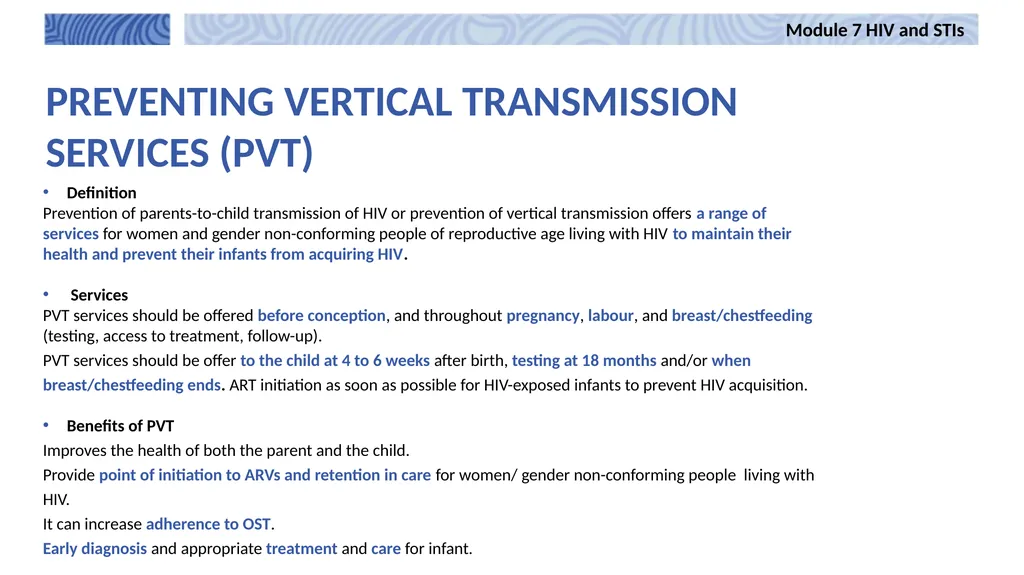
Module 7 HIV and STIs Preventing vertical transmission services (PVT) Definition
Prevention of parents-to-child transmission of HIV or prevention of vertical transmission offers a range of services for women and gender non-conforming people of reproductive age living with HIV to maintain their health and prevent their infants from acquiring HIV.
Services
PVT services should be offered before conception, and throughout pregnancy, labour, and breast/chestfeeding (testing, access to treatment, follow-up).
PVT services should be offer to the child at 4 to 6 weeks after birth, testing at 18 months and/or when breast/chestfeeding ends. ART initiation as soon as possible for HIV-exposed infants to prevent HIV acquisition.
Benefits of PVT
Improves the health of both the parent and the child.
Provide point of initiation to ARVs and retention in care for women/ gender non-conforming people living with HIV.
It can increase adherence to OST.
Early diagnosis and appropriate treatment and care for infant.<br>
Prevention of parents-to-child transmission of HIV or prevention of vertical transmission offers a range of services for women and gender non-conforming people of reproductive age living with HIV to maintain their health and prevent their infants from acquiring HIV.
Services
PVT services should be offered before conception, and throughout pregnancy, labour, and breast/chestfeeding (testing, access to treatment, follow-up).
PVT services should be offer to the child at 4 to 6 weeks after birth, testing at 18 months and/or when breast/chestfeeding ends. ART initiation as soon as possible for HIV-exposed infants to prevent HIV acquisition.
Benefits of PVT
Improves the health of both the parent and the child.
Provide point of initiation to ARVs and retention in care for women/ gender non-conforming people living with HIV.
It can increase adherence to OST.
Early diagnosis and appropriate treatment and care for infant.<br>
16
Module 7 HIV and STIs DEVELOP YOUR STRATEGIES In pairs / 3 stories
Work on the different stories and find responses, strategies, solutions and tips to negotiate condom use for the couple 20 mins<br>
Work on the different stories and find responses, strategies, solutions and tips to negotiate condom use for the couple 20 mins<br>
17
Module 7 HIV and STIs DISCUSSIONS What could be the outcome of this story if they have unprotected sex? If they decide not to have sex?
Based on the outcomes from the different stories, what could be the answer to the sentences in Handout 6? 10 mins<br>
Based on the outcomes from the different stories, what could be the answer to the sentences in Handout 6? 10 mins<br>
18
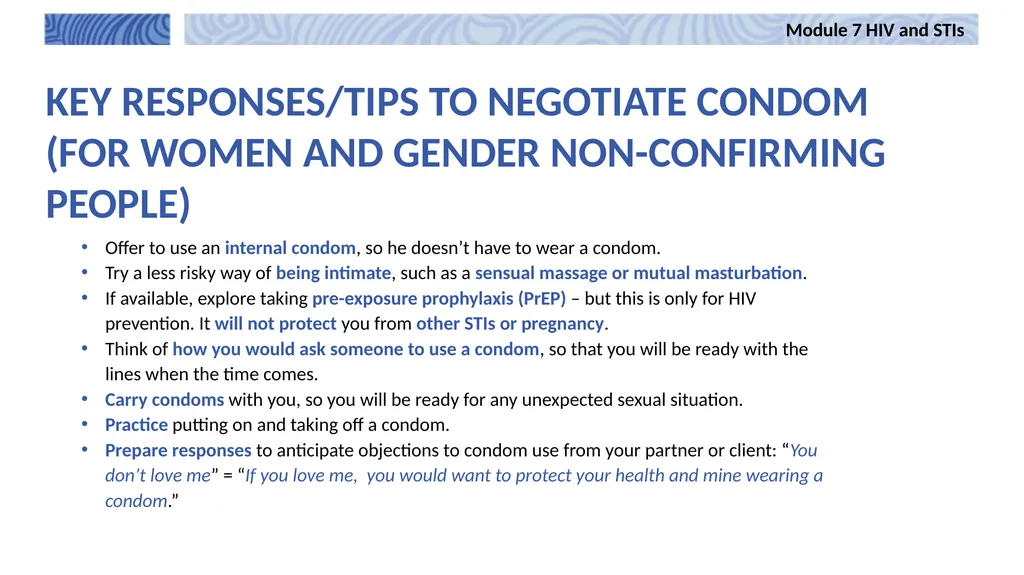
Module 7 HIV and STIs KEY RESPONSES/TIPS TO NEGOTIATE CONDOM (FOR WOMEN AND GENDER NON-CONFIRMING PEOPLE) Offer to use an internal condom, so he doesn’t have to wear a condom.
Try a less risky way of being intimate, such as a sensual massage or mutual masturbation.
If available, explore taking pre-exposure prophylaxis (PrEP) – but this is only for HIV prevention. It will not protect you from other STIs or pregnancy.
Think of how you would ask someone to use a condom, so that you will be ready with the lines when the time comes.
Carry condoms with you, so you will be ready for any unexpected sexual situation.
Practice putting on and taking off a condom.
Prepare responses to anticipate objections to condom use from your partner or client: “You don’t love me” = “If you love me, you would want to protect your health and mine wearing a condom.”<br>
Try a less risky way of being intimate, such as a sensual massage or mutual masturbation.
If available, explore taking pre-exposure prophylaxis (PrEP) – but this is only for HIV prevention. It will not protect you from other STIs or pregnancy.
Think of how you would ask someone to use a condom, so that you will be ready with the lines when the time comes.
Carry condoms with you, so you will be ready for any unexpected sexual situation.
Practice putting on and taking off a condom.
Prepare responses to anticipate objections to condom use from your partner or client: “You don’t love me” = “If you love me, you would want to protect your health and mine wearing a condom.”<br>
19
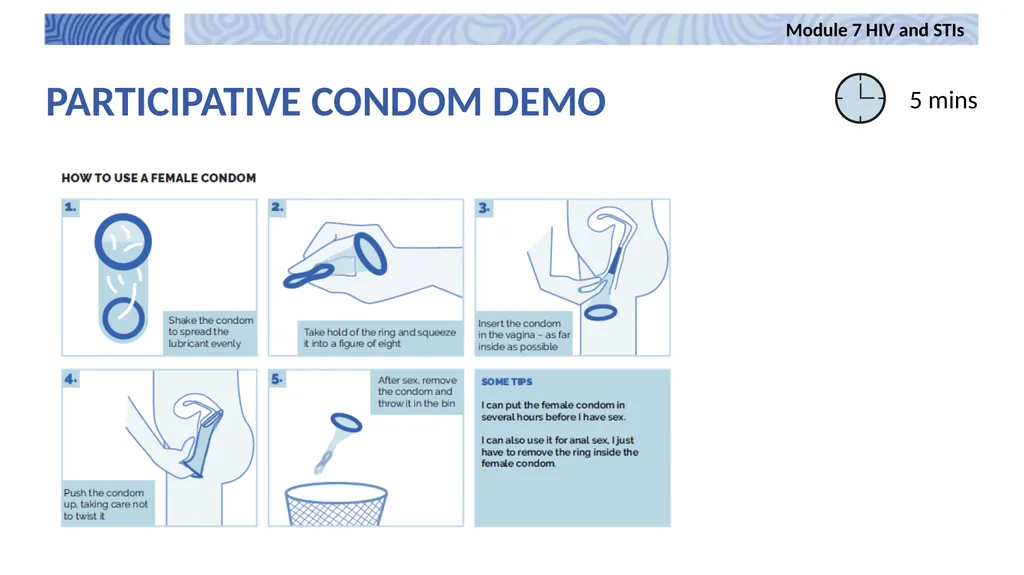
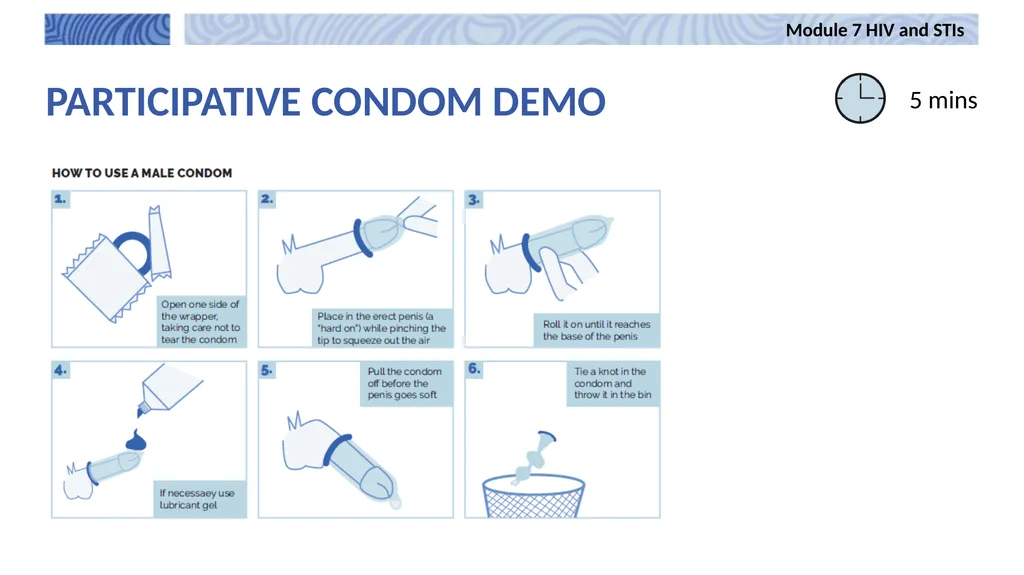
Module 7 HIV and STIs PARTICIPATIVE CONDOM DEMO 5 mins<br>
20
Module 7 HIV and STIs PARTICIPATIVE CONDOM DEMO 5 mins<br>