
8 Jack the Ripper Curriculum for Wales Scheme of
PT
Published · 7 slides · 0 views

1 / 1
Description
8 Jack the Ripper Curriculum for Wales Scheme of Learning: Humanities Department Vision Overall Learning Journey 7-11 Overtime Statement 1: Enquiry, exploration and investigation inspire curiosity about the world, its past, present and
Related Topics
Share
Embed code
Download this presentation From Below
"8 Jack the Ripper Curriculum for Wales Scheme of" is the property of its rightful owner. Permission is granted to download and print the materials on this website for personal, non-commercial use only, and to display it on your personal computer provided you do not modify the materials and that you retain all copyright notices contained in the materials. By downloading content from our website, you accept the terms of this agreement.
Presentation Transcript
01
8 Jack the Ripper Curriculum for Wales Scheme of Learning:
Humanities<br>
02
Department Vision Overall Learning Journey 7-11 Overtime<br>
03
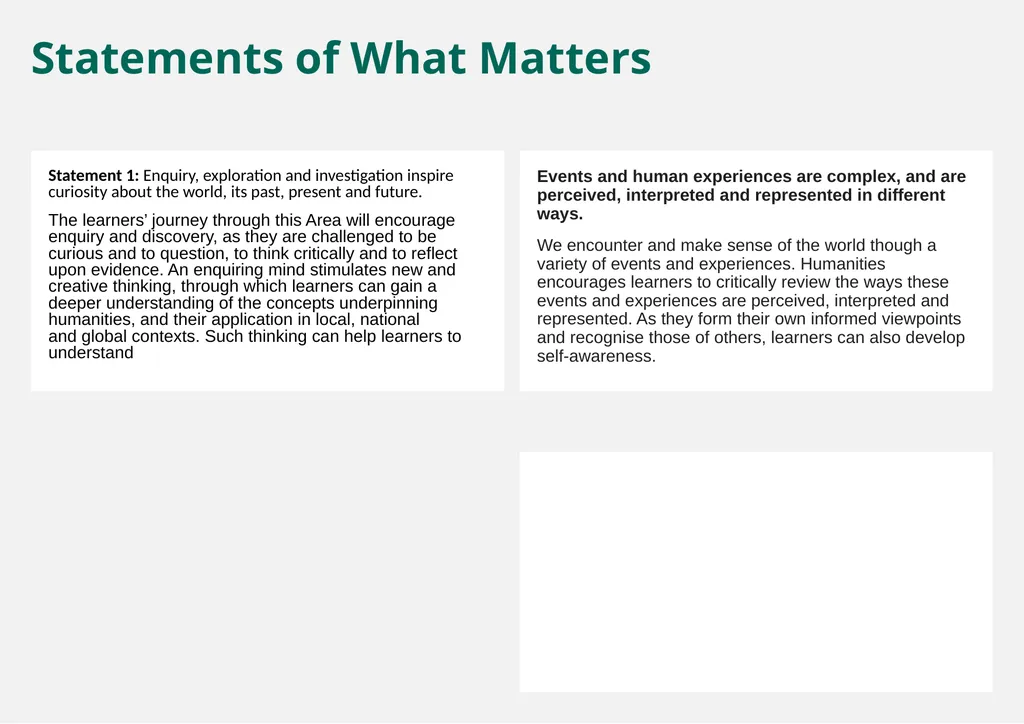
Statement 1: Enquiry, exploration and investigation inspire curiosity about the world, its past, present and future.
The learners’ journey through this Area will encourage enquiry and discovery, as they are challenged to be curious and to question, to think critically and to reflect upon evidence. An enquiring mind stimulates new and creative thinking, through which learners can gain a deeper understanding of the concepts underpinning humanities, and their application in local, national and global contexts. Such thinking can help learners to understand Events and human experiences are complex, and are perceived, interpreted and represented in different ways.
We encounter and make sense of the world though a variety of events and experiences. Humanities encourages learners to critically review the ways these events and experiences are perceived, interpreted and represented. As they form their own informed viewpoints and recognise those of others, learners can also develop self-awareness. Statements of What Matters<br>
04
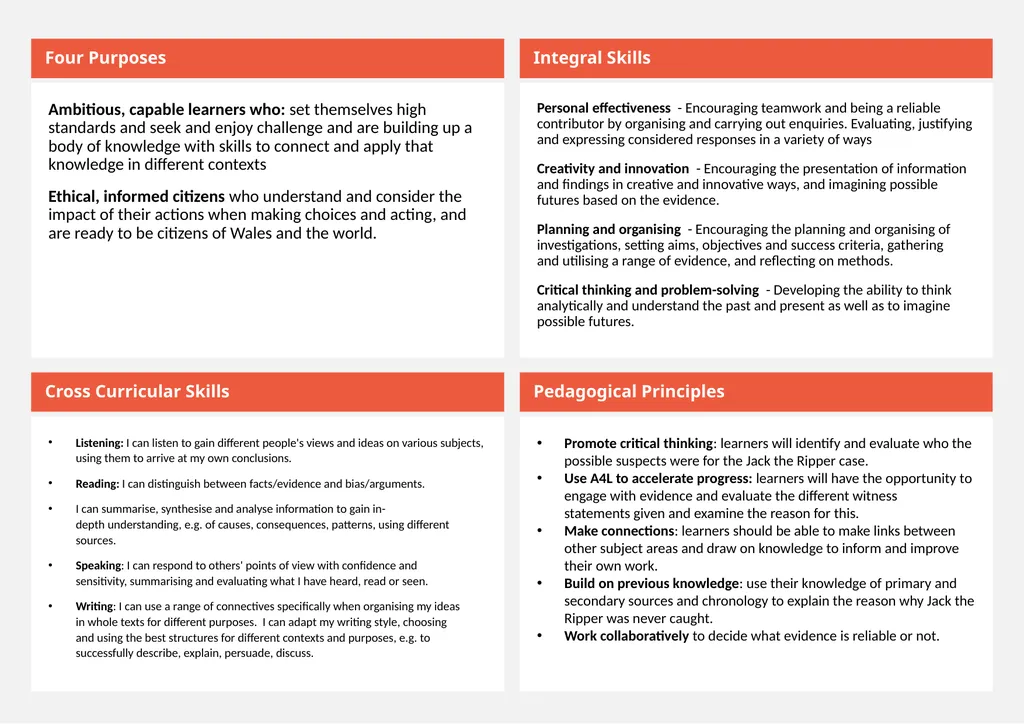
Ambitious, capable learners who: set themselves high standards and seek and enjoy challenge and are building up a body of knowledge with skills to connect and apply that knowledge in different contexts
Ethical, informed citizens who understand and consider the impact of their actions when making choices and acting, and are ready to be citizens of Wales and the world. Four Purposes Listening: I can listen to gain different people's views and ideas on various subjects, using them to arrive at my own conclusions.
Reading: I can distinguish between facts/evidence and bias/arguments.
I can summarise, synthesise and analyse information to gain in-depth understanding, e.g. of causes, consequences, patterns, using different sources.
Speaking: I can respond to others' points of view with confidence and sensitivity, summarising and evaluating what I have heard, read or seen.
Writing: I can use a range of connectives specifically when organising my ideas in whole texts for different purposes. I can adapt my writing style, choosing and using the best structures for different contexts and purposes, e.g. to successfully describe, explain, persuade, discuss. Cross Curricular Skills Integral Skills Personal effectiveness - Encouraging teamwork and being a reliable contributor by organising and carrying out enquiries. Evaluating, justifying and expressing considered responses in a variety of ways
Creativity and innovation - Encouraging the presentation of information and findings in creative and innovative ways, and imagining possible futures based on the evidence.
Planning and organising - Encouraging the planning and organising of investigations, setting aims, objectives and success criteria, gathering and utilising a range of evidence, and reflecting on methods.
Critical thinking and problem-solving - Developing the ability to think analytically and understand the past and present as well as to imagine possible futures. Promote critical thinking: learners will identify and evaluate who the possible suspects were for the Jack the Ripper case.
Use A4L to accelerate progress: learners will have the opportunity to engage with evidence and evaluate the different witness statements given and examine the reason for this.
Make connections: learners should be able to make links between other subject areas and draw on knowledge to inform and improve their own work.
Build on previous knowledge: use their knowledge of primary and secondary sources and chronology to explain the reason why Jack the Ripper was never caught.
Work collaboratively to decide what evidence is reliable or not. Pedagogical Principles<br>
05
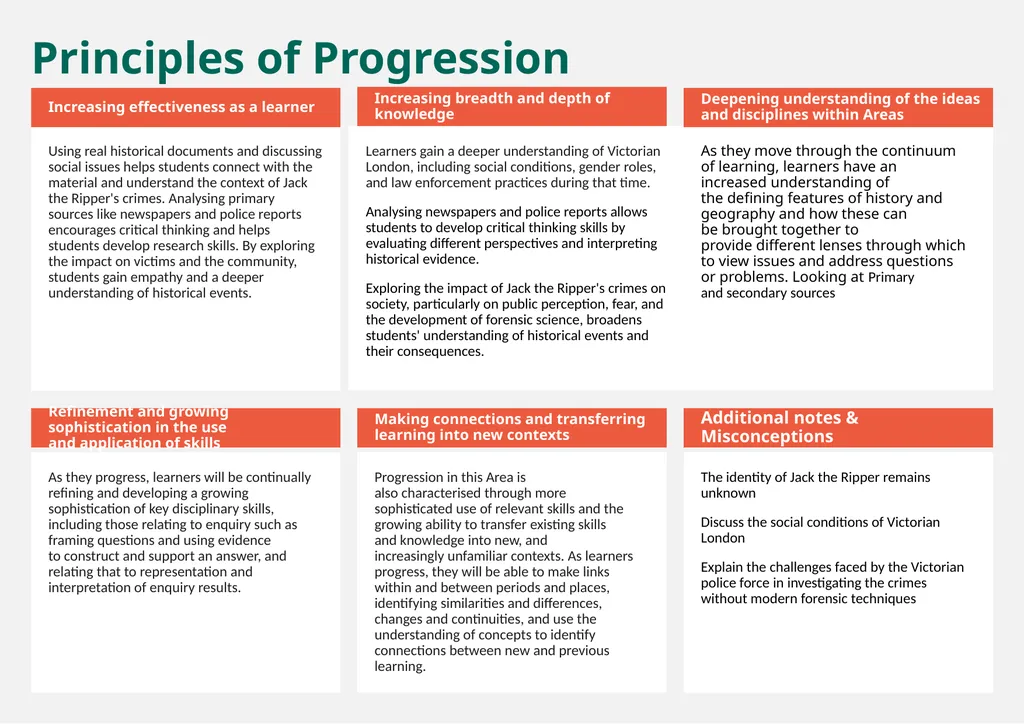
Using real historical documents and discussing social issues helps students connect with the material and understand the context of Jack the Ripper's crimes. Analysing primary sources like newspapers and police reports encourages critical thinking and helps students develop research skills. By exploring the impact on victims and the community, students gain empathy and a deeper understanding of historical events. Increasing effectiveness as a learner Learners gain a deeper understanding of Victorian London, including social conditions, gender roles, and law enforcement practices during that time.
Analysing newspapers and police reports allows students to develop critical thinking skills by evaluating different perspectives and interpreting historical evidence.
Exploring the impact of Jack the Ripper's crimes on society, particularly on public perception, fear, and the development of forensic science, broadens students' understanding of historical events and their consequences. Increasing breadth and depth of knowledge As they move through the continuum of learning, learners have an increased understanding of the defining features of history and geography and how these can be brought together to provide different lenses through which to view issues and address questions or problems. Looking at Primary and secondary sources Deepening understanding of the ideas and disciplines within Areas Principles of Progression As they progress, learners will be continually refining and developing a growing sophistication of key disciplinary skills, including those relating to enquiry such as framing questions and using evidence to construct and support an answer, and relating that to representation and interpretation of enquiry results. Refinement and growing sophistication in the use and application of skills Progression in this Area is also characterised through more sophisticated use of relevant skills and the growing ability to transfer existing skills and knowledge into new, and increasingly unfamiliar contexts. As learners progress, they will be able to make links within and between periods and places, identifying similarities and differences, changes and continuities, and use the understanding of concepts to identify connections between new and previous learning. Making connections and transferring learning into new contexts The identity of Jack the Ripper remains unknown
Discuss the social conditions of Victorian London
Explain the challenges faced by the Victorian police force in investigating the crimes without modern forensic techniques Additional notes & Misconceptions<br>
06
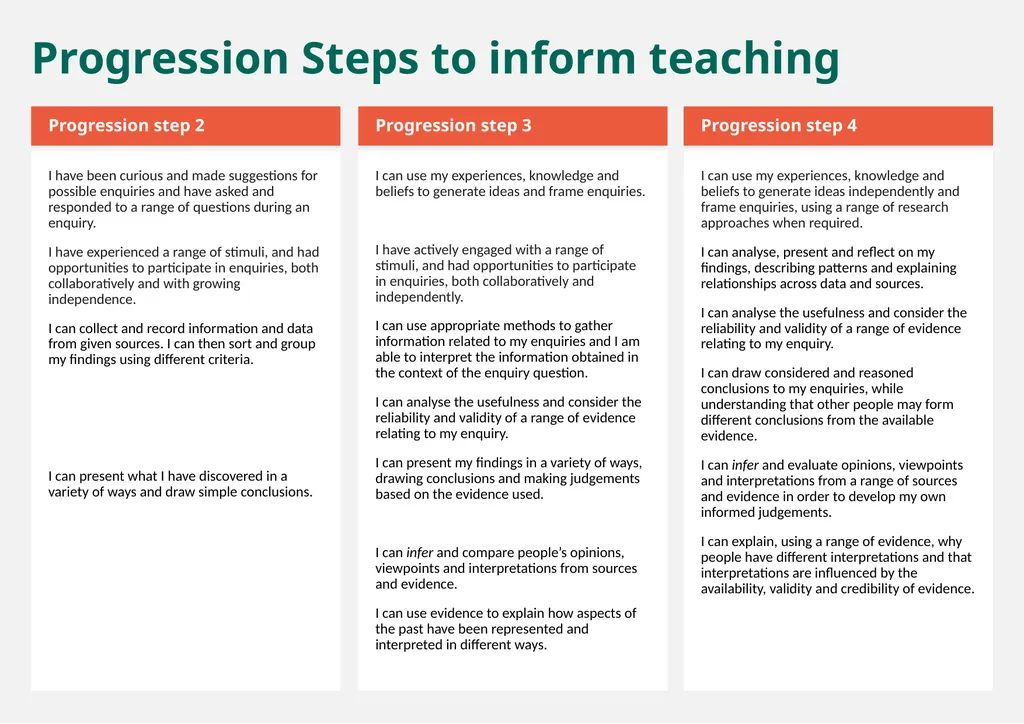
I have been curious and made suggestions for possible enquiries and have asked and responded to a range of questions during an enquiry.
I have experienced a range of stimuli, and had opportunities to participate in enquiries, both collaboratively and with growing independence.
I can collect and record information and data from given sources. I can then sort and group my findings using different criteria.
I can present what I have discovered in a variety of ways and draw simple conclusions. Progression step 2 I can use my experiences, knowledge and beliefs to generate ideas and frame enquiries.
I have actively engaged with a range of stimuli, and had opportunities to participate in enquiries, both collaboratively and independently.
I can use appropriate methods to gather information related to my enquiries and I am able to interpret the information obtained in the context of the enquiry question.
I can analyse the usefulness and consider the reliability and validity of a range of evidence relating to my enquiry.
I can present my findings in a variety of ways, drawing conclusions and making judgements based on the evidence used.
I can infer and compare people’s opinions, viewpoints and interpretations from sources and evidence.
I can use evidence to explain how aspects of the past have been represented and interpreted in different ways. Progression step 3 I can use my experiences, knowledge and beliefs to generate ideas independently and frame enquiries, using a range of research approaches when required.
I can analyse, present and reflect on my findings, describing patterns and explaining relationships across data and sources.
I can analyse the usefulness and consider the reliability and validity of a range of evidence relating to my enquiry.
I can draw considered and reasoned conclusions to my enquiries, while understanding that other people may form different conclusions from the available evidence.
I can infer and evaluate opinions, viewpoints and interpretations from a range of sources and evidence in order to develop my own informed judgements.
I can explain, using a range of evidence, why people have different interpretations and that interpretations are influenced by the availability, validity and credibility of evidence. Progression step 4 Progression Steps to inform teaching<br>
07
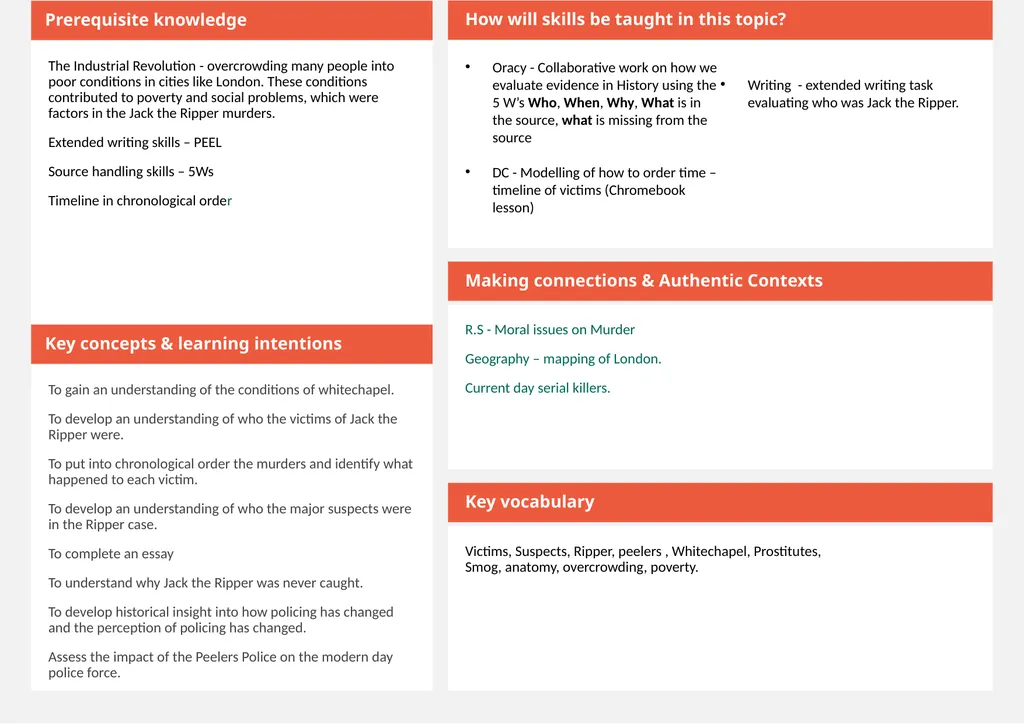
The Industrial Revolution - overcrowding many people into poor conditions in cities like London. These conditions contributed to poverty and social problems, which were factors in the Jack the Ripper murders.
Extended writing skills – PEEL
Source handling skills – 5Ws
Timeline in chronological order Prerequisite knowledge To gain an understanding of the conditions of whitechapel.
To develop an understanding of who the victims of Jack the Ripper were.
To put into chronological order the murders and identify what happened to each victim.
To develop an understanding of who the major suspects were in the Ripper case.
To complete an essay
To understand why Jack the Ripper was never caught.
To develop historical insight into how policing has changed and the perception of policing has changed.
Assess the impact of the Peelers Police on the modern day police force. Key concepts & learning intentions How will skills be taught in this topic? Making connections & Authentic Contexts Key vocabulary Oracy - Collaborative work on how we evaluate evidence in History using the 5 W’s Who, When, Why, What is in the source, what is missing from the source
DC - Modelling of how to order time – timeline of victims (Chromebook lesson)
Writing - extended writing task evaluating who was Jack the Ripper. Victims, Suspects, Ripper, peelers , Whitechapel, Prostitutes, Smog, anatomy, overcrowding, poverty. R.S - Moral issues on Murder
Geography – mapping of London.
Current day serial killers.<br>