
8 May 2025 Enhancing Nature-based Solutions for
CS
Published · 30 slides · 0 views
1 / 1







Description
8 May 2025 Enhancing Nature-based Solutions for Climate Mitigation A Market Engagement Event ASEAN-UK Green Transition Fund Agenda Welcoming remarks by UK Mission to ASEAN Introduction to ASEAN-UK GTF ASEAN-UK GTF - Call for Proposals
Related Topics
Share
Embed code
Download this presentation From Below
"8 May 2025 Enhancing Nature-based Solutions for" is the property of its rightful owner. Permission is granted to download and print the materials on this website for personal, non-commercial use only, and to display it on your personal computer provided you do not modify the materials and that you retain all copyright notices contained in the materials. By downloading content from our website, you accept the terms of this agreement.
Presentation Transcript
01
8 May 2025 Enhancing Nature-based Solutions for Climate Mitigation A Market Engagement Event
ASEAN-UK Green Transition Fund<br>
ASEAN-UK Green Transition Fund<br>
02
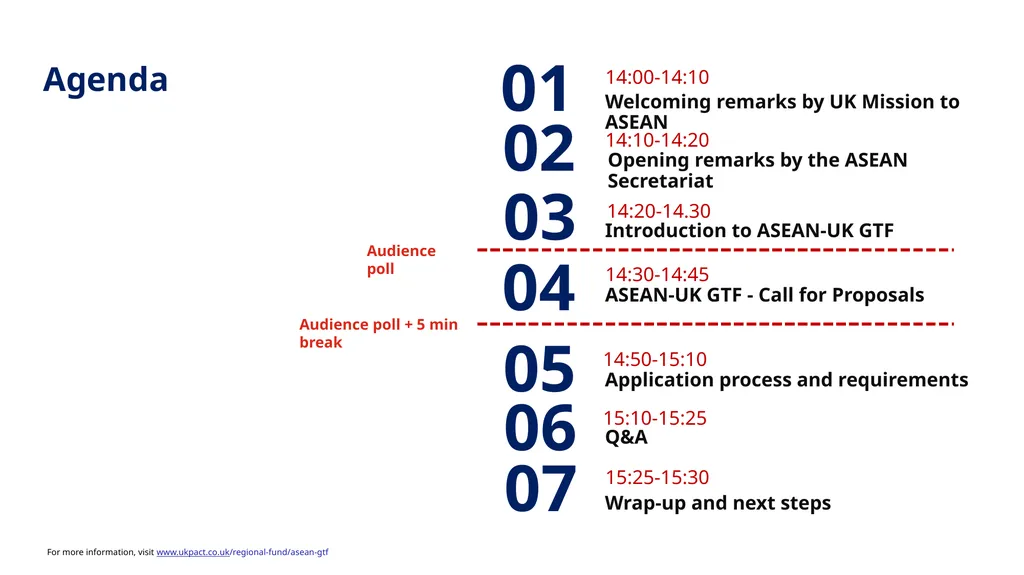
Agenda Welcoming remarks by UK Mission to ASEAN Introduction to ASEAN-UK GTF ASEAN-UK GTF - Call for Proposals Application process and requirements Q&A 14:00-14:10 14:30-14:45 14:50-15:10 15:10-15:25 15:25-15:30 14:10-14:20 Wrap-up and next steps Audience poll + 5 min break 01 02 04 05 06 07 Audience poll 03 Opening remarks by the ASEAN Secretariat 14:20-14.30<br>
03
Welcoming Remarks 01 Anila Khan
Socio-Cultural Counsellor
UK Mission to ASEAN<br>
Socio-Cultural Counsellor
UK Mission to ASEAN<br>
04
Opening Remarks 02 Dr. Pham Quang Minh,
Head of Food, Agriculture and Forestry Division,
ASEAN Secretariat<br>
Head of Food, Agriculture and Forestry Division,
ASEAN Secretariat<br>
05
Introduction to ASEAN-UK GTF 03 Edwin Gultom
Programme Manager,
UK Mission to ASEAN<br>
Programme Manager,
UK Mission to ASEAN<br>
06
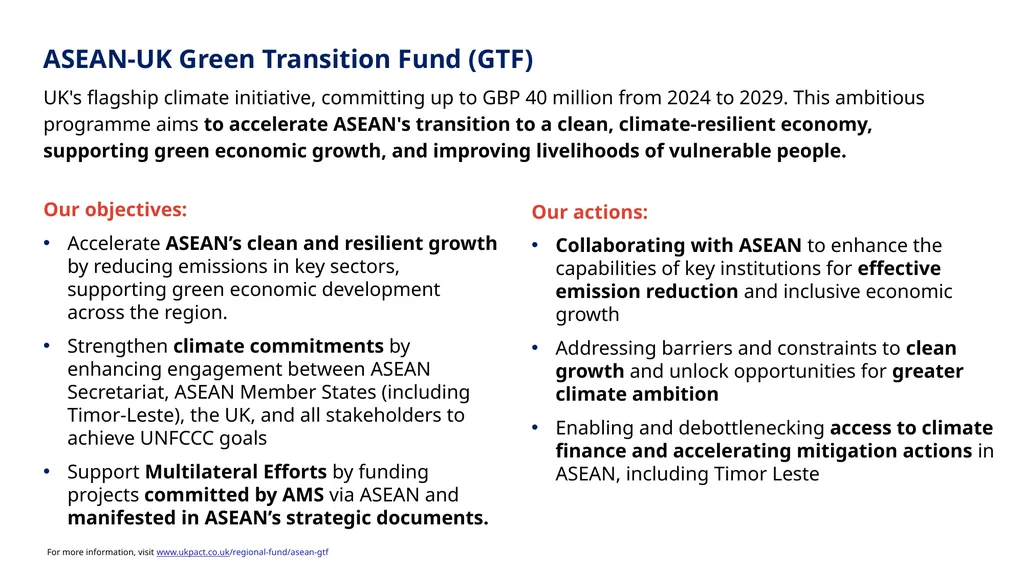
ASEAN-UK Green Transition Fund (GTF) UK's flagship climate initiative, committing up to GBP 40 million from 2024 to 2029. This ambitious programme aims to accelerate ASEAN's transition to a clean, climate-resilient economy, supporting green economic growth, and improving livelihoods of vulnerable people. Our objectives:
Accelerate ASEAN’s clean and resilient growth by reducing emissions in key sectors, supporting green economic development across the region.
Strengthen climate commitments by enhancing engagement between ASEAN Secretariat, ASEAN Member States (including Timor-Leste), the UK, and all stakeholders to achieve UNFCCC goals
Support Multilateral Efforts by funding projects committed by AMS via ASEAN and manifested in ASEAN’s strategic documents. Our actions:
Collaborating with ASEAN to enhance the capabilities of key institutions for effective emission reduction and inclusive economic growth
Addressing barriers and constraints to clean growth and unlock opportunities for greater climate ambition
Enabling and debottlenecking access to climate finance and accelerating mitigation actions in ASEAN, including Timor Leste<br>
Accelerate ASEAN’s clean and resilient growth by reducing emissions in key sectors, supporting green economic development across the region.
Strengthen climate commitments by enhancing engagement between ASEAN Secretariat, ASEAN Member States (including Timor-Leste), the UK, and all stakeholders to achieve UNFCCC goals
Support Multilateral Efforts by funding projects committed by AMS via ASEAN and manifested in ASEAN’s strategic documents. Our actions:
Collaborating with ASEAN to enhance the capabilities of key institutions for effective emission reduction and inclusive economic growth
Addressing barriers and constraints to clean growth and unlock opportunities for greater climate ambition
Enabling and debottlenecking access to climate finance and accelerating mitigation actions in ASEAN, including Timor Leste<br>
07
The pillars of the ASEAN-UK GTF I II III IV V Climate
policy Green
finance Clean and just energy transition Sustainable cities and transportation Nature-based solutions<br>
policy Green
finance Clean and just energy transition Sustainable cities and transportation Nature-based solutions<br>
08
ASEAN-UK GTF is delivered through the UK PACT mechanism About UK PACT
UK Partnering for Accelerated Climate Transitions (UK PACT) is a flagship programme under the UK’s International Climate Finance (ICF) portfolio. The programme is jointly governed and funded by the Foreign, Commonwealth and Development Office (FCDO) and the Department for Energy Security and Net Zero (DESNZ).
Supporting achievement of Nationally Determined Contributions (NDCs) and the long-term goal of the 2015 Paris Agreement to limit dangerous climate change
Demand-driven, adjusting key focus areas based on partner countries’ needs and sectoral priorities Delivery of ASEAN-UK GTF
All information regarding ASEAN-UK GTF are communicated through UK PACT website and other channels
All projects proposed under ASEAN-UK GTF must align with ASEAN-UK GTF Theory of Change which incorporate UK PACT Theory of Change<br>
UK Partnering for Accelerated Climate Transitions (UK PACT) is a flagship programme under the UK’s International Climate Finance (ICF) portfolio. The programme is jointly governed and funded by the Foreign, Commonwealth and Development Office (FCDO) and the Department for Energy Security and Net Zero (DESNZ).
Supporting achievement of Nationally Determined Contributions (NDCs) and the long-term goal of the 2015 Paris Agreement to limit dangerous climate change
Demand-driven, adjusting key focus areas based on partner countries’ needs and sectoral priorities Delivery of ASEAN-UK GTF
All information regarding ASEAN-UK GTF are communicated through UK PACT website and other channels
All projects proposed under ASEAN-UK GTF must align with ASEAN-UK GTF Theory of Change which incorporate UK PACT Theory of Change<br>
09
Zoom Audience poll<br>
10
ASEAN-UK GTF
Call for Proposals 04 Ridwan Kurniawan
ASEAN-UK GTF Fund Manager, Palladium<br>
Call for Proposals 04 Ridwan Kurniawan
ASEAN-UK GTF Fund Manager, Palladium<br>
11
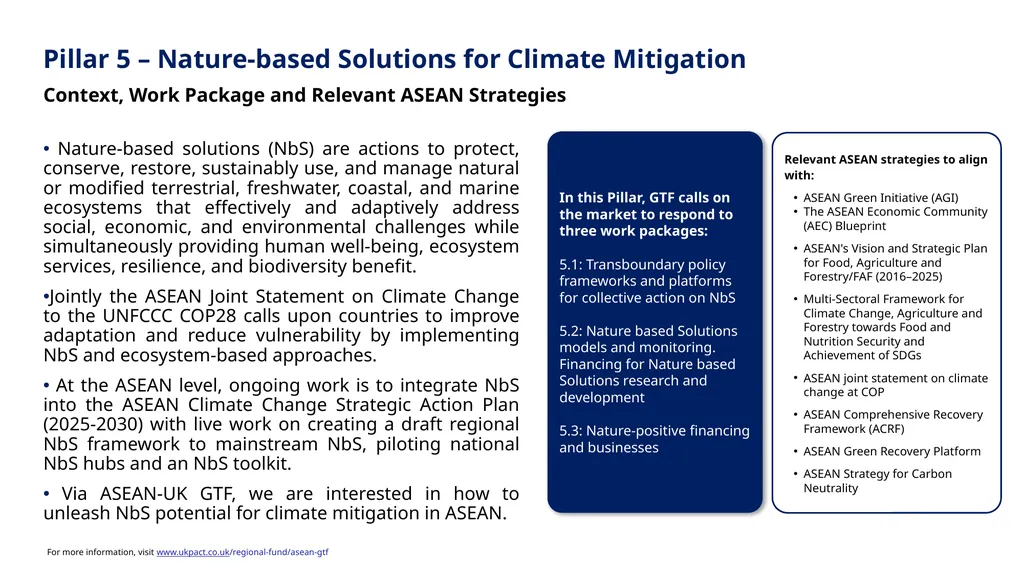
Pillar 5 – Nature-based Solutions for Climate Mitigation Nature-based solutions (NbS) are actions to protect, conserve, restore, sustainably use, and manage natural or modified terrestrial, freshwater, coastal, and marine ecosystems that effectively and adaptively address social, economic, and environmental challenges while simultaneously providing human well-being, ecosystem services, resilience, and biodiversity benefit.
Jointly the ASEAN Joint Statement on Climate Change to the UNFCCC COP28 calls upon countries to improve adaptation and reduce vulnerability by implementing NbS and ecosystem-based approaches.
At the ASEAN level, ongoing work is to integrate NbS into the ASEAN Climate Change Strategic Action Plan (2025-2030) with live work on creating a draft regional NbS framework to mainstream NbS, piloting national NbS hubs and an NbS toolkit.
Via ASEAN-UK GTF, we are interested in how to unleash NbS potential for climate mitigation in ASEAN. Context, Work Package and Relevant ASEAN Strategies In this Pillar, GTF calls on the market to respond to three work packages:
5.1: Transboundary policy frameworks and platforms for collective action on NbS
5.2: Nature based Solutions models and monitoring. Financing for Nature based Solutions research and development
5.3: Nature-positive financing and businesses Relevant ASEAN strategies to align with:
ASEAN Green Initiative (AGI)
The ASEAN Economic Community (AEC) Blueprint
ASEAN's Vision and Strategic Plan for Food, Agriculture and Forestry/FAF (2016–2025)
Multi-Sectoral Framework for Climate Change, Agriculture and Forestry towards Food and Nutrition Security and Achievement of SDGs
ASEAN joint statement on climate change at COP
ASEAN Comprehensive Recovery Framework (ACRF)
ASEAN Green Recovery Platform
ASEAN Strategy for Carbon Neutrality<br>
Jointly the ASEAN Joint Statement on Climate Change to the UNFCCC COP28 calls upon countries to improve adaptation and reduce vulnerability by implementing NbS and ecosystem-based approaches.
At the ASEAN level, ongoing work is to integrate NbS into the ASEAN Climate Change Strategic Action Plan (2025-2030) with live work on creating a draft regional NbS framework to mainstream NbS, piloting national NbS hubs and an NbS toolkit.
Via ASEAN-UK GTF, we are interested in how to unleash NbS potential for climate mitigation in ASEAN. Context, Work Package and Relevant ASEAN Strategies In this Pillar, GTF calls on the market to respond to three work packages:
5.1: Transboundary policy frameworks and platforms for collective action on NbS
5.2: Nature based Solutions models and monitoring. Financing for Nature based Solutions research and development
5.3: Nature-positive financing and businesses Relevant ASEAN strategies to align with:
ASEAN Green Initiative (AGI)
The ASEAN Economic Community (AEC) Blueprint
ASEAN's Vision and Strategic Plan for Food, Agriculture and Forestry/FAF (2016–2025)
Multi-Sectoral Framework for Climate Change, Agriculture and Forestry towards Food and Nutrition Security and Achievement of SDGs
ASEAN joint statement on climate change at COP
ASEAN Comprehensive Recovery Framework (ACRF)
ASEAN Green Recovery Platform
ASEAN Strategy for Carbon Neutrality<br>
12
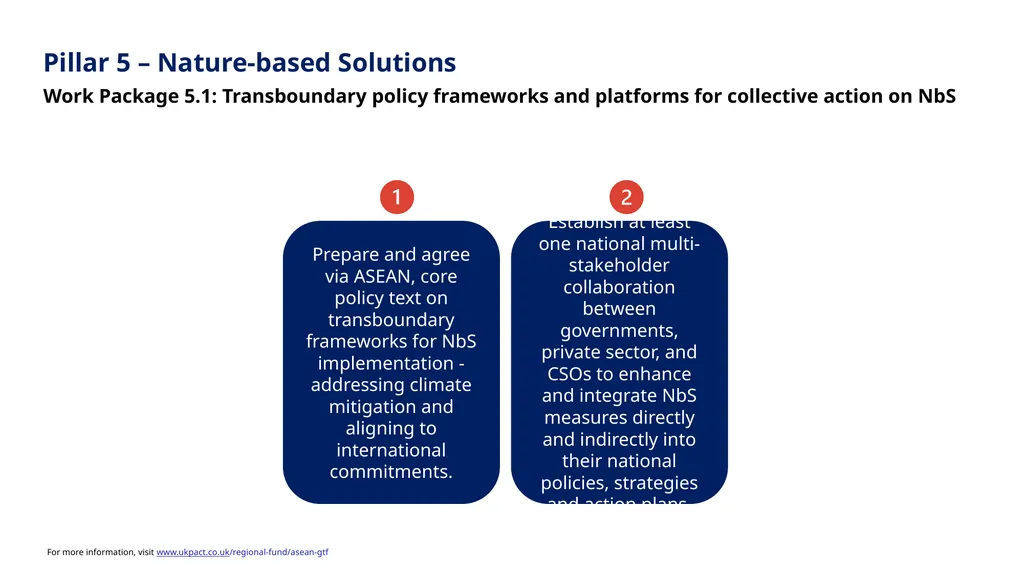
Pillar 5 – Nature-based Solutions Work Package 5.1: Transboundary policy frameworks and platforms for collective action on NbS Prepare and agree via ASEAN, core policy text on transboundary frameworks for NbS implementation -addressing climate mitigation and aligning to international commitments. Establish at least one national multi-stakeholder collaboration between governments, private sector, and CSOs to enhance and integrate NbS measures directly and indirectly into their national policies, strategies and action plans.<br>
13
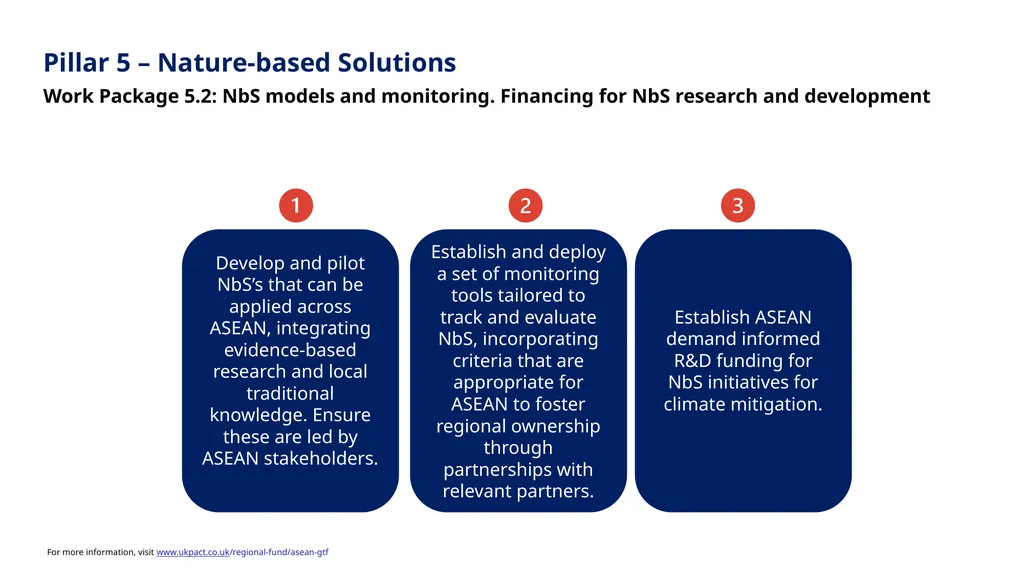
Pillar 5 – Nature-based Solutions Work Package 5.2: NbS models and monitoring. Financing for NbS research and development Develop and pilot NbS’s that can be applied across ASEAN, integrating evidence-based research and local traditional knowledge. Ensure these are led by ASEAN stakeholders. Establish and deploy a set of monitoring tools tailored to track and evaluate NbS, incorporating criteria that are appropriate for ASEAN to foster regional ownership through partnerships with relevant partners. Establish ASEAN demand informed R&D funding for NbS initiatives for climate mitigation.<br>
14
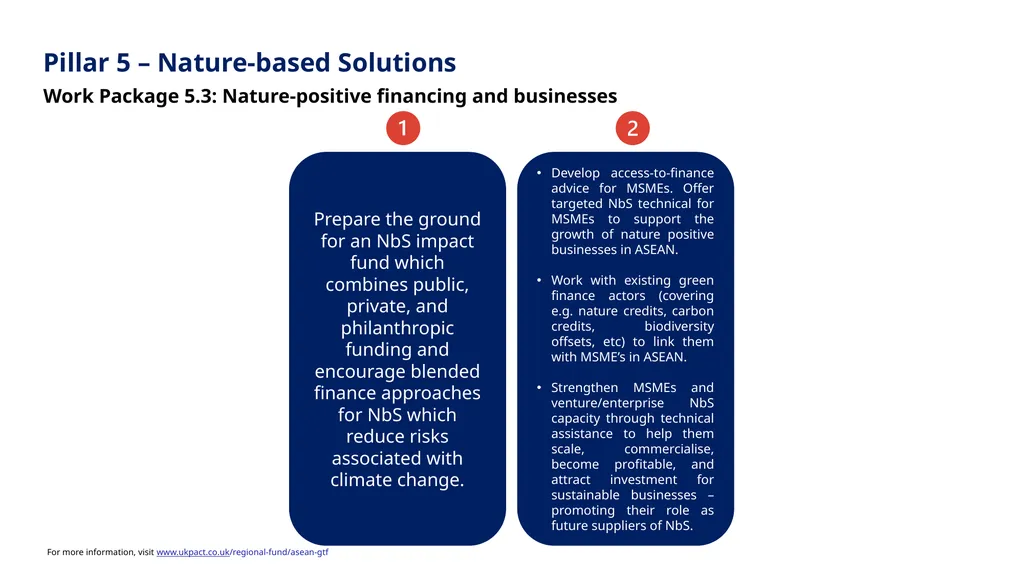
Pillar 5 – Nature-based Solutions Work Package 5.3: Nature-positive financing and businesses Prepare the ground for an NbS impact fund which combines public, private, and philanthropic funding and encourage blended finance approaches for NbS which reduce risks associated with climate change. Develop access-to-finance advice for MSMEs. Offer targeted NbS technical for MSMEs to support the growth of nature positive businesses in ASEAN.
Work with existing green finance actors (covering e.g. nature credits, carbon credits, biodiversity offsets, etc) to link them with MSME’s in ASEAN.
Strengthen MSMEs and venture/enterprise NbS capacity through technical assistance to help them scale, commercialise, become profitable, and attract investment for sustainable businesses – promoting their role as future suppliers of NbS.<br>
Work with existing green finance actors (covering e.g. nature credits, carbon credits, biodiversity offsets, etc) to link them with MSME’s in ASEAN.
Strengthen MSMEs and venture/enterprise NbS capacity through technical assistance to help them scale, commercialise, become profitable, and attract investment for sustainable businesses – promoting their role as future suppliers of NbS.<br>
15
Zoom Audience poll<br>
16
5 min break 5 min break<br>
17
Application Process and Requirements 05 Ridwan Kurniawan
ASEAN-UK GTF Fund Manager, Palladium<br>
ASEAN-UK GTF Fund Manager, Palladium<br>
18
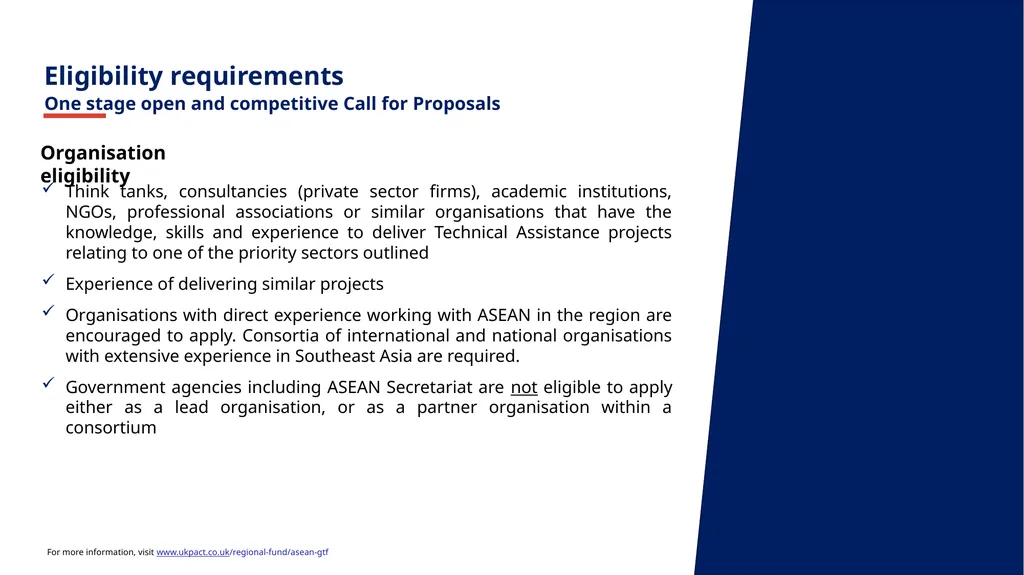
Eligibility requirements Think tanks, consultancies (private sector firms), academic institutions, NGOs, professional associations or similar organisations that have the knowledge, skills and experience to deliver Technical Assistance projects relating to one of the priority sectors outlined
Experience of delivering similar projects
Organisations with direct experience working with ASEAN in the region are encouraged to apply. Consortia of international and national organisations with extensive experience in Southeast Asia are required.
Government agencies including ASEAN Secretariat are not eligible to apply either as a lead organisation, or as a partner organisation within a consortium One stage open and competitive Call for Proposals Organisation eligibility Project eligibility<br>
Experience of delivering similar projects
Organisations with direct experience working with ASEAN in the region are encouraged to apply. Consortia of international and national organisations with extensive experience in Southeast Asia are required.
Government agencies including ASEAN Secretariat are not eligible to apply either as a lead organisation, or as a partner organisation within a consortium One stage open and competitive Call for Proposals Organisation eligibility Project eligibility<br>
19
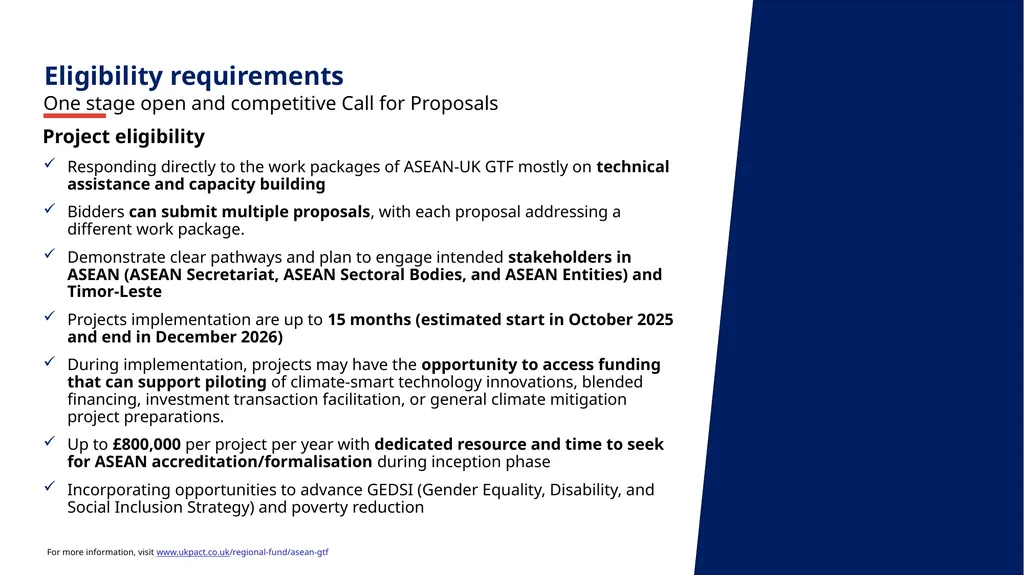
Eligibility requirements Responding directly to the work packages of ASEAN-UK GTF mostly on technical assistance and capacity building
Bidders can submit multiple proposals, with each proposal addressing a different work package.
Demonstrate clear pathways and plan to engage intended stakeholders in ASEAN (ASEAN Secretariat, ASEAN Sectoral Bodies, and ASEAN Entities) and Timor-Leste
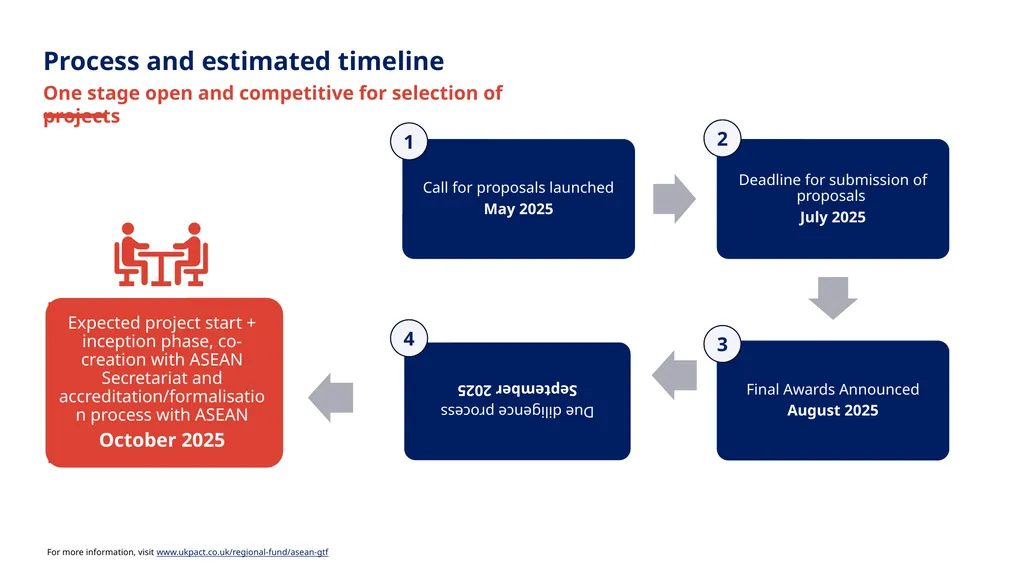
Projects implementation are up to 15 months (estimated start in October 2025 and end in December 2026)
During implementation, projects may have the opportunity to access funding that can support piloting of climate-smart technology innovations, blended financing, investment transaction facilitation, or general climate mitigation project preparations.
Up to £800,000 per project per year with dedicated resource and time to seek for ASEAN accreditation/formalisation during inception phase
Incorporating opportunities to advance GEDSI (Gender Equality, Disability, and Social Inclusion Strategy) and poverty reduction Project eligibility One stage open and competitive Call for Proposals<br>
Bidders can submit multiple proposals, with each proposal addressing a different work package.
Demonstrate clear pathways and plan to engage intended stakeholders in ASEAN (ASEAN Secretariat, ASEAN Sectoral Bodies, and ASEAN Entities) and Timor-Leste
Projects implementation are up to 15 months (estimated start in October 2025 and end in December 2026)
During implementation, projects may have the opportunity to access funding that can support piloting of climate-smart technology innovations, blended financing, investment transaction facilitation, or general climate mitigation project preparations.
Up to £800,000 per project per year with dedicated resource and time to seek for ASEAN accreditation/formalisation during inception phase
Incorporating opportunities to advance GEDSI (Gender Equality, Disability, and Social Inclusion Strategy) and poverty reduction Project eligibility One stage open and competitive Call for Proposals<br>
20
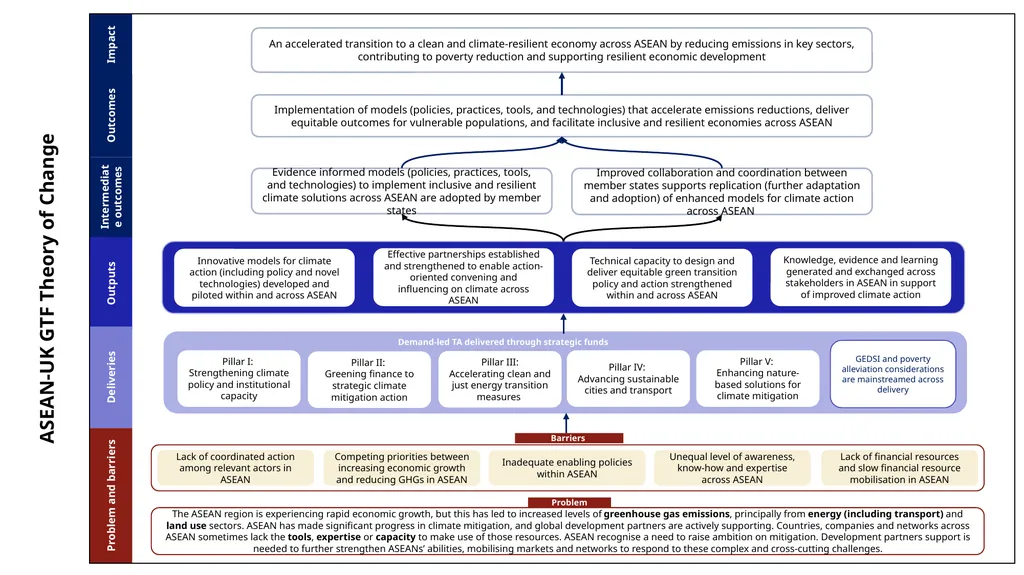
An accelerated transition to a clean and climate-resilient economy across ASEAN by reducing emissions in key sectors, contributing to poverty reduction and supporting resilient economic development Evidence informed models (policies, practices, tools, and technologies) to implement inclusive and resilient climate solutions across ASEAN are adopted by member states Improved collaboration and coordination between member states supports replication (further adaptation and adoption) of enhanced models for climate action across ASEAN Knowledge, evidence and learning generated and exchanged across stakeholders in ASEAN in support of improved climate action Technical capacity to design and deliver equitable green transition policy and action strengthened within and across ASEAN Effective partnerships established and strengthened to enable action-oriented convening and influencing on climate across ASEAN Innovative models for climate action (including policy and novel technologies) developed and piloted within and across ASEAN Pillar I:
Strengthening climate policy and institutional capacity Pillar II:
Greening finance to strategic climate mitigation action Pillar III:
Accelerating clean and just energy transition measures Pillar IV:
Advancing sustainable cities and transport Pillar V:
Enhancing nature-based solutions for climate mitigation Demand-led TA delivered through strategic funds GEDSI and poverty alleviation considerations are mainstreamed across delivery Barriers Problem The ASEAN region is experiencing rapid economic growth, but this has led to increased levels of greenhouse gas emissions, principally from energy (including transport) and land use sectors. ASEAN has made significant progress in climate mitigation, and global development partners are actively supporting. Countries, companies and networks across ASEAN sometimes lack the tools, expertise or capacity to make use of those resources. ASEAN recognise a need to raise ambition on mitigation. Development partners support is needed to further strengthen ASEANs’ abilities, mobilising markets and networks to respond to these complex and cross-cutting challenges. Lack of coordinated action among relevant actors in ASEAN Competing priorities between increasing economic growth and reducing GHGs in ASEAN Inadequate enabling policies within ASEAN Unequal level of awareness, know-how and expertise across ASEAN Lack of financial resources and slow financial resource mobilisation in ASEAN Impact Outcomes Intermediate outcomes Outputs Deliveries Problem and barriers ASEAN-UK GTF Theory of Change Implementation of models (policies, practices, tools, and technologies) that accelerate emissions reductions, deliver equitable outcomes for vulnerable populations, and facilitate inclusive and resilient economies across ASEAN<br>
Strengthening climate policy and institutional capacity Pillar II:
Greening finance to strategic climate mitigation action Pillar III:
Accelerating clean and just energy transition measures Pillar IV:
Advancing sustainable cities and transport Pillar V:
Enhancing nature-based solutions for climate mitigation Demand-led TA delivered through strategic funds GEDSI and poverty alleviation considerations are mainstreamed across delivery Barriers Problem The ASEAN region is experiencing rapid economic growth, but this has led to increased levels of greenhouse gas emissions, principally from energy (including transport) and land use sectors. ASEAN has made significant progress in climate mitigation, and global development partners are actively supporting. Countries, companies and networks across ASEAN sometimes lack the tools, expertise or capacity to make use of those resources. ASEAN recognise a need to raise ambition on mitigation. Development partners support is needed to further strengthen ASEANs’ abilities, mobilising markets and networks to respond to these complex and cross-cutting challenges. Lack of coordinated action among relevant actors in ASEAN Competing priorities between increasing economic growth and reducing GHGs in ASEAN Inadequate enabling policies within ASEAN Unequal level of awareness, know-how and expertise across ASEAN Lack of financial resources and slow financial resource mobilisation in ASEAN Impact Outcomes Intermediate outcomes Outputs Deliveries Problem and barriers ASEAN-UK GTF Theory of Change Implementation of models (policies, practices, tools, and technologies) that accelerate emissions reductions, deliver equitable outcomes for vulnerable populations, and facilitate inclusive and resilient economies across ASEAN<br>
21
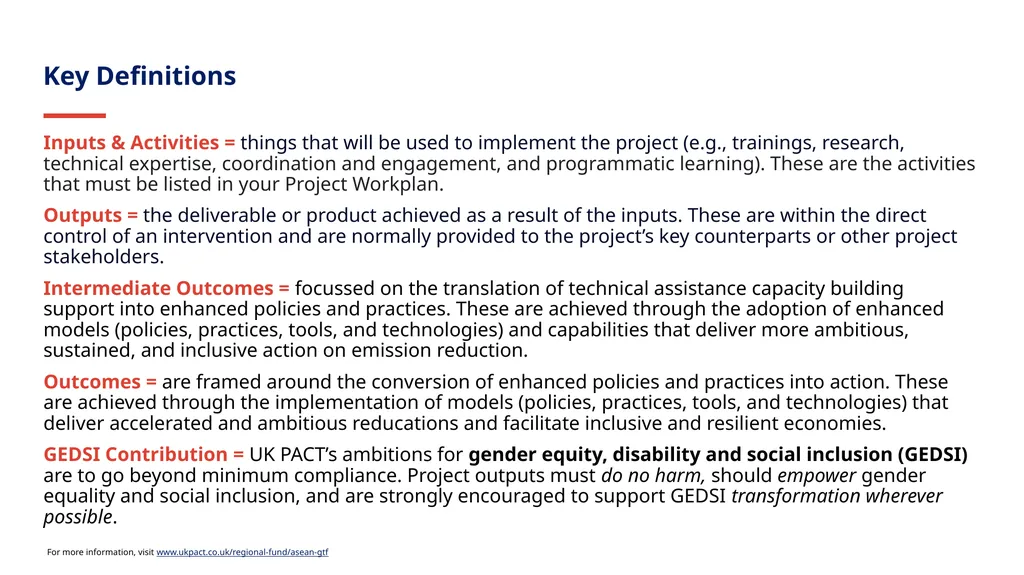
Key Definitions Inputs & Activities = things that will be used to implement the project (e.g., trainings, research, technical expertise, coordination and engagement, and programmatic learning). These are the activities that must be listed in your Project Workplan.
Outputs = the deliverable or product achieved as a result of the inputs. These are within the direct control of an intervention and are normally provided to the project’s key counterparts or other project stakeholders.
Intermediate Outcomes = focussed on the translation of technical assistance capacity building support into enhanced policies and practices. These are achieved through the adoption of enhanced models (policies, practices, tools, and technologies) and capabilities that deliver more ambitious, sustained, and inclusive action on emission reduction.
Outcomes = are framed around the conversion of enhanced policies and practices into action. These are achieved through the implementation of models (policies, practices, tools, and technologies) that deliver accelerated and ambitious reducations and facilitate inclusive and resilient economies.
GEDSI Contribution = UK PACT’s ambitions for gender equity, disability and social inclusion (GEDSI) are to go beyond minimum compliance. Project outputs must do no harm, should empower gender equality and social inclusion, and are strongly encouraged to support GEDSI transformation wherever possible.<br>
Outputs = the deliverable or product achieved as a result of the inputs. These are within the direct control of an intervention and are normally provided to the project’s key counterparts or other project stakeholders.
Intermediate Outcomes = focussed on the translation of technical assistance capacity building support into enhanced policies and practices. These are achieved through the adoption of enhanced models (policies, practices, tools, and technologies) and capabilities that deliver more ambitious, sustained, and inclusive action on emission reduction.
Outcomes = are framed around the conversion of enhanced policies and practices into action. These are achieved through the implementation of models (policies, practices, tools, and technologies) that deliver accelerated and ambitious reducations and facilitate inclusive and resilient economies.
GEDSI Contribution = UK PACT’s ambitions for gender equity, disability and social inclusion (GEDSI) are to go beyond minimum compliance. Project outputs must do no harm, should empower gender equality and social inclusion, and are strongly encouraged to support GEDSI transformation wherever possible.<br>
22
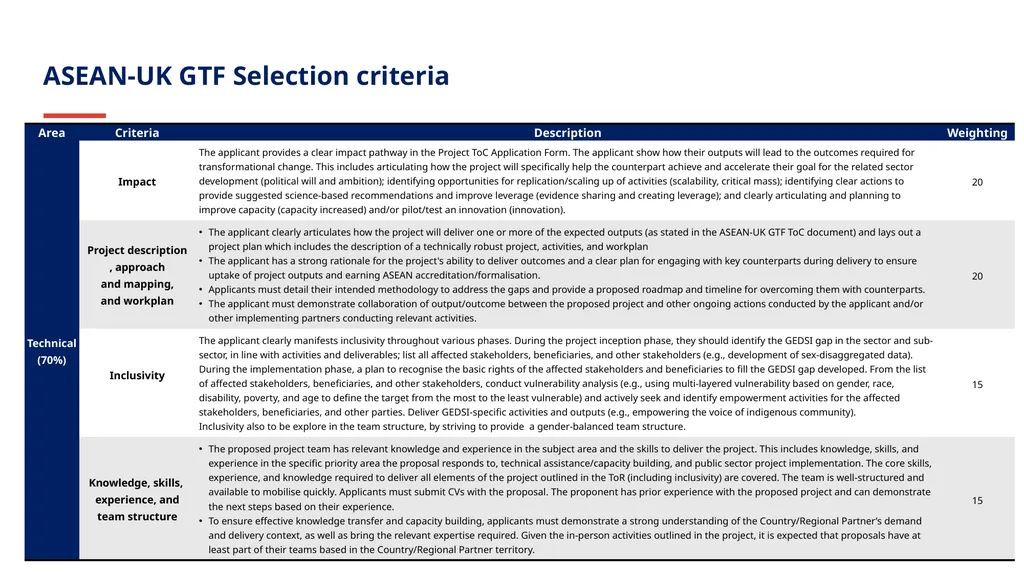
ASEAN-UK GTF Selection criteria<br>
23
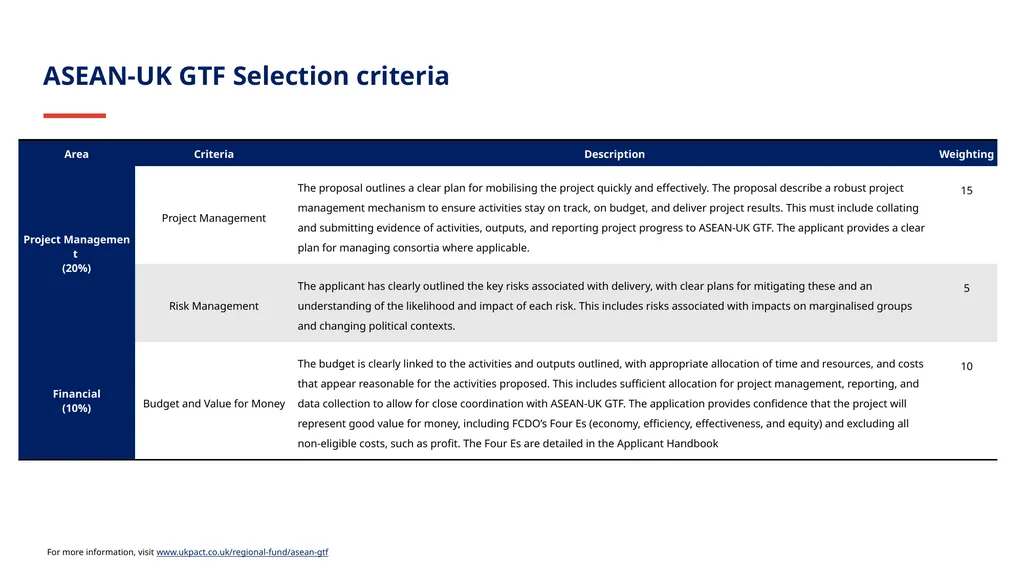
ASEAN-UK GTF Selection criteria<br>
24
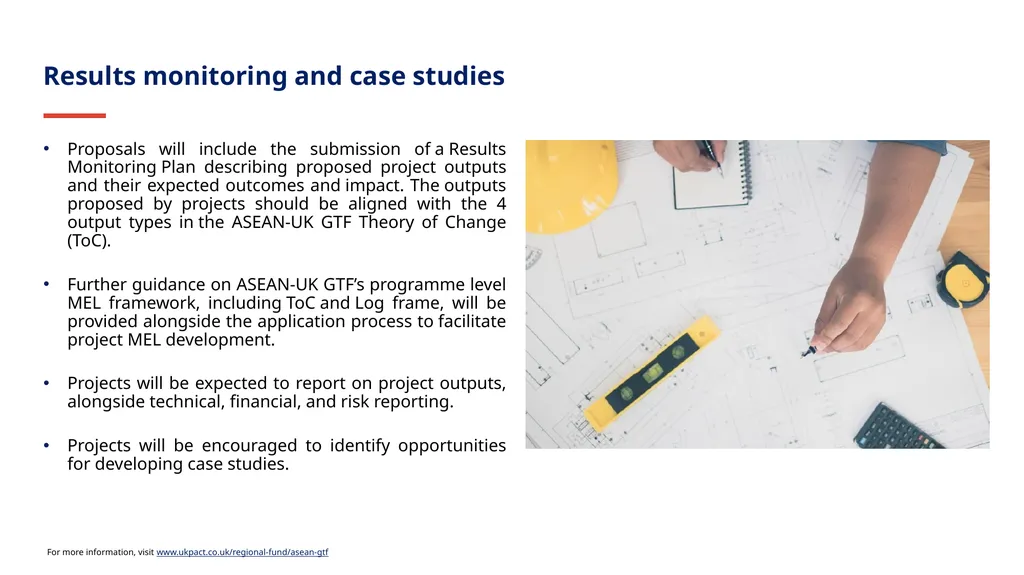
Results monitoring and case studies Proposals will include the submission of a Results Monitoring Plan describing proposed project outputs and their expected outcomes and impact. The outputs proposed by projects should be aligned with the 4 output types in the ASEAN-UK GTF Theory of Change (ToC).
Further guidance on ASEAN-UK GTF’s programme level MEL framework, including ToC and Log frame, will be provided alongside the application process to facilitate project MEL development.
Projects will be expected to report on project outputs, alongside technical, financial, and risk reporting.
Projects will be encouraged to identify opportunities for developing case studies.<br>
Further guidance on ASEAN-UK GTF’s programme level MEL framework, including ToC and Log frame, will be provided alongside the application process to facilitate project MEL development.
Projects will be expected to report on project outputs, alongside technical, financial, and risk reporting.
Projects will be encouraged to identify opportunities for developing case studies.<br>
25
Process and estimated timeline One stage open and competitive for selection of projects 1 2 3 4<br>
26
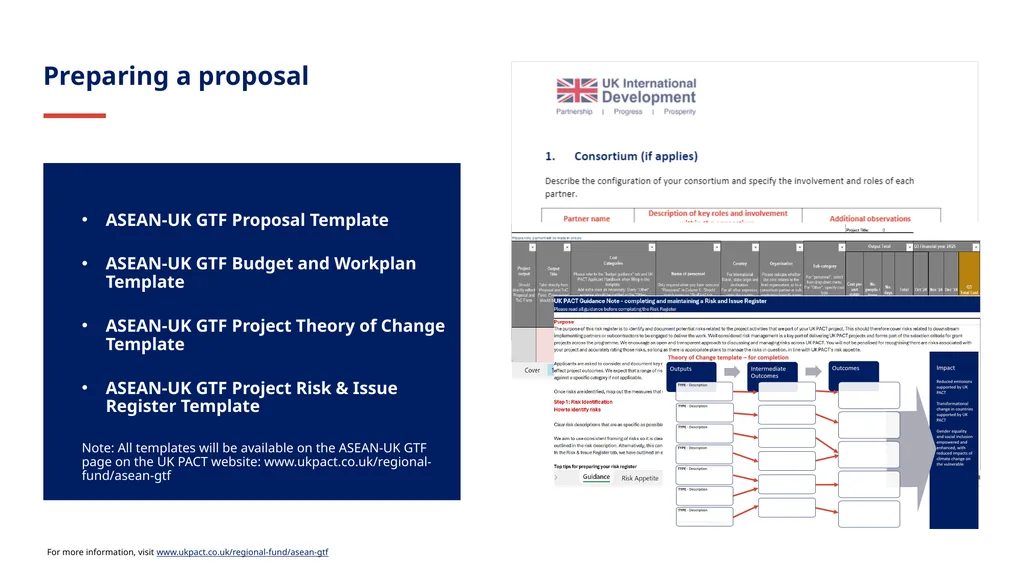
Preparing a proposal ASEAN-UK GTF Proposal Template
ASEAN-UK GTF Budget and Workplan Template
ASEAN-UK GTF Project Theory of Change Template
ASEAN-UK GTF Project Risk & Issue Register Template
Note: All templates will be available on the ASEAN-UK GTF page on the UK PACT website: www.ukpact.co.uk/regional-fund/asean-gtf<br>
ASEAN-UK GTF Budget and Workplan Template
ASEAN-UK GTF Project Theory of Change Template
ASEAN-UK GTF Project Risk & Issue Register Template
Note: All templates will be available on the ASEAN-UK GTF page on the UK PACT website: www.ukpact.co.uk/regional-fund/asean-gtf<br>
27
Q & A 06<br>
28
Wrap-up and
Next Steps 07<br>
Next Steps 07<br>
29
Next steps Presentation will be published on ASEAN-UK GTF website in the coming days (www.ukpact.co.uk/regional-fund/asean-gtf)
Call for Proposals will be launched on 15 May 2025 at the ASEAN-UK GTF webpage
For any technical issues when registering on the application portal please contact: aseangtf@ukpact.co.uk Reminder on upcoming timeframes for application<br>
Call for Proposals will be launched on 15 May 2025 at the ASEAN-UK GTF webpage
For any technical issues when registering on the application portal please contact: aseangtf@ukpact.co.uk Reminder on upcoming timeframes for application<br>
30
aseangtf@ukpact.co.uk<br>