9-1 Binding Consider the following method invocation: obj.doIt(); At some point, this invocation is bound to the definition of the method that it invokes If this binding occurred at compile time, then that line of code would call the same
"9-1 Binding Consider the following method" is the property of its rightful owner. Permission is granted to
download and print the materials on this website for personal, non-commercial use only, and to display it
on your personal computer provided you do not modify the materials and that you retain all copyright
notices contained in the materials. By downloading content from our website, you accept the terms of this
agreement.
Presentation Transcript
01
9-1 Binding Consider the following method invocation:
obj.doIt();
At some point, this invocation
is bound to the definition of the method that it invokes
If this binding occurred at compile time,
then that line of code would call the same method every time
However, Java defers method binding until run time –
this is called dynamic binding or late binding
Late binding provides flexibility in program design<br>
02
9-2 Polymorphism The term polymorphism literally
means "having many forms"
A polymorphic reference is a variable that can refer
to different types of objects at different points in time
The method invoked through a polymorphic reference
can change from one invocation to the next
All object references in Java
are potentially polymorphic<br>
03
9-3 Polymorphism Suppose we create the following reference variable:
Occupation job;
Java allows this reference to point
to an Occupation object, or
to any object of any compatible type
This compatibility can be established
using inheritance or using interfaces
Careful use of polymorphic references
can lead to elegant, robust software designs<br>
04
9-4 Outline Polymorphic References
Polymorphism via Inheritance
Polymorphism via Interfaces
Sorting
Searching
Event Processing Revisited
File Choosers and Color Choosers
Sliders<br>
05
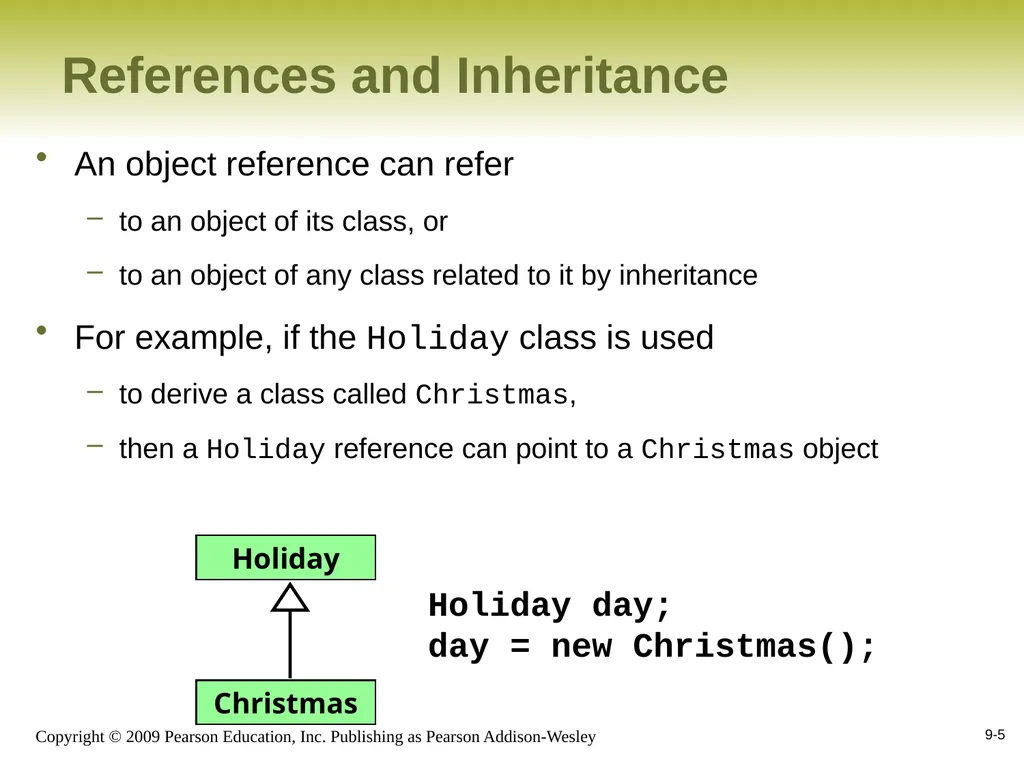
9-5 References and Inheritance An object reference can refer
to an object of its class, or
to an object of any class related to it by inheritance
For example, if the Holiday class is used
to derive a class called Christmas,
then a Holiday reference can point to a Christmas object Holiday day;
day = new Christmas();<br>
06
9-6 References and Inheritance Assigning a child object to a parent reference
is considered to be a widening conversion,
and can be performed by simple assignment
Assigning a parent object to a child reference
can be done also, but it is considered
a narrowing conversion and must be done with a cast
The widening conversion is the most useful<br>
07
9-7 Polymorphism via Inheritance It is the type of the object
being referenced, not the reference type,
that determines which method is invoked
Suppose the Holiday class
has a method called celebrate,
and the Christmas class overrides it
Now consider the following invocation:
day.celebrate();
If day refers to a Holiday object,
it invokes the Holiday version of celebrate;
if it refers to a Christmas object, it invokes the Christmas version<br>
08
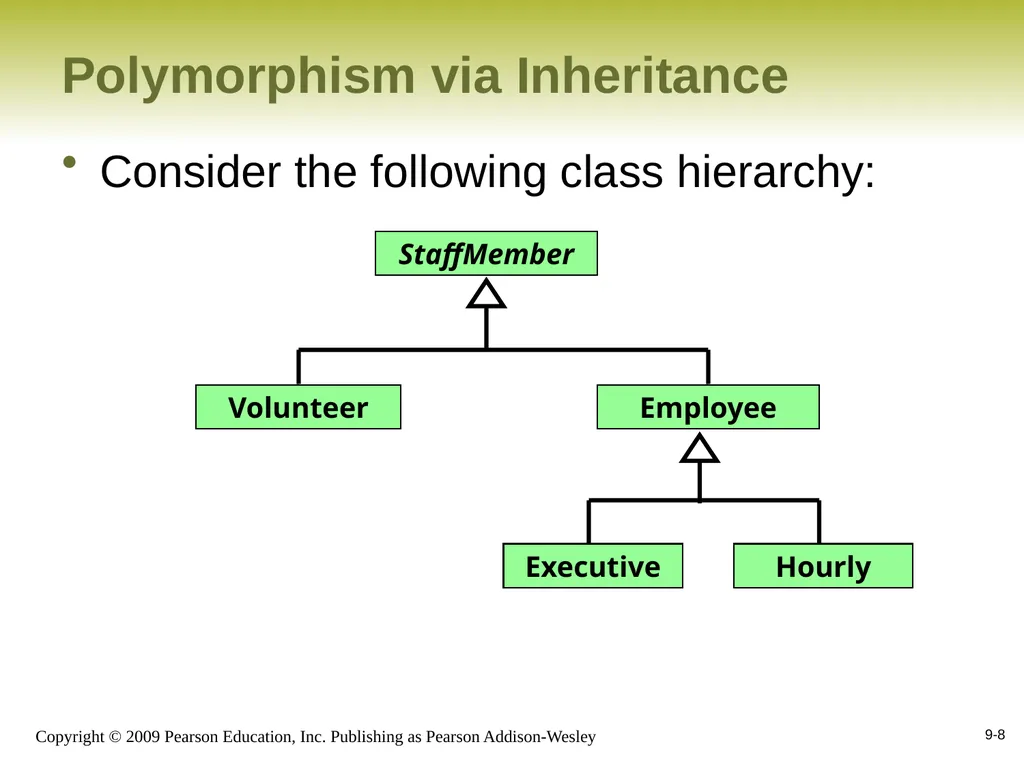
9-8 Polymorphism via Inheritance Consider the following class hierarchy:<br>
09
9-9 Outline Polymorphic References
Polymorphism via Inheritance
Polymorphism via Interfaces
Sorting
Searching
Event Processing Revisited
File Choosers and Color Choosers
Sliders<br>
10
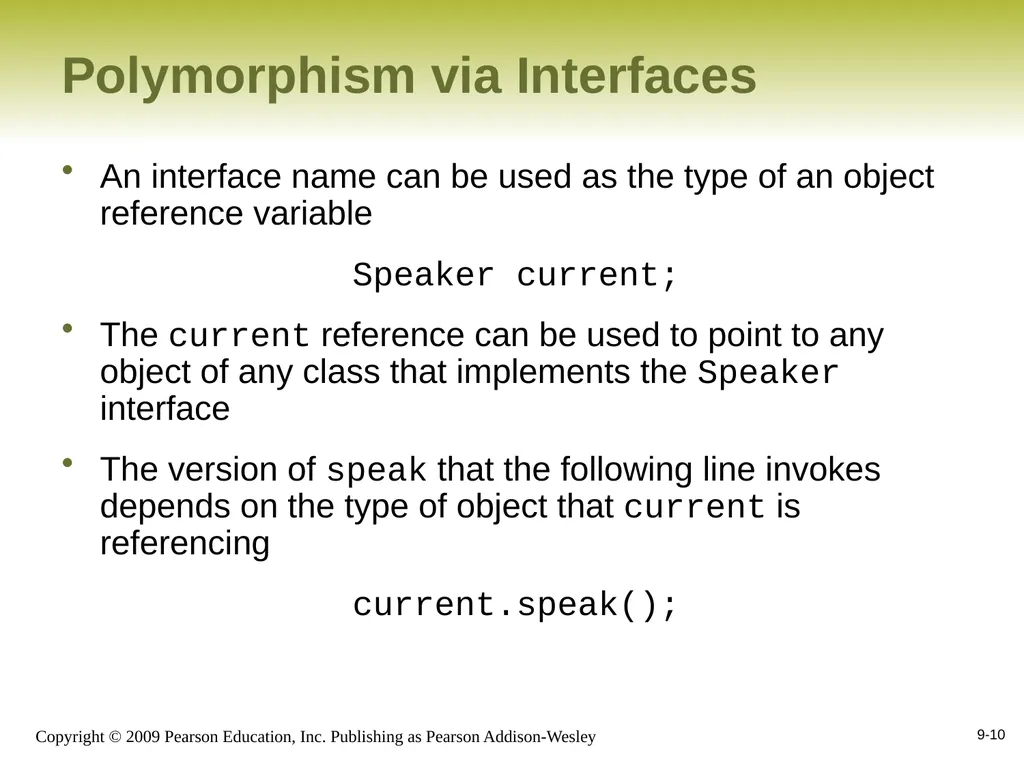
9-10 Polymorphism via Interfaces An interface name can be used as the type of an object reference variable
Speaker current;
The current reference can be used to point to any object of any class that implements the Speaker interface
The version of speak that the following line invokes depends on the type of object that current is referencing
current.speak();<br>
11
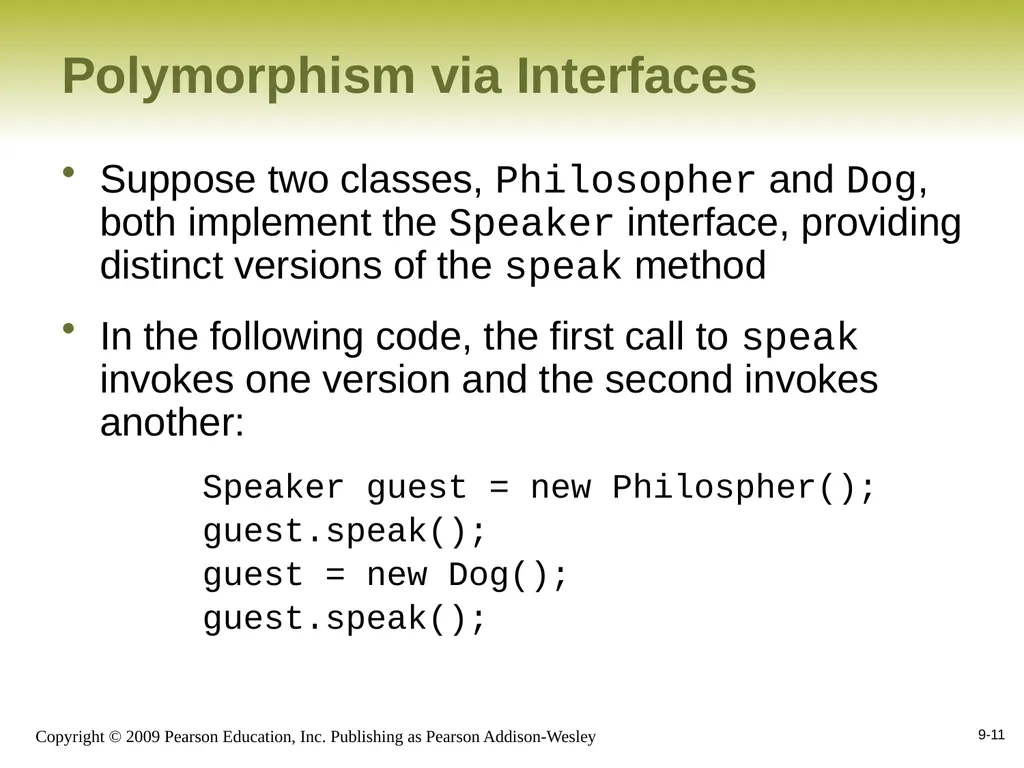
9-11 Polymorphism via Interfaces Suppose two classes, Philosopher and Dog, both implement the Speaker interface, providing distinct versions of the speak method
In the following code, the first call to speak invokes one version and the second invokes another:
Speaker guest = new Philospher();
guest.speak();
guest = new Dog();
guest.speak();<br>