
A Case Study Using KEYNOTE-024 to Examine the
LV
Published · 22 slides · 0 views
1 / 1







Description
A Case Study Using KEYNOTE-024 to Examine the Impact of Cut-Point Selection on Long-Term Survival Estimates from Piecewise Modeling 08 May 2023, ISPOR Podium Presentation, P14 Connor Davies and Blake Liu Costello Medical, Boston, MA, USA
Related Topics
Share
Embed code
Download this presentation From Below
"A Case Study Using KEYNOTE-024 to Examine the" is the property of its rightful owner. Permission is granted to download and print the materials on this website for personal, non-commercial use only, and to display it on your personal computer provided you do not modify the materials and that you retain all copyright notices contained in the materials. By downloading content from our website, you accept the terms of this agreement.
Presentation Transcript
01
A Case Study Using KEYNOTE-024 to Examine the Impact of Cut-Point Selection on Long-Term Survival Estimates from Piecewise Modeling 08 May 2023, ISPOR Podium Presentation, P14
Connor Davies and Blake Liu
Costello Medical, Boston, MA, USA<br>
Connor Davies and Blake Liu
Costello Medical, Boston, MA, USA<br>
02
Background<br>
03
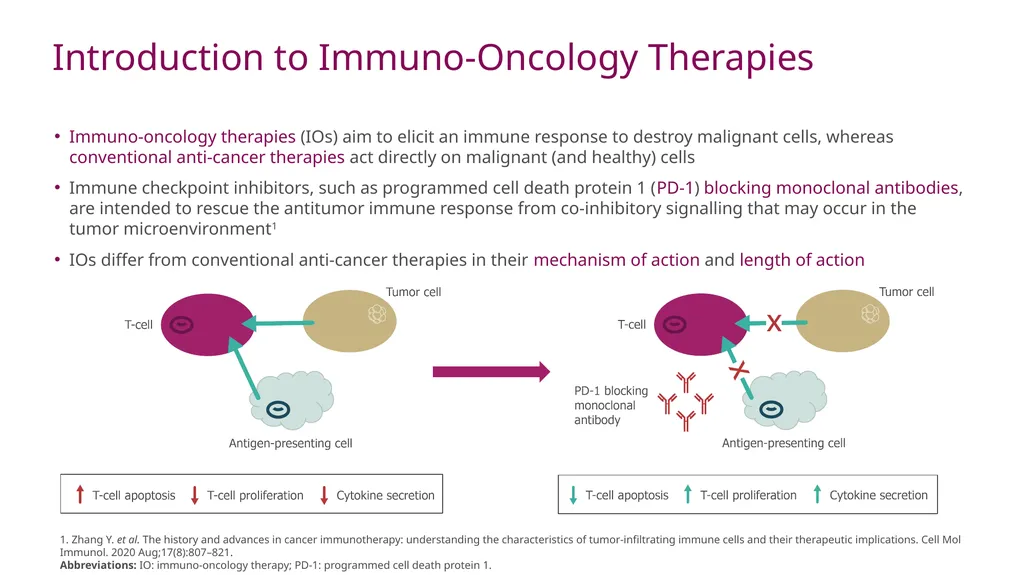
Introduction to Immuno-Oncology Therapies Immuno-oncology therapies (IOs) aim to elicit an immune response to destroy malignant cells, whereas conventional anti-cancer therapies act directly on malignant (and healthy) cells
Immune checkpoint inhibitors, such as programmed cell death protein 1 (PD-1) blocking monoclonal antibodies, are intended to rescue the antitumor immune response from co-inhibitory signalling that may occur in the tumor microenvironment1
IOs differ from conventional anti-cancer therapies in their mechanism of action and length of action 1. Zhang Y. et al. The history and advances in cancer immunotherapy: understanding the characteristics of tumor-infiltrating immune cells and their therapeutic implications. Cell Mol Immunol. 2020 Aug;17(8):807–821.
Abbreviations: IO: immuno-oncology therapy; PD-1: programmed cell death protein 1.<br>
Immune checkpoint inhibitors, such as programmed cell death protein 1 (PD-1) blocking monoclonal antibodies, are intended to rescue the antitumor immune response from co-inhibitory signalling that may occur in the tumor microenvironment1
IOs differ from conventional anti-cancer therapies in their mechanism of action and length of action 1. Zhang Y. et al. The history and advances in cancer immunotherapy: understanding the characteristics of tumor-infiltrating immune cells and their therapeutic implications. Cell Mol Immunol. 2020 Aug;17(8):807–821.
Abbreviations: IO: immuno-oncology therapy; PD-1: programmed cell death protein 1.<br>
04
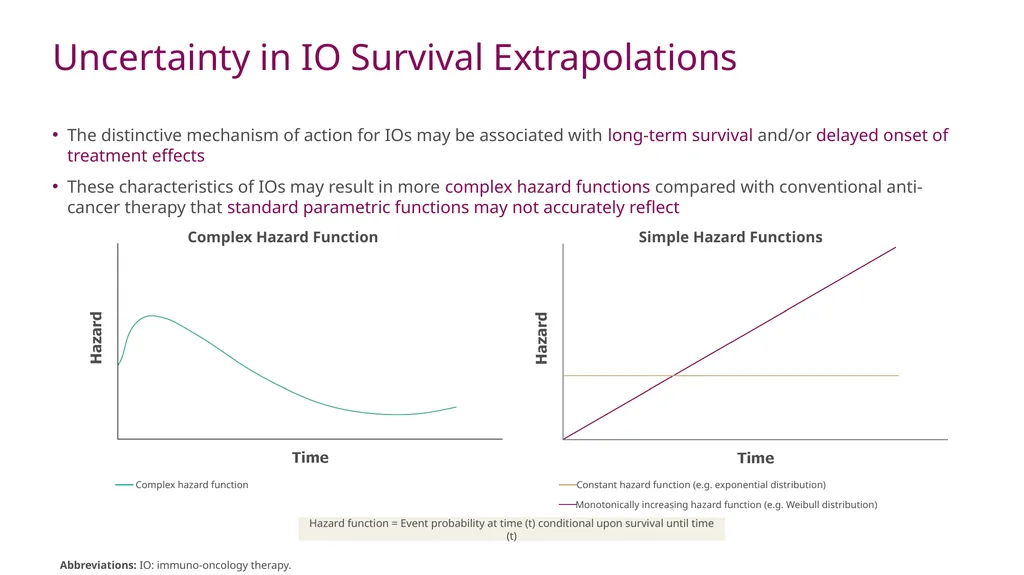
Uncertainty in IO Survival Extrapolations The distinctive mechanism of action for IOs may be associated with long-term survival and/or delayed onset of treatment effects
These characteristics of IOs may result in more complex hazard functions compared with conventional anti-cancer therapy that standard parametric functions may not accurately reflect Abbreviations: IO: immuno-oncology therapy. Hazard function = Event probability at time (t) conditional upon survival until time (t)<br>
These characteristics of IOs may result in more complex hazard functions compared with conventional anti-cancer therapy that standard parametric functions may not accurately reflect Abbreviations: IO: immuno-oncology therapy. Hazard function = Event probability at time (t) conditional upon survival until time (t)<br>
05
1. Latimer N. NICE DSU Technical Support Document 14: Survival Analysis for Economic Evaluations Alongside Clinical Trials – Extrapolation With Patient-Level Data, Version 2: National Institute for Health and Care Excellence, Decision Support Unit, 2013; 2. Rutherford MJ. et al. NICE DSU Technical Support Document 21. Flexible Methods for Survival Analysis. 2020.
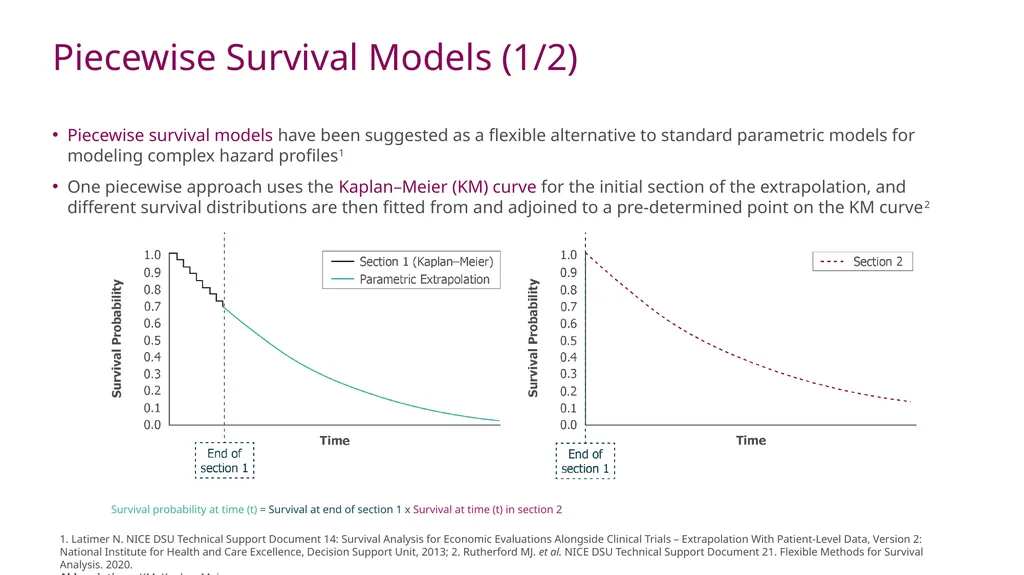
Abbreviations: KM: Kaplan–Meier. Piecewise Survival Models (1/2) Piecewise survival models have been suggested as a flexible alternative to standard parametric models for modeling complex hazard profiles1
One piecewise approach uses the Kaplan–Meier (KM) curve for the initial section of the extrapolation, and different survival distributions are then fitted from and adjoined to a pre-determined point on the KM curve2 Survival probability at time (t) = Survival at end of section 1 x Survival at time (t) in section 2<br>
Abbreviations: KM: Kaplan–Meier. Piecewise Survival Models (1/2) Piecewise survival models have been suggested as a flexible alternative to standard parametric models for modeling complex hazard profiles1
One piecewise approach uses the Kaplan–Meier (KM) curve for the initial section of the extrapolation, and different survival distributions are then fitted from and adjoined to a pre-determined point on the KM curve2 Survival probability at time (t) = Survival at end of section 1 x Survival at time (t) in section 2<br>
06
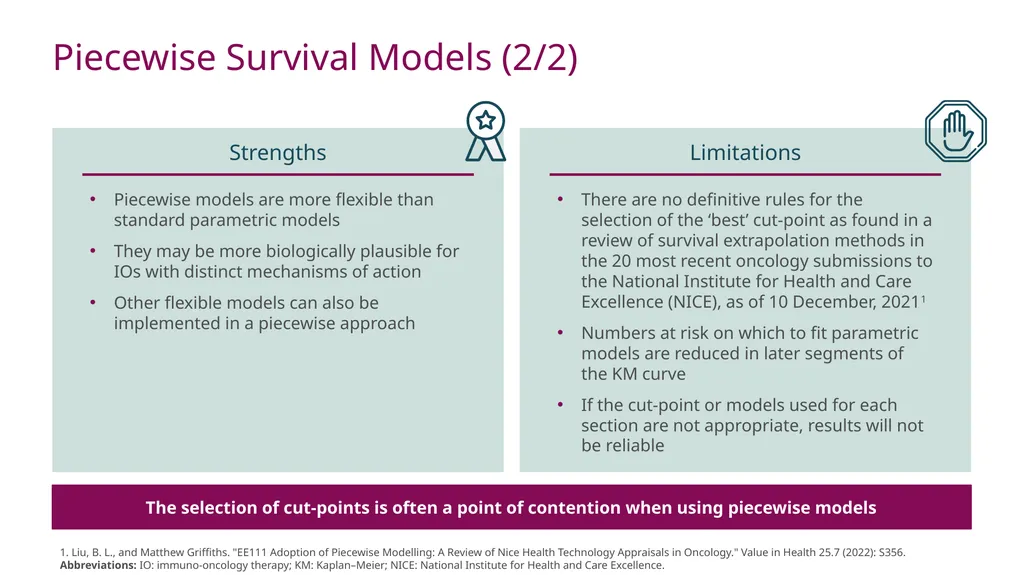
Piecewise Survival Models (2/2) Piecewise models are more flexible than standard parametric models
They may be more biologically plausible for IOs with distinct mechanisms of action
Other flexible models can also be implemented in a piecewise approach Strengths There are no definitive rules for the selection of the ‘best’ cut-point as found in a review of survival extrapolation methods in the 20 most recent oncology submissions to the National Institute for Health and Care Excellence (NICE), as of 10 December, 20211
Numbers at risk on which to fit parametric models are reduced in later segments of the KM curve
If the cut-point or models used for each section are not appropriate, results will not be reliable Limitations The selection of cut-points is often a point of contention when using piecewise models 1. Liu, B. L., and Matthew Griffiths. "EE111 Adoption of Piecewise Modelling: A Review of Nice Health Technology Appraisals in Oncology." Value in Health 25.7 (2022): S356.
Abbreviations: IO: immuno-oncology therapy; KM: Kaplan–Meier; NICE: National Institute for Health and Care Excellence.<br>
They may be more biologically plausible for IOs with distinct mechanisms of action
Other flexible models can also be implemented in a piecewise approach Strengths There are no definitive rules for the selection of the ‘best’ cut-point as found in a review of survival extrapolation methods in the 20 most recent oncology submissions to the National Institute for Health and Care Excellence (NICE), as of 10 December, 20211
Numbers at risk on which to fit parametric models are reduced in later segments of the KM curve
If the cut-point or models used for each section are not appropriate, results will not be reliable Limitations The selection of cut-points is often a point of contention when using piecewise models 1. Liu, B. L., and Matthew Griffiths. "EE111 Adoption of Piecewise Modelling: A Review of Nice Health Technology Appraisals in Oncology." Value in Health 25.7 (2022): S356.
Abbreviations: IO: immuno-oncology therapy; KM: Kaplan–Meier; NICE: National Institute for Health and Care Excellence.<br>
07
Objective Abbreviations: IO: immuno-oncology therapy.<br>
08
Methods<br>
09
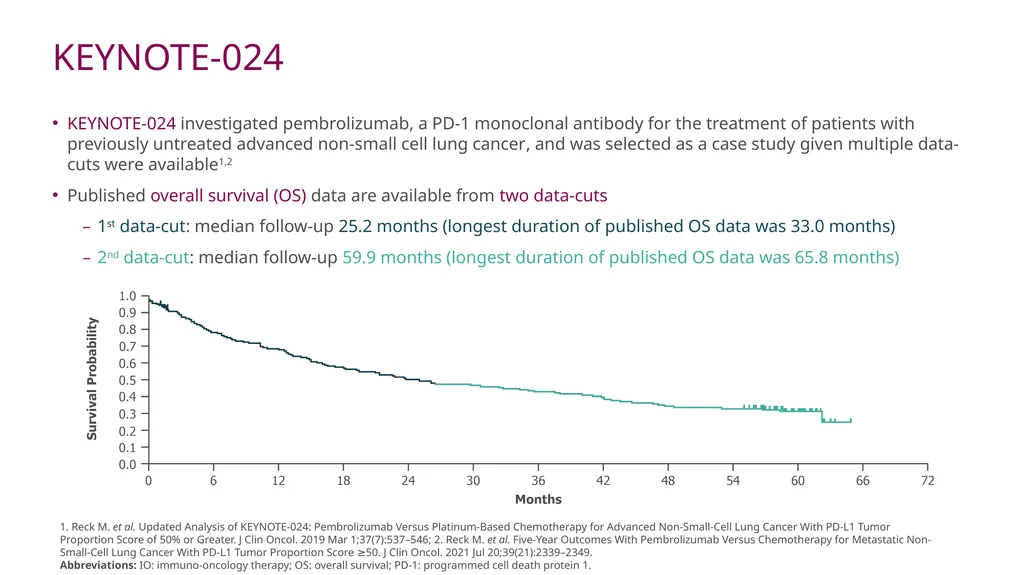
KEYNOTE-024 investigated pembrolizumab, a PD-1 monoclonal antibody for the treatment of patients with previously untreated advanced non-small cell lung cancer, and was selected as a case study given multiple data-cuts were available1,2
Published overall survival (OS) data are available from two data-cuts
1st data-cut: median follow-up 25.2 months (longest duration of published OS data was 33.0 months)
2nd data-cut: median follow-up 59.9 months (longest duration of published OS data was 65.8 months) KEYNOTE-024 1. Reck M. et al. Updated Analysis of KEYNOTE-024: Pembrolizumab Versus Platinum-Based Chemotherapy for Advanced Non-Small-Cell Lung Cancer With PD-L1 Tumor Proportion Score of 50% or Greater. J Clin Oncol. 2019 Mar 1;37(7):537–546; 2. Reck M. et al. Five-Year Outcomes With Pembrolizumab Versus Chemotherapy for Metastatic Non-Small-Cell Lung Cancer With PD-L1 Tumor Proportion Score ≥50. J Clin Oncol. 2021 Jul 20;39(21):2339–2349.
Abbreviations: IO: immuno-oncology therapy; OS: overall survival; PD-1: programmed cell death protein 1.<br>
Published overall survival (OS) data are available from two data-cuts
1st data-cut: median follow-up 25.2 months (longest duration of published OS data was 33.0 months)
2nd data-cut: median follow-up 59.9 months (longest duration of published OS data was 65.8 months) KEYNOTE-024 1. Reck M. et al. Updated Analysis of KEYNOTE-024: Pembrolizumab Versus Platinum-Based Chemotherapy for Advanced Non-Small-Cell Lung Cancer With PD-L1 Tumor Proportion Score of 50% or Greater. J Clin Oncol. 2019 Mar 1;37(7):537–546; 2. Reck M. et al. Five-Year Outcomes With Pembrolizumab Versus Chemotherapy for Metastatic Non-Small-Cell Lung Cancer With PD-L1 Tumor Proportion Score ≥50. J Clin Oncol. 2021 Jul 20;39(21):2339–2349.
Abbreviations: IO: immuno-oncology therapy; OS: overall survival; PD-1: programmed cell death protein 1.<br>
10
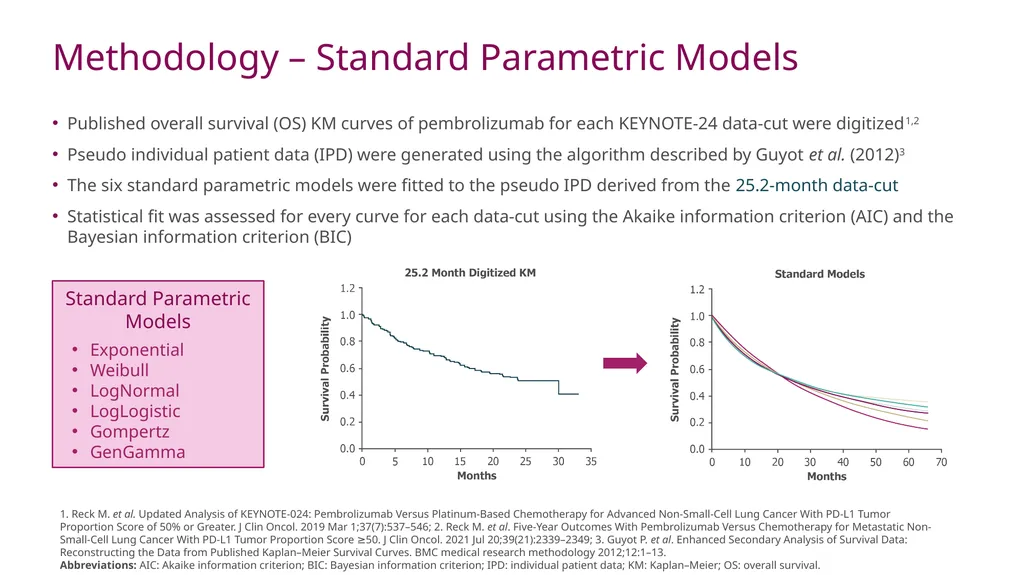
Published overall survival (OS) KM curves of pembrolizumab for each KEYNOTE-24 data-cut were digitized1,2
Pseudo individual patient data (IPD) were generated using the algorithm described by Guyot et al. (2012)3
The six standard parametric models were fitted to the pseudo IPD derived from the 25.2-month data-cut
Statistical fit was assessed for every curve for each data-cut using the Akaike information criterion (AIC) and the Bayesian information criterion (BIC) Methodology – Standard Parametric Models 1. Reck M. et al. Updated Analysis of KEYNOTE-024: Pembrolizumab Versus Platinum-Based Chemotherapy for Advanced Non-Small-Cell Lung Cancer With PD-L1 Tumor Proportion Score of 50% or Greater. J Clin Oncol. 2019 Mar 1;37(7):537–546; 2. Reck M. et al. Five-Year Outcomes With Pembrolizumab Versus Chemotherapy for Metastatic Non-Small-Cell Lung Cancer With PD-L1 Tumor Proportion Score ≥50. J Clin Oncol. 2021 Jul 20;39(21):2339–2349; 3. Guyot P. et al. Enhanced Secondary Analysis of Survival Data: Reconstructing the Data from Published Kaplan–Meier Survival Curves. BMC medical research methodology 2012;12:1–13. Abbreviations: AIC: Akaike information criterion; BIC: Bayesian information criterion; IPD: individual patient data; KM: Kaplan–Meier; OS: overall survival. Standard Parametric Models
Exponential
Weibull
LogNormal
LogLogistic
Gompertz
GenGamma<br>
Pseudo individual patient data (IPD) were generated using the algorithm described by Guyot et al. (2012)3
The six standard parametric models were fitted to the pseudo IPD derived from the 25.2-month data-cut
Statistical fit was assessed for every curve for each data-cut using the Akaike information criterion (AIC) and the Bayesian information criterion (BIC) Methodology – Standard Parametric Models 1. Reck M. et al. Updated Analysis of KEYNOTE-024: Pembrolizumab Versus Platinum-Based Chemotherapy for Advanced Non-Small-Cell Lung Cancer With PD-L1 Tumor Proportion Score of 50% or Greater. J Clin Oncol. 2019 Mar 1;37(7):537–546; 2. Reck M. et al. Five-Year Outcomes With Pembrolizumab Versus Chemotherapy for Metastatic Non-Small-Cell Lung Cancer With PD-L1 Tumor Proportion Score ≥50. J Clin Oncol. 2021 Jul 20;39(21):2339–2349; 3. Guyot P. et al. Enhanced Secondary Analysis of Survival Data: Reconstructing the Data from Published Kaplan–Meier Survival Curves. BMC medical research methodology 2012;12:1–13. Abbreviations: AIC: Akaike information criterion; BIC: Bayesian information criterion; IPD: individual patient data; KM: Kaplan–Meier; OS: overall survival. Standard Parametric Models
Exponential
Weibull
LogNormal
LogLogistic
Gompertz
GenGamma<br>
11
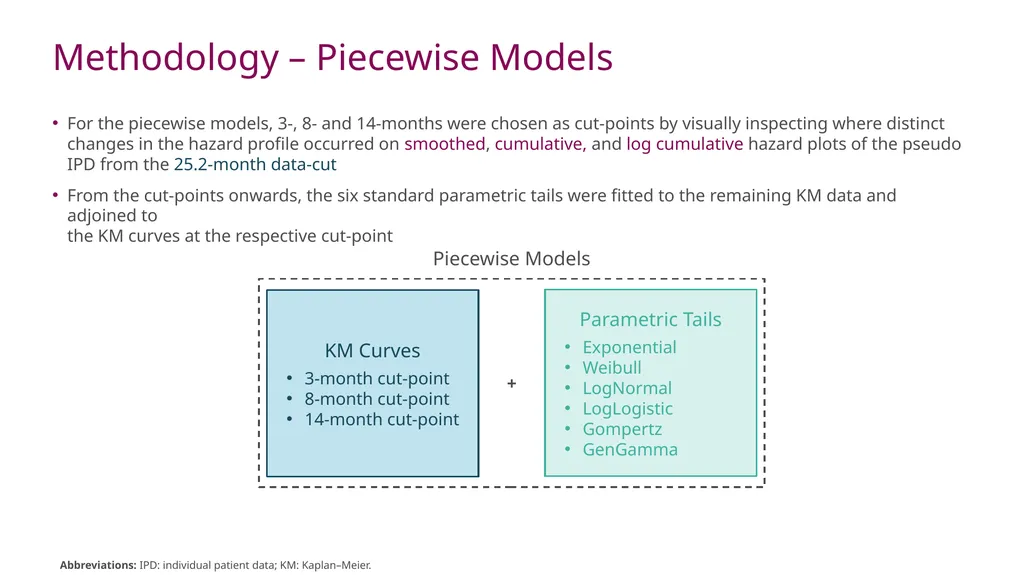
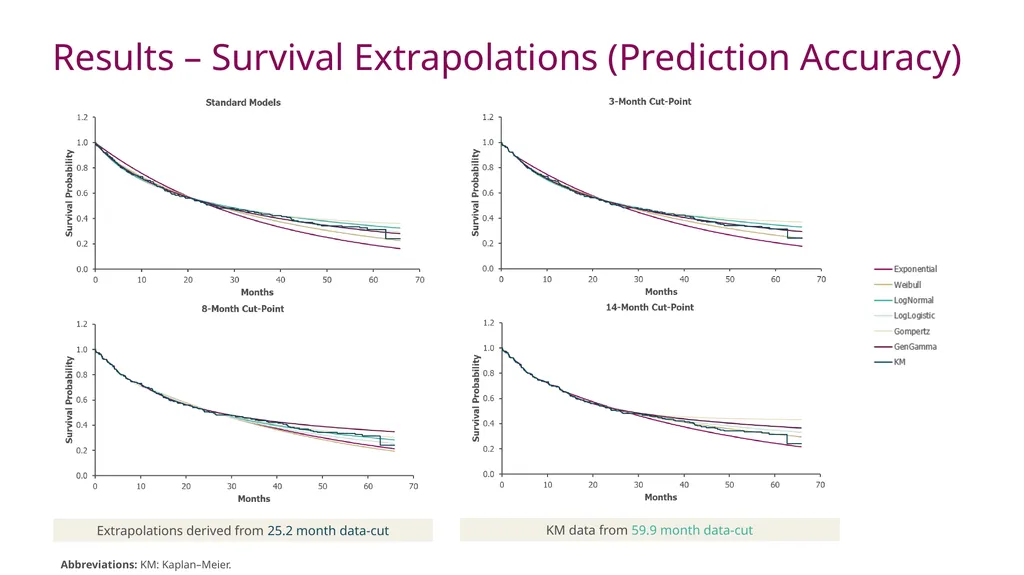
For the piecewise models, 3-, 8- and 14-months were chosen as cut-points by visually inspecting where distinct changes in the hazard profile occurred on smoothed, cumulative, and log cumulative hazard plots of the pseudo IPD from the 25.2-month data-cut
From the cut-points onwards, the six standard parametric tails were fitted to the remaining KM data and adjoined to the KM curves at the respective cut-point Methodology – Piecewise Models Abbreviations: IPD: individual patient data; KM: Kaplan–Meier.<br>
From the cut-points onwards, the six standard parametric tails were fitted to the remaining KM data and adjoined to the KM curves at the respective cut-point Methodology – Piecewise Models Abbreviations: IPD: individual patient data; KM: Kaplan–Meier.<br>
12
1. Reck M. et al. Five-Year Outcomes With Pembrolizumab Versus Chemotherapy for Metastatic Non-Small-Cell Lung Cancer With PD-L1 Tumor Proportion Score ≥50. J Clin Oncol. 2021
Jul 20;39(21):2339–2349.
Abbreviations: KM: Kaplan–Meier; LY: life year; OS: overall survival. Methodology – Life Year Calculations The predicted cumulative life years (LYs) were calculated for each model over a 65.8-month time horizon (longest duration of published OS from the 59.9-month data-cut)1 Predicted LYs were then compared to realized cumulative LYs over this period (calculated as an absolute percentage difference) to determine long-term survival estimate accuracy Predicted cumulative life years Realized cumulative life years KM Data Extrapolation KM Data KEYNOTE-024 1st data-cut (25.2 months) KEYNOTE-024 2nd data-cut (59.9 months)<br>
Abbreviations: KM: Kaplan–Meier; LY: life year; OS: overall survival. Methodology – Life Year Calculations The predicted cumulative life years (LYs) were calculated for each model over a 65.8-month time horizon (longest duration of published OS from the 59.9-month data-cut)1 Predicted LYs were then compared to realized cumulative LYs over this period (calculated as an absolute percentage difference) to determine long-term survival estimate accuracy Predicted cumulative life years Realized cumulative life years KM Data Extrapolation KM Data KEYNOTE-024 1st data-cut (25.2 months) KEYNOTE-024 2nd data-cut (59.9 months)<br>
13
Results<br>
14
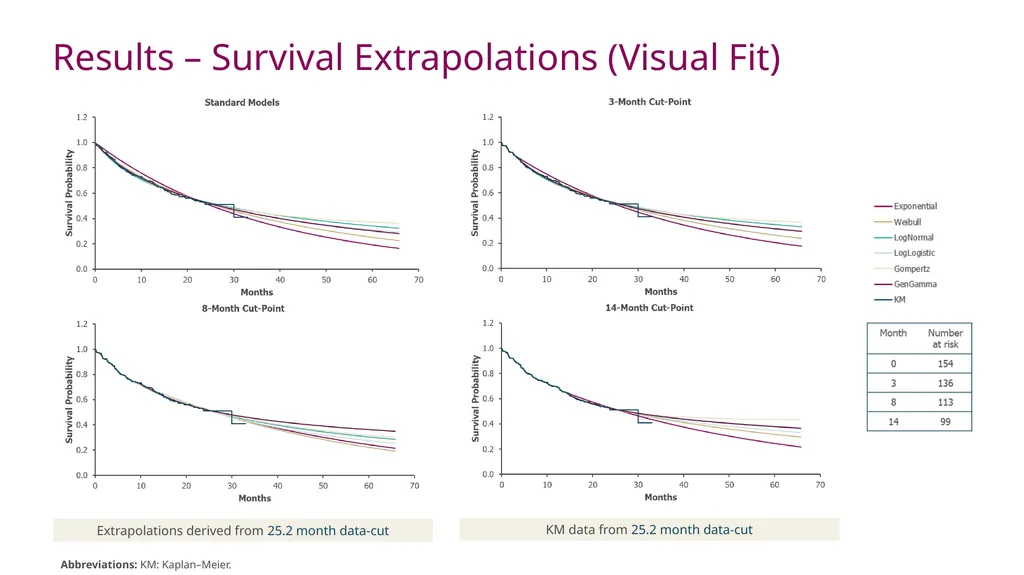
Results – Survival Extrapolations (Visual Fit) Abbreviations: KM: Kaplan–Meier.<br>
15
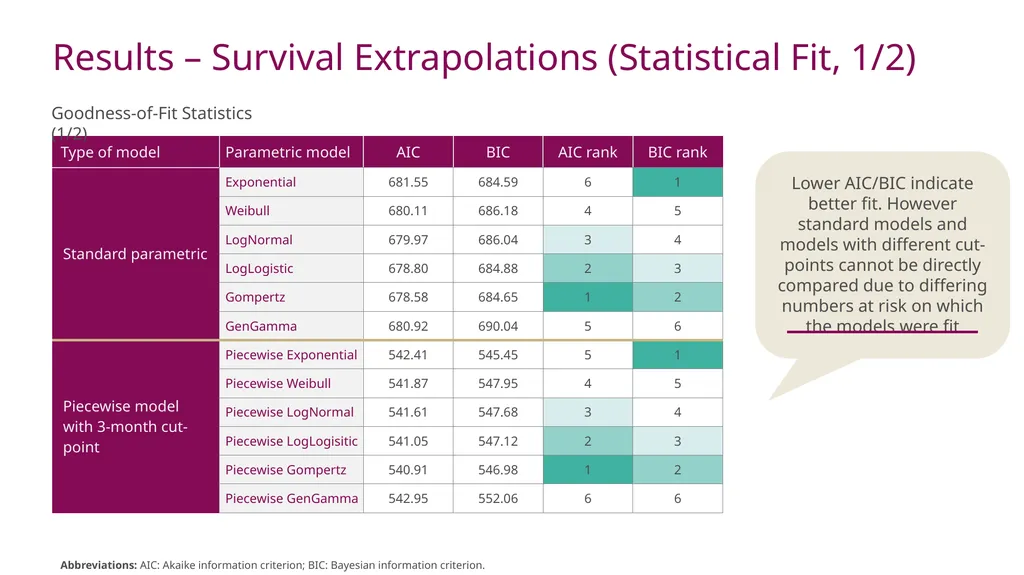
Results – Survival Extrapolations (Statistical Fit, 1/2) Goodness-of-Fit Statistics (1/2) Abbreviations: AIC: Akaike information criterion; BIC: Bayesian information criterion.<br>
16
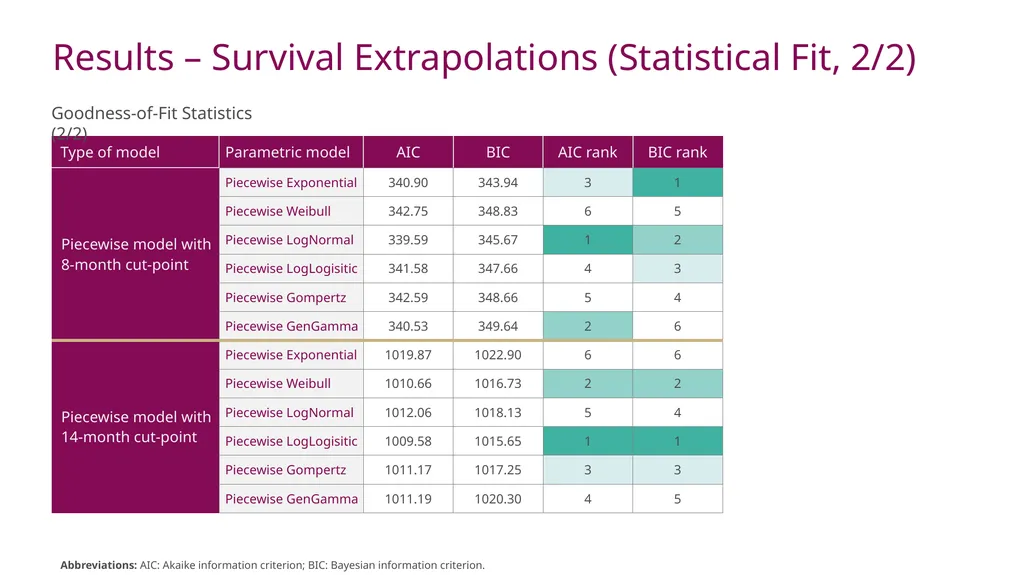
Results – Survival Extrapolations (Statistical Fit, 2/2) Abbreviations: AIC: Akaike information criterion; BIC: Bayesian information criterion. Goodness-of-Fit Statistics (2/2)<br>
17
Results – Survival Extrapolations (Prediction Accuracy) Abbreviations: KM: Kaplan–Meier.<br>
18
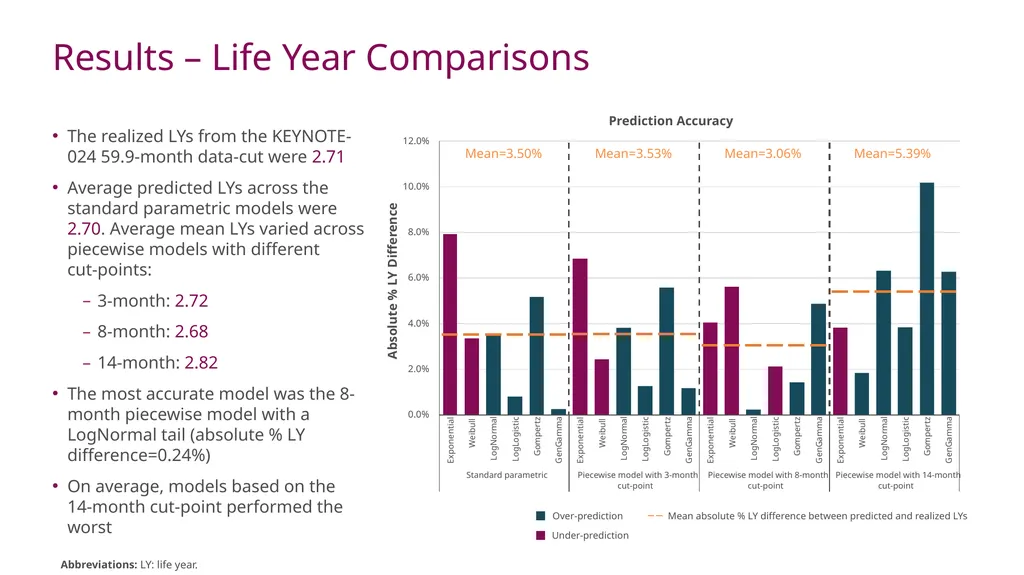
Results – Life Year Comparisons The realized LYs from the KEYNOTE-024 59.9-month data-cut were 2.71
Average predicted LYs across the standard parametric models were 2.70. Average mean LYs varied across piecewise models with different cut-points:
3-month: 2.72
8-month: 2.68
14-month: 2.82
The most accurate model was the 8-month piecewise model with a LogNormal tail (absolute % LY difference=0.24%)
On average, models based on the 14-month cut-point performed the worst Abbreviations: LY: life year.<br>
Average predicted LYs across the standard parametric models were 2.70. Average mean LYs varied across piecewise models with different cut-points:
3-month: 2.72
8-month: 2.68
14-month: 2.82
The most accurate model was the 8-month piecewise model with a LogNormal tail (absolute % LY difference=0.24%)
On average, models based on the 14-month cut-point performed the worst Abbreviations: LY: life year.<br>
19
Summary and Conclusions<br>
20
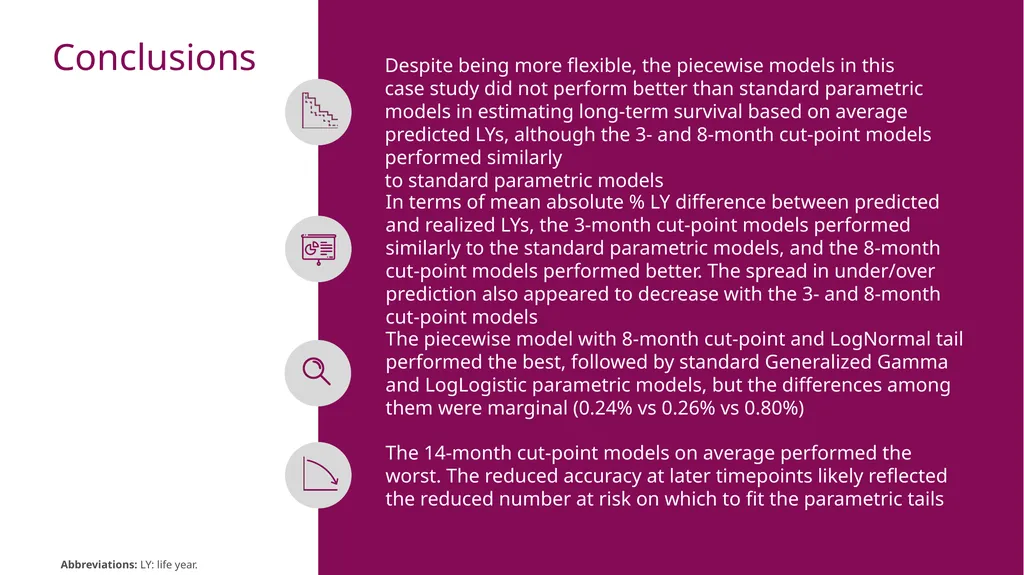
Conclusions The piecewise model with 8-month cut-point and LogNormal tail performed the best, followed by standard Generalized Gamma and LogLogistic parametric models, but the differences among them were marginal (0.24% vs 0.26% vs 0.80%) Abbreviations: LY: life year.<br>
21
Acknowledgements Contact details: connor.davies@costellomedical.com Alex Porteous<br>
22
Thank You<br>