
A Christmas Carol SLICED in QUOTES LEARN KEY






Description: A Christmas Carol SLICED in QUOTES LEARN KEY QUOTES KNOW: Structure, Language, Ideas, Context, Effects on Reader Scrooge was his sole executor, his sole administrator, his sole assign, his sole residuary legatee, his sole friend, and sole
Related Topics
Download Presentation
"A Christmas Carol SLICED in QUOTES LEARN KEY" is the property of its rightful owner. Permission is granted to download and print the materials on this website for personal, non-commercial use only, and to display it on your personal computer provided you do not modify the materials and that you retain all copyright notices contained in the materials. By downloading content from our website, you accept the terms of this agreement.
Presentation Transcript
slide1. A Christmas Carol
SLICED in QUOTES LEARN KEY QUOTES
KNOW:
Structure, Language, Ideas, Context, Effects on Reader<br>
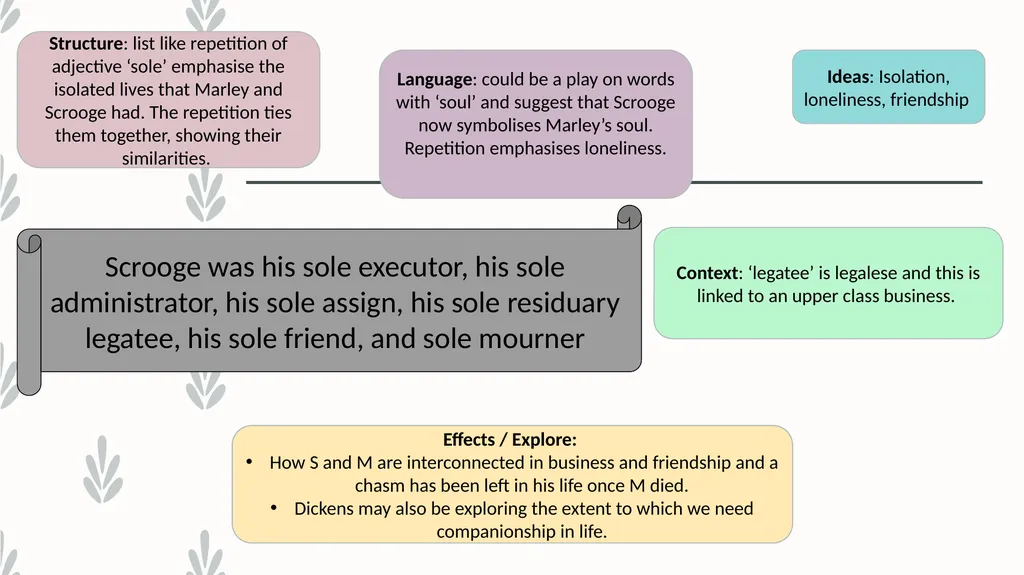
slide2. Scrooge was his sole executor, his sole administrator, his sole assign, his sole residuary legatee, his sole friend, and sole mourner Structure: list like repetition of adjective ‘sole’ emphasise the isolated lives that Marley and Scrooge had. The repetition ties them together, showing their similarities. Language: could be a play on words with ‘soul’ and suggest that Scrooge now symbolises Marley’s soul. Repetition emphasises loneliness. Ideas: Isolation, loneliness, friendship Context: ‘legatee’ is legalese and this is linked to an upper class business. Effects / Explore:
How S and M are interconnected in business and friendship and a chasm has been left in his life once M died.
Dickens may also be exploring the extent to which we need companionship in life.<br>
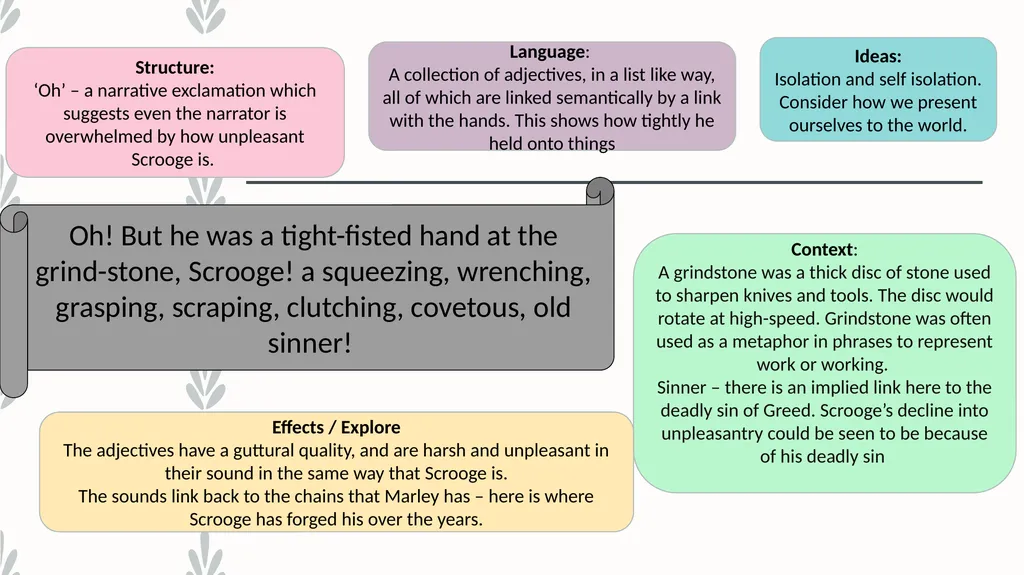
slide3. Oh! But he was a tight-fisted hand at the grind-stone, Scrooge! a squeezing, wrenching, grasping, scraping, clutching, covetous, old sinner! Structure:
‘Oh’ – a narrative exclamation which suggests even the narrator is overwhelmed by how unpleasant Scrooge is. Language:
A collection of adjectives, in a list like way, all of which are linked semantically by a link with the hands. This shows how tightly he held onto things Ideas:
Isolation and self isolation.
Consider how we present ourselves to the world. Context: A grindstone was a thick disc of stone used to sharpen knives and tools. The disc would rotate at high-speed. Grindstone was often used as a metaphor in phrases to represent work or working.
Sinner – there is an implied link here to the deadly sin of Greed. Scrooge’s decline into unpleasantry could be seen to be because of his deadly sin Effects / Explore
The adjectives have a guttural quality, and are harsh and unpleasant in their sound in the same way that Scrooge is.
The sounds link back to the chains that Marley has – here is where Scrooge has forged his over the years.<br>
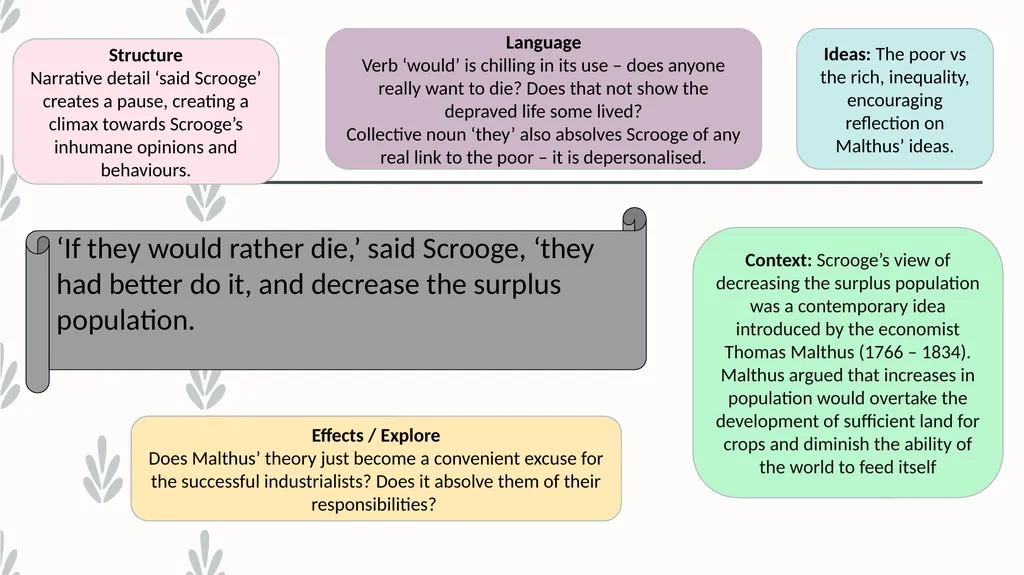
slide4. ‘If they would rather die,’ said Scrooge, ‘they had better do it, and decrease the surplus population. Structure
Narrative detail ‘said Scrooge’ creates a pause, creating a climax towards Scrooge’s inhumane opinions and behaviours. Language
Verb ‘would’ is chilling in its use – does anyone really want to die? Does that not show the depraved life some lived?
Collective noun ‘they’ also absolves Scrooge of any real link to the poor – it is depersonalised. Ideas: The poor vs the rich, inequality, encouraging reflection on Malthus’ ideas. Context: Scrooge’s view of decreasing the surplus population was a contemporary idea introduced by the economist Thomas Malthus (1766 – 1834). Malthus argued that increases in population would overtake the development of sufficient land for crops and diminish the ability of the world to feed itself Effects / Explore
Does Malthus’ theory just become a convenient excuse for the successful industrialists? Does it absolve them of their responsibilities?<br>
slide5. ‘I wear the chain I forged in life,’ replied the Ghost. ‘I made it link by link, and yard by yard; I girded it on of my own free will, and of my own free will I wore it. Is its pattern strange to you?’ Structure
Repetition of ’link by link’ and ‘yard by yard’ is symbolic of how the chain is forged. Language
The verb ‘forged’ suggests that Marley/Scrooge have painstakingly created their own guilt, deliberately and repeatedly through their immoral behaviour. Ideas
Guilt and responsibility
Free will
Symbolism Context
Free will can be traced back to the Bible, where it is suggested that the difference between animals and humans is that we have free will like God, whereas animals have instincts.
The concept of free will is that we have full control over the choices that we make and the implication is that Marley and Scrooge’s free will has lead to their metaphorical chains. Free will comes with moral implications.
There could also be a biblical link here, with the suggestion that Marley is in purgatory, being judged for his actions on Earth. Effects / Explore
All actions have consequences
We have a responsibility that comes with free will.<br>
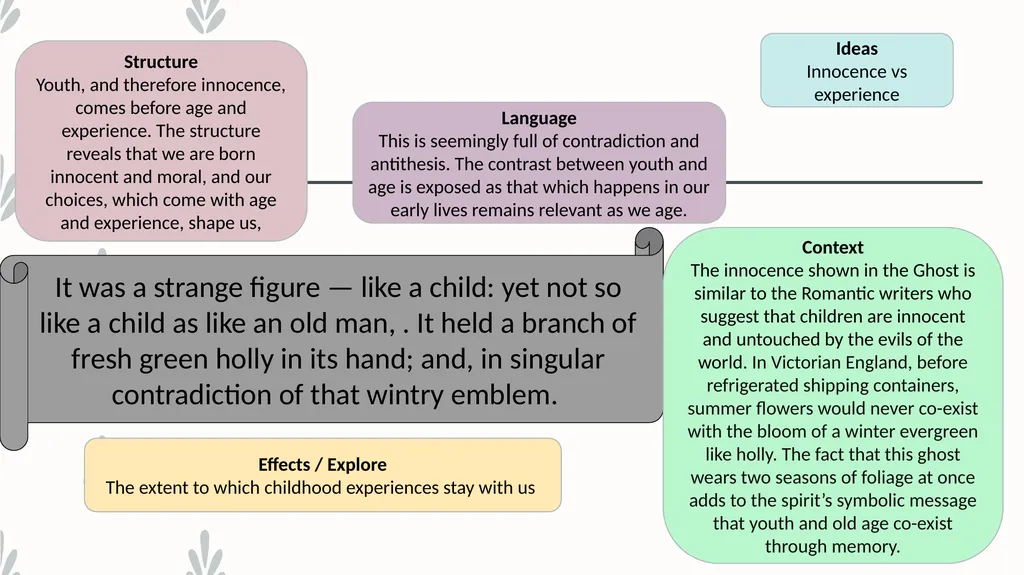
slide6. It was a strange figure — like a child: yet not so like a child as like an old man, . It held a branch of fresh green holly in its hand; and, in singular contradiction of that wintry emblem. Structure
Youth, and therefore innocence, comes before age and experience. The structure reveals that we are born innocent and moral, and our choices, which come with age and experience, shape us, Language
This is seemingly full of contradiction and antithesis. The contrast between youth and age is exposed as that which happens in our early lives remains relevant as we age. Ideas
Innocence vs experience Context
The innocence shown in the Ghost is similar to the Romantic writers who suggest that children are innocent and untouched by the evils of the world. In Victorian England, before refrigerated shipping containers, summer flowers would never co-exist with the bloom of a winter evergreen like holly. The fact that this ghost wears two seasons of foliage at once adds to the spirit’s symbolic message that youth and old age co-exist through memory. Effects / Explore
The extent to which childhood experiences stay with us<br>
slide7. ‘A solitary child, neglected by his friends, is left there still.’ Structure
This links back to the carol singer Scrooge was unkind to – this link, which Scrooge himself makes, is suggesting that he is reflecting on his actions and sets in motion his transformation. Language
‘solitary’ is similar to ‘sole’ used previously to describe Scrooge now. This reflects how loneliness has always been a part of Scrooge, and implies that loneliness does not need to equate with inhumane behaviour as a result. Ideas
Childhood impacts upon our lives
Isolation Context
There is a contrast almost between the increasing population and Scrooge’s loneliness. Dicken’s illustrates the idea that the rich can lead equally poor lives. Effects / Explore
Scrooge weeps for his younger self, which is an indication that he too will weep for his future self, as they have loneliness in common.
Has Scrooge ever really over come loneliness?<br>
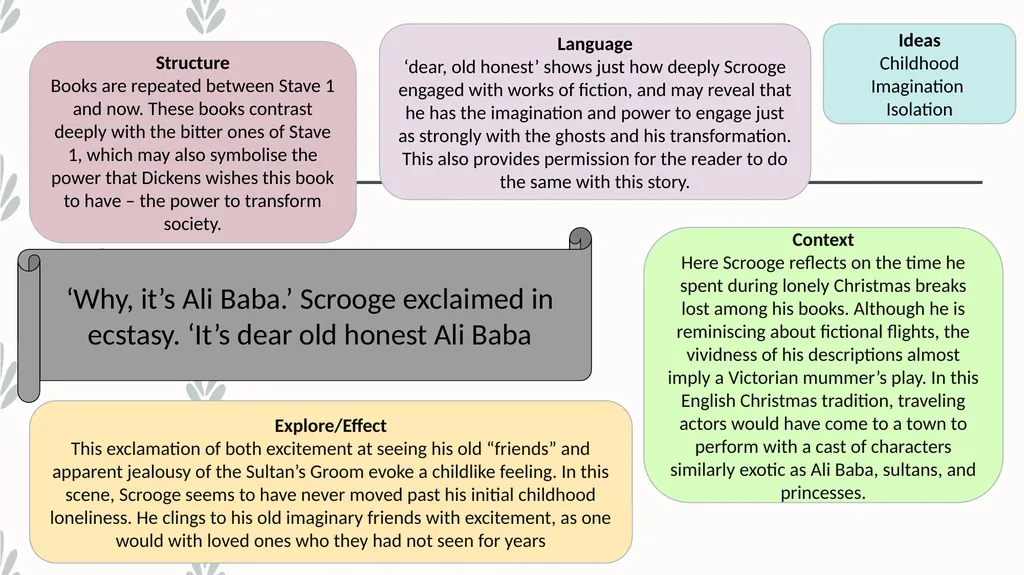
slide8. ‘Why, it’s Ali Baba.’ Scrooge exclaimed in ecstasy. ‘It’s dear old honest Ali Baba Structure
Books are repeated between Stave 1 and now. These books contrast deeply with the bitter ones of Stave 1, which may also symbolise the power that Dickens wishes this book to have – the power to transform society. Language
‘dear, old honest’ shows just how deeply Scrooge engaged with works of fiction, and may reveal that he has the imagination and power to engage just as strongly with the ghosts and his transformation. This also provides permission for the reader to do the same with this story. Ideas
Childhood
Imagination
Isolation Context
Here Scrooge reflects on the time he spent during lonely Christmas breaks lost among his books. Although he is reminiscing about fictional flights, the vividness of his descriptions almost imply a Victorian mummer’s play. In this English Christmas tradition, traveling actors would have come to a town to perform with a cast of characters similarly exotic as Ali Baba, sultans, and princesses. Explore/Effect
This exclamation of both excitement at seeing his old “friends” and apparent jealousy of the Sultan’s Groom evoke a childlike feeling. In this scene, Scrooge seems to have never moved past his initial childhood loneliness. He clings to his old imaginary friends with excitement, as one would with loved ones who they had not seen for years<br>
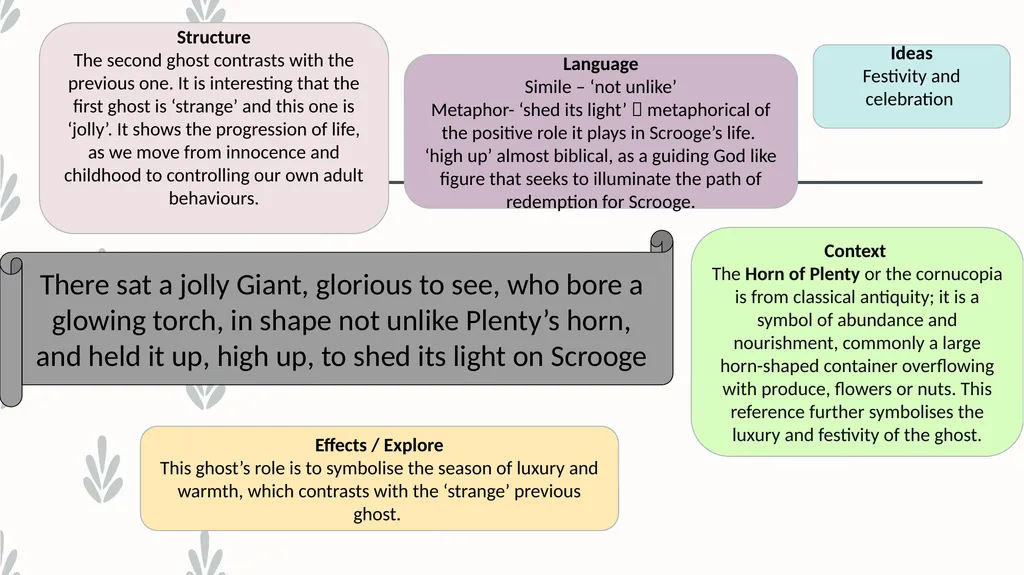
slide9. There sat a jolly Giant, glorious to see, who bore a glowing torch, in shape not unlike Plenty’s horn, and held it up, high up, to shed its light on Scrooge Structure
The second ghost contrasts with the previous one. It is interesting that the first ghost is ‘strange’ and this one is ‘jolly’. It shows the progression of life, as we move from innocence and childhood to controlling our own adult behaviours. Language
Simile – ‘not unlike’
Metaphor- ‘shed its light’ metaphorical of the positive role it plays in Scrooge’s life.
‘high up’ almost biblical, as a guiding God like figure that seeks to illuminate the path of redemption for Scrooge. Ideas
Festivity and celebration Context
The Horn of Plenty or the cornucopia is from classical antiquity; it is a symbol of abundance and nourishment, commonly a large horn-shaped container overflowing with produce, flowers or nuts. This reference further symbolises the luxury and festivity of the ghost. Effects / Explore
This ghost’s role is to symbolise the season of luxury and warmth, which contrasts with the ‘strange’ previous ghost.<br>
slide10. Mrs Cratchit, Cratchit’s wife, dressed out but poorly in a twice-turned gown, but brave in ribbons Structure
Repetition of her married status reinforces the importance of family and places her at the centre o f a happy, jovial family, knitting them together despite their challenges. Language: ‘twice turned’- A dress that has been taken apart at the seams, turned inside out and resewn, so that the less worn fabric shows, twice! Meaning that the offending inside is now better than the outside, and has been turned out again. An illustration of not only poverty, but ingenuity and pride. Ideas
Financial or emotional poverty Context
‘brave’ is a more antiquated phrase – in this case it means looking fine and splendid
The conditions of workers and families in newly industrialized England manifest themselves in the symbolism of Mrs Cratchit. Dickens implies despite the booming economy, the struggles of the poor remain damaging to humanity. Effects / Explore
The role that the poor play in life – they still have worth and value and take pleasure in life regardless of their financial circumstances. Dickens humanises the poor through the touching portrayal of the Cratchits.
The dress is a testament to Mrs. Cratchit’s pride, and sense of pride in herself, that she is not defeated by the poverty and appalling working conditions that typified not only her husband Bob Cratchit’s at the hands of Ebenezer Scrooge<br>
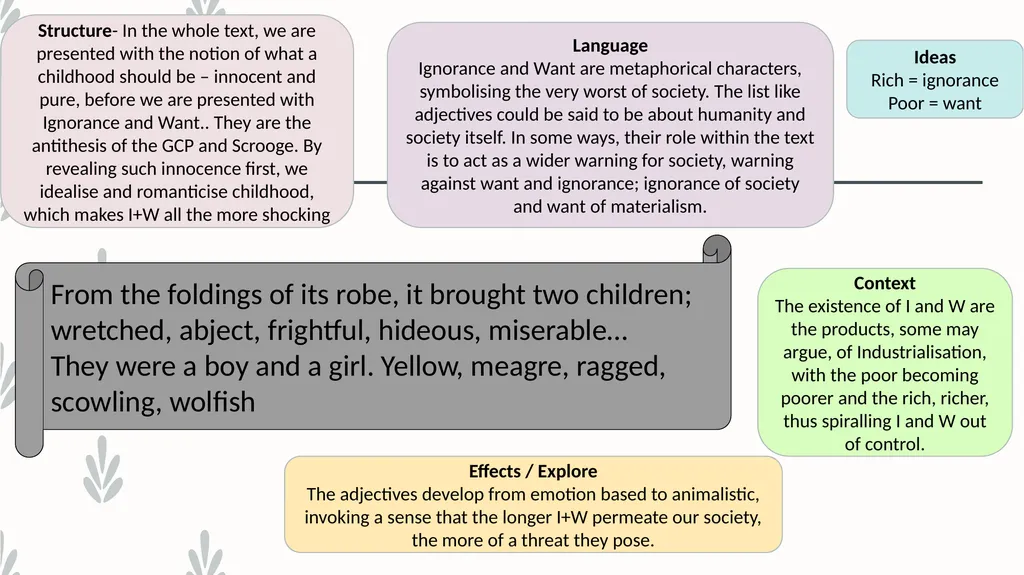
slide11. From the foldings of its robe, it brought two children; wretched, abject, frightful, hideous, miserable…
They were a boy and a girl. Yellow, meagre, ragged, scowling, wolfish Structure- In the whole text, we are presented with the notion of what a childhood should be – innocent and pure, before we are presented with Ignorance and Want.. They are the antithesis of the GCP and Scrooge. By revealing such innocence first, we idealise and romanticise childhood, which makes I+W all the more shocking Language
Ignorance and Want are metaphorical characters, symbolising the very worst of society. The list like adjectives could be said to be about humanity and society itself. In some ways, their role within the text is to act as a wider warning for society, warning against want and ignorance; ignorance of society and want of materialism. Ideas
Rich = ignorance
Poor = want Context
The existence of I and W are the products, some may argue, of Industrialisation, with the poor becoming poorer and the rich, richer, thus spiralling I and W out of control. Effects / Explore
The adjectives develop from emotion based to animalistic, invoking a sense that the longer I+W permeate our society, the more of a threat they pose.<br>
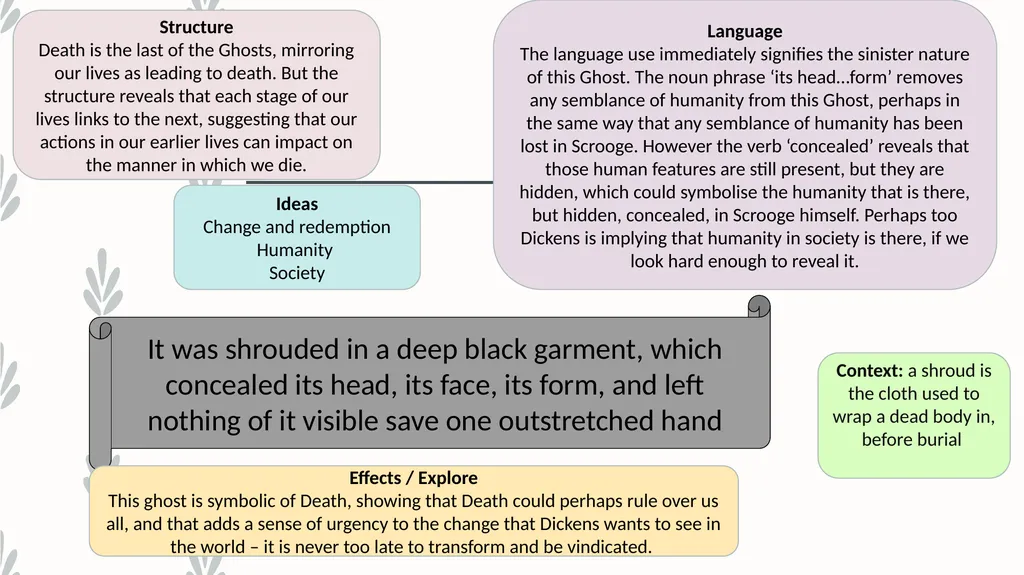
slide12. It was shrouded in a deep black garment, which concealed its head, its face, its form, and left nothing of it visible save one outstretched hand Structure
Death is the last of the Ghosts, mirroring our lives as leading to death. But the structure reveals that each stage of our lives links to the next, suggesting that our actions in our earlier lives can impact on the manner in which we die. Language
The language use immediately signifies the sinister nature of this Ghost. The noun phrase ‘its head…form’ removes any semblance of humanity from this Ghost, perhaps in the same way that any semblance of humanity has been lost in Scrooge. However the verb ‘concealed’ reveals that those human features are still present, but they are hidden, which could symbolise the humanity that is there, but hidden, concealed, in Scrooge himself. Perhaps too Dickens is implying that humanity in society is there, if we look hard enough to reveal it. Ideas
Change and redemption
Humanity
Society Context: a shroud is the cloth used to wrap a dead body in, before burial Effects / Explore
This ghost is symbolic of Death, showing that Death could perhaps rule over us all, and that adds a sense of urgency to the change that Dickens wants to see in the world – it is never too late to transform and be vindicated.<br>
slide13. I will honour Christmas in my heart, and try to keep it all the year. I will live in the Past, the Present, and the Future. The Spirits of all Three shall strive within me Structure
Anaphora of ‘I will’ becomes almost list like pledges that Scrooge makes.
Use of complex sentence is symbolic of how all of the Ghosts, the events, and more widely, our own lives, are interconnected.
In the whole text, he lived for the future only, right at the beginning, in order to be richer and have more. Now, he realises the value of the past in shaping futures, which is also a lesson Dickens teaches us, the reader. Language
‘live’ is metaphorical – it is about how we use the past to influence our present, and to focus on our futures. It is about learning and changing and adapting, which is, after all, what Scrooge has done. Ideas
Transformation
Change Context
You could argue that the Past, Present and Future is a triadic structure and therefore may be symbolic of the Holy Trinity. Past = The Son, Present = The Father, Future = Holy Spirit. Only after an experience with the Holy Trinity is Scrooge ready and able to make a transformation, which could be said to be symbolic of a religious re birth or a re commitment to living a Christian life. Effects / Explore
Christmas is symbolic perhaps of how society ‘should’ live, as Dickens sees it. He shows us that our personal pledges about our lives have a far reaching impact on society.<br>
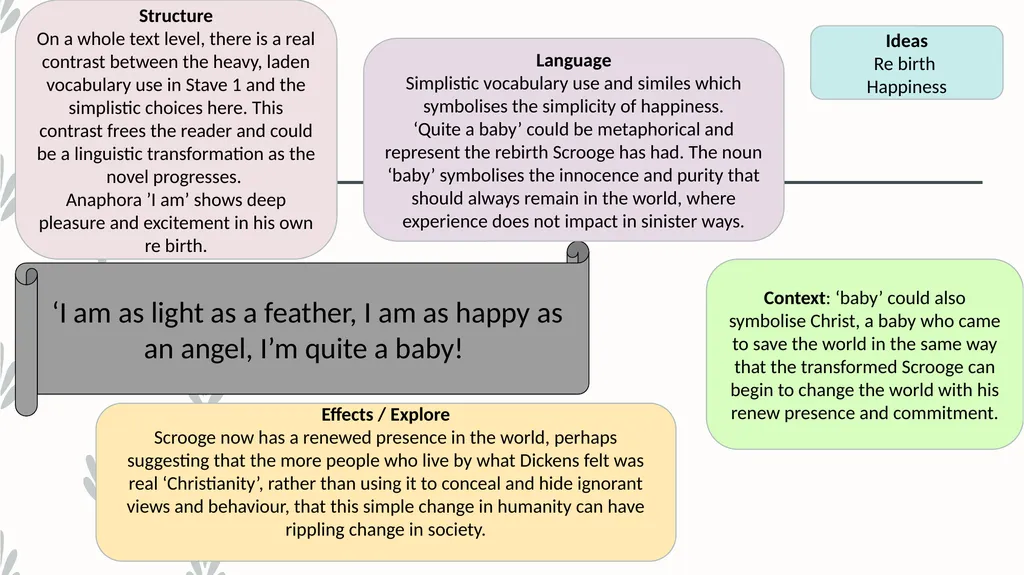
slide14. ‘I am as light as a feather, I am as happy as an angel, I’m quite a baby! Structure
On a whole text level, there is a real contrast between the heavy, laden vocabulary use in Stave 1 and the simplistic choices here. This contrast frees the reader and could be a linguistic transformation as the novel progresses.
Anaphora ’I am’ shows deep pleasure and excitement in his own re birth. Language
Simplistic vocabulary use and similes which symbolises the simplicity of happiness.
‘Quite a baby’ could be metaphorical and represent the rebirth Scrooge has had. The noun ‘baby’ symbolises the innocence and purity that should always remain in the world, where experience does not impact in sinister ways. Ideas
Re birth
Happiness Context: ‘baby’ could also symbolise Christ, a baby who came to save the world in the same way that the transformed Scrooge can begin to change the world with his renew presence and commitment. Effects / Explore
Scrooge now has a renewed presence in the world, perhaps suggesting that the more people who live by what Dickens felt was real ‘Christianity’, rather than using it to conceal and hide ignorant views and behaviour, that this simple change in humanity can have rippling change in society.<br>
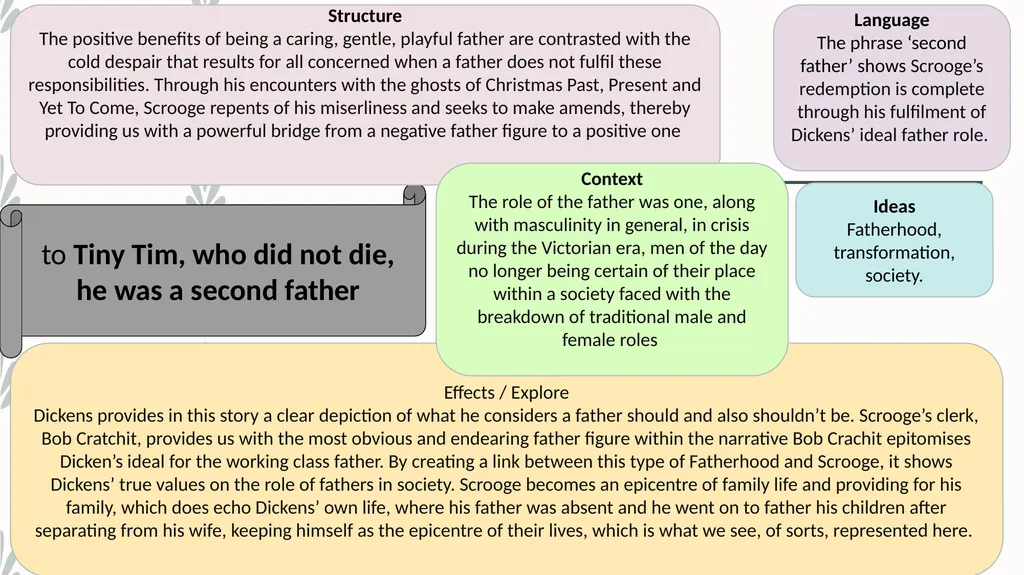
slide15. to Tiny Tim, who did not die, he was a second father Structure
The positive benefits of being a caring, gentle, playful father are contrasted with the cold despair that results for all concerned when a father does not fulfil these responsibilities. Through his encounters with the ghosts of Christmas Past, Present and Yet To Come, Scrooge repents of his miserliness and seeks to make amends, thereby providing us with a powerful bridge from a negative father figure to a positive one Language
The phrase ‘second father’ shows Scrooge’s redemption is complete through his fulfilment of Dickens’ ideal father role. Ideas
Fatherhood, transformation, society. Effects / Explore
Dickens provides in this story a clear depiction of what he considers a father should and also shouldn’t be. Scrooge’s clerk, Bob Cratchit, provides us with the most obvious and endearing father figure within the narrative Bob Crachit epitomises Dicken’s ideal for the working class father. By creating a link between this type of Fatherhood and Scrooge, it shows Dickens’ true values on the role of fathers in society. Scrooge becomes an epicentre of family life and providing for his family, which does echo Dickens’ own life, where his father was absent and he went on to father his children after separating from his wife, keeping himself as the epicentre of their lives, which is what we see, of sorts, represented here. Context
The role of the father was one, along with masculinity in general, in crisis during the Victorian era, men of the day no longer being certain of their place within a society faced with the breakdown of traditional male and female roles<br>
KNOW:
Structure, Language, Ideas, Context, Effects on Reader<br>
slide2. Scrooge was his sole executor, his sole administrator, his sole assign, his sole residuary legatee, his sole friend, and sole mourner Structure: list like repetition of adjective ‘sole’ emphasise the isolated lives that Marley and Scrooge had. The repetition ties them together, showing their similarities. Language: could be a play on words with ‘soul’ and suggest that Scrooge now symbolises Marley’s soul. Repetition emphasises loneliness. Ideas: Isolation, loneliness, friendship Context: ‘legatee’ is legalese and this is linked to an upper class business. Effects / Explore:
How S and M are interconnected in business and friendship and a chasm has been left in his life once M died.
Dickens may also be exploring the extent to which we need companionship in life.<br>
slide3. Oh! But he was a tight-fisted hand at the grind-stone, Scrooge! a squeezing, wrenching, grasping, scraping, clutching, covetous, old sinner! Structure:
‘Oh’ – a narrative exclamation which suggests even the narrator is overwhelmed by how unpleasant Scrooge is. Language:
A collection of adjectives, in a list like way, all of which are linked semantically by a link with the hands. This shows how tightly he held onto things Ideas:
Isolation and self isolation.
Consider how we present ourselves to the world. Context: A grindstone was a thick disc of stone used to sharpen knives and tools. The disc would rotate at high-speed. Grindstone was often used as a metaphor in phrases to represent work or working.
Sinner – there is an implied link here to the deadly sin of Greed. Scrooge’s decline into unpleasantry could be seen to be because of his deadly sin Effects / Explore
The adjectives have a guttural quality, and are harsh and unpleasant in their sound in the same way that Scrooge is.
The sounds link back to the chains that Marley has – here is where Scrooge has forged his over the years.<br>
slide4. ‘If they would rather die,’ said Scrooge, ‘they had better do it, and decrease the surplus population. Structure
Narrative detail ‘said Scrooge’ creates a pause, creating a climax towards Scrooge’s inhumane opinions and behaviours. Language
Verb ‘would’ is chilling in its use – does anyone really want to die? Does that not show the depraved life some lived?
Collective noun ‘they’ also absolves Scrooge of any real link to the poor – it is depersonalised. Ideas: The poor vs the rich, inequality, encouraging reflection on Malthus’ ideas. Context: Scrooge’s view of decreasing the surplus population was a contemporary idea introduced by the economist Thomas Malthus (1766 – 1834). Malthus argued that increases in population would overtake the development of sufficient land for crops and diminish the ability of the world to feed itself Effects / Explore
Does Malthus’ theory just become a convenient excuse for the successful industrialists? Does it absolve them of their responsibilities?<br>
slide5. ‘I wear the chain I forged in life,’ replied the Ghost. ‘I made it link by link, and yard by yard; I girded it on of my own free will, and of my own free will I wore it. Is its pattern strange to you?’ Structure
Repetition of ’link by link’ and ‘yard by yard’ is symbolic of how the chain is forged. Language
The verb ‘forged’ suggests that Marley/Scrooge have painstakingly created their own guilt, deliberately and repeatedly through their immoral behaviour. Ideas
Guilt and responsibility
Free will
Symbolism Context
Free will can be traced back to the Bible, where it is suggested that the difference between animals and humans is that we have free will like God, whereas animals have instincts.
The concept of free will is that we have full control over the choices that we make and the implication is that Marley and Scrooge’s free will has lead to their metaphorical chains. Free will comes with moral implications.
There could also be a biblical link here, with the suggestion that Marley is in purgatory, being judged for his actions on Earth. Effects / Explore
All actions have consequences
We have a responsibility that comes with free will.<br>
slide6. It was a strange figure — like a child: yet not so like a child as like an old man, . It held a branch of fresh green holly in its hand; and, in singular contradiction of that wintry emblem. Structure
Youth, and therefore innocence, comes before age and experience. The structure reveals that we are born innocent and moral, and our choices, which come with age and experience, shape us, Language
This is seemingly full of contradiction and antithesis. The contrast between youth and age is exposed as that which happens in our early lives remains relevant as we age. Ideas
Innocence vs experience Context
The innocence shown in the Ghost is similar to the Romantic writers who suggest that children are innocent and untouched by the evils of the world. In Victorian England, before refrigerated shipping containers, summer flowers would never co-exist with the bloom of a winter evergreen like holly. The fact that this ghost wears two seasons of foliage at once adds to the spirit’s symbolic message that youth and old age co-exist through memory. Effects / Explore
The extent to which childhood experiences stay with us<br>
slide7. ‘A solitary child, neglected by his friends, is left there still.’ Structure
This links back to the carol singer Scrooge was unkind to – this link, which Scrooge himself makes, is suggesting that he is reflecting on his actions and sets in motion his transformation. Language
‘solitary’ is similar to ‘sole’ used previously to describe Scrooge now. This reflects how loneliness has always been a part of Scrooge, and implies that loneliness does not need to equate with inhumane behaviour as a result. Ideas
Childhood impacts upon our lives
Isolation Context
There is a contrast almost between the increasing population and Scrooge’s loneliness. Dicken’s illustrates the idea that the rich can lead equally poor lives. Effects / Explore
Scrooge weeps for his younger self, which is an indication that he too will weep for his future self, as they have loneliness in common.
Has Scrooge ever really over come loneliness?<br>
slide8. ‘Why, it’s Ali Baba.’ Scrooge exclaimed in ecstasy. ‘It’s dear old honest Ali Baba Structure
Books are repeated between Stave 1 and now. These books contrast deeply with the bitter ones of Stave 1, which may also symbolise the power that Dickens wishes this book to have – the power to transform society. Language
‘dear, old honest’ shows just how deeply Scrooge engaged with works of fiction, and may reveal that he has the imagination and power to engage just as strongly with the ghosts and his transformation. This also provides permission for the reader to do the same with this story. Ideas
Childhood
Imagination
Isolation Context
Here Scrooge reflects on the time he spent during lonely Christmas breaks lost among his books. Although he is reminiscing about fictional flights, the vividness of his descriptions almost imply a Victorian mummer’s play. In this English Christmas tradition, traveling actors would have come to a town to perform with a cast of characters similarly exotic as Ali Baba, sultans, and princesses. Explore/Effect
This exclamation of both excitement at seeing his old “friends” and apparent jealousy of the Sultan’s Groom evoke a childlike feeling. In this scene, Scrooge seems to have never moved past his initial childhood loneliness. He clings to his old imaginary friends with excitement, as one would with loved ones who they had not seen for years<br>
slide9. There sat a jolly Giant, glorious to see, who bore a glowing torch, in shape not unlike Plenty’s horn, and held it up, high up, to shed its light on Scrooge Structure
The second ghost contrasts with the previous one. It is interesting that the first ghost is ‘strange’ and this one is ‘jolly’. It shows the progression of life, as we move from innocence and childhood to controlling our own adult behaviours. Language
Simile – ‘not unlike’
Metaphor- ‘shed its light’ metaphorical of the positive role it plays in Scrooge’s life.
‘high up’ almost biblical, as a guiding God like figure that seeks to illuminate the path of redemption for Scrooge. Ideas
Festivity and celebration Context
The Horn of Plenty or the cornucopia is from classical antiquity; it is a symbol of abundance and nourishment, commonly a large horn-shaped container overflowing with produce, flowers or nuts. This reference further symbolises the luxury and festivity of the ghost. Effects / Explore
This ghost’s role is to symbolise the season of luxury and warmth, which contrasts with the ‘strange’ previous ghost.<br>
slide10. Mrs Cratchit, Cratchit’s wife, dressed out but poorly in a twice-turned gown, but brave in ribbons Structure
Repetition of her married status reinforces the importance of family and places her at the centre o f a happy, jovial family, knitting them together despite their challenges. Language: ‘twice turned’- A dress that has been taken apart at the seams, turned inside out and resewn, so that the less worn fabric shows, twice! Meaning that the offending inside is now better than the outside, and has been turned out again. An illustration of not only poverty, but ingenuity and pride. Ideas
Financial or emotional poverty Context
‘brave’ is a more antiquated phrase – in this case it means looking fine and splendid
The conditions of workers and families in newly industrialized England manifest themselves in the symbolism of Mrs Cratchit. Dickens implies despite the booming economy, the struggles of the poor remain damaging to humanity. Effects / Explore
The role that the poor play in life – they still have worth and value and take pleasure in life regardless of their financial circumstances. Dickens humanises the poor through the touching portrayal of the Cratchits.
The dress is a testament to Mrs. Cratchit’s pride, and sense of pride in herself, that she is not defeated by the poverty and appalling working conditions that typified not only her husband Bob Cratchit’s at the hands of Ebenezer Scrooge<br>
slide11. From the foldings of its robe, it brought two children; wretched, abject, frightful, hideous, miserable…
They were a boy and a girl. Yellow, meagre, ragged, scowling, wolfish Structure- In the whole text, we are presented with the notion of what a childhood should be – innocent and pure, before we are presented with Ignorance and Want.. They are the antithesis of the GCP and Scrooge. By revealing such innocence first, we idealise and romanticise childhood, which makes I+W all the more shocking Language
Ignorance and Want are metaphorical characters, symbolising the very worst of society. The list like adjectives could be said to be about humanity and society itself. In some ways, their role within the text is to act as a wider warning for society, warning against want and ignorance; ignorance of society and want of materialism. Ideas
Rich = ignorance
Poor = want Context
The existence of I and W are the products, some may argue, of Industrialisation, with the poor becoming poorer and the rich, richer, thus spiralling I and W out of control. Effects / Explore
The adjectives develop from emotion based to animalistic, invoking a sense that the longer I+W permeate our society, the more of a threat they pose.<br>
slide12. It was shrouded in a deep black garment, which concealed its head, its face, its form, and left nothing of it visible save one outstretched hand Structure
Death is the last of the Ghosts, mirroring our lives as leading to death. But the structure reveals that each stage of our lives links to the next, suggesting that our actions in our earlier lives can impact on the manner in which we die. Language
The language use immediately signifies the sinister nature of this Ghost. The noun phrase ‘its head…form’ removes any semblance of humanity from this Ghost, perhaps in the same way that any semblance of humanity has been lost in Scrooge. However the verb ‘concealed’ reveals that those human features are still present, but they are hidden, which could symbolise the humanity that is there, but hidden, concealed, in Scrooge himself. Perhaps too Dickens is implying that humanity in society is there, if we look hard enough to reveal it. Ideas
Change and redemption
Humanity
Society Context: a shroud is the cloth used to wrap a dead body in, before burial Effects / Explore
This ghost is symbolic of Death, showing that Death could perhaps rule over us all, and that adds a sense of urgency to the change that Dickens wants to see in the world – it is never too late to transform and be vindicated.<br>
slide13. I will honour Christmas in my heart, and try to keep it all the year. I will live in the Past, the Present, and the Future. The Spirits of all Three shall strive within me Structure
Anaphora of ‘I will’ becomes almost list like pledges that Scrooge makes.
Use of complex sentence is symbolic of how all of the Ghosts, the events, and more widely, our own lives, are interconnected.
In the whole text, he lived for the future only, right at the beginning, in order to be richer and have more. Now, he realises the value of the past in shaping futures, which is also a lesson Dickens teaches us, the reader. Language
‘live’ is metaphorical – it is about how we use the past to influence our present, and to focus on our futures. It is about learning and changing and adapting, which is, after all, what Scrooge has done. Ideas
Transformation
Change Context
You could argue that the Past, Present and Future is a triadic structure and therefore may be symbolic of the Holy Trinity. Past = The Son, Present = The Father, Future = Holy Spirit. Only after an experience with the Holy Trinity is Scrooge ready and able to make a transformation, which could be said to be symbolic of a religious re birth or a re commitment to living a Christian life. Effects / Explore
Christmas is symbolic perhaps of how society ‘should’ live, as Dickens sees it. He shows us that our personal pledges about our lives have a far reaching impact on society.<br>
slide14. ‘I am as light as a feather, I am as happy as an angel, I’m quite a baby! Structure
On a whole text level, there is a real contrast between the heavy, laden vocabulary use in Stave 1 and the simplistic choices here. This contrast frees the reader and could be a linguistic transformation as the novel progresses.
Anaphora ’I am’ shows deep pleasure and excitement in his own re birth. Language
Simplistic vocabulary use and similes which symbolises the simplicity of happiness.
‘Quite a baby’ could be metaphorical and represent the rebirth Scrooge has had. The noun ‘baby’ symbolises the innocence and purity that should always remain in the world, where experience does not impact in sinister ways. Ideas
Re birth
Happiness Context: ‘baby’ could also symbolise Christ, a baby who came to save the world in the same way that the transformed Scrooge can begin to change the world with his renew presence and commitment. Effects / Explore
Scrooge now has a renewed presence in the world, perhaps suggesting that the more people who live by what Dickens felt was real ‘Christianity’, rather than using it to conceal and hide ignorant views and behaviour, that this simple change in humanity can have rippling change in society.<br>
slide15. to Tiny Tim, who did not die, he was a second father Structure
The positive benefits of being a caring, gentle, playful father are contrasted with the cold despair that results for all concerned when a father does not fulfil these responsibilities. Through his encounters with the ghosts of Christmas Past, Present and Yet To Come, Scrooge repents of his miserliness and seeks to make amends, thereby providing us with a powerful bridge from a negative father figure to a positive one Language
The phrase ‘second father’ shows Scrooge’s redemption is complete through his fulfilment of Dickens’ ideal father role. Ideas
Fatherhood, transformation, society. Effects / Explore
Dickens provides in this story a clear depiction of what he considers a father should and also shouldn’t be. Scrooge’s clerk, Bob Cratchit, provides us with the most obvious and endearing father figure within the narrative Bob Crachit epitomises Dicken’s ideal for the working class father. By creating a link between this type of Fatherhood and Scrooge, it shows Dickens’ true values on the role of fathers in society. Scrooge becomes an epicentre of family life and providing for his family, which does echo Dickens’ own life, where his father was absent and he went on to father his children after separating from his wife, keeping himself as the epicentre of their lives, which is what we see, of sorts, represented here. Context
The role of the father was one, along with masculinity in general, in crisis during the Victorian era, men of the day no longer being certain of their place within a society faced with the breakdown of traditional male and female roles<br>