
A Community Economic Development Model Based on
CP
Published · 33 slides · 0 views
1 / 1


Description
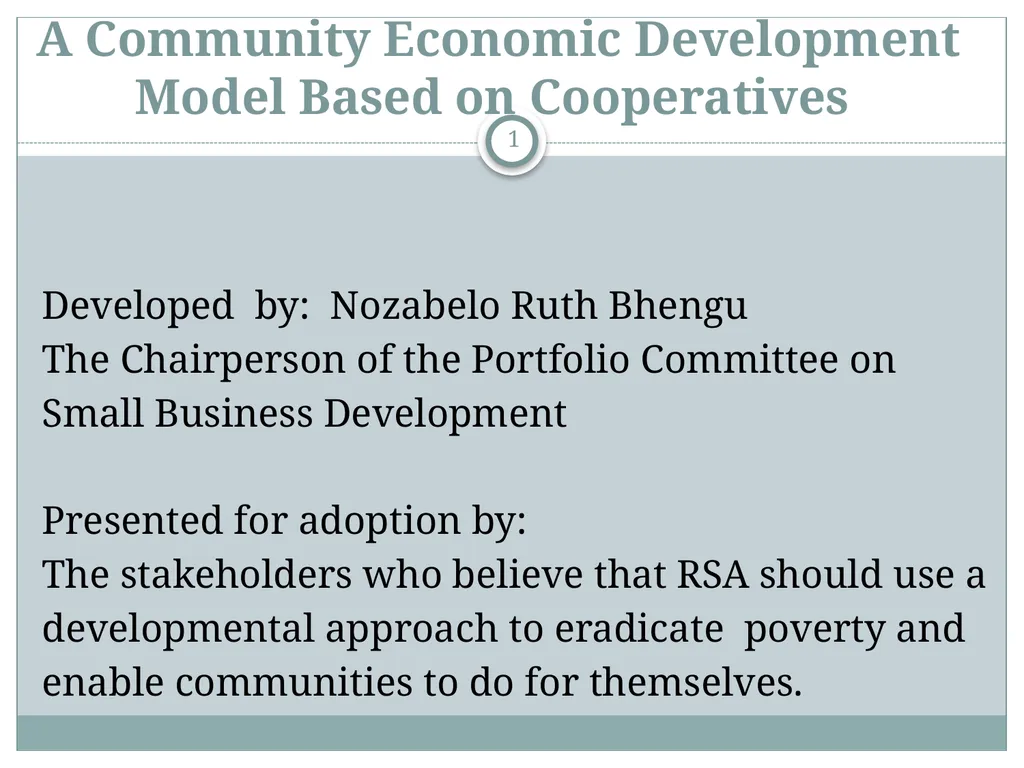
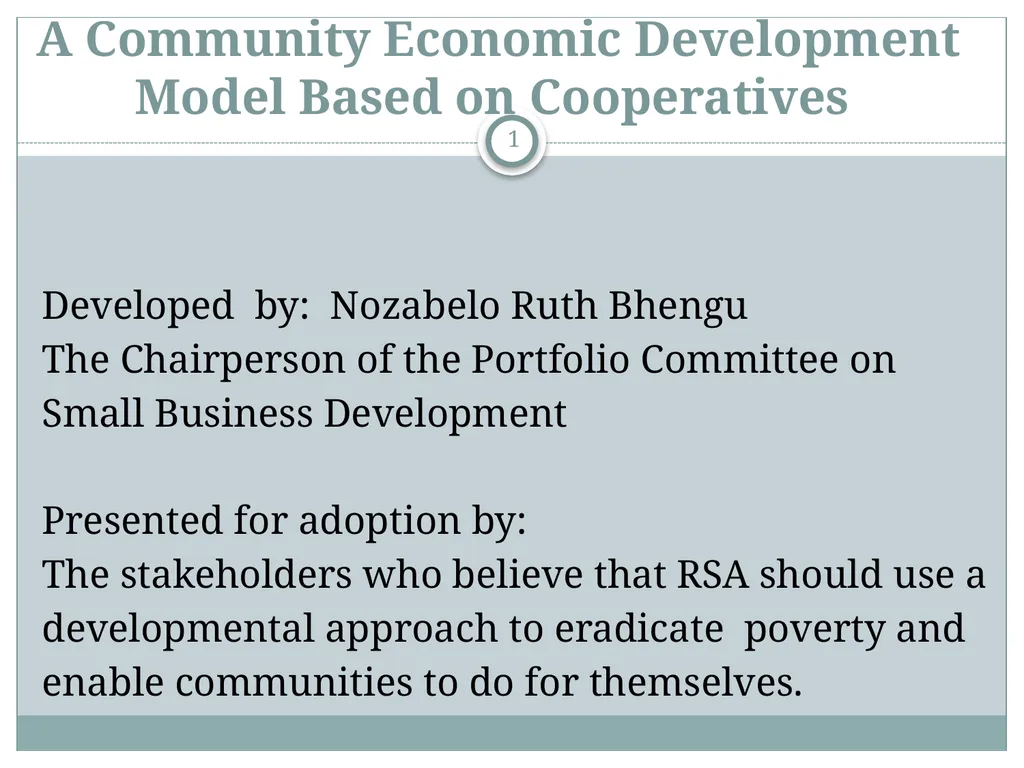
A Community Economic Development Model Based on Cooperatives 1 Developed by: Nozabelo Ruth Bhengu The Chairperson of the Portfolio Committee on Small Business Development Presented for adoption by: The stakeholders who believe that RSA
Related Topics
Share
Embed code
Download this presentation From Below
"A Community Economic Development Model Based on" is the property of its rightful owner. Permission is granted to download and print the materials on this website for personal, non-commercial use only, and to display it on your personal computer provided you do not modify the materials and that you retain all copyright notices contained in the materials. By downloading content from our website, you accept the terms of this agreement.
Presentation Transcript
01
A Community Economic Development Model Based on Cooperatives 1 Developed by: Nozabelo Ruth Bhengu
The Chairperson of the Portfolio Committee on
Small Business Development
Presented for adoption by:
The stakeholders who believe that RSA should use a
developmental approach to eradicate poverty and
enable communities to do for themselves.<br>
The Chairperson of the Portfolio Committee on
Small Business Development
Presented for adoption by:
The stakeholders who believe that RSA should use a
developmental approach to eradicate poverty and
enable communities to do for themselves.<br>
02
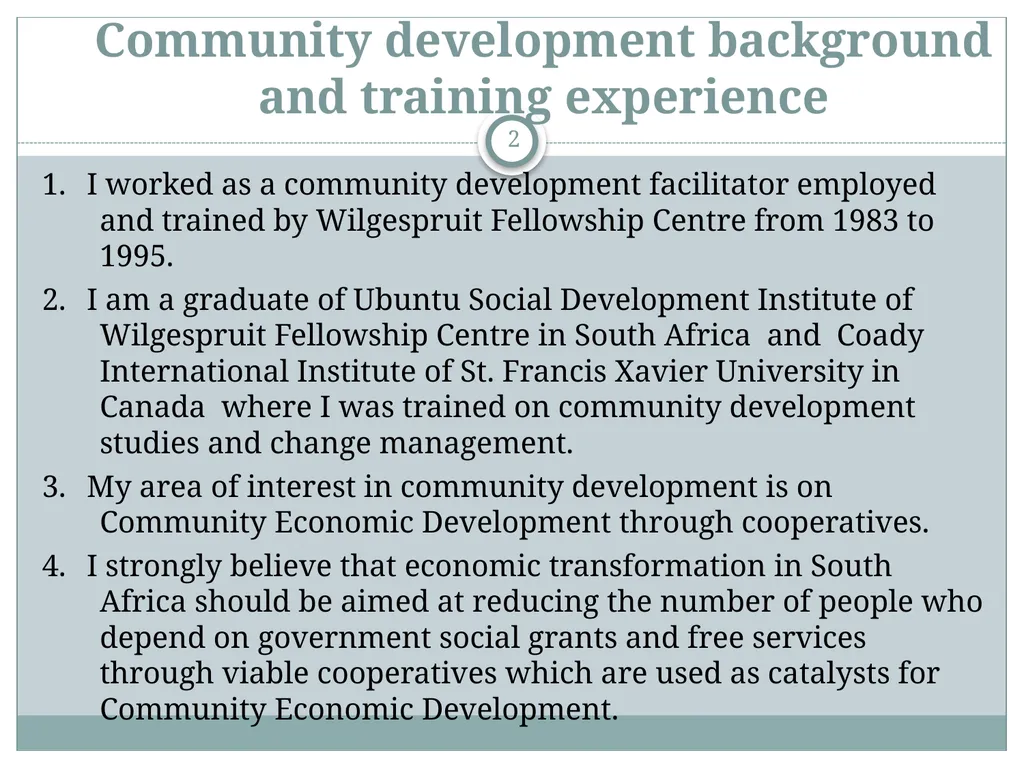
Community development background and training experience 2 1. I worked as a community development facilitator employed and trained by Wilgespruit Fellowship Centre from 1983 to 1995.
2. I am a graduate of Ubuntu Social Development Institute of Wilgespruit Fellowship Centre in South Africa and Coady International Institute of St. Francis Xavier University in Canada where I was trained on community development studies and change management.
3. My area of interest in community development is on Community Economic Development through cooperatives.
4. I strongly believe that economic transformation in South Africa should be aimed at reducing the number of people who depend on government social grants and free services through viable cooperatives which are used as catalysts for Community Economic Development.<br>
2. I am a graduate of Ubuntu Social Development Institute of Wilgespruit Fellowship Centre in South Africa and Coady International Institute of St. Francis Xavier University in Canada where I was trained on community development studies and change management.
3. My area of interest in community development is on Community Economic Development through cooperatives.
4. I strongly believe that economic transformation in South Africa should be aimed at reducing the number of people who depend on government social grants and free services through viable cooperatives which are used as catalysts for Community Economic Development.<br>
03
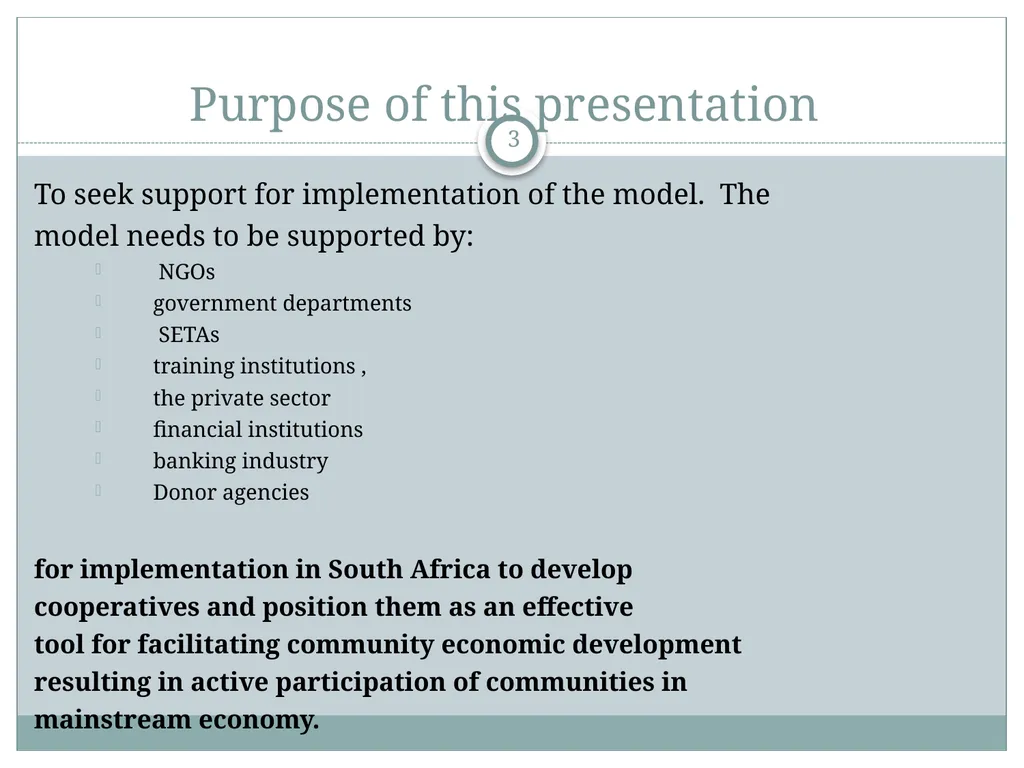
Purpose of this presentation 3 To seek support for implementation of the model. The
model needs to be supported by:
NGOs
government departments
SETAs
training institutions ,
the private sector
financial institutions
banking industry
Donor agencies
for implementation in South Africa to develop
cooperatives and position them as an effective
tool for facilitating community economic development
resulting in active participation of communities in
mainstream economy.<br>
model needs to be supported by:
NGOs
government departments
SETAs
training institutions ,
the private sector
financial institutions
banking industry
Donor agencies
for implementation in South Africa to develop
cooperatives and position them as an effective
tool for facilitating community economic development
resulting in active participation of communities in
mainstream economy.<br>
04
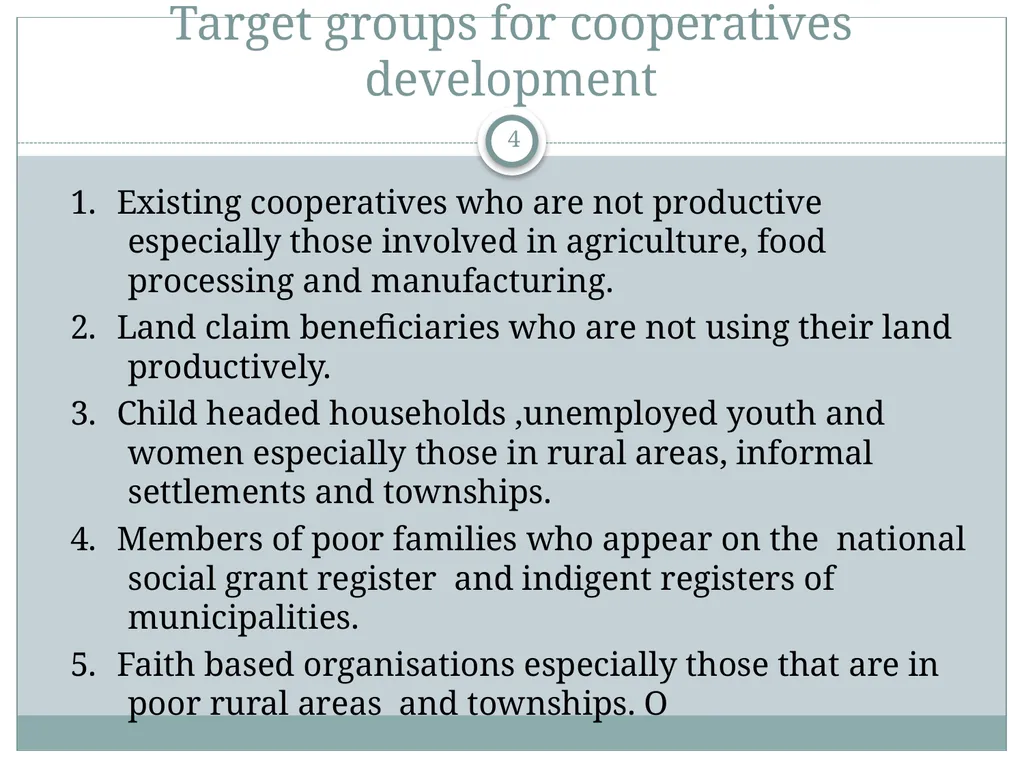
Target groups for cooperatives development 4 1. Existing cooperatives who are not productive especially those involved in agriculture, food processing and manufacturing.
2. Land claim beneficiaries who are not using their land productively.
3. Child headed households ,unemployed youth and women especially those in rural areas, informal settlements and townships.
4. Members of poor families who appear on the national social grant register and indigent registers of municipalities.
5. Faith based organisations especially those that are in poor rural areas and townships. O<br>
2. Land claim beneficiaries who are not using their land productively.
3. Child headed households ,unemployed youth and women especially those in rural areas, informal settlements and townships.
4. Members of poor families who appear on the national social grant register and indigent registers of municipalities.
5. Faith based organisations especially those that are in poor rural areas and townships. O<br>
05
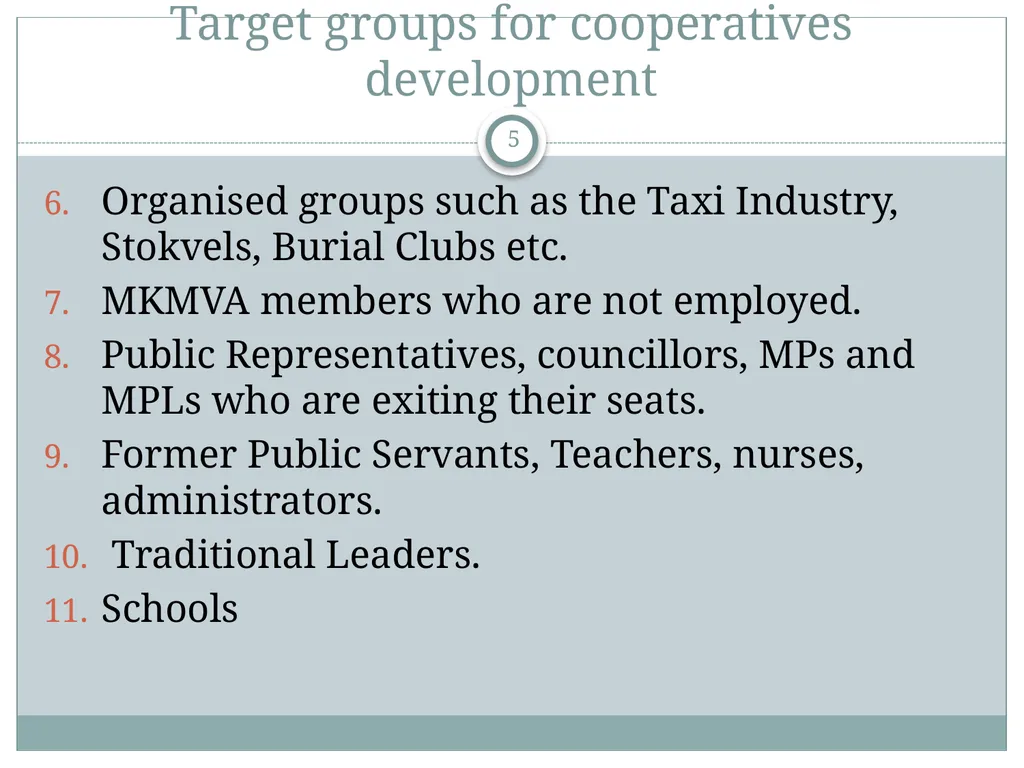
Target groups for cooperatives development 5 Organised groups such as the Taxi Industry, Stokvels, Burial Clubs etc.
MKMVA members who are not employed.
Public Representatives, councillors, MPs and MPLs who are exiting their seats.
Former Public Servants, Teachers, nurses, administrators.
Traditional Leaders.
Schools<br>
MKMVA members who are not employed.
Public Representatives, councillors, MPs and MPLs who are exiting their seats.
Former Public Servants, Teachers, nurses, administrators.
Traditional Leaders.
Schools<br>
06
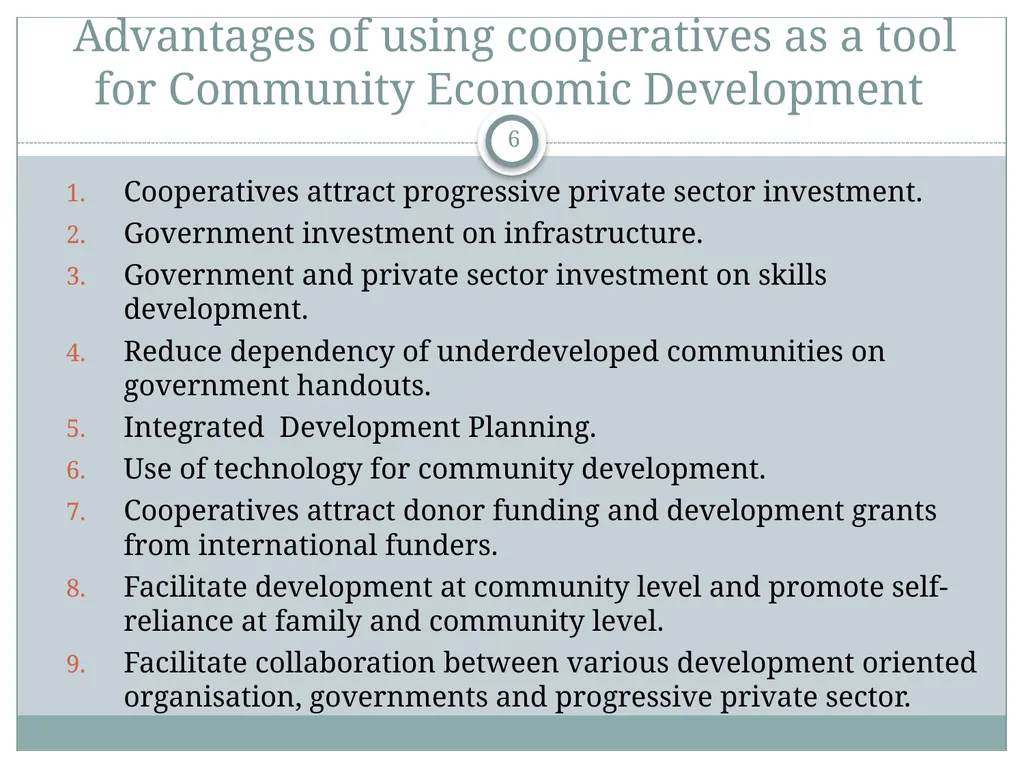
Advantages of using cooperatives as a tool for Community Economic Development 6 Cooperatives attract progressive private sector investment.
Government investment on infrastructure.
Government and private sector investment on skills development.
Reduce dependency of underdeveloped communities on government handouts.
Integrated Development Planning.
Use of technology for community development.
Cooperatives attract donor funding and development grants from international funders.
Facilitate development at community level and promote self-reliance at family and community level.
Facilitate collaboration between various development oriented organisation, governments and progressive private sector.<br>
Government investment on infrastructure.
Government and private sector investment on skills development.
Reduce dependency of underdeveloped communities on government handouts.
Integrated Development Planning.
Use of technology for community development.
Cooperatives attract donor funding and development grants from international funders.
Facilitate development at community level and promote self-reliance at family and community level.
Facilitate collaboration between various development oriented organisation, governments and progressive private sector.<br>
07
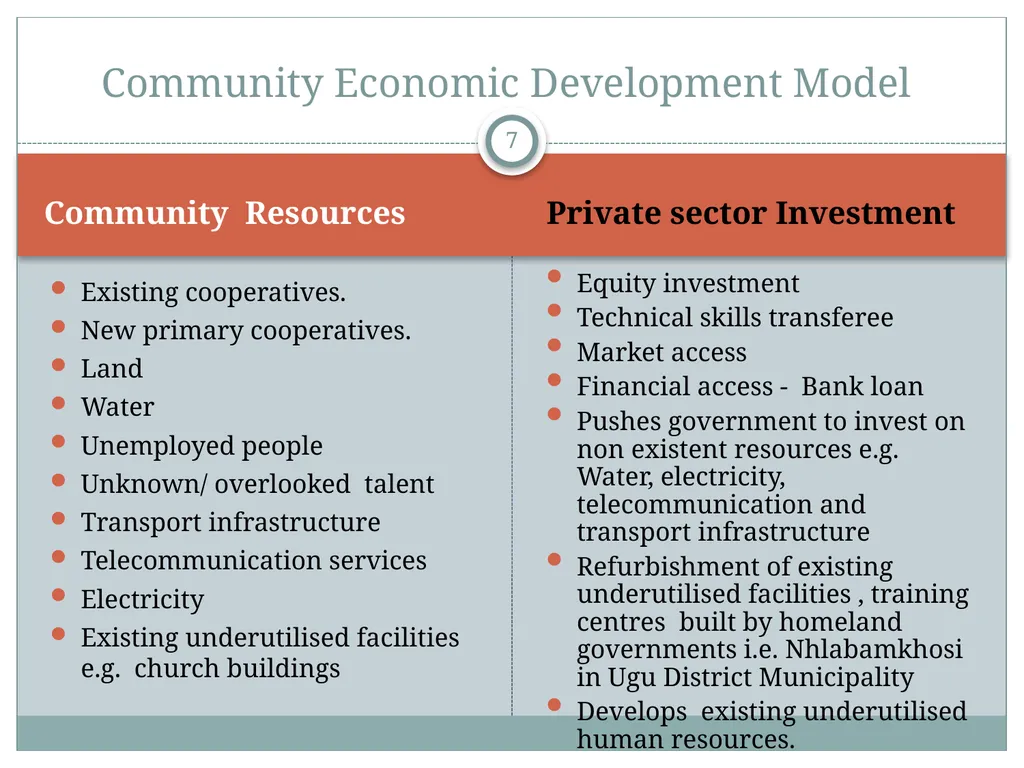
Community Resources Private sector Investment Existing cooperatives.
New primary cooperatives.
Land
Water
Unemployed people
Unknown/ overlooked talent
Transport infrastructure
Telecommunication services
Electricity
Existing underutilised facilities e.g. church buildings Equity investment
Technical skills transferee
Market access
Financial access - Bank loan
Pushes government to invest on non existent resources e.g. Water, electricity, telecommunication and transport infrastructure
Refurbishment of existing underutilised facilities , training centres built by homeland governments i.e. Nhlabamkhosi in Ugu District Municipality
Develops existing underutilised human resources. 7 Community Economic Development Model<br>
New primary cooperatives.
Land
Water
Unemployed people
Unknown/ overlooked talent
Transport infrastructure
Telecommunication services
Electricity
Existing underutilised facilities e.g. church buildings Equity investment
Technical skills transferee
Market access
Financial access - Bank loan
Pushes government to invest on non existent resources e.g. Water, electricity, telecommunication and transport infrastructure
Refurbishment of existing underutilised facilities , training centres built by homeland governments i.e. Nhlabamkhosi in Ugu District Municipality
Develops existing underutilised human resources. 7 Community Economic Development Model<br>
08
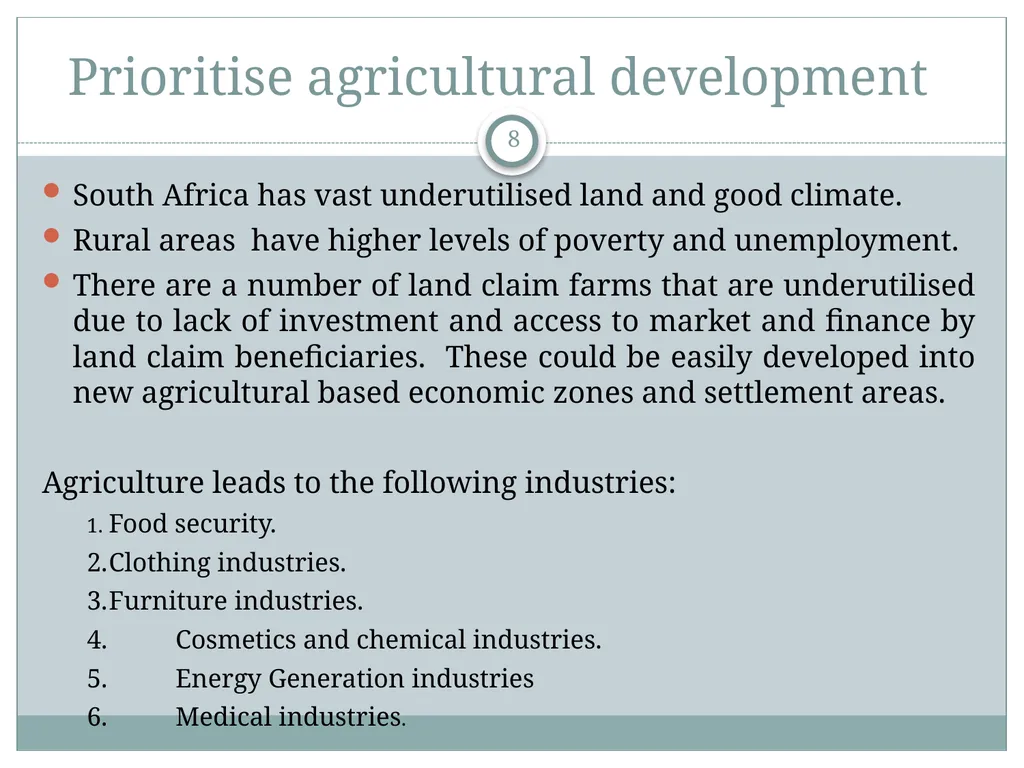
Prioritise agricultural development 8 South Africa has vast underutilised land and good climate.
Rural areas have higher levels of poverty and unemployment.
There are a number of land claim farms that are underutilised due to lack of investment and access to market and finance by land claim beneficiaries. These could be easily developed into new agricultural based economic zones and settlement areas.
Agriculture leads to the following industries:
1. Food security.
2. Clothing industries.
3. Furniture industries.
4. Cosmetics and chemical industries.
5. Energy Generation industries
6. Medical industries.<br>
Rural areas have higher levels of poverty and unemployment.
There are a number of land claim farms that are underutilised due to lack of investment and access to market and finance by land claim beneficiaries. These could be easily developed into new agricultural based economic zones and settlement areas.
Agriculture leads to the following industries:
1. Food security.
2. Clothing industries.
3. Furniture industries.
4. Cosmetics and chemical industries.
5. Energy Generation industries
6. Medical industries.<br>
09
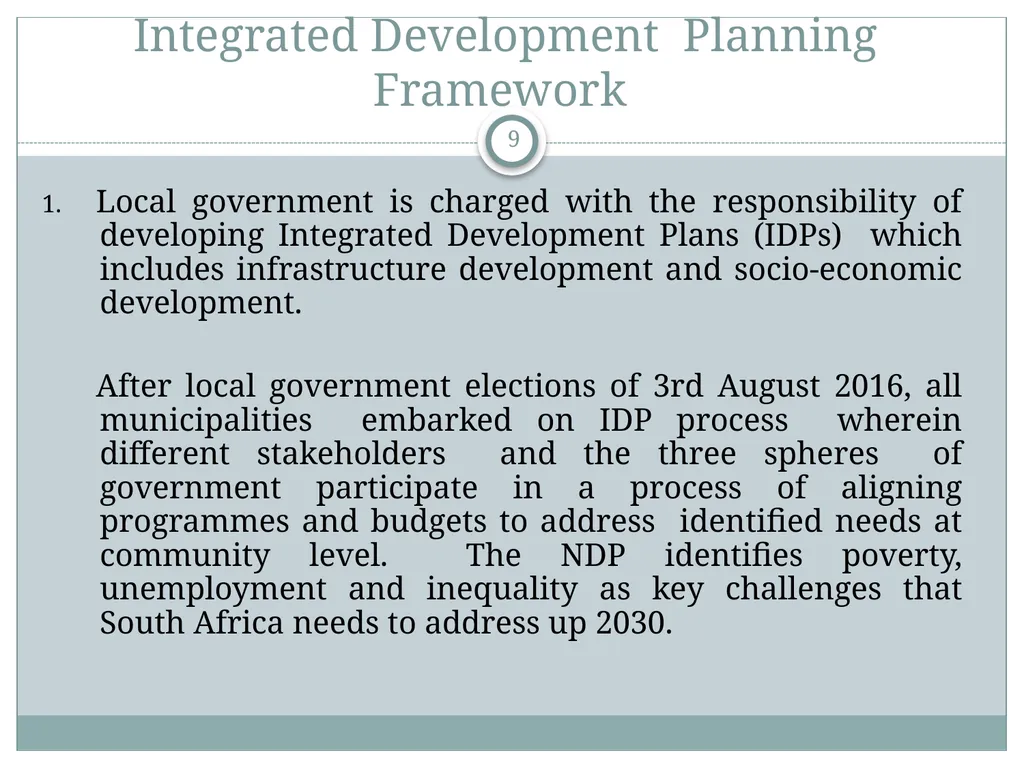
Integrated Development Planning Framework 9 1. Local government is charged with the responsibility of developing Integrated Development Plans (IDPs) which includes infrastructure development and socio-economic development.
After local government elections of 3rd August 2016, all municipalities embarked on IDP process wherein different stakeholders and the three spheres of government participate in a process of aligning programmes and budgets to address identified needs at community level. The NDP identifies poverty, unemployment and inequality as key challenges that South Africa needs to address up 2030.<br>
After local government elections of 3rd August 2016, all municipalities embarked on IDP process wherein different stakeholders and the three spheres of government participate in a process of aligning programmes and budgets to address identified needs at community level. The NDP identifies poverty, unemployment and inequality as key challenges that South Africa needs to address up 2030.<br>
10
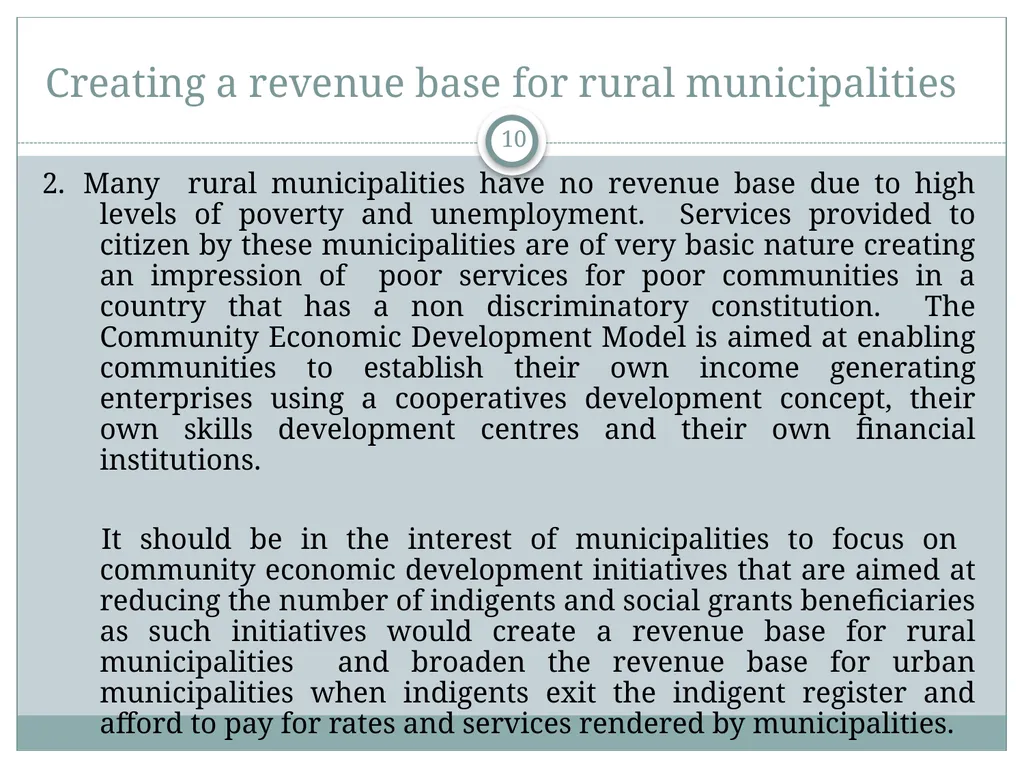
Creating a revenue base for rural municipalities 10 2. Many rural municipalities have no revenue base due to high levels of poverty and unemployment. Services provided to citizen by these municipalities are of very basic nature creating an impression of poor services for poor communities in a country that has a non discriminatory constitution. The Community Economic Development Model is aimed at enabling communities to establish their own income generating enterprises using a cooperatives development concept, their own skills development centres and their own financial institutions.
It should be in the interest of municipalities to focus on community economic development initiatives that are aimed at reducing the number of indigents and social grants beneficiaries as such initiatives would create a revenue base for rural municipalities and broaden the revenue base for urban municipalities when indigents exit the indigent register and afford to pay for rates and services rendered by municipalities.<br>
It should be in the interest of municipalities to focus on community economic development initiatives that are aimed at reducing the number of indigents and social grants beneficiaries as such initiatives would create a revenue base for rural municipalities and broaden the revenue base for urban municipalities when indigents exit the indigent register and afford to pay for rates and services rendered by municipalities.<br>
11
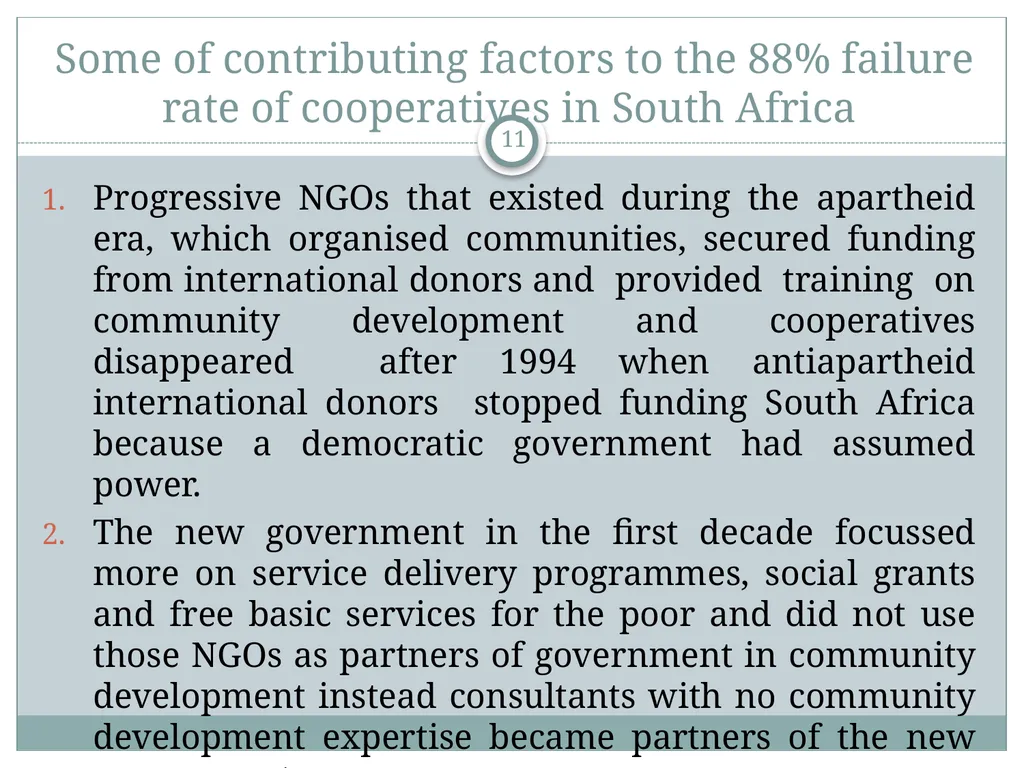
Some of contributing factors to the 88% failure rate of cooperatives in South Africa 11 Progressive NGOs that existed during the apartheid era, which organised communities, secured funding from international donors and provided training on community development and cooperatives disappeared after 1994 when antiapartheid international donors stopped funding South Africa because a democratic government had assumed power.
The new government in the first decade focussed more on service delivery programmes, social grants and free basic services for the poor and did not use those NGOs as partners of government in community development instead consultants with no community development expertise became partners of the new government.<br>
The new government in the first decade focussed more on service delivery programmes, social grants and free basic services for the poor and did not use those NGOs as partners of government in community development instead consultants with no community development expertise became partners of the new government.<br>
12
Some of contributing factors to the 88% failure rate of cooperatives in South Africa 12 Community development facilitators and trainers who were produced by progressive NGOs found themselves overlooked and underutilised by the new government.
Silo mentality in government departments resulting in competition and duplication of activities instead of collaborating and complementing each other to achieve maximum results through limited resources<br>
Silo mentality in government departments resulting in competition and duplication of activities instead of collaborating and complementing each other to achieve maximum results through limited resources<br>
13
Some of contributing factors to the 88% failure rate of cooperatives in South Africa 13 The new generation of cooperatives developed after the 1994 general elections were not linked to the processes of community economic development they were instead treated as the end of the process .
Most of them were started by people who wanted to access grants provided by government to cooperatives as well as access to government tenders.<br>
Most of them were started by people who wanted to access grants provided by government to cooperatives as well as access to government tenders.<br>
14
Key stakeholders for infrastructure provision 14 1. Department of Rural Development and Land Reform.
2. Ingonyama Trust (in the case of KwaZulu-Natal).
3. Amakhosi and Izinduna ( Traditional leaders).
4. Municipalities.
5. Department of Water Affairs and Sanitation.
6. Department of Telecommunications.
7. Department of Energy.
8. Department of Transport.<br>
2. Ingonyama Trust (in the case of KwaZulu-Natal).
3. Amakhosi and Izinduna ( Traditional leaders).
4. Municipalities.
5. Department of Water Affairs and Sanitation.
6. Department of Telecommunications.
7. Department of Energy.
8. Department of Transport.<br>
15
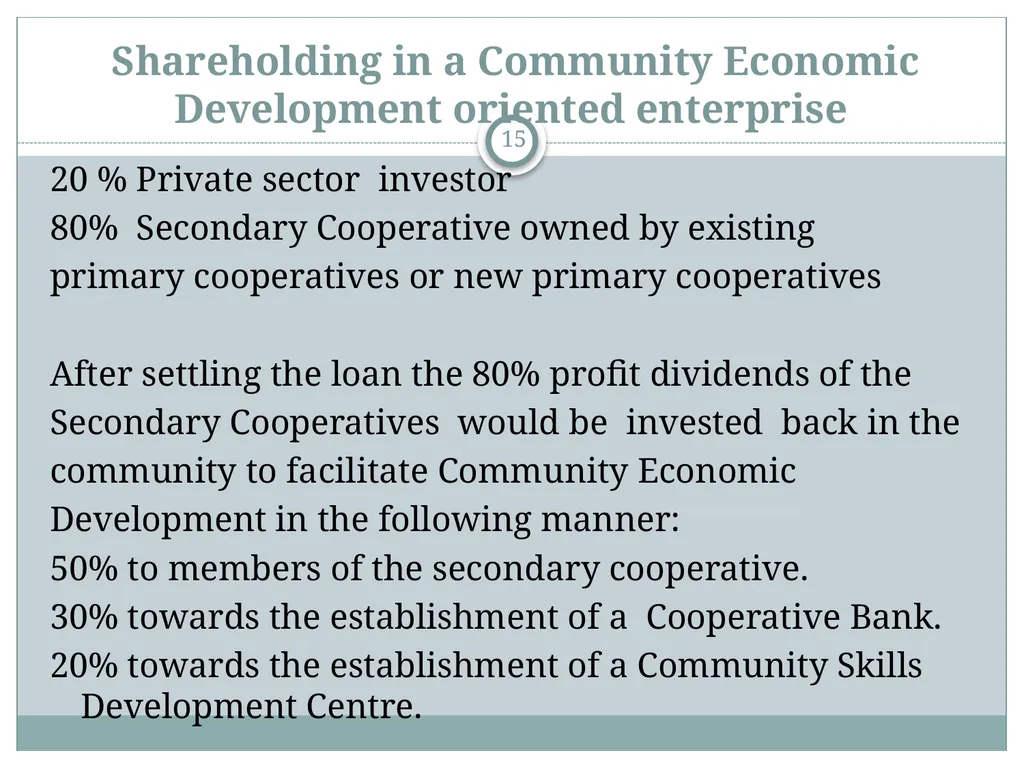
Shareholding in a Community Economic Development oriented enterprise 15 20 % Private sector investor
80% Secondary Cooperative owned by existing
primary cooperatives or new primary cooperatives
After settling the loan the 80% profit dividends of the
Secondary Cooperatives would be invested back in the
community to facilitate Community Economic
Development in the following manner:
50% to members of the secondary cooperative.
30% towards the establishment of a Cooperative Bank.
20% towards the establishment of a Community Skills Development Centre.<br>
80% Secondary Cooperative owned by existing
primary cooperatives or new primary cooperatives
After settling the loan the 80% profit dividends of the
Secondary Cooperatives would be invested back in the
community to facilitate Community Economic
Development in the following manner:
50% to members of the secondary cooperative.
30% towards the establishment of a Cooperative Bank.
20% towards the establishment of a Community Skills Development Centre.<br>
16
Value added by the private sector investor 16 1. Technical skills transfer to the community.
2. 20% equity finance provides access to 80% financial loan from private funders or commercial banks.
3. Business skills and sector experience provides access to market and builds capacity at community level.
4. Project management skills.
5. Holds community by hand through all stages of their development.<br>
2. 20% equity finance provides access to 80% financial loan from private funders or commercial banks.
3. Business skills and sector experience provides access to market and builds capacity at community level.
4. Project management skills.
5. Holds community by hand through all stages of their development.<br>
17
Value added by the existing cooperatives who are already involved in agriculture 17 1. They are a catalysts for private and public sector investment attraction to underdeveloped community
2. Social capital and subscribe to community development values and principles.
3. Instrument for Community Economic Development.
4. Trend setters for economic transformation in
favour of poor communities.
5. Sacrifice profits for establishment of a community
skills development centre.
6. Pioneers for establishment of a community owned
cooperative bank.<br>
2. Social capital and subscribe to community development values and principles.
3. Instrument for Community Economic Development.
4. Trend setters for economic transformation in
favour of poor communities.
5. Sacrifice profits for establishment of a community
skills development centre.
6. Pioneers for establishment of a community owned
cooperative bank.<br>
18
Value of government 18 1. Commitment of building a developmental state with active participation of communities in the economy.
2. Coordinate integrated planning on Community Economic Development initiative at local government level to ensure stakeholders participation and inclusion of the initiative on IDPs of municipalities
3. Provide feasibility study funding.
4. Provide land, infrastructure and required licences.
5. Investment on Skills Development Centre through SETAs.<br>
2. Coordinate integrated planning on Community Economic Development initiative at local government level to ensure stakeholders participation and inclusion of the initiative on IDPs of municipalities
3. Provide feasibility study funding.
4. Provide land, infrastructure and required licences.
5. Investment on Skills Development Centre through SETAs.<br>
19
Value of government (Contd.) 19 6. Provide data and statistics on poverty and
unemployment levels particularly households
dependent on social grants and free services.
7. Provide stipend during training phase.
8. Provide job creation related incentives to cooperatives.
9. Provide % towards the establishment cooperatives
bank
10. Monitor, evaluate and report on progress made and
impact on GDP, poverty reduction and employment
levels as a result of a Community Economic
Development approach.<br>
unemployment levels particularly households
dependent on social grants and free services.
7. Provide stipend during training phase.
8. Provide job creation related incentives to cooperatives.
9. Provide % towards the establishment cooperatives
bank
10. Monitor, evaluate and report on progress made and
impact on GDP, poverty reduction and employment
levels as a result of a Community Economic
Development approach.<br>
20
Role of a Cooperative bank 20 1. Provide funding for new cooperative enterprises.
2. Provide savings facilities to the community at large.
4. Provide community members with personal loans.
5. Provide members of community with bank ownership opportunity.<br>
2. Provide savings facilities to the community at large.
4. Provide community members with personal loans.
5. Provide members of community with bank ownership opportunity.<br>
21
Role of the Skills Development Centre 21 1. Skills training to existing cooperatives.
2. Skills Development for community members.
3. Secure partnerships with other leading training institutions nationally and international.
4. Build research capacity at community level.
5. Facilitates exchange programmes with other countries and similar institutions.<br>
2. Skills Development for community members.
3. Secure partnerships with other leading training institutions nationally and international.
4. Build research capacity at community level.
5. Facilitates exchange programmes with other countries and similar institutions.<br>
22
Expected end result 22 1. Active participation of households and cooperatives in mainstream economy as an equal pillar of a mixed economy of the Republic of South Africa.
2. Reduced number of poor families on the social grant and indigent registers.
3. Broadened revenue base for municipalities and SARS.
4. Economic growth in terms of GDP and community development.
5. Working partnership between government, private sector and communities.
6. Reduced community protests against unemployment and poor service delivery.
7. Establishment of new settlement areas and vibrant communities in farms and underdeveloped rural areas.<br>
2. Reduced number of poor families on the social grant and indigent registers.
3. Broadened revenue base for municipalities and SARS.
4. Economic growth in terms of GDP and community development.
5. Working partnership between government, private sector and communities.
6. Reduced community protests against unemployment and poor service delivery.
7. Establishment of new settlement areas and vibrant communities in farms and underdeveloped rural areas.<br>
23
Team needed to implement the model 23 1. NGOs with necessary know how and supported by the International Labour Organisation (ILO) which has an excellent track record in Community Economic Development through cooperatives. This player would:
Assess training needs of members and community leaders .
Facilitate registration of cooperatives.
Develop training programmes.
Facilitate the establishment of the Community Skills Development Centre.
Link the Community Skills Development Centre to National and International Training and Donor Funding through governments.
Facilitate training of local based Cooperatives Managers and Community Economic Development Facilitators.<br>
Assess training needs of members and community leaders .
Facilitate registration of cooperatives.
Develop training programmes.
Facilitate the establishment of the Community Skills Development Centre.
Link the Community Skills Development Centre to National and International Training and Donor Funding through governments.
Facilitate training of local based Cooperatives Managers and Community Economic Development Facilitators.<br>
24
Team needed to implement the model 24 2. Cooperatives Incubator – Sector based technical partner to focus on:
Assessment and revival of existing primary cooperatives in each community.
Work with the rest of the team to form a cluster of cooperatives in each community.
Marketing and value chain development.
Development of business plans for each Primary cooperative and submit applications for cluster funding.
Facilitating establishment of small scale production and distribution channel to the market.
Providing technical skills training, project management and mentorship of members to take over management after a period of time.<br>
Assessment and revival of existing primary cooperatives in each community.
Work with the rest of the team to form a cluster of cooperatives in each community.
Marketing and value chain development.
Development of business plans for each Primary cooperative and submit applications for cluster funding.
Facilitating establishment of small scale production and distribution channel to the market.
Providing technical skills training, project management and mentorship of members to take over management after a period of time.<br>
25
Team needed to implement the model 25 3. The Barak Fund and Venda Building Society type of a
Financial Institute to provide the 80% loan and work with the community towards the establishment of a Cooperative / Community Bank.
The Barak Fund has a vast experience in funding of
commodities and community based income generating/ self-help projects and supports the model as well as Venda Building Society.
Other institutions that would be drawn in to support communities include the Get Ahead Foundation in South Africa, Kenya, the Grameen Bank in Bangladesh, the Credit Unions in Canada, the Mondragon Cooperatives in Spain etc..<br>
Financial Institute to provide the 80% loan and work with the community towards the establishment of a Cooperative / Community Bank.
The Barak Fund has a vast experience in funding of
commodities and community based income generating/ self-help projects and supports the model as well as Venda Building Society.
Other institutions that would be drawn in to support communities include the Get Ahead Foundation in South Africa, Kenya, the Grameen Bank in Bangladesh, the Credit Unions in Canada, the Mondragon Cooperatives in Spain etc..<br>
26
Team needed to implement the model 26 4. Progressive Private Companies to invest in a Cooperatives Based Community Economic Development Initiatives/ Programmes with a 20% equity shareholder
These companies should demonstrate a high level of commitment and experience in community economic development through financial investment, master plan development technical skills transfer and opening access to market<br>
These companies should demonstrate a high level of commitment and experience in community economic development through financial investment, master plan development technical skills transfer and opening access to market<br>
27
Team needed to implement the model 27 4. continued ....
The main focus would be on:
Feasibility study resulting in a long term Master Plan for Community Economic Development (to be funded by the government or donor funding).
Establishment of commercial enterprises, the skills development centre and a Cooperative Bank at community level.
Technical skills transfer.
Access to finance and market.
Project management.<br>
The main focus would be on:
Feasibility study resulting in a long term Master Plan for Community Economic Development (to be funded by the government or donor funding).
Establishment of commercial enterprises, the skills development centre and a Cooperative Bank at community level.
Technical skills transfer.
Access to finance and market.
Project management.<br>
28
Key government departments and Government Agencies to the success of the Model. 28 Department of Small Business Development with a changed perspective.
COGTA.
Rural Development and Land Reform.
Department of Agriculture.
The Cooperatives Development Bank.
The Cooperatives Development Academy.
The Cooperative Development Agency with a new breed of officials who understand development economics not inherited from DSBD and SEDA<br>
COGTA.
Rural Development and Land Reform.
Department of Agriculture.
The Cooperatives Development Bank.
The Cooperatives Development Academy.
The Cooperative Development Agency with a new breed of officials who understand development economics not inherited from DSBD and SEDA<br>
29
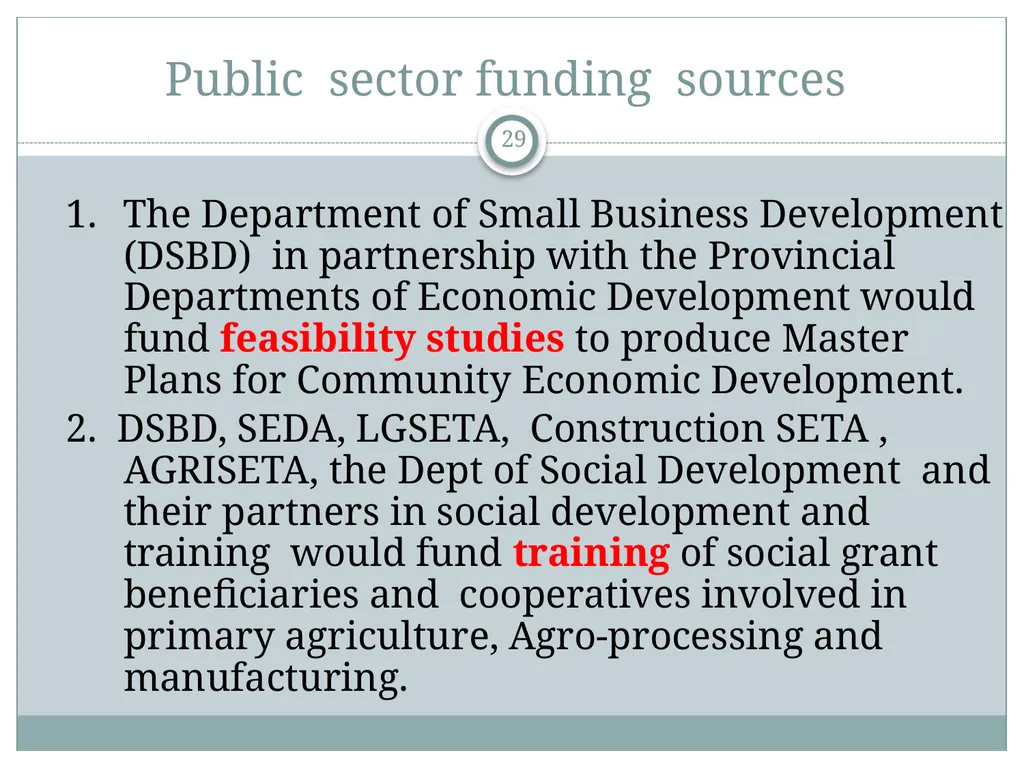
Public sector funding sources 29 1. The Department of Small Business Development (DSBD) in partnership with the Provincial Departments of Economic Development would fund feasibility studies to produce Master Plans for Community Economic Development.
2. DSBD, SEDA, LGSETA, Construction SETA , AGRISETA, the Dept of Social Development and their partners in social development and training would fund training of social grant beneficiaries and cooperatives involved in primary agriculture, Agro-processing and manufacturing.<br>
2. DSBD, SEDA, LGSETA, Construction SETA , AGRISETA, the Dept of Social Development and their partners in social development and training would fund training of social grant beneficiaries and cooperatives involved in primary agriculture, Agro-processing and manufacturing.<br>
30
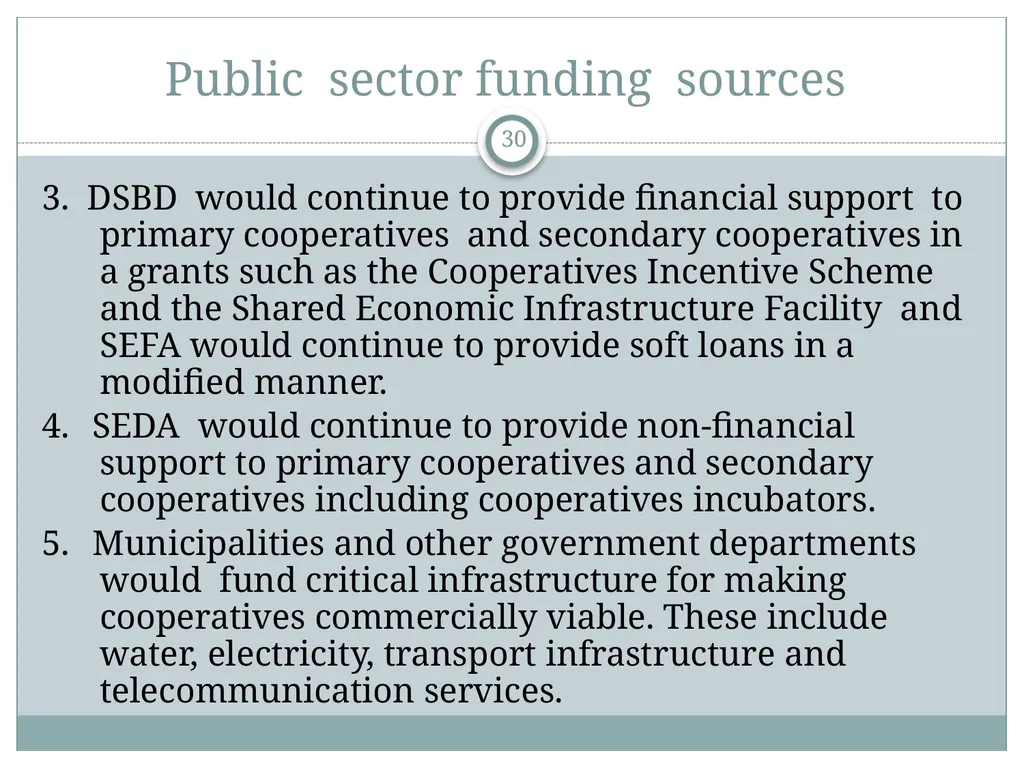
Public sector funding sources 30 3. DSBD would continue to provide financial support to primary cooperatives and secondary cooperatives in a grants such as the Cooperatives Incentive Scheme and the Shared Economic Infrastructure Facility and SEFA would continue to provide soft loans in a modified manner.
4. SEDA would continue to provide non-financial support to primary cooperatives and secondary cooperatives including cooperatives incubators.
5. Municipalities and other government departments would fund critical infrastructure for making cooperatives commercially viable. These include water, electricity, transport infrastructure and telecommunication services.<br>
4. SEDA would continue to provide non-financial support to primary cooperatives and secondary cooperatives including cooperatives incubators.
5. Municipalities and other government departments would fund critical infrastructure for making cooperatives commercially viable. These include water, electricity, transport infrastructure and telecommunication services.<br>
31
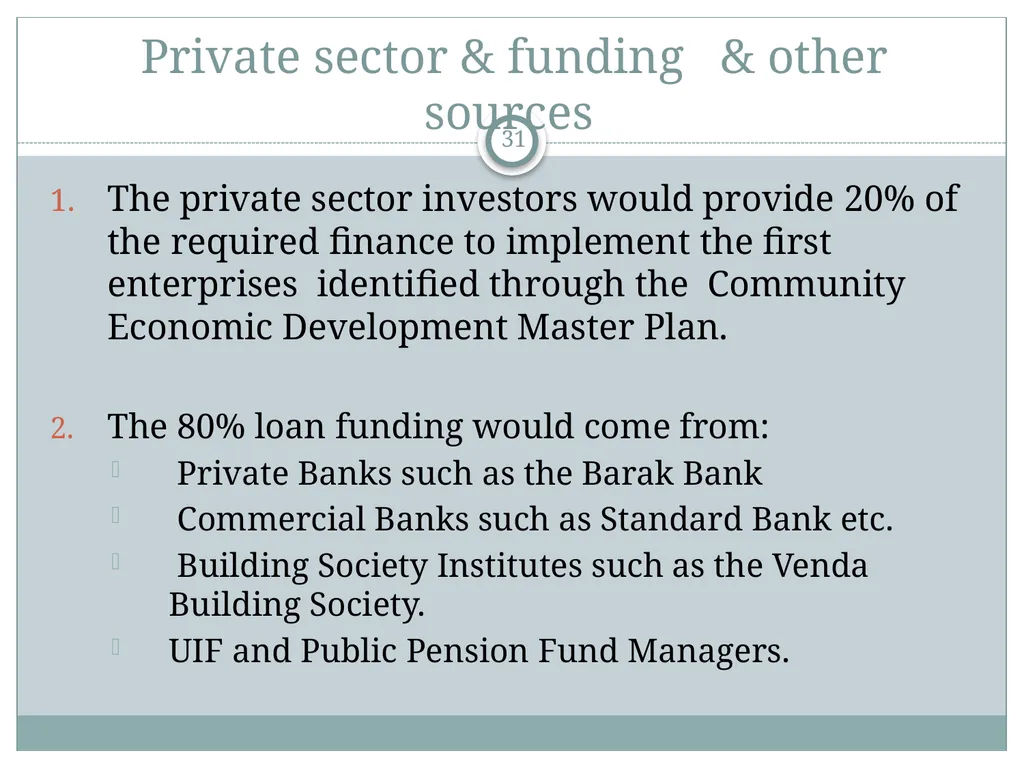
Private sector & funding & other sources 31 The private sector investors would provide 20% of the required finance to implement the first enterprises identified through the Community Economic Development Master Plan.
The 80% loan funding would come from:
Private Banks such as the Barak Bank
Commercial Banks such as Standard Bank etc.
Building Society Institutes such as the Venda Building Society.
UIF and Public Pension Fund Managers.<br>
The 80% loan funding would come from:
Private Banks such as the Barak Bank
Commercial Banks such as Standard Bank etc.
Building Society Institutes such as the Venda Building Society.
UIF and Public Pension Fund Managers.<br>
32
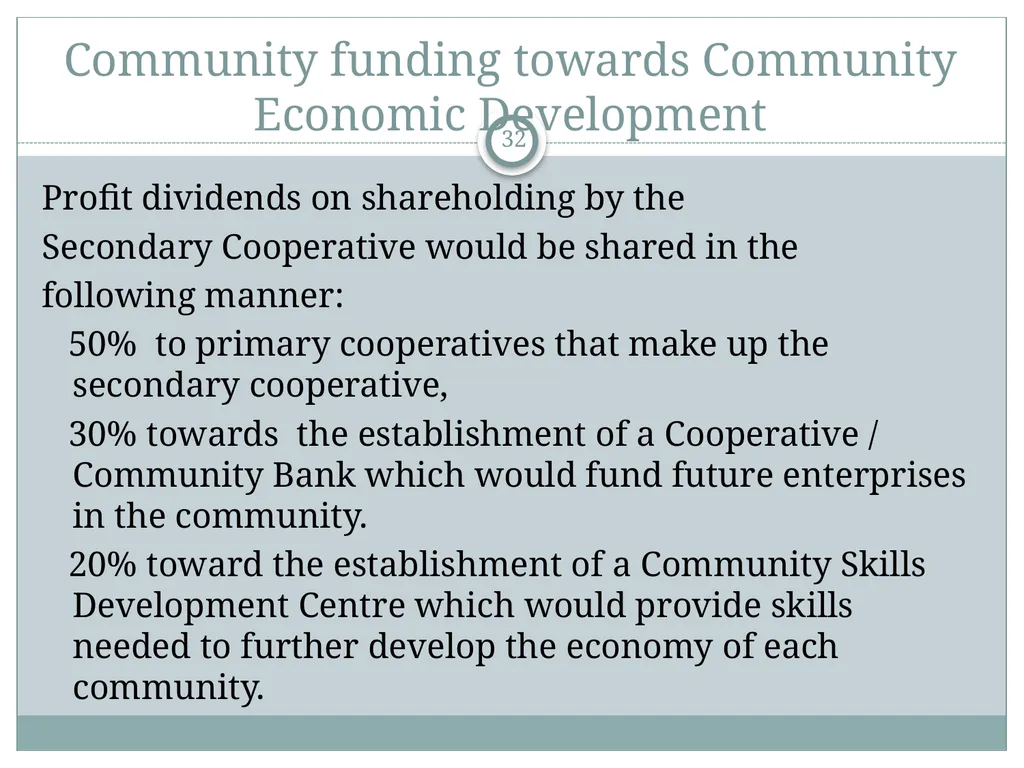
Community funding towards Community Economic Development 32 Profit dividends on shareholding by the
Secondary Cooperative would be shared in the
following manner:
50% to primary cooperatives that make up the secondary cooperative,
30% towards the establishment of a Cooperative / Community Bank which would fund future enterprises in the community.
20% toward the establishment of a Community Skills Development Centre which would provide skills needed to further develop the economy of each community.<br>
Secondary Cooperative would be shared in the
following manner:
50% to primary cooperatives that make up the secondary cooperative,
30% towards the establishment of a Cooperative / Community Bank which would fund future enterprises in the community.
20% toward the establishment of a Community Skills Development Centre which would provide skills needed to further develop the economy of each community.<br>
33
An appeal by Ruth Bhengu- The Model developer 33 Please adopt this model and participate in it. Give communities
especially the underdeveloped an opportunity of actively
participating in their own development thereby regaining their
human dignity.
We shall identify the blind spots and gaps along the way
and improve on them as we move forward.
Let us enable communities to become the Masters of
their own destiny.
I THANK YOU.
Nozabelo Ruth Bhengu.<br>
especially the underdeveloped an opportunity of actively
participating in their own development thereby regaining their
human dignity.
We shall identify the blind spots and gaps along the way
and improve on them as we move forward.
Let us enable communities to become the Masters of
their own destiny.
I THANK YOU.
Nozabelo Ruth Bhengu.<br>